Biofertilizers: types, production
and application
Biofertilizer
s
• Biofertilizers is a substance which contains living
microorganisms, which when applied to seed, plant
surface, or soil, colonizes the rhizosphere or interior of the
plant and promotes growth by increasing the supply or
availability of primary nutrients to the host plant.
OR
• Biofertilizers are carrier-based microbial inoculants
containing sufficient cells of efficient strains of specific
microoranisms, that help in enhancing the soil fertility by
fixing atmospheric nitrogen, solubilization/ mineralization
of phosphorus or decomposing organic wastes, by
augmenting plant growth promoting substances with their
biological activities.
Types of biofertilizers (on the bases of
nature and function)
1. Nitrogen fixing: Nitrogen is most abundant and ubiquitous in the air, yet becomes
a limiting nutrient due to difficulty of its fixation and uptake by the plants. However,
certain microorganisms, some of which can form various associations with plants as
well, are capable of considerable nitrogen fixation. These microbes can be:
– Bacteria
• Free living: Free-living in the soil eg. Azotobacter
• Associative: Living in rhizosphere (associative/associated) without
endophytic symbioses. Eg. Azospirillum
• Symbiotic: Having symbiotic and other endophytic associations with plants.
Eg. Rhizobia, Frankia
– Blue grean algae (Cyanobacteria): have been reported to be helpful in enhancing
rice-field fertility for the cultivation of rice in many parts of the world. BGA can
further provide natural growth hormones, proteins, vitamins, and minerals to
the soil. Eg. Anabaena, Nostoc, Tolypothrix, Cylindrospermum etc.
– Azolla: is a floating pteridophyte, which contains as endosymbiont the nitrogen-
fixing cyanobacterium Anabaena azollae. Azolla is either incorporated into the
soil before rice transplanting or grown as a dual crop along with rice.
2. Phosphate solubilizing:
The phosphorus-solubilizing bacteria (PSB) can increase phosphorus availability to
plants by dissolution of bound phosphates in soil by secreting organic acids
characterized by lower pH in their vicinity. Eg. Bacillus spp., Paenibacillus spp.,
Pseudomonas spp. etc.
3. Phosphate mobilizing:
The mycorrhizal fungi form obligate or facultative functional mutualistic symbioses
with more than 80% of all land plants, in which the fungus is dependent on host
for photosynthates and energy and in return provides a plethora of benefits to its
host. The mycelium of the fungus extends from host plant root surfaces into soil,
thereby increasing the surface area for more efficient nutrient access and
acquisition for the plant, especially from insoluble phosphorus sources and others
like calcium, copper, zinc, etc, eg. ectomycorrhiza (Laccaria spp., Pisolithus spp.,
Boletus spp., Amanita spp.), endomycorrhiza (eg. arbuscular mycorrhiza- Glomus
sp., Gigaspora sp., Acaulospora sp., Scutellospora sp., and Sclerocystis sp.)
4. Mineral-Solubilizing Biofertilizers
– Potassium solubilizing: Certain rhizobacteria can solubilize insoluble potassium
forms, which is another essential nutrient necessary for plant growth. Eg.
Bacillus edaphicus, B. mucilaginosus, and Paenibacillus glucanolyticus
– Silicate and zinc solubilizing: Another important mineral is zinc, which is
present at a low concentration in the Earth’s crust, due to which it is externally
applied as the costlier soluble zinc sulfate to overcome its deficiencies in plant.
Certain microbes can solubilize insoluble cheaper zinc compounds like zinc
oxide, zinc carbonate, and zinc sulfide in soil. Similarly, microorganisms can
hydrolyze silicates and aluminum silicates by supplying protons (that causes
hydrolysis) and organic acids. Eg. Bacillus subtilis, Thiobacillus thioxidans, and
Saccharomyces sp.
5. Plant growth promoting rhizobacteria: Besides nitrogen-fixing, phosphorus
and minerals solubilizing microbes, there are microbes that are suitable to be used
as biofertilizers as these enhance plant growth by synthesizing growth-promoting
chemicals like growth hormones (auxins, gibberellin etc.). These bacteria shows
more than one mechanism of plant growth promotion viz. nitrogen fixation,
phosphorus solubilization, production of antibiotics, cytokinins, chitinase, and
other hydrolytic enzymes and enhancement of soil porosity. Eg. Achromobacter,
Alcaligenes, Arthrobacter, Actinoplanes, Azotobacter, Bacillus, Pseudomonas
fluorescens, Rhizobium, Bradyrhizobium etc.
6. Compost Biofertilizers: Compost is a decomposing, brittle, murky material
forming a symbiotic food web within the soil, which contains about 2% (w/w) of
nitrogen, phosphorus, and potassium, along with microorganisms, earthworms,
and dung beetles.
• The microbial organic solid residue oxidation causes the formation of humus-
containing material, which can be used as an organic fertilizer that sufficiently
aerates, aggregates, buffers, and keeps the soil moist, besides providing beneficial
minerals to the crops and increasing soil microbial diversity.
• Compost is produced from a wide variety of materials like straw, leaves, cattle-
shed bedding, fruit and vegetable wastes, biogas plant slurry, industrial wastes,
city garbage, sewage sludge, factory waste, etc.
• Thecompost is formed from these materials by different decomposing
microorganisms like Trichoderma viridae, Aspergillus niger, A. terreus, Bacillus
spp., several Gram-negative bacteria (Pseudomonas, Serratia, Klebsiella, and
Enterobacter), etc. that have plant cell wall-degrading cellulolytic or lignolytic and
other activities, besides having proteolytic activity and antibiosis (by production of
antibiotics) that suppresses other parasitic or pathogenic microorganisms .
• Another important type (vermicompost) contains earthworm cocoons, excreta,
microorganisms (like bacteria, actinomycetes, fungi), and different organic matters,
which provide nitrogen, phosphorus, potassium, and several micronutrients, and
efficiently recycles animal wastes, agricultural residues, and industrial wastes cost-
effectively and uses low energy.
Biofertilizer Production
• Biofertilizers are the biological preparations with live dormant strains of microbes,
which positively impact soil rhizosphere and helps in plant development. Biofertilizers
are formulated with living or dormant (inactive metabolically) microbial cells. An
efficient nitrogen-fixing strain is selected, and later the inoculum is prepared to
produce a bio-fertilizer of good quality.
• An inoculum is a form in which the strain is inoculated in the seed or soil. Besides
strain selection, maintenance, storage and packing are other aspects of bio-fertilizer
production. During the biofertilizer production, the product manufactured must fulfil
the quality standards laid down by BIS
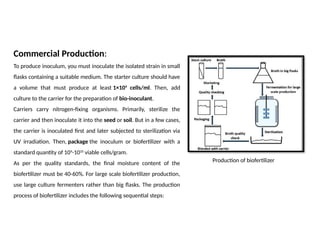
Production of biofertilizer
Commercial Production:
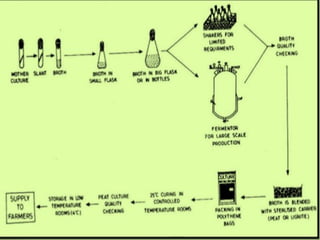
To produce inoculum, you must inoculate the isolated strain in small
flasks containing a suitable medium. The starter culture should have
a volume that must produce at least 1×10⁹
cells/ml. Then, add
culture to the carrier for the preparation of bio-inoculant.
Carriers carry nitrogen-fixing organisms. Primarily, sterilize the
carrier and then inoculate it into the seed or soil. But in a few cases,
the carrier is inoculated first and later subjected to sterilization via
UV irradiation. Then, package the inoculum or biofertilizer with a
standard quantity of 109
-1010
viable cells/gram.
As per the quality standards, the final moisture content of the
biofertilizer must be 40-60%. For large scale biofertilizer production,
use large culture fermenters rather than big flasks. The production
process of biofertilizer includes the following sequential steps:
Strain Selection
First, select the efficient nitrogen-fixing strains and later maintain the culture of strains artificially in
the laboratory on the nutrient-rich medium before inoculating them in the seed or soil.
Seed Pelleting
Then, prepare the inoculum of the desired strain. After that, inoculate the seeds using either of the
seed coating methods (direct coating or slurry method). The direct seed coating method uses gum
arable or sugary syrup. The slurry seed coating method uses efficient nitrogen-fixing strains (coating of
rhizobia over specific host legume seeds).
Then, add calcium carbonate to the sticky seeds right away after seed coating. Sometimes, root
nodule bacteria are absent in soil, necessary to fulfil the plant’s nitrogen requirements. Therefore, we
should inoculate the soil with inadequate nodule bacteria with seed pellets of highly effective
rhizobia.
Inoculant Carriers
Inoculants are simply the mixture of the starter culture and a finely milled carrier
material. The ideal properties of the carrier should have the properties:
•Non-toxicity
•Good moisture absorption capacity
•Free of lump forming material
•Easy to sterilize
•Inexpensive
•Easily available
•Good buffering capacity
Therefore, the carrier material with these properties can prolong the growth of microbial
strains. Peat is the most standard carrier used in bioinoculant preparation. The application of peat is
not common in few countries such as India due to its unavailability.
Therefore, peat as a carrier can be substituted with various alternative carriers like lignite, coal,
charcoal, vermiculite, polyacrylamide etc. The production of inoculant involves carrier processing, in
which the carrier material is subjected to the following stages:
•Mining: Carrier like peat is mined, drained and cleared off stones, roots, etc.
•Drying: Then, the carrier material is shredded and dried.
•Milling: After that, pass the peat through heavy mills. Peat is generally used as a soil inoculant, with a
preferable particle size (0.5-1.5 mm).
•Neutralization: Then, neutralize the carriers by treating them with precipitated CaCO3, which
maintains the pH between 6.5 and 7.0.
•Sterilization: At last, sterilize the carriers so that they can be used as inoculants.
Quality Standards for Inoculants
During the production of biofertilizers, it should be kept in mind that the product must make up the
quality standards. The inoculant should be carrier-based. There should be a minimum of 108 viable
cells per gram (dry mass) of the carrier in the inoculant. The inoculant must have an expiry period of at
least 12 months from DOM.
Production of Biofertilizers
Bacterial
Solid carrier based formulation
• The mass production of biofertilizers involves culturing of microorganisms, processing of
carrier material, mixing of carrier material with the broth culture, and packing.
• The ideal carrier materials used in the preparation of biofertilizers must be cheaper,
locally available, and easier to process; must be non-toxic and organic in structure (so
that they remain biodegradable) with high water-holding capacity; and should carry
higher bacterial cells and support their survival for longer durations.
• The carriers can be of various origins (organic, inorganic, or synthetic) and can be
classified into four main categories:
– Soils: peat, coal, clays, lignite, inorganic soil
– Plant waste materials: charcoal, composts, farmyard manure, cellulose, soybean
meal, soybean and peanut oil, wheat bran, press mud, corn cobs
– Inert materials: vermiculite, perlite, ground rock phosphate, bentonite, calcium
sulfate, polyacrylamide gels, alginate beads
• In many parts of the world, inoculants are formulated using peat (soil carrier). Peat is
made of partially decomposed flora accumulated over the years. It provides a nutritive
and defensive growth environment of an extensive variety of microorganisms.
• Once dried, peat is ground, commonly to pass through at least a 250-μm sieve.
Generally the peat deposits have a low pH, which must be corrected to pH 6.5–7.0.
The peat is then sterilized and an adequate amount of liquid inoculum is added to it. A
final moisture content of 40–55 % is generally acceptable.
• Inoculated peat is incubated for a certain period of time to allow bacteria
multiplication in the carrier. This step, also called maturing or curing is of major
importance since it improves the bacteria survival rate during storage and on seeds.
• Often in peat sticking agents are incorporated thus enhancing its uniformity of
coverage on seed. The adhesives used in current agricultural practices are different
polymers: polysaccharides (such as gum arabic or carboxymethylcellulose),
polyalcohol derivatives, or caseinate salts. Important prerequisites are:
– nontoxic to seed or microorganisms,
– easily dispersible in water
– offering a better adhesion and survival to microorganisms on seed.
• Other materials added to the inoculant formulation include macro- and
micronutrients, carbon or mineral sources, hormones, and even fungicides. The aim is
to supply microorganisms with protective and/or a nutrient source, to assure better
adhesion to seed thus improving the inoculant quality, to make the product more
stable, to inactivate the toxins, or to enhance the strain(s) survival during storage and
after exposure to environmental stress conditions (high temperature, desiccation).
• Packaging: Polythene bags used for packaging should be of low density grade (50-75
micron).
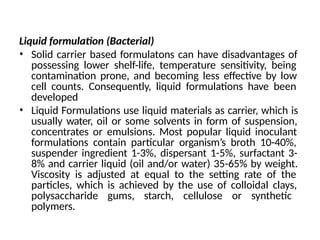
Liquid formulation (Bacterial)
• Solid carrier based formulatons can have disadvantages of
possessing lower shelf-life, temperature sensitivity, being
contamination prone, and becoming less effective by low
cell counts. Consequently, liquid formulations have been
developed
• Liquid Formulations use liquid materials as carrier, which is
usually water, oil or some solvents in form of suspension,
concentrates or emulsions. Most popular liquid inoculant
formulations contain particular organism’s broth 10-40%,
suspender ingredient 1-3%, dispersant 1-5%, surfactant 3-
8% and carrier liquid (oil and/or water) 35-65% by weight.
Viscosity is adjusted at equal to the setting rate of the
particles, which is achieved by the use of colloidal clays,
polysaccharide gums, starch, cellulose or synthetic
polymers.
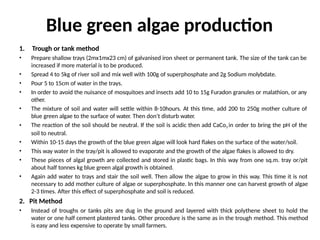
Blue green algae production
1. Trough or tank method
• Prepare shallow trays (2mx1mx23 cm) of galvanised iron sheet or permanent tank. The size of the tank can be
increased if more material is to be produced.
• Spread 4 to 5kg of river soil and mix well with 100g of superphosphate and 2g Sodium molybdate.
• Pour 5 to 15cm of water in the trays.
• In order to avoid the nuisance of mosquitoes and insects add 10 to 15g Furadon granules or malathion, or any
other.
• The mixture of soil and water will settle within 8-10hours. At this time, add 200 to 250g mother culture of
blue green algae to the surface of water. Then don’t disturb water.
• The reaction of the soil should be neutral. If the soil is acidic then add CaCo3 in order to bring the pH of the
soil to neutral.
• Within 10-15 days the growth of the blue green algae will look hard flakes on the surface of the water/soil.
• This way water in the tray/pit is allowed to evaporate and the growth of the algae flakes is allowed to dry.
• These pieces of algal growth are collected and stored in plastic bags. In this way from one sq.m. tray or/pit
about half tonnes kg blue green algal growth is obtained.
• Again add water to trays and stair the soil well. Then allow the algae to grow in this way. This time it is not
necessary to add mother culture of algae or superphosphate. In this manner one can harvest growth of algae
2-3 times. After this effect of superphosphate and soil is reduced.
2. Pit Method
• Instead of troughs or tanks pits are dug in the ground and layered with thick polythene sheet to hold the
water or one half cement plastered tanks. Other procedure is the same as in the trough method. This method
is easy and less expensive to operate by small farmers.
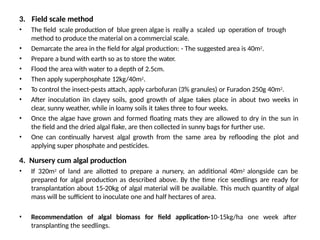
3. Field scale method
• The field scale production of blue green algae is really a scaled up operation of trough
method to produce the material on a commercial scale.
• Demarcate the area in the field for algal production: - The suggested area is 40m2.
• Prepare a bund with earth so as to store the water.
• Flood the area with water to a depth of 2.5cm.
• Then apply superphosphate 12kg/40m2.
• To control the insect-pests attach, apply carbofuran (3% granules) or Furadon 250g 40m2.
• After inoculation iIn clayey soils, good growth of algae takes place in about two weeks in
clear, sunny weather, while in loamy soils it takes three to four weeks.
• Once the algae have grown and formed floating mats they are allowed to dry in the sun in
the field and the dried algal flake, are then collected in sunny bags for further use.
• One can continually harvest algal growth from the same area by reflooding the plot and
applying super phosphate and pesticides.
4. Nursery cum algal production
• If 320m2 of land are allotted to prepare a nursery, an additional 40m2 alongside can be
prepared for algal production as described above. By the time rice seedlings are ready for
transplantation about 15-20kg of algal material will be available. This much quantity of algal
mass will be sufficient to inoculate one and half hectares of area.
• Recommendation of algal biomass for field application-10-15kg/ha one week after
transplanting the seedlings.
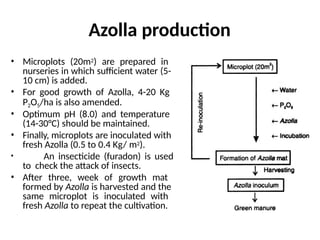
Azolla production
• Microplots (20m2) are prepared in
nurseries in which sufficient water (5-
10 cm) is added.
• For good growth of Azolla, 4-20 Kg
P2O5/ha is also amended.
• Optimum pH (8.0) and temperature
(14-30°C) should be maintained.
• Finally, microplots are inoculated with
fresh Azolla (0.5 to 0.4 Kg/ m2).
• An insecticide (furadon) is used
to check the attack of insects.
• After three, week of growth mat
formed by Azolla is harvested and the
same microplot is inoculated with
fresh Azolla to repeat the cultivation.
Mycorrhiza production
Ectomycorrhiza
– Ectomycorrhiza generally are grown in glucose
containing medium and produced spores are used for
inoculation.
– Pure mycelia cultures are preferred as they suppress
growth of pathogens and contaminants.
– Ectomycorrhizal inoculants may be formulated using a
carrier made of vermiculite and 5–10 % peat
moisturized with salts and glucose nutrient medium.
– This formulation provides a strong buffering capacity
(keeping pH below 6) and enhances the production of
fulvic acid that stimulates growth.
– Formulation is then mixed in nursery beds to form
association with roots of cultured plants.
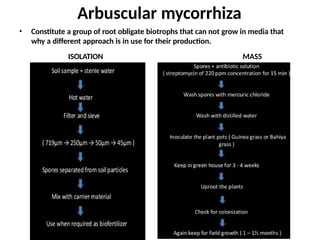
• Constitute a group of root obligate biotrophs that can not grow in media that
why a different approach is in use for their production.
ISOLATION MASS
PRODUCTION
Arbuscular mycorrhiza
Packaging
Finally, pack the bio-inoculant in polyethene bags of low density (50-75 µ). Label each
packet with the product information like name of the product, type of carrier, batch
number, DOM, DOE, net quantity and storage instructions etc. Each packet should be ISI
(BIS) certified.
Storage
Store the bio-inoculant in a cool and dry place. Keep the bio-inoculant ideally at a
temperature of 15°C and a pH between 6.0 and 7.5.
Inoculation into the Field
Seed inoculation and soil inoculation are the two standard inoculation methods that are
prevalently used. The soil inoculation involves direct mixing of the bio-inoculant into the
sowing furrow along with the seeds. Seed inoculation is a more popular technique that
involves seed pelleting or coating with an inoculant.
Application of biofertilizer
• Seed treatment: Seed treatment is a very effective, economic, and most
common method implemented for all types of bacterial inoculants. The
seeds are mixed and uniformly coated in a slurry (inoculant mixed with
200 mL of rice kanji or 1% jeggey) and then shade-dried, before being
sown within 24 h. Coating of lime after rhizobia inoculant treatment
enhances the efficacy.
• Seedling root dipping: This application is common for plantation crops
such as cereals, vegetables, fruits, trees,
sugarcane, cotton, banana, and tobacco where
seedling roots are dipped in a
grapes,
water
suspension of biofertilizer (nitrogen-fixing Azotobacter or Azospirillum and
phosphorus-solubilizing microbial biofertilizer) for sufficient period of
time.
• Soil application: In this practice, biofertilizer is applied directly to the soil
either alone or in combination. Some examples of biofertilizers in which
soil application is employed are Rhizobium (for leguminous plants or trees)
and Azotobacter (for tea, coffee, rubber, coconuts, all fruit/agroforestry
plants), BGA and azolla in rice field, mycorrhiza in nursery beds.
QUESTIONS
• Define biofertilizers. Explain the industrial production of biofertilizers.
Ans. Give in short about all types.
• What are the types of biofertilizers. Discuss with example.
• Write an essay on industrial production of bacterial biofertilizers and application
methods.
• Write short note on Organic fertilizer.
Ans. Write compost and vermicompost
• Write short note on phosphate mobilizing biofertilizer production
Ans. Mycorrhiza
• Short note on BGA production.
• Short note on azolla production

Biofertilizerssssssssssssssssssssss.pptx

  • 1.
  • 2.
    Biofertilizer s • Biofertilizers isa substance which contains living microorganisms, which when applied to seed, plant surface, or soil, colonizes the rhizosphere or interior of the plant and promotes growth by increasing the supply or availability of primary nutrients to the host plant. OR • Biofertilizers are carrier-based microbial inoculants containing sufficient cells of efficient strains of specific microoranisms, that help in enhancing the soil fertility by fixing atmospheric nitrogen, solubilization/ mineralization of phosphorus or decomposing organic wastes, by augmenting plant growth promoting substances with their biological activities.
  • 3.
    Types of biofertilizers(on the bases of nature and function) 1. Nitrogen fixing: Nitrogen is most abundant and ubiquitous in the air, yet becomes a limiting nutrient due to difficulty of its fixation and uptake by the plants. However, certain microorganisms, some of which can form various associations with plants as well, are capable of considerable nitrogen fixation. These microbes can be: – Bacteria • Free living: Free-living in the soil eg. Azotobacter • Associative: Living in rhizosphere (associative/associated) without endophytic symbioses. Eg. Azospirillum • Symbiotic: Having symbiotic and other endophytic associations with plants. Eg. Rhizobia, Frankia – Blue grean algae (Cyanobacteria): have been reported to be helpful in enhancing rice-field fertility for the cultivation of rice in many parts of the world. BGA can further provide natural growth hormones, proteins, vitamins, and minerals to the soil. Eg. Anabaena, Nostoc, Tolypothrix, Cylindrospermum etc. – Azolla: is a floating pteridophyte, which contains as endosymbiont the nitrogen- fixing cyanobacterium Anabaena azollae. Azolla is either incorporated into the soil before rice transplanting or grown as a dual crop along with rice.
  • 4.
    2. Phosphate solubilizing: Thephosphorus-solubilizing bacteria (PSB) can increase phosphorus availability to plants by dissolution of bound phosphates in soil by secreting organic acids characterized by lower pH in their vicinity. Eg. Bacillus spp., Paenibacillus spp., Pseudomonas spp. etc. 3. Phosphate mobilizing: The mycorrhizal fungi form obligate or facultative functional mutualistic symbioses with more than 80% of all land plants, in which the fungus is dependent on host for photosynthates and energy and in return provides a plethora of benefits to its host. The mycelium of the fungus extends from host plant root surfaces into soil, thereby increasing the surface area for more efficient nutrient access and acquisition for the plant, especially from insoluble phosphorus sources and others like calcium, copper, zinc, etc, eg. ectomycorrhiza (Laccaria spp., Pisolithus spp., Boletus spp., Amanita spp.), endomycorrhiza (eg. arbuscular mycorrhiza- Glomus sp., Gigaspora sp., Acaulospora sp., Scutellospora sp., and Sclerocystis sp.)
  • 5.
    4. Mineral-Solubilizing Biofertilizers –Potassium solubilizing: Certain rhizobacteria can solubilize insoluble potassium forms, which is another essential nutrient necessary for plant growth. Eg. Bacillus edaphicus, B. mucilaginosus, and Paenibacillus glucanolyticus – Silicate and zinc solubilizing: Another important mineral is zinc, which is present at a low concentration in the Earth’s crust, due to which it is externally applied as the costlier soluble zinc sulfate to overcome its deficiencies in plant. Certain microbes can solubilize insoluble cheaper zinc compounds like zinc oxide, zinc carbonate, and zinc sulfide in soil. Similarly, microorganisms can hydrolyze silicates and aluminum silicates by supplying protons (that causes hydrolysis) and organic acids. Eg. Bacillus subtilis, Thiobacillus thioxidans, and Saccharomyces sp. 5. Plant growth promoting rhizobacteria: Besides nitrogen-fixing, phosphorus and minerals solubilizing microbes, there are microbes that are suitable to be used as biofertilizers as these enhance plant growth by synthesizing growth-promoting chemicals like growth hormones (auxins, gibberellin etc.). These bacteria shows more than one mechanism of plant growth promotion viz. nitrogen fixation, phosphorus solubilization, production of antibiotics, cytokinins, chitinase, and other hydrolytic enzymes and enhancement of soil porosity. Eg. Achromobacter, Alcaligenes, Arthrobacter, Actinoplanes, Azotobacter, Bacillus, Pseudomonas fluorescens, Rhizobium, Bradyrhizobium etc.
  • 6.
    6. Compost Biofertilizers:Compost is a decomposing, brittle, murky material forming a symbiotic food web within the soil, which contains about 2% (w/w) of nitrogen, phosphorus, and potassium, along with microorganisms, earthworms, and dung beetles. • The microbial organic solid residue oxidation causes the formation of humus- containing material, which can be used as an organic fertilizer that sufficiently aerates, aggregates, buffers, and keeps the soil moist, besides providing beneficial minerals to the crops and increasing soil microbial diversity. • Compost is produced from a wide variety of materials like straw, leaves, cattle- shed bedding, fruit and vegetable wastes, biogas plant slurry, industrial wastes, city garbage, sewage sludge, factory waste, etc. • Thecompost is formed from these materials by different decomposing microorganisms like Trichoderma viridae, Aspergillus niger, A. terreus, Bacillus spp., several Gram-negative bacteria (Pseudomonas, Serratia, Klebsiella, and Enterobacter), etc. that have plant cell wall-degrading cellulolytic or lignolytic and other activities, besides having proteolytic activity and antibiosis (by production of antibiotics) that suppresses other parasitic or pathogenic microorganisms . • Another important type (vermicompost) contains earthworm cocoons, excreta, microorganisms (like bacteria, actinomycetes, fungi), and different organic matters, which provide nitrogen, phosphorus, potassium, and several micronutrients, and efficiently recycles animal wastes, agricultural residues, and industrial wastes cost- effectively and uses low energy.
  • 7.
    Biofertilizer Production • Biofertilizersare the biological preparations with live dormant strains of microbes, which positively impact soil rhizosphere and helps in plant development. Biofertilizers are formulated with living or dormant (inactive metabolically) microbial cells. An efficient nitrogen-fixing strain is selected, and later the inoculum is prepared to produce a bio-fertilizer of good quality. • An inoculum is a form in which the strain is inoculated in the seed or soil. Besides strain selection, maintenance, storage and packing are other aspects of bio-fertilizer production. During the biofertilizer production, the product manufactured must fulfil the quality standards laid down by BIS
  • 8.
    Production of biofertilizer CommercialProduction: To produce inoculum, you must inoculate the isolated strain in small flasks containing a suitable medium. The starter culture should have a volume that must produce at least 1×10⁹ cells/ml. Then, add culture to the carrier for the preparation of bio-inoculant. Carriers carry nitrogen-fixing organisms. Primarily, sterilize the carrier and then inoculate it into the seed or soil. But in a few cases, the carrier is inoculated first and later subjected to sterilization via UV irradiation. Then, package the inoculum or biofertilizer with a standard quantity of 109 -1010 viable cells/gram. As per the quality standards, the final moisture content of the biofertilizer must be 40-60%. For large scale biofertilizer production, use large culture fermenters rather than big flasks. The production process of biofertilizer includes the following sequential steps:
  • 9.
    Strain Selection First, selectthe efficient nitrogen-fixing strains and later maintain the culture of strains artificially in the laboratory on the nutrient-rich medium before inoculating them in the seed or soil. Seed Pelleting Then, prepare the inoculum of the desired strain. After that, inoculate the seeds using either of the seed coating methods (direct coating or slurry method). The direct seed coating method uses gum arable or sugary syrup. The slurry seed coating method uses efficient nitrogen-fixing strains (coating of rhizobia over specific host legume seeds). Then, add calcium carbonate to the sticky seeds right away after seed coating. Sometimes, root nodule bacteria are absent in soil, necessary to fulfil the plant’s nitrogen requirements. Therefore, we should inoculate the soil with inadequate nodule bacteria with seed pellets of highly effective rhizobia. Inoculant Carriers Inoculants are simply the mixture of the starter culture and a finely milled carrier material. The ideal properties of the carrier should have the properties: •Non-toxicity •Good moisture absorption capacity •Free of lump forming material •Easy to sterilize •Inexpensive •Easily available •Good buffering capacity
  • 10.
    Therefore, the carriermaterial with these properties can prolong the growth of microbial strains. Peat is the most standard carrier used in bioinoculant preparation. The application of peat is not common in few countries such as India due to its unavailability. Therefore, peat as a carrier can be substituted with various alternative carriers like lignite, coal, charcoal, vermiculite, polyacrylamide etc. The production of inoculant involves carrier processing, in which the carrier material is subjected to the following stages: •Mining: Carrier like peat is mined, drained and cleared off stones, roots, etc. •Drying: Then, the carrier material is shredded and dried. •Milling: After that, pass the peat through heavy mills. Peat is generally used as a soil inoculant, with a preferable particle size (0.5-1.5 mm). •Neutralization: Then, neutralize the carriers by treating them with precipitated CaCO3, which maintains the pH between 6.5 and 7.0. •Sterilization: At last, sterilize the carriers so that they can be used as inoculants. Quality Standards for Inoculants During the production of biofertilizers, it should be kept in mind that the product must make up the quality standards. The inoculant should be carrier-based. There should be a minimum of 108 viable cells per gram (dry mass) of the carrier in the inoculant. The inoculant must have an expiry period of at least 12 months from DOM.
  • 11.
    Production of Biofertilizers Bacterial Solidcarrier based formulation • The mass production of biofertilizers involves culturing of microorganisms, processing of carrier material, mixing of carrier material with the broth culture, and packing. • The ideal carrier materials used in the preparation of biofertilizers must be cheaper, locally available, and easier to process; must be non-toxic and organic in structure (so that they remain biodegradable) with high water-holding capacity; and should carry higher bacterial cells and support their survival for longer durations. • The carriers can be of various origins (organic, inorganic, or synthetic) and can be classified into four main categories: – Soils: peat, coal, clays, lignite, inorganic soil – Plant waste materials: charcoal, composts, farmyard manure, cellulose, soybean meal, soybean and peanut oil, wheat bran, press mud, corn cobs – Inert materials: vermiculite, perlite, ground rock phosphate, bentonite, calcium sulfate, polyacrylamide gels, alginate beads • In many parts of the world, inoculants are formulated using peat (soil carrier). Peat is made of partially decomposed flora accumulated over the years. It provides a nutritive and defensive growth environment of an extensive variety of microorganisms.
  • 12.
    • Once dried,peat is ground, commonly to pass through at least a 250-μm sieve. Generally the peat deposits have a low pH, which must be corrected to pH 6.5–7.0. The peat is then sterilized and an adequate amount of liquid inoculum is added to it. A final moisture content of 40–55 % is generally acceptable. • Inoculated peat is incubated for a certain period of time to allow bacteria multiplication in the carrier. This step, also called maturing or curing is of major importance since it improves the bacteria survival rate during storage and on seeds. • Often in peat sticking agents are incorporated thus enhancing its uniformity of coverage on seed. The adhesives used in current agricultural practices are different polymers: polysaccharides (such as gum arabic or carboxymethylcellulose), polyalcohol derivatives, or caseinate salts. Important prerequisites are: – nontoxic to seed or microorganisms, – easily dispersible in water – offering a better adhesion and survival to microorganisms on seed. • Other materials added to the inoculant formulation include macro- and micronutrients, carbon or mineral sources, hormones, and even fungicides. The aim is to supply microorganisms with protective and/or a nutrient source, to assure better adhesion to seed thus improving the inoculant quality, to make the product more stable, to inactivate the toxins, or to enhance the strain(s) survival during storage and after exposure to environmental stress conditions (high temperature, desiccation). • Packaging: Polythene bags used for packaging should be of low density grade (50-75 micron).
  • 14.
    Liquid formulation (Bacterial) •Solid carrier based formulatons can have disadvantages of possessing lower shelf-life, temperature sensitivity, being contamination prone, and becoming less effective by low cell counts. Consequently, liquid formulations have been developed • Liquid Formulations use liquid materials as carrier, which is usually water, oil or some solvents in form of suspension, concentrates or emulsions. Most popular liquid inoculant formulations contain particular organism’s broth 10-40%, suspender ingredient 1-3%, dispersant 1-5%, surfactant 3- 8% and carrier liquid (oil and/or water) 35-65% by weight. Viscosity is adjusted at equal to the setting rate of the particles, which is achieved by the use of colloidal clays, polysaccharide gums, starch, cellulose or synthetic polymers.
  • 15.
    Blue green algaeproduction 1. Trough or tank method • Prepare shallow trays (2mx1mx23 cm) of galvanised iron sheet or permanent tank. The size of the tank can be increased if more material is to be produced. • Spread 4 to 5kg of river soil and mix well with 100g of superphosphate and 2g Sodium molybdate. • Pour 5 to 15cm of water in the trays. • In order to avoid the nuisance of mosquitoes and insects add 10 to 15g Furadon granules or malathion, or any other. • The mixture of soil and water will settle within 8-10hours. At this time, add 200 to 250g mother culture of blue green algae to the surface of water. Then don’t disturb water. • The reaction of the soil should be neutral. If the soil is acidic then add CaCo3 in order to bring the pH of the soil to neutral. • Within 10-15 days the growth of the blue green algae will look hard flakes on the surface of the water/soil. • This way water in the tray/pit is allowed to evaporate and the growth of the algae flakes is allowed to dry. • These pieces of algal growth are collected and stored in plastic bags. In this way from one sq.m. tray or/pit about half tonnes kg blue green algal growth is obtained. • Again add water to trays and stair the soil well. Then allow the algae to grow in this way. This time it is not necessary to add mother culture of algae or superphosphate. In this manner one can harvest growth of algae 2-3 times. After this effect of superphosphate and soil is reduced. 2. Pit Method • Instead of troughs or tanks pits are dug in the ground and layered with thick polythene sheet to hold the water or one half cement plastered tanks. Other procedure is the same as in the trough method. This method is easy and less expensive to operate by small farmers.
  • 16.
    3. Field scalemethod • The field scale production of blue green algae is really a scaled up operation of trough method to produce the material on a commercial scale. • Demarcate the area in the field for algal production: - The suggested area is 40m2. • Prepare a bund with earth so as to store the water. • Flood the area with water to a depth of 2.5cm. • Then apply superphosphate 12kg/40m2. • To control the insect-pests attach, apply carbofuran (3% granules) or Furadon 250g 40m2. • After inoculation iIn clayey soils, good growth of algae takes place in about two weeks in clear, sunny weather, while in loamy soils it takes three to four weeks. • Once the algae have grown and formed floating mats they are allowed to dry in the sun in the field and the dried algal flake, are then collected in sunny bags for further use. • One can continually harvest algal growth from the same area by reflooding the plot and applying super phosphate and pesticides. 4. Nursery cum algal production • If 320m2 of land are allotted to prepare a nursery, an additional 40m2 alongside can be prepared for algal production as described above. By the time rice seedlings are ready for transplantation about 15-20kg of algal material will be available. This much quantity of algal mass will be sufficient to inoculate one and half hectares of area. • Recommendation of algal biomass for field application-10-15kg/ha one week after transplanting the seedlings.
  • 17.
    Azolla production • Microplots(20m2) are prepared in nurseries in which sufficient water (5- 10 cm) is added. • For good growth of Azolla, 4-20 Kg P2O5/ha is also amended. • Optimum pH (8.0) and temperature (14-30°C) should be maintained. • Finally, microplots are inoculated with fresh Azolla (0.5 to 0.4 Kg/ m2). • An insecticide (furadon) is used to check the attack of insects. • After three, week of growth mat formed by Azolla is harvested and the same microplot is inoculated with fresh Azolla to repeat the cultivation.
  • 18.
    Mycorrhiza production Ectomycorrhiza – Ectomycorrhizagenerally are grown in glucose containing medium and produced spores are used for inoculation. – Pure mycelia cultures are preferred as they suppress growth of pathogens and contaminants. – Ectomycorrhizal inoculants may be formulated using a carrier made of vermiculite and 5–10 % peat moisturized with salts and glucose nutrient medium. – This formulation provides a strong buffering capacity (keeping pH below 6) and enhances the production of fulvic acid that stimulates growth. – Formulation is then mixed in nursery beds to form association with roots of cultured plants.
  • 19.
    • Constitute agroup of root obligate biotrophs that can not grow in media that why a different approach is in use for their production. ISOLATION MASS PRODUCTION Arbuscular mycorrhiza
  • 20.
    Packaging Finally, pack thebio-inoculant in polyethene bags of low density (50-75 µ). Label each packet with the product information like name of the product, type of carrier, batch number, DOM, DOE, net quantity and storage instructions etc. Each packet should be ISI (BIS) certified. Storage Store the bio-inoculant in a cool and dry place. Keep the bio-inoculant ideally at a temperature of 15°C and a pH between 6.0 and 7.5. Inoculation into the Field Seed inoculation and soil inoculation are the two standard inoculation methods that are prevalently used. The soil inoculation involves direct mixing of the bio-inoculant into the sowing furrow along with the seeds. Seed inoculation is a more popular technique that involves seed pelleting or coating with an inoculant.
  • 21.
    Application of biofertilizer •Seed treatment: Seed treatment is a very effective, economic, and most common method implemented for all types of bacterial inoculants. The seeds are mixed and uniformly coated in a slurry (inoculant mixed with 200 mL of rice kanji or 1% jeggey) and then shade-dried, before being sown within 24 h. Coating of lime after rhizobia inoculant treatment enhances the efficacy. • Seedling root dipping: This application is common for plantation crops such as cereals, vegetables, fruits, trees, sugarcane, cotton, banana, and tobacco where seedling roots are dipped in a grapes, water suspension of biofertilizer (nitrogen-fixing Azotobacter or Azospirillum and phosphorus-solubilizing microbial biofertilizer) for sufficient period of time. • Soil application: In this practice, biofertilizer is applied directly to the soil either alone or in combination. Some examples of biofertilizers in which soil application is employed are Rhizobium (for leguminous plants or trees) and Azotobacter (for tea, coffee, rubber, coconuts, all fruit/agroforestry plants), BGA and azolla in rice field, mycorrhiza in nursery beds.
  • 22.
    QUESTIONS • Define biofertilizers.Explain the industrial production of biofertilizers. Ans. Give in short about all types. • What are the types of biofertilizers. Discuss with example. • Write an essay on industrial production of bacterial biofertilizers and application methods. • Write short note on Organic fertilizer. Ans. Write compost and vermicompost • Write short note on phosphate mobilizing biofertilizer production Ans. Mycorrhiza • Short note on BGA production. • Short note on azolla production