Chapter 1: Environmental Health
Contents
 Definition Environmental Health.
 Environmental burden of diseases.
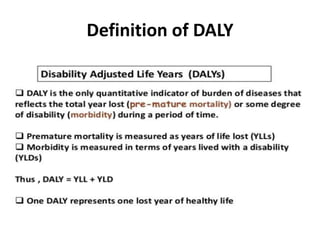
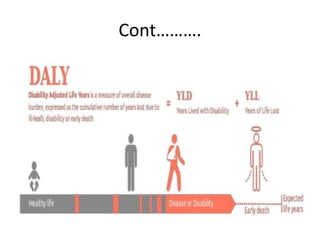
 Definition of DALY.
 Definition of QALY.
 Difference between QALY &DALY.
 Definition of Weather.
 What exactly is climate.
 Greenhouse gas.
 Greenhouse effect.
 How are humans impacting the greenhouse effect.
 What is a Carbon Sink.
 Carbon footprint.
 Carbon Footprint Calculation .
 What is the Kyoto Protocol.
Environmental Health
• Environmental Health is the branch of public
health concerned with monitoring or
mitigating those factors in the environment
that affect human health and disease.
Environmental burden of diseases
(EBD).
• The environmental burden of
disease quantifies the amount
of disease caused
by environmental risks. Disease attributable
to the environment can be expressed in
deaths and in Disability-Adjusted Life Years
(DALYs). The latter measure combines
the burden due to death and disability in a
single index.
Cont………
• Disease attributable to the environment can
be expressed in deaths and in Disability-
Adjusted Life Years (DALYs. The latter measure
combines the burden due to death and
disability in a single index. Using such an index
permits the comparison of the burden due to
various environmental risk factors with other
risk factors or diseases.
Cont………
• approach is an important tool to illustrate the
importance of environmental protection to
health. On the basis of EBD studies it is also
possible to estimate the level of health-related
costs which may be saved by a healthy
environment.
• Even if more useful information on health-related
environmental protection is provided, the EBD
approach must be further developed and
adapted to the current state of research.
Cont……..
• For example, the EBD approach does not yet
sufficiently take into consideration the fact that
diseases or premature deaths are mostly caused
by a combination of different (environmental)
factors. Solely how the loss of quality of life as a
result of various diseases can be uniformly
determined and compared is still a matter of
intense discussion among specialists.
Definition of DALY
Cont……….
Definition of QALY
• The quality-adjusted life-year (QALY) is a measure of
the value of health outcomes. Since health is a
function of length of life and quality of life, the QALY
was developed as an attempt to combine the value of
these attributes into a single index number. The QALY
calculation is simple: the change in utility value
induced by the treatment is multiplied by the duration
of the treatment effect to provide the number of QALYs
gained. QALYs can then be incorporated with medical
costs to arrive at a final common denominator of
cost/QALY. This parameter can be used to compare the
cost-effectiveness of any treatment.
Cont………
• The quality-adjusted life-year (QALY) is a measure of
the value of health outcomes. Since health is a function
of length of life and quality of life, the QALY was
developed as an attempt to combine the value of these
attributes into a single index number. The QALY
calculation is simple: the change in utility value
induced by the treatment is multiplied by the duration
of the treatment effect to provide the number of QALYs
gained. QALYs can then be incorporated with medical
costs to arrive at a final common denominator of
cost/QALY. This parameter can be used to compare the
cost-effectiveness of any treatment.
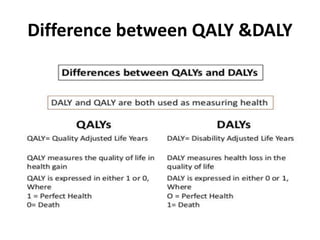
Difference between QALY &DALY
Cont……….
• DALY v.s QALY.
• DALY and QALY are both measurements used in order to calculate time
(in terms of life years) of an individual or a general population. The
concept of time, illnesses, diseases, and health treatments are major
and recurring factors in both methods of measurement. A common
factor between the two measurements is that both serve as evaluations,
and both are under cost utility analysis. They also share a common
technique of weighing the cost per healthy unit measure.
• “DALY” stands for “disability adjusted life years” while the acronym
“QALY” stands for “quality adjusted life years.”
• DALY, in essence, measures health loss in the quality of life. On the
other hand, QALY measures the same quality of life in health gain.
• QALY is usually used in measuring the quality and quantity of care and
life when considering options for health treatments for a particular
illness.
Cont……..
• QALY measures the burden of diseases on a
life with the inclusion of quality and quantity
of lived life. It is a method of evaluation that
offers information in considering, measuring,
and choosing health interventions often in the
role of diseases treatment. It generates an
estimated number of years that can be added
to a life if an intervention is given.
Definition of Weather
• The weather is the condition of
the atmosphere in one area at a particular
time, for example if it is raining , hot, or windy.
• Climate is the weather conditions prevailing
in an area in general or over a long period.
• Climate is the average weather in a place over
many years. While the weather can change in
just a few hours, climate takes hundreds,
thousands, even millions of years to change.
What exactly is climate?
• Whereas weather refers to short-term
changes in the atmosphere, climate describes
what the weather is like over a long period of
time in a specific area. Different regions can
have different climates. To describe the
climate of a place, we might say what the
temperatures are like during different seasons
, how windy it usually is, or how much rain or
snow typically falls.
Greenhouse gas
• a gas that contributes to the greenhouse
effect by absorbing infrared radiation. Carbon
dioxide and chlorofluorocarbons are examples
of greenhouse gases.
Greenhouse effect
• The greenhouse effect is a process that occurs
when gases in Earth's atmosphere trap the
Sun's heat. This process makes Earth much
warmer than it would be without an
atmosphere. The greenhouse effect is one of
the things that makes Earth a comfortable
place to live.
How are humans impacting the
greenhouse effect?
• Human activities are changing Earth's natural
greenhouse effect. Burning fossil fuels like coal
and oil puts more carbon dioxide into our
atmosphere.
• NASA has observed increases in the amount of
carbon dioxide and some other greenhouse gases
in our atmosphere. Too much of these
greenhouse gases can cause Earth's atmosphere
to trap more and more heat. This causes Earth to
warm up.
How does the greenhouse effect work?
• A greenhouse stays warm inside, even during the
winter. In the daytime, sunlight shines into the
greenhouse and warms the plants and air inside.
At nighttime, it's colder outside, but the
greenhouse stays pretty warm inside. That's
because the glass walls of the greenhouse trap
the Sun's heat.
• The greenhouse effect works much the same way
on Earth. Gases in the atmosphere, such
as carbon dioxide , trap heat just like the glass
roof of a greenhouse. These heat-trapping gases
are called greenhouse gases.
Cont………..
• During the day, the Sun shines through the
atmosphere. Earth's surface warms up in the
sunlight. At night, Earth's surface cools,
releasing heat back into the air. But some of
the heat is trapped by the greenhouse gases in
the atmosphere. That's what keeps our Earth
a warm and cozy 58 degrees Fahrenheit (14
degrees Celsius), on average.
What is a Carbon Sink
• Carbon sinks are natural systems that suck up and
store carbon dioxide from the atmosphere.
• The main natural carbon sinks are plants, the
ocean and soil. Plants grab carbon dioxide from
the atmosphere to use in photosynthesis; some
of this carbon is transferred to soil as plants die
and decompose. The oceans are a major carbon
storage system for carbon dioxide. Marine
animals also take up the gas for photosynthesis,
while some carbon dioxide simply dissolves in the
seawater.
Carbon footprint
• Carbon footprint, amount of carbon
dioxide (CO2) emissions associated with all the
activities of a person or other entity (e.g.,
building, corporation, country, etc.). It includes
direct emissions, such as those that result from
fossil fuel combustion in manufacturing ,
heating, and transportation , as well as emissions
required to produce the electricity associated
with goods and services consumed. In addition,
the carbon footprint concept also often includes
the emissions of other greenhouse gases, such as
methane ,nitrous oxide, or chlorofluorocarbon
(CFCs).
Carbon Footprint Calculation
• Carbon footprints are different from a
country’s reported per capita emissions (for
example, those reported under the United
Nations Framework Convention on Climate
Change). Rather than the greenhouse
gas emissions associated with production,
carbon footprints focus on the greenhouse
gas emissions associated with consumption.
What is the Kyoto Protocol
• The Kyoto Protocol was adopted on 11 December
1997. Owing to a complex ratification process, it
entered into force on 16 February 2005. Currently,
there are 192 Parties to the Kyoto Protocol.
• In short, the Kyoto Protocol operationalizes the united
nations framework convention on climate change by
committing industrialized countries to limit and
reduce greenhouse gases (GHG) emissions in
accordance with agreed individual targets. The
Convention itself only asks those countries to adopt
policies and measures on mitigation and to report
periodically.
Cont………
• The Kyoto Protocol is based on the principles
and provisions of the Convention and follows
its annex-based structure. It only binds
developed countries, and places a heavier
burden on them under the principle of
“common but differentiated responsibility and
respective capabilities”, because it recognizes
that they are largely responsible for the
current high levels of GHG emissions in the
atmosphere.
The Kyoto mechanisms
• One important element of the Kyoto Protocol
was the establishment of flexible market
mechanisms, which are based on the trade of
emissions permits. Under the Protocol,
countries must meet their targets primarily
through national measures. However, the
Protocol also offers them an additional means
to meet their targets by way of three market
based mechanisms.
Cont………..
• International emission trading.
• Clean Development Mechanism(CDM).
• Joint Implementation(JI).
These mechanisms ideally encourage GHG abatement
to start where it is most cost-effective, for example, in
the developing world. It does not matter where
emissions are reduced, as long as they are removed
from the atmosphere. This has the parallel benefits of
stimulating green investment in developing countries
and including the private sector in this endeavour to
cut and hold steady GHG emissions at a safe level.

En v. h. hiu

  • 1.
    Chapter 1: EnvironmentalHealth Contents  Definition Environmental Health.  Environmental burden of diseases.  Definition of DALY.  Definition of QALY.  Difference between QALY &DALY.  Definition of Weather.  What exactly is climate.  Greenhouse gas.  Greenhouse effect.  How are humans impacting the greenhouse effect.  What is a Carbon Sink.  Carbon footprint.  Carbon Footprint Calculation .  What is the Kyoto Protocol.
  • 2.
    Environmental Health • EnvironmentalHealth is the branch of public health concerned with monitoring or mitigating those factors in the environment that affect human health and disease.
  • 3.
    Environmental burden ofdiseases (EBD). • The environmental burden of disease quantifies the amount of disease caused by environmental risks. Disease attributable to the environment can be expressed in deaths and in Disability-Adjusted Life Years (DALYs). The latter measure combines the burden due to death and disability in a single index.
  • 4.
    Cont……… • Disease attributableto the environment can be expressed in deaths and in Disability- Adjusted Life Years (DALYs. The latter measure combines the burden due to death and disability in a single index. Using such an index permits the comparison of the burden due to various environmental risk factors with other risk factors or diseases.
  • 5.
    Cont……… • approach isan important tool to illustrate the importance of environmental protection to health. On the basis of EBD studies it is also possible to estimate the level of health-related costs which may be saved by a healthy environment. • Even if more useful information on health-related environmental protection is provided, the EBD approach must be further developed and adapted to the current state of research.
  • 6.
    Cont…….. • For example,the EBD approach does not yet sufficiently take into consideration the fact that diseases or premature deaths are mostly caused by a combination of different (environmental) factors. Solely how the loss of quality of life as a result of various diseases can be uniformly determined and compared is still a matter of intense discussion among specialists.
  • 7.
  • 8.
  • 9.
    Definition of QALY •The quality-adjusted life-year (QALY) is a measure of the value of health outcomes. Since health is a function of length of life and quality of life, the QALY was developed as an attempt to combine the value of these attributes into a single index number. The QALY calculation is simple: the change in utility value induced by the treatment is multiplied by the duration of the treatment effect to provide the number of QALYs gained. QALYs can then be incorporated with medical costs to arrive at a final common denominator of cost/QALY. This parameter can be used to compare the cost-effectiveness of any treatment.
  • 10.
    Cont……… • The quality-adjustedlife-year (QALY) is a measure of the value of health outcomes. Since health is a function of length of life and quality of life, the QALY was developed as an attempt to combine the value of these attributes into a single index number. The QALY calculation is simple: the change in utility value induced by the treatment is multiplied by the duration of the treatment effect to provide the number of QALYs gained. QALYs can then be incorporated with medical costs to arrive at a final common denominator of cost/QALY. This parameter can be used to compare the cost-effectiveness of any treatment.
  • 11.
  • 12.
    Cont………. • DALY v.sQALY. • DALY and QALY are both measurements used in order to calculate time (in terms of life years) of an individual or a general population. The concept of time, illnesses, diseases, and health treatments are major and recurring factors in both methods of measurement. A common factor between the two measurements is that both serve as evaluations, and both are under cost utility analysis. They also share a common technique of weighing the cost per healthy unit measure. • “DALY” stands for “disability adjusted life years” while the acronym “QALY” stands for “quality adjusted life years.” • DALY, in essence, measures health loss in the quality of life. On the other hand, QALY measures the same quality of life in health gain. • QALY is usually used in measuring the quality and quantity of care and life when considering options for health treatments for a particular illness.
  • 13.
    Cont…….. • QALY measuresthe burden of diseases on a life with the inclusion of quality and quantity of lived life. It is a method of evaluation that offers information in considering, measuring, and choosing health interventions often in the role of diseases treatment. It generates an estimated number of years that can be added to a life if an intervention is given.
  • 14.
    Definition of Weather •The weather is the condition of the atmosphere in one area at a particular time, for example if it is raining , hot, or windy. • Climate is the weather conditions prevailing in an area in general or over a long period. • Climate is the average weather in a place over many years. While the weather can change in just a few hours, climate takes hundreds, thousands, even millions of years to change.
  • 15.
    What exactly isclimate? • Whereas weather refers to short-term changes in the atmosphere, climate describes what the weather is like over a long period of time in a specific area. Different regions can have different climates. To describe the climate of a place, we might say what the temperatures are like during different seasons , how windy it usually is, or how much rain or snow typically falls.
  • 16.
    Greenhouse gas • agas that contributes to the greenhouse effect by absorbing infrared radiation. Carbon dioxide and chlorofluorocarbons are examples of greenhouse gases.
  • 17.
    Greenhouse effect • Thegreenhouse effect is a process that occurs when gases in Earth's atmosphere trap the Sun's heat. This process makes Earth much warmer than it would be without an atmosphere. The greenhouse effect is one of the things that makes Earth a comfortable place to live.
  • 18.
    How are humansimpacting the greenhouse effect? • Human activities are changing Earth's natural greenhouse effect. Burning fossil fuels like coal and oil puts more carbon dioxide into our atmosphere. • NASA has observed increases in the amount of carbon dioxide and some other greenhouse gases in our atmosphere. Too much of these greenhouse gases can cause Earth's atmosphere to trap more and more heat. This causes Earth to warm up.
  • 19.
    How does thegreenhouse effect work? • A greenhouse stays warm inside, even during the winter. In the daytime, sunlight shines into the greenhouse and warms the plants and air inside. At nighttime, it's colder outside, but the greenhouse stays pretty warm inside. That's because the glass walls of the greenhouse trap the Sun's heat. • The greenhouse effect works much the same way on Earth. Gases in the atmosphere, such as carbon dioxide , trap heat just like the glass roof of a greenhouse. These heat-trapping gases are called greenhouse gases.
  • 20.
    Cont……….. • During theday, the Sun shines through the atmosphere. Earth's surface warms up in the sunlight. At night, Earth's surface cools, releasing heat back into the air. But some of the heat is trapped by the greenhouse gases in the atmosphere. That's what keeps our Earth a warm and cozy 58 degrees Fahrenheit (14 degrees Celsius), on average.
  • 21.
    What is aCarbon Sink • Carbon sinks are natural systems that suck up and store carbon dioxide from the atmosphere. • The main natural carbon sinks are plants, the ocean and soil. Plants grab carbon dioxide from the atmosphere to use in photosynthesis; some of this carbon is transferred to soil as plants die and decompose. The oceans are a major carbon storage system for carbon dioxide. Marine animals also take up the gas for photosynthesis, while some carbon dioxide simply dissolves in the seawater.
  • 22.
    Carbon footprint • Carbonfootprint, amount of carbon dioxide (CO2) emissions associated with all the activities of a person or other entity (e.g., building, corporation, country, etc.). It includes direct emissions, such as those that result from fossil fuel combustion in manufacturing , heating, and transportation , as well as emissions required to produce the electricity associated with goods and services consumed. In addition, the carbon footprint concept also often includes the emissions of other greenhouse gases, such as methane ,nitrous oxide, or chlorofluorocarbon (CFCs).
  • 23.
    Carbon Footprint Calculation •Carbon footprints are different from a country’s reported per capita emissions (for example, those reported under the United Nations Framework Convention on Climate Change). Rather than the greenhouse gas emissions associated with production, carbon footprints focus on the greenhouse gas emissions associated with consumption.
  • 24.
    What is theKyoto Protocol • The Kyoto Protocol was adopted on 11 December 1997. Owing to a complex ratification process, it entered into force on 16 February 2005. Currently, there are 192 Parties to the Kyoto Protocol. • In short, the Kyoto Protocol operationalizes the united nations framework convention on climate change by committing industrialized countries to limit and reduce greenhouse gases (GHG) emissions in accordance with agreed individual targets. The Convention itself only asks those countries to adopt policies and measures on mitigation and to report periodically.
  • 25.
    Cont……… • The KyotoProtocol is based on the principles and provisions of the Convention and follows its annex-based structure. It only binds developed countries, and places a heavier burden on them under the principle of “common but differentiated responsibility and respective capabilities”, because it recognizes that they are largely responsible for the current high levels of GHG emissions in the atmosphere.
  • 26.
    The Kyoto mechanisms •One important element of the Kyoto Protocol was the establishment of flexible market mechanisms, which are based on the trade of emissions permits. Under the Protocol, countries must meet their targets primarily through national measures. However, the Protocol also offers them an additional means to meet their targets by way of three market based mechanisms.
  • 27.
    Cont……….. • International emissiontrading. • Clean Development Mechanism(CDM). • Joint Implementation(JI). These mechanisms ideally encourage GHG abatement to start where it is most cost-effective, for example, in the developing world. It does not matter where emissions are reduced, as long as they are removed from the atmosphere. This has the parallel benefits of stimulating green investment in developing countries and including the private sector in this endeavour to cut and hold steady GHG emissions at a safe level.