Module 6: Chemicals in the
Workplace
Contents
1) Introduction.
2) Chemicals in the Workplace.
3) What chemicals are hazardous?
4) Classifications of hazardous chemicals
5) How do chemicals enter the body?
6) What are the steps for chemical risk assessment?
7) Control hierarchy
8) Who should do the risk assessment?
9) What is a Hazcom instruction?
10) Hazard Control and Prevention
11) Managing chemicals
12) Working with Chemicals
Introduction
• Today, almost every business uses chemicals,
Even in the cleanest, most modern office,
employees are exposed routinely to inks,
toners and adhesives not to mention a wide
range of materials used in cleaning and
maintenance. Exposure to chemicals in the
workplace can cause many different types of
harm, ranging from mild irritations to cancer.
Cont…….
• Managing chemicals and their associated
hazards in the workplace will bring real
benefits to a business. In addition to
improved employee safety and health, cost
savings can be achieved by limiting economic
losses through effective work practices such as
correct storage, handling, use and disposal
procedures. Potential harm to the
environment will also be reduced.
Chemicals in the Workplace
• There are 750,000 hazardous chemicals used in
the workplace around the world.
• Chemicals are used for a variety of purposes.
• Employees must know how to protect
themselves from chemical hazards.
• What is a Hazardous Chemical?
• A hazardous chemical is any substance that poses
a physical or health hazard to you or others in the
workplace.
What chemicals are hazardous?
• Any substance, in gas, liquid or solid form,
which has the potential to cause harm, is
referred to as a hazardous or dangerous
substance. Such substances include those:
Cont…..
• Brought directly into the workplace and
handled, stored and used for processing (e.g.
solvents, cleaning agents, glues, paints).
• Generated by a process or work activity (e.g.
fumes from welding).
• Generated as waste or residue (e.g. fumes
from soldering irons, carbon monoxide from
exhausts).
Cont……..
• Substances can be considered hazardous not only
because of what they contain (i.e. their chemical
ingredients) but because of the form or way in
which they are used at the workplace.
• In addition to their effects on human health,
some chemicals also present physical hazards
such as the potential to ignite or support
combustion of other substances (oxidizer) and
the potential to explode. The physical,
environmental and human hazards of a chemical
substance must be considered when conducting a
risk assessment in the workplace.
Classifications of hazardous chemicals
A variety of hazardous chemicals are commonly
found in the workplace. It's important to
understand the substances that fall under this
classification, as they can have an adverse effect
on human health and cause harm to property and
the environment.
Hazardous chemicals
• Hazardous chemicals are substances that can
cause adverse health effects such as poisoning,
breathing problems, skin rashes, allergic
reactions, cancer, and other health problems
from exposure.
Cont……..
• Many hazardous chemicals are also classified as
dangerous goods. These can cause fires,
explosions, corrosion, and hazardous reactions if
not handled safely.
• Examples of hazardous chemicals.
1. Paints
2. Drugs
3. Cosmetics
4. Cleaning chemicals.
5. Detergents
Cont…….
6. Pesticides
7. Welding fumes
8. Gases
9. Corrosives
10. Chemically reactive or acutely (highly) toxic
substances.
How do chemicals enter the body?
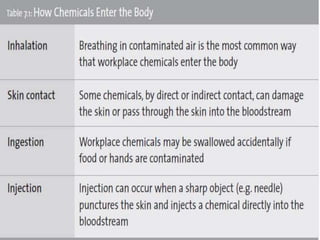
• In order for a chemical to become hazardous
to a person’s health, it must first contact or
enter the body and the chemical must have
some biological effect on the body.
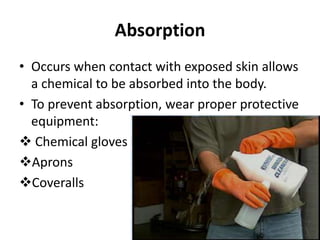
Absorption
• Occurs when contact with exposed skin allows
a chemical to be absorbed into the body.
• To prevent absorption, wear proper protective
equipment:
 Chemical gloves
Aprons
Coveralls
Inhalation
• Can occur when chemicals become airborne in
the form of a vapor, dust allowing them to be
inhaled into the lungs.
• To prevent inhaling hazardous chemicals you
must select and use proper respiratory
protection.
Ingestion
• Can occur when hazardous chemicals are
eaten or swallowed.
• To avoid ingesting hazardous chemicals never
Eat
Drink
Apply make-up
• Always wash hands after handling chemicals.
Examples
1. Acute effects are those that show up immediately
after a chemical exposure occurs. A good example
of an acute effect is the spillage of acid on the skin
– a chemical burn will occur immediately.
2. Chronic effects are those that occur after a
significant amount of time passes and usually are
the result of multiple exposures over a period of
time. Cancer is a typical example of a chronic
effect because cancers caused by chemical
exposures often do not show up until twenty or
more years after the initial exposure.
Some common examples of the
effects of hazardous chemicals
Skin irritation, dermatitis or skin cancer from
frequent contact with oils.
Injuries to hands and eyes from contact with
corrosive liquids.
 Long-term disability from lung diseases following
exposure to dusty environments (e.g. exposure to
respirable crystalline silicate).
Death or injury from exposure to toxic fumes (e.g.
carbon monoxide).
Cancer causing death many years after first exposure
to carcinogens at work (e.g. asbestos).
What are the steps for chemical risk
assessment?
• Chemical risk assessment forms an integral part
of controlling health risks in the workplace. There
are four main steps involved.
Step 1: Make an inventory
• Chemical inventories are a very important tool
and the first step in effective chemical
management. Make an inventory of the
substances used in your work processes (e.g.
solvents) and those generated by the work
processes (e.g. dust, residues, waste). It should
be designed to systematically identify hazardous
substances present in the workplace.
Step 2: Collect information
• Collect information about each substance, i.e. the
harm it can do and how this can happen. Safety Data
Sheets, which must be provided by the supplier of a
chemical, and labels are an important source of
information.
Step 3: Assess exposure
• Assess exposure to the identified dangerous
substances, looking at the type, intensity, length,
frequency and occurrence of exposure to employees,
including combined effects of dangerous substances
used together and the related risk. Find out if
substances have occupational exposure limits (OELs).
Consider any physical or environmental hazards.
Step 4: Decide on and implement
• suitable control measures to hierarchy for
exposure control measures to be applied if a risk
assessment reveals risks.
1. Elimination of the hazard by changing the
process or product.
2. Substitute another, non-hazardous or less
dangerous chemical.
3. Where 1 and 2 are not possible, control
measures should be implemented to remove or
reduce the risks to employees’ health.
Control hierarchy
1. Enclosure/isolation of hazard:
• Design work processes and controls, and use
adequate equipment and materials, to reduce
the release of dangerous substances (e.g. total
or partial enclosure).
2. Ventilation of area:
• use, for example, extraction equipment or
general ventilation.
Cont…………
3. Use personal protective equipment
• (PPE): where exposure cannot be prevented
by other means, use PPE including respirators,
safety glasses, gloves, overalls, protective
creams and lotions.
Further measures include:
Chemical emergency procedures:
• Draw up an emergency plan covering procedures
for spillages, first aid, emergency exits etc.
Organizational control:
• through, for example, chemical inventories,
labeling, training and consultation of staff,
providing risk information using Hazard
communication (Hazcom) instructions,
instructions from manufacturers, systems of
work and handling procedures, safe storage and
transfer.
Who should do the risk assessment?
• In many cases, you and your employees have the
best knowledge and understanding of your work
processes and are therefore best placed to carry
out the risk assessment. If specification of the
control measures is not straightforward, or if
complex risks have to be assessed, you may need
to engage competent specialist expertise to
assist in the task.
Cont………
• The risk assessment must be recorded and
made available to employees. The law
requires that the control measures are
identified in writing (paper or electronic
format). The risk assessment should be a
‘living document’ that is reviewed if situations
change or if there is reason to think that it is
no longer valid.
What is a Hazcom instruction?
• A Hazcom instruction is an important tool in
conveying risk information to employees. It
should be simple in layout and use easy to
understand language. As previously stated, a
Safety Data Sheet can be difficult to use for
this purpose. A Hazcom instruction should
include, as a minimum, the following
information.
Cont……….
 Name (substance identification).
 Hazard identification.
Safety measures and safe-handling
procedures.
 Accidental release measures.
 First aid procedures.
 Appropriate methods of disposal.
Cont………..
• It should describe the workplace operation
and be signed by the user. Hazcom
instructions can also take the form of
pictograms to illustrate good work practices.
Hazard Control and Prevention
• The most effective chemical hazard control is
prevention. Establishing an effective chemical
control program in your facility can reduce or
eliminate chemical hazards in food.
• Successful chemical control program should
include:
1. Train employees to follow safe handling and
application procedures for sanitation,
maintenance or pesticides chemicals.
Cont……
2. Store chemicals in designated areas away from
food, ingredients, packaging and food contact
surfaces.
3. Make it standard practice for staff, after
maintenance, to properly clean and remove all
chemical residues from food contact surfaces.
4. Do not use excessive grease or lubricants on
equipment. Regularly re-evaluate all procedures
to ensure they effectively remove chemicals.
Cont……
5. Ensure chemical containers and measuring
tools are clearly labeled or colour coded, and
that they are used only for chemicals.
Managing chemicals
When managing laboratory chemicals, not all
risk can be eliminated. However, laboratory
safety and security are greatly improved
through informed risk assessment and careful
risk management. The careful management of
a chemical’s life cycle not only minimizes risks
to humans and to the environment, but also
decreases costs.
Storage of highly reactive substances
• Storage of highly reactive substances
• Check international, regional, or local building
and fire codes to determine the maximum
amount of highly reactive chemicals that can be
stored in a laboratory. Follow the general
guidelines below when storing highly reactive
substances.
1. Consider the storage requirements of each
highly reactive chemical before bringing it into
the laboratory.
Cont……
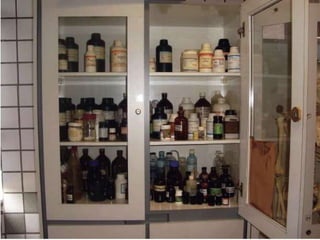
2. Bring into the laboratory only the quantities
of material needed for immediate purposes
depending on the materials).
3. Be sure to label, date, and inventory all highly
reactive materials as soon as received.
4. Store highly reactive liquids in container large
enough to hold the contents of the bottles.
5. Restrict access to the storage facility.
Cont………
Working with Chemicals
• Safe and secure execution of experiments
requires work practices that reduce risk and
protect the health and safety of laboratory
personnel as well as the public and the
environment.
General Procedures for Working with
Hazardous Chemicals.
Personal Behavior.
1. Avoid distracting or startling other personnel.
2. Do not allow practical jokes conduct.
3. Use laboratory equipment only for its designated purpose.
4. Review basic safety procedures with all visitors to
laboratories where hazardous substances are stored or in
use or where hazardous activities are in progress.
5. If minors are permitted in laboratories, ensure that they are
under the direct supervision of qualified adults at all times.
Develop a policy regarding minors in the laboratory, and
review and approve all activities of minors prior to their
arrival. Make sure other laboratory personnel in the area
are aware of the presence of minors.
Reducing Exposure to Chemicals
• Take care to avoid exposure by the principal
routes: skin and eye contact, inhalation, and
ingestion. The preferred methods for reducing
chemical exposure, in order of preference, are as
follows.
1. Substitution of less hazardous materials.
2. Engineering controls
3. Administrative controls
4. Personal protective equipment
Engineering Controls
• Engineering controls are measures that
eliminate, isolate, or reduce exposure to
chemical or physical hazards through the use
of various devices. Examples include
laboratory chemical hoods and other
ventilation systems, shields, barricades.
• Engineering controls must always be the first
and primary line of defense to protect
personnel and property.
Housekeeping
• An orderly laboratory is a safe laboratory. By contrast, a
disorderly laboratory can hinder or endanger emergency
responders.
• Follow these housekeeping rules:
1. Regularly clean work areas, including floors, to reduce
respiratory hazards.
2. Properly label and neatly store all chemicals in order.
Face labels outward for easy viewing. Containers
themselves should be clean and free of dust. For
containers and labels that have begun to degrade,
replace, repackage, or dispose of them in the proper
location.
3. Return all equipment and laboratory chemicals to their
designated storage locations.
Cont……….
5. Do not store chemical containers on the floor.
6. Do not use floors, stairways, and hallways as
storage areas.

Chapter 6 chemical

  • 1.
    Module 6: Chemicalsin the Workplace Contents 1) Introduction. 2) Chemicals in the Workplace. 3) What chemicals are hazardous? 4) Classifications of hazardous chemicals 5) How do chemicals enter the body? 6) What are the steps for chemical risk assessment? 7) Control hierarchy 8) Who should do the risk assessment? 9) What is a Hazcom instruction? 10) Hazard Control and Prevention 11) Managing chemicals 12) Working with Chemicals
  • 2.
    Introduction • Today, almostevery business uses chemicals, Even in the cleanest, most modern office, employees are exposed routinely to inks, toners and adhesives not to mention a wide range of materials used in cleaning and maintenance. Exposure to chemicals in the workplace can cause many different types of harm, ranging from mild irritations to cancer.
  • 3.
    Cont……. • Managing chemicalsand their associated hazards in the workplace will bring real benefits to a business. In addition to improved employee safety and health, cost savings can be achieved by limiting economic losses through effective work practices such as correct storage, handling, use and disposal procedures. Potential harm to the environment will also be reduced.
  • 4.
    Chemicals in theWorkplace • There are 750,000 hazardous chemicals used in the workplace around the world. • Chemicals are used for a variety of purposes. • Employees must know how to protect themselves from chemical hazards. • What is a Hazardous Chemical? • A hazardous chemical is any substance that poses a physical or health hazard to you or others in the workplace.
  • 5.
    What chemicals arehazardous? • Any substance, in gas, liquid or solid form, which has the potential to cause harm, is referred to as a hazardous or dangerous substance. Such substances include those:
  • 6.
    Cont….. • Brought directlyinto the workplace and handled, stored and used for processing (e.g. solvents, cleaning agents, glues, paints). • Generated by a process or work activity (e.g. fumes from welding). • Generated as waste or residue (e.g. fumes from soldering irons, carbon monoxide from exhausts).
  • 7.
    Cont…….. • Substances canbe considered hazardous not only because of what they contain (i.e. their chemical ingredients) but because of the form or way in which they are used at the workplace. • In addition to their effects on human health, some chemicals also present physical hazards such as the potential to ignite or support combustion of other substances (oxidizer) and the potential to explode. The physical, environmental and human hazards of a chemical substance must be considered when conducting a risk assessment in the workplace.
  • 8.
    Classifications of hazardouschemicals A variety of hazardous chemicals are commonly found in the workplace. It's important to understand the substances that fall under this classification, as they can have an adverse effect on human health and cause harm to property and the environment. Hazardous chemicals • Hazardous chemicals are substances that can cause adverse health effects such as poisoning, breathing problems, skin rashes, allergic reactions, cancer, and other health problems from exposure.
  • 9.
    Cont…….. • Many hazardouschemicals are also classified as dangerous goods. These can cause fires, explosions, corrosion, and hazardous reactions if not handled safely. • Examples of hazardous chemicals. 1. Paints 2. Drugs 3. Cosmetics 4. Cleaning chemicals. 5. Detergents
  • 10.
    Cont……. 6. Pesticides 7. Weldingfumes 8. Gases 9. Corrosives 10. Chemically reactive or acutely (highly) toxic substances.
  • 11.
    How do chemicalsenter the body? • In order for a chemical to become hazardous to a person’s health, it must first contact or enter the body and the chemical must have some biological effect on the body.
  • 13.
    Absorption • Occurs whencontact with exposed skin allows a chemical to be absorbed into the body. • To prevent absorption, wear proper protective equipment:  Chemical gloves Aprons Coveralls
  • 14.
    Inhalation • Can occurwhen chemicals become airborne in the form of a vapor, dust allowing them to be inhaled into the lungs. • To prevent inhaling hazardous chemicals you must select and use proper respiratory protection.
  • 15.
    Ingestion • Can occurwhen hazardous chemicals are eaten or swallowed. • To avoid ingesting hazardous chemicals never Eat Drink Apply make-up • Always wash hands after handling chemicals.
  • 16.
    Examples 1. Acute effectsare those that show up immediately after a chemical exposure occurs. A good example of an acute effect is the spillage of acid on the skin – a chemical burn will occur immediately. 2. Chronic effects are those that occur after a significant amount of time passes and usually are the result of multiple exposures over a period of time. Cancer is a typical example of a chronic effect because cancers caused by chemical exposures often do not show up until twenty or more years after the initial exposure.
  • 18.
    Some common examplesof the effects of hazardous chemicals Skin irritation, dermatitis or skin cancer from frequent contact with oils. Injuries to hands and eyes from contact with corrosive liquids.  Long-term disability from lung diseases following exposure to dusty environments (e.g. exposure to respirable crystalline silicate). Death or injury from exposure to toxic fumes (e.g. carbon monoxide). Cancer causing death many years after first exposure to carcinogens at work (e.g. asbestos).
  • 19.
    What are thesteps for chemical risk assessment? • Chemical risk assessment forms an integral part of controlling health risks in the workplace. There are four main steps involved. Step 1: Make an inventory • Chemical inventories are a very important tool and the first step in effective chemical management. Make an inventory of the substances used in your work processes (e.g. solvents) and those generated by the work processes (e.g. dust, residues, waste). It should be designed to systematically identify hazardous substances present in the workplace.
  • 20.
    Step 2: Collectinformation • Collect information about each substance, i.e. the harm it can do and how this can happen. Safety Data Sheets, which must be provided by the supplier of a chemical, and labels are an important source of information. Step 3: Assess exposure • Assess exposure to the identified dangerous substances, looking at the type, intensity, length, frequency and occurrence of exposure to employees, including combined effects of dangerous substances used together and the related risk. Find out if substances have occupational exposure limits (OELs). Consider any physical or environmental hazards.
  • 21.
    Step 4: Decideon and implement • suitable control measures to hierarchy for exposure control measures to be applied if a risk assessment reveals risks. 1. Elimination of the hazard by changing the process or product. 2. Substitute another, non-hazardous or less dangerous chemical. 3. Where 1 and 2 are not possible, control measures should be implemented to remove or reduce the risks to employees’ health.
  • 22.
    Control hierarchy 1. Enclosure/isolationof hazard: • Design work processes and controls, and use adequate equipment and materials, to reduce the release of dangerous substances (e.g. total or partial enclosure). 2. Ventilation of area: • use, for example, extraction equipment or general ventilation.
  • 23.
    Cont………… 3. Use personalprotective equipment • (PPE): where exposure cannot be prevented by other means, use PPE including respirators, safety glasses, gloves, overalls, protective creams and lotions.
  • 24.
    Further measures include: Chemicalemergency procedures: • Draw up an emergency plan covering procedures for spillages, first aid, emergency exits etc. Organizational control: • through, for example, chemical inventories, labeling, training and consultation of staff, providing risk information using Hazard communication (Hazcom) instructions, instructions from manufacturers, systems of work and handling procedures, safe storage and transfer.
  • 25.
    Who should dothe risk assessment? • In many cases, you and your employees have the best knowledge and understanding of your work processes and are therefore best placed to carry out the risk assessment. If specification of the control measures is not straightforward, or if complex risks have to be assessed, you may need to engage competent specialist expertise to assist in the task.
  • 26.
    Cont……… • The riskassessment must be recorded and made available to employees. The law requires that the control measures are identified in writing (paper or electronic format). The risk assessment should be a ‘living document’ that is reviewed if situations change or if there is reason to think that it is no longer valid.
  • 27.
    What is aHazcom instruction? • A Hazcom instruction is an important tool in conveying risk information to employees. It should be simple in layout and use easy to understand language. As previously stated, a Safety Data Sheet can be difficult to use for this purpose. A Hazcom instruction should include, as a minimum, the following information.
  • 28.
    Cont……….  Name (substanceidentification).  Hazard identification. Safety measures and safe-handling procedures.  Accidental release measures.  First aid procedures.  Appropriate methods of disposal.
  • 29.
    Cont……….. • It shoulddescribe the workplace operation and be signed by the user. Hazcom instructions can also take the form of pictograms to illustrate good work practices.
  • 30.
    Hazard Control andPrevention • The most effective chemical hazard control is prevention. Establishing an effective chemical control program in your facility can reduce or eliminate chemical hazards in food. • Successful chemical control program should include: 1. Train employees to follow safe handling and application procedures for sanitation, maintenance or pesticides chemicals.
  • 31.
    Cont…… 2. Store chemicalsin designated areas away from food, ingredients, packaging and food contact surfaces. 3. Make it standard practice for staff, after maintenance, to properly clean and remove all chemical residues from food contact surfaces. 4. Do not use excessive grease or lubricants on equipment. Regularly re-evaluate all procedures to ensure they effectively remove chemicals.
  • 32.
    Cont…… 5. Ensure chemicalcontainers and measuring tools are clearly labeled or colour coded, and that they are used only for chemicals.
  • 33.
    Managing chemicals When managinglaboratory chemicals, not all risk can be eliminated. However, laboratory safety and security are greatly improved through informed risk assessment and careful risk management. The careful management of a chemical’s life cycle not only minimizes risks to humans and to the environment, but also decreases costs.
  • 35.
    Storage of highlyreactive substances • Storage of highly reactive substances • Check international, regional, or local building and fire codes to determine the maximum amount of highly reactive chemicals that can be stored in a laboratory. Follow the general guidelines below when storing highly reactive substances. 1. Consider the storage requirements of each highly reactive chemical before bringing it into the laboratory.
  • 36.
    Cont…… 2. Bring intothe laboratory only the quantities of material needed for immediate purposes depending on the materials). 3. Be sure to label, date, and inventory all highly reactive materials as soon as received. 4. Store highly reactive liquids in container large enough to hold the contents of the bottles. 5. Restrict access to the storage facility.
  • 37.
  • 38.
    Working with Chemicals •Safe and secure execution of experiments requires work practices that reduce risk and protect the health and safety of laboratory personnel as well as the public and the environment.
  • 39.
    General Procedures forWorking with Hazardous Chemicals. Personal Behavior. 1. Avoid distracting or startling other personnel. 2. Do not allow practical jokes conduct. 3. Use laboratory equipment only for its designated purpose. 4. Review basic safety procedures with all visitors to laboratories where hazardous substances are stored or in use or where hazardous activities are in progress. 5. If minors are permitted in laboratories, ensure that they are under the direct supervision of qualified adults at all times. Develop a policy regarding minors in the laboratory, and review and approve all activities of minors prior to their arrival. Make sure other laboratory personnel in the area are aware of the presence of minors.
  • 40.
    Reducing Exposure toChemicals • Take care to avoid exposure by the principal routes: skin and eye contact, inhalation, and ingestion. The preferred methods for reducing chemical exposure, in order of preference, are as follows. 1. Substitution of less hazardous materials. 2. Engineering controls 3. Administrative controls 4. Personal protective equipment
  • 41.
    Engineering Controls • Engineeringcontrols are measures that eliminate, isolate, or reduce exposure to chemical or physical hazards through the use of various devices. Examples include laboratory chemical hoods and other ventilation systems, shields, barricades. • Engineering controls must always be the first and primary line of defense to protect personnel and property.
  • 42.
    Housekeeping • An orderlylaboratory is a safe laboratory. By contrast, a disorderly laboratory can hinder or endanger emergency responders. • Follow these housekeeping rules: 1. Regularly clean work areas, including floors, to reduce respiratory hazards. 2. Properly label and neatly store all chemicals in order. Face labels outward for easy viewing. Containers themselves should be clean and free of dust. For containers and labels that have begun to degrade, replace, repackage, or dispose of them in the proper location. 3. Return all equipment and laboratory chemicals to their designated storage locations.
  • 43.
    Cont………. 5. Do notstore chemical containers on the floor. 6. Do not use floors, stairways, and hallways as storage areas.