TREES
The Binary Tree
ADT
01/27/15 10-1BY- VIKAS SINGH
10-2
Objectives
• Define trees as data structures
• Define the terms associated with trees
• Discuss tree traversal algorithms
• Discuss a binary tree implementation
• Examine a binary tree example
01/27/15 BY- VIKAS SINGH
10-3
Trees
• A tree is a nonlinear data structure used to
represent entities that are in some
hierarchical relationship
• Examples in real life:
• Family tree
• Table of contents of a book
• Class inheritance hierarchy in Java
• Computer file system (folders and
subfolders)
• Decision trees
• Top-down design
01/27/15 BY- VIKAS SINGH
10-4
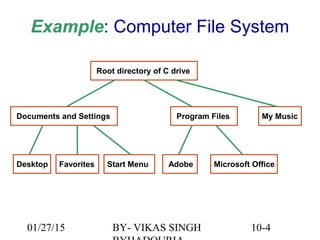
Example: Computer File System
Root directory of C drive
Documents and Settings Program Files My Music
Desktop Favorites Start Menu Microsoft OfficeAdobe
01/27/15 BY- VIKAS SINGH
10-5
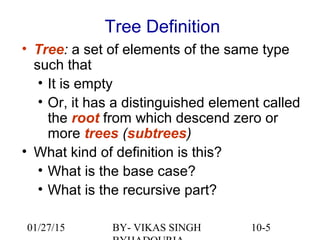
Tree Definition
• Tree: a set of elements of the same type
such that
• It is empty
• Or, it has a distinguished element called
the root from which descend zero or
more trees (subtrees)
• What kind of definition is this?
• What is the base case?
• What is the recursive part?
01/27/15 BY- VIKAS SINGH
10-6
Tree Definition
Subtrees of
the root
Root
01/27/15 BY- VIKAS SINGH
10-7
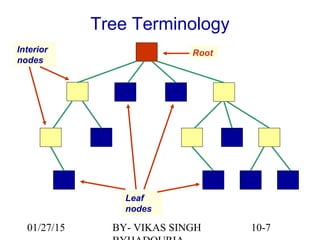
Tree Terminology
Leaf
nodes
RootInterior
nodes
01/27/15 BY- VIKAS SINGH
10-8
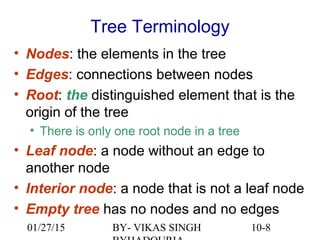
Tree Terminology
• Nodes: the elements in the tree
• Edges: connections between nodes
• Root: the distinguished element that is the
origin of the tree
• There is only one root node in a tree
• Leaf node: a node without an edge to
another node
• Interior node: a node that is not a leaf node
• Empty tree has no nodes and no edges
01/27/15 BY- VIKAS SINGH
10-9
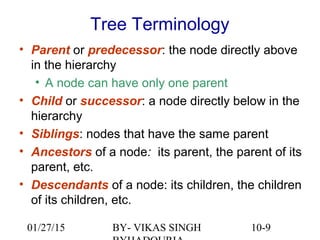
• Parent or predecessor: the node directly above
in the hierarchy
• A node can have only one parent
• Child or successor: a node directly below in the
hierarchy
• Siblings: nodes that have the same parent
• Ancestors of a node: its parent, the parent of its
parent, etc.
• Descendants of a node: its children, the children
of its children, etc.
Tree Terminology
01/27/15 BY- VIKAS SINGH
10-10
Discussion
• Does a leaf node have any children?
• Does the root node have a parent?
• How many parents does every node
other than the root node have?
01/27/15 BY- VIKAS SINGH
10-11
Height of a Tree
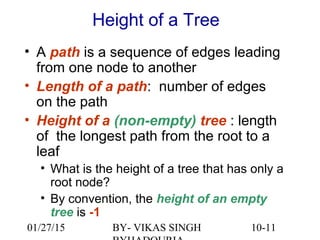
• A path is a sequence of edges leading
from one node to another
• Length of a path: number of edges
on the path
• Height of a (non-empty) tree : length
of the longest path from the root to a
leaf
• What is the height of a tree that has only a
root node?
• By convention, the height of an empty
tree is -1
01/27/15 BY- VIKAS SINGH
10-12
Level of a Node
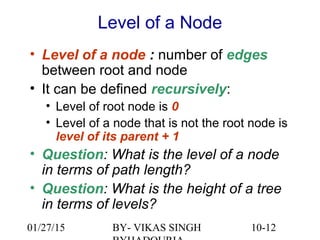
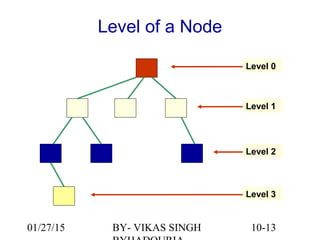
• Level of a node : number of edges
between root and node
• It can be defined recursively:
• Level of root node is 0
• Level of a node that is not the root node is
level of its parent + 1
• Question: What is the level of a node
in terms of path length?
• Question: What is the height of a tree
in terms of levels?
01/27/15 BY- VIKAS SINGH
10-13
Level of a Node
Level 0
Level 1
Level 2
Level 3
01/27/15 BY- VIKAS SINGH
10-14
Subtrees
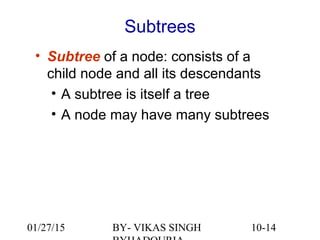
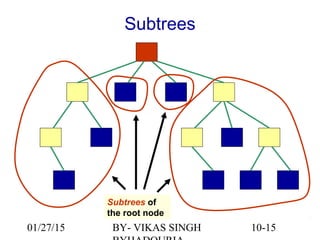
• Subtree of a node: consists of a
child node and all its descendants
• A subtree is itself a tree
• A node may have many subtrees
01/27/15 BY- VIKAS SINGH
10-15
Subtrees
Subtrees of
the root node
01/27/15 BY- VIKAS SINGH
10-16
Subtrees
Subtrees of the
node labeled E
E
01/27/15 BY- VIKAS SINGH
10-17
More Tree Terminology
• Degree or arity of a node: the number of
children it has
• Degree or arity of a tree: the maximum
of the degrees of the tree’s nodes
01/27/15 BY- VIKAS SINGH
10-18
Binary Trees
• General tree: a tree each of whose
nodes may have any number of children
• n-ary tree: a tree each of whose nodes
may have no more than n children
• Binary tree: a tree each of whose nodes
may have no more than 2 children
• i.e. a binary tree is a tree with degree
(arity) 2
• The children (if present) are called the
left child and right child
01/27/15 BY- VIKAS SINGH
10-19
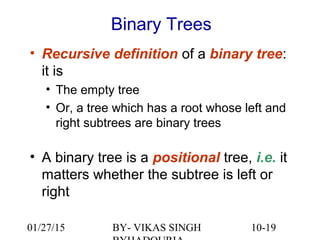
• Recursive definition of a binary tree:
it is
• The empty tree
• Or, a tree which has a root whose left and
right subtrees are binary trees
• A binary tree is a positional tree, i.e. it
matters whether the subtree is left or
right
Binary Trees
01/27/15 BY- VIKAS SINGH
10-20
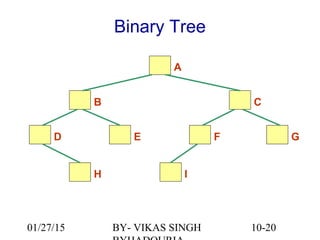
Binary Tree
A
IH
D E
B
F
C
G
01/27/15 BY- VIKAS SINGH
10-21
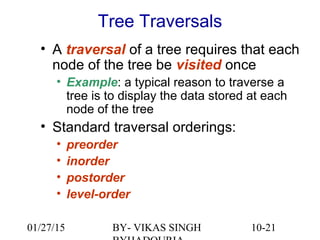
Tree Traversals
• A traversal of a tree requires that each
node of the tree be visited once
• Example: a typical reason to traverse a
tree is to display the data stored at each
node of the tree
• Standard traversal orderings:
• preorder
• inorder
• postorder
• level-order
01/27/15 BY- VIKAS SINGH
10-22
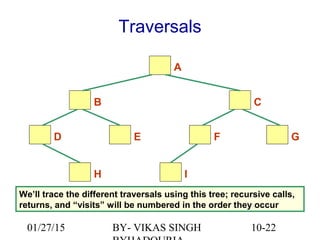
Traversals
A
IH
D E
B
F
C
G
We’ll trace the different traversals using this tree; recursive calls,
returns, and “visits” will be numbered in the order they occur
01/27/15 BY- VIKAS SINGH
10-23
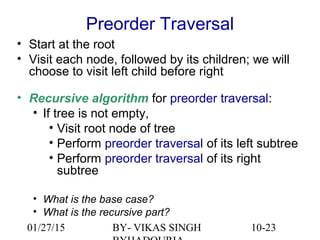
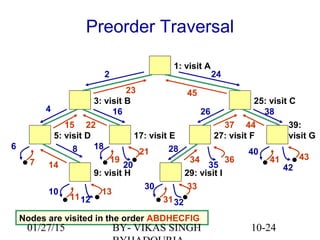
Preorder Traversal
• Start at the root
• Visit each node, followed by its children; we will
choose to visit left child before right
• Recursive algorithm for preorder traversal:
• If tree is not empty,
• Visit root node of tree
• Perform preorder traversal of its left subtree
• Perform preorder traversal of its right
subtree
• What is the base case?
• What is the recursive part?
01/27/15 BY- VIKAS SINGH
10-24
Preorder Traversal
1: visit A
29: visit I9: visit H
5: visit D 17: visit E
3: visit B
27: visit F
25: visit C
39:
visit G
Nodes are visited in the order ABDHECFIG
. .
.
.. .
. ..
6
4
2
11
10
8
7
16
15
14
13
12
21
20
19
18 28
26
24
23
22
34
33
3231
30
38
37
45
44
43
42
41
40
35
36
01/27/15 BY- VIKAS SINGH
10-25
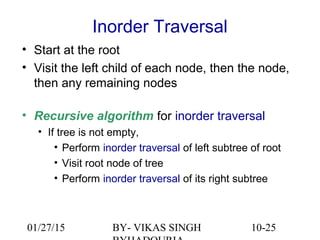
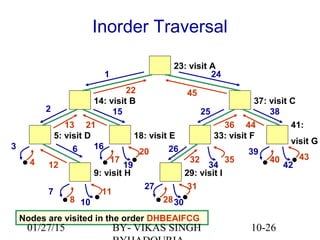
Inorder Traversal
• Start at the root
• Visit the left child of each node, then the node,
then any remaining nodes
• Recursive algorithm for inorder traversal
• If tree is not empty,
• Perform inorder traversal of left subtree of root
• Visit root node of tree
• Perform inorder traversal of its right subtree
01/27/15 BY- VIKAS SINGH
10-26
Inorder Traversal
23: visit A
29: visit I9: visit H
5: visit D 18: visit E
14: visit B
33: visit F
37: visit C
41:
visit G
Nodes are visited in the order DHBEAIFCG
. .
.
.. .
. ..
3
2
1
8
7
6
4
15
13
12
11
10
20
19
17
16 26
25
24
22
21
32
31
3028
27
38
36
45
44
43
42
40
39
34
35
01/27/15 BY- VIKAS SINGH
10-27
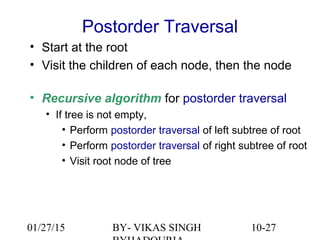
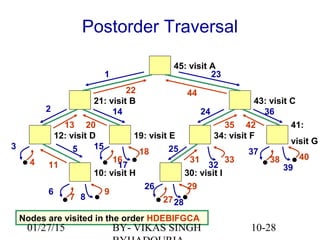
Postorder Traversal
• Start at the root
• Visit the children of each node, then the node
• Recursive algorithm for postorder traversal
• If tree is not empty,
• Perform postorder traversal of left subtree of root
• Perform postorder traversal of right subtree of root
• Visit root node of tree
01/27/15 BY- VIKAS SINGH
10-28
Postorder Traversal
45: visit A
30: visit I10: visit H
12: visit D 19: visit E
21: visit B
34: visit F
43: visit C
41:
visit G
Nodes are visited in the order HDEBIFGCA
. .
.
.. .
. ..
3
2
1
7
6
5
4
14
13
11
9
8
18
17
16
15 25
24
23
22
20
31
29
2827
26
36
35
44
42
40
39
38
37
32
33
01/27/15 BY- VIKAS SINGH
10-29
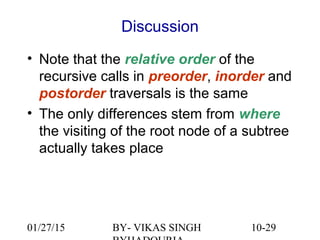
Discussion
• Note that the relative order of the
recursive calls in preorder, inorder and
postorder traversals is the same
• The only differences stem from where
the visiting of the root node of a subtree
actually takes place
01/27/15 BY- VIKAS SINGH
10-30
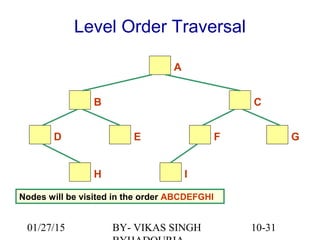
Level Order Traversal
• Start at the root
• Visit the nodes at each level, from left to
right
• Is there a recursive algorithm for a level
order traversal?
01/27/15 BY- VIKAS SINGH
10-31
Level Order Traversal
A
IH
D E
B
F
C
G
Nodes will be visited in the order ABCDEFGHI
01/27/15 BY- VIKAS SINGH
10-32
Iterative Binary Tree Traversals
• In recursive tree traversals, the Java call stack
keeps track of where we are in the tree (by
means of the call frames for each call)
• In iterative traversals, the programmer needs
to keep track!
• An iterative traversal uses a container to store
references to nodes not yet visited
• Order of visiting will depend on the type of container
being used (stack, queue, etc.)
01/27/15 BY- VIKAS SINGH
10-33
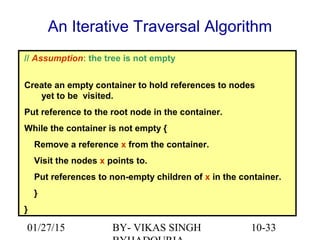
An Iterative Traversal Algorithm
// Assumption: the tree is not empty
Create an empty container to hold references to nodes
yet to be visited.
Put reference to the root node in the container.
While the container is not empty {
Remove a reference x from the container.
Visit the nodes x points to.
Put references to non-empty children of x in the container.
}
}
01/27/15 BY- VIKAS SINGH
10-34
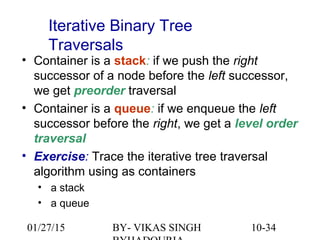
• Container is a stack: if we push the right
successor of a node before the left successor,
we get preorder traversal
• Container is a queue: if we enqueue the left
successor before the right, we get a level order
traversal
• Exercise: Trace the iterative tree traversal
algorithm using as containers
• a stack
• a queue
Iterative Binary Tree
Traversals
01/27/15 BY- VIKAS SINGH
10-35
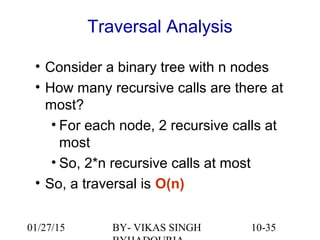
Traversal Analysis
• Consider a binary tree with n nodes
• How many recursive calls are there at
most?
• For each node, 2 recursive calls at
most
• So, 2*n recursive calls at most
• So, a traversal is O(n)
01/27/15 BY- VIKAS SINGH
10-36
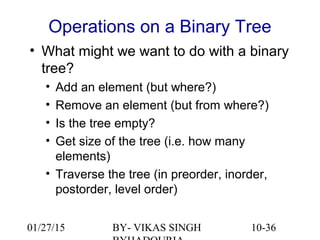
Operations on a Binary Tree
• What might we want to do with a binary
tree?
• Add an element (but where?)
• Remove an element (but from where?)
• Is the tree empty?
• Get size of the tree (i.e. how many
elements)
• Traverse the tree (in preorder, inorder,
postorder, level order)
01/27/15 BY- VIKAS SINGH
10-37
Discussion
• It is difficult to have a general add
operation, until we know the purpose of
the tree (we will discuss binary search
trees later)
• We could add “randomly”: go either right
or left, and add at the first available spot
01/27/15 BY- VIKAS SINGH
10-38
Discussion
• Similarly, where would a general
remove operation remove from?
• We could arbitrarily choose to remove, say,
the leftmost leaf
• If random choice, what would happen to
the children and descendants of the
element that was removed? What does the
parent of the removed element now point
to?
• What if the removed element is the root?
01/27/15 BY- VIKAS SINGH
10-39
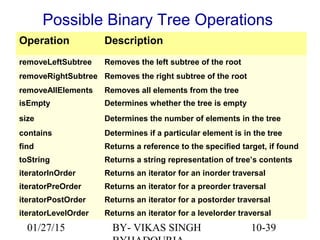
Possible Binary Tree Operations
Operation Description
removeLeftSubtree Removes the left subtree of the root
removeRightSubtree Removes the right subtree of the root
removeAllElements Removes all elements from the tree
isEmpty Determines whether the tree is empty
size Determines the number of elements in the tree
contains Determines if a particular element is in the tree
find Returns a reference to the specified target, if found
toString Returns a string representation of tree’s contents
iteratorInOrder Returns an iterator for an inorder traversal
iteratorPreOrder Returns an iterator for a preorder traversal
iteratorPostOrder Returns an iterator for a postorder traversal
iteratorLevelOrder Returns an iterator for a levelorder traversal
01/27/15 BY- VIKAS SINGH
10-40
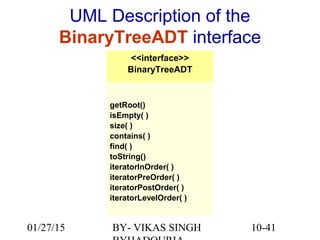
Binary Tree Operations
• Our textbook has a smaller set of
operations for the BinaryTreeADT
• See BinaryTreeADT.java
01/27/15 BY- VIKAS SINGH
10-41
UML Description of the
BinaryTreeADT interface
<<interface>>
BinaryTreeADT
getRoot()
isEmpty( )
size( )
contains( )
find( )
toString()
iteratorInOrder( )
iteratorPreOrder( )
iteratorPostOrder( )
iteratorLevelOrder( )
01/27/15 BY- VIKAS SINGH
10-42
Linked Binary Tree Implementation
• To represent the binary tree, we will use a
linked structure of nodes
• root: reference to the node that is the root
of the tree
• count: keeps track of the number of nodes
in the tree
• First, how will we represent a node of a
binary tree?
01/27/15 BY- VIKAS SINGH
10-43
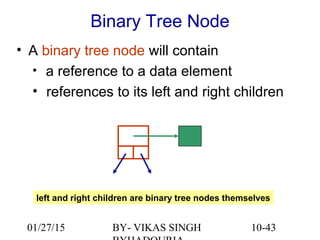
Binary Tree Node
• A binary tree node will contain
• a reference to a data element
• references to its left and right children
left and right children are binary tree nodes themselves
01/27/15 BY- VIKAS SINGH
10-44
BinaryTreeNode class
• Represents a node in a binary tree
• Attributes:
• element: reference to data element
• left: reference to left child of the node
• right: reference to right child of the node
• See BinaryTreeNode.java
• Note that the attributes here are protected
• This means that they can be accessed directly from
any class that is in the same package as
BinaryTreeNode.java
01/27/15 BY- VIKAS SINGH
10-45
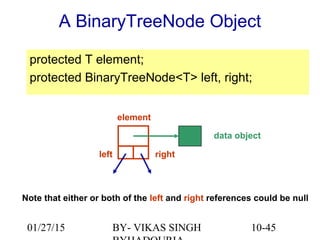
A BinaryTreeNode Object
protected T element;
protected BinaryTreeNode<T> left, right;
element
data object
left right
Note that either or both of the left and right references could be null
01/27/15 BY- VIKAS SINGH
10-46
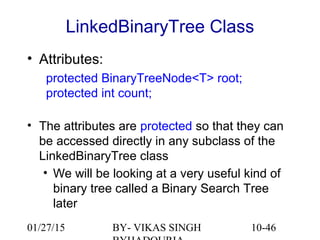
LinkedBinaryTree Class
• Attributes:
protected BinaryTreeNode<T> root;
protected int count;
• The attributes are protected so that they can
be accessed directly in any subclass of the
LinkedBinaryTree class
• We will be looking at a very useful kind of
binary tree called a Binary Search Tree
later
01/27/15 BY- VIKAS SINGH
10-47
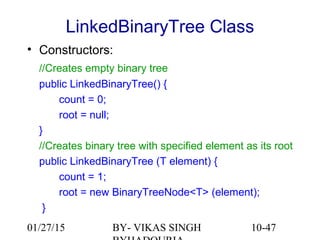
LinkedBinaryTree Class
• Constructors:
//Creates empty binary tree
public LinkedBinaryTree() {
count = 0;
root = null;
}
//Creates binary tree with specified element as its root
public LinkedBinaryTree (T element) {
count = 1;
root = new BinaryTreeNode<T> (element);
}
01/27/15 BY- VIKAS SINGH
10-48
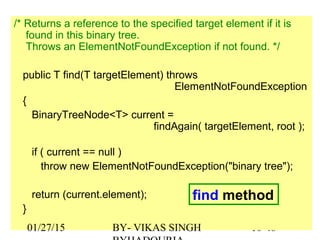
/* Returns a reference to the specified target element if it is
found in this binary tree.
Throws an ElementNotFoundException if not found. */
public T find(T targetElement) throws
ElementNotFoundException
{
BinaryTreeNode<T> current =
findAgain( targetElement, root );
if ( current == null )
throw new ElementNotFoundException("binary tree");
return (current.element);
}
find method
01/27/15 BY- VIKAS SINGH
10-49
Discussion
• What is element in this statement from
the method?
return (current.element);
• If element were private rather than
protected in BinaryTreeNode.java, what
would be need in order to access it?
• We will now look at the helper method
findAgain …
01/27/15 BY- VIKAS SINGH
10-50
private BinaryTreeNode<T> findAgain(T targetElement,
BinaryTreeNode<T> next)
{
if (next == null)
return null;
if (next.element.equals(targetElement))
return next;
BinaryTreeNode<T> temp =
findAgain(targetElement, next.left);
if (temp == null)
temp = findAgain(targetElement, next.right);
return temp;
}
findAgain helper method
01/27/15 BY- VIKAS SINGH
10-51
Discussion
• What kind of method is findAgain?
• What is the base case?
• There are two!
• What is the recursive part?
01/27/15 BY- VIKAS SINGH
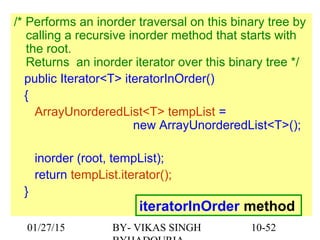
10-52
/* Performs an inorder traversal on this binary tree by
calling a recursive inorder method that starts with
the root.
Returns an inorder iterator over this binary tree */
public Iterator<T> iteratorInOrder()
{
ArrayUnorderedList<T> tempList =
new ArrayUnorderedList<T>();
inorder (root, tempList);
return tempList.iterator();
}
iteratorInOrder method
01/27/15 BY- VIKAS SINGH
10-53
Discussion
• iteratorInOrder is returning an iterator
object
• It will perform the iteration in inorder
• But where is that iterator coming from?
return tempList.iterator();
• Let’s now look at the helper method
inorder …
01/27/15 BY- VIKAS SINGH
10-54
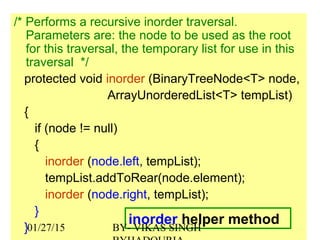
/* Performs a recursive inorder traversal.
Parameters are: the node to be used as the root
for this traversal, the temporary list for use in this
traversal */
protected void inorder (BinaryTreeNode<T> node,
ArrayUnorderedList<T> tempList)
{
if (node != null)
{
inorder (node.left, tempList);
tempList.addToRear(node.element);
inorder (node.right, tempList);
}
}
inorder helper method
01/27/15 BY- VIKAS SINGH
10-55
Discussion
• Recall the recursive algorithm for inorder
traversal:
• If tree is not empty,
• Perform inorder traversal of left subtree of
root
• Visit root node of tree
• Perform inorder traversal of its right subtree
• That’s exactly the order that is being
implemented here!
• What is “visiting” the root node here?
01/27/15 BY- VIKAS SINGH
10-56
Discussion
• The data elements of the tree (i.e. items
of type T) are being temporarily added
to an unordered list, in inorder order
• Why use an unordered list??
• Why not? We already have this
collection, with its iterator operation
that we can use!
01/27/15 BY- VIKAS SINGH
10-57
Using Binary Trees: Expression Trees
• Programs that manipulate or evaluate
arithmetic expressions can use binary
trees to hold the expressions
• An expression tree represents an
arithmetic expression such as
(5 – 3) * 4 + 9 / 2
• Root node and interior nodes contain
operations
• Leaf nodes contain operands
01/27/15 BY- VIKAS SINGH
10-58
Example: An Expression Tree
/
-
35
+
(5 – 3) * 4 + 9 / 2
4
*
9 2
01/27/15 BY- VIKAS SINGH
10-59
Evaluating Expression Trees
• We can use an expression tree to
evaluate an expression
• We start the evaluation at the bottom left
• What kind of traversal is this?
01/27/15 BY- VIKAS SINGH
10-60
Evaluating an Expression Tree
-
57 8/
29
* This tree represents
the expression
(9 / 2 + 7) * (8 – 5)
Evaluation is based on postorder traversal:
If root node is a leaf, return the associated value.
Recursively evaluate expression in left subtree.
Recursively evaluate expression in right subtree.
Perform operation in root node on these two
values, and return result.
+
01/27/15 BY- VIKAS SINGH
10-61
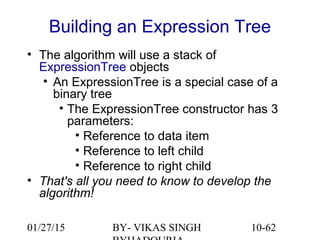
Building an Expression Tree
• Now we know how to evaluate an
expression represented by an expression
tree
• But, how do we build an expression tree?
• We will build it from the postfix form of
the expression
• Exercise: develop the algorithm by
following the diagrams on the next pages
01/27/15 BY- VIKAS SINGH
10-62
Building an Expression Tree
• The algorithm will use a stack of
ExpressionTree objects
• An ExpressionTree is a special case of a
binary tree
• The ExpressionTree constructor has 3
parameters:
• Reference to data item
• Reference to left child
• Reference to right child
• That's all you need to know to develop the
algorithm!
01/27/15 BY- VIKAS SINGH
10-63
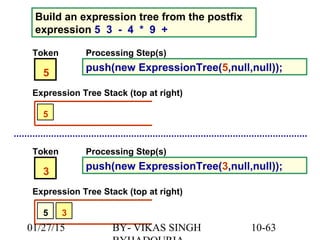
Build an expression tree from the postfix
expression 5 3 - 4 * 9 +
Token
5
push(new ExpressionTree(5,null,null));
Processing Step(s)
Expression Tree Stack (top at right)
5
Token
3
push(new ExpressionTree(3,null,null));
Processing Step(s)
Expression Tree Stack (top at right)
5 3
01/27/15 BY- VIKAS SINGH
10-64
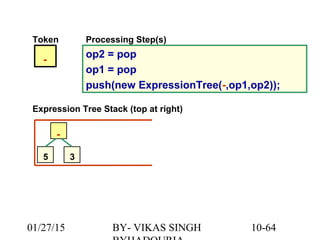
Token
-
op2 = pop
op1 = pop
push(new ExpressionTree(-,op1,op2));
Processing Step(s)
Expression Tree Stack (top at right)
5
-
3
01/27/15 BY- VIKAS SINGH
10-65
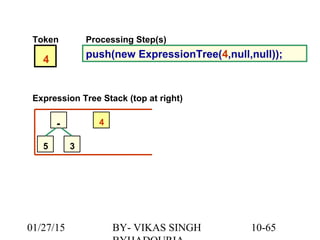
Token
4
push(new ExpressionTree(4,null,null));
Processing Step(s)
Expression Tree Stack (top at right)
5
-
3
4
01/27/15 BY- VIKAS SINGH
10-66
Token
*
op2 = pop
op1 = pop
push(new ExpressionTree(*,op1,op2));
Processing Step(s)
Expression Tree Stack (top at right)
5
-
3
4
*
01/27/15 BY- VIKAS SINGH
10-67
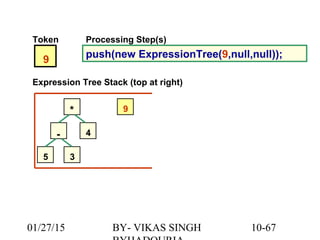
Token
9
push(new ExpressionTree(9,null,null));
Processing Step(s)
Expression Tree Stack (top at right)
5
-
3
4
* 9
01/27/15 BY- VIKAS SINGH
10-68
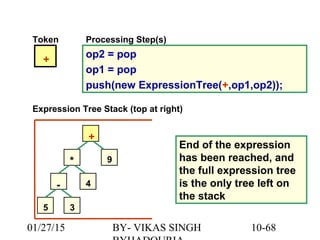
Token
+
op2 = pop
op1 = pop
push(new ExpressionTree(+,op1,op2));
Processing Step(s)
Expression Tree Stack (top at right)
5
-
3
4
* 9
+
End of the expression
has been reached, and
the full expression tree
is the only tree left on
the stack
01/27/15 BY- VIKAS SINGH

Trees

  • 1.
  • 2.
    10-2 Objectives • Define treesas data structures • Define the terms associated with trees • Discuss tree traversal algorithms • Discuss a binary tree implementation • Examine a binary tree example 01/27/15 BY- VIKAS SINGH
  • 3.
    10-3 Trees • A treeis a nonlinear data structure used to represent entities that are in some hierarchical relationship • Examples in real life: • Family tree • Table of contents of a book • Class inheritance hierarchy in Java • Computer file system (folders and subfolders) • Decision trees • Top-down design 01/27/15 BY- VIKAS SINGH
  • 4.
    10-4 Example: Computer FileSystem Root directory of C drive Documents and Settings Program Files My Music Desktop Favorites Start Menu Microsoft OfficeAdobe 01/27/15 BY- VIKAS SINGH
  • 5.
    10-5 Tree Definition • Tree:a set of elements of the same type such that • It is empty • Or, it has a distinguished element called the root from which descend zero or more trees (subtrees) • What kind of definition is this? • What is the base case? • What is the recursive part? 01/27/15 BY- VIKAS SINGH
  • 6.
    10-6 Tree Definition Subtrees of theroot Root 01/27/15 BY- VIKAS SINGH
  • 7.
  • 8.
    10-8 Tree Terminology • Nodes:the elements in the tree • Edges: connections between nodes • Root: the distinguished element that is the origin of the tree • There is only one root node in a tree • Leaf node: a node without an edge to another node • Interior node: a node that is not a leaf node • Empty tree has no nodes and no edges 01/27/15 BY- VIKAS SINGH
  • 9.
    10-9 • Parent orpredecessor: the node directly above in the hierarchy • A node can have only one parent • Child or successor: a node directly below in the hierarchy • Siblings: nodes that have the same parent • Ancestors of a node: its parent, the parent of its parent, etc. • Descendants of a node: its children, the children of its children, etc. Tree Terminology 01/27/15 BY- VIKAS SINGH
  • 10.
    10-10 Discussion • Does aleaf node have any children? • Does the root node have a parent? • How many parents does every node other than the root node have? 01/27/15 BY- VIKAS SINGH
  • 11.
    10-11 Height of aTree • A path is a sequence of edges leading from one node to another • Length of a path: number of edges on the path • Height of a (non-empty) tree : length of the longest path from the root to a leaf • What is the height of a tree that has only a root node? • By convention, the height of an empty tree is -1 01/27/15 BY- VIKAS SINGH
  • 12.
    10-12 Level of aNode • Level of a node : number of edges between root and node • It can be defined recursively: • Level of root node is 0 • Level of a node that is not the root node is level of its parent + 1 • Question: What is the level of a node in terms of path length? • Question: What is the height of a tree in terms of levels? 01/27/15 BY- VIKAS SINGH
  • 13.
    10-13 Level of aNode Level 0 Level 1 Level 2 Level 3 01/27/15 BY- VIKAS SINGH
  • 14.
    10-14 Subtrees • Subtree ofa node: consists of a child node and all its descendants • A subtree is itself a tree • A node may have many subtrees 01/27/15 BY- VIKAS SINGH
  • 15.
    10-15 Subtrees Subtrees of the rootnode 01/27/15 BY- VIKAS SINGH
  • 16.
    10-16 Subtrees Subtrees of the nodelabeled E E 01/27/15 BY- VIKAS SINGH
  • 17.
    10-17 More Tree Terminology •Degree or arity of a node: the number of children it has • Degree or arity of a tree: the maximum of the degrees of the tree’s nodes 01/27/15 BY- VIKAS SINGH
  • 18.
    10-18 Binary Trees • Generaltree: a tree each of whose nodes may have any number of children • n-ary tree: a tree each of whose nodes may have no more than n children • Binary tree: a tree each of whose nodes may have no more than 2 children • i.e. a binary tree is a tree with degree (arity) 2 • The children (if present) are called the left child and right child 01/27/15 BY- VIKAS SINGH
  • 19.
    10-19 • Recursive definitionof a binary tree: it is • The empty tree • Or, a tree which has a root whose left and right subtrees are binary trees • A binary tree is a positional tree, i.e. it matters whether the subtree is left or right Binary Trees 01/27/15 BY- VIKAS SINGH
  • 20.
  • 21.
    10-21 Tree Traversals • Atraversal of a tree requires that each node of the tree be visited once • Example: a typical reason to traverse a tree is to display the data stored at each node of the tree • Standard traversal orderings: • preorder • inorder • postorder • level-order 01/27/15 BY- VIKAS SINGH
  • 22.
    10-22 Traversals A IH D E B F C G We’ll tracethe different traversals using this tree; recursive calls, returns, and “visits” will be numbered in the order they occur 01/27/15 BY- VIKAS SINGH
  • 23.
    10-23 Preorder Traversal • Startat the root • Visit each node, followed by its children; we will choose to visit left child before right • Recursive algorithm for preorder traversal: • If tree is not empty, • Visit root node of tree • Perform preorder traversal of its left subtree • Perform preorder traversal of its right subtree • What is the base case? • What is the recursive part? 01/27/15 BY- VIKAS SINGH
  • 24.
    10-24 Preorder Traversal 1: visitA 29: visit I9: visit H 5: visit D 17: visit E 3: visit B 27: visit F 25: visit C 39: visit G Nodes are visited in the order ABDHECFIG . . . .. . . .. 6 4 2 11 10 8 7 16 15 14 13 12 21 20 19 18 28 26 24 23 22 34 33 3231 30 38 37 45 44 43 42 41 40 35 36 01/27/15 BY- VIKAS SINGH
  • 25.
    10-25 Inorder Traversal • Startat the root • Visit the left child of each node, then the node, then any remaining nodes • Recursive algorithm for inorder traversal • If tree is not empty, • Perform inorder traversal of left subtree of root • Visit root node of tree • Perform inorder traversal of its right subtree 01/27/15 BY- VIKAS SINGH
  • 26.
    10-26 Inorder Traversal 23: visitA 29: visit I9: visit H 5: visit D 18: visit E 14: visit B 33: visit F 37: visit C 41: visit G Nodes are visited in the order DHBEAIFCG . . . .. . . .. 3 2 1 8 7 6 4 15 13 12 11 10 20 19 17 16 26 25 24 22 21 32 31 3028 27 38 36 45 44 43 42 40 39 34 35 01/27/15 BY- VIKAS SINGH
  • 27.
    10-27 Postorder Traversal • Startat the root • Visit the children of each node, then the node • Recursive algorithm for postorder traversal • If tree is not empty, • Perform postorder traversal of left subtree of root • Perform postorder traversal of right subtree of root • Visit root node of tree 01/27/15 BY- VIKAS SINGH
  • 28.
    10-28 Postorder Traversal 45: visitA 30: visit I10: visit H 12: visit D 19: visit E 21: visit B 34: visit F 43: visit C 41: visit G Nodes are visited in the order HDEBIFGCA . . . .. . . .. 3 2 1 7 6 5 4 14 13 11 9 8 18 17 16 15 25 24 23 22 20 31 29 2827 26 36 35 44 42 40 39 38 37 32 33 01/27/15 BY- VIKAS SINGH
  • 29.
    10-29 Discussion • Note thatthe relative order of the recursive calls in preorder, inorder and postorder traversals is the same • The only differences stem from where the visiting of the root node of a subtree actually takes place 01/27/15 BY- VIKAS SINGH
  • 30.
    10-30 Level Order Traversal •Start at the root • Visit the nodes at each level, from left to right • Is there a recursive algorithm for a level order traversal? 01/27/15 BY- VIKAS SINGH
  • 31.
    10-31 Level Order Traversal A IH DE B F C G Nodes will be visited in the order ABCDEFGHI 01/27/15 BY- VIKAS SINGH
  • 32.
    10-32 Iterative Binary TreeTraversals • In recursive tree traversals, the Java call stack keeps track of where we are in the tree (by means of the call frames for each call) • In iterative traversals, the programmer needs to keep track! • An iterative traversal uses a container to store references to nodes not yet visited • Order of visiting will depend on the type of container being used (stack, queue, etc.) 01/27/15 BY- VIKAS SINGH
  • 33.
    10-33 An Iterative TraversalAlgorithm // Assumption: the tree is not empty Create an empty container to hold references to nodes yet to be visited. Put reference to the root node in the container. While the container is not empty { Remove a reference x from the container. Visit the nodes x points to. Put references to non-empty children of x in the container. } } 01/27/15 BY- VIKAS SINGH
  • 34.
    10-34 • Container isa stack: if we push the right successor of a node before the left successor, we get preorder traversal • Container is a queue: if we enqueue the left successor before the right, we get a level order traversal • Exercise: Trace the iterative tree traversal algorithm using as containers • a stack • a queue Iterative Binary Tree Traversals 01/27/15 BY- VIKAS SINGH
  • 35.
    10-35 Traversal Analysis • Considera binary tree with n nodes • How many recursive calls are there at most? • For each node, 2 recursive calls at most • So, 2*n recursive calls at most • So, a traversal is O(n) 01/27/15 BY- VIKAS SINGH
  • 36.
    10-36 Operations on aBinary Tree • What might we want to do with a binary tree? • Add an element (but where?) • Remove an element (but from where?) • Is the tree empty? • Get size of the tree (i.e. how many elements) • Traverse the tree (in preorder, inorder, postorder, level order) 01/27/15 BY- VIKAS SINGH
  • 37.
    10-37 Discussion • It isdifficult to have a general add operation, until we know the purpose of the tree (we will discuss binary search trees later) • We could add “randomly”: go either right or left, and add at the first available spot 01/27/15 BY- VIKAS SINGH
  • 38.
    10-38 Discussion • Similarly, wherewould a general remove operation remove from? • We could arbitrarily choose to remove, say, the leftmost leaf • If random choice, what would happen to the children and descendants of the element that was removed? What does the parent of the removed element now point to? • What if the removed element is the root? 01/27/15 BY- VIKAS SINGH
  • 39.
    10-39 Possible Binary TreeOperations Operation Description removeLeftSubtree Removes the left subtree of the root removeRightSubtree Removes the right subtree of the root removeAllElements Removes all elements from the tree isEmpty Determines whether the tree is empty size Determines the number of elements in the tree contains Determines if a particular element is in the tree find Returns a reference to the specified target, if found toString Returns a string representation of tree’s contents iteratorInOrder Returns an iterator for an inorder traversal iteratorPreOrder Returns an iterator for a preorder traversal iteratorPostOrder Returns an iterator for a postorder traversal iteratorLevelOrder Returns an iterator for a levelorder traversal 01/27/15 BY- VIKAS SINGH
  • 40.
    10-40 Binary Tree Operations •Our textbook has a smaller set of operations for the BinaryTreeADT • See BinaryTreeADT.java 01/27/15 BY- VIKAS SINGH
  • 41.
    10-41 UML Description ofthe BinaryTreeADT interface <<interface>> BinaryTreeADT getRoot() isEmpty( ) size( ) contains( ) find( ) toString() iteratorInOrder( ) iteratorPreOrder( ) iteratorPostOrder( ) iteratorLevelOrder( ) 01/27/15 BY- VIKAS SINGH
  • 42.
    10-42 Linked Binary TreeImplementation • To represent the binary tree, we will use a linked structure of nodes • root: reference to the node that is the root of the tree • count: keeps track of the number of nodes in the tree • First, how will we represent a node of a binary tree? 01/27/15 BY- VIKAS SINGH
  • 43.
    10-43 Binary Tree Node •A binary tree node will contain • a reference to a data element • references to its left and right children left and right children are binary tree nodes themselves 01/27/15 BY- VIKAS SINGH
  • 44.
    10-44 BinaryTreeNode class • Representsa node in a binary tree • Attributes: • element: reference to data element • left: reference to left child of the node • right: reference to right child of the node • See BinaryTreeNode.java • Note that the attributes here are protected • This means that they can be accessed directly from any class that is in the same package as BinaryTreeNode.java 01/27/15 BY- VIKAS SINGH
  • 45.
    10-45 A BinaryTreeNode Object protectedT element; protected BinaryTreeNode<T> left, right; element data object left right Note that either or both of the left and right references could be null 01/27/15 BY- VIKAS SINGH
  • 46.
    10-46 LinkedBinaryTree Class • Attributes: protectedBinaryTreeNode<T> root; protected int count; • The attributes are protected so that they can be accessed directly in any subclass of the LinkedBinaryTree class • We will be looking at a very useful kind of binary tree called a Binary Search Tree later 01/27/15 BY- VIKAS SINGH
  • 47.
    10-47 LinkedBinaryTree Class • Constructors: //Createsempty binary tree public LinkedBinaryTree() { count = 0; root = null; } //Creates binary tree with specified element as its root public LinkedBinaryTree (T element) { count = 1; root = new BinaryTreeNode<T> (element); } 01/27/15 BY- VIKAS SINGH
  • 48.
    10-48 /* Returns areference to the specified target element if it is found in this binary tree. Throws an ElementNotFoundException if not found. */ public T find(T targetElement) throws ElementNotFoundException { BinaryTreeNode<T> current = findAgain( targetElement, root ); if ( current == null ) throw new ElementNotFoundException("binary tree"); return (current.element); } find method 01/27/15 BY- VIKAS SINGH
  • 49.
    10-49 Discussion • What iselement in this statement from the method? return (current.element); • If element were private rather than protected in BinaryTreeNode.java, what would be need in order to access it? • We will now look at the helper method findAgain … 01/27/15 BY- VIKAS SINGH
  • 50.
    10-50 private BinaryTreeNode<T> findAgain(TtargetElement, BinaryTreeNode<T> next) { if (next == null) return null; if (next.element.equals(targetElement)) return next; BinaryTreeNode<T> temp = findAgain(targetElement, next.left); if (temp == null) temp = findAgain(targetElement, next.right); return temp; } findAgain helper method 01/27/15 BY- VIKAS SINGH
  • 51.
    10-51 Discussion • What kindof method is findAgain? • What is the base case? • There are two! • What is the recursive part? 01/27/15 BY- VIKAS SINGH
  • 52.
    10-52 /* Performs aninorder traversal on this binary tree by calling a recursive inorder method that starts with the root. Returns an inorder iterator over this binary tree */ public Iterator<T> iteratorInOrder() { ArrayUnorderedList<T> tempList = new ArrayUnorderedList<T>(); inorder (root, tempList); return tempList.iterator(); } iteratorInOrder method 01/27/15 BY- VIKAS SINGH
  • 53.
    10-53 Discussion • iteratorInOrder isreturning an iterator object • It will perform the iteration in inorder • But where is that iterator coming from? return tempList.iterator(); • Let’s now look at the helper method inorder … 01/27/15 BY- VIKAS SINGH
  • 54.
    10-54 /* Performs arecursive inorder traversal. Parameters are: the node to be used as the root for this traversal, the temporary list for use in this traversal */ protected void inorder (BinaryTreeNode<T> node, ArrayUnorderedList<T> tempList) { if (node != null) { inorder (node.left, tempList); tempList.addToRear(node.element); inorder (node.right, tempList); } } inorder helper method 01/27/15 BY- VIKAS SINGH
  • 55.
    10-55 Discussion • Recall therecursive algorithm for inorder traversal: • If tree is not empty, • Perform inorder traversal of left subtree of root • Visit root node of tree • Perform inorder traversal of its right subtree • That’s exactly the order that is being implemented here! • What is “visiting” the root node here? 01/27/15 BY- VIKAS SINGH
  • 56.
    10-56 Discussion • The dataelements of the tree (i.e. items of type T) are being temporarily added to an unordered list, in inorder order • Why use an unordered list?? • Why not? We already have this collection, with its iterator operation that we can use! 01/27/15 BY- VIKAS SINGH
  • 57.
    10-57 Using Binary Trees:Expression Trees • Programs that manipulate or evaluate arithmetic expressions can use binary trees to hold the expressions • An expression tree represents an arithmetic expression such as (5 – 3) * 4 + 9 / 2 • Root node and interior nodes contain operations • Leaf nodes contain operands 01/27/15 BY- VIKAS SINGH
  • 58.
    10-58 Example: An ExpressionTree / - 35 + (5 – 3) * 4 + 9 / 2 4 * 9 2 01/27/15 BY- VIKAS SINGH
  • 59.
    10-59 Evaluating Expression Trees •We can use an expression tree to evaluate an expression • We start the evaluation at the bottom left • What kind of traversal is this? 01/27/15 BY- VIKAS SINGH
  • 60.
    10-60 Evaluating an ExpressionTree - 57 8/ 29 * This tree represents the expression (9 / 2 + 7) * (8 – 5) Evaluation is based on postorder traversal: If root node is a leaf, return the associated value. Recursively evaluate expression in left subtree. Recursively evaluate expression in right subtree. Perform operation in root node on these two values, and return result. + 01/27/15 BY- VIKAS SINGH
  • 61.
    10-61 Building an ExpressionTree • Now we know how to evaluate an expression represented by an expression tree • But, how do we build an expression tree? • We will build it from the postfix form of the expression • Exercise: develop the algorithm by following the diagrams on the next pages 01/27/15 BY- VIKAS SINGH
  • 62.
    10-62 Building an ExpressionTree • The algorithm will use a stack of ExpressionTree objects • An ExpressionTree is a special case of a binary tree • The ExpressionTree constructor has 3 parameters: • Reference to data item • Reference to left child • Reference to right child • That's all you need to know to develop the algorithm! 01/27/15 BY- VIKAS SINGH
  • 63.
    10-63 Build an expressiontree from the postfix expression 5 3 - 4 * 9 + Token 5 push(new ExpressionTree(5,null,null)); Processing Step(s) Expression Tree Stack (top at right) 5 Token 3 push(new ExpressionTree(3,null,null)); Processing Step(s) Expression Tree Stack (top at right) 5 3 01/27/15 BY- VIKAS SINGH
  • 64.
    10-64 Token - op2 = pop op1= pop push(new ExpressionTree(-,op1,op2)); Processing Step(s) Expression Tree Stack (top at right) 5 - 3 01/27/15 BY- VIKAS SINGH
  • 65.
    10-65 Token 4 push(new ExpressionTree(4,null,null)); Processing Step(s) ExpressionTree Stack (top at right) 5 - 3 4 01/27/15 BY- VIKAS SINGH
  • 66.
    10-66 Token * op2 = pop op1= pop push(new ExpressionTree(*,op1,op2)); Processing Step(s) Expression Tree Stack (top at right) 5 - 3 4 * 01/27/15 BY- VIKAS SINGH
  • 67.
    10-67 Token 9 push(new ExpressionTree(9,null,null)); Processing Step(s) ExpressionTree Stack (top at right) 5 - 3 4 * 9 01/27/15 BY- VIKAS SINGH
  • 68.
    10-68 Token + op2 = pop op1= pop push(new ExpressionTree(+,op1,op2)); Processing Step(s) Expression Tree Stack (top at right) 5 - 3 4 * 9 + End of the expression has been reached, and the full expression tree is the only tree left on the stack 01/27/15 BY- VIKAS SINGH

Editor's Notes