A binary search tree is a binary tree where each node has at most two children, and the value of each node is greater than all values in its left subtree and less than all values in its right subtree. This structure allows for efficient search, insertion, and deletion operations in O(log n) time due to the ordering of nodes. Common operations on binary search trees include searching for a node, counting the number of nodes, inserting a new node, and deleting a node while maintaining the binary search tree properties.
Presentation on Binary Search Trees by Anya Chaturvedi for CS 1305, August 31, 2015.
Binary Search Trees have unique paths, each node can have up to two successors, and organizational properties including height, full and complete trees.
BST nodes store keys, defining left and right sub-trees. Height 'h' is crucial for efficient operations, with h applying to time complexity.
Searching strategies: Binary trees require O(N), while BSTs optimize this to O(log(N)), leveraging structural properties.
Recursive methods for counting nodes and retrieving items, with size factors based on the number of nodes and base cases for empty trees.
Functions to insert and delete items, maintaining the BST property, with methodologies for different cases of deletion.
Traversal methods include inorder, postorder, and preorder. Inorder traversal is used for sorting tree output.
Binary Search Trees facilitate efficient searching, sorting, and element management compared to other data structures.
Citations for images and text sources used in the presentation, focused on educational websites and platforms.
What is aBinary Search Tree?
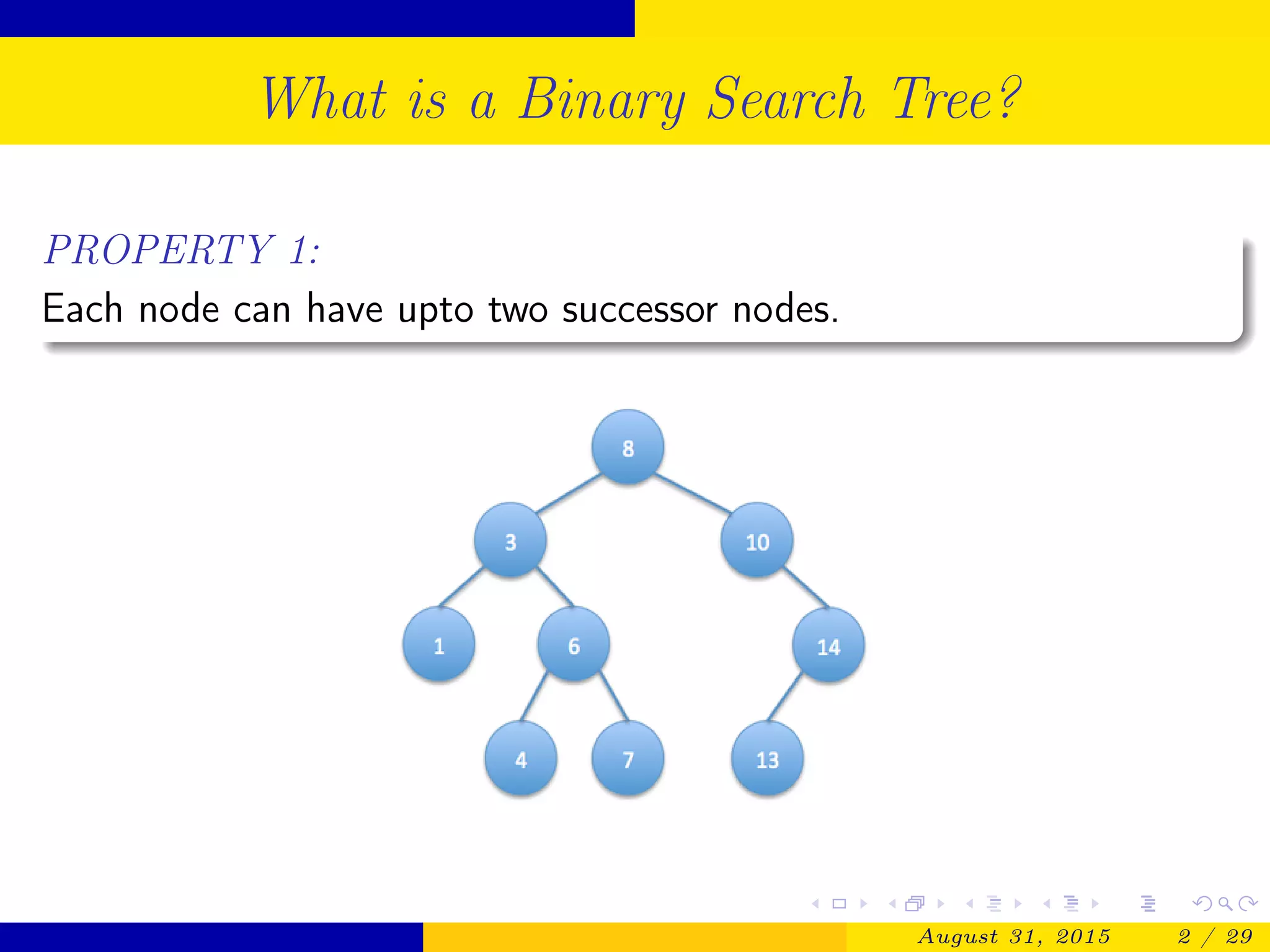
PROPERTY 1:
Each node can have upto two successor nodes.
August 31, 2015 2 / 29
3.
What is aBinary Search Tree?
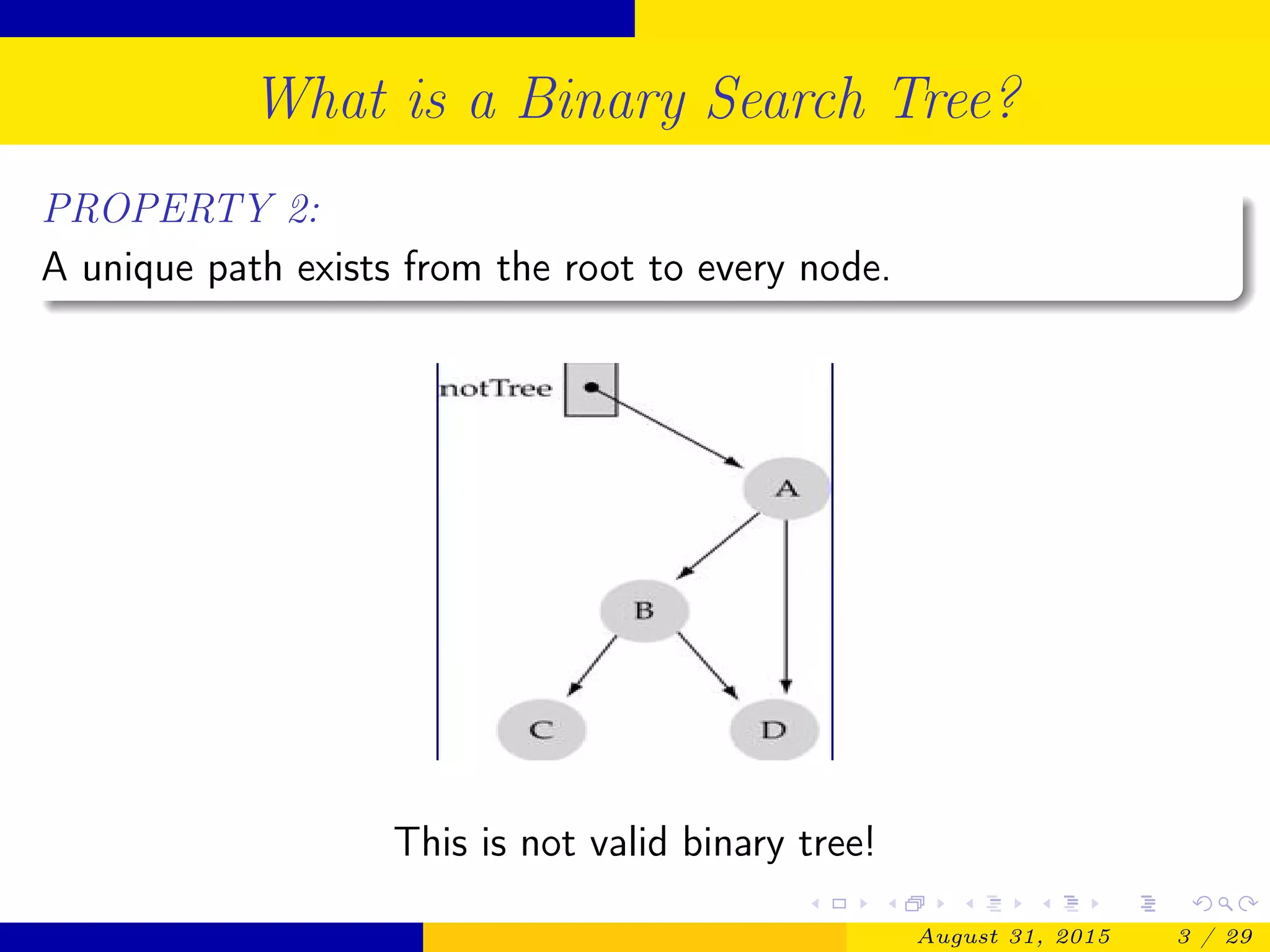
PROPERTY 2:
A unique path exists from the root to every node.
This is not valid binary tree!
August 31, 2015 3 / 29
4.
Some Basic Information
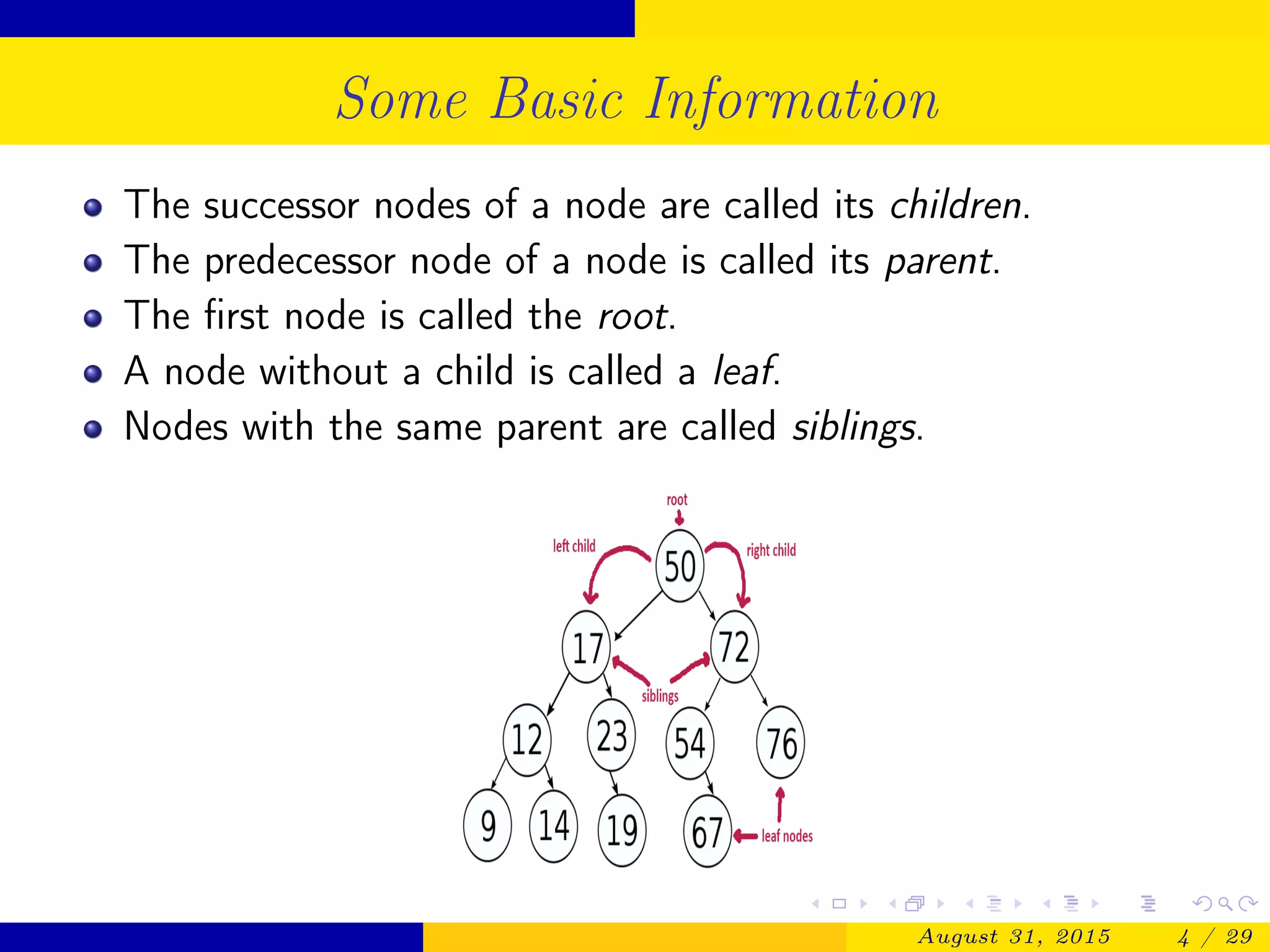
Thesuccessor nodes of a node are called its children.
The predecessor node of a node is called its parent.
The first node is called the root.
A node without a child is called a leaf.
Nodes with the same parent are called siblings.
August 31, 2015 4 / 29
5.
Basic Information(Cont.)
Nodes areorganized in levels.indexed from 0.
Level(or depth) of a node is the number of edges in the path
from the root to that node.
Height of a tree (h):No. of levels (L)
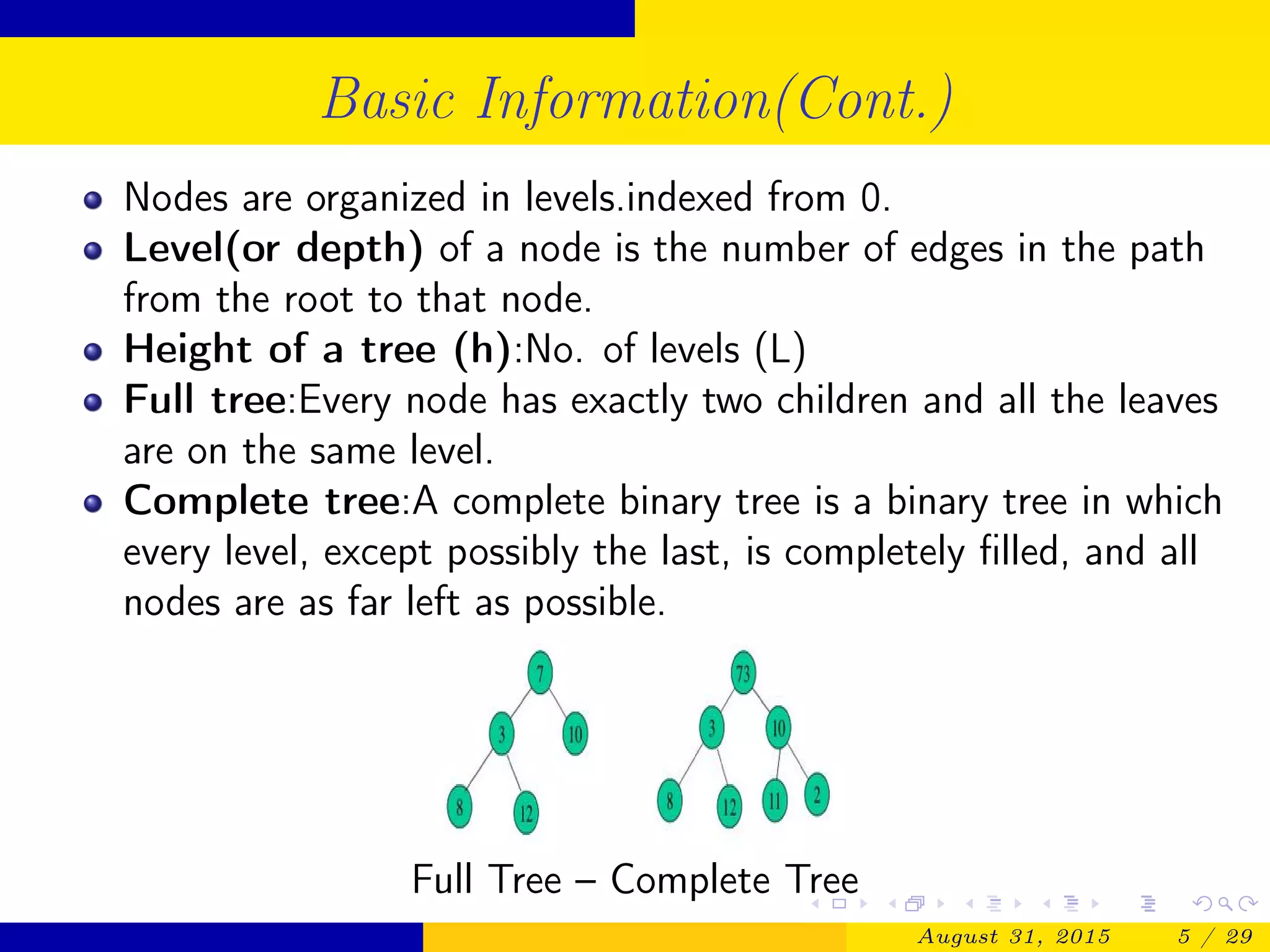
Full tree:Every node has exactly two children and all the leaves
are on the same level.
Complete tree:A complete binary tree is a binary tree in which
every level, except possibly the last, is completely filled, and all
nodes are as far left as possible.
Full Tree – Complete Tree
August 31, 2015 5 / 29
6.
Binary Search TreeProperty
-
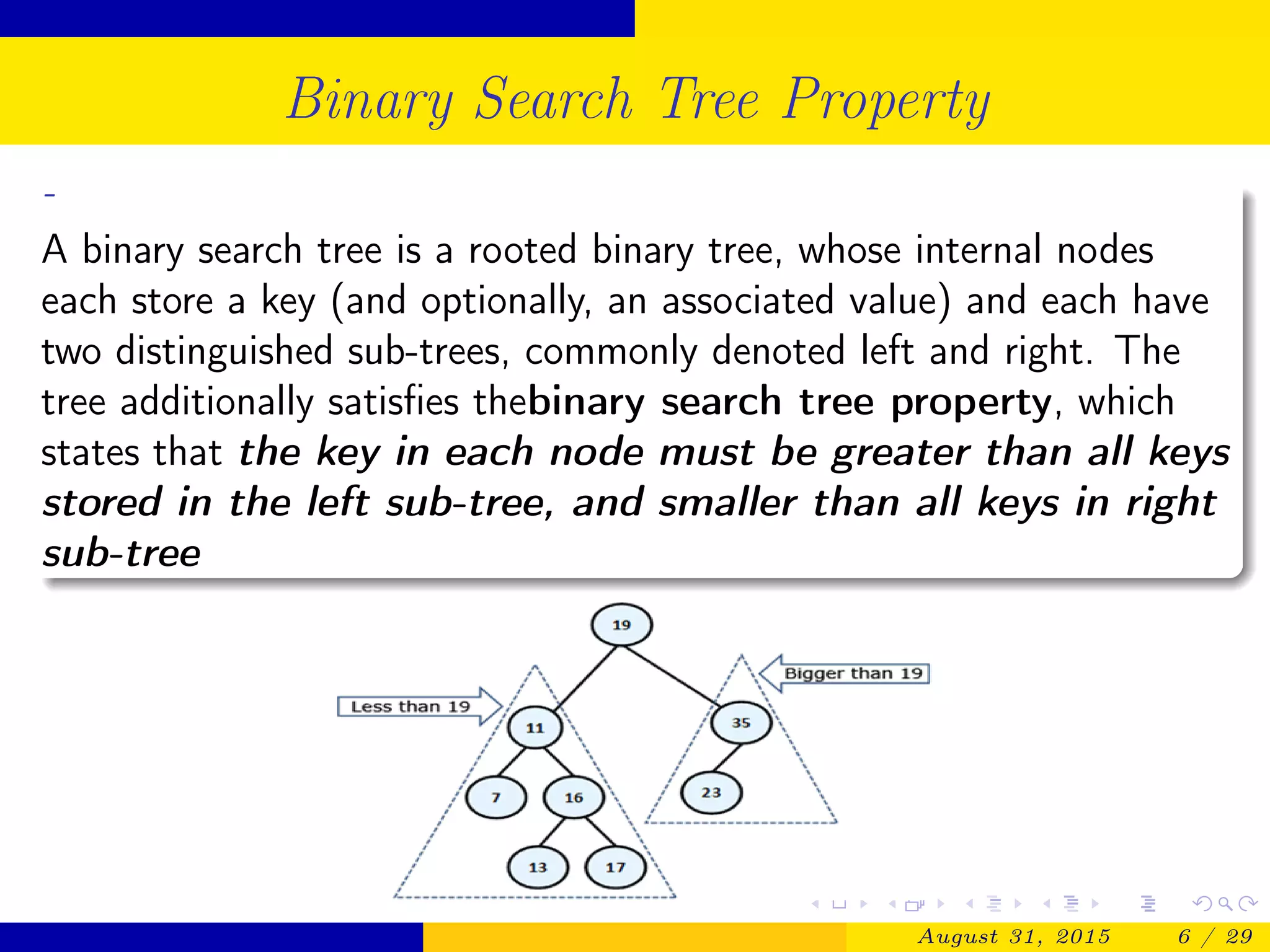
A binary search tree is a rooted binary tree, whose internal nodes
each store a key (and optionally, an associated value) and each have
two distinguished sub-trees, commonly denoted left and right. The
tree additionally satisfies thebinary search tree property, which
states that the key in each node must be greater than all keys
stored in the left sub-tree, and smaller than all keys in right
sub-tree
August 31, 2015 6 / 29
7.
Max No.of Nodes
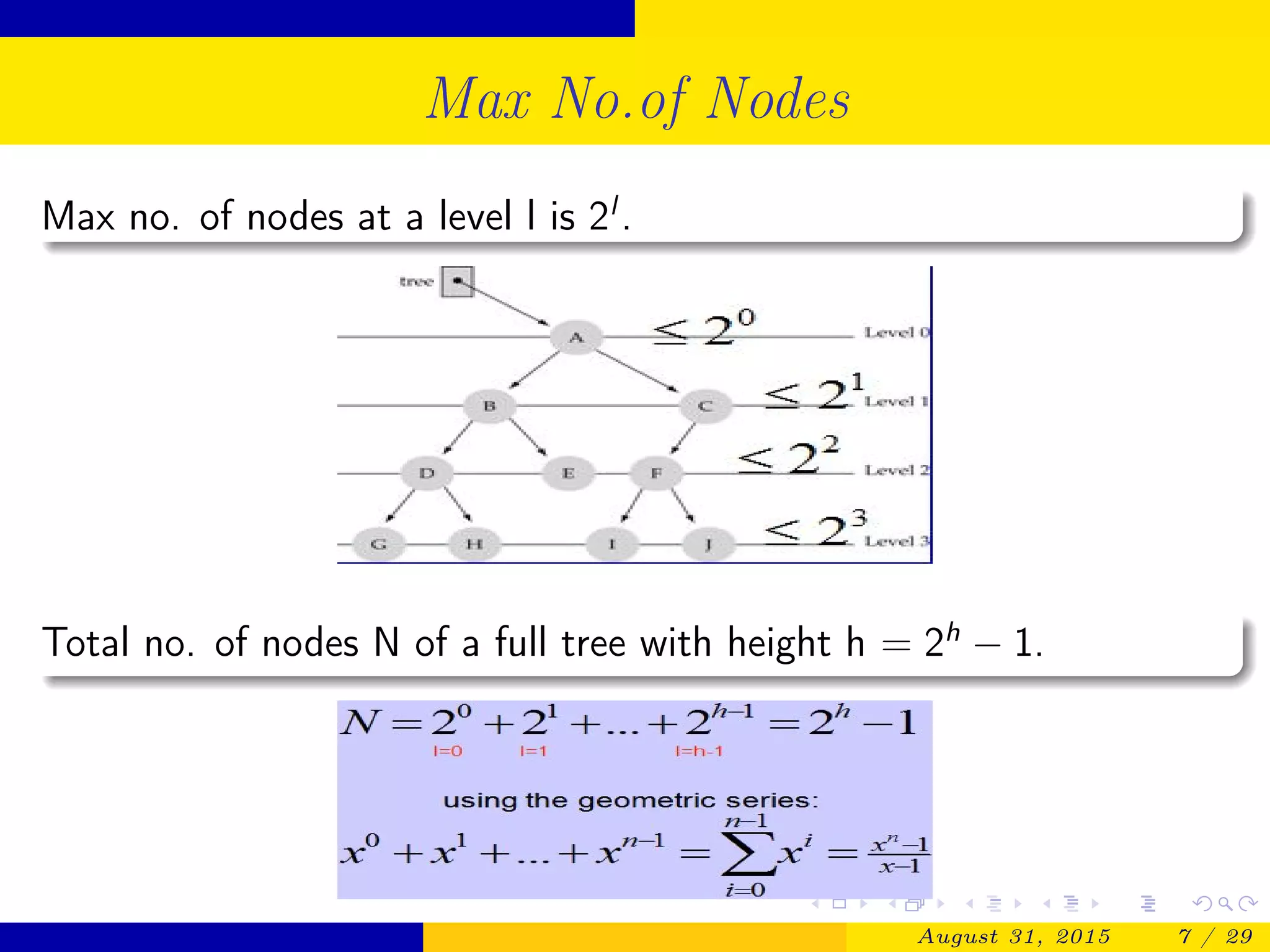
Maxno. of nodes at a level l is 2l
.
Total no. of nodes N of a full tree with height h = 2h
− 1.
August 31, 2015 7 / 29
8.
Height h ANDIt’s Importance
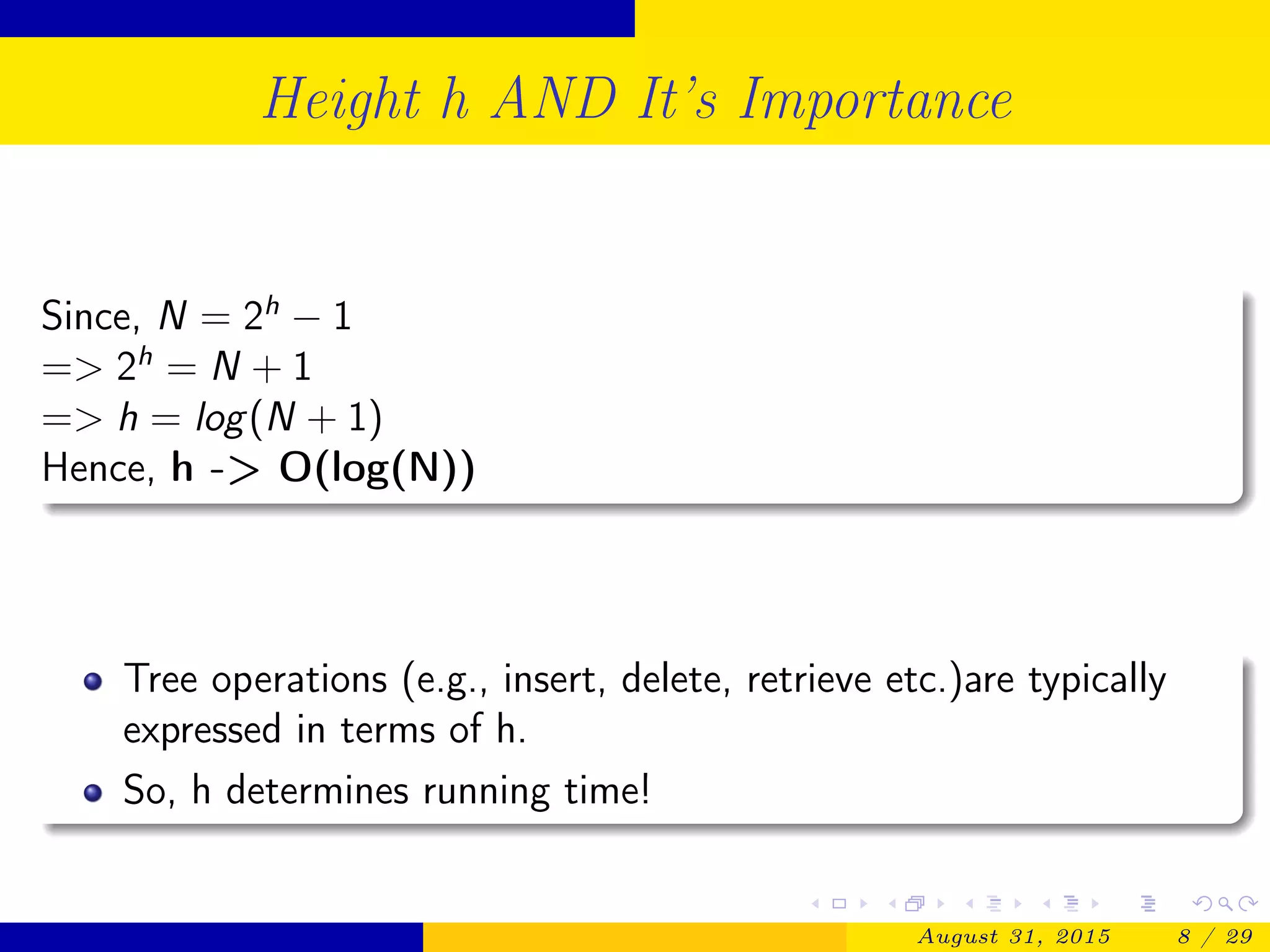
Since, N = 2h
− 1
=> 2h
= N + 1
=> h = log(N + 1)
Hence, h -> O(log(N))
Tree operations (e.g., insert, delete, retrieve etc.)are typically
expressed in terms of h.
So, h determines running time!
August 31, 2015 8 / 29
9.
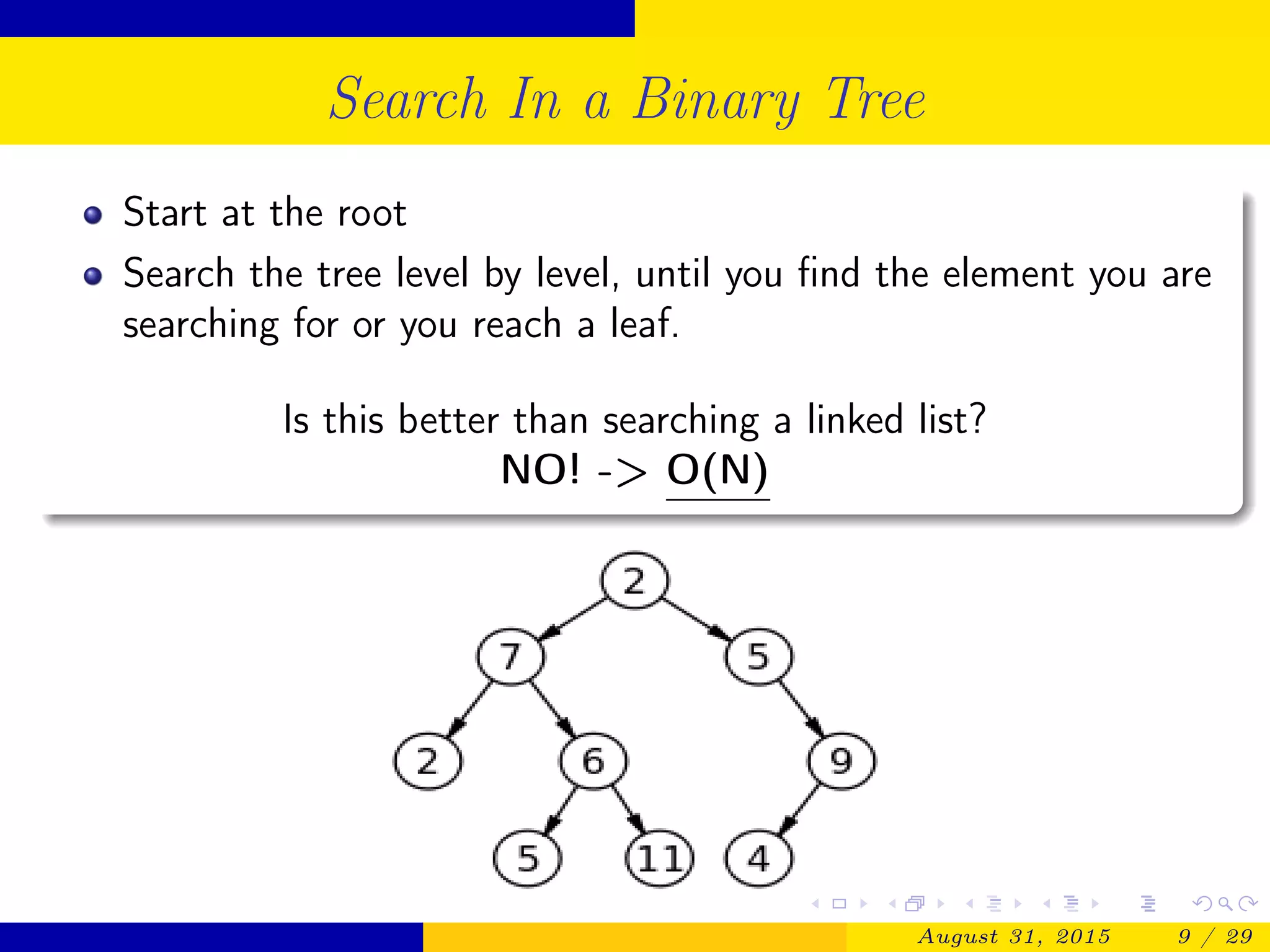
Search In aBinary Tree
Start at the root
Search the tree level by level, until you find the element you are
searching for or you reach a leaf.
Is this better than searching a linked list?
NO! -> O(N)
August 31, 2015 9 / 29
10.
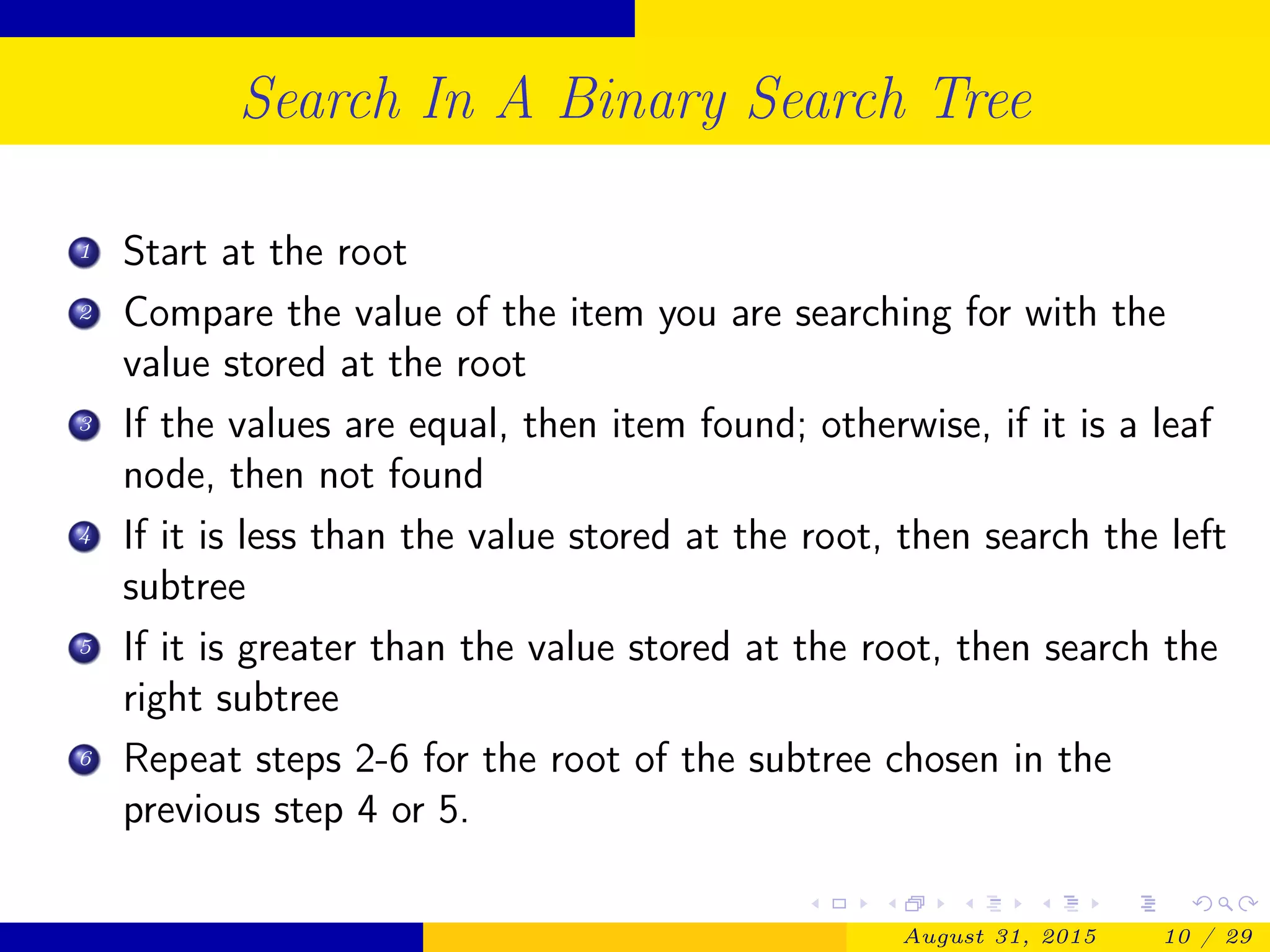
Search In ABinary Search Tree
1 Start at the root
2 Compare the value of the item you are searching for with the
value stored at the root
3 If the values are equal, then item found; otherwise, if it is a leaf
node, then not found
4 If it is less than the value stored at the root, then search the left
subtree
5 If it is greater than the value stored at the root, then search the
right subtree
6 Repeat steps 2-6 for the root of the subtree chosen in the
previous step 4 or 5.
August 31, 2015 10 / 29
11.
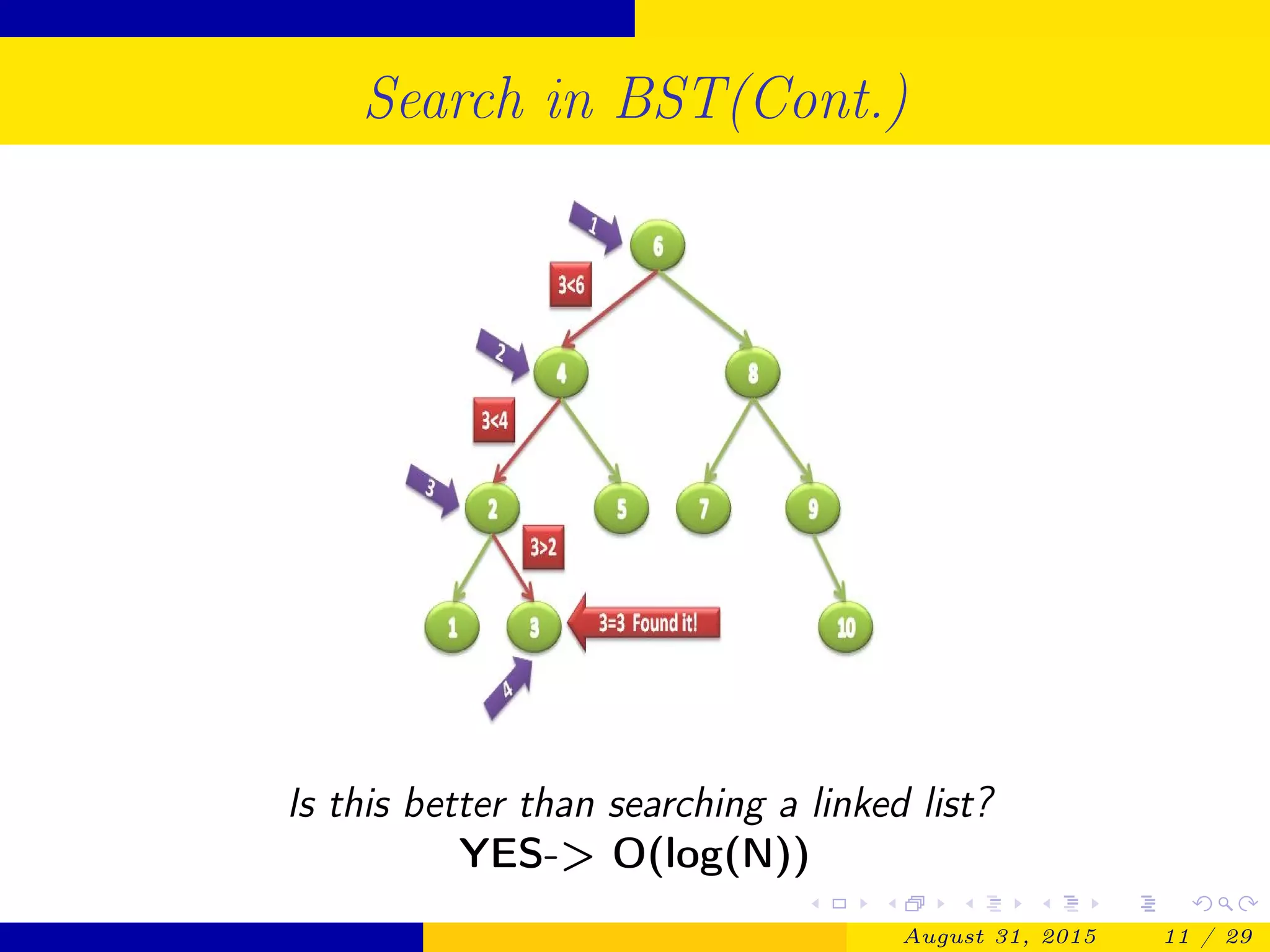
Search in BST(Cont.)
Isthis better than searching a linked list?
YES-> O(log(N))
August 31, 2015 11 / 29
12.
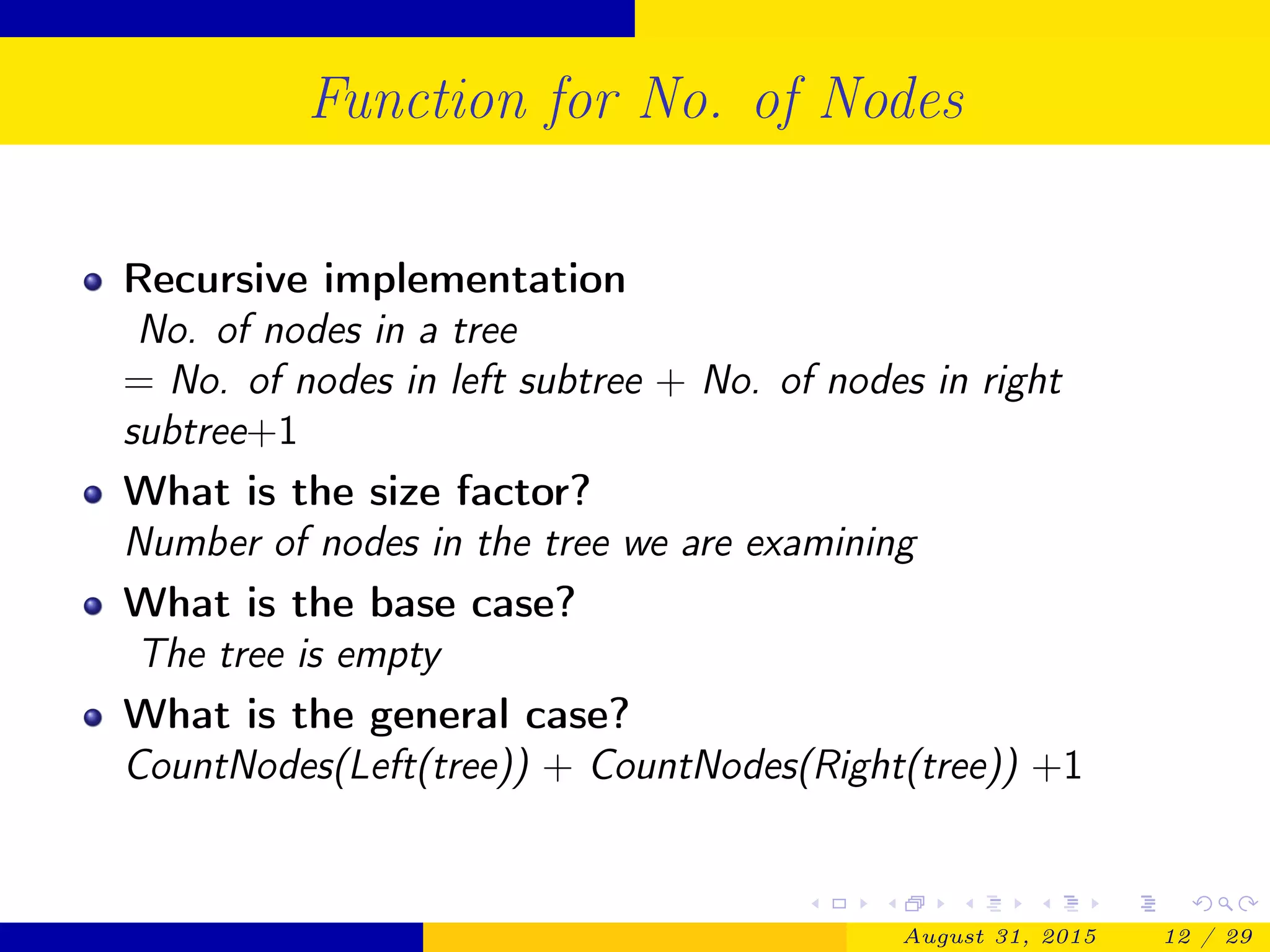
Function for No.of Nodes
Recursive implementation
No. of nodes in a tree
= No. of nodes in left subtree + No. of nodes in right
subtree+1
What is the size factor?
Number of nodes in the tree we are examining
What is the base case?
The tree is empty
What is the general case?
CountNodes(Left(tree)) + CountNodes(Right(tree)) +1
August 31, 2015 12 / 29
13.
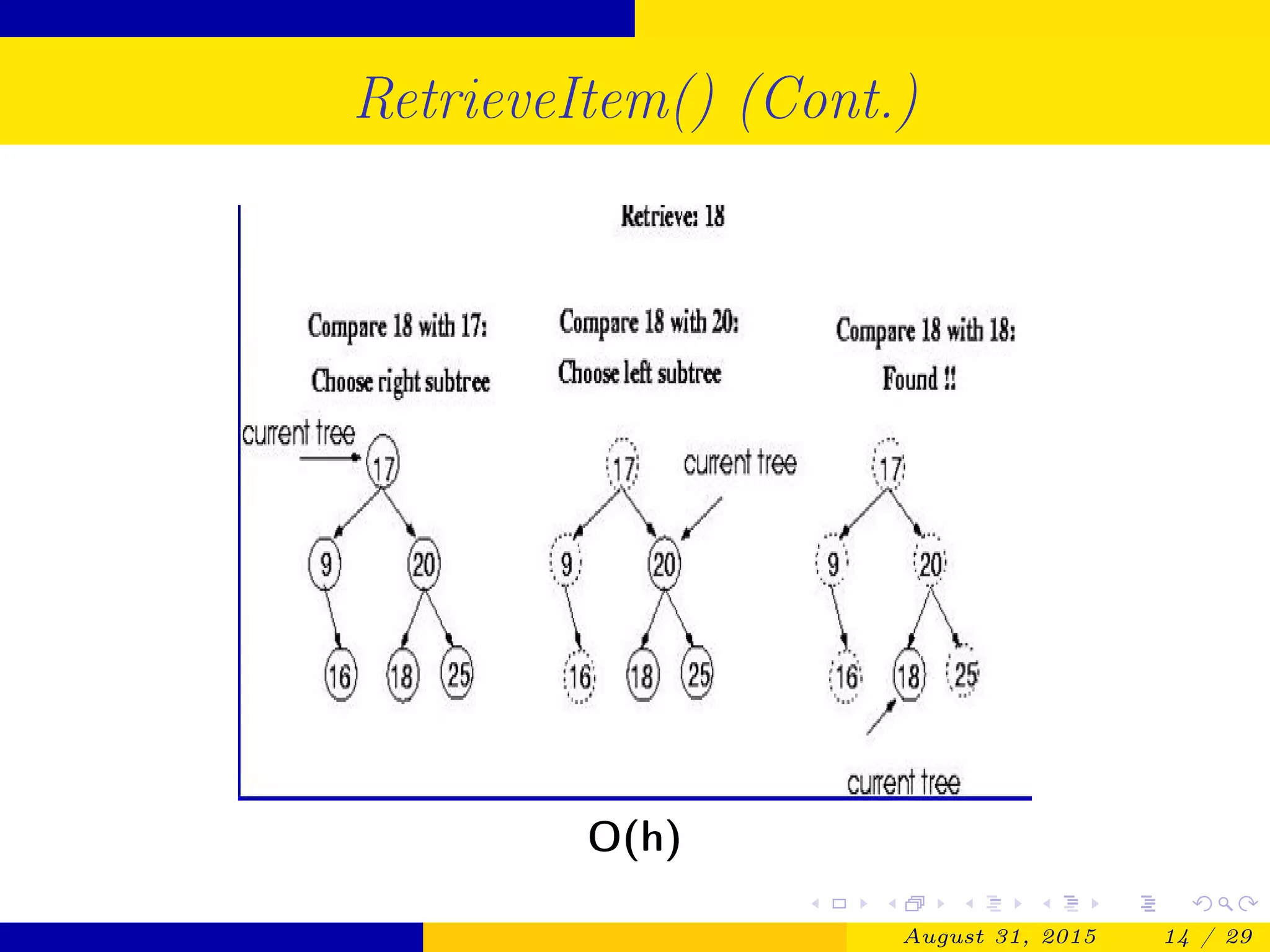
Function RetrieveItem()
What isthe size of the problem?
Number of nodes in the tree we are examining
What is the base case(s)?
1 When the key is found
2 The tree is empty (key was not found)
What is the general case?
Search in the left or right subtrees
August 31, 2015 13 / 29
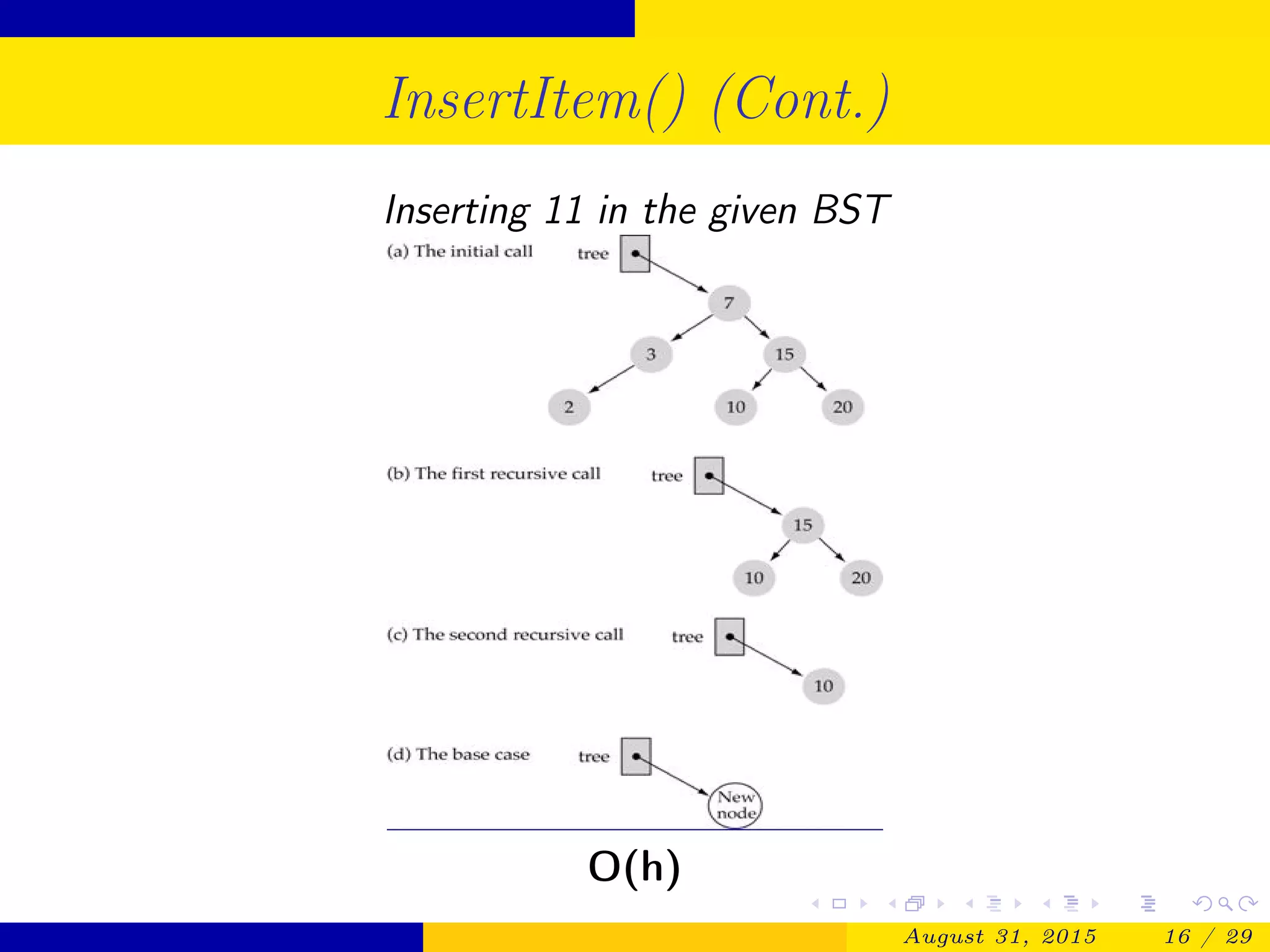
Function InsertItem()
What isthe size of the problem?
Number of nodes in the tree we are examining
What is the base case(s)?
The tree is empty
What is the general case?
Choose the left or right subtree
August 31, 2015 15 / 29
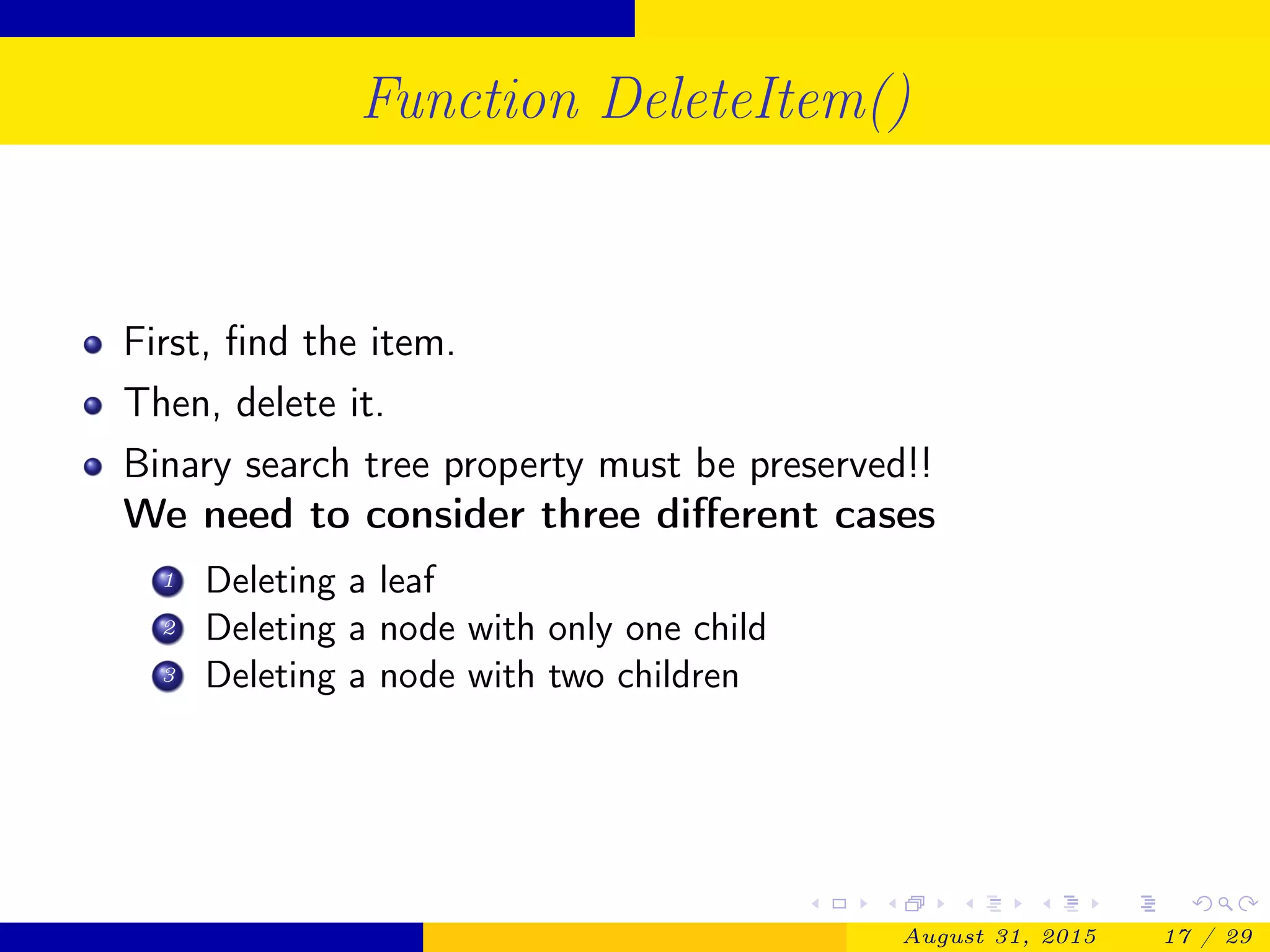
Function DeleteItem()
First, findthe item.
Then, delete it.
Binary search tree property must be preserved!!
We need to consider three different cases
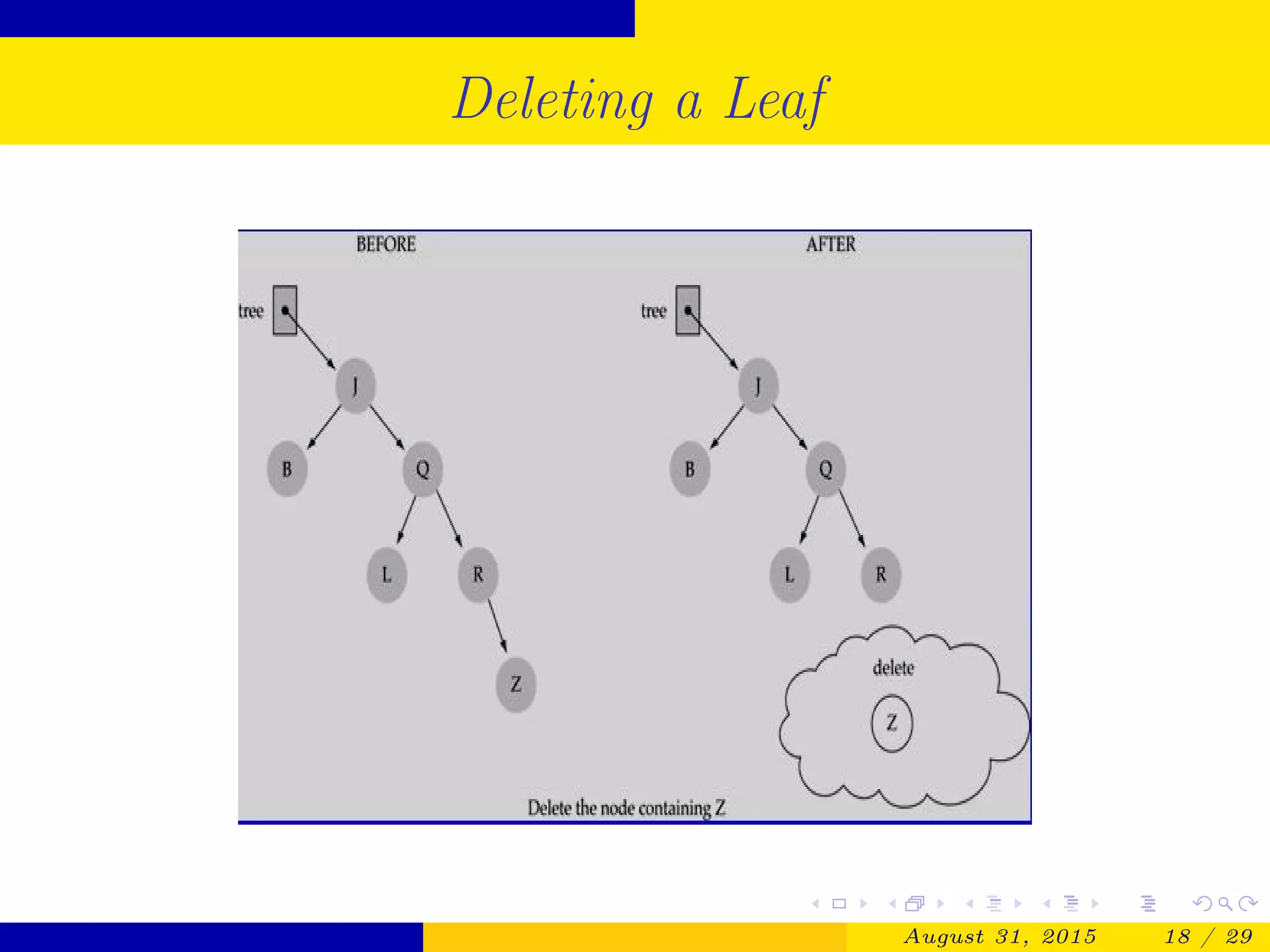
1 Deleting a leaf
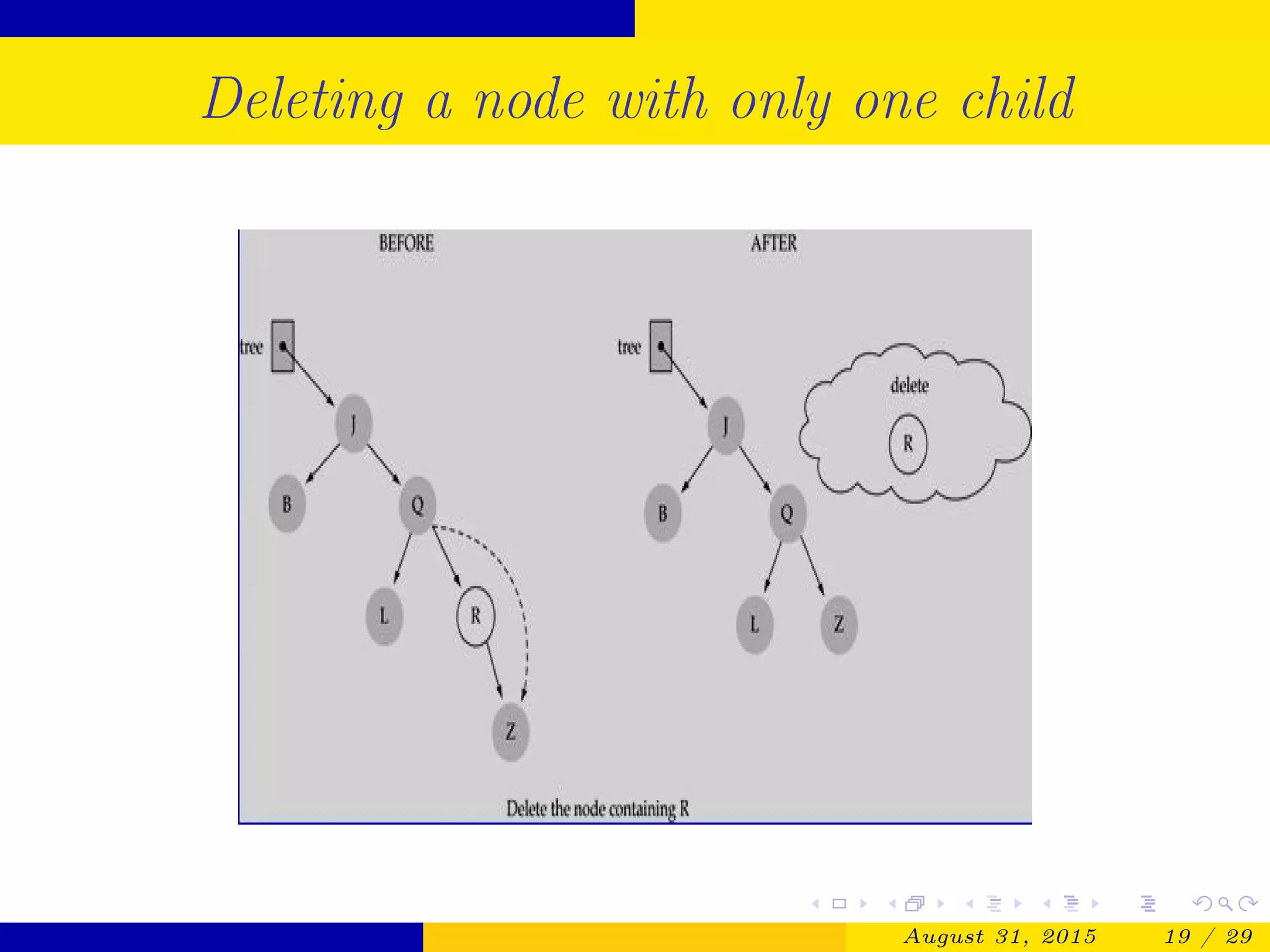
2 Deleting a node with only one child
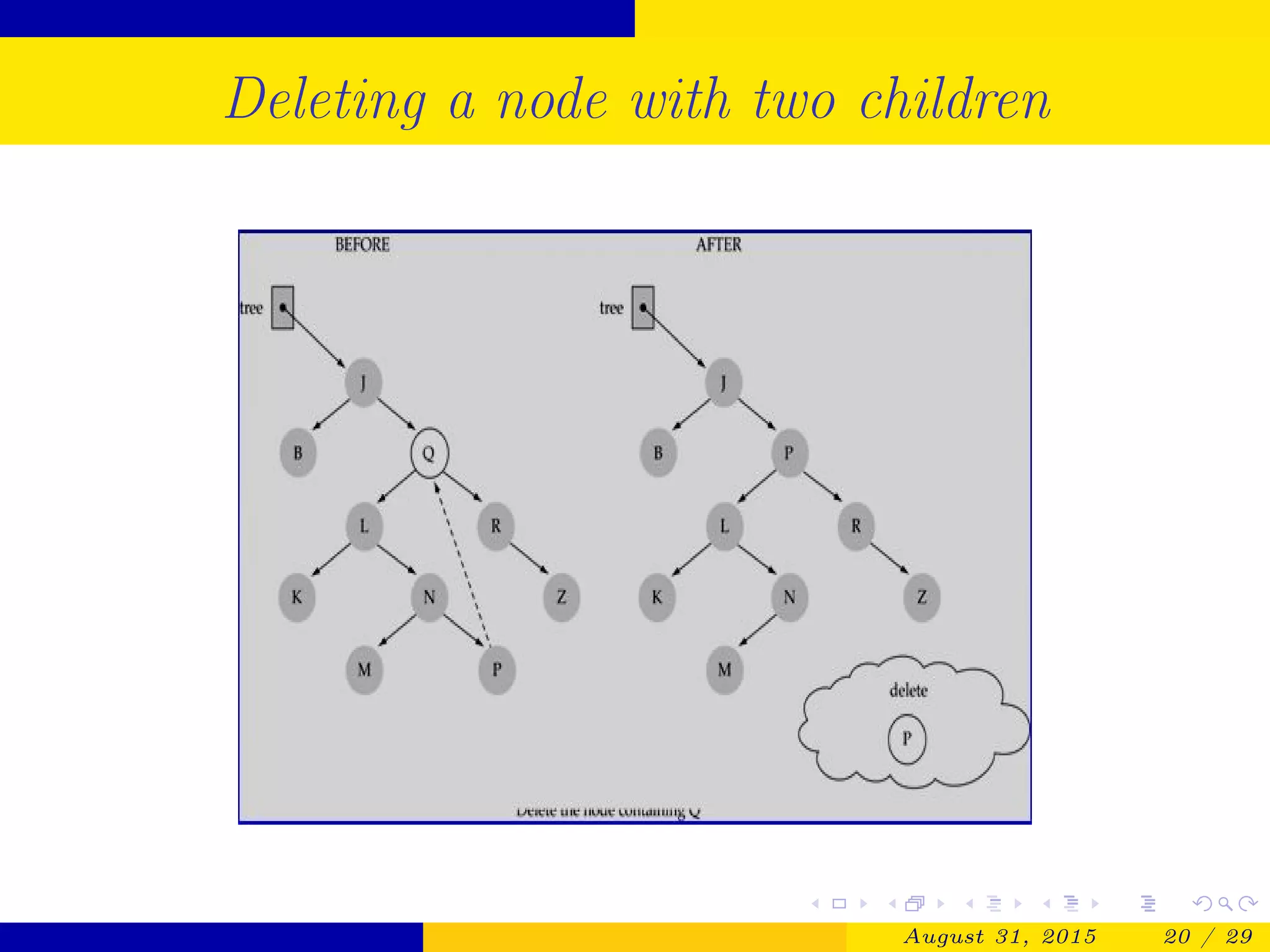
3 Deleting a node with two children
August 31, 2015 17 / 29
Deleting a nodewith two children(Cont.)
Find predecessor (i.e., rightmost node in the left subtree)
Replace the data of the node to be deleted with predecessor’s
data
Delete predecessor node
August 31, 2015 21 / 29
22.
Function DeleteItem()
What isthe size of the problem?
Number of nodes in the tree we are examining
What is the base case(s)?
Key to be deleted was found
What is the general case?
Choose the left or right subtree
August 31, 2015 22 / 29
23.
Traversals
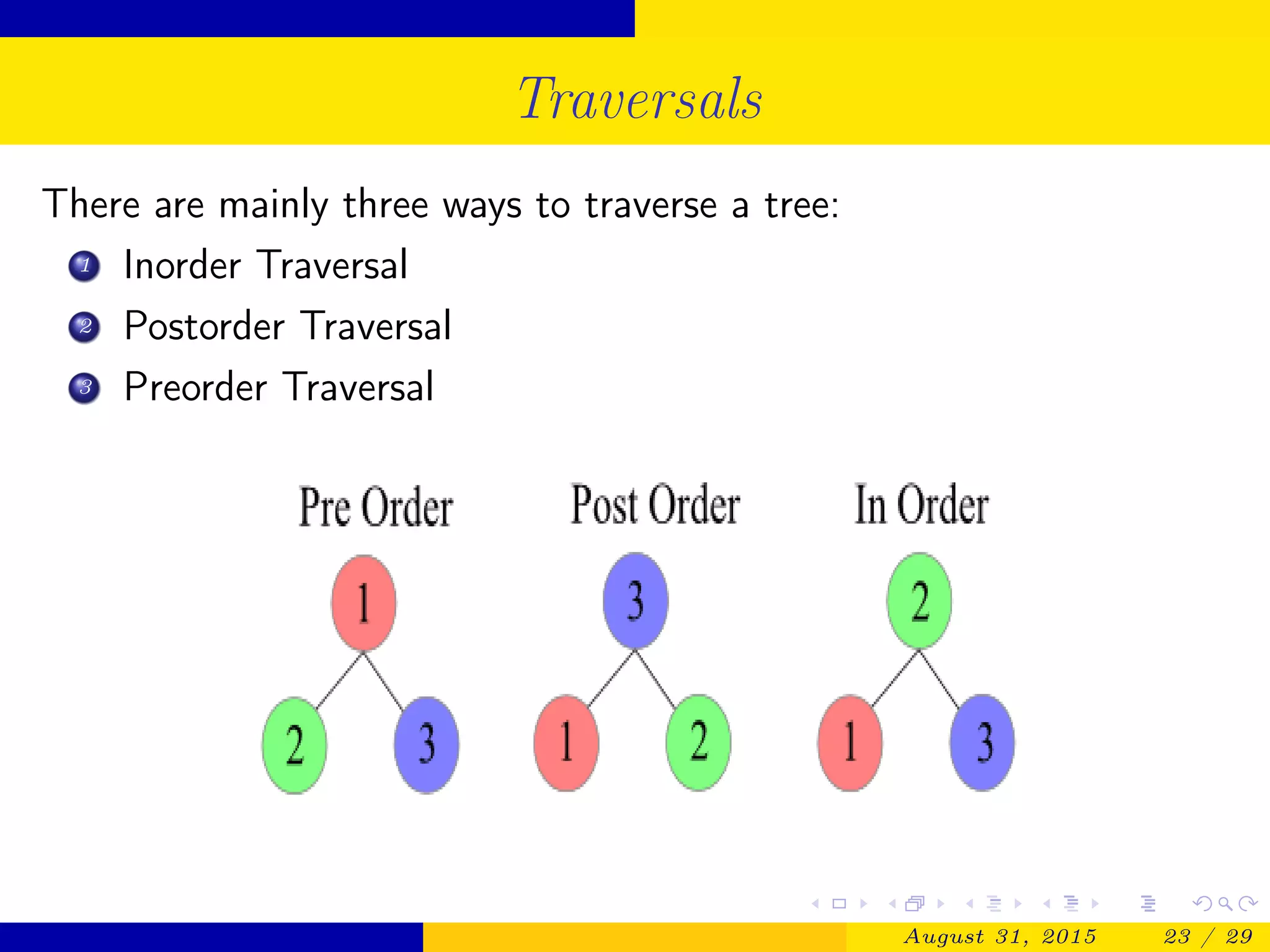
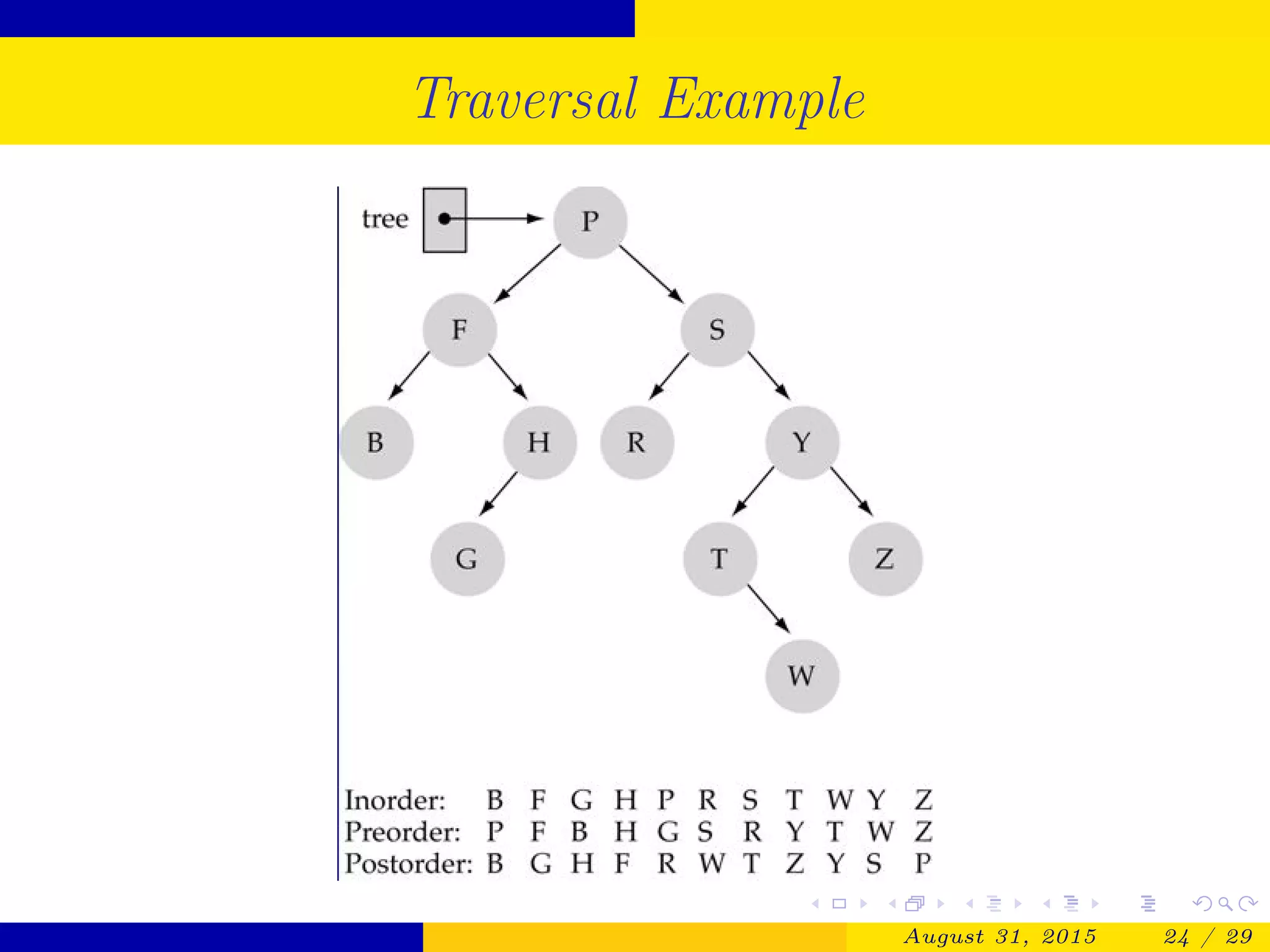
There are mainlythree ways to traverse a tree:
1 Inorder Traversal
2 Postorder Traversal
3 Preorder Traversal
August 31, 2015 23 / 29
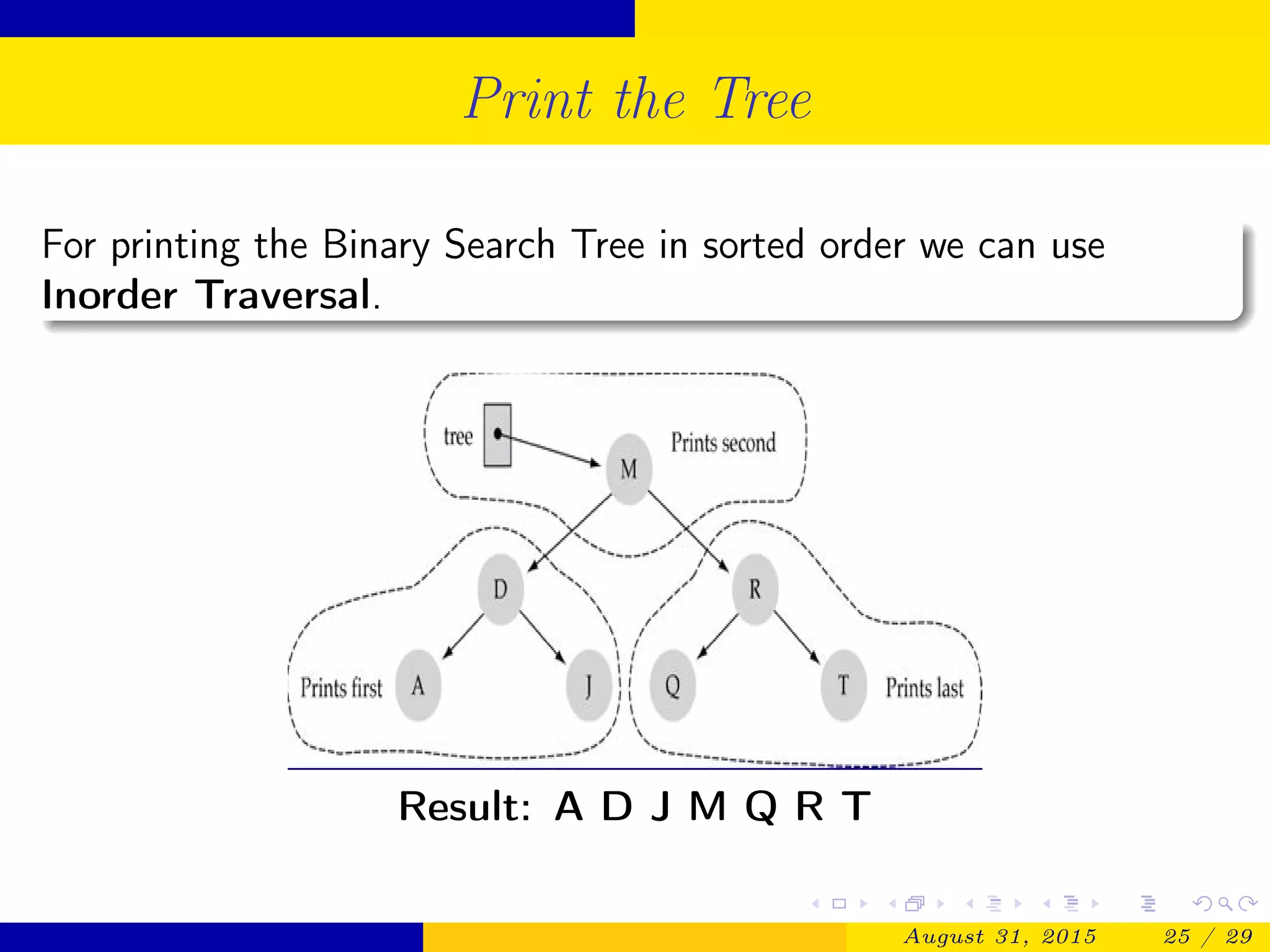
Print the Tree
Forprinting the Binary Search Tree in sorted order we can use
Inorder Traversal.
Result: A D J M Q R T
August 31, 2015 25 / 29
26.
Use Of ABinary Search Tree
In comparison to other trees using a Binary Search Tree we can
efficiently perform the following:
Search for a particular element.
Sorting of elements.
Find Maximum/Minimum.
Delete a particular element.
August 31, 2015 26 / 29