UNIT III- NON LINEAR DATA STRUCTURES –
TREES
Tree ADT – Tree traversals - Binary Tree ADT –
Expression trees – Applications Of Trees – Binary
Search Tree ADT – Threaded Binary Trees- AVL
Trees – B-Tree - B+ Tree - Heap – Applications of
heap.
TREES
❖ A tree is recursively defined as a set of one or more
nodes where one node is designated as the root of the
tree and
❖ All the remaining nodes can be partitioned into non-
empty sets each of which is a sub-tree of the root.
❖ A tree structure means that the data are organized so
that items of information are related by branches.
❖ Trees organize information hierarchically.
❖ A tree is a collection of elements (nodes)
TREES EXAMPLE
TREE TERMINOLOGIES
❖ Root – A node which does not have a parent. Root
is A.
❖ Node – Item of Information.
❖ Leaf – A node which does not have a child is called
Leaf or Terminal node. Here B,K,L,G,H,M,J are
leafs.
❖ Siblings - Children of the same parents are said to
be siblings.
❖ Path – A path from node n1 to nk is defined as the
sequence of nodes n1, n2, n3, ... nk such that ni is
the parent of ni+1 for 1<=i<=k. There is exactly one
path from each node to root.
TREE TERMINOLOGIES
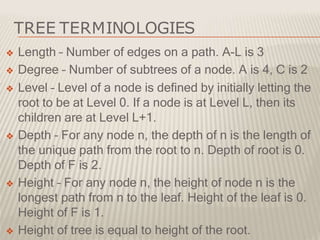
❖ Length – Number of edges on a path. A-L is 3
❖ Degree – Number of subtrees of a node. A is 4, C is 2
❖ Level – Level of a node is defined by initially letting the
root to be at Level 0. If a node is at Level L, then its
children are at Level L+1.
❖ Depth – For any node n, the depth of n is the length of
the unique path from the root to n. Depth of root is 0.
Depth of F is 2.
❖ Height – For any node n, the height of node n is the
longest path from n to the leaf. Height of the leaf is 0.
Height of F is 1.
❖ Height of tree is equal to height of the root.
BINARY TREE
❖ Binary Tree is a tree in which no node can have more
than two children.
❖ A binary tree is a hierarchical data structure in which
each node has at most two children generally referred
as left child and right child.
❖ Maximum number of nodes at level L of a binary tree is
2L
❖ Maximum number of nodes at Height H of a binary tree
is 2H - 1 , General Tree has many number of children.
BINARY TREE NODE DECLARATION
Struct TreeNode
{
int Element;
Struct TreeNode *Left;
Struct TreeNode *Right;
}
TYPES OF BINARY TREES
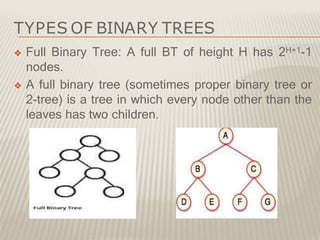
❖ Full Binary Tree: A full BT of height H has 2H+1-1
nodes.
❖ A full binary tree (sometimes proper binary tree or
2-tree) is a tree in which every node other than the
leaves has two children.
COMPLETE BINARY TREE
❖ A complete binary tree is a binary tree in which every
level, except possibly the last, is completely filled, and all
nodes are as far left as possible.
❖ A complete BT of height H has between 2H and 2H+1-1
nodes.
❖ In Last level, the elements should be filled from left to
right.
❖ A FBT can be a CBT, but all CBT is not a FBT.
REPRESENTATION OF A BINARY
TREES
There are two ways for representing BT
❖ Linear Representation
❖ Linked Representation
LINEAR REPRESENTATION
❖ The elements are represented using arrays.
❖ For any element in position i,
❖ The left child is in position (2i )
❖ The right child is in position (2i+1)
❖ The parent is in position (i/2)
LINKED REPRESENTATION
❖ The elements represented using pointers.
❖ Each node in linked representation has three fields.
Namely
❖ Pointer to the Left Subtree
❖ Data Field
❖ Pointer to the Right Subtree
❖ In Leaf nodes both pointer fields are assigned as
NULL.
LINKED REPRESENTATION
FIRST CHILD NEXT SIBLING
REPRESENTATION
❖ In this type representation, cellspace contains three
field’s namely leftmost child, label and rightmost
child.
❖ A node in identified with the index of the cell in
cellspace that represents it as a child.
❖ Then the next pointers of cellspace point to right
siblings and the information contained in the
nodespace array can be held by introducing a field
leftmost child in cellspace.
EXAMPLE
TREE TRAVERSAL
❖ Tree traversal is a method for visiting all the node in
the tree exactly once.
❖ There are 3 types of tree traversal techniques
❖ Inorder Traversal
❖ Preorder Traversal
❖ Postorder Traversal
INORDER TRAVERSAL –(LEFT, ROOT,
RIGHT )
The Inorder traversal of a Binary tree is performed as
❖ Traverse the LEFT subtree in Inorder
❖ Visit the ROOT
❖Traverse the RIGHT subtree in Inorder
Ex : Inorder : D B E A F C G
EXAMPLE
❖ Inorder : A B C D E G H I J K
RECURSIVE ROUTINE FOR INORDER
void inorder(Tree T)
{
if (T!=NULL)
{
inorder (T🡪 left);
printElement (T🡪 Element);
inorder (T🡪 right);
}
}
PREORDER TRAVERSAL -(ROOT,LEFT
,RIGHT )
The Preorder traversal of a Binary tree is performed
as
❖ Visit the ROOT
❖ Traverse the LEFT subtree in Inorder
❖Traverse the RIGHT subtree in Inorder
Ex: Preorder : A B D E C F G
EXAMPLE
❖ Preorder : D C A B I G E H K J
RECURSIVE ROUTINE FOR
PREORDER
void preorder(Tree T)
{
if (T!=NULL)
{
printElement (T🡪 Element);
preorder (T🡪
preorder (T🡪
left);
right);
}
}
POSTORDER TRAVERSAL -(LEFT ,RIGHT,
ROOT )
The Postorder traversal of a Binary tree is performed
as
❖ Traverse the LEFT subtree in Inorder
❖ Traverse the RIGHT subtree in Inorder
❖ Visit the ROOT
Ex: Postorder : D E B F G C A
EXAMPLE
❖ Postorder : B A C E H G J K I D
RECURSIVE ROUTINE FOR
POSTORDER
void preorder(Tree T)
{
if (T!=NULL)
{
postorder (T🡪
postorder (T🡪
left);
right);
printElement (T🡪 Element);
}
}
EXPRESSION TREE
❖ It is a binary tree in which the leaf nodes are
operands and the interior nodes are operators.
❖ Like binary tree, Expression tree can also traversed
by Inorder, Preorder and Postorder traversal.
CONSTRUCTING AN EXPRESSION
TREE
❖ Read one symbol at a time from the postfix
expression.
❖ Check whether the symbol is an operand or
operator
(a) If the symbol is an operand, create a one
node tree and push a pointer on to the stack.
(b)If the symbol is an operator pop two pointers
from the stack namely T1 and T2 and form a
new tree with root as the operator and T2 as a left
child and T1 as a right child. A pointer to this
new tree is then pushed onto the stack.
EXAMPLE
Expression : Infix : a*(b+c)/d 🡪 Postfix: abc+*d/
APPLICATIONS OF TREE
❖ Binary Search Tree.
❖ Expression Tree.
❖ Threaded Binary Tree.
❖ B and B+ Tree.
BINARY SEARCH TREE
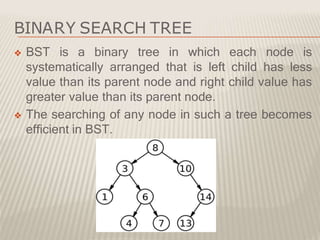
❖ BST is a binary tree in which each node is
systematically arranged that is left child has less
value than its parent node and right child value has
greater value than its parent node.
❖ The searching of any node in such a tree becomes
efficient in BST.
BINARY SEARCH TREE
❖ Every BST is a Binary Tree.
❖ All Binary Trees need not be a BST.
❖ left_subtree (keys) < node (key) ≤ right_subtree (keys)
Node Declartion
Struct node
{
int data;
struct node *leftChild;
struct node *rightChild;
};
ADVANTAGE OF BST
❖ The major advantage of binary search trees over
other data structures is that the related sorting
algorithms and search algorithms such as in-order
traversal can be very efficient.
OPERATIONS ON BST
❖ Insertion
❖ Find
❖ Find Min
❖ Find Max
❖ Deletion
Case 1 : Node with no Children
Case 2: Node with One Child
Case 3: Node with Two Child
INSERTION ALGORITHM
SearchTree Insert(int X,SearchTree T)
{
if(T==NULL)
{
T=malloc(sizeof(Struct TreeNode));
if(T!=NULL)
{
T🡪 Element=x;
T🡪 Left=NULL;
T🡪 Right=NULL;
}
}
else
If(X<T🡪 Element)
T🡪 Left=Insert(X,T🡪 Left);
else
If(X>T🡪 Element)
T🡪 Right=Insert(X,T🡪 Right);
return T;
}
INSERTION ALGORITHM –EXAMPLE 1
INSERTION ALGORITHM –EXAMPLE
2
INSERTION ALGORITHM –EXAMPLE
3
FINDMIN
❖ This operation returns the position of the smallest
element in the tree.
❖ To perform FindMin start at the root and go left as
there is a left child.
❖ The stopping point is the smallest element.
FIND MIN
NON RECURSIVE
int FindMin(SearchTree T)
{
if(T!=NULL)
while(T🡪 Left!=NULL)
T=T🡪 Left;
return T;
}
RECURSIVE
int FindMin(SearchTree T)
{
if(T==NULL)
return NULL;
else if(T🡪 Left==NULL)
return T;
else
return FindMin(T🡪 Left);
}
FINDMAX
❖ This operation returns the position of the largest
element in the tree.
❖ To perform FindMax start at the root and go right as
there is a left child.
❖ The stopping point is the largest element.
FIND MAX
NON RECURSIVE
int FindMax(SearchTree T)
{
if(T!=NULL)
while(T🡪 Right!=NUL
L)
T=T🡪 Right;
return T;
}
RECURSIVE
int FindMax(SearchTree T)
{
if(T==NULL)
return NULL;
else
if(T🡪 Right==NULL)
return T;
else
return
FindMax(T🡪 Right);
}
DELETION
❖ Deletion operation is the complex in BST.
Case 1 : Node with no Children
Case 2: Node with One Child
Case 3: Node with Two Child
CASE 1:NODE WITH NO CHILDREN
CASE 2: NODE WITH ONE CHILD
CASE 3: NODE WITH TWO CHILD
STRATEGY FOR CASE 3
❖ Strategy 1 : The general strategy is to replace the
data if the node to be deleted with its smallest data
of the right subtree and recursively delete that
node.
❖ Strategy 2: Using Inorder
□ First find the successor (or predecessor) of the this node.
□ Delete the successor (or predecessor) from the tree.
□ Replace the node to be deleted with the successor
(or predecessor)
CASE 3: NODE WITH TWO CHILD
DELETION ROUTINE
SearchTree Delete(int X, SearchTree T)
{
int Tmpcell;
if(T==NULL)
Error(“Tree is Empty”);
else
if(X<T🡪 Element)
T🡪 Left=Delete(X,T🡪 Left);
else
if(X>T🡪 Element)
T🡪 Right=Delete(X,T🡪 Right);
DELETION ROUTINE –CONT.,
else //TwoChildren (Replace with smallest data in the right subtree)
if(T🡪 Left && T🡪 Right)
{
Tmpcell=FindMin(T🡪 Right);
T🡪 Element=Tmpcell🡪 Element;
T🡪 Right=Delete(T🡪 Element;T🡪 Right);
}
else /
/
One or Zero Children
{
Tmpcell=T;
if(T🡪 Left==NULL)
T=T🡪 Right;
if(T🡪 Right==NULL)
T=T🡪 Left;
Free(Tmpcell);
}
return T;
}
THREADED BINARY TREE
❖ In TBT the leaf nodes are having the NULL values in
the left and right link fields.
❖ To avoid the NULL value the threads are used.
❖ The threads are nothing but the links to predecessor
and successor nodes.
❖ Instead of left NULL pointer the link points to Inorder
predecessor.
❖ Instead of right NULL pointer the link points to Inorder
successor.
THREADED BINARY TREE
❖ Inorder : 50 60 65 70 78 80 90 95 98
TYPES OF TBT
There are two types
❖ One way Threading
❖ Two way Threading
ONE WAY THREADING
❖ Accordingly, in the one way threading of T, a thread
will appear in the right field of a node and will point
to the next node in the in-order traversal of T.
❖ See the bellow example of one-way in-order
threading.
EXAMPLE
❖ Inorder of bellow tree is: D,B,F,E,A,G,C,L,J,H,K
TWO WAY THREADING
❖ A thread will also appear in the left field of a node
and will point to the preceding node in the in-order
traversal of tree T.
❖ Furthermore, the left pointer of the first node and
the right pointer of the last node (in the in-order
traversal of T) will contain the null value when T
does not have a header node.
EXAMPLE
❖ Here, right pointer=next node of in-order traversal
and left pointer=previous node of in-order traversal
❖ Inorder of bellow tree is: D,B,F,E,A,G,C,L,J,H,K
AVL TREE –(ADELSON,VELSKILL & LANDIS)
❖ AVL tree is a binary search tree except that for
every node in the tree, the height of the left and
right subtree can differ by almost 1.
❖ The height of the empty tree is defined to be -1.
❖ Balance factor:
Height of the Left Subtree - Height of the Right
Subtree
AVL TREE –(ADELSON,VELSKILL & LANDIS)
❖ For an AVL tree all balance factor should be +1,0,-
1.
❖ If the balance factor of any node in an AVL tree
becomes less than -1 or greater than 1, then the
tree has to be balanced by making either single or
double rotations.
ROTATIONS
An AVL tree causes imbalance, when any one of the
following conditions occur.
❖ Case 1: An insertion into the left subtree of the left child.
❖ Case 2: An insertion into the right subtree of the left child.
❖ Case 3: An insertion into the left subtree of the right child.
❖ Case 4: An insertion into the right subtree of the right
child.
These imbalances can be overcome by
❖ 1.Single Rotation – Performed to fix Case 1 and Case 4.
❖ 2.Double Rotation – Performed to fix Case 2 and Case
CASE 1:AN INSERTION INTO THE LEFT SUBTREE OF THE LEFT
CHILD.
❖ To Insert :1
CASE 4:AN INSERTION INTO THE RIGHT SUBTREE OF THE RIGHT
CHILD.
❖ To insert : 10
CASE 2:AN INSERTION INTO THE RIGHT SUBTREE OF THE
LEFT CHILD.
❖ Insertion of either ’12’ and ‘18’
CASE 4:AN INSERTION INTO THE RIGHT SUBTREE OF THE RIGHT
CHILD.
CASE 3:AN INSERTION INTO THE LEFT SUBTREE OF THE
RIGHT CHILD.
❖ To Insert : 11 and 14
CASE 3:AN INSERTION INTO THE LEFT SUBTREE OF THE RIGHT
CHILD.
EXAMPLE
Routine for Insertion
AVLTree Insert(AVLTree T,int x)
{
if(T==NULL)
{
T=malloc(sizeof(Struct AVLNode));
if(T==NULL)
Error(“Out Of Space”);
else
{
T→ Data=X;
T→ Height=0;
T→ Left=NULL;
T→ Right = NULL;
}
}
Routine for Insertion -Contd.,
else
{
if(X<T→ Data)
{
T→ Left=Insert(T→ Left,X);
if(Height(T→ Left) - Height(T→ Right)==2)
if(X<T→ Left→ data)
T=SingleRotateWithLeft(T);
else
T=DoubleRotateWithLeft(T);
}
else
Routine for Insertion -Contd.,
if(X>T→ Data)
{
T→ Right=Insert(T→ Right,X);
if(Height(T→ Right) - Height(T→ Left)==2)
if(X>T→ Right→ data)
T=SingleRotateWithRight(T);
else
T=DoubleRotateWithRight(T);
}
T→ Height=Max(Height(T→ Left),Height(T→ Right))+1;
return T;
}
B-TREE
A B-Tree of order m is an m-way search tree with the
following properties.
❖ The root node must have atleast 2 child nodes and
atmost m child nodes.
❖ All internal nodes other than root node must hav e
atleast m/2 to m non empty child nodes.
❖ The number of keys in each internal node is one less
than its number of child nodes, which will partition
the keys of the tree into subtree.
❖ All internal nodes are at the same level.
Example
 B-Tree is known as a self-balancing tree as its nodes are
sorted in the inorder traversal.
Operation on B-Tree
❖ Insertion
❖ Deletion
Insertion
❖ Case 1: When the node X of the B-Tree of order m
can accommodate the key K, then it is inserted in
that node and the number of the child pointer fields
are appropriately upgraded.
Case 1-Example
❖ M=5
❖ Before Insertion
❖ To Insert : 23
Case 2
❖ If the node is full then the key K is apparently inserted into
the list of elements and the list is splitted into two on the
same level at it median(Kmedian).
❖ The keys which are less than Kmedian are placed in the Xleft
and those greater than Kmedian are placed at Xright
❖ The median key is not placed into either of the two new
nodes, but instead moved up the tree to be inserted into
the parent node of X.
❖ This insertion inturn will call case 1 and 2 depending upon
whether the parent node can accommodate or not.
Case 2 -Example
❖ Before Insertion
❖ To insert 93
❖ After Insertion
Deletion –Case 1
❖ If the key K to be deleted belongs to a leaf nodes
and its deletion does not result in the node having
less than its minimum number of elements.
❖ Then delete the key from the leaf and adjust child
pointers.
Case 1-Example
❖ Before Deletion
❖ To delete: 17
❖ After Deletion
Case 2
❖ If the key belongs to a non leaf node.
❖ Then replace K with largest key KLmax in the left
subtree of K or the smallest key KRmin from the
right subtree of K and then delete KLmax or KRmin
from the node, which in turn will trigger case 1 or
2.
Case 2 - Example
❖ Before Deletion
❖ To Delete : 25
❖ After Deletion
Case 3
❖ If the key K to be deleted from a node leaves it with less
than its minimum number of elements, then the elements
may be borrowed either from left or right sibling.
❖ If the left sibling node has an element to spare, then move
the largest key KLmax in the left sibling node to the parent
node and the element P in the parent is moved down to set
the vacancy by the deletion of K in node X.
❖ If the left sibling node has no element to spare then move
to case 4.
Case 3 -Example
❖ Before Deletion
❖ To Delete: 39
❖ After Deletion :
Case 4
❖ If the key to be deleted from a node X leaves it with
less than its minimum number of elements and both
the sibling nodes are unable to spare an element.
❖ Then the node X is merged with one of the sibling
nodes along with intervening element P in the parent
node.
Case 4 –Example
❖ Before Deletion
❖ To Delete : 36
❖ After Deletion
B+Tree
❖ B+ tree eliminates the drawback B-tree used for indexing
by storing data pointers only at the leaf nodes of the tree.
❖ The structure of leaf nodes of a B+ tree is quite different
from the structure of internal nodes of the B tree.
❖ It may be noted here that, since data pointers are present
only at the leaf nodes, the leaf nodes must necessarily
store all the key values along with their corresponding data
pointers to the disk file block, in order to access them.
B+Tree
❖ Moreover, the leaf nodes are linked to providing
ordered access to the records.
❖ The leaf nodes, therefore form the first level of the
index, with the internal nodes forming the other
levels of a multilevel index.
❖ Some of the key values of the leaf nodes also
appear in the internal nodes, to simply act as a
medium to control the searching of a record.
Example
B Tree Vs.B+Tree
S. No B Tree B+ Tree
1
All internal and leaf nodes have data
pointers.
Only leaf nodes have data pointers.
2
Since all keys are not available at
leaf, search often takes more time.
All keys are at leaf nodes, hence
search is faster and accurate.
3
No duplicate of keys is maintained in
the tree.
Duplicate of keys are maintained and
all nodes are present at leaf.
4
Insertion takes more time and it is
not predictable sometimes.
Insertion is easier and the results are
always the same.
5
Deletion of internal node is very
complex and tree has to undergo lot
of transformations.
Deletion of any node is easy because
all node are found at leaf.
6
Leaf nodes are not stored as
structural linked list.
Leaf nodes are stored as structural
linked list.
7
No redundant search keys are
present.
Redundant search keys may be
present.
Trees.pptx
Trees.pptx
Trees.pptx
Trees.pptx
Trees.pptx
Trees.pptx

Trees.pptx

  • 1.
    UNIT III- NONLINEAR DATA STRUCTURES – TREES Tree ADT – Tree traversals - Binary Tree ADT – Expression trees – Applications Of Trees – Binary Search Tree ADT – Threaded Binary Trees- AVL Trees – B-Tree - B+ Tree - Heap – Applications of heap.
  • 2.
    TREES ❖ A treeis recursively defined as a set of one or more nodes where one node is designated as the root of the tree and ❖ All the remaining nodes can be partitioned into non- empty sets each of which is a sub-tree of the root. ❖ A tree structure means that the data are organized so that items of information are related by branches. ❖ Trees organize information hierarchically. ❖ A tree is a collection of elements (nodes)
  • 3.
  • 4.
    TREE TERMINOLOGIES ❖ Root– A node which does not have a parent. Root is A. ❖ Node – Item of Information. ❖ Leaf – A node which does not have a child is called Leaf or Terminal node. Here B,K,L,G,H,M,J are leafs. ❖ Siblings - Children of the same parents are said to be siblings. ❖ Path – A path from node n1 to nk is defined as the sequence of nodes n1, n2, n3, ... nk such that ni is the parent of ni+1 for 1<=i<=k. There is exactly one path from each node to root.
  • 5.
    TREE TERMINOLOGIES ❖ Length– Number of edges on a path. A-L is 3 ❖ Degree – Number of subtrees of a node. A is 4, C is 2 ❖ Level – Level of a node is defined by initially letting the root to be at Level 0. If a node is at Level L, then its children are at Level L+1. ❖ Depth – For any node n, the depth of n is the length of the unique path from the root to n. Depth of root is 0. Depth of F is 2. ❖ Height – For any node n, the height of node n is the longest path from n to the leaf. Height of the leaf is 0. Height of F is 1. ❖ Height of tree is equal to height of the root.
  • 6.
    BINARY TREE ❖ BinaryTree is a tree in which no node can have more than two children. ❖ A binary tree is a hierarchical data structure in which each node has at most two children generally referred as left child and right child. ❖ Maximum number of nodes at level L of a binary tree is 2L ❖ Maximum number of nodes at Height H of a binary tree is 2H - 1 , General Tree has many number of children.
  • 7.
    BINARY TREE NODEDECLARATION Struct TreeNode { int Element; Struct TreeNode *Left; Struct TreeNode *Right; }
  • 8.
    TYPES OF BINARYTREES ❖ Full Binary Tree: A full BT of height H has 2H+1-1 nodes. ❖ A full binary tree (sometimes proper binary tree or 2-tree) is a tree in which every node other than the leaves has two children.
  • 9.
    COMPLETE BINARY TREE ❖A complete binary tree is a binary tree in which every level, except possibly the last, is completely filled, and all nodes are as far left as possible. ❖ A complete BT of height H has between 2H and 2H+1-1 nodes. ❖ In Last level, the elements should be filled from left to right. ❖ A FBT can be a CBT, but all CBT is not a FBT.
  • 10.
    REPRESENTATION OF ABINARY TREES There are two ways for representing BT ❖ Linear Representation ❖ Linked Representation
  • 11.
    LINEAR REPRESENTATION ❖ Theelements are represented using arrays. ❖ For any element in position i, ❖ The left child is in position (2i ) ❖ The right child is in position (2i+1) ❖ The parent is in position (i/2)
  • 12.
    LINKED REPRESENTATION ❖ Theelements represented using pointers. ❖ Each node in linked representation has three fields. Namely ❖ Pointer to the Left Subtree ❖ Data Field ❖ Pointer to the Right Subtree ❖ In Leaf nodes both pointer fields are assigned as NULL.
  • 13.
  • 14.
  • 15.
    FIRST CHILD NEXTSIBLING REPRESENTATION ❖ In this type representation, cellspace contains three field’s namely leftmost child, label and rightmost child. ❖ A node in identified with the index of the cell in cellspace that represents it as a child. ❖ Then the next pointers of cellspace point to right siblings and the information contained in the nodespace array can be held by introducing a field leftmost child in cellspace.
  • 16.
  • 17.
    TREE TRAVERSAL ❖ Treetraversal is a method for visiting all the node in the tree exactly once. ❖ There are 3 types of tree traversal techniques ❖ Inorder Traversal ❖ Preorder Traversal ❖ Postorder Traversal
  • 18.
    INORDER TRAVERSAL –(LEFT,ROOT, RIGHT ) The Inorder traversal of a Binary tree is performed as ❖ Traverse the LEFT subtree in Inorder ❖ Visit the ROOT ❖Traverse the RIGHT subtree in Inorder Ex : Inorder : D B E A F C G
  • 19.
    EXAMPLE ❖ Inorder :A B C D E G H I J K
  • 20.
    RECURSIVE ROUTINE FORINORDER void inorder(Tree T) { if (T!=NULL) { inorder (T🡪 left); printElement (T🡪 Element); inorder (T🡪 right); } }
  • 21.
    PREORDER TRAVERSAL -(ROOT,LEFT ,RIGHT) The Preorder traversal of a Binary tree is performed as ❖ Visit the ROOT ❖ Traverse the LEFT subtree in Inorder ❖Traverse the RIGHT subtree in Inorder Ex: Preorder : A B D E C F G
  • 22.
    EXAMPLE ❖ Preorder :D C A B I G E H K J
  • 23.
    RECURSIVE ROUTINE FOR PREORDER voidpreorder(Tree T) { if (T!=NULL) { printElement (T🡪 Element); preorder (T🡪 preorder (T🡪 left); right); } }
  • 24.
    POSTORDER TRAVERSAL -(LEFT,RIGHT, ROOT ) The Postorder traversal of a Binary tree is performed as ❖ Traverse the LEFT subtree in Inorder ❖ Traverse the RIGHT subtree in Inorder ❖ Visit the ROOT Ex: Postorder : D E B F G C A
  • 25.
    EXAMPLE ❖ Postorder :B A C E H G J K I D
  • 26.
    RECURSIVE ROUTINE FOR POSTORDER voidpreorder(Tree T) { if (T!=NULL) { postorder (T🡪 postorder (T🡪 left); right); printElement (T🡪 Element); } }
  • 27.
    EXPRESSION TREE ❖ Itis a binary tree in which the leaf nodes are operands and the interior nodes are operators. ❖ Like binary tree, Expression tree can also traversed by Inorder, Preorder and Postorder traversal.
  • 28.
    CONSTRUCTING AN EXPRESSION TREE ❖Read one symbol at a time from the postfix expression. ❖ Check whether the symbol is an operand or operator (a) If the symbol is an operand, create a one node tree and push a pointer on to the stack. (b)If the symbol is an operator pop two pointers from the stack namely T1 and T2 and form a new tree with root as the operator and T2 as a left child and T1 as a right child. A pointer to this new tree is then pushed onto the stack.
  • 29.
    EXAMPLE Expression : Infix: a*(b+c)/d 🡪 Postfix: abc+*d/
  • 30.
    APPLICATIONS OF TREE ❖Binary Search Tree. ❖ Expression Tree. ❖ Threaded Binary Tree. ❖ B and B+ Tree.
  • 31.
    BINARY SEARCH TREE ❖BST is a binary tree in which each node is systematically arranged that is left child has less value than its parent node and right child value has greater value than its parent node. ❖ The searching of any node in such a tree becomes efficient in BST.
  • 32.
    BINARY SEARCH TREE ❖Every BST is a Binary Tree. ❖ All Binary Trees need not be a BST. ❖ left_subtree (keys) < node (key) ≤ right_subtree (keys) Node Declartion Struct node { int data; struct node *leftChild; struct node *rightChild; };
  • 33.
    ADVANTAGE OF BST ❖The major advantage of binary search trees over other data structures is that the related sorting algorithms and search algorithms such as in-order traversal can be very efficient.
  • 34.
    OPERATIONS ON BST ❖Insertion ❖ Find ❖ Find Min ❖ Find Max ❖ Deletion Case 1 : Node with no Children Case 2: Node with One Child Case 3: Node with Two Child
  • 35.
    INSERTION ALGORITHM SearchTree Insert(intX,SearchTree T) { if(T==NULL) { T=malloc(sizeof(Struct TreeNode)); if(T!=NULL) { T🡪 Element=x; T🡪 Left=NULL; T🡪 Right=NULL; } } else If(X<T🡪 Element) T🡪 Left=Insert(X,T🡪 Left); else If(X>T🡪 Element) T🡪 Right=Insert(X,T🡪 Right); return T; }
  • 36.
  • 37.
  • 38.
  • 39.
    FINDMIN ❖ This operationreturns the position of the smallest element in the tree. ❖ To perform FindMin start at the root and go left as there is a left child. ❖ The stopping point is the smallest element.
  • 40.
    FIND MIN NON RECURSIVE intFindMin(SearchTree T) { if(T!=NULL) while(T🡪 Left!=NULL) T=T🡪 Left; return T; } RECURSIVE int FindMin(SearchTree T) { if(T==NULL) return NULL; else if(T🡪 Left==NULL) return T; else return FindMin(T🡪 Left); }
  • 41.
    FINDMAX ❖ This operationreturns the position of the largest element in the tree. ❖ To perform FindMax start at the root and go right as there is a left child. ❖ The stopping point is the largest element.
  • 42.
    FIND MAX NON RECURSIVE intFindMax(SearchTree T) { if(T!=NULL) while(T🡪 Right!=NUL L) T=T🡪 Right; return T; } RECURSIVE int FindMax(SearchTree T) { if(T==NULL) return NULL; else if(T🡪 Right==NULL) return T; else return FindMax(T🡪 Right); }
  • 43.
    DELETION ❖ Deletion operationis the complex in BST. Case 1 : Node with no Children Case 2: Node with One Child Case 3: Node with Two Child
  • 44.
    CASE 1:NODE WITHNO CHILDREN
  • 45.
    CASE 2: NODEWITH ONE CHILD
  • 46.
    CASE 3: NODEWITH TWO CHILD
  • 47.
    STRATEGY FOR CASE3 ❖ Strategy 1 : The general strategy is to replace the data if the node to be deleted with its smallest data of the right subtree and recursively delete that node. ❖ Strategy 2: Using Inorder □ First find the successor (or predecessor) of the this node. □ Delete the successor (or predecessor) from the tree. □ Replace the node to be deleted with the successor (or predecessor)
  • 48.
    CASE 3: NODEWITH TWO CHILD
  • 49.
    DELETION ROUTINE SearchTree Delete(intX, SearchTree T) { int Tmpcell; if(T==NULL) Error(“Tree is Empty”); else if(X<T🡪 Element) T🡪 Left=Delete(X,T🡪 Left); else if(X>T🡪 Element) T🡪 Right=Delete(X,T🡪 Right);
  • 50.
    DELETION ROUTINE –CONT., else//TwoChildren (Replace with smallest data in the right subtree) if(T🡪 Left && T🡪 Right) { Tmpcell=FindMin(T🡪 Right); T🡪 Element=Tmpcell🡪 Element; T🡪 Right=Delete(T🡪 Element;T🡪 Right); } else / / One or Zero Children { Tmpcell=T; if(T🡪 Left==NULL) T=T🡪 Right; if(T🡪 Right==NULL) T=T🡪 Left; Free(Tmpcell); } return T; }
  • 51.
    THREADED BINARY TREE ❖In TBT the leaf nodes are having the NULL values in the left and right link fields. ❖ To avoid the NULL value the threads are used. ❖ The threads are nothing but the links to predecessor and successor nodes. ❖ Instead of left NULL pointer the link points to Inorder predecessor. ❖ Instead of right NULL pointer the link points to Inorder successor.
  • 52.
  • 53.
  • 54.
    THREADED BINARY TREE ❖Inorder : 50 60 65 70 78 80 90 95 98
  • 55.
    TYPES OF TBT Thereare two types ❖ One way Threading ❖ Two way Threading
  • 56.
    ONE WAY THREADING ❖Accordingly, in the one way threading of T, a thread will appear in the right field of a node and will point to the next node in the in-order traversal of T. ❖ See the bellow example of one-way in-order threading.
  • 57.
    EXAMPLE ❖ Inorder ofbellow tree is: D,B,F,E,A,G,C,L,J,H,K
  • 58.
    TWO WAY THREADING ❖A thread will also appear in the left field of a node and will point to the preceding node in the in-order traversal of tree T. ❖ Furthermore, the left pointer of the first node and the right pointer of the last node (in the in-order traversal of T) will contain the null value when T does not have a header node.
  • 59.
    EXAMPLE ❖ Here, rightpointer=next node of in-order traversal and left pointer=previous node of in-order traversal ❖ Inorder of bellow tree is: D,B,F,E,A,G,C,L,J,H,K
  • 60.
    AVL TREE –(ADELSON,VELSKILL& LANDIS) ❖ AVL tree is a binary search tree except that for every node in the tree, the height of the left and right subtree can differ by almost 1. ❖ The height of the empty tree is defined to be -1. ❖ Balance factor: Height of the Left Subtree - Height of the Right Subtree
  • 61.
    AVL TREE –(ADELSON,VELSKILL& LANDIS) ❖ For an AVL tree all balance factor should be +1,0,- 1. ❖ If the balance factor of any node in an AVL tree becomes less than -1 or greater than 1, then the tree has to be balanced by making either single or double rotations.
  • 62.
    ROTATIONS An AVL treecauses imbalance, when any one of the following conditions occur. ❖ Case 1: An insertion into the left subtree of the left child. ❖ Case 2: An insertion into the right subtree of the left child. ❖ Case 3: An insertion into the left subtree of the right child. ❖ Case 4: An insertion into the right subtree of the right child. These imbalances can be overcome by ❖ 1.Single Rotation – Performed to fix Case 1 and Case 4. ❖ 2.Double Rotation – Performed to fix Case 2 and Case
  • 63.
    CASE 1:AN INSERTIONINTO THE LEFT SUBTREE OF THE LEFT CHILD. ❖ To Insert :1
  • 64.
    CASE 4:AN INSERTIONINTO THE RIGHT SUBTREE OF THE RIGHT CHILD. ❖ To insert : 10
  • 65.
    CASE 2:AN INSERTIONINTO THE RIGHT SUBTREE OF THE LEFT CHILD. ❖ Insertion of either ’12’ and ‘18’
  • 66.
    CASE 4:AN INSERTIONINTO THE RIGHT SUBTREE OF THE RIGHT CHILD.
  • 67.
    CASE 3:AN INSERTIONINTO THE LEFT SUBTREE OF THE RIGHT CHILD. ❖ To Insert : 11 and 14
  • 68.
    CASE 3:AN INSERTIONINTO THE LEFT SUBTREE OF THE RIGHT CHILD.
  • 69.
  • 70.
    Routine for Insertion AVLTreeInsert(AVLTree T,int x) { if(T==NULL) { T=malloc(sizeof(Struct AVLNode)); if(T==NULL) Error(“Out Of Space”); else { T→ Data=X; T→ Height=0; T→ Left=NULL; T→ Right = NULL; } }
  • 71.
    Routine for Insertion-Contd., else { if(X<T→ Data) { T→ Left=Insert(T→ Left,X); if(Height(T→ Left) - Height(T→ Right)==2) if(X<T→ Left→ data) T=SingleRotateWithLeft(T); else T=DoubleRotateWithLeft(T); } else
  • 72.
    Routine for Insertion-Contd., if(X>T→ Data) { T→ Right=Insert(T→ Right,X); if(Height(T→ Right) - Height(T→ Left)==2) if(X>T→ Right→ data) T=SingleRotateWithRight(T); else T=DoubleRotateWithRight(T); } T→ Height=Max(Height(T→ Left),Height(T→ Right))+1; return T; }
  • 73.
    B-TREE A B-Tree oforder m is an m-way search tree with the following properties. ❖ The root node must have atleast 2 child nodes and atmost m child nodes. ❖ All internal nodes other than root node must hav e atleast m/2 to m non empty child nodes. ❖ The number of keys in each internal node is one less than its number of child nodes, which will partition the keys of the tree into subtree. ❖ All internal nodes are at the same level.
  • 74.
    Example  B-Tree isknown as a self-balancing tree as its nodes are sorted in the inorder traversal. Operation on B-Tree ❖ Insertion ❖ Deletion
  • 75.
    Insertion ❖ Case 1:When the node X of the B-Tree of order m can accommodate the key K, then it is inserted in that node and the number of the child pointer fields are appropriately upgraded.
  • 76.
    Case 1-Example ❖ M=5 ❖Before Insertion ❖ To Insert : 23
  • 77.
    Case 2 ❖ Ifthe node is full then the key K is apparently inserted into the list of elements and the list is splitted into two on the same level at it median(Kmedian). ❖ The keys which are less than Kmedian are placed in the Xleft and those greater than Kmedian are placed at Xright ❖ The median key is not placed into either of the two new nodes, but instead moved up the tree to be inserted into the parent node of X. ❖ This insertion inturn will call case 1 and 2 depending upon whether the parent node can accommodate or not.
  • 78.
    Case 2 -Example ❖Before Insertion ❖ To insert 93 ❖ After Insertion
  • 79.
    Deletion –Case 1 ❖If the key K to be deleted belongs to a leaf nodes and its deletion does not result in the node having less than its minimum number of elements. ❖ Then delete the key from the leaf and adjust child pointers.
  • 80.
    Case 1-Example ❖ BeforeDeletion ❖ To delete: 17 ❖ After Deletion
  • 81.
    Case 2 ❖ Ifthe key belongs to a non leaf node. ❖ Then replace K with largest key KLmax in the left subtree of K or the smallest key KRmin from the right subtree of K and then delete KLmax or KRmin from the node, which in turn will trigger case 1 or 2.
  • 82.
    Case 2 -Example ❖ Before Deletion ❖ To Delete : 25 ❖ After Deletion
  • 83.
    Case 3 ❖ Ifthe key K to be deleted from a node leaves it with less than its minimum number of elements, then the elements may be borrowed either from left or right sibling. ❖ If the left sibling node has an element to spare, then move the largest key KLmax in the left sibling node to the parent node and the element P in the parent is moved down to set the vacancy by the deletion of K in node X. ❖ If the left sibling node has no element to spare then move to case 4.
  • 84.
    Case 3 -Example ❖Before Deletion ❖ To Delete: 39 ❖ After Deletion :
  • 85.
    Case 4 ❖ Ifthe key to be deleted from a node X leaves it with less than its minimum number of elements and both the sibling nodes are unable to spare an element. ❖ Then the node X is merged with one of the sibling nodes along with intervening element P in the parent node.
  • 86.
    Case 4 –Example ❖Before Deletion ❖ To Delete : 36 ❖ After Deletion
  • 87.
    B+Tree ❖ B+ treeeliminates the drawback B-tree used for indexing by storing data pointers only at the leaf nodes of the tree. ❖ The structure of leaf nodes of a B+ tree is quite different from the structure of internal nodes of the B tree. ❖ It may be noted here that, since data pointers are present only at the leaf nodes, the leaf nodes must necessarily store all the key values along with their corresponding data pointers to the disk file block, in order to access them.
  • 88.
    B+Tree ❖ Moreover, theleaf nodes are linked to providing ordered access to the records. ❖ The leaf nodes, therefore form the first level of the index, with the internal nodes forming the other levels of a multilevel index. ❖ Some of the key values of the leaf nodes also appear in the internal nodes, to simply act as a medium to control the searching of a record.
  • 89.
  • 90.
    B Tree Vs.B+Tree S.No B Tree B+ Tree 1 All internal and leaf nodes have data pointers. Only leaf nodes have data pointers. 2 Since all keys are not available at leaf, search often takes more time. All keys are at leaf nodes, hence search is faster and accurate. 3 No duplicate of keys is maintained in the tree. Duplicate of keys are maintained and all nodes are present at leaf. 4 Insertion takes more time and it is not predictable sometimes. Insertion is easier and the results are always the same. 5 Deletion of internal node is very complex and tree has to undergo lot of transformations. Deletion of any node is easy because all node are found at leaf. 6 Leaf nodes are not stored as structural linked list. Leaf nodes are stored as structural linked list. 7 No redundant search keys are present. Redundant search keys may be present.