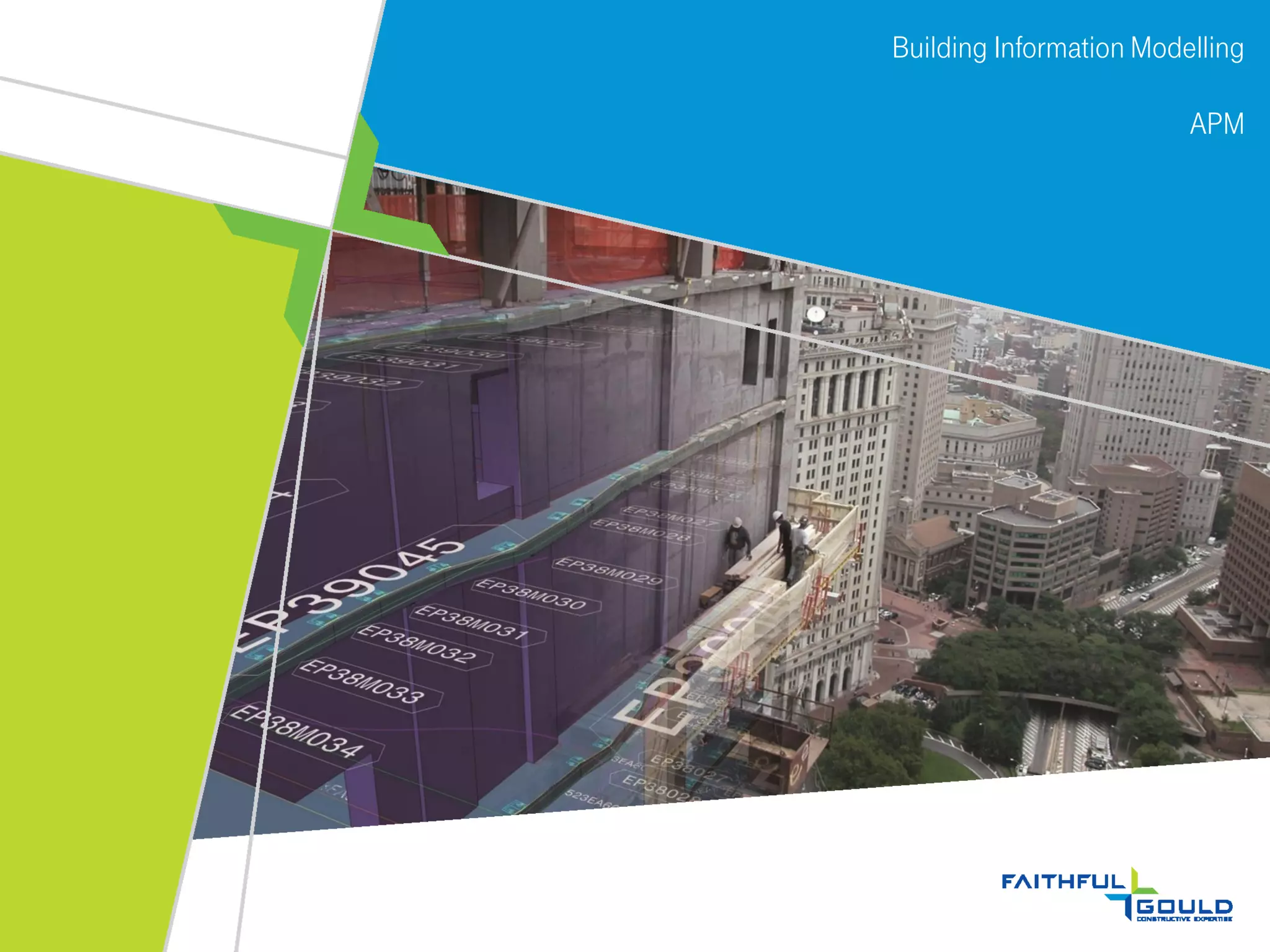
Building Information Modelling
APM
Chair’s Welcome
BIM: Re-defining the role of the project manager.
APM Knowledge SIG
• House keeping
• Mobile phones – off or silent
• Twitter: #APMBIM
UK Government Strategy
May 2011
Sep 2011
July 2013
BIM is a formal requirement for all
centrally procured government
construction projects by 2016.
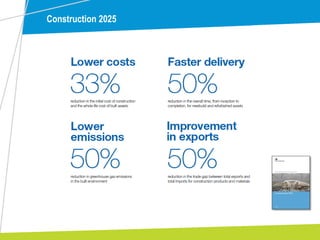
Construction 2025
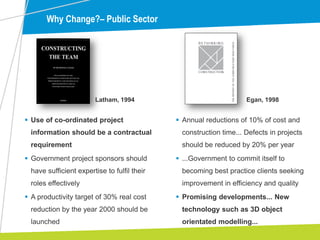
Why Change?– Public Sector
 Use of co-ordinated project
information should be a contractual
requirement
 Government project sponsors should
have sufficient expertise to fulfil their
roles effectively
 A productivity target of 30% real cost
reduction by the year 2000 should be
launched
 Annual reductions of 10% of cost and
construction time... Defects in projects
should be reduced by 20% per year
 ...Government to commit itself to
becoming best practice clients seeking
improvement in efficiency and quality
 Promising developments... New
technology such as 3D object
orientated modelling...
Latham, 1994 Egan, 1998
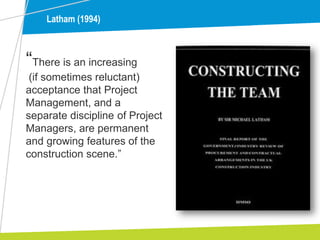
Latham (1994)
“There is an increasing
(if sometimes reluctant)
acceptance that Project
Management, and a
separate discipline of Project
Managers, are permanent
and growing features of the
construction scene.”
Egan(1998)
“at the project manager
level, we see a need for
training in integrating
projects and leading
performance
improvement, from
conception to final
delivery.”
So... What is BIM?
 ‘Building Information Modelling (BIM) is both a new technology
and a new way of working.
 ‘BIM involves much more than simply implementing new software.
It is a different way of thinking’
 ‘BIM combines technology with new working practices to improve
the quality of the delivered product and also improve the reliability,
timeliness and consistency of the process.’
What is BIM? RICS Definition
RICS
New Technology
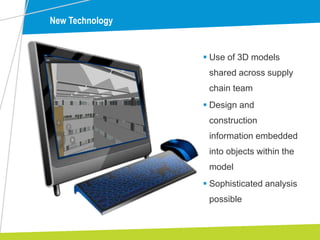
 Use of 3D models
shared across supply
chain team
 Design and
construction
information embedded
into objects within the
model
 Sophisticated analysis
possible
Structured Information
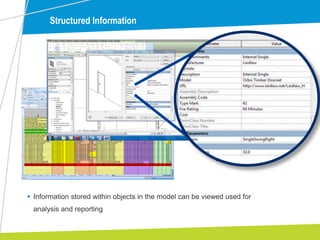
 Information stored within objects in the model can be viewed used for
analysis and reporting
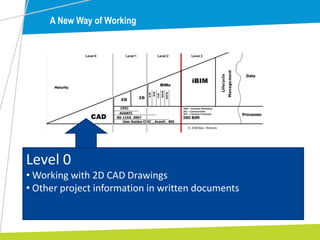
A New Way of Working
Level 0
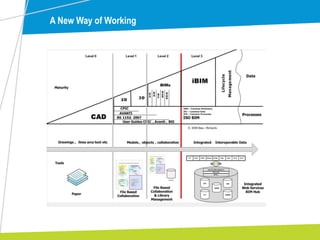
• Working with 2D CAD Drawings
• Other project information in written documents
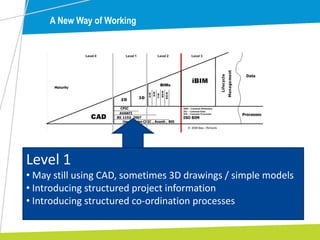
A New Way of Working
Level 1
• May still using CAD, sometimes 3D drawings / simple models
• Introducing structured project information
• Introducing structured co-ordination processes
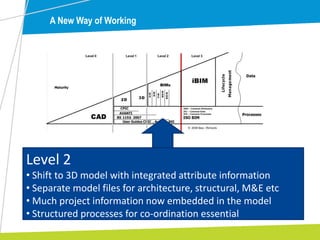
A New Way of Working
Level 2
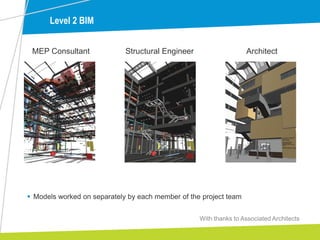
• Shift to 3D model with integrated attribute information
• Separate model files for architecture, structural, M&E etc
• Much project information now embedded in the model
• Structured processes for co-ordination essential
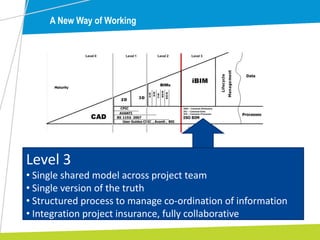
A New Way of Working
Level 3
• Single shared model across project team
• Single version of the truth
• Structured process to manage co-ordination of information
• Integration project insurance, fully collaborative
MEP Consultant Structural Engineer Architect
 Models worked on separately by each member of the project team
Level 2 BIM
With thanks to Associated Architects
 BIM is not limited to new assets
 BIM is not limited to the design phase
 BIM is not limited to buildings
 BIM is not just for big projects
Where and When to Use BIM
BIM can be applied to projects of
any size, across all phases of the
lifecycle and to all types of built
asset.
Where and When to Use BIM
BIM
BIM for PM’s - Not yet on the radar?
BIM
BIM for PM’s - Another thing to juggle?
Case Study
HMYOI Cookham Wood
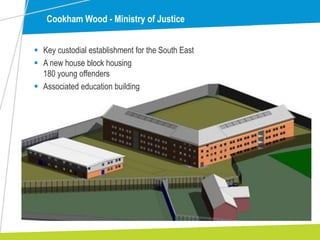
Cookham Wood - Ministry of Justice
 Key custodial establishment for the South East
 A new house block housing
180 young offenders
 Associated education building
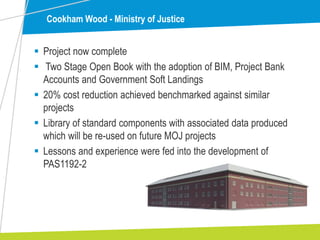
Cookham Wood - Ministry of Justice
 Project now complete
 Two Stage Open Book with the adoption of BIM, Project Bank
Accounts and Government Soft Landings
 20% cost reduction achieved benchmarked against similar
projects
 Library of standard components with associated data produced
which will be re-used on future MOJ projects
 Lessons and experience were fed into the development of
PAS1192-2
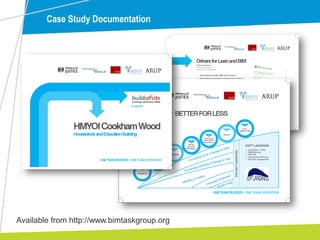
Case Study Documentation
Available from http://www.bimtaskgroup.org
Project Process
BIM
Process
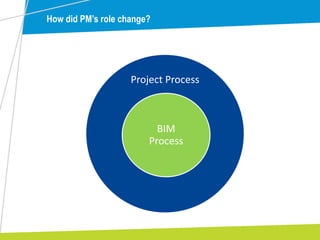
How did PM’s role change?
BIM Client
Requirements
Standards
Software
Platforms
Stake-
holders
BIM
Deliverables
Managing
Change
Co-
ordinates
Planning the
work and
data
segregation
File
Security
Level of
Detail
H+S
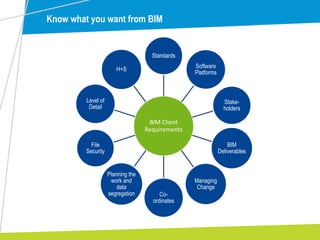
Know what you want from BIM
Lessons from Cookham Wood
 In order to incorporate BIM, the client requirements and processes have to be
carefully understood
 Alignment between BIM processes and wider project processes is needed. The
MOJ undertook a comprehensive review of the internal processes used to
operate it’s projects.
 The EIR should be explicit about which of the ten ‘Client’s Strategic Purposes’
the COBie* data will be used for.
 The brief and the BIM Clients Information Requirements need to be written in
plain English with no ambiguity.
Selected Lessons:
* COBie = Construction Operations Building Information Exchange
The BIM Process
Key Documents – PAS 1192 Part 2
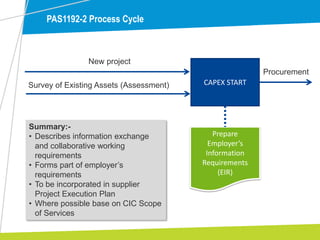
PAS1192-2 Process Cycle
CAPEX START
New project
Survey of Existing Assets (Assessment)
Prepare
Employer’s
Information
Requirements
(EIR)
Summary:-
• Describes information exchange
and collaborative working
requirements
• Forms part of employer’s
requirements
• To be incorporated in supplier
Project Execution Plan
• Where possible base on CIC Scope
of Services
Procurement
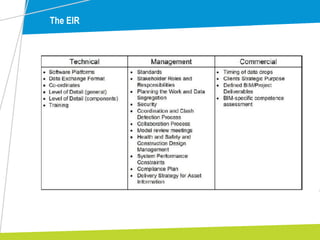
The EIR
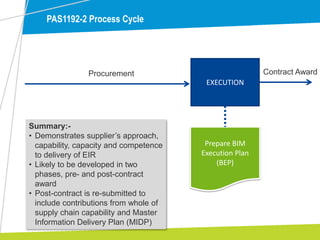
PAS1192-2 Process Cycle
EXECUTION
Procurement
Prepare BIM
Execution Plan
(BEP)
Summary:-
• Demonstrates supplier’s approach,
capability, capacity and competence
to delivery of EIR
• Likely to be developed in two
phases, pre- and post-contract
award
• Post-contract is re-submitted to
include contributions from whole of
supply chain capability and Master
Information Delivery Plan (MIDP)
Contract Award
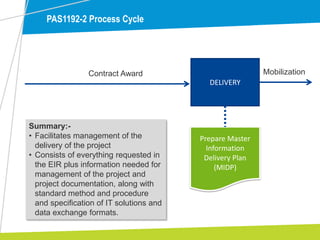
PAS1192-2 Process Cycle
DELIVERY
Contract Award
Prepare Master
Information
Delivery Plan
(MIDP)
Summary:-
• Facilitates management of the
delivery of the project
• Consists of everything requested in
the EIR plus information needed for
management of the project and
project documentation, along with
standard method and procedure
and specification of IT solutions and
data exchange formats.
Mobilization
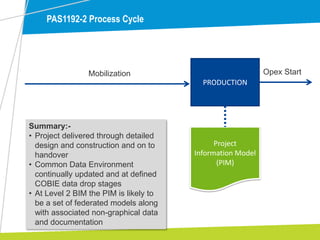
PAS1192-2 Process Cycle
PRODUCTION
Mobilization
Project
Information Model
(PIM)
Summary:-
• Project delivered through detailed
design and construction and on to
handover
• Common Data Environment
continually updated and at defined
COBIE data drop stages
• At Level 2 BIM the PIM is likely to
be a set of federated models along
with associated non-graphical data
and documentation
Opex Start
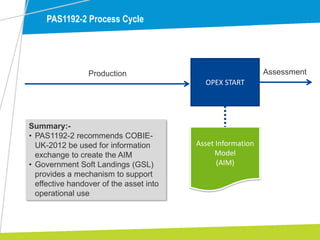
PAS1192-2 Process Cycle
OPEX START
Production
Asset Information
Model
(AIM)
Summary:-
• PAS1192-2 recommends COBIE-
UK-2012 be used for information
exchange to create the AIM
• Government Soft Landings (GSL)
provides a mechanism to support
effective handover of the asset into
operational use
Assessment
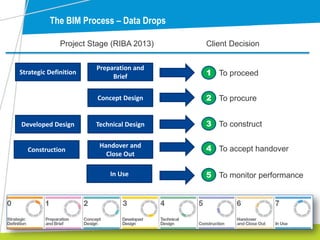
The BIM Process – Data Drops
Strategic Definition
Preparation and
Brief
Concept Design
Developed Design Technical Design
Handover and
Close Out
In Use
1 To proceed
2 To procure
3 To construct
4 To accept handover
5 To monitor performance
Project Stage (RIBA 2013) Client Decision
Construction
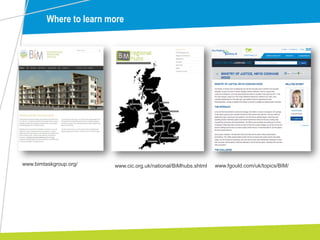
Where to learn more
www.fgould.com/uk/topics/BIM/www.cic.org.uk/national/BiMhubs.shtmlwww.bimtaskgroup.org/
Adrian Malone
Head of BIM and Knowledge
Management
Faithful+Gould
0113 306 6884
adrian.malone@fgould.com
@adrianmalone

Building information modelling - redefining the role of the project manager: Adrian Malone

  • 1.
  • 2.
    Chair’s Welcome BIM: Re-definingthe role of the project manager. APM Knowledge SIG • House keeping • Mobile phones – off or silent • Twitter: #APMBIM
  • 3.
    UK Government Strategy May2011 Sep 2011 July 2013 BIM is a formal requirement for all centrally procured government construction projects by 2016.
  • 4.
  • 5.
    Why Change?– PublicSector  Use of co-ordinated project information should be a contractual requirement  Government project sponsors should have sufficient expertise to fulfil their roles effectively  A productivity target of 30% real cost reduction by the year 2000 should be launched  Annual reductions of 10% of cost and construction time... Defects in projects should be reduced by 20% per year  ...Government to commit itself to becoming best practice clients seeking improvement in efficiency and quality  Promising developments... New technology such as 3D object orientated modelling... Latham, 1994 Egan, 1998
  • 6.
    Latham (1994) “There isan increasing (if sometimes reluctant) acceptance that Project Management, and a separate discipline of Project Managers, are permanent and growing features of the construction scene.”
  • 7.
    Egan(1998) “at the projectmanager level, we see a need for training in integrating projects and leading performance improvement, from conception to final delivery.”
  • 8.
  • 9.
     ‘Building InformationModelling (BIM) is both a new technology and a new way of working.  ‘BIM involves much more than simply implementing new software. It is a different way of thinking’  ‘BIM combines technology with new working practices to improve the quality of the delivered product and also improve the reliability, timeliness and consistency of the process.’ What is BIM? RICS Definition RICS
  • 10.
    New Technology  Useof 3D models shared across supply chain team  Design and construction information embedded into objects within the model  Sophisticated analysis possible
  • 11.
    Structured Information  Informationstored within objects in the model can be viewed used for analysis and reporting
  • 12.
    A New Wayof Working
  • 13.
    A New Wayof Working Level 0 • Working with 2D CAD Drawings • Other project information in written documents
  • 14.
    A New Wayof Working Level 1 • May still using CAD, sometimes 3D drawings / simple models • Introducing structured project information • Introducing structured co-ordination processes
  • 15.
    A New Wayof Working Level 2 • Shift to 3D model with integrated attribute information • Separate model files for architecture, structural, M&E etc • Much project information now embedded in the model • Structured processes for co-ordination essential
  • 16.
    A New Wayof Working Level 3 • Single shared model across project team • Single version of the truth • Structured process to manage co-ordination of information • Integration project insurance, fully collaborative
  • 17.
    MEP Consultant StructuralEngineer Architect  Models worked on separately by each member of the project team Level 2 BIM With thanks to Associated Architects
  • 18.
     BIM isnot limited to new assets  BIM is not limited to the design phase  BIM is not limited to buildings  BIM is not just for big projects Where and When to Use BIM
  • 19.
    BIM can beapplied to projects of any size, across all phases of the lifecycle and to all types of built asset. Where and When to Use BIM
  • 20.
    BIM BIM for PM’s- Not yet on the radar?
  • 21.
    BIM BIM for PM’s- Another thing to juggle?
  • 22.
  • 23.
    Cookham Wood -Ministry of Justice  Key custodial establishment for the South East  A new house block housing 180 young offenders  Associated education building
  • 24.
    Cookham Wood -Ministry of Justice  Project now complete  Two Stage Open Book with the adoption of BIM, Project Bank Accounts and Government Soft Landings  20% cost reduction achieved benchmarked against similar projects  Library of standard components with associated data produced which will be re-used on future MOJ projects  Lessons and experience were fed into the development of PAS1192-2
  • 25.
    Case Study Documentation Availablefrom http://www.bimtaskgroup.org
  • 26.
  • 27.
  • 28.
    Lessons from CookhamWood  In order to incorporate BIM, the client requirements and processes have to be carefully understood  Alignment between BIM processes and wider project processes is needed. The MOJ undertook a comprehensive review of the internal processes used to operate it’s projects.  The EIR should be explicit about which of the ten ‘Client’s Strategic Purposes’ the COBie* data will be used for.  The brief and the BIM Clients Information Requirements need to be written in plain English with no ambiguity. Selected Lessons: * COBie = Construction Operations Building Information Exchange
  • 29.
  • 30.
    Key Documents –PAS 1192 Part 2
  • 31.
    PAS1192-2 Process Cycle CAPEXSTART New project Survey of Existing Assets (Assessment) Prepare Employer’s Information Requirements (EIR) Summary:- • Describes information exchange and collaborative working requirements • Forms part of employer’s requirements • To be incorporated in supplier Project Execution Plan • Where possible base on CIC Scope of Services Procurement
  • 32.
  • 33.
    PAS1192-2 Process Cycle EXECUTION Procurement PrepareBIM Execution Plan (BEP) Summary:- • Demonstrates supplier’s approach, capability, capacity and competence to delivery of EIR • Likely to be developed in two phases, pre- and post-contract award • Post-contract is re-submitted to include contributions from whole of supply chain capability and Master Information Delivery Plan (MIDP) Contract Award
  • 34.
    PAS1192-2 Process Cycle DELIVERY ContractAward Prepare Master Information Delivery Plan (MIDP) Summary:- • Facilitates management of the delivery of the project • Consists of everything requested in the EIR plus information needed for management of the project and project documentation, along with standard method and procedure and specification of IT solutions and data exchange formats. Mobilization
  • 35.
    PAS1192-2 Process Cycle PRODUCTION Mobilization Project InformationModel (PIM) Summary:- • Project delivered through detailed design and construction and on to handover • Common Data Environment continually updated and at defined COBIE data drop stages • At Level 2 BIM the PIM is likely to be a set of federated models along with associated non-graphical data and documentation Opex Start
  • 36.
    PAS1192-2 Process Cycle OPEXSTART Production Asset Information Model (AIM) Summary:- • PAS1192-2 recommends COBIE- UK-2012 be used for information exchange to create the AIM • Government Soft Landings (GSL) provides a mechanism to support effective handover of the asset into operational use Assessment
  • 37.
    The BIM Process– Data Drops Strategic Definition Preparation and Brief Concept Design Developed Design Technical Design Handover and Close Out In Use 1 To proceed 2 To procure 3 To construct 4 To accept handover 5 To monitor performance Project Stage (RIBA 2013) Client Decision Construction
  • 38.
    Where to learnmore www.fgould.com/uk/topics/BIM/www.cic.org.uk/national/BiMhubs.shtmlwww.bimtaskgroup.org/
  • 39.
    Adrian Malone Head ofBIM and Knowledge Management Faithful+Gould 0113 306 6884 adrian.malone@fgould.com @adrianmalone