SEMINAR PRESENTATION
Presented by
Supervisor
Preston Emmanuel Vah
Roll No: 2154016
Prof. (Dr.) Purnachandra Saha
School of Civil Engineering, KIIT
Topic
Applications of Building Information Modeling (BIM)
in Construction Project Management
June-2022
M. Tech, Construction Engineering and Management 1
KALINGA INSTITUTE OF INDUSTRIAL TECHNOLOGY
Deemed to be University U/S 3 of the UGC Act, 1956
SCHOOL OF CIVIL ENGINEERING
Presented in partial fulfillment of the requirements
for the degree of
MASTER OF TECHNOLGY IN CIVIL ENGINEERING
2
Seminar Presentation 2
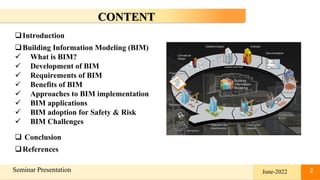
CONTENT
Introduction
Building Information Modeling (BIM)
 What is BIM?
 Development of BIM
 Requirements of BIM
 Benefits of BIM
 Approaches to BIM implementation
 BIM applications
 BIM adoption for Safety & Risk
 BIM Challenges
 Conclusion
References
June-2022
3
Seminar Presentation 3
1.0 INTRODUCTION
June-2022
 Construction project management is complex because of its traditional, evolving, and
dynamic nature. The relations between different construction project stakeholders,
from feasibility to decommissioning/demolition are fragmented and constantly
changing, and for this reason, the issue of finding the exact application capability of
BIM processes and tools/software to fully address all aspects and challenges of
construction project management ( i.e. planning, cost, quality, safety, etc.) has been
slow to achieve as compared to other aspects of the AEC Industry [1].
 Building information modeling (BIM), is described as a product, process, and system
by the National Building Information Modeling Standard (NBIMS) (National
Institute of Building Sciences 2019), is becoming increasingly substantial and
widespread in today’s fast-moving competitive AEC industry [2]. This review is
intended to explore the salient applications of BIM in the AEC industry, focusing
primarily on construction project management.
4
Seminar Presentation 4
1.0 INTRODUCTION
June-2022
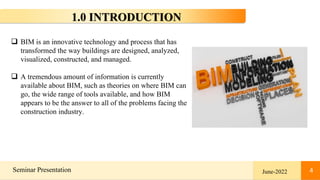
 BIM is an innovative technology and process that has
transformed the way buildings are designed, analyzed,
visualized, constructed, and managed.
 A tremendous amount of information is currently
available about BIM, such as theories on where BIM can
go, the wide range of tools available, and how BIM
appears to be the answer to all of the problems facing the
construction industry.
5
Seminar Presentation June-2022 5
2.0 Building Information Modeling (BIM)
2.1 What is BIM?
 Building Information Modeling (BIM) is an integrated and
collaborative technology-enabled process that uses various tools for
the generation, analysis, visualization, and utilization of information
related to the digital representation of the geometry and non-geometry
aspects of a building to enable project stakeholders to work seamlessly
throughout the building project’s lifecycle [3].
 The Building data/information is embedded in a parametric and
intelligent 3D model which represents the digital/virtual model of the
building/infrastructure before and after it is constructed. This enables
stakeholders to make informed decisions relating to planning, design,
pre-construction, construction, operation, and demolition activities of
the asset/building [4].
6
Seminar Presentation June-2022 6
2.0 Building Information Modeling (BIM)
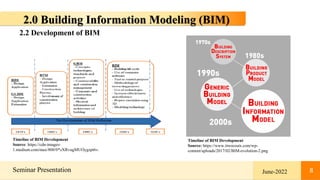
2.2 Development of BIM
 The 1970s: A Tool to Revolutionize Architecture
Charles M. Eastman (May 5, 1940 – November 9, 2020) was a professor and a
pioneer in the areas of design cognition, building information modeling (BIM),
solid and parametric modeling, engineering databases, product models, and
interoperability. While no single person can be credited for the invention of
BIM, he is widely considered the father of BIM therefore, he has been cited in
most research literature relating to BIM.
Eastman [5] outlined the concept of BIM as we know it today when he
introduced Building Description Systems (BDS) in the 1970s. Among his many
publications in the 70s there are two articles that discuss the early concepts of
BIM, both as a process and technology [6,7].
Charles M. Eastman
7
Seminar Presentation June-2022 7
2.0 Building Information Modeling (BIM)
2.2 Development of BIM
In their paper published in 1992, G.A. van Nederveen and F.P. Tolman [8]
introduced the term BIM, as we know it today.
 The 2000s and present: An Era of Digitally Native Design
 However, it was not until 2003 that commercial BIM tools became
abundant and the industry slowly started adopting BIM in its processes
(Autodesk 2003; Bentley and Workman 2003; Cyon Research
Corporation 2003; Laiserin 2003).
 As many companies across the globe struggled with technical and
organizational issues without knowing where they were going in the
mid-to-late 2000s. BIM adoption during this period is referred to as the
early stage or as the first wave of BIM adoption at the industry and
organization levels
G.A Van Nederveen
Assistant Professor Integrated
Design and Information Systems,
Delft University of Technology
8
Seminar Presentation June-2022 8
2.0 Building Information Modeling (BIM)
2.2 Development of BIM
Timeline of BIM Development
Source: https://cdn-images-
1.medium.com/max/800/0*zXRvugMUOygzpt6v.
Timeline of BIM Development
Source: https://www.itwocostx.com/wp-
content/uploads/2017/02/BIM-evolution-2.png
9
Seminar Presentation June-2022 9
2.0 Building Information Modeling (BIM)
2.2 Development of BIM
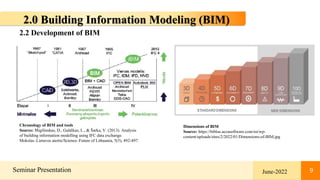
Chronology of BIM and tools
Source: Migilinskas, D., Galdikas, L., & Šarka, V. (2013). Analysis
of building information modelling using IFC data exchange.
Mokslas–Lietuvos ateitis/Science–Future of Lithuania, 5(5), 492-497.
Dimensions of BIM
Source: https://biblus.accasoftware.com/en/wp-
content/uploads/sites/2/2022/01/Dimensions-of-BIM.jpg
10
Seminar Presentation June-2022
1
0
2.0 Building Information Modeling (BIM)
2.2 Development of BIM
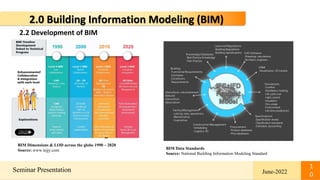
BIM Data Standards
Source: National Building Information Modeling Standard
BIM Dimensions & LOD across the globe 1990 – 2020
Source: www.tejjy.com
11
Seminar Presentation June-2022 11
2.0 Building Information Modeling (BIM)
2.3 Requirements of BIM in Construction Industry
 Implementing BIM efficiently requires significant changes in the way in which
the construction industry operates and its processes. BIM consists of four main
components: process, people, policy, and technology [9].
Source: bimdesignhub.com
12
Seminar Presentation June-2022 12
2.0 Building Information Modeling (BIM)
2.4 Benefits of BIM
 By using Building Information Modeling (BIM) organizations can better manage
their work. The various phases of construction in which BIM is used, include
programming, design, preconstruction, construction, and postconstruction
(operations and maintenance) [10].
Source: https://www.bimspot.io/wp-ontent/uploads/2021/02/bim_advantages-1316x740-c-
center-960x0-c-default.png
13
Seminar Presentation June-2022 13
2.0 Building Information Modeling (BIM)
2.5 Approaches to the implementation of BIM
 Determine your organization's BIM maturity level
 Determine which technologies are best for your role and business
 Define the organization’s BIM vision
 Create a business case for the adoption of new technologies
 Create a business model based on realistic targets
 Recognize and address challenges
 Develop a learning environment supportive of BIM implementation
 Monitor implementation and refinement [11]
14
Seminar Presentation June-2022 14
2.0 Building Information Modeling (BIM)
 Design and documentation:
 Creation of 3D architectural and structural
models
 Preparation of 2D construction drawings
and specifications
 5D BIM-driven quantity take-off and
budgeting
 Construction planning and scheduling by
using 4D BIM [12]
 Preconstruction:
 Human resource management
 virtual reconstruction/4D simulation
 Quality assurance, and safety [13]
 Constructability reviews and clash detection
 Visualization of the construction process [14]
 Testing different construction method statements
and procedures for constructability compliance
[15].
2.6 BIM applications in construction project management
15
Seminar Presentation June-2022 15
2.0 Building Information Modeling (BIM)
2.6 BIM applications in construction project management
 Construction phase:
 Shop drawing and fabrication,
 Construction defect detection,
 Sustainable construction planning
 Efficient cost management and project reports
 Visual risk analysis and logistic models,
 Digital models of building elements
 Increase employer satisfaction and confidence
 Improve communication and collaboration [16].
 Monitoring construction progress:
 By using time-lapse, close-range, and
aerial images of construction sites, as well
as laser scanners and 3D point clouds. [17].
 Identification, analysis, and visualization of
deviations of as-built vs as-planned
information [18].
16
Seminar Presentation June-2022 16
2.0 Building Information Modeling (BIM)
2.7 BIM adoption for Safety & Risk in construction
 BIM can serve in many areas of the entire life cycle of a facility. For safety
management, although BIM has shown a great potential to improve
construction safety performance, it is still a new area [19].
 Incorporation of safety and risk management during the project planning and
design stages [20].
 Safety on construction sites can be improved greatly by using 4D BIM
 BIM applications in construction projects can reduce waste and safety
problems in construction, leading to the completion of quality projects [21].
17
Seminar Presentation June-2022 17
2.0 Building Information Modeling (BIM)
2.8 BIM Challenges
 Construction has traditionally been slow
to adopt new technologies due to a
number of factors, including a lack of
awareness and training; the fragmentation
of the AEC sector; the industry's
reluctance to change its existing practices;
a reluctance to embrace new technologies
and concepts; confusion about the role,
responsibilities, and benefits of these new
technologies [22].
No Factors Challenges
1 People  Comfort with conventional
processes used add to refusal
of construction players to
change.
 Lack of knowledge of BIM.
 Lack of skill on BIM.
2 Process & Policy  No BIM guideline and specific
model could assist
construction players to
implement BIM.
3 Technology  BIM tools are expensive.
 New hardware is expensive.
 BIM training is expensive.
18
Seminar Presentation June-2022 18
Conclusion
 BIM is an innovative concept, combining process and technology to manage
construction projects by simultaneously generating, storing, and visualizing
construction data. Due to its benefits, numerous research studies have been
conducted regarding the applications of BIM in the AEC industry. In this paper,
the various aspects of BIM in the AEC industry have been presented, with specific
focus on the salient applications of BIM in construction project management.
 For BIM to be fully adopted and implemented in the entire processes of
construction project management, there is a need to improve awareness of the
BIM concept through education and training, both in the AEC industry and
academia, including more information and provision of expertise about BIM that
can enhance the levels of adoption and application. This will result in the
development of a holistic strategy to increase the adoption of BIM in the
industry.
19
Seminar Presentation June-2022 19
References
[1] Selçuk Çıdık, M., Boyd, D., & Thurairajah, N. (2017). Innovative
capability of building information modeling in construction design. Journal
of construction engineering and management, 143(8), 04017047.
[2] Seyis, S. (2019). Pros and cons of using building information modeling
in the AEC industry. Journal of Construction Engineering and Management,
145(8), 04019046.
[3] Shaqour, E. N. (2022). The role of implementing BIM applications in
enhancing project management knowledge areas in Egypt. Ain Shams
Engineering Journal, 13(1), 101509.
[4] Son, H., Lee, S., & Kim, C. (2015). What drives the adoption of building
information modeling in design organizations? An empirical investigation
of the antecedents affecting architects' behavioral intentions. Automation in
construction, 49, 92-99.
[5] Eastman, C. (1974). An Outline of the Building Description System.
Research Report No. 50.
[6] Eastman, C. (1975). The use of computers instead of drawings in
building design. AIA journal, 63(3), 46-50.
[7] Eastman, C., & Henrion, M. (1977). GLIDE: a language for design
information systems. ACM SIGGRAPH Computer Graphics, 11(2), 24-33.
[8] van Nederveen, G. A., & Tolman, F. P. (1992). Modelling multiple
views on buildings. Automation in Construction, 1(3), 215-224.
[9] Aitbayeva, D., & Hossain, M. A. (2020). Building information model
(BIM) implementation in perspective of Kazakhstan: opportunities and
barriers. J. Eng. Res. Rep, 14, 13-24.
[10] Moazzami, M., Maalek, R., Senanayake, S., & Ruwanpura, J. (2020,
November). Adoption and Implementation of BIM in Canadian Construction
Projects: Benefits, Challenges, and Limitations. In Construction Research
Congress 2020: Computer Applications (pp. 1-10). Reston, VA: American
Society of Civil Engineers.
[11] Dowd, T., & Marsh, D. (2020). The future of BIM: digital transformation
in the UK construction and infrastructure sector. RICS insight paper.
[12] Singh, V., Gu, N., & Wang, X. (2011). A theoretical framework of a
BIM-based multi-disciplinary collaboration platform. Automation in
construction, 20(2), 134-144.
[13] Zhang, S., Teizer, J., Lee, J. K., Eastman, C. M., & Venugopal, M.
(2013). Building information modeling (BIM) and safety: Automatic safety
checking of construction models and schedules. Automation in construction,
29, 183-195.
[14] Zhang, J., Yu, F., Li, D., and Hu, Z. (2014). “Development and
implementation of an industry foundation classes-based graphic information
model for virtual construction.” Comput. Aided Civ. Infrastruct. Eng., 29(1),
60–74.
[15] Wang, J.,Wang, X., Shou,W., Chong, H. Y., and Guo, J. (2016).
“Building information modeling-based integration of MEP layout designs and
constructability.” Autom. Constr., 61, 134–146.
[16] Seyis, S. (2019). Pros and cons of using building information modeling
in the AEC industry. Journal of Construction Engineering and Management,
145(8), 04019046.
20
Seminar Presentation June-2022 20
References
[17] Yang, J., Park, M. W., Vela, P. A., & Golparvar-Fard, M. (2015).
Construction performance monitoring via still images, time-lapse photos,
and video streams: Now, tomorrow, and the future. Advanced Engineering
Informatics, 29(2), 211-224.
[18] Han, K. K., Cline, D., & Golparvar-Fard, M. (2015). Formalized
knowledge of construction sequencing for visual monitoring of work-in-
progress via incomplete point clouds and low-LoD 4D BIMs. Advanced
Engineering Informatics, 29(4), 889-901.
[19] Rajendran, S., & Clarke, B. (2011). Building Information Modeling:
safety benefits & opportunities. Professional Safety, 56(10), 44-51.
[20] Azhar, S., & Behringer, A. (2013, April). A BIM-based approach for
communicating and implementing a construction site safety plan. In Proc.,
49th ASC Annual International Conference Proceedings.
[21] John, G., & Ganah, A. (2011). Integrating BIM and planning software
for health and safety site induction.
[22] Latiffi, A. A., Mohd, S., Kasim, N., & Fathi, M. S. (2013). Building
information modeling (BIM) application in Malaysian construction industry.
International Journal of Construction Engineering and Management, 2(4A),
1-6.
21
Seminar Presentation June-2022 21
THANK
YOU
Q & A

Seminarpresentation.pptx

  • 1.
    SEMINAR PRESENTATION Presented by Supervisor PrestonEmmanuel Vah Roll No: 2154016 Prof. (Dr.) Purnachandra Saha School of Civil Engineering, KIIT Topic Applications of Building Information Modeling (BIM) in Construction Project Management June-2022 M. Tech, Construction Engineering and Management 1 KALINGA INSTITUTE OF INDUSTRIAL TECHNOLOGY Deemed to be University U/S 3 of the UGC Act, 1956 SCHOOL OF CIVIL ENGINEERING Presented in partial fulfillment of the requirements for the degree of MASTER OF TECHNOLGY IN CIVIL ENGINEERING
  • 2.
    2 Seminar Presentation 2 CONTENT Introduction BuildingInformation Modeling (BIM)  What is BIM?  Development of BIM  Requirements of BIM  Benefits of BIM  Approaches to BIM implementation  BIM applications  BIM adoption for Safety & Risk  BIM Challenges  Conclusion References June-2022
  • 3.
    3 Seminar Presentation 3 1.0INTRODUCTION June-2022  Construction project management is complex because of its traditional, evolving, and dynamic nature. The relations between different construction project stakeholders, from feasibility to decommissioning/demolition are fragmented and constantly changing, and for this reason, the issue of finding the exact application capability of BIM processes and tools/software to fully address all aspects and challenges of construction project management ( i.e. planning, cost, quality, safety, etc.) has been slow to achieve as compared to other aspects of the AEC Industry [1].  Building information modeling (BIM), is described as a product, process, and system by the National Building Information Modeling Standard (NBIMS) (National Institute of Building Sciences 2019), is becoming increasingly substantial and widespread in today’s fast-moving competitive AEC industry [2]. This review is intended to explore the salient applications of BIM in the AEC industry, focusing primarily on construction project management.
  • 4.
    4 Seminar Presentation 4 1.0INTRODUCTION June-2022  BIM is an innovative technology and process that has transformed the way buildings are designed, analyzed, visualized, constructed, and managed.  A tremendous amount of information is currently available about BIM, such as theories on where BIM can go, the wide range of tools available, and how BIM appears to be the answer to all of the problems facing the construction industry.
  • 5.
    5 Seminar Presentation June-20225 2.0 Building Information Modeling (BIM) 2.1 What is BIM?  Building Information Modeling (BIM) is an integrated and collaborative technology-enabled process that uses various tools for the generation, analysis, visualization, and utilization of information related to the digital representation of the geometry and non-geometry aspects of a building to enable project stakeholders to work seamlessly throughout the building project’s lifecycle [3].  The Building data/information is embedded in a parametric and intelligent 3D model which represents the digital/virtual model of the building/infrastructure before and after it is constructed. This enables stakeholders to make informed decisions relating to planning, design, pre-construction, construction, operation, and demolition activities of the asset/building [4].
  • 6.
    6 Seminar Presentation June-20226 2.0 Building Information Modeling (BIM) 2.2 Development of BIM  The 1970s: A Tool to Revolutionize Architecture Charles M. Eastman (May 5, 1940 – November 9, 2020) was a professor and a pioneer in the areas of design cognition, building information modeling (BIM), solid and parametric modeling, engineering databases, product models, and interoperability. While no single person can be credited for the invention of BIM, he is widely considered the father of BIM therefore, he has been cited in most research literature relating to BIM. Eastman [5] outlined the concept of BIM as we know it today when he introduced Building Description Systems (BDS) in the 1970s. Among his many publications in the 70s there are two articles that discuss the early concepts of BIM, both as a process and technology [6,7]. Charles M. Eastman
  • 7.
    7 Seminar Presentation June-20227 2.0 Building Information Modeling (BIM) 2.2 Development of BIM In their paper published in 1992, G.A. van Nederveen and F.P. Tolman [8] introduced the term BIM, as we know it today.  The 2000s and present: An Era of Digitally Native Design  However, it was not until 2003 that commercial BIM tools became abundant and the industry slowly started adopting BIM in its processes (Autodesk 2003; Bentley and Workman 2003; Cyon Research Corporation 2003; Laiserin 2003).  As many companies across the globe struggled with technical and organizational issues without knowing where they were going in the mid-to-late 2000s. BIM adoption during this period is referred to as the early stage or as the first wave of BIM adoption at the industry and organization levels G.A Van Nederveen Assistant Professor Integrated Design and Information Systems, Delft University of Technology
  • 8.
    8 Seminar Presentation June-20228 2.0 Building Information Modeling (BIM) 2.2 Development of BIM Timeline of BIM Development Source: https://cdn-images- 1.medium.com/max/800/0*zXRvugMUOygzpt6v. Timeline of BIM Development Source: https://www.itwocostx.com/wp- content/uploads/2017/02/BIM-evolution-2.png
  • 9.
    9 Seminar Presentation June-20229 2.0 Building Information Modeling (BIM) 2.2 Development of BIM Chronology of BIM and tools Source: Migilinskas, D., Galdikas, L., & Šarka, V. (2013). Analysis of building information modelling using IFC data exchange. Mokslas–Lietuvos ateitis/Science–Future of Lithuania, 5(5), 492-497. Dimensions of BIM Source: https://biblus.accasoftware.com/en/wp- content/uploads/sites/2/2022/01/Dimensions-of-BIM.jpg
  • 10.
    10 Seminar Presentation June-2022 1 0 2.0Building Information Modeling (BIM) 2.2 Development of BIM BIM Data Standards Source: National Building Information Modeling Standard BIM Dimensions & LOD across the globe 1990 – 2020 Source: www.tejjy.com
  • 11.
    11 Seminar Presentation June-202211 2.0 Building Information Modeling (BIM) 2.3 Requirements of BIM in Construction Industry  Implementing BIM efficiently requires significant changes in the way in which the construction industry operates and its processes. BIM consists of four main components: process, people, policy, and technology [9]. Source: bimdesignhub.com
  • 12.
    12 Seminar Presentation June-202212 2.0 Building Information Modeling (BIM) 2.4 Benefits of BIM  By using Building Information Modeling (BIM) organizations can better manage their work. The various phases of construction in which BIM is used, include programming, design, preconstruction, construction, and postconstruction (operations and maintenance) [10]. Source: https://www.bimspot.io/wp-ontent/uploads/2021/02/bim_advantages-1316x740-c- center-960x0-c-default.png
  • 13.
    13 Seminar Presentation June-202213 2.0 Building Information Modeling (BIM) 2.5 Approaches to the implementation of BIM  Determine your organization's BIM maturity level  Determine which technologies are best for your role and business  Define the organization’s BIM vision  Create a business case for the adoption of new technologies  Create a business model based on realistic targets  Recognize and address challenges  Develop a learning environment supportive of BIM implementation  Monitor implementation and refinement [11]
  • 14.
    14 Seminar Presentation June-202214 2.0 Building Information Modeling (BIM)  Design and documentation:  Creation of 3D architectural and structural models  Preparation of 2D construction drawings and specifications  5D BIM-driven quantity take-off and budgeting  Construction planning and scheduling by using 4D BIM [12]  Preconstruction:  Human resource management  virtual reconstruction/4D simulation  Quality assurance, and safety [13]  Constructability reviews and clash detection  Visualization of the construction process [14]  Testing different construction method statements and procedures for constructability compliance [15]. 2.6 BIM applications in construction project management
  • 15.
    15 Seminar Presentation June-202215 2.0 Building Information Modeling (BIM) 2.6 BIM applications in construction project management  Construction phase:  Shop drawing and fabrication,  Construction defect detection,  Sustainable construction planning  Efficient cost management and project reports  Visual risk analysis and logistic models,  Digital models of building elements  Increase employer satisfaction and confidence  Improve communication and collaboration [16].  Monitoring construction progress:  By using time-lapse, close-range, and aerial images of construction sites, as well as laser scanners and 3D point clouds. [17].  Identification, analysis, and visualization of deviations of as-built vs as-planned information [18].
  • 16.
    16 Seminar Presentation June-202216 2.0 Building Information Modeling (BIM) 2.7 BIM adoption for Safety & Risk in construction  BIM can serve in many areas of the entire life cycle of a facility. For safety management, although BIM has shown a great potential to improve construction safety performance, it is still a new area [19].  Incorporation of safety and risk management during the project planning and design stages [20].  Safety on construction sites can be improved greatly by using 4D BIM  BIM applications in construction projects can reduce waste and safety problems in construction, leading to the completion of quality projects [21].
  • 17.
    17 Seminar Presentation June-202217 2.0 Building Information Modeling (BIM) 2.8 BIM Challenges  Construction has traditionally been slow to adopt new technologies due to a number of factors, including a lack of awareness and training; the fragmentation of the AEC sector; the industry's reluctance to change its existing practices; a reluctance to embrace new technologies and concepts; confusion about the role, responsibilities, and benefits of these new technologies [22]. No Factors Challenges 1 People  Comfort with conventional processes used add to refusal of construction players to change.  Lack of knowledge of BIM.  Lack of skill on BIM. 2 Process & Policy  No BIM guideline and specific model could assist construction players to implement BIM. 3 Technology  BIM tools are expensive.  New hardware is expensive.  BIM training is expensive.
  • 18.
    18 Seminar Presentation June-202218 Conclusion  BIM is an innovative concept, combining process and technology to manage construction projects by simultaneously generating, storing, and visualizing construction data. Due to its benefits, numerous research studies have been conducted regarding the applications of BIM in the AEC industry. In this paper, the various aspects of BIM in the AEC industry have been presented, with specific focus on the salient applications of BIM in construction project management.  For BIM to be fully adopted and implemented in the entire processes of construction project management, there is a need to improve awareness of the BIM concept through education and training, both in the AEC industry and academia, including more information and provision of expertise about BIM that can enhance the levels of adoption and application. This will result in the development of a holistic strategy to increase the adoption of BIM in the industry.
  • 19.
    19 Seminar Presentation June-202219 References [1] Selçuk Çıdık, M., Boyd, D., & Thurairajah, N. (2017). Innovative capability of building information modeling in construction design. Journal of construction engineering and management, 143(8), 04017047. [2] Seyis, S. (2019). Pros and cons of using building information modeling in the AEC industry. Journal of Construction Engineering and Management, 145(8), 04019046. [3] Shaqour, E. N. (2022). The role of implementing BIM applications in enhancing project management knowledge areas in Egypt. Ain Shams Engineering Journal, 13(1), 101509. [4] Son, H., Lee, S., & Kim, C. (2015). What drives the adoption of building information modeling in design organizations? An empirical investigation of the antecedents affecting architects' behavioral intentions. Automation in construction, 49, 92-99. [5] Eastman, C. (1974). An Outline of the Building Description System. Research Report No. 50. [6] Eastman, C. (1975). The use of computers instead of drawings in building design. AIA journal, 63(3), 46-50. [7] Eastman, C., & Henrion, M. (1977). GLIDE: a language for design information systems. ACM SIGGRAPH Computer Graphics, 11(2), 24-33. [8] van Nederveen, G. A., & Tolman, F. P. (1992). Modelling multiple views on buildings. Automation in Construction, 1(3), 215-224. [9] Aitbayeva, D., & Hossain, M. A. (2020). Building information model (BIM) implementation in perspective of Kazakhstan: opportunities and barriers. J. Eng. Res. Rep, 14, 13-24. [10] Moazzami, M., Maalek, R., Senanayake, S., & Ruwanpura, J. (2020, November). Adoption and Implementation of BIM in Canadian Construction Projects: Benefits, Challenges, and Limitations. In Construction Research Congress 2020: Computer Applications (pp. 1-10). Reston, VA: American Society of Civil Engineers. [11] Dowd, T., & Marsh, D. (2020). The future of BIM: digital transformation in the UK construction and infrastructure sector. RICS insight paper. [12] Singh, V., Gu, N., & Wang, X. (2011). A theoretical framework of a BIM-based multi-disciplinary collaboration platform. Automation in construction, 20(2), 134-144. [13] Zhang, S., Teizer, J., Lee, J. K., Eastman, C. M., & Venugopal, M. (2013). Building information modeling (BIM) and safety: Automatic safety checking of construction models and schedules. Automation in construction, 29, 183-195. [14] Zhang, J., Yu, F., Li, D., and Hu, Z. (2014). “Development and implementation of an industry foundation classes-based graphic information model for virtual construction.” Comput. Aided Civ. Infrastruct. Eng., 29(1), 60–74. [15] Wang, J.,Wang, X., Shou,W., Chong, H. Y., and Guo, J. (2016). “Building information modeling-based integration of MEP layout designs and constructability.” Autom. Constr., 61, 134–146. [16] Seyis, S. (2019). Pros and cons of using building information modeling in the AEC industry. Journal of Construction Engineering and Management, 145(8), 04019046.
  • 20.
    20 Seminar Presentation June-202220 References [17] Yang, J., Park, M. W., Vela, P. A., & Golparvar-Fard, M. (2015). Construction performance monitoring via still images, time-lapse photos, and video streams: Now, tomorrow, and the future. Advanced Engineering Informatics, 29(2), 211-224. [18] Han, K. K., Cline, D., & Golparvar-Fard, M. (2015). Formalized knowledge of construction sequencing for visual monitoring of work-in- progress via incomplete point clouds and low-LoD 4D BIMs. Advanced Engineering Informatics, 29(4), 889-901. [19] Rajendran, S., & Clarke, B. (2011). Building Information Modeling: safety benefits & opportunities. Professional Safety, 56(10), 44-51. [20] Azhar, S., & Behringer, A. (2013, April). A BIM-based approach for communicating and implementing a construction site safety plan. In Proc., 49th ASC Annual International Conference Proceedings. [21] John, G., & Ganah, A. (2011). Integrating BIM and planning software for health and safety site induction. [22] Latiffi, A. A., Mohd, S., Kasim, N., & Fathi, M. S. (2013). Building information modeling (BIM) application in Malaysian construction industry. International Journal of Construction Engineering and Management, 2(4A), 1-6.
  • 21.