UNIVERSITY OF THE ARMED
FORCES
LANGUAGE ACQUISITION
“BILINGUALISMS IN CHILDREN”
 MERCY RECALDE
 DAYANA TAMAYO
BILINGUALISM
 Bilingualism is a term defined for person’s capacity for dominating
two language modalities
 Bilingualism in children let them to understand the difference
between languages at a young age and learn two or more languages at
the same time
LANGUAGE LEARNING
 For adults learning a new language may seem:
 intimidating
 difficult
 ludicrous
 For children according their innate linguistic
characteristics can be:
 simple
 natural
 feasible
DOUBLE THE LANGUAGES
 BABY ACQUIRING TWO OR MORE LANGUAGES
TYPICALCONCERNS
FORPARENTS
confusion between languages
retards in first language learning
a lot of effort
SIMULTANEOUS BILINGUAL FIRST
LANGUAGE ACQUISITION
 At early 1980s, linguists focused on the simultaneous acquisition of two
languages from birth
 Researches about Bilingualisms in children showed that a child can learn two
languages and has a little sign of confusion between both
 Simultaneous Bilingualism Process has two stages of bilingual language
development
1. Undifferentiated languages
2. Differentiated languages
UNDIFFERENTIATED LANGUAGES
 It is a single-language system composed of elements from both
languages compiled in the baby’s mind
 Grammar
 Vocabulary
 Word combinations
 Verb tenses
DIFFERENTIATED LANGUAGES
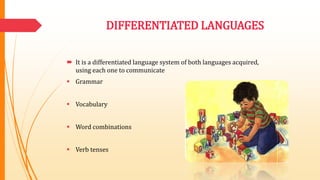
 It is a differentiated language system of both languages acquired,
using each one to communicate
 Grammar
 Vocabulary
 Word combinations
 Verb tenses
DIFFERENTIATED LANGUAGES
 In 2000, a study made to 15 bilingual children of approximate 2-4 years old
(French and English) demonstrated that children sometimes can make mistakes,
for example:
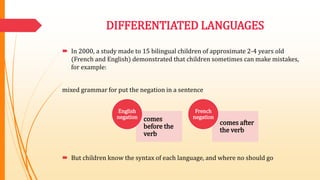
mixed grammar for put the negation in a sentence
 But children know the syntax of each language, and where no should go
comes
before the
verb
English
negation
comes after
the verb
French
negation
DIFFERENTIATED LANGUAGES
 Other study in 2005 with a longitudinal data collected from 29 different kids
of 1-6 years olds with different language pairing.
 Each research was looking at a lot of syntactic properties:
pronouns
word order
gender
negation
 And, from of all children no was evidence of they mixing their grammar
together
 Grammar was separated in children’s mind
LANGUAGE SOUNDS
 DIFFERENT PHONEMES OF TWO LANGUAGES
Babies have the ability to differentiate two sounds which form a phoneme in any
language
Young children, children, and adults can lose this ability when they are more related
to their own language and cannot distinguish other sounds
CODE MIXING
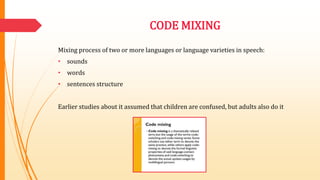
Mixing process of two or more languages or language varieties in speech:
• sounds
• words
• sentences structure
Earlier studies about it assumed that children are confused, but adults also do it
CODE MIXING
 ADULT RESEARCH IN CODE MIXING
Code mixing process in adults depend on the social cues as:
 who are talking to
 what are talking about
 how good are for both languages
 how formal is your language
CODE MIXING
 CODE MIXING IN CHILDREN
Code mixing process in children can happen due to:
 speaking in their weaker language
 less mixing when they talk with someone who only speak one language
It is a controlled process, children are not confused with grammar, or any
structure of the language
CONCLUSIONS
 For adults could be difficult learn a new language, but for children it is
easier
 Sometimes parents use to be worried about how their kids can deal
with two languages at the same time
 When children are involved with two languages simultaneously, they
learn two vocabulary, grammar, sounds, syntax; and are able to
distinguish the structure and its features of each one
CONCLUSIONS
 The way of learning phonemes became simple for them
 The younger the children, they have more possibilities to differentiate
phonemes from one language to another
 Many studies had been made and the conclusion of all of them is that
children learn two languages from the start and it is an advantage for
them
Bilingualism in children

Bilingualism in children

  • 1.
    UNIVERSITY OF THEARMED FORCES LANGUAGE ACQUISITION “BILINGUALISMS IN CHILDREN”  MERCY RECALDE  DAYANA TAMAYO
  • 2.
    BILINGUALISM  Bilingualism isa term defined for person’s capacity for dominating two language modalities  Bilingualism in children let them to understand the difference between languages at a young age and learn two or more languages at the same time
  • 3.
    LANGUAGE LEARNING  Foradults learning a new language may seem:  intimidating  difficult  ludicrous  For children according their innate linguistic characteristics can be:  simple  natural  feasible
  • 4.
    DOUBLE THE LANGUAGES BABY ACQUIRING TWO OR MORE LANGUAGES TYPICALCONCERNS FORPARENTS confusion between languages retards in first language learning a lot of effort
  • 5.
    SIMULTANEOUS BILINGUAL FIRST LANGUAGEACQUISITION  At early 1980s, linguists focused on the simultaneous acquisition of two languages from birth  Researches about Bilingualisms in children showed that a child can learn two languages and has a little sign of confusion between both  Simultaneous Bilingualism Process has two stages of bilingual language development 1. Undifferentiated languages 2. Differentiated languages
  • 6.
    UNDIFFERENTIATED LANGUAGES  Itis a single-language system composed of elements from both languages compiled in the baby’s mind  Grammar  Vocabulary  Word combinations  Verb tenses
  • 7.
    DIFFERENTIATED LANGUAGES  Itis a differentiated language system of both languages acquired, using each one to communicate  Grammar  Vocabulary  Word combinations  Verb tenses
  • 8.
    DIFFERENTIATED LANGUAGES  In2000, a study made to 15 bilingual children of approximate 2-4 years old (French and English) demonstrated that children sometimes can make mistakes, for example: mixed grammar for put the negation in a sentence  But children know the syntax of each language, and where no should go comes before the verb English negation comes after the verb French negation
  • 9.
    DIFFERENTIATED LANGUAGES  Otherstudy in 2005 with a longitudinal data collected from 29 different kids of 1-6 years olds with different language pairing.  Each research was looking at a lot of syntactic properties: pronouns word order gender negation  And, from of all children no was evidence of they mixing their grammar together  Grammar was separated in children’s mind
  • 10.
    LANGUAGE SOUNDS  DIFFERENTPHONEMES OF TWO LANGUAGES Babies have the ability to differentiate two sounds which form a phoneme in any language Young children, children, and adults can lose this ability when they are more related to their own language and cannot distinguish other sounds
  • 11.
    CODE MIXING Mixing processof two or more languages or language varieties in speech: • sounds • words • sentences structure Earlier studies about it assumed that children are confused, but adults also do it
  • 12.
    CODE MIXING  ADULTRESEARCH IN CODE MIXING Code mixing process in adults depend on the social cues as:  who are talking to  what are talking about  how good are for both languages  how formal is your language
  • 13.
    CODE MIXING  CODEMIXING IN CHILDREN Code mixing process in children can happen due to:  speaking in their weaker language  less mixing when they talk with someone who only speak one language It is a controlled process, children are not confused with grammar, or any structure of the language
  • 14.
    CONCLUSIONS  For adultscould be difficult learn a new language, but for children it is easier  Sometimes parents use to be worried about how their kids can deal with two languages at the same time  When children are involved with two languages simultaneously, they learn two vocabulary, grammar, sounds, syntax; and are able to distinguish the structure and its features of each one
  • 15.
    CONCLUSIONS  The wayof learning phonemes became simple for them  The younger the children, they have more possibilities to differentiate phonemes from one language to another  Many studies had been made and the conclusion of all of them is that children learn two languages from the start and it is an advantage for them