Re-using MEEG data & maximizing its
value: Considerations of statistical
power & white matter connectivity
AINA PUCE
PSYCHOLOGICAL & BRAIN SCIENCES, INDIANA UNIVERSITY, BLOOMINGTON
Roadmap
 Pre-amble: post-reproducibility crisis
 Study 1: Detectability of signals at sensor level
 Study 2: Information flow within the face processing system
 Sum up
Pre-amble: post-reproducibility crisis
 Need to focus on solid experimental design, data quality,
adequate signal-to-noise & data/code sharing
 best practices rock!
 Need to integrate brain/behavior data from multiple methods
 value added; the sum >> the parts
 Need to put the brain ‘back into the body’
 include continuous measures of behavior
Study 1:
Detectability of
signals at sensor
level
 Detectability of signals at sensor level – MEG data
Chaumon et al., in revision
METHOD
 HCP MEG resting state data [n=89]; preprocessed with HCP pipeline
 Associated with structural MRI, 3D sensor position map, fiducials
 Create single-shell conduction model [FieldTrip] + HCP structural pipeline
segment the cortical mantle [Freesurfer]
 Mesh topology: 64,984 vertices/brain
 Create leadfield matrix in FieldTrip, project dipole sources =10 nA.m
through leadfield to the sensors
 2 different source models: source dipoles either constrained orthogonal to
individual’s cortical mantle [or were free from any anatomical constraint]
METHOD
 Monte Carlo simulations; different numbers of trials & subjects; sampling w/o replacement;
‘trial’= 25-ms (50 samples) time segments of the continuous resting state data, at least 2 s
apart from each other
 Split trials randomly in 2 equal sets; add signal in one set; average data across time points &
trials separately for each set
 Paired t-test between 2 sets across subjects at each sensor; note significance (p<0.05, uncorr)
 Spatial cluster-mass based correction for multiple comparisons (Maris & Oostenveld, 2007),
1000 permutations, cluster & significance thresholds both at p<0.05)
 A comparison = significant only when peak sensor (i.e. the sensor at which absolute value of
projection of source signal peaked) was included in a significant cluster
 Procedure repeated 500 times for each trial-by-subject number pair; note number of times
comparison was significant in 500 simulations
 Examine position & orientation variability
A simulation of statistical power
across the cortical surface
50 trials, 25 subjects
single dipole placed, in
turn, at every possible
neocortical position
Simulations in
some
commonly
activated brain
regions
Fusiform gyrus
relatively low cross-subject
position variability
Simulations in
some
commonly
activated brain
regions
Superior occipital gyrus
relatively high cross-subject
position variability
Simulations in
some
commonly
activated brain
regions
Insula
relatively low cross-subject
orientation variability
Simulations in
some
commonly
activated brain
regions
Superior temporal sulcus
relatively high cross-subject
orientation variability
Average
cross-
subject
variability in
the brain
POSITION
cross-subject variability in position = std dev of source position across subjects
FG SOG
ORIENTATION
cross-subject variability in orientation = log of the inverse of average resultant
vector length across individual sources, for each cortical location
Insula STS
Interim sum up 1
 Optimizing SNR in MEG studies?
 No single optimal data acquisition protocol e.g. x number of trials, y
number of subjects
 Consider potential activated structures in experiment: design with
adequate SNR for least detectable brain structure!
 Implications analyses of functional & effective connectivity [DCM, graph
analyses]
 How does this apply to EEG studies? MEG/EEG studies?
Study 2:
Information flow
within the face
processing system
Babo-Rebelo et al., submitted
METHOD
 Existing iEEG data set with face processing task [Huijgen et al., 2015]
 Localization of intracranial electrodes [MRI-based]
 ‘Cleaning’ of long-epochs of EEG data [n=18]; reject inter-ictal spikes [n=7]
 Discard incorrect behavioral trials
 Average data by condition in each site in each subject [Face 1, Face 2 etc.]
 Express as bipolar activity; re-check anatomy
 Normalize evoked activity
 Statistical testing:
 1. ID sites with evoked activity Z>1;
 2. cluster-based permutation t-test against zero across time at each site [multiple
comparisons];
 Visualize activity as a function of ROI
Paradigm
Huijgen et al, Soc Cogn Affect Neurosci 2015
Face onset
Emotion onset [happy/fearful]
Gaze aversion [or direct gaze]
Checkerboard target
[cong/incong to gaze]
Patients
Intracranial electrode sites
Responsivity
Face type
& ROI
Effect size across ROIs
The STC prefers gaze aversions
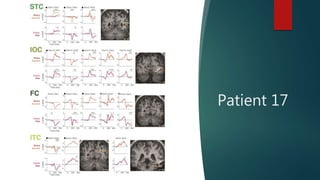
Patient 17
White matter tract endpoints
Overlap
analysis
IOC sends
information to ITC
[via ILF]
ITC communicates
with STC & FC [via
pARC]
Interim sum up 2
 Core & extended structures in face processing pathways
 IOC & ITC important additions
 Information appears to flow from IOC & ITC
 New white matter routes need further testing & verification
 Latencies of evoked iEEG activity have been underutilized for studying
information transfer during face processing tasks
Overall sum up: Quo vadis?
 Need for further simulation studies of MEG/scalp EEG & ability
to detect sources at the sensor level
 Share simulation tools
 Improve artifact detection/rejection; machine learning?
 Need for further studies integrating white matter pathways &
MEG/EEG/fMRI data to map out information flow in brain
networks
Acknowledgement
 George, Chaumon, Babo-Rebelo: CENIR platform at ICM in Paris; infrastructure funding from
"Investissements d’avenir" ANR-10-IAIHU-06 & ANR-11-INBS-0006
 Dinkerlacker: John Bost Foundation [La Force, France]
 Puce: Indiana University College of the Arts & Sciences [Sabbatical leave]
 2021-2023 CR-CNS grant:
 Puce PI, Pestilli Co-PI NIBIB USA; George, Chaumon Co-PIs INR France

Puce U kentucky_2020

  • 1.
    Re-using MEEG data& maximizing its value: Considerations of statistical power & white matter connectivity AINA PUCE PSYCHOLOGICAL & BRAIN SCIENCES, INDIANA UNIVERSITY, BLOOMINGTON
  • 2.
    Roadmap  Pre-amble: post-reproducibilitycrisis  Study 1: Detectability of signals at sensor level  Study 2: Information flow within the face processing system  Sum up
  • 3.
    Pre-amble: post-reproducibility crisis Need to focus on solid experimental design, data quality, adequate signal-to-noise & data/code sharing  best practices rock!  Need to integrate brain/behavior data from multiple methods  value added; the sum >> the parts  Need to put the brain ‘back into the body’  include continuous measures of behavior
  • 4.
  • 5.
     Detectability ofsignals at sensor level – MEG data Chaumon et al., in revision
  • 6.
    METHOD  HCP MEGresting state data [n=89]; preprocessed with HCP pipeline  Associated with structural MRI, 3D sensor position map, fiducials  Create single-shell conduction model [FieldTrip] + HCP structural pipeline segment the cortical mantle [Freesurfer]  Mesh topology: 64,984 vertices/brain  Create leadfield matrix in FieldTrip, project dipole sources =10 nA.m through leadfield to the sensors  2 different source models: source dipoles either constrained orthogonal to individual’s cortical mantle [or were free from any anatomical constraint]
  • 7.
    METHOD  Monte Carlosimulations; different numbers of trials & subjects; sampling w/o replacement; ‘trial’= 25-ms (50 samples) time segments of the continuous resting state data, at least 2 s apart from each other  Split trials randomly in 2 equal sets; add signal in one set; average data across time points & trials separately for each set  Paired t-test between 2 sets across subjects at each sensor; note significance (p<0.05, uncorr)  Spatial cluster-mass based correction for multiple comparisons (Maris & Oostenveld, 2007), 1000 permutations, cluster & significance thresholds both at p<0.05)  A comparison = significant only when peak sensor (i.e. the sensor at which absolute value of projection of source signal peaked) was included in a significant cluster  Procedure repeated 500 times for each trial-by-subject number pair; note number of times comparison was significant in 500 simulations  Examine position & orientation variability
  • 8.
    A simulation ofstatistical power across the cortical surface 50 trials, 25 subjects single dipole placed, in turn, at every possible neocortical position
  • 9.
    Simulations in some commonly activated brain regions Fusiformgyrus relatively low cross-subject position variability
  • 10.
    Simulations in some commonly activated brain regions Superioroccipital gyrus relatively high cross-subject position variability
  • 11.
  • 12.
    Simulations in some commonly activated brain regions Superiortemporal sulcus relatively high cross-subject orientation variability
  • 13.
    Average cross- subject variability in the brain POSITION cross-subjectvariability in position = std dev of source position across subjects FG SOG ORIENTATION cross-subject variability in orientation = log of the inverse of average resultant vector length across individual sources, for each cortical location Insula STS
  • 14.
    Interim sum up1  Optimizing SNR in MEG studies?  No single optimal data acquisition protocol e.g. x number of trials, y number of subjects  Consider potential activated structures in experiment: design with adequate SNR for least detectable brain structure!  Implications analyses of functional & effective connectivity [DCM, graph analyses]  How does this apply to EEG studies? MEG/EEG studies?
  • 15.
    Study 2: Information flow withinthe face processing system
  • 16.
  • 17.
    METHOD  Existing iEEGdata set with face processing task [Huijgen et al., 2015]  Localization of intracranial electrodes [MRI-based]  ‘Cleaning’ of long-epochs of EEG data [n=18]; reject inter-ictal spikes [n=7]  Discard incorrect behavioral trials  Average data by condition in each site in each subject [Face 1, Face 2 etc.]  Express as bipolar activity; re-check anatomy  Normalize evoked activity  Statistical testing:  1. ID sites with evoked activity Z>1;  2. cluster-based permutation t-test against zero across time at each site [multiple comparisons];  Visualize activity as a function of ROI
  • 18.
    Paradigm Huijgen et al,Soc Cogn Affect Neurosci 2015 Face onset Emotion onset [happy/fearful] Gaze aversion [or direct gaze] Checkerboard target [cong/incong to gaze]
  • 19.
  • 20.
  • 21.
  • 22.
  • 23.
  • 24.
    The STC prefersgaze aversions
  • 25.
  • 26.
  • 27.
  • 28.
    IOC sends information toITC [via ILF] ITC communicates with STC & FC [via pARC]
  • 29.
    Interim sum up2  Core & extended structures in face processing pathways  IOC & ITC important additions  Information appears to flow from IOC & ITC  New white matter routes need further testing & verification  Latencies of evoked iEEG activity have been underutilized for studying information transfer during face processing tasks
  • 30.
    Overall sum up:Quo vadis?  Need for further simulation studies of MEG/scalp EEG & ability to detect sources at the sensor level  Share simulation tools  Improve artifact detection/rejection; machine learning?  Need for further studies integrating white matter pathways & MEG/EEG/fMRI data to map out information flow in brain networks
  • 31.
    Acknowledgement  George, Chaumon,Babo-Rebelo: CENIR platform at ICM in Paris; infrastructure funding from "Investissements d’avenir" ANR-10-IAIHU-06 & ANR-11-INBS-0006  Dinkerlacker: John Bost Foundation [La Force, France]  Puce: Indiana University College of the Arts & Sciences [Sabbatical leave]  2021-2023 CR-CNS grant:  Puce PI, Pestilli Co-PI NIBIB USA; George, Chaumon Co-PIs INR France