![The Dawn of the Age of Artificially Intelligent
Neuroprosthetics
Sagar Hingal1
1
Department of Computer Science and Engineering, Lovely Professional University, Punjab,
India
{sagarhingalai@gmail.com}
Abstract - Neuroprosthetics is a field of study or in simple words is a technology
that encompasses the fundamentals of neuroscience and biomedical engineering.
It’s basically a complex machine that connects the brain directly to an external de-
vice such as computer, motors, or any gadget via an interface that acts as an in-
termediate to carry out signal processing tasks. These kind of devices are used to
replace a motor sensory or cognitive modality that has been damaged due to some
accident or a disease causing breakage of interconnected links to the brain and
central nervous system. But with the significant amount of advancements in
stream of hardware and software, there is one technology that has been a key in
development of such techniques – Artificial Intelligence.
It is an advance technique which is used to make machines smarter that enables
them to complete their tasks in a more intelligent manner. The unique fusion of
this technology with Neuroprosthetics has helped us to take a quantumleap in the
field of science and technology. This review will present a brief overview, includ-
ing the current and future scenarios of the respective technologies froma general
aspect.
Keywords: Neuroprosthetics, Brain Machine Interface, Computational Neurosci-
ence, Artificial Intelligence
Since the origin of first cochlear implant in 1957, the development of such kind
of machines which could repair or which could be used as a replacement to a par-
ticular part of the human body has expanded the horizons of Technology. Because
of this first minor step in biomedical engineering, an astonishing thought came in-
to everyone’s mid – What If we could connect our machines directly to the brain?
If we could then probably we could control them with the help of just our mind.
Today Neuroprosthetics has stepped into almost all the aspects of the human
body such as Visual, Auditory, Motor, Bladder control, Sensory, Spinal Cord,
Cognitive and so on [1]. The basic procedure of this methodology is to insert mul-](https://image.slidesharecdn.com/aa961df9-bfba-4ddb-b776-1ba0dd0b4a4f-150924060449-lva1-app6891/85/The-Dawn-of-the-Age-of-Artificially-Intelligent-Neuroprosthetics-1-320.jpg)
![The Dawn of the Age of Artificially Intelligent
Neuroprosthetics
Sagar Hingal1
1
Department of Computer Science and Engineering, Lovely Professional University, Punjab,
India
{sagarhingalai@gmail.com}
Abstract - Neuroprosthetics is a field of study or in simple words is a technology
that encompasses the fundamentals of neuroscience and biomedical engineering.
It’s basically a complex machine that connects the brain directly to an external de-
vice such as computer, motors, or any gadget via an interface that acts as an in-
termediate to carry out signal processing tasks. These kind of devices are used to
replace a motor sensory or cognitive modality that has been damaged due to some
accident or a disease causing breakage of interconnected links to the brain and
central nervous system. But with the significant amount of advancements in
stream of hardware and software, there is one technology that has been a key in
development of such techniques – Artificial Intelligence.
It is an advance technique which is used to make machines smarter that enables
them to complete their tasks in a more intelligent manner. The unique fusion of
this technology with Neuroprosthetics has helped us to take a quantumleap in the
field of science and technology. This review will present a brief overview, includ-
ing the current and future scenarios of the respective technologies froma general
aspect.
Keywords: Neuroprosthetics, Brain Machine Interface, Computational Neurosci-
ence, Artificial Intelligence
Since the origin of first cochlear implant in 1957, the development of such kind
of machines which could repair or which could be used as a replacement to a par-
ticular part of the human body has expanded the horizons of Technology. Because
of this first minor step in biomedical engineering, an astonishing thought came in-
to everyone’s mid – What If we could connect our machines directly to the brain?
If we could then probably we could control them with the help of just our mind.
Today Neuroprosthetics has stepped into almost all the aspects of the human
body such as Visual, Auditory, Motor, Bladder control, Sensory, Spinal Cord,
Cognitive and so on [1]. The basic procedure of this methodology is to insert mul-](https://image.slidesharecdn.com/aa961df9-bfba-4ddb-b776-1ba0dd0b4a4f-150924060449-lva1-app6891/75/The-Dawn-of-the-Age-of-Artificially-Intelligent-Neuroprosthetics-1-2048.jpg)
![2
tiple electrodes inside the brain, collect data in terms of electrophysiological sig-
nals, decode them and then process the interpreted signals into the machine. Alt-
hough at the initial point, this simple-looking process used to take a lot of time as
the hardware technology was not up to the mark in respect of the requirements of
the procedure. Scientist achieved a breakthrough in 1988, when they were able to
make people stand and walk who were diagnosed with Paraplegia – an impairment
in motor or sensory functions which is caused due to spinal cord injuries [2].
The issues that researches faced in developing such interfaces is the size and
power consumption parameters. Because we can’t insert a giant device or a high
power consuming IC into our brain, and even if we managed to fabricate a small
chip, the software computational model that will be responsible for calculating and
processing of the raw brain signals will be requiring advanced methodologies and
algorithms. Also not to forget, the implantable device should be bio-compatible so
that it could not cause any internal damage to the brain [1].
Over the years, scientists overcame such limitations with the evolution of bio-
technology and with parallel progress in computational models using Machine
Learning – a major sub-field of Artificial Intelligence. It allowed the machines to
learn from the previously stored data (experience) which could be incorporated in
future tasks or queries. These software models play an essential part in the BMI
(Brain-Machine Interfaces) that includes an intermediate channel which is respon-
sible for the bi-directional I/O and O/P operations performed on the data received
from the brain to the connected prosthetic device respectively.
Following are some of the fact files which follows the above mentioned tech-
niques in neural prosthetics.
1. SIMULATOR-BASED BRAIN-BIOMIMETIC
MODELS
For building out an intricate brain-machine interface (BMI), it is necessary to
decode the raw neurophysiological data signals that are received to the other end
through the implanted electrodes. Unless and until the interpreted signals are pro-
cessed or converted into a machine familiar binary-coded instructions, we cannot
operate a machine. For that, a computation model is required which can handle an
ample amount of data and execute the conversion process in real time.
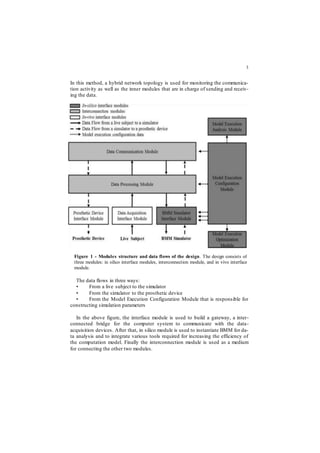
By deploying a Brain-Biomimetic-Model (BMM) the algorithms which were re-
sponsible for the complex mathematical calculations could be initialized for the
preliminary phase. Then, a data-acquisition device is installed which grab appro-
priate raw signals from those embedded electrodes and filter out all the other ex-
ternal factors such as noise. In the last, by feeding this data to the BMM, proper
machine signals are sent to the attached prosthetic machines such as a prosthetic
arm. These three components are fused together to forma base platformnecessary
for real-time communication.](https://image.slidesharecdn.com/aa961df9-bfba-4ddb-b776-1ba0dd0b4a4f-150924060449-lva1-app6891/85/The-Dawn-of-the-Age-of-Artificially-Intelligent-Neuroprosthetics-2-320.jpg)
![4
These type of BMMs, artificially recreate some of the parameters that results in
sending signals from the brain to the other parts of the body which carry out dif-
ferent functions such as sensory, motor, etc. Being more specific, the activity of
the brain which involves sudden spiking of the inter-connected neurons which
send or receive signals.
In other words, by implementing a learning mechanism into the core logical
blocks of BMM, this composite system learns at the same time with respect to
brain. If simply put together, the machine and the brain learn at the same time
which enables themto adapt to each other in a synchronous manner.
For the record, this technique has been successfully implemented on a non-
human primate for the purpose of enhancements in the neuronal systems. Many
experimental illustrations which formulates sensorimotor learning or cellular mi-
cro stimulation could be recreated using such techniques.
Its working is very similar to a dynamic clamp, which is used to link the living
cells to a computer or an analog device to simulate dynamic process such as mem-
brane or synaptic currents. One of the main part of such approach is to process the
sudden occurring spiking signals that are responsible for a number of possible
events such as moving a hand, recognizing an object, etc.
For such spiking solutions, this methodology uses a Multi-Channel Acquisition
Processor (MAP) server which has a feature of filtering and sorting of spikes sig-
nals collected from small-sized electrodes implanted in the live subject. A Large-
Scale Spiking Neuron Model is integrated with a MAP Server for linking MAP
server to the BMM so that the signals could be interpreted into appropriate ma-
chine controlling commands.
2. TACTILE SENSORY FEEDBACK OF PROSTHETIC
HANDS
Upper-Limb amputees are those people who had gone through some major
accidents which resulted into the loss of their limbs. Technically, Amputation is
the abolition of the body periphery by an injury or a surgery [5]. Such kind of
cases are very common in China. In reality, a total of 2.26 million amputees con-
stituted approximately 9.37% out of 24.12 million physically challenged people,
as claimed by Second Chinese National Sample Survey on Disability in 2006.
The numbers are same in the United States as well, although both countries are
well developed.
So, to tackle such drawbacks, researchers fromall around the world initiated a
deep study and experimentations on prostheses, specifically on prosthetic hands
in a widespread manner.](https://image.slidesharecdn.com/aa961df9-bfba-4ddb-b776-1ba0dd0b4a4f-150924060449-lva1-app6891/85/The-Dawn-of-the-Age-of-Artificially-Intelligent-Neuroprosthetics-4-320.jpg)
![5
But even if an appropriate interface is developed, it is necessary that the amputee
should have enough sensory feedback in order to feel the prosthetic hand or any
other limb. Due to this obstacle, the prosthetic device is useless as without any
input it can’t be operated.
Thus, various strategies took a change in developing a sensory feedback alterna-
tive for the amputees so that not only the prosthetic devices could be operated but
also the patients could feel the artificial limbs through the feedback system by
processing the electromyography (EMG) signals from residual muscles [4].
Considering previous two decades, scientists are testing a variety of testing
methodologies for signal processing, subterfuging the inter-communicating pe-
ripheral nerves. But still, the desired output has not fully achieved. Alternate
techniques have been tried out by some great intellects around the globe which
comprises of a direct-connection to the somatosensory cortex– the main sensory
receptive region that is responsible for the function of touch [6].
Since then, multiple technologies has been developed depending on the tech-
niques each follow.
They are categorized as follows:
• Cutaneous Mechanical Simulation (CMS)
• Transcutaneous electrical nerve stimulation (TENS)
• Direct Peripheral nerve electrical simulation (DPNES)
Figure 2 - Schematic illustration of three kinds offeedback approaches through
stimulating peripheral afferents to restore tactile sensation in upper amputees'
somatosensory cortex](https://image.slidesharecdn.com/aa961df9-bfba-4ddb-b776-1ba0dd0b4a4f-150924060449-lva1-app6891/85/The-Dawn-of-the-Age-of-Artificially-Intelligent-Neuroprosthetics-5-320.jpg)
![6
Cutaneous Mechanical Simulations (CMS) proved that the amputees which
were suffering from upper-limb injuries can feel a rubber hand or a prosthetic
hand’s visual tactile illusion.
Afterwards, a controlled sensory feedback system was put forwarded by
Antfolk et al, making sure that the amputees could experience various planes
of touch. In other words, by making direct contact with the inner bulb implant
ted inside the amputee’s arm, he/she can detect a variable amount of force
with respect to the touch intensity.
If summarizing the entire concept, CMS put amputees in a more favorable po-
sition due to its high accuracy factor. For instance, the skin feeling a certain
degree of sensation is totally dependent upon the input force that is applied on
it. Although, due to its composite mechanical formation and not to forget, be-
ing ponderous and the amount of magnitude it has with extreme energy con-
sumption makes it unsuitable for wide clinical implementations.
The second technique which has been formulated is Transcutaneous Electri-
cal Nerve Simulation (TENS), yet another supervised tactic for Tactile Senso-
ry Feedback. In this scenario, Mulvey et al claimed that healthy participants
became aware of a tangible realization i.e. something physically existing
when connected to a prosthetic hand. On the other hand, the amputees were
able to feel a bodily sensation generated by TENS.
This technique uses an Electro-tactile sensory replacement system which
could possibly detect 59 discrete sensations which are way more than CMS
where the respective number is 16. But if it could detect those, then the next
step would be to develop some mechanisms to implement those sensations in-
to the prosthetic hand, which is very difficult even to simulate simple senses
such as hot and cold. The possible choices left now is to stimulate the missing
sensory feedback or to trigger the remaining sensory afferent fibers in the
surviving limbs. Putting things all together, TENS could generate a sufficient
amount of sensation levels but the real problemexists is how to extract the in-
formation that is being perceived with the limited number of transmission
channels.
The final technique is Direct Peripheral Nerve Electrical Simulation
(DPNES) which is a type of uncontrollable method that straight away restore
structural fibers that are present in the spinal nerve trunks for upper limb am-
putees’ sensory feedback. It is considered as a feasible option due to its supe-
riority in reduced-energy utilization and usage of very small devices.
Currently, apart from above mentioned techniques, there is still work to be
done in sensory feedback although no perfect method has been generally
acknowledged which will overcome the limitations of these techniques [4].](https://image.slidesharecdn.com/aa961df9-bfba-4ddb-b776-1ba0dd0b4a4f-150924060449-lva1-app6891/85/The-Dawn-of-the-Age-of-Artificially-Intelligent-Neuroprosthetics-6-320.jpg)
![7
3. IMPLANTABLE SPINE [7]:
With the advancement in the material technology, fusion of various combina-
tions and permutations of different kinds of materials has been tested at the mo-
lecular level. This has resulted in yet another achievement which will aid spinal-
cord injuries in very less amount of time.
EPFL (École polytechnique fédérale de Lausanne) is a specialized university in
the field of science and technology which is located in Lausanne, Switzerland has
achieved a breakthrough by developing an e-Dura implant which can be directly
applied to the spinal cord without any possibility of tissue damage.In its initial de-
velopment and testing phase, EPFL scientists carried out their re-establishment
protocol to create a fusion between electrical and chemical stimulation to inca-
pacitate rats, i.e. paralyze them. It resulted into a positive response that is the im-
plant not only proved its compatibility towards bio-elements present inside the
body but also successfully completed the task of restoring its capabilities to stand
and walk again. Off course, the rat was able to walk in the normal form after few
weeks of physical exercises.
Moreover it includes some electronic elements that are fundamental in restor-
ing the spinal cord at the time of any trauma or injury. The underlying layer of sil-
icon is covered with gold conducting tracks that are capable of stretching and pull-
ing at a general level. A pioneering permutation of silicon and platinum
microbeads (microbeads are poly ethylene chemical widely used in cosmetics and
skin-care products) has been used in development of such electrodes.
The advantage of having an electronic module (specifically a neurotransmitter –
for re-animating the movement in the nerve cells present beneath the injured spi-
nal cord) inside the spine is that, it can be used to track and monitor the sending
and receiving of signals in real-time. In simpler words, the scientist are able to
withdraw exact timing of the living-being’s (in this case rat) motor-controlling
command signal before even it was processed for movement.
Figure 3 - Illustration ofSpine. Flexible and Stretchy, the implant devel-
oped at EPFL is placed beneath the Dura mater,directly onto the spinal
cord. It consists of elastic propertywhich is capable of withstanding de-
formation.](https://image.slidesharecdn.com/aa961df9-bfba-4ddb-b776-1ba0dd0b4a4f-150924060449-lva1-app6891/85/The-Dawn-of-the-Age-of-Artificially-Intelligent-Neuroprosthetics-7-320.jpg)
![8
4. ARTIFICIAL INTELLIGENCE: BRAIN-INSPIRED
COMPUTING
For the first time in human history, the concept of thinking machines and arti-
ficial beings were featured in Greek mythology, as Talos of Crete, the bronze ro-
bot of Hephaestus and Pygmalion’s Galatea. In the ancient times, human tales
used to be enriched with animated characters, some of which were also wor-
shipped in Egypt and Greece. All these were pure imaginary, if we look through
the science perspective. But then, coming to the myths that started around 19th
and 20th century with the movies began to depict the intelligence of the machines
over-coming the very intellect of human beings, the point which we can find
common is that all of the stories pictured machine as an intelligent entity just like
us, humans [9].
If speaking scientifically, the beginning of such concepts began to take place
in the early 1950’s when the digital computer was invented with the working logic
of 0 and 1 which we can refer to as True or False in human language. Develop-
ment of simple Logics and Reasoning began to develop using the base of some
noted mathematicians of those times such as Alan Turing and others.
At that time, Turing’s theory of computation i.e. 0’s and 1’s could form any
form of data with the parallel progress in the field of neuroscience, bio-medical
engineering and cybernetics paved the way for the dawn of electronic brain, i.e.
Artificial Intelligence which was founded at technical conference on the campus
of Dartmouth College in the summer of 1956. Since then, a lot of advancements
has been achieved in this field, many companies have invested a substantial
amount of money in AI projects such as Intel and IBM, both big names in com-
puter and IC manufacturing [9]. But still today, the famous Alan Turing’s test to
determine whether the machine is intelligent simply determining on the basis of a
general conversation with a person has not yet passed. No doubt, the hardware is
far more efficient and faster than the human brain in terms of processing, but even
now it lags behind a big time. He estimated that human brain works just like a
computer, which is in terms of computation and processing tasks. But the truth is,
it is not.
After almost a century, the human brain remains the most complex mystery
that we are not able to unravel. Discussing this issue,a solution was suggested in a
paper which was published by Mexican Scientist Carlos Gershenson and Professor
Edmonds. They postulated that Adaptability is the crucial part of the human intel-
lect. For e.g. when we talk to somebody, there are some things that we learn from
another person while talking and then we improvise at real-time to make the con-
versation more comfortable.
Fortunately, due to vast growth in the field of neuroscience engineering, we
are getting closer to untangle the very fundamentals of the human brain. With the
evolution of Neuroprosthetics, advanced sub fields such as Deep Learning, Com-
puter Vision and Natural language processing are progressing at a very fast rate to](https://image.slidesharecdn.com/aa961df9-bfba-4ddb-b776-1ba0dd0b4a4f-150924060449-lva1-app6891/85/The-Dawn-of-the-Age-of-Artificially-Intelligent-Neuroprosthetics-8-320.jpg)
![9
achieve the goal of creating an artificial brain. In this modern age, a new breed of
computers has begun rising to the surface, which is called as Neuromorphic Com-
puter Systems (NMC).
NMCs mimic various functionalities of the human brain. For instance, our
brain comprises of Neurons - fundamental building blocks that are responsible for
transmitting and receiving data by processing electrical and chemical signals [10].
These neurons are connected to other neurons through axons which are a unique
biological extension that connects to the other axons (usually up to 1m or more
varying from species to species) just like a network cable that is used to connect
computers in a network. Also there are dendrites, which grow from the cell body
(neuron) and extend into hundreds of sub-branches, forming a tree like structure
[10].
If stated in simple words, there are millions of nodes that have billions of in-
ter-connection links. These inter-connected neurons form a Neural Net-
work.Different species consists of different type of a neural network which varies
the amount of neurons required. For e.g. a simple worm contains approximate 302
neurons depending upon its cellular structure of the brain. Implementation of such
networks in the virtual reality is termed as Artificial Neural Networks which ap-
pears to be the main goal of NMCs. But a lot of hardware power is required as our
human brain encompasses billion of axons as well as millions of neurons.
Starting first, is the SpiNNaker project initiated by the University of Man-
chester led by Prof. Steve Furber, co-founder of the ARM microprocessor. This
project consists of a mammoth parallel computing platform integrating thousands
of Multi-core System-On-Chips (S-o-C). They achieved a million processor in-
duced machine which is capable of simulating 25 million neurons in real-time
[11].
Unlike SpiNNaker, a distinct approach has been taken by the University of
Heidelberg. Known as FACETS and BrainScaleS, these projects are run by Prof.
Karlheinz Meier which make use of analog circuits to recreate a biological neural
network. The team acquired two silicon wafers out of 20 that would be required to
Figure 4– Neuron](https://image.slidesharecdn.com/aa961df9-bfba-4ddb-b776-1ba0dd0b4a4f-150924060449-lva1-app6891/85/The-Dawn-of-the-Age-of-Artificially-Intelligent-Neuroprosthetics-9-320.jpg)
![10
simulate one billion brain synapses (Synapses are the functional bodies which al-
low the neurons to pass signals) and 4 million neurons.
It uses a specific VLSI Neural circuit to simulate cortical cell types, engaging
into electrophysiological data recorded from the cells as a reference processing at
a single cellular level.
Such internal parameters of the Neuromorphic circuits will be used to analyze
and design different permutation of neural networks, whereas by initiating simula-
tions based on analog and physical data, appropriate inputs for the neuronal hard-
ware could be generated at the network level. Another aim of this type of ap-
proach is to draft a prototype called as Mixed Hardware-Software Platform,
intentionally designed to a virtual environment for carrying out experiments on
spiking activity of the Neural Network [13].
Another astonishing entry in the Human-Brain Project is by the IT giant IBM
with TrueNorth.As claimed by the company, it is the first single, self-contained
chip which holds the power to simulate 256 million individually programmable
synapses, fabrication of billions of transistors on a chip that consumes only 70
mili-watts that is capable of performing 46 billion synaptic operations per second.
IBM calls it ‘Neurosynaptic Supercomputers’.
These were all the advancements that are currently going on in developing a new
species of computers, or we can say supercomputers. Technically speaking, even
the limits of a supercomputer has also been surpassed in developing such kind of
devices.
Coming back to the real question, does these methods will be able to replicate
the human brain? The answer is still not derived. Because there are still plenty of
secrets which are covered by our brain and we don’t even know the limit to this.
But as we have no other option, taking brain as the initial point is not a bad option
in the race of building the ultimate intellectual machine.
As said by one of the leading neuroscientist, Professor James Olds (newly ap-
pointed head of the US National Science Foundation’s biological sciences direc-
torate), Artificial Intelligence will pass the Turing test, but not by mimicking the
brain, but through a different path. The example would be the invention of the
aero planes, which works on the principle of aerodynamics not by flapping of
wings [8].
5. CONCLUSION
It is a very crucial time in the field of science and technology. Right now, we
have advanced to a certain limit where we still don’t know how far we have to go
to achieve perfection. With the evolution of Neuroprosthetics, we are no longer in
debt to our bio-logical short-comings. The diseases such as Parkinson’s, Gait dis-
orders, amputation have now became a history. Combining various materials, we
can now build an artificial skin which could be sensed by the patients who have
lost their sensory feedback, restore listening for those who suffer with loss in audi-
tory functions (cochlear implants) and lot more cases have been resolved.](https://image.slidesharecdn.com/aa961df9-bfba-4ddb-b776-1ba0dd0b4a4f-150924060449-lva1-app6891/85/The-Dawn-of-the-Age-of-Artificially-Intelligent-Neuroprosthetics-10-320.jpg)
![11
In addition to this, artificial intelligence is finding new techniques, new ways
to develop more efficient and smarter machines. Considering next 5-10 years, the
face of technology will be totally different, Turing test will be just a small hurdle
for the machines, devices would be controlled just by a thought of our mind, i.e.
from our brain we will be able to control machines that we use in day-to-day life.
Virtual Reality will bring a whole new level of dimensions, changing the face of
3-dimensional objects. Diseases like Cancer will not only be treated in a cheaper
way, but also will be cured in a matter of weeks with the advancements in nano-
technology [15], through brain stimulators, we will be able to correct or recover
our lost memories by using brain stimulator that will be working on the con-
sciousness generating areas of our brain [16]. All the secrets regarding the entities
that exist in nature which still has no reason but we are familiar with (such as our
soul – which acts as a power supply to our human body is just a certain amount of
neutrinos that is released from the body at the time of death) will be revealed
through science and technology [17][18].
There will be one time when all these mysteries will be unraveled by the help of
science and technology.
6. REFERENCES
[1] Neuroprosthetics - http://en.wikipedia.org/wiki/Neuroprosthetics
[2] Paraplegia - http://en.wikipedia.org/wiki/Paraplegia
[3] Giljae Lee, Andréa Matsunaga, Salvador Dura-Bernal, Wenjie Zhang,
William W Lytton, Joseph T Francis, José AB Fortes, “Towards real-time
communication between in vivo neurophysiological data sources and
simulator-based brain biomimetic models”, 11/11/2014
[4] CHAI Guo-hong (柴国鸿), SUI Xiao-hong∗ (隋晓红), LI Peng(李鹏)
LIU Xiao-xuan (刘小旋), LAN Ning (蓝宁) (School of Biomedical En-
gineering, Shanghai Jiaotong University, Shanghai 200240, China), “Re-
view on Tactile Sensory Feedback of Prosthetic Hands for the Upper-
Limb Amputees by Sensory Afferent Stimulation”, J. Shanghai Jiaotong
Univ. (Sci.), 2014, 19(5): 587-591 DOI: 10.1007/s12204-014-1546-y.
[5] Amputation http://en.wikipedia.org/wiki/Amputation
[6] Somatosensory Cortex http://en.wikipedia.org/wiki/Postcentral_gyrus
[7] Ivan R. Minev, Pavel Musienko, Arthur Hirsch, Quentin Barraud, Niko-
laus Wenger, Eduardo Martin Moraud, Jérôme Gandar, Marco Capogros-
so, Tomislav Milekovic, Léonie Asboth, Rafael Fajardo Torres, Nicolas
Vachicouras, Qihan Liu, Natalia Pavlova, Simone Duis, Alexandre Lar-
magnac, Janos Vörös, Silvestro Micera, Zhigang Suo, Grégoire Courtine,
and Stéphanie P. Lacour. Electronic dura mater for long-term multimodal
neural interfaces. Science, January 2015 DOI:10.1126/science.1260318
[8] The Turing Test: brain-inspired computing's multiple-path approach](https://image.slidesharecdn.com/aa961df9-bfba-4ddb-b776-1ba0dd0b4a4f-150924060449-lva1-app6891/85/The-Dawn-of-the-Age-of-Artificially-Intelligent-Neuroprosthetics-11-320.jpg)
![12
http://eandt.theiet.org/magazine/2014/11/imitation-brains.cfm
[9] Artificial Intelligence
http://en.wikipedia.org/wiki/Artificial_intelligence:
[10] Neuron
http://en.wikipedia.org/wiki/Neuron
[11] SpiNNaker Project
http://apt.cs.manchester.ac.uk/projects/SpiNNaker/project/
[12] Wafer (Electronics)
http://en.wikipedia.org/wiki/Wafer_(electronics)
[13] Silicon neural networks: implementation of cortical cells to improve the
artificial-biological hybrid technique
https://facets.kip.uniheidelberg.de/jss/AccessDs/GRASSIA_FILIPPO_20
13.pdf?s=PxPQyxQ Rtz6xAJ9&ID=105&documentID=124
[14] IBM - brain-inspired computer called as TrueNorth
http://www.research.ibm.com/articles/brain-chip.shtml
[15] NanoBot - The Next cure for Cancer
https://sites.google.com/site/fictiontoreality/nanobots-the-next-cure-for-
cancer
[16] Restoring Memory using Brain-Stimulators – DARPA
http://www.technologyreview.com/news/536331/work-begins-on-brain-
stimulator-to-correct-memory/
[17] Russian scientist photographs soul leaving body
http://www.esotericonline.net/profiles/blogs/russian-scientist-
photographs-the-soul-leaving-the-body-at-death
[18] What happens to the soul after leaving the human body?
http://ezinearticles.com/?What-Happens-to-the-Energy-in-the-Human-
Body-When-We-Die?&id=4085251](https://image.slidesharecdn.com/aa961df9-bfba-4ddb-b776-1ba0dd0b4a4f-150924060449-lva1-app6891/85/The-Dawn-of-the-Age-of-Artificially-Intelligent-Neuroprosthetics-12-320.jpg)

This document explores the advancements in neuroprosthetics, highlighting the integration of artificial intelligence to enhance the connection between the brain and external devices, such as prosthetics. It discusses various methodologies employed in developing brain-machine interfaces and addressing sensory feedback for amputees to improve their experience with artificial limbs. The evolution of these technologies demonstrates significant breakthroughs in treating neurological impairments and enhancing motor functions through bioengineering and AI.


