Big Data from the LHC
Commissioning	

!

Practical Lessons from Big Science
Simon/@drsm79
Hello!
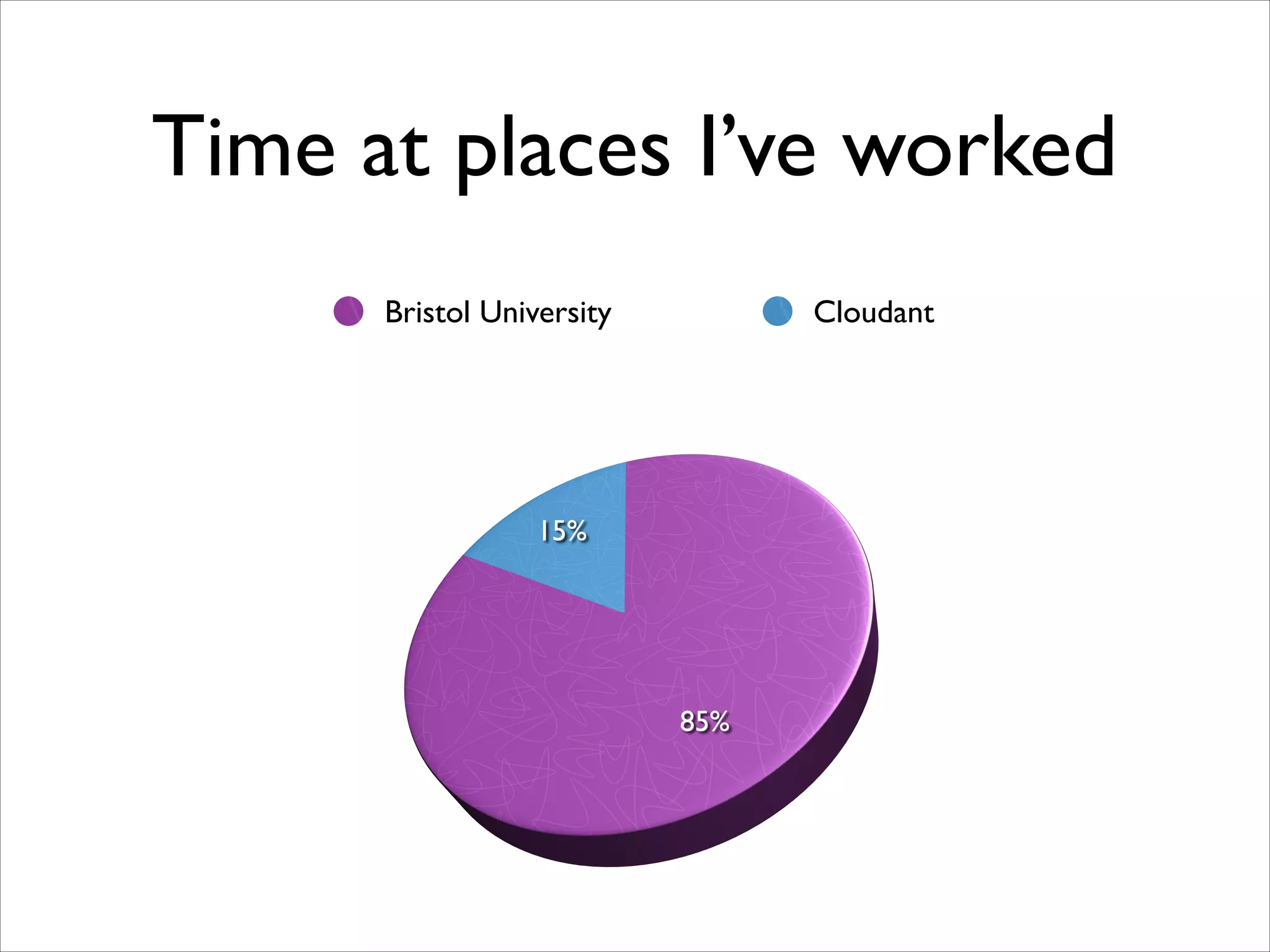
Time at places I’ve worked
Bristol University

Cloudant
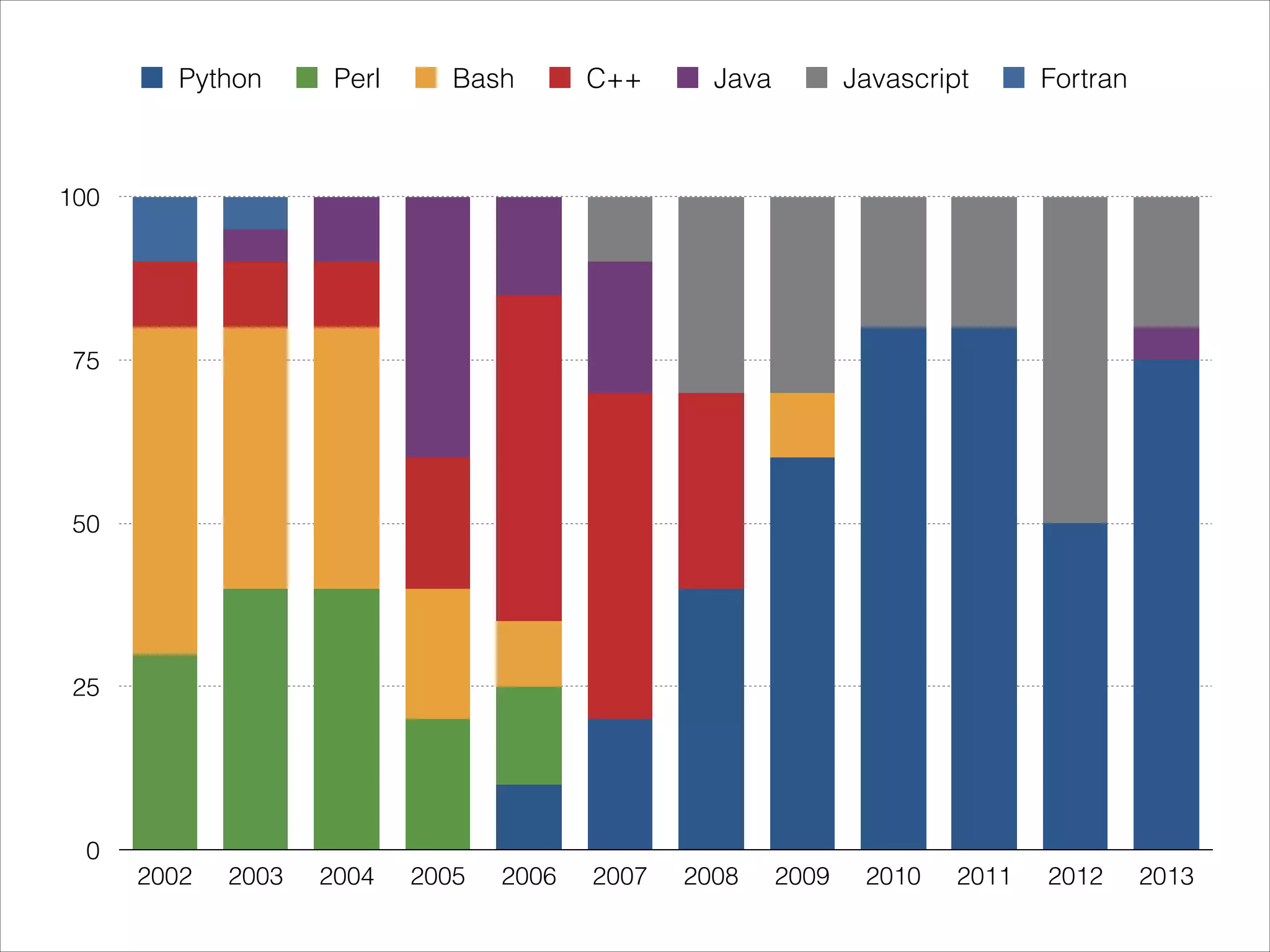
Python

Perl

Bash

C++

Java

Javascript

Fortran

100

75

50

25

0
2002

2003

2004

2005

2006

2007

2008

2009

2010

2011

2012

2013
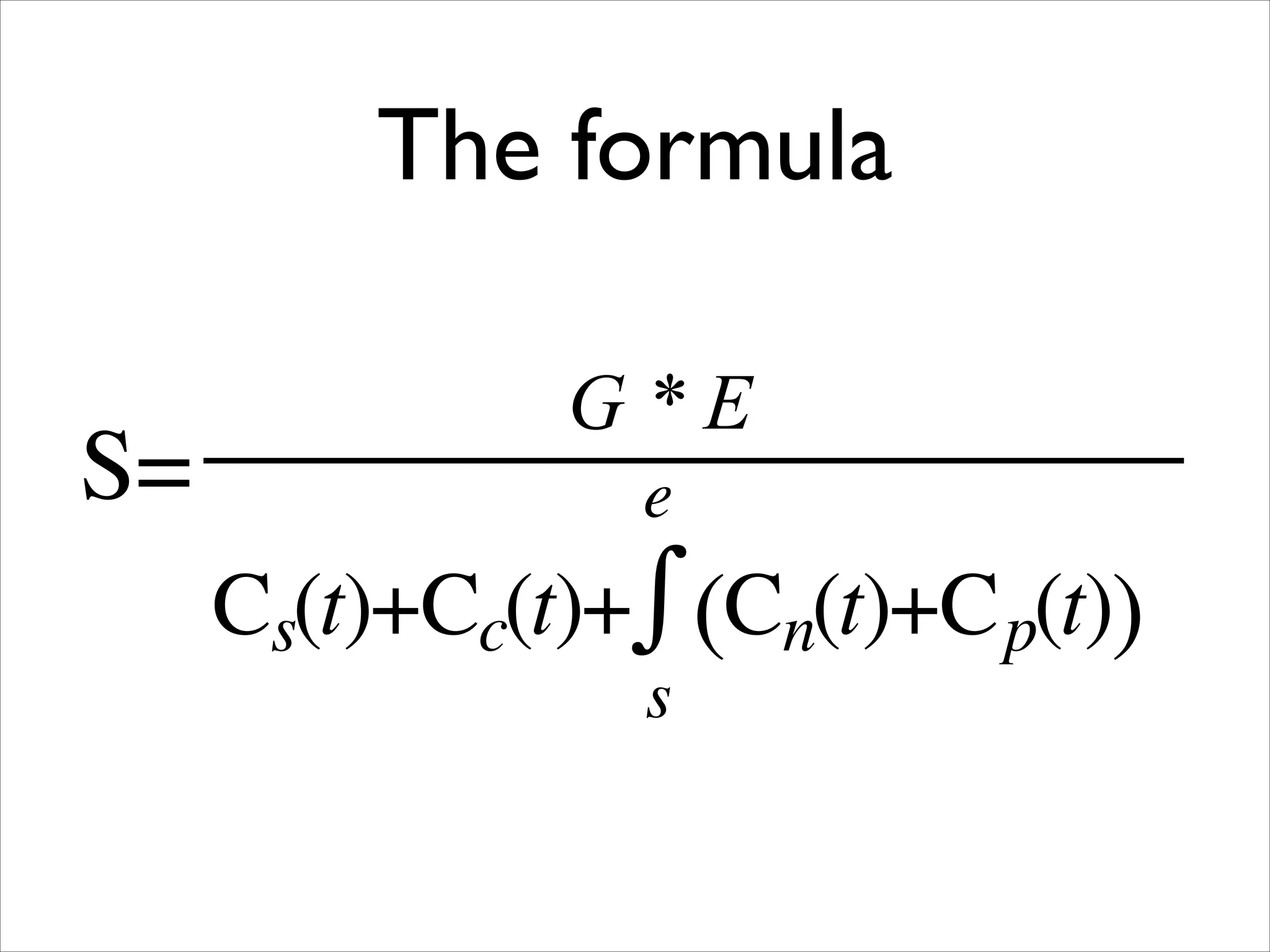
The formula
G*E
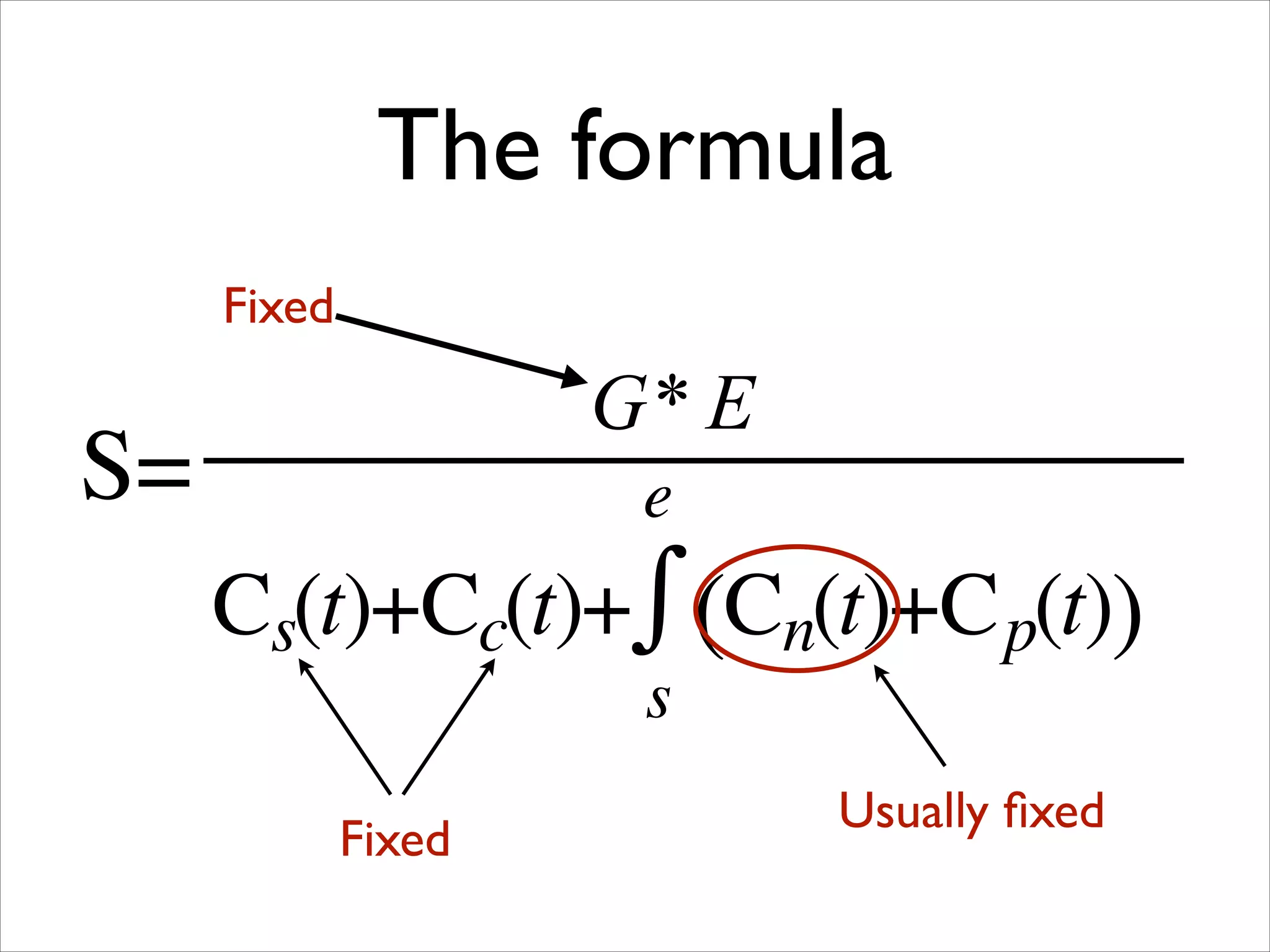
The formula
Fixed

G* E

Fixed

Usually fixed
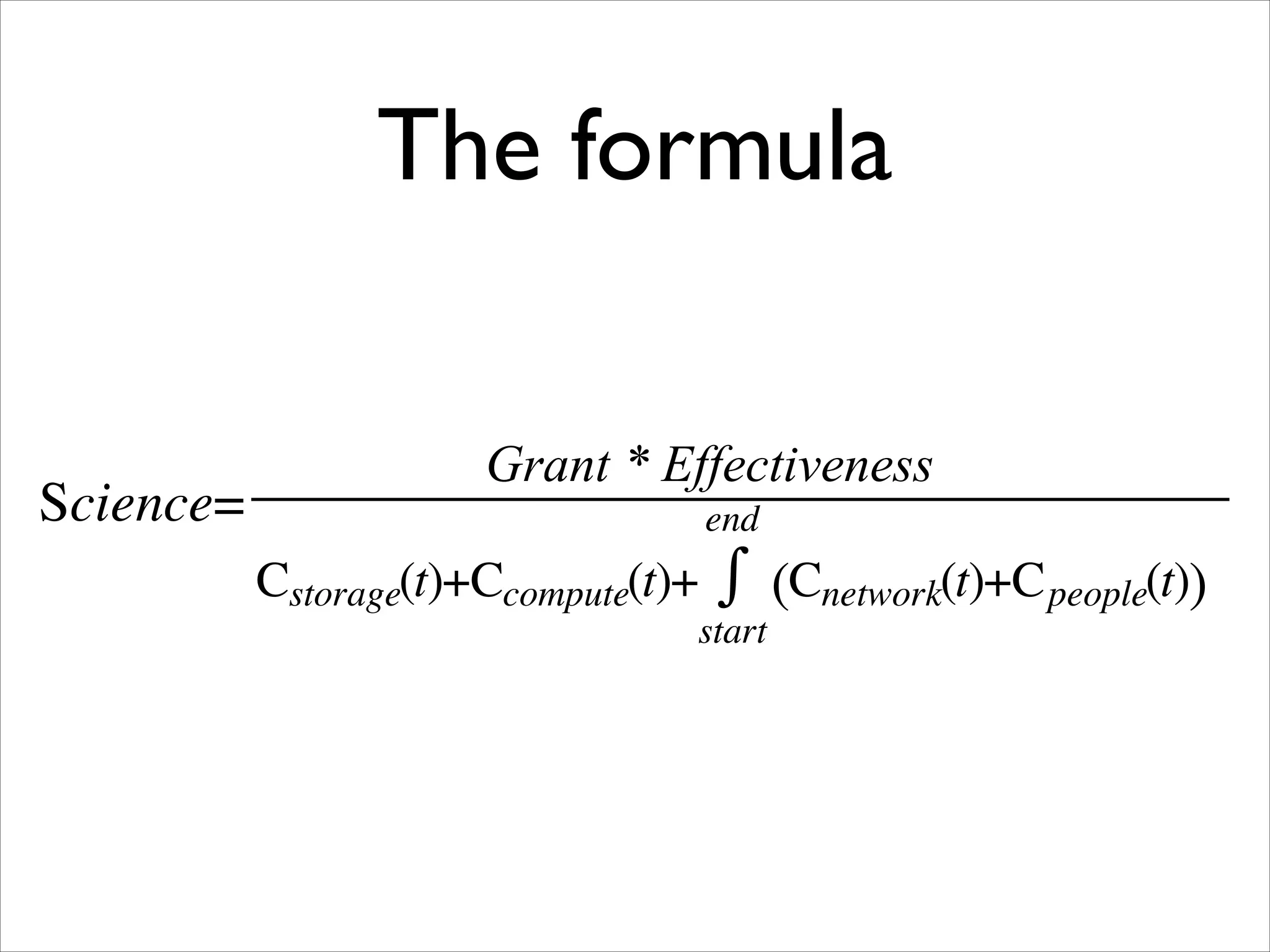
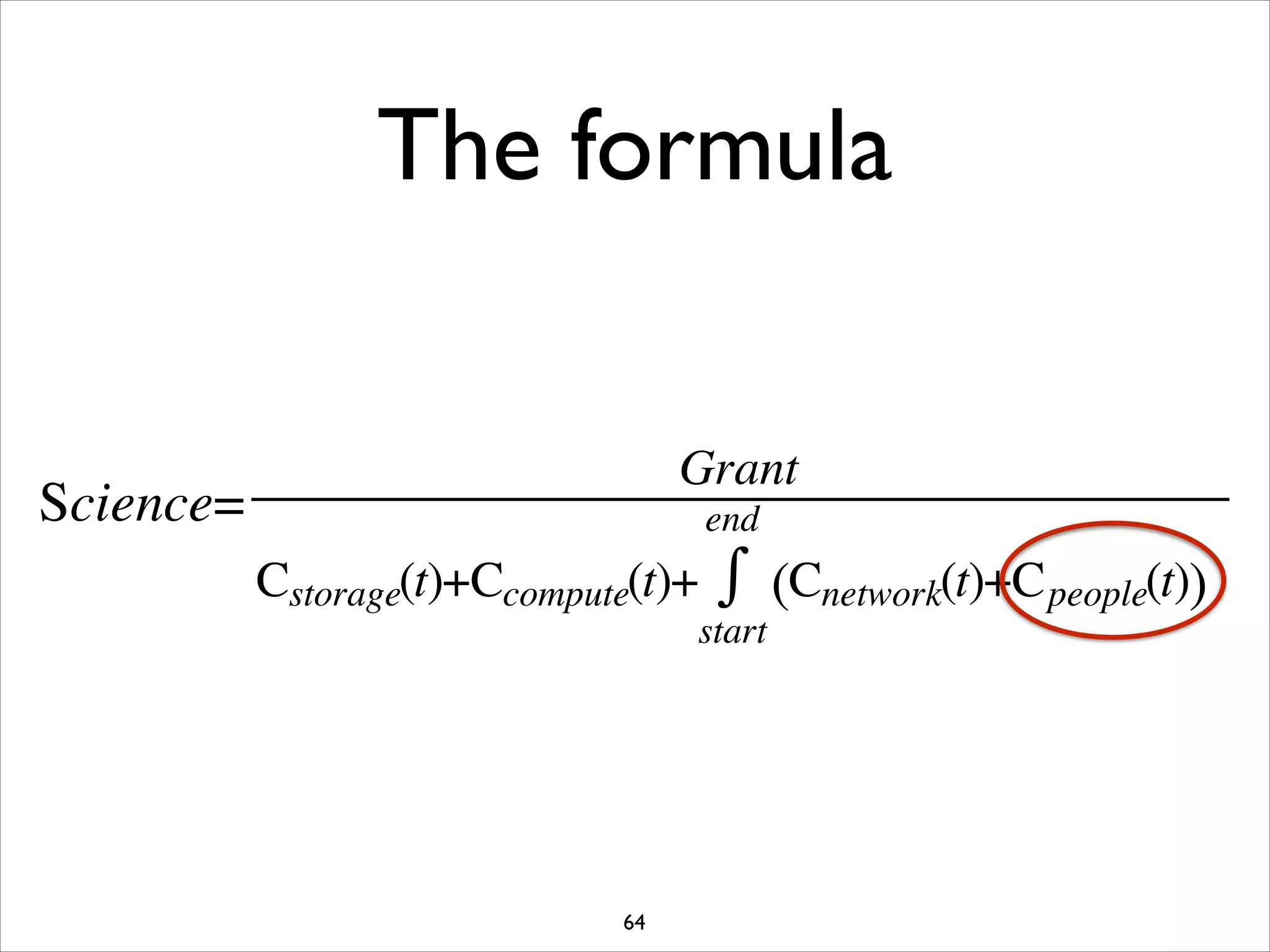
The formula
Grant * Effectiveness
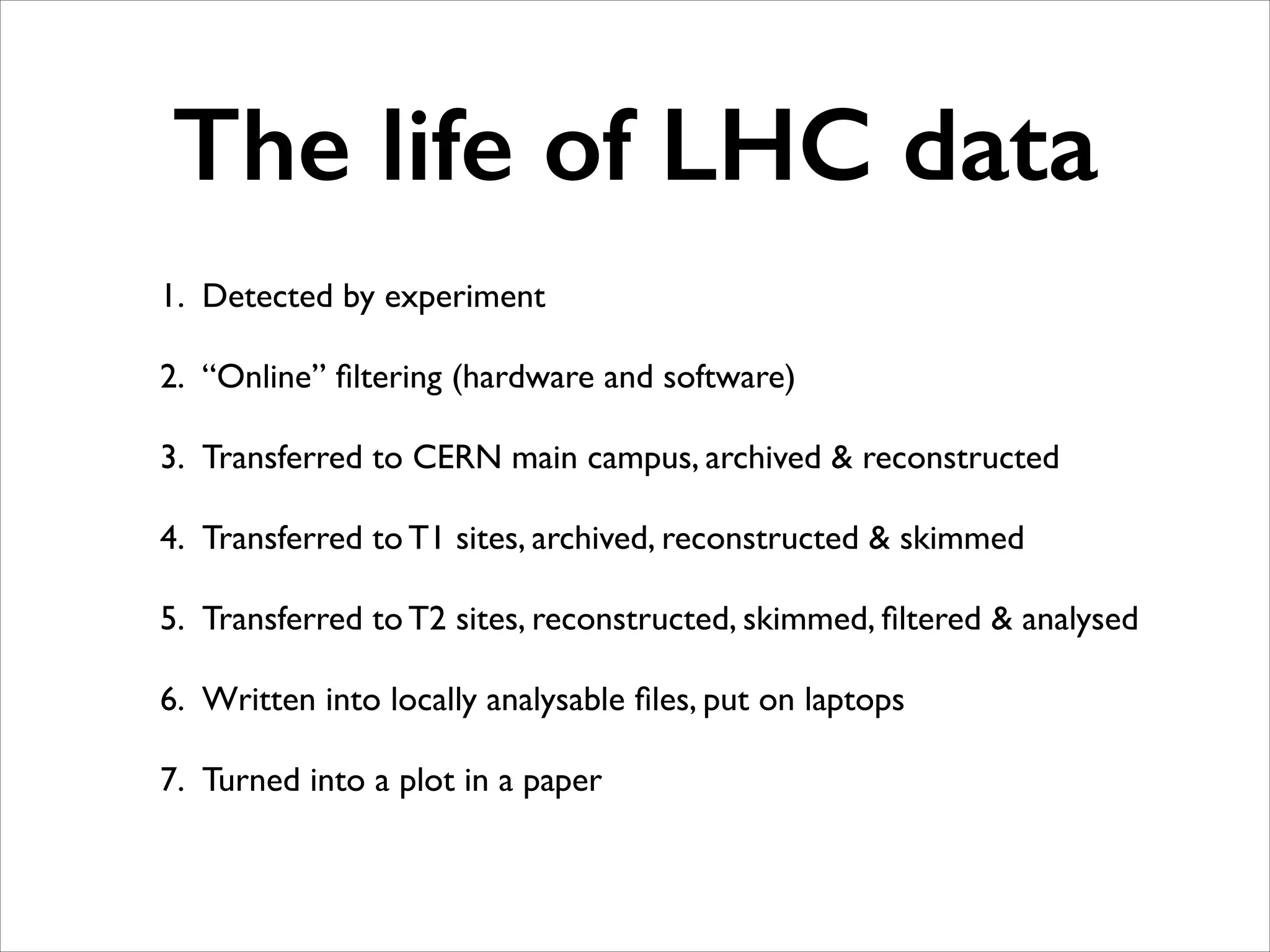
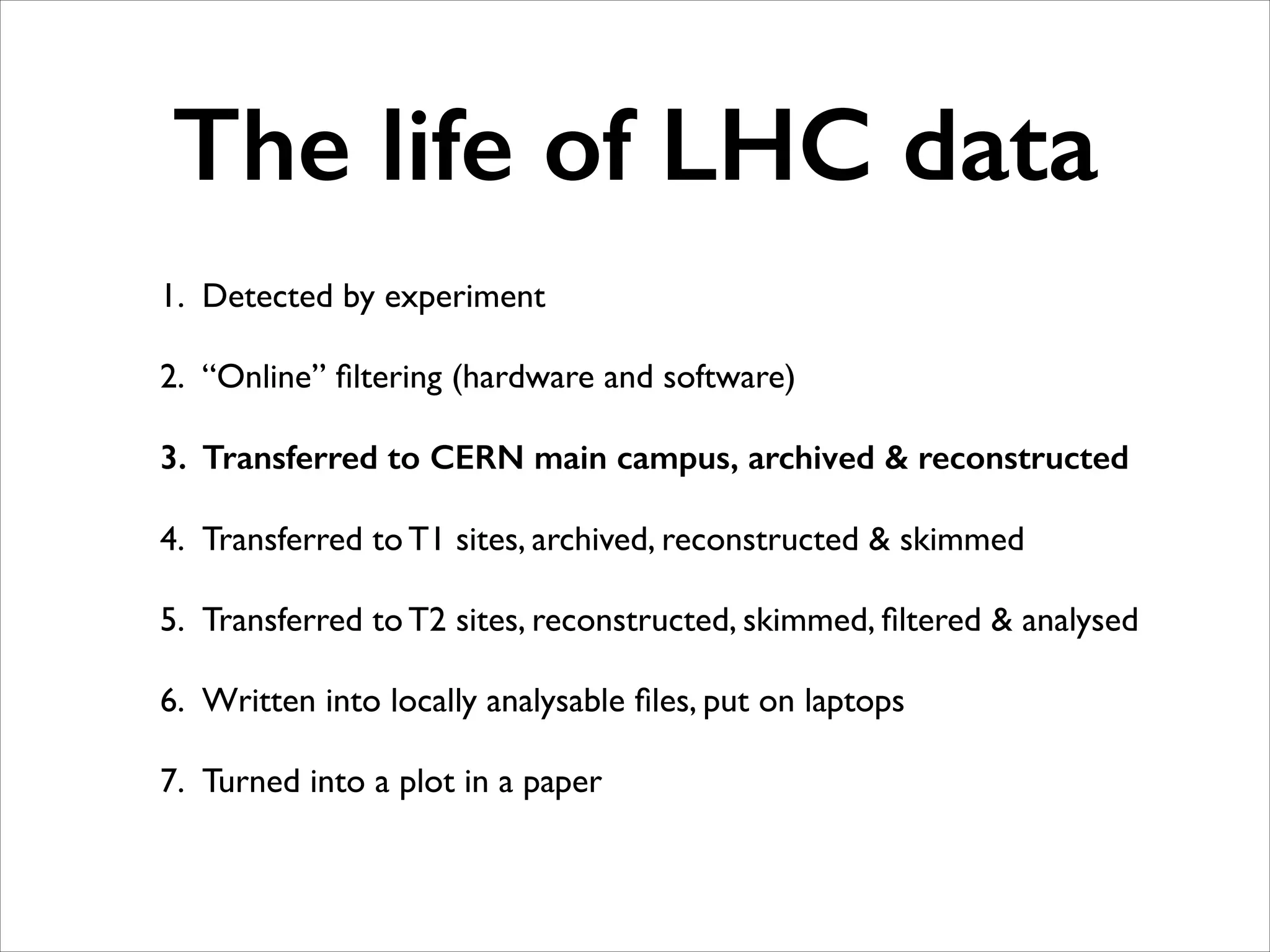
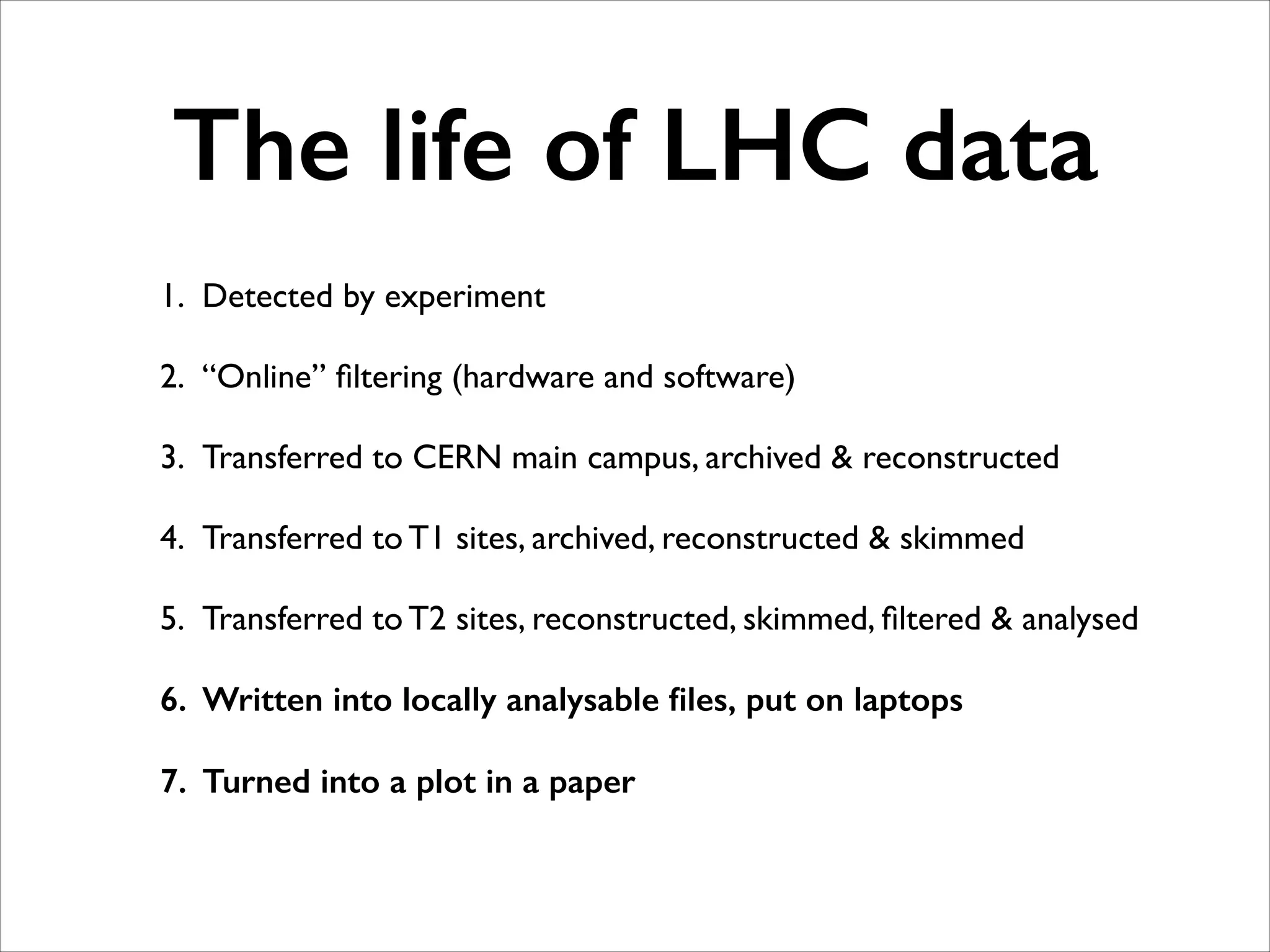
The life of LHC data
1. Detected by experiment	

2. “Online” filtering (hardware and software)	

3. Transferred to CERN main campus, archived & reconstructed	

4. Transferred to T1 sites, archived, reconstructed & skimmed	

5. Transferred to T2 sites, reconstructed, skimmed, filtered & analysed	

6. Written into locally analysable files, put on laptops	

7. Turned into a plot in a paper
The life of LHC data
1. Detected by experiment
2. “Online” filtering (hardware and software)	

3. Transferred to CERN main campus, archived & reconstructed	

4. Transferred to T1 sites, archived, reconstructed & skimmed	

5. Transferred to T2 sites, reconstructed, skimmed, filtered & analysed	

6. Written into locally analysable files, put on laptops	

7. Turned into a plot in a paper
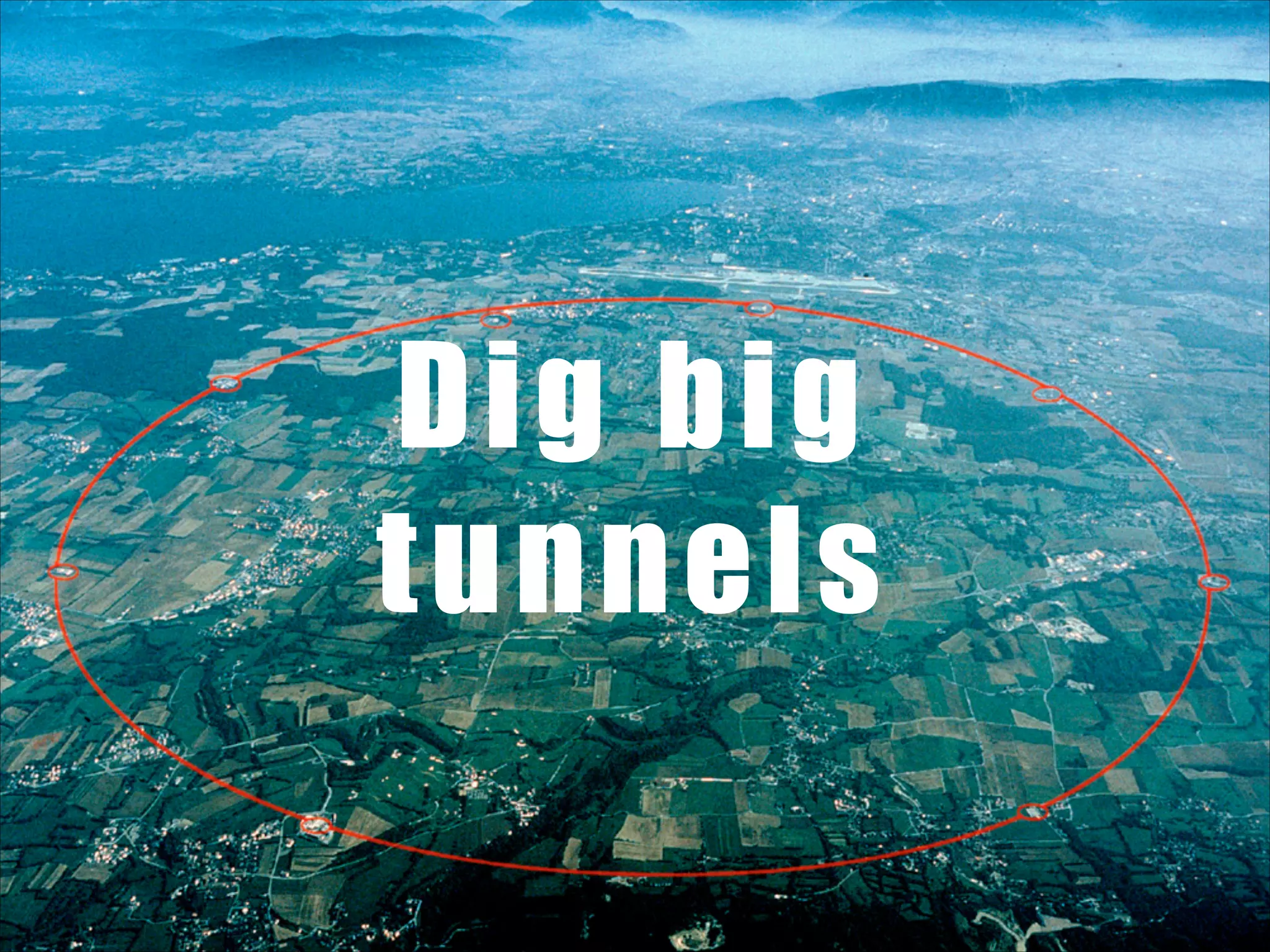
Dig big
tu nne ls
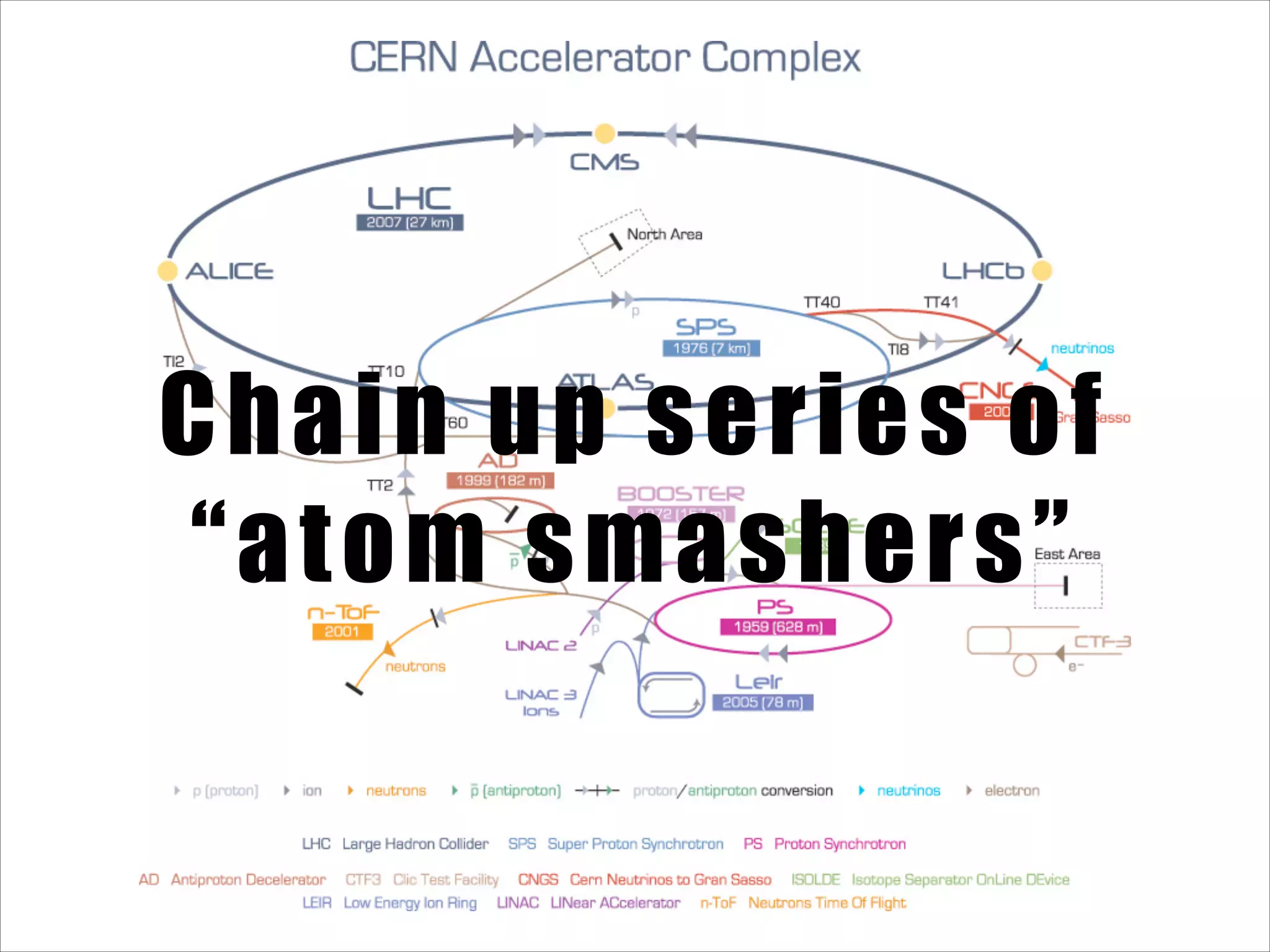
Chain u p se rie s o f
“ato m smashe rs”
Pu t se nsitive cam eras in
aw kw ard places
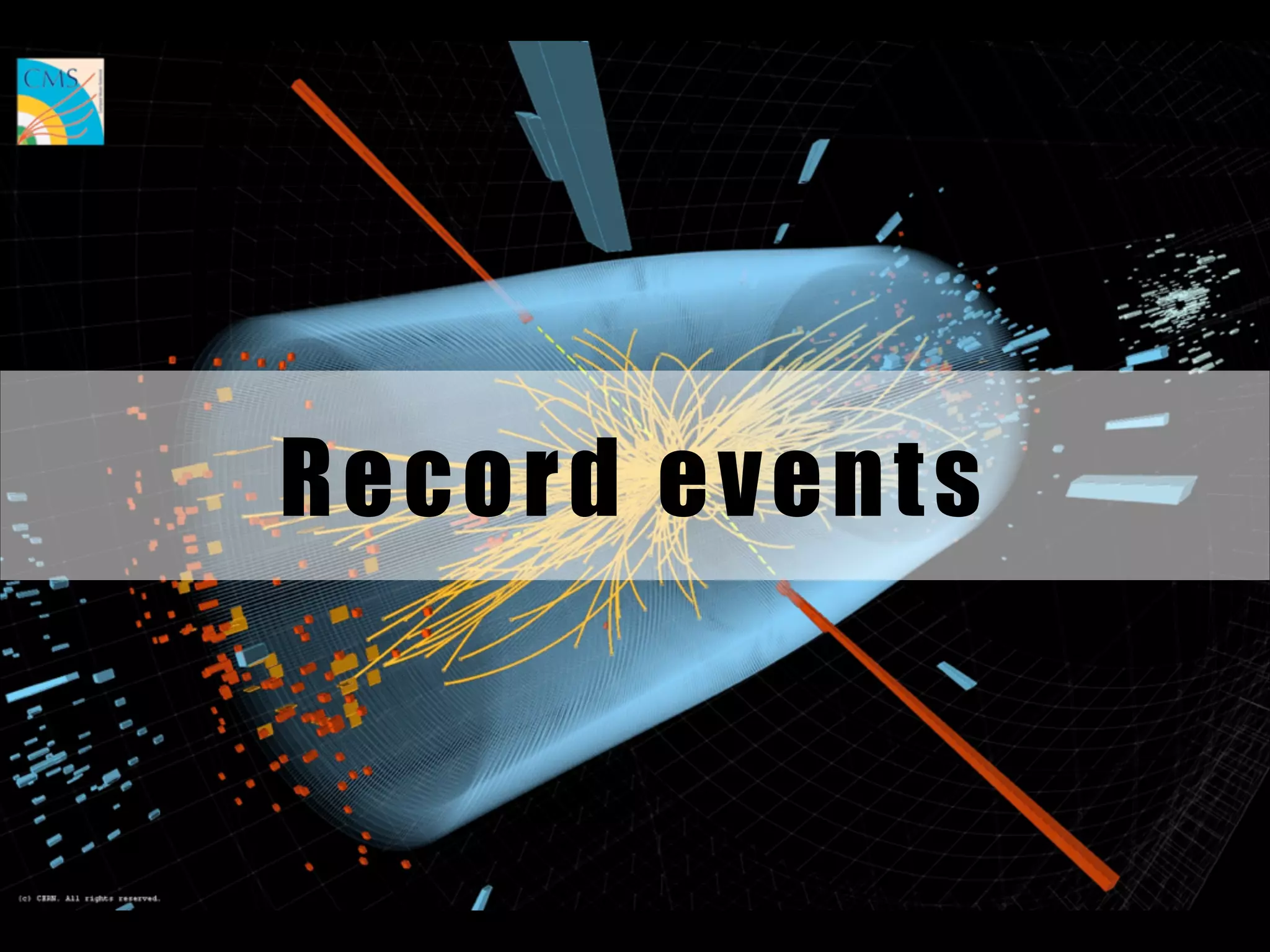
Re co rd e ve nts
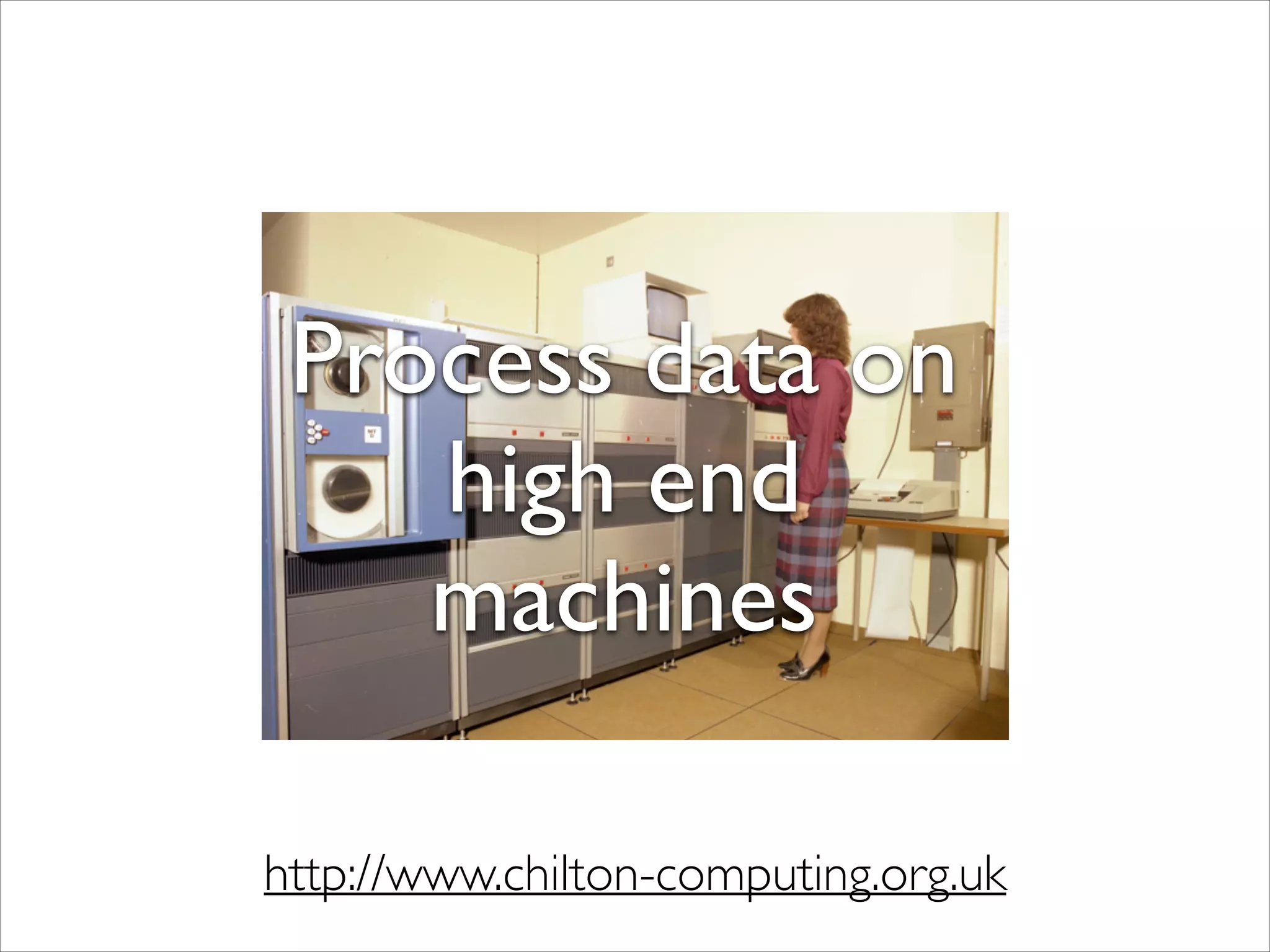
Process data on
high end
machines
http://www.chilton-computing.org.uk
The life of LHC data
1. Detected by experiment	

2. “Online” filtering (hardware and software)
3. Transferred to CERN main campus, archived & reconstructed	

4. Transferred to T1 sites, archived, reconstructed & skimmed	

5. Transferred to T2 sites, reconstructed, skimmed, filtered & analysed	

6. Written into locally analysable files, put on laptops	

7. Turned into a plot in a paper
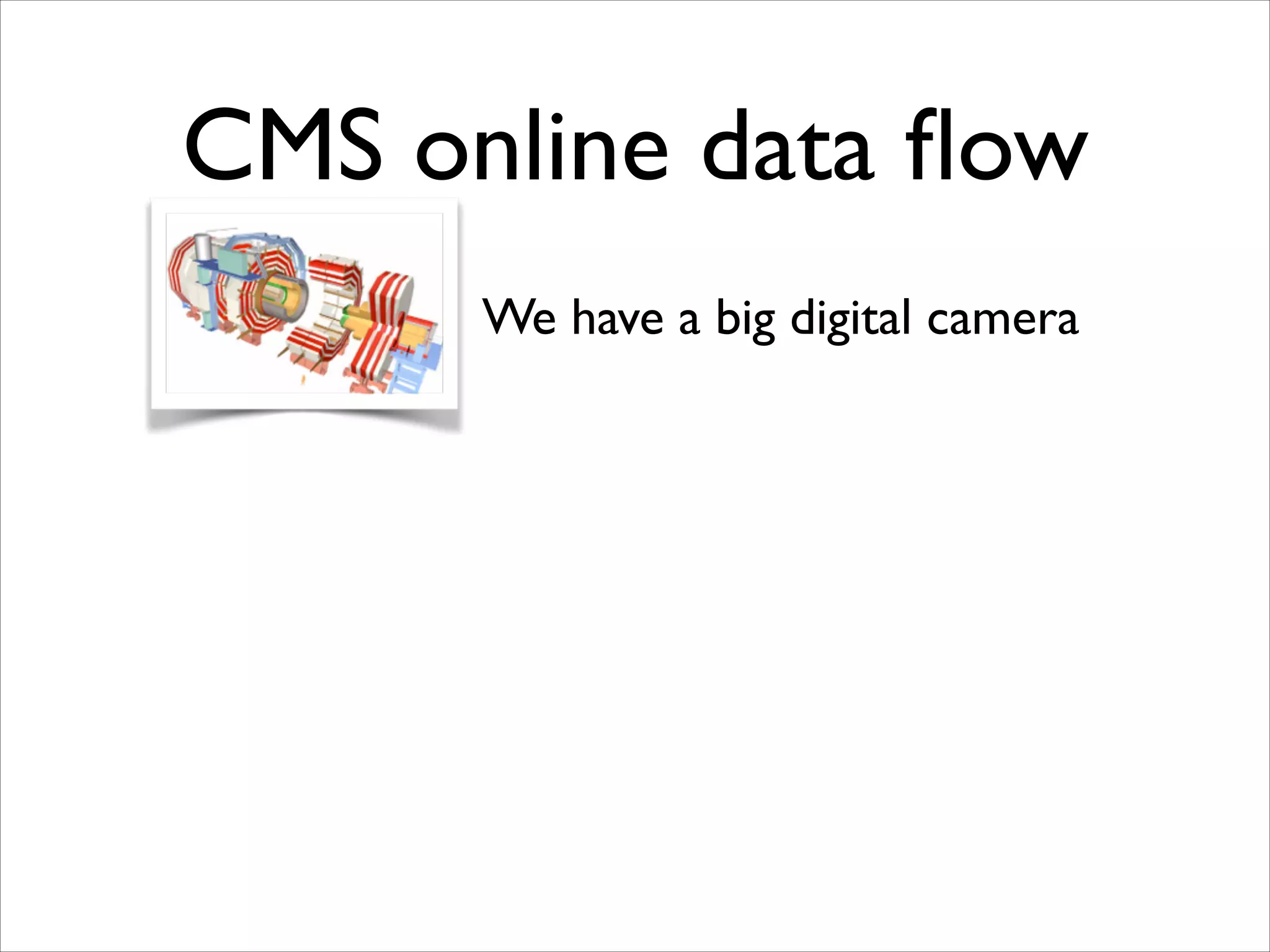
CMS online data flow
We have a big digital camera
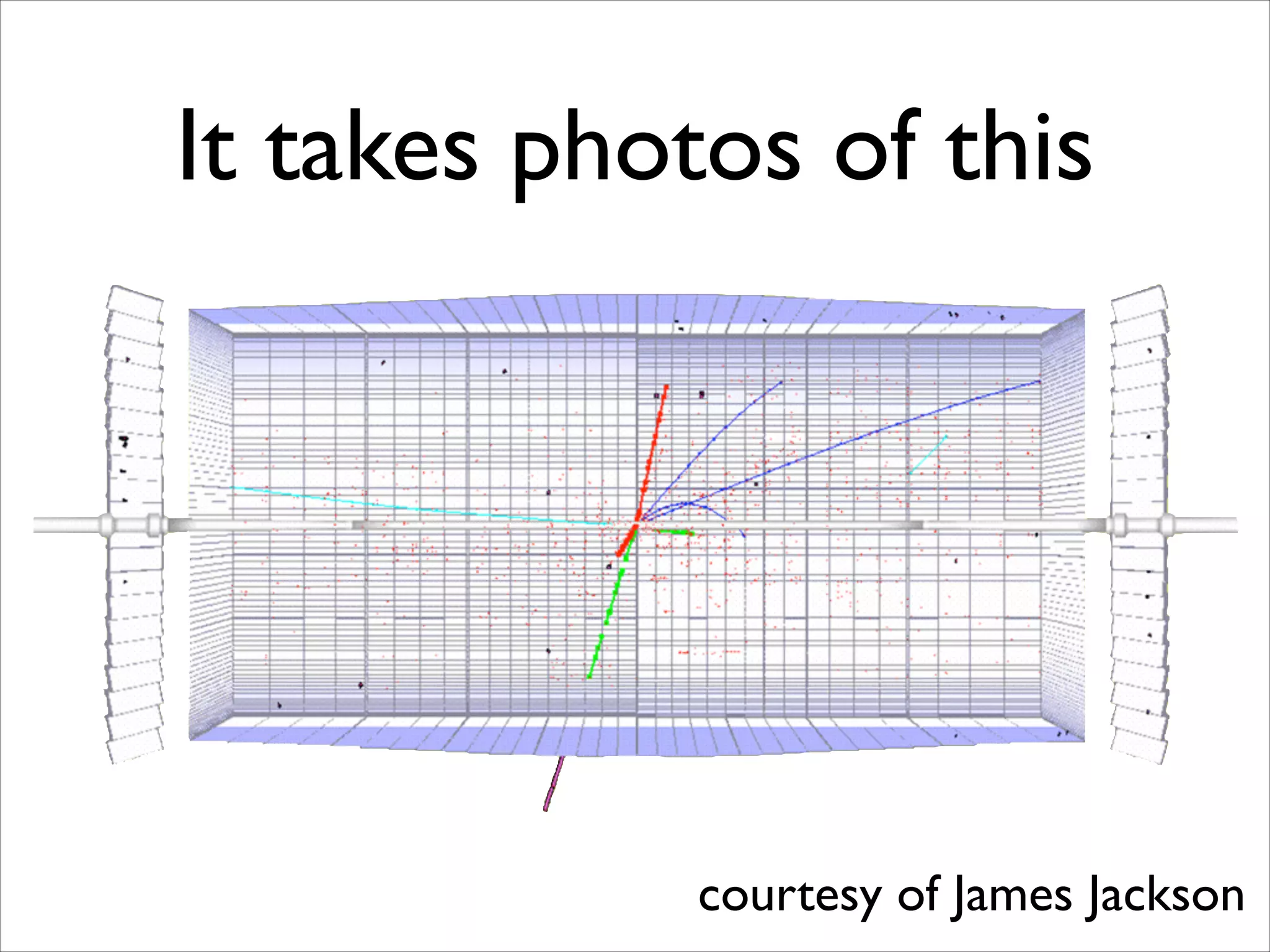
It takes photos of this

courtesy of James Jackson
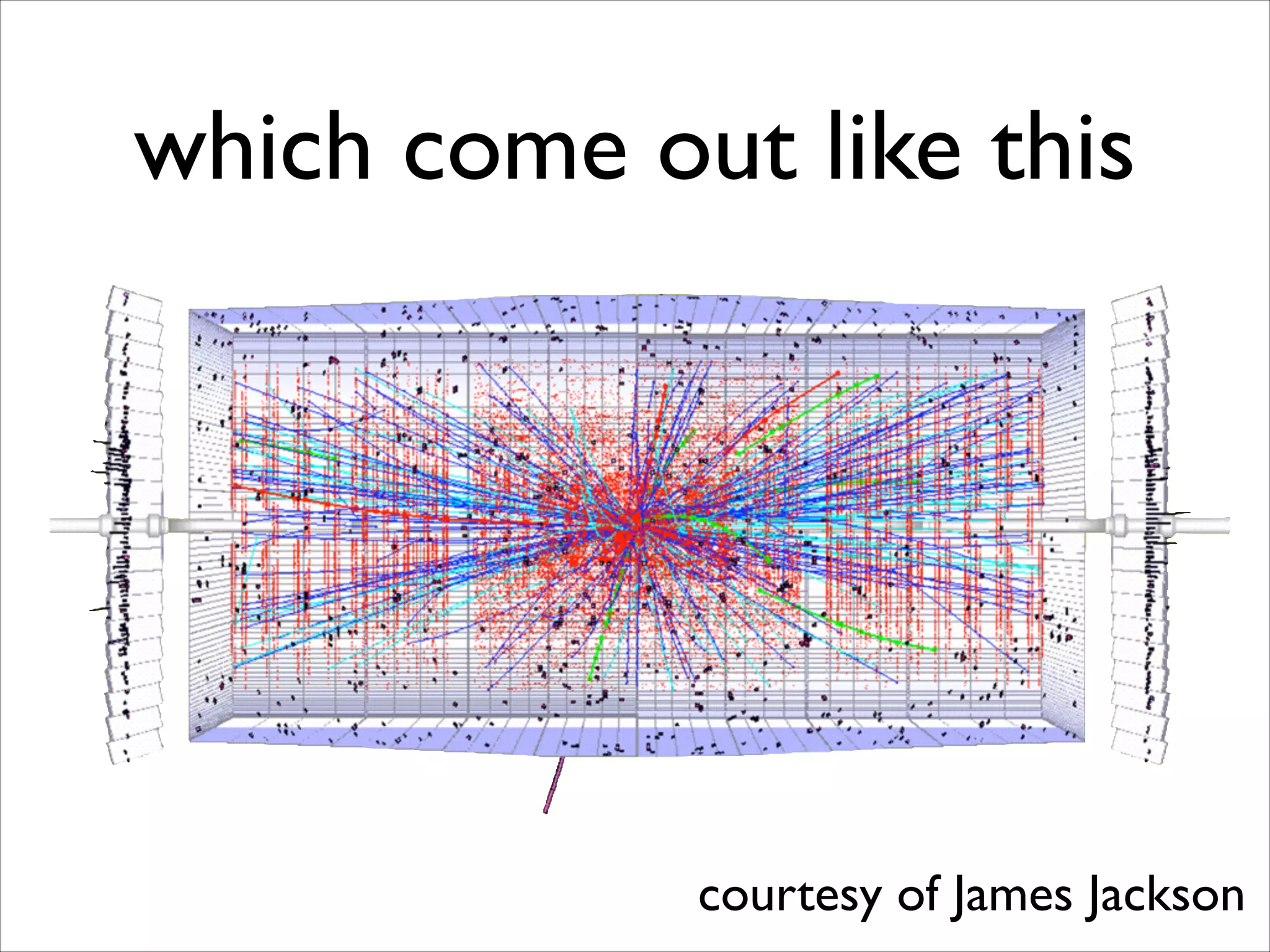
which come out like this

courtesy of James Jackson
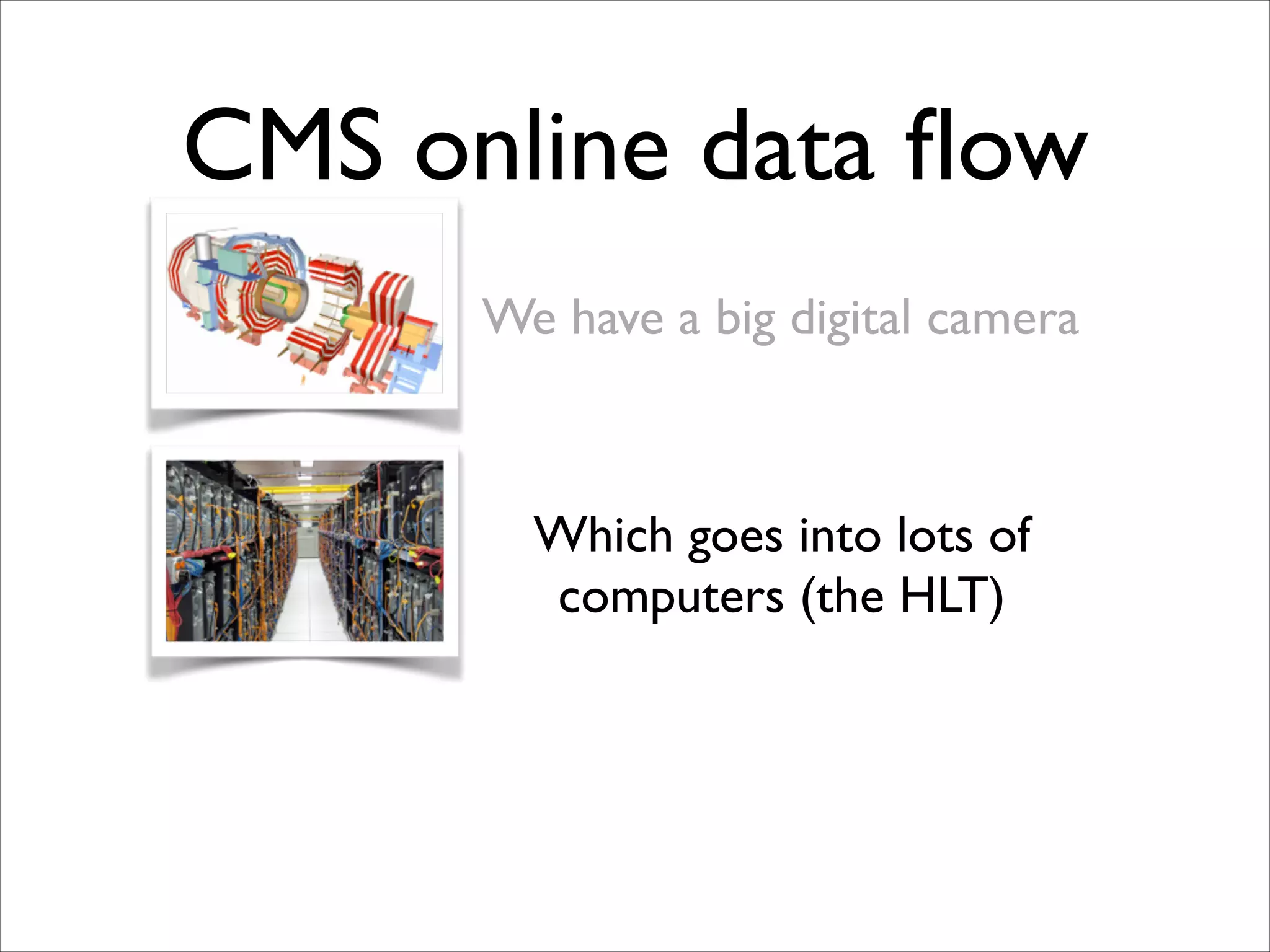
CMS online data flow
We have a big digital camera

Which goes into lots of
computers (the HLT)
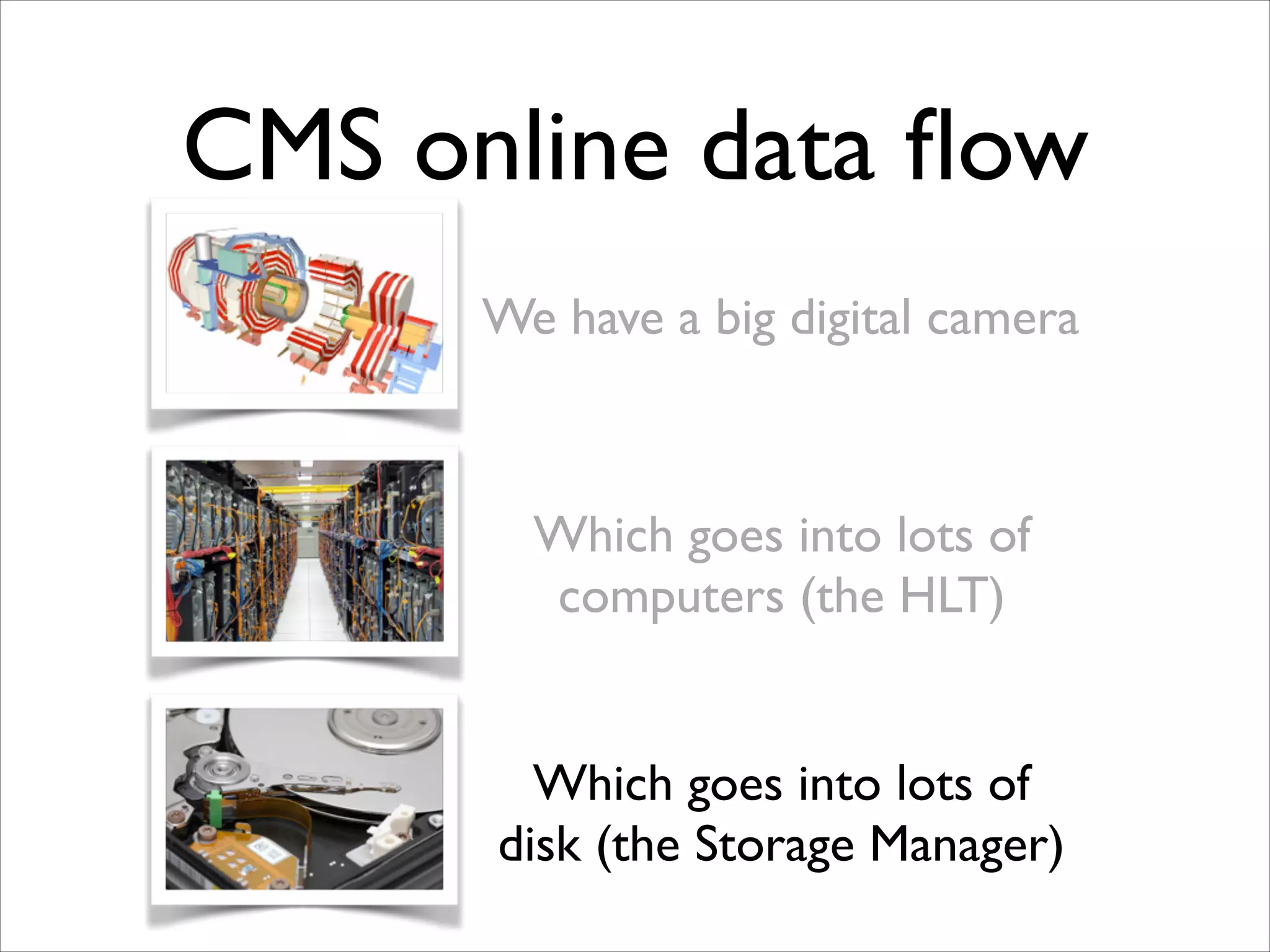
CMS online data flow
We have a big digital camera

Which goes into lots of
computers (the HLT)
Which goes into lots of
disk (the Storage Manager)
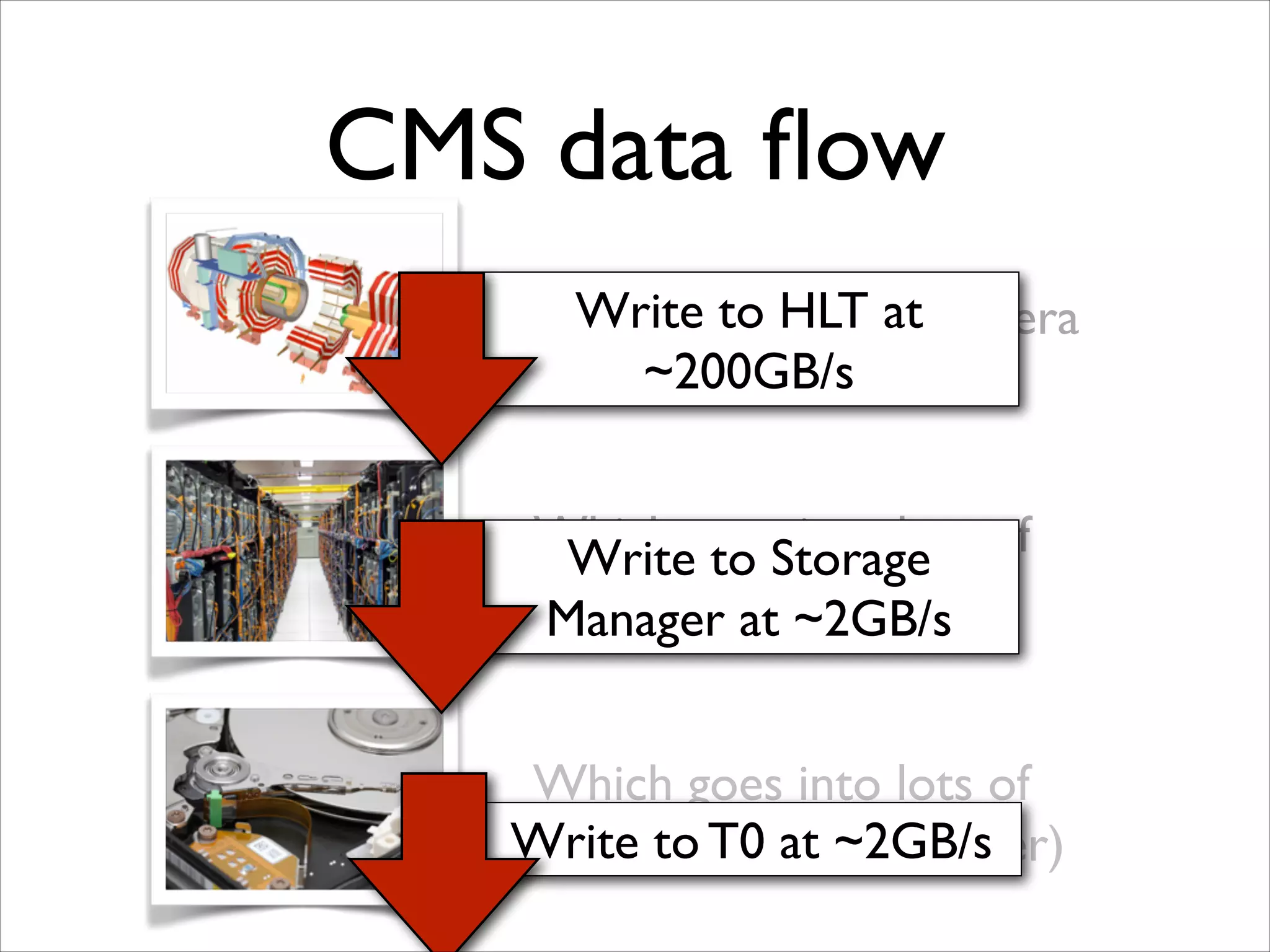
CMS data flow
Write to digital
We have a big HLT at camera
~200GB/s
Which goes into lots of
Write to Storage
computers ~2GB/s
(the HLT)
Manager at
Which goes into lots of
Write to T0 at ~2GB/s
disk (the Storage Manager)
The life of LHC data
1. Detected by experiment	

2. “Online” filtering (hardware and software)	

3. Transferred to CERN main campus, archived & reconstructed
4. Transferred to T1 sites, archived, reconstructed & skimmed	

5. Transferred to T2 sites, reconstructed, skimmed, filtered & analysed	

6. Written into locally analysable files, put on laptops	

7. Turned into a plot in a paper
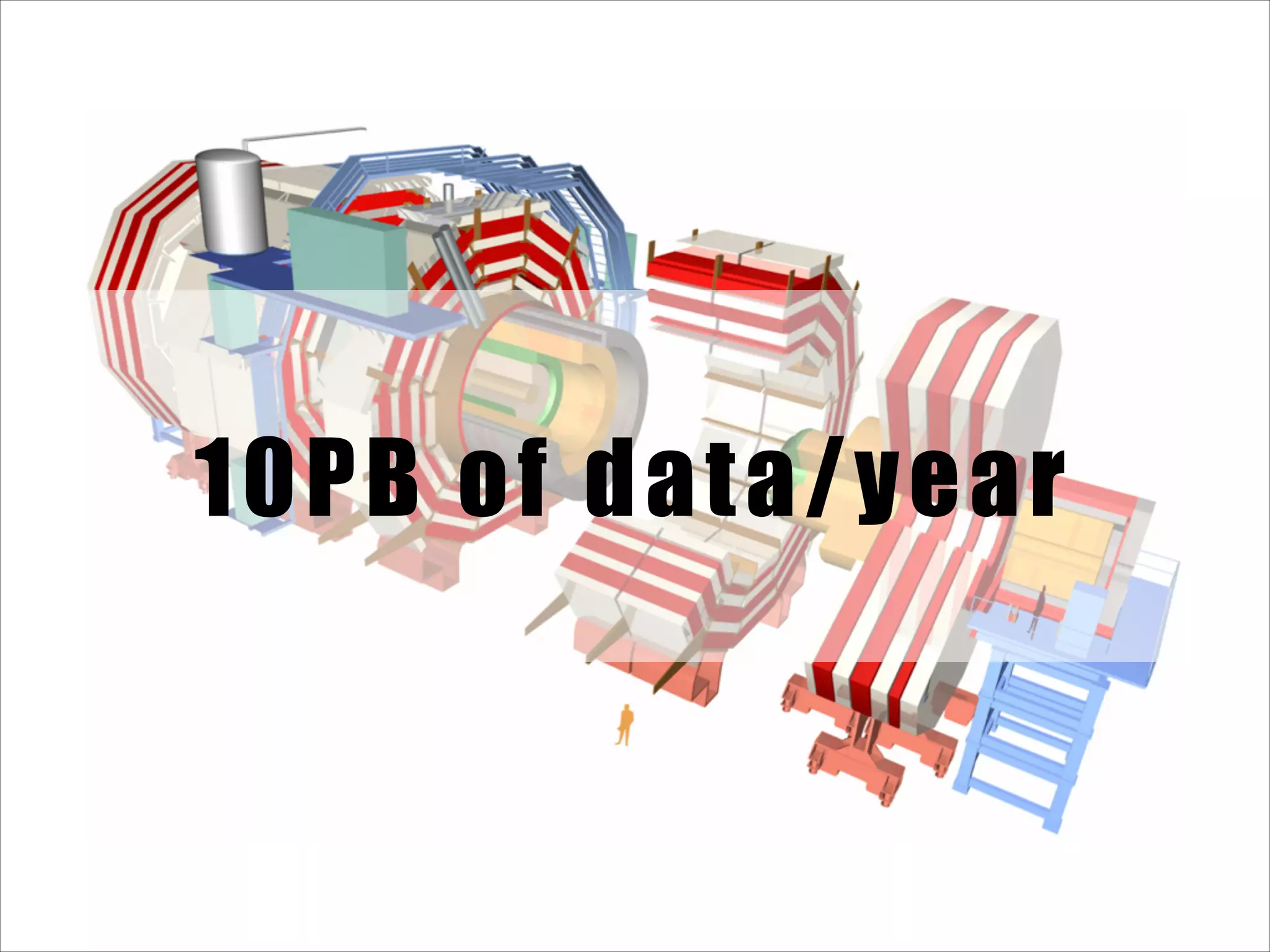
10PB of data/year
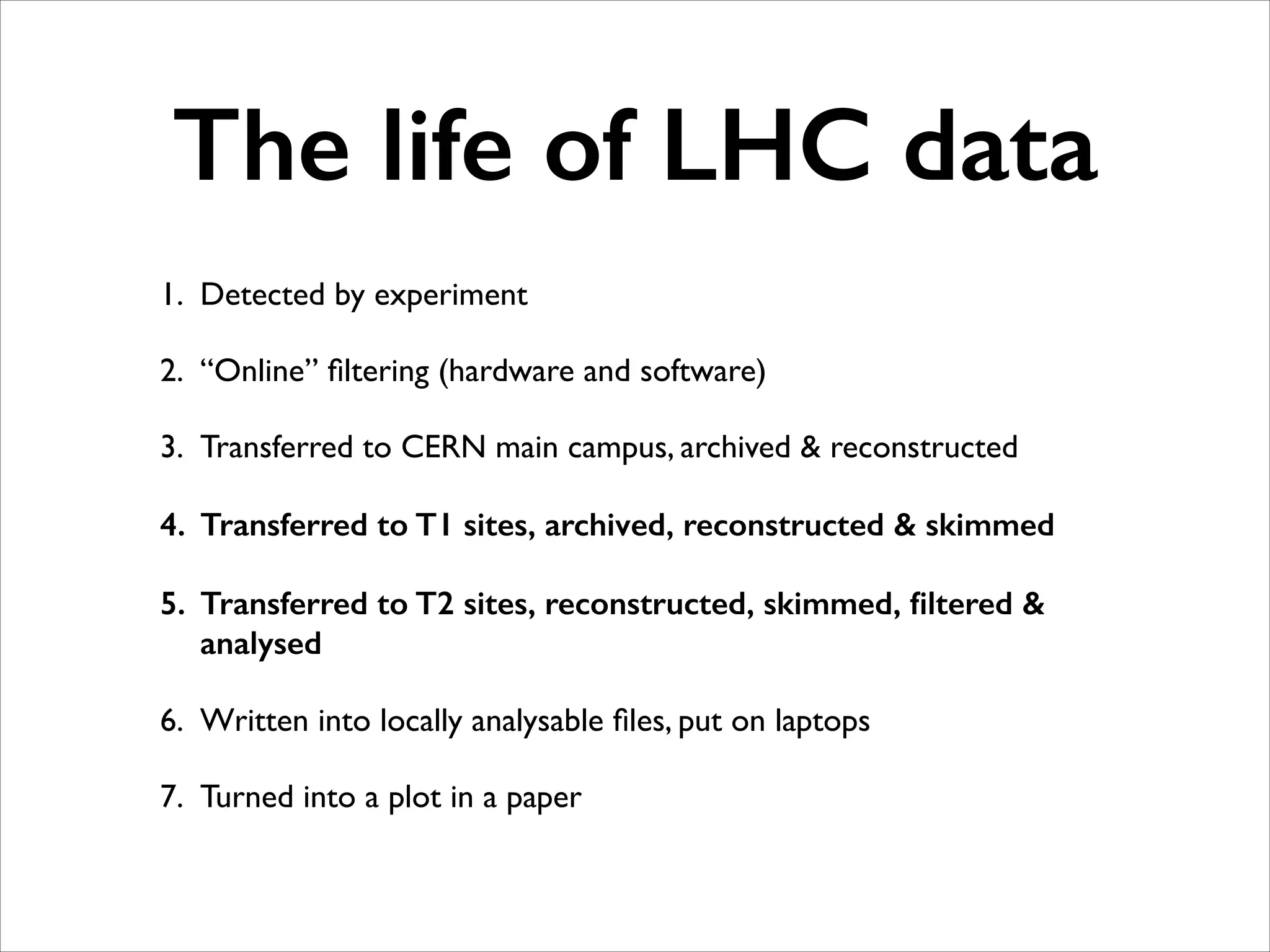
The life of LHC data
1. Detected by experiment	

2. “Online” filtering (hardware and software)	

3. Transferred to CERN main campus, archived & reconstructed	

4. Transferred to T1 sites, archived, reconstructed & skimmed
5. Transferred to T2 sites, reconstructed, skimmed, filtered &
analysed
6. Written into locally analysable files, put on laptops	

7. Turned into a plot in a paper
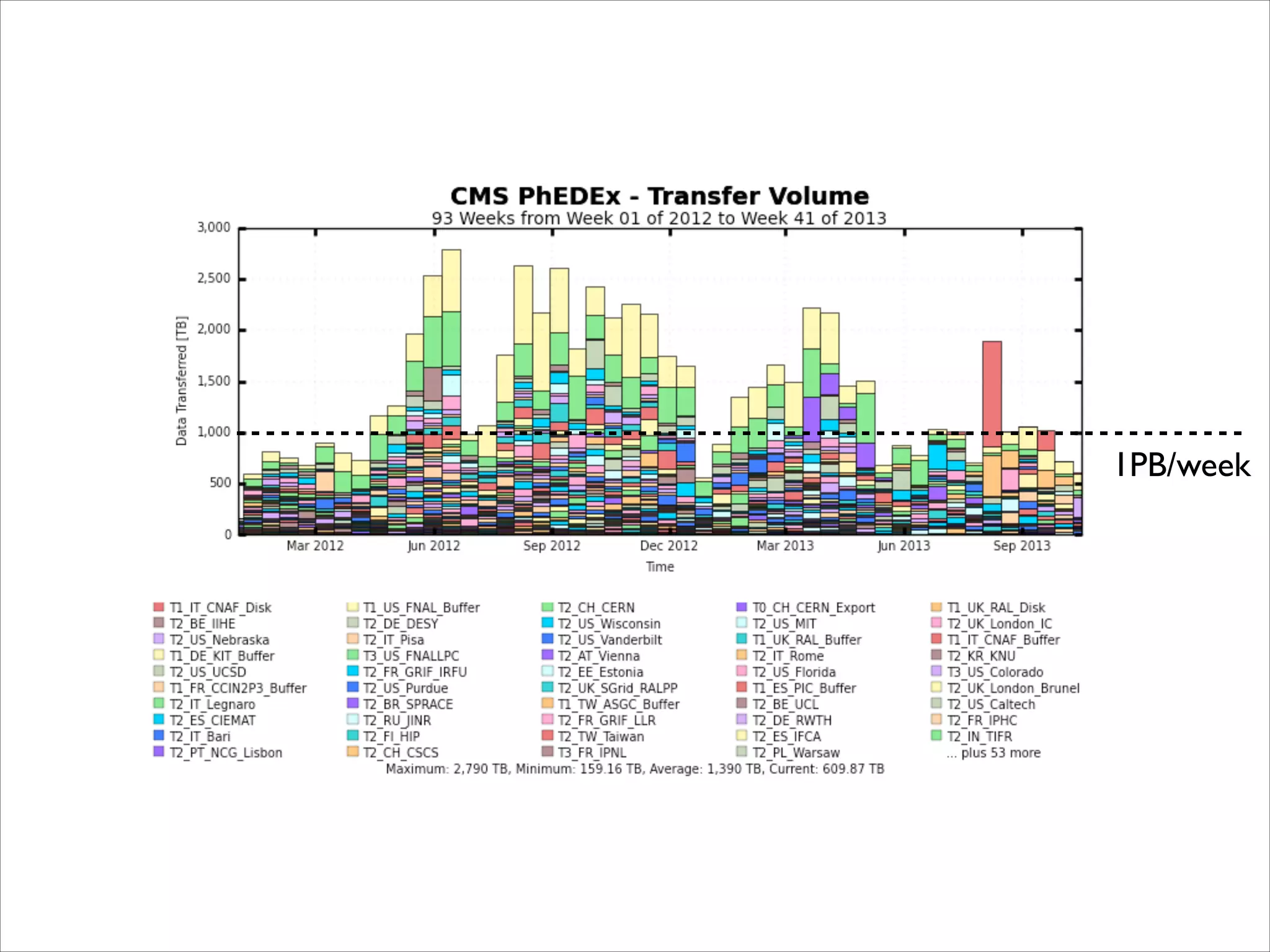
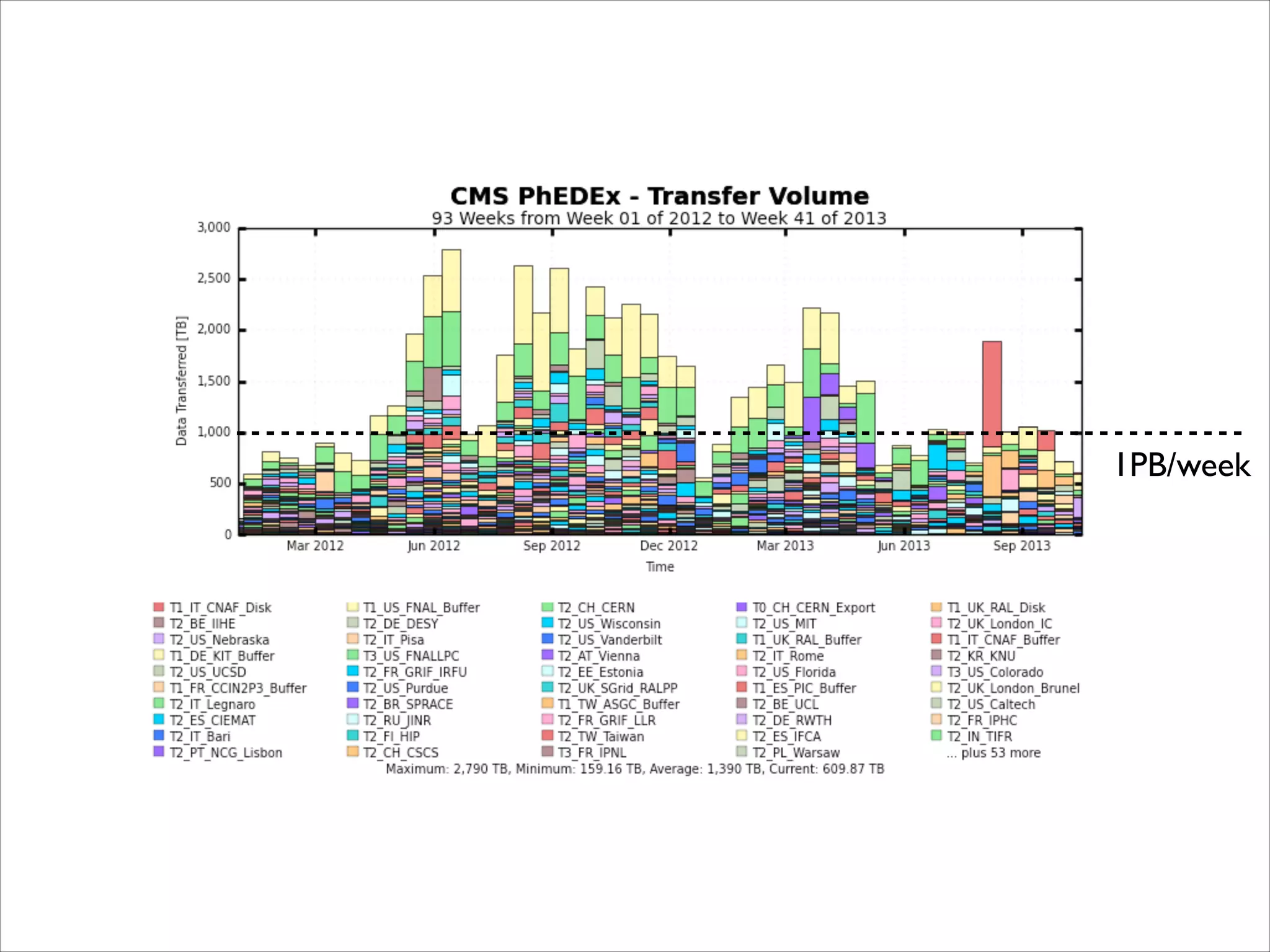
1PB/week
Why transfer so much
data?
To process all the data
taken in one year on
one computer would
take ~64,000 years
The life of LHC data
1. Detected by experiment	

2. “Online” filtering (hardware and software)	

3. Transferred to CERN main campus, archived & reconstructed	

4. Transferred to T1 sites, archived, reconstructed & skimmed	

5. Transferred to T2 sites, reconstructed, skimmed, filtered & analysed	

6. Written into locally analysable files, put on laptops
7. Turned into a plot in a paper
Analysis
• Each analysis is ~unique	

• Query language is C++	

• Runs on distributed system and local resources	

• Series of “cut” selections to identify interesting
events	


• Data in the final plot may be substantially
reduced from the original dataset
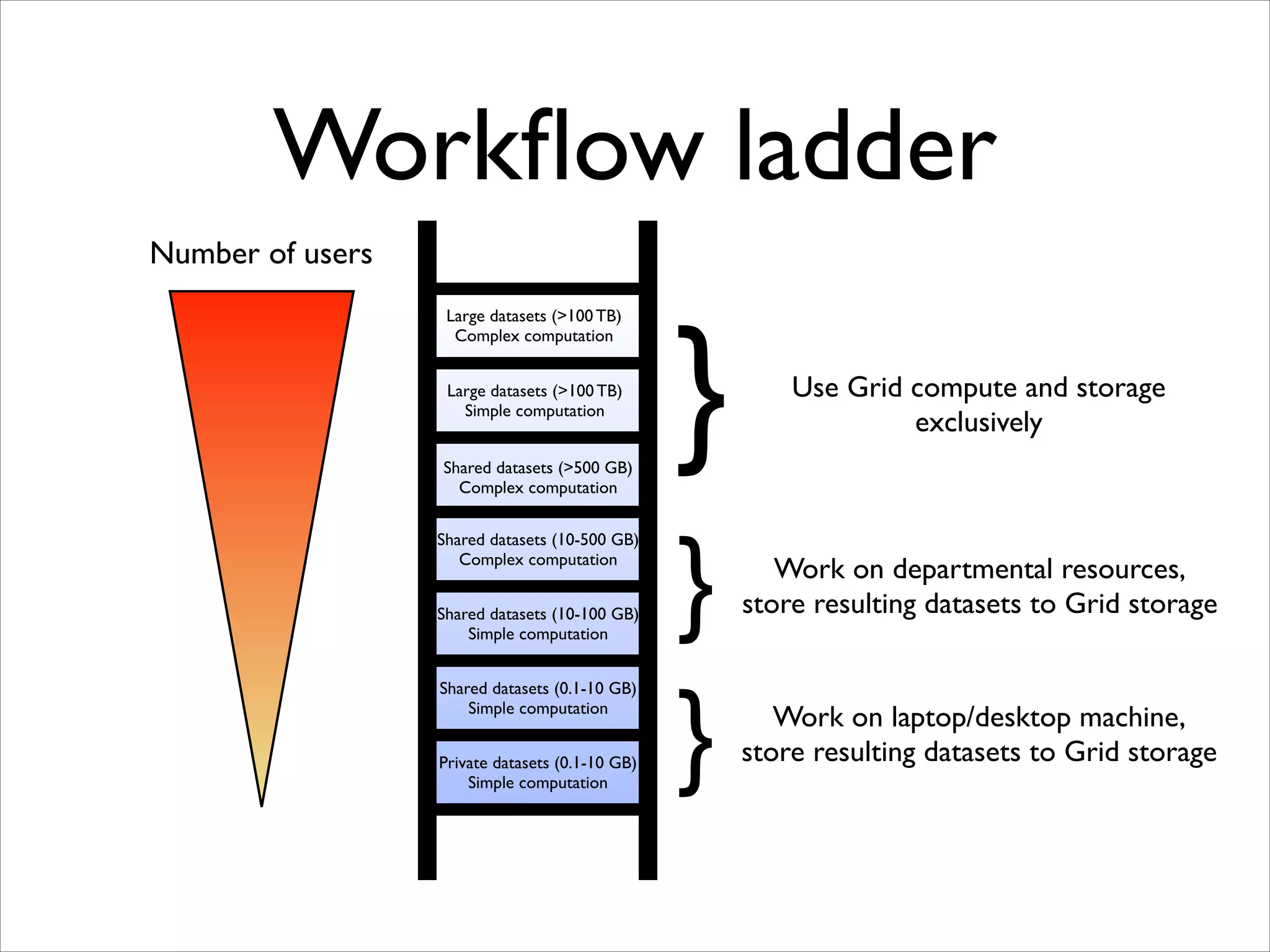
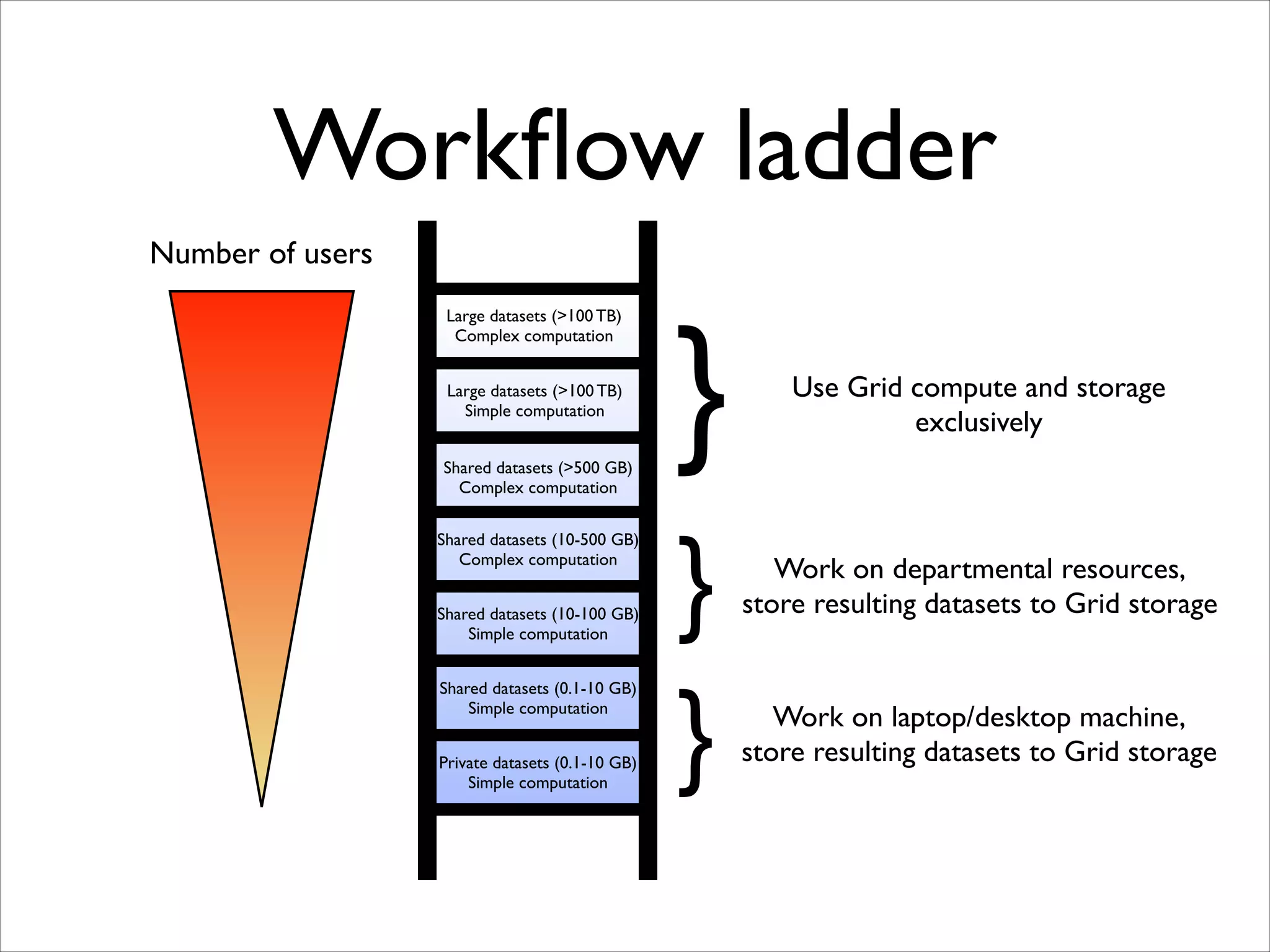
Workflow ladder
Number of users
Large datasets (>100 TB)	

Complex computation
Large datasets (>100 TB)	

Simple computation
Shared datasets (>500 GB)	

Complex computation
Shared datasets (10-500 GB)	

Complex computation
Shared datasets (10-100 GB)	

Simple computation
Shared datasets (0.1-10 GB)	

Simple computation
Private datasets (0.1-10 GB)	

Simple computation

}
}
}

Use Grid compute and storage 	

exclusively

Work on departmental resources,	

store resulting datasets to Grid storage

Work on laptop/desktop machine,	

store resulting datasets to Grid storage
The life of LHC
simulated data
1. Simulated by experimentalists at T0/T1/T2 sites	

2. Transferred to T1 sites, archived possibly reconstructed &
skimmed	

3. Transferred to T2 sites, reconstructed, skimmed, filtered &
analysed	

4. Written into locally analysable files, put on laptops	

5. Turned into a plot in a paper
Most events get cut
!

“We are going to die, and that makes us the
lucky ones. Most people are never going to
die because they are never going to be born.”
!

- Richard Dawkins
Adoption & Use
Setup
• Maybe a bit different to other people	

• Many sites (>100) with >100’s TB storage,
10000’s worker nodes	


• Global system	

• Why not at one site?	

• politics, power budget, cost
The grid
We Have a “Big Data”
Problem
We Have a Big “Data
Problem”
Do what you do best,
out source the rest
What's interesting is
that big data isn't
interesting any more
NIH
Define and refine
workflows
Our situation

•

Expert users, who are not
interested in infrastructure	


• Will work around things they
perceive as unnecessary
limitations
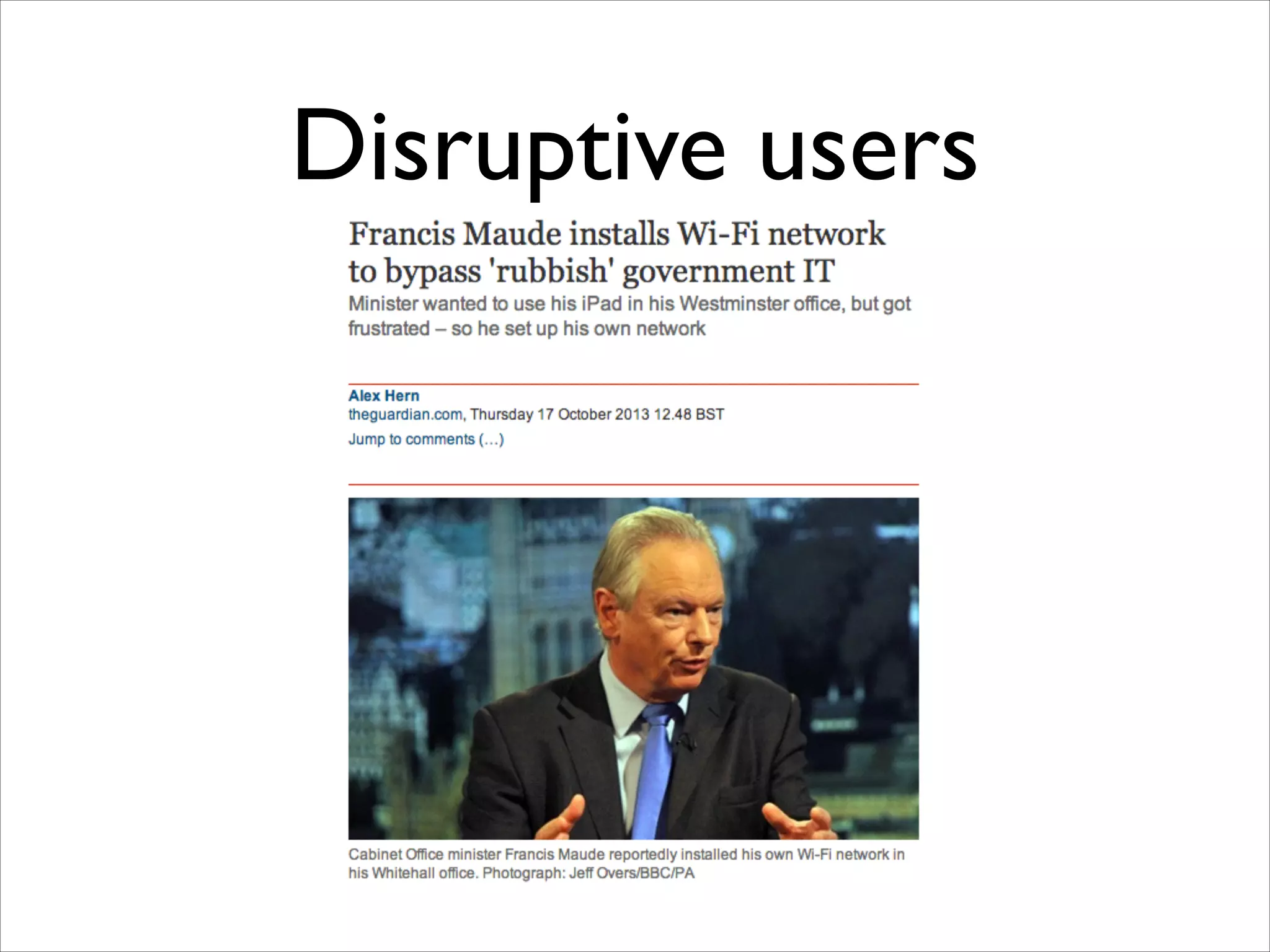
Disruptive users
How to engage
disruptive users?
Open access
1PB/week
Open access
Our situation
• Limited resources for integration/
testbed style activities	


• Strange organisation
Data temperature
There is no such thing
as now
Keep things as local as
possible
Defining monitoring is
difficult
Small files are bad,
m'kay
Compartmentalise
metadata
Recognise, embrace and
communicate failures
People are harder than
computers
People are important
The formula

64
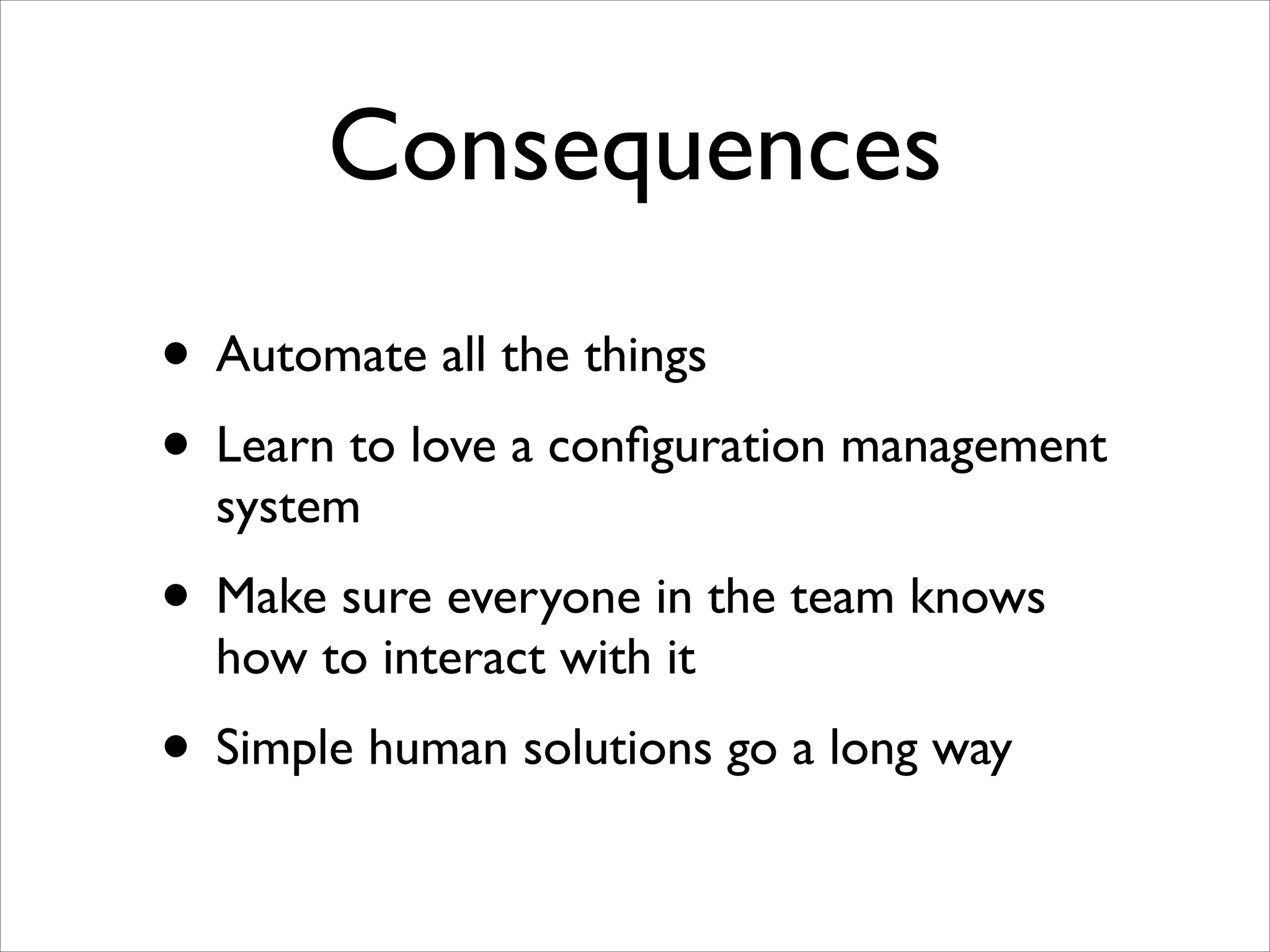
Consequences
• Automate all the things	

• Learn to love a configuration management
system	


• Make sure everyone in the team knows
how to interact with it	


• Simple human solutions go a long way
Build good abstractions
Encourage
collaboration
Workflow ladder
Number of users
Large datasets (100 TB)	

Complex computation
Large datasets (100 TB)	

Simple computation
Shared datasets (500 GB)	

Complex computation
Shared datasets (10-500 GB)	

Complex computation
Shared datasets (10-100 GB)	

Simple computation
Shared datasets (0.1-10 GB)	

Simple computation
Private datasets (0.1-10 GB)	

Simple computation

}
}
}

Use Grid compute and storage 	

exclusively

Work on departmental resources,	

store resulting datasets to Grid storage

Work on laptop/desktop machine,	

store resulting datasets to Grid storage
Summary

Big data from the LHC commissioning: practical lessons from big science - Simon Metson (Cloudant)

  • 1.
    Big Data fromthe LHC Commissioning ! Practical Lessons from Big Science Simon/@drsm79
  • 2.
  • 6.
    Time at placesI’ve worked Bristol University Cloudant
  • 7.
  • 8.
  • 9.
  • 10.
    The formula Grant *Effectiveness
  • 11.
    The life ofLHC data 1. Detected by experiment 2. “Online” filtering (hardware and software) 3. Transferred to CERN main campus, archived & reconstructed 4. Transferred to T1 sites, archived, reconstructed & skimmed 5. Transferred to T2 sites, reconstructed, skimmed, filtered & analysed 6. Written into locally analysable files, put on laptops 7. Turned into a plot in a paper
  • 12.
    The life ofLHC data 1. Detected by experiment 2. “Online” filtering (hardware and software) 3. Transferred to CERN main campus, archived & reconstructed 4. Transferred to T1 sites, archived, reconstructed & skimmed 5. Transferred to T2 sites, reconstructed, skimmed, filtered & analysed 6. Written into locally analysable files, put on laptops 7. Turned into a plot in a paper
  • 13.
  • 14.
    Chain u pse rie s o f “ato m smashe rs”
  • 15.
    Pu t sensitive cam eras in aw kw ard places
  • 16.
    Re co rde ve nts
  • 17.
    Process data on highend machines http://www.chilton-computing.org.uk
  • 18.
    The life ofLHC data 1. Detected by experiment 2. “Online” filtering (hardware and software) 3. Transferred to CERN main campus, archived & reconstructed 4. Transferred to T1 sites, archived, reconstructed & skimmed 5. Transferred to T2 sites, reconstructed, skimmed, filtered & analysed 6. Written into locally analysable files, put on laptops 7. Turned into a plot in a paper
  • 19.
    CMS online dataflow We have a big digital camera
  • 20.
    It takes photosof this courtesy of James Jackson
  • 21.
    which come outlike this courtesy of James Jackson
  • 22.
    CMS online dataflow We have a big digital camera Which goes into lots of computers (the HLT)
  • 23.
    CMS online dataflow We have a big digital camera Which goes into lots of computers (the HLT) Which goes into lots of disk (the Storage Manager)
  • 24.
    CMS data flow Writeto digital We have a big HLT at camera ~200GB/s Which goes into lots of Write to Storage computers ~2GB/s (the HLT) Manager at Which goes into lots of Write to T0 at ~2GB/s disk (the Storage Manager)
  • 25.
    The life ofLHC data 1. Detected by experiment 2. “Online” filtering (hardware and software) 3. Transferred to CERN main campus, archived & reconstructed 4. Transferred to T1 sites, archived, reconstructed & skimmed 5. Transferred to T2 sites, reconstructed, skimmed, filtered & analysed 6. Written into locally analysable files, put on laptops 7. Turned into a plot in a paper
  • 26.
  • 27.
    The life ofLHC data 1. Detected by experiment 2. “Online” filtering (hardware and software) 3. Transferred to CERN main campus, archived & reconstructed 4. Transferred to T1 sites, archived, reconstructed & skimmed 5. Transferred to T2 sites, reconstructed, skimmed, filtered & analysed 6. Written into locally analysable files, put on laptops 7. Turned into a plot in a paper
  • 28.
  • 29.
    Why transfer somuch data?
  • 30.
    To process allthe data taken in one year on one computer would take ~64,000 years
  • 32.
    The life ofLHC data 1. Detected by experiment 2. “Online” filtering (hardware and software) 3. Transferred to CERN main campus, archived & reconstructed 4. Transferred to T1 sites, archived, reconstructed & skimmed 5. Transferred to T2 sites, reconstructed, skimmed, filtered & analysed 6. Written into locally analysable files, put on laptops 7. Turned into a plot in a paper
  • 33.
    Analysis • Each analysisis ~unique • Query language is C++ • Runs on distributed system and local resources • Series of “cut” selections to identify interesting events • Data in the final plot may be substantially reduced from the original dataset
  • 34.
    Workflow ladder Number ofusers Large datasets (>100 TB) Complex computation Large datasets (>100 TB) Simple computation Shared datasets (>500 GB) Complex computation Shared datasets (10-500 GB) Complex computation Shared datasets (10-100 GB) Simple computation Shared datasets (0.1-10 GB) Simple computation Private datasets (0.1-10 GB) Simple computation } } } Use Grid compute and storage exclusively Work on departmental resources, store resulting datasets to Grid storage Work on laptop/desktop machine, store resulting datasets to Grid storage
  • 35.
    The life ofLHC simulated data 1. Simulated by experimentalists at T0/T1/T2 sites 2. Transferred to T1 sites, archived possibly reconstructed & skimmed 3. Transferred to T2 sites, reconstructed, skimmed, filtered & analysed 4. Written into locally analysable files, put on laptops 5. Turned into a plot in a paper
  • 36.
  • 37.
    ! “We are goingto die, and that makes us the lucky ones. Most people are never going to die because they are never going to be born.” ! - Richard Dawkins
  • 39.
  • 40.
    Setup • Maybe abit different to other people • Many sites (>100) with >100’s TB storage, 10000’s worker nodes • Global system • Why not at one site? • politics, power budget, cost
  • 41.
  • 42.
    We Have a“Big Data” Problem
  • 43.
    We Have aBig “Data Problem”
  • 44.
    Do what youdo best, out source the rest
  • 45.
    What's interesting is thatbig data isn't interesting any more
  • 46.
  • 47.
  • 48.
    Our situation • Expert users,who are not interested in infrastructure • Will work around things they perceive as unnecessary limitations
  • 49.
  • 50.
  • 51.
  • 52.
  • 53.
  • 54.
    Our situation • Limitedresources for integration/ testbed style activities • Strange organisation
  • 55.
  • 56.
    There is nosuch thing as now
  • 57.
    Keep things aslocal as possible
  • 58.
  • 59.
    Small files arebad, m'kay
  • 60.
  • 61.
  • 62.
    People are harderthan computers
  • 63.
  • 64.
  • 65.
    Consequences • Automate allthe things • Learn to love a configuration management system • Make sure everyone in the team knows how to interact with it • Simple human solutions go a long way
  • 66.
  • 67.
  • 68.
    Workflow ladder Number ofusers Large datasets (100 TB) Complex computation Large datasets (100 TB) Simple computation Shared datasets (500 GB) Complex computation Shared datasets (10-500 GB) Complex computation Shared datasets (10-100 GB) Simple computation Shared datasets (0.1-10 GB) Simple computation Private datasets (0.1-10 GB) Simple computation } } } Use Grid compute and storage exclusively Work on departmental resources, store resulting datasets to Grid storage Work on laptop/desktop machine, store resulting datasets to Grid storage
  • 69.