Steve Poole IBM

JVM Support for Multitenant Applications
Important Disclaimers

THE INFORMATION CONTAINED IN THIS PRESENTATION IS PROVIDED FOR
INFORMATIONAL PURPOSES ONLY.
WHILST EFFORTS WERE MADE TO VERIFY THE COMPLETENESS AND ACCURACY OF THE
INFORMATION CONTAINED IN THIS PRESENTATION, IT IS PROVIDED “AS IS”, WITHOUT
WARRANTY OF ANY KIND, EXPRESS OR IMPLIED.
ALL PERFORMANCE DATA INCLUDED IN THIS PRESENTATION HAVE BEEN GATHERED IN A
CONTROLLED ENVIRONMENT. YOUR OWN TEST RESULTS MAY VARY BASED ON
HARDWARE, SOFTWARE OR INFRASTRUCTURE DIFFERENCES.
ALL DATA INCLUDED IN THIS PRESENTATION ARE MEANT TO BE USED ONLY AS A GUIDE.
IN ADDITION, THE INFORMATION CONTAINED IN THIS PRESENTATION IS BASED ON IBM’S
CURRENT PRODUCT PLANS AND STRATEGY, WHICH ARE SUBJECT TO CHANGE BY IBM,
WITHOUT NOTICE.
IBM AND ITS AFFILIATED COMPANIES SHALL NOT BE RESPONSIBLE FOR ANY DAMAGES
ARISING OUT OF THE USE OF, OR OTHERWISE RELATED TO, THIS PRESENTATION OR
ANY OTHER DOCUMENTATION.
NOTHING CONTAINED IN THIS PRESENTATION IS INTENDED TO, OR SHALL HAVE THE
EFFECT OF:
- CREATING ANY WARRANT OR REPRESENTATION FROM IBM, ITS AFFILIATED
COMPANIES OR ITS OR THEIR SUPPLIERS AND/OR LICENSORS
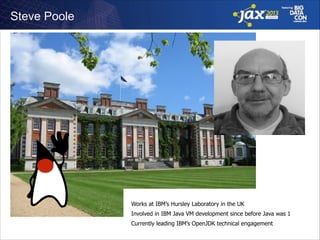
Steve Poole

!
Works at IBM’s Hursley Laboratory in the UK
Involved in IBM Java VM development since before Java was 1
Currently leading IBM’s OpenJDK technical engagement
What this talk is about
!
!
!
!

JVM Support for Multi-Tenant Applications
This experimental technology is being developed to help address
important pressures on Java	

!

Google ‘IBM Java 8 beta’ for more information	

!
■

By the end of this session, you should be able to:	

!

– Understand what multitenancy is and what it’s good for	

!

– Describe the challenges of multitenant Java deployments	

!

– Understand ideas for new JDK features to convert existing
applications into multitenant deployments	

!
Agenda

1. What Multi-tenancy is all about aka how to simplify to save time
and money
2. The challenges of building a multi-tenant application in Java
3. How to keep your application running in a multi-tenant world dealing with bad behaviour
4. Risk vs. Reward: How dense can we go?
5. Wrap-up: Summary, and next steps
Part 1
What is Multitenancy?	

!

(simplify to save time and money)
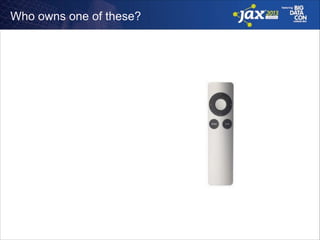
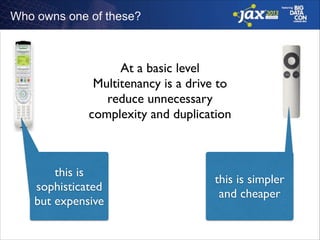
Who owns one of these?

At a basic level	

Multitenancy is a drive to
reduce unnecessary	

complexity and duplication

this is
sophisticated
but expensive

this is simpler
and cheaper
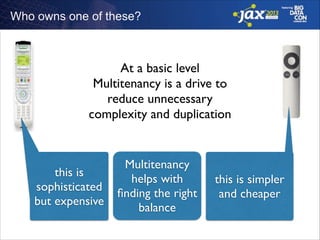
Who owns one of these?

At a basic level	

Multitenancy is a drive to
reduce unnecessary	

complexity and duplication

this is
sophisticated
but expensive

Multitenancy
helps with
finding the right
balance

this is simpler
and cheaper
Its not just a hardware story

Simplifying the software stack by removing all extraneous
pieces makes better use of hardware and the people who
run it.
!

Simple == Cheaper == Predictable == Robust
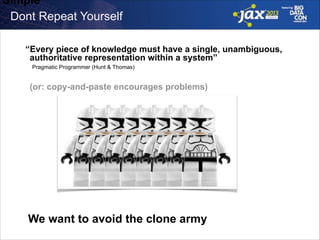
Simple
Dont Repeat Yourself
“Every piece of knowledge must have a single, unambiguous,
authoritative representation within a system” 


Pragmatic Programmer (Hunt & Thomas)

(or: copy-and-paste encourages problems)

We want to avoid the clone army
Are you already using Multitenancy

•Are your choices only	

•fully dedicated machine or shared hardware?	

•Multitenancy isn’t just a checkbox. 	

•There are various levels of ‘tenancy’ defined today.
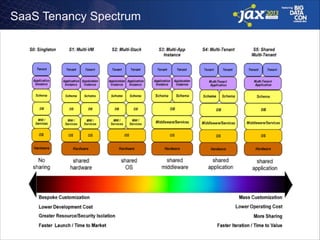
SaaS Tenancy Spectrum

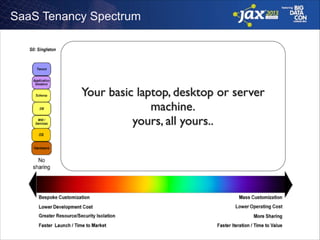
Your basic laptop, desktop or server
machine.	

yours, all yours..
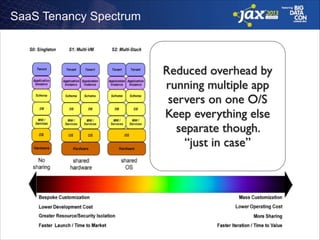
SaaS Tenancy Spectrum

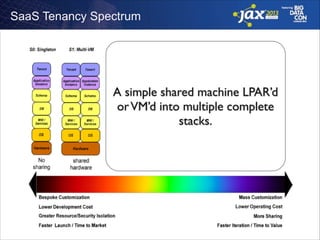
A simple shared machine LPAR’d
or VM’d into multiple complete
stacks.
SaaS Tenancy Spectrum

Reduced overhead by
running multiple app
servers on one O/S	

Keep everything else
separate though. 	

“just in case”
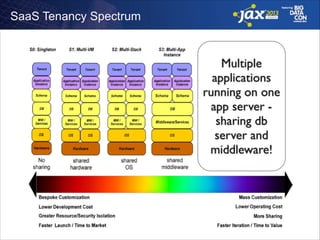
SaaS Tenancy Spectrum

Multiple
applications
running on one
app server sharing db
server and
middleware!
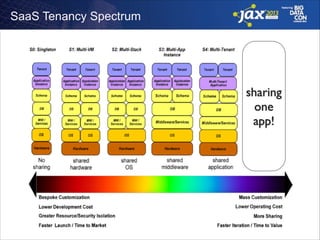
SaaS Tenancy Spectrum

sharing
one
app!
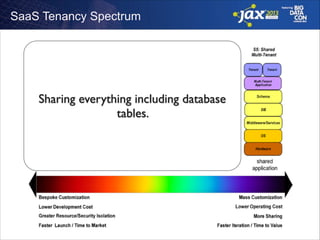
SaaS Tenancy Spectrum

Sharing everything including database
tables.
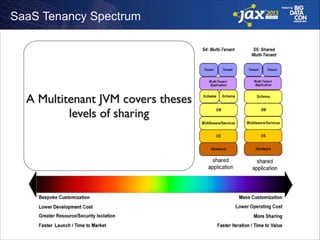
SaaS Tenancy Spectrum

A Multitenant JVM covers theses
levels of sharing
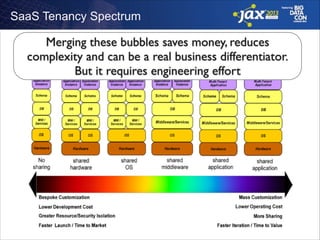
SaaS Tenancy Spectrum

Merging these bubbles saves money, reduces
complexity and can be a real business differentiator.	

But it requires engineering effort
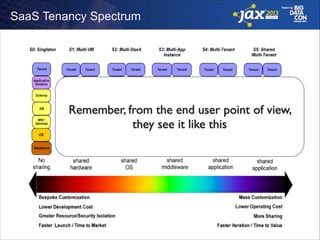
SaaS Tenancy Spectrum

Remember, from the end user point of view,
they see it like this
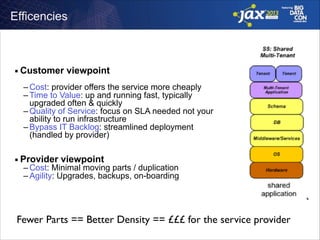
Efficencies

■

Customer viewpoint
!

– Cost: provider offers the service more cheaply
– Time to Value: up and running fast, typically
upgraded often & quickly
– Quality of Service: focus on SLA needed not your
ability to run infrastructure
– Bypass IT Backlog: streamlined deployment
(handled by provider)
!
■

Provider viewpoint

– Cost: Minimal moving parts / duplication
– Agility: Upgrades, backups, on-boarding

Fewer Parts == Better Density == £££ for the service provider
Part 2
Getting there..	

!
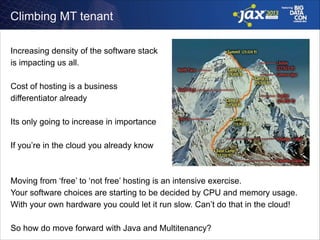
Climbing MT tenant
Increasing density of the software stack
is impacting us all.
!

Cost of hosting is a business
differentiator already
!

Its only going to increase in importance
!

If you’re in the cloud you already know
!
!

Moving from ‘free’ to ‘not free’ hosting is an intensive exercise.
Your software choices are starting to be decided by CPU and memory usage.
With your own hardware you could let it run slow. Can’t do that in the cloud!
!

So how do move forward with Java and Multitenancy?
Challenge #1 Isolation
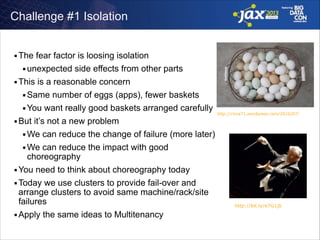
The fear factor is loosing isolation
■ unexpected side effects from other parts
■ This is a reasonable concern
■ Same number of eggs (apps), fewer baskets
■ You want really good baskets arranged carefully
http://circa71.wordpress.com/2010/07/
■ But it’s not a new problem
■ We can reduce the change of failure (more later)
■ We can reduce the impact with good
choreography
■ You need to think about choreography today
■ Today we use clusters to provide fail-over and
arrange clusters to avoid same machine/rack/site
failures
http://bit.ly/e7G1jb
■ Apply the same ideas to Multitenancy
■
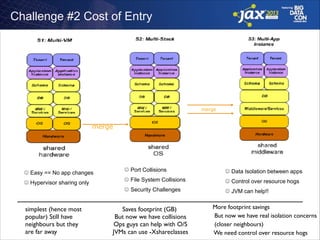
Challenge #2 Cost of Entry

merge

merge

J Hypervisor sharing only

simplest (hence most
popular) Still have
neighbours but they
are far away	


J Port Collisions

J Data Isolation between apps

J File System Collisions

J Control over resource hogs

J Security Challenges

J Easy == No app changes

J JVM can help!!

Saves footprint (GB)	

But now we have collisions	

Ops guys can help with O/S	

JVMs can use -Xshareclasses	


More footprint savings	

But now we have real isolation concerns	

(closer neighbours)	

We need control over resource hogs
Challenge #2.5 Building isolation

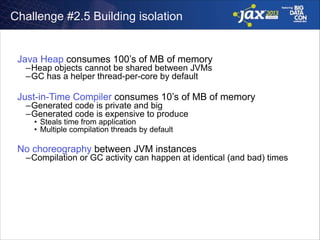
Java Heap consumes 100’s of MB of memory
–Heap objects cannot be shared between JVMs
–GC has a helper thread-per-core by default


Just-in-Time Compiler consumes 10’s of MB of memory
–Generated code is private and big
–Generated code is expensive to produce
• Steals time from application
• Multiple compilation threads by default


No choreography between JVM instances

–Compilation or GC activity can happen at identical (and bad) times
Challenge #2.5 Building isolation

We need to fix the following
!

L Data Isolation between applications
!

L Control over resource hogs

Without forcing people to change their applications!
Data Isolation Challenges

■

■

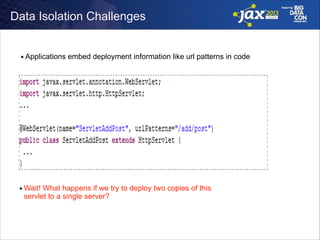
Applications embed deployment information like url patterns in code

Wait! What happens if we try to deploy two copies of this
servlet to a single server?
■

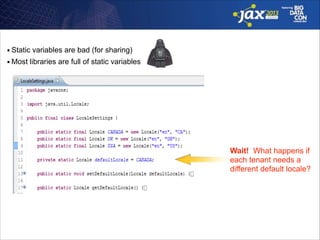
Static variables are bad (for sharing)

■

Most libraries are full of static variables

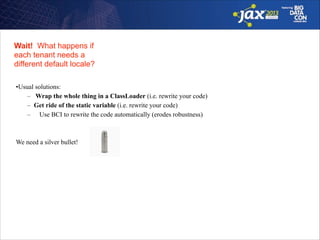
Wait! What happens if

each tenant needs a 

different default locale?
Wait! What happens if

each tenant needs a 

different default locale?
•Usual solutions:
– Wrap the whole thing in a ClassLoader (i.e. rewrite your code)
– Get ride of the static variable (i.e. rewrite your code)
– Use BCI to rewrite the code automatically (erodes robustness)

!
!
We need a silver bullet!
Multitenant JDK

■

Concept: Add a single argument (–Xmt for multi-tenant) to
your Java command-line to opt into sharing a runtime with
others. 

■

Result: Your application behaves exactly as it if had a
dedicated JVM, but in reality it runs side-by-side with other
applications.


■

Benefits: Smaller, faster, and eventually smarter

–Less duplication: (1 GC, 1 JIT), Heap object sharing
–Fast Startup: JVM is already running and warm when starting apps

■

Required: No code Changes!
Part 3
Demo (of a demo)
Launch your application

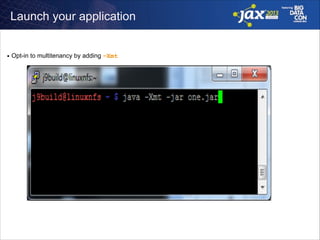
■

Opt-in to multitenancy by adding –Xmt
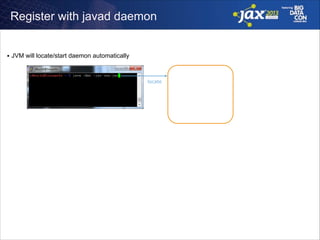
Register with javad daemon

■

JVM will locate/start daemon automatically

locate
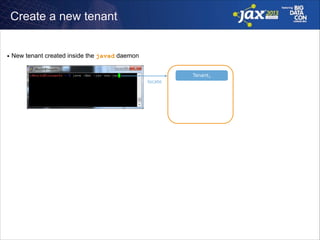
Create a new tenant

■

New tenant created inside the javad daemon

locate

Tenant1
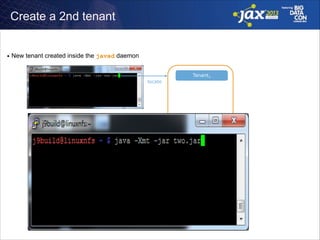
Create a 2nd tenant

■

New tenant created inside the javad daemon

locate

Tenant1
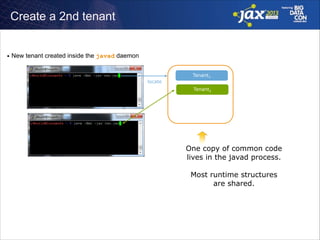
Create a 2nd tenant

■

New tenant created inside the javad daemon

locate

Tenant1
Tenant2

One copy of common code

lives in the javad process.


Most runtime structures

are shared.
Providing data isolation
■

■

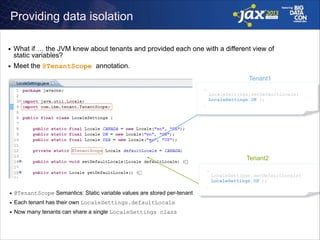
What if … the JVM knew about tenants and provided each one with a different view of
static variables?
Meet the @TenantScope annotation.
Tenant1
…

LocaleSettings.setDefaultLocale(

LocaleSettings.UK );
…

Tenant2
…

LocaleSettings.setDefaultLocale(

LocaleSettings.US );
…
■

@TenantScope Semantics: Static variable values are stored per-tenant

■

Each tenant has their own LocaleSettings.defaultLocale

■

Now many tenants can share a single LocaleSettings class
Did I say ‘no code changes?’

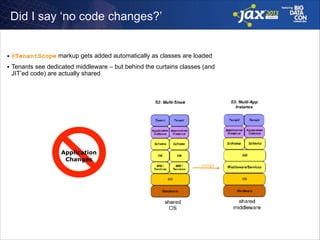
■
■

@TenantScope markup gets added automatically as classes are loaded
Tenants see dedicated middleware – but behind the curtains classes (and
JIT’ed code) are actually shared

Application

Changes
merge
If it’s invisible - why have @TenantScope?
Allows middleware to opt out
■ Opportunities for even more density.
■

!
■

Basic operations on Tenants available to the middleware
–Data Isolation
–Resource Management (more in this in a minute)
!

■

Ability for the middleware to differentiate between Tenants
–Which one is causing the problem?
!

■

Querying the state of Tenants
–How much free memory do you have?
Part 4
Hey, aren’t we done yet?
Dealing with bad behaviour

http://bit.ly/ficwkl

images from http://www.rra.memberlodge.org/Neighbourhood-Watch-Reporting
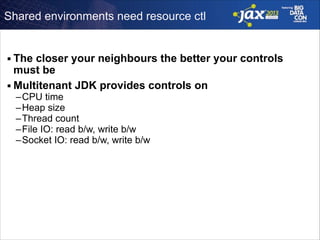
Shared environments need resource ctl

The closer your neighbours the better your controls
must be
■ Multitenant JDK provides controls on
■

–CPU time
–Heap size
–Thread count
–File IO: read b/w, write b/w
–Socket IO: read b/w, write b/w

!
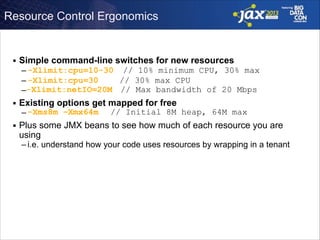
Resource Control Ergonomics

■

Simple command-line switches for new resources
– -Xlimit:cpu=10-30 // 10% minimum CPU, 30% max
// 30% max CPU
– -Xlimit:cpu=30
–-Xlimit:netIO=20M // Max bandwidth of 20 Mbps

■

Existing options get mapped for free
– -Xms8m –Xmx64m

■

// Initial 8M heap, 64M max

Plus some JMX beans to see how much of each resource you are
using

– i.e. understand how your code uses resources by wrapping in a tenant
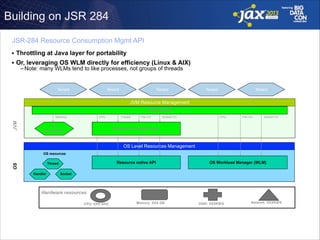
Building on JSR 284
JSR-284 Resource Consumption Mgmt API
■

Throttling at Java layer for portability

■

Or, leveraging OS WLM directly for efficiency (Linux & AIX)
– Note: many WLMs tend to like processes, not groups of threads

Tenant

Tenant

Tenant

Tenant

Tenant

JVM Resource Management
JSR 284 API

JVM

Memory

CPU

GC 

(Heap Mgmt)

Thread

File I/O

Socket I/O

CPU

File I/O

Socket I/O

Resource Throttle Layer

OS Level Resources Management
OS resources

Resource native API

OS

Thread
Handler

OS Workload Manager (WLM)

Socket

Hardware resources
CPU: XXX GHZ

Memory: XXX GB

DISK: XXXKB/S

Network: XXXKB/S
CPU Throttling
Round

1239s

1452s

1390s

1094s

1122s

1139s

1123s

6

1244s

1134s

Average

1243s

1212s

cpu throttling in jvm controller
90.00

60.00

67.50

cpu%

80.00

cpu%

1167s

5

cpu throttling in os controller

1267s

4

Accuracy

1362s

3

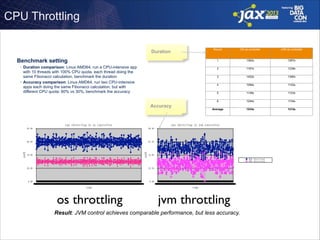
• Duration comparison: Linux AMD64, run a CPU-intensive app
with 10 threads with 100% CPU quota, each thread doing the
same Fibonacci calculation, benchmark the duration
• Accuracy comparison: Linux AMD64, run two CPU-intensive
apps each doing the same Fibonacci calculation, but with
different CPU quota: 60% vs 30%, benchmark the accuracy

JVM as controller

2

Benchmark setting

OS as controller

1

Duration

40.00

20.00

45.00
60% throttling
30% throttling
22.50

0.00

0.00
00:0000:3001:0001:3002:0002:3003:0003:3004:0004:3005:0005:3006:0006:3007:0007:3008:0008:3009:0009:30
00:0100:3101:0101:3102:0102:3103:0103:3104:0104:3105:0105:3106:0106:3107:0107:3108:0108:3109:0109:31
00:0200:3201:0201:3202:0202:3203:0203:3204:0204:3205:0205:3206:0206:3207:0207:3208:0208:3209:0209:32
00:0300:3301:0301:3302:0302:3303:0303:3304:0304:3305:0305:3306:0306:3307:0307:3308:0308:3309:0309:33
00:0400:3401:0401:3402:0402:3403:0403:3404:0404:3405:0405:3406:0406:3407:0407:3408:0408:3409:0409:34
00:0500:3501:0501:3502:0502:3503:0503:3504:0504:3505:0505:3506:0506:3507:0507:3508:0508:3509:0509:35
00:0600:3601:0601:3602:0602:3603:0603:3604:0604:3605:0605:3606:0606:3607:0607:3608:0608:3609:0609:36
00:0700:3701:0701:3702:0702:3703:0703:3704:0704:3705:0705:3706:0706:3707:0707:3708:0708:3709:0709:37
00:0800:3801:0801:3802:0802:3803:0803:3804:0804:3805:0805:3806:0806:3807:0807:3808:0808:3809:0809:38
00:0900:3901:0901:3902:0902:3903:0903:3904:0904:3905:0905:3906:0906:3907:0907:3908:0908:3909:0909:39
00:1000:4001:1001:4002:1002:4003:1003:4004:1004:4005:1005:4006:1006:4007:1007:4008:1008:4009:1009:40
00:1100:4101:1101:4102:1102:4103:1103:4104:1104:4105:1105:4106:1106:4107:1107:4108:1108:4109:1109:41
00:1200:4201:1201:4202:1202:4203:1203:4204:1204:4205:1205:4206:1206:4207:1207:4208:1208:4209:1209:42
00:1300:4301:1301:4302:1302:4303:1303:4304:1304:4305:1305:4306:1306:4307:1307:4308:1308:4309:1309:43
00:1400:4401:1401:4402:1402:4403:1403:4404:1404:4405:1405:4406:1406:4407:1407:4408:1408:4409:1409:44
00:1500:4501:1501:4502:1502:4503:1503:4504:1504:4505:1505:4506:1506:4507:1507:4508:1508:4509:1509:45
00:1600:4601:1601:4602:1602:4603:1603:4604:1604:4605:1605:4606:1606:4607:1607:4608:1608:4609:1609:46
00:1700:4701:1701:4702:1702:4703:1703:4704:1704:4705:1705:4706:1706:4707:1707:4708:1708:4709:1709:47
00:1800:4801:1801:4802:1802:4803:1803:4804:1804:4805:1805:4806:1806:4807:1807:4808:1808:4809:1809:48
00:1900:4901:1901:4902:1902:4903:1903:4904:1904:4905:1905:4906:1906:4907:1907:4908:1908:4909:1909:49
00:2000:5001:2001:5002:2002:5003:2003:5004:2004:5005:2005:5006:2006:5007:2007:5008:2008:5009:2009:50
00:2100:5101:2101:5102:2102:5103:2103:5104:2104:5105:2105:5106:2106:5107:2107:5108:2108:5109:2109:51
00:2200:5201:2201:5202:2202:5203:2203:5204:2204:5205:2205:5206:2206:5207:2207:5208:2208:5209:2209:52
00:2300:5301:2301:5302:2302:5303:2303:5304:2304:5305:2305:5306:2306:5307:2307:5308:2308:5309:2309:53
00:2400:5401:2401:5402:2402:5403:2403:5404:2404:5405:2405:5406:2406:5407:2407:5408:2408:5409:2409:54
00:2500:5501:2501:5502:2502:5503:2503:5504:2504:5505:2505:5506:2506:5507:2507:5508:2508:5509:2509:55
00:2600:5601:2601:5602:2602:5603:2603:5604:2604:5605:2605:5606:2606:5607:2607:5608:2608:5609:2609:56
00:2700:5701:2701:5702:2702:5703:2703:5704:2704:5705:2705:5706:2706:5707:2707:5708:2708:5709:2709:57
00:2800:5801:2801:5802:2802:5803:2803:5804:2804:5805:2805:5806:2806:5807:2807:5808:2808:5809:2809:58
00:2900:5901:2901:5902:2902:5903:2903:5904:2904:5905:2905:5906:2906:5907:2907:5908:2908:5909:29

00:0000:4201:2402:0602:4803:3004:1204:5405:3606:1807:0007:4208:2409:0609:48
00:0100:4301:2502:0702:4903:3104:1304:5505:3706:1907:0107:4308:2509:0709:49
00:0200:4401:2602:0802:5003:3204:1404:5605:3806:2007:0207:4408:2609:0809:50
00:0300:4501:2702:0902:5103:3304:1504:5705:3906:2107:0307:4508:2709:0909:51
00:0400:4601:2802:1002:5203:3404:1604:5805:4006:2207:0407:4608:2809:1009:52
00:0500:4701:2902:1102:5303:3504:1704:5905:4106:2307:0507:4708:2909:1109:53
00:0600:4801:3002:1202:5403:3604:1805:0005:4206:2407:0607:4808:3009:1209:54
00:0700:4901:3102:1302:5503:3704:1905:0105:4306:2507:0707:4908:3109:1309:55
00:0800:5001:3202:1402:5603:3804:2005:0205:4406:2607:0807:5008:3209:1409:56
00:0900:5101:3302:1502:5703:3904:2105:0305:4506:2707:0907:5108:3309:1509:57
00:1000:5201:3402:1602:5803:4004:2205:0405:4606:2807:1007:5208:3409:1609:58
00:1100:5301:3502:1702:5903:4104:2305:0505:4706:2907:1107:5308:3509:17
00:1200:5401:3602:1803:0003:4204:2405:0605:4806:3007:1207:5408:3609:18
00:1300:5501:3702:1903:0103:4304:2505:0705:4906:3107:1307:5508:3709:19
00:1400:5601:3802:2003:0203:4404:2605:0805:5006:3207:1407:5608:3809:20
00:1500:5701:3902:2103:0303:4504:2705:0905:5106:3307:1507:5708:3909:21
00:1600:5801:4002:2203:0403:4604:2805:1005:5206:3407:1607:5808:4009:22
00:1700:5901:4102:2303:0503:4704:2905:1105:5306:3507:1707:5908:4109:23
00:1801:0001:4202:2403:0603:4804:3005:1205:5406:3607:1808:0008:4209:24
00:1901:0101:4302:2503:0703:4904:3105:1305:5506:3707:1908:0108:4309:25
00:2001:0201:4402:2603:0803:5004:3205:1405:5606:3807:2008:0208:4409:26
00:2101:0301:4502:2703:0903:5104:3305:1505:5706:3907:2108:0308:4509:27
00:2201:0401:4602:2803:1003:5204:3405:1605:5806:4007:2208:0408:4609:28
00:2301:0501:4702:2903:1103:5304:3505:1705:5906:4107:2308:0508:4709:29
00:2401:0601:4802:3003:1203:5404:3605:1806:0006:4207:2408:0608:4809:30
00:2501:0701:4902:3103:1303:5504:3705:1906:0106:4307:2508:0708:4909:31
00:2601:0801:5002:3203:1403:5604:3805:2006:0206:4407:2608:0808:5009:32
00:2701:0901:5102:3303:1503:5704:3905:2106:0306:4507:2708:0908:5109:33
00:2801:1001:5202:3403:1603:5804:4005:2206:0406:4607:2808:1008:5209:34
00:2901:1101:5302:3503:1703:5904:4105:2306:0506:4707:2908:1108:5309:35
00:3001:1201:5402:3603:1804:0004:4205:2406:0606:4807:3008:1208:5409:36
00:3101:1301:5502:3703:1904:0104:4305:2506:0706:4907:3108:1308:5509:37
00:3201:1401:5602:3803:2004:0204:4405:2606:0806:5007:3208:1408:5609:38
00:3301:1501:5702:3903:2104:0304:4505:2706:0906:5107:3308:1508:5709:39
00:3401:1601:5802:4003:2204:0404:4605:2806:1006:5207:3408:1608:5809:40
00:3501:1701:5902:4103:2304:0504:4705:2906:1106:5307:3508:1708:5909:41
00:3601:1802:0002:4203:2404:0604:4805:3006:1206:5407:3608:1809:0009:42
00:3701:1902:0102:4303:2504:0704:4905:3106:1306:5507:3708:1909:0109:43
00:3801:2002:0202:4403:2604:0804:5005:3206:1406:5607:3808:2009:0209:44
00:3901:2102:0302:4503:2704:0904:5105:3306:1506:5707:3908:2109:0309:45
00:4001:2202:0402:4603:2804:1004:5205:3406:1606:5807:4008:2209:0409:46
00:4101:2302:0502:4703:2904:1104:5305:3506:1706:5907:4108:2309:0509:47

time

time

os throttling

jvm throttling

Result: JVM control achieves comparable performance, but less accuracy.
Part 5
Performance so far
Current Performance Data
■

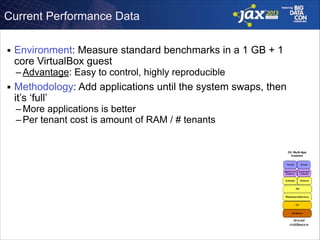
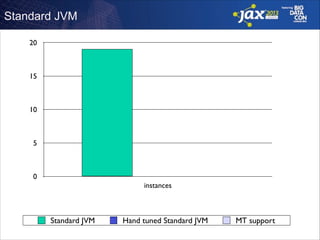
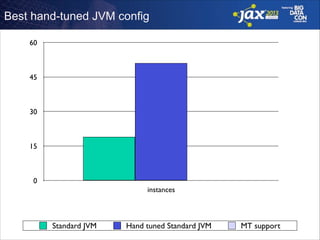
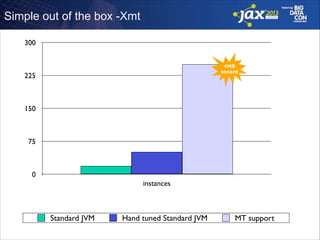
Environment: Measure standard benchmarks in a 1 GB + 1
core VirtualBox guest
– Advantage: Easy to control, highly reproducible

■

Methodology: Add applications until the system swaps, then
it’s ‘full’
– More applications is better
– Per tenant cost is amount of RAM / # tenants
Standard JVM
20

15

10

5

0
instances

Standard JVM

Hand tuned Standard JVM

MT support
Best hand-tuned JVM config
60

45

30

15

0
instances

Standard JVM

Hand tuned Standard JVM

MT support
Simple out of the box -Xmt
300
4MB

tenant

225

150

75

0
instances

Standard JVM

Hand tuned Standard JVM

MT support
Part 6
Wrap up
This is still ‘experimental’

■

Focus to date has been ‘zero application changes’
– We can do even better with tenant-aware middleware

■

API’s used to provide isolation & throttling are available to stack
products
– JSR-284 (Resource Management)
– JSR-121 (Isolates)
– @TenantScope fields

■

Java language and frameworks (EclipseLink) are evolving to have
first-class multitenant support

■

Stay tuned for progress: watch the IBM Java 8 beta program
This is still ‘experimental’

Simplifying the software stack by removing all extraneous pieces
makes better use of hardware (and people who run it).
!

Multitenancy can make us more efficient:
–Trades isolation for footprint and agility
–JVM support makes multitenancy safer and easier
–Measuring resource usage and load patterns is critical
–Multitenant JDK primitives give us room for future growth
Conclusion

Now that you’ve completed this session, you are able to:

– Understand what multitenancy is and what it’s good for
• Per-tenant costs measured in single-digit MB are possible


– Describe challenges of multitenant Java deployments
• Hard for VM guys, should be easy for you
• Choreography of load / deployment is up to you


– Understand new JDK features to convert existing applications into
multitenant deployments
• Are we on the right track? Could you use this in your business?

Thank you - any questions?

JVM Support for Multitenant Applications - Steve Poole (IBM)

  • 1.
    Steve Poole IBM JVMSupport for Multitenant Applications
  • 2.
    Important Disclaimers THE INFORMATIONCONTAINED IN THIS PRESENTATION IS PROVIDED FOR INFORMATIONAL PURPOSES ONLY. WHILST EFFORTS WERE MADE TO VERIFY THE COMPLETENESS AND ACCURACY OF THE INFORMATION CONTAINED IN THIS PRESENTATION, IT IS PROVIDED “AS IS”, WITHOUT WARRANTY OF ANY KIND, EXPRESS OR IMPLIED. ALL PERFORMANCE DATA INCLUDED IN THIS PRESENTATION HAVE BEEN GATHERED IN A CONTROLLED ENVIRONMENT. YOUR OWN TEST RESULTS MAY VARY BASED ON HARDWARE, SOFTWARE OR INFRASTRUCTURE DIFFERENCES. ALL DATA INCLUDED IN THIS PRESENTATION ARE MEANT TO BE USED ONLY AS A GUIDE. IN ADDITION, THE INFORMATION CONTAINED IN THIS PRESENTATION IS BASED ON IBM’S CURRENT PRODUCT PLANS AND STRATEGY, WHICH ARE SUBJECT TO CHANGE BY IBM, WITHOUT NOTICE. IBM AND ITS AFFILIATED COMPANIES SHALL NOT BE RESPONSIBLE FOR ANY DAMAGES ARISING OUT OF THE USE OF, OR OTHERWISE RELATED TO, THIS PRESENTATION OR ANY OTHER DOCUMENTATION. NOTHING CONTAINED IN THIS PRESENTATION IS INTENDED TO, OR SHALL HAVE THE EFFECT OF: - CREATING ANY WARRANT OR REPRESENTATION FROM IBM, ITS AFFILIATED COMPANIES OR ITS OR THEIR SUPPLIERS AND/OR LICENSORS
  • 3.
    Steve Poole ! Works atIBM’s Hursley Laboratory in the UK Involved in IBM Java VM development since before Java was 1 Currently leading IBM’s OpenJDK technical engagement
  • 4.
    What this talkis about ! ! ! ! JVM Support for Multi-Tenant Applications This experimental technology is being developed to help address important pressures on Java ! Google ‘IBM Java 8 beta’ for more information ! ■ By the end of this session, you should be able to: ! – Understand what multitenancy is and what it’s good for ! – Describe the challenges of multitenant Java deployments ! – Understand ideas for new JDK features to convert existing applications into multitenant deployments !
  • 5.
    Agenda 1. What Multi-tenancyis all about aka how to simplify to save time and money 2. The challenges of building a multi-tenant application in Java 3. How to keep your application running in a multi-tenant world dealing with bad behaviour 4. Risk vs. Reward: How dense can we go? 5. Wrap-up: Summary, and next steps
  • 6.
    Part 1 What isMultitenancy? ! (simplify to save time and money)
  • 7.
    Who owns oneof these?
  • 8.
    Who owns oneof these?
  • 9.
    Who owns oneof these?
  • 10.
    Who owns oneof these? At a basic level Multitenancy is a drive to reduce unnecessary complexity and duplication this is sophisticated but expensive this is simpler and cheaper
  • 11.
    Who owns oneof these? At a basic level Multitenancy is a drive to reduce unnecessary complexity and duplication this is sophisticated but expensive Multitenancy helps with finding the right balance this is simpler and cheaper
  • 12.
    Its not justa hardware story Simplifying the software stack by removing all extraneous pieces makes better use of hardware and the people who run it. ! Simple == Cheaper == Predictable == Robust
  • 13.
    Simple Dont Repeat Yourself “Everypiece of knowledge must have a single, unambiguous, authoritative representation within a system” 
 
 Pragmatic Programmer (Hunt & Thomas) (or: copy-and-paste encourages problems) We want to avoid the clone army
  • 14.
    Are you alreadyusing Multitenancy •Are your choices only •fully dedicated machine or shared hardware? •Multitenancy isn’t just a checkbox. •There are various levels of ‘tenancy’ defined today.
  • 15.
  • 16.
    SaaS Tenancy Spectrum Yourbasic laptop, desktop or server machine. yours, all yours..
  • 17.
    SaaS Tenancy Spectrum Asimple shared machine LPAR’d or VM’d into multiple complete stacks.
  • 18.
    SaaS Tenancy Spectrum Reducedoverhead by running multiple app servers on one O/S Keep everything else separate though. “just in case”
  • 19.
    SaaS Tenancy Spectrum Multiple applications runningon one app server sharing db server and middleware!
  • 20.
  • 21.
    SaaS Tenancy Spectrum Sharingeverything including database tables.
  • 22.
    SaaS Tenancy Spectrum AMultitenant JVM covers theses levels of sharing
  • 23.
    SaaS Tenancy Spectrum Mergingthese bubbles saves money, reduces complexity and can be a real business differentiator. But it requires engineering effort
  • 24.
    SaaS Tenancy Spectrum Remember,from the end user point of view, they see it like this
  • 25.
    Efficencies ■ Customer viewpoint ! – Cost:provider offers the service more cheaply – Time to Value: up and running fast, typically upgraded often & quickly – Quality of Service: focus on SLA needed not your ability to run infrastructure – Bypass IT Backlog: streamlined deployment (handled by provider) ! ■ Provider viewpoint – Cost: Minimal moving parts / duplication – Agility: Upgrades, backups, on-boarding Fewer Parts == Better Density == £££ for the service provider
  • 26.
  • 27.
    Climbing MT tenant Increasingdensity of the software stack is impacting us all. ! Cost of hosting is a business differentiator already ! Its only going to increase in importance ! If you’re in the cloud you already know ! ! Moving from ‘free’ to ‘not free’ hosting is an intensive exercise. Your software choices are starting to be decided by CPU and memory usage. With your own hardware you could let it run slow. Can’t do that in the cloud! ! So how do move forward with Java and Multitenancy?
  • 28.
    Challenge #1 Isolation Thefear factor is loosing isolation ■ unexpected side effects from other parts ■ This is a reasonable concern ■ Same number of eggs (apps), fewer baskets ■ You want really good baskets arranged carefully http://circa71.wordpress.com/2010/07/ ■ But it’s not a new problem ■ We can reduce the change of failure (more later) ■ We can reduce the impact with good choreography ■ You need to think about choreography today ■ Today we use clusters to provide fail-over and arrange clusters to avoid same machine/rack/site failures http://bit.ly/e7G1jb ■ Apply the same ideas to Multitenancy ■
  • 29.
    Challenge #2 Costof Entry merge merge J Hypervisor sharing only simplest (hence most popular) Still have neighbours but they are far away J Port Collisions J Data Isolation between apps J File System Collisions J Control over resource hogs J Security Challenges J Easy == No app changes J JVM can help!! Saves footprint (GB) But now we have collisions Ops guys can help with O/S JVMs can use -Xshareclasses More footprint savings But now we have real isolation concerns (closer neighbours) We need control over resource hogs
  • 30.
    Challenge #2.5 Buildingisolation Java Heap consumes 100’s of MB of memory –Heap objects cannot be shared between JVMs –GC has a helper thread-per-core by default
 Just-in-Time Compiler consumes 10’s of MB of memory –Generated code is private and big –Generated code is expensive to produce • Steals time from application • Multiple compilation threads by default
 No choreography between JVM instances –Compilation or GC activity can happen at identical (and bad) times
  • 31.
    Challenge #2.5 Buildingisolation We need to fix the following ! L Data Isolation between applications ! L Control over resource hogs Without forcing people to change their applications!
  • 32.
    Data Isolation Challenges ■ ■ Applicationsembed deployment information like url patterns in code Wait! What happens if we try to deploy two copies of this servlet to a single server?
  • 33.
    ■ Static variables arebad (for sharing) ■ Most libraries are full of static variables Wait! What happens if
 each tenant needs a 
 different default locale?
  • 34.
    Wait! What happensif
 each tenant needs a 
 different default locale? •Usual solutions: – Wrap the whole thing in a ClassLoader (i.e. rewrite your code) – Get ride of the static variable (i.e. rewrite your code) – Use BCI to rewrite the code automatically (erodes robustness) ! ! We need a silver bullet!
  • 35.
    Multitenant JDK ■ Concept: Adda single argument (–Xmt for multi-tenant) to your Java command-line to opt into sharing a runtime with others. 
 ■ Result: Your application behaves exactly as it if had a dedicated JVM, but in reality it runs side-by-side with other applications.
 ■ Benefits: Smaller, faster, and eventually smarter –Less duplication: (1 GC, 1 JIT), Heap object sharing –Fast Startup: JVM is already running and warm when starting apps ■ Required: No code Changes!
  • 36.
  • 37.
    Launch your application ■ Opt-into multitenancy by adding –Xmt
  • 38.
    Register with javaddaemon ■ JVM will locate/start daemon automatically locate
  • 39.
    Create a newtenant ■ New tenant created inside the javad daemon locate Tenant1
  • 40.
    Create a 2ndtenant ■ New tenant created inside the javad daemon locate Tenant1
  • 41.
    Create a 2ndtenant ■ New tenant created inside the javad daemon locate Tenant1 Tenant2 One copy of common code
 lives in the javad process.
 
 Most runtime structures
 are shared.
  • 42.
    Providing data isolation ■ ■ Whatif … the JVM knew about tenants and provided each one with a different view of static variables? Meet the @TenantScope annotation. Tenant1 …
 LocaleSettings.setDefaultLocale(
 LocaleSettings.UK ); … Tenant2 …
 LocaleSettings.setDefaultLocale(
 LocaleSettings.US ); … ■ @TenantScope Semantics: Static variable values are stored per-tenant ■ Each tenant has their own LocaleSettings.defaultLocale ■ Now many tenants can share a single LocaleSettings class
  • 43.
    Did I say‘no code changes?’ ■ ■ @TenantScope markup gets added automatically as classes are loaded Tenants see dedicated middleware – but behind the curtains classes (and JIT’ed code) are actually shared Application
 Changes merge
  • 44.
    If it’s invisible- why have @TenantScope? Allows middleware to opt out ■ Opportunities for even more density. ■ ! ■ Basic operations on Tenants available to the middleware –Data Isolation –Resource Management (more in this in a minute) ! ■ Ability for the middleware to differentiate between Tenants –Which one is causing the problem? ! ■ Querying the state of Tenants –How much free memory do you have?
  • 45.
  • 46.
    Dealing with badbehaviour http://bit.ly/ficwkl images from http://www.rra.memberlodge.org/Neighbourhood-Watch-Reporting
  • 47.
    Shared environments needresource ctl The closer your neighbours the better your controls must be ■ Multitenant JDK provides controls on ■ –CPU time –Heap size –Thread count –File IO: read b/w, write b/w –Socket IO: read b/w, write b/w !
  • 48.
    Resource Control Ergonomics ■ Simplecommand-line switches for new resources – -Xlimit:cpu=10-30 // 10% minimum CPU, 30% max // 30% max CPU – -Xlimit:cpu=30 –-Xlimit:netIO=20M // Max bandwidth of 20 Mbps ■ Existing options get mapped for free – -Xms8m –Xmx64m ■ // Initial 8M heap, 64M max Plus some JMX beans to see how much of each resource you are using – i.e. understand how your code uses resources by wrapping in a tenant
  • 49.
    Building on JSR284 JSR-284 Resource Consumption Mgmt API ■ Throttling at Java layer for portability ■ Or, leveraging OS WLM directly for efficiency (Linux & AIX) – Note: many WLMs tend to like processes, not groups of threads Tenant Tenant Tenant Tenant Tenant JVM Resource Management JSR 284 API JVM Memory CPU GC 
 (Heap Mgmt) Thread File I/O Socket I/O CPU File I/O Socket I/O Resource Throttle Layer OS Level Resources Management OS resources Resource native API OS Thread Handler OS Workload Manager (WLM) Socket Hardware resources CPU: XXX GHZ Memory: XXX GB DISK: XXXKB/S Network: XXXKB/S
  • 50.
    CPU Throttling Round 1239s 1452s 1390s 1094s 1122s 1139s 1123s 6 1244s 1134s Average 1243s 1212s cpu throttlingin jvm controller 90.00 60.00 67.50 cpu% 80.00 cpu% 1167s 5 cpu throttling in os controller 1267s 4 Accuracy 1362s 3 • Duration comparison: Linux AMD64, run a CPU-intensive app with 10 threads with 100% CPU quota, each thread doing the same Fibonacci calculation, benchmark the duration • Accuracy comparison: Linux AMD64, run two CPU-intensive apps each doing the same Fibonacci calculation, but with different CPU quota: 60% vs 30%, benchmark the accuracy JVM as controller 2 Benchmark setting OS as controller 1 Duration 40.00 20.00 45.00 60% throttling 30% throttling 22.50 0.00 0.00 00:0000:3001:0001:3002:0002:3003:0003:3004:0004:3005:0005:3006:0006:3007:0007:3008:0008:3009:0009:30 00:0100:3101:0101:3102:0102:3103:0103:3104:0104:3105:0105:3106:0106:3107:0107:3108:0108:3109:0109:31 00:0200:3201:0201:3202:0202:3203:0203:3204:0204:3205:0205:3206:0206:3207:0207:3208:0208:3209:0209:32 00:0300:3301:0301:3302:0302:3303:0303:3304:0304:3305:0305:3306:0306:3307:0307:3308:0308:3309:0309:33 00:0400:3401:0401:3402:0402:3403:0403:3404:0404:3405:0405:3406:0406:3407:0407:3408:0408:3409:0409:34 00:0500:3501:0501:3502:0502:3503:0503:3504:0504:3505:0505:3506:0506:3507:0507:3508:0508:3509:0509:35 00:0600:3601:0601:3602:0602:3603:0603:3604:0604:3605:0605:3606:0606:3607:0607:3608:0608:3609:0609:36 00:0700:3701:0701:3702:0702:3703:0703:3704:0704:3705:0705:3706:0706:3707:0707:3708:0708:3709:0709:37 00:0800:3801:0801:3802:0802:3803:0803:3804:0804:3805:0805:3806:0806:3807:0807:3808:0808:3809:0809:38 00:0900:3901:0901:3902:0902:3903:0903:3904:0904:3905:0905:3906:0906:3907:0907:3908:0908:3909:0909:39 00:1000:4001:1001:4002:1002:4003:1003:4004:1004:4005:1005:4006:1006:4007:1007:4008:1008:4009:1009:40 00:1100:4101:1101:4102:1102:4103:1103:4104:1104:4105:1105:4106:1106:4107:1107:4108:1108:4109:1109:41 00:1200:4201:1201:4202:1202:4203:1203:4204:1204:4205:1205:4206:1206:4207:1207:4208:1208:4209:1209:42 00:1300:4301:1301:4302:1302:4303:1303:4304:1304:4305:1305:4306:1306:4307:1307:4308:1308:4309:1309:43 00:1400:4401:1401:4402:1402:4403:1403:4404:1404:4405:1405:4406:1406:4407:1407:4408:1408:4409:1409:44 00:1500:4501:1501:4502:1502:4503:1503:4504:1504:4505:1505:4506:1506:4507:1507:4508:1508:4509:1509:45 00:1600:4601:1601:4602:1602:4603:1603:4604:1604:4605:1605:4606:1606:4607:1607:4608:1608:4609:1609:46 00:1700:4701:1701:4702:1702:4703:1703:4704:1704:4705:1705:4706:1706:4707:1707:4708:1708:4709:1709:47 00:1800:4801:1801:4802:1802:4803:1803:4804:1804:4805:1805:4806:1806:4807:1807:4808:1808:4809:1809:48 00:1900:4901:1901:4902:1902:4903:1903:4904:1904:4905:1905:4906:1906:4907:1907:4908:1908:4909:1909:49 00:2000:5001:2001:5002:2002:5003:2003:5004:2004:5005:2005:5006:2006:5007:2007:5008:2008:5009:2009:50 00:2100:5101:2101:5102:2102:5103:2103:5104:2104:5105:2105:5106:2106:5107:2107:5108:2108:5109:2109:51 00:2200:5201:2201:5202:2202:5203:2203:5204:2204:5205:2205:5206:2206:5207:2207:5208:2208:5209:2209:52 00:2300:5301:2301:5302:2302:5303:2303:5304:2304:5305:2305:5306:2306:5307:2307:5308:2308:5309:2309:53 00:2400:5401:2401:5402:2402:5403:2403:5404:2404:5405:2405:5406:2406:5407:2407:5408:2408:5409:2409:54 00:2500:5501:2501:5502:2502:5503:2503:5504:2504:5505:2505:5506:2506:5507:2507:5508:2508:5509:2509:55 00:2600:5601:2601:5602:2602:5603:2603:5604:2604:5605:2605:5606:2606:5607:2607:5608:2608:5609:2609:56 00:2700:5701:2701:5702:2702:5703:2703:5704:2704:5705:2705:5706:2706:5707:2707:5708:2708:5709:2709:57 00:2800:5801:2801:5802:2802:5803:2803:5804:2804:5805:2805:5806:2806:5807:2807:5808:2808:5809:2809:58 00:2900:5901:2901:5902:2902:5903:2903:5904:2904:5905:2905:5906:2906:5907:2907:5908:2908:5909:29 00:0000:4201:2402:0602:4803:3004:1204:5405:3606:1807:0007:4208:2409:0609:48 00:0100:4301:2502:0702:4903:3104:1304:5505:3706:1907:0107:4308:2509:0709:49 00:0200:4401:2602:0802:5003:3204:1404:5605:3806:2007:0207:4408:2609:0809:50 00:0300:4501:2702:0902:5103:3304:1504:5705:3906:2107:0307:4508:2709:0909:51 00:0400:4601:2802:1002:5203:3404:1604:5805:4006:2207:0407:4608:2809:1009:52 00:0500:4701:2902:1102:5303:3504:1704:5905:4106:2307:0507:4708:2909:1109:53 00:0600:4801:3002:1202:5403:3604:1805:0005:4206:2407:0607:4808:3009:1209:54 00:0700:4901:3102:1302:5503:3704:1905:0105:4306:2507:0707:4908:3109:1309:55 00:0800:5001:3202:1402:5603:3804:2005:0205:4406:2607:0807:5008:3209:1409:56 00:0900:5101:3302:1502:5703:3904:2105:0305:4506:2707:0907:5108:3309:1509:57 00:1000:5201:3402:1602:5803:4004:2205:0405:4606:2807:1007:5208:3409:1609:58 00:1100:5301:3502:1702:5903:4104:2305:0505:4706:2907:1107:5308:3509:17 00:1200:5401:3602:1803:0003:4204:2405:0605:4806:3007:1207:5408:3609:18 00:1300:5501:3702:1903:0103:4304:2505:0705:4906:3107:1307:5508:3709:19 00:1400:5601:3802:2003:0203:4404:2605:0805:5006:3207:1407:5608:3809:20 00:1500:5701:3902:2103:0303:4504:2705:0905:5106:3307:1507:5708:3909:21 00:1600:5801:4002:2203:0403:4604:2805:1005:5206:3407:1607:5808:4009:22 00:1700:5901:4102:2303:0503:4704:2905:1105:5306:3507:1707:5908:4109:23 00:1801:0001:4202:2403:0603:4804:3005:1205:5406:3607:1808:0008:4209:24 00:1901:0101:4302:2503:0703:4904:3105:1305:5506:3707:1908:0108:4309:25 00:2001:0201:4402:2603:0803:5004:3205:1405:5606:3807:2008:0208:4409:26 00:2101:0301:4502:2703:0903:5104:3305:1505:5706:3907:2108:0308:4509:27 00:2201:0401:4602:2803:1003:5204:3405:1605:5806:4007:2208:0408:4609:28 00:2301:0501:4702:2903:1103:5304:3505:1705:5906:4107:2308:0508:4709:29 00:2401:0601:4802:3003:1203:5404:3605:1806:0006:4207:2408:0608:4809:30 00:2501:0701:4902:3103:1303:5504:3705:1906:0106:4307:2508:0708:4909:31 00:2601:0801:5002:3203:1403:5604:3805:2006:0206:4407:2608:0808:5009:32 00:2701:0901:5102:3303:1503:5704:3905:2106:0306:4507:2708:0908:5109:33 00:2801:1001:5202:3403:1603:5804:4005:2206:0406:4607:2808:1008:5209:34 00:2901:1101:5302:3503:1703:5904:4105:2306:0506:4707:2908:1108:5309:35 00:3001:1201:5402:3603:1804:0004:4205:2406:0606:4807:3008:1208:5409:36 00:3101:1301:5502:3703:1904:0104:4305:2506:0706:4907:3108:1308:5509:37 00:3201:1401:5602:3803:2004:0204:4405:2606:0806:5007:3208:1408:5609:38 00:3301:1501:5702:3903:2104:0304:4505:2706:0906:5107:3308:1508:5709:39 00:3401:1601:5802:4003:2204:0404:4605:2806:1006:5207:3408:1608:5809:40 00:3501:1701:5902:4103:2304:0504:4705:2906:1106:5307:3508:1708:5909:41 00:3601:1802:0002:4203:2404:0604:4805:3006:1206:5407:3608:1809:0009:42 00:3701:1902:0102:4303:2504:0704:4905:3106:1306:5507:3708:1909:0109:43 00:3801:2002:0202:4403:2604:0804:5005:3206:1406:5607:3808:2009:0209:44 00:3901:2102:0302:4503:2704:0904:5105:3306:1506:5707:3908:2109:0309:45 00:4001:2202:0402:4603:2804:1004:5205:3406:1606:5807:4008:2209:0409:46 00:4101:2302:0502:4703:2904:1104:5305:3506:1706:5907:4108:2309:0509:47 time time os throttling jvm throttling Result: JVM control achieves comparable performance, but less accuracy.
  • 51.
  • 52.
    Current Performance Data ■ Environment:Measure standard benchmarks in a 1 GB + 1 core VirtualBox guest – Advantage: Easy to control, highly reproducible ■ Methodology: Add applications until the system swaps, then it’s ‘full’ – More applications is better – Per tenant cost is amount of RAM / # tenants
  • 53.
  • 54.
    Best hand-tuned JVMconfig 60 45 30 15 0 instances Standard JVM Hand tuned Standard JVM MT support
  • 55.
    Simple out ofthe box -Xmt 300 4MB
 tenant 225 150 75 0 instances Standard JVM Hand tuned Standard JVM MT support
  • 56.
  • 57.
    This is still‘experimental’ ■ Focus to date has been ‘zero application changes’ – We can do even better with tenant-aware middleware ■ API’s used to provide isolation & throttling are available to stack products – JSR-284 (Resource Management) – JSR-121 (Isolates) – @TenantScope fields ■ Java language and frameworks (EclipseLink) are evolving to have first-class multitenant support ■ Stay tuned for progress: watch the IBM Java 8 beta program
  • 58.
    This is still‘experimental’ Simplifying the software stack by removing all extraneous pieces makes better use of hardware (and people who run it). ! Multitenancy can make us more efficient: –Trades isolation for footprint and agility –JVM support makes multitenancy safer and easier –Measuring resource usage and load patterns is critical –Multitenant JDK primitives give us room for future growth
  • 59.
    Conclusion Now that you’vecompleted this session, you are able to:
 – Understand what multitenancy is and what it’s good for • Per-tenant costs measured in single-digit MB are possible
 – Describe challenges of multitenant Java deployments • Hard for VM guys, should be easy for you • Choreography of load / deployment is up to you
 – Understand new JDK features to convert existing applications into multitenant deployments • Are we on the right track? Could you use this in your business? Thank you - any questions?