Computational materials design with high-
throughput and machine learning methods
Anubhav Jain
Energy Technologies Area
Lawrence Berkeley National Laboratory
Berkeley, CA
Presentation at Apple, Sept 21 2018
Slides (already) posted to hackingmaterials.lbl.gov
New materials discovery for devices is difficult
•  Novel materials with enhanced performance characteristics
could make a big dent in sustainability, scalability, and cost
•  In practice, we tend to re-use the same fundamental materials
for decades
–  solar power w/Si since 1950s
–  graphite/LiCoO2 (basis of today’s Li battery electrodes) since 1990
–  Bi2Te3 and PbTe thermoelectrics first studied ~1910
•  Although there are lots of improvements to manufacturing,
microstructure, etc., there not many new basic compositions
•  Why is discovering better materials such a challenge?
2
What constrains traditional experimentation?
3
“[The Chevrel] discovery resulted from a lot of
unsuccessful experiments of Mg ions insertion
into well-known hosts for Li+ ions insertion, as
well as from the thorough literature analysis
concerning the possibility of divalent ions
intercalation into inorganic materials.”
-Aurbach group, on discovery of Chevrel cathode
for multivalent (e.g., Mg2+) batteries
Levi, Levi, Chasid, Aurbach
J. Electroceramics (2009)
Outline
4
①  Density functional theory and “high-throughput”
screening of materials
–  Intro to high-throughput density functional theory
–  Materials Project database
–  atomate
②  Data mining approaches to materials design
–  matminer
–  matbench
–  Text mining
③  Conclusion
What is density functional theory (DFT)?
5
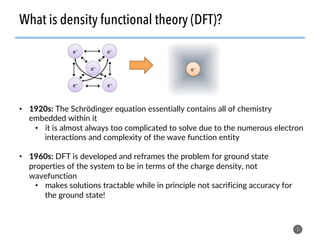
•  1920s: The Schrödinger equation essentially contains all of chemistry
embedded within it
•  it is almost always too complicated to solve due to the numerous electron
interactions and complexity of the wave function entity
•  1960s: DFT is developed and reframes the problem for ground state
properties of the system to be in terms of the charge density, not
wavefunction
•  makes solutions tractable while in principle not sacrificing accuracy for
the ground state!
e–	
e–	 e–	
e–	 e–	
e–
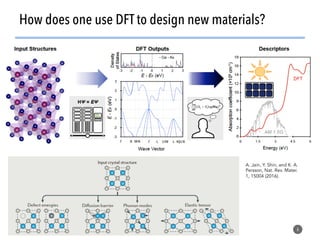
How does one use DFT to design new materials?
6
A. Jain, Y. Shin, and K. A.
Persson, Nat. Rev. Mater.
1, 15004 (2016).
How accurate is DFT in practice?
7
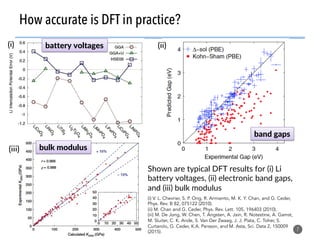
Shown are typical DFT results for (i) Li
battery voltages, (ii) electronic band gaps,
and (iii) bulk modulus
(i) (ii)
(iii)
(i) V. L. Chevrier, S. P. Ong, R. Armiento, M. K. Y. Chan, and G. Ceder,
Phys. Rev. B 82, 075122 (2010).
(ii) M. Chan and G. Ceder, Phys. Rev. Lett. 105, 196403 (2010).
(iii) M. De Jong, W. Chen, T. Angsten, A. Jain, R. Notestine, A. Gamst,
M. Sluiter, C. K. Ande, S. Van Der Zwaag, J. J. Plata, C. Toher, S.
Curtarolo, G. Ceder, K.A. Persson, and M. Asta, Sci. Data 2, 150009
(2015).
battery voltages
band gaps
bulk modulus
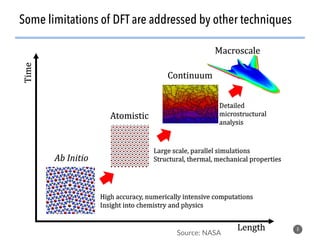
Some limitations of DFT are addressed by other techniques
8
Source: NASA
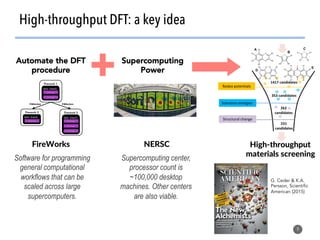
High-throughput DFT: a key idea
9
Automate the DFT
procedure
Supercomputing
Power
FireWorks
Software for programming
general computational
workflows that can be
scaled across large
supercomputers.
NERSC
Supercomputing center,
processor count is
~100,000 desktop
machines. Other centers
are also viable.
High-throughput
materials screening
G. Ceder & K.A.
Persson, Scientific
American (2015)
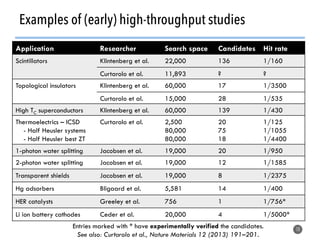
Examples of (early) high-throughput studies
10
Application Researcher Search space Candidates Hit rate
Scintillators Klintenberg et al. 22,000 136 1/160
Curtarolo et al. 11,893 ? ?
Topological insulators Klintenberg et al. 60,000 17 1/3500
Curtarolo et al. 15,000 28 1/535
High TC superconductors Klintenberg et al. 60,000 139 1/430
Thermoelectrics – ICSD
- Half Heusler systems
- Half Heusler best ZT
Curtarolo et al. 2,500
80,000
80,000
20
75
18
1/125
1/1055
1/4400
1-photon water splitting Jacobsen et al. 19,000 20 1/950
2-photon water splitting Jacobsen et al. 19,000 12 1/1585
Transparent shields Jacobsen et al. 19,000 8 1/2375
Hg adsorbers Bligaard et al. 5,581 14 1/400
HER catalysts Greeley et al. 756 1 1/756*
Li ion battery cathodes Ceder et al. 20,000 4 1/5000*
Entries marked with * have experimentally verified the candidates.
See also: Curtarolo et al., Nature Materials 12 (2013) 191–201.
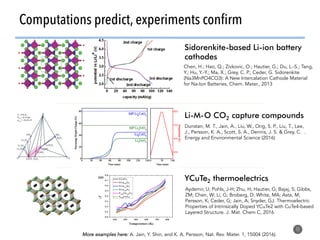
Computations predict, experiments confirm
11
Sidorenkite-based Li-ion battery
cathodes
YCuTe2 thermoelectrics
Chen, H.; Hao, Q.; Zivkovic, O.; Hautier, G.; Du, L.-S.; Tang,
Y.; Hu, Y.-Y.; Ma, X.; Grey, C. P.; Ceder, G. Sidorenkite
(Na3MnPO4CO3): A New Intercalation Cathode Material
for Na-Ion Batteries, Chem. Mater., 2013
Aydemir, U; Pohls, J-H; Zhu, H; Hautier, G; Bajaj, S; Gibbs,
ZM; Chen, W; Li, G; Broberg, D; White, MA; Asta, M;
Persson, K; Ceder, G; Jain, A; Snyder, GJ. Thermoelectric
Properties of Intrinsically Doped YCuTe2 with CuTe4-based
Layered Structure. J. Mat. Chem C, 2016
More examples here: A. Jain, Y. Shin, and K. A. Persson, Nat. Rev. Mater. 1, 15004 (2016).
Li-M-O CO2 capture compounds
Dunstan, M. T., Jain, A., Liu, W., Ong, S. P., Liu, T., Lee,
J., Persson, K. A., Scott, S. A., Dennis, J. S. & Grey, C. .
Energy and Environmental Science (2016)
Outline
12
①  Density functional theory and “high-throughput”
screening of materials
–  Intro to high-throughput density functional theory
–  Materials Project database
–  atomate
②  Data mining approaches to materials design
–  matminer
–  matbench
–  Text mining
③  Conclusion
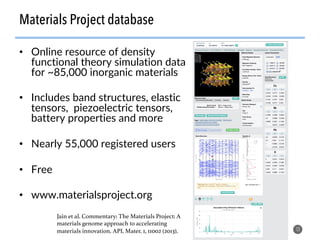
Materials Project database
•  Online resource of density
functional theory simulation data
for ~85,000 inorganic materials
•  Includes band structures, elastic
tensors, piezoelectric tensors,
battery properties and more
•  Nearly 55,000 registered users
•  Free
•  www.materialsproject.org
13
Jain et al. Commentary: The Materials Project: A
materials genome approach to accelerating
materials innovation. APL Mater. 1, 11002 (2013).!
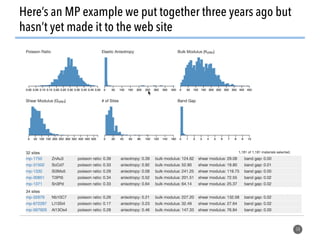
Here’s an MP example we put together three years ago but
hasn’t yet made it to the web site
14
Outline
15
①  Density functional theory and “high-throughput”
screening of materials
–  Intro to high-throughput density functional theory
–  Materials Project database
–  atomate
②  Data mining approaches to materials design
–  matminer
–  matbench
–  Text mining
③  Conclusion
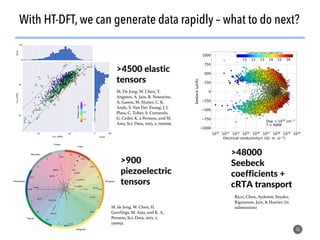
With HT-DFT, we can generate data rapidly – what to do next?
16
M. de Jong, W. Chen, H.
Geerlings, M. Asta, and K. A.
Persson, Sci. Data, 2015, 2,
150053.!
M. De Jong, W. Chen, T.
Angsten, A. Jain, R. Notestine,
A. Gamst, M. Sluiter, C. K.
Ande, S. Van Der Zwaag, J. J.
Plata, C. Toher, S. Curtarolo,
G. Ceder, K. a Persson, and M.
Asta, Sci. Data, 2015, 2, 150009.!
>4500 elastic
tensors
>900
piezoelectric
tensors
>48000
Seebeck
coefficients +
cRTA transport
Ricci, Chen, Aydemir, Snyder,
Rignanese, Jain, & Hautier (in
submission)!
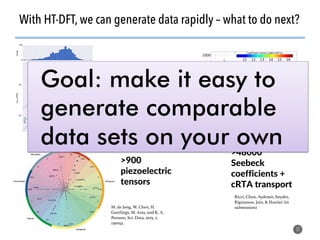
With HT-DFT, we can generate data rapidly – what to do next?
17
M. de Jong, W. Chen, H.
Geerlings, M. Asta, and K. A.
Persson, Sci. Data, 2015, 2,
150053.!
M. De Jong, W. Chen, T.
Angsten, A. Jain, R. Notestine,
A. Gamst, M. Sluiter, C. K.
Ande, S. Van Der Zwaag, J. J.
Plata, C. Toher, S. Curtarolo,
G. Ceder, K. a Persson, and M.
Asta, Sci. Data, 2015, 2, 150009.!
>4500 elastic
tensors
>900
piezoelectric
tensors
>48000
Seebeck
coefficients +
cRTA transport
Ricci, Chen, Aydemir, Snyder,
Rignanese, Jain, & Hautier (in
submission)!
Goal: make it easy to
generate comparable
data sets on your own
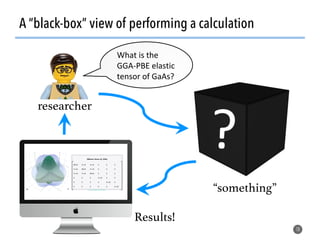
A “black-box” view of performing a calculation
18
“something”!
Results!!
researcher!
What	is	the	
GGA-PBE	elastic	
tensor	of	GaAs?
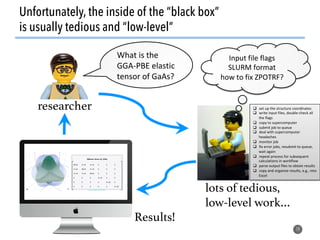
Unfortunately, the inside of the “black box”
is usually tedious and “low-level”
19
lots of tedious,
low-level work…!
Results!!
researcher!
What	is	the	
GGA-PBE	elastic	
tensor	of	GaAs?	
Input	file	flags	
SLURM	format	
how	to	fix	ZPOTRF?	
	
		
q  set	up	the	structure	coordinates	
q  write	input	files,	double-check	all	
the	flags	
q  copy	to	supercomputer	
q  submit	job	to	queue	
q  deal	with	supercomputer	
headaches	
q  monitor	job	
q  fix	error	jobs,	resubmit	to	queue,	
wait	again	
q  repeat	process	for	subsequent	
calculations	in	workflow	
q  parse	output	files	to	obtain	results	
q  copy	and	organize	results,	e.g.,	into	
Excel
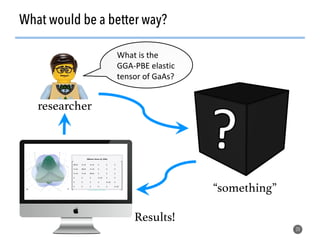
What would be a better way?
20
“something”!
Results!!
researcher!
What	is	the	
GGA-PBE	elastic	
tensor	of	GaAs?
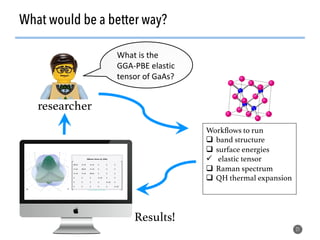
What would be a better way?
21
Results!!
researcher!
What	is	the	
GGA-PBE	elastic	
tensor	of	GaAs?	
Workflows to run!
q  band structure!
q  surface energies!
ü  elastic tensor!
q  Raman spectrum!
q  QH thermal expansion!
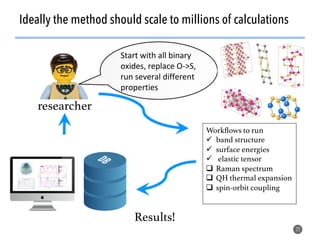
Ideally the method should scale to millions of calculations
22
Results!!
researcher!
Start	with	all	binary	
oxides,	replace	O->S,	
run	several	different	
properties	
Workflows to run!
ü  band structure!
ü  surface energies!
ü  elastic tensor!
q  Raman spectrum!
q  QH thermal expansion!
q  spin-orbit coupling!
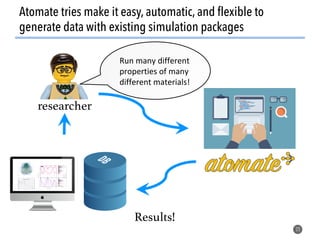
Atomate tries make it easy, automatic, and flexible to
generate data with existing simulation packages
23
Results!!
researcher!
Run	many	different	
properties	of	many	
different	materials!
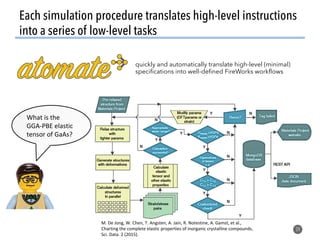
Each simulation procedure translates high-level instructions
into a series of low-level tasks
24
quickly and automatically translate high-level (minimal)
specifications into well-defined FireWorks workflows
What	is	the	
GGA-PBE	elastic	
tensor	of	GaAs?	
M.	De	Jong,	W.	Chen,	T.	Angsten,	A.	Jain,	R.	Notestine,	A.	Gamst,	et	al.,	
Charting	the	complete	elastic	properties	of	inorganic	crystalline	compounds,	
Sci.	Data.	2	(2015).
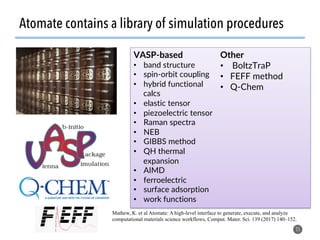
Atomate contains a library of simulation procedures
25
VASP-based
•  band structure
•  spin-orbit coupling
•  hybrid functional
calcs
•  elastic tensor
•  piezoelectric tensor
•  Raman spectra
•  NEB
•  GIBBS method
•  QH thermal
expansion
•  AIMD
•  ferroelectric
•  surface adsorption
•  work functions
Other
•  BoltzTraP
•  FEFF method
•  Q-Chem
Mathew, K. et al Atomate: A high-level interface to generate, execute, and analyze
computational materials science workflows, Comput. Mater. Sci. 139 (2017) 140–152.
26
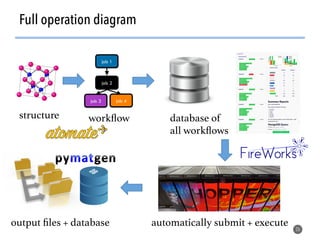
Full operation diagram
job 1
job 2
job 3 job 4
structure! workflow! database of
all workflows!
automatically submit + execute!output files + database!
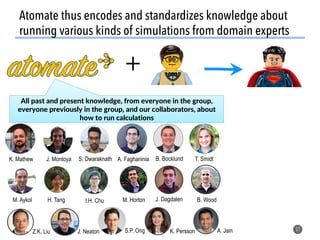
Atomate thus encodes and standardizes knowledge about
running various kinds of simulations from domain experts
27
K. Mathew J. Montoya S. Dwaraknath A. Faghaninia
All past and present knowledge, from everyone in the group,
everyone previously in the group, and our collaborators, about
how to run calculations
M. Aykol
S.P. Ong
B. Bocklund T. Smidt
H. Tang I.H. Chu M. Horton J. Dagdalen B. Wood
Z.K. Liu J. Neaton K. Persson A. Jain
+
Outline
28
①  Density functional theory and “high-throughput”
screening of materials
–  Intro to high-throughput density functional theory
–  Materials Project database
–  atomate
②  Data mining approaches to materials design
–  matminer
–  matbench
–  Text mining
③  Conclusion
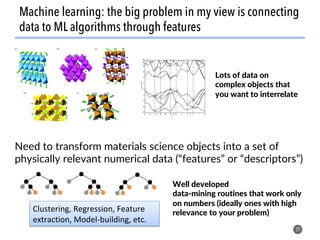
Machine learning: the big problem in my view is connecting
data to ML algorithms through features
29
Lots of data on
complex objects that
you want to interrelate
Clustering,	Regression,	Feature	
extraction,	Model-building,	etc.	
Well developed
data-mining routines that work only
on numbers (ideally ones with high
relevance to your problem)
Need to transform materials science objects into a set of
physically relevant numerical data (“features” or “descriptors”)
30
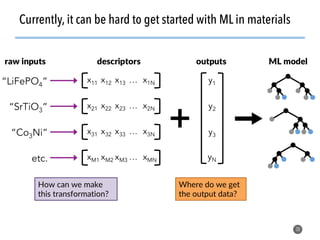
Currently, it can be hard to get started with ML in materials
How can we make
this transformation?
Where do we get
the output data?
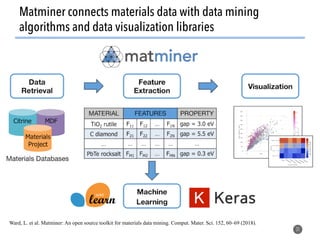
Matminer connects materials data with data mining
algorithms and data visualization libraries
31
Ward, L. et al. Matminer: An open source toolkit for materials data mining. Comput. Mater. Sci. 152, 60–69 (2018).
>40 featurizer classes can
generate thousands of potential
descriptors that are described in
the literature
32
Matminer contains a library of descriptors for various
materials science entities
feat	=	EwaldEnergy([options])	
y	=	feat.featurize([input_data])	
•  compatible with scikit-
learn pipelining
•  automatically deploy
multiprocessing to
parallelize over data
•  include citations to
methodology papers
33
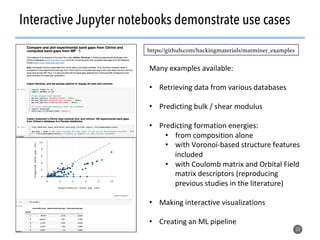
Interactive Jupyter notebooks demonstrate use cases
https://github.com/hackingmaterials/matminer_examples!
Many	examples	available:		
	
•  Retrieving	data	from	various	databases	
	
•  Predicting	bulk	/	shear	modulus	
•  Predicting	formation	energies:	
•  from	composition	alone	
•  with	Voronoi-based	structure	features	
included	
•  with	Coulomb	matrix	and	Orbital	Field	
matrix	descriptors	(reproducing	
previous	studies	in	the	literature)	
•  Making	interactive	visualizations	
	
•  Creating	an	ML	pipeline
Outline
34
①  Density functional theory and “high-throughput”
screening of materials
–  Intro to high-throughput density functional theory
–  Materials Project database
–  atomate
②  Data mining approaches to materials design
–  matminer
–  matbench
–  Text mining
③  Conclusion
35
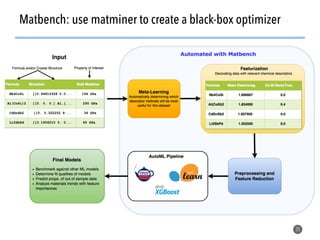
Matbench: use matminer to create a black-box optimizer
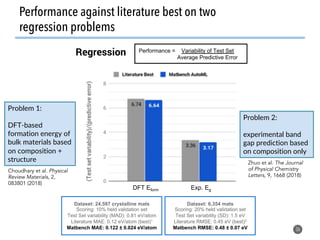
Dataset: 24,597 crystalline mats
Scoring: 10% held validation set
Test Set variability (MAD): 0.81 eV/atom
Literature MAE: 0.12 eV/atom (best)1
Matbench MAE: 0.122 ± 0.024 eV/atom
DFT Eform Exp. Eg
Dataset: 6,354 mats
Scoring: 20% held validation set
Test Set variability (SD): 1.5 eV
Literature RMSE: 0.45 eV (best)2
Matbench RMSE: 0.48 ± 0.07 eV
Regression Performance = Variability of Test Set
Average Predictive Error
36
Performance against literature best on two
regression problems
Problem 1:
DFT-based
formation energy of
bulk materials based
on composition +
structure
Problem 2:
experimental band
gap prediction based
on composition only
Choudhary et al. Physical
Review Materials, 2,
083801 (2018)
Zhuo et al. The Journal
of Physical Chemistry
Letters, 9, 1668 (2018)
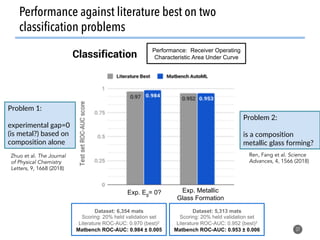
Classification
Dataset: 6,354 mats
Scoring: 20% held validation set
Literature ROC-AUC: 0.970 (best)2
Matbench ROC-AUC: 0.984 ± 0.005
Dataset: 5,313 mats
Scoring: 20% held validation set
Literature ROC-AUC: 0.952 (best)3
Matbench ROC-AUC: 0.953 ± 0.006
Exp. Metallic
Glass Formation
Exp. Eg= 0?
Performance: Receiver Operating
Characteristic Area Under Curve
37
Performance against literature best on two
classification problems
Problem 1:
experimental gap=0
(is metal?) based on
composition alone
Problem 2:
is a composition
metallic glass forming?
Ren, Fang et al. Science
Advances, 4, 1566 (2018)
Zhuo et al. The Journal
of Physical Chemistry
Letters, 9, 1668 (2018)
Outline
38
①  Density functional theory and “high-throughput”
screening of materials
–  Intro to high-throughput density functional theory
–  Materials Project database
–  atomate
②  Data mining approaches to materials design
–  matminer
–  matbench
–  Text mining
③  Conclusion
39
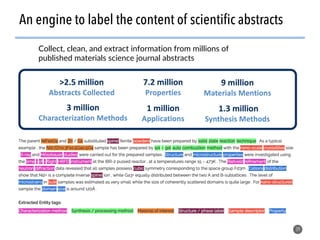
An engine to label the content of scientific abstracts
Collect, clean, and extract information from millions of
published materials science journal abstracts
40
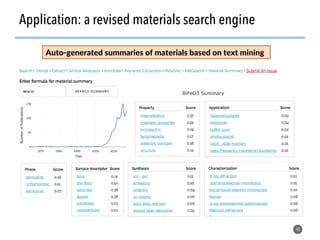
Application: a revised materials search engine
Auto-generated summaries of materials based on text mining
41
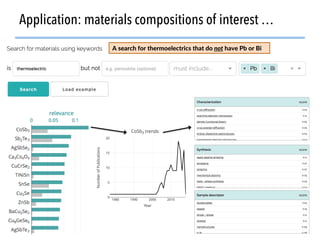
Application: materials compositions of interest …
A search for thermoelectrics that do not have Pb or Bi
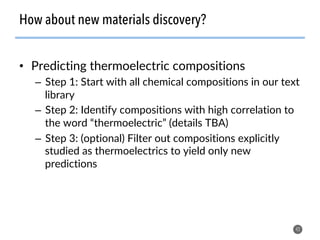
•  Predicting thermoelectric compositions
–  Step 1: Start with all chemical compositions in our text
library
–  Step 2: Identify compositions with high correlation to
the word “thermoelectric” (details TBA)
–  Step 3: (optional) Filter out compositions explicitly
studied as thermoelectrics to yield only new
predictions
42
How about new materials discovery?
43
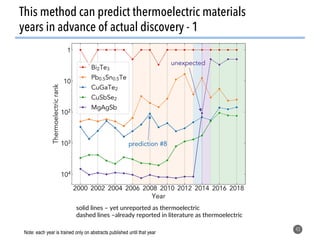
This method can predict thermoelectric materials
years in advance of actual discovery - 1
solid lines – yet unreported as thermoelectric
dashed lines –already reported in literature as thermoelectric
Note: each year is trained only on abstracts published until that year
44
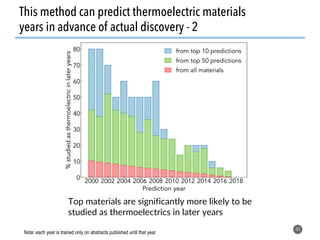
This method can predict thermoelectric materials
years in advance of actual discovery - 2
Top materials are significantly more likely to be
studied as thermoelectrics in later years
Note: each year is trained only on abstracts published until that year
45
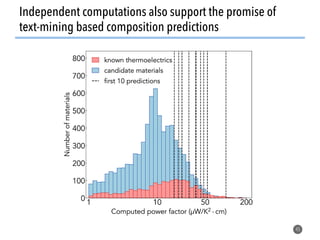
Independent computations also support the promise of
text-mining based composition predictions
46
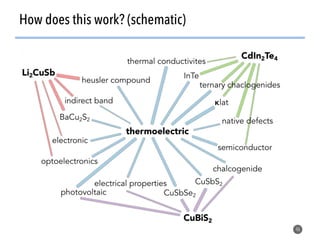
How does this work? (schematic)
Outline
47
①  Density functional theory and “high-throughput”
screening of materials
–  Intro to high-throughput density functional theory
–  Materials Project database
–  atomate
②  Data mining approaches to materials design
–  matminer
–  matbench
–  Text mining
③  Conclusion
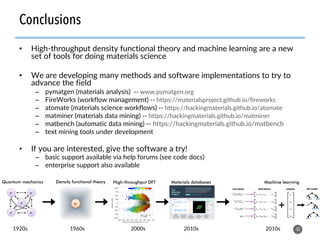
•  High-throughput density functional theory and machine learning are a new
set of tools for doing materials science
•  We are developing many methods and software implementations to try to
advance the field
–  pymatgen (materials analysis) -- www.pymatgen.org
–  FireWorks (workflow management) -- https://materialsproject.github.io/fireworks
–  atomate (materials science workflows) -- https://hackingmaterials.github.io/atomate
–  matminer (materials data mining) -- https://hackingmaterials.github.io/matminer
–  matbench (automatic data mining) -- https://hackingmaterials.github.io/matbench
–  text mining tools under development
•  If you are interested, give the software a try!
–  basic support available via help forums (see code docs)
–  enterprise support also available
48
Conclusions
Quantum mechanics Density functional theory High-throughput DFT
e–	e–	
e–	 e–	
e–	 e–	
Materials databases Machine learning
1920s 1960s 2000s 2010s 2010s
•  Materials Project
–  K. Persson (director)
•  Atomate
–  K. Mathew
•  Matminer
–  L. Ward
•  Matbench
–  A. Dunn
•  Text mining
–  V. Tshitoyan, J. Dagdelen, L. Weston
•  Funding:
–  DOE-BES (MP)
–  DOE-BES (ECRP)
–  Toyota Research Institute
•  Computing: NERSC
49
Thank you!
Slides (already) posted to hackingmaterials.lbl.gov

Computational materials design with high-throughput and machine learning methods

  • 1.
    Computational materials designwith high- throughput and machine learning methods Anubhav Jain Energy Technologies Area Lawrence Berkeley National Laboratory Berkeley, CA Presentation at Apple, Sept 21 2018 Slides (already) posted to hackingmaterials.lbl.gov
  • 2.
    New materials discoveryfor devices is difficult •  Novel materials with enhanced performance characteristics could make a big dent in sustainability, scalability, and cost •  In practice, we tend to re-use the same fundamental materials for decades –  solar power w/Si since 1950s –  graphite/LiCoO2 (basis of today’s Li battery electrodes) since 1990 –  Bi2Te3 and PbTe thermoelectrics first studied ~1910 •  Although there are lots of improvements to manufacturing, microstructure, etc., there not many new basic compositions •  Why is discovering better materials such a challenge? 2
  • 3.
    What constrains traditionalexperimentation? 3 “[The Chevrel] discovery resulted from a lot of unsuccessful experiments of Mg ions insertion into well-known hosts for Li+ ions insertion, as well as from the thorough literature analysis concerning the possibility of divalent ions intercalation into inorganic materials.” -Aurbach group, on discovery of Chevrel cathode for multivalent (e.g., Mg2+) batteries Levi, Levi, Chasid, Aurbach J. Electroceramics (2009)
  • 4.
    Outline 4 ①  Density functionaltheory and “high-throughput” screening of materials –  Intro to high-throughput density functional theory –  Materials Project database –  atomate ②  Data mining approaches to materials design –  matminer –  matbench –  Text mining ③  Conclusion
  • 5.
    What is densityfunctional theory (DFT)? 5 •  1920s: The Schrödinger equation essentially contains all of chemistry embedded within it •  it is almost always too complicated to solve due to the numerous electron interactions and complexity of the wave function entity •  1960s: DFT is developed and reframes the problem for ground state properties of the system to be in terms of the charge density, not wavefunction •  makes solutions tractable while in principle not sacrificing accuracy for the ground state! e– e– e– e– e– e–
  • 6.
    How does oneuse DFT to design new materials? 6 A. Jain, Y. Shin, and K. A. Persson, Nat. Rev. Mater. 1, 15004 (2016).
  • 7.
    How accurate isDFT in practice? 7 Shown are typical DFT results for (i) Li battery voltages, (ii) electronic band gaps, and (iii) bulk modulus (i) (ii) (iii) (i) V. L. Chevrier, S. P. Ong, R. Armiento, M. K. Y. Chan, and G. Ceder, Phys. Rev. B 82, 075122 (2010). (ii) M. Chan and G. Ceder, Phys. Rev. Lett. 105, 196403 (2010). (iii) M. De Jong, W. Chen, T. Angsten, A. Jain, R. Notestine, A. Gamst, M. Sluiter, C. K. Ande, S. Van Der Zwaag, J. J. Plata, C. Toher, S. Curtarolo, G. Ceder, K.A. Persson, and M. Asta, Sci. Data 2, 150009 (2015). battery voltages band gaps bulk modulus
  • 8.
    Some limitations ofDFT are addressed by other techniques 8 Source: NASA
  • 9.
    High-throughput DFT: akey idea 9 Automate the DFT procedure Supercomputing Power FireWorks Software for programming general computational workflows that can be scaled across large supercomputers. NERSC Supercomputing center, processor count is ~100,000 desktop machines. Other centers are also viable. High-throughput materials screening G. Ceder & K.A. Persson, Scientific American (2015)
  • 10.
    Examples of (early)high-throughput studies 10 Application Researcher Search space Candidates Hit rate Scintillators Klintenberg et al. 22,000 136 1/160 Curtarolo et al. 11,893 ? ? Topological insulators Klintenberg et al. 60,000 17 1/3500 Curtarolo et al. 15,000 28 1/535 High TC superconductors Klintenberg et al. 60,000 139 1/430 Thermoelectrics – ICSD - Half Heusler systems - Half Heusler best ZT Curtarolo et al. 2,500 80,000 80,000 20 75 18 1/125 1/1055 1/4400 1-photon water splitting Jacobsen et al. 19,000 20 1/950 2-photon water splitting Jacobsen et al. 19,000 12 1/1585 Transparent shields Jacobsen et al. 19,000 8 1/2375 Hg adsorbers Bligaard et al. 5,581 14 1/400 HER catalysts Greeley et al. 756 1 1/756* Li ion battery cathodes Ceder et al. 20,000 4 1/5000* Entries marked with * have experimentally verified the candidates. See also: Curtarolo et al., Nature Materials 12 (2013) 191–201.
  • 11.
    Computations predict, experimentsconfirm 11 Sidorenkite-based Li-ion battery cathodes YCuTe2 thermoelectrics Chen, H.; Hao, Q.; Zivkovic, O.; Hautier, G.; Du, L.-S.; Tang, Y.; Hu, Y.-Y.; Ma, X.; Grey, C. P.; Ceder, G. Sidorenkite (Na3MnPO4CO3): A New Intercalation Cathode Material for Na-Ion Batteries, Chem. Mater., 2013 Aydemir, U; Pohls, J-H; Zhu, H; Hautier, G; Bajaj, S; Gibbs, ZM; Chen, W; Li, G; Broberg, D; White, MA; Asta, M; Persson, K; Ceder, G; Jain, A; Snyder, GJ. Thermoelectric Properties of Intrinsically Doped YCuTe2 with CuTe4-based Layered Structure. J. Mat. Chem C, 2016 More examples here: A. Jain, Y. Shin, and K. A. Persson, Nat. Rev. Mater. 1, 15004 (2016). Li-M-O CO2 capture compounds Dunstan, M. T., Jain, A., Liu, W., Ong, S. P., Liu, T., Lee, J., Persson, K. A., Scott, S. A., Dennis, J. S. & Grey, C. . Energy and Environmental Science (2016)
  • 12.
    Outline 12 ①  Density functionaltheory and “high-throughput” screening of materials –  Intro to high-throughput density functional theory –  Materials Project database –  atomate ②  Data mining approaches to materials design –  matminer –  matbench –  Text mining ③  Conclusion
  • 13.
    Materials Project database • Online resource of density functional theory simulation data for ~85,000 inorganic materials •  Includes band structures, elastic tensors, piezoelectric tensors, battery properties and more •  Nearly 55,000 registered users •  Free •  www.materialsproject.org 13 Jain et al. Commentary: The Materials Project: A materials genome approach to accelerating materials innovation. APL Mater. 1, 11002 (2013).!
  • 14.
    Here’s an MPexample we put together three years ago but hasn’t yet made it to the web site 14
  • 15.
    Outline 15 ①  Density functionaltheory and “high-throughput” screening of materials –  Intro to high-throughput density functional theory –  Materials Project database –  atomate ②  Data mining approaches to materials design –  matminer –  matbench –  Text mining ③  Conclusion
  • 16.
    With HT-DFT, wecan generate data rapidly – what to do next? 16 M. de Jong, W. Chen, H. Geerlings, M. Asta, and K. A. Persson, Sci. Data, 2015, 2, 150053.! M. De Jong, W. Chen, T. Angsten, A. Jain, R. Notestine, A. Gamst, M. Sluiter, C. K. Ande, S. Van Der Zwaag, J. J. Plata, C. Toher, S. Curtarolo, G. Ceder, K. a Persson, and M. Asta, Sci. Data, 2015, 2, 150009.! >4500 elastic tensors >900 piezoelectric tensors >48000 Seebeck coefficients + cRTA transport Ricci, Chen, Aydemir, Snyder, Rignanese, Jain, & Hautier (in submission)!
  • 17.
    With HT-DFT, wecan generate data rapidly – what to do next? 17 M. de Jong, W. Chen, H. Geerlings, M. Asta, and K. A. Persson, Sci. Data, 2015, 2, 150053.! M. De Jong, W. Chen, T. Angsten, A. Jain, R. Notestine, A. Gamst, M. Sluiter, C. K. Ande, S. Van Der Zwaag, J. J. Plata, C. Toher, S. Curtarolo, G. Ceder, K. a Persson, and M. Asta, Sci. Data, 2015, 2, 150009.! >4500 elastic tensors >900 piezoelectric tensors >48000 Seebeck coefficients + cRTA transport Ricci, Chen, Aydemir, Snyder, Rignanese, Jain, & Hautier (in submission)! Goal: make it easy to generate comparable data sets on your own
  • 18.
    A “black-box” viewof performing a calculation 18 “something”! Results!! researcher! What is the GGA-PBE elastic tensor of GaAs?
  • 19.
    Unfortunately, the insideof the “black box” is usually tedious and “low-level” 19 lots of tedious, low-level work…! Results!! researcher! What is the GGA-PBE elastic tensor of GaAs? Input file flags SLURM format how to fix ZPOTRF? q  set up the structure coordinates q  write input files, double-check all the flags q  copy to supercomputer q  submit job to queue q  deal with supercomputer headaches q  monitor job q  fix error jobs, resubmit to queue, wait again q  repeat process for subsequent calculations in workflow q  parse output files to obtain results q  copy and organize results, e.g., into Excel
  • 20.
    What would bea better way? 20 “something”! Results!! researcher! What is the GGA-PBE elastic tensor of GaAs?
  • 21.
    What would bea better way? 21 Results!! researcher! What is the GGA-PBE elastic tensor of GaAs? Workflows to run! q  band structure! q  surface energies! ü  elastic tensor! q  Raman spectrum! q  QH thermal expansion!
  • 22.
    Ideally the methodshould scale to millions of calculations 22 Results!! researcher! Start with all binary oxides, replace O->S, run several different properties Workflows to run! ü  band structure! ü  surface energies! ü  elastic tensor! q  Raman spectrum! q  QH thermal expansion! q  spin-orbit coupling!
  • 23.
    Atomate tries makeit easy, automatic, and flexible to generate data with existing simulation packages 23 Results!! researcher! Run many different properties of many different materials!
  • 24.
    Each simulation proceduretranslates high-level instructions into a series of low-level tasks 24 quickly and automatically translate high-level (minimal) specifications into well-defined FireWorks workflows What is the GGA-PBE elastic tensor of GaAs? M. De Jong, W. Chen, T. Angsten, A. Jain, R. Notestine, A. Gamst, et al., Charting the complete elastic properties of inorganic crystalline compounds, Sci. Data. 2 (2015).
  • 25.
    Atomate contains alibrary of simulation procedures 25 VASP-based •  band structure •  spin-orbit coupling •  hybrid functional calcs •  elastic tensor •  piezoelectric tensor •  Raman spectra •  NEB •  GIBBS method •  QH thermal expansion •  AIMD •  ferroelectric •  surface adsorption •  work functions Other •  BoltzTraP •  FEFF method •  Q-Chem Mathew, K. et al Atomate: A high-level interface to generate, execute, and analyze computational materials science workflows, Comput. Mater. Sci. 139 (2017) 140–152.
  • 26.
    26 Full operation diagram job1 job 2 job 3 job 4 structure! workflow! database of all workflows! automatically submit + execute!output files + database!
  • 27.
    Atomate thus encodesand standardizes knowledge about running various kinds of simulations from domain experts 27 K. Mathew J. Montoya S. Dwaraknath A. Faghaninia All past and present knowledge, from everyone in the group, everyone previously in the group, and our collaborators, about how to run calculations M. Aykol S.P. Ong B. Bocklund T. Smidt H. Tang I.H. Chu M. Horton J. Dagdalen B. Wood Z.K. Liu J. Neaton K. Persson A. Jain +
  • 28.
    Outline 28 ①  Density functionaltheory and “high-throughput” screening of materials –  Intro to high-throughput density functional theory –  Materials Project database –  atomate ②  Data mining approaches to materials design –  matminer –  matbench –  Text mining ③  Conclusion
  • 29.
    Machine learning: thebig problem in my view is connecting data to ML algorithms through features 29 Lots of data on complex objects that you want to interrelate Clustering, Regression, Feature extraction, Model-building, etc. Well developed data-mining routines that work only on numbers (ideally ones with high relevance to your problem) Need to transform materials science objects into a set of physically relevant numerical data (“features” or “descriptors”)
  • 30.
    30 Currently, it canbe hard to get started with ML in materials How can we make this transformation? Where do we get the output data?
  • 31.
    Matminer connects materialsdata with data mining algorithms and data visualization libraries 31 Ward, L. et al. Matminer: An open source toolkit for materials data mining. Comput. Mater. Sci. 152, 60–69 (2018).
  • 32.
    >40 featurizer classescan generate thousands of potential descriptors that are described in the literature 32 Matminer contains a library of descriptors for various materials science entities feat = EwaldEnergy([options]) y = feat.featurize([input_data]) •  compatible with scikit- learn pipelining •  automatically deploy multiprocessing to parallelize over data •  include citations to methodology papers
  • 33.
    33 Interactive Jupyter notebooksdemonstrate use cases https://github.com/hackingmaterials/matminer_examples! Many examples available: •  Retrieving data from various databases •  Predicting bulk / shear modulus •  Predicting formation energies: •  from composition alone •  with Voronoi-based structure features included •  with Coulomb matrix and Orbital Field matrix descriptors (reproducing previous studies in the literature) •  Making interactive visualizations •  Creating an ML pipeline
  • 34.
    Outline 34 ①  Density functionaltheory and “high-throughput” screening of materials –  Intro to high-throughput density functional theory –  Materials Project database –  atomate ②  Data mining approaches to materials design –  matminer –  matbench –  Text mining ③  Conclusion
  • 35.
    35 Matbench: use matminerto create a black-box optimizer
  • 36.
    Dataset: 24,597 crystallinemats Scoring: 10% held validation set Test Set variability (MAD): 0.81 eV/atom Literature MAE: 0.12 eV/atom (best)1 Matbench MAE: 0.122 ± 0.024 eV/atom DFT Eform Exp. Eg Dataset: 6,354 mats Scoring: 20% held validation set Test Set variability (SD): 1.5 eV Literature RMSE: 0.45 eV (best)2 Matbench RMSE: 0.48 ± 0.07 eV Regression Performance = Variability of Test Set Average Predictive Error 36 Performance against literature best on two regression problems Problem 1: DFT-based formation energy of bulk materials based on composition + structure Problem 2: experimental band gap prediction based on composition only Choudhary et al. Physical Review Materials, 2, 083801 (2018) Zhuo et al. The Journal of Physical Chemistry Letters, 9, 1668 (2018)
  • 37.
    Classification Dataset: 6,354 mats Scoring:20% held validation set Literature ROC-AUC: 0.970 (best)2 Matbench ROC-AUC: 0.984 ± 0.005 Dataset: 5,313 mats Scoring: 20% held validation set Literature ROC-AUC: 0.952 (best)3 Matbench ROC-AUC: 0.953 ± 0.006 Exp. Metallic Glass Formation Exp. Eg= 0? Performance: Receiver Operating Characteristic Area Under Curve 37 Performance against literature best on two classification problems Problem 1: experimental gap=0 (is metal?) based on composition alone Problem 2: is a composition metallic glass forming? Ren, Fang et al. Science Advances, 4, 1566 (2018) Zhuo et al. The Journal of Physical Chemistry Letters, 9, 1668 (2018)
  • 38.
    Outline 38 ①  Density functionaltheory and “high-throughput” screening of materials –  Intro to high-throughput density functional theory –  Materials Project database –  atomate ②  Data mining approaches to materials design –  matminer –  matbench –  Text mining ③  Conclusion
  • 39.
    39 An engine tolabel the content of scientific abstracts Collect, clean, and extract information from millions of published materials science journal abstracts
  • 40.
    40 Application: a revisedmaterials search engine Auto-generated summaries of materials based on text mining
  • 41.
    41 Application: materials compositionsof interest … A search for thermoelectrics that do not have Pb or Bi
  • 42.
    •  Predicting thermoelectriccompositions –  Step 1: Start with all chemical compositions in our text library –  Step 2: Identify compositions with high correlation to the word “thermoelectric” (details TBA) –  Step 3: (optional) Filter out compositions explicitly studied as thermoelectrics to yield only new predictions 42 How about new materials discovery?
  • 43.
    43 This method canpredict thermoelectric materials years in advance of actual discovery - 1 solid lines – yet unreported as thermoelectric dashed lines –already reported in literature as thermoelectric Note: each year is trained only on abstracts published until that year
  • 44.
    44 This method canpredict thermoelectric materials years in advance of actual discovery - 2 Top materials are significantly more likely to be studied as thermoelectrics in later years Note: each year is trained only on abstracts published until that year
  • 45.
    45 Independent computations alsosupport the promise of text-mining based composition predictions
  • 46.
    46 How does thiswork? (schematic)
  • 47.
    Outline 47 ①  Density functionaltheory and “high-throughput” screening of materials –  Intro to high-throughput density functional theory –  Materials Project database –  atomate ②  Data mining approaches to materials design –  matminer –  matbench –  Text mining ③  Conclusion
  • 48.
    •  High-throughput densityfunctional theory and machine learning are a new set of tools for doing materials science •  We are developing many methods and software implementations to try to advance the field –  pymatgen (materials analysis) -- www.pymatgen.org –  FireWorks (workflow management) -- https://materialsproject.github.io/fireworks –  atomate (materials science workflows) -- https://hackingmaterials.github.io/atomate –  matminer (materials data mining) -- https://hackingmaterials.github.io/matminer –  matbench (automatic data mining) -- https://hackingmaterials.github.io/matbench –  text mining tools under development •  If you are interested, give the software a try! –  basic support available via help forums (see code docs) –  enterprise support also available 48 Conclusions Quantum mechanics Density functional theory High-throughput DFT e– e– e– e– e– e– Materials databases Machine learning 1920s 1960s 2000s 2010s 2010s
  • 49.
    •  Materials Project – K. Persson (director) •  Atomate –  K. Mathew •  Matminer –  L. Ward •  Matbench –  A. Dunn •  Text mining –  V. Tshitoyan, J. Dagdelen, L. Weston •  Funding: –  DOE-BES (MP) –  DOE-BES (ECRP) –  Toyota Research Institute •  Computing: NERSC 49 Thank you! Slides (already) posted to hackingmaterials.lbl.gov