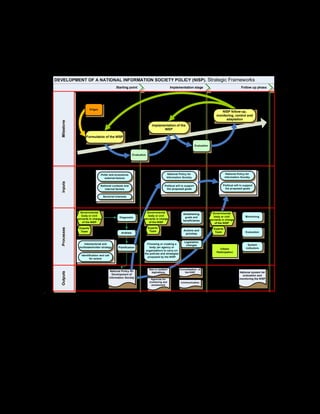
NATIONAL INFORMATION SOCIETY POLICY:
A TEMPLATE
DEVELOPED BY THE INFORMATION FOR ALL PROGRAMME OF UNESCO
TO ASSIST UNESCO MEMBER STATES IN THE DEVELOPMENT OF
NATIONAL INFORMATION POLICY AND STRATEGY FRAMEWORKS
PARIS, November 2009
2
Coordinator: Susana Finquelievich
Researchers: Adrian Rozengardt, Alejandra Davidziuk, Daniel Finquelievich
Management and Development Foundation: Gestion y Desarrollo – LINKS
Buenos Aires, Argentina
With a Foreword and additional content by Dr Karol Jakubowicz
3
TABLE OF CONTENTS
FOREWORD by Dr Karol Jakubowicz, Chair, Intergovernmental Council of the
Information for All Programme, UNESCO……………………………………………………….5
EXECUTIVE SUMMARY………………………………………………………………………...11
INTRODUCTION………………………………………………………………………………….17
NATIONAL INFORMATION SOCIETY POLICY: A TEMPLATE………………………….....17
NISPS: A SIGNIFICANT SYMBOL FOR THE BEGINNIG OF THE NEW MILLENIUM…..18
ESSENTIAL GUIDELINES………………………………………………………………………19
WHAT IS AN INFORMATION SOCIETY?..........................................................................20
NATIONAL INFORMATION SOCIETY POLICY: A STEP TOWARDS KNOWLEDGE
SOCIETIES………………………………………………………………………………………..22
THE INTERNATIONAL CONTEXT……………………………………………………………..23
INFORMATION SOCIETY POLICIES IN DEVELOPING COUNTRIES……………………26
Characteristics of Developing Countries……………………………………………………….26
Preparing Citizens for the Information Society in Developing Countries…………………...29
MODULE I: INFORMATION POLICIES PLANNING AND IMPLEMENTATION
FEATURES
1.1. THE ADDED VALUE OF PUBLIC POLICIES IN INFORMATION / KNOWLEDGE
SOCIETIES………………………………………………………………………………………..32
1.1.1. WHY DO COUNTRIES NEED EXPLICIT NISPs?....................................................35
1.1.2. SCOPES AND THEMATIC SECTORS OF A NISP…………………………………...37
1.2. FIRST CONSIDERATIONS WHEN PLANNING A NISP………………………………41
1.2.1. PHASES OF A NISP………………………………………………………………………41
1.2.2. WHAT’S IN A NISP?.................................................................................................41
1.2.3. ROLE OF THE GOVERNMENT…………………………………………………………50
1.2.4. THE MULTISTAKEHOLDER APPROACH……………………………………………..56
1.2.5. THE IMPORTANCE OF ACCURATE DIAGNOSIS……………………………………58
1.2.6. DIAGNOSING E-READINESS…………………………………………………………...58
1.2.7. STAFF………………………………………………………………………………………59
MODULE II: TEMPLATE FOR THE ELABORATION OF NATIONAL INFORMATION
SOCIETY POLICIES (NISP)
2.1. TEMPLATE INTRODUCTION……………………………………………………………..61
2.2. KEY FACTORS……………………………………………………………………………...62
2.2.1. NO COUNTRY STARTS AT “GROUND ZERO”……………………………………….62
2.2.2. EACH COUNTRY HAS ITS OWN ENTRY POINT…………………………………….62
2.2.3. BE AWARE OF YOUR OWN CIRCUMSTANCES…………………………………….62
2.2.4. CONSIDER THE ROLE OF THE GOVERNMENT…………………………………….62
2.2.5. INTERSECTORIALITY: A KEY ELEMENT OF THE STRATEGY…………………...63
2.3. STRATEGIC FRAMEWORK……………………………………………………………….65
2.3.1. MILESTONES……………………………………………………………………………...65
2.4. STARTING POINT: FORMULATION OF A NATIONAL POLICY FOR THE
INFORMATION SOCIETY……………………………………………………………………….69
2.4.1. INTRODUCTION TO THE STARTING POINT…………………………………………69
2.4.2. INPUTS OR FACTORS THAT INFLUENCE FORMULATION OF A NISP ………...70
4
a. Political and economic external factors……………………………………………………70
b. National contexts and internal factors……………………………………………………..71
c. Sectoral interests…………………………………………………………………………….71
2.4.3. MAIN PROCESSES OF THIS PHASE………………………………………………….73
a. Creation of an Expert Team………………………………………………………………..76
b. Identification and Invitation of Participants………………………………………………..80
c. Diagnosis……………………………………………………………………………………..81
d. Analysis of obstacles and accelerating factors……..……………………………………..86
e. Planning the Implementation Phase…………………..……………………………………89
2.4.4. OUTCOMES……………………………………………………………………………….94
a. Writing the NISP Action Plan…………..……………………………………………………95
2.5. IMPLEMENTATION PHASE……………………………………………………………….96
2.5.1. INPUTS FOR THE IMPLEMENTATION PHASE………………………………………97
2.5.2. IMPLEMENTATION PHASE OUTCOMES……………………………………………105
2.6. FOLLOW UP PHASE……………………………………………………………………..106
2.6.1. MONITORING……………………………………………………………………………108
2.6.2. EVALUATION…………………………………………………………………………….108
2.6.3. THE USE OF INDICATORS…………………………………………………………….110
2.7. PERMANENT EVALUATION: A KEY ELEMENT IN THE WHOLE PROCESS……111
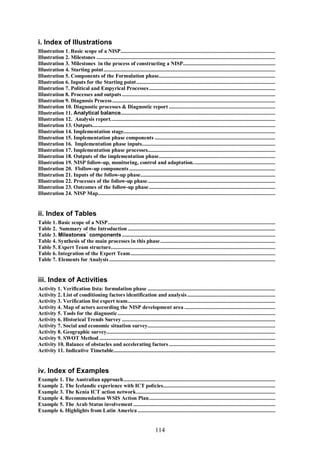
I. INDEX OF ILLUSTRATIONS………………………………………………………………114
II. INDEX OF TABLES…………………………………………………………………………114
III. INDEX OF ACTIVITIES……………………………………………………………………..114
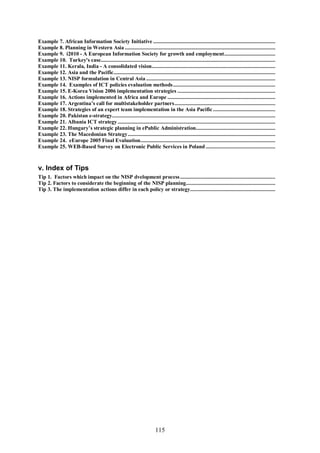
IV. INDEX OF EXAMPLES…………………………………………………………………….114
V. INDEX OF TIPS……………………………………………………………………………..115
MODULE III
GLOSSARY……………………………………………………………………………………...116
REFERENCES…………………………………………………………………………………..133
DOCUMENTS, PAPERS & BOOKS………………………………………………………….133
ANNEX 1: ACRONYMS………………………………………………………………………..141
5
FOREWORD
The Information for All Programme of UNESCO is proud to present NATIONAL
INFORMATION SOCIETY POLICY: A TEMPLATE.
The Information for All Programme (IFAP) was established by UNESCO to provide a
framework for international co-operation and partnerships in “building an information
society for all”. IFAP’s focus is on ensuring that all people have access to information
they can use to enhance their lives.
UNESCO General Conference resolution 34 C/Res.48 for Major Programme V, contained
in the Approved Programme and Budget 2008–2009 (34 C/5), authorizes the Director
General to “assist in the formulation of national information policy frameworks, in particular
within the framework of the Information for All Programme (IFAP)”. The need for such
policy frameworks is highlighted repeatedly in the WSIS outcome documents: the Geneva
Declaration of Principles (para. 43 and 62); the Geneva Plan of Action (para. 26 and D1);
the Tunis Commitment (para. 25, 27, 34 and 35); and the Tunis Agenda for the Information
Society (para. 85, 90 and 100). The latter document contains in para. 85 a direct appeal for
the development of such frameworks:
Taking into consideration the leading role of governments in partnership with other
stakeholders in implementing the WSIS outcomes (including the Geneva Plan of
Action) at the national level, we encourage those governments that have not yet
done so to elaborate, as appropriate, comprehensive, forward-looking and
sustainable national e-strategies, including ICT strategies and sectoral e-strategies
as appropriate , as an integral part of national development plans and poverty
reduction strategies, as soon as possible and before 2010.
The present Template is designed to assist in the development of such policies and
strategies.
UNESCO’s standard-setting work is addressed primarily to Member States, i.e. their
governments. The present Template fully endorses the multi-stakeholder approach to the
development of the Information Society, however, and acknowledges that the role of other
stakeholders (especially entrepreneurs, network, service and content providers, but also,
of course, civil society and NGOs) is as (if not, in some cases, more) important as that of
governments. Nevertheless, this depends on the specific circumstances, and also on the
stage of the process of developing the Information Society, in any particular country. The
emphasis in this Template is primarily on what governments and the civil service should do
and this was a deliberate choice, in keeping with the approach adopted in the Tunis
Agenda for the Information Society, given that the document may be most useful in
countries where the role of government policy and of the public sector is especially
important.
The draft Template has been posted for a public online consultation, with everyone invited
to make comments. Some of these comments are cited below:
6
“Overall, I found the goals and structure of this document well thought-out and incredibly
useful in helping governments create and implement a National Information Society Policy
(NISP). I also appreciated the call for inter-stakeholder communication and collaboration
because I think they will be crucial elements in the formulation of policies that are open
and inclusive.”
“After a very enjoyable read, the document looks really useful! And, finally, nicely
[balanced] between ideas and practical cases...Congratulations to the team.”
“I would like to say that it is a very informative document that does ask a few questions,
throw up different opinions in terms of how the perceived NISP should be developed and
where countries seem to be placed in terms of the developmental structure in the
development of an NISP. I think that the document will bring the correct response from the
decision makers in terms of how some countries should now try and move forward in
today’s world of globalization.”
“While formal policy documents might be useful and advisable, experience shows that
policy making is a dynamic process in which formal rules and prescriptions play a limited
role. What really matters is the interaction among stakeholders and the fit between their
respective visions and realities.”
There were also some critical remarks, of course, and these have been taken into
consideration in revising the Template.
Each country’s NISP will, of course, be different. It is not possible, therefore, to provide a
one-size-fits-all recipe to be applied in every country. This is why an extensive range of
practical experience and of approaches taken by particular countries or international
organizations is referred to, and described here. In this way, the governments and
administrations of particular countries will be able to find examples of action taken
elsewhere which might best suit their circumstances. The element of preparation and
diagnosis of the situation prevailing in the particular country is therefore prominently
highlighted here, as this is a necessary first stage, making possible the development of a
NISP answering needs on the ground. Finally, administrative procedures are described at
some length – again to assist administrations that might be in need of some pointers in this
regard. Naturally, advice in this and every other area is descriptive, not prescriptive,
suggesting an approach and a set of procedures that could be useful, without laying down
rules that are binding on any interested parties. The bottom-up nature of the process is
stressed repeatedly in the document.
In addition to the Template, Member States and all interested parties can profit from the
ability to access an online IFAP Information Society Observatory (http://ifap-is-
observatory.ittk.hu/), continuously updated with new, relevant strategic documents, events,
books and experiences, annotations and links, following the development of the field.
Once a year, IFAP will publish Information Society Policies. Annual World Report that will
summarize latest trends, fresh approaches and experiences, new phenomena and
concepts, and the important features and patterns of different practices worldwide,
This Template has been developed in line with IFAP’S Strategic Plan for 2008-2013,
endorsed by the UNESCO Executive Board, under the guidance and with the approval of
the Intergovernmental Council of IFAP, based in part on the results of the public online
consultation.
7
The choice of this focus for IFAP’s activities is fully in line with UNESCO’s decision to
concentrate on “upstream policy work”. It concerns wide-ranging issues of fundamental,
indeed decisive importance for the comprehensive future development of UNESCO
Member States as they enter the Information/Knowledge Societies. As shown by para. 90
of the Tunis Agenda for the Information Society, such information policy frameworks (also
known as e-strategies, ICT policies, public strategies for the Information Society, etc.)
concern every aspect of the human and the broader societal, democratic, cultural and
economic dimensions of information access and use; aim ultimately at eliminating digital
exclusion and digital and broadband divides; determine prospects for development, growth
and raising living standards; and serve to provide access and the ability to use information.
Access to information is fundamental to all aspects of our lives: prospects for it depend in
part on creating an enabling environment for free and independent sources of information,
and on the widespread availability of the ICTs, production of local digital content, and
developing the capacity to use them.
“Information for all” could mean:
· Information literate communities, where “people in all walks of life are empowered to
seek, evaluate, use, and create information effectively to achieve their personal, social,
occupational and educational goals.”
· All people have access to “information services,” including the media, ICTs and in
whatever other form they present themselves;
· Community libraries, archives and community information centres are accessible to
all;
· Qualified information professionals staffing libraries and archives;
· Information resources relevant to local communities accessible, available and
affordable;
· Digital access (computers, internet) in all community libraries;
· Mobile phones being used for information creation and access;
· People with computer literacy (ICT skills) and media literacy;
· Facilities for storing and preserving information whether in analogue or digital form in
all communities;
· School libraries (learning resources) accessible to all children;
· Online libraries and archives accessible to all on the internet;
· Online search tools available to all, including multilingual searching;
· “Open access” to scientific and educational information and resources;
· New literacies (information, computer, media) incorporated into education curricula.
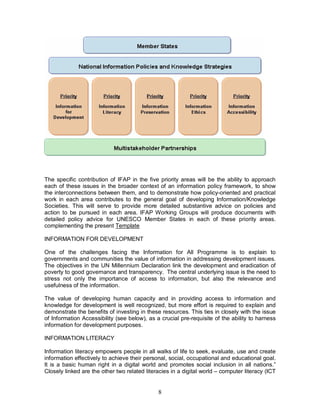
IFAP’s general approach to the development of national information policy frameworks is
illustrated by the figure below:
8
The specific contribution of IFAP in the five priority areas will be the ability to approach
each of these issues in the broader context of an information policy framework, to show
the interconnections between them, and to demonstrate how policy-oriented and practical
work in each area contributes to the general goal of developing Information/Knowledge
Societies. This will serve to provide more detailed substantive advice on policies and
action to be pursued in each area. IFAP Working Groups will produce documents with
detailed policy advice for UNESCO Member States in each of these priority areas.
complementing the present Template
INFORMATION FOR DEVELOPMENT
One of the challenges facing the Information for All Programme is to explain to
governments and communities the value of information in addressing development issues.
The objectives in the UN Millennium Declaration link the development and eradication of
poverty to good governance and transparency. The central underlying issue is the need to
stress not only the importance of access to information, but also the relevance and
usefulness of the information.
The value of developing human capacity and in providing access to information and
knowledge for development is well recognized, but more effort is required to explain and
demonstrate the benefits of investing in these resources. This ties in closely with the issue
of Information Accessibility (see below), as a crucial pre-requisite of the ability to harness
information for development purposes.
INFORMATION LITERACY
Information literacy empowers people in all walks of life to seek, evaluate, use and create
information effectively to achieve their personal, social, occupational and educational goal.
It is a basic human right in a digital world and promotes social inclusion in all nations.”
Closely linked are the other two related literacies in a digital world – computer literacy (ICT
9
skills) and media literacy (understanding of various kinds of mediums and formats by
which information is transmitted).
INFORMATION PRESERVATION
In a world increasingly being shaped by digital technologies, the traditional guardian
institutions (libraries, archives and museums) are challenged to keep pace with the rapid
growth in information. They also face a new challenge – as technology advances the
stability and lifespan of documents is considerably decreasing. If nothing is done, many
important documents in electronic format will not survive or will become completely
inaccessible within a very short time. The result will be a permanent loss to the collective
memory of humankind. This challenge needs to be tackled urgently and the costs of
preserving digital information should not be underestimated – these far exceed the
preservation costs experienced to date with five millennia of traditional documents.
Digital preservation also contributes to at least two other IFAP priorities – information for
development and open & multilingual access to information. Digital technologies open up
access to information and knowledge in democratic dimensions that have never been
experienced before.
This priority area is predominantly executed by strengthening the underlying principles and
concepts of the Memory of the World Programme, beyond its registers, which serve as
catalysts to alert decision makers, and the public at large.
INFORMATION ETHICS
The international debate on information ethics (info-ethics) addresses the ethical, legal and
societal aspects of the applications of information and communication technologies (ICTs).
Ethical principles for knowledge societies derive from the Universal Declaration of Human
Rights and include the right to freedom of expression, universal access to information,
particularly that which is in the public domain, the right to education, the right to privacy
and the right to participate in cultural life. One of the most challenging ethical issues is the
inequity of access to ICTs between countries, and between urban and rural communities
within countries.
INFORMATION ACCESSIBILITY
The new economic and technological environment raises concerns about the erosion of
access to certain information and knowledge that has been freely shared in the past, for
example to facilitate scientific research and education. At the same time, developments
such as the Internet create an unprecedented opportunity for sharing information as well
as promoting linguistic diversity and preserving languages that would otherwise become
extinct. IFAP’s vision is for all Member States to develop a digital content strategy to
encourage the development of the information public domain, the creation of new content.
While many thousands of the world’s languages are still absent from Internet content, the
provision of digital connectivity to all people will allow communities to create their own
content in their own languages.
In 2003, UNESCO adopted a “Recommendation concerning the Promotion and Use of
Multilingualism and Universal Access to Cyberspace” promoting multilingualism and an
equitable balance between the interests of information rights-holders and the public
interest. Subsequently, UNESCO has endorsed global efforts related to Free and Open
10
source Software (FOSS), Open Educational Resources (OER), and has responded with
several projects to promote multilingualism in cyberspace, as well as the use of ICTs for
more equitable access to information, including for people with disabilities. Mention should
also be made in this context of the Policy Guidelines for the Development and Promotion
of Governmental Public Domain Information, adopted by UNESCO in 2004.
Meanwhile, I wish to thank dr Susana Finquelievich and her team for their work and to
commend the present document to all UNESCO Member States.
Karol Jakubowicz
Chair, IFAP Intergovernmental Council
11
EXECUTIVE SUMMARY
The text is divided into three Working Modules:
1. The first Module offers a brief theoretical framework which provides definitions of
the main concepts used in this work and identifies the existing information on
national information society policies: relevant documents in the field of information
society planning, legislation, policies and declarations; diverse countries’ expertise
in the field of information society planning and legislation (explicit national digital
agendas, national, regional and local information society policies, national and
regional legislative measures, etc.); and relevant international documents in the
field of information society planning, legislation, policies and declarations. It also
describes briefly the diverse legal, economic, social, and technological contexts
regarding an information society, as well as explicit national, regional, and/or local
information society policies, either general or specific for given sectors (e-
government, e-inclusion, e-education, e-health, etc.).
2. The second Module is a concrete guideline methodology, a Template for the
development of national information society policies and legislation, so that the
diverse social actors (governments, enterprises, NGOs, or other organizations)
involved in creating, implementing, and updating agendas to develop these policies
may have access to the existing information, methodologies, existing examples,
processes, mechanisms, and information sources. The Template includes three
main phases: the starting point or formulation of a NISP; the implementation of the
NISP; and the monitoring and adaptation/updating of the NISP. This methodology
is intended to be dynamic, flexible, and adaptable to countries with diverse
development levels. Moreover, diverse activities are suggested so that the
individuals and groups entrusted with the formulation of the NISP may check if they
have taken all the necessary steps to complete their work. The Module also
includes a general bibliography.
3. Finally, the third Module is a wide-reaching glossary of the terms and expressions
used currently regarding information society policies and strategies. This Glossary
also provides sources of information and links to relevant Websites related to these
issues.
The work is complemented by an ANNEX: a list of the most used acronyms.
Three fundamental goals of a NISP could be summed up as follows:
· Goal 1: to democratize access: To place within the reach of all persons, the means
to access and use information and information and communication technologies,
guaranteeing the enjoyment of citizen rights, fostering education, local development,
eradication of poverty, gender equity, digital inclusion, universal access, public
transparency and efficiency, and participatory governance;
· Goal 2: to develop capacities: to create, support and promote strategies, tools and
methodologies to generate capacities and skills to utilize information and information
and communication technologies for all sectors and societal groups, at all levels of
formal and informal education, also disseminating the possibilities provided by different
12
information management models. In particular, to build capacity for research and
technological innovation, oriented toward generating one's own knowledge; and to
generate national contents on the part of public institutions and local contents on the
part of different social groups;
· Goal 3: to achieve an adequate legal and regulatory framework: to create the
necessary norms and regulations to guarantee the right to information; to encourage
utilization of information and of information and communication technologies, through
relevant legal bodies, creating an adequate, stable legal setting. The goals of the NIP
must be designed to reinforce all ways of accessing and using information, both
traditional and digital.
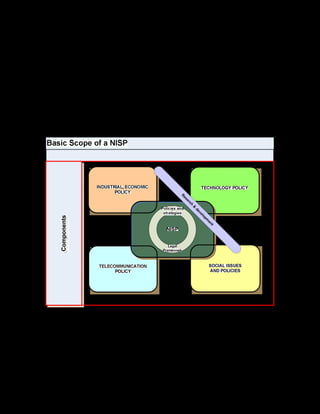
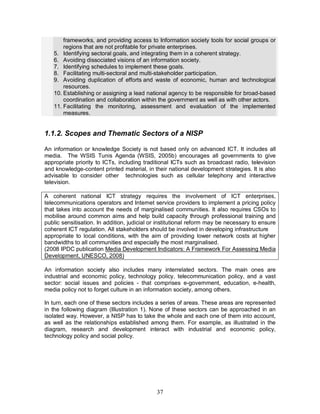
Achievement of these goals must be the objective of a broad range of policies.
Components
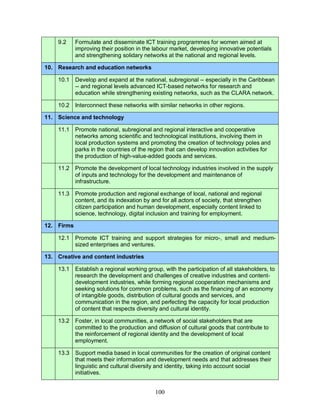
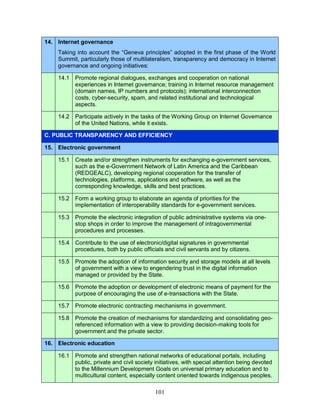
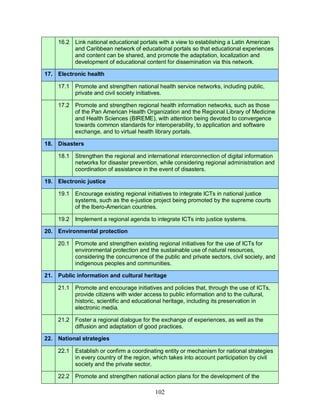
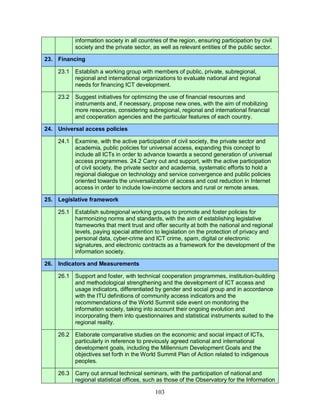
R
eserch
&
developm
ent
Basic scope of a NISP
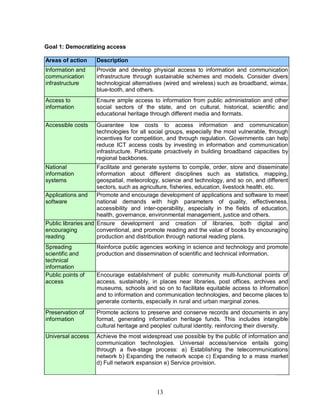
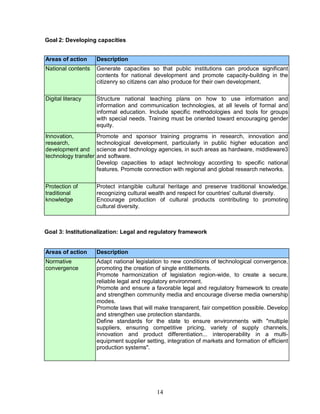
A UNESCO publication Building National Information Policies: Experiences in Latin
America lists areas of action for the implementation of a NISP in a way that amounts to a
model “table of contents” for a national information society policy:
13
Goal 1: Democratizing access
Areas of action Description
Information and
communication
infrastructure
Provide and develop physical access to information and communication
infrastructure through sustainable schemes and models. Consider divers
technological alternatives (wired and wireless) such as broadband, wimax,
blue-tooth, and others.
Access to
information
Ensure ample access to information from public administration and other
social sectors of the state, and on cultural, historical, scientific and
educational heritage through different media and formats.
Accessible costs Guarantee low costs to access information and communication
technologies for all social groups, especially the most vulnerable, through
incentives for competition, and through regulation. Governments can help
reduce ICT access costs by investing in information and communication
infrastructure. Participate proactively in building broadband capacities by
regional backbones.
National
information
systems
Facilitate and generate systems to compile, order, store and disseminate
information about different disciplines such as statistics, mapping,
geospatial, meteorology, science and technology, and so on, and different
sectors, such as agriculture, fisheries, education, livestock health, etc.
Applications and
software
Promote and encourage development of applications and software to meet
national demands with high parameters of quality, effectiveness,
accessibility and inter-operability, especially in the fields of education,
health, governance, environmental management, justice and others.
Public libraries and
encouraging
reading
Ensure development and creation of libraries, both digital and
conventional, and promote reading and the value of books by encouraging
production and distribution through national reading plans.
Spreading
scientific and
technical
information
Reinforce public agencies working in science and technology and promote
production and dissemination of scientific and technical information.
Public points of
access
Encourage establishment of public community multi-functional points of
access, sustainably, in places near libraries, post offices, archives and
museums, schools and so on to facilitate equitable access to information
and to information and communication technologies, and become places to
generate contents, especially in rural and urban marginal zones.
Preservation of
information
Promote actions to preserve and conserve records and documents in any
format, generating information heritage funds. This includes intangible
cultural heritage and peoples' cultural identity, reinforcing their diversity.
Universal access Achieve the most widespread use possible by the public of information and
communication technologies. Universal access/service entails going
through a five-stage process: a) Establishing the telecommunications
network b) Expanding the network scope c) Expanding to a mass market
d) Full network expansion e) Service provision.
14
Goal 2: Developing capacities
Areas of action Description
National contents Generate capacities so that public institutions can produce significant
contents for national development and promote capacity-building in the
citizenry so citizens can also produce for their own development.
Digital literacy Structure national teaching plans on how to use information and
information and communication technologies, at all levels of formal and
informal education. Include specific methodologies and tools for groups
with special needs. Training must be oriented toward encouraging gender
equity.
Innovation,
research,
development and
technology transfer
Promote and sponsor training programs in research, innovation and
technological development, particularly in public higher education and
science and technology agencies, in such areas as hardware, middleware3
and software.
Develop capacities to adapt technology according to specific national
features. Promote connection with regional and global research networks.
Protection of
traditional
knowledge
Protect intangible cultural heritage and preserve traditional knowledge,
recognizing cultural wealth and respect for countries' cultural diversity.
Encourage production of cultural products contributing to promoting
cultural diversity.
Goal 3: Institutionalization: Legal and regulatory framework
Areas of action Description
Normative
convergence
Adapt national legislation to new conditions of technological convergence,
promoting the creation of single entitlements.
Promote harmonization of legislation region-wide, to create a secure,
reliable legal and regulatory environment.
Promote and ensure a favorable legal and regulatory framework to create
and strengthen community media and encourage diverse media ownership
modes.
Promote laws that will make transparent, fair competition possible. Develop
and strengthen use protection standards.
Define standards for the state to ensure environments with "multiple
suppliers, ensuring competitive pricing, variety of supply channels,
innovation and product differentiation... interoperability in a multi-
equipment supplier setting, integration of markets and formation of efficient
production systems".
15
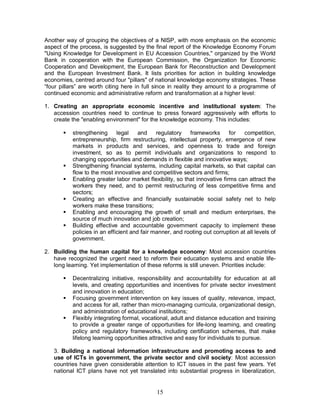
Another way of grouping the objectives of a NISP, with more emphasis on the economic
aspect of the process, is suggested by the final report of the Knowledge Economy Forum
"Using Knowledge for Development in EU Accession Countries," organized by the World
Bank in cooperation with the European Commission, the Organization for Economic
Cooperation and Development, the European Bank for Reconstruction and Development
and the European Investment Bank. It lists priorities for action in building knowledge
economies, centred around four "pillars" of national knowledge economy strategies. These
“four pillars” are worth citing here in full since in reality they amount to a programme of
continued economic and administrative reform and transformation at a higher level:
1. Creating an appropriate economic incentive and institutional system: The
accession countries need to continue to press forward aggressively with efforts to
create the "enabling environment" for the knowledge economy. This includes:
§ strengthening legal and regulatory frameworks for competition,
entrepreneurship, firm restructuring, intellectual property, emergence of new
markets in products and services, and openness to trade and foreign
investment, so as to permit individuals and organizations to respond to
changing opportunities and demands in flexible and innovative ways;
§ Strengthening financial systems, including capital markets, so that capital can
flow to the most innovative and competitive sectors and firms;
§ Enabling greater labor market flexibility, so that innovative firms can attract the
workers they need, and to permit restructuring of less competitive firms and
sectors;
§ Creating an effective and financially sustainable social safety net to help
workers make these transitions;
§ Enabling and encouraging the growth of small and medium enterprises, the
source of much innovation and job creation;
§ Building effective and accountable government capacity to implement these
policies in an efficient and fair manner, and rooting out corruption at all levels of
government.
2. Building the human capital for a knowledge economy: Most accession countries
have recognized the urgent need to reform their education systems and enable life-
long learning. Yet implementation of these reforms is still uneven. Priorities include:
§ Decentralizing initiative, responsibility and accountability for education at all
levels, and creating opportunities and incentives for private sector investment
and innovation in education;
§ Focusing government intervention on key issues of quality, relevance, impact,
and access for all, rather than micro-managing curricula, organizational design,
and administration of educational institutions;
§ Flexibly integrating formal, vocational, adult and distance education and training
to provide a greater range of opportunities for life-long learning, and creating
policy and regulatory frameworks, including certification schemes, that make
lifelong learning opportunities attractive and easy for individuals to pursue.
3. Building a national information infrastructure and promoting access to and
use of ICTs in government, the private sector and civil society: Most accession
countries have given considerable attention to ICT issues in the past few years. Yet
national ICT plans have not yet translated into substantial progress in liberalization,
16
competition and innovation in ICT infrastructure, applications, services and products.
Accession countries need to continue to move dynamically on:
§ Fostering competition and private sector investment in information
infrastructure and services;
§ Developing independent and professional regulatory mechanisms to manage
and allocate licenses and protect broader public interests while granting
maximum flexibility for innovation and new service models;
§ Creating flexible legal and regulatory regimes for new forms of economic and
social activity and government services made possible by the spread of ICTs,
most notably e-commerce and e-government;
§ Promoting broad and affordable public access, particularly among poor and
rural populations, to ICTs, through a careful mix of government investments
and incentives for private investment and innovation.
4. Creating a strong and effective national innovation system and promoting
research and development that brings innovations onto the market: The
previously-strong scientific and technical capacity of the accession countries
continues to be a wasteful asset for many, although some progress has been made
in reforming innovation systems. Much more dynamic efforts are needed in:
§ Rationalizing government funding for research and development, and making it
more transparent and results-oriented;
§ Improving support for innovation and networking among small and medium
enterprises (SMEs);
§ Encouraging greater interaction and cooperation among firms, universities,
government and private research organizations, and greater contact with their
foreign counterparts.
17
INTRODUCTION
National Information Society Policy: A Template
This guideline methodology for the development of National Information Society Policies
(NISPs) and legislation is intended to allow governments, working with enterprises,
community organizations, the science and technology sector (among other social actors)
on creating, implementing and updating agendas to develop those policies and relevant
legislation. This work offers guidance and assistance, as well as general information on the
formulation of Information Society policies and legislation, and about existing examples,
processes, mechanisms and information sources. This methodology is a flexible working
document, adaptable to countries with diverse development levels, and lending itself to
implementation by governmental bodies and civil servants, articulated with an “expert pool"
in each country.
This Template provides orientations for developing a NISP proposal. It is basically a “how
to” guide divided into different steps to prepare a policy proposal. These steps, or phases,
follow a sequential structure, which is disaggregated into all its components. Certainly,
UNESCO Member States have their own institutional, administrative and governance
practices and approaches. Therefore, the procedures described in this Template are not
mandatory for any of them. The step-by-step approach shown in this Template serves as
an example and an illustration of a way of proceeding; it is not a prescription nor a set of
rules for the way every administration should behave.
This document revises some of the policies and legislation suggested and/or implemented
by international organizations, governments, enterprises, and non-governmental
organizations (NGOs) in different countries and regions, in order to propose a
methodology that can be used to generate and update public policies for the Information
and Knowledge Society.
A NISP can be defined as a roadmap, a national, regional, or local plan for the inclusion
and appropriation, by Governments, institutions, communities and individuals, of the
benefits derived from the construction of an Information Society. The NISP is a highway,
not a harbour. It is a process, a collaborative, open, and permanent building task. In order
to travel this highway, it is necessary to envision it, to plan and build it, to make it
travelable for all the citizens.
The work reviews relevant existing documents in the field of Information Society Planning,
legislation, policies and declarations; diverse countries’ expertise in the field of Information
Society planning and legislation (explicit national digital agendas; national, regional and
local Information Society policies; national and regional legislative measures; etc.); and
relevant international documents in the field of Information Society planning, legislation,
policies and declarations.
18
NISPs: a significant symbol for the beginning of the new
millennium
UNESCO´s Information for All Programme (IFAP) is an intergovernmental programme,
created in 2000. Through IFAP, governments have pledged to harness the new
opportunities of the information age to create equitable societies through better access to
information. IFAP is a platform for international policy discussions and programme
development aiming at narrowing the gap between the information-rich and the
information- poor. In the context of fast and permeable evolution of ICTs, UNESCO with its
mandate to promote the “intellectual and moral solidarity of mankind” is uniquely well
placed to provide a forum for international debate, and to contribute to policymaking,
especially at international and regional levels.
UNESCO and IFAP have contributed to the formulation of national policies for information
societies1
in UNESCO member countries. The issue of public policies for information
societies is relatively young. Even the countries that have dedicated efforts to national or
local strategies, such as Canada, Australia or New Zealand among others, started to do
this in the mid 1990s.
Therefore, the history and antecedents of NISP, even if rich in content and organizational
schemes, were still relatively young and scarce until the beginning of the new millennium.
The 2003 World Summit of Information Society´s “Declaration of Principles Building the
Information Society: a global challenge in the new Millennium” (WSIS, 2003a) states that
“Sustainable development can best be advanced in the Information Society when ICT-
related efforts and programmes are fully integrated in national and regional development
strategies.” (Paragraph 44). WSIS 2003 Plan of Action declares that “Development of
national e-strategies, including the necessary human capacity building, should be
encouraged by all countries by 2005, taking into account different national circumstances”
(WSIS, 2003b).
In 2005, the WSIS Tunis Commitment (WSIS, 2005a) declared: “We also recognize that
the ICT revolution can have a tremendous positive impact as an instrument of sustainable
development. In addition, an appropriate enabling environment at national and
international levels could prevent increasing social and economic divisions, and the
widening of the gap between rich and poor countries, regions, and individuals—including
between men and women”, and recognized the central role of public policy in setting the
framework in which resource mobilization can take place. Paragraph 84 of the Tunis
Agenda for Information Society declares: “Governments and other stakeholders should
identify those areas where further effort and resources are required, and jointly identify,
and where appropriate develop, implementation strategies, mechanisms and processes for
WSIS outcomes at international, regional, national and local levels, paying particular
attention to people and groups that are still marginalized in their access to, and utilization
of ICTs”.
1
Even if this Template considers an information society as a stage towards the construction of a knowledge
society, we use the term NISP because of its present international acceptance to refer to public policies for
information and knowledge societies.
19
Essential guidelines
NISP goals may be formulated and implemented following six essential overall guidelines:
1. The Millennium Development Goals2
2. The 2003 and 2005 World Summit for Information Society (WSIS) Declarations:
Geneva Declaration of Principles, Geneva Plan of Action, Tunis Commitment, and
Tunis Agenda for the Information Society3
3. Objectives established by regions (Arab States, Asia and the Pacific, Latin America
and the Caribbean, Europe, North America, East, West and Central Africa, among
others)
4. Principles and goals established by North-South, North-North and South-South
cooperation programmes between regions. An example is the EU 274
cooperation
with Africa (Joint EU – Africa Strategy, 2007). The European Union and the African
Union have thus decided to develop a co-owned “joint strategy” which “reflects the
needs and aspirations of the peoples of Africa and Europe”. Particularly relevant is
the thematic Partnership on Science, Information Society and Space.
5. National development goals, as stated in national development plans. According to
the Tunis Agenda for Information Society: “National e-strategies, where
appropriate, should be an integral part of national development plans, including
poverty reduction strategies, aiming to contribute to the achievement of
internationally agreed development goals and objectives, including the Millennium
Development Goals” (WSIS, 2005b).
6. Regional (provinces, states in a country) and local development goals. For
example, the Ecuadorian Project for Involving Local Youth Councils in Good
Practices in Local Governance began in 2006 and responds to the strong need for
new leaders in Ecuador and for “spaces” in which talented young people can
interact about new leadership styles based on transparency and social
participation. This Project also addresses specific local management issues and
the application of the Law on Access to Public Information (LOTAIP). The use of
ICTs in communication and information management is vital in empowering these
local youth groups, notably through the set-up of public “information corners”
installed at locations of easy access for local youth. The project benefits 15,000
local young people and municipal civil servants.
2
To be achieved by 2015, the MDGs are: halving poverty and hunger; achieving universal primary education; removing
gender disparities; reducing under-five mortality by two-thirds and maternal mortality by three-quarters; reversing the
spread of HIV/AIDS and other diseases; ensuring environmental sustainability; and halving the proportion of people
without access to safe water.
3
On the following Web page, you will find all the WSIS declarations: http://www.itu.int/wsis/index.html
4
EU-27: Austria, Belgium, Bulgaria, Cyprus, Czech Republic, Denmark, Estonia, Finland, France, Germany,
Greece, Hungary, Ireland, Italy, Latvia, Lithuania, Luxemburg, Malta, the Netherlands, Poland, Portugal,
Romania, Slovakia, Slovenia, Spain, Sweden and the United Kingdom. Find more information at
http://www.eea.europa.eu/help/eea-help-centre/faqs/what-is-the-eu-27
20
What is an Information Society?
Primarily, the term defines a society in which the creation, distribution and treatment of
information have become the most significant economic and cultural activities. An
information society is often contrasted with societies in which the economic foundation is
primarily industrial or agrarian.
The freedom and ability to receive and impart information is a basic human need and right,
as affirmed by Article 19, Universal Declaration of Human Rights. Access to information is
fundamental to all aspects of our lives – in learning, at work, in staying healthy, improving
our individual and collective rights, in being entertained, in knowing our history, in
maintaining our cultures and languages and in participating actively in democratic
societies. Documents adopted during the World Summit on the Information Society show
a clear link between the human and the broader societal, cultural and economic
dimensions of information access and use.
As noted in two documents adopted by the Committee of Ministers of the Council of
Europe (Declaration on human rights and the rule of law in the Information Society, 2005,
and Recommendation CM/Rec(2007)16 on measures to promote the public service value
of the Internet), the ICTs offer unprecedented opportunities to enjoy the right to freedom of
expression, information and communication. Accordingly, as stated forcefully in WSIS
outcome documents, this translates into an obligation for States and the international
community to ensure enjoyment of these opportunities by everyone.
“information for all” could mean Information literate communities, where “people in all
walks of life are empowered to seek, evaluate, use, and create information effectively to
achieve their personal, social, occupational and educational goals.” A realistic strategy to
provide information for all must take account of the existence of a wide range of sources of
information used by individuals and societies, including both traditional media and
information distribution channels and the ICTs, including the Internet. Information and
knowledge policies and strategies must therefore be oriented to developing all these
media and channels.
Very significant from the point of view is the report Media Development Indicators: A
Framework For Assessing Media Development, adopted by the Intergovernmental Council
of the International Programme for the Development of Communication at its 26th session
in Paris in March 2008. Among those indicators are: “Professional capacity building and
supporting institutions that underpins freedom of expression, pluralism and diversity” and
“Infrastructural capacity is sufficient to support independent and pluralistic media.” This
part of the report deals inter alia with ICT penetration. It calls for establishing what
proportion of the population has access to newspapers, radio, television, Internet, and
fixed and mobile telephony and for developing strategies to enable marginalized
communities to use them.
Nevertheless, the digital divide remains a global challenge. Despite these impressive
statistics the distribution of access between developed and developing countries, between
urban and rural communities and even between different age groups is inequitable. The
resources required to bridge all these digital divides is far beyond the means of UNESCO
and interestingly most governments view this beyond their means as well. This Strategic
21
Plan does not pretend to solve this problem, but underlying the priorities identified in the
Plan is an assumption that governments and others will continue to seek solutions that
provide all citizens with digital connectivity if not in their homes, at least within walking
distance of their homes.
Community libraries, public archives, telecentres, community multimedia centres and other
community-based centres where people can get access to information, have many of the
key functionalities required to build information literate communities
Libraries, archives and community information centres are good examples of how
“information for all” could materialise within a community.
Example 1. The Australian approach
The Australian Approach
Australia defines an information society as one where information, knowledge and
education are major inputs to business and social activity. It is not a separate “new”
society—it is a society in which the rapid development and diffusion of ICT-based
innovation is transforming all sectors and all aspects of society. The Australian approach is
one of a market-led information society with the government providing the framework for
economic and social development, ensuring universal, affordable access to the information
economy and its benefits, and ensuring a predictable, safe and secure environment.
Partnerships with the private sector and civil society involving consultative processes, joint
projects and the development of co- or self-regulatory processes ensure the development
of an information society that meets the needs of all participants.
Source: Sadagopan and Weckert, 2005
National Information Society Policy: a step towards Knowledge
Societies
One of UNESCO’s signal contributions to the Information Society debate is the concept of
Knowledge Societies . This draws attention to the people impacts of the Information
Society, and especially the four pillars – knowledge creation, knowledge preservation,
knowledge dissemination and knowledge utilisation. These four pillars are based on the
principles of inclusion and pluralism, which in turn derive from underlying human needs
and rights.
The OECD speaks of knowledge economy , or “knowledge-driven economies” to signify
the complex and all-encompassing change leading – though at a different pace in different
parts of the world – to the emergence of the “knowledge society” and the “knowledge-
based economy.”
The UNESCO World Report on Knowledge Societies for All (2005) stresses that
knowledge societies are not to be confused with information societies. Knowledge
societies contribute to the well-being of individuals and communities, and encompass
social, ethical and political dimensions. Singapore, for example, started out as a
developing country of shantytowns at Independence and achieved economic growth rates
that surpass those of most industrialized nations in just four decades by promoting
knowledge (education) and creativity. On the other hand, information societies are based
22
on technological breakthroughs that risk providing little more than “a mass of indistinct
data” for those who don’t have the skills to benefit from it.
An information society is, therefore, considered as a necessary previous step to build
Knowledge Societies. Abdul Waheed Khan (Assistant Director-General for Communication
and Information of UNESCO, quoted by Burch et al. (2005), states: “Information society is
the building block for knowledge societies. Whereas I see the concept of ‘information
society’ as linked to the idea of ‘technological innovation’, the concept of ‘knowledge
societies’ includes a dimension of social, cultural, economical, political and institutional
transformation, and a more pluralistic and developmental perspective. In my view, the
concept of ‘knowledge societies’ is preferable to that of the ‘information society’ because it
better captures the complexity and dynamism of the changes taking place. (...) the
knowledge in question is important not only for economic growth but also for empowering
and developing all sectors of society.”
UNESCO (2005) considers that while information is a knowledge-generating tool, it is not
knowledge itself. “The idea of the information society is based on technological
breakthroughs. The concept of knowledge societies encompasses much broader social,
ethical and political dimensions. There is a multitude of such dimensions which rules out
the idea of any single, ready-made model, for such a model would not take sufficient
account of cultural and linguistic diversity, vital if individuals are to feel at home in a
changing world. Various forms of knowledge and culture always enter into the building of
any society, including those strongly influenced by scientific progress and modern
technology. It would be inadmissible to envisage the information and communication
revolution leading – through a narrow, fatalistic technological determinism – to a single
possible form of society”. (Bindé et.al., UNESCO, 2005, p. 17).
Therefore, ICT tools are a necessary but not sufficient precondition for the societal and
political process of developing knowledge societies. Our template concentrates on some
aspects of this broader issue
Technological change is advancing at the fastest pace known in history. Therefore,
governments have to keep up with this pace, elaborating not only long-term policies, but
also strategies for short- and medium-terms, which will produce results visible to the actors
involved and to the general population. There is no general formula for successful ICT
policies and e-strategies. Governmental officers, experts’ teams and policy makers in
diverse development countries may identify examples of successes or best practices either
within their own territories, in their own regions, or in other, similar countries and adjust
them as needed to fit their nation’s unique circumstances.
The issue of public policies for an information society is relatively young. Even the
countries that have dedicated efforts to national or local strategies, such as Canada,
Australia or New Zealand, among others, started to do this in the mid 1990s.
Example 2. The Icelandic experience with ICT policies
The Icelandic experience with ICT policies
More than fifteen years ago, Iceland presented its chief goal for information society
policies, hoping to place the country at the forefront of the world's nations in the utilization
of information technology in the service of improved human existence and increased
prosperity.
To follow up on this overriding goal, five main objectives were set out as a foundation for
23
a vision of the future:
1. Icelanders shall have easy access to the information society. That its advantages be
utilized to strengthen democracy and increase the quality of life for the benefit of the
public and the Icelandic economy. That information technology be employed in all fields,
whether for innovation, public health, science, the arts or other fields of daily life.
2. Complete equality shall be ensured between the public and private sectors in the field
of information technology and the information industry. That the Government, with the
help of information technology, shall facilitate access to governmental information and
services to equalize the status of individuals and companies without regard to residence
and economic resources.
3. Information and telecommunication technologies shall be mobilized to improve the
competitiveness of the Icelandic economy, increase productivity and spread the
possibilities of exporting Icelandic inventiveness.
4. The educational system shall adapt to changed social dynamics and focus general
education and continuing education upon the advantages of the information society while,
at the same time, keeping watch over our language and culture.
5. Legislation, rules and working methods shall be re-examined with respect to
information technology to stimulate technological progress and to protect the rights of
individuals and companies.
Source: Iceland Prime Minister's Office, 1996
Therefore, the history and antecedents of NISPs even if rich in contents and
organizational schemes, were still relatively young and scarce until the beginning of the
new millennium. Policies and strategies are driven not only by each country’s specific
history, social structure and endogenous factors, but also by the influence of the
international context and external factors, as analyzed in the following pages.
The International Context
The urge to build and update explicit NISPs and ICT legislations is not a local isolated
impulse, but an international process that can be followed through international events and
documents. The discussion and debate process that took place at national and
international levels, triggered by the two WSIS events, deepened the perception about the
need to construct NISPs.
Example 3. The Kenya ICT action network
The Kenya ICT Action Network (KICTANet)
The impetus for a multi-stakeholder process in Kenya arose from a recommendation of the
World Summit on the Information Society and long-standing collaboration between civil
society and the private sector in advocating for different ICT policy changes in Kenya over
the last two decades. KICTANet was initiated by civil society organisations in October
2004 during a meeting organised by the Media Council, the Association for Progressive
Communication, the Catalysing Access to ICTs in Africa (CATIA) programme supported by
the UK Department for International Development (DFID), TESPOK (Telecommunications
Service Providers Association of Kenya), Summit Strategies and the Kenya WSIS Civil
Society Caucus. These organisations together with the Kenya ICT Federation (KIF) formed
the initial members of KICTANet.
The initiators of KICTANet were facing common problems relating to ICT policy in Kenya
and felt that their individual goals could be achieved by focusing on the collective goal of
sharing resources and skills, stimulating debate and catalysing the policy process.
24
Through interaction with stakeholders, awareness creation, mobilisation of the private and
public sectors and civil society around policy issues and encouragement of synergies,
KICTANet was able to achieve trust and social legitimacy among policy-makers,
international institutions and the general public in Kenya. KICTANet played a catalytic role
in facilitating ICT policy changes in the country.
Source: Adam et al., 2007
According to Aballi et al., (UNESCO, 2008), the evolution of a NISP toward state policies
orienting the development and consolidation of the information society inclusively and
equitably is one of the main challenges of the present-day globalized world. For that
reason, NISP goals may be formulated and implemented following five essential overall
guidelines:
1. The Millennium Development Goals
2. The 2003 and 2005 World Summit for Information Society (WSIS) Declarations:
Geneva Declaration of Principles, Geneva Plan of Action, Tunis Commitment,
and Tunis Agenda for the Information Society
3. Objectives established by regions (Arab States, Asia and the Pacific, Latin
America and the Caribbean, Europe, North America, East, West and Central
Africa, among others)
4. Principles and goals established by North-South, North-North and South-South
coperation programs between regions. An example is the EU 27 cooperation
with Africa (Joint EU – Africa Strategy, 2007). The European Union and the
African Union have thus decided to develop a co-owned ‘joint strategy’ which
“reflects the needs and aspirations of the peoples of Africa and Europe”.
Particularly relevant is the thematic Partnership on Science, Information Society
and Space.
5. National development goals, as stated in National Development Plans.
According to the Tunis Agenda for Information Society: “National e-strategies,
where appropriate, should be an integral part of national development plans,
including Poverty Reduction Strategies, aiming to contribute to the achievement
of internationally agreed development goals and objectives, including the
Millennium Development Goals” (WSIS, 2005b).
6. Regional (provinces, states in a country) and local development goals), For
example, the Ecuadorian Project Involving Local Youth Councils in Good
Practices in Local Governance was launched in 2006 and responds to the
strong need for new leaders in Ecuador and for spaces in which talented young
people can interact about new leadership styles based on transparency and
social participation. The project also addresses specific local management
issues and the application of the Law on Access to Public Information
(LOTAIP). The use of ICTs in communication and information management is
vital in ensuring the empowerment of these local youth groups, notably through
the set-up of public “information corners” installed at locations of easy access
for local youth. The project benefits 15,000 local young people and municipal
civil servants.
Since the concepts of an information society and a knowledge society are relatively recent,
the idea of National Information Society Policies is new too. In general, it dates from the
1990s, with a few countries, such as Iceland (cf. supra), working on information society
policies as early as the 1980s. However, as stated by UNESCO (2005): “Even before the
first phase of the World Summit on the Information Society (Geneva, 10–12 December
2003), the international community’s reflections in this area had been followed up by a
number of initiatives, such as the World Conference on Higher Education, the World
25
Conference on Science in Budapest, ‘Science for the Twenty-first Century: A New
Commitment?’ and the World Summit on Sustainable Development”. This interest in the
issue also translated, during the preparation of the Geneva Summit (2003), and the
Tunisia Summit (2005), into the organization of regional summits and forums and initiatives
on governmental and non-governmental levels.
International organizations, national governments, the academic sector, the private sector
and civil society have showed concern for the transition to a new technological, economic
and social paradigm. Today, the concept of the knowledge society has become an
essential framework of reflection for most member countries of the UNESCO.
The fact of discussing a NISP makes governments, as well as the other social agents,
associate access and social appropriation of information and communication technologies
with public policy-making. As mentioned before, information society policies are those
which consider the overall development of governmental responsibility in the construction
and permanent development of an information society suited to each country’s context,
specificities, needs and potentials. This study considers that a country has a national
digital agenda, or national information society policy, when such a policy is explicit in an
official document, or implicit in a higher hierarchy document, such as a national
development plan.
Example 4. Recommendation WSIS Action Plan
Although none of the WSIS commitments urges explicitly national, regional or local
governments to design and implement information/knowledge society policies and
strategies, the WSIS Action Plan (2003) recommended the initiation at the national level of
“a structured dialogue involving all relevant stakeholders, including through public/private
partnerships, in devising e-strategies for the Information Society and for the exchange of
best practices.” The resultant WSIS Plan of Action emphasized the importance of
establishing “a trustworthy, transparent and non-discriminatory legal, regulatory and policy
environment”, for which “Governments should foster a supportive, transparent, pro-
competitive and predictable policy, legal and regulatory framework, which provides the
appropriate incentives to investment and community development in the Information
Society.
Source: WSIS Action Plan (2003)
In specific fields, such as telecommunications, policies cannot be formulated at the
national level alone. International institutions such as the World Trade Organisation
(WTO), the reforming International Telecommunication Union (ITU), the World Intellectual
Property Organisation (WIPO) and the Internet Corporation for Assigned Names and
Numbers (ICANN) “are determining, with varying degrees of formality, the rules for global
participation. While the biases and agendas of these various organisations have been
identified and the factors contributing to the lack of effectual participation by developing
countries acknowledged, the fact remains that, with the globalisation of communications,
such global entities will increasingly determine the frameworks for effective participation…
For this reason alone, it has become increasingly important to invest resources in
influencing these agendas and their outcomes in ways that represent the interests of
developing countries and emerging economies.” (Gillwald and Abrahams, 2003: 4).
26
Example 5. The Arab Status involvement
“[A]s Arab States join the World Trade Organization (WTO), they have been adapting their
legal and regulatory systems to accommodate trademark, patent, and intellectual property
rights (IPR) protection.
Source: Dutta and Coury, 2003
Arab Countries: Launched in January 2009, ITU’s initiative “Connect Arab Countries 2011”
is focused on prioritized initiatives centre on establishing ICT indicators and capacity
building; developing a regional regulatory framework; creating a centre for digital
documentation and archiving of heritage; developing access nodes to connect Arab
internet networks; and translation into Arabic of ICT terminology.
Source: ITU, 2009
NISPs are meant to facilitate the countries development, as well as the well being of their
populations. As stated by Soyo, Chacko and Pradhan (2004) “[b]e it for bridging the digital
divide or re-positioning the nation in the new digital inter-connected economy, and
ensuring that marginalized communities and cultures are not discounted in the move to
embrace ICT, nations need to step back and evaluate where they stand. They need to
ensure that national ICT policies and e-strategies address the core aspect of
development—human development. In the final analysis, ICT policies and e-strategies
should be the means.”
Information Society Policies in Developing Countries
Concerning principles that are essential to developing an Information Society (IS), a series
of questions are raised:
· How the building of an inclusive and equitable information society is to be ensured
by the different social actors in developing countries?
· What elements should be attracting priority efforts of governments, the private
sector and civil society to implement National Policies for Information Society
(NISP)?
· What sources of financing to ensure the implementation of these NISPs should be
encouraged?
· What are the conditions required to ensure that multi-stakeholder participation in
the creation and implementation of NISP becomes a reality?
Characteristics of Developing Countries
Although strategies for developing a local ICT sector date back to the 1980s (Singapore,
India, Brazil were among the pioneers), a development application only emerged in the late
1990s. The expectations raised by turn of the Millennium contributed additional support to this
shift in focus. With the support of new global public-private partnerships, such as the G-8
Digital Opportunity Task Force (DOT Force), and the UN ICT Task Force, countries shifted
from random pilot experiences to more comprehensive policy approaches with national ICTD
strategies as the cornerstones. The goals set in this context ranged from identifying
applications for ICT in development, to the development of wholly new domestic ICT
industries (Brazil, India, Ghana, Argentina, and Uruguay, among others). The last decade has
witnessed substantial increase in the development of ICTD strategies. In Africa alone in 2003,
27
more than 35 countries have completed, or are in the process of completing, related efforts
(Zambrano and Browne, 2004).
Nevertheless, Zambrano and Browne (2004) state that “although more than 90 developing
countries had already embarked on the design of national ICTD strategies before 2005, the
results have been far from optimal. There is an urgent need to streamline approaches. Many
of the strategies have a technological focus and aim at promoting the development of a local
ICT industry (mostly software). Others are over-ambitious and lack the credibility to attract the
required financial resources for implementation. Yet others do not identify concrete priorities
and/or adequate implementations plans and are, for the most part, government driven,
excluding all other sectors from the process. Moreover, most of them are not linked with
national development agendas, such as poverty reduction and the MDGs”.
Already in 1999, ESCAP identified the factors affecting the formulation of national ICT
policies in developing countries. That study stated that “[t]he importance of ICT policies is
understood at the highest political level in many developing countries, and some countries
have already adopted their own policies (…). The effectiveness of an ICT policy in one
country does not guarantee that the same recipe would work in another and many
developing countries face similar constraints that need to be taken into account when ICT
policies are formulated.” (ESCAP, 1999)
Example 6. Highlights from Latin America
Brazil
Brazil’s first strategic instrument was the Information Society (SocInfo) Program, created by
Decree 3294 in December 1999, under the Ministry of Science and Technology. The
SocInfo Program produced a “Green Book: Information Society in Brazil” (http://www.inst-
informatica.pt/servicos/informacao-e-documentacao/biblioteca-digital/gestao-e-
organizacao/BRASIL_livroverdeSI.pdf) , which sets the main strategic guidelines, organized
into seven sectors: work and opportunities; universal citizen services; education for the
Information Society; contents and cultural identity; government within everyone’s reach;
research and development, Information Society technologies and applications; advanced
infrastructure and new services.
Nowadays, Brazil is in the process of redesigning its national strategy, having formed in
May 2003 the Executive Committee on e-Government, coordinated by the Ministry of
Planning, Budgeting and Management.
This multi-sectoral committee is working in eight Technical Groups, seeking to integrate the
various scattered national initiatives into a coherent national plan. Mass access and digital
inclusion appear as a high-priority strategic sector, especially for e-government.
Source: Fernandez Aballi et al., 2007
Source: MIS, 1997
Bolivia
In March 2002, Presidential Decree 26553 created the Agency to Develop the Information
Society in Bolivia (ADSIB), a decentralized entity supervised by the Vice-Presidency of the
Nation. It was given the task of designing the strategic plan. Then, in 2003, the National
Committee for the Information Society in Bolivia was created, with ADSIB as its executive
secretariat. This Committee is currently responsible for setting strategy. It is chaired by the
Vice-Presidency and includes the Ministry of the Presidency, Ministry of Services and Public
Works, Ministry of Sustainable Development and Planning, Ministry of Economic
Development, Ministry of Finance, Ministry of Education, Ministry of Health and Sports, the
28
President of Private Enterprise, a representative of universities, with civil society
represented by CrisBol, which is conveying the concerns of different NGOs, and a
representative of the media.
It is currently completing the design stage for the action plan, called the National Strategy
for Information and Communication Technologies for Development (ENTICD), under the
Vice Presidency, ADSIB, and the Vice Minister of Telecommunications, the
Superintendence of Telecommunications and participation by multiple stakeholders from
private and public sectors, working through a virtual consultation system. ENTICD is
receiving support from UNDP. ENTICD is also grouping all programs under way in the NICT
area, under common strategic goals and lines of action. These include TIC Bolivia and
actions that ADSIB is pursuing in the field of e-government.
Source: Fernandez Aballi et al, 2007
Chile
Chile’s strategy was prepared by the President Commission for ““New Information and
Communication Technologies” created by presidential order in June 1998. This
Commission, chaired by the Minister of Economics and comprising several ministers and
undersecretaries, senators and representatives of the private sector and civil society,
presented (January 1999) its report, entitled Chile: Toward the Information Society. To
prepare this document, public and private sector participants were grouped in four
categories: Trade legislation and regulation; New technologies and digital networks for
productive and technological use; Modernization of the State and use of new technologies;
and Information Society, equity and cultural development.
This has resulted in a large number of projects, especially in the e-government sector,
between 1999 and 2002, positioning Chile among the world’s most developed countries in
this field.
With the new government in 2000, the President created the Committee of Ministers of
Information Technologies, which gave rise to the Digital Action Group, comprising
representatives of the public and private sector, civil society and academics, and
coordinated by the Governmental Coordinator of Information Technologies, reporting to the
Under-Secretariat of Economics. The GAD prepared and is implementing its plan of action,
Chile’s Digital Agenda, with a large number of initiatives, under the following STRATEGIC
SECTORS: mass access, education and training, e-government, digital development of
companies, ICT industry start-up, and legal framework.
Source: Fernandez Aballi et al, 2007
In spite of these drawbacks, UNESCAP (1999) sustains that “[t]he ICT evolution will take
place with or without a systematic, comprehensive and articulated policy”. However, it also
points out that the lack of a coherent policy is liable to contribute to the development (or
prolonged existence) of ineffective infrastructure and a waste of resources.
Listed below are some of the aspirations that ICT policies often try to meet:
· Increasing the benefits from information technology
· Helping people and organizations to adapt to new circumstances and providing
tools and models to respond rationally to challenges posed by ICT
· Providing information and communication facilities, services and management at a
reasonable or reduced cost
· Improving the quality of services and products
· Encouraging innovations in technology development, use of technology and
general work flows
· Promoting information sharing, transparency and accountability and reducing
bureaucracy within and between organizations, and towards the public at large
29
· Identifying priority areas for ICT development (areas that will have the greatest
positive impact on programmes, services and customers)
· Providing citizens with a chance to access information; one may further specify the
quality of that access in terms of media, retrieval performance, and so on
· Attaining a specified minimum level of information technology resources for
educational institutions and government agencies
· Supporting the concept of lifelong learning
· Providing individuals and organizations with a minimum level of ICT knowledge,
and the ability to keep it up to date
· Helping to understand information technology, its development and its cross-
disciplinary impact.
Example 7. African Information Society Initiative
African Information Society Initiative
In Africa, the African Information Society Initiative (AISI) provides a framework for the
development and implementation of national information and communication infrastructure
plans in all African countries and the pursuit of priority strategies, programmes and
projects which can assist in the building of a sustainable information society. A key
component of the AISI is the development of national e-strategies, or the NICI plans,
policies and strategies aiming principally at assisting countries to deploy, harness and
exploit ICTs for development.5
The AISI also defines role of government as being that of providing a vision, a strategy and
an enabling environment to develop national information and communication infrastructure
and to ensure that all sectors of society benefit from it. To fulfill its role in achieving these
objectives, the AISI recommends that each African government establishes or assigns a
lead national agency to be responsible for broad-based coordination and collaboration
within government as well as with other sectors. This role also includes the development of
national policies and plans for adopting ICTs within the government to improve the
effectiveness of government service delivery.
To ensure the smooth implementation of the national information and communication
infrastructure in African countries, governments are also advised to address the legal and
regulatory environment, which currently constrains the use of ICTs. This would require
modification of laws and regulations in different areas such as communication, intellectual
property, privacy and free information flow.
Source: UNECA, 2008
Preparing Citizens for the Information Society in Developing Countries
In order to benefit from the opportunities provided by the Information Society (IS), citizens
should be prepared for the current economic, social, cultural and technological advances.
To this effect, the following elements, among others, are needed:
· Access to ICT infrastructures: hardware, software, connectivity; fast, free or low-cost
access to Internet.
5
AISI, African Information Society Initiative, published by the Economic Commission for Africa, 2008
(http://www.uneca.org/aisi/docs/AISI+10.pdf)
30
· ICT training (not only technological literacy, but also education in business
management and organizations using ICTs); life-long education and training in
courses, professions and skills related to the IS.
· Information and creativity to identify the opportunities offered by the IS.
· Information and social organization to demand from governments the ICT
infrastructures, innovative education systems, legislation and public information, which
are necessary to benefit from the opportunities offered by the IS.
· Effective ICT use: the capacity and opportunity to integrate successfully ICTs into the
accomplishment of self or collaboratively identified goals.
State and non-state provision of telecommunication infrastructure and connectivity
services contributes to the people e-readiness. Cybercafés, which are mostly the result of
private micro-undertakings, nowadays represent the access door to cyberspace for a large
number of Latin American, Asian and African people.
Example 8. Planning in Western Asia
Planning in Western Asia
As a result of the World Summit on the Information Society (WSIS) third preparatory
conference (PreCom-3), which was held in Geneva, from 15 to 26 September 2003,
working documents were produced for the Draft Plan of Action and the Draft Declaration
of Principles. These documents are set to become final drafts to be adopted at the
Summit after further deliberations between governments to solve outstanding differences.
The Economic and Social Commission for Western Asia (ESCWA), through its
Information and Communication Technology Division, produced and advanced a tentative
plan of action for Western Asia, which is based on the global Draft Plan of Action while
being tailored for the ESCWA region.
This customized plan has been built around a framework that is flexible on many levels.
Within that context, activities can be launched in parallel, amended to fit national priority
areas, extended to include innovations in the field of information and communication
technology (ICT), and executed at different times and according to the levels of
application and the use of information technology in a country, or e-readiness status. This
report endeavours to be a source of be a source of guidance on the plan of action and to
stimulate further discussions at both national and regional levels.
The tentative plan of action for the region is an evolving document that aims at instigating
further cooperation among ESCWA member countries. ESCWA hopes that this report will
assist in drafting a final plan of action for the region, paving the way for effective
strategies devised by regional and local communities and supported by proper policies
that can lead to the information society in Western Asia. This new society can sustain
development and reduce the digital divide by using ICTs as a tool to process and
disseminate information and, more importantly, to empower people with knowledge even
in remote areas. Within that context, the following objectives form the main basis for
cooperation and coordination among all stakeholders:
(a) To trigger substantive inputs specific to the ESCWA region with added value to local
communities;
(b) To agree on tentative information society actions and indicative targets for priority
areas that contribute to the compilation of a plan of action for ESCWA member countries;
(c) To promote social inclusion and increase the social and economic potentials of
ESCWA member countries, particularly vulnerable communities;
(d) To recommend an implementation framework;
31
(e) To devise guidelines for a monitoring mechanism in order to report on the progress of
work.
Source: ESCWA, 2005
As explained by Gómez and Martínez (2001), “[t]he ‘digital divide’, which usually refers to
inequities in the access to new ICTs, particularly Internet, is not the cause but the
expression of the existing social, economic and political gaps, at global, national and local
levels. Focusing only on the digital divide will not help communities to improve their living
conditions, overcome poverty or have a more equitable access to goods and services.” In
developing countries it is necessary to build a new economy - the Information Economy -
and adapt it to the needs, advantages, challenges, obstacles and potentialities of the
region.
The role of the state is to foresee the needs and interests of the different social actors and
be prepared for relevant legislation and control, as well to establish operative articulations
among them. For this reason, the strategies and policies of developing countries’
governments should be aimed at turning those nations into pioneers in terms of
technological, social and economic management. In order to achieve this, it is necessary
to focus on technological and scientific production, innovation, specialized training,
knowledge management and the use of existing brains, avoiding “brain drain” and
promoting “brain gain”, through coordination with S&T centres abroad.
And above all, that role is not only in response to these trends, but also in anticipating
them as concerns the legal framework, regulations, strategies, and actions. In short, it is
necessary and urgent for governments to implement integral policies in the sectors of
telecommunications, informatics and ICTs in general, aimed at coordinating the
technological, economic and scientific development strategies with initiatives for social,
cultural and communications development.
32
MODULE I: INFORMATION POLICIES -
PLANNING AND IMPLEMENTATION
FEATURES
1.1. THE ADDED VALUE OF PUBLIC POLICIES IN INFORMATION /
KNOWLEDGE SOCIETIES
According to one view, policy objectives in developing an information society can be
grouped in three areas:
· Network infrastructure - physical and logical networks and systems for provision of
sound, data and images, so that the availability of modern communication networks
and advanced information technologies (IT) and the involvement of industry are
ensured. Competition rules and governance of the converging media will also require
special policy consideration. Particular attention has to be paid to the ability of local
industry to implement advanced technologies and supply state-of-the-art equipment
and services, meeting the requirements for interoperability and user-friendliness.
· Info-structure, i.e. the information and content capable of providing new services and
content through communication networks. An important aspect is the availability of
public access points and the involvement of all stakeholders in the process of building
info-structures and provision of high quality services and content to the general public.
· Capabilities and skills, i.e. the competency of the population, in particular the work
force. Digital literacy, awareness of the implications of ICTs and their benefits are
necessary conditions for the development and use of new electronic services for
entertainment, business and work
The final report of the Knowledge Economy Forum "Using Knowledge for Development in
EU Accession Countries" - organized by the World Bank in cooperation with the European
Commission, the Organization for Economic Cooperation and Development, the European
Bank for Reconstruction and Development and the European Investment Bank - lists
priorities for action in building knowledge economies, centred around four "pillars" of
national knowledge economy strategies. These “four pillars” are worth citing here in full
since in reality they amount to a programme of continued economic and administrative
reform and transformation at a higher level:
3. Creating an appropriate economic incentive and institutional system: The
accession countries need to continue to press forward aggressively with efforts to
create the "enabling environment" for the knowledge economy. This includes:
§ strengthening legal and regulatory frameworks for competition,
entrepreneurship, firm restructuring, intellectual property, emergence of new
markets in products and services, and openness to trade and foreign
investment, so as to permit individuals and organizations to respond to
changing opportunities and demands in flexible and innovative ways;
33
§ Strengthening financial systems, including capital markets, so that capital can
flow to the most innovative and competitive sectors and firms;
§ Enabling greater labor market flexibility, so that innovative firms can attract the
workers they need, and to permit restructuring of less competitive firms and
sectors;
§ Creating an effective and financially sustainable social safety net to help
workers make these transitions;
§ Enabling and encouraging the growth of small and medium enterprises, the
source of much innovation and job creation;
§ Building effective and accountable government capacity to implement these
policies in an efficient and fair manner, and rooting out corruption at all levels of
government.
4. Building the human capital for a knowledge economy: Most accession countries
have recognized the urgent need to reform their education systems and enable life-
long learning. Yet implementation of these reforms is still uneven. Priorities include:
§ Decentralizing initiative, responsibility and accountability for education at all
levels, and creating opportunities and incentives for private sector investment
and innovation in education;
§ Focusing government intervention on key issues of quality, relevance, impact,
and access for all, rather than micro-managing curricula, organizational design,
and administration of educational institutions;
§ Flexibly integrating formal, vocational, adult and distance education and training
to provide a greater range of opportunities for life-long learning, and creating
policy and regulatory frameworks, including certification schemes, that make
lifelong learning opportunities attractive and easy for individuals to pursue.
3. Building a national information infrastructure and promoting access to and
use of ICTs in government, the private sector and civil society: Most accession
countries have given considerable attention to ICT issues in the past few years. Yet
national ICT plans have not yet translated into substantial progress in liberalization,
competition and innovation in ICT infrastructure, applications, services and products.
Accession countries need to continue to move dynamically on:
§ Fostering competition and private sector investment in information
infrastructure and services;
§ Developing independent and professional regulatory mechanisms to manage
and allocate licenses and protect broader public interests while granting
maximum flexibility for innovation and new service models;
§ Creating flexible legal and regulatory regimes for new forms of economic and
social activity and government services made possible by the spread of ICTs,
most notably e-commerce and e-government;
§ Promoting broad and affordable public access, particularly among poor and
rural populations, to ICTs, through a careful mix of government investments
and incentives for private investment and innovation.
5. Creating a strong and effective national innovation system and promoting
research and development that brings innovations onto the market: The
previously-strong scientific and technical capacity of the accession countries
continues to be a wasteful asset for many, although some progress has been made
in reforming innovation systems. Much more dynamic efforts are needed in:
34
§ Rationalizing government funding for research and development, and making it
more transparent and results-oriented;
§ Improving support for innovation and networking among small and medium
enterprises (SMEs);
§ Encouraging greater interaction and cooperation among firms, universities,
government and private research organizations, and greater contact with their
foreign counterparts.
This emphasis on market forces is important, but public policies, too, have an
outstanding place in the general process of developing an information society, as well as in
the general strategy which needs to take into account general social and market-driven
processes contributing to that development.
A public policy is an attempt by the government to address a public issue. The government
- whether it is city, state or provincial, or national - develops public policy in terms of laws,
regulations, decisions, and actions. These can also be defined as courses of action in
which public decision makers work on the issues defined as “public” or “of general
interest”. In short, public policies are sets of goals, initiatives, decisions and actions
carried out by a government to solve problems that citizens, and the government itself,
consider as a priority at a given moment. It refers to the governments’ philosophies and
main concerns, either as legislations or programs, which represent the governmental
responsibility.
If public policies can be defined as the body of principles that underpin the operation of
legal systems in each state, NISP can be defined as a coherent set of public strategies to
promote the construction and development of an information society oriented to the overall
and interrelated social, political, human, and technological development in each society,
which powers the production, use and equitable exploitation of knowledge by all the social
sectors.
Example 9. i2010 - A European Information Society for growth and employment
i2010 is an initiative driven by the revision of the Lisbon Strategy and it provides a
framework outlining broad policy guidelines with the goal of being an integrated policy to
encourage knowledge and innovation. It also follows on from the eEurope 2002 and 2005
programmes that had focused on providing the availability of a widespread broadband
access, a secured information infrastructure and greater development of on-line public
services and eBusiness applications. ETSI has contributed with specifications, reports and
guidelines under these programmes and continues to do so through trying to answer to the
EC's ICT Standardization Work Programme6
.
Source: EC 2005a
These public policies are generally based on the assumption that knowledge-based goods
and services are integrated into the central structure of the new economy, in which
information and knowledge, exchanged and disseminated through ICT-based networks,
will constitute the main input for societies´ development.
6
More information at
http://www.etsi.org/WebSite/AboutETSI/RoleinEurope/Publicpolicy.aspx and at
http://ec.europa.eu/information_society/activities/ict_psp/library/wp/index_en.htm.
35
However, NISPs should always consider the interrelation among diverse policy areas in
each country: infrastructures, E-government, education and training, health, legislation,
decurity, and other areas.
NISPs may constitute key driving forces for national and regional development. As
mentioned before, this governmental impulse to prepare a NISP is often triggered by
international processes, such as the forums and debates leading to WSIS 2003 and WSIS
2005.
There are other factors that can influence the elaboration and updating of a NISP. Hilbert,
Bustos and Ferraz (2005) consider that there are internal factors that are not subject to
political decision. Among them there is the hierarchical level held by the agency or person
mandated to lead the national strategy.
Example 10. Turkey's case
Turkey's case
In Turkey’s 2006-2010 Action Plan (ISD, 2006), the actions were planned to start in 2006,
and were intensified in 2007-2008 to trigger demand rapidly and achieve the targeted
economic and social benefits, and finalized in 2009-2010. Expansion of technological
infrastructure and competency development programs planned for citizens and enterprises
which create the demand were to be implemented thoroughly in the initial years, whereas
projects for the delivery of public services electronically based on the principle of citizen-
focus are spread over a longer term. Investments were planned to be made in human
resources and standard development efforts in the initial years to develop the IT sector
and increase its competitive power on foreign markets in the long run, but it is expected
that returns will be obtained on a relatively longer-term basis.
The implementation steps and cost analyses in the Program Definition Document prepared
in parallel to the actions included in the Action Plan serve only as indicators and do not
constitute the sole basis for resource allocation in public investment programs. Agencies
and organizations responsible for the actions prepare the feasibility studies for such
actions within the framework of investment program preparation guidelines.
Source: ISD 2006
In addition, the design of a national strategy is conditioned by the thematic priorities with
which the issue is approached. A national strategy constitutes the combination of a wide
range of thematic concerns. Governments can prioritize thematic areas, or direct a whole
national strategy towards one specific issue. As a third internal factor, the working
procedures and the special coordination for the participants´ work, is considered.
1.1.1. Why do Countries Need Explicit NISPs?
Many countries, regions, and cities, have developed information society initiatives and
actions without establishing an explicit public policy. Many of these initiatives have been
successful, at least in some sectors, such as ICT infrastructures or e-government. In most
countries, an information society is not developed by public policy alone, but largely by
market forces, where they are strong enough. The question arises: Why do countries need
to design explicit NISPs?
36
A NISP can be defined as a roadmap, a national, regional or local plan for the inclusion of
a calculation by the governments, institutions, communities and individuals of the benefits
derived from the construction of an information society. The NISP is a highway, not a
harbour. It is a process, a collaborative, open, and permanent construction. In order to
travel this highway, it is necessary to envision it, to plan and build it, to make it travelable
for all the citizens.
The United Nations Economic and Social Commission for Asia and the Pacific (ESCAP,
1999), observes that: "Even when promulgated as distinct policy pronouncements, ICT
policies of necessity have to take into account other policy areas, such as education
policies, information policies, trade and investment policies, and cultural and linguistic
policies. However, the mere establishment of a written national ICT policy has value in
itself. At a minimum, it conveys the message that the government is forward-looking and
intends to pursue the utilization of ICT in society. Governments should, of course, aspire to
more by putting the policy content into actual practice and becoming a role model in
applying ICT in their own administration and services."
Example 11. Kerala, India - A consolidated vision
Kerala, India - A consolidated vision
States within larger countries have also given particular attention to NISP. In Kerala, India,
for example, the Report on “Information Technology Policy, Towards an Inclusive
Knowledge Society,” issued by the Department of Information Technology, Government of
Kerala (2007), states in its Preamble that “The Government has a comprehensive view of
ICT as a vehicle for transforming Kerala into a knowledge-based, economically vibrant,
democratic and inclusive society. By the term ‘inclusive,’ the Government means that the
benefits of the socioeconomic transformation possible through ICT should reach every
single citizen of the State. This policy document defines the Government’s vision, mission
and strategy for achieving the same.” The Government’s vision is to turn Kerala into a
knowledge society with sustainable economic growth, social harmony and a high quality of
life for all.
Source: Government of Kerala, 2007
Countries do not only need to build explicit NISP; given the particular characteristics of an
information society, they also need the constant updating of their public policies. The fast
pace of technological innovation requires a periodical updating and monitoring process.
Technological convergence, triple play, interactive television on mobile phones, new
services to citizens also based on mobile phones, Internet 2.0, traceable devices, and new
software are drastically shifting the terms of the debate not only on access to technologies
and citizens’ appropriation of those technologies, but also on access to diversified contents
and national capacities to negotiate and achieve certain level of development.
Explicit public policies functionalities
The construction and updating of explicit public policies for an information society have the
following functions:
1. Inviting public institutions to make a diagnostic of their situation regarding an
information society, e-readiness, etc., in order to base the public policies on the
needs, demands, and aspirations identified.
2. Relating information society strategies to overall national policies and strategies.
3. Identifying common goals, visions, and missions.
4. Redressing market failures or insufficiencies through legal and regulation
37
frameworks, and providing access to Information society tools for social groups or
regions that are not profitable for private enterprises.
5. Identifying sectoral goals, and integrating them in a coherent strategy.
6. Avoiding dissociated visions of an information society.
7. Identifying schedules to implement these goals.
8. Facilitating multi-sectoral and multi-stakeholder participation.
9. Avoiding duplication of efforts and waste of economic, human and technological
resources.
10. Establishing or assigning a lead national agency to be responsible for broad-based
coordination and collaboration within the government as well as with other actors.
11. Facilitating the monitoring, assessment and evaluation of the implemented
measures.
1.1.2. Scopes and Thematic Sectors of a NISP
An information or knowledge Society is not based only on advanced ICT. It includes all
media. The WSIS Tunis Agenda (WSIS, 2005b) encourages all governments to give
appropriate priority to ICTs, including traditional ICTs such as broadcast radio, television
and knowledge-content printed material, in their national development strategies. It is also
advisable to consider other technologies such as cellular telephony and interactive
television.
A coherent national ICT strategy requires the involvement of ICT enterprises,
telecommunications operators and Internet service providers to implement a pricing policy
that takes into account the needs of marginalised communities. It also requires CSOs to
mobilise around common aims and help build capacity through professional training and
public sensitisation. In addition, judicial or institutional reform may be necessary to ensure
coherent ICT regulation. All stakeholders should be involved in developing infrastructure
appropriate to local conditions, with the aim of providing lower network costs at higher
bandwidths to all communities and especially the most marginalised.
(2008 IPDC publication Media Development Indicators: A Framework For Assessing Media
Development, UNESCO, 2008)
An information society also includes many interrelated sectors. The main ones are
industrial and economic policy, technology policy, telecommunication policy, and a vast
sector: social issues and policies - that comprises e-government, education, e-health,
media policy not to forget culture in an information society, among others.
In turn, each one of these sectors includes a series of areas. These areas are represented
in the following diagram (Illustration 1). None of these sectors can be approached in an
isolated way. However, a NISP has to take the whole and each one of them into account,
as well as the relationships established among them. For example, as illustrated in the
diagram, research and development interact with industrial and economic policy,
technology policy and social policy.
38
Illustration 1. Basic scope of a NISP
Components
R
eserch
&
developm
ent
Table 1. Basic scope of a NISP
Policies and strategies and legislation are at the core of the NISP. Therefore, they
overlap the other four areas.
Policies and strategies
· Development policies
· Information society policies and strategies
· Plans
· Projects
· Agendas
· Sectoral policies and strategies
· Local policies and strategies
Legislation
· Legal framework for an information society
· National sectoral digital policies
· Permanent task force for legislation in an information society
· Privacy and personal data protection
· Legislation on cyber crime
· Digital signature and digital documents
· Industrial regulation
NISP
Legal
Framewoek
Policies and
strategies
39
· Regulatory framework for telecommunications
· Intellectual property
· Industrial rights, patents, and labels
· Consumers’ rights
· E-commerce
Industrial, Economic Policy
Employment
· Training of human resources
· Scholarship systems for young technicians and engineers
· Cooperation between universities and enterprises
· Governmental agreements with enterprises of the IT sector
for employment plans
ICT Industries
· Productivity policies
· Promotion of ICT industries
· ICT training for SMEs
· ICT use in SMEs’ management and organization
· Public-private partnerships
· E-business
· E-commerce
· Technopoles such as the convergence of universities’ and ICT industries’ efforts
· Fiscal policies
· Enterprises social responsibility
Telecommunication Policy
Connectivity infrastructures
· State policies
· Proportion of households with a computer
· Proportion of households with Internet and broadband
access at home
· Bandwidth penetration and accessibility
· Fixed and mobile phone penetration and infrastructures
· Penetration of WiFi hotspots and coverage
· Universal service
· Interoperability and networks’ interoperability
· Financial resources
· Licensing Policy
· Authorisation system
· General conditions of entitlement
· Telephone numbering allocation
· Network charge controls
· Metering and billing
40
Technology Policy
Technology policies and innovation systems
· Appropriate use of technology in electoral voting processes
· Computer networking and public policy
· Productivity policies
E-security
· Security measures in e-networks
· Measures against cyber crime
· Confidentiality
· Integrity
· Availability of resources
· Technological responses to e-threats and risks
Social Issues and Policy
E-Government
· E-management and services for citizens
· M-management and services for citizens
· Digital cities
· Digital signature
· Citizens’ participation
· Homologation of state services
· Interoperability
· Data security
Education
· Information literacy
· ICT capacity
· Curricula for an information society
· Interconnected schools
· Training for teachers
· Evaluation of educational programs
· Contents for education
· Educational portals
· Universities in an information society
· Networked universities
· New careers for an information society
E-Health
· Training health staff in ICTs’ use
· Hospital networks
· Preventive measures
· Telemedicine
· Tele-epidemiology
· Public health systems communication
· Health E-cards
· Assurance systems
· Home care
· E-care for the aging
· National, regional or local e-health networks
Access to Information and Knowledge
· Educational, scientific, and cultural institutions, including libraries, archives and
41
museums as gateways to content
· Capacity to develop content and e-content, in local and/or indigenous languages
· Use of traditional and new media in order to foster universal access to information,
culture and knowledge (Internet as well as traditional media: radio, television, press,
etc.)
E-Inclusion and Diversity (Use of ICTs and generation of contents)
· ICT and cultural heritage
· ICT and gender
· Multilingualism and multiculturalism
· ICT for people with disabilities
· ICT and aging
· Digital technologies and social inequality
Environmental preservation
· Re-use and refurbishing of electronic waste
· Final disposition of electronic waste
· State-enterprises’ agreements for the disposition of e-waste
· Study of international best practices
· Awareness campaigns
Research and
Development
· National research and
development +
innovation systems
· Creation of capacities
· Partnerships between
universities and
enterprises
· Intellectual property
measures
· International
cooperation
· Scientific E-networks between S&D+I centres
· Dissemination of knowledge
1.2. First considerations When Planning a NISP
1.2.1. Phases of a NISP
The path leading to a political decision to formulate a NISP to the evaluation of the NISP´s
impacts on society is a complex process which may be broken down into phases for its
better understanding. These phases should be considered as a whole, although they are
strongly articulated between them.
UNESCO (Fernández-Aballí, 2007) points to several essential phases of the policy-
making process:
R
eserch
&
developm
ent
42
· formulation (which includes assessment and situational analysis to identify and define
the problem(s) to be addressed),
· setting goals for future developments (not necessarily present problems to be solved at
the medium or long run),
· assignment of responsibilities ( to state organizations and other partners for the NISP
implementation), and
· monitoring/updating/adaptation of the NISP.
This work provides a dynamic structure of the phases suggested by UNESCO, with the
goal to facilitate, order, and direct the work of governmental officers and civil servants.
These phases are fully developed and disaggregated in their integrating practical steps in
Module 2.
The following figure illustrates the phases followed by this methodological proposal.
Illustration 2. Milestones
Milestone
The following chart provides descriptions of each phase and their main characteristics:
1. Formulation of the NISP: Deciding on goals and planning the actions that will be
implemented in the next phase. Some fundamental processes, such as action
diagnosis and planning, take place in this framework.
2. Implementation of the NISP: The implementation phase gathers all the aspects
related to the NISP implementation as planned in the phase of the NISP
formulation, through a set of instruments and actions. In this phase, the
implementation does not depend so much on the expert team as on the
government and other social actors, such as the private enterprise sector,
universities, and civil society organizations.
3. NISP follow-up, monitoring, control and adaptation plan the required actions to
carry out the NISP follow-up, monitoring, assessment and adaptation or updating.
1.2.2. What’s in a NISP?
The processes at this moment of NISP formulation is of a great importance, since they will
be the origin of the next steps. The formulation of a NISP includes:
43
· The sensitization of decision-makers to the significance and urgency of beginning a
process to develop or update a national IS policy
· The creation of a consultative experts group that will help civil servants and
governmental officers in charge of the NISP formulation
· The involvement of other social agents (private sector, S&T sector, social
organizations)
· The diagnostic of national or local situations regarding an information society. This
involves analysis of the national context, the country’s e-readiness, and linkages
with the international context, to interpret the information situation and identify
development issues to be addressed
· Setting goals for future developments
· Setting up policy guidelines, budget, staff responsible for the NISP implementation,
and timetables
· Writing the NISP agenda
Example 12. Asia and the Pacific
Asia and the Pacific
Among existing tools addressed to experts to plan and update NISPs, the report “Good
Practices in Information and Communication Technology Policies in Asia and the Pacific:
Promotion of Enabling Policies and Regulatory Frameworks for Information and
Communication Technology Development in the Asia-Pacific Region”7
is intended to be a
resource for ICT policy planners and decision makers, and offers policy-oriented
perspectives on three major sets of issues:
1. Understanding the background and process of ICT policy formulation and
implementation relevant to the Asian and Pacific countries;
2. Sharing the rich and diversified experiences of selected countries of the region in ICT
policy development through best practices;
3. Developing materials for awareness and capacity-building programmes at the national
and regional levels.
Source: ICSTD, 2005
In order to formulate a NISP, it is necessary that governments fully acknowledge that ICTs
are a matter for public policies (Hilbert; 2007). If such a conviction is not present, there will
not be formulation or implementation of a solid NISP. The jurisdictional scope will have to
be clearly defined by the political spheres from which these processes or their
(re)formulation will begin. Although in many countries the political and technical civil
servants in charge rotate in different positions, the designation of the people in charge of
promoting this process, as well as their capacity of management and negotiation with the
government and other actors, will have a fundamental impact in the NISP´s future.
The Tunis Agenda for the Information Society highlights the “leading role of governments
in partnership with other stakeholders in implementing the WSIS outcomes” and
encourages “those governments that have not yet done so to elaborate, as appropriate,
comprehensive, forward-looking and sustainable national e-strategies, including ICT
strategies and sectoral e-strategies as appropriate, as an integral part of national
7
Prepared in 2005 by the Information, Communication and Space Technology (ICSTD), Information and
Communications Technology and Disaster Risk Reduction
(http://www.unescap.org/icstd/pubs/st_escap_2347.pdf)
44
development plans and poverty reduction strategies, as soon as possible and before
2010”.
In the 2005 UNESCO publication on Information Policies in Asia, Nick Moore says that
“The countries that have made most progress in the transition to information societies are
those that have produced overall policy documents that provide a vision, set out the scope
of the framework of policies and specify the measures that will be employed to achieve the
policy goals”. It is thus most advisable to have such a document and many countries in
different parts of the world have indeed developed plans and strategies for the
development of an information society.
As one reads WSIS outcome documents, it becomes clear that the two Summits attached
great importance to references to plans and strategies for the development of an
information society in particular countries and regions.
The Geneva Declaration of Principles speaks in para. 43 of the need to integrate ICT-
related efforts and programmes with national and regional development strategies. Also, in
para. 62, it stresses that national strategies should be aligned with the goals of this
Declaration of Principles, while respecting national and regional particularities.
The Geneva Plan of Action calls in para. 26 for national action plans to support the
fulfilment of the goals indicated in the Declaration of Principles and says that national e-
strategies should be made an integral part of national development plans, including
poverty reduction strategies.
Tunis Commitment is emphatic in paras. 34 and 35 in recognizing “the need for, and strive
to mobilize resources, both human and financial … to enable us to increase the use of ICT
for development and realize the short-, medium- and long-term plans dedicated to building
the Information Society as follow-up and implementation of the outcomes of WSIS”. It also
recognizes “the central role of public policy in setting the framework in which resource
mobilization can take place”.
Finally, Tunis Agenda for the Information Society maps out in para. 90 actions needed to
develop comprehensive information society development plans, including:
1. mainstreaming and aligning national e-strategies, across local, national, and
regional action plans, in accordance with local and national development priorities;
2. developing and implementing enabling policies that promote a supportive
international environment, foreign direct investment as well as the mobilization of
domestic resources, in order to promote and foster entrepreneurship;
3. building ICT capacity for all and confidence in the use of ICTs by all;
4. promoting public policies aimed at providing affordable access at all levels,
including community-level, to hardware as well as software and connectivity
through an increasingly converging technological environment, capacity building
and local content;
5. improving access to the world's health knowledge and telemedicine services;
6. building ICT capacities to improve access and use of postal networks and services;
7. using ICTs to improve access to agricultural knowledge, combat poverty, and
support production of and access to locally relevant agriculture-related content;
8. developing and implementing e-government applications based on open standards
in order to enhance the growth and interoperability of e-government systems, at all
levels;
45
9. enhancing the capacity of communities in all regions to develop content in local
and/or indigenous languages; strengthening the creation of quality e-content, on
national, regional and international levels;
10. promoting the use of traditional and new media in order to foster universal access
to information, culture and knowledge for all people;
11. reaffirming the independence, pluralism and diversity of media, and freedom of
information and reducing international imbalances affecting the media, particularly;
12. incorporating regulatory, self-regulatory, and other effective policies and
frameworks to protect children and young people from abuse and exploitation
through ICTs into national plans of action and e-strategies;
13. promoting the use of ICTs to enhance flexible ways of working, including
teleworking, leading to greater productivity and job creation.
An information policy, plan or strategy is not something that can be adopted once and for
all. For example, a publication appeared in 2000 on public strategies for the Information
Society in the Member States of the European Union, based on a survey of such strategies
in 1997-1998. It affirmed that in the meantime (i.e. in the space of 2-3 years) “new needs
and challenges have emerged. Member States are now re-evaluating their policy goals
and priority areas and are re-calibrating their policies and planning new measures”.
A 2007 UNESCO publication on Building National Information Policies: Experiences in
Latin America defined a national information policy as: “State policy establishing
mechanisms and generating actions to reduce existing gaps in information access and
usage, for both public-domain and private information, by the entire population, with equity,
sustainable development, safety and social justice, to foster knowledge”. Also, as “Planned
courses of action, defined by public decision-makers as State policy, with contributions by
all interested parties, especially civil society and the private sector, to ensure public- and
private-domain information access and use in various media and formats by the citizenry
under equal conditions.”
Three fundamental goals for the NIP are proposed in the publication:
· Goal 1: to democratize access: To place within the reach of all persons, the means
to access and use information and information and communication technologies,
guaranteeing the enjoyment of citizen rights, fostering education, local development,
eradication of poverty, gender equity, digital inclusion, universal access, public
transparency and efficiency, and participatory governance;
· Goal 2: to develop capacities: to create, support and promote strategies, tools and
methodologies to generate capacities and skills to utilize information and information
and communication technologies for all sectors and societal groups, at all levels of
formal and informal education, also disseminating the possibilities provided by different
information management models. In particular, to build capacity for research and
technological innovation, oriented toward generating one's own knowledge; and to
generate national contents on the part of public institutions and local contents on the
part of different social groups;
· Goal 3: to achieve an adequate legal and regulatory framework: to create the
necessary norms and regulations to guarantee the right to information; to encourage
utilization of information and of information and communication technologies, through
relevant legal bodies, creating an adequate, stable legal setting. The goals of the NIP
46
must be designed to reinforce all ways of accessing and using information, both
traditional and digital.
Thus, the scope of information policy is very broad, encompassing a collection of policies
and strategies that are designed to promote the development of an information-based
society, able to rely on information systems that are accessible, open, diverse and secure.
In line with the WSIS approach, it should lead to creating an information society that is
people-centred and serves to promote human rights and democracy. According to ICT
Policy: A Beginner's Handbook, published by the Association for Progressive
Communications, the scope of an information policy overlaps with four well-established
policy fields: technology, industry/economy, telecommunications and media. Also all
sectoral policies such as education, employment, health, welfare, etc., are increasingly
having to address issues relating to the new technologies.
A starting point in any basic plan for the development of the Information Society is the
development of the telecommunications network, because it is the most important
component of an information-based society. It must be possible to communicate large
amounts of digital information and data quickly and securely. Further, everyone in the
society should have ready and affordable access to the telecommunications network. After
all, one of the Millennium Development Goals is to “ensure that the benefits of new
technologies, especially information and communication technologies are available to all”.
The Tunis Agenda for the Information Society also reaffirms the commitment to providing
equitable access to information and knowledge for all, by improving connectivity and
universal, ubiquitous, equitable, non-discriminatory and affordable access to, and use of,
ICTs. Other elements of information policy include pricing and regulation (especially of any
state monopoly), both needed to promote universal access.
The digital divide in reality consists of several factors. One is telecommunications
connectivity. The second sector is Internet access, and this must be addressed separately,
to facilitate widespread ability to actually use the Internet. However, technical connectivity
and access are only one part of the problem. Another, equally important part is skills and
competencies:
(i) information literacy (knowing how to use the technology, but also how to
identify information needs, to search for and to gather information, to
assess and evaluate the information collected and to use it to achieve a
specific goal); and
(ii) general information-handling skills (those required by people like teachers,
managers, doctors and lawyers, enabling them to make the best use of
information in their daily work). Information policy must include action to
ensure that there is a basic level of information literacy throughout society.
And then comes a third element of the digital divide: Internet content, services and e-
commerce. What is the use of connectivity and Internet access if you can only read
somebody else’s content and you can only buy on the Internet, but not sell anything?
The information sector is an important part of a country's economy and many countries
have developed policies to support its development. This covers three areas: content,
delivery and processing. Content should be produced by local authors and content
providers in indigenous language or languages, and should be representative of
indigenous culture(s). Also government, public bodies and the public sector in general
47
should be under an obligation to place official information and documents in the public
domain, accessible via the Internet.
Where content is concerned, the issue of intellectual property rights, embodied in
books, music, films, television programmes, software and databases, becomes important.
So does that of patents, designed to protect inventions. A balance has to be struck, so that
on the one hand the interests of artists, authors and inventors are protected, but on the
other hand property rights do not prevent fair use and do not unreasonably restrict access
to content. Open knowledge sharing, creative commons systems and free and open
source software, open architecture, open standards, interoperability, internet neutrality – all
these are some ways of meeting that goal.
Information delivery covers information content in conventional and digital formats and
therefore includes booksellers, libraries, analogue broadcasting companies, cable
television networks, terrestrial and satellite broadcasters, mobile telecommunications
providers, radio and television broadcasters and the providers of value-added network
services. Information policy should cover the development of all of these information
providers and delivery platforms. The same is true of information processing, organisations
that undertake the computing and information processing function for other organisations,
as well as research and consultancy organisations.
In developing information policy frameworks, special attention has to be paid to the
appropriate roles of the state and of public and private sectors. There is no question that
the state is responsible for developing and implementing an enabling policy and for
creating the right legal and regulatory environment, enabling the information sector to
prosper; the information-intensive organisations to function effectively and the social
dimension of the information society to operate smoothly. On the other hand, an open and
demonopolized telecommunications system is a necessary prerequisite of Information
Society development. Most telecommunications infrastructures were created initially as
state monopolies. However, the private sector has increasingly become involved in
building and running telecommunication services. Its ability to invest and prosper in this
field is indispensable. Services and e-commerce available via the new technologies are a
major source of financing their development and a major level of technological and
economic growth. The third digital divide mentioned above is not removed until a country
has thriving businesses operating online and satisfying a wide range of needs.
To sum up, we can go back to the UNESCO publication Building National Information
Policies: Experiences in Latin America for a list of areas of action which amounts to a
model “table of contents” for a national information society policy:
Goal 1: Democratizing access
Areas of action Description
Information and
communication
infrastructure
Provide and develop physical access to information and communication
infrastructure through sustainable schemes and models. Consider divers
technological alternatives (wired and wireless) such as broadband, wimax,
blue-tooth, and others.
48
Access to
information
Ensure ample access to information from public administration and other
social sectors of the state, and on cultural, historical, scientific and
educational heritage through different media and formats.
Accessible costs Guarantee low costs to access information and communication
technologies for all social groups, especially the most vulnerable, through
incentives for competition, and through regulation. Governments can help
reduce ICT access costs by investing in information and communication
infrastructure. Participate proactively in building broadband capacities by
regional backbones.
National
information
systems
Facilitate and generate systems to compile, order, store and disseminate
information about different disciplines such as statistics, mapping,
geospatial, meteorology, science and technology, and so on, and different
sectors, such as agriculture, fisheries, education, livestock health, etc.
Applications and
software
Promote and encourage development of applications and software to meet
national demands with high parameters of quality, effectiveness,
accessibility and inter-operability, especially in the fields of education,
health, governance, environmental management, justice and others.
Public libraries and
encouraging
reading
Ensure development and creation of libraries, both digital and
conventional, and promote reading and the value of books by encouraging
production and distribution through national reading plans.
Spreading
scientific and
technical
information
Reinforce public agencies working in science and technology and promote
production and dissemination of scientific and technical information.
Public points of
access
Encourage establishment of public community multi-functional points of
access, sustainably, in places near libraries, post offices, archives and
museums, schools and so on to facilitate equitable access to information
and to information and communication technologies, and become places to
generate contents, especially in rural and urban marginal zones.
Preservation of
information
Promote actions to preserve and conserve records and documents in any
format, generating information heritage funds. This includes intangible
cultural heritage and peoples' cultural identity, reinforcing their diversity.
Universal access Achieve the most widespread use possible by the public of information and
communication technologies. Universal access/service entails going
through a five-stage process: a) Establishing the telecommunications
network b) Expanding the network scope c) Expanding to a mass market
d) Full network expansion e) Service provision.
49
Goal 2: Developing capacities
Areas of action Description
National contents Generate capacities so that public institutions can produce significant
contents for national development and promote capacity-building in the
citizenry so citizens can also produce for their own development.
Digital literacy Structure national teaching plans on how to use information and
information and communication technologies, at all levels of formal and
informal education. Include specific methodologies and tools for groups
with special needs. Training must be oriented toward encouraging gender
equity.
Innovation,
research,
development and
technology transfer
Promote and sponsor training programs in research, innovation and
technological development, particularly in public higher education and
science and technology agencies, in such areas as hardware, middleware3
and software.
Develop capacities to adapt technology according to specific national
features. Promote connection with regional and global research networks.
Protection of
traditional
knowledge
Protect intangible cultural heritage and preserve traditional knowledge,
recognizing cultural wealth and respect for countries' cultural diversity.
Encourage production of cultural products contributing to promoting
cultural diversity.
Goal 3: Institutionalization: Legal and regulatory framework
Areas of action Description
Normative
convergence
Adapt national legislation to new conditions of technological convergence,
promoting the creation of single entitlements.
Promote harmonization of legislation region-wide, to create a secure,
reliable legal and regulatory environment.
Promote and ensure a favorable legal and regulatory framework to create
and strengthen community media and encourage diverse media ownership
modes.
Promote laws that will make transparent, fair competition possible. Develop
and strengthen use protection standards.
Define standards for the state to ensure environments with "multiple
suppliers, ensuring competitive pricing, variety of supply channels,
innovation and product differentiation... interoperability in a multi-
equipment supplier setting, integration of markets and formation of efficient
production systems".
50
1.2.3. Role of the government
ICT issues are subjects totally related to public policy (Hilbert; 2007). The governmental
bodies and officers in charge of the NISP process will rely, according to positive
experience in different countries, on the support and collaboration of a team of experts.
Defining the development of an inter-sectoral strategy for the identification and call for
excellent actors will be keys to achieve this stage success.
On what factors does this call for actors depend? On political decisions, the social agents’
participation in the elaboration and political decision making, their responsibility in regard
of negotiation terms, their cooperation will, and naturally, on the existing priorities within
each country.
ECLAC, through the Digital Panorama of Latin America and the Caribbean 2007 (2008),
expresses the helpful idea to put into practice diverse aspects of the public agenda to
present arranged social actions: “Political will does not arise spontaneously and
exclusively in the state (...), but it is constructed from the society. However, the main
obstacle that interrupts the process constitutes the capacity to represent the social
preferences as well as individual preferences.”8
Governmental agents will be able to resort to the support of an expert team or group. The
development of an inter-sectoral strategy for the identification and call for excellent actors
will be fundamental to achieve the success of a NISP.
Example 13. NISP formulation in Central Asia
NISP formulation in Central Asia
The report titled “Integration of Information and Communication Technologies into National
Development Plans for Central Asian Countries”9
suggests the implementation of a
mainstreaming approach to adopt in ICT policy formulation for national development, a
cross-disciplinary approach since there are several crosscutting issues relating to
infrastructure and involving different sectors, and a strategic approach to think strategically
of the role of ICTs in development, the constraints and challenges facing the country and
the development priorities need first to be identified, based on which it will be possible to
consider the extent to which greater access to information and ICTs can contribute to
improving people’s lives.
The development planning issues to be addressed largely cut across several sectors and
are interrelated. A participatory mechanism is essential to ensure that policies will
correspond to real concerns and will be supported by stakeholders.
Sources: ICSTD, 2007
A crucial role for governments is to seek to redress market failure and thus supplement
and potentially correct the effect of market forces where they cannot be relied upon to
satisfy the above-mentioned strategic goals of a NISP, e.g. democratization of access.
8
The translation is ours.
9
Shailendra Hajela, for Information, Communication and Space Technology (ICSTD), UN-ESCAP,
(http://www.unescap.org/icstd/policy/publications/Integrating-ICT-into-Nat-Dev-Plans-for-Central-Asian-
States/full-document.pdf)
51
According to an American author, Sandra Schickele from the Department of Economics,
Sonoma State University in the U.S.A., the Internet represents a massive case of market
failure: network services on a large scale can never be produced adequately through the
private market mechanism. In fact, the Internet is a special type of good called a "quasi-
public good", which means that network services can only be produced to a limited extent
by the private market acting without government intervention, but an efficient market
cannot exist. The electric power industry, the highway system, the education system, and
the health care system are examples of quasi- public goods. They can be produced to a
limited extent through the private market, but a functioning modern society requires
that they be more widely available than the private sector can provide. The Internet
has some of the characteristics of both a public and a private good. As a quasi-public good
it will never be produced in sufficient quantity or be as generally available as true efficiency
would require unless it receives a generous enough subsidy to reach an optimum level of
output and use. In the United States, the Internet is clearly an example of a mixed-use,
mixed-funding good: a good used and funded by the public and private sector jointly.
Writing in 1993, Schickele indicated that if the current level of funding and subsidy to
the U.S portion of the Internet from all parts of the public and non-profit sectors
were to be totaled, it is quite possible that such spending makes up the largest
share of spending on the net.
In 1998, the Clinton administration launched what is known as the “E-rate program”,
providing up to $2.25 billion per year of subsidies to school and library investment in
Internet and communications technology. The E-rate subsidy is, by far, the most ambitious
federal technology program in schools.
Schickele adds that it seems probable that user fees have already been decided in the
United States as a financing mechanism for the Internet, also in the case of public sector
providers, such as universities. Elsewhere, information may be free, but it is accompanied
by advertising. Many newspapers and other media open up their archives in the hope of
making money on advertising. This is an example of the march of commercialization of the
Internet.
The most obvious example of Internet market failure is access.
The 2005 UNESCO publication on Information Policies in Asia points out that while
countries generally try to ensure that everyone has access to the telecommunications
network, geographical conditions make the achievement of this goal difficult even for state
monopolies. It is, however, much more difficult to achieve in a de-regulated system where
market forces mean that providers are reluctant to invest in remote areas with dispersed
populations. Policies on universal access are, therefore, important.
According to ITU data, at least 39 countries have set up subsidy schemes known under
the general name of Universal Access and Service Funds, imposing levies on operators to
obtain funds to subsidize telephony and internet services and supporting ICT projects.
Another aspect of this is pricing. The cost of provision is usually lowest in urban centres
and highest in rural areas. Market forces alone, therefore, will tend to encourage low prices
in urban areas where costs are low and competition is fiercest, and high prices in rural
areas. Most governments try, through policy, to ensure that the price of
telecommunications services is broadly equal across the country.
52
Thus, public intervention is important. A 2007 UNESCO publication on Building National
Information Policies: Experiences in Latin America says that “information must be
addressed by governments as State Policy, because the gap separating Latin America's
countries from information access, use, application, filing and preservation is so huge that
it calls for State action to reduce and if possible eliminate it, guaranteeing and protecting
the right to generate, disseminate, access and utilize information for the purpose of
enhancing development for a country and its inhabitants”. This is true, but the state cannot
undertake to provide telecommunications and Internet access for everyone. The private
sector must play its important role. However, national policy, law and regulation must make
sure that market failure and its harmful consequences for access, for example, are avoided
as much as possible.
Eli Noam of Columbia University argues that telecom policy and Internet development
policy should be one of entry and investment based on market forces and competition, but
that government should play the role of the lead user, to help create domestic critical mass
and experts. It was the US military that got the Internet started in the first place. Also
many government operations should move to the web, to create traffic and encourage
domestic public services and business operators to go online.
However, as already argued, as a quasi-public service, the Internet cannot really develop
without public policy, funding and subsidy. Multilingualism and multiculturalism cannot
make sufficient progress on the Internet without public policy, involvement and financing.
Market failure also accounts for the poor state of security on the Internet. Software
companies have been able to institute a framework denying them liability for faulty
products. In addition, time-to-market (Internet time) pressures compel software companies
to release software as early as possible with lower levels of testing, if any testing at all.
This combined with the increasing complexity of software virtually ensures software flaws
will exist that will be exploited as security vulnerabilities. Consumers are denied
information about the different levels of security for different products due to closed source
(i.e., security-by-obscurity).
Another area of government activity is to ensure effective access to language- and
culturally-specific Internet, inter alia by ensuring appropriate content production.
As a new public, social and personal space, the Internet can only be truly useful and
effective it if offers content that is relevant to the users, in their language and in their
cultural frame of reference.
That is why the 2003 UNESCO General Conference adopted a Recommendation
concerning the Promotion and Use of Multilingualism and Universal Access to Cyberspace
in which it calls on all stakeholders to:
· take the necessary measures and provide the necessary resources and to alleviate
language barriers and promote human interaction on the Internet by encouraging the
creation and processing of, and access to, educational, cultural and scientific content
in digital form, so as to ensure that all cultures can express themselves and have
access to cyberspace in all languages, including indigenous ones;
· to encourage and support capacity-building for the production of local and indigenous
content on the Internet;
· to formulate appropriate national policies on the crucial issue of language survival in
cyberspace, designed to promote the teaching of languages, including mother
53
tongues, in cyberspace, as well as to facilitate the development of freely accessible
materials on language education in electronic form and to the enhancement of human
capital skills in this area;
· to collaborative participatory research and development on, and local adaptation of,
operating systems, search engines and web browsers with extensive multilingual
capabilities, online dictionaries and terminologies. Also, to support international
cooperative efforts with regard to automated translation services accessible to all, as
well as intelligent linguistic systems such as those performing multilingual information
retrieval, summarizing/abstracting and speech understanding, while fully respecting
the right of translation of authors.
The 2005 UNESCO Convention on the Protection and Promotion of the Diversity of
Cultural Expressions proclaims:
· the principle of equal dignity of and respect for all cultures, saying that the protection
and promotion of the diversity of cultural expressions presuppose the recognition of
equal dignity of and respect for all cultures, including the cultures of persons belonging
to minorities and indigenous peoples.
· The principle of equitable access to a rich and diversified range of cultural expressions
from all over the world and access of cultures to the means of expressions and
dissemination constitute important elements for enhancing cultural diversity and
encouraging mutual understanding.
· The principle of openness and balance, to promote openness to other cultures of the
world.
Parties to the Convention reaffirm their sovereign right to formulate and implement
their cultural policies and to adopt measures to protect and promote the diversity of cultural
expressions, including:
· measures that provide opportunities for the creation, production, dissemination,
distribution and enjoyment of domestic cultural activities, goods and services, including
provisions relating to the language used therefor;
· measures aimed at providing domestic independent cultural industries and activities in
the informal sector effective access to the means of production, dissemination and
distribution of cultural activities, goods and services;
· measures aimed at providing public financial assistance; measures aimed at
encouraging non-profit organizations, as well as public and private institutions and
artists and other cultural professionals, to develop and promote the free exchange and
circulation of ideas, cultural expressions and cultural activities, goods and services,
and to stimulate both the creative and entrepreneurial spirit in their activities;
· measures aimed at nurturing and supporting artists and others involved in the creation
of cultural expressions;
· measures aimed at enhancing diversity of the media including through public service
broadcasting.
Under the Convention, Parties affirm their right to take measures to promote and protect
cultural expressions.
Also the Council of Europe, in its 2007 Recommendation on the Public Service Value of
the Internet called on all stakeholders to:
54
· promote cultural diversity in ICT policy covering telecommunications, broadcasting and
the Internet;
· promote the active participation of the public in using, and contributing content to, the
Internet and other ICTs;
· promote public domain information accessibility via the Internet which includes
creative works that are part of a shared cultural base, allowing persons to participate
actively in their community and cultural history;
· adapt and extend the remit of public service media, so that both generalist and
specialised contents and services can be offered, as well as distinct personalised
interactive and on-demand services.
· to ensure that Internet and ICT content is contributed by all regions, countries and
communities so as to ensure over time representation of all peoples, nations, cultures
and languages, in particular by:
- encouraging and promoting the growth of national or local cultural industries,
especially in the field of digital content production, including that undertaken by
public service media,
- developing strategies and policies and creating appropriate legal and institutional
frameworks to preserve the digital heritage of lasting cultural, scientific,
- promoting mechanisms for the production and distribution of user- and community-
generated content (thereby facilitating online communities), inter alia by encouraging
public service media to use such content and co-operate with such communities;
- encouraging the creation and processing of and access to educational, cultural and
scientific content in digital form, so as to ensure that all cultures can express
themselves and have access to the Internet in all languages, including indigenous
ones;
- encouraging capacity building for the production of local and indigenous content on
the Internet;
- encouraging the multilingualisation of the Internet so that everyone can use it in their
own language.
The 2007 General Conference of UNESCO considered the First Consolidated Report
on the Measures Taken by Member States for the Implementation of the
Recommendation Concerning the Promotion and Use of Multilingualism and Universal
Access to Cyberspace It covered, among other things, development of multilingual content
and systems, development of public domain content and the question of facilitating access
to networks and services.
As for development of multilingual content and systems, particular attention was
paid to the promotion of linguistic diversity. The Government of Canada supports
community programmes by means of the Aboriginal Languages Initiative. Bolivia is also
introducing policies to develop indigenous knowledge and languages. For Egypt, linguistic
diversity is a cultural asset and a "window" for disseminating cultural traditions and
experiences (Eternal Egypt project). Lithuania, in conjunction with the Council of Europe,
has prepared policy guidelines for the application of multilingualism in schools, while the
State Commission for the Lithuanian Language is developing programmes and activities
enabling information technology to be used to preserve the cultural and linguistic heritage.
In France, the Technolangue project, launched in 2003, aims to develop language
processing computer tools. New teaching tools are being prepared and regularly placed
online by Belgium (French Community Ministry) and Zimbabwe, which has launched
several dictionaries and websites specializing in language promotion online.
55
A special case are European Union support measures to promote the development of the
audiovisual industry, production and distribution of European content.
The AVMS Directive retains the provisions of TWFD in Articles 4 and 5, stipulating that the
Member States should ensure, wherever possible, that broadcasters reserve a majority of
their broadcasting time to European works (except for news, sport, game shows,
advertising and teletext). 10 % of broadcasting time must be reserved, wherever possible,
to independent European productions. These and other provisions of the directive ensure
investment into European and independent productions and their availability to European
audiences.
These provisions are achieving their desired effects: in 2004, 63.32% of qualifying air time
was given over to European productions, and 31.5% to independent productions on
television services of EU Member States. (European Commission, 2006).
Apart from these quotas, a succession of MEDIA programmes have provided support
schemes for the European film and television programme industry with the aim of making
this industry more competitive and more capable of meeting the needs of an ever
increasing number of television stations.
In 2006, the European Parliament and Council established a new incarnation of the
MEDIA programme, MEDIA 2007, with a budget of 755 million € for the years 2007-2013,
to be spent primarily on development and distribution of European audiovisual works.
Another area of this effort is digital and online content. In 2000, the Council established a
multiannual Community programme to stimulate the development and use of European
digital content on the global networks and to promote linguistic diversity in the information
society, earmarking 100 mln € for the purpose. In 2002, there was a Council Resolution on
interactive media content in Europe, inviting Member States to promote such content. In
2005, Decision 456/2005/EC of the European Parliament and of the Council established a
multiannual Community programme to make digital content in Europe more accessible,
usable and exploitable (the “eContentplus” programme) for the years 2005 to 2008,
allocating 149 million euro for the purpose.
As for development of public domain content the Egyptian Government has created a
computerized framework for bringing together online more than 700 different services of
the Egyptian administration. In France, the availability of public data free of charge has
been established in principle by the government action programme for the country's entry
into the knowledge society (PAGSI). Thus, the National Library of France has placed
online on its website Gallica a collection of more than 80,000 digitized works that are freely
accessible to the public. Bolivia continues to place educational and scientific content online
so as to facilitate the work of teachers and students and Colombia has launched a specific
policy (Agenda de Conectividad) aimed at improving access by citizens to the sources and
content of information produced by the national government and local bodies (the
programmes "Territorial Government Online", "Government Intranet", and so on).
As for facilitating access to networks and services, the Russian Federation adopted a
federal law in July 2006 on information, information technology and information protection,
with a special section on the right to access information. France developed a blueprint and
programming law on the future of schools in 2005 concerning the acquisition by all young
people of information and communication technology (ICT) skills. Likewise, since
November 2006 Qatar has been implementing a law regulating the information and
56
communication technology sector and, among the approaches mentioned in this context,
the Teacher Online project, which involves sending lessons on mobile telephones, is
described as having considerable potential.
In Lithuania, more than 300 public Internet access structures have been opened and in
Colombia the creation of some 1,490 Internet access points has been encouraged by the
Ministry of Communications. Other specific examples include the "OUSRATIC, a PC in
every household" initiative which aims to enable every Algerian family to have the means
of Internet access, and projects to create Internet centres and clubs and cyber cafés
(Bhutan, Egypt, Latvia, Turkey, Zimbabwe).
In addition, measures have been taken in many UNESCO Member States to open up
isolated locations and rural areas so that the whole of their territory is covered by the
telecommunications network. Thus, in Mexico the Government is continuing its efforts to
extend network access to the regions, paying particular attention to users in indigenous
language communities. In Bolivia, the Government has launched a project for educational
community computer centres in order to integrate ICT training and application into the
national education system.
Other areas of such efforts to boost access include promoting information literacy and
generally the use of education for these purposes. In Colombia, the programme
"Computers to Educate" aims to give all public education institutions ICT access, including
in rural areas and among indigenous communities. For the same reason, projects to create
educational and cultural portals have received institutional backing (Australia, Belgium,
Bolivia, Latvia, Turkey).
In some countries (Russian Federation, Slovakia) infrastructure development has been
one of the main priorities in the computerization strategy. Several countries (Canada,
Colombia, Japan, Latvia) have launched broadband programmes for rural development.
The programmes are intended to help local communities devise and implement action
plans for the development of the broadband infrastructure. Their priorities include
support for local communities, such as indigenous, rural or remote communities, in
overcoming geographical, social and economic obstacles to broadband access.
Several UNESCO Member States have created local and national mechanisms to facilitate
universal Internet access by means of more affordable telecommunication and Internet
costs. The measures taken include the efforts by Côte d'Ivoire to encourage investment
and the reduction of financial obstacles to the use of ICTs such as taxes and customs
duties on computer equipment and the significant efforts made in Japan and Algeria
regarding Internet pricing, which has been cut thanks to the coordinated efforts of
telecommunications operators and Internet access and service providers.
1.2.4. The Multi-stakeholder Approach
The full potential of ICT, as relevant enabling tools to support the process of development,
can be realised only if the ICT policies are effective. An essential element to make ICT
policies effective is to ensure the active participation of stakeholders in government, the
private sector, civil society, and eventually international organisations in the formulation
and implementation of NISP.
57
The Tunis Agenda for Information Society (2005) states in its paragraph 80: “We
encourage the development of multi-stakeholder processes at the national, regional and
international levels to discuss and collaborate on the expansion and diffusion of the
Internet as a means to support development efforts to achieve internationally agreed
development goals and objectives, including the Millennium Development Goals”. For
making this a reality, a transparent and non-discriminatory ICT policy is necessary.
The same document states in paragraph 88, that “Building an inclusive development-
oriented Information Society will require unremitting multi-stakeholder effort”.
Later, in paragraph 90, the Tunis Agenda remarks: “We acknowledge that multi-
stakeholder participation is essential to the successful building of a people-centred,
inclusive and development-oriented Information Society and that governments could play
an important role in this process”.
Which are the actors whose participation is key to a successful NISP formulation and
implementation?
§ Governments
The government plays the most important role in the formulation of ICT policy, and thus, it
decides how countries are able to take advantage of the technical opportunities available
to them and exploit them for good. A national strategy includes the combination of a wide
range of thematic concerns. Governments can prioritize thematic areas, or orient a whole
national strategy around key issues, such as infrastructure and connectivity, bridging the
Digital Divide, training of human resources for the ICT sector, among others.
§ IT Sector, private enterprises:
The private sector plays a vital role in the establishment of a knowledge economy. The
national IT sector can (and often does) promote the elaboration of a NISP. It is a strong
actor that frequently leads technological and organizational innovations. Although
information and knowledge society public policies are formally led and put in place by
governments, the diverse stakeholders and, in particular, the private sector make inputs
into the policy process and affect its outcomes. In the context of globalised markets, large
and rich corporations are often more powerful than developing countries’ governments,
allowing them to shape the policy-making process. However, it should be taken into
account that while private-sector leadership is unquestioned in the process of building ICT
environments, the public sector has to strive to complement its work.
Small, Medium and Micro Enterprises (SMMEs), are key actors in the elaboration of NISP.
UNDP – APDIP (2004) recommends that “National policies must take into account the
challenges and public and private sector deficiencies faced by SMMEs (...). Equally
important, the government, through policy, should make clear the linkages between
enterprise development and human resource development by developing a knowledge-
based workforce in support of the needs of enterprise for adopting, maintaining and
innovating with ICTs”.
§ Civil Society:
Essentially, civil society means community groupings or networks, and their activities. Civil
society is an expression of shared democratic values and resources which is distinct from,
but which intersects with, those of democratic political institutions or businesses. Civil
society acts for the public good, in the space between the state and market sectors. Civil
society organizations are increasingly participating in information society issues, mainly on
access to information, right to information, connectivity, and telecommunications universal
58
service. The concerns and interests of civil society organizations need to be addressed at
the highest policy-making level.
§ Science & Technology sector:
This sector comprises national science and technology institutions, universities, science
and technology research centres, among others. It is a relevant actor in building an
information society, since it provides both the highly qualified human resources, the
researchers and the knowledge to build a knowledge society. Another relevant issue
concerns the relationships between universities, high technology enterprises, and research
programs. Permanent interaction between these three elements is key for ICT
development. At times when boundaries between research and innovation policies are
fading, scientific and technological research should be accompanied by supporting
measures to facilitate the translation into successful products and services.
1.2.5. The Importance of Accurate Diagnosis
This phase identifies and analyzes all the aspects directly related to the national situation
regarding an information society, as well as the external issues which have impacts on the
national sphere. The identification of new goals, deriving from the setting of policy
guidelines, can also be developed from the analysis of national or international best
practices in building NISPs. The establishment of a public vision on the issue, including a
preliminary time frame to accomplish the goals agreed upon, is followed by a process of
formulation of policies and strategies, which in turn will be operatively implemented.
In order to assess the economic, social, human and technological conditions of a country
regarding its information society, studies and research will have to be conducted and used.
In some cases, these studies may be produced by Chambers of IT enterprises; the
institutions responsible for statistics and censuses can also provide helpful findings.
The role of the civil servants in charge of the NISP process does not consist of actually
carrying out these studies, but of using their results and research already carried out,
having assessed the coherence and accuracy of their results.
1.2.6. Diagnosing E-readiness
E-readiness describes a country’s degree of preparation to participate as a proactive agent
in the diverse sectors and levels of an information society, and to capitalize on the
opportunities of participation offered by the new economic and technological
environment (Finquelievich, 2004).
According to the text Comparison of E-Readiness Assessment Models in bridges.org10
,
this implies considering if the measurable necessary infrastructures are in place; but it also
means to go further, and to consider whether ICT are accessible for the majority of the
population, and if the country has an adequate legislative and regulatory framework to
sustain the use and social appropriation of these technologies.
E-readiness needs, among other elements:
10
More information at http://www.bridges.org/
59
• Access to ICT infrastructures: hardware, software, connectivity, etc.
• Training in the use of ICTs (not only technological literacy, but also training in ICT-
based management of enterprises, social organizations, etc.).
• Lifelong education and training in the careers, skills, and positions related to an
information society.
• Access to public information about public and private initiatives related to an
information society.
It is important to understand the relevance, for a national, regional or local community, to
be prepared (“e-ready”) for an information society and to implement an evaluation based
on objective criteria, in order to establish “milestones” and basic measurable values of this
e-readiness. In order to integrate the population in the information society, and to reduce
the digital gap, it would be fundamental that all these issues and others be approached by
a coherent, realistic and attainable strategy.
Diagnosing national or local E-readiness may be used by governments as a mechanism to
collect the necessary information on which to base the formulation of NISP´s goals. This
evaluation will help governments to focus their efforts and to identify areas that require the
investment of larger resources, external efforts, or extra help.
The tools used in different countries for these evaluations have recourse to diverse
definitions of e-readiness, and different methods for the measurements, such as indicators
systems. The evaluations differ in their goals, strategies and results. The right tool, in each
case, depends on the objective of the user (the evaluator and/or the government). The
user may choose a tool that measures the theme studied or sought, guided by a standard
adjusted to the users´ own vision on an e-ready society.
1.2.7. Staff
The guidelines will be put into practice by the governmental organization in charge. This
group or organization may include other stakeholders (private sector, universities, NGOs,
local governments, etc.). Therefore, determining the agency or organization, and the staff
that will be in charge of the NISP process, or creating a specific governmental-coordinated
multi-stakeholder agency is relevant for the success of the NISP. Even if the national
government will have the final decision in this area, it is advisable to include a multi-
stakeholders approach in this choice. If the activities are entrusted to diverse ministries or
secretariats, or to other stakeholders, a specific agency in charge of the NISP will have to
coordinate the actions.
Example 14. E-Korea Vision 2006 implementation strategies
E-Korea (Republic of Korea): Vision 2006 Implementation Strategies
· The government establishes and implements a yearly operational plan based on the
Master Plan, e-Korea Vision 2006. The Master Plan is revised in response to the rapid
environmental changes and technological developments of each year.
· The government develops a detailed action plan in order to evaluate achievements
semi-annually and reports annually to the Informatization Promotion Committee. The
work of the global leader, e-Korea, is promoted through the systematic management
of all issues and outcomes from each area, and cooperation is strengthened between
relevant government ministries and departments for the promotion of related actions
through the coordination of the Informatization Promotion Committee.
Source: E-Korea Vision, 2006
60
The next Module is a concrete guideline methodology, a Template for the development of
NISP. It is addressed to the governments and the diverse social actors involved in
creating, implementing, and updating agendas to develop these policies, so they will have
access to the existing information, methodology, examples, processes, mechanisms, and
information sources.
The Template comprises three main phases: the initial point or formulation of a NISP; the
implementation of the NISP; and the monitoring, assessment and as necessary the
adaptation or updating of the NISP.
61
MODULE II: Template for the Elaboration
of National Information Society Policies
(NISP)
2.1. TEMPLATE INTRODUCTION
The present document is intended as a practical guide that provides orientations for the
preparation of a National Information Society Policy (NISP), based on the theoretical
contents developed in Module I. It is divided into different stages. Each of them represents
a step or phase structured in a sequential way that will shape the NISP process.
This Template provides orientations for developing a NISP proposal. It is basically a “how
to” guide divided into different steps. These steps, or phases, follow a sequential structure,
which is disaggregated into all its components. Naturally, UNESCO Member States have
their own institutional, administrative and governance practices and approaches.
Therefore, the procedures described in this Template are not mandatory for any of them.
The step-by-step approach shown in this Template serves as an example and an
illustration of a way of proceeding; it is neither a prescription nor a set of rules for the way
every administration should behave.
Once a NISP is adopted as a state policy, the diverse actors (those who have participated
fully in the NISP elaboration process and others who took some kind of part in it at different
times) will start working on its implementation, based on the agreements reached by the
diverse sectors and actors involved. The implementation of a NISP entails consequences;
the execution of a new policy may often imply deep institutional changes, clashes of
interests, new legislation, adjustments of budgets and investments, changes in fiscal
policies and market regulation norms, new definitions of social participation and
involvement, and the launching of new processes of transparency and public control,
among others measures.
The monitoring, assessment and readjustment of an already-established strategy are the
last step (but not the closing point) of this sequence. In order to achieve successfully this
succession of steps, it is necessary to construct and to apply sets of indicators, evaluation
instruments, qualitative and quantitative studies of impacts, processes and results, in order
to generate statistics, public information, and periodic evaluation studies, etc. Since
technology advances at a fast pace, updating of a NISP is essential. Most probably the
monitoring and assessment process can generate the inputs to readjust and update a
NISP. In any case, it will never turn back to zero.
This Module suggests activities to be undertaken by the civil servants and coordinators in
charge of the NISP, as reminders of the tasks that should be accomplished. Some
62
examples of these tasks and their possible solutions are provided as suggestions, but not
“instructions.”
2.2. Key factors
There are five key factors to consider when facing the task of elaborating or updating a
NISP:
2.2.1. No Country Starts at “Ground Zero”
In the first place, it is necessary to recognize that no country departs from ground zero in
the construction and development of an information society. The multiple examples shown
in this document demonstrate that.
2.2.2. Each Country Has Its Own Entry Point
Each local, national and regional reality is unique and needs a NISP adjusted to its
circumstances.
The methodology suggested here can be useful for all since its dynamics are intended to
allow different countries “to catch the information society train” at any of the stations, to
analyze their own context in the mirror provided by the diverse suggested steps, and to
contribute to the retrofitting of the strategies. This methodology is a model, a scheme that
should stimulate the actors involved to examine their country’s needs and use their best
capabilities and strengths to develop an appropriate NISP for it, as well as to ensure its
concrete implementation in diverse development contexts.
2.2.3. Be Aware of Your Own Circumstances
It is essential to identify the economic strengths and weakness, cultural diversity and
institutional conditions of each country or region in order to foster policies such as a NISP.
The methodology formulated in this Guide is a model that will allow civil servants in charge
of building a NISP to:
§ Stimulate the actors involved to examine their own country’s needs and use its
positive capacities and strengths to develop the most suitable NISP
§ Ensure its application in countries with diverse levels of development.
That is the reason it can be applied flexibly in any country or region, whatever the degree
of development or the existing extent of progress towards an information society.
2.2.4. Consider the Role of the Government
As has been mentioned in Module I, the government authorities should be aware that the
ICT issues are subjects related to public policy (Hilbert; 2007). If they do not understand
this political dimension, it will be difficult to reach the following stages. The jurisdictional
scope within which the NISP process will begin, or be reformulated, has to be clearly
defined by the political authorities. The governmental officers in charge of the NISP
process should have the support and collaboration of a team of experts. Therefore,
63
defining the development of an inter-sectoral strategy for the identification and invitation of
excellent actors will be a key to achieve success at this stage.
ECLAC, through the Digital Panorama of Latin America and the Caribbean 2007 (2008),
expresses an illustrative idea for implementing diverse aspects of the public agenda to
present organized social actions: “The political will does not arise spontaneously and
exclusively in the state or political sphere, but it is constructed from the society. However,
the main obstacle that interrupts the process constitutes the capacity to distinguish social
preferences from individual preferences.”11
On what factors does this depend? On political decisions, the social agents’ participation in
political decision making, their responsibility with regard to negotiation terms, their will to
cooperate, and, naturally, the existing priorities within each country. All this will be possible
as long as the social agreements can be maintained.
2.2.5. Intersectoriality: a Key Element on the Strategy
In this document, functions are defined for each one of the participating institutions12
,
setting up a clear competence and specific commitment (Institutions, like groups or
individuals involved in the formulation of a NISP, are considered actors). Strategies and
actions are formulated, and individuals or organizations are mandated to carry them out.
This perspective indicates as “sectors” not only the usual ones from the governmental
organization (executive, legislative, education, infrastructure, regulation of the
telecommunications, etc.), but it also refers to the logic of the collective action and to
mechanisms of social coordination. Therefore, the intersectoriality can mean building
bridges between the public sector, the social sector, the enterprise sector, the academic
sector, etc.
This model of coordinated intersectoriality can be applied with variables according to each
country’s social, economic and political context. There are countries where the state can
lead this process. In other countries the original impulse comes from the market or from
social organizations, although sometimes the government assumes the initiatives as its
own. In yet other countries, the intersectoriality and multi-stakeholder approach are
transformed into a political objective in themselves. Each state will be able to find different
levels of institutional development of the sectors mentioned and, therefore, create
conditions and capacities for their involvement and joint action.
Intersectoriality is one of the factors that can determine the success or failure of the
initiatives. Indeed, the success will depend on the cooperation between the different
sectors and their respective actors, which will make possible the joint search of solutions.
The fundamental issues in the formulation of a multisectoral and multi-stakeholder strategy
are:
11
The translation is ours.
12
The intersectoriality notion sends, in principle, to the integration of diverse sectors with view to the definition
of policies or the solution of social problems. But, according to which it is understood by “sector” are possible to
be found shades or differentiated connotations. According to Cunill Grau (2005), two premises conceptually
delimit the intersectoriality: 1) Integration between sectors makes possible the search of integral solutions. This
assigns a foundation specifically political to the intersectoriality and is translated in the assumption of all those
public policies that persecute integral aims, like the NISP; they must be interly-sectoral planned and executed.
2) Integration between sectors allows that the differences among them can be productively used to solve social
problems. From this perspective the intersectoriality is consistent with the idea that creates better solutions
(than the sectoriality) because it allows sharing resources that are particular to each sector.
64
· To define which individuals and organizations are able to, or should, assume
responsibilities and commitments in the different stages of a NISP;
· To define and distribute functions to each of the involved actors (institutions or
individuals), establishing specific capacities and resources;
· To consider the broader kinds and numbers of possible actors who might support
and be involved in the different processes (state, market (enterprises and
entrepreneurs), civil society, university, citizens, etc.);
· To consider not only the usual public sector “areas" related to an information
society such as telecommunications, infrastructure, science and technology, but
also other instances within the executive authority, e.g. education, social
development, health, legislative branches, regulators, etc;
· Intersectoriality supposes recourse to different modalities linking to the public
sector, the social sector, the private sector and the academic sector. All of those
may impel within their own institutions intra-sector and internal consensual policies.
Each of those institutions will present different levels of development, conditions
and capabilities for their participation and joint actions;
· To understand that the roles can vary (for example, in many countries, NISP
creation has been the result of a government with strong leadership role, whereas
in others, it has arisen like an initiative from the market, or by strong campaigns
from the civil society sector);
· To respect the essence of each actor and its own activities. With this in mind, it will
be possible to maintain the independence of each with respect to the others.
Table 2. Summary of the Introduction
Summary
A developing
process and
the UNESCO
role.
The present move toward and expansion of information societies have
been accompanied by outstanding efforts in developing and
disseminating tools for the planning, implementation and evaluation of
those processes. After individual and often isolated initiatives to formulate
NISPs, countries have started to harmonize criteria and methodological
tools, etc. among themselves.
The World Summits and the large numbers of international meetings and
events at regional level have had a fundamental role, as have different
international organisations such as UNESCO.
Therefore, experiences have started to be replicated; this contributes to
overcoming remaining obstacles.
What is this
Template?
This Template is a methodological proposal based on international
experience and good practices that have been detected.
To whom is
this template
addressed?
The governmental officers and civil servants of the national or local state
structures (sometimes with the support of an expert team, sometimes with
only the assistance of their staff), which face the exciting challenge of
initiating, reviewing and/or updating the process of NISP elaboration.
Key factors
for using this
Guide.
1. No country starts at “zero”, since all countries have some experience
with information society issues, whatever their development level.
2. Each country boards the information society train at its own “station”; it
is essential to take into account the national and regional circumstances,
since each situation has unique characteristics.
65
3. Start from each country´s own reality and needs, identifying the
economic strengths and weakness, cultural diversity and institutional
conditions in order to foster IS policies.
4. Recognize the key role of the government and of governmental agents
as coordinators for the whole process.
5. Consider the intersectoral and multi-stakeholder approaches as central
points of a NISP strategy in each country.
2.3. STRATEGIC FRAMEWORK
2.3.1. Milestones
NISP definition and implementation is a process of strategic planning. As mentioned earlier
in this document, the sequential stages to create, implement and improve a NISP
constitute an ideal paradigm to facilitate its analysis. This Guide features diverse
milestones to understand each NISP stage.
The multiple activities and processes can be defined sequentially in the following way
(Illustration 3):
Illustration 3. Milestones in the process of constructing a NISP
For a public information society policy formulation, it is necessary to undertake a series of
processes that involve people, groups and institutions. Activities should be promoted and
executed, information generated and exchanged, and a collective production directed
through a decision making process.
These processes will be conditioned by external political and economic factors, by the
national context and internal factors, and the expression of the diverse sectoral interests.
66
Table 3. Milestones´ components
Involved actors
During this stage, the governmental representatives in
charge who will assume the responsibility for initiating the
formulation of the NISP, together with the other involved
social actors, will develop a series of processes. These
technical and political officers will be supported during the
whole process- or at least part of it- by a group of experts
on Information Society who will contribute their
knowledge and advice. In this context, an intersectorial
strategy is required.
Objectives
To prepare the dianostics in which the NISP will be based.
To formulate the NISP - including deciding the goals,
strategies, and actions that will be implemented in the next
phase.
Outcomes
A NISP Plan of Action, providing gudelines, a defined
strategy, a chronogram, a budget, a list of involved actors,
and the institutional transformation required to implement
the NISP.
List of experts on Information Society
List of research centers working on Information Society
Diagnostics of the present situation regarding Information
Society, at national, regional, or local level
Diagnostics of the present situation regarding Information
Society areas (such as e-government, m-government,
education for Information Society, e-heath, among others)
at national, regional, or local level
List of Goals to be achieved by the NISP
Strategies to be used to achieve the goals, chronogram,
agents in charge for the accomplishment of each goal,
financial, human and technological resources assigned to
each goal
Action Plan
Description
This phase concerns the implementation of the gudelines
and strategies that were planned in the previous stage. The
phase will incorporate possible rectifications or
modifications if external or internal changes have happened
(management changes, macroeconomic crises, evaluations,
new political definitions, etc.). Decisions should be taken
on resources’s allocation, governmental and
multisakeholder bodies charged with the implementation of
the NISP, tasks distribution, and the adjustment of the
project to the real context in which the NISP will be
developed.
It will be useful that the governmental body responsible for
the implementation, together with the involved
stakeholders, define tools and instruments to check
67
indicators, survey results, and use impact assessment to be
used in the stage of follow-up, monitoring, control and
adaptation.
Objetives
The implementation phase gathers all the aspects related to
the implementation of the NISP as planned in the
elaboration phase, through a set of instruments and actions.
In this phase, the implementation dos not depend so much
on the Expert Team, but on the Government and other
social actors.
Outcomes
Projects derived from the Action Plan
List of Tasks’ assignations
Description
In this phase, the NISP’s results as well as the impacts of
the whole NISP building process are evaluated using sets
of indicators.
Objective:
To monitor and assess the NISP´s execution, impacts, and
achievements
Outcomes
An Assessment report of each of the NISP phases
An Assessment report of the partial and/or total results
achieved by the NISP
Tip 1. Factors which impact on the NISP dvelopment process
Every phase will undergo permanent evaluation and adaptation actions. This process will
enable assessment of expected and unexpected results, evaluation of required
adjustments, and planning of a useful adjustment process. Many qualitative and
quantitative indicator tools should be available for governmental officers, experts groups
and other involved actors.
The phases to plan and carry out the NISP’s guidelines and strategies are shown as a
model to facilitate working on the NISP.
This model allows each country to assume a position according to its own development
stage, culture and socio-economic context.
In the process of elaborating public policies, it is necessary to consider each and every
one of these phases.
Example 15. Actions implemented in Africa and Europe
In Africa, the National Information and Communication Infrastructure policies and plans
(NICI) development process cycle is summarized as follows:
Phase 1:
The first phase of the methodology concentrates on the development of the Framework
Document. The Framework Document, among other things, provides an analytical basis
for the development of the subsequent Policy document and the Plan. This is achieved
68
through a baseline study, which establishes benchmarks so that subsequent monitoring
and evaluation can assess the effects of identified programmes on the target population.
Phase 2:
This phase concentrates on the development of the Policy Document, which provides
details of the government’s policy commitments in relation to what needs to be done
through the exploitation and development of ICTs.
Phase 3:
This phase of the methodology is devoted to the development of the first Plan guided by
the government’s policy commitments detailed in the Policy Document. This Plan, the first
of series of rolling Plans serves as a cornerstone of the government’s socio-economic
development plan over a specific time frame.
Phase 4: This final phase involves the actual implementation of the specific programmes
in the Plan. Once the Plan is developed and implemented, progress is monitored and
evaluated on a regular basis. The monitoring and evaluation exercise will be based on the
analysis of relevant indicators to assess progress towards Information Society
development and socio-economic impact13
.
Among the existing tools addressed to experts to plan and update NISPs, the
Report “Good Practices in Information and Communication Technology Policies in Asia
and the Pacific: Promotion of Enabling Policies and Regulatory Frameworks for Information
and Communication Technology Development in the Asia-Pacific Region” (ESCAP, 2004)
is intended to be a resource for ICT policy planners and decision makers and offers policy-
oriented perspectives on three major sets of issues:
-Understanding the background and process of ICT policy formulation and implementation
relevant to the Asian and Pacific countries;
- Sharing the rich and diversified experiences of selected countries of the region in ICT
policy development through best practices;
- Developing materials for awareness and capacity-building programmes at the national
and regional levels.
Source: African Information Society Initiative, 1999
The approach of the report "Rethinking the European ICT Agenda - Ten ICT
Breakthroughs for Reaching Lisbon Goals" (MEA, 2004) consisted of five phases
a) The preparation phase was used to determine the outlines of the study in order to
establish the main issues under investigation. An e-boardroom session with industry
leaders and policy makers was held to verify the first results of the desk study
concluded in an outline paper.
b) The second phase consisted of an extensive interview round, with opinion leaders,
information society decision makers throughout Europe and the five reference
countries to identify new insights, new perspectives, discontinuities, a new sense of
urgency that would give rise to the formulation of new policy questions. As annex D
shows over 90 thought-leaders were interviewed. These interviews resulted in an
extensive list of policy questions and breakthroughs.
c) During the third phase the ranking and selection of this gross list of policy questions
and breakthroughs took place in several workshops with representatives from the ICT
industry, users and policy Information Society.
d) During the selection phase we made the final selection of the main breakthroughs and
policy questions using the input of policy Information Society across Europe during the
second e-boardroom meeting and some additional interviews.
e) Finally, the fifth phase consisted of the elaboration of the results, some additional
interviews to further verify the outcomes and the writing of the report.
Source: MEA, 2004
13
See page 28 of the quoted report for scheme on NICI cycle
69
2.4. Starting Point: Formulation of a National Policy for the
Information Society
2.4.1. Introduction to the Starting Point
Illustration 4. Starting point
Starting point
Origin
Evaluation
Formulation of the
NISP
Within this framework, three fundamental processes will be developed:
2. Diagnosis
3. Analysis
4. Action Planning
The final outcome of this work can be reached by the formulation of a document that gives
the NISP substance. It can be a Digital Agenda, a National Plan, a National Strategy, or
any other definition to desccribe a coherent nationwide effort that will have to be
implemented in the following stage.
Illustration 5 shows the components that form the NISP’s formulation phase: Inputs,
Processes, and Outpouts or final results.
70
Illustration 5. Components of the Formulation phase
2.4.2. Inputs or Factors That Influence Formulation of a NISP
a. Political and economic external factors
The external factors are exogenous to political decisions on information society national
strategies, since the strategies´ designers and decision-makers do not have decision
power over them.
§ International organizations: International organizations frequently trigger regional
and national initiatives to develop NISPs, as it was shown in the processes leading
to WSIS 2003, WSIS 2005, and E-LAC 2007, among others. They also provide
assessments and best practices of ongoing Information society policies.
Commercial partnerships: Commercial alliances or partnerships strongly
influence national policies and strategies. A given government may wish to protect
its alliances with a regional bloc (for example, MERCOSUR or the European
Union), adopting measures for a common or coherent information society scheme.
On the contrary, external commercial alliances may exclude or economically harm
countries or regions, which will hence adopt policies that try to compensate for this
exclusion.
b. National contexts and internal factors
§ Degree of awareness of the political groups regarding an information society:
If a government is informed and willing to build a national information society
agenda to integrate fully its country in the global information society – while
respecting its own specificities -, it will be supportive of and receptive to the
transformations proposed by the NISP.
§ State agency in charge of the NISP: Among them there is the hierarchical level
held by the agency, group or person mandated to lead the national strategy.
Obviously, the higher the hierarchical level, the stronger will be the support for the
policies proposed by this agency or group and the higher the possibilities to
implement them concretely. The working procedures and the special coordination
of the participants´ work are also to be considered.
§ Infrastructure and generic ICT services: The most obvious thematic topics of
information society strategies focus on the building of the ICT infrastructure and
services. Depending on the characteristics of each country’s infrastructure and ICT
services, and the number and location of the underserved population, policies
should be aimed at fostering universal access and use of the technology by
71
providing a basic minimum of connectivity for the whole of society, with special
emphasis on marginalized groups, such as rural inhabitants, ethnic minorities,
women, the disabled and elderly people (ECLAC, 2003).
§ Regulatory frameworks: National regulatory frameworks are key elements in the
formulation of NISPs. They need to be established or adjusted in order to ensure
the concrete implementation, assessment and renovation of national policies. The
regulation of the telecommunications industry and the strengthening of hardware
and software markets are key policy areas (ECLAC, 2003).
c. Sectoral interests
§ State: A national strategy constitutes the combination of a wide range of thematic
concerns. Governments can prioritize thematic areas, or orient a whole national
strategy around one issue, such as infrastructure and connectivity.
§ IT sector, private enterprises: The national IT sector can promote the elaboration
of a NISP. It is a strong actor that frequently leads technological and organizational
innovations. However, as stated by ECLAC (2003), market mechanisms alone are
often not sufficient to create programmes and tools that can help lead the way to
broader development goals. Besides, IT enterprises can focus on given thematic
areas, or foster a national strategy around the issues that interest them (training
human resources for ICT enterprises, software and informatics services, etc.).
§ Civil society: The civil society is increasingly participating in information society
issues, mainly on access to information, right to information, connectivity, and
universal telecommunications services. The concerns and interests of civil society
need to be addressed at the highest policy-making level.
§ Science & technology sector: This sector, also called “academic sector”, is a
relevant actor in information society issues, since it provides both the researchers
and the knowledge to carry on the informational paradigm: innovative technologies
facilitate the production of knowledge, which in turn facilitates the production of even
more ground-breaking technology and procedures.
§
Illustration 6. Inputs for the Starting point
/ N.B.The first oval above should read “Political and economic external factors”./
72
Diverse activities are provided so that the individuals and groups entrusted with the
formulation of an NISP may check if they have taken all the necessary steps to complete
their work.
Activity 1 consists on the verification and checking of the determinant factors influencing
the NISP formulation process.
Activity 1. Verification list: formulation phase
VERIFICATION LIST: FORMULATION PHASE
Determinant Factors
YES NO
1. Were all the existing determinant factors taken into account?
2. Have you prepared a detailed list of external and internal
determinant factors to check this?
3. Have you analyzed how those factors can affect the NISP
formulation process?
4. Have you prioritized those factors that can militate against the
success of the formulation of a NISP global strategy?
5. Did you think of ways to neutralize the negative effects and/or
activate the positive ones?
Activity 2 consists of the identification and analysis of the determinant factors that influence
the NISP formulation process.
Activity 2. List of conditioning factors identification and analysis
LIST OF DETERMINANT FACTORS IDENTIFICATION AND ANALYSIS
Factor
(Who or What is
it?)
Type (
external /
internal)
How can it affect the
NISP formulation?
Which actions can be
implemented to
neutralize the negative
effects and/or activate
the positive ones?
i.e.: Lack of
updated legal
framework
i.e.: Internal Hindering the
formulation of goals
and strategies that are
not contemplated in the
present legal
framework
. Debating updatings in
the legal framework,
standards, norms, etc.
. Involving the Legislative
Power in the NISP
. Updating the legal
framework
i.e.: Insufficiency
of local ICT policy
experts
i.e.: Internal Difficulties in preparing
a balanced and
objective preliminary
assessment report
. Search for regional and
international reports that
contemplate the national
perspective
. Consultation with
international or regional
experts
i.e.: Lack or
insufficiency of
i.e.: Internal Low capacity to lobby
and argue their
. Allocate resources to
do statistic research in
73
local ICT and
telecommunication
statistics
country’s positions in
international
negotiations
local academic
institutions and national
research centres
i.e.: National and
local interests in
an information
society are not
represented by
global and
international
leading agendas
i.e.: External Low level of funding
and representation in
international
negotiations.
Low negotiation
capacity
. Train national
representatives in order
to represent the country
in international events.
. Determine leading
ideas to negotiate in
international scenarios in
order to defend national
interests and find
suitable partners
i.e.: Lack of
national
ownership of
telecommunication
services
i.e.: Internal Low level of autonomy
and management of
ICT services (such as
universal services and
low tariffs)
. Arrange multisectoral
meetings to negotiate
new ICT strategies
. Plan state partnerships
with ICT enterprises
. Plan regulation
activities
2.4.3. Main processes of this phase
From the definition of the institutional space whence the NISP process will be fostered
and supported, a series of political and empirical processes will start to be developed.
They are synthesized in the following illustration:
Illustration 7. Political and Empyrical Processes
Governmental body or
civil servants in charge of
the NISP
Planning
Experts
Team
Analysis
Diagnostic
Processes
Intersectorial and
multistakeholder strategy
Identification and call
for actors
74
Table 4. Synthesis of the main processes in this phase
Processes Objective Description Outcomes
Assembling of
experts’ team
To assemble a
group of experts on
information dociety
iddurd that
contribute their
knowledge to the
diverse formulation
and implementation
phases.
In order to achieve a
high level of
effectiveness in the
formulation of a
NISP, international
experience suggests
inviting a group of
experts on
information society
issues and their
diverse sectors, to
contribute their know-
how and their advice
to the process of
definition,
implementation and
follow-up of the NISP.
The experts can work
ad honorem or
receive honoraria.
An active experts’
group that
collaborates in the
different phases of the
process.
Actors
identification
and invitation
Identify and invite
diverse actors from
all sectors
(institutions and
individuals) to be
involved in the
whole NISP process
A high diversity of
social actors are
directly or indirectly
involved with an
NISP. The
governmental agents’
capacity to invite and
involve them in the
diverste stages of an
NISP is fundamental
to its success
Sectoral, multi-
sectoral and multi-
stakeholder groups
and networks
Diagnostic To obtain an an
updated diagnostic
that will describe the
country´s e-
readiness, its needs
to be addressed by
an information
society, and its
diverse sectors to be
used as a basis for a
NISP
Prepare an updated
diagnostic of all the
necessary
components (sectors)
for the NISP
formulation and
implementation.
Diagnosis of the
panorama in the
diverse areas (e-
government,
education, ICT
industries,
telecommunication
policies, legal
framework, etc.)
This diagnostic will be
be the key input for
A diagnosis that will
describe the country´s
e-readiness, its needs
to be addressed by an
information society,
and its diverse
sectors.
75
the analysis phase.
Analysis To analyze the
needs of the country
regarding an
information society
(the expected model
to be reached), and
to establish
consensual goals,
strategies, and
main guidelines.
Based on the
previous diagnosis,
state the reasons why
the country should
embark in this
initiative, the
quantification of the
project, the analysis
of viability, the
political frame and
the support the NISP
will have at the time
of its implementation.
It is also an exercise
where the institutional
strategy and
transformations may
be defined and
reached by diverse
social actors. It is the
description of the
expected model to
reach.
A document that
features the most
important NISP
strategic and
methodological
guidelines. It is a
fundamental input for
planning
implementation
actions. This
document is a first
approach to the
definitive formulation,
a declaration of
interests and a
communication of
expectations.
Planning To define goals,
strategies, engaged
resources and
timetable, and to
appoint the agents
in charge of the
NISP’s
implementation.
Diverse methods and
tools may be used for
planning, according
to the criteria defined
by the governmental
coordinators, with the
Experts’ team.
A document
formulating the
information society
model that the country
wants to reach.
Illustration 8 shows how the processes and their diverse phases generate products or
outcomes.
76
Illustration 8. Processes and outputs
a. Creation of a team of experts
In order to achieve a high level of effectiveness in the formulation of an NISP, the
governmental officers in charge of it may assemble an Experts’ team (ET) on overall
information society issues and/or specific constituent sectors to contribute their knowledge
discuss, and systematize the process of definition of goals and strategies, implementation
and follow-up of the public policy for an information society.
Table 5. Expert Team structure
The mission Actively support and collaborate with the governmental team
to elaborate a proposal for an NISP as well as its
implementation, monitoring, and assessment
How to choose the
specialists to conform
the ET?
All countries, independently of their degree of development,
currently count on experts on information society issues:
government’s members, private consultants, entrepreneurs
in the IT sector, academic researchers, and/or NGOs’
representatives who have participated in the WSIS 2003
and 2005 processes, representatives who have participated
in national and international forums and events on
information society issues, professors and graduate
students who have published papers on these issues, or
specialized actors who have a role, as producers or
disseminators, in the national IT sector.
Who is an expert? An "expert" is someone widely recognized as a reliable
source of technique or skill whose faculty for judging or
deciding rightly, justly or wisely is accorded authority and
status by his/her peers or the public in a specific well
distinguished domain. An expert, more generally, is a
person with extensive knowledge or ability in a particular
area of study. The experts who may form the team should
77
come from diverse disciplines and sectors, in order to
provide a wide range of viewpoints
Decision makers in the public sector are primary actors for developing an information
society in each country. Those representatives are the common denominator and driving
force behind the establishment of solid multi-stakeholder coordination, active political
leadership, effective policy changes, and adequate allocation of financial resources and
human efforts.
Regarding the social actors, the more they are involved in the creation or updating of a
NISP, the more they will respond favorably to its implementation in their respective
sectors. The respective roles played by local and regional NGOs, private businesses and
consultants, and researchers, are vital in developing an information society. Most countries
have created multi-stakeholder ETs, formulate and/or monitor and/or update their NISPs.
Table 6. Members of the ET
Who joins the experts’
team?
Once the national agent or agents that will coordinate the ET
have been identified, there remains the issue of slecting the
experts. There are many sources of experts on information
society issues in each of the participating sectors:
· Directors of governmental agencies related to
information society issues (ministries or secretariats
of telecommunications, science and technology,
education, health, etc.)
· Presidents of national chambers gathering industries
of the telecommunications and IT sectors
· Relevant academics and researchers on information
society issues (identifiable through universities,
national research and development agencies, forums,
academic events, etc)
· Members of significant NGOs working on IS issues
(identifiable through their websites, virtual and
physical forums, events, etc)
How to assemble an
Experts Team?
Since National Governments are to coordinate the NISP, a
governmental agency or initial group is the one to summon
the experts. This can be done though diverse procedures:
· By identifying the experts through previous personal
contacts through virtual or face ti face forums and
events, or by using the procedure described above.
· Through calls addressed to the diverse sectors’
organizations (Governmental agencies, private
sector, the S&T sector, civil society) so that each
sector chooses its representatives
· Organizing a sensibilization and information event
with representatives of diverse sectors to discuss the
possibility of creating or updating a NISP
How does an ET work? Experts’ teams can work in different ways. However, a
78
common pattern can be identified, in which the successive
steps are:
1. Establishing a common methodology
2. Reaching an agreement to work together for a given time
3. Agreeing on an outcome (first or second NISP draft)
4. Establishing the periodicity of meetings
5. Establishing diverse working groups according to the
chosen methodology (for example, interdisciplinary and
multisectoral groups that will work on e-government, e-
education, e-heath, infrastructures, contents, etc.)
6. Deciding how to combine face to face meetings with ICT
use (e-mails, wikis, virtual forums, etc.)
7. Working on partial reports (e-government, infrastructures,
contents, etc.)
8. Debating the reports
9. Unifying the reports into a first draft
10. Debating the first draft
11. Elaborating a second (hopefully final) draft
Example 16. Argentina’s appeal for multi-stakeholder partners
Multi-stakeholder partners’ invitation to participate in the formulation of a NISP
In 2008, the Argentine National Office for Information Technology (ONTI) was mandated to
formulate a National Digital Agenda. The ONTI decided to work with partners from the
governmental areas, private IT enterprises, academia and the civil society.
ONTI organized a concentric scheme for involving the diverse actors. It started by inviting
governmental officers from diverse national public institutions (Ministry of Science,
Technology and Innovation, Ministry of Education, Program of Information Society, among
others) to formulate a basic methodology to work on the formulation of the Argentina
Digital Agenda (ADA).
Afterwards, information society experts and NGO representatives were invited to join the
group. Later, presidents of IT enterprises’ chambers and entrepreneurs were invited to
work with the enlarging ADA Group. Finally, representatives of the science and technology
sector, and universities, were involved in the formulation of the ADA. The whole process
took a month. A qualified experts’ group was thus formed.
Source: Authors’ experience as members of the Argentinian Experts’ Team
79
Activity 3 is a checklist which allows verification of execution of the tasks linked to the
identification and invitation of experts to join the ET
Activity 3. Verification list: experts’ team
VERIFICATION LIST: FORMULATION PHASE
.
Experts’ Team
YES NO
1. Have you completed all the required actions to identify the
experts?
2. Did you apply intersectoral and multidisciplinary criteria in the
identification process?
3. Did you apply intersectoral and multidisciplinary criteria in the
team selection process?
4. Have you encouraged them to participate?
5. Once you have the team, do they belong to different sectors
(intersectoriality) and different professions
(multidisciplinary)?
6. Has the global strategy of who will coordinate the Experts’
Team been decided on in an aware and coherent way?
7. Are all the actors going to participate under the same
conditions and with the same rights?
8. Have these decisions taken into account the political and
economic context?
9. Was the work methodology for the Expert Team defined
according to the UNESCO model? If not, to which other
model?
80
Example 17. Strategies of an experts’ team implementation in the Asia Pacific
Strategies of implementation of an experts’ team in the Asia-Pacific region
The role of Experts’ Teams is mainly to:
§ Identify the problem areas to be solved though a NISP
§ Identify the goals that the country wants to achieve in an information society
§ Identify relevant priority areas
§ To identify the participating actors in a NISP
§ To propose a working methodology
§ To establish a timetable
§ To carry on a debate
§ To use the results as inputs in a NISP initial proposal
§ To submit the proposal to the national government
§ To submit the proposal (once validated by the national government) to other social
actors, to the national community, and to generate a debate around it
§ To formulate a NISP
§ To devise guidelines for a monitoring mechanism in order to report on the progress of
work.
Processes
Source: UNDP, 2004
b. Identification and invitation of participants
One of the essential steps in this strategy is the identification and invitation of those social
actors that, either institutionally or individually, are firmly related to the development of an
information society.
These actors are representatives of the private sector, the science & technology sector,
the civil society, and the media, as well as of the country’s regions, porvinces or states,
and of local governments. As when forming the Experts’ Team, the call for participating
social actors requires identification of the individuals, groups, organizations and institutions
in diverse governmental levels (national, regional, local), the private sector (enterprises,
ICT industries), ICT services, the scientific and technological sector (universities, research
centres), civil society, the media, etc. According to their concerns, they may be involved in
the NISP process at diverse stages.
The identification of actors allows definition of people in charge, competencies,
adequacies, coordination mechanisms within an institution and between the sectors. In
particular, it facilitates the establishment of strategic alliances based on common interests
and shared results.
81
Activity 4 helps to map out the diverse actors according to the basic NISP scope.
Examples are provided as indications.
Activity 4. Map of actors according the NISP development area
Actors
Basic NISP Scope
(See NISP Scope in
Module 1)
Government Private Sector Civil Society Universities, S&T
sector
Policies and
strategies;
Legislation
e.g.:
Representatives of
the Ministry of
Justice
e.g.: Private lawyers’
offices
ICT enterprises’
legal Departments
e.g.: NGOs
specialized in
information society
policies, strategies,
and legislation
e.g.: Researchers
specialized in
information society
policies, strategies,
and legislation
Industrial, Economy
Policy
Employment;
ICT Industries
e.g.:
Representatives of
the Ministry of
Economy and
Industry; other
public institutions
relating to public
management,
labour, etc.
e.g.:
Representatives of
ICT chambers and
industries
e.g.: NGOs
specialized in I
information society
economy and
market
e.g.: Researchers
specialized in
information society
economy and
market
Telecommunications
Policy
Connectivity;
Infrastructures
e.g.:
Representatives of
Communication
Ministry; other
public institutions,
such as regulating
entities, etc.
e.g.:
Representatives of
ICT chambers and
industries, mainly
telecommunications
e.g.: NGOs
specialized in
telecommunications’
impacts in society
e.g.: Researchers
specialized in
telecommunications
Technology Policy
E-security
Research and
Development
e.g.:
Representatives of
the Ministries of
Economy, Industry,
Science and
Technology and
other public
institutions relating
to R&D&I.
e.g.:
Representatives of
S&T&I chambers
and main
companies (private
initiatives and IT
clusters and S&T
parks)
e.g.: NGOs
specialized in
S&T&I
e.g.: Researchers
specialized in
S&T&I
Social Issues and
policies
E-Government:
Education;
E-Health;
Access to
information and
knowledge;
E-Inclusion and
diversity;
Environmental
preservation
e.g.:
Representatives of
the Education and
Health Ministries,
Environment
Ministry, and other
public institutions
related to social
inclusion,
enviromental
preservation and
diversity.
e.g.:
Representatives of
public and private
schools, research
institutes, hospitals,
and health centers.
e.g.: NGOs
specialized in social
inclusion, health,
enviromental
preservation,
diversity, women,
children, aged
people, etc.
e.g.: Researchers
specialized in social
inclusion, health,
enviromental
preservation,
gender, and
diversity
c. Diagnosis
In this phase, it is necessary to collect data that will be analyzed and processed into useful
information for decision-making. Illustration 9 shows the processes leading to the
formulation of a Diagnostic.
82
Illustration 9. Diagnosis process
.
Antecedents
a) Related public policies
b) Country’s development
model
c) Historical trends related
to Information Society
a) Selecting national, regional,
international information sources
b) Selecting indicators
c) Statistics and qualitative and
quantitative analysis
d) Definiing possible scenarios
Contextual and
sectoral
information
Diagnostic
The analysis needs to identify the country’s main historical trends and progress regarding
the construction of an information society. These data are useful to the governmental
officers mandated to identify the country´s needs, demands, capacities, actors and
resources, among other issues.
Tools for Diagnosis
In order to collect data on the country’s e-readiness and on the trends regarding
information society building, it is possible to use the following strategies (Activity 5):
Activity 5. Tools for the diagnostic
Possible sources and tools:
Progress in e-readiness (computers park,
penetration of the Internet, braodband,
WiFi, etc. Public access to Internet
equipment (cybercafes, community
technological centres, among others)
§ National censuses
§ Reports and studies of the chambers of
IT industries
§ Experts´ research and studies
For collecting the historical trends data, it is possible to use the following strategies
(Activity 6):
83
Activity 6. Historical trends survey
Possible sources and tools:
In order to plan telecommunications
infrastructure and telecommunications
policies, it is necessary to collect data on the
historical trends of information society as
pects at the national and local level.
§ Interviews with key informants
§ Document survey
§ Legal and legislative documents
(laws, decrees, etc.)
§ Reports and studies of the chambers
of IT industries
§ Experts´ research and studies
For collecting data about the social and economic situation, it is possible to use the
following strategies (Activity 7):
Activity 7. Social and economic situation survey
Possible sources and tools:
In order to plan telecommunications
infrastructure and telecommunications
policies and legislation, it is necessary to
understand the country´s social and
economic situation: territory, population,
living conditions, employment, education and
science, public health, public security,
financial system, ethnic composition, gender
relations, social hierarchies based on caste,
religion, ethnic belonging, language, among
others.
§ Official and private statistical and
information institutions
§ Reports by research centres,
universities, etc.
§ Census
§ Interviews with key informants
§ Text review
For collecting data related to geography and environment, it is possible to use the following
strategies (Activity 8):
Activity 8. Geographic survey
Possible tools:
It is necessary to know the physical and
geographic context of the country and the
regions in which NISP strategies will have
impact: topography, population density and
distribution, built environment,
infrastructures, productive areas, markets,
etc.
§ Official and private statistical and
information institutions
§ Research centres, universities, etc.
§ Census
Activity 9 shows how to use the SWOT Analysis as an alternative to process the collected
information. SWOT Analysis is simple but effective. It is a strategic planning method used
to evaluate the Strengths, Weaknesses, Opportunities, and Threats involved in a project or
in a business venture. It involves specifying the objective of the business venture or project
and identifying the internal and external factors that are favourable and unfavourable to
achieving that objective.
84
Activity 9. SWOT method
The SWOT method is a good instrument to apply with
small groups. It tends to overvalue the perceptions of
the participants, which is the reason why it will have
to be complemented with other analyses and
sources. It is usually used in workshops, since the
collective approach is ideal for achieving better
results.
SWOT presents the following steps:
1. To determine the subjects to analyze. Take the
time for brainstorming the themes that you need to
analyze. The result will be like an agenda of
discussion subjects, and it can be organized as
below.
2. To identify the weaknesses, strengths, threats and opportunities working in groups.
The workshop moderator can explain the SWOT method, insisting on the separation of
the internal dimensions (weaknesses and strengths) and external (threats and
opportunities). Later, the participants are divided into small groups to facilitate the
exchange. Each group identifies the weaknesses, strengths, threats and opportunities for
each identified subject; it writes down each category in color cards that previously have
been distributed: red for the threats, blue for the opportunities, green for the strengths
and yellow for the weaknesses. Depending the time and the number of subjects, each
group can approach the whole agenda or a part of it.
3. To present the results and discuss them. The moderator of each group sets out the
results, placing the cards in a great combined picture located on a wall where the analysis
axes have been drawn. Once the results of all groups have been thus exhibited, it is time
to discuss the topics presented in the first step.
4. To systematize the discussion results. The content of cards and the discussion
contributions and corrections have to be transcribed in a document.
The result of the diagnosis process is a document or a series of documents that will be the
input for the analysis process, as well as the conceptual support to justify the
transformations needed to build a public policy for an information society. Illustration 10
shows the dynamic process leading to the diagnostic report.
85
Illustration 10. Diagnostic processes & Diagnostic report
Example 19. Information society planning in Poland
Information society planning in Poland
The Strategy for the Development of the Information Society in Poland until 2013, prepared
by the Government of Poland, is consistent with the information society documents that
delineate the strategic development directions for Poland:
o National Development Strategy 2007-2015 (http://bip.mrr.gov.pl);
o National Strategic Reference Framework 2007-2013 (http://bip.mrr.gov.pl);
o Strategic Governance Plan (http://www.premier.gov.pl).
The Strategy takes into account the priorities of the European information society policy
that result from the assumptions of the Lisbon Strategy and the initiatives: “eEurope –
Information Society for all” and its continuation “i2010 – A European Information Society for
growth and employment” (http://www.ukie.gov.pl).
This Strategy is sectoral and, as such, defines the vision and mission for the development
of the information society in Poland until 2013. Within each of its three areas – human,
economic and state-level – it maps out strategic directions and determines the objectives
that should be accomplished in order to achieve the desired development status for an
information society in Poland by 2013.
The pace of development of Poland’s information society depends on various factors that
result from current conditions and ongoing changes in Poland and in other EU Member
States. In order to achieve a diagnostic, these factors are discussed below, using the
SWOT analysis structure.
Source: MRR, 2008
86
a. Analysis of obstacles and accelerating factors
Illustration 11. Analytical balance
Based on the diagnostic, and on the exchange of opinions and informations with sectoral
national and international actors, the persons and groups in charge of the NISP may
advance to:
§ Anlysis of alternatives and strategies
§ Priorities to consider, relating them to the nacional political, social, technological
and economic strategies.
§ The general and sectoral goals of the NISP construction process
§ The possible obstacles to be faced
§ The accelerating factors that may remove these obstacles
§ The necessary institucional transformations needed to implement the NISP
(legislation, standards, the possible creation of a National Agency for Information
Society, among others)
Table 7 resumes the tasks needed to complete the diagnostic phase.
Table 7. Elements for analysis
Tasks: Description:
Analysis of alternatives
and definition of the
overall process strategies
The information collected in the diagnostic phase (E-
readiness, information society trends, etc.) can be
compared with the NISP´s expected goals. It is probable
that the diagnostic will show that not all the desired goals
can be achieved. This offers the opportunity to weigh the
diverse options, to formulate realistically a NISP or to
update it.
Sometimes it becomes necessary to take strategic
decisions on which certain goals will be privileged.
Therefore, the analysis of alternatives and the choice of the
action strategies is the first part of the bridge leading from
diagnostic to planning.
Definition of priorities,
general and sectoral goals
The analysis of priorities defines which goals are included
in the NISP and which are left aside, at least for the time
87
being. The criteria for defining priorities are variable,
depending on the development level of the country, and on
its own political, social and economic context.
General and sectoral goals have to be defined. It will prove
useful to debate about these goals´feasibility.
It is fundamental to analyse the financial needs to achieve
the NISP´s implementation, the possible allocated budget,
and the human resources that will be needed, both at the
beginning of the NISP´s implementation and thoughout its
development. This can lead to a strategy to train adequate
human resources to carry on the NISP.
Identification of obstacles The identification of obstacles allows identification of those
factors that can inhibit or slow the process of building or
updating the country’s specific Information Society Policy.
The most common obstacles could be:
1. Historical and cultural (resistance to change)
2. The countries’ diverse development levels
3. Managerial
4. Political (power struggles or issues)
5. Institutional
6. Infrastructural
7. Geographical
8. Insufficence of adequate human resources
Identification of
accelerating factors to
remove the obstacles
The obstacles identified for each one of the proposed goals
can be removed by the impulse of accelerating or
facilitating factors. Accelerating factors are measures or
actions taken at institutional and political levels; they imply
coordinated operations between the diverse actors
involved. Accelerating factors require financial investments,
specialized human resources, communication strategies
and training strategies.
Institutional changes The implementation of a public policy such as a NISP may
require institutional transformations: changes in the
legislation, regulation norms, standards, or even new
governmental institutions, such as an Information Society
Agency.
In some cases, these changes may generate conflicts of
interest among the diverse actors taking part. The
coordinating group should be alert and organize as
necessary a debate about each conflictual issue.
It may be necessary to analyze NISP best practices in
other national, and International, experiences, as well as to
examine the institutional and political sustainability
capacity, and the necessary agreements between the
government and the diverse actors involved in the NISP.
Activity 10 features the diverse scopes of a NISP, intersected by columns which allow
identification of alternatives for each category (strategic lines, obstacles, and accelerating
factors). This input should be later integrated into a general strategy. Examples are
provided as indicative titles.
88
Activity 10. Balance of obstacles and accelerating factors
Balance of obstacles and accelerating factors
Basic Scope of the NISP Strategic lines Obstacles Accelerating
factors
§ Policies and strategies
§ Legislation
To formulate and
implement a
national policy for
an Information
Society
Lack of
interest from
the higher
governmental
instances
Sensitization
and information
among
governmental
representatives
Industrial, Economic Policy
§ Employment
§ ICT Industries
To formulate and
implement a
national strategy
to strenghten ICT
industries and to
turne them
competitive in the
global scenario
Lack of
instruments
both to h
foster
investment
and stimulate
the R&D&I
human
resources
Stimulate
international
cooperation
tools and offer
incentives to
R&D&I
professional
careers
Telecommunication Policy
§ Connectivity
Infrastructures
To formulate and
implement
national strategies
to improve
telecommunication
infrastructures and
to build inclusive
and balanced
connectivity
Lack of
instruments to
regulate
private
activities in
the ICT
Strengthen the
national
regulation
authority or
create an
autonomous
regulating entity
Technology Policy
§ E-security
§ Research and
Development
To formulate and
implement a
national strategy
to improve e-
security.
To strenghten
research and
development in
the public and
private sectors
Lack of
R&D&I
initiative to
create a local
technology
pole
Low economic
resources
granted to
R&D activities
Promote special
tax benefits and
funding regions
to prpmote
R&D&I
initiatives
Increase
economic
resources
granted to R&D
activities
Promote public-
private
partnerships for
R&D activities
Social Issues and Policies
§ E-Government
§ Education
§ E-Health
§ Access to Information
and Knowledge
§ E-Inclusion and
Diversity
§ Environmental
To formulate and
implement
national sectoral
strategies for e-
inclusion
Lack of
research and
development
initiatives on
social issues
related to
social
inclusión,
environmental
Foster local
research and
public
campaigns on
social inclusion,
enviromental
preservation
and diversity
issues
89
preservation preservation,
and diversity
Tip 2. Factors to consider at the beginning of NISP planning
When the previous actions are completed, the persons and groups in charge of the NISP
may draft a preliminary document, a real starting point for the final document. This
document is an important tool for initiating the Planning Stage.
NISP formulation implies:
a) Consideration that the NISP is an exercise with a long-term projection, which will
comprise many years and will probably have to survive a succession of governments with
diverse political tendencies.
b) Consideration that its implementation requires the permanent search for consensus
among the diverse stakeholders, as well as carrying out participative processes.
c) Accurate definition of the institutional and managerial framework required for NISP
implementation.
d) Definition of the roles of the diverse stakeholders.
e) Choice of indicators and guidelines for future NISP monitoring and assessment.
f) Establishment of procedures to communicate the NISP to the population.
Illustration 12 shows the interrelations between the phases of planning a multisectoial and
multi-stakeholder strategy for the NISP, producing one or several diagnostics featured in a
diagnostic report, and followed by the analysis and its report.
Illustration 12. Analysis report.
b. Planning the implementation phase
Setting goals for future developments
A goal or objective is a projected state of affairs that a person or a system plans or intends
to achieve—an organizationally-desired end-point of some sort of desired development.
Many organizations endeavor to reach goals within a finite time by setting deadlines.
In order to establish goals, it is useful to imagine what the country or region will be once an
information society has been achieved in the long run.
90
Determining policy guidelines, specific objectives, responsible staff for the NISP
implementation, budget, and timetables
§ Establishing guidelines
A guideline is a statement or other indication of a policy or procedure by which to
determine a course of action. For each goal of the NISP, one or more guidelines will
determine their direction towards concretization. Policies and guidelines describe
standards that have stakeholders’ consensus; achieving this consensus is itself a core
policy.
Once the officers in charge of the NISP, together with the experts’ group, have established
the goals to be attained by the NISP, it is time to identify the policy guidelines that will
direct the actions for its creation. In turn, these policy guidelines will be determined by the
priority areas of action chosen.
Ulrich, Chacko and Sayo (2004) suggest ten priority areas for ICT policies and e-
strategies:
1. ICTs within poverty-reduction strategy programmes and Millennium
Development Goals (MDGs)
2. The role of gender in ICT
3. Supportive government policies and e-eovernment
4. Infrastructure, access and telecom development
5. Building human capacity and generating jobs in a knowledge-based economy
6. Developing local content and managing knowledge
7. Public-private partnerships (PPPs): mobilizing and allocating resources
8. Regulatory frameworks and privatization
9. Intellectual property, legal issues and security
10. Economic development and competitiveness in a globalized economy
These priority areas are merely indicative. Each country, each regional or local
government, will choose the areas that are have precedence for them.
Example 18. Pakistan e-strategy
Pakistan e-strategy
One example of the right way to develop an e-strategy comes from Pakistan, which in
2000 demonstrated the appropriate actions for crafting and then acting upon an e-
strategy. Pakistan began a nationwide ICT development programme by first reviewing
best practices from around the world, adapting what it learned to the local context,
introducing supportive policies, and then revising its budget allocation sharply upward to
cover the cost of reaching its targets.
Source: Ulrich, Chacko and Sayo, 2004
Priority areas and strategic guidelines may evolve from the original NISP when it is
updated.
Example 19. Albania ICT strategy
Albania ICT strategy
Albania published its first strategy document in 2003. It was formally approved but no
concrete steps were undertaken by the government. In 2007 the country formulated a
new document, and the government is working to implement ICT in critical sectors
91
(Kacani et. Al., 2008). Government projects with important ICT components are funded
with about 64 million EUR mainly from international donors (data based on the draft
strategy of 2007):
- Deepening the liberalization of the telecommunications market, including completion of
privatization of the incumbent fixed operator (NISE 08) Jorgaq Kacani & Gudar Beqiraj &
Neki Frasheri
- Legislation for electronic services in public procurement, electronic certificates,
electronic payments, and electronic surveillance
- Creation of a National Agency for Information Society and a National Center for
Registration of Businesses
- Deployment of the site for electronic public procurement
- Launch of online services to help tax payment from businesses
- Adoption of Automated System for Customs Data (ASYCUDA) in customs
- Creation of a new electronic civil status registry
- Preparation for “smart” identity cards and deployment of electronic certificates
- Planning of reorganization of address systems in urban centers
- Remote access to the database of the Ministry of Justice arranged for other high level
institutions.
Source: Kacani Jorgaq & Gudar Beqiraj & Neki Frasheri, 2008
The priority areas will have to be disaggregated into partial specific objectives. For
example, Hungary developed in the second half of 2008 a comprehensive strategy of
informatics (Bodi, 2008). It consists of 4 parts:
1. e-Public administration strategy
2. Digital literacy action plan
3. e-Economy action plan
4. Broadband action plan
Within the area of epublic administration strategy, the objective is to set up a general vision
for all the participants in the field of e-public administration, a framework to be followed by
all projects, and to define the key strategic factors for the implementation of the goals.
Example 20. Hungary’s strategic planning in e-public administration
Hungary’s strategic planning
Hungary developed 4 strategic fields of the strategy in e-public administration:
• Modernisation of the public services for the citizens, enterprises and the public
administration
• Introduction of integrated services for the governmental institutions, special offices in
order to promote a transparent and effective public administration
• Contribution to the spread of the professional e-government knowledge at the leadership
level, and implementation
• Development of e-government adaptability, especially among those enterprises and
citizens disadvantaged in the area of IT.
Source: Bodi,,2008
The strategy identifies main programmes that should be followed by the institutions when
they provide their own services:
• Horizontal programmes: set up guidelines and framework for the institutional service
developments, including content, process development and technological implementation
of those services.
• Vertical programmes: EU 20 services development by sectors
92
• Integrated, shared services: contribute to elimination of parallel processes, and to further
cost-efficient developments and function.
§ Linking and integrating the NISP with the budget
When assigning budgets to the goals and activities to be accomplished in a NISP, it is
necessary first to have accurate information about how the government links macro level
development policies and priorities to budgetary processes in order to translate into
concrete results for the citizens. In developing countries, there is very often a huge gap
between macro priorities and policies and the actual use of limited resources for
implementation and delivery of planned results.
The civil servants in charge of the NISP also have to discuss the ways in which the
budgeting system can link the use of resources with producing optimal development
results though the NISP. It would be useful to connect the NISP’s budget allocation to the
national budgeting system.
Other items to be consider are how national policies link resources to results. Does the
national or local government use evidence of performance of similar programs to inform
budget decisions? What tools is the national/local government using to have performance
data feed into resource allocation processes?
§ Establishing timetables
Given the fast pace of technological innovation, it is relevant to define the activities that will
be developed in the short, medium and long run. Activity 11 provides some examples of
how to organize a timetable.
Activity 11. Indicative timetable
GOALS TASKS INDIVIDUALS OR
INSTITUTIONS IN
CHARGE
SCHEDULE
e.g: Achieve
70% of access
to the Internet
Implementing
WiFi
connections in
all the urban
settlements
above 50
inhabitants
National Agency of
Information Society
National Chamber of
ICT Enterprises
January 2010 – February
2011
Provide
personal
portable
computers
throughout the
educational
system, in
order to
encourage
e-inclusion
Provide
personal
computers to
all school
children and all
the teachers in
the national
educational
system, and to
train all the
teachers in the
educational
National Agency of
Information Society;
Ministry of Education
February 2010 – January
2012
93
use of
computers by
year 2012.
Improve the
productivity,
competitivity
and
international
integration of
national ICT
enterprises,
based on
partnerships,
the creation of
new bussiness
models, and
other
initiatives.
Implement a
software
strategic plan.
Its activities
are oriented
towards the
improvement
of productivity
and
competitivity of
the ICT
industries and
enterprises, to
triple the
exports in the
next 3 years,
and to have at
least 10
enterprises
that invoice
more than US$
15
million per year
by 2012.
National Ministry of
Economy
Chambers of ICT
enterprises
universities and S&T
centres
Enterprises´clusters
March 2010 – June 2012
Encourage the
development of
small and
medium
enterprises
that link the
production of
cultural
contents to the
use of new
digital
networks, such
as the Internet,
mobile
telephony, or
digital TV.
Implementation
of the first
appeal and
granting of a
prize:
“Entrepreneurs
in Culture and
New
Technologies
in 2010”.
Incubation of a
maximum of
five
companies.
National Ministry of
Economy
federation of SMEs
cultural production
centres
Chambers of ICT
enterprises
universities and S&T
centres.
March 2010 – June 2012
§ Dissemination
After the final new policy approval by the appropriate structures, the next step will be to
plan and implement a broad communication and distribution strategy. The dissemination of
a NISP depends mainly on the political vision of each government and of the actors
involved. However, since a NISP is a public policy, citizens have the right to be informed
94
about it and to comment on its contents. As mentioned under the previous point, NISPs
can be published in different formats, such as paper form, online format as PDF files
uploaded at a governmental website (or each involved actors website), videos and CD
Roms.
The NISP should be disseminated not only among information society experts, but also
among the citizens, through traditional media (newspapers, TV) and through the Internet
(using all the potentials of Internet 2.0).
The first step to disseminate a NISP is to organize press conferences to present the new
initiative to the mass media. The public presentation of the NISP, as well as the
organization of citizens’ forums, would greatly contribute to the population’s sensitization
about information society Issues. It is important to prepare tools and formal channels to
catalyze the feedback and comments in order to enrich the work.
2.4.4. Outcomes
Illustration 13. Outputs
Output
National Policy for
Information Society
The first reports can take diverse forms and feature diverse authorships. They can be a set
of reports written by the diverse sectors’ representatives, coordinated by a government
official. Or they can be entrusted to experts in the information society area, who will put
together the diagnostics on the state of the information society in the country, plus the
concepts expressed by all the sectors in the discussions and debates, and yielding
recommendations.
For example, Uruguay produced its Recommendations of Goals and Objectives for
Uruguay’s Digital Agenda 2007-2008 for an Information and Knowledge Society (Rivoir
and Rios, 2007) in July 2007. This document, written by two experts, proposed goals,
objectives, responsible individuals or entities for each goal, and indicators to measure their
achievement. This was an intermediate outcome.
The final version of Uruguay’s Digital Agenda, 2008-2010 (AGESIC, 2008), declares that
“The present version of Digital Agenda (ADU 08-10), was presented by the National
Agency of the Development of the Electronic Management Government and Information
Society, and approved by the Advisory Council of the Information Society. It is structured
around the objectives: Access, Fairness and Inclusion; Productive development; Electronic
government; Creation of Capacities and Knowledge; Institutionalization and Normative
Frame. It includes the goals to be reached in the period 2008-2010. From the pursuit
95
mechanisms the forms of update to future will have to be derived, not only of the contents,
but of the elaboration modalities of the Agenda”14
. This final result - extremely precise in
its foreseen outcomes, the individuals and organizations responsible for its
implementation, and timetables - was extensively publicized in national and international
media.
The NISP main outcome, generally called Action Plan, is a detailed planning and
implementation document, accompanies a National ICT Strategy. Before the first outcome
and the definitive Action Plan, a consultation round may take place among information
society experts, governmental participants, representatives of the private, science and
technology, and civil society sectors, and/or local authorities in the country’s diverse
provinces or states, on a specific interim report. The final report or action plan can
therefore collect and include the diverse opinions of the different sectors and local
authorities.
A good example is the Portugal’s Livro Verde Para Sociedade da Informaçao (Green Book
for Information Society; MIS, 1997). Approved by the Portuguese Cabinet in April of 1997,
the Livro Verde, elaborated by the Commission of Information Society of the Ministry of
Sciences of Portugal, includes a series of political measures, studies the social and legal
implications, and aims to illustrate experiences carried out in the public administration and
the Portuguese companies that participate in the Information Society (state, schools,
companies, labor market, industry, national infrastructure, research and development),
with the purpose of obtaining their participation, in this new way of social and economic
development, in which the acquisition, collection, processing, transmission and distribution
of information plays a central role in all the activities of today’s world.
The objective of this Livro Verde, which comprises a “National Initiative for the Information
Society”, is to lead to the elaboration of action plans that enable wide benefits from the
new knowledge availability – a consequence of the information revolution and its
associated tools. At the same time, this book tries to lead to a strategic concept allowing
definition of a way to implant an information society in Portugal, so that the announced
measures can be applied by the government, after their approval by the competent bodies.
In order to give the widest dissemination to these measures, a Web page was created with
the text of the document, which is also available in paper format.
a. Writing the NISP action plan
An action plan is a specific method or process to achieve the results called for by one or
more objectives. It proposes outcomes within specific time-frames, and operates within
limited and defined resource envelopes. It also defines coordination arrangements for
implementation of a NISP.
Generally the NISP report covers the following items.
· Vision
· Mission
· Departure context
· Goals
· Strategies
· Activities
14
http://www.agesic.gub.uy/Sitio/descargas/Agenda%20Digital%20del%20Uruguay%200708.doc.pdf . The
translation from Spanish is ours.
96
Since the NISP will be read by a variety of people, including political decision-makers, civil
servants, technicians, civil society representatives, academics, entrepreneurs, and laymen,
it is advisable to keep the style and language accessable to and understandable for all
types of readers.
A policy may also contain the following optional elements:
1. Reference to other relevant policies and procedures
2. Examples to illustrate the working of the policy
3. Where in the policy “hierarchy” the policy fits, i.e. how it interacts with other policies
4. Enforcement mechanism and appeal process (if applicable)
5. Exceptions to and exemptions from the working of the policy
2.5. Implementation phase
The implementation phase is the moment to put the guidelines into practice, the assigned
budget and the activities planned in previous phases. The main tool at this stage is the
political will to support the proposed goals, and to encourage the maintenance and
streghtening of the established alliances between the multiple participating stakeholders.
Illustration 14. Implementation stage
Milestone
97
Illustration 15. Implementation phase components
2.5.1. Inputs for the implementation phase
Before we take up this topic, let us take a look at practical steps required to
implement a NISP. Reference could be made to the Plan of Action for the Information
Society in Latin America and the Caribbean, eLAC 2007, which encompassed 30 goals
and 70 activities for the years 2005-2007. This offers a very practical look at the initial
stages and areas of implementation of a NISP:
A. ACCESS AND DIGITAL INCLUSION
1. Regional infrastructure
1.1 Promote the development of regional ICT infrastructure, including broadband
capacity through backbones and interconnection of existing Network Access
Points (NAP) with root servers, mirror servers and traffic exchange points.
1.2 Conduct regional studies that guide the development of this infrastructure and
that take into account the need to increase security and trust and the cost-
benefit factors of ICT within the framework of existing international, regional and
subregional agreements.
1.3 Promote the creation of sustainable schemes and models for ICT penetration in
the different countries of the region, as well as the generation of local
associative proposals designed to arrange for improved connectivity conditions,
particularly in disadvantaged areas.
2. Community centres
Considering the different subregional, national and local realities:
2.1 Reduce by half the potential national average user base through community
Internet access centres, or reduce its coverage to 20,000 people per centre,
regardless of whether it is public or private.
2.2 Foster the quality and ensure the sustainability of Internet access centres, with
community participation within a framework of respect for cultural diversity,
and considering the needs of people with disabilities in accordance with
98
international standards.
2.3 Offer training and information services, including, among others, those
provided by radio and television stations based in local communities.
2.4 Support media based in local communities and projects that combine the use
of traditional media with new technologies to facilitate the use of local
languages, to document and preserve local heritage, including the landscape
and biodiversity, and as a means of reaching out to rural, isolated and
nomadic communities.
3. Online schools and libraries
Considering local realities, particularly in rural, isolated or marginal areas:
3.1 Double the number of public schools and libraries that are connected to the
Internet or connect one third of them, if possible via broadband, particularly
those located in rural, isolated or marginal areas, while setting the application
of ICTs in education within the context of local realities.
3.2 Considerably increase the number of computers per student in educational
establishments and encourage its efficient use for learning.
3.3 Train at least one third of teachers in the use of ICTs.
4. Online health centres
4.1 Double the number of health centres and hospitals in the region that are
connected to the Internet or connect one third of them.
4.2 Promote ICT training programmes in health centres and hospitals.
5. Employment
Create a regional working group to:
5.1 Promote ICT capacity-building for the development of new forms of work and
tele-work, encouraging their application, in particular, for local job creation.
5.2 Facilitate the creation of a network of social stakeholders to foster an
exchange of experiences and to formulate proposals for creating local
employment and jobs.
5.3 Maintain updated information on necessary skills and knowledge to ensure the
region’s inclusive and sustainable development.
6. Local government
6.1 Connect at least half of local urban governments and one third of local rural
governments to the Internet, ensuring local governments’ staff capacity in
relation to ICTs.
6.2 Encourage synergy in service delivery, including the provision of digital or
analogue services, while supporting national ICT suppliers, applications and
content, between local and national governments.
99
6.3 Promote ICT training programmes for local public officials.
6.4 Stimulate local development of information and access to local information,
considering local and indigenous languages and the needs of people with
disabilities.
6.5 Disseminate ICT access models in remote or rural areas with a view to
encouraging their adoption in order to optimize local government
administration, as well as improvements in the competitiveness of local
productive capacity.
7. Alternative technologies
Within the framework of existing efforts and in constant dialogue with the private
sector and other sectors of society:
7.1 Create a regional working group to elaborate proposals on options and
strategies for the development of digital television and other wired and
wireless technologies in Latin America and the Caribbean, examining
standards, interactivity and applications for the provision of universal access.
7.2 Consider carrying out, among other activities of the group, pilot tests of digital
television applications and other available interactive technologies under
different circumstances and in various countries of the region.
B. CAPACITY-BUILDING AND KNOWLEDGE CREATION
8. Software
8.1 In the context of efficiency and social inclusion, establish a regional working
group to exchange experiences and criteria used for the development and use
of open-source software and free software, which includes studies on
technical, economic, organizational, training and security challenges.
8.2 In the context of criteria of efficiency and social inclusion, the group will also
analyse the use of proprietary software in order to disseminate best practices
and to maximize efficiency, coexistence with other forms of licensing,
interoperability and possibilities of migration.
8.3 Promote and encourage the development of the software industry, content,
applications and informatics services, using such instruments as an
appropriate legal framework, measures to strengthen the university-enterprise
relationship, measures to promote complementary and cooperative business
partnerships, human resources development and the expansion of access to
markets.
9. Training
9.1 Provide ICT literacy training to at least 2.5% of the working-age population
annually, taking into account gender equity, focusing on entrepreneurs,
professionals and workers in microenterprises and small businesses; on public
servants; on disadvantaged, marginalized or vulnerable communities; and on
the unemployed and making content available for these purposes that is
directed towards indigenous peoples and communities.
100
9.2 Formulate and disseminate ICT training programmes for women aimed at
improving their position in the labour market, developing innovative potentials
and strengthening solidary networks at the national and regional levels.
10. Research and education networks
10.1 Develop and expand at the national, subregional -- especially in the Caribbean
-- and regional levels advanced ICT-based networks for research and
education while strengthening existing networks, such as the CLARA network.
10.2 Interconnect these networks with similar networks in other regions.
11. Science and technology
11.1 Promote national, subregional and regional interactive and cooperative
networks among scientific and technological institutions, involving them in
local production systems and promoting the creation of technology poles and
parks in the countries of the region that can develop innovation activities for
the production of high-value-added goods and services.
11.2 Promote the development of local technology industries involved in the supply
of inputs and technology for the development and maintenance of
infrastructure.
11.3 Promote production and regional exchange of local, national and regional
content, and its indexation by and for all actors of society, that strengthen
citizen participation and human development, especially content linked to
science, technology, digital inclusion and training for employment.
12. Firms
12.1 Promote ICT training and support strategies for micro-, small and medium-
sized enterprises and ventures.
13. Creative and content industries
13.1 Establish a regional working group, with the participation of all stakeholders, to
research the development and challenges of creative industries and content-
development industries, while forming regional cooperation mechanisms and
seeking solutions for common problems, such as the financing of an economy
of intangible goods, distribution of cultural goods and services, and
communication in the region, and perfecting the capacity for local production
of content that respects diversity and cultural identity.
13.2 Foster, in local communities, a network of social stakeholders that are
committed to the production and diffusion of cultural goods that contribute to
the reinforcement of regional identity and the development of local
employment.
13.3 Support media based in local communities for the creation of original content
that meets their information and development needs and that addresses their
linguistic and cultural diversity and identity, taking into account social
initiatives.
101
14. Internet governance
Taking into account the “Geneva principles” adopted in the first phase of the World
Summit, particularly those of multilateralism, transparency and democracy in Internet
governance and ongoing initiatives:
14.1 Promote regional dialogues, exchanges and cooperation on national
experiences in Internet governance; training in Internet resource management
(domain names, IP numbers and protocols); international interconnection
costs, cyber-security, spam, and related institutional and technological
aspects.
14.2 Participate actively in the tasks of the Working Group on Internet Governance
of the United Nations, while it exists.
C. PUBLIC TRANSPARENCY AND EFFICIENCY
15. Electronic government
15.1 Create and/or strengthen instruments for exchanging e-government services,
such as the e-Government Network of Latin America and the Caribbean
(REDGEALC), developing regional cooperation for the transfer of
technologies, platforms, applications and software, as well as the
corresponding knowledge, skills and best practices.
15.2 Form a working group to elaborate an agenda of priorities for the
implementation of interoperability standards for e-government services.
15.3 Promote the electronic integration of public administrative systems via one-
stop shops in order to improve the management of intragovernmental
procedures and processes.
15.4 Contribute to the use of electronic/digital signatures in governmental
procedures, both by public officials and civil servants and by citizens.
15.5 Promote the adoption of information security and storage models at all levels
of government with a view to engendering trust in the digital information
managed or provided by the State.
15.6 Promote the adoption or development of electronic means of payment for the
purpose of encouraging the use of e-transactions with the State.
15.7 Promote electronic contracting mechanisms in government.
15.8 Promote the creation of mechanisms for standardizing and consolidating geo-
referenced information with a view to providing decision-making tools for
government and the private sector.
16. Electronic education
16.1 Promote and strengthen national networks of educational portals, including
public, private and civil society initiatives, with special attention being devoted
to the Millennium Development Goals on universal primary education and to
multicultural content, especially content oriented towards indigenous peoples.
102
16.2 Link national educational portals with a view to establishing a Latin American
and Caribbean network of educational portals so that educational experiences
and content can be shared, and promote the adaptation, localization and
development of educational content for dissemination via this network.
17. Electronic health
17.1 Promote and strengthen national health service networks, including public,
private and civil society initiatives.
17.2 Promote and strengthen regional health information networks, such as those
of the Pan American Health Organization and the Regional Library of Medicine
and Health Sciences (BIREME), with attention being devoted to convergence
towards common standards for interoperability, to application and software
exchange, and to virtual health library portals.
18. Disasters
18.1 Strengthen the regional and international interconnection of digital information
networks for disaster prevention, while considering regional administration and
coordination of assistance in the event of disasters.
19. Electronic justice
19.1 Encourage existing regional initiatives to integrate ICTs in national justice
systems, such as the e-justice project being promoted by the supreme courts
of the Ibero-American countries.
19.2 Implement a regional agenda to integrate ICTs into justice systems.
20. Environmental protection
20.1 Promote and strengthen existing regional initiatives for the use of ICTs for
environmental protection and the sustainable use of natural resources,
considering the concurrence of the public and private sectors, civil society, and
indigenous peoples and communities.
21. Public information and cultural heritage
21.1 Promote and encourage initiatives and policies that, through the use of ICTs,
provide citizens with wider access to public information and to the cultural,
historic, scientific and educational heritage, including its preservation in
electronic media.
21.2 Foster a regional dialogue for the exchange of experiences, as well as the
diffusion and adaptation of good practices.
22. National strategies
22.1 Establish or confirm a coordinating entity or mechanism for national strategies
in every country of the region, which takes into account participation by civil
society and the private sector.
22.2 Promote and strengthen national action plans for the development of the
103
information society in all countries of the region, ensuring participation by civil
society and the private sector, as well as relevant entities of the public sector.
23. Financing
23.1 Establish a working group with members of public, private, subregional,
regional and international organizations to evaluate national and regional
needs for financing ICT development.
23.2 Suggest initiatives for optimizing the use of financial resources and
instruments and, if necessary, propose new ones, with the aim of mobilizing
more resources, considering subregional, regional and international financial
and cooperation agencies and the particular features of each country.
24. Universal access policies
24.1 Examine, with the active participation of civil society, the private sector and
academia, public policies for universal access, expanding this concept to
include all ICTs in order to advance towards a second generation of universal
access programmes. 24.2 Carry out and support, with the active participation
of civil society, the private sector and academia, systematic efforts to hold a
regional dialogue on technology and service convergence and public policies
oriented towards the universalization of access and cost reduction in Internet
access in order to include low-income sectors and rural or remote areas.
25. Legislative framework
25.1 Establish subregional working groups to promote and foster policies for
harmonizing norms and standards, with the aim of establishing legislative
frameworks that merit trust and offer security at both the national and regional
levels, paying special attention to legislation on the protection of privacy and
personal data, cyber-crime and ICT crime, spam, digital or electronic
signatures, and electronic contracts as a framework for the development of the
information society.
26. Indicators and Measurements
26.1 Support and foster, with technical cooperation programmes, institution-building
and methodological strengthening and the development of ICT access and
usage indicators, differentiated by gender and social group and in accordance
with the ITU definitions of community access indicators and the
recommendations of the World Summit side event on monitoring the
information society, taking into account their ongoing evolution and
incorporating them into questionnaires and statistical instruments suited to the
regional reality.
26.2 Elaborate comparative studies on the economic and social impact of ICTs,
particularly in reference to previously agreed national and international
development goals, including the Millennium Development Goals and the
objectives set forth in the World Summit Plan of Action related to indigenous
peoples.
26.3 Carry out annual technical seminars, with the participation of national and
regional statistical offices, such as those of the Observatory for the Information
104
Society in Latin America and the Caribbean (OSILAC).
E. ENABLING ENVIRONMENT
27. Establish a regional mechanism for follow-up to the themes of the World Summit and
the implementation of eLAC 2007 in accordance with the situation and priorities of
each country, taking advantage of the existing structures and regional cooperation
agencies, within the framework of their capacities and competencies, and in close
collaboration with civil society, the private sector and the academic sector, taking into
account the agreements reached in the Geneva and Tunis phases of the World
Summit, as well as in the regional conferences in Bávaro and Rio de Janeiro.
28. Promote concrete measures of solidarity and assistance to facilitate access to the
benefits of the information society by the region’s relatively less developed countries,
small island developing States and other countries facing special difficulties in
applying their national strategies for the development of the information society.
29. Devise concrete regional initiatives and proposals for overcoming obstacles to the
effective implementation of national strategies for the development of the information
society arising from the prevailing international economic, trade and financial order,
exploring possible formulas, such as debt relief, as a means of promoting investment
to boost infrastructure development and training in the use and development of ICTs.
30. Request that the ITU and relevant regional organizations report on a regular basis to
the Summit’s follow-up mechanism on activities to safeguard the use of the
radioelectric spectrum in the public interest, in accordance with the principle of
legality and in full observance of relevant international laws and agreements, as well
as national and international regulations.
Action Plan eLAC 2007 is being followed by another plan, eLAC 2010 - 83 goals to be
achieved during 2008-2010
(see: http://www.eclac.org/socinfo/elac/default.asp?idioma=IN).
The implementation phase gathers all the aspects related to the implementation of the
NISP as planned in the elaboration stage, through a set of instruments and actions. In this
phase, the implementation does not depend so much on the civil servants or governmental
bodies entrusted with the construction of the NISP, nor on Experts’ Team, but on the
government and other social actors.
105
Illustration 16. Implementation phase inputs
Tip 3. The implementation actions differ in each policy or strategy
· Choosing or creating a body (an agency or organization) to carry on the policies and
strategies proposed by the NISP. This organization is usually coordinated by the
government, but it includes multisectoral stakeholders: enterprises, universities, NGOs,
etc.
· Establishing goals and beneficiaries: Goals are the reason for the policy to exist; the
beneficiaries are the individuals, communities and organizations that will benefit from
the NISP´s implementation.
· Plannig actions and activities to achieve the goals, concrete programs and projects, as
priority areas: e-government, e-health, cybersecurity, etc.
· Legislation changes to make the NISP proposal feasible.
Illustration 17. Implementation phase processes
2.5.2. Implementation phase outcomes
· New or updated legislations on an information society
· The concretization of parts of the NISP, through concrete initiatives and projects, or
of the full policy, over a given period of time
106
· The designation of control agencies for monitoring and assessment
· Communication of the NISP to the population, in order to obtain citizens’
involvement
Illustration 18. Outputs of the implementation phase
2.6. Follow-up phase
Assessment or control is the method through which governments and society may judge
the real worthiness or credit of governmental (or multi-stakeholder) actions. Many
countries are concerned about measuring the effective impacts of a NISP. The evaluation
process implies a systematic examination of the NISP’s objectives and its results, that is to
say, an analysis of the distance between the actual results and the expected results.
107
Illustration 19. NISP follow-up, monitoring, control and adaptation.
Follow up phase
NISP follow-up,
monitoring, control and
adaptation
Evaluation
Illustration 20. Flollow-up components
This distance may result from the impact of random elements and/or the government’s or
designated responsible organization’s handling of certain obstacles. In general, the
monitoring and evaluation processes measure the distance between the actual
implementation of policy and the initial plan, and the economic effects generated by the
policy executed.
108
Illustration 21. Inputs of the follow-up phase
2.6.1. Monitoring
It is important to consider that generally there is no data available to consider the long-term
effects of the NISP. Therefore, further than the accurate evaluation of the NISP’s
implementation results, a complete analysis or monitoring during several years can be
necessary.
Monitoring provides information that will be useful in:
· Analysing the situation in the country or community;
· Determining whether the inputs in the NISP are well utilized;
· Identifying problems facing the NISP’s implementation and finding solutions;
· Ensuring that all activities are carried out properly by the right people and on
schedule;
· Using lessons from the experience to update the NISP, its strategies and tactics;
· Determining whether the way the NISP implementation was planned is the most
appropriate way of achieving the goals.
2.6.2. Evaluation
Evaluation should provide a clear picture of the extent to which the intended objectives of
the NISP’s actions and policies have been realized. Evaluation can and should be done
before, during and after implementation.
Before implementing the NISP, evaluation is needed in order to:
§ Assess the possible consequences of the planned NISP to the country over a given
period of time;
§ Assist in making decisions on how the policy will be implemented.
During the NISP’s implementation:
Evaluation should be a continuous process and should take place in all the implementation
activities. This enables the organization in charge to review progressively the strategies
according to the changing circumstances in order to attain the desired activity and
objectives.
After projects´implementation:
Evaluation should be used to retrace the NISP’s planning and implementation process,
and results after its implementation.
109
Due to the time between the layout or planning and the effective instrumentation, the
evaluation of technological and organizational policies becomes an additional tool to
understand any faults in the process, from the elaboration of the NISP to its application.
Evaluating a NISP and studying its limitations can help to formulate a suitable new policy
which takes into account the real the necessities of a country. In many cases, it is verified
that the implementation difficulties are due to the lack of coordination between the agents
who act in the innovation system (companies, research centers, universities, NGOs) and
financing institutions.
The second aspect of the evaluation is centered on the axis that links the policy with its
economic effects. In this case, the evaluation aims to understand the ways in which the
implemented NISP affected directly and indirectly the performance of the participant
agents, as well as other spheres of the economy.
In addition to quantitative methods (surveys, questionnaires), it may be useful to employ
qualitative evaluation methods, including interviews of key informants, questionnaires,
surveys and case studies.
Illustration 22. Processes of the follow-up phase
Example 21. The Macedonian strategy
The Macedonian Strategy
On 21 September, 2005, the Parliament of the Republic of Macedonia adopted the
National Information Society Development Strategy 1 (hereinafter “the Strategy”). The
Strategy represents the result of numerous efforts and processes in which various entities
took part from the domestic political scene, the civil sector and international
organizations.The National Information Society Policy of the Republic of Macedonia
states that the “Development of a process of permanent monitoring and evaluation of the
achieved results in the development of the information society, with an emphasis on
mandatory usage of the feedback (indicators) to create the future policies, strategies and
plans in the Republic of Macedonia”.
Source: Republic of Macedonia, 2005
110
2.6.3. The use of indicators
Indicators can measure inputs, processes, outputs and impacts. Input indicators measure
resources, both human and financial, devoted to a particular program or intervention (e.g.
number of workers). Input indicators can also include measures of characteristics of target
populations (e.g. number of clients eligible for a program). Process indicators measure
ways in which program services and goods are provided (e.g. error rates). Output
indicators measure the quantity of goods and services produced and the efficiency of
production (e.g. number of people served, speed of response to reports of abuse). These
indicators can be identified for programs, sub-programs, agencies, and multi-unit/agency
initiatives. Impact indicators measure the broader results achieved through the provision of
goods and services. These indicators can exist at various levels: population, agency and
program.
Some questions that may guide the selection of indicators are:
· Does this indicator enable one to know about the expected result or condition?
· Is the indicator defined in the same way over time? Are data for the indicator
collected in the same way over time?
· Will data be available for a given indicator?
· Are data currently being collected? If not, can cost-effective instruments for data
collection be developed?
· Is this indicator important to most people? Will this indicator provide sufficient
information about a condition or result to convince both supporters and skeptics?
· Is the indicator quantitative?
Some indicators systems developed by international organizations, and national and
regional governments, are the following: OECD´s Guide to Measuring the Information
Society (OECD, 2009); the ICT Development Index (IDI) of the International
Communication Union - ITU (ITU, 2009b) and UNCTAD´s "The Global Information
Society: a Statistical View” (UNCTAD, 2008).
Illustration 23. Outcomes of the follow-up phase
111
2.7. Permanent evaluation: a key element in the whole process
Evaluation of a NISP also provides an assessment of the NISP´s relevance, effectiveness
and impact, efficiency and utility. A key aim of the evaluation is to assess a country’s
added value resulting from these initiatives, their impacts at the national level and lessons
to be learned that may inform work-programme development along the agreed time line.
A multi-stakeholder commission may be designated in order periodically to monitor and
assess the NISP´s efficiency and impacts.
Example 22. eEurope 2005 Final Evaluation
eEurope 2005 Final Evaluation
This evaluation concerns the eEurope 2005 Action Plan, complementing the evaluation of
the multi-annual programme of MODINIS (2003-2005). Its assessment includes three
different evaluation criteria:
1. Relevance and utility: whether the objectives of that programme corresponded to the
needs, opportunities and challenges of society
2. Efficiency: examining the level of resource use (inputs) required to produce outputs and
generate results
3. Impact: whether the intervention has created the intended effects
Within each of these criteria a set of evaluation questions has been formulated to make
the scope of the evaluation operational. The methodological approach is based on four
types of analysis conducted in consecutive phases and makes use of multiple data
sources; programme analysis, peer group analysis, country analysis and an impact
analysis – developing an impact model.
Source: EC, 2007
The use of indicators to monitor these objectives is critically important, particularly in the
developing countries, where the digital divide is a prominent political issue. Indicators
provide feedback with regard to national policy-making and investment, and also in terms
of external participation in projects and investments. In order to design the assessment
methodology, the appointed commission will need to build a set of indicators (ESCWA,
2005).
The surveys can be reduced to chosen groups or open to the public. In this case, Web
surveys can be extremely useful, as shown by the Web-Based Survey on Electronic Public
Services in Poland:
Example 23. WEB-Based Survey on Electronic Public Services in Poland
WEB-Based Survey on Electronic Public Services in Poland (III Edition 2004)
Conducted by he Ministry of Interior and Administration, the Ministry of Science and
Information Society and Technologies Capgemini Poland (a private consulting company).
The report is conducted regularly, as part of the "eEurope 2002" and "eEurope 2005"
strategies.This report evaluates the public service's development in Poland in comparison
with other European countries. It points out the strengths and weaknesses of Polish
eGovernment and helps to build up a proper developing strategy leading Poland to EU's
level.
Source: MRR, 2008
112
Based on the evaluation findings, the assessment report may suggest that several aspects
of both management and content of the given NISP can be improved when continuing the
development of successive phases and updatings.
The eEurope 2005 Final Evaluation was conducted with a mixture of quantitative and
qualitative methods. The mixture was chosen to meet the requirement that the evaluation
be exploratory and forward-looking in order to provide lessons for the future. The
methodology applied was more system- and model-oriented than is usual in standard
evaluation practice. The soundness and validity of the analyses and data elaborations
were secured through triangulation of findings from multiple sources.
The scope of the data collection was wide and different data were linked to each other in
the analysis. The methodology contained four types of analysis:
− Programme analysis
− Peer-group analysis
− Country analysis
− Impact analysis - impact cases and development of an impact model
The overall objective of the programme analysis was to establish a preliminary description
and analysis of the programme. The analysis primarily provided the basis for the
assessment of efficiency, but has also provided input for the assessment of the
programme’s relevance, in particular regarding the relationship to other programmes. The
data supporting the analysis were collected through desk research and interviews with
programme-related personnel both within the Commission services and in Member States.
Interviews were of both groups were conducted face to face and over the phone. The
selection of interview partners was made in cooperation with the Commission, DG INFSO.
Another example from Poland is the ePolska 2004-2006 Monitoring Report (MRR 2008).
Conducted by the Ministry of Interior and Administration (MI&A) and the Ministry of
Science and Information Society Technologies, this report was the first but such monitoring
should be conducted regularly, checking the progress in developing an information society
in Poland. Based on the information given by all departments responsible for the
implementation of the Strategy, it deals with the following issues: to provide a cheap,
broadband, safe internet for all citizens; to create on-line public services and eLearning
platforms; to support a common ability to use PCs and to fight against eExlusion.
113
Illustration 24 shows the complete map pf the procedures to formulate, implement, monitor
and evaluate a NISP:
Illustration 24. NISP Map
DEVELOPMENT OF A NATIONAL INFORMATION SOCIETY POLICY (NISP). Strategic Frameworks
Starting point Implementation stage Follow up phase
InputsProcessesOutputsMilestone
Evaluation
Formulation of the NISP
NISP follow-up,
monitoring, control and
adaptation
Origen
Evaluation
Implementation of the
NISP
Sectorial interests
National contexts and
internal factors
Politc and economics
external factors
Diagnostic
Identification and call
for actors
Análisis
Governmental
body or civil
servants in charge
of the NISP
Experts
Team
National Policy for
Development of
Information Society
Political will to support
the proposed goals
National Policy for
Information Society
Establishing
goals and
beneficiaries
Legislation
changesChoosing or creating a
body (an agency or
organization) to carry on
the policies and strategies
proposed by the NISP
Governmental
body or civil
servants in charge
of the NISP
Experts
Team Actions and
activities
Planification
Communication
Agencies for
monitoring and
assessment
New or updated
legislations
Concretization of
the NISP
Political will to support
the proposed goals
National Policy for
Information Society
Governmental
body or civil
servants in charge
of the NISP
Experts
Team
Citizen
Participation
Monitoring
Evaluation
System
indicators
National system for
evaluation and
monitoring the NISP
Intersectorial and
multistakeholder strategy
114
i. Index of Illustrations
Illustration 1. Basic scope of a NISP.............................................................................................................
Illustration 2. Milestones ..............................................................................................................................
Illustration 3. Milestones in the process of constructing a NISP.................................................................
Illustration 4. Starting point.........................................................................................................................
Illustration 5. Components of the Formulation phase..................................................................................
Illustration 6. Inputs for the Starting point..................................................................................................
Illustration 7. Political and Empyrical Processes.........................................................................................
Illustration 8. Processes and outputs ............................................................................................................
Illustration 9. Diagnosis Process...................................................................................................................
Illustration 10. Diagnostic processes & Diagnostic report ...........................................................................
Illustration 11. Analytical balance.............................................................................................................
Illustration 12. Analysis report....................................................................................................................
Illustration 13. Outputs.................................................................................................................................
Illustration 14. Implementation stage...........................................................................................................
Illustration 15. Implementation phase components .....................................................................................
Illustration 16. Implementation phase inputs..............................................................................................
Illustration 17. Implementation phase processes..........................................................................................
Illustration 18. Outputs of the implementation phase..................................................................................
Illustration 19. NISP follow-up, monitoring, control and adaptation..........................................................
Illustration 20. Flollow-up components.......................................................................................................
Illustration 21. Inputs of the follow-up phase...............................................................................................
Illustration 22. Processes of the follow-up phase..........................................................................................
Illustration 23. Outcomes of the follow-up phase.........................................................................................
Illustration 24. NISP Map.............................................................................................................................
ii. Index of Tables
Table 1. Basic scope of a NISP......................................................................................................................
Table 2. Summary of the Introduction ........................................................................................................
Table 3. Milestones´ components............................................................................................................
Table 4. Synthesis of the main processes in this phase.................................................................................
Table 5. Expert Team structure....................................................................................................................
Table 6. Integration of the Expert Team......................................................................................................
Table 7. Elements for Analysis .....................................................................................................................
iii. Index of Activities
Activity 1. Verification lista: formulation phase ..........................................................................................
Activity 2. List of conditioning factors identification and analysis ..............................................................
Activity 3. Verification list expert team........................................................................................................
Activity 4. Map of actors according the NISP development area ................................................................
Activity 5. Tools for the diagnostic...............................................................................................................
Activity 6. Historical Trends Survey ............................................................................................................
Activity 7. Social and economic situation survey..........................................................................................
Activity 8. Geographic survey.......................................................................................................................
Activity 9. SWOT Method ............................................................................................................................
Activity 10. Balance of obstacles and accelerating factors ...........................................................................
Activity 11. Indicative Timetable..................................................................................................................
iv. Index of Examples
Example 1. The Australian approach...........................................................................................................
Example 2. The Icelandic experience with ICT policies...............................................................................
Example 3. The Kenia ICT action network..................................................................................................
Example 4. Recommendation WSIS Action Plan.........................................................................................
Example 5. The Arab Status involvement ....................................................................................................
Example 6. Highlights from Latin America .................................................................................................
115
Example 7. African Information Society Initiative ......................................................................................
Example 8. Planning in Western Asia ..........................................................................................................
Example 9. i2010 - A European Information Society for growth and employment....................................
Example 10. Turkey's case...........................................................................................................................
Example 11. Kerala, India - A consolidated vision.......................................................................................
Example 12. Asia and the Pacific..................................................................................................................
Example 13. NISP formulation in Central Asia ...........................................................................................
Example 14. Examples of ICT policies evaluation methods........................................................................
Example 15. E-Korea Vision 2006 implementation strategies .....................................................................
Example 16. Actions implemented in Africa and Europe ............................................................................
Example 17. Argentina’s call for multistakeholder partners.......................................................................
Example 18. Strategies of an expert team implementation in the Asia Pacific............................................
Example 20. Pakistan e-strategy...................................................................................................................
Example 21. Albania ICT strategy ...............................................................................................................
Example 22. Hungary’s strategic planning in ePublic Administration........................................................
Example 23. The Macedonian Strategy........................................................................................................
Example 24. eEurope 2005 Final Evaluation...............................................................................................
Example 25. WEB-Based Survey on Electronic Public Services in Poland .................................................
v. Index of Tips
Tip 1. Factors which impact on the NISP dvelopment process...................................................................
Tip 2. Factors to considerate the beginning of the NISP planning...............................................................
Tip 3. The implementation actions differ in each policy or strategy............................................................
116
MODULE III
GLOSSARY
A
Access to Information
The right to access publicly-funded information means that all information, including scientific
and social research, that is produced with the support of public funds should be freely available
to all. More broadly, access to information also refers to communities or individuals gaining
access to information which was previously not available to them, as a result of access to
information and communication technologies and/or the internet. Source: APC Internet Rights
Charter, http://www.apc.org/
Accessibility
Accessibility is a general term used to describe the degree to which a system is usable by as
many people as possible. In the context of the internet, accessibility refers to the design of Web
interfaces, content and applications which are accessible to all, including people with physical,
sensory or cognitive disabilities, people with changing abilities due to aging, people who are not
literate, people who speak minority languages and people with slow internet connections.
Source: Wikipedia, http://en.wikipedia.org/wiki/Accessibility; W3C Web Accessibility Initiative
http://www.w3.org/WAI/intro/accessibility.php#terms; and APC Internet Rights Charter http://www.apc.org/
Accelerating Factors
Accelerating factors are specific measures or actions taken at institutional and political level to
overcome the obstacles in a given process. They imply coordinated operations a kind of
consensus among the diverse involved actors. Accelerating factors require financial
investments, specialized human resources, communicational strategies, and training strategies.
Advocacy
The act of pleading or arguing in favour of something, such as a cause, idea, or policy; it is an
active support.
Source: The American Heritage Dictionaries on Answers.com,
http://www.answers.com/advocacy?cat=biz-fin
Agenda
A list or program of things to be done or considered. See also “Political Agenda.”
Source: Merriam – Webster´s Online Dictionary, http://www.merriam-webster.com/dictionary/agenda) .
Analytical Phase
The Analytical Phase, also called Assessment, is the phase for strategic definitions, when the
Experts’ Group will have to answer to questions on the general and sectoral goals of the initiated
process. It is the feedback of the Diagnostic. The Analytical Phase is also an exercise in which
the Experts’ Group will have to define the necessary institutional transformations (such as the
creation of a National Information Society Agency, or changes in the legislation) to reach the
proposed information society model.
AISI - The African Information Society Initiative
AISI is an action framework that has been the basis for information and communication activities
in Africa since 1996. AISI is not about technology. It is about giving Africans the means to
improve the quality of their lives and fight against poverty. The African Information Society
117
Initiative aims at supporting and accelerating socio-economic development across the region.
Driven by critical development imperatives, it focuses on priority strategies, programmes and
projects which can assist in the sustainable build-up of an information society in African
countries. This is in accordance with the regional integration goals of the Treaty establishing the
African Economic Community, which foresaw the necessity of information networks and of
regional databases, information sources and skills capacities.
Source: AISI, http://www.uneca.org/aisi/
ASEAN - Association of South-East Asian Nations
ASEAN was established on 8 August 1967 in Bangkok by the five original Member Countries,
namely, Indonesia, Malaysia, Philippines, Singapore, and Thailand. Brunei Darussalam joined
on 8 January 1984, Vietnam on 28 July 1995, Laos and Myanmar on 23 July 1997, and
Cambodia on 30 April 1999.
Official website: http://www.asean.or.id/
Assessment
It is the process of documenting (usually in measurable terms) knowledge, skills, attitudes and
beliefs. Assessment can focus on one individual actor, a community, the institution, or the
educational system as a whole.
Source: Wikipedia, http://en.wikipedia.org/wiki/Assessment
APC - Association for Progressive Communications
APC is an international network of civil society organisations dedicated to empowering and
supporting groups and individuals working for peace, human rights, development and protection
of the environment, through the strategic use of information and communication technologies
(ICTs), including the Internet.
Source: Association for Progressive Communications, http://www.apc.org/
B
Beneficiaries
A beneficiary in the broadest sense is a natural person or other legal entity who receives money
or other benefits from a benefactor. In this guide, it is important to identify the beneficiaries
because that will indicate how one wants the benefits distributed.
Source: Wikipedia, http://en.wikipedia.org/wiki/Heir
C
Capacity-building
Capacity-building should be understood as a whole range of ideas, approaches and
development interventions rather than a single concept. It goes from purely technical input (e.g.
training) via organisational development (focusing on an organisation’s systems and physical
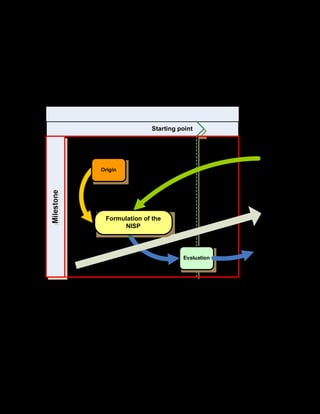
assets, but also on its people, its culture and its ability to plan for the future) and institutional
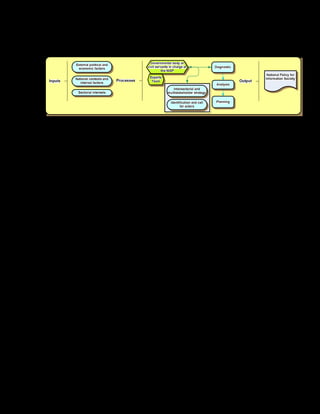
development (the strengthening of links and development of the environments within which
organisations exist) to a broader process involving individuals and communities in poor
countries, strengthening and building their understanding and knowledge of their own needs,
entitlements and rights, and enabling them to organise themselves to respond to this
understanding.
Source: "Capacity building: A buzz word or an aid to understanding?" by Ben Green and Mike Battcock, in
Developments Magazine, 2001. Available at http://www.developments.org.uk/
Civil Society
Civil society commonly embraces a diversity of spaces, actors and institutional forms, varying in
their degree of formality, autonomy and power. Civil societies are often populated by
118
organisations such as registered charities, development non-governmental organisations,
community groups, women's organisations, faith-based organisations, professional associations,
trades unions, self-help groups, social movements, business associations, coalitions and
advocacy groups.
Source: "What is civil society?", initial working definition adopted by the Centre for Civil Society at the
London School of Economics, http://www.lse.ac.uk/collections/CCS/what_is_civil_society.htm
Cultural and Linguistic Diversity
The WSIS Plan of Action states that cultural and linguistic diversity, while stimulating respect for
cultural identity, traditions and religions, is essential to the development of an information society
based on the dialogue among cultures and regional and international cooperation and an
important factor for sustainable development. Websites, online tools and software are dominated
by the use of Latin script. This affects the development of local content in non-Latin languages
and impedes the possibility of intercultural content exchange.
Source: Action line C8 of the WSIS Plan of Action http://portal.unesco.org/ci/en/ev.php-
URL_ID=15927&URL_DO=DO_TOPIC&URL_SECTION=201.html; and APC Internet Rights Charter,
http://www.apc.org/
Creative Commons
Creative Commons is a nonprofit corporation dedicated to making it easier for people to share
and build upon the work of others, consistent with the rules of copyright. It provides free licenses
and other legal tools to mark creative work with the freedom the creator wants it to carry, so
others can share, remix, use commercially, or any combination thereof.
Source: Creative Commons website, http://creativecommons.org/
Community
There are a number of ways of defining communities and together they make up the
interconnected systems of society. Some approaches include: geographic communities (such as
suburbs or towns that are often referred to as "the local communities"); communities of interest,
identity, or circumstance (such as business and its various industrial sectors, and the research
communities); the non-profit and voluntary sectors, which are also known as the community
sector; ethnic and cultural communities; communities of interest such as those for hobbies,
sports or politics; imagine communities (a concept coined by Benedict Anderson which states
that a nation is a community socially constructed, which is to say imagined by the people who
perceive themselves as part of that group); and communities of circumstance, such as youth,
parenthood, senior citizens or the disabled; among other perceptions.
Connectivity
It means the ability to use an electronic network in order to send and receive information
between any locations, devices or business services.
Convergence
Term applied to the way in which computing, telecommunications and television are moving
towards a common technological basis characterized by the use of digital systems.
D
Development
The concept of development is used in a broad range of disciplines, such as biology, natural
sciences, philosophy, economics, telecommunications, and social sciences. In this guide, the
concept “development” is more related to human development than to economic growth. If
economic growth does not always translate into human development, it is essential to conceive
public policies that foster a kind of development that take into account the improvement of the
people’s standard of living and not only the economic growth of the country.
119
Diagnostic
The Diagnostic, also called Assessment Phase, refers to a diagnostic analysis process based on
the situational theory. The Hersey-Blanchard situational theory is a situational leadership theory
developed by Paul Hersey, and Ken Blanchard. They created a model of situational leadership
in the late 1960s that makes it possible to analyze the needs of the situation, then adopt the
most appropriate leadership style. It has been proven popular with managers over the years
because it is simple to understand, and it works in most environments for most people. This
analysis means to identify: the country’s main historical antecedents; the national political
definitions the adopted development models; the progresses in the construction of an
information society; and the obstacles and limitations found in this process.
Source: Wikipedia, The Free Encyclopaedia, http://en.wikipedia.org/wiki/Hersey-
Blanchard_situational_theory
Digital Divide
The term "digital divide" was coined in the 1990s to describe the perceived growing gap between
those who have access to and the skills to use ICT and those who, for socio-economic and/or
geographical reasons, have limited or no access. There was a particular concern that ICT would
exacerbate existing inequalities. A number of areas of specific concern were identified both here
and abroad, namely that people could be disadvantaged by their geographic location, age,
gender, culture and/or economic status.
Digital Literacy
It refers to the ability to use digital technology, communication tools or networks to locate,
evaluate, use and create information.
Disruptive Technology
This term was coined by Clayton M. Christensen to describe a new, low-cost, often simpler
technology that displaces an existing sustaining technology. Disruptive technologies are usually
initially inferior to the technology that they displace, but their low cost creates a market that
induces technological and economic network effects that provide the incentive to enhance them
to match and surpass the previous technology. They create new industries, but eventually
change the world. Examples include the internal combustion engine, transistors and the Internet.
Source: Wikipedia, http://en.wikipedia.org/wiki/Disruptive_technology
E
e-LAC
eLAC is a regionally concerted strategy that conceives of Information and Communications
Technologies (ICTs) as instruments for economic development and social inclusion. It is a
strategy with a long-term vision (until 2015) in line with the Millennium Development Goals
(MDGs) and those of the World Summit on the Information Society (WSIS), which is
concentrated on short-term action plans with concrete qualitative and quantitative goals to be
achieved:
· eLAC2007 with 30 goals and 70 activities for the years 2005-2007
· eLAC2010 with 83 goals to be achieved during the 2008-2010 period.
The eLAC Action Plans aim to:
· 1) Act as a "metaplatform" for public-private action in order to coordinate the efforts of
various sectors, with an end to generating synergies, avoiding the duplication of efforts,
and strengthen regional projects, by means of cooperation and the exchange of best
practices at a regional level.
· 2) Forge national strategies and initiatives in specific areas, establishing lines of action
and defining indicators that illustrate the state of progress in the development of the
information society.
· 3) Deepen knowledge on critical issues in order to support the definition, design,
implementation and evaluation of policies.
120
· 4) Intermediate between the needs of the region's countries and the rhythm of global
development, considering regional particularities within the context of the goals of the
global community.
Source: eLAC page on ECLAC website http://www.eclac.org/socinfo/elac/default.asp?idioma=IN
Enabling Environment
This refers to the national policies, laws, physical infrastructure (roads, electricity, etc.), and
other infrastructure (access to education, access to the Internet, access to banks, etc.) that need
to be in place for people to be able to use ICTs to their advantage.
Source: ICT for Rural Livelihoods, http://www.ict4rl.info/Topics/EnablingEnvironment
e-Crime
Electronic crime covers offences where a computer or other ICT is used as a tool to commit an
offence, is the target of an offence or is used as a storage device in an offence. Source: New
Zealand Police: Services: E-Crime Unit, http://www.police.govt.nz/service/ecrime/
e-GIF - E-government Interoperability Framework
The e-GIF is a significant tool to enable agencies to work together electronically in a spirit of
collaboration. It allows agencies to focus on the business of integrating their services for people
without having to decide on competing technology standards. In the e-government context,
interoperability relates specifically to the electronic systems that support business processes
between agencies and between government and people and business. It does not mean that a
central agency will dictate common systems and processes. Interoperability can be achieved by
the application of a framework of policies, standards and guidelines that leave decisions about
specific hardware and software solutions open for individual agencies or clusters of agencies to
resolve.
Source: E-government Unit, New Zealand, http://www.e-government.govt.nz/docs/e-gif-v-2/chapter4.html
e-Government
Definitions of “e-government” range from “the use of information technology to free movement of
information to surpass the physical bounds of traditional paper and physical based systems” to
“the use of technology to enhance the access to and delivery of government services to benefit
citizens, business partners and employees.” The common theme behind these definitions is that
e-government involves the automation or computerization of existing paper-based procedures
that will prompt new styles of leadership, new ways of debating and deciding strategies, new
ways of transacting business, new ways of listening to citizens and communities, and new ways
of organizing and delivering information. Ultimately, e-government aims to enhance access to
and delivery of government services to benefit citizens. More important, it aims to help
strengthen government’s drive toward effective governance and increased transparency to
better manage a country’s social and economic resources for development
Source: Wikipedia, http://en.wikibooks.org/wiki/E-government/Definition
e-Health
It involves the electronic enablement of the health and disability support services in order to:
empower individuals and their families to manage their own health and participation better;
improve the co-ordination and integration of care delivery to individuals; and allow population
health initiatives such as a disease mapping to occur in a timely fashion.
e-Inclusion
It refers to specific policies to encompass activities related to the achievement of an inclusive
information society.
121
e-Learning
Learning that is facilitated by the use of digital tools and content. Typically, it involves some form
of interactivity, which may include online interaction between the learner and their teacher or
peers. It can also be defines as the delivery of a learning, training or education program by
electronic means. E-learning involves the use of a computer or electronic device (e.g. a mobile
phone) in some way to provide training, educational or learning material.
Source: Derek Stockley (2003), http://derekstockley.com.au/elearning-definition.html
E-learning can also involve a greater variety of equipment than online training or education, for
as the name implies, "online" involves using the Internet or an Intranet. CD-ROM and DVD can
be used to provide learning materials.
e-Readiness
It is the “state of play” of a country’s information and communications technology (ICT)
infrastructure and the ability of its consumers, businesses and governments to use ICT to their
benefit. E-readiness is not simply a matter of the number of computers, broadband connections
and mobile phones in the country (although these naturally form a core component of the
rankings); it also depends on such things as citizens’ ability to utilise technology skillfully, the
transparency of the business and legal systems, and the extent to which governments
encourage the use of technologies.
Source: “2006 e-readiness rankings” by Economist Intelligence Unit,
http://a330.g.akamai.net/7/330/2540/20060424215053/graphics.eiu.com/files/ad_pdfs/2006Ereadiness_R
anking_WP.pdf
e-Europe Initiative
On 8 December 1999 the European Commission has launched an initiative entitled "e-Europe:
An Information Society for All", which proposes ambitious targets to bring the benefits of the
Information Society within reach of all Europeans. The initiative focuses on ten priority areas,
from education to transport and from healthcare to the disabled.
Official website: http://ec.europa.eu/eeurope/
Experts:
An expert is someone widely recognized as a reliable source of technique or skill whose faculty
for judging or deciding rightly, justly, or wisely is accorded authority and status by their peers or
the public in a specific well distinguished domain. An expert, more generally, is a person with
extensive knowledge or ability in a particular area of study. Experts are called in for advice on
their respective subject, but they do not always agree on the particulars of a field of study. An
expert can be, by virtue of training, education, profession, publication or experience, believed to
have special knowledge of a subject beyond that of the average person, sufficient that others
may officially (and legally) rely upon the individual's opinion.
Source: Wikipedia, http://en.wikipedia.org/wiki/Expert
EUREKA
Launched in 1985, EUREKA has already changed the face of pan-European cooperative
research and development. It is a framework through which industry and research institutes from
26 European countries and the European Union develop and exploit the technologies crucial to
global competitiveness and a better quality of life.
Official website: http://www3.eureka.be/Home/
Evaluation
It encompasses a process of judging value on what a NISP has achieved particularly in relation
to activities planned and overall objectives. It involves value judgment and therefore it is different
from monitoring (which is observation and reporting of observations). It is important to identify
the constraints or bottlenecks that hold back the NISP implementation in achieving its goals.
Solutions to the constraints can then be identified and implemented.
122
F
Future Internet
Future Internet is a summarizing term for world-wide research activities dedicated to the further
development of the original Internet. While the technical development of the Internet has been
an extensive research topic from the beginning, an increased public awareness of several critical
shortcomings in terms of performance, reliability, scalability, security and many other categories
including societal, economical and business aspects, has led to Future Internet research efforts.
Given the diversity of technologies related to the Internet, extended by lower and higher layers
and applications, the related research topics are wide spread. The time horizon of Future
Internet studies is typically considered to be long term, taking several years before significant
results can be expected or corresponding deployments take place in the real world.
Source: Wikipedia, http://en.wikipedia.org/wiki/Future_Internet
Framework
It is a basic conceptual structure used to solve or address complex issues. This very broad
definition has allowed the term to be used as a buzzword, especially in a software context and
social sciences.
Source: Wikipedia, http://en.wikipedia.org/wiki/Framework
FOSS - Free and Open Source Software
Free and open source software (FOSS) includes programmes whose licenses give users the
freedom to run, copy, distribute, study, change and improve the software as well as share copies
of either the original or the modified software, under the same license agreement. Free, in this
context, refers to free use and not necessarily “free of charge”.
Source: Free Software Foundation, http://www.fsf.org/licensing/essays/free-sw.html
G
GDP
Gross domestic product is a measure of the size of the economy of a particular territory. It is
defined as the total value of all goods and services produced within that territory during a
specified period (most commonly, per year).
Source: Wikipedia, http://en.wikipedia.org/wiki/Gross_domestic_product
Gender and ICTs
In many societies, women are the most impoverished with the least access to resources and
with little control over decisions that affect their lives. For this reason, women are on the wrong
side of the digital divide, with limited access to and control over ICTs. When considering the
factors that contribute to these inequalities it is important to understand the ways in which ICTs
are allocated between women and men (the gendered allocation of ICTs), the different
opportunities that exist for men and women with respect to education, training and skills
development, employment and working conditions, content development and access to power
structures and decision-making processes. Beyond questions of access to technology and
software, other major concerns may need to be addressed such as the need to break down
gender and cultural barriers to women’s access to careers in technology, or absence of women
in decision-making structures.
Source: GenderIT.org, http://www.genderit.org/en/beginners/whygender.htm, and APC Glossary,
http://www.apc.org/en/glossary/term/328
Governance
Governance refers to all the rules, procedures and practices affecting how powers
are exercised, whether at the international or national level or within an organisation
or network.
Source: Europa glossary, http://europa.eu/scadplus/glossary/governance_en.htm
123
Government
It refers the organisation that is the governing authority of a political unit, the ruling power in a
political society, and the apparatus through which a governing body functions and exercises
authority.
Source: Wikipedia, http://en.wikipedia.org/wiki/Government
G7
It refers to the group of the 7 most developed industrial countries: Canada, France, Germany,
Italy, Japan, United Kingdom, and the United States.
G8
It refers to the group of the 8 leading industrialised nations: Canada, France, Germany, Italy,
Japan, Russia, United Kingdom, and the United States.
I
ICT Sector
In most countries, the ICT sector is an agglomeration of the communications sector, including
telecommunications providers, and the information technology sector, which ranges from small
software development firms to multi-national hardware and software producers.
Source: “Growth and Innovation Framework” by the Ministry of Economic Development, New Zealand,
http://www.med.govt.nz/templates/ContentTopicSummary____566.aspx
ICT Policy
It refers to those plans of actions to guide decisions and achieve rational outcomes on ICT
related areas. Usually, it covers three main areas: telecommunications (especially telephone
communications), broadcasting (radio and TV) and the internet. It may be national, regional or
international. Each level may have its own decision-making bodies, sometimes making different
and even contradictory policies. ICT policy is formally put in place by governments, but
increasingly in most contexts, different stakeholders including the private sector and civil society
make inputs into the policy process, thereby affecting its outcomes.
Source: APC, www.apc.org
ICT Taskforce
In March 2001, the Economic and Social Council requested the Secretary-General to establish
an Information and Communication Technologies (ICT) Task Force. This initiative is intended to
lend a truly global dimension to the multitude of efforts to bridge the global digital divide, foster
digital opportunity and thus firmly put ICT at the service of development for all. The Task Force
is supported by the Heads of State and Government of all UN Member States who endorsed the
ECOSOC Ministerial Declaration at the Millennium Summit in September 2000.
Official website: http://www.unicttaskforce.org/
In New Zealand, this group was established in response to the government's Growth and
Innovation Framework. It has four related goals, which are to enhance the existing innovation
framework, develop skills and talent, increase global connectedness and focus effort for
maximum gain. The Taskforce comprised a tightly focused group of New Zealand ICT business
leaders with relevant commercial experience. It reported into the growth potential of New
Zealand ICT and identified the collective private sector and government contributions needed to
achieve this potential.
Source: “ICT Taskforce, Breaking through the Barriers” (2003),
http://www.nzte.govt.nz/section/13680.aspx
Information
This term has many meanings depending on the context. For example, it is often related to such
concepts as meaning, knowledge, communication, truth, representation, and mental stimulus.
124
See also Information Society and ICT.
Source: Wikipedia, http://en.wikipedia.org/wiki/Information
Information literacy
It refers to the life-long ability to locate, evaluate, use and create information.
Information Society
A term for a society in which the creation, distribution and manipulation of information has
become the most significant economic and cultural activity. An Information Society may be
contrasted with societies in which the economic underpinning is primarily industrial or agrarian.
The machine tools of the Information Society are computers and telecommunications, rather
than lathes or ploughs.
Source: A Whatis Definition, http://whatis.techtarget.com/definition/0,,sid9_gci213588,00.html Manuel
Castells (2000), a well known Spanish sociologist that has deeply analyzed this knowledge area,
prefers the term “informational society” to “information society” (establishing the comparison with
the difference between industry and industrial). He states that while knowledge and information
are decisive elements in all modes of development, “the term informational indicates the attribute
of a specific form of social organization in which information generation, processing, and
transmission are transformed into the fundamental sources of productivity and power, due to the
new technological conditions that arise during this historic period.”
ICT - Information and Communications Technology (or technologies)
It is an umbrella term that includes all technologies for the manipulation and communication of
information.
Source: Wikipedia, http://en.wikipedia.org/wiki/Information_and_Communication_Technologies
Information, Communication Technology (ICT) goods
ICT goods are those that are either intended to fulfil the function of information processing and
communication by electronic means, including transmission and display, OR which use
electronic processing to detect, measure and/or record physical phenomena, or to control a
physical process. ICT goods are defined by the OECD in terms of the United Nations
Harmonised System.
Source: OECD Glossary for Statistical Terms, http://stats.oecd.org/glossary/detail.asp?ID=6274
Innovation
The term means a new way of doing something. It may refer to incremental, radical, and
revolutionary changes in thinking, products, processes, or organizations. Colloquially, the word
"innovation" is often synonymous with the output of the process. However, economists tend to
focus on the process itself, from the origination of an idea to its transformation into something
useful, to its implementation; and on the system within which the process of innovation unfolds.
Since innovation is also considered a major driver of the economy, especially when it leads to
increasing productivity, the factors that lead to innovation are also considered to be critical to
policy makers.
Source: Wikipedia, http://en.wikipedia.org/wiki/Innovation
Innovating firm, technological product and process
A technological product and process innovating firm is one that has implemented technologically
new or significantly technologically improved products or processes during the period under
review.
Source: OECD, http://stats.oecd.org/glossary/search.asp
IDB - Inter-American Development Bank
The IDB (although sometimes found abbreviated as IADB), is an international organization
established and headquartered in Washington, D.C., United States, in 1959 to support Latin
American and Caribbean economic and social development and regional integration by lending
125
mainly to governments and government agencies, including State corporations. Source:
Wikipedia, http://en.wikipedia.org/wiki/Inter-American_Development_Bank
Intellectual property
Very broadly, it means the legal rights that result from intellectual activity in the industrial,
scientific, literary and artistic fields. Countries have laws to protect intellectual property, for two
main reasons: to give statutory expression to the moral and economic rights of creators in their
creations and the rights of the public in access to those creations; and to promote, as a
deliberate act of government policy, creativity and the dissemination and application of its
results, and encourage the fair trading that contributes to economic and social development.
Intellectual property is traditionally divided into two branches: industrial property and copyright.
Industrial property includes inventions (patents), trademarks, industrial designs and geographic
indications of source and copyright includes literary and artistic works.
Source: “WIPO Intellectual Property Handbook: Policy, Law and Use” by WIPO, http://www.wipo.int/about-
ip/en/iprm/
Inter-modal competition
This refers to competition between dissimilar technologies, such as ADSL and wireless
technologies. Intra-modal competition refers to competition between similar technologies.
Interoperability
It is the ability of two or more systems or components to exchange information and to use the
information that has been exchanged.
Source: Software Engineering Institute, Carnegie Mellon University,
http://www.sei.cmu.edu/str/index.html
IP - Internet Protocol
The IP is a network-layer protocol that contains addressing information and some control
information that enables packets of data to be routed between hosts on the Internet.
Source: Cisco Systems Inc., http://www.cisco.com/univercd/cc/td/doc/cisintwk/ito_doc/ip.htm
Internet Governance
The definition of Internet governance has been contested by differing groups across political and
ideological lines. One of the key debates centers on the authority and participation of certain
actors, such as national governments and corporate entities, to play a role in the Internet's
governance. A Working Group established after a United Nations-initiated World Summit on the
Information Society (WSIS) proposed the following definition of Internet governance as part of its
June 2005 report: Internet governance is the development and application by Governments, the
private sector and civil society, in their respective roles, of shared principles, norms, rules,
decision-making procedures, and programmes that shape the evolution and use of the Internet.
Source, Wikipedia, http://en.wikipedia.org/wiki/Internet_governance
IANA - The Internet Assigned Numbers Authority
The IANA is the entity that oversees global IP address allocation, root zone management for the
Domain Name System (DNS), media types, and other Internet protocol assignments. It is
operated by the Internet Corporation for Assigned Names and Numbers, better known as
ICANN. Prior to the establishment of ICANN for this purpose, IANA was administered primarily
by Jon Postel at the Information Sciences Institute at the University of Southern California, under
a contract USC/ISI had with the United States Department of Defense, until ICANN was made to
assume the responsibility under a United States Department of Commerce contract.
Source: Wikipedia, http://en.wikipedia.org/wiki/Internet_Assigned_Numbers_Authority
ICANN - the Internet Corporation for Assigned Names and Numbers
ICANN is the Internet Corporation for Assigned Names and Numbers. Headquartered in Marina
Del Rey, California, United States, ICANN is a non-profit corporation that was created on
126
September 18, 1998 in order to oversee a number of Internet-related tasks previously performed
directly on behalf of the U.S. government by other organizations, notably the Internet Assigned
Numbers Authority (IANA). ICANN's tasks include responsibility for Internet Protocol (IP)
address space allocation, protocol identifier assignment, generic (gTLD) and country code
(ccTLD) Top Level Domain name system management, and root server system management
functions. More generically, ICANN is responsible for managing the assignment of domain
names and IP addresses. To date, much of its work has concerned the introduction of new
generic top-level domains. The technical work of ICANN is referred to as the IANA function.
ICANN's other primary function involves helping preserve the operational stability of the Internet;
to promote competition; to achieve broad representation of global Internet community; and to
develop policies appropriate to its mission through bottom-up, consensus-based processes.
Source: Wikipedia, http://en.wikipedia.org/wiki/ICANN
IETF - the Internet Engineering Task Force
The Internet Engineering Task Force (IETF) develops and promotes Internet standards,
cooperating closely with the W3C and ISO/IEC standard bodies and dealing in particular with
standards of the TCP/IP and Internet protocol suite. It is an open standards organization, with no
formal membership or membership requirements.
Source: Wikipedia, http://en.wikipedia.org/wiki/Internet_Engineering_Task_Force
ITU - International Communication Union
ITU is the leading United Nations agency for information and communication technology issues,
and the global focal point for governments and the private sector in developing networks and
services. For nearly 145 years, ITU has coordinated the shared global use of the radio spectrum,
promoted international cooperation in assigning satellite orbits, worked to improve
telecommunication infrastructure in the developing world, established the worldwide standards
that foster seamless interconnection of a vast range of communications systems and addressed
the global challenges of our times, such as mitigating climate change and strengthening
cybersecurity. ITU also organizes worldwide and regional exhibitions and forums, such as ITU
TELECOM WORLD, bringing together the most influential representatives of government and
the telecommunications and ICT industry to exchange ideas, knowledge and technology for the
benefit of the global community, and in particular the developing world.
Source: ITU website, http://www.itu.int/net/about/index.aspx
Inter-operability
Devices, in particular application programmes, are inter-operable when, in addition to
communicating with each others, they can also execute together a common task. They co-
operate. This requires additional standards, such as API (Application Programme Interfaces).
Source: EUROPA - Europe's Information Society Thematic Portal, http://europa.eu/scadplus/glossary/.htm
i2010 - A European Information Society for 2010
The i2010 is the European Commission's new strategic framework for the information and media
society, launched in June 2005. It centres on three priorities: completing a single European
information space which will encourage an open, competitive internal market for the information
and media society; promoting innovation and investment in research into information and
communication technologies (ICT); creating a European information society based on inclusion
and stressing better public services and quality of life. i2010 is the first initiative taken by the
Commission within the renewed Lisbon partnership for growth and employment. This strategy
follows on from two action plans, eEurope 2002 and eEurope 2005, which set out the steps to be
taken to promote ICT in Europe.
Source: Europa Glossary, http://europa.eu/scadplus/glossary/infoso_media_policy_guidelines_en.htm
J
Joint Africa-EU Strategy:
127
The European Union and the African Union have decided to further strengthen the ties linking
both continents by developing a ‘co-owned joint strategy’ which reflects the needs and
aspirations of the peoples of Africa and Europe. The purpose of this Joint Strategy is to develop
a political vision and practical approaches for the future partnership between the EU and Africa,
based on mutual respect, common interests and the principle of ownership. The negotiations on
the Joint Strategy have been ongoing since February 2007, and a first draft was approved in
May 2007. The final Strategy was therefore adopted at the EU-Africa Summit which was held in
Lisbon in December 2007.
Source: Eurafrica.net, http://europafrica.net/jointstrategy/
K
Knowledge
It is built up from interaction with the world, and is organised and stored in each individual's
mind. It is also stored on an organisational level within the minds of employees and in paper and
electronic records. Two forms of knowledge can be distinguished: tacit, or implicit knowledge,
which is held in a person's mind and is instinctively known without being formulated into words;
and explicit knowledge, which has been communicated to others and is held in written
documents and procedures. Organisations are increasingly recognising the value of knowledge,
and many employees are now recognised as knowledge workers.
Strategic knowledge
It is concerned with the decisions made during the conceptual design phase and is used for
deciding the course of action when there are conflicting criteria. Strategic knowledge is used by
the designer to decide what actions to perform in a given situation, where actions are considered
to have observable consequences.
Source: Faculty of Architecture, Design and Planning, University of Sydney,
http://faculty.arch.usyd.edu.au/kcdc/conferences/SKCF/SKCFIntro.html
Knowledge society
A society that creates, shares and uses knowledge for the prosperity and well-being of its
people. Knowledge societies have the characteristic that knowledge forms a major component of
any human activity. Economic, social, cultural, and all other human activities become dependent
on a huge volume of knowledge and information. A knowledge society is one in which
knowledge becomes a major creative force.
Source: Wikipedia, http://en.wikipedia.org/wiki/Knowledge_society
M
M-Government
As an integral part of the e-government program, many central and local governments in the
world start to offer e-government services via a variety of service delivery channels apart from
the Web. One of these service delivery channels is mobile telephony. Use of mobile telephony in
delivering e-government services gave birth to the mobile government or m-government.
Source: m-Government: Definition and Perspectives
The Development Gateway, www.developmentgateway.org/e-government
Matrix
It is a broad term that means the place in which material things or concepts are developed or
formed. In this case, it is the context in which policies are conceived and put into action.
Methodology
In this guide, it refers to pubic policy specific analysis techniques.
128
Monitoring
It is the regular observation and recording of activities taking place in a project or programme. It
is a process of routinely gathering information on all aspects of the project. In this case, to
monitor is to check on how NISP’s activities are progressing. Monitoring also involves giving
feedback about the progress of the NISP to the stakeholders, implementers and beneficiaries of
the project. Reporting enables the gathered information to be used in making decisions for
improving the NISP’s performance.
Source: The Nature of Monitoring and Evaluation, by Phil Bartle, http://www.scn.org/cmp/modules/mon-
wht.htm
N
NISPs - National Information Society Policies
NISPs can be defined as a coherent set of public strategies to promote the growth of an
Information Society oriented to the overall and interrelated social, political, human, and
technological development in each society, which development motor is the production use and
equitable exploitation of knowledge by all the social sectors. These public policies are generally
based on the assumption that knowledge- based goods and services integrate the central
structure of the new economy, in which information and knowledge, exchanged and
disseminated through ICT-based networks, will constitute the main input for society
development.
Next Generation Internet
Next Generation Internet is a term used by governments, corporations and educators to describe
the future network and the work underway to develop it. The future Internet will be so pervasive,
reliable and transparent that it will be taken for granted. It will be a seamless part of life much
like electricity or plumbing. However, getting to this will involve exploring technologies and
network capacities that are in advance of offerings from commercial providers in terms of
bandwidths, communications protocols and services.
O
OECD - Organisation for Economic Co-operation and Development
OECD comprises 30 member countries sharing a commitment to democratic government and
the market economy. Its work covers economic and social issues, from macroeconomics to
trade, education, development and science and innovation.
Source: OECD, http://www.oecd.org/about/0,2337,en_2649_201185_1_1_1_1_1,00.html
P
Political agenda
It refers to a set of issues and policies laid out by either the executive or cabinet in government
which tries to dictate existing and near-future political news and debate. The political agenda
while shaped by government can be influenced by grass-roots support from party activists at
events such as a party conference and can even be shaped by non governmental activist groups
which have a political aim.
Source: Wikipedia, http://dictionary.babylon.com/Political%20agenda
Propositive Matrix
It is the third phase of the NISP formulation process, which follows the Diagnostic and the
Analysis. It is a logical framework that explicits the NISP proposals, identifies and suggests
129
accelerator factors to reach the desired goals (Accelerator factors are those elements or
measures that remove the identified obstacles). The Propositive Matrix confronts the ideal
Information Society model drafted in the Analytical phase with the possible obstacles that will
have to be overcome, and identifies the accelerator factors which will be used to reach the goals
more rapidly and efficiently.
Public sector
The public sector comprises the general government sector plus all public corporations including
the central bank.
Source: OECD, http://stats.oecd.org/glossary/search.asp
Public policy
In any society, governmental entities enact laws, make policies, and allocate resources. This is
true at all levels. Public policy can be generally defined as a system of laws, regulatory
measures, courses of action, and funding priorities concerning a given topic promulgated by a
governmental entity or its representatives.
Public policies can also be defined as public policies can be defined as the body of principles
that underpin the operation of legal systems in each state
Source: Dean G. Kilpatrick, Definitions of Public Policy and the Law,
http://www.musc.edu/vawprevention/policy/definition.shtml and Wikipidia,
http://en.wikipedia.org/wiki/State_(law)
R
Radio frequency
It refers to a location or band on the radio frequency spectrum, such as 800, 900 or 1800Mhz.
RFID - Radio Frequency Identification
It first appeared in tracking and access applications during the 1980s. These wireless systems
allow for non-contact reading and are effective in manufacturing and other hostile environments
where barcode labels may not survive. RFID has established itself in a wide range of markets
including livestock identification and automated vehicle identification systems because of its
ability to track moving objects.
Source: AIM - The Global Trade Association for Automatic Identification,
http://www.aimglobal.org/technologies/rfid/
Roadmap
A roadmap is a detailed plan to guide progress toward a goal; a set of guidelines, instructions, or
explanations.
Source: Merriam-Webster Dictionary Online, http://www.merriam-webster.com/dictionary/roadmap
S
Sectoral:
A distinct part, especially of society or of a nation's economy
Source: Dictionary.com, http://dictionary.reference.com/browse/Sectoral
SMEs
SMES are small and medium-sized enterprises. Their size varies in diverse countries. They are
usually taken to be firms of up to 50 full-time equivalent employees (FTEs).
Stakeholder
A person, group, organization, or system who affects or can be affected by an organization's
actions.
130
Source: Wikipedia, the Free Encyclopedia, http://en.wikipedia.org/wiki/Stakeholder
Stakeholder theory
The stakeholder theory is a theory of organizational management and business ethics that
addresses morals and values in managing an organization. It was originally detailed by R.
Edward Freeman in the book Strategic Management: A Stakeholder Approach, and identifies
and models the groups which are stakeholders of a corporation, and both describes and
recommends methods by which management can give due regard to the interests of those
groups. In short, it attempts to address the "Principle of Who or What Really Counts." The
concept identifies and models the groups which are stakeholders of a corporation or project.
Source: Wikipedia, the Free Encyclopedia, http://en.wikipedia.org/wiki/Stakeholder
Stakeholder analysis
It is the process of identifying those affected by a project or event.
Source: Wikipedia, the Free Encyclopedia, http://en.wikipedia.org/wiki/Stakeholder
Strategic use
Strategic use of information and communication technologies by civil society organisations
(CSOs) is not technology-driven; it requires a deep understanding of the context in which the
technology is being deployed. It means ensuring that tools and technologies that can support
CSOs in meeting their strategic objectives (or mission) exist and are available and accessible.
Availability and accessibility covers a range of factors, such as infrastructure, cost, intellectual
property dispensations, and adherence to standards. Strategic use also requires that CSOs are
aware of the range of technology options available and have the skills and knowledge to use
them effectively and securely, and that they understand their own organisational context and
needs.
Source: APC Annual Report 2005, http://www.apc.org/
T
Telematics
It refers to the integrated use of telecommunications and informatics (see also ICT - Information
and Communications Technology). More specifically it is the science of sending, receiving and
storing information via telecommunication devices.
Source: Wikipedia, http://en.wikipedia.org/wiki/Telematic
Telematics Infrastructure
It refers the assemblage of telecommunications and information-processing systems and
services that offers a base for telematics applications.
Source: EUROPA - Europe's Information Society Thematic Portal,
http://ec.europa.eu/information_society/index_en.htm
Telework
Telework may be broadly defined as work undertaken by an individual for an employer or client
that is mostly performed at a location other than the traditional workplace, using information and
communication technology. It can encompass a variety of working arrangements, including
home-working; telecottages/telecentres; and working from satellite offices in different locations.
Teleworkers may be company employees or self-employed.
Source: European Foundation for the Improvement of Living and Working Conditions,
http://www.eurofound.europa.eu/ewco/balance/telework/index.htm
Template
131
It is a design pattern that defines a structure to define series of phases, redefined in subclasses.
U
UNCTAD - United Nations Conference on Trade and Development
Established in 1964, UNCTAD promotes the development-friendly integration of developing
countries into the world economy. UNCTAD has progressively evolved into an authoritative
knowledge-based institution whose work aims to help shape current policy debates and thinking
on development, with a particular focus on ensuring that domestic policies and international
action are mutually supportive in bringing about sustainable development.
Source: UNCTAD , http://www.unctad.org/Templates/StartPage.asp?intItemID=2068
UNDP - United Nations Development Program
UNDP is the UN's global development network, an organization advocating for change and
connecting countries to knowledge, experience and resources to help people build a better life.
Official website: UNDP, http://www.undp.org
UNESCO - United Nations Educational, Scientific and Cultural Organisation
This specialized United Nations agency, founded in 1945, currently functions as a laboratory of
ideas and a standard-setter to forge universal agreements on emerging ethical issues.
Official website: UNDP, http://www.unesco.org/
UNECA, United Nations Economic Commission for Africa
The Economic Commission for Africa (ECA) was established by the Economic and Social
Council (ECOSOC) of the United Nations (UN) in 1958 as one of the UN's five regional
commissions. ECA's mandate is to promote the economic and social development of its member
States, foster intra-regional integration, and promote international cooperation for Africa's
development. ECA's dual role as a regional arm of the UN, and a part of the regional institutional
landscape in Africa, positions it well to make unique contributions to member States' efforts to
address their development challenges. Its strength derives from its role as the only UN agency
mandated to operate at the regional and subregional levels to harness resources and bring them
to bear on Africa's priorities.
Source: UNECA, http://www.uneca.org/aisi/
Universal Service
This refers to a set of basic services that have to be made available at an affordable price to all
users by public or private operators irrespective of the user's geographical location.
Usability
It is a term used to denote the ease with which people can employ a particular tool or other
human-made object in order to achieve a particular goal. Usability can also refer to the methods
of measuring usability and the study of the principles behind an object's perceived efficiency or
elegance. In human-computer interaction and computer science, usability usually refers to the
elegance and clarity with which the interaction with a computer programme or a website is
designed.
Source: Wikipedia, http://en.wikipedia.org/wiki/Usability
W
132
WSIS - World Summit on the Information Society
WSIS was a global series of events which were held in two phases. The first phase took place in
Geneva in December 2003 and the second phase will take place in Tunis in November 2005.
The objective of the first phase was to develop and foster a clear statement of political will and
take concrete steps to establish the foundations for an Information Society for all, reflecting all
the different interests at stake. The second phase involved a process of monitoring and
evaluation of the progress of feasible actions outlined in Geneva and a concrete set of
deliverables that were to be achieved by the time the Summit met again in Tunis in November
2005.
Source: World Summit on the Information Society, http://www.itu.int/wsis/basic/about.html
Other Glossaries and related resources
· Europa Glossary at http://europa.eu/scadplus/glossary/governance_en.htm
· Multilingual glossary on EU institutions, policies and enlargement (11 languages)
· CORDIS (Community Research and Development Information Services), through the “A-
Z Index” at http://www.cordis.lu/guidance/a-zindex.htm and the “Thematic Index” at
http://www.cordis.lu/guidance/thematic_index.htm
· The Association for Progressive Communications (APC) Glossary at
http://www.apc.org/en/glossary
133
REFERENCES
Declarations & Commitments
“Accra Commitments for WSIS Tunis 2005,” signed at the Africa Regional Conference,
preparatory to the second phase of the World Summit on the Information Society, held at the
Accra, Republic of Ghana from February 2-4, 2005. Available at
http://www.uneca.org/aisi/docs/AccracommittmentsEN.pdf (29/03/09)
“Declaration of Principles, Building the Information Society: a global challenge in the new
Millennium,” endorsed at World Summit on the Information Society (WISIS), held December
12, 2003 in Geneva. Available at:
http://www.icsu.org/Gestion/img/ICSU_DOC_DOWNLOAD/49_DD_FILE_Decl_of_Principles
_12.12.03.pdf (29/03/09)
“San Salvador Commitment,” adopted at the Second Ministerial Conference on the Information
Society in Latin America and the Caribbean, held in San Salvador, February 6-8, 2008.
Available at: http://www.eclac.org/socinfo/noticias/noticias/3/32363/2008-2-TICs-
San_Salvador_Commitment.pdf (29/03/09)
“Tunis Commitment,” endorsed at the second phase of the World Summit on the Information
Society, held at Tunis from November 16-18, 2005. Available at:
http://www.itu.int/wsis/docs2/tunis/off/7.html (29/03/09)
“The Tokyo Declaration - the Asia-Pacific perspective to the WSIS,” endorsed at the Asia-Pacific
Regional Conference, held in Tokyo, Japan from January 13-15, 2003. Available at:
http://www.unescap.org/icstd/documents/declarations/tokyo_declaration.pdf (29/03/09)
Documents, Papers & Books
Adam, L.; James, T.; and Munyua Wanjira, A. 2007. “Frequently Asked Questions about Multi-
Stakeholder Partnerships in ICTs for Development: A guide for national ICT policy
animators”, APC-CATIA. Available at:
http://www.apc.org/es/system/files/catia_ms_guide_EN-1.pdf (29/03/09)
African Information Society Initiative 1999. “National Information and Communication
Infrastructure: Policies and Plans (NICI)”, Addis-Ababa: United Nations Economic
Commission for Africa (UNECA).
AGESIC 2008. “Agenda Digital Uruguay 2008-2010 para la Sociedad de la Información y el
Conocimiento (ADU 2008-2010),” Agencia para el Desarrollo del Gobierno de Gestión
Electrónica y la Sociedad de la Información y del Conocimiento, Montevideo. Available at:
http://www.agesic.gub.uy/Sitio/descargas/Agenda_Digital_08-10.pdf (29/03/09)
Bartle, P. 2007. “The Nature of Monitoring and Evaluation: Definition and Purpose,” article
published at the Community Empowerment website. Available at:
http://www.scn.org/cmp/modules/mon-wht.htm (29/03/09)
Beech, J.; Artopoulos, A.; Davidziuk, A. 2008. “Estudio de Factibilidad del Proyecto de
Formación en Informática para jóvenes en situación de vulnerabilidad social. Módulo I:
Demanda laboral en la industria del software y servicios informáticos en la Argentina.
Situación actual y perspectivas”, Escuela de Educación, Universidad de San Andrés,
Argentina. Documento de Trabajo.
134
Bindé, Jerome, et. Al. 2005: “Towards Knowledge Societies”, UNESCO, Paris.
Bodi, G. 2008. “Digital (R)evolution: Hungarian Information Society Strategies”, in National
Information Society Experiences (NISE 08), IT STAR WS, Godollo, Hungary
Burch, S. 2005. Word Matters: multicultural perspectives on information societies. Coordinated
by Alain Ambrosi, Valérie Peugeot and Daniel Pimienta, C & F Éditions.
Checchi, R.; Sevcik, G.; Loch, K.; Straub, D. 2002. “An Instrumentation Process for Measuring
ICT Policies and Culture,” J. Mack Robinson College of Business, Georgia State University.
Available at: http://www.cis.gsu.edu/~dstraub/Research/ACIT-
APIT/Endnote/Publications/Checchi(2002).pdf (29/03/09)
Castells, M. 2000. The Rise of the Network Society, The Information Age: Economy, Society and
Culture Vol. I. Cambridge, MA; Oxford, UK: Blackwell.
Corral, M.; Perfetti; and Ochoa, E. 1999. Metodología para la formación de política pública en el
área social, Corporación para el Desarrollo Humano, Proyecto PNUD Col 95-007. Bogotá.
Davidziuk, A. 2007. "Towards Adapting Gender Evaluation Methodology for Telecentres",
background paper presented at the APC WNSP First Global Training Exchange, Kuala
Lumpur, July 2007.
Davidziuk, A. 2007. “Apropiación de las tecnologías móviles desde una espejo lejano: infiltración
barroca, creolización y canibalismo: una reseña” Journal of Community Informatics - Special
issue: Community Informatics in Latin America and the Caribbean, 3(3). Available online at:
http://ci-journal.net/index.php/ciej/article/view/455/344 (29/03/09)
Davidziuk, A. 2007. “Regional and Bilateral Trade Agreements at Crossroads – Tip-off to
Preserve and Promote Diversity in Audiovisual Services”, report commissioned by the Social
Science Research Council (SSRC) and CRIS Campaigmand. It was selected to be
presented at the Pre-Conference Media Policy Research, January 11 2007, Memphis, US.
Dutta, S. and Coury, M. E. 2003. “Chapter 8: ICT Challenges for the Arab World,” in The Global
Information Technology Report, New York: Oxford University Press.
http://www.mafhoum.com/press7/218T42.pdf (29/03/09)
EC 2005a. “i2010 in context: ICT and Lisbon Strategy. Lisbon,” article published at the Europe’s
Information Society Thematic Portal. Available at:
http://ec.europa.eu/information_society/eeurope/i2010/ict_and_lisbon/index_en.htm
(29/03/09)
EC 2005b. “The new Integrated economic and employment guidelines,” European Commission
MEMO/05/123, Brussels, Available at:
http://europa.eu/rapid/pressReleasesAction.do?reference=MEMO/05/123&format=PDF&age
d=1&language=EN&guiLanguage=en (29/03/09)
EC 2006. “i2010 Benchmarking Framework,” based on a list of key indicators endorsed by the
i2010 High Level Group, European Commission. Available at:
http://ec.europa.eu/information_society/eeurope/i2010/docs/benchmarking/060220_i2010_b
enchmarking_framework_nov_2006.doc (20/03/09)
EC 2007. “eEurope 2005 Final Evaluation,” European Commission DG Information Society,
Stockholm. Available at:
135
http://ec.europa.eu/dgs/information_society/evaluation/data/pdf/studies/s2005_01/eeurope20
05_final_report.pdf (29/03/09)
ECLAC 2005. “eLAC- Strategy for the Information Society in Latin America and the Caribbean,”
Economic Commission for Latin America and the Caribbean (ECLAC). Available at:
http://www.eclac.org/socinfo/elac/default.asp?idioma=IN (29/03/09)
ECLAC 2007a. “Plan of Action for the Information Society in Latin America and the Caribbean
eLAC 2007,” Economic Commission for Latin America and the Caribbean (ECLAC).
Available at:
http://www.eclac.org/socinfo/noticias/documentosdetrabajo/5/21685/eLAC%202007%20Engl
ish.pdf (29/03/09)
ESCAP 2007b. “Guidelines on ICT Application for Trade and Transport Facilitation for
Landlocked Countries in the Asia and Pacific Region,” United Nations Economic and Social
Commission for Asia and the Pacific (ESCAP). Available
at: http://www.unescap.org/icstd/pubs/ict_guidelines_for_ttf.pdf (29/03/09)
ESCAP 1999. “Considerations for ICT policy formulation in developing countries,” in Economic
and Social Survey of Asia and the Pacific 1999, United Nations Economic and Social
Commission for Asia and the Pacific (ESCAP). Available at:
http://www.unescap.org/Stat/gc/box-ch8.asp (29/03/09)
ESCAP 2004. “Good Practices in Information and Communication Technology Policies in Asia
and the Pacific: Promotion of Enabling Policies and Regulatory Frameworks for Information
and Communication Technology Development in the Asia-Pacific Region,” United Nations
Economic and Social Commission for Asia and the Pacific (ESCAP). Available at:
http://www.unescap.org/icstd/pubs/st_escap_2347.pdf (29/03/09)
ESCAP 2007. “Internet Use for Business Development an Introductory Set of Training Modules
for Policymakers,” United Nations Economic and Social Commission for Asia and the Pacific
(ESCAP). Available at: http://www.unescap.org/icstd/policy/publications/internet-use-for-
business-development/Complete-document.pdf (29/03/09)
ESCWA 2005. “Information Society Indicators,” Economic and Social Commission for Western
Asia, United Nations. Available at:
http://www.escwa.un.org/information/publications/edit/upload/ictd-05-1.pdf (29/03/09)
European Communities 2005. “Integrated Guidelines For Growth And Jobs (2005–08),”
Communication to the Spring European Council, European Commission, Brussels. Available
at: http://ec.europa.eu/growthandjobs/pdf/integrated_guidelines_en.pdf (29/03/09)
Fernandez-Aballi, I. (ed.) 2007. “Building National Information Policies: Experiences in Latin
America,” Information Society Division, Communication and Information Sector, Kingston:
UNESCO. Available at: http://unesdoc.unesco.org/images/0015/001528/152806m.pdf
(29/03/09)
Findlay, R. 2007. “ICT Development and Implementation Methodology. Quick Wins & Fast-Track
Initiatives,” presentation at the Caribbean Internet Forum, at St. Lucia, Nov 5-6, 2007.
Available at: www.cif.tt/2007/day1/RickFindlay.ppt (29/03/09)
Finquelievich, S. 2005. “Proposed Strategies for the Information Society in the South,” in
Information Society in the South: Vision or Hallucination? Montevideo: Instituto del Tercer
Mundo (ITeM). Available at: http://www.choike.org/nuevo_eng/informes/3592.html
(29/03/09)
136
Finquelievich, S. 2005. E-Gobierno y E-Política en América Latina, (E-government and E-Politics
in Latin America), Finquelievich, S. (ed.), LINKS Ediciones, electronic book, Buenos Aires.
Available at: http://www.links.org.ar/infoteca/E-Gobierno-y-E-Politica-en-LATAM.pdf (29/03/09)
Finquelievich, S. (2007): “Iniciativas para acceder a la Sociedad de la Información. Sistemas
sociales de respuesta a necesidades de conectividad” (Initiatives to access Information Society.
Social Systems as answers to connectivity needs), in Finquelievich, S.; Finquelievich, D.,
Kaufman, E. (eds.) Políticas Públicas y tecnologías, La Crujía, Buenos Aires.
Friedewald, M. 2004. “Benchmarking national and regional policies in support of the
competitiveness of the ICT sector in the EU,” Interim Report. Prepared for European
Commission, Directorate-General Enterprises, Karlsruhe. Available at:
http://ec.europa.eu/enterprise/ict/policy/ict-policies/int_rep_fin.pdf (29/03/09)
Gillwald, A. and Abrahams, L. 2003. “Creating an ICT Public Policy Knowledge Base for African
Decision-Makers,” Link Public Policy Research Paper No. 1. Available at:
http://link.wits.ac.za/papers/agla2003.pdf (29/03/09)
Gómez, R. and Martínez, J. 2001. “Internet... ¿para qué?: Pensando las TIC para el desarrollo
en América Latina y Caribe”, IDRC and Fundación Acceso.
Government of Kerala 2007. “Information Technology Policy: Towards an inclusive knowledge
society,” report from the Department of Information Technology. Available at:
http://www.kerala.gov.in/annualprofile/it_07.pdf (29/03/09)
Guerra, M.; Hilbert, M.; Jordán, V.; and Nicolai, C. 2008. “Panorama Digital 2007 de América
Latina y el Caribe – CEPAL Avances y desafíos de las políticas para el desarrollo con las
Tecnologías de Información y Comunicaciones,” Santiago de Chile: Naciones Unidas.
Available at: http://www.eclac.org/publicaciones/xml/6/34726/W210.pdf (29/03/09)
Gupta, M. 2005. “i2010 - The EU's new ICT strategy,” article published at Eurescom. Available
at:
http://www.eurescom.de/message/messageOct2005/i2010_The_EUs_new_ICT_strategy.as
p (29/03/09)
Hilbert, M. and Katz, J. 2002. “Toward a Conceptual Framework and Public Policy agenda for
the Information Society in Latin America and the Caribbean,” Division of Production,
Productivity and Management, Restructuring and Competitiveness Network, ECLAC,
Santiago: United Nations. Available at:
http://www.eclac.org/publicaciones/xml/1/11301/LCL1807.pdf (29/03/09)
Hilbert M.; Bustos, S.; and Ferraz J. C. 2005. “Estrategias nacionales para la sociedad de la
información en América Latina y el Caribe,” División Desarrollo Productivo y Empresarial,
CEPAL, Santiago: United Nations. Available at:
http://www.cedi.uchile.cl/catalogo/downloads/politicas20publicas.esp.pdf (29/03/09)
Holcombe, R. 1997. “A Theory of the Theory of Public Goods,” Review of Austrian Economics
10(1): 1-22.
Horsch, K. 1997. “Indicators: Definition and Use in a Results-Based Accountability System,“
Harvard Family Research Project. Available at: http://www.hfrp.org/publications-
resources/browse-our-publications/indicators-definition-and-use-in-a-results-based-
accountability-system (29/03/09)
137
Howkins J. and Valantin R. 1997. “Development and the Information Age: Four Global Scenarios
for the Future of Information and Communication Technology,” prepared for IDRC and the
United Nations Commission on Science and Technology for Development. Available at:
http://www.idrc.ca/en/ev-28771-201-1-DO_TOPIC.html (29/03/09)
Iceland Prime Minister's Office, 1996. “Vision of the Information Society” in Information Society
section. Available at: http://eng.forsaetisraduneyti.is/information-society/English/nr/890
(29/03/09)
ISD 2006. “Information Society Strategy (2006-2010),” Information Society Department, e-
Transformation Turkey Executive Board. Available at:
http://www.bilgitoplumu.gov.tr/eng/docs/Information_Society_Strategy.pdf (29/03/09)
ITU, 2009. “Regional Initiatives,” article at the Connect Arab States Summit 2011 section,
International Telecommunication union website. Available at: http://www.itu.int/ITU-
D/connect/arabstates/initiatives.html (29/03/09)
ITU 2009b. “Measuring the Information Society - The ICT Development Index,” International
Telecommunication union website. Available at: http://www.itu.int/ITU-
D/ict/publications/idi/2009/index.html (07/08/09)
Kacani Jorgaq; Gudar Beqiraj; Neki Frasheri, 2008. “Reflection on National ICT Strategies in
Albania”, in National Information Society Experiences (NISE 08), IT STAR WS, Hungary
Lallana, E. C. 2004. “An Overview of ICT Policies and e-Strategies of Select Asian Economies,”
United Nations Development Programme - Asia Pacific Development Information
Programme (UNDP-APDIP), New Delhi: Elsevier. Available at:
http://www.apdip.net/publications/ict4d/ict4dlallana.pdf (29/03/09)
Leiras, M. 2007. “La incidencia de las organizaciones de la sociedad civil en las políticas
públicas. Definiciones, explicaciones y evaluaciones de la literatura especializada local e
internacional,” in Acuña, C. and Vacchieri, A. (ed.), La incidencia política de la sociedad civil,
Buenos Aires: Iniciativas, Siglo XXI, p. 17-66.
Lohento, K. (ed.) 2007. “Opening the Internet Governance Forum debate in Africa,” Centre for
International ICT Policies – Central and West Africa (CIPACO), Panos Institute West Africa
(PIWA). Available at: http://www.cipaco.org/sources/OpeningIGFdebateAfrica.pdf (29/03/09)
McNamara, K. 2008. “Building Local Capacity for ICT Policy and Regulation: A Needs
Assessment and Gap Analysis for Africa, the Caribbean, and the Pacific,” InfoDev Working
Paper No. 16, United Nations – Asian and Pacific Training Centre for Information and
Communication Technology for Development (UN-APCICT). Available at:
http://www.unapcict.org/ecohub/resources/building-local-capacity-for-ict-policy-and-
regulation-a-needs-assessment-and-gap-analysis-for-africa-the-caribbean-and-the-pacific-
supply-analysis (29/03/09)
MEA 2004. "Rethinking the European ICT agenda - Ten ICT-breakthroughs for reaching Lisbon
goals," Directorate-General Telecommunications and Post, Ministry of Economic Affairs, The
Netherlands. Available at:
http://ec.europa.eu/information_society/eeurope/i2010/docs/rethinking_the_european_ict_ag
enda.pdf (29/03/09)
138
MIS 1997. “Livro Verde para a Sociedade da Informação em Portugal,” Missão para a
Sociedade da Informação, Lisboa. Available at:
http://www.posc.mctes.pt/documentos/pdf/LivroVerde.pdf (29/03/09)
MMT 2009. “Draft Green Paper: The Jamaica Information and Communications Technology
Policy,” Ministry of Mining and Telecommunications, Kingston. Available at:
http://www.mmt.gov.jm/PDF%20Files/Minerals%20Policy/Draft%20Green%20Paper%20-
%20ICT%20Policy%20_MMT_%20-%2027%20Feb%202009.pdf (29/03/09)
MRR 2008. “National Strategic Reference Framework 2007–2013, in Support of Growth and
Jobs: National Cohesion Strategy,” Ministry of Regional Development of Poland, Warshaw.
Available at:
http://www.mrr.gov.pl/english/National%20Cohesion%20Strategy/Documents/c30b064a07e9
4abeb83fd8f6268b76e3NSRO_an_20_07.pdf (29/03/09)
OECD 2009. “Guide to Measuring the Information Society,” Directorate for Science, Technology
and Industry, Organisation for Economic Co-operation and Development. Available at:
http://www.oecd.org/document/22/0,3343,en_2649_34449_34508886_1_1_1_1,00.html
(07/08/09)
Prince, A. 2005. Consideraciones, aportes y experiencias para el Voto electrónico en Argentina,
Ed. Dunken, Buenos Aires. Available at:
http://www.spkrsbr.com/biblioteca/htm/Libro_Voto_electronico_%20Prince.PDF (29/03/09)
Republic of Macedonia 2005, “National Information Society Policy,” Committee for the
Information Society. Available at: http://www.kit.gov.mk/WBStorage/Files/policy.pdf
(07/08/09)
Rivoir, A. L. and Ríos, M. 2007. “Recomendaciones de metas y objetivos para la Agenda Digital
Uruguay 2007-2008 para la Sociedad de la Información y el Conocimiento,” Agencia para el
Gobierno Electrónico, la Sociedad de la Información y del Conocimiento (AGESIC).
Available at:
http://www.agesic.gub.uy/Sitio/descargas/Agenda%20Digital%20del%20Uruguay%200708.d
oc.pdf (29/03/09)
Rydhagen, B. and Trojer, L. 2003. “ICT and the role of universities - a technopolitical and
postcolonial challenge,” paper presented at the ITDG closing Symposium Information
Technology, Transnational Democracy and Gender – RELOADED, Luleå University of
Technology. Available at: http://www.luth.se/depts/arb/genus_tekn/manus_BRY_LTR.pdf
(29/03/09)
Soyo, Phet; James George Chacko; and Gopi Pradhan 2004. “ICT Policies and e-Strategies in
the Asia-Pacific. A critical assessment of the way Forward”, United Nations Development
Programme-Asia Pacific Development Information Programme (UNDP-APDIP) – New Delhi,
Spennemann, D. H. 2004. “Digital Divides in the Pacific Islands,” IT & Society 1(7): 46-65
Sadagopan, S.; Weckert, J. 2005. The Information Society in the Asia-Pacific Region India and
Australia, Springer Boston. Available at:
http://www.springerlink.com/content/v6758p6736447361/ (29/03/09)
Don Schauder, Graeme Johnson, and Wal Taylor (2006): “Libraries, ICT policy, and Australian
civil society: issues and prospects from national consultations”, VALA - Libraries, Technology
and the Future Inc.,
http://www.valaconf.org.au/vala2006/papers2006/50_Schauder_Final.pdf (29/03/09)
139
UNCTAD 2008. "The Global Information Society: a Statistical View,” United Nations Conference
on Trade and Development. Available at: http://www.unctad.org/en/docs/LCW190_en.pdf
(07/08/09)
UNECA 2008. “The African Information Society Initiative (AISI): A decade’s perspective,” report
prepared by the Economic Commission for Africa (ECA), United Nations Economic
Commission for Africa (UNECA). Available at: http://www.uneca.org/aisi/docs/AISI+10.pdf
(29/03/09)
UNESCAP, 1999. “Considerations for ICT policy formulation in developing countries” in
Economic and Social Survey of Asia and the Pacific. http://www.unescap.org/stat/gc/box-
ch8.asp (29/03/09)
UNESCO 2005. “Towards knowledge societies,” UNESCO World Report, UNESCO, Paris.
Available at: http://unesdoc.unesco.org/images/0014/001418/141843e.pdf (29/03/09)
UNESCO 2008: “Media Development Indicators: A Framework For Assessing Media
Development”, International Programme for the Development of Communication (IPDC) at
its 26th session (26-28 March 2008), Paris.
United Nations Development Programme - Asia Pacific Development Information Programme
(UNDP-APDIP) – 2004: “e-Strategies in the Asia-Pacific. A critical assessment of the way
Forward”, New Delhi, www.asiaelsevier.com
Van Eecke, P.; Da Fonseca Pinto, P.; and Egyedi, T. 2007. “EU Study on the specific policy
needs for ICT standardization,” Unit D4, Innovation Policy, DG Enterprise and Industry,
European Commission, Brussels: European Communities. Available at:
http://bookshop.europa.eu/eubookshop/download.action?fileName=NB7007030ENC_002.pd
f&eubphfUid=603059&catalogNbr=NB-70-07-030-EN-C (29/03/09)
Wilde, K. 2006. “The importance of convergence in the ICT policy environment,” paper
commissioned by the APC as part of the Catalysing Access to ICTs in Africa (CATIA)
initiative supported by DfID, Johannesburg. Available at:
http://www.apc.org/es/system/files/convergence_EN.pdf (29/03/09)
Williams, R. 1995. “Constructing the Public Good: Social Movements and Cultural Resources,”
Social Problems 42(1): 124-144.
WSIS 2003a. “Declaration of Principles. Building the Information Society: a global challenge in
the new Millennium (WSIS-03/GENEVA/DOC/4-E)” World Summit on the Information
Society, 12 December 2003, Geneva. Available at: http://www.itu.int/dms_pub/itu-
s/md/03/wsis/doc/S03-WSIS-DOC-0004!!PDF-E.pdf (07/08/09)
WSIS 2003b. “Plan of Action (WSIS-03/GENEVA/DOC/5-E)” World Summit on the Information
Society, 12 December 2003, Geneva. Available at: http://www.itu.int/dms_pub/itu-
s/md/03/wsis/doc/S03-WSIS-DOC-0005!!MSW-E.doc (07/08/09)
WSIS 2005a. “Tunis Commitment (WSIS-05/TUNIS/DOC/7-E)” World Summit on the Information
Society, 18 November 2005, Tunis. Available at: http://www.itu.int/wsis/docs2/tunis/off/7.html
(07/08/09)
WSIS 2005b. “Tunis Agenda for the Information Society (WSIS-05/TUNIS/DOC/6(Rev. 1)-E )”
World Summit on the Information Society, 18 November 2005, Tunis. Available at:
http://www.itu.int/wsis/docs2/tunis/off/6rev1.html (07/08/09)
140
Zambrano, R. and Browne, S. 2004. “National ICTD strategies: Roadmaps to the information
society,” in Human Development Viewpoint National, United Nations Development
Programme (UNDP). Available at: http://www.apdip.net/documents/HDV-ICTD.pdf
(29/03/09)
141
ANNEX 1: ACRONYMS
ACG: Arab Content Group
ACP: African, Caribbean and Pacific Countries
ADA: Argentina Digital Agenda
ADR: alternative dispute resolution
ADSIB: Agency to Develop the Information Society in Bolivia
ADU: Agenda Digital de Uruguay
AfDB: African Development Bank
AFRINIC: African Network Information Centre
AGESIC: Agencia para el Desarrollo del Gobierno de Gestión Electrónica y la Sociedad de la
Información y del Conocimiento
AHCIET: Asociación Hispanoamericana de Centros de Investigación y Empresas de
Telecomunicaciones
AISI: African Information Society Initiative
APC: Association for Progressive Communications
ASEAN: Association of South-East Asian Nations
ASO: Address Supporting Organization
ASPA: American Society for Public Administration
ASYCUDA: Adoption of Automated System for Customs Data
B2B: business-to-business
B2C: business-to-consumer
CATIA: Catalysing Access to ICTs in Africa
CASE: computer-aided software engineering
CS: Civil Society
CSO: Civil Society Organization
DFID: UK Department for International Development
DG INFSO: Information Society and Media Directorate General
DNSO: Domain Name Supporting Organization
DOT Force: Digital Opportunity Task Force
DSF: Digital Solidarity Fund
EC: European Commission
ECLAC: Economic Commission for Latin America and the Caribbean
EMR: electronic medical records
ENTICD: National Strategy for Information and Communication Technologies for Development
ERP: enterprise resource planning
ESCAP: Economic and Social Commission for Asia and the Pacific
ESCWA: Economic and Social Commission for Western Asia
ESIS: European Survey of Information Society
ET: Expert team
ETSI: European Telecommunications Standards Institute
FDI: foreign direct investment
GAD: Global Architectural Development
G2B: Government-to-business
G2C: Government-to-citizen
G2E: Government-to-employees
G2G: Government-to-Government
GAC: Government Advisory Committee
GIC: Global Internet Council
GIGF: Global Internet Governance Forum
GIPC: Global Internet Policy Council
GSU: Georgia State University
IAB: Internet Architecture Board
IANA: The Internet Assigned Numbers Authority
ICANN: Internet Corporation for Assigned Names and Numbers
142
ICARSOs: Internet Coordination, Administration, Regulatory and Standards Organizations
ICC: International Chamber of Commerce
ICSTD: Information, Communication and Space Technology
ICT: information and communication technology
ICTD: information and communication technology for development
IDB: Inter-American Development Bank
IDI: ICT Development Index
IDRC: International Development Research Centre
IESG: Internet Engineering Steering Group
IETF: Internet Engineering Task Force
IFAP: Information for All Programme
IG: Internet Governance
IGF: Internet Governance Forum
IIC: International Internet Council
IP: Internet Protocol
IPDC: International Programme for the Development of Communication
IPR: intellectual property rights
IRPOs: Internet Resource Provision Organizations
IRTF: Internet Research Task Force
IS / ISOC: Internet Society
ISP: Internet service provider
IT: Information Technology
ITT: Information Technology Transfer
ITU: International Telecommunication Union
KE: Knowledge Economy
KICTANet: Kenya ICT Action Network
KIF: Kenya ICT Federation
LOTAIP: Law on Access to Public Information
MDGs: Millennium Development Goals
MSP: multi-sector partnership
NEPAD: New Partnership for Africa’s Development
NGO: non-governmental organization
MI&A: Polish Ministry of Interior and Administration
NICI: National Information and Communication Infrastructure
NISE: National Information Society Experiences
NISP: National Information Society Policy
OAU: Organization of African Unity, now replaced with the African Union (AU)
OCR: optical character recognition
OECD: Organisation for Economic Co-operation and Development
ONTI: Argentine National Office for Information Technology
OSS: open-source software
PDF: Portable Document Format
PIWA: Panos Institute West Africa
PPP: private and public partnership
PSO: Protocol Supporting Organization
R&D: research and development
R&D&I: Research, Development and Innovation
RFID: Radio Frequency Identification
S+D+I: Science, Development and Innovation
SMEs: small and medium-sized enterprises
SOs: Supporting Organizations
SocInfo: Fundación Sociedad de la Información
S&T: Science and Technology
SWOT: Strengths, Weaknesses, Opportunities, and Threats
TESPOK: Telecommunications Service Providers Association of Kenya
143
TV: television
UNDPEPA: United Nations Division for Public Economics and Public Administration
UNCTAD: United Nations Conference on Trade and Development
UNDP: United Nations Development Program
UNESCO: United Nations Educational, Scientific and Cultural Organisation
UNECA: United Nations Economic Commission for Africa
UNESCAP: United Nations Economic and Social Commission for Asia and the Pacific
USG: United State Government
VoIP: Voice over Internet Protocol
W3C: World Wide Web Consortium
WIPO: World Intellectual Property Organisation
WGIG: Working Group on Internet Governance
WICANN: World Internet Corporation for Assigned Numbers and Names
WSIS: World Summit on the Information Society
WTO: World Trade Organisation

National information policy

  • 1.
    NATIONAL INFORMATION SOCIETYPOLICY: A TEMPLATE DEVELOPED BY THE INFORMATION FOR ALL PROGRAMME OF UNESCO TO ASSIST UNESCO MEMBER STATES IN THE DEVELOPMENT OF NATIONAL INFORMATION POLICY AND STRATEGY FRAMEWORKS PARIS, November 2009
  • 2.
    2 Coordinator: Susana Finquelievich Researchers:Adrian Rozengardt, Alejandra Davidziuk, Daniel Finquelievich Management and Development Foundation: Gestion y Desarrollo – LINKS Buenos Aires, Argentina With a Foreword and additional content by Dr Karol Jakubowicz
  • 3.
    3 TABLE OF CONTENTS FOREWORDby Dr Karol Jakubowicz, Chair, Intergovernmental Council of the Information for All Programme, UNESCO……………………………………………………….5 EXECUTIVE SUMMARY………………………………………………………………………...11 INTRODUCTION………………………………………………………………………………….17 NATIONAL INFORMATION SOCIETY POLICY: A TEMPLATE………………………….....17 NISPS: A SIGNIFICANT SYMBOL FOR THE BEGINNIG OF THE NEW MILLENIUM…..18 ESSENTIAL GUIDELINES………………………………………………………………………19 WHAT IS AN INFORMATION SOCIETY?..........................................................................20 NATIONAL INFORMATION SOCIETY POLICY: A STEP TOWARDS KNOWLEDGE SOCIETIES………………………………………………………………………………………..22 THE INTERNATIONAL CONTEXT……………………………………………………………..23 INFORMATION SOCIETY POLICIES IN DEVELOPING COUNTRIES……………………26 Characteristics of Developing Countries……………………………………………………….26 Preparing Citizens for the Information Society in Developing Countries…………………...29 MODULE I: INFORMATION POLICIES PLANNING AND IMPLEMENTATION FEATURES 1.1. THE ADDED VALUE OF PUBLIC POLICIES IN INFORMATION / KNOWLEDGE SOCIETIES………………………………………………………………………………………..32 1.1.1. WHY DO COUNTRIES NEED EXPLICIT NISPs?....................................................35 1.1.2. SCOPES AND THEMATIC SECTORS OF A NISP…………………………………...37 1.2. FIRST CONSIDERATIONS WHEN PLANNING A NISP………………………………41 1.2.1. PHASES OF A NISP………………………………………………………………………41 1.2.2. WHAT’S IN A NISP?.................................................................................................41 1.2.3. ROLE OF THE GOVERNMENT…………………………………………………………50 1.2.4. THE MULTISTAKEHOLDER APPROACH……………………………………………..56 1.2.5. THE IMPORTANCE OF ACCURATE DIAGNOSIS……………………………………58 1.2.6. DIAGNOSING E-READINESS…………………………………………………………...58 1.2.7. STAFF………………………………………………………………………………………59 MODULE II: TEMPLATE FOR THE ELABORATION OF NATIONAL INFORMATION SOCIETY POLICIES (NISP) 2.1. TEMPLATE INTRODUCTION……………………………………………………………..61 2.2. KEY FACTORS……………………………………………………………………………...62 2.2.1. NO COUNTRY STARTS AT “GROUND ZERO”……………………………………….62 2.2.2. EACH COUNTRY HAS ITS OWN ENTRY POINT…………………………………….62 2.2.3. BE AWARE OF YOUR OWN CIRCUMSTANCES…………………………………….62 2.2.4. CONSIDER THE ROLE OF THE GOVERNMENT…………………………………….62 2.2.5. INTERSECTORIALITY: A KEY ELEMENT OF THE STRATEGY…………………...63 2.3. STRATEGIC FRAMEWORK……………………………………………………………….65 2.3.1. MILESTONES……………………………………………………………………………...65 2.4. STARTING POINT: FORMULATION OF A NATIONAL POLICY FOR THE INFORMATION SOCIETY……………………………………………………………………….69 2.4.1. INTRODUCTION TO THE STARTING POINT…………………………………………69 2.4.2. INPUTS OR FACTORS THAT INFLUENCE FORMULATION OF A NISP ………...70
  • 4.
    4 a. Political andeconomic external factors……………………………………………………70 b. National contexts and internal factors……………………………………………………..71 c. Sectoral interests…………………………………………………………………………….71 2.4.3. MAIN PROCESSES OF THIS PHASE………………………………………………….73 a. Creation of an Expert Team………………………………………………………………..76 b. Identification and Invitation of Participants………………………………………………..80 c. Diagnosis……………………………………………………………………………………..81 d. Analysis of obstacles and accelerating factors……..……………………………………..86 e. Planning the Implementation Phase…………………..……………………………………89 2.4.4. OUTCOMES……………………………………………………………………………….94 a. Writing the NISP Action Plan…………..……………………………………………………95 2.5. IMPLEMENTATION PHASE……………………………………………………………….96 2.5.1. INPUTS FOR THE IMPLEMENTATION PHASE………………………………………97 2.5.2. IMPLEMENTATION PHASE OUTCOMES……………………………………………105 2.6. FOLLOW UP PHASE……………………………………………………………………..106 2.6.1. MONITORING……………………………………………………………………………108 2.6.2. EVALUATION…………………………………………………………………………….108 2.6.3. THE USE OF INDICATORS…………………………………………………………….110 2.7. PERMANENT EVALUATION: A KEY ELEMENT IN THE WHOLE PROCESS……111 I. INDEX OF ILLUSTRATIONS………………………………………………………………114 II. INDEX OF TABLES…………………………………………………………………………114 III. INDEX OF ACTIVITIES……………………………………………………………………..114 IV. INDEX OF EXAMPLES…………………………………………………………………….114 V. INDEX OF TIPS……………………………………………………………………………..115 MODULE III GLOSSARY……………………………………………………………………………………...116 REFERENCES…………………………………………………………………………………..133 DOCUMENTS, PAPERS & BOOKS………………………………………………………….133 ANNEX 1: ACRONYMS………………………………………………………………………..141
  • 5.
    5 FOREWORD The Information forAll Programme of UNESCO is proud to present NATIONAL INFORMATION SOCIETY POLICY: A TEMPLATE. The Information for All Programme (IFAP) was established by UNESCO to provide a framework for international co-operation and partnerships in “building an information society for all”. IFAP’s focus is on ensuring that all people have access to information they can use to enhance their lives. UNESCO General Conference resolution 34 C/Res.48 for Major Programme V, contained in the Approved Programme and Budget 2008–2009 (34 C/5), authorizes the Director General to “assist in the formulation of national information policy frameworks, in particular within the framework of the Information for All Programme (IFAP)”. The need for such policy frameworks is highlighted repeatedly in the WSIS outcome documents: the Geneva Declaration of Principles (para. 43 and 62); the Geneva Plan of Action (para. 26 and D1); the Tunis Commitment (para. 25, 27, 34 and 35); and the Tunis Agenda for the Information Society (para. 85, 90 and 100). The latter document contains in para. 85 a direct appeal for the development of such frameworks: Taking into consideration the leading role of governments in partnership with other stakeholders in implementing the WSIS outcomes (including the Geneva Plan of Action) at the national level, we encourage those governments that have not yet done so to elaborate, as appropriate, comprehensive, forward-looking and sustainable national e-strategies, including ICT strategies and sectoral e-strategies as appropriate , as an integral part of national development plans and poverty reduction strategies, as soon as possible and before 2010. The present Template is designed to assist in the development of such policies and strategies. UNESCO’s standard-setting work is addressed primarily to Member States, i.e. their governments. The present Template fully endorses the multi-stakeholder approach to the development of the Information Society, however, and acknowledges that the role of other stakeholders (especially entrepreneurs, network, service and content providers, but also, of course, civil society and NGOs) is as (if not, in some cases, more) important as that of governments. Nevertheless, this depends on the specific circumstances, and also on the stage of the process of developing the Information Society, in any particular country. The emphasis in this Template is primarily on what governments and the civil service should do and this was a deliberate choice, in keeping with the approach adopted in the Tunis Agenda for the Information Society, given that the document may be most useful in countries where the role of government policy and of the public sector is especially important. The draft Template has been posted for a public online consultation, with everyone invited to make comments. Some of these comments are cited below:
  • 6.
    6 “Overall, I foundthe goals and structure of this document well thought-out and incredibly useful in helping governments create and implement a National Information Society Policy (NISP). I also appreciated the call for inter-stakeholder communication and collaboration because I think they will be crucial elements in the formulation of policies that are open and inclusive.” “After a very enjoyable read, the document looks really useful! And, finally, nicely [balanced] between ideas and practical cases...Congratulations to the team.” “I would like to say that it is a very informative document that does ask a few questions, throw up different opinions in terms of how the perceived NISP should be developed and where countries seem to be placed in terms of the developmental structure in the development of an NISP. I think that the document will bring the correct response from the decision makers in terms of how some countries should now try and move forward in today’s world of globalization.” “While formal policy documents might be useful and advisable, experience shows that policy making is a dynamic process in which formal rules and prescriptions play a limited role. What really matters is the interaction among stakeholders and the fit between their respective visions and realities.” There were also some critical remarks, of course, and these have been taken into consideration in revising the Template. Each country’s NISP will, of course, be different. It is not possible, therefore, to provide a one-size-fits-all recipe to be applied in every country. This is why an extensive range of practical experience and of approaches taken by particular countries or international organizations is referred to, and described here. In this way, the governments and administrations of particular countries will be able to find examples of action taken elsewhere which might best suit their circumstances. The element of preparation and diagnosis of the situation prevailing in the particular country is therefore prominently highlighted here, as this is a necessary first stage, making possible the development of a NISP answering needs on the ground. Finally, administrative procedures are described at some length – again to assist administrations that might be in need of some pointers in this regard. Naturally, advice in this and every other area is descriptive, not prescriptive, suggesting an approach and a set of procedures that could be useful, without laying down rules that are binding on any interested parties. The bottom-up nature of the process is stressed repeatedly in the document. In addition to the Template, Member States and all interested parties can profit from the ability to access an online IFAP Information Society Observatory (http://ifap-is- observatory.ittk.hu/), continuously updated with new, relevant strategic documents, events, books and experiences, annotations and links, following the development of the field. Once a year, IFAP will publish Information Society Policies. Annual World Report that will summarize latest trends, fresh approaches and experiences, new phenomena and concepts, and the important features and patterns of different practices worldwide, This Template has been developed in line with IFAP’S Strategic Plan for 2008-2013, endorsed by the UNESCO Executive Board, under the guidance and with the approval of the Intergovernmental Council of IFAP, based in part on the results of the public online consultation.
  • 7.
    7 The choice ofthis focus for IFAP’s activities is fully in line with UNESCO’s decision to concentrate on “upstream policy work”. It concerns wide-ranging issues of fundamental, indeed decisive importance for the comprehensive future development of UNESCO Member States as they enter the Information/Knowledge Societies. As shown by para. 90 of the Tunis Agenda for the Information Society, such information policy frameworks (also known as e-strategies, ICT policies, public strategies for the Information Society, etc.) concern every aspect of the human and the broader societal, democratic, cultural and economic dimensions of information access and use; aim ultimately at eliminating digital exclusion and digital and broadband divides; determine prospects for development, growth and raising living standards; and serve to provide access and the ability to use information. Access to information is fundamental to all aspects of our lives: prospects for it depend in part on creating an enabling environment for free and independent sources of information, and on the widespread availability of the ICTs, production of local digital content, and developing the capacity to use them. “Information for all” could mean: · Information literate communities, where “people in all walks of life are empowered to seek, evaluate, use, and create information effectively to achieve their personal, social, occupational and educational goals.” · All people have access to “information services,” including the media, ICTs and in whatever other form they present themselves; · Community libraries, archives and community information centres are accessible to all; · Qualified information professionals staffing libraries and archives; · Information resources relevant to local communities accessible, available and affordable; · Digital access (computers, internet) in all community libraries; · Mobile phones being used for information creation and access; · People with computer literacy (ICT skills) and media literacy; · Facilities for storing and preserving information whether in analogue or digital form in all communities; · School libraries (learning resources) accessible to all children; · Online libraries and archives accessible to all on the internet; · Online search tools available to all, including multilingual searching; · “Open access” to scientific and educational information and resources; · New literacies (information, computer, media) incorporated into education curricula. IFAP’s general approach to the development of national information policy frameworks is illustrated by the figure below:
  • 8.
    8 The specific contributionof IFAP in the five priority areas will be the ability to approach each of these issues in the broader context of an information policy framework, to show the interconnections between them, and to demonstrate how policy-oriented and practical work in each area contributes to the general goal of developing Information/Knowledge Societies. This will serve to provide more detailed substantive advice on policies and action to be pursued in each area. IFAP Working Groups will produce documents with detailed policy advice for UNESCO Member States in each of these priority areas. complementing the present Template INFORMATION FOR DEVELOPMENT One of the challenges facing the Information for All Programme is to explain to governments and communities the value of information in addressing development issues. The objectives in the UN Millennium Declaration link the development and eradication of poverty to good governance and transparency. The central underlying issue is the need to stress not only the importance of access to information, but also the relevance and usefulness of the information. The value of developing human capacity and in providing access to information and knowledge for development is well recognized, but more effort is required to explain and demonstrate the benefits of investing in these resources. This ties in closely with the issue of Information Accessibility (see below), as a crucial pre-requisite of the ability to harness information for development purposes. INFORMATION LITERACY Information literacy empowers people in all walks of life to seek, evaluate, use and create information effectively to achieve their personal, social, occupational and educational goal. It is a basic human right in a digital world and promotes social inclusion in all nations.” Closely linked are the other two related literacies in a digital world – computer literacy (ICT
  • 9.
    9 skills) and medialiteracy (understanding of various kinds of mediums and formats by which information is transmitted). INFORMATION PRESERVATION In a world increasingly being shaped by digital technologies, the traditional guardian institutions (libraries, archives and museums) are challenged to keep pace with the rapid growth in information. They also face a new challenge – as technology advances the stability and lifespan of documents is considerably decreasing. If nothing is done, many important documents in electronic format will not survive or will become completely inaccessible within a very short time. The result will be a permanent loss to the collective memory of humankind. This challenge needs to be tackled urgently and the costs of preserving digital information should not be underestimated – these far exceed the preservation costs experienced to date with five millennia of traditional documents. Digital preservation also contributes to at least two other IFAP priorities – information for development and open & multilingual access to information. Digital technologies open up access to information and knowledge in democratic dimensions that have never been experienced before. This priority area is predominantly executed by strengthening the underlying principles and concepts of the Memory of the World Programme, beyond its registers, which serve as catalysts to alert decision makers, and the public at large. INFORMATION ETHICS The international debate on information ethics (info-ethics) addresses the ethical, legal and societal aspects of the applications of information and communication technologies (ICTs). Ethical principles for knowledge societies derive from the Universal Declaration of Human Rights and include the right to freedom of expression, universal access to information, particularly that which is in the public domain, the right to education, the right to privacy and the right to participate in cultural life. One of the most challenging ethical issues is the inequity of access to ICTs between countries, and between urban and rural communities within countries. INFORMATION ACCESSIBILITY The new economic and technological environment raises concerns about the erosion of access to certain information and knowledge that has been freely shared in the past, for example to facilitate scientific research and education. At the same time, developments such as the Internet create an unprecedented opportunity for sharing information as well as promoting linguistic diversity and preserving languages that would otherwise become extinct. IFAP’s vision is for all Member States to develop a digital content strategy to encourage the development of the information public domain, the creation of new content. While many thousands of the world’s languages are still absent from Internet content, the provision of digital connectivity to all people will allow communities to create their own content in their own languages. In 2003, UNESCO adopted a “Recommendation concerning the Promotion and Use of Multilingualism and Universal Access to Cyberspace” promoting multilingualism and an equitable balance between the interests of information rights-holders and the public interest. Subsequently, UNESCO has endorsed global efforts related to Free and Open
  • 10.
    10 source Software (FOSS),Open Educational Resources (OER), and has responded with several projects to promote multilingualism in cyberspace, as well as the use of ICTs for more equitable access to information, including for people with disabilities. Mention should also be made in this context of the Policy Guidelines for the Development and Promotion of Governmental Public Domain Information, adopted by UNESCO in 2004. Meanwhile, I wish to thank dr Susana Finquelievich and her team for their work and to commend the present document to all UNESCO Member States. Karol Jakubowicz Chair, IFAP Intergovernmental Council
  • 11.
    11 EXECUTIVE SUMMARY The textis divided into three Working Modules: 1. The first Module offers a brief theoretical framework which provides definitions of the main concepts used in this work and identifies the existing information on national information society policies: relevant documents in the field of information society planning, legislation, policies and declarations; diverse countries’ expertise in the field of information society planning and legislation (explicit national digital agendas, national, regional and local information society policies, national and regional legislative measures, etc.); and relevant international documents in the field of information society planning, legislation, policies and declarations. It also describes briefly the diverse legal, economic, social, and technological contexts regarding an information society, as well as explicit national, regional, and/or local information society policies, either general or specific for given sectors (e- government, e-inclusion, e-education, e-health, etc.). 2. The second Module is a concrete guideline methodology, a Template for the development of national information society policies and legislation, so that the diverse social actors (governments, enterprises, NGOs, or other organizations) involved in creating, implementing, and updating agendas to develop these policies may have access to the existing information, methodologies, existing examples, processes, mechanisms, and information sources. The Template includes three main phases: the starting point or formulation of a NISP; the implementation of the NISP; and the monitoring and adaptation/updating of the NISP. This methodology is intended to be dynamic, flexible, and adaptable to countries with diverse development levels. Moreover, diverse activities are suggested so that the individuals and groups entrusted with the formulation of the NISP may check if they have taken all the necessary steps to complete their work. The Module also includes a general bibliography. 3. Finally, the third Module is a wide-reaching glossary of the terms and expressions used currently regarding information society policies and strategies. This Glossary also provides sources of information and links to relevant Websites related to these issues. The work is complemented by an ANNEX: a list of the most used acronyms. Three fundamental goals of a NISP could be summed up as follows: · Goal 1: to democratize access: To place within the reach of all persons, the means to access and use information and information and communication technologies, guaranteeing the enjoyment of citizen rights, fostering education, local development, eradication of poverty, gender equity, digital inclusion, universal access, public transparency and efficiency, and participatory governance; · Goal 2: to develop capacities: to create, support and promote strategies, tools and methodologies to generate capacities and skills to utilize information and information and communication technologies for all sectors and societal groups, at all levels of formal and informal education, also disseminating the possibilities provided by different
  • 12.
    12 information management models.In particular, to build capacity for research and technological innovation, oriented toward generating one's own knowledge; and to generate national contents on the part of public institutions and local contents on the part of different social groups; · Goal 3: to achieve an adequate legal and regulatory framework: to create the necessary norms and regulations to guarantee the right to information; to encourage utilization of information and of information and communication technologies, through relevant legal bodies, creating an adequate, stable legal setting. The goals of the NIP must be designed to reinforce all ways of accessing and using information, both traditional and digital. Achievement of these goals must be the objective of a broad range of policies. Components R eserch & developm ent Basic scope of a NISP A UNESCO publication Building National Information Policies: Experiences in Latin America lists areas of action for the implementation of a NISP in a way that amounts to a model “table of contents” for a national information society policy:
  • 13.
    13 Goal 1: Democratizingaccess Areas of action Description Information and communication infrastructure Provide and develop physical access to information and communication infrastructure through sustainable schemes and models. Consider divers technological alternatives (wired and wireless) such as broadband, wimax, blue-tooth, and others. Access to information Ensure ample access to information from public administration and other social sectors of the state, and on cultural, historical, scientific and educational heritage through different media and formats. Accessible costs Guarantee low costs to access information and communication technologies for all social groups, especially the most vulnerable, through incentives for competition, and through regulation. Governments can help reduce ICT access costs by investing in information and communication infrastructure. Participate proactively in building broadband capacities by regional backbones. National information systems Facilitate and generate systems to compile, order, store and disseminate information about different disciplines such as statistics, mapping, geospatial, meteorology, science and technology, and so on, and different sectors, such as agriculture, fisheries, education, livestock health, etc. Applications and software Promote and encourage development of applications and software to meet national demands with high parameters of quality, effectiveness, accessibility and inter-operability, especially in the fields of education, health, governance, environmental management, justice and others. Public libraries and encouraging reading Ensure development and creation of libraries, both digital and conventional, and promote reading and the value of books by encouraging production and distribution through national reading plans. Spreading scientific and technical information Reinforce public agencies working in science and technology and promote production and dissemination of scientific and technical information. Public points of access Encourage establishment of public community multi-functional points of access, sustainably, in places near libraries, post offices, archives and museums, schools and so on to facilitate equitable access to information and to information and communication technologies, and become places to generate contents, especially in rural and urban marginal zones. Preservation of information Promote actions to preserve and conserve records and documents in any format, generating information heritage funds. This includes intangible cultural heritage and peoples' cultural identity, reinforcing their diversity. Universal access Achieve the most widespread use possible by the public of information and communication technologies. Universal access/service entails going through a five-stage process: a) Establishing the telecommunications network b) Expanding the network scope c) Expanding to a mass market d) Full network expansion e) Service provision.
  • 14.
    14 Goal 2: Developingcapacities Areas of action Description National contents Generate capacities so that public institutions can produce significant contents for national development and promote capacity-building in the citizenry so citizens can also produce for their own development. Digital literacy Structure national teaching plans on how to use information and information and communication technologies, at all levels of formal and informal education. Include specific methodologies and tools for groups with special needs. Training must be oriented toward encouraging gender equity. Innovation, research, development and technology transfer Promote and sponsor training programs in research, innovation and technological development, particularly in public higher education and science and technology agencies, in such areas as hardware, middleware3 and software. Develop capacities to adapt technology according to specific national features. Promote connection with regional and global research networks. Protection of traditional knowledge Protect intangible cultural heritage and preserve traditional knowledge, recognizing cultural wealth and respect for countries' cultural diversity. Encourage production of cultural products contributing to promoting cultural diversity. Goal 3: Institutionalization: Legal and regulatory framework Areas of action Description Normative convergence Adapt national legislation to new conditions of technological convergence, promoting the creation of single entitlements. Promote harmonization of legislation region-wide, to create a secure, reliable legal and regulatory environment. Promote and ensure a favorable legal and regulatory framework to create and strengthen community media and encourage diverse media ownership modes. Promote laws that will make transparent, fair competition possible. Develop and strengthen use protection standards. Define standards for the state to ensure environments with "multiple suppliers, ensuring competitive pricing, variety of supply channels, innovation and product differentiation... interoperability in a multi- equipment supplier setting, integration of markets and formation of efficient production systems".
  • 15.
    15 Another way ofgrouping the objectives of a NISP, with more emphasis on the economic aspect of the process, is suggested by the final report of the Knowledge Economy Forum "Using Knowledge for Development in EU Accession Countries," organized by the World Bank in cooperation with the European Commission, the Organization for Economic Cooperation and Development, the European Bank for Reconstruction and Development and the European Investment Bank. It lists priorities for action in building knowledge economies, centred around four "pillars" of national knowledge economy strategies. These “four pillars” are worth citing here in full since in reality they amount to a programme of continued economic and administrative reform and transformation at a higher level: 1. Creating an appropriate economic incentive and institutional system: The accession countries need to continue to press forward aggressively with efforts to create the "enabling environment" for the knowledge economy. This includes: § strengthening legal and regulatory frameworks for competition, entrepreneurship, firm restructuring, intellectual property, emergence of new markets in products and services, and openness to trade and foreign investment, so as to permit individuals and organizations to respond to changing opportunities and demands in flexible and innovative ways; § Strengthening financial systems, including capital markets, so that capital can flow to the most innovative and competitive sectors and firms; § Enabling greater labor market flexibility, so that innovative firms can attract the workers they need, and to permit restructuring of less competitive firms and sectors; § Creating an effective and financially sustainable social safety net to help workers make these transitions; § Enabling and encouraging the growth of small and medium enterprises, the source of much innovation and job creation; § Building effective and accountable government capacity to implement these policies in an efficient and fair manner, and rooting out corruption at all levels of government. 2. Building the human capital for a knowledge economy: Most accession countries have recognized the urgent need to reform their education systems and enable life- long learning. Yet implementation of these reforms is still uneven. Priorities include: § Decentralizing initiative, responsibility and accountability for education at all levels, and creating opportunities and incentives for private sector investment and innovation in education; § Focusing government intervention on key issues of quality, relevance, impact, and access for all, rather than micro-managing curricula, organizational design, and administration of educational institutions; § Flexibly integrating formal, vocational, adult and distance education and training to provide a greater range of opportunities for life-long learning, and creating policy and regulatory frameworks, including certification schemes, that make lifelong learning opportunities attractive and easy for individuals to pursue. 3. Building a national information infrastructure and promoting access to and use of ICTs in government, the private sector and civil society: Most accession countries have given considerable attention to ICT issues in the past few years. Yet national ICT plans have not yet translated into substantial progress in liberalization,
  • 16.
    16 competition and innovationin ICT infrastructure, applications, services and products. Accession countries need to continue to move dynamically on: § Fostering competition and private sector investment in information infrastructure and services; § Developing independent and professional regulatory mechanisms to manage and allocate licenses and protect broader public interests while granting maximum flexibility for innovation and new service models; § Creating flexible legal and regulatory regimes for new forms of economic and social activity and government services made possible by the spread of ICTs, most notably e-commerce and e-government; § Promoting broad and affordable public access, particularly among poor and rural populations, to ICTs, through a careful mix of government investments and incentives for private investment and innovation. 4. Creating a strong and effective national innovation system and promoting research and development that brings innovations onto the market: The previously-strong scientific and technical capacity of the accession countries continues to be a wasteful asset for many, although some progress has been made in reforming innovation systems. Much more dynamic efforts are needed in: § Rationalizing government funding for research and development, and making it more transparent and results-oriented; § Improving support for innovation and networking among small and medium enterprises (SMEs); § Encouraging greater interaction and cooperation among firms, universities, government and private research organizations, and greater contact with their foreign counterparts.
  • 17.
    17 INTRODUCTION National Information SocietyPolicy: A Template This guideline methodology for the development of National Information Society Policies (NISPs) and legislation is intended to allow governments, working with enterprises, community organizations, the science and technology sector (among other social actors) on creating, implementing and updating agendas to develop those policies and relevant legislation. This work offers guidance and assistance, as well as general information on the formulation of Information Society policies and legislation, and about existing examples, processes, mechanisms and information sources. This methodology is a flexible working document, adaptable to countries with diverse development levels, and lending itself to implementation by governmental bodies and civil servants, articulated with an “expert pool" in each country. This Template provides orientations for developing a NISP proposal. It is basically a “how to” guide divided into different steps to prepare a policy proposal. These steps, or phases, follow a sequential structure, which is disaggregated into all its components. Certainly, UNESCO Member States have their own institutional, administrative and governance practices and approaches. Therefore, the procedures described in this Template are not mandatory for any of them. The step-by-step approach shown in this Template serves as an example and an illustration of a way of proceeding; it is not a prescription nor a set of rules for the way every administration should behave. This document revises some of the policies and legislation suggested and/or implemented by international organizations, governments, enterprises, and non-governmental organizations (NGOs) in different countries and regions, in order to propose a methodology that can be used to generate and update public policies for the Information and Knowledge Society. A NISP can be defined as a roadmap, a national, regional, or local plan for the inclusion and appropriation, by Governments, institutions, communities and individuals, of the benefits derived from the construction of an Information Society. The NISP is a highway, not a harbour. It is a process, a collaborative, open, and permanent building task. In order to travel this highway, it is necessary to envision it, to plan and build it, to make it travelable for all the citizens. The work reviews relevant existing documents in the field of Information Society Planning, legislation, policies and declarations; diverse countries’ expertise in the field of Information Society planning and legislation (explicit national digital agendas; national, regional and local Information Society policies; national and regional legislative measures; etc.); and relevant international documents in the field of Information Society planning, legislation, policies and declarations.
  • 18.
    18 NISPs: a significantsymbol for the beginning of the new millennium UNESCO´s Information for All Programme (IFAP) is an intergovernmental programme, created in 2000. Through IFAP, governments have pledged to harness the new opportunities of the information age to create equitable societies through better access to information. IFAP is a platform for international policy discussions and programme development aiming at narrowing the gap between the information-rich and the information- poor. In the context of fast and permeable evolution of ICTs, UNESCO with its mandate to promote the “intellectual and moral solidarity of mankind” is uniquely well placed to provide a forum for international debate, and to contribute to policymaking, especially at international and regional levels. UNESCO and IFAP have contributed to the formulation of national policies for information societies1 in UNESCO member countries. The issue of public policies for information societies is relatively young. Even the countries that have dedicated efforts to national or local strategies, such as Canada, Australia or New Zealand among others, started to do this in the mid 1990s. Therefore, the history and antecedents of NISP, even if rich in content and organizational schemes, were still relatively young and scarce until the beginning of the new millennium. The 2003 World Summit of Information Society´s “Declaration of Principles Building the Information Society: a global challenge in the new Millennium” (WSIS, 2003a) states that “Sustainable development can best be advanced in the Information Society when ICT- related efforts and programmes are fully integrated in national and regional development strategies.” (Paragraph 44). WSIS 2003 Plan of Action declares that “Development of national e-strategies, including the necessary human capacity building, should be encouraged by all countries by 2005, taking into account different national circumstances” (WSIS, 2003b). In 2005, the WSIS Tunis Commitment (WSIS, 2005a) declared: “We also recognize that the ICT revolution can have a tremendous positive impact as an instrument of sustainable development. In addition, an appropriate enabling environment at national and international levels could prevent increasing social and economic divisions, and the widening of the gap between rich and poor countries, regions, and individuals—including between men and women”, and recognized the central role of public policy in setting the framework in which resource mobilization can take place. Paragraph 84 of the Tunis Agenda for Information Society declares: “Governments and other stakeholders should identify those areas where further effort and resources are required, and jointly identify, and where appropriate develop, implementation strategies, mechanisms and processes for WSIS outcomes at international, regional, national and local levels, paying particular attention to people and groups that are still marginalized in their access to, and utilization of ICTs”. 1 Even if this Template considers an information society as a stage towards the construction of a knowledge society, we use the term NISP because of its present international acceptance to refer to public policies for information and knowledge societies.
  • 19.
    19 Essential guidelines NISP goalsmay be formulated and implemented following six essential overall guidelines: 1. The Millennium Development Goals2 2. The 2003 and 2005 World Summit for Information Society (WSIS) Declarations: Geneva Declaration of Principles, Geneva Plan of Action, Tunis Commitment, and Tunis Agenda for the Information Society3 3. Objectives established by regions (Arab States, Asia and the Pacific, Latin America and the Caribbean, Europe, North America, East, West and Central Africa, among others) 4. Principles and goals established by North-South, North-North and South-South cooperation programmes between regions. An example is the EU 274 cooperation with Africa (Joint EU – Africa Strategy, 2007). The European Union and the African Union have thus decided to develop a co-owned “joint strategy” which “reflects the needs and aspirations of the peoples of Africa and Europe”. Particularly relevant is the thematic Partnership on Science, Information Society and Space. 5. National development goals, as stated in national development plans. According to the Tunis Agenda for Information Society: “National e-strategies, where appropriate, should be an integral part of national development plans, including poverty reduction strategies, aiming to contribute to the achievement of internationally agreed development goals and objectives, including the Millennium Development Goals” (WSIS, 2005b). 6. Regional (provinces, states in a country) and local development goals. For example, the Ecuadorian Project for Involving Local Youth Councils in Good Practices in Local Governance began in 2006 and responds to the strong need for new leaders in Ecuador and for “spaces” in which talented young people can interact about new leadership styles based on transparency and social participation. This Project also addresses specific local management issues and the application of the Law on Access to Public Information (LOTAIP). The use of ICTs in communication and information management is vital in empowering these local youth groups, notably through the set-up of public “information corners” installed at locations of easy access for local youth. The project benefits 15,000 local young people and municipal civil servants. 2 To be achieved by 2015, the MDGs are: halving poverty and hunger; achieving universal primary education; removing gender disparities; reducing under-five mortality by two-thirds and maternal mortality by three-quarters; reversing the spread of HIV/AIDS and other diseases; ensuring environmental sustainability; and halving the proportion of people without access to safe water. 3 On the following Web page, you will find all the WSIS declarations: http://www.itu.int/wsis/index.html 4 EU-27: Austria, Belgium, Bulgaria, Cyprus, Czech Republic, Denmark, Estonia, Finland, France, Germany, Greece, Hungary, Ireland, Italy, Latvia, Lithuania, Luxemburg, Malta, the Netherlands, Poland, Portugal, Romania, Slovakia, Slovenia, Spain, Sweden and the United Kingdom. Find more information at http://www.eea.europa.eu/help/eea-help-centre/faqs/what-is-the-eu-27
  • 20.
    20 What is anInformation Society? Primarily, the term defines a society in which the creation, distribution and treatment of information have become the most significant economic and cultural activities. An information society is often contrasted with societies in which the economic foundation is primarily industrial or agrarian. The freedom and ability to receive and impart information is a basic human need and right, as affirmed by Article 19, Universal Declaration of Human Rights. Access to information is fundamental to all aspects of our lives – in learning, at work, in staying healthy, improving our individual and collective rights, in being entertained, in knowing our history, in maintaining our cultures and languages and in participating actively in democratic societies. Documents adopted during the World Summit on the Information Society show a clear link between the human and the broader societal, cultural and economic dimensions of information access and use. As noted in two documents adopted by the Committee of Ministers of the Council of Europe (Declaration on human rights and the rule of law in the Information Society, 2005, and Recommendation CM/Rec(2007)16 on measures to promote the public service value of the Internet), the ICTs offer unprecedented opportunities to enjoy the right to freedom of expression, information and communication. Accordingly, as stated forcefully in WSIS outcome documents, this translates into an obligation for States and the international community to ensure enjoyment of these opportunities by everyone. “information for all” could mean Information literate communities, where “people in all walks of life are empowered to seek, evaluate, use, and create information effectively to achieve their personal, social, occupational and educational goals.” A realistic strategy to provide information for all must take account of the existence of a wide range of sources of information used by individuals and societies, including both traditional media and information distribution channels and the ICTs, including the Internet. Information and knowledge policies and strategies must therefore be oriented to developing all these media and channels. Very significant from the point of view is the report Media Development Indicators: A Framework For Assessing Media Development, adopted by the Intergovernmental Council of the International Programme for the Development of Communication at its 26th session in Paris in March 2008. Among those indicators are: “Professional capacity building and supporting institutions that underpins freedom of expression, pluralism and diversity” and “Infrastructural capacity is sufficient to support independent and pluralistic media.” This part of the report deals inter alia with ICT penetration. It calls for establishing what proportion of the population has access to newspapers, radio, television, Internet, and fixed and mobile telephony and for developing strategies to enable marginalized communities to use them. Nevertheless, the digital divide remains a global challenge. Despite these impressive statistics the distribution of access between developed and developing countries, between urban and rural communities and even between different age groups is inequitable. The resources required to bridge all these digital divides is far beyond the means of UNESCO and interestingly most governments view this beyond their means as well. This Strategic
  • 21.
    21 Plan does notpretend to solve this problem, but underlying the priorities identified in the Plan is an assumption that governments and others will continue to seek solutions that provide all citizens with digital connectivity if not in their homes, at least within walking distance of their homes. Community libraries, public archives, telecentres, community multimedia centres and other community-based centres where people can get access to information, have many of the key functionalities required to build information literate communities Libraries, archives and community information centres are good examples of how “information for all” could materialise within a community. Example 1. The Australian approach The Australian Approach Australia defines an information society as one where information, knowledge and education are major inputs to business and social activity. It is not a separate “new” society—it is a society in which the rapid development and diffusion of ICT-based innovation is transforming all sectors and all aspects of society. The Australian approach is one of a market-led information society with the government providing the framework for economic and social development, ensuring universal, affordable access to the information economy and its benefits, and ensuring a predictable, safe and secure environment. Partnerships with the private sector and civil society involving consultative processes, joint projects and the development of co- or self-regulatory processes ensure the development of an information society that meets the needs of all participants. Source: Sadagopan and Weckert, 2005 National Information Society Policy: a step towards Knowledge Societies One of UNESCO’s signal contributions to the Information Society debate is the concept of Knowledge Societies . This draws attention to the people impacts of the Information Society, and especially the four pillars – knowledge creation, knowledge preservation, knowledge dissemination and knowledge utilisation. These four pillars are based on the principles of inclusion and pluralism, which in turn derive from underlying human needs and rights. The OECD speaks of knowledge economy , or “knowledge-driven economies” to signify the complex and all-encompassing change leading – though at a different pace in different parts of the world – to the emergence of the “knowledge society” and the “knowledge- based economy.” The UNESCO World Report on Knowledge Societies for All (2005) stresses that knowledge societies are not to be confused with information societies. Knowledge societies contribute to the well-being of individuals and communities, and encompass social, ethical and political dimensions. Singapore, for example, started out as a developing country of shantytowns at Independence and achieved economic growth rates that surpass those of most industrialized nations in just four decades by promoting knowledge (education) and creativity. On the other hand, information societies are based
  • 22.
    22 on technological breakthroughsthat risk providing little more than “a mass of indistinct data” for those who don’t have the skills to benefit from it. An information society is, therefore, considered as a necessary previous step to build Knowledge Societies. Abdul Waheed Khan (Assistant Director-General for Communication and Information of UNESCO, quoted by Burch et al. (2005), states: “Information society is the building block for knowledge societies. Whereas I see the concept of ‘information society’ as linked to the idea of ‘technological innovation’, the concept of ‘knowledge societies’ includes a dimension of social, cultural, economical, political and institutional transformation, and a more pluralistic and developmental perspective. In my view, the concept of ‘knowledge societies’ is preferable to that of the ‘information society’ because it better captures the complexity and dynamism of the changes taking place. (...) the knowledge in question is important not only for economic growth but also for empowering and developing all sectors of society.” UNESCO (2005) considers that while information is a knowledge-generating tool, it is not knowledge itself. “The idea of the information society is based on technological breakthroughs. The concept of knowledge societies encompasses much broader social, ethical and political dimensions. There is a multitude of such dimensions which rules out the idea of any single, ready-made model, for such a model would not take sufficient account of cultural and linguistic diversity, vital if individuals are to feel at home in a changing world. Various forms of knowledge and culture always enter into the building of any society, including those strongly influenced by scientific progress and modern technology. It would be inadmissible to envisage the information and communication revolution leading – through a narrow, fatalistic technological determinism – to a single possible form of society”. (Bindé et.al., UNESCO, 2005, p. 17). Therefore, ICT tools are a necessary but not sufficient precondition for the societal and political process of developing knowledge societies. Our template concentrates on some aspects of this broader issue Technological change is advancing at the fastest pace known in history. Therefore, governments have to keep up with this pace, elaborating not only long-term policies, but also strategies for short- and medium-terms, which will produce results visible to the actors involved and to the general population. There is no general formula for successful ICT policies and e-strategies. Governmental officers, experts’ teams and policy makers in diverse development countries may identify examples of successes or best practices either within their own territories, in their own regions, or in other, similar countries and adjust them as needed to fit their nation’s unique circumstances. The issue of public policies for an information society is relatively young. Even the countries that have dedicated efforts to national or local strategies, such as Canada, Australia or New Zealand, among others, started to do this in the mid 1990s. Example 2. The Icelandic experience with ICT policies The Icelandic experience with ICT policies More than fifteen years ago, Iceland presented its chief goal for information society policies, hoping to place the country at the forefront of the world's nations in the utilization of information technology in the service of improved human existence and increased prosperity. To follow up on this overriding goal, five main objectives were set out as a foundation for
  • 23.
    23 a vision ofthe future: 1. Icelanders shall have easy access to the information society. That its advantages be utilized to strengthen democracy and increase the quality of life for the benefit of the public and the Icelandic economy. That information technology be employed in all fields, whether for innovation, public health, science, the arts or other fields of daily life. 2. Complete equality shall be ensured between the public and private sectors in the field of information technology and the information industry. That the Government, with the help of information technology, shall facilitate access to governmental information and services to equalize the status of individuals and companies without regard to residence and economic resources. 3. Information and telecommunication technologies shall be mobilized to improve the competitiveness of the Icelandic economy, increase productivity and spread the possibilities of exporting Icelandic inventiveness. 4. The educational system shall adapt to changed social dynamics and focus general education and continuing education upon the advantages of the information society while, at the same time, keeping watch over our language and culture. 5. Legislation, rules and working methods shall be re-examined with respect to information technology to stimulate technological progress and to protect the rights of individuals and companies. Source: Iceland Prime Minister's Office, 1996 Therefore, the history and antecedents of NISPs even if rich in contents and organizational schemes, were still relatively young and scarce until the beginning of the new millennium. Policies and strategies are driven not only by each country’s specific history, social structure and endogenous factors, but also by the influence of the international context and external factors, as analyzed in the following pages. The International Context The urge to build and update explicit NISPs and ICT legislations is not a local isolated impulse, but an international process that can be followed through international events and documents. The discussion and debate process that took place at national and international levels, triggered by the two WSIS events, deepened the perception about the need to construct NISPs. Example 3. The Kenya ICT action network The Kenya ICT Action Network (KICTANet) The impetus for a multi-stakeholder process in Kenya arose from a recommendation of the World Summit on the Information Society and long-standing collaboration between civil society and the private sector in advocating for different ICT policy changes in Kenya over the last two decades. KICTANet was initiated by civil society organisations in October 2004 during a meeting organised by the Media Council, the Association for Progressive Communication, the Catalysing Access to ICTs in Africa (CATIA) programme supported by the UK Department for International Development (DFID), TESPOK (Telecommunications Service Providers Association of Kenya), Summit Strategies and the Kenya WSIS Civil Society Caucus. These organisations together with the Kenya ICT Federation (KIF) formed the initial members of KICTANet. The initiators of KICTANet were facing common problems relating to ICT policy in Kenya and felt that their individual goals could be achieved by focusing on the collective goal of sharing resources and skills, stimulating debate and catalysing the policy process.
  • 24.
    24 Through interaction withstakeholders, awareness creation, mobilisation of the private and public sectors and civil society around policy issues and encouragement of synergies, KICTANet was able to achieve trust and social legitimacy among policy-makers, international institutions and the general public in Kenya. KICTANet played a catalytic role in facilitating ICT policy changes in the country. Source: Adam et al., 2007 According to Aballi et al., (UNESCO, 2008), the evolution of a NISP toward state policies orienting the development and consolidation of the information society inclusively and equitably is one of the main challenges of the present-day globalized world. For that reason, NISP goals may be formulated and implemented following five essential overall guidelines: 1. The Millennium Development Goals 2. The 2003 and 2005 World Summit for Information Society (WSIS) Declarations: Geneva Declaration of Principles, Geneva Plan of Action, Tunis Commitment, and Tunis Agenda for the Information Society 3. Objectives established by regions (Arab States, Asia and the Pacific, Latin America and the Caribbean, Europe, North America, East, West and Central Africa, among others) 4. Principles and goals established by North-South, North-North and South-South coperation programs between regions. An example is the EU 27 cooperation with Africa (Joint EU – Africa Strategy, 2007). The European Union and the African Union have thus decided to develop a co-owned ‘joint strategy’ which “reflects the needs and aspirations of the peoples of Africa and Europe”. Particularly relevant is the thematic Partnership on Science, Information Society and Space. 5. National development goals, as stated in National Development Plans. According to the Tunis Agenda for Information Society: “National e-strategies, where appropriate, should be an integral part of national development plans, including Poverty Reduction Strategies, aiming to contribute to the achievement of internationally agreed development goals and objectives, including the Millennium Development Goals” (WSIS, 2005b). 6. Regional (provinces, states in a country) and local development goals), For example, the Ecuadorian Project Involving Local Youth Councils in Good Practices in Local Governance was launched in 2006 and responds to the strong need for new leaders in Ecuador and for spaces in which talented young people can interact about new leadership styles based on transparency and social participation. The project also addresses specific local management issues and the application of the Law on Access to Public Information (LOTAIP). The use of ICTs in communication and information management is vital in ensuring the empowerment of these local youth groups, notably through the set-up of public “information corners” installed at locations of easy access for local youth. The project benefits 15,000 local young people and municipal civil servants. Since the concepts of an information society and a knowledge society are relatively recent, the idea of National Information Society Policies is new too. In general, it dates from the 1990s, with a few countries, such as Iceland (cf. supra), working on information society policies as early as the 1980s. However, as stated by UNESCO (2005): “Even before the first phase of the World Summit on the Information Society (Geneva, 10–12 December 2003), the international community’s reflections in this area had been followed up by a number of initiatives, such as the World Conference on Higher Education, the World
  • 25.
    25 Conference on Sciencein Budapest, ‘Science for the Twenty-first Century: A New Commitment?’ and the World Summit on Sustainable Development”. This interest in the issue also translated, during the preparation of the Geneva Summit (2003), and the Tunisia Summit (2005), into the organization of regional summits and forums and initiatives on governmental and non-governmental levels. International organizations, national governments, the academic sector, the private sector and civil society have showed concern for the transition to a new technological, economic and social paradigm. Today, the concept of the knowledge society has become an essential framework of reflection for most member countries of the UNESCO. The fact of discussing a NISP makes governments, as well as the other social agents, associate access and social appropriation of information and communication technologies with public policy-making. As mentioned before, information society policies are those which consider the overall development of governmental responsibility in the construction and permanent development of an information society suited to each country’s context, specificities, needs and potentials. This study considers that a country has a national digital agenda, or national information society policy, when such a policy is explicit in an official document, or implicit in a higher hierarchy document, such as a national development plan. Example 4. Recommendation WSIS Action Plan Although none of the WSIS commitments urges explicitly national, regional or local governments to design and implement information/knowledge society policies and strategies, the WSIS Action Plan (2003) recommended the initiation at the national level of “a structured dialogue involving all relevant stakeholders, including through public/private partnerships, in devising e-strategies for the Information Society and for the exchange of best practices.” The resultant WSIS Plan of Action emphasized the importance of establishing “a trustworthy, transparent and non-discriminatory legal, regulatory and policy environment”, for which “Governments should foster a supportive, transparent, pro- competitive and predictable policy, legal and regulatory framework, which provides the appropriate incentives to investment and community development in the Information Society. Source: WSIS Action Plan (2003) In specific fields, such as telecommunications, policies cannot be formulated at the national level alone. International institutions such as the World Trade Organisation (WTO), the reforming International Telecommunication Union (ITU), the World Intellectual Property Organisation (WIPO) and the Internet Corporation for Assigned Names and Numbers (ICANN) “are determining, with varying degrees of formality, the rules for global participation. While the biases and agendas of these various organisations have been identified and the factors contributing to the lack of effectual participation by developing countries acknowledged, the fact remains that, with the globalisation of communications, such global entities will increasingly determine the frameworks for effective participation… For this reason alone, it has become increasingly important to invest resources in influencing these agendas and their outcomes in ways that represent the interests of developing countries and emerging economies.” (Gillwald and Abrahams, 2003: 4).
  • 26.
    26 Example 5. TheArab Status involvement “[A]s Arab States join the World Trade Organization (WTO), they have been adapting their legal and regulatory systems to accommodate trademark, patent, and intellectual property rights (IPR) protection. Source: Dutta and Coury, 2003 Arab Countries: Launched in January 2009, ITU’s initiative “Connect Arab Countries 2011” is focused on prioritized initiatives centre on establishing ICT indicators and capacity building; developing a regional regulatory framework; creating a centre for digital documentation and archiving of heritage; developing access nodes to connect Arab internet networks; and translation into Arabic of ICT terminology. Source: ITU, 2009 NISPs are meant to facilitate the countries development, as well as the well being of their populations. As stated by Soyo, Chacko and Pradhan (2004) “[b]e it for bridging the digital divide or re-positioning the nation in the new digital inter-connected economy, and ensuring that marginalized communities and cultures are not discounted in the move to embrace ICT, nations need to step back and evaluate where they stand. They need to ensure that national ICT policies and e-strategies address the core aspect of development—human development. In the final analysis, ICT policies and e-strategies should be the means.” Information Society Policies in Developing Countries Concerning principles that are essential to developing an Information Society (IS), a series of questions are raised: · How the building of an inclusive and equitable information society is to be ensured by the different social actors in developing countries? · What elements should be attracting priority efforts of governments, the private sector and civil society to implement National Policies for Information Society (NISP)? · What sources of financing to ensure the implementation of these NISPs should be encouraged? · What are the conditions required to ensure that multi-stakeholder participation in the creation and implementation of NISP becomes a reality? Characteristics of Developing Countries Although strategies for developing a local ICT sector date back to the 1980s (Singapore, India, Brazil were among the pioneers), a development application only emerged in the late 1990s. The expectations raised by turn of the Millennium contributed additional support to this shift in focus. With the support of new global public-private partnerships, such as the G-8 Digital Opportunity Task Force (DOT Force), and the UN ICT Task Force, countries shifted from random pilot experiences to more comprehensive policy approaches with national ICTD strategies as the cornerstones. The goals set in this context ranged from identifying applications for ICT in development, to the development of wholly new domestic ICT industries (Brazil, India, Ghana, Argentina, and Uruguay, among others). The last decade has witnessed substantial increase in the development of ICTD strategies. In Africa alone in 2003,
  • 27.
    27 more than 35countries have completed, or are in the process of completing, related efforts (Zambrano and Browne, 2004). Nevertheless, Zambrano and Browne (2004) state that “although more than 90 developing countries had already embarked on the design of national ICTD strategies before 2005, the results have been far from optimal. There is an urgent need to streamline approaches. Many of the strategies have a technological focus and aim at promoting the development of a local ICT industry (mostly software). Others are over-ambitious and lack the credibility to attract the required financial resources for implementation. Yet others do not identify concrete priorities and/or adequate implementations plans and are, for the most part, government driven, excluding all other sectors from the process. Moreover, most of them are not linked with national development agendas, such as poverty reduction and the MDGs”. Already in 1999, ESCAP identified the factors affecting the formulation of national ICT policies in developing countries. That study stated that “[t]he importance of ICT policies is understood at the highest political level in many developing countries, and some countries have already adopted their own policies (…). The effectiveness of an ICT policy in one country does not guarantee that the same recipe would work in another and many developing countries face similar constraints that need to be taken into account when ICT policies are formulated.” (ESCAP, 1999) Example 6. Highlights from Latin America Brazil Brazil’s first strategic instrument was the Information Society (SocInfo) Program, created by Decree 3294 in December 1999, under the Ministry of Science and Technology. The SocInfo Program produced a “Green Book: Information Society in Brazil” (http://www.inst- informatica.pt/servicos/informacao-e-documentacao/biblioteca-digital/gestao-e- organizacao/BRASIL_livroverdeSI.pdf) , which sets the main strategic guidelines, organized into seven sectors: work and opportunities; universal citizen services; education for the Information Society; contents and cultural identity; government within everyone’s reach; research and development, Information Society technologies and applications; advanced infrastructure and new services. Nowadays, Brazil is in the process of redesigning its national strategy, having formed in May 2003 the Executive Committee on e-Government, coordinated by the Ministry of Planning, Budgeting and Management. This multi-sectoral committee is working in eight Technical Groups, seeking to integrate the various scattered national initiatives into a coherent national plan. Mass access and digital inclusion appear as a high-priority strategic sector, especially for e-government. Source: Fernandez Aballi et al., 2007 Source: MIS, 1997 Bolivia In March 2002, Presidential Decree 26553 created the Agency to Develop the Information Society in Bolivia (ADSIB), a decentralized entity supervised by the Vice-Presidency of the Nation. It was given the task of designing the strategic plan. Then, in 2003, the National Committee for the Information Society in Bolivia was created, with ADSIB as its executive secretariat. This Committee is currently responsible for setting strategy. It is chaired by the Vice-Presidency and includes the Ministry of the Presidency, Ministry of Services and Public Works, Ministry of Sustainable Development and Planning, Ministry of Economic Development, Ministry of Finance, Ministry of Education, Ministry of Health and Sports, the
  • 28.
    28 President of PrivateEnterprise, a representative of universities, with civil society represented by CrisBol, which is conveying the concerns of different NGOs, and a representative of the media. It is currently completing the design stage for the action plan, called the National Strategy for Information and Communication Technologies for Development (ENTICD), under the Vice Presidency, ADSIB, and the Vice Minister of Telecommunications, the Superintendence of Telecommunications and participation by multiple stakeholders from private and public sectors, working through a virtual consultation system. ENTICD is receiving support from UNDP. ENTICD is also grouping all programs under way in the NICT area, under common strategic goals and lines of action. These include TIC Bolivia and actions that ADSIB is pursuing in the field of e-government. Source: Fernandez Aballi et al, 2007 Chile Chile’s strategy was prepared by the President Commission for ““New Information and Communication Technologies” created by presidential order in June 1998. This Commission, chaired by the Minister of Economics and comprising several ministers and undersecretaries, senators and representatives of the private sector and civil society, presented (January 1999) its report, entitled Chile: Toward the Information Society. To prepare this document, public and private sector participants were grouped in four categories: Trade legislation and regulation; New technologies and digital networks for productive and technological use; Modernization of the State and use of new technologies; and Information Society, equity and cultural development. This has resulted in a large number of projects, especially in the e-government sector, between 1999 and 2002, positioning Chile among the world’s most developed countries in this field. With the new government in 2000, the President created the Committee of Ministers of Information Technologies, which gave rise to the Digital Action Group, comprising representatives of the public and private sector, civil society and academics, and coordinated by the Governmental Coordinator of Information Technologies, reporting to the Under-Secretariat of Economics. The GAD prepared and is implementing its plan of action, Chile’s Digital Agenda, with a large number of initiatives, under the following STRATEGIC SECTORS: mass access, education and training, e-government, digital development of companies, ICT industry start-up, and legal framework. Source: Fernandez Aballi et al, 2007 In spite of these drawbacks, UNESCAP (1999) sustains that “[t]he ICT evolution will take place with or without a systematic, comprehensive and articulated policy”. However, it also points out that the lack of a coherent policy is liable to contribute to the development (or prolonged existence) of ineffective infrastructure and a waste of resources. Listed below are some of the aspirations that ICT policies often try to meet: · Increasing the benefits from information technology · Helping people and organizations to adapt to new circumstances and providing tools and models to respond rationally to challenges posed by ICT · Providing information and communication facilities, services and management at a reasonable or reduced cost · Improving the quality of services and products · Encouraging innovations in technology development, use of technology and general work flows · Promoting information sharing, transparency and accountability and reducing bureaucracy within and between organizations, and towards the public at large
  • 29.
    29 · Identifying priorityareas for ICT development (areas that will have the greatest positive impact on programmes, services and customers) · Providing citizens with a chance to access information; one may further specify the quality of that access in terms of media, retrieval performance, and so on · Attaining a specified minimum level of information technology resources for educational institutions and government agencies · Supporting the concept of lifelong learning · Providing individuals and organizations with a minimum level of ICT knowledge, and the ability to keep it up to date · Helping to understand information technology, its development and its cross- disciplinary impact. Example 7. African Information Society Initiative African Information Society Initiative In Africa, the African Information Society Initiative (AISI) provides a framework for the development and implementation of national information and communication infrastructure plans in all African countries and the pursuit of priority strategies, programmes and projects which can assist in the building of a sustainable information society. A key component of the AISI is the development of national e-strategies, or the NICI plans, policies and strategies aiming principally at assisting countries to deploy, harness and exploit ICTs for development.5 The AISI also defines role of government as being that of providing a vision, a strategy and an enabling environment to develop national information and communication infrastructure and to ensure that all sectors of society benefit from it. To fulfill its role in achieving these objectives, the AISI recommends that each African government establishes or assigns a lead national agency to be responsible for broad-based coordination and collaboration within government as well as with other sectors. This role also includes the development of national policies and plans for adopting ICTs within the government to improve the effectiveness of government service delivery. To ensure the smooth implementation of the national information and communication infrastructure in African countries, governments are also advised to address the legal and regulatory environment, which currently constrains the use of ICTs. This would require modification of laws and regulations in different areas such as communication, intellectual property, privacy and free information flow. Source: UNECA, 2008 Preparing Citizens for the Information Society in Developing Countries In order to benefit from the opportunities provided by the Information Society (IS), citizens should be prepared for the current economic, social, cultural and technological advances. To this effect, the following elements, among others, are needed: · Access to ICT infrastructures: hardware, software, connectivity; fast, free or low-cost access to Internet. 5 AISI, African Information Society Initiative, published by the Economic Commission for Africa, 2008 (http://www.uneca.org/aisi/docs/AISI+10.pdf)
  • 30.
    30 · ICT training(not only technological literacy, but also education in business management and organizations using ICTs); life-long education and training in courses, professions and skills related to the IS. · Information and creativity to identify the opportunities offered by the IS. · Information and social organization to demand from governments the ICT infrastructures, innovative education systems, legislation and public information, which are necessary to benefit from the opportunities offered by the IS. · Effective ICT use: the capacity and opportunity to integrate successfully ICTs into the accomplishment of self or collaboratively identified goals. State and non-state provision of telecommunication infrastructure and connectivity services contributes to the people e-readiness. Cybercafés, which are mostly the result of private micro-undertakings, nowadays represent the access door to cyberspace for a large number of Latin American, Asian and African people. Example 8. Planning in Western Asia Planning in Western Asia As a result of the World Summit on the Information Society (WSIS) third preparatory conference (PreCom-3), which was held in Geneva, from 15 to 26 September 2003, working documents were produced for the Draft Plan of Action and the Draft Declaration of Principles. These documents are set to become final drafts to be adopted at the Summit after further deliberations between governments to solve outstanding differences. The Economic and Social Commission for Western Asia (ESCWA), through its Information and Communication Technology Division, produced and advanced a tentative plan of action for Western Asia, which is based on the global Draft Plan of Action while being tailored for the ESCWA region. This customized plan has been built around a framework that is flexible on many levels. Within that context, activities can be launched in parallel, amended to fit national priority areas, extended to include innovations in the field of information and communication technology (ICT), and executed at different times and according to the levels of application and the use of information technology in a country, or e-readiness status. This report endeavours to be a source of be a source of guidance on the plan of action and to stimulate further discussions at both national and regional levels. The tentative plan of action for the region is an evolving document that aims at instigating further cooperation among ESCWA member countries. ESCWA hopes that this report will assist in drafting a final plan of action for the region, paving the way for effective strategies devised by regional and local communities and supported by proper policies that can lead to the information society in Western Asia. This new society can sustain development and reduce the digital divide by using ICTs as a tool to process and disseminate information and, more importantly, to empower people with knowledge even in remote areas. Within that context, the following objectives form the main basis for cooperation and coordination among all stakeholders: (a) To trigger substantive inputs specific to the ESCWA region with added value to local communities; (b) To agree on tentative information society actions and indicative targets for priority areas that contribute to the compilation of a plan of action for ESCWA member countries; (c) To promote social inclusion and increase the social and economic potentials of ESCWA member countries, particularly vulnerable communities; (d) To recommend an implementation framework;
  • 31.
    31 (e) To deviseguidelines for a monitoring mechanism in order to report on the progress of work. Source: ESCWA, 2005 As explained by Gómez and Martínez (2001), “[t]he ‘digital divide’, which usually refers to inequities in the access to new ICTs, particularly Internet, is not the cause but the expression of the existing social, economic and political gaps, at global, national and local levels. Focusing only on the digital divide will not help communities to improve their living conditions, overcome poverty or have a more equitable access to goods and services.” In developing countries it is necessary to build a new economy - the Information Economy - and adapt it to the needs, advantages, challenges, obstacles and potentialities of the region. The role of the state is to foresee the needs and interests of the different social actors and be prepared for relevant legislation and control, as well to establish operative articulations among them. For this reason, the strategies and policies of developing countries’ governments should be aimed at turning those nations into pioneers in terms of technological, social and economic management. In order to achieve this, it is necessary to focus on technological and scientific production, innovation, specialized training, knowledge management and the use of existing brains, avoiding “brain drain” and promoting “brain gain”, through coordination with S&T centres abroad. And above all, that role is not only in response to these trends, but also in anticipating them as concerns the legal framework, regulations, strategies, and actions. In short, it is necessary and urgent for governments to implement integral policies in the sectors of telecommunications, informatics and ICTs in general, aimed at coordinating the technological, economic and scientific development strategies with initiatives for social, cultural and communications development.
  • 32.
    32 MODULE I: INFORMATIONPOLICIES - PLANNING AND IMPLEMENTATION FEATURES 1.1. THE ADDED VALUE OF PUBLIC POLICIES IN INFORMATION / KNOWLEDGE SOCIETIES According to one view, policy objectives in developing an information society can be grouped in three areas: · Network infrastructure - physical and logical networks and systems for provision of sound, data and images, so that the availability of modern communication networks and advanced information technologies (IT) and the involvement of industry are ensured. Competition rules and governance of the converging media will also require special policy consideration. Particular attention has to be paid to the ability of local industry to implement advanced technologies and supply state-of-the-art equipment and services, meeting the requirements for interoperability and user-friendliness. · Info-structure, i.e. the information and content capable of providing new services and content through communication networks. An important aspect is the availability of public access points and the involvement of all stakeholders in the process of building info-structures and provision of high quality services and content to the general public. · Capabilities and skills, i.e. the competency of the population, in particular the work force. Digital literacy, awareness of the implications of ICTs and their benefits are necessary conditions for the development and use of new electronic services for entertainment, business and work The final report of the Knowledge Economy Forum "Using Knowledge for Development in EU Accession Countries" - organized by the World Bank in cooperation with the European Commission, the Organization for Economic Cooperation and Development, the European Bank for Reconstruction and Development and the European Investment Bank - lists priorities for action in building knowledge economies, centred around four "pillars" of national knowledge economy strategies. These “four pillars” are worth citing here in full since in reality they amount to a programme of continued economic and administrative reform and transformation at a higher level: 3. Creating an appropriate economic incentive and institutional system: The accession countries need to continue to press forward aggressively with efforts to create the "enabling environment" for the knowledge economy. This includes: § strengthening legal and regulatory frameworks for competition, entrepreneurship, firm restructuring, intellectual property, emergence of new markets in products and services, and openness to trade and foreign investment, so as to permit individuals and organizations to respond to changing opportunities and demands in flexible and innovative ways;
  • 33.
    33 § Strengthening financialsystems, including capital markets, so that capital can flow to the most innovative and competitive sectors and firms; § Enabling greater labor market flexibility, so that innovative firms can attract the workers they need, and to permit restructuring of less competitive firms and sectors; § Creating an effective and financially sustainable social safety net to help workers make these transitions; § Enabling and encouraging the growth of small and medium enterprises, the source of much innovation and job creation; § Building effective and accountable government capacity to implement these policies in an efficient and fair manner, and rooting out corruption at all levels of government. 4. Building the human capital for a knowledge economy: Most accession countries have recognized the urgent need to reform their education systems and enable life- long learning. Yet implementation of these reforms is still uneven. Priorities include: § Decentralizing initiative, responsibility and accountability for education at all levels, and creating opportunities and incentives for private sector investment and innovation in education; § Focusing government intervention on key issues of quality, relevance, impact, and access for all, rather than micro-managing curricula, organizational design, and administration of educational institutions; § Flexibly integrating formal, vocational, adult and distance education and training to provide a greater range of opportunities for life-long learning, and creating policy and regulatory frameworks, including certification schemes, that make lifelong learning opportunities attractive and easy for individuals to pursue. 3. Building a national information infrastructure and promoting access to and use of ICTs in government, the private sector and civil society: Most accession countries have given considerable attention to ICT issues in the past few years. Yet national ICT plans have not yet translated into substantial progress in liberalization, competition and innovation in ICT infrastructure, applications, services and products. Accession countries need to continue to move dynamically on: § Fostering competition and private sector investment in information infrastructure and services; § Developing independent and professional regulatory mechanisms to manage and allocate licenses and protect broader public interests while granting maximum flexibility for innovation and new service models; § Creating flexible legal and regulatory regimes for new forms of economic and social activity and government services made possible by the spread of ICTs, most notably e-commerce and e-government; § Promoting broad and affordable public access, particularly among poor and rural populations, to ICTs, through a careful mix of government investments and incentives for private investment and innovation. 5. Creating a strong and effective national innovation system and promoting research and development that brings innovations onto the market: The previously-strong scientific and technical capacity of the accession countries continues to be a wasteful asset for many, although some progress has been made in reforming innovation systems. Much more dynamic efforts are needed in:
  • 34.
    34 § Rationalizing governmentfunding for research and development, and making it more transparent and results-oriented; § Improving support for innovation and networking among small and medium enterprises (SMEs); § Encouraging greater interaction and cooperation among firms, universities, government and private research organizations, and greater contact with their foreign counterparts. This emphasis on market forces is important, but public policies, too, have an outstanding place in the general process of developing an information society, as well as in the general strategy which needs to take into account general social and market-driven processes contributing to that development. A public policy is an attempt by the government to address a public issue. The government - whether it is city, state or provincial, or national - develops public policy in terms of laws, regulations, decisions, and actions. These can also be defined as courses of action in which public decision makers work on the issues defined as “public” or “of general interest”. In short, public policies are sets of goals, initiatives, decisions and actions carried out by a government to solve problems that citizens, and the government itself, consider as a priority at a given moment. It refers to the governments’ philosophies and main concerns, either as legislations or programs, which represent the governmental responsibility. If public policies can be defined as the body of principles that underpin the operation of legal systems in each state, NISP can be defined as a coherent set of public strategies to promote the construction and development of an information society oriented to the overall and interrelated social, political, human, and technological development in each society, which powers the production, use and equitable exploitation of knowledge by all the social sectors. Example 9. i2010 - A European Information Society for growth and employment i2010 is an initiative driven by the revision of the Lisbon Strategy and it provides a framework outlining broad policy guidelines with the goal of being an integrated policy to encourage knowledge and innovation. It also follows on from the eEurope 2002 and 2005 programmes that had focused on providing the availability of a widespread broadband access, a secured information infrastructure and greater development of on-line public services and eBusiness applications. ETSI has contributed with specifications, reports and guidelines under these programmes and continues to do so through trying to answer to the EC's ICT Standardization Work Programme6 . Source: EC 2005a These public policies are generally based on the assumption that knowledge-based goods and services are integrated into the central structure of the new economy, in which information and knowledge, exchanged and disseminated through ICT-based networks, will constitute the main input for societies´ development. 6 More information at http://www.etsi.org/WebSite/AboutETSI/RoleinEurope/Publicpolicy.aspx and at http://ec.europa.eu/information_society/activities/ict_psp/library/wp/index_en.htm.
  • 35.
    35 However, NISPs shouldalways consider the interrelation among diverse policy areas in each country: infrastructures, E-government, education and training, health, legislation, decurity, and other areas. NISPs may constitute key driving forces for national and regional development. As mentioned before, this governmental impulse to prepare a NISP is often triggered by international processes, such as the forums and debates leading to WSIS 2003 and WSIS 2005. There are other factors that can influence the elaboration and updating of a NISP. Hilbert, Bustos and Ferraz (2005) consider that there are internal factors that are not subject to political decision. Among them there is the hierarchical level held by the agency or person mandated to lead the national strategy. Example 10. Turkey's case Turkey's case In Turkey’s 2006-2010 Action Plan (ISD, 2006), the actions were planned to start in 2006, and were intensified in 2007-2008 to trigger demand rapidly and achieve the targeted economic and social benefits, and finalized in 2009-2010. Expansion of technological infrastructure and competency development programs planned for citizens and enterprises which create the demand were to be implemented thoroughly in the initial years, whereas projects for the delivery of public services electronically based on the principle of citizen- focus are spread over a longer term. Investments were planned to be made in human resources and standard development efforts in the initial years to develop the IT sector and increase its competitive power on foreign markets in the long run, but it is expected that returns will be obtained on a relatively longer-term basis. The implementation steps and cost analyses in the Program Definition Document prepared in parallel to the actions included in the Action Plan serve only as indicators and do not constitute the sole basis for resource allocation in public investment programs. Agencies and organizations responsible for the actions prepare the feasibility studies for such actions within the framework of investment program preparation guidelines. Source: ISD 2006 In addition, the design of a national strategy is conditioned by the thematic priorities with which the issue is approached. A national strategy constitutes the combination of a wide range of thematic concerns. Governments can prioritize thematic areas, or direct a whole national strategy towards one specific issue. As a third internal factor, the working procedures and the special coordination for the participants´ work, is considered. 1.1.1. Why do Countries Need Explicit NISPs? Many countries, regions, and cities, have developed information society initiatives and actions without establishing an explicit public policy. Many of these initiatives have been successful, at least in some sectors, such as ICT infrastructures or e-government. In most countries, an information society is not developed by public policy alone, but largely by market forces, where they are strong enough. The question arises: Why do countries need to design explicit NISPs?
  • 36.
    36 A NISP canbe defined as a roadmap, a national, regional or local plan for the inclusion of a calculation by the governments, institutions, communities and individuals of the benefits derived from the construction of an information society. The NISP is a highway, not a harbour. It is a process, a collaborative, open, and permanent construction. In order to travel this highway, it is necessary to envision it, to plan and build it, to make it travelable for all the citizens. The United Nations Economic and Social Commission for Asia and the Pacific (ESCAP, 1999), observes that: "Even when promulgated as distinct policy pronouncements, ICT policies of necessity have to take into account other policy areas, such as education policies, information policies, trade and investment policies, and cultural and linguistic policies. However, the mere establishment of a written national ICT policy has value in itself. At a minimum, it conveys the message that the government is forward-looking and intends to pursue the utilization of ICT in society. Governments should, of course, aspire to more by putting the policy content into actual practice and becoming a role model in applying ICT in their own administration and services." Example 11. Kerala, India - A consolidated vision Kerala, India - A consolidated vision States within larger countries have also given particular attention to NISP. In Kerala, India, for example, the Report on “Information Technology Policy, Towards an Inclusive Knowledge Society,” issued by the Department of Information Technology, Government of Kerala (2007), states in its Preamble that “The Government has a comprehensive view of ICT as a vehicle for transforming Kerala into a knowledge-based, economically vibrant, democratic and inclusive society. By the term ‘inclusive,’ the Government means that the benefits of the socioeconomic transformation possible through ICT should reach every single citizen of the State. This policy document defines the Government’s vision, mission and strategy for achieving the same.” The Government’s vision is to turn Kerala into a knowledge society with sustainable economic growth, social harmony and a high quality of life for all. Source: Government of Kerala, 2007 Countries do not only need to build explicit NISP; given the particular characteristics of an information society, they also need the constant updating of their public policies. The fast pace of technological innovation requires a periodical updating and monitoring process. Technological convergence, triple play, interactive television on mobile phones, new services to citizens also based on mobile phones, Internet 2.0, traceable devices, and new software are drastically shifting the terms of the debate not only on access to technologies and citizens’ appropriation of those technologies, but also on access to diversified contents and national capacities to negotiate and achieve certain level of development. Explicit public policies functionalities The construction and updating of explicit public policies for an information society have the following functions: 1. Inviting public institutions to make a diagnostic of their situation regarding an information society, e-readiness, etc., in order to base the public policies on the needs, demands, and aspirations identified. 2. Relating information society strategies to overall national policies and strategies. 3. Identifying common goals, visions, and missions. 4. Redressing market failures or insufficiencies through legal and regulation
  • 37.
    37 frameworks, and providingaccess to Information society tools for social groups or regions that are not profitable for private enterprises. 5. Identifying sectoral goals, and integrating them in a coherent strategy. 6. Avoiding dissociated visions of an information society. 7. Identifying schedules to implement these goals. 8. Facilitating multi-sectoral and multi-stakeholder participation. 9. Avoiding duplication of efforts and waste of economic, human and technological resources. 10. Establishing or assigning a lead national agency to be responsible for broad-based coordination and collaboration within the government as well as with other actors. 11. Facilitating the monitoring, assessment and evaluation of the implemented measures. 1.1.2. Scopes and Thematic Sectors of a NISP An information or knowledge Society is not based only on advanced ICT. It includes all media. The WSIS Tunis Agenda (WSIS, 2005b) encourages all governments to give appropriate priority to ICTs, including traditional ICTs such as broadcast radio, television and knowledge-content printed material, in their national development strategies. It is also advisable to consider other technologies such as cellular telephony and interactive television. A coherent national ICT strategy requires the involvement of ICT enterprises, telecommunications operators and Internet service providers to implement a pricing policy that takes into account the needs of marginalised communities. It also requires CSOs to mobilise around common aims and help build capacity through professional training and public sensitisation. In addition, judicial or institutional reform may be necessary to ensure coherent ICT regulation. All stakeholders should be involved in developing infrastructure appropriate to local conditions, with the aim of providing lower network costs at higher bandwidths to all communities and especially the most marginalised. (2008 IPDC publication Media Development Indicators: A Framework For Assessing Media Development, UNESCO, 2008) An information society also includes many interrelated sectors. The main ones are industrial and economic policy, technology policy, telecommunication policy, and a vast sector: social issues and policies - that comprises e-government, education, e-health, media policy not to forget culture in an information society, among others. In turn, each one of these sectors includes a series of areas. These areas are represented in the following diagram (Illustration 1). None of these sectors can be approached in an isolated way. However, a NISP has to take the whole and each one of them into account, as well as the relationships established among them. For example, as illustrated in the diagram, research and development interact with industrial and economic policy, technology policy and social policy.
  • 38.
    38 Illustration 1. Basicscope of a NISP Components R eserch & developm ent Table 1. Basic scope of a NISP Policies and strategies and legislation are at the core of the NISP. Therefore, they overlap the other four areas. Policies and strategies · Development policies · Information society policies and strategies · Plans · Projects · Agendas · Sectoral policies and strategies · Local policies and strategies Legislation · Legal framework for an information society · National sectoral digital policies · Permanent task force for legislation in an information society · Privacy and personal data protection · Legislation on cyber crime · Digital signature and digital documents · Industrial regulation NISP Legal Framewoek Policies and strategies
  • 39.
    39 · Regulatory frameworkfor telecommunications · Intellectual property · Industrial rights, patents, and labels · Consumers’ rights · E-commerce Industrial, Economic Policy Employment · Training of human resources · Scholarship systems for young technicians and engineers · Cooperation between universities and enterprises · Governmental agreements with enterprises of the IT sector for employment plans ICT Industries · Productivity policies · Promotion of ICT industries · ICT training for SMEs · ICT use in SMEs’ management and organization · Public-private partnerships · E-business · E-commerce · Technopoles such as the convergence of universities’ and ICT industries’ efforts · Fiscal policies · Enterprises social responsibility Telecommunication Policy Connectivity infrastructures · State policies · Proportion of households with a computer · Proportion of households with Internet and broadband access at home · Bandwidth penetration and accessibility · Fixed and mobile phone penetration and infrastructures · Penetration of WiFi hotspots and coverage · Universal service · Interoperability and networks’ interoperability · Financial resources · Licensing Policy · Authorisation system · General conditions of entitlement · Telephone numbering allocation · Network charge controls · Metering and billing
  • 40.
    40 Technology Policy Technology policiesand innovation systems · Appropriate use of technology in electoral voting processes · Computer networking and public policy · Productivity policies E-security · Security measures in e-networks · Measures against cyber crime · Confidentiality · Integrity · Availability of resources · Technological responses to e-threats and risks Social Issues and Policy E-Government · E-management and services for citizens · M-management and services for citizens · Digital cities · Digital signature · Citizens’ participation · Homologation of state services · Interoperability · Data security Education · Information literacy · ICT capacity · Curricula for an information society · Interconnected schools · Training for teachers · Evaluation of educational programs · Contents for education · Educational portals · Universities in an information society · Networked universities · New careers for an information society E-Health · Training health staff in ICTs’ use · Hospital networks · Preventive measures · Telemedicine · Tele-epidemiology · Public health systems communication · Health E-cards · Assurance systems · Home care · E-care for the aging · National, regional or local e-health networks Access to Information and Knowledge · Educational, scientific, and cultural institutions, including libraries, archives and
  • 41.
    41 museums as gatewaysto content · Capacity to develop content and e-content, in local and/or indigenous languages · Use of traditional and new media in order to foster universal access to information, culture and knowledge (Internet as well as traditional media: radio, television, press, etc.) E-Inclusion and Diversity (Use of ICTs and generation of contents) · ICT and cultural heritage · ICT and gender · Multilingualism and multiculturalism · ICT for people with disabilities · ICT and aging · Digital technologies and social inequality Environmental preservation · Re-use and refurbishing of electronic waste · Final disposition of electronic waste · State-enterprises’ agreements for the disposition of e-waste · Study of international best practices · Awareness campaigns Research and Development · National research and development + innovation systems · Creation of capacities · Partnerships between universities and enterprises · Intellectual property measures · International cooperation · Scientific E-networks between S&D+I centres · Dissemination of knowledge 1.2. First considerations When Planning a NISP 1.2.1. Phases of a NISP The path leading to a political decision to formulate a NISP to the evaluation of the NISP´s impacts on society is a complex process which may be broken down into phases for its better understanding. These phases should be considered as a whole, although they are strongly articulated between them. UNESCO (Fernández-Aballí, 2007) points to several essential phases of the policy- making process: R eserch & developm ent
  • 42.
    42 · formulation (whichincludes assessment and situational analysis to identify and define the problem(s) to be addressed), · setting goals for future developments (not necessarily present problems to be solved at the medium or long run), · assignment of responsibilities ( to state organizations and other partners for the NISP implementation), and · monitoring/updating/adaptation of the NISP. This work provides a dynamic structure of the phases suggested by UNESCO, with the goal to facilitate, order, and direct the work of governmental officers and civil servants. These phases are fully developed and disaggregated in their integrating practical steps in Module 2. The following figure illustrates the phases followed by this methodological proposal. Illustration 2. Milestones Milestone The following chart provides descriptions of each phase and their main characteristics: 1. Formulation of the NISP: Deciding on goals and planning the actions that will be implemented in the next phase. Some fundamental processes, such as action diagnosis and planning, take place in this framework. 2. Implementation of the NISP: The implementation phase gathers all the aspects related to the NISP implementation as planned in the phase of the NISP formulation, through a set of instruments and actions. In this phase, the implementation does not depend so much on the expert team as on the government and other social actors, such as the private enterprise sector, universities, and civil society organizations. 3. NISP follow-up, monitoring, control and adaptation plan the required actions to carry out the NISP follow-up, monitoring, assessment and adaptation or updating. 1.2.2. What’s in a NISP? The processes at this moment of NISP formulation is of a great importance, since they will be the origin of the next steps. The formulation of a NISP includes:
  • 43.
    43 · The sensitizationof decision-makers to the significance and urgency of beginning a process to develop or update a national IS policy · The creation of a consultative experts group that will help civil servants and governmental officers in charge of the NISP formulation · The involvement of other social agents (private sector, S&T sector, social organizations) · The diagnostic of national or local situations regarding an information society. This involves analysis of the national context, the country’s e-readiness, and linkages with the international context, to interpret the information situation and identify development issues to be addressed · Setting goals for future developments · Setting up policy guidelines, budget, staff responsible for the NISP implementation, and timetables · Writing the NISP agenda Example 12. Asia and the Pacific Asia and the Pacific Among existing tools addressed to experts to plan and update NISPs, the report “Good Practices in Information and Communication Technology Policies in Asia and the Pacific: Promotion of Enabling Policies and Regulatory Frameworks for Information and Communication Technology Development in the Asia-Pacific Region”7 is intended to be a resource for ICT policy planners and decision makers, and offers policy-oriented perspectives on three major sets of issues: 1. Understanding the background and process of ICT policy formulation and implementation relevant to the Asian and Pacific countries; 2. Sharing the rich and diversified experiences of selected countries of the region in ICT policy development through best practices; 3. Developing materials for awareness and capacity-building programmes at the national and regional levels. Source: ICSTD, 2005 In order to formulate a NISP, it is necessary that governments fully acknowledge that ICTs are a matter for public policies (Hilbert; 2007). If such a conviction is not present, there will not be formulation or implementation of a solid NISP. The jurisdictional scope will have to be clearly defined by the political spheres from which these processes or their (re)formulation will begin. Although in many countries the political and technical civil servants in charge rotate in different positions, the designation of the people in charge of promoting this process, as well as their capacity of management and negotiation with the government and other actors, will have a fundamental impact in the NISP´s future. The Tunis Agenda for the Information Society highlights the “leading role of governments in partnership with other stakeholders in implementing the WSIS outcomes” and encourages “those governments that have not yet done so to elaborate, as appropriate, comprehensive, forward-looking and sustainable national e-strategies, including ICT strategies and sectoral e-strategies as appropriate, as an integral part of national 7 Prepared in 2005 by the Information, Communication and Space Technology (ICSTD), Information and Communications Technology and Disaster Risk Reduction (http://www.unescap.org/icstd/pubs/st_escap_2347.pdf)
  • 44.
    44 development plans andpoverty reduction strategies, as soon as possible and before 2010”. In the 2005 UNESCO publication on Information Policies in Asia, Nick Moore says that “The countries that have made most progress in the transition to information societies are those that have produced overall policy documents that provide a vision, set out the scope of the framework of policies and specify the measures that will be employed to achieve the policy goals”. It is thus most advisable to have such a document and many countries in different parts of the world have indeed developed plans and strategies for the development of an information society. As one reads WSIS outcome documents, it becomes clear that the two Summits attached great importance to references to plans and strategies for the development of an information society in particular countries and regions. The Geneva Declaration of Principles speaks in para. 43 of the need to integrate ICT- related efforts and programmes with national and regional development strategies. Also, in para. 62, it stresses that national strategies should be aligned with the goals of this Declaration of Principles, while respecting national and regional particularities. The Geneva Plan of Action calls in para. 26 for national action plans to support the fulfilment of the goals indicated in the Declaration of Principles and says that national e- strategies should be made an integral part of national development plans, including poverty reduction strategies. Tunis Commitment is emphatic in paras. 34 and 35 in recognizing “the need for, and strive to mobilize resources, both human and financial … to enable us to increase the use of ICT for development and realize the short-, medium- and long-term plans dedicated to building the Information Society as follow-up and implementation of the outcomes of WSIS”. It also recognizes “the central role of public policy in setting the framework in which resource mobilization can take place”. Finally, Tunis Agenda for the Information Society maps out in para. 90 actions needed to develop comprehensive information society development plans, including: 1. mainstreaming and aligning national e-strategies, across local, national, and regional action plans, in accordance with local and national development priorities; 2. developing and implementing enabling policies that promote a supportive international environment, foreign direct investment as well as the mobilization of domestic resources, in order to promote and foster entrepreneurship; 3. building ICT capacity for all and confidence in the use of ICTs by all; 4. promoting public policies aimed at providing affordable access at all levels, including community-level, to hardware as well as software and connectivity through an increasingly converging technological environment, capacity building and local content; 5. improving access to the world's health knowledge and telemedicine services; 6. building ICT capacities to improve access and use of postal networks and services; 7. using ICTs to improve access to agricultural knowledge, combat poverty, and support production of and access to locally relevant agriculture-related content; 8. developing and implementing e-government applications based on open standards in order to enhance the growth and interoperability of e-government systems, at all levels;
  • 45.
    45 9. enhancing thecapacity of communities in all regions to develop content in local and/or indigenous languages; strengthening the creation of quality e-content, on national, regional and international levels; 10. promoting the use of traditional and new media in order to foster universal access to information, culture and knowledge for all people; 11. reaffirming the independence, pluralism and diversity of media, and freedom of information and reducing international imbalances affecting the media, particularly; 12. incorporating regulatory, self-regulatory, and other effective policies and frameworks to protect children and young people from abuse and exploitation through ICTs into national plans of action and e-strategies; 13. promoting the use of ICTs to enhance flexible ways of working, including teleworking, leading to greater productivity and job creation. An information policy, plan or strategy is not something that can be adopted once and for all. For example, a publication appeared in 2000 on public strategies for the Information Society in the Member States of the European Union, based on a survey of such strategies in 1997-1998. It affirmed that in the meantime (i.e. in the space of 2-3 years) “new needs and challenges have emerged. Member States are now re-evaluating their policy goals and priority areas and are re-calibrating their policies and planning new measures”. A 2007 UNESCO publication on Building National Information Policies: Experiences in Latin America defined a national information policy as: “State policy establishing mechanisms and generating actions to reduce existing gaps in information access and usage, for both public-domain and private information, by the entire population, with equity, sustainable development, safety and social justice, to foster knowledge”. Also, as “Planned courses of action, defined by public decision-makers as State policy, with contributions by all interested parties, especially civil society and the private sector, to ensure public- and private-domain information access and use in various media and formats by the citizenry under equal conditions.” Three fundamental goals for the NIP are proposed in the publication: · Goal 1: to democratize access: To place within the reach of all persons, the means to access and use information and information and communication technologies, guaranteeing the enjoyment of citizen rights, fostering education, local development, eradication of poverty, gender equity, digital inclusion, universal access, public transparency and efficiency, and participatory governance; · Goal 2: to develop capacities: to create, support and promote strategies, tools and methodologies to generate capacities and skills to utilize information and information and communication technologies for all sectors and societal groups, at all levels of formal and informal education, also disseminating the possibilities provided by different information management models. In particular, to build capacity for research and technological innovation, oriented toward generating one's own knowledge; and to generate national contents on the part of public institutions and local contents on the part of different social groups; · Goal 3: to achieve an adequate legal and regulatory framework: to create the necessary norms and regulations to guarantee the right to information; to encourage utilization of information and of information and communication technologies, through relevant legal bodies, creating an adequate, stable legal setting. The goals of the NIP
  • 46.
    46 must be designedto reinforce all ways of accessing and using information, both traditional and digital. Thus, the scope of information policy is very broad, encompassing a collection of policies and strategies that are designed to promote the development of an information-based society, able to rely on information systems that are accessible, open, diverse and secure. In line with the WSIS approach, it should lead to creating an information society that is people-centred and serves to promote human rights and democracy. According to ICT Policy: A Beginner's Handbook, published by the Association for Progressive Communications, the scope of an information policy overlaps with four well-established policy fields: technology, industry/economy, telecommunications and media. Also all sectoral policies such as education, employment, health, welfare, etc., are increasingly having to address issues relating to the new technologies. A starting point in any basic plan for the development of the Information Society is the development of the telecommunications network, because it is the most important component of an information-based society. It must be possible to communicate large amounts of digital information and data quickly and securely. Further, everyone in the society should have ready and affordable access to the telecommunications network. After all, one of the Millennium Development Goals is to “ensure that the benefits of new technologies, especially information and communication technologies are available to all”. The Tunis Agenda for the Information Society also reaffirms the commitment to providing equitable access to information and knowledge for all, by improving connectivity and universal, ubiquitous, equitable, non-discriminatory and affordable access to, and use of, ICTs. Other elements of information policy include pricing and regulation (especially of any state monopoly), both needed to promote universal access. The digital divide in reality consists of several factors. One is telecommunications connectivity. The second sector is Internet access, and this must be addressed separately, to facilitate widespread ability to actually use the Internet. However, technical connectivity and access are only one part of the problem. Another, equally important part is skills and competencies: (i) information literacy (knowing how to use the technology, but also how to identify information needs, to search for and to gather information, to assess and evaluate the information collected and to use it to achieve a specific goal); and (ii) general information-handling skills (those required by people like teachers, managers, doctors and lawyers, enabling them to make the best use of information in their daily work). Information policy must include action to ensure that there is a basic level of information literacy throughout society. And then comes a third element of the digital divide: Internet content, services and e- commerce. What is the use of connectivity and Internet access if you can only read somebody else’s content and you can only buy on the Internet, but not sell anything? The information sector is an important part of a country's economy and many countries have developed policies to support its development. This covers three areas: content, delivery and processing. Content should be produced by local authors and content providers in indigenous language or languages, and should be representative of indigenous culture(s). Also government, public bodies and the public sector in general
  • 47.
    47 should be underan obligation to place official information and documents in the public domain, accessible via the Internet. Where content is concerned, the issue of intellectual property rights, embodied in books, music, films, television programmes, software and databases, becomes important. So does that of patents, designed to protect inventions. A balance has to be struck, so that on the one hand the interests of artists, authors and inventors are protected, but on the other hand property rights do not prevent fair use and do not unreasonably restrict access to content. Open knowledge sharing, creative commons systems and free and open source software, open architecture, open standards, interoperability, internet neutrality – all these are some ways of meeting that goal. Information delivery covers information content in conventional and digital formats and therefore includes booksellers, libraries, analogue broadcasting companies, cable television networks, terrestrial and satellite broadcasters, mobile telecommunications providers, radio and television broadcasters and the providers of value-added network services. Information policy should cover the development of all of these information providers and delivery platforms. The same is true of information processing, organisations that undertake the computing and information processing function for other organisations, as well as research and consultancy organisations. In developing information policy frameworks, special attention has to be paid to the appropriate roles of the state and of public and private sectors. There is no question that the state is responsible for developing and implementing an enabling policy and for creating the right legal and regulatory environment, enabling the information sector to prosper; the information-intensive organisations to function effectively and the social dimension of the information society to operate smoothly. On the other hand, an open and demonopolized telecommunications system is a necessary prerequisite of Information Society development. Most telecommunications infrastructures were created initially as state monopolies. However, the private sector has increasingly become involved in building and running telecommunication services. Its ability to invest and prosper in this field is indispensable. Services and e-commerce available via the new technologies are a major source of financing their development and a major level of technological and economic growth. The third digital divide mentioned above is not removed until a country has thriving businesses operating online and satisfying a wide range of needs. To sum up, we can go back to the UNESCO publication Building National Information Policies: Experiences in Latin America for a list of areas of action which amounts to a model “table of contents” for a national information society policy: Goal 1: Democratizing access Areas of action Description Information and communication infrastructure Provide and develop physical access to information and communication infrastructure through sustainable schemes and models. Consider divers technological alternatives (wired and wireless) such as broadband, wimax, blue-tooth, and others.
  • 48.
    48 Access to information Ensure ampleaccess to information from public administration and other social sectors of the state, and on cultural, historical, scientific and educational heritage through different media and formats. Accessible costs Guarantee low costs to access information and communication technologies for all social groups, especially the most vulnerable, through incentives for competition, and through regulation. Governments can help reduce ICT access costs by investing in information and communication infrastructure. Participate proactively in building broadband capacities by regional backbones. National information systems Facilitate and generate systems to compile, order, store and disseminate information about different disciplines such as statistics, mapping, geospatial, meteorology, science and technology, and so on, and different sectors, such as agriculture, fisheries, education, livestock health, etc. Applications and software Promote and encourage development of applications and software to meet national demands with high parameters of quality, effectiveness, accessibility and inter-operability, especially in the fields of education, health, governance, environmental management, justice and others. Public libraries and encouraging reading Ensure development and creation of libraries, both digital and conventional, and promote reading and the value of books by encouraging production and distribution through national reading plans. Spreading scientific and technical information Reinforce public agencies working in science and technology and promote production and dissemination of scientific and technical information. Public points of access Encourage establishment of public community multi-functional points of access, sustainably, in places near libraries, post offices, archives and museums, schools and so on to facilitate equitable access to information and to information and communication technologies, and become places to generate contents, especially in rural and urban marginal zones. Preservation of information Promote actions to preserve and conserve records and documents in any format, generating information heritage funds. This includes intangible cultural heritage and peoples' cultural identity, reinforcing their diversity. Universal access Achieve the most widespread use possible by the public of information and communication technologies. Universal access/service entails going through a five-stage process: a) Establishing the telecommunications network b) Expanding the network scope c) Expanding to a mass market d) Full network expansion e) Service provision.
  • 49.
    49 Goal 2: Developingcapacities Areas of action Description National contents Generate capacities so that public institutions can produce significant contents for national development and promote capacity-building in the citizenry so citizens can also produce for their own development. Digital literacy Structure national teaching plans on how to use information and information and communication technologies, at all levels of formal and informal education. Include specific methodologies and tools for groups with special needs. Training must be oriented toward encouraging gender equity. Innovation, research, development and technology transfer Promote and sponsor training programs in research, innovation and technological development, particularly in public higher education and science and technology agencies, in such areas as hardware, middleware3 and software. Develop capacities to adapt technology according to specific national features. Promote connection with regional and global research networks. Protection of traditional knowledge Protect intangible cultural heritage and preserve traditional knowledge, recognizing cultural wealth and respect for countries' cultural diversity. Encourage production of cultural products contributing to promoting cultural diversity. Goal 3: Institutionalization: Legal and regulatory framework Areas of action Description Normative convergence Adapt national legislation to new conditions of technological convergence, promoting the creation of single entitlements. Promote harmonization of legislation region-wide, to create a secure, reliable legal and regulatory environment. Promote and ensure a favorable legal and regulatory framework to create and strengthen community media and encourage diverse media ownership modes. Promote laws that will make transparent, fair competition possible. Develop and strengthen use protection standards. Define standards for the state to ensure environments with "multiple suppliers, ensuring competitive pricing, variety of supply channels, innovation and product differentiation... interoperability in a multi- equipment supplier setting, integration of markets and formation of efficient production systems".
  • 50.
    50 1.2.3. Role ofthe government ICT issues are subjects totally related to public policy (Hilbert; 2007). The governmental bodies and officers in charge of the NISP process will rely, according to positive experience in different countries, on the support and collaboration of a team of experts. Defining the development of an inter-sectoral strategy for the identification and call for excellent actors will be keys to achieve this stage success. On what factors does this call for actors depend? On political decisions, the social agents’ participation in the elaboration and political decision making, their responsibility in regard of negotiation terms, their cooperation will, and naturally, on the existing priorities within each country. ECLAC, through the Digital Panorama of Latin America and the Caribbean 2007 (2008), expresses the helpful idea to put into practice diverse aspects of the public agenda to present arranged social actions: “Political will does not arise spontaneously and exclusively in the state (...), but it is constructed from the society. However, the main obstacle that interrupts the process constitutes the capacity to represent the social preferences as well as individual preferences.”8 Governmental agents will be able to resort to the support of an expert team or group. The development of an inter-sectoral strategy for the identification and call for excellent actors will be fundamental to achieve the success of a NISP. Example 13. NISP formulation in Central Asia NISP formulation in Central Asia The report titled “Integration of Information and Communication Technologies into National Development Plans for Central Asian Countries”9 suggests the implementation of a mainstreaming approach to adopt in ICT policy formulation for national development, a cross-disciplinary approach since there are several crosscutting issues relating to infrastructure and involving different sectors, and a strategic approach to think strategically of the role of ICTs in development, the constraints and challenges facing the country and the development priorities need first to be identified, based on which it will be possible to consider the extent to which greater access to information and ICTs can contribute to improving people’s lives. The development planning issues to be addressed largely cut across several sectors and are interrelated. A participatory mechanism is essential to ensure that policies will correspond to real concerns and will be supported by stakeholders. Sources: ICSTD, 2007 A crucial role for governments is to seek to redress market failure and thus supplement and potentially correct the effect of market forces where they cannot be relied upon to satisfy the above-mentioned strategic goals of a NISP, e.g. democratization of access. 8 The translation is ours. 9 Shailendra Hajela, for Information, Communication and Space Technology (ICSTD), UN-ESCAP, (http://www.unescap.org/icstd/policy/publications/Integrating-ICT-into-Nat-Dev-Plans-for-Central-Asian- States/full-document.pdf)
  • 51.
    51 According to anAmerican author, Sandra Schickele from the Department of Economics, Sonoma State University in the U.S.A., the Internet represents a massive case of market failure: network services on a large scale can never be produced adequately through the private market mechanism. In fact, the Internet is a special type of good called a "quasi- public good", which means that network services can only be produced to a limited extent by the private market acting without government intervention, but an efficient market cannot exist. The electric power industry, the highway system, the education system, and the health care system are examples of quasi- public goods. They can be produced to a limited extent through the private market, but a functioning modern society requires that they be more widely available than the private sector can provide. The Internet has some of the characteristics of both a public and a private good. As a quasi-public good it will never be produced in sufficient quantity or be as generally available as true efficiency would require unless it receives a generous enough subsidy to reach an optimum level of output and use. In the United States, the Internet is clearly an example of a mixed-use, mixed-funding good: a good used and funded by the public and private sector jointly. Writing in 1993, Schickele indicated that if the current level of funding and subsidy to the U.S portion of the Internet from all parts of the public and non-profit sectors were to be totaled, it is quite possible that such spending makes up the largest share of spending on the net. In 1998, the Clinton administration launched what is known as the “E-rate program”, providing up to $2.25 billion per year of subsidies to school and library investment in Internet and communications technology. The E-rate subsidy is, by far, the most ambitious federal technology program in schools. Schickele adds that it seems probable that user fees have already been decided in the United States as a financing mechanism for the Internet, also in the case of public sector providers, such as universities. Elsewhere, information may be free, but it is accompanied by advertising. Many newspapers and other media open up their archives in the hope of making money on advertising. This is an example of the march of commercialization of the Internet. The most obvious example of Internet market failure is access. The 2005 UNESCO publication on Information Policies in Asia points out that while countries generally try to ensure that everyone has access to the telecommunications network, geographical conditions make the achievement of this goal difficult even for state monopolies. It is, however, much more difficult to achieve in a de-regulated system where market forces mean that providers are reluctant to invest in remote areas with dispersed populations. Policies on universal access are, therefore, important. According to ITU data, at least 39 countries have set up subsidy schemes known under the general name of Universal Access and Service Funds, imposing levies on operators to obtain funds to subsidize telephony and internet services and supporting ICT projects. Another aspect of this is pricing. The cost of provision is usually lowest in urban centres and highest in rural areas. Market forces alone, therefore, will tend to encourage low prices in urban areas where costs are low and competition is fiercest, and high prices in rural areas. Most governments try, through policy, to ensure that the price of telecommunications services is broadly equal across the country.
  • 52.
    52 Thus, public interventionis important. A 2007 UNESCO publication on Building National Information Policies: Experiences in Latin America says that “information must be addressed by governments as State Policy, because the gap separating Latin America's countries from information access, use, application, filing and preservation is so huge that it calls for State action to reduce and if possible eliminate it, guaranteeing and protecting the right to generate, disseminate, access and utilize information for the purpose of enhancing development for a country and its inhabitants”. This is true, but the state cannot undertake to provide telecommunications and Internet access for everyone. The private sector must play its important role. However, national policy, law and regulation must make sure that market failure and its harmful consequences for access, for example, are avoided as much as possible. Eli Noam of Columbia University argues that telecom policy and Internet development policy should be one of entry and investment based on market forces and competition, but that government should play the role of the lead user, to help create domestic critical mass and experts. It was the US military that got the Internet started in the first place. Also many government operations should move to the web, to create traffic and encourage domestic public services and business operators to go online. However, as already argued, as a quasi-public service, the Internet cannot really develop without public policy, funding and subsidy. Multilingualism and multiculturalism cannot make sufficient progress on the Internet without public policy, involvement and financing. Market failure also accounts for the poor state of security on the Internet. Software companies have been able to institute a framework denying them liability for faulty products. In addition, time-to-market (Internet time) pressures compel software companies to release software as early as possible with lower levels of testing, if any testing at all. This combined with the increasing complexity of software virtually ensures software flaws will exist that will be exploited as security vulnerabilities. Consumers are denied information about the different levels of security for different products due to closed source (i.e., security-by-obscurity). Another area of government activity is to ensure effective access to language- and culturally-specific Internet, inter alia by ensuring appropriate content production. As a new public, social and personal space, the Internet can only be truly useful and effective it if offers content that is relevant to the users, in their language and in their cultural frame of reference. That is why the 2003 UNESCO General Conference adopted a Recommendation concerning the Promotion and Use of Multilingualism and Universal Access to Cyberspace in which it calls on all stakeholders to: · take the necessary measures and provide the necessary resources and to alleviate language barriers and promote human interaction on the Internet by encouraging the creation and processing of, and access to, educational, cultural and scientific content in digital form, so as to ensure that all cultures can express themselves and have access to cyberspace in all languages, including indigenous ones; · to encourage and support capacity-building for the production of local and indigenous content on the Internet; · to formulate appropriate national policies on the crucial issue of language survival in cyberspace, designed to promote the teaching of languages, including mother
  • 53.
    53 tongues, in cyberspace,as well as to facilitate the development of freely accessible materials on language education in electronic form and to the enhancement of human capital skills in this area; · to collaborative participatory research and development on, and local adaptation of, operating systems, search engines and web browsers with extensive multilingual capabilities, online dictionaries and terminologies. Also, to support international cooperative efforts with regard to automated translation services accessible to all, as well as intelligent linguistic systems such as those performing multilingual information retrieval, summarizing/abstracting and speech understanding, while fully respecting the right of translation of authors. The 2005 UNESCO Convention on the Protection and Promotion of the Diversity of Cultural Expressions proclaims: · the principle of equal dignity of and respect for all cultures, saying that the protection and promotion of the diversity of cultural expressions presuppose the recognition of equal dignity of and respect for all cultures, including the cultures of persons belonging to minorities and indigenous peoples. · The principle of equitable access to a rich and diversified range of cultural expressions from all over the world and access of cultures to the means of expressions and dissemination constitute important elements for enhancing cultural diversity and encouraging mutual understanding. · The principle of openness and balance, to promote openness to other cultures of the world. Parties to the Convention reaffirm their sovereign right to formulate and implement their cultural policies and to adopt measures to protect and promote the diversity of cultural expressions, including: · measures that provide opportunities for the creation, production, dissemination, distribution and enjoyment of domestic cultural activities, goods and services, including provisions relating to the language used therefor; · measures aimed at providing domestic independent cultural industries and activities in the informal sector effective access to the means of production, dissemination and distribution of cultural activities, goods and services; · measures aimed at providing public financial assistance; measures aimed at encouraging non-profit organizations, as well as public and private institutions and artists and other cultural professionals, to develop and promote the free exchange and circulation of ideas, cultural expressions and cultural activities, goods and services, and to stimulate both the creative and entrepreneurial spirit in their activities; · measures aimed at nurturing and supporting artists and others involved in the creation of cultural expressions; · measures aimed at enhancing diversity of the media including through public service broadcasting. Under the Convention, Parties affirm their right to take measures to promote and protect cultural expressions. Also the Council of Europe, in its 2007 Recommendation on the Public Service Value of the Internet called on all stakeholders to:
  • 54.
    54 · promote culturaldiversity in ICT policy covering telecommunications, broadcasting and the Internet; · promote the active participation of the public in using, and contributing content to, the Internet and other ICTs; · promote public domain information accessibility via the Internet which includes creative works that are part of a shared cultural base, allowing persons to participate actively in their community and cultural history; · adapt and extend the remit of public service media, so that both generalist and specialised contents and services can be offered, as well as distinct personalised interactive and on-demand services. · to ensure that Internet and ICT content is contributed by all regions, countries and communities so as to ensure over time representation of all peoples, nations, cultures and languages, in particular by: - encouraging and promoting the growth of national or local cultural industries, especially in the field of digital content production, including that undertaken by public service media, - developing strategies and policies and creating appropriate legal and institutional frameworks to preserve the digital heritage of lasting cultural, scientific, - promoting mechanisms for the production and distribution of user- and community- generated content (thereby facilitating online communities), inter alia by encouraging public service media to use such content and co-operate with such communities; - encouraging the creation and processing of and access to educational, cultural and scientific content in digital form, so as to ensure that all cultures can express themselves and have access to the Internet in all languages, including indigenous ones; - encouraging capacity building for the production of local and indigenous content on the Internet; - encouraging the multilingualisation of the Internet so that everyone can use it in their own language. The 2007 General Conference of UNESCO considered the First Consolidated Report on the Measures Taken by Member States for the Implementation of the Recommendation Concerning the Promotion and Use of Multilingualism and Universal Access to Cyberspace It covered, among other things, development of multilingual content and systems, development of public domain content and the question of facilitating access to networks and services. As for development of multilingual content and systems, particular attention was paid to the promotion of linguistic diversity. The Government of Canada supports community programmes by means of the Aboriginal Languages Initiative. Bolivia is also introducing policies to develop indigenous knowledge and languages. For Egypt, linguistic diversity is a cultural asset and a "window" for disseminating cultural traditions and experiences (Eternal Egypt project). Lithuania, in conjunction with the Council of Europe, has prepared policy guidelines for the application of multilingualism in schools, while the State Commission for the Lithuanian Language is developing programmes and activities enabling information technology to be used to preserve the cultural and linguistic heritage. In France, the Technolangue project, launched in 2003, aims to develop language processing computer tools. New teaching tools are being prepared and regularly placed online by Belgium (French Community Ministry) and Zimbabwe, which has launched several dictionaries and websites specializing in language promotion online.
  • 55.
    55 A special caseare European Union support measures to promote the development of the audiovisual industry, production and distribution of European content. The AVMS Directive retains the provisions of TWFD in Articles 4 and 5, stipulating that the Member States should ensure, wherever possible, that broadcasters reserve a majority of their broadcasting time to European works (except for news, sport, game shows, advertising and teletext). 10 % of broadcasting time must be reserved, wherever possible, to independent European productions. These and other provisions of the directive ensure investment into European and independent productions and their availability to European audiences. These provisions are achieving their desired effects: in 2004, 63.32% of qualifying air time was given over to European productions, and 31.5% to independent productions on television services of EU Member States. (European Commission, 2006). Apart from these quotas, a succession of MEDIA programmes have provided support schemes for the European film and television programme industry with the aim of making this industry more competitive and more capable of meeting the needs of an ever increasing number of television stations. In 2006, the European Parliament and Council established a new incarnation of the MEDIA programme, MEDIA 2007, with a budget of 755 million € for the years 2007-2013, to be spent primarily on development and distribution of European audiovisual works. Another area of this effort is digital and online content. In 2000, the Council established a multiannual Community programme to stimulate the development and use of European digital content on the global networks and to promote linguistic diversity in the information society, earmarking 100 mln € for the purpose. In 2002, there was a Council Resolution on interactive media content in Europe, inviting Member States to promote such content. In 2005, Decision 456/2005/EC of the European Parliament and of the Council established a multiannual Community programme to make digital content in Europe more accessible, usable and exploitable (the “eContentplus” programme) for the years 2005 to 2008, allocating 149 million euro for the purpose. As for development of public domain content the Egyptian Government has created a computerized framework for bringing together online more than 700 different services of the Egyptian administration. In France, the availability of public data free of charge has been established in principle by the government action programme for the country's entry into the knowledge society (PAGSI). Thus, the National Library of France has placed online on its website Gallica a collection of more than 80,000 digitized works that are freely accessible to the public. Bolivia continues to place educational and scientific content online so as to facilitate the work of teachers and students and Colombia has launched a specific policy (Agenda de Conectividad) aimed at improving access by citizens to the sources and content of information produced by the national government and local bodies (the programmes "Territorial Government Online", "Government Intranet", and so on). As for facilitating access to networks and services, the Russian Federation adopted a federal law in July 2006 on information, information technology and information protection, with a special section on the right to access information. France developed a blueprint and programming law on the future of schools in 2005 concerning the acquisition by all young people of information and communication technology (ICT) skills. Likewise, since November 2006 Qatar has been implementing a law regulating the information and
  • 56.
    56 communication technology sectorand, among the approaches mentioned in this context, the Teacher Online project, which involves sending lessons on mobile telephones, is described as having considerable potential. In Lithuania, more than 300 public Internet access structures have been opened and in Colombia the creation of some 1,490 Internet access points has been encouraged by the Ministry of Communications. Other specific examples include the "OUSRATIC, a PC in every household" initiative which aims to enable every Algerian family to have the means of Internet access, and projects to create Internet centres and clubs and cyber cafés (Bhutan, Egypt, Latvia, Turkey, Zimbabwe). In addition, measures have been taken in many UNESCO Member States to open up isolated locations and rural areas so that the whole of their territory is covered by the telecommunications network. Thus, in Mexico the Government is continuing its efforts to extend network access to the regions, paying particular attention to users in indigenous language communities. In Bolivia, the Government has launched a project for educational community computer centres in order to integrate ICT training and application into the national education system. Other areas of such efforts to boost access include promoting information literacy and generally the use of education for these purposes. In Colombia, the programme "Computers to Educate" aims to give all public education institutions ICT access, including in rural areas and among indigenous communities. For the same reason, projects to create educational and cultural portals have received institutional backing (Australia, Belgium, Bolivia, Latvia, Turkey). In some countries (Russian Federation, Slovakia) infrastructure development has been one of the main priorities in the computerization strategy. Several countries (Canada, Colombia, Japan, Latvia) have launched broadband programmes for rural development. The programmes are intended to help local communities devise and implement action plans for the development of the broadband infrastructure. Their priorities include support for local communities, such as indigenous, rural or remote communities, in overcoming geographical, social and economic obstacles to broadband access. Several UNESCO Member States have created local and national mechanisms to facilitate universal Internet access by means of more affordable telecommunication and Internet costs. The measures taken include the efforts by Côte d'Ivoire to encourage investment and the reduction of financial obstacles to the use of ICTs such as taxes and customs duties on computer equipment and the significant efforts made in Japan and Algeria regarding Internet pricing, which has been cut thanks to the coordinated efforts of telecommunications operators and Internet access and service providers. 1.2.4. The Multi-stakeholder Approach The full potential of ICT, as relevant enabling tools to support the process of development, can be realised only if the ICT policies are effective. An essential element to make ICT policies effective is to ensure the active participation of stakeholders in government, the private sector, civil society, and eventually international organisations in the formulation and implementation of NISP.
  • 57.
    57 The Tunis Agendafor Information Society (2005) states in its paragraph 80: “We encourage the development of multi-stakeholder processes at the national, regional and international levels to discuss and collaborate on the expansion and diffusion of the Internet as a means to support development efforts to achieve internationally agreed development goals and objectives, including the Millennium Development Goals”. For making this a reality, a transparent and non-discriminatory ICT policy is necessary. The same document states in paragraph 88, that “Building an inclusive development- oriented Information Society will require unremitting multi-stakeholder effort”. Later, in paragraph 90, the Tunis Agenda remarks: “We acknowledge that multi- stakeholder participation is essential to the successful building of a people-centred, inclusive and development-oriented Information Society and that governments could play an important role in this process”. Which are the actors whose participation is key to a successful NISP formulation and implementation? § Governments The government plays the most important role in the formulation of ICT policy, and thus, it decides how countries are able to take advantage of the technical opportunities available to them and exploit them for good. A national strategy includes the combination of a wide range of thematic concerns. Governments can prioritize thematic areas, or orient a whole national strategy around key issues, such as infrastructure and connectivity, bridging the Digital Divide, training of human resources for the ICT sector, among others. § IT Sector, private enterprises: The private sector plays a vital role in the establishment of a knowledge economy. The national IT sector can (and often does) promote the elaboration of a NISP. It is a strong actor that frequently leads technological and organizational innovations. Although information and knowledge society public policies are formally led and put in place by governments, the diverse stakeholders and, in particular, the private sector make inputs into the policy process and affect its outcomes. In the context of globalised markets, large and rich corporations are often more powerful than developing countries’ governments, allowing them to shape the policy-making process. However, it should be taken into account that while private-sector leadership is unquestioned in the process of building ICT environments, the public sector has to strive to complement its work. Small, Medium and Micro Enterprises (SMMEs), are key actors in the elaboration of NISP. UNDP – APDIP (2004) recommends that “National policies must take into account the challenges and public and private sector deficiencies faced by SMMEs (...). Equally important, the government, through policy, should make clear the linkages between enterprise development and human resource development by developing a knowledge- based workforce in support of the needs of enterprise for adopting, maintaining and innovating with ICTs”. § Civil Society: Essentially, civil society means community groupings or networks, and their activities. Civil society is an expression of shared democratic values and resources which is distinct from, but which intersects with, those of democratic political institutions or businesses. Civil society acts for the public good, in the space between the state and market sectors. Civil society organizations are increasingly participating in information society issues, mainly on access to information, right to information, connectivity, and telecommunications universal
  • 58.
    58 service. The concernsand interests of civil society organizations need to be addressed at the highest policy-making level. § Science & Technology sector: This sector comprises national science and technology institutions, universities, science and technology research centres, among others. It is a relevant actor in building an information society, since it provides both the highly qualified human resources, the researchers and the knowledge to build a knowledge society. Another relevant issue concerns the relationships between universities, high technology enterprises, and research programs. Permanent interaction between these three elements is key for ICT development. At times when boundaries between research and innovation policies are fading, scientific and technological research should be accompanied by supporting measures to facilitate the translation into successful products and services. 1.2.5. The Importance of Accurate Diagnosis This phase identifies and analyzes all the aspects directly related to the national situation regarding an information society, as well as the external issues which have impacts on the national sphere. The identification of new goals, deriving from the setting of policy guidelines, can also be developed from the analysis of national or international best practices in building NISPs. The establishment of a public vision on the issue, including a preliminary time frame to accomplish the goals agreed upon, is followed by a process of formulation of policies and strategies, which in turn will be operatively implemented. In order to assess the economic, social, human and technological conditions of a country regarding its information society, studies and research will have to be conducted and used. In some cases, these studies may be produced by Chambers of IT enterprises; the institutions responsible for statistics and censuses can also provide helpful findings. The role of the civil servants in charge of the NISP process does not consist of actually carrying out these studies, but of using their results and research already carried out, having assessed the coherence and accuracy of their results. 1.2.6. Diagnosing E-readiness E-readiness describes a country’s degree of preparation to participate as a proactive agent in the diverse sectors and levels of an information society, and to capitalize on the opportunities of participation offered by the new economic and technological environment (Finquelievich, 2004). According to the text Comparison of E-Readiness Assessment Models in bridges.org10 , this implies considering if the measurable necessary infrastructures are in place; but it also means to go further, and to consider whether ICT are accessible for the majority of the population, and if the country has an adequate legislative and regulatory framework to sustain the use and social appropriation of these technologies. E-readiness needs, among other elements: 10 More information at http://www.bridges.org/
  • 59.
    59 • Access toICT infrastructures: hardware, software, connectivity, etc. • Training in the use of ICTs (not only technological literacy, but also training in ICT- based management of enterprises, social organizations, etc.). • Lifelong education and training in the careers, skills, and positions related to an information society. • Access to public information about public and private initiatives related to an information society. It is important to understand the relevance, for a national, regional or local community, to be prepared (“e-ready”) for an information society and to implement an evaluation based on objective criteria, in order to establish “milestones” and basic measurable values of this e-readiness. In order to integrate the population in the information society, and to reduce the digital gap, it would be fundamental that all these issues and others be approached by a coherent, realistic and attainable strategy. Diagnosing national or local E-readiness may be used by governments as a mechanism to collect the necessary information on which to base the formulation of NISP´s goals. This evaluation will help governments to focus their efforts and to identify areas that require the investment of larger resources, external efforts, or extra help. The tools used in different countries for these evaluations have recourse to diverse definitions of e-readiness, and different methods for the measurements, such as indicators systems. The evaluations differ in their goals, strategies and results. The right tool, in each case, depends on the objective of the user (the evaluator and/or the government). The user may choose a tool that measures the theme studied or sought, guided by a standard adjusted to the users´ own vision on an e-ready society. 1.2.7. Staff The guidelines will be put into practice by the governmental organization in charge. This group or organization may include other stakeholders (private sector, universities, NGOs, local governments, etc.). Therefore, determining the agency or organization, and the staff that will be in charge of the NISP process, or creating a specific governmental-coordinated multi-stakeholder agency is relevant for the success of the NISP. Even if the national government will have the final decision in this area, it is advisable to include a multi- stakeholders approach in this choice. If the activities are entrusted to diverse ministries or secretariats, or to other stakeholders, a specific agency in charge of the NISP will have to coordinate the actions. Example 14. E-Korea Vision 2006 implementation strategies E-Korea (Republic of Korea): Vision 2006 Implementation Strategies · The government establishes and implements a yearly operational plan based on the Master Plan, e-Korea Vision 2006. The Master Plan is revised in response to the rapid environmental changes and technological developments of each year. · The government develops a detailed action plan in order to evaluate achievements semi-annually and reports annually to the Informatization Promotion Committee. The work of the global leader, e-Korea, is promoted through the systematic management of all issues and outcomes from each area, and cooperation is strengthened between relevant government ministries and departments for the promotion of related actions through the coordination of the Informatization Promotion Committee. Source: E-Korea Vision, 2006
  • 60.
    60 The next Moduleis a concrete guideline methodology, a Template for the development of NISP. It is addressed to the governments and the diverse social actors involved in creating, implementing, and updating agendas to develop these policies, so they will have access to the existing information, methodology, examples, processes, mechanisms, and information sources. The Template comprises three main phases: the initial point or formulation of a NISP; the implementation of the NISP; and the monitoring, assessment and as necessary the adaptation or updating of the NISP.
  • 61.
    61 MODULE II: Templatefor the Elaboration of National Information Society Policies (NISP) 2.1. TEMPLATE INTRODUCTION The present document is intended as a practical guide that provides orientations for the preparation of a National Information Society Policy (NISP), based on the theoretical contents developed in Module I. It is divided into different stages. Each of them represents a step or phase structured in a sequential way that will shape the NISP process. This Template provides orientations for developing a NISP proposal. It is basically a “how to” guide divided into different steps. These steps, or phases, follow a sequential structure, which is disaggregated into all its components. Naturally, UNESCO Member States have their own institutional, administrative and governance practices and approaches. Therefore, the procedures described in this Template are not mandatory for any of them. The step-by-step approach shown in this Template serves as an example and an illustration of a way of proceeding; it is neither a prescription nor a set of rules for the way every administration should behave. Once a NISP is adopted as a state policy, the diverse actors (those who have participated fully in the NISP elaboration process and others who took some kind of part in it at different times) will start working on its implementation, based on the agreements reached by the diverse sectors and actors involved. The implementation of a NISP entails consequences; the execution of a new policy may often imply deep institutional changes, clashes of interests, new legislation, adjustments of budgets and investments, changes in fiscal policies and market regulation norms, new definitions of social participation and involvement, and the launching of new processes of transparency and public control, among others measures. The monitoring, assessment and readjustment of an already-established strategy are the last step (but not the closing point) of this sequence. In order to achieve successfully this succession of steps, it is necessary to construct and to apply sets of indicators, evaluation instruments, qualitative and quantitative studies of impacts, processes and results, in order to generate statistics, public information, and periodic evaluation studies, etc. Since technology advances at a fast pace, updating of a NISP is essential. Most probably the monitoring and assessment process can generate the inputs to readjust and update a NISP. In any case, it will never turn back to zero. This Module suggests activities to be undertaken by the civil servants and coordinators in charge of the NISP, as reminders of the tasks that should be accomplished. Some
  • 62.
    62 examples of thesetasks and their possible solutions are provided as suggestions, but not “instructions.” 2.2. Key factors There are five key factors to consider when facing the task of elaborating or updating a NISP: 2.2.1. No Country Starts at “Ground Zero” In the first place, it is necessary to recognize that no country departs from ground zero in the construction and development of an information society. The multiple examples shown in this document demonstrate that. 2.2.2. Each Country Has Its Own Entry Point Each local, national and regional reality is unique and needs a NISP adjusted to its circumstances. The methodology suggested here can be useful for all since its dynamics are intended to allow different countries “to catch the information society train” at any of the stations, to analyze their own context in the mirror provided by the diverse suggested steps, and to contribute to the retrofitting of the strategies. This methodology is a model, a scheme that should stimulate the actors involved to examine their country’s needs and use their best capabilities and strengths to develop an appropriate NISP for it, as well as to ensure its concrete implementation in diverse development contexts. 2.2.3. Be Aware of Your Own Circumstances It is essential to identify the economic strengths and weakness, cultural diversity and institutional conditions of each country or region in order to foster policies such as a NISP. The methodology formulated in this Guide is a model that will allow civil servants in charge of building a NISP to: § Stimulate the actors involved to examine their own country’s needs and use its positive capacities and strengths to develop the most suitable NISP § Ensure its application in countries with diverse levels of development. That is the reason it can be applied flexibly in any country or region, whatever the degree of development or the existing extent of progress towards an information society. 2.2.4. Consider the Role of the Government As has been mentioned in Module I, the government authorities should be aware that the ICT issues are subjects related to public policy (Hilbert; 2007). If they do not understand this political dimension, it will be difficult to reach the following stages. The jurisdictional scope within which the NISP process will begin, or be reformulated, has to be clearly defined by the political authorities. The governmental officers in charge of the NISP process should have the support and collaboration of a team of experts. Therefore,
  • 63.
    63 defining the developmentof an inter-sectoral strategy for the identification and invitation of excellent actors will be a key to achieve success at this stage. ECLAC, through the Digital Panorama of Latin America and the Caribbean 2007 (2008), expresses an illustrative idea for implementing diverse aspects of the public agenda to present organized social actions: “The political will does not arise spontaneously and exclusively in the state or political sphere, but it is constructed from the society. However, the main obstacle that interrupts the process constitutes the capacity to distinguish social preferences from individual preferences.”11 On what factors does this depend? On political decisions, the social agents’ participation in political decision making, their responsibility with regard to negotiation terms, their will to cooperate, and, naturally, the existing priorities within each country. All this will be possible as long as the social agreements can be maintained. 2.2.5. Intersectoriality: a Key Element on the Strategy In this document, functions are defined for each one of the participating institutions12 , setting up a clear competence and specific commitment (Institutions, like groups or individuals involved in the formulation of a NISP, are considered actors). Strategies and actions are formulated, and individuals or organizations are mandated to carry them out. This perspective indicates as “sectors” not only the usual ones from the governmental organization (executive, legislative, education, infrastructure, regulation of the telecommunications, etc.), but it also refers to the logic of the collective action and to mechanisms of social coordination. Therefore, the intersectoriality can mean building bridges between the public sector, the social sector, the enterprise sector, the academic sector, etc. This model of coordinated intersectoriality can be applied with variables according to each country’s social, economic and political context. There are countries where the state can lead this process. In other countries the original impulse comes from the market or from social organizations, although sometimes the government assumes the initiatives as its own. In yet other countries, the intersectoriality and multi-stakeholder approach are transformed into a political objective in themselves. Each state will be able to find different levels of institutional development of the sectors mentioned and, therefore, create conditions and capacities for their involvement and joint action. Intersectoriality is one of the factors that can determine the success or failure of the initiatives. Indeed, the success will depend on the cooperation between the different sectors and their respective actors, which will make possible the joint search of solutions. The fundamental issues in the formulation of a multisectoral and multi-stakeholder strategy are: 11 The translation is ours. 12 The intersectoriality notion sends, in principle, to the integration of diverse sectors with view to the definition of policies or the solution of social problems. But, according to which it is understood by “sector” are possible to be found shades or differentiated connotations. According to Cunill Grau (2005), two premises conceptually delimit the intersectoriality: 1) Integration between sectors makes possible the search of integral solutions. This assigns a foundation specifically political to the intersectoriality and is translated in the assumption of all those public policies that persecute integral aims, like the NISP; they must be interly-sectoral planned and executed. 2) Integration between sectors allows that the differences among them can be productively used to solve social problems. From this perspective the intersectoriality is consistent with the idea that creates better solutions (than the sectoriality) because it allows sharing resources that are particular to each sector.
  • 64.
    64 · To definewhich individuals and organizations are able to, or should, assume responsibilities and commitments in the different stages of a NISP; · To define and distribute functions to each of the involved actors (institutions or individuals), establishing specific capacities and resources; · To consider the broader kinds and numbers of possible actors who might support and be involved in the different processes (state, market (enterprises and entrepreneurs), civil society, university, citizens, etc.); · To consider not only the usual public sector “areas" related to an information society such as telecommunications, infrastructure, science and technology, but also other instances within the executive authority, e.g. education, social development, health, legislative branches, regulators, etc; · Intersectoriality supposes recourse to different modalities linking to the public sector, the social sector, the private sector and the academic sector. All of those may impel within their own institutions intra-sector and internal consensual policies. Each of those institutions will present different levels of development, conditions and capabilities for their participation and joint actions; · To understand that the roles can vary (for example, in many countries, NISP creation has been the result of a government with strong leadership role, whereas in others, it has arisen like an initiative from the market, or by strong campaigns from the civil society sector); · To respect the essence of each actor and its own activities. With this in mind, it will be possible to maintain the independence of each with respect to the others. Table 2. Summary of the Introduction Summary A developing process and the UNESCO role. The present move toward and expansion of information societies have been accompanied by outstanding efforts in developing and disseminating tools for the planning, implementation and evaluation of those processes. After individual and often isolated initiatives to formulate NISPs, countries have started to harmonize criteria and methodological tools, etc. among themselves. The World Summits and the large numbers of international meetings and events at regional level have had a fundamental role, as have different international organisations such as UNESCO. Therefore, experiences have started to be replicated; this contributes to overcoming remaining obstacles. What is this Template? This Template is a methodological proposal based on international experience and good practices that have been detected. To whom is this template addressed? The governmental officers and civil servants of the national or local state structures (sometimes with the support of an expert team, sometimes with only the assistance of their staff), which face the exciting challenge of initiating, reviewing and/or updating the process of NISP elaboration. Key factors for using this Guide. 1. No country starts at “zero”, since all countries have some experience with information society issues, whatever their development level. 2. Each country boards the information society train at its own “station”; it is essential to take into account the national and regional circumstances, since each situation has unique characteristics.
  • 65.
    65 3. Start fromeach country´s own reality and needs, identifying the economic strengths and weakness, cultural diversity and institutional conditions in order to foster IS policies. 4. Recognize the key role of the government and of governmental agents as coordinators for the whole process. 5. Consider the intersectoral and multi-stakeholder approaches as central points of a NISP strategy in each country. 2.3. STRATEGIC FRAMEWORK 2.3.1. Milestones NISP definition and implementation is a process of strategic planning. As mentioned earlier in this document, the sequential stages to create, implement and improve a NISP constitute an ideal paradigm to facilitate its analysis. This Guide features diverse milestones to understand each NISP stage. The multiple activities and processes can be defined sequentially in the following way (Illustration 3): Illustration 3. Milestones in the process of constructing a NISP For a public information society policy formulation, it is necessary to undertake a series of processes that involve people, groups and institutions. Activities should be promoted and executed, information generated and exchanged, and a collective production directed through a decision making process. These processes will be conditioned by external political and economic factors, by the national context and internal factors, and the expression of the diverse sectoral interests.
  • 66.
    66 Table 3. Milestones´components Involved actors During this stage, the governmental representatives in charge who will assume the responsibility for initiating the formulation of the NISP, together with the other involved social actors, will develop a series of processes. These technical and political officers will be supported during the whole process- or at least part of it- by a group of experts on Information Society who will contribute their knowledge and advice. In this context, an intersectorial strategy is required. Objectives To prepare the dianostics in which the NISP will be based. To formulate the NISP - including deciding the goals, strategies, and actions that will be implemented in the next phase. Outcomes A NISP Plan of Action, providing gudelines, a defined strategy, a chronogram, a budget, a list of involved actors, and the institutional transformation required to implement the NISP. List of experts on Information Society List of research centers working on Information Society Diagnostics of the present situation regarding Information Society, at national, regional, or local level Diagnostics of the present situation regarding Information Society areas (such as e-government, m-government, education for Information Society, e-heath, among others) at national, regional, or local level List of Goals to be achieved by the NISP Strategies to be used to achieve the goals, chronogram, agents in charge for the accomplishment of each goal, financial, human and technological resources assigned to each goal Action Plan Description This phase concerns the implementation of the gudelines and strategies that were planned in the previous stage. The phase will incorporate possible rectifications or modifications if external or internal changes have happened (management changes, macroeconomic crises, evaluations, new political definitions, etc.). Decisions should be taken on resources’s allocation, governmental and multisakeholder bodies charged with the implementation of the NISP, tasks distribution, and the adjustment of the project to the real context in which the NISP will be developed. It will be useful that the governmental body responsible for the implementation, together with the involved stakeholders, define tools and instruments to check
  • 67.
    67 indicators, survey results,and use impact assessment to be used in the stage of follow-up, monitoring, control and adaptation. Objetives The implementation phase gathers all the aspects related to the implementation of the NISP as planned in the elaboration phase, through a set of instruments and actions. In this phase, the implementation dos not depend so much on the Expert Team, but on the Government and other social actors. Outcomes Projects derived from the Action Plan List of Tasks’ assignations Description In this phase, the NISP’s results as well as the impacts of the whole NISP building process are evaluated using sets of indicators. Objective: To monitor and assess the NISP´s execution, impacts, and achievements Outcomes An Assessment report of each of the NISP phases An Assessment report of the partial and/or total results achieved by the NISP Tip 1. Factors which impact on the NISP dvelopment process Every phase will undergo permanent evaluation and adaptation actions. This process will enable assessment of expected and unexpected results, evaluation of required adjustments, and planning of a useful adjustment process. Many qualitative and quantitative indicator tools should be available for governmental officers, experts groups and other involved actors. The phases to plan and carry out the NISP’s guidelines and strategies are shown as a model to facilitate working on the NISP. This model allows each country to assume a position according to its own development stage, culture and socio-economic context. In the process of elaborating public policies, it is necessary to consider each and every one of these phases. Example 15. Actions implemented in Africa and Europe In Africa, the National Information and Communication Infrastructure policies and plans (NICI) development process cycle is summarized as follows: Phase 1: The first phase of the methodology concentrates on the development of the Framework Document. The Framework Document, among other things, provides an analytical basis for the development of the subsequent Policy document and the Plan. This is achieved
  • 68.
    68 through a baselinestudy, which establishes benchmarks so that subsequent monitoring and evaluation can assess the effects of identified programmes on the target population. Phase 2: This phase concentrates on the development of the Policy Document, which provides details of the government’s policy commitments in relation to what needs to be done through the exploitation and development of ICTs. Phase 3: This phase of the methodology is devoted to the development of the first Plan guided by the government’s policy commitments detailed in the Policy Document. This Plan, the first of series of rolling Plans serves as a cornerstone of the government’s socio-economic development plan over a specific time frame. Phase 4: This final phase involves the actual implementation of the specific programmes in the Plan. Once the Plan is developed and implemented, progress is monitored and evaluated on a regular basis. The monitoring and evaluation exercise will be based on the analysis of relevant indicators to assess progress towards Information Society development and socio-economic impact13 . Among the existing tools addressed to experts to plan and update NISPs, the Report “Good Practices in Information and Communication Technology Policies in Asia and the Pacific: Promotion of Enabling Policies and Regulatory Frameworks for Information and Communication Technology Development in the Asia-Pacific Region” (ESCAP, 2004) is intended to be a resource for ICT policy planners and decision makers and offers policy- oriented perspectives on three major sets of issues: -Understanding the background and process of ICT policy formulation and implementation relevant to the Asian and Pacific countries; - Sharing the rich and diversified experiences of selected countries of the region in ICT policy development through best practices; - Developing materials for awareness and capacity-building programmes at the national and regional levels. Source: African Information Society Initiative, 1999 The approach of the report "Rethinking the European ICT Agenda - Ten ICT Breakthroughs for Reaching Lisbon Goals" (MEA, 2004) consisted of five phases a) The preparation phase was used to determine the outlines of the study in order to establish the main issues under investigation. An e-boardroom session with industry leaders and policy makers was held to verify the first results of the desk study concluded in an outline paper. b) The second phase consisted of an extensive interview round, with opinion leaders, information society decision makers throughout Europe and the five reference countries to identify new insights, new perspectives, discontinuities, a new sense of urgency that would give rise to the formulation of new policy questions. As annex D shows over 90 thought-leaders were interviewed. These interviews resulted in an extensive list of policy questions and breakthroughs. c) During the third phase the ranking and selection of this gross list of policy questions and breakthroughs took place in several workshops with representatives from the ICT industry, users and policy Information Society. d) During the selection phase we made the final selection of the main breakthroughs and policy questions using the input of policy Information Society across Europe during the second e-boardroom meeting and some additional interviews. e) Finally, the fifth phase consisted of the elaboration of the results, some additional interviews to further verify the outcomes and the writing of the report. Source: MEA, 2004 13 See page 28 of the quoted report for scheme on NICI cycle
  • 69.
    69 2.4. Starting Point:Formulation of a National Policy for the Information Society 2.4.1. Introduction to the Starting Point Illustration 4. Starting point Starting point Origin Evaluation Formulation of the NISP Within this framework, three fundamental processes will be developed: 2. Diagnosis 3. Analysis 4. Action Planning The final outcome of this work can be reached by the formulation of a document that gives the NISP substance. It can be a Digital Agenda, a National Plan, a National Strategy, or any other definition to desccribe a coherent nationwide effort that will have to be implemented in the following stage. Illustration 5 shows the components that form the NISP’s formulation phase: Inputs, Processes, and Outpouts or final results.
  • 70.
    70 Illustration 5. Componentsof the Formulation phase 2.4.2. Inputs or Factors That Influence Formulation of a NISP a. Political and economic external factors The external factors are exogenous to political decisions on information society national strategies, since the strategies´ designers and decision-makers do not have decision power over them. § International organizations: International organizations frequently trigger regional and national initiatives to develop NISPs, as it was shown in the processes leading to WSIS 2003, WSIS 2005, and E-LAC 2007, among others. They also provide assessments and best practices of ongoing Information society policies. Commercial partnerships: Commercial alliances or partnerships strongly influence national policies and strategies. A given government may wish to protect its alliances with a regional bloc (for example, MERCOSUR or the European Union), adopting measures for a common or coherent information society scheme. On the contrary, external commercial alliances may exclude or economically harm countries or regions, which will hence adopt policies that try to compensate for this exclusion. b. National contexts and internal factors § Degree of awareness of the political groups regarding an information society: If a government is informed and willing to build a national information society agenda to integrate fully its country in the global information society – while respecting its own specificities -, it will be supportive of and receptive to the transformations proposed by the NISP. § State agency in charge of the NISP: Among them there is the hierarchical level held by the agency, group or person mandated to lead the national strategy. Obviously, the higher the hierarchical level, the stronger will be the support for the policies proposed by this agency or group and the higher the possibilities to implement them concretely. The working procedures and the special coordination of the participants´ work are also to be considered. § Infrastructure and generic ICT services: The most obvious thematic topics of information society strategies focus on the building of the ICT infrastructure and services. Depending on the characteristics of each country’s infrastructure and ICT services, and the number and location of the underserved population, policies should be aimed at fostering universal access and use of the technology by
  • 71.
    71 providing a basicminimum of connectivity for the whole of society, with special emphasis on marginalized groups, such as rural inhabitants, ethnic minorities, women, the disabled and elderly people (ECLAC, 2003). § Regulatory frameworks: National regulatory frameworks are key elements in the formulation of NISPs. They need to be established or adjusted in order to ensure the concrete implementation, assessment and renovation of national policies. The regulation of the telecommunications industry and the strengthening of hardware and software markets are key policy areas (ECLAC, 2003). c. Sectoral interests § State: A national strategy constitutes the combination of a wide range of thematic concerns. Governments can prioritize thematic areas, or orient a whole national strategy around one issue, such as infrastructure and connectivity. § IT sector, private enterprises: The national IT sector can promote the elaboration of a NISP. It is a strong actor that frequently leads technological and organizational innovations. However, as stated by ECLAC (2003), market mechanisms alone are often not sufficient to create programmes and tools that can help lead the way to broader development goals. Besides, IT enterprises can focus on given thematic areas, or foster a national strategy around the issues that interest them (training human resources for ICT enterprises, software and informatics services, etc.). § Civil society: The civil society is increasingly participating in information society issues, mainly on access to information, right to information, connectivity, and universal telecommunications services. The concerns and interests of civil society need to be addressed at the highest policy-making level. § Science & technology sector: This sector, also called “academic sector”, is a relevant actor in information society issues, since it provides both the researchers and the knowledge to carry on the informational paradigm: innovative technologies facilitate the production of knowledge, which in turn facilitates the production of even more ground-breaking technology and procedures. § Illustration 6. Inputs for the Starting point / N.B.The first oval above should read “Political and economic external factors”./
  • 72.
    72 Diverse activities areprovided so that the individuals and groups entrusted with the formulation of an NISP may check if they have taken all the necessary steps to complete their work. Activity 1 consists on the verification and checking of the determinant factors influencing the NISP formulation process. Activity 1. Verification list: formulation phase VERIFICATION LIST: FORMULATION PHASE Determinant Factors YES NO 1. Were all the existing determinant factors taken into account? 2. Have you prepared a detailed list of external and internal determinant factors to check this? 3. Have you analyzed how those factors can affect the NISP formulation process? 4. Have you prioritized those factors that can militate against the success of the formulation of a NISP global strategy? 5. Did you think of ways to neutralize the negative effects and/or activate the positive ones? Activity 2 consists of the identification and analysis of the determinant factors that influence the NISP formulation process. Activity 2. List of conditioning factors identification and analysis LIST OF DETERMINANT FACTORS IDENTIFICATION AND ANALYSIS Factor (Who or What is it?) Type ( external / internal) How can it affect the NISP formulation? Which actions can be implemented to neutralize the negative effects and/or activate the positive ones? i.e.: Lack of updated legal framework i.e.: Internal Hindering the formulation of goals and strategies that are not contemplated in the present legal framework . Debating updatings in the legal framework, standards, norms, etc. . Involving the Legislative Power in the NISP . Updating the legal framework i.e.: Insufficiency of local ICT policy experts i.e.: Internal Difficulties in preparing a balanced and objective preliminary assessment report . Search for regional and international reports that contemplate the national perspective . Consultation with international or regional experts i.e.: Lack or insufficiency of i.e.: Internal Low capacity to lobby and argue their . Allocate resources to do statistic research in
  • 73.
    73 local ICT and telecommunication statistics country’spositions in international negotiations local academic institutions and national research centres i.e.: National and local interests in an information society are not represented by global and international leading agendas i.e.: External Low level of funding and representation in international negotiations. Low negotiation capacity . Train national representatives in order to represent the country in international events. . Determine leading ideas to negotiate in international scenarios in order to defend national interests and find suitable partners i.e.: Lack of national ownership of telecommunication services i.e.: Internal Low level of autonomy and management of ICT services (such as universal services and low tariffs) . Arrange multisectoral meetings to negotiate new ICT strategies . Plan state partnerships with ICT enterprises . Plan regulation activities 2.4.3. Main processes of this phase From the definition of the institutional space whence the NISP process will be fostered and supported, a series of political and empirical processes will start to be developed. They are synthesized in the following illustration: Illustration 7. Political and Empyrical Processes Governmental body or civil servants in charge of the NISP Planning Experts Team Analysis Diagnostic Processes Intersectorial and multistakeholder strategy Identification and call for actors
  • 74.
    74 Table 4. Synthesisof the main processes in this phase Processes Objective Description Outcomes Assembling of experts’ team To assemble a group of experts on information dociety iddurd that contribute their knowledge to the diverse formulation and implementation phases. In order to achieve a high level of effectiveness in the formulation of a NISP, international experience suggests inviting a group of experts on information society issues and their diverse sectors, to contribute their know- how and their advice to the process of definition, implementation and follow-up of the NISP. The experts can work ad honorem or receive honoraria. An active experts’ group that collaborates in the different phases of the process. Actors identification and invitation Identify and invite diverse actors from all sectors (institutions and individuals) to be involved in the whole NISP process A high diversity of social actors are directly or indirectly involved with an NISP. The governmental agents’ capacity to invite and involve them in the diverste stages of an NISP is fundamental to its success Sectoral, multi- sectoral and multi- stakeholder groups and networks Diagnostic To obtain an an updated diagnostic that will describe the country´s e- readiness, its needs to be addressed by an information society, and its diverse sectors to be used as a basis for a NISP Prepare an updated diagnostic of all the necessary components (sectors) for the NISP formulation and implementation. Diagnosis of the panorama in the diverse areas (e- government, education, ICT industries, telecommunication policies, legal framework, etc.) This diagnostic will be be the key input for A diagnosis that will describe the country´s e-readiness, its needs to be addressed by an information society, and its diverse sectors.
  • 75.
    75 the analysis phase. AnalysisTo analyze the needs of the country regarding an information society (the expected model to be reached), and to establish consensual goals, strategies, and main guidelines. Based on the previous diagnosis, state the reasons why the country should embark in this initiative, the quantification of the project, the analysis of viability, the political frame and the support the NISP will have at the time of its implementation. It is also an exercise where the institutional strategy and transformations may be defined and reached by diverse social actors. It is the description of the expected model to reach. A document that features the most important NISP strategic and methodological guidelines. It is a fundamental input for planning implementation actions. This document is a first approach to the definitive formulation, a declaration of interests and a communication of expectations. Planning To define goals, strategies, engaged resources and timetable, and to appoint the agents in charge of the NISP’s implementation. Diverse methods and tools may be used for planning, according to the criteria defined by the governmental coordinators, with the Experts’ team. A document formulating the information society model that the country wants to reach. Illustration 8 shows how the processes and their diverse phases generate products or outcomes.
  • 76.
    76 Illustration 8. Processesand outputs a. Creation of a team of experts In order to achieve a high level of effectiveness in the formulation of an NISP, the governmental officers in charge of it may assemble an Experts’ team (ET) on overall information society issues and/or specific constituent sectors to contribute their knowledge discuss, and systematize the process of definition of goals and strategies, implementation and follow-up of the public policy for an information society. Table 5. Expert Team structure The mission Actively support and collaborate with the governmental team to elaborate a proposal for an NISP as well as its implementation, monitoring, and assessment How to choose the specialists to conform the ET? All countries, independently of their degree of development, currently count on experts on information society issues: government’s members, private consultants, entrepreneurs in the IT sector, academic researchers, and/or NGOs’ representatives who have participated in the WSIS 2003 and 2005 processes, representatives who have participated in national and international forums and events on information society issues, professors and graduate students who have published papers on these issues, or specialized actors who have a role, as producers or disseminators, in the national IT sector. Who is an expert? An "expert" is someone widely recognized as a reliable source of technique or skill whose faculty for judging or deciding rightly, justly or wisely is accorded authority and status by his/her peers or the public in a specific well distinguished domain. An expert, more generally, is a person with extensive knowledge or ability in a particular area of study. The experts who may form the team should
  • 77.
    77 come from diversedisciplines and sectors, in order to provide a wide range of viewpoints Decision makers in the public sector are primary actors for developing an information society in each country. Those representatives are the common denominator and driving force behind the establishment of solid multi-stakeholder coordination, active political leadership, effective policy changes, and adequate allocation of financial resources and human efforts. Regarding the social actors, the more they are involved in the creation or updating of a NISP, the more they will respond favorably to its implementation in their respective sectors. The respective roles played by local and regional NGOs, private businesses and consultants, and researchers, are vital in developing an information society. Most countries have created multi-stakeholder ETs, formulate and/or monitor and/or update their NISPs. Table 6. Members of the ET Who joins the experts’ team? Once the national agent or agents that will coordinate the ET have been identified, there remains the issue of slecting the experts. There are many sources of experts on information society issues in each of the participating sectors: · Directors of governmental agencies related to information society issues (ministries or secretariats of telecommunications, science and technology, education, health, etc.) · Presidents of national chambers gathering industries of the telecommunications and IT sectors · Relevant academics and researchers on information society issues (identifiable through universities, national research and development agencies, forums, academic events, etc) · Members of significant NGOs working on IS issues (identifiable through their websites, virtual and physical forums, events, etc) How to assemble an Experts Team? Since National Governments are to coordinate the NISP, a governmental agency or initial group is the one to summon the experts. This can be done though diverse procedures: · By identifying the experts through previous personal contacts through virtual or face ti face forums and events, or by using the procedure described above. · Through calls addressed to the diverse sectors’ organizations (Governmental agencies, private sector, the S&T sector, civil society) so that each sector chooses its representatives · Organizing a sensibilization and information event with representatives of diverse sectors to discuss the possibility of creating or updating a NISP How does an ET work? Experts’ teams can work in different ways. However, a
  • 78.
    78 common pattern canbe identified, in which the successive steps are: 1. Establishing a common methodology 2. Reaching an agreement to work together for a given time 3. Agreeing on an outcome (first or second NISP draft) 4. Establishing the periodicity of meetings 5. Establishing diverse working groups according to the chosen methodology (for example, interdisciplinary and multisectoral groups that will work on e-government, e- education, e-heath, infrastructures, contents, etc.) 6. Deciding how to combine face to face meetings with ICT use (e-mails, wikis, virtual forums, etc.) 7. Working on partial reports (e-government, infrastructures, contents, etc.) 8. Debating the reports 9. Unifying the reports into a first draft 10. Debating the first draft 11. Elaborating a second (hopefully final) draft Example 16. Argentina’s appeal for multi-stakeholder partners Multi-stakeholder partners’ invitation to participate in the formulation of a NISP In 2008, the Argentine National Office for Information Technology (ONTI) was mandated to formulate a National Digital Agenda. The ONTI decided to work with partners from the governmental areas, private IT enterprises, academia and the civil society. ONTI organized a concentric scheme for involving the diverse actors. It started by inviting governmental officers from diverse national public institutions (Ministry of Science, Technology and Innovation, Ministry of Education, Program of Information Society, among others) to formulate a basic methodology to work on the formulation of the Argentina Digital Agenda (ADA). Afterwards, information society experts and NGO representatives were invited to join the group. Later, presidents of IT enterprises’ chambers and entrepreneurs were invited to work with the enlarging ADA Group. Finally, representatives of the science and technology sector, and universities, were involved in the formulation of the ADA. The whole process took a month. A qualified experts’ group was thus formed. Source: Authors’ experience as members of the Argentinian Experts’ Team
  • 79.
    79 Activity 3 isa checklist which allows verification of execution of the tasks linked to the identification and invitation of experts to join the ET Activity 3. Verification list: experts’ team VERIFICATION LIST: FORMULATION PHASE . Experts’ Team YES NO 1. Have you completed all the required actions to identify the experts? 2. Did you apply intersectoral and multidisciplinary criteria in the identification process? 3. Did you apply intersectoral and multidisciplinary criteria in the team selection process? 4. Have you encouraged them to participate? 5. Once you have the team, do they belong to different sectors (intersectoriality) and different professions (multidisciplinary)? 6. Has the global strategy of who will coordinate the Experts’ Team been decided on in an aware and coherent way? 7. Are all the actors going to participate under the same conditions and with the same rights? 8. Have these decisions taken into account the political and economic context? 9. Was the work methodology for the Expert Team defined according to the UNESCO model? If not, to which other model?
  • 80.
    80 Example 17. Strategiesof an experts’ team implementation in the Asia Pacific Strategies of implementation of an experts’ team in the Asia-Pacific region The role of Experts’ Teams is mainly to: § Identify the problem areas to be solved though a NISP § Identify the goals that the country wants to achieve in an information society § Identify relevant priority areas § To identify the participating actors in a NISP § To propose a working methodology § To establish a timetable § To carry on a debate § To use the results as inputs in a NISP initial proposal § To submit the proposal to the national government § To submit the proposal (once validated by the national government) to other social actors, to the national community, and to generate a debate around it § To formulate a NISP § To devise guidelines for a monitoring mechanism in order to report on the progress of work. Processes Source: UNDP, 2004 b. Identification and invitation of participants One of the essential steps in this strategy is the identification and invitation of those social actors that, either institutionally or individually, are firmly related to the development of an information society. These actors are representatives of the private sector, the science & technology sector, the civil society, and the media, as well as of the country’s regions, porvinces or states, and of local governments. As when forming the Experts’ Team, the call for participating social actors requires identification of the individuals, groups, organizations and institutions in diverse governmental levels (national, regional, local), the private sector (enterprises, ICT industries), ICT services, the scientific and technological sector (universities, research centres), civil society, the media, etc. According to their concerns, they may be involved in the NISP process at diverse stages. The identification of actors allows definition of people in charge, competencies, adequacies, coordination mechanisms within an institution and between the sectors. In particular, it facilitates the establishment of strategic alliances based on common interests and shared results.
  • 81.
    81 Activity 4 helpsto map out the diverse actors according to the basic NISP scope. Examples are provided as indications. Activity 4. Map of actors according the NISP development area Actors Basic NISP Scope (See NISP Scope in Module 1) Government Private Sector Civil Society Universities, S&T sector Policies and strategies; Legislation e.g.: Representatives of the Ministry of Justice e.g.: Private lawyers’ offices ICT enterprises’ legal Departments e.g.: NGOs specialized in information society policies, strategies, and legislation e.g.: Researchers specialized in information society policies, strategies, and legislation Industrial, Economy Policy Employment; ICT Industries e.g.: Representatives of the Ministry of Economy and Industry; other public institutions relating to public management, labour, etc. e.g.: Representatives of ICT chambers and industries e.g.: NGOs specialized in I information society economy and market e.g.: Researchers specialized in information society economy and market Telecommunications Policy Connectivity; Infrastructures e.g.: Representatives of Communication Ministry; other public institutions, such as regulating entities, etc. e.g.: Representatives of ICT chambers and industries, mainly telecommunications e.g.: NGOs specialized in telecommunications’ impacts in society e.g.: Researchers specialized in telecommunications Technology Policy E-security Research and Development e.g.: Representatives of the Ministries of Economy, Industry, Science and Technology and other public institutions relating to R&D&I. e.g.: Representatives of S&T&I chambers and main companies (private initiatives and IT clusters and S&T parks) e.g.: NGOs specialized in S&T&I e.g.: Researchers specialized in S&T&I Social Issues and policies E-Government: Education; E-Health; Access to information and knowledge; E-Inclusion and diversity; Environmental preservation e.g.: Representatives of the Education and Health Ministries, Environment Ministry, and other public institutions related to social inclusion, enviromental preservation and diversity. e.g.: Representatives of public and private schools, research institutes, hospitals, and health centers. e.g.: NGOs specialized in social inclusion, health, enviromental preservation, diversity, women, children, aged people, etc. e.g.: Researchers specialized in social inclusion, health, enviromental preservation, gender, and diversity c. Diagnosis In this phase, it is necessary to collect data that will be analyzed and processed into useful information for decision-making. Illustration 9 shows the processes leading to the formulation of a Diagnostic.
  • 82.
    82 Illustration 9. Diagnosisprocess . Antecedents a) Related public policies b) Country’s development model c) Historical trends related to Information Society a) Selecting national, regional, international information sources b) Selecting indicators c) Statistics and qualitative and quantitative analysis d) Definiing possible scenarios Contextual and sectoral information Diagnostic The analysis needs to identify the country’s main historical trends and progress regarding the construction of an information society. These data are useful to the governmental officers mandated to identify the country´s needs, demands, capacities, actors and resources, among other issues. Tools for Diagnosis In order to collect data on the country’s e-readiness and on the trends regarding information society building, it is possible to use the following strategies (Activity 5): Activity 5. Tools for the diagnostic Possible sources and tools: Progress in e-readiness (computers park, penetration of the Internet, braodband, WiFi, etc. Public access to Internet equipment (cybercafes, community technological centres, among others) § National censuses § Reports and studies of the chambers of IT industries § Experts´ research and studies For collecting the historical trends data, it is possible to use the following strategies (Activity 6):
  • 83.
    83 Activity 6. Historicaltrends survey Possible sources and tools: In order to plan telecommunications infrastructure and telecommunications policies, it is necessary to collect data on the historical trends of information society as pects at the national and local level. § Interviews with key informants § Document survey § Legal and legislative documents (laws, decrees, etc.) § Reports and studies of the chambers of IT industries § Experts´ research and studies For collecting data about the social and economic situation, it is possible to use the following strategies (Activity 7): Activity 7. Social and economic situation survey Possible sources and tools: In order to plan telecommunications infrastructure and telecommunications policies and legislation, it is necessary to understand the country´s social and economic situation: territory, population, living conditions, employment, education and science, public health, public security, financial system, ethnic composition, gender relations, social hierarchies based on caste, religion, ethnic belonging, language, among others. § Official and private statistical and information institutions § Reports by research centres, universities, etc. § Census § Interviews with key informants § Text review For collecting data related to geography and environment, it is possible to use the following strategies (Activity 8): Activity 8. Geographic survey Possible tools: It is necessary to know the physical and geographic context of the country and the regions in which NISP strategies will have impact: topography, population density and distribution, built environment, infrastructures, productive areas, markets, etc. § Official and private statistical and information institutions § Research centres, universities, etc. § Census Activity 9 shows how to use the SWOT Analysis as an alternative to process the collected information. SWOT Analysis is simple but effective. It is a strategic planning method used to evaluate the Strengths, Weaknesses, Opportunities, and Threats involved in a project or in a business venture. It involves specifying the objective of the business venture or project and identifying the internal and external factors that are favourable and unfavourable to achieving that objective.
  • 84.
    84 Activity 9. SWOTmethod The SWOT method is a good instrument to apply with small groups. It tends to overvalue the perceptions of the participants, which is the reason why it will have to be complemented with other analyses and sources. It is usually used in workshops, since the collective approach is ideal for achieving better results. SWOT presents the following steps: 1. To determine the subjects to analyze. Take the time for brainstorming the themes that you need to analyze. The result will be like an agenda of discussion subjects, and it can be organized as below. 2. To identify the weaknesses, strengths, threats and opportunities working in groups. The workshop moderator can explain the SWOT method, insisting on the separation of the internal dimensions (weaknesses and strengths) and external (threats and opportunities). Later, the participants are divided into small groups to facilitate the exchange. Each group identifies the weaknesses, strengths, threats and opportunities for each identified subject; it writes down each category in color cards that previously have been distributed: red for the threats, blue for the opportunities, green for the strengths and yellow for the weaknesses. Depending the time and the number of subjects, each group can approach the whole agenda or a part of it. 3. To present the results and discuss them. The moderator of each group sets out the results, placing the cards in a great combined picture located on a wall where the analysis axes have been drawn. Once the results of all groups have been thus exhibited, it is time to discuss the topics presented in the first step. 4. To systematize the discussion results. The content of cards and the discussion contributions and corrections have to be transcribed in a document. The result of the diagnosis process is a document or a series of documents that will be the input for the analysis process, as well as the conceptual support to justify the transformations needed to build a public policy for an information society. Illustration 10 shows the dynamic process leading to the diagnostic report.
  • 85.
    85 Illustration 10. Diagnosticprocesses & Diagnostic report Example 19. Information society planning in Poland Information society planning in Poland The Strategy for the Development of the Information Society in Poland until 2013, prepared by the Government of Poland, is consistent with the information society documents that delineate the strategic development directions for Poland: o National Development Strategy 2007-2015 (http://bip.mrr.gov.pl); o National Strategic Reference Framework 2007-2013 (http://bip.mrr.gov.pl); o Strategic Governance Plan (http://www.premier.gov.pl). The Strategy takes into account the priorities of the European information society policy that result from the assumptions of the Lisbon Strategy and the initiatives: “eEurope – Information Society for all” and its continuation “i2010 – A European Information Society for growth and employment” (http://www.ukie.gov.pl). This Strategy is sectoral and, as such, defines the vision and mission for the development of the information society in Poland until 2013. Within each of its three areas – human, economic and state-level – it maps out strategic directions and determines the objectives that should be accomplished in order to achieve the desired development status for an information society in Poland by 2013. The pace of development of Poland’s information society depends on various factors that result from current conditions and ongoing changes in Poland and in other EU Member States. In order to achieve a diagnostic, these factors are discussed below, using the SWOT analysis structure. Source: MRR, 2008
  • 86.
    86 a. Analysis ofobstacles and accelerating factors Illustration 11. Analytical balance Based on the diagnostic, and on the exchange of opinions and informations with sectoral national and international actors, the persons and groups in charge of the NISP may advance to: § Anlysis of alternatives and strategies § Priorities to consider, relating them to the nacional political, social, technological and economic strategies. § The general and sectoral goals of the NISP construction process § The possible obstacles to be faced § The accelerating factors that may remove these obstacles § The necessary institucional transformations needed to implement the NISP (legislation, standards, the possible creation of a National Agency for Information Society, among others) Table 7 resumes the tasks needed to complete the diagnostic phase. Table 7. Elements for analysis Tasks: Description: Analysis of alternatives and definition of the overall process strategies The information collected in the diagnostic phase (E- readiness, information society trends, etc.) can be compared with the NISP´s expected goals. It is probable that the diagnostic will show that not all the desired goals can be achieved. This offers the opportunity to weigh the diverse options, to formulate realistically a NISP or to update it. Sometimes it becomes necessary to take strategic decisions on which certain goals will be privileged. Therefore, the analysis of alternatives and the choice of the action strategies is the first part of the bridge leading from diagnostic to planning. Definition of priorities, general and sectoral goals The analysis of priorities defines which goals are included in the NISP and which are left aside, at least for the time
  • 87.
    87 being. The criteriafor defining priorities are variable, depending on the development level of the country, and on its own political, social and economic context. General and sectoral goals have to be defined. It will prove useful to debate about these goals´feasibility. It is fundamental to analyse the financial needs to achieve the NISP´s implementation, the possible allocated budget, and the human resources that will be needed, both at the beginning of the NISP´s implementation and thoughout its development. This can lead to a strategy to train adequate human resources to carry on the NISP. Identification of obstacles The identification of obstacles allows identification of those factors that can inhibit or slow the process of building or updating the country’s specific Information Society Policy. The most common obstacles could be: 1. Historical and cultural (resistance to change) 2. The countries’ diverse development levels 3. Managerial 4. Political (power struggles or issues) 5. Institutional 6. Infrastructural 7. Geographical 8. Insufficence of adequate human resources Identification of accelerating factors to remove the obstacles The obstacles identified for each one of the proposed goals can be removed by the impulse of accelerating or facilitating factors. Accelerating factors are measures or actions taken at institutional and political levels; they imply coordinated operations between the diverse actors involved. Accelerating factors require financial investments, specialized human resources, communication strategies and training strategies. Institutional changes The implementation of a public policy such as a NISP may require institutional transformations: changes in the legislation, regulation norms, standards, or even new governmental institutions, such as an Information Society Agency. In some cases, these changes may generate conflicts of interest among the diverse actors taking part. The coordinating group should be alert and organize as necessary a debate about each conflictual issue. It may be necessary to analyze NISP best practices in other national, and International, experiences, as well as to examine the institutional and political sustainability capacity, and the necessary agreements between the government and the diverse actors involved in the NISP. Activity 10 features the diverse scopes of a NISP, intersected by columns which allow identification of alternatives for each category (strategic lines, obstacles, and accelerating factors). This input should be later integrated into a general strategy. Examples are provided as indicative titles.
  • 88.
    88 Activity 10. Balanceof obstacles and accelerating factors Balance of obstacles and accelerating factors Basic Scope of the NISP Strategic lines Obstacles Accelerating factors § Policies and strategies § Legislation To formulate and implement a national policy for an Information Society Lack of interest from the higher governmental instances Sensitization and information among governmental representatives Industrial, Economic Policy § Employment § ICT Industries To formulate and implement a national strategy to strenghten ICT industries and to turne them competitive in the global scenario Lack of instruments both to h foster investment and stimulate the R&D&I human resources Stimulate international cooperation tools and offer incentives to R&D&I professional careers Telecommunication Policy § Connectivity Infrastructures To formulate and implement national strategies to improve telecommunication infrastructures and to build inclusive and balanced connectivity Lack of instruments to regulate private activities in the ICT Strengthen the national regulation authority or create an autonomous regulating entity Technology Policy § E-security § Research and Development To formulate and implement a national strategy to improve e- security. To strenghten research and development in the public and private sectors Lack of R&D&I initiative to create a local technology pole Low economic resources granted to R&D activities Promote special tax benefits and funding regions to prpmote R&D&I initiatives Increase economic resources granted to R&D activities Promote public- private partnerships for R&D activities Social Issues and Policies § E-Government § Education § E-Health § Access to Information and Knowledge § E-Inclusion and Diversity § Environmental To formulate and implement national sectoral strategies for e- inclusion Lack of research and development initiatives on social issues related to social inclusión, environmental Foster local research and public campaigns on social inclusion, enviromental preservation and diversity issues
  • 89.
    89 preservation preservation, and diversity Tip2. Factors to consider at the beginning of NISP planning When the previous actions are completed, the persons and groups in charge of the NISP may draft a preliminary document, a real starting point for the final document. This document is an important tool for initiating the Planning Stage. NISP formulation implies: a) Consideration that the NISP is an exercise with a long-term projection, which will comprise many years and will probably have to survive a succession of governments with diverse political tendencies. b) Consideration that its implementation requires the permanent search for consensus among the diverse stakeholders, as well as carrying out participative processes. c) Accurate definition of the institutional and managerial framework required for NISP implementation. d) Definition of the roles of the diverse stakeholders. e) Choice of indicators and guidelines for future NISP monitoring and assessment. f) Establishment of procedures to communicate the NISP to the population. Illustration 12 shows the interrelations between the phases of planning a multisectoial and multi-stakeholder strategy for the NISP, producing one or several diagnostics featured in a diagnostic report, and followed by the analysis and its report. Illustration 12. Analysis report. b. Planning the implementation phase Setting goals for future developments A goal or objective is a projected state of affairs that a person or a system plans or intends to achieve—an organizationally-desired end-point of some sort of desired development. Many organizations endeavor to reach goals within a finite time by setting deadlines. In order to establish goals, it is useful to imagine what the country or region will be once an information society has been achieved in the long run.
  • 90.
    90 Determining policy guidelines,specific objectives, responsible staff for the NISP implementation, budget, and timetables § Establishing guidelines A guideline is a statement or other indication of a policy or procedure by which to determine a course of action. For each goal of the NISP, one or more guidelines will determine their direction towards concretization. Policies and guidelines describe standards that have stakeholders’ consensus; achieving this consensus is itself a core policy. Once the officers in charge of the NISP, together with the experts’ group, have established the goals to be attained by the NISP, it is time to identify the policy guidelines that will direct the actions for its creation. In turn, these policy guidelines will be determined by the priority areas of action chosen. Ulrich, Chacko and Sayo (2004) suggest ten priority areas for ICT policies and e- strategies: 1. ICTs within poverty-reduction strategy programmes and Millennium Development Goals (MDGs) 2. The role of gender in ICT 3. Supportive government policies and e-eovernment 4. Infrastructure, access and telecom development 5. Building human capacity and generating jobs in a knowledge-based economy 6. Developing local content and managing knowledge 7. Public-private partnerships (PPPs): mobilizing and allocating resources 8. Regulatory frameworks and privatization 9. Intellectual property, legal issues and security 10. Economic development and competitiveness in a globalized economy These priority areas are merely indicative. Each country, each regional or local government, will choose the areas that are have precedence for them. Example 18. Pakistan e-strategy Pakistan e-strategy One example of the right way to develop an e-strategy comes from Pakistan, which in 2000 demonstrated the appropriate actions for crafting and then acting upon an e- strategy. Pakistan began a nationwide ICT development programme by first reviewing best practices from around the world, adapting what it learned to the local context, introducing supportive policies, and then revising its budget allocation sharply upward to cover the cost of reaching its targets. Source: Ulrich, Chacko and Sayo, 2004 Priority areas and strategic guidelines may evolve from the original NISP when it is updated. Example 19. Albania ICT strategy Albania ICT strategy Albania published its first strategy document in 2003. It was formally approved but no concrete steps were undertaken by the government. In 2007 the country formulated a new document, and the government is working to implement ICT in critical sectors
  • 91.
    91 (Kacani et. Al.,2008). Government projects with important ICT components are funded with about 64 million EUR mainly from international donors (data based on the draft strategy of 2007): - Deepening the liberalization of the telecommunications market, including completion of privatization of the incumbent fixed operator (NISE 08) Jorgaq Kacani & Gudar Beqiraj & Neki Frasheri - Legislation for electronic services in public procurement, electronic certificates, electronic payments, and electronic surveillance - Creation of a National Agency for Information Society and a National Center for Registration of Businesses - Deployment of the site for electronic public procurement - Launch of online services to help tax payment from businesses - Adoption of Automated System for Customs Data (ASYCUDA) in customs - Creation of a new electronic civil status registry - Preparation for “smart” identity cards and deployment of electronic certificates - Planning of reorganization of address systems in urban centers - Remote access to the database of the Ministry of Justice arranged for other high level institutions. Source: Kacani Jorgaq & Gudar Beqiraj & Neki Frasheri, 2008 The priority areas will have to be disaggregated into partial specific objectives. For example, Hungary developed in the second half of 2008 a comprehensive strategy of informatics (Bodi, 2008). It consists of 4 parts: 1. e-Public administration strategy 2. Digital literacy action plan 3. e-Economy action plan 4. Broadband action plan Within the area of epublic administration strategy, the objective is to set up a general vision for all the participants in the field of e-public administration, a framework to be followed by all projects, and to define the key strategic factors for the implementation of the goals. Example 20. Hungary’s strategic planning in e-public administration Hungary’s strategic planning Hungary developed 4 strategic fields of the strategy in e-public administration: • Modernisation of the public services for the citizens, enterprises and the public administration • Introduction of integrated services for the governmental institutions, special offices in order to promote a transparent and effective public administration • Contribution to the spread of the professional e-government knowledge at the leadership level, and implementation • Development of e-government adaptability, especially among those enterprises and citizens disadvantaged in the area of IT. Source: Bodi,,2008 The strategy identifies main programmes that should be followed by the institutions when they provide their own services: • Horizontal programmes: set up guidelines and framework for the institutional service developments, including content, process development and technological implementation of those services. • Vertical programmes: EU 20 services development by sectors
  • 92.
    92 • Integrated, sharedservices: contribute to elimination of parallel processes, and to further cost-efficient developments and function. § Linking and integrating the NISP with the budget When assigning budgets to the goals and activities to be accomplished in a NISP, it is necessary first to have accurate information about how the government links macro level development policies and priorities to budgetary processes in order to translate into concrete results for the citizens. In developing countries, there is very often a huge gap between macro priorities and policies and the actual use of limited resources for implementation and delivery of planned results. The civil servants in charge of the NISP also have to discuss the ways in which the budgeting system can link the use of resources with producing optimal development results though the NISP. It would be useful to connect the NISP’s budget allocation to the national budgeting system. Other items to be consider are how national policies link resources to results. Does the national or local government use evidence of performance of similar programs to inform budget decisions? What tools is the national/local government using to have performance data feed into resource allocation processes? § Establishing timetables Given the fast pace of technological innovation, it is relevant to define the activities that will be developed in the short, medium and long run. Activity 11 provides some examples of how to organize a timetable. Activity 11. Indicative timetable GOALS TASKS INDIVIDUALS OR INSTITUTIONS IN CHARGE SCHEDULE e.g: Achieve 70% of access to the Internet Implementing WiFi connections in all the urban settlements above 50 inhabitants National Agency of Information Society National Chamber of ICT Enterprises January 2010 – February 2011 Provide personal portable computers throughout the educational system, in order to encourage e-inclusion Provide personal computers to all school children and all the teachers in the national educational system, and to train all the teachers in the educational National Agency of Information Society; Ministry of Education February 2010 – January 2012
  • 93.
    93 use of computers by year2012. Improve the productivity, competitivity and international integration of national ICT enterprises, based on partnerships, the creation of new bussiness models, and other initiatives. Implement a software strategic plan. Its activities are oriented towards the improvement of productivity and competitivity of the ICT industries and enterprises, to triple the exports in the next 3 years, and to have at least 10 enterprises that invoice more than US$ 15 million per year by 2012. National Ministry of Economy Chambers of ICT enterprises universities and S&T centres Enterprises´clusters March 2010 – June 2012 Encourage the development of small and medium enterprises that link the production of cultural contents to the use of new digital networks, such as the Internet, mobile telephony, or digital TV. Implementation of the first appeal and granting of a prize: “Entrepreneurs in Culture and New Technologies in 2010”. Incubation of a maximum of five companies. National Ministry of Economy federation of SMEs cultural production centres Chambers of ICT enterprises universities and S&T centres. March 2010 – June 2012 § Dissemination After the final new policy approval by the appropriate structures, the next step will be to plan and implement a broad communication and distribution strategy. The dissemination of a NISP depends mainly on the political vision of each government and of the actors involved. However, since a NISP is a public policy, citizens have the right to be informed
  • 94.
    94 about it andto comment on its contents. As mentioned under the previous point, NISPs can be published in different formats, such as paper form, online format as PDF files uploaded at a governmental website (or each involved actors website), videos and CD Roms. The NISP should be disseminated not only among information society experts, but also among the citizens, through traditional media (newspapers, TV) and through the Internet (using all the potentials of Internet 2.0). The first step to disseminate a NISP is to organize press conferences to present the new initiative to the mass media. The public presentation of the NISP, as well as the organization of citizens’ forums, would greatly contribute to the population’s sensitization about information society Issues. It is important to prepare tools and formal channels to catalyze the feedback and comments in order to enrich the work. 2.4.4. Outcomes Illustration 13. Outputs Output National Policy for Information Society The first reports can take diverse forms and feature diverse authorships. They can be a set of reports written by the diverse sectors’ representatives, coordinated by a government official. Or they can be entrusted to experts in the information society area, who will put together the diagnostics on the state of the information society in the country, plus the concepts expressed by all the sectors in the discussions and debates, and yielding recommendations. For example, Uruguay produced its Recommendations of Goals and Objectives for Uruguay’s Digital Agenda 2007-2008 for an Information and Knowledge Society (Rivoir and Rios, 2007) in July 2007. This document, written by two experts, proposed goals, objectives, responsible individuals or entities for each goal, and indicators to measure their achievement. This was an intermediate outcome. The final version of Uruguay’s Digital Agenda, 2008-2010 (AGESIC, 2008), declares that “The present version of Digital Agenda (ADU 08-10), was presented by the National Agency of the Development of the Electronic Management Government and Information Society, and approved by the Advisory Council of the Information Society. It is structured around the objectives: Access, Fairness and Inclusion; Productive development; Electronic government; Creation of Capacities and Knowledge; Institutionalization and Normative Frame. It includes the goals to be reached in the period 2008-2010. From the pursuit
  • 95.
    95 mechanisms the formsof update to future will have to be derived, not only of the contents, but of the elaboration modalities of the Agenda”14 . This final result - extremely precise in its foreseen outcomes, the individuals and organizations responsible for its implementation, and timetables - was extensively publicized in national and international media. The NISP main outcome, generally called Action Plan, is a detailed planning and implementation document, accompanies a National ICT Strategy. Before the first outcome and the definitive Action Plan, a consultation round may take place among information society experts, governmental participants, representatives of the private, science and technology, and civil society sectors, and/or local authorities in the country’s diverse provinces or states, on a specific interim report. The final report or action plan can therefore collect and include the diverse opinions of the different sectors and local authorities. A good example is the Portugal’s Livro Verde Para Sociedade da Informaçao (Green Book for Information Society; MIS, 1997). Approved by the Portuguese Cabinet in April of 1997, the Livro Verde, elaborated by the Commission of Information Society of the Ministry of Sciences of Portugal, includes a series of political measures, studies the social and legal implications, and aims to illustrate experiences carried out in the public administration and the Portuguese companies that participate in the Information Society (state, schools, companies, labor market, industry, national infrastructure, research and development), with the purpose of obtaining their participation, in this new way of social and economic development, in which the acquisition, collection, processing, transmission and distribution of information plays a central role in all the activities of today’s world. The objective of this Livro Verde, which comprises a “National Initiative for the Information Society”, is to lead to the elaboration of action plans that enable wide benefits from the new knowledge availability – a consequence of the information revolution and its associated tools. At the same time, this book tries to lead to a strategic concept allowing definition of a way to implant an information society in Portugal, so that the announced measures can be applied by the government, after their approval by the competent bodies. In order to give the widest dissemination to these measures, a Web page was created with the text of the document, which is also available in paper format. a. Writing the NISP action plan An action plan is a specific method or process to achieve the results called for by one or more objectives. It proposes outcomes within specific time-frames, and operates within limited and defined resource envelopes. It also defines coordination arrangements for implementation of a NISP. Generally the NISP report covers the following items. · Vision · Mission · Departure context · Goals · Strategies · Activities 14 http://www.agesic.gub.uy/Sitio/descargas/Agenda%20Digital%20del%20Uruguay%200708.doc.pdf . The translation from Spanish is ours.
  • 96.
    96 Since the NISPwill be read by a variety of people, including political decision-makers, civil servants, technicians, civil society representatives, academics, entrepreneurs, and laymen, it is advisable to keep the style and language accessable to and understandable for all types of readers. A policy may also contain the following optional elements: 1. Reference to other relevant policies and procedures 2. Examples to illustrate the working of the policy 3. Where in the policy “hierarchy” the policy fits, i.e. how it interacts with other policies 4. Enforcement mechanism and appeal process (if applicable) 5. Exceptions to and exemptions from the working of the policy 2.5. Implementation phase The implementation phase is the moment to put the guidelines into practice, the assigned budget and the activities planned in previous phases. The main tool at this stage is the political will to support the proposed goals, and to encourage the maintenance and streghtening of the established alliances between the multiple participating stakeholders. Illustration 14. Implementation stage Milestone
  • 97.
    97 Illustration 15. Implementationphase components 2.5.1. Inputs for the implementation phase Before we take up this topic, let us take a look at practical steps required to implement a NISP. Reference could be made to the Plan of Action for the Information Society in Latin America and the Caribbean, eLAC 2007, which encompassed 30 goals and 70 activities for the years 2005-2007. This offers a very practical look at the initial stages and areas of implementation of a NISP: A. ACCESS AND DIGITAL INCLUSION 1. Regional infrastructure 1.1 Promote the development of regional ICT infrastructure, including broadband capacity through backbones and interconnection of existing Network Access Points (NAP) with root servers, mirror servers and traffic exchange points. 1.2 Conduct regional studies that guide the development of this infrastructure and that take into account the need to increase security and trust and the cost- benefit factors of ICT within the framework of existing international, regional and subregional agreements. 1.3 Promote the creation of sustainable schemes and models for ICT penetration in the different countries of the region, as well as the generation of local associative proposals designed to arrange for improved connectivity conditions, particularly in disadvantaged areas. 2. Community centres Considering the different subregional, national and local realities: 2.1 Reduce by half the potential national average user base through community Internet access centres, or reduce its coverage to 20,000 people per centre, regardless of whether it is public or private. 2.2 Foster the quality and ensure the sustainability of Internet access centres, with community participation within a framework of respect for cultural diversity, and considering the needs of people with disabilities in accordance with
  • 98.
    98 international standards. 2.3 Offertraining and information services, including, among others, those provided by radio and television stations based in local communities. 2.4 Support media based in local communities and projects that combine the use of traditional media with new technologies to facilitate the use of local languages, to document and preserve local heritage, including the landscape and biodiversity, and as a means of reaching out to rural, isolated and nomadic communities. 3. Online schools and libraries Considering local realities, particularly in rural, isolated or marginal areas: 3.1 Double the number of public schools and libraries that are connected to the Internet or connect one third of them, if possible via broadband, particularly those located in rural, isolated or marginal areas, while setting the application of ICTs in education within the context of local realities. 3.2 Considerably increase the number of computers per student in educational establishments and encourage its efficient use for learning. 3.3 Train at least one third of teachers in the use of ICTs. 4. Online health centres 4.1 Double the number of health centres and hospitals in the region that are connected to the Internet or connect one third of them. 4.2 Promote ICT training programmes in health centres and hospitals. 5. Employment Create a regional working group to: 5.1 Promote ICT capacity-building for the development of new forms of work and tele-work, encouraging their application, in particular, for local job creation. 5.2 Facilitate the creation of a network of social stakeholders to foster an exchange of experiences and to formulate proposals for creating local employment and jobs. 5.3 Maintain updated information on necessary skills and knowledge to ensure the region’s inclusive and sustainable development. 6. Local government 6.1 Connect at least half of local urban governments and one third of local rural governments to the Internet, ensuring local governments’ staff capacity in relation to ICTs. 6.2 Encourage synergy in service delivery, including the provision of digital or analogue services, while supporting national ICT suppliers, applications and content, between local and national governments.
  • 99.
    99 6.3 Promote ICTtraining programmes for local public officials. 6.4 Stimulate local development of information and access to local information, considering local and indigenous languages and the needs of people with disabilities. 6.5 Disseminate ICT access models in remote or rural areas with a view to encouraging their adoption in order to optimize local government administration, as well as improvements in the competitiveness of local productive capacity. 7. Alternative technologies Within the framework of existing efforts and in constant dialogue with the private sector and other sectors of society: 7.1 Create a regional working group to elaborate proposals on options and strategies for the development of digital television and other wired and wireless technologies in Latin America and the Caribbean, examining standards, interactivity and applications for the provision of universal access. 7.2 Consider carrying out, among other activities of the group, pilot tests of digital television applications and other available interactive technologies under different circumstances and in various countries of the region. B. CAPACITY-BUILDING AND KNOWLEDGE CREATION 8. Software 8.1 In the context of efficiency and social inclusion, establish a regional working group to exchange experiences and criteria used for the development and use of open-source software and free software, which includes studies on technical, economic, organizational, training and security challenges. 8.2 In the context of criteria of efficiency and social inclusion, the group will also analyse the use of proprietary software in order to disseminate best practices and to maximize efficiency, coexistence with other forms of licensing, interoperability and possibilities of migration. 8.3 Promote and encourage the development of the software industry, content, applications and informatics services, using such instruments as an appropriate legal framework, measures to strengthen the university-enterprise relationship, measures to promote complementary and cooperative business partnerships, human resources development and the expansion of access to markets. 9. Training 9.1 Provide ICT literacy training to at least 2.5% of the working-age population annually, taking into account gender equity, focusing on entrepreneurs, professionals and workers in microenterprises and small businesses; on public servants; on disadvantaged, marginalized or vulnerable communities; and on the unemployed and making content available for these purposes that is directed towards indigenous peoples and communities.
  • 100.
    100 9.2 Formulate anddisseminate ICT training programmes for women aimed at improving their position in the labour market, developing innovative potentials and strengthening solidary networks at the national and regional levels. 10. Research and education networks 10.1 Develop and expand at the national, subregional -- especially in the Caribbean -- and regional levels advanced ICT-based networks for research and education while strengthening existing networks, such as the CLARA network. 10.2 Interconnect these networks with similar networks in other regions. 11. Science and technology 11.1 Promote national, subregional and regional interactive and cooperative networks among scientific and technological institutions, involving them in local production systems and promoting the creation of technology poles and parks in the countries of the region that can develop innovation activities for the production of high-value-added goods and services. 11.2 Promote the development of local technology industries involved in the supply of inputs and technology for the development and maintenance of infrastructure. 11.3 Promote production and regional exchange of local, national and regional content, and its indexation by and for all actors of society, that strengthen citizen participation and human development, especially content linked to science, technology, digital inclusion and training for employment. 12. Firms 12.1 Promote ICT training and support strategies for micro-, small and medium- sized enterprises and ventures. 13. Creative and content industries 13.1 Establish a regional working group, with the participation of all stakeholders, to research the development and challenges of creative industries and content- development industries, while forming regional cooperation mechanisms and seeking solutions for common problems, such as the financing of an economy of intangible goods, distribution of cultural goods and services, and communication in the region, and perfecting the capacity for local production of content that respects diversity and cultural identity. 13.2 Foster, in local communities, a network of social stakeholders that are committed to the production and diffusion of cultural goods that contribute to the reinforcement of regional identity and the development of local employment. 13.3 Support media based in local communities for the creation of original content that meets their information and development needs and that addresses their linguistic and cultural diversity and identity, taking into account social initiatives.
  • 101.
    101 14. Internet governance Takinginto account the “Geneva principles” adopted in the first phase of the World Summit, particularly those of multilateralism, transparency and democracy in Internet governance and ongoing initiatives: 14.1 Promote regional dialogues, exchanges and cooperation on national experiences in Internet governance; training in Internet resource management (domain names, IP numbers and protocols); international interconnection costs, cyber-security, spam, and related institutional and technological aspects. 14.2 Participate actively in the tasks of the Working Group on Internet Governance of the United Nations, while it exists. C. PUBLIC TRANSPARENCY AND EFFICIENCY 15. Electronic government 15.1 Create and/or strengthen instruments for exchanging e-government services, such as the e-Government Network of Latin America and the Caribbean (REDGEALC), developing regional cooperation for the transfer of technologies, platforms, applications and software, as well as the corresponding knowledge, skills and best practices. 15.2 Form a working group to elaborate an agenda of priorities for the implementation of interoperability standards for e-government services. 15.3 Promote the electronic integration of public administrative systems via one- stop shops in order to improve the management of intragovernmental procedures and processes. 15.4 Contribute to the use of electronic/digital signatures in governmental procedures, both by public officials and civil servants and by citizens. 15.5 Promote the adoption of information security and storage models at all levels of government with a view to engendering trust in the digital information managed or provided by the State. 15.6 Promote the adoption or development of electronic means of payment for the purpose of encouraging the use of e-transactions with the State. 15.7 Promote electronic contracting mechanisms in government. 15.8 Promote the creation of mechanisms for standardizing and consolidating geo- referenced information with a view to providing decision-making tools for government and the private sector. 16. Electronic education 16.1 Promote and strengthen national networks of educational portals, including public, private and civil society initiatives, with special attention being devoted to the Millennium Development Goals on universal primary education and to multicultural content, especially content oriented towards indigenous peoples.
  • 102.
    102 16.2 Link nationaleducational portals with a view to establishing a Latin American and Caribbean network of educational portals so that educational experiences and content can be shared, and promote the adaptation, localization and development of educational content for dissemination via this network. 17. Electronic health 17.1 Promote and strengthen national health service networks, including public, private and civil society initiatives. 17.2 Promote and strengthen regional health information networks, such as those of the Pan American Health Organization and the Regional Library of Medicine and Health Sciences (BIREME), with attention being devoted to convergence towards common standards for interoperability, to application and software exchange, and to virtual health library portals. 18. Disasters 18.1 Strengthen the regional and international interconnection of digital information networks for disaster prevention, while considering regional administration and coordination of assistance in the event of disasters. 19. Electronic justice 19.1 Encourage existing regional initiatives to integrate ICTs in national justice systems, such as the e-justice project being promoted by the supreme courts of the Ibero-American countries. 19.2 Implement a regional agenda to integrate ICTs into justice systems. 20. Environmental protection 20.1 Promote and strengthen existing regional initiatives for the use of ICTs for environmental protection and the sustainable use of natural resources, considering the concurrence of the public and private sectors, civil society, and indigenous peoples and communities. 21. Public information and cultural heritage 21.1 Promote and encourage initiatives and policies that, through the use of ICTs, provide citizens with wider access to public information and to the cultural, historic, scientific and educational heritage, including its preservation in electronic media. 21.2 Foster a regional dialogue for the exchange of experiences, as well as the diffusion and adaptation of good practices. 22. National strategies 22.1 Establish or confirm a coordinating entity or mechanism for national strategies in every country of the region, which takes into account participation by civil society and the private sector. 22.2 Promote and strengthen national action plans for the development of the
  • 103.
    103 information society inall countries of the region, ensuring participation by civil society and the private sector, as well as relevant entities of the public sector. 23. Financing 23.1 Establish a working group with members of public, private, subregional, regional and international organizations to evaluate national and regional needs for financing ICT development. 23.2 Suggest initiatives for optimizing the use of financial resources and instruments and, if necessary, propose new ones, with the aim of mobilizing more resources, considering subregional, regional and international financial and cooperation agencies and the particular features of each country. 24. Universal access policies 24.1 Examine, with the active participation of civil society, the private sector and academia, public policies for universal access, expanding this concept to include all ICTs in order to advance towards a second generation of universal access programmes. 24.2 Carry out and support, with the active participation of civil society, the private sector and academia, systematic efforts to hold a regional dialogue on technology and service convergence and public policies oriented towards the universalization of access and cost reduction in Internet access in order to include low-income sectors and rural or remote areas. 25. Legislative framework 25.1 Establish subregional working groups to promote and foster policies for harmonizing norms and standards, with the aim of establishing legislative frameworks that merit trust and offer security at both the national and regional levels, paying special attention to legislation on the protection of privacy and personal data, cyber-crime and ICT crime, spam, digital or electronic signatures, and electronic contracts as a framework for the development of the information society. 26. Indicators and Measurements 26.1 Support and foster, with technical cooperation programmes, institution-building and methodological strengthening and the development of ICT access and usage indicators, differentiated by gender and social group and in accordance with the ITU definitions of community access indicators and the recommendations of the World Summit side event on monitoring the information society, taking into account their ongoing evolution and incorporating them into questionnaires and statistical instruments suited to the regional reality. 26.2 Elaborate comparative studies on the economic and social impact of ICTs, particularly in reference to previously agreed national and international development goals, including the Millennium Development Goals and the objectives set forth in the World Summit Plan of Action related to indigenous peoples. 26.3 Carry out annual technical seminars, with the participation of national and regional statistical offices, such as those of the Observatory for the Information
  • 104.
    104 Society in LatinAmerica and the Caribbean (OSILAC). E. ENABLING ENVIRONMENT 27. Establish a regional mechanism for follow-up to the themes of the World Summit and the implementation of eLAC 2007 in accordance with the situation and priorities of each country, taking advantage of the existing structures and regional cooperation agencies, within the framework of their capacities and competencies, and in close collaboration with civil society, the private sector and the academic sector, taking into account the agreements reached in the Geneva and Tunis phases of the World Summit, as well as in the regional conferences in Bávaro and Rio de Janeiro. 28. Promote concrete measures of solidarity and assistance to facilitate access to the benefits of the information society by the region’s relatively less developed countries, small island developing States and other countries facing special difficulties in applying their national strategies for the development of the information society. 29. Devise concrete regional initiatives and proposals for overcoming obstacles to the effective implementation of national strategies for the development of the information society arising from the prevailing international economic, trade and financial order, exploring possible formulas, such as debt relief, as a means of promoting investment to boost infrastructure development and training in the use and development of ICTs. 30. Request that the ITU and relevant regional organizations report on a regular basis to the Summit’s follow-up mechanism on activities to safeguard the use of the radioelectric spectrum in the public interest, in accordance with the principle of legality and in full observance of relevant international laws and agreements, as well as national and international regulations. Action Plan eLAC 2007 is being followed by another plan, eLAC 2010 - 83 goals to be achieved during 2008-2010 (see: http://www.eclac.org/socinfo/elac/default.asp?idioma=IN). The implementation phase gathers all the aspects related to the implementation of the NISP as planned in the elaboration stage, through a set of instruments and actions. In this phase, the implementation does not depend so much on the civil servants or governmental bodies entrusted with the construction of the NISP, nor on Experts’ Team, but on the government and other social actors.
  • 105.
    105 Illustration 16. Implementationphase inputs Tip 3. The implementation actions differ in each policy or strategy · Choosing or creating a body (an agency or organization) to carry on the policies and strategies proposed by the NISP. This organization is usually coordinated by the government, but it includes multisectoral stakeholders: enterprises, universities, NGOs, etc. · Establishing goals and beneficiaries: Goals are the reason for the policy to exist; the beneficiaries are the individuals, communities and organizations that will benefit from the NISP´s implementation. · Plannig actions and activities to achieve the goals, concrete programs and projects, as priority areas: e-government, e-health, cybersecurity, etc. · Legislation changes to make the NISP proposal feasible. Illustration 17. Implementation phase processes 2.5.2. Implementation phase outcomes · New or updated legislations on an information society · The concretization of parts of the NISP, through concrete initiatives and projects, or of the full policy, over a given period of time
  • 106.
    106 · The designationof control agencies for monitoring and assessment · Communication of the NISP to the population, in order to obtain citizens’ involvement Illustration 18. Outputs of the implementation phase 2.6. Follow-up phase Assessment or control is the method through which governments and society may judge the real worthiness or credit of governmental (or multi-stakeholder) actions. Many countries are concerned about measuring the effective impacts of a NISP. The evaluation process implies a systematic examination of the NISP’s objectives and its results, that is to say, an analysis of the distance between the actual results and the expected results.
  • 107.
    107 Illustration 19. NISPfollow-up, monitoring, control and adaptation. Follow up phase NISP follow-up, monitoring, control and adaptation Evaluation Illustration 20. Flollow-up components This distance may result from the impact of random elements and/or the government’s or designated responsible organization’s handling of certain obstacles. In general, the monitoring and evaluation processes measure the distance between the actual implementation of policy and the initial plan, and the economic effects generated by the policy executed.
  • 108.
    108 Illustration 21. Inputsof the follow-up phase 2.6.1. Monitoring It is important to consider that generally there is no data available to consider the long-term effects of the NISP. Therefore, further than the accurate evaluation of the NISP’s implementation results, a complete analysis or monitoring during several years can be necessary. Monitoring provides information that will be useful in: · Analysing the situation in the country or community; · Determining whether the inputs in the NISP are well utilized; · Identifying problems facing the NISP’s implementation and finding solutions; · Ensuring that all activities are carried out properly by the right people and on schedule; · Using lessons from the experience to update the NISP, its strategies and tactics; · Determining whether the way the NISP implementation was planned is the most appropriate way of achieving the goals. 2.6.2. Evaluation Evaluation should provide a clear picture of the extent to which the intended objectives of the NISP’s actions and policies have been realized. Evaluation can and should be done before, during and after implementation. Before implementing the NISP, evaluation is needed in order to: § Assess the possible consequences of the planned NISP to the country over a given period of time; § Assist in making decisions on how the policy will be implemented. During the NISP’s implementation: Evaluation should be a continuous process and should take place in all the implementation activities. This enables the organization in charge to review progressively the strategies according to the changing circumstances in order to attain the desired activity and objectives. After projects´implementation: Evaluation should be used to retrace the NISP’s planning and implementation process, and results after its implementation.
  • 109.
    109 Due to thetime between the layout or planning and the effective instrumentation, the evaluation of technological and organizational policies becomes an additional tool to understand any faults in the process, from the elaboration of the NISP to its application. Evaluating a NISP and studying its limitations can help to formulate a suitable new policy which takes into account the real the necessities of a country. In many cases, it is verified that the implementation difficulties are due to the lack of coordination between the agents who act in the innovation system (companies, research centers, universities, NGOs) and financing institutions. The second aspect of the evaluation is centered on the axis that links the policy with its economic effects. In this case, the evaluation aims to understand the ways in which the implemented NISP affected directly and indirectly the performance of the participant agents, as well as other spheres of the economy. In addition to quantitative methods (surveys, questionnaires), it may be useful to employ qualitative evaluation methods, including interviews of key informants, questionnaires, surveys and case studies. Illustration 22. Processes of the follow-up phase Example 21. The Macedonian strategy The Macedonian Strategy On 21 September, 2005, the Parliament of the Republic of Macedonia adopted the National Information Society Development Strategy 1 (hereinafter “the Strategy”). The Strategy represents the result of numerous efforts and processes in which various entities took part from the domestic political scene, the civil sector and international organizations.The National Information Society Policy of the Republic of Macedonia states that the “Development of a process of permanent monitoring and evaluation of the achieved results in the development of the information society, with an emphasis on mandatory usage of the feedback (indicators) to create the future policies, strategies and plans in the Republic of Macedonia”. Source: Republic of Macedonia, 2005
  • 110.
    110 2.6.3. The useof indicators Indicators can measure inputs, processes, outputs and impacts. Input indicators measure resources, both human and financial, devoted to a particular program or intervention (e.g. number of workers). Input indicators can also include measures of characteristics of target populations (e.g. number of clients eligible for a program). Process indicators measure ways in which program services and goods are provided (e.g. error rates). Output indicators measure the quantity of goods and services produced and the efficiency of production (e.g. number of people served, speed of response to reports of abuse). These indicators can be identified for programs, sub-programs, agencies, and multi-unit/agency initiatives. Impact indicators measure the broader results achieved through the provision of goods and services. These indicators can exist at various levels: population, agency and program. Some questions that may guide the selection of indicators are: · Does this indicator enable one to know about the expected result or condition? · Is the indicator defined in the same way over time? Are data for the indicator collected in the same way over time? · Will data be available for a given indicator? · Are data currently being collected? If not, can cost-effective instruments for data collection be developed? · Is this indicator important to most people? Will this indicator provide sufficient information about a condition or result to convince both supporters and skeptics? · Is the indicator quantitative? Some indicators systems developed by international organizations, and national and regional governments, are the following: OECD´s Guide to Measuring the Information Society (OECD, 2009); the ICT Development Index (IDI) of the International Communication Union - ITU (ITU, 2009b) and UNCTAD´s "The Global Information Society: a Statistical View” (UNCTAD, 2008). Illustration 23. Outcomes of the follow-up phase
  • 111.
    111 2.7. Permanent evaluation:a key element in the whole process Evaluation of a NISP also provides an assessment of the NISP´s relevance, effectiveness and impact, efficiency and utility. A key aim of the evaluation is to assess a country’s added value resulting from these initiatives, their impacts at the national level and lessons to be learned that may inform work-programme development along the agreed time line. A multi-stakeholder commission may be designated in order periodically to monitor and assess the NISP´s efficiency and impacts. Example 22. eEurope 2005 Final Evaluation eEurope 2005 Final Evaluation This evaluation concerns the eEurope 2005 Action Plan, complementing the evaluation of the multi-annual programme of MODINIS (2003-2005). Its assessment includes three different evaluation criteria: 1. Relevance and utility: whether the objectives of that programme corresponded to the needs, opportunities and challenges of society 2. Efficiency: examining the level of resource use (inputs) required to produce outputs and generate results 3. Impact: whether the intervention has created the intended effects Within each of these criteria a set of evaluation questions has been formulated to make the scope of the evaluation operational. The methodological approach is based on four types of analysis conducted in consecutive phases and makes use of multiple data sources; programme analysis, peer group analysis, country analysis and an impact analysis – developing an impact model. Source: EC, 2007 The use of indicators to monitor these objectives is critically important, particularly in the developing countries, where the digital divide is a prominent political issue. Indicators provide feedback with regard to national policy-making and investment, and also in terms of external participation in projects and investments. In order to design the assessment methodology, the appointed commission will need to build a set of indicators (ESCWA, 2005). The surveys can be reduced to chosen groups or open to the public. In this case, Web surveys can be extremely useful, as shown by the Web-Based Survey on Electronic Public Services in Poland: Example 23. WEB-Based Survey on Electronic Public Services in Poland WEB-Based Survey on Electronic Public Services in Poland (III Edition 2004) Conducted by he Ministry of Interior and Administration, the Ministry of Science and Information Society and Technologies Capgemini Poland (a private consulting company). The report is conducted regularly, as part of the "eEurope 2002" and "eEurope 2005" strategies.This report evaluates the public service's development in Poland in comparison with other European countries. It points out the strengths and weaknesses of Polish eGovernment and helps to build up a proper developing strategy leading Poland to EU's level. Source: MRR, 2008
  • 112.
    112 Based on theevaluation findings, the assessment report may suggest that several aspects of both management and content of the given NISP can be improved when continuing the development of successive phases and updatings. The eEurope 2005 Final Evaluation was conducted with a mixture of quantitative and qualitative methods. The mixture was chosen to meet the requirement that the evaluation be exploratory and forward-looking in order to provide lessons for the future. The methodology applied was more system- and model-oriented than is usual in standard evaluation practice. The soundness and validity of the analyses and data elaborations were secured through triangulation of findings from multiple sources. The scope of the data collection was wide and different data were linked to each other in the analysis. The methodology contained four types of analysis: − Programme analysis − Peer-group analysis − Country analysis − Impact analysis - impact cases and development of an impact model The overall objective of the programme analysis was to establish a preliminary description and analysis of the programme. The analysis primarily provided the basis for the assessment of efficiency, but has also provided input for the assessment of the programme’s relevance, in particular regarding the relationship to other programmes. The data supporting the analysis were collected through desk research and interviews with programme-related personnel both within the Commission services and in Member States. Interviews were of both groups were conducted face to face and over the phone. The selection of interview partners was made in cooperation with the Commission, DG INFSO. Another example from Poland is the ePolska 2004-2006 Monitoring Report (MRR 2008). Conducted by the Ministry of Interior and Administration (MI&A) and the Ministry of Science and Information Society Technologies, this report was the first but such monitoring should be conducted regularly, checking the progress in developing an information society in Poland. Based on the information given by all departments responsible for the implementation of the Strategy, it deals with the following issues: to provide a cheap, broadband, safe internet for all citizens; to create on-line public services and eLearning platforms; to support a common ability to use PCs and to fight against eExlusion.
  • 113.
    113 Illustration 24 showsthe complete map pf the procedures to formulate, implement, monitor and evaluate a NISP: Illustration 24. NISP Map DEVELOPMENT OF A NATIONAL INFORMATION SOCIETY POLICY (NISP). Strategic Frameworks Starting point Implementation stage Follow up phase InputsProcessesOutputsMilestone Evaluation Formulation of the NISP NISP follow-up, monitoring, control and adaptation Origen Evaluation Implementation of the NISP Sectorial interests National contexts and internal factors Politc and economics external factors Diagnostic Identification and call for actors Análisis Governmental body or civil servants in charge of the NISP Experts Team National Policy for Development of Information Society Political will to support the proposed goals National Policy for Information Society Establishing goals and beneficiaries Legislation changesChoosing or creating a body (an agency or organization) to carry on the policies and strategies proposed by the NISP Governmental body or civil servants in charge of the NISP Experts Team Actions and activities Planification Communication Agencies for monitoring and assessment New or updated legislations Concretization of the NISP Political will to support the proposed goals National Policy for Information Society Governmental body or civil servants in charge of the NISP Experts Team Citizen Participation Monitoring Evaluation System indicators National system for evaluation and monitoring the NISP Intersectorial and multistakeholder strategy
  • 114.
    114 i. Index ofIllustrations Illustration 1. Basic scope of a NISP............................................................................................................. Illustration 2. Milestones .............................................................................................................................. Illustration 3. Milestones in the process of constructing a NISP................................................................. Illustration 4. Starting point......................................................................................................................... Illustration 5. Components of the Formulation phase.................................................................................. Illustration 6. Inputs for the Starting point.................................................................................................. Illustration 7. Political and Empyrical Processes......................................................................................... Illustration 8. Processes and outputs ............................................................................................................ Illustration 9. Diagnosis Process................................................................................................................... Illustration 10. Diagnostic processes & Diagnostic report ........................................................................... Illustration 11. Analytical balance............................................................................................................. Illustration 12. Analysis report.................................................................................................................... Illustration 13. Outputs................................................................................................................................. Illustration 14. Implementation stage........................................................................................................... Illustration 15. Implementation phase components ..................................................................................... Illustration 16. Implementation phase inputs.............................................................................................. Illustration 17. Implementation phase processes.......................................................................................... Illustration 18. Outputs of the implementation phase.................................................................................. Illustration 19. NISP follow-up, monitoring, control and adaptation.......................................................... Illustration 20. Flollow-up components....................................................................................................... Illustration 21. Inputs of the follow-up phase............................................................................................... Illustration 22. Processes of the follow-up phase.......................................................................................... Illustration 23. Outcomes of the follow-up phase......................................................................................... Illustration 24. NISP Map............................................................................................................................. ii. Index of Tables Table 1. Basic scope of a NISP...................................................................................................................... Table 2. Summary of the Introduction ........................................................................................................ Table 3. Milestones´ components............................................................................................................ Table 4. Synthesis of the main processes in this phase................................................................................. Table 5. Expert Team structure.................................................................................................................... Table 6. Integration of the Expert Team...................................................................................................... Table 7. Elements for Analysis ..................................................................................................................... iii. Index of Activities Activity 1. Verification lista: formulation phase .......................................................................................... Activity 2. List of conditioning factors identification and analysis .............................................................. Activity 3. Verification list expert team........................................................................................................ Activity 4. Map of actors according the NISP development area ................................................................ Activity 5. Tools for the diagnostic............................................................................................................... Activity 6. Historical Trends Survey ............................................................................................................ Activity 7. Social and economic situation survey.......................................................................................... Activity 8. Geographic survey....................................................................................................................... Activity 9. SWOT Method ............................................................................................................................ Activity 10. Balance of obstacles and accelerating factors ........................................................................... Activity 11. Indicative Timetable.................................................................................................................. iv. Index of Examples Example 1. The Australian approach........................................................................................................... Example 2. The Icelandic experience with ICT policies............................................................................... Example 3. The Kenia ICT action network.................................................................................................. Example 4. Recommendation WSIS Action Plan......................................................................................... Example 5. The Arab Status involvement .................................................................................................... Example 6. Highlights from Latin America .................................................................................................
  • 115.
    115 Example 7. AfricanInformation Society Initiative ...................................................................................... Example 8. Planning in Western Asia .......................................................................................................... Example 9. i2010 - A European Information Society for growth and employment.................................... Example 10. Turkey's case........................................................................................................................... Example 11. Kerala, India - A consolidated vision....................................................................................... Example 12. Asia and the Pacific.................................................................................................................. Example 13. NISP formulation in Central Asia ........................................................................................... Example 14. Examples of ICT policies evaluation methods........................................................................ Example 15. E-Korea Vision 2006 implementation strategies ..................................................................... Example 16. Actions implemented in Africa and Europe ............................................................................ Example 17. Argentina’s call for multistakeholder partners....................................................................... Example 18. Strategies of an expert team implementation in the Asia Pacific............................................ Example 20. Pakistan e-strategy................................................................................................................... Example 21. Albania ICT strategy ............................................................................................................... Example 22. Hungary’s strategic planning in ePublic Administration........................................................ Example 23. The Macedonian Strategy........................................................................................................ Example 24. eEurope 2005 Final Evaluation............................................................................................... Example 25. WEB-Based Survey on Electronic Public Services in Poland ................................................. v. Index of Tips Tip 1. Factors which impact on the NISP dvelopment process................................................................... Tip 2. Factors to considerate the beginning of the NISP planning............................................................... Tip 3. The implementation actions differ in each policy or strategy............................................................
  • 116.
    116 MODULE III GLOSSARY A Access toInformation The right to access publicly-funded information means that all information, including scientific and social research, that is produced with the support of public funds should be freely available to all. More broadly, access to information also refers to communities or individuals gaining access to information which was previously not available to them, as a result of access to information and communication technologies and/or the internet. Source: APC Internet Rights Charter, http://www.apc.org/ Accessibility Accessibility is a general term used to describe the degree to which a system is usable by as many people as possible. In the context of the internet, accessibility refers to the design of Web interfaces, content and applications which are accessible to all, including people with physical, sensory or cognitive disabilities, people with changing abilities due to aging, people who are not literate, people who speak minority languages and people with slow internet connections. Source: Wikipedia, http://en.wikipedia.org/wiki/Accessibility; W3C Web Accessibility Initiative http://www.w3.org/WAI/intro/accessibility.php#terms; and APC Internet Rights Charter http://www.apc.org/ Accelerating Factors Accelerating factors are specific measures or actions taken at institutional and political level to overcome the obstacles in a given process. They imply coordinated operations a kind of consensus among the diverse involved actors. Accelerating factors require financial investments, specialized human resources, communicational strategies, and training strategies. Advocacy The act of pleading or arguing in favour of something, such as a cause, idea, or policy; it is an active support. Source: The American Heritage Dictionaries on Answers.com, http://www.answers.com/advocacy?cat=biz-fin Agenda A list or program of things to be done or considered. See also “Political Agenda.” Source: Merriam – Webster´s Online Dictionary, http://www.merriam-webster.com/dictionary/agenda) . Analytical Phase The Analytical Phase, also called Assessment, is the phase for strategic definitions, when the Experts’ Group will have to answer to questions on the general and sectoral goals of the initiated process. It is the feedback of the Diagnostic. The Analytical Phase is also an exercise in which the Experts’ Group will have to define the necessary institutional transformations (such as the creation of a National Information Society Agency, or changes in the legislation) to reach the proposed information society model. AISI - The African Information Society Initiative AISI is an action framework that has been the basis for information and communication activities in Africa since 1996. AISI is not about technology. It is about giving Africans the means to improve the quality of their lives and fight against poverty. The African Information Society
  • 117.
    117 Initiative aims atsupporting and accelerating socio-economic development across the region. Driven by critical development imperatives, it focuses on priority strategies, programmes and projects which can assist in the sustainable build-up of an information society in African countries. This is in accordance with the regional integration goals of the Treaty establishing the African Economic Community, which foresaw the necessity of information networks and of regional databases, information sources and skills capacities. Source: AISI, http://www.uneca.org/aisi/ ASEAN - Association of South-East Asian Nations ASEAN was established on 8 August 1967 in Bangkok by the five original Member Countries, namely, Indonesia, Malaysia, Philippines, Singapore, and Thailand. Brunei Darussalam joined on 8 January 1984, Vietnam on 28 July 1995, Laos and Myanmar on 23 July 1997, and Cambodia on 30 April 1999. Official website: http://www.asean.or.id/ Assessment It is the process of documenting (usually in measurable terms) knowledge, skills, attitudes and beliefs. Assessment can focus on one individual actor, a community, the institution, or the educational system as a whole. Source: Wikipedia, http://en.wikipedia.org/wiki/Assessment APC - Association for Progressive Communications APC is an international network of civil society organisations dedicated to empowering and supporting groups and individuals working for peace, human rights, development and protection of the environment, through the strategic use of information and communication technologies (ICTs), including the Internet. Source: Association for Progressive Communications, http://www.apc.org/ B Beneficiaries A beneficiary in the broadest sense is a natural person or other legal entity who receives money or other benefits from a benefactor. In this guide, it is important to identify the beneficiaries because that will indicate how one wants the benefits distributed. Source: Wikipedia, http://en.wikipedia.org/wiki/Heir C Capacity-building Capacity-building should be understood as a whole range of ideas, approaches and development interventions rather than a single concept. It goes from purely technical input (e.g. training) via organisational development (focusing on an organisation’s systems and physical assets, but also on its people, its culture and its ability to plan for the future) and institutional development (the strengthening of links and development of the environments within which organisations exist) to a broader process involving individuals and communities in poor countries, strengthening and building their understanding and knowledge of their own needs, entitlements and rights, and enabling them to organise themselves to respond to this understanding. Source: "Capacity building: A buzz word or an aid to understanding?" by Ben Green and Mike Battcock, in Developments Magazine, 2001. Available at http://www.developments.org.uk/ Civil Society Civil society commonly embraces a diversity of spaces, actors and institutional forms, varying in their degree of formality, autonomy and power. Civil societies are often populated by
  • 118.
    118 organisations such asregistered charities, development non-governmental organisations, community groups, women's organisations, faith-based organisations, professional associations, trades unions, self-help groups, social movements, business associations, coalitions and advocacy groups. Source: "What is civil society?", initial working definition adopted by the Centre for Civil Society at the London School of Economics, http://www.lse.ac.uk/collections/CCS/what_is_civil_society.htm Cultural and Linguistic Diversity The WSIS Plan of Action states that cultural and linguistic diversity, while stimulating respect for cultural identity, traditions and religions, is essential to the development of an information society based on the dialogue among cultures and regional and international cooperation and an important factor for sustainable development. Websites, online tools and software are dominated by the use of Latin script. This affects the development of local content in non-Latin languages and impedes the possibility of intercultural content exchange. Source: Action line C8 of the WSIS Plan of Action http://portal.unesco.org/ci/en/ev.php- URL_ID=15927&URL_DO=DO_TOPIC&URL_SECTION=201.html; and APC Internet Rights Charter, http://www.apc.org/ Creative Commons Creative Commons is a nonprofit corporation dedicated to making it easier for people to share and build upon the work of others, consistent with the rules of copyright. It provides free licenses and other legal tools to mark creative work with the freedom the creator wants it to carry, so others can share, remix, use commercially, or any combination thereof. Source: Creative Commons website, http://creativecommons.org/ Community There are a number of ways of defining communities and together they make up the interconnected systems of society. Some approaches include: geographic communities (such as suburbs or towns that are often referred to as "the local communities"); communities of interest, identity, or circumstance (such as business and its various industrial sectors, and the research communities); the non-profit and voluntary sectors, which are also known as the community sector; ethnic and cultural communities; communities of interest such as those for hobbies, sports or politics; imagine communities (a concept coined by Benedict Anderson which states that a nation is a community socially constructed, which is to say imagined by the people who perceive themselves as part of that group); and communities of circumstance, such as youth, parenthood, senior citizens or the disabled; among other perceptions. Connectivity It means the ability to use an electronic network in order to send and receive information between any locations, devices or business services. Convergence Term applied to the way in which computing, telecommunications and television are moving towards a common technological basis characterized by the use of digital systems. D Development The concept of development is used in a broad range of disciplines, such as biology, natural sciences, philosophy, economics, telecommunications, and social sciences. In this guide, the concept “development” is more related to human development than to economic growth. If economic growth does not always translate into human development, it is essential to conceive public policies that foster a kind of development that take into account the improvement of the people’s standard of living and not only the economic growth of the country.
  • 119.
    119 Diagnostic The Diagnostic, alsocalled Assessment Phase, refers to a diagnostic analysis process based on the situational theory. The Hersey-Blanchard situational theory is a situational leadership theory developed by Paul Hersey, and Ken Blanchard. They created a model of situational leadership in the late 1960s that makes it possible to analyze the needs of the situation, then adopt the most appropriate leadership style. It has been proven popular with managers over the years because it is simple to understand, and it works in most environments for most people. This analysis means to identify: the country’s main historical antecedents; the national political definitions the adopted development models; the progresses in the construction of an information society; and the obstacles and limitations found in this process. Source: Wikipedia, The Free Encyclopaedia, http://en.wikipedia.org/wiki/Hersey- Blanchard_situational_theory Digital Divide The term "digital divide" was coined in the 1990s to describe the perceived growing gap between those who have access to and the skills to use ICT and those who, for socio-economic and/or geographical reasons, have limited or no access. There was a particular concern that ICT would exacerbate existing inequalities. A number of areas of specific concern were identified both here and abroad, namely that people could be disadvantaged by their geographic location, age, gender, culture and/or economic status. Digital Literacy It refers to the ability to use digital technology, communication tools or networks to locate, evaluate, use and create information. Disruptive Technology This term was coined by Clayton M. Christensen to describe a new, low-cost, often simpler technology that displaces an existing sustaining technology. Disruptive technologies are usually initially inferior to the technology that they displace, but their low cost creates a market that induces technological and economic network effects that provide the incentive to enhance them to match and surpass the previous technology. They create new industries, but eventually change the world. Examples include the internal combustion engine, transistors and the Internet. Source: Wikipedia, http://en.wikipedia.org/wiki/Disruptive_technology E e-LAC eLAC is a regionally concerted strategy that conceives of Information and Communications Technologies (ICTs) as instruments for economic development and social inclusion. It is a strategy with a long-term vision (until 2015) in line with the Millennium Development Goals (MDGs) and those of the World Summit on the Information Society (WSIS), which is concentrated on short-term action plans with concrete qualitative and quantitative goals to be achieved: · eLAC2007 with 30 goals and 70 activities for the years 2005-2007 · eLAC2010 with 83 goals to be achieved during the 2008-2010 period. The eLAC Action Plans aim to: · 1) Act as a "metaplatform" for public-private action in order to coordinate the efforts of various sectors, with an end to generating synergies, avoiding the duplication of efforts, and strengthen regional projects, by means of cooperation and the exchange of best practices at a regional level. · 2) Forge national strategies and initiatives in specific areas, establishing lines of action and defining indicators that illustrate the state of progress in the development of the information society. · 3) Deepen knowledge on critical issues in order to support the definition, design, implementation and evaluation of policies.
  • 120.
    120 · 4) Intermediatebetween the needs of the region's countries and the rhythm of global development, considering regional particularities within the context of the goals of the global community. Source: eLAC page on ECLAC website http://www.eclac.org/socinfo/elac/default.asp?idioma=IN Enabling Environment This refers to the national policies, laws, physical infrastructure (roads, electricity, etc.), and other infrastructure (access to education, access to the Internet, access to banks, etc.) that need to be in place for people to be able to use ICTs to their advantage. Source: ICT for Rural Livelihoods, http://www.ict4rl.info/Topics/EnablingEnvironment e-Crime Electronic crime covers offences where a computer or other ICT is used as a tool to commit an offence, is the target of an offence or is used as a storage device in an offence. Source: New Zealand Police: Services: E-Crime Unit, http://www.police.govt.nz/service/ecrime/ e-GIF - E-government Interoperability Framework The e-GIF is a significant tool to enable agencies to work together electronically in a spirit of collaboration. It allows agencies to focus on the business of integrating their services for people without having to decide on competing technology standards. In the e-government context, interoperability relates specifically to the electronic systems that support business processes between agencies and between government and people and business. It does not mean that a central agency will dictate common systems and processes. Interoperability can be achieved by the application of a framework of policies, standards and guidelines that leave decisions about specific hardware and software solutions open for individual agencies or clusters of agencies to resolve. Source: E-government Unit, New Zealand, http://www.e-government.govt.nz/docs/e-gif-v-2/chapter4.html e-Government Definitions of “e-government” range from “the use of information technology to free movement of information to surpass the physical bounds of traditional paper and physical based systems” to “the use of technology to enhance the access to and delivery of government services to benefit citizens, business partners and employees.” The common theme behind these definitions is that e-government involves the automation or computerization of existing paper-based procedures that will prompt new styles of leadership, new ways of debating and deciding strategies, new ways of transacting business, new ways of listening to citizens and communities, and new ways of organizing and delivering information. Ultimately, e-government aims to enhance access to and delivery of government services to benefit citizens. More important, it aims to help strengthen government’s drive toward effective governance and increased transparency to better manage a country’s social and economic resources for development Source: Wikipedia, http://en.wikibooks.org/wiki/E-government/Definition e-Health It involves the electronic enablement of the health and disability support services in order to: empower individuals and their families to manage their own health and participation better; improve the co-ordination and integration of care delivery to individuals; and allow population health initiatives such as a disease mapping to occur in a timely fashion. e-Inclusion It refers to specific policies to encompass activities related to the achievement of an inclusive information society.
  • 121.
    121 e-Learning Learning that isfacilitated by the use of digital tools and content. Typically, it involves some form of interactivity, which may include online interaction between the learner and their teacher or peers. It can also be defines as the delivery of a learning, training or education program by electronic means. E-learning involves the use of a computer or electronic device (e.g. a mobile phone) in some way to provide training, educational or learning material. Source: Derek Stockley (2003), http://derekstockley.com.au/elearning-definition.html E-learning can also involve a greater variety of equipment than online training or education, for as the name implies, "online" involves using the Internet or an Intranet. CD-ROM and DVD can be used to provide learning materials. e-Readiness It is the “state of play” of a country’s information and communications technology (ICT) infrastructure and the ability of its consumers, businesses and governments to use ICT to their benefit. E-readiness is not simply a matter of the number of computers, broadband connections and mobile phones in the country (although these naturally form a core component of the rankings); it also depends on such things as citizens’ ability to utilise technology skillfully, the transparency of the business and legal systems, and the extent to which governments encourage the use of technologies. Source: “2006 e-readiness rankings” by Economist Intelligence Unit, http://a330.g.akamai.net/7/330/2540/20060424215053/graphics.eiu.com/files/ad_pdfs/2006Ereadiness_R anking_WP.pdf e-Europe Initiative On 8 December 1999 the European Commission has launched an initiative entitled "e-Europe: An Information Society for All", which proposes ambitious targets to bring the benefits of the Information Society within reach of all Europeans. The initiative focuses on ten priority areas, from education to transport and from healthcare to the disabled. Official website: http://ec.europa.eu/eeurope/ Experts: An expert is someone widely recognized as a reliable source of technique or skill whose faculty for judging or deciding rightly, justly, or wisely is accorded authority and status by their peers or the public in a specific well distinguished domain. An expert, more generally, is a person with extensive knowledge or ability in a particular area of study. Experts are called in for advice on their respective subject, but they do not always agree on the particulars of a field of study. An expert can be, by virtue of training, education, profession, publication or experience, believed to have special knowledge of a subject beyond that of the average person, sufficient that others may officially (and legally) rely upon the individual's opinion. Source: Wikipedia, http://en.wikipedia.org/wiki/Expert EUREKA Launched in 1985, EUREKA has already changed the face of pan-European cooperative research and development. It is a framework through which industry and research institutes from 26 European countries and the European Union develop and exploit the technologies crucial to global competitiveness and a better quality of life. Official website: http://www3.eureka.be/Home/ Evaluation It encompasses a process of judging value on what a NISP has achieved particularly in relation to activities planned and overall objectives. It involves value judgment and therefore it is different from monitoring (which is observation and reporting of observations). It is important to identify the constraints or bottlenecks that hold back the NISP implementation in achieving its goals. Solutions to the constraints can then be identified and implemented.
  • 122.
    122 F Future Internet Future Internetis a summarizing term for world-wide research activities dedicated to the further development of the original Internet. While the technical development of the Internet has been an extensive research topic from the beginning, an increased public awareness of several critical shortcomings in terms of performance, reliability, scalability, security and many other categories including societal, economical and business aspects, has led to Future Internet research efforts. Given the diversity of technologies related to the Internet, extended by lower and higher layers and applications, the related research topics are wide spread. The time horizon of Future Internet studies is typically considered to be long term, taking several years before significant results can be expected or corresponding deployments take place in the real world. Source: Wikipedia, http://en.wikipedia.org/wiki/Future_Internet Framework It is a basic conceptual structure used to solve or address complex issues. This very broad definition has allowed the term to be used as a buzzword, especially in a software context and social sciences. Source: Wikipedia, http://en.wikipedia.org/wiki/Framework FOSS - Free and Open Source Software Free and open source software (FOSS) includes programmes whose licenses give users the freedom to run, copy, distribute, study, change and improve the software as well as share copies of either the original or the modified software, under the same license agreement. Free, in this context, refers to free use and not necessarily “free of charge”. Source: Free Software Foundation, http://www.fsf.org/licensing/essays/free-sw.html G GDP Gross domestic product is a measure of the size of the economy of a particular territory. It is defined as the total value of all goods and services produced within that territory during a specified period (most commonly, per year). Source: Wikipedia, http://en.wikipedia.org/wiki/Gross_domestic_product Gender and ICTs In many societies, women are the most impoverished with the least access to resources and with little control over decisions that affect their lives. For this reason, women are on the wrong side of the digital divide, with limited access to and control over ICTs. When considering the factors that contribute to these inequalities it is important to understand the ways in which ICTs are allocated between women and men (the gendered allocation of ICTs), the different opportunities that exist for men and women with respect to education, training and skills development, employment and working conditions, content development and access to power structures and decision-making processes. Beyond questions of access to technology and software, other major concerns may need to be addressed such as the need to break down gender and cultural barriers to women’s access to careers in technology, or absence of women in decision-making structures. Source: GenderIT.org, http://www.genderit.org/en/beginners/whygender.htm, and APC Glossary, http://www.apc.org/en/glossary/term/328 Governance Governance refers to all the rules, procedures and practices affecting how powers are exercised, whether at the international or national level or within an organisation or network. Source: Europa glossary, http://europa.eu/scadplus/glossary/governance_en.htm
  • 123.
    123 Government It refers theorganisation that is the governing authority of a political unit, the ruling power in a political society, and the apparatus through which a governing body functions and exercises authority. Source: Wikipedia, http://en.wikipedia.org/wiki/Government G7 It refers to the group of the 7 most developed industrial countries: Canada, France, Germany, Italy, Japan, United Kingdom, and the United States. G8 It refers to the group of the 8 leading industrialised nations: Canada, France, Germany, Italy, Japan, Russia, United Kingdom, and the United States. I ICT Sector In most countries, the ICT sector is an agglomeration of the communications sector, including telecommunications providers, and the information technology sector, which ranges from small software development firms to multi-national hardware and software producers. Source: “Growth and Innovation Framework” by the Ministry of Economic Development, New Zealand, http://www.med.govt.nz/templates/ContentTopicSummary____566.aspx ICT Policy It refers to those plans of actions to guide decisions and achieve rational outcomes on ICT related areas. Usually, it covers three main areas: telecommunications (especially telephone communications), broadcasting (radio and TV) and the internet. It may be national, regional or international. Each level may have its own decision-making bodies, sometimes making different and even contradictory policies. ICT policy is formally put in place by governments, but increasingly in most contexts, different stakeholders including the private sector and civil society make inputs into the policy process, thereby affecting its outcomes. Source: APC, www.apc.org ICT Taskforce In March 2001, the Economic and Social Council requested the Secretary-General to establish an Information and Communication Technologies (ICT) Task Force. This initiative is intended to lend a truly global dimension to the multitude of efforts to bridge the global digital divide, foster digital opportunity and thus firmly put ICT at the service of development for all. The Task Force is supported by the Heads of State and Government of all UN Member States who endorsed the ECOSOC Ministerial Declaration at the Millennium Summit in September 2000. Official website: http://www.unicttaskforce.org/ In New Zealand, this group was established in response to the government's Growth and Innovation Framework. It has four related goals, which are to enhance the existing innovation framework, develop skills and talent, increase global connectedness and focus effort for maximum gain. The Taskforce comprised a tightly focused group of New Zealand ICT business leaders with relevant commercial experience. It reported into the growth potential of New Zealand ICT and identified the collective private sector and government contributions needed to achieve this potential. Source: “ICT Taskforce, Breaking through the Barriers” (2003), http://www.nzte.govt.nz/section/13680.aspx Information This term has many meanings depending on the context. For example, it is often related to such concepts as meaning, knowledge, communication, truth, representation, and mental stimulus.
  • 124.
    124 See also InformationSociety and ICT. Source: Wikipedia, http://en.wikipedia.org/wiki/Information Information literacy It refers to the life-long ability to locate, evaluate, use and create information. Information Society A term for a society in which the creation, distribution and manipulation of information has become the most significant economic and cultural activity. An Information Society may be contrasted with societies in which the economic underpinning is primarily industrial or agrarian. The machine tools of the Information Society are computers and telecommunications, rather than lathes or ploughs. Source: A Whatis Definition, http://whatis.techtarget.com/definition/0,,sid9_gci213588,00.html Manuel Castells (2000), a well known Spanish sociologist that has deeply analyzed this knowledge area, prefers the term “informational society” to “information society” (establishing the comparison with the difference between industry and industrial). He states that while knowledge and information are decisive elements in all modes of development, “the term informational indicates the attribute of a specific form of social organization in which information generation, processing, and transmission are transformed into the fundamental sources of productivity and power, due to the new technological conditions that arise during this historic period.” ICT - Information and Communications Technology (or technologies) It is an umbrella term that includes all technologies for the manipulation and communication of information. Source: Wikipedia, http://en.wikipedia.org/wiki/Information_and_Communication_Technologies Information, Communication Technology (ICT) goods ICT goods are those that are either intended to fulfil the function of information processing and communication by electronic means, including transmission and display, OR which use electronic processing to detect, measure and/or record physical phenomena, or to control a physical process. ICT goods are defined by the OECD in terms of the United Nations Harmonised System. Source: OECD Glossary for Statistical Terms, http://stats.oecd.org/glossary/detail.asp?ID=6274 Innovation The term means a new way of doing something. It may refer to incremental, radical, and revolutionary changes in thinking, products, processes, or organizations. Colloquially, the word "innovation" is often synonymous with the output of the process. However, economists tend to focus on the process itself, from the origination of an idea to its transformation into something useful, to its implementation; and on the system within which the process of innovation unfolds. Since innovation is also considered a major driver of the economy, especially when it leads to increasing productivity, the factors that lead to innovation are also considered to be critical to policy makers. Source: Wikipedia, http://en.wikipedia.org/wiki/Innovation Innovating firm, technological product and process A technological product and process innovating firm is one that has implemented technologically new or significantly technologically improved products or processes during the period under review. Source: OECD, http://stats.oecd.org/glossary/search.asp IDB - Inter-American Development Bank The IDB (although sometimes found abbreviated as IADB), is an international organization established and headquartered in Washington, D.C., United States, in 1959 to support Latin American and Caribbean economic and social development and regional integration by lending
  • 125.
    125 mainly to governmentsand government agencies, including State corporations. Source: Wikipedia, http://en.wikipedia.org/wiki/Inter-American_Development_Bank Intellectual property Very broadly, it means the legal rights that result from intellectual activity in the industrial, scientific, literary and artistic fields. Countries have laws to protect intellectual property, for two main reasons: to give statutory expression to the moral and economic rights of creators in their creations and the rights of the public in access to those creations; and to promote, as a deliberate act of government policy, creativity and the dissemination and application of its results, and encourage the fair trading that contributes to economic and social development. Intellectual property is traditionally divided into two branches: industrial property and copyright. Industrial property includes inventions (patents), trademarks, industrial designs and geographic indications of source and copyright includes literary and artistic works. Source: “WIPO Intellectual Property Handbook: Policy, Law and Use” by WIPO, http://www.wipo.int/about- ip/en/iprm/ Inter-modal competition This refers to competition between dissimilar technologies, such as ADSL and wireless technologies. Intra-modal competition refers to competition between similar technologies. Interoperability It is the ability of two or more systems or components to exchange information and to use the information that has been exchanged. Source: Software Engineering Institute, Carnegie Mellon University, http://www.sei.cmu.edu/str/index.html IP - Internet Protocol The IP is a network-layer protocol that contains addressing information and some control information that enables packets of data to be routed between hosts on the Internet. Source: Cisco Systems Inc., http://www.cisco.com/univercd/cc/td/doc/cisintwk/ito_doc/ip.htm Internet Governance The definition of Internet governance has been contested by differing groups across political and ideological lines. One of the key debates centers on the authority and participation of certain actors, such as national governments and corporate entities, to play a role in the Internet's governance. A Working Group established after a United Nations-initiated World Summit on the Information Society (WSIS) proposed the following definition of Internet governance as part of its June 2005 report: Internet governance is the development and application by Governments, the private sector and civil society, in their respective roles, of shared principles, norms, rules, decision-making procedures, and programmes that shape the evolution and use of the Internet. Source, Wikipedia, http://en.wikipedia.org/wiki/Internet_governance IANA - The Internet Assigned Numbers Authority The IANA is the entity that oversees global IP address allocation, root zone management for the Domain Name System (DNS), media types, and other Internet protocol assignments. It is operated by the Internet Corporation for Assigned Names and Numbers, better known as ICANN. Prior to the establishment of ICANN for this purpose, IANA was administered primarily by Jon Postel at the Information Sciences Institute at the University of Southern California, under a contract USC/ISI had with the United States Department of Defense, until ICANN was made to assume the responsibility under a United States Department of Commerce contract. Source: Wikipedia, http://en.wikipedia.org/wiki/Internet_Assigned_Numbers_Authority ICANN - the Internet Corporation for Assigned Names and Numbers ICANN is the Internet Corporation for Assigned Names and Numbers. Headquartered in Marina Del Rey, California, United States, ICANN is a non-profit corporation that was created on
  • 126.
    126 September 18, 1998in order to oversee a number of Internet-related tasks previously performed directly on behalf of the U.S. government by other organizations, notably the Internet Assigned Numbers Authority (IANA). ICANN's tasks include responsibility for Internet Protocol (IP) address space allocation, protocol identifier assignment, generic (gTLD) and country code (ccTLD) Top Level Domain name system management, and root server system management functions. More generically, ICANN is responsible for managing the assignment of domain names and IP addresses. To date, much of its work has concerned the introduction of new generic top-level domains. The technical work of ICANN is referred to as the IANA function. ICANN's other primary function involves helping preserve the operational stability of the Internet; to promote competition; to achieve broad representation of global Internet community; and to develop policies appropriate to its mission through bottom-up, consensus-based processes. Source: Wikipedia, http://en.wikipedia.org/wiki/ICANN IETF - the Internet Engineering Task Force The Internet Engineering Task Force (IETF) develops and promotes Internet standards, cooperating closely with the W3C and ISO/IEC standard bodies and dealing in particular with standards of the TCP/IP and Internet protocol suite. It is an open standards organization, with no formal membership or membership requirements. Source: Wikipedia, http://en.wikipedia.org/wiki/Internet_Engineering_Task_Force ITU - International Communication Union ITU is the leading United Nations agency for information and communication technology issues, and the global focal point for governments and the private sector in developing networks and services. For nearly 145 years, ITU has coordinated the shared global use of the radio spectrum, promoted international cooperation in assigning satellite orbits, worked to improve telecommunication infrastructure in the developing world, established the worldwide standards that foster seamless interconnection of a vast range of communications systems and addressed the global challenges of our times, such as mitigating climate change and strengthening cybersecurity. ITU also organizes worldwide and regional exhibitions and forums, such as ITU TELECOM WORLD, bringing together the most influential representatives of government and the telecommunications and ICT industry to exchange ideas, knowledge and technology for the benefit of the global community, and in particular the developing world. Source: ITU website, http://www.itu.int/net/about/index.aspx Inter-operability Devices, in particular application programmes, are inter-operable when, in addition to communicating with each others, they can also execute together a common task. They co- operate. This requires additional standards, such as API (Application Programme Interfaces). Source: EUROPA - Europe's Information Society Thematic Portal, http://europa.eu/scadplus/glossary/.htm i2010 - A European Information Society for 2010 The i2010 is the European Commission's new strategic framework for the information and media society, launched in June 2005. It centres on three priorities: completing a single European information space which will encourage an open, competitive internal market for the information and media society; promoting innovation and investment in research into information and communication technologies (ICT); creating a European information society based on inclusion and stressing better public services and quality of life. i2010 is the first initiative taken by the Commission within the renewed Lisbon partnership for growth and employment. This strategy follows on from two action plans, eEurope 2002 and eEurope 2005, which set out the steps to be taken to promote ICT in Europe. Source: Europa Glossary, http://europa.eu/scadplus/glossary/infoso_media_policy_guidelines_en.htm J Joint Africa-EU Strategy:
  • 127.
    127 The European Unionand the African Union have decided to further strengthen the ties linking both continents by developing a ‘co-owned joint strategy’ which reflects the needs and aspirations of the peoples of Africa and Europe. The purpose of this Joint Strategy is to develop a political vision and practical approaches for the future partnership between the EU and Africa, based on mutual respect, common interests and the principle of ownership. The negotiations on the Joint Strategy have been ongoing since February 2007, and a first draft was approved in May 2007. The final Strategy was therefore adopted at the EU-Africa Summit which was held in Lisbon in December 2007. Source: Eurafrica.net, http://europafrica.net/jointstrategy/ K Knowledge It is built up from interaction with the world, and is organised and stored in each individual's mind. It is also stored on an organisational level within the minds of employees and in paper and electronic records. Two forms of knowledge can be distinguished: tacit, or implicit knowledge, which is held in a person's mind and is instinctively known without being formulated into words; and explicit knowledge, which has been communicated to others and is held in written documents and procedures. Organisations are increasingly recognising the value of knowledge, and many employees are now recognised as knowledge workers. Strategic knowledge It is concerned with the decisions made during the conceptual design phase and is used for deciding the course of action when there are conflicting criteria. Strategic knowledge is used by the designer to decide what actions to perform in a given situation, where actions are considered to have observable consequences. Source: Faculty of Architecture, Design and Planning, University of Sydney, http://faculty.arch.usyd.edu.au/kcdc/conferences/SKCF/SKCFIntro.html Knowledge society A society that creates, shares and uses knowledge for the prosperity and well-being of its people. Knowledge societies have the characteristic that knowledge forms a major component of any human activity. Economic, social, cultural, and all other human activities become dependent on a huge volume of knowledge and information. A knowledge society is one in which knowledge becomes a major creative force. Source: Wikipedia, http://en.wikipedia.org/wiki/Knowledge_society M M-Government As an integral part of the e-government program, many central and local governments in the world start to offer e-government services via a variety of service delivery channels apart from the Web. One of these service delivery channels is mobile telephony. Use of mobile telephony in delivering e-government services gave birth to the mobile government or m-government. Source: m-Government: Definition and Perspectives The Development Gateway, www.developmentgateway.org/e-government Matrix It is a broad term that means the place in which material things or concepts are developed or formed. In this case, it is the context in which policies are conceived and put into action. Methodology In this guide, it refers to pubic policy specific analysis techniques.
  • 128.
    128 Monitoring It is theregular observation and recording of activities taking place in a project or programme. It is a process of routinely gathering information on all aspects of the project. In this case, to monitor is to check on how NISP’s activities are progressing. Monitoring also involves giving feedback about the progress of the NISP to the stakeholders, implementers and beneficiaries of the project. Reporting enables the gathered information to be used in making decisions for improving the NISP’s performance. Source: The Nature of Monitoring and Evaluation, by Phil Bartle, http://www.scn.org/cmp/modules/mon- wht.htm N NISPs - National Information Society Policies NISPs can be defined as a coherent set of public strategies to promote the growth of an Information Society oriented to the overall and interrelated social, political, human, and technological development in each society, which development motor is the production use and equitable exploitation of knowledge by all the social sectors. These public policies are generally based on the assumption that knowledge- based goods and services integrate the central structure of the new economy, in which information and knowledge, exchanged and disseminated through ICT-based networks, will constitute the main input for society development. Next Generation Internet Next Generation Internet is a term used by governments, corporations and educators to describe the future network and the work underway to develop it. The future Internet will be so pervasive, reliable and transparent that it will be taken for granted. It will be a seamless part of life much like electricity or plumbing. However, getting to this will involve exploring technologies and network capacities that are in advance of offerings from commercial providers in terms of bandwidths, communications protocols and services. O OECD - Organisation for Economic Co-operation and Development OECD comprises 30 member countries sharing a commitment to democratic government and the market economy. Its work covers economic and social issues, from macroeconomics to trade, education, development and science and innovation. Source: OECD, http://www.oecd.org/about/0,2337,en_2649_201185_1_1_1_1_1,00.html P Political agenda It refers to a set of issues and policies laid out by either the executive or cabinet in government which tries to dictate existing and near-future political news and debate. The political agenda while shaped by government can be influenced by grass-roots support from party activists at events such as a party conference and can even be shaped by non governmental activist groups which have a political aim. Source: Wikipedia, http://dictionary.babylon.com/Political%20agenda Propositive Matrix It is the third phase of the NISP formulation process, which follows the Diagnostic and the Analysis. It is a logical framework that explicits the NISP proposals, identifies and suggests
  • 129.
    129 accelerator factors toreach the desired goals (Accelerator factors are those elements or measures that remove the identified obstacles). The Propositive Matrix confronts the ideal Information Society model drafted in the Analytical phase with the possible obstacles that will have to be overcome, and identifies the accelerator factors which will be used to reach the goals more rapidly and efficiently. Public sector The public sector comprises the general government sector plus all public corporations including the central bank. Source: OECD, http://stats.oecd.org/glossary/search.asp Public policy In any society, governmental entities enact laws, make policies, and allocate resources. This is true at all levels. Public policy can be generally defined as a system of laws, regulatory measures, courses of action, and funding priorities concerning a given topic promulgated by a governmental entity or its representatives. Public policies can also be defined as public policies can be defined as the body of principles that underpin the operation of legal systems in each state Source: Dean G. Kilpatrick, Definitions of Public Policy and the Law, http://www.musc.edu/vawprevention/policy/definition.shtml and Wikipidia, http://en.wikipedia.org/wiki/State_(law) R Radio frequency It refers to a location or band on the radio frequency spectrum, such as 800, 900 or 1800Mhz. RFID - Radio Frequency Identification It first appeared in tracking and access applications during the 1980s. These wireless systems allow for non-contact reading and are effective in manufacturing and other hostile environments where barcode labels may not survive. RFID has established itself in a wide range of markets including livestock identification and automated vehicle identification systems because of its ability to track moving objects. Source: AIM - The Global Trade Association for Automatic Identification, http://www.aimglobal.org/technologies/rfid/ Roadmap A roadmap is a detailed plan to guide progress toward a goal; a set of guidelines, instructions, or explanations. Source: Merriam-Webster Dictionary Online, http://www.merriam-webster.com/dictionary/roadmap S Sectoral: A distinct part, especially of society or of a nation's economy Source: Dictionary.com, http://dictionary.reference.com/browse/Sectoral SMEs SMES are small and medium-sized enterprises. Their size varies in diverse countries. They are usually taken to be firms of up to 50 full-time equivalent employees (FTEs). Stakeholder A person, group, organization, or system who affects or can be affected by an organization's actions.
  • 130.
    130 Source: Wikipedia, theFree Encyclopedia, http://en.wikipedia.org/wiki/Stakeholder Stakeholder theory The stakeholder theory is a theory of organizational management and business ethics that addresses morals and values in managing an organization. It was originally detailed by R. Edward Freeman in the book Strategic Management: A Stakeholder Approach, and identifies and models the groups which are stakeholders of a corporation, and both describes and recommends methods by which management can give due regard to the interests of those groups. In short, it attempts to address the "Principle of Who or What Really Counts." The concept identifies and models the groups which are stakeholders of a corporation or project. Source: Wikipedia, the Free Encyclopedia, http://en.wikipedia.org/wiki/Stakeholder Stakeholder analysis It is the process of identifying those affected by a project or event. Source: Wikipedia, the Free Encyclopedia, http://en.wikipedia.org/wiki/Stakeholder Strategic use Strategic use of information and communication technologies by civil society organisations (CSOs) is not technology-driven; it requires a deep understanding of the context in which the technology is being deployed. It means ensuring that tools and technologies that can support CSOs in meeting their strategic objectives (or mission) exist and are available and accessible. Availability and accessibility covers a range of factors, such as infrastructure, cost, intellectual property dispensations, and adherence to standards. Strategic use also requires that CSOs are aware of the range of technology options available and have the skills and knowledge to use them effectively and securely, and that they understand their own organisational context and needs. Source: APC Annual Report 2005, http://www.apc.org/ T Telematics It refers to the integrated use of telecommunications and informatics (see also ICT - Information and Communications Technology). More specifically it is the science of sending, receiving and storing information via telecommunication devices. Source: Wikipedia, http://en.wikipedia.org/wiki/Telematic Telematics Infrastructure It refers the assemblage of telecommunications and information-processing systems and services that offers a base for telematics applications. Source: EUROPA - Europe's Information Society Thematic Portal, http://ec.europa.eu/information_society/index_en.htm Telework Telework may be broadly defined as work undertaken by an individual for an employer or client that is mostly performed at a location other than the traditional workplace, using information and communication technology. It can encompass a variety of working arrangements, including home-working; telecottages/telecentres; and working from satellite offices in different locations. Teleworkers may be company employees or self-employed. Source: European Foundation for the Improvement of Living and Working Conditions, http://www.eurofound.europa.eu/ewco/balance/telework/index.htm Template
  • 131.
    131 It is adesign pattern that defines a structure to define series of phases, redefined in subclasses. U UNCTAD - United Nations Conference on Trade and Development Established in 1964, UNCTAD promotes the development-friendly integration of developing countries into the world economy. UNCTAD has progressively evolved into an authoritative knowledge-based institution whose work aims to help shape current policy debates and thinking on development, with a particular focus on ensuring that domestic policies and international action are mutually supportive in bringing about sustainable development. Source: UNCTAD , http://www.unctad.org/Templates/StartPage.asp?intItemID=2068 UNDP - United Nations Development Program UNDP is the UN's global development network, an organization advocating for change and connecting countries to knowledge, experience and resources to help people build a better life. Official website: UNDP, http://www.undp.org UNESCO - United Nations Educational, Scientific and Cultural Organisation This specialized United Nations agency, founded in 1945, currently functions as a laboratory of ideas and a standard-setter to forge universal agreements on emerging ethical issues. Official website: UNDP, http://www.unesco.org/ UNECA, United Nations Economic Commission for Africa The Economic Commission for Africa (ECA) was established by the Economic and Social Council (ECOSOC) of the United Nations (UN) in 1958 as one of the UN's five regional commissions. ECA's mandate is to promote the economic and social development of its member States, foster intra-regional integration, and promote international cooperation for Africa's development. ECA's dual role as a regional arm of the UN, and a part of the regional institutional landscape in Africa, positions it well to make unique contributions to member States' efforts to address their development challenges. Its strength derives from its role as the only UN agency mandated to operate at the regional and subregional levels to harness resources and bring them to bear on Africa's priorities. Source: UNECA, http://www.uneca.org/aisi/ Universal Service This refers to a set of basic services that have to be made available at an affordable price to all users by public or private operators irrespective of the user's geographical location. Usability It is a term used to denote the ease with which people can employ a particular tool or other human-made object in order to achieve a particular goal. Usability can also refer to the methods of measuring usability and the study of the principles behind an object's perceived efficiency or elegance. In human-computer interaction and computer science, usability usually refers to the elegance and clarity with which the interaction with a computer programme or a website is designed. Source: Wikipedia, http://en.wikipedia.org/wiki/Usability W
  • 132.
    132 WSIS - WorldSummit on the Information Society WSIS was a global series of events which were held in two phases. The first phase took place in Geneva in December 2003 and the second phase will take place in Tunis in November 2005. The objective of the first phase was to develop and foster a clear statement of political will and take concrete steps to establish the foundations for an Information Society for all, reflecting all the different interests at stake. The second phase involved a process of monitoring and evaluation of the progress of feasible actions outlined in Geneva and a concrete set of deliverables that were to be achieved by the time the Summit met again in Tunis in November 2005. Source: World Summit on the Information Society, http://www.itu.int/wsis/basic/about.html Other Glossaries and related resources · Europa Glossary at http://europa.eu/scadplus/glossary/governance_en.htm · Multilingual glossary on EU institutions, policies and enlargement (11 languages) · CORDIS (Community Research and Development Information Services), through the “A- Z Index” at http://www.cordis.lu/guidance/a-zindex.htm and the “Thematic Index” at http://www.cordis.lu/guidance/thematic_index.htm · The Association for Progressive Communications (APC) Glossary at http://www.apc.org/en/glossary
  • 133.
    133 REFERENCES Declarations & Commitments “AccraCommitments for WSIS Tunis 2005,” signed at the Africa Regional Conference, preparatory to the second phase of the World Summit on the Information Society, held at the Accra, Republic of Ghana from February 2-4, 2005. Available at http://www.uneca.org/aisi/docs/AccracommittmentsEN.pdf (29/03/09) “Declaration of Principles, Building the Information Society: a global challenge in the new Millennium,” endorsed at World Summit on the Information Society (WISIS), held December 12, 2003 in Geneva. Available at: http://www.icsu.org/Gestion/img/ICSU_DOC_DOWNLOAD/49_DD_FILE_Decl_of_Principles _12.12.03.pdf (29/03/09) “San Salvador Commitment,” adopted at the Second Ministerial Conference on the Information Society in Latin America and the Caribbean, held in San Salvador, February 6-8, 2008. Available at: http://www.eclac.org/socinfo/noticias/noticias/3/32363/2008-2-TICs- San_Salvador_Commitment.pdf (29/03/09) “Tunis Commitment,” endorsed at the second phase of the World Summit on the Information Society, held at Tunis from November 16-18, 2005. Available at: http://www.itu.int/wsis/docs2/tunis/off/7.html (29/03/09) “The Tokyo Declaration - the Asia-Pacific perspective to the WSIS,” endorsed at the Asia-Pacific Regional Conference, held in Tokyo, Japan from January 13-15, 2003. Available at: http://www.unescap.org/icstd/documents/declarations/tokyo_declaration.pdf (29/03/09) Documents, Papers & Books Adam, L.; James, T.; and Munyua Wanjira, A. 2007. “Frequently Asked Questions about Multi- Stakeholder Partnerships in ICTs for Development: A guide for national ICT policy animators”, APC-CATIA. Available at: http://www.apc.org/es/system/files/catia_ms_guide_EN-1.pdf (29/03/09) African Information Society Initiative 1999. “National Information and Communication Infrastructure: Policies and Plans (NICI)”, Addis-Ababa: United Nations Economic Commission for Africa (UNECA). AGESIC 2008. “Agenda Digital Uruguay 2008-2010 para la Sociedad de la Información y el Conocimiento (ADU 2008-2010),” Agencia para el Desarrollo del Gobierno de Gestión Electrónica y la Sociedad de la Información y del Conocimiento, Montevideo. Available at: http://www.agesic.gub.uy/Sitio/descargas/Agenda_Digital_08-10.pdf (29/03/09) Bartle, P. 2007. “The Nature of Monitoring and Evaluation: Definition and Purpose,” article published at the Community Empowerment website. Available at: http://www.scn.org/cmp/modules/mon-wht.htm (29/03/09) Beech, J.; Artopoulos, A.; Davidziuk, A. 2008. “Estudio de Factibilidad del Proyecto de Formación en Informática para jóvenes en situación de vulnerabilidad social. Módulo I: Demanda laboral en la industria del software y servicios informáticos en la Argentina. Situación actual y perspectivas”, Escuela de Educación, Universidad de San Andrés, Argentina. Documento de Trabajo.
  • 134.
    134 Bindé, Jerome, et.Al. 2005: “Towards Knowledge Societies”, UNESCO, Paris. Bodi, G. 2008. “Digital (R)evolution: Hungarian Information Society Strategies”, in National Information Society Experiences (NISE 08), IT STAR WS, Godollo, Hungary Burch, S. 2005. Word Matters: multicultural perspectives on information societies. Coordinated by Alain Ambrosi, Valérie Peugeot and Daniel Pimienta, C & F Éditions. Checchi, R.; Sevcik, G.; Loch, K.; Straub, D. 2002. “An Instrumentation Process for Measuring ICT Policies and Culture,” J. Mack Robinson College of Business, Georgia State University. Available at: http://www.cis.gsu.edu/~dstraub/Research/ACIT- APIT/Endnote/Publications/Checchi(2002).pdf (29/03/09) Castells, M. 2000. The Rise of the Network Society, The Information Age: Economy, Society and Culture Vol. I. Cambridge, MA; Oxford, UK: Blackwell. Corral, M.; Perfetti; and Ochoa, E. 1999. Metodología para la formación de política pública en el área social, Corporación para el Desarrollo Humano, Proyecto PNUD Col 95-007. Bogotá. Davidziuk, A. 2007. "Towards Adapting Gender Evaluation Methodology for Telecentres", background paper presented at the APC WNSP First Global Training Exchange, Kuala Lumpur, July 2007. Davidziuk, A. 2007. “Apropiación de las tecnologías móviles desde una espejo lejano: infiltración barroca, creolización y canibalismo: una reseña” Journal of Community Informatics - Special issue: Community Informatics in Latin America and the Caribbean, 3(3). Available online at: http://ci-journal.net/index.php/ciej/article/view/455/344 (29/03/09) Davidziuk, A. 2007. “Regional and Bilateral Trade Agreements at Crossroads – Tip-off to Preserve and Promote Diversity in Audiovisual Services”, report commissioned by the Social Science Research Council (SSRC) and CRIS Campaigmand. It was selected to be presented at the Pre-Conference Media Policy Research, January 11 2007, Memphis, US. Dutta, S. and Coury, M. E. 2003. “Chapter 8: ICT Challenges for the Arab World,” in The Global Information Technology Report, New York: Oxford University Press. http://www.mafhoum.com/press7/218T42.pdf (29/03/09) EC 2005a. “i2010 in context: ICT and Lisbon Strategy. Lisbon,” article published at the Europe’s Information Society Thematic Portal. Available at: http://ec.europa.eu/information_society/eeurope/i2010/ict_and_lisbon/index_en.htm (29/03/09) EC 2005b. “The new Integrated economic and employment guidelines,” European Commission MEMO/05/123, Brussels, Available at: http://europa.eu/rapid/pressReleasesAction.do?reference=MEMO/05/123&format=PDF&age d=1&language=EN&guiLanguage=en (29/03/09) EC 2006. “i2010 Benchmarking Framework,” based on a list of key indicators endorsed by the i2010 High Level Group, European Commission. Available at: http://ec.europa.eu/information_society/eeurope/i2010/docs/benchmarking/060220_i2010_b enchmarking_framework_nov_2006.doc (20/03/09) EC 2007. “eEurope 2005 Final Evaluation,” European Commission DG Information Society, Stockholm. Available at:
  • 135.
    135 http://ec.europa.eu/dgs/information_society/evaluation/data/pdf/studies/s2005_01/eeurope20 05_final_report.pdf (29/03/09) ECLAC 2005.“eLAC- Strategy for the Information Society in Latin America and the Caribbean,” Economic Commission for Latin America and the Caribbean (ECLAC). Available at: http://www.eclac.org/socinfo/elac/default.asp?idioma=IN (29/03/09) ECLAC 2007a. “Plan of Action for the Information Society in Latin America and the Caribbean eLAC 2007,” Economic Commission for Latin America and the Caribbean (ECLAC). Available at: http://www.eclac.org/socinfo/noticias/documentosdetrabajo/5/21685/eLAC%202007%20Engl ish.pdf (29/03/09) ESCAP 2007b. “Guidelines on ICT Application for Trade and Transport Facilitation for Landlocked Countries in the Asia and Pacific Region,” United Nations Economic and Social Commission for Asia and the Pacific (ESCAP). Available at: http://www.unescap.org/icstd/pubs/ict_guidelines_for_ttf.pdf (29/03/09) ESCAP 1999. “Considerations for ICT policy formulation in developing countries,” in Economic and Social Survey of Asia and the Pacific 1999, United Nations Economic and Social Commission for Asia and the Pacific (ESCAP). Available at: http://www.unescap.org/Stat/gc/box-ch8.asp (29/03/09) ESCAP 2004. “Good Practices in Information and Communication Technology Policies in Asia and the Pacific: Promotion of Enabling Policies and Regulatory Frameworks for Information and Communication Technology Development in the Asia-Pacific Region,” United Nations Economic and Social Commission for Asia and the Pacific (ESCAP). Available at: http://www.unescap.org/icstd/pubs/st_escap_2347.pdf (29/03/09) ESCAP 2007. “Internet Use for Business Development an Introductory Set of Training Modules for Policymakers,” United Nations Economic and Social Commission for Asia and the Pacific (ESCAP). Available at: http://www.unescap.org/icstd/policy/publications/internet-use-for- business-development/Complete-document.pdf (29/03/09) ESCWA 2005. “Information Society Indicators,” Economic and Social Commission for Western Asia, United Nations. Available at: http://www.escwa.un.org/information/publications/edit/upload/ictd-05-1.pdf (29/03/09) European Communities 2005. “Integrated Guidelines For Growth And Jobs (2005–08),” Communication to the Spring European Council, European Commission, Brussels. Available at: http://ec.europa.eu/growthandjobs/pdf/integrated_guidelines_en.pdf (29/03/09) Fernandez-Aballi, I. (ed.) 2007. “Building National Information Policies: Experiences in Latin America,” Information Society Division, Communication and Information Sector, Kingston: UNESCO. Available at: http://unesdoc.unesco.org/images/0015/001528/152806m.pdf (29/03/09) Findlay, R. 2007. “ICT Development and Implementation Methodology. Quick Wins & Fast-Track Initiatives,” presentation at the Caribbean Internet Forum, at St. Lucia, Nov 5-6, 2007. Available at: www.cif.tt/2007/day1/RickFindlay.ppt (29/03/09) Finquelievich, S. 2005. “Proposed Strategies for the Information Society in the South,” in Information Society in the South: Vision or Hallucination? Montevideo: Instituto del Tercer Mundo (ITeM). Available at: http://www.choike.org/nuevo_eng/informes/3592.html (29/03/09)
  • 136.
    136 Finquelievich, S. 2005.E-Gobierno y E-Política en América Latina, (E-government and E-Politics in Latin America), Finquelievich, S. (ed.), LINKS Ediciones, electronic book, Buenos Aires. Available at: http://www.links.org.ar/infoteca/E-Gobierno-y-E-Politica-en-LATAM.pdf (29/03/09) Finquelievich, S. (2007): “Iniciativas para acceder a la Sociedad de la Información. Sistemas sociales de respuesta a necesidades de conectividad” (Initiatives to access Information Society. Social Systems as answers to connectivity needs), in Finquelievich, S.; Finquelievich, D., Kaufman, E. (eds.) Políticas Públicas y tecnologías, La Crujía, Buenos Aires. Friedewald, M. 2004. “Benchmarking national and regional policies in support of the competitiveness of the ICT sector in the EU,” Interim Report. Prepared for European Commission, Directorate-General Enterprises, Karlsruhe. Available at: http://ec.europa.eu/enterprise/ict/policy/ict-policies/int_rep_fin.pdf (29/03/09) Gillwald, A. and Abrahams, L. 2003. “Creating an ICT Public Policy Knowledge Base for African Decision-Makers,” Link Public Policy Research Paper No. 1. Available at: http://link.wits.ac.za/papers/agla2003.pdf (29/03/09) Gómez, R. and Martínez, J. 2001. “Internet... ¿para qué?: Pensando las TIC para el desarrollo en América Latina y Caribe”, IDRC and Fundación Acceso. Government of Kerala 2007. “Information Technology Policy: Towards an inclusive knowledge society,” report from the Department of Information Technology. Available at: http://www.kerala.gov.in/annualprofile/it_07.pdf (29/03/09) Guerra, M.; Hilbert, M.; Jordán, V.; and Nicolai, C. 2008. “Panorama Digital 2007 de América Latina y el Caribe – CEPAL Avances y desafíos de las políticas para el desarrollo con las Tecnologías de Información y Comunicaciones,” Santiago de Chile: Naciones Unidas. Available at: http://www.eclac.org/publicaciones/xml/6/34726/W210.pdf (29/03/09) Gupta, M. 2005. “i2010 - The EU's new ICT strategy,” article published at Eurescom. Available at: http://www.eurescom.de/message/messageOct2005/i2010_The_EUs_new_ICT_strategy.as p (29/03/09) Hilbert, M. and Katz, J. 2002. “Toward a Conceptual Framework and Public Policy agenda for the Information Society in Latin America and the Caribbean,” Division of Production, Productivity and Management, Restructuring and Competitiveness Network, ECLAC, Santiago: United Nations. Available at: http://www.eclac.org/publicaciones/xml/1/11301/LCL1807.pdf (29/03/09) Hilbert M.; Bustos, S.; and Ferraz J. C. 2005. “Estrategias nacionales para la sociedad de la información en América Latina y el Caribe,” División Desarrollo Productivo y Empresarial, CEPAL, Santiago: United Nations. Available at: http://www.cedi.uchile.cl/catalogo/downloads/politicas20publicas.esp.pdf (29/03/09) Holcombe, R. 1997. “A Theory of the Theory of Public Goods,” Review of Austrian Economics 10(1): 1-22. Horsch, K. 1997. “Indicators: Definition and Use in a Results-Based Accountability System,“ Harvard Family Research Project. Available at: http://www.hfrp.org/publications- resources/browse-our-publications/indicators-definition-and-use-in-a-results-based- accountability-system (29/03/09)
  • 137.
    137 Howkins J. andValantin R. 1997. “Development and the Information Age: Four Global Scenarios for the Future of Information and Communication Technology,” prepared for IDRC and the United Nations Commission on Science and Technology for Development. Available at: http://www.idrc.ca/en/ev-28771-201-1-DO_TOPIC.html (29/03/09) Iceland Prime Minister's Office, 1996. “Vision of the Information Society” in Information Society section. Available at: http://eng.forsaetisraduneyti.is/information-society/English/nr/890 (29/03/09) ISD 2006. “Information Society Strategy (2006-2010),” Information Society Department, e- Transformation Turkey Executive Board. Available at: http://www.bilgitoplumu.gov.tr/eng/docs/Information_Society_Strategy.pdf (29/03/09) ITU, 2009. “Regional Initiatives,” article at the Connect Arab States Summit 2011 section, International Telecommunication union website. Available at: http://www.itu.int/ITU- D/connect/arabstates/initiatives.html (29/03/09) ITU 2009b. “Measuring the Information Society - The ICT Development Index,” International Telecommunication union website. Available at: http://www.itu.int/ITU- D/ict/publications/idi/2009/index.html (07/08/09) Kacani Jorgaq; Gudar Beqiraj; Neki Frasheri, 2008. “Reflection on National ICT Strategies in Albania”, in National Information Society Experiences (NISE 08), IT STAR WS, Hungary Lallana, E. C. 2004. “An Overview of ICT Policies and e-Strategies of Select Asian Economies,” United Nations Development Programme - Asia Pacific Development Information Programme (UNDP-APDIP), New Delhi: Elsevier. Available at: http://www.apdip.net/publications/ict4d/ict4dlallana.pdf (29/03/09) Leiras, M. 2007. “La incidencia de las organizaciones de la sociedad civil en las políticas públicas. Definiciones, explicaciones y evaluaciones de la literatura especializada local e internacional,” in Acuña, C. and Vacchieri, A. (ed.), La incidencia política de la sociedad civil, Buenos Aires: Iniciativas, Siglo XXI, p. 17-66. Lohento, K. (ed.) 2007. “Opening the Internet Governance Forum debate in Africa,” Centre for International ICT Policies – Central and West Africa (CIPACO), Panos Institute West Africa (PIWA). Available at: http://www.cipaco.org/sources/OpeningIGFdebateAfrica.pdf (29/03/09) McNamara, K. 2008. “Building Local Capacity for ICT Policy and Regulation: A Needs Assessment and Gap Analysis for Africa, the Caribbean, and the Pacific,” InfoDev Working Paper No. 16, United Nations – Asian and Pacific Training Centre for Information and Communication Technology for Development (UN-APCICT). Available at: http://www.unapcict.org/ecohub/resources/building-local-capacity-for-ict-policy-and- regulation-a-needs-assessment-and-gap-analysis-for-africa-the-caribbean-and-the-pacific- supply-analysis (29/03/09) MEA 2004. "Rethinking the European ICT agenda - Ten ICT-breakthroughs for reaching Lisbon goals," Directorate-General Telecommunications and Post, Ministry of Economic Affairs, The Netherlands. Available at: http://ec.europa.eu/information_society/eeurope/i2010/docs/rethinking_the_european_ict_ag enda.pdf (29/03/09)
  • 138.
    138 MIS 1997. “LivroVerde para a Sociedade da Informação em Portugal,” Missão para a Sociedade da Informação, Lisboa. Available at: http://www.posc.mctes.pt/documentos/pdf/LivroVerde.pdf (29/03/09) MMT 2009. “Draft Green Paper: The Jamaica Information and Communications Technology Policy,” Ministry of Mining and Telecommunications, Kingston. Available at: http://www.mmt.gov.jm/PDF%20Files/Minerals%20Policy/Draft%20Green%20Paper%20- %20ICT%20Policy%20_MMT_%20-%2027%20Feb%202009.pdf (29/03/09) MRR 2008. “National Strategic Reference Framework 2007–2013, in Support of Growth and Jobs: National Cohesion Strategy,” Ministry of Regional Development of Poland, Warshaw. Available at: http://www.mrr.gov.pl/english/National%20Cohesion%20Strategy/Documents/c30b064a07e9 4abeb83fd8f6268b76e3NSRO_an_20_07.pdf (29/03/09) OECD 2009. “Guide to Measuring the Information Society,” Directorate for Science, Technology and Industry, Organisation for Economic Co-operation and Development. Available at: http://www.oecd.org/document/22/0,3343,en_2649_34449_34508886_1_1_1_1,00.html (07/08/09) Prince, A. 2005. Consideraciones, aportes y experiencias para el Voto electrónico en Argentina, Ed. Dunken, Buenos Aires. Available at: http://www.spkrsbr.com/biblioteca/htm/Libro_Voto_electronico_%20Prince.PDF (29/03/09) Republic of Macedonia 2005, “National Information Society Policy,” Committee for the Information Society. Available at: http://www.kit.gov.mk/WBStorage/Files/policy.pdf (07/08/09) Rivoir, A. L. and Ríos, M. 2007. “Recomendaciones de metas y objetivos para la Agenda Digital Uruguay 2007-2008 para la Sociedad de la Información y el Conocimiento,” Agencia para el Gobierno Electrónico, la Sociedad de la Información y del Conocimiento (AGESIC). Available at: http://www.agesic.gub.uy/Sitio/descargas/Agenda%20Digital%20del%20Uruguay%200708.d oc.pdf (29/03/09) Rydhagen, B. and Trojer, L. 2003. “ICT and the role of universities - a technopolitical and postcolonial challenge,” paper presented at the ITDG closing Symposium Information Technology, Transnational Democracy and Gender – RELOADED, Luleå University of Technology. Available at: http://www.luth.se/depts/arb/genus_tekn/manus_BRY_LTR.pdf (29/03/09) Soyo, Phet; James George Chacko; and Gopi Pradhan 2004. “ICT Policies and e-Strategies in the Asia-Pacific. A critical assessment of the way Forward”, United Nations Development Programme-Asia Pacific Development Information Programme (UNDP-APDIP) – New Delhi, Spennemann, D. H. 2004. “Digital Divides in the Pacific Islands,” IT & Society 1(7): 46-65 Sadagopan, S.; Weckert, J. 2005. The Information Society in the Asia-Pacific Region India and Australia, Springer Boston. Available at: http://www.springerlink.com/content/v6758p6736447361/ (29/03/09) Don Schauder, Graeme Johnson, and Wal Taylor (2006): “Libraries, ICT policy, and Australian civil society: issues and prospects from national consultations”, VALA - Libraries, Technology and the Future Inc., http://www.valaconf.org.au/vala2006/papers2006/50_Schauder_Final.pdf (29/03/09)
  • 139.
    139 UNCTAD 2008. "TheGlobal Information Society: a Statistical View,” United Nations Conference on Trade and Development. Available at: http://www.unctad.org/en/docs/LCW190_en.pdf (07/08/09) UNECA 2008. “The African Information Society Initiative (AISI): A decade’s perspective,” report prepared by the Economic Commission for Africa (ECA), United Nations Economic Commission for Africa (UNECA). Available at: http://www.uneca.org/aisi/docs/AISI+10.pdf (29/03/09) UNESCAP, 1999. “Considerations for ICT policy formulation in developing countries” in Economic and Social Survey of Asia and the Pacific. http://www.unescap.org/stat/gc/box- ch8.asp (29/03/09) UNESCO 2005. “Towards knowledge societies,” UNESCO World Report, UNESCO, Paris. Available at: http://unesdoc.unesco.org/images/0014/001418/141843e.pdf (29/03/09) UNESCO 2008: “Media Development Indicators: A Framework For Assessing Media Development”, International Programme for the Development of Communication (IPDC) at its 26th session (26-28 March 2008), Paris. United Nations Development Programme - Asia Pacific Development Information Programme (UNDP-APDIP) – 2004: “e-Strategies in the Asia-Pacific. A critical assessment of the way Forward”, New Delhi, www.asiaelsevier.com Van Eecke, P.; Da Fonseca Pinto, P.; and Egyedi, T. 2007. “EU Study on the specific policy needs for ICT standardization,” Unit D4, Innovation Policy, DG Enterprise and Industry, European Commission, Brussels: European Communities. Available at: http://bookshop.europa.eu/eubookshop/download.action?fileName=NB7007030ENC_002.pd f&eubphfUid=603059&catalogNbr=NB-70-07-030-EN-C (29/03/09) Wilde, K. 2006. “The importance of convergence in the ICT policy environment,” paper commissioned by the APC as part of the Catalysing Access to ICTs in Africa (CATIA) initiative supported by DfID, Johannesburg. Available at: http://www.apc.org/es/system/files/convergence_EN.pdf (29/03/09) Williams, R. 1995. “Constructing the Public Good: Social Movements and Cultural Resources,” Social Problems 42(1): 124-144. WSIS 2003a. “Declaration of Principles. Building the Information Society: a global challenge in the new Millennium (WSIS-03/GENEVA/DOC/4-E)” World Summit on the Information Society, 12 December 2003, Geneva. Available at: http://www.itu.int/dms_pub/itu- s/md/03/wsis/doc/S03-WSIS-DOC-0004!!PDF-E.pdf (07/08/09) WSIS 2003b. “Plan of Action (WSIS-03/GENEVA/DOC/5-E)” World Summit on the Information Society, 12 December 2003, Geneva. Available at: http://www.itu.int/dms_pub/itu- s/md/03/wsis/doc/S03-WSIS-DOC-0005!!MSW-E.doc (07/08/09) WSIS 2005a. “Tunis Commitment (WSIS-05/TUNIS/DOC/7-E)” World Summit on the Information Society, 18 November 2005, Tunis. Available at: http://www.itu.int/wsis/docs2/tunis/off/7.html (07/08/09) WSIS 2005b. “Tunis Agenda for the Information Society (WSIS-05/TUNIS/DOC/6(Rev. 1)-E )” World Summit on the Information Society, 18 November 2005, Tunis. Available at: http://www.itu.int/wsis/docs2/tunis/off/6rev1.html (07/08/09)
  • 140.
    140 Zambrano, R. andBrowne, S. 2004. “National ICTD strategies: Roadmaps to the information society,” in Human Development Viewpoint National, United Nations Development Programme (UNDP). Available at: http://www.apdip.net/documents/HDV-ICTD.pdf (29/03/09)
  • 141.
    141 ANNEX 1: ACRONYMS ACG:Arab Content Group ACP: African, Caribbean and Pacific Countries ADA: Argentina Digital Agenda ADR: alternative dispute resolution ADSIB: Agency to Develop the Information Society in Bolivia ADU: Agenda Digital de Uruguay AfDB: African Development Bank AFRINIC: African Network Information Centre AGESIC: Agencia para el Desarrollo del Gobierno de Gestión Electrónica y la Sociedad de la Información y del Conocimiento AHCIET: Asociación Hispanoamericana de Centros de Investigación y Empresas de Telecomunicaciones AISI: African Information Society Initiative APC: Association for Progressive Communications ASEAN: Association of South-East Asian Nations ASO: Address Supporting Organization ASPA: American Society for Public Administration ASYCUDA: Adoption of Automated System for Customs Data B2B: business-to-business B2C: business-to-consumer CATIA: Catalysing Access to ICTs in Africa CASE: computer-aided software engineering CS: Civil Society CSO: Civil Society Organization DFID: UK Department for International Development DG INFSO: Information Society and Media Directorate General DNSO: Domain Name Supporting Organization DOT Force: Digital Opportunity Task Force DSF: Digital Solidarity Fund EC: European Commission ECLAC: Economic Commission for Latin America and the Caribbean EMR: electronic medical records ENTICD: National Strategy for Information and Communication Technologies for Development ERP: enterprise resource planning ESCAP: Economic and Social Commission for Asia and the Pacific ESCWA: Economic and Social Commission for Western Asia ESIS: European Survey of Information Society ET: Expert team ETSI: European Telecommunications Standards Institute FDI: foreign direct investment GAD: Global Architectural Development G2B: Government-to-business G2C: Government-to-citizen G2E: Government-to-employees G2G: Government-to-Government GAC: Government Advisory Committee GIC: Global Internet Council GIGF: Global Internet Governance Forum GIPC: Global Internet Policy Council GSU: Georgia State University IAB: Internet Architecture Board IANA: The Internet Assigned Numbers Authority ICANN: Internet Corporation for Assigned Names and Numbers
  • 142.
    142 ICARSOs: Internet Coordination,Administration, Regulatory and Standards Organizations ICC: International Chamber of Commerce ICSTD: Information, Communication and Space Technology ICT: information and communication technology ICTD: information and communication technology for development IDB: Inter-American Development Bank IDI: ICT Development Index IDRC: International Development Research Centre IESG: Internet Engineering Steering Group IETF: Internet Engineering Task Force IFAP: Information for All Programme IG: Internet Governance IGF: Internet Governance Forum IIC: International Internet Council IP: Internet Protocol IPDC: International Programme for the Development of Communication IPR: intellectual property rights IRPOs: Internet Resource Provision Organizations IRTF: Internet Research Task Force IS / ISOC: Internet Society ISP: Internet service provider IT: Information Technology ITT: Information Technology Transfer ITU: International Telecommunication Union KE: Knowledge Economy KICTANet: Kenya ICT Action Network KIF: Kenya ICT Federation LOTAIP: Law on Access to Public Information MDGs: Millennium Development Goals MSP: multi-sector partnership NEPAD: New Partnership for Africa’s Development NGO: non-governmental organization MI&A: Polish Ministry of Interior and Administration NICI: National Information and Communication Infrastructure NISE: National Information Society Experiences NISP: National Information Society Policy OAU: Organization of African Unity, now replaced with the African Union (AU) OCR: optical character recognition OECD: Organisation for Economic Co-operation and Development ONTI: Argentine National Office for Information Technology OSS: open-source software PDF: Portable Document Format PIWA: Panos Institute West Africa PPP: private and public partnership PSO: Protocol Supporting Organization R&D: research and development R&D&I: Research, Development and Innovation RFID: Radio Frequency Identification S+D+I: Science, Development and Innovation SMEs: small and medium-sized enterprises SOs: Supporting Organizations SocInfo: Fundación Sociedad de la Información S&T: Science and Technology SWOT: Strengths, Weaknesses, Opportunities, and Threats TESPOK: Telecommunications Service Providers Association of Kenya
  • 143.
    143 TV: television UNDPEPA: UnitedNations Division for Public Economics and Public Administration UNCTAD: United Nations Conference on Trade and Development UNDP: United Nations Development Program UNESCO: United Nations Educational, Scientific and Cultural Organisation UNECA: United Nations Economic Commission for Africa UNESCAP: United Nations Economic and Social Commission for Asia and the Pacific USG: United State Government VoIP: Voice over Internet Protocol W3C: World Wide Web Consortium WIPO: World Intellectual Property Organisation WGIG: Working Group on Internet Governance WICANN: World Internet Corporation for Assigned Numbers and Names WSIS: World Summit on the Information Society WTO: World Trade Organisation