Bibliographies


 Prepared by:
Jane L. Garay
What is a Bibliography?


Derived from two Greek words,
“biblion” meaning book and
“graphein” meaning to write  or
the writing of books.
 The history, identification, or
description of writings or publications.

A list of works written by an author or
printed by a publishing house.

It is the name given to a list of books,
manuscripts, and other publications,
systematically described and arranged,
which have some relationship to each
other.
Three Basic Purposes


To Identify and verify information

To locate materials

To select materials for the collection
Types of Bibliography

A. Systematic Enumerative Bibliography

B. Current Selection Aids

C. Bibliography of Bibiliographies
A. Systematic Enumerative
           Bibliography


 Type of bibliography which
refers to a list of books, film or
recordings.
1. Universal Bibliography
   Includes everything, published, issued or
   printed in the fields of communication from
   the beginning, through the present to the
   future.

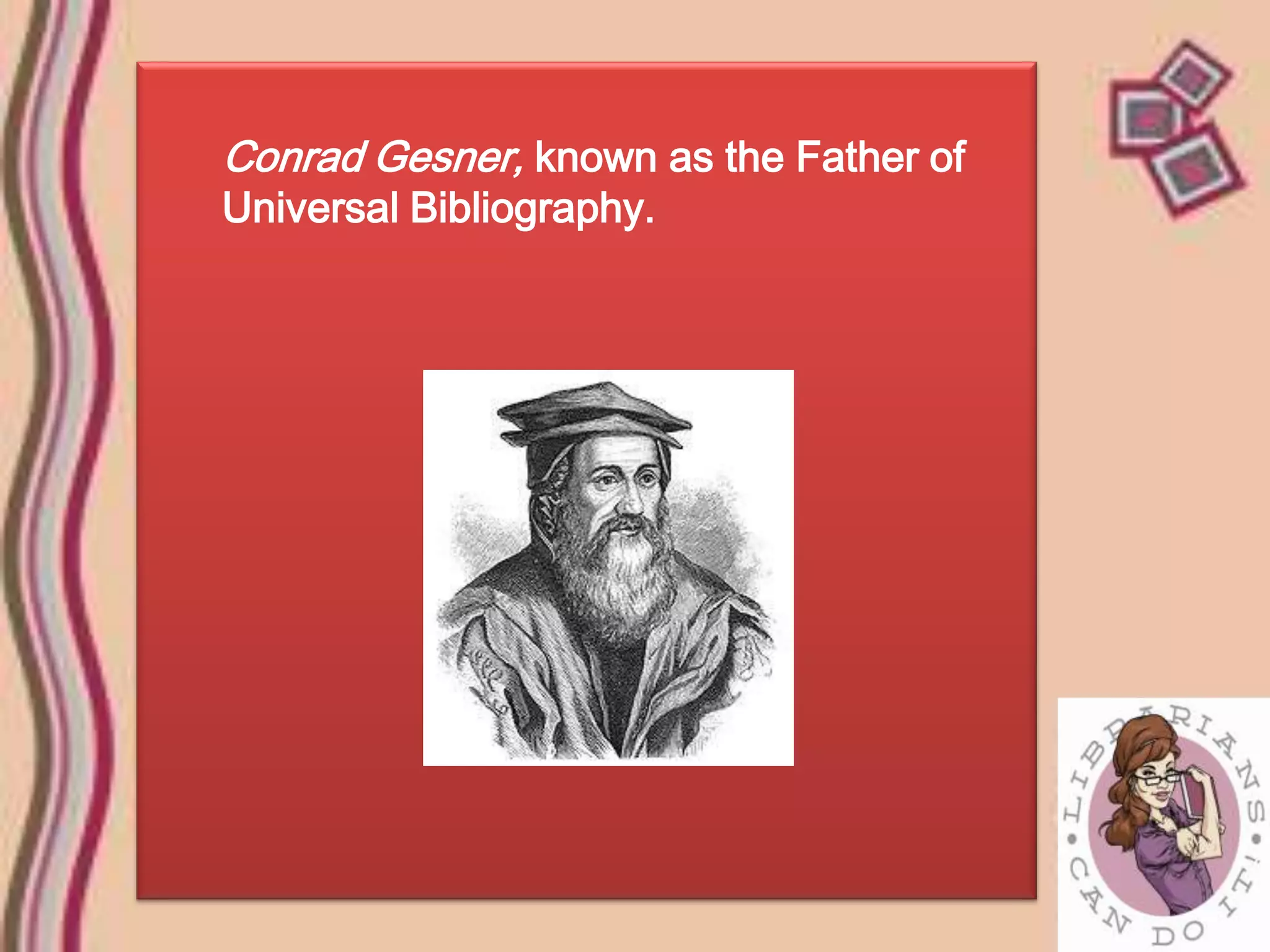
   Conrad Gesner, known as the Father of
   Universal Bibliography.
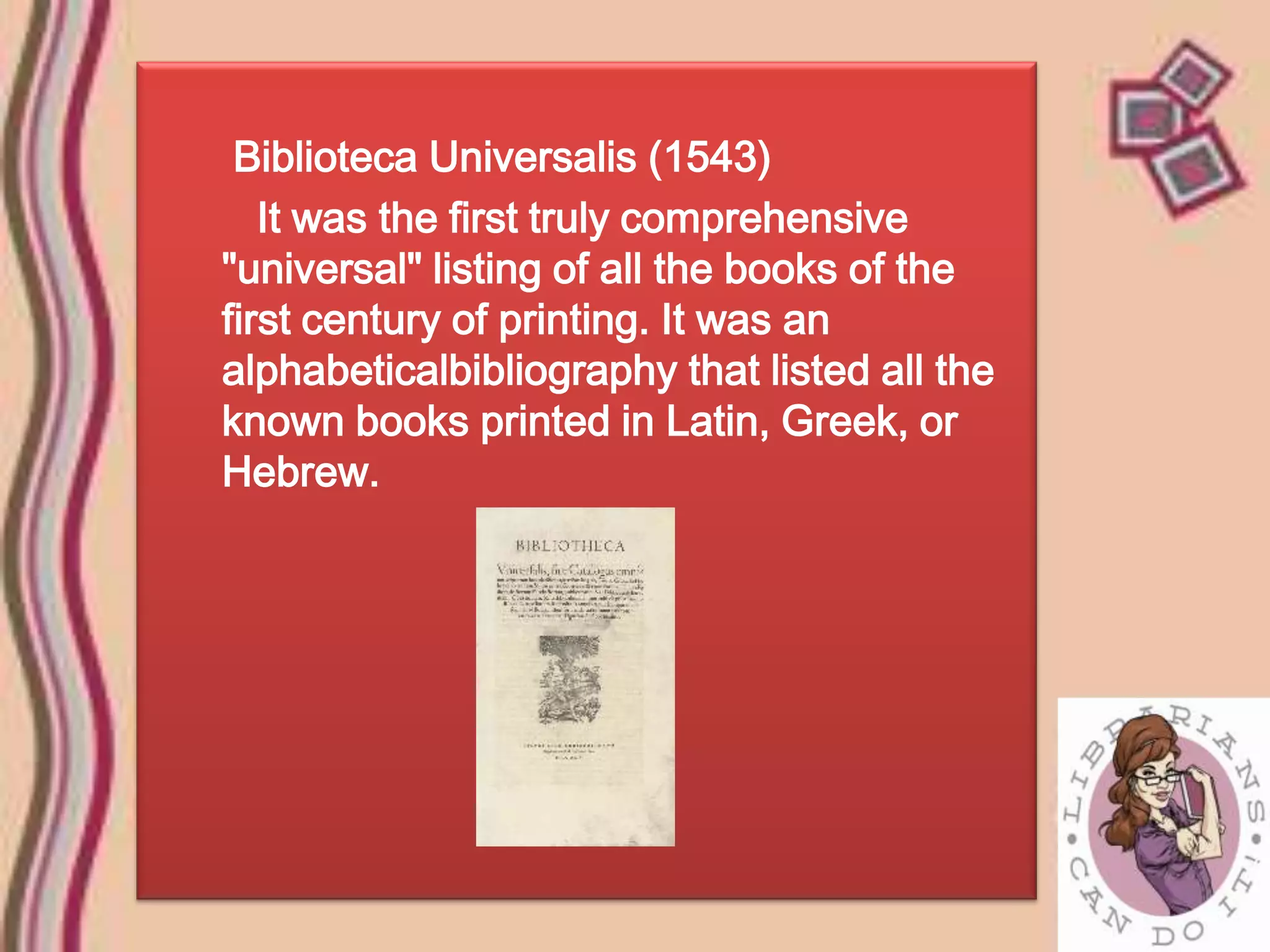
   Biblioteca Universalis (1543)
Conrad Gesner, known as the Father of
Universal Bibliography.
Biblioteca Universalis (1543)
   It was the first truly comprehensive
"universal" listing of all the books of the
first century of printing. It was an
alphabeticalbibliography that listed all the
known books printed in Latin, Greek, or
Hebrew.
2. National and Trade Bibliographies


 a. National Bibliography
     -published by government
Two basic requirements:

 Legal Deposit System- law that requires a
library to received a copy.

The record must be fromdirect examination of
materials.
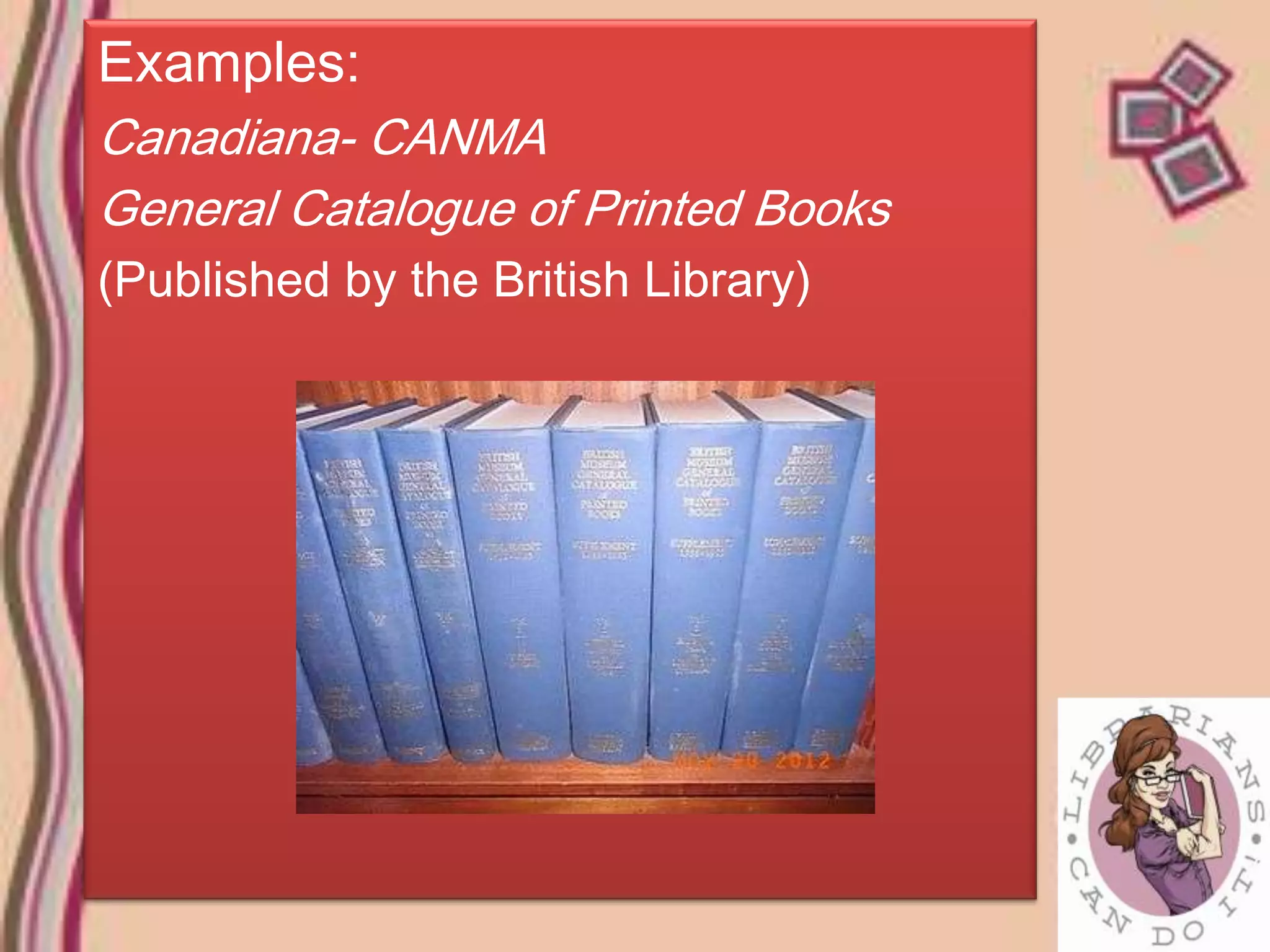
Examples:
Canadiana- CANMA
General Catalogue of Printed Books
(Published by the British Library)
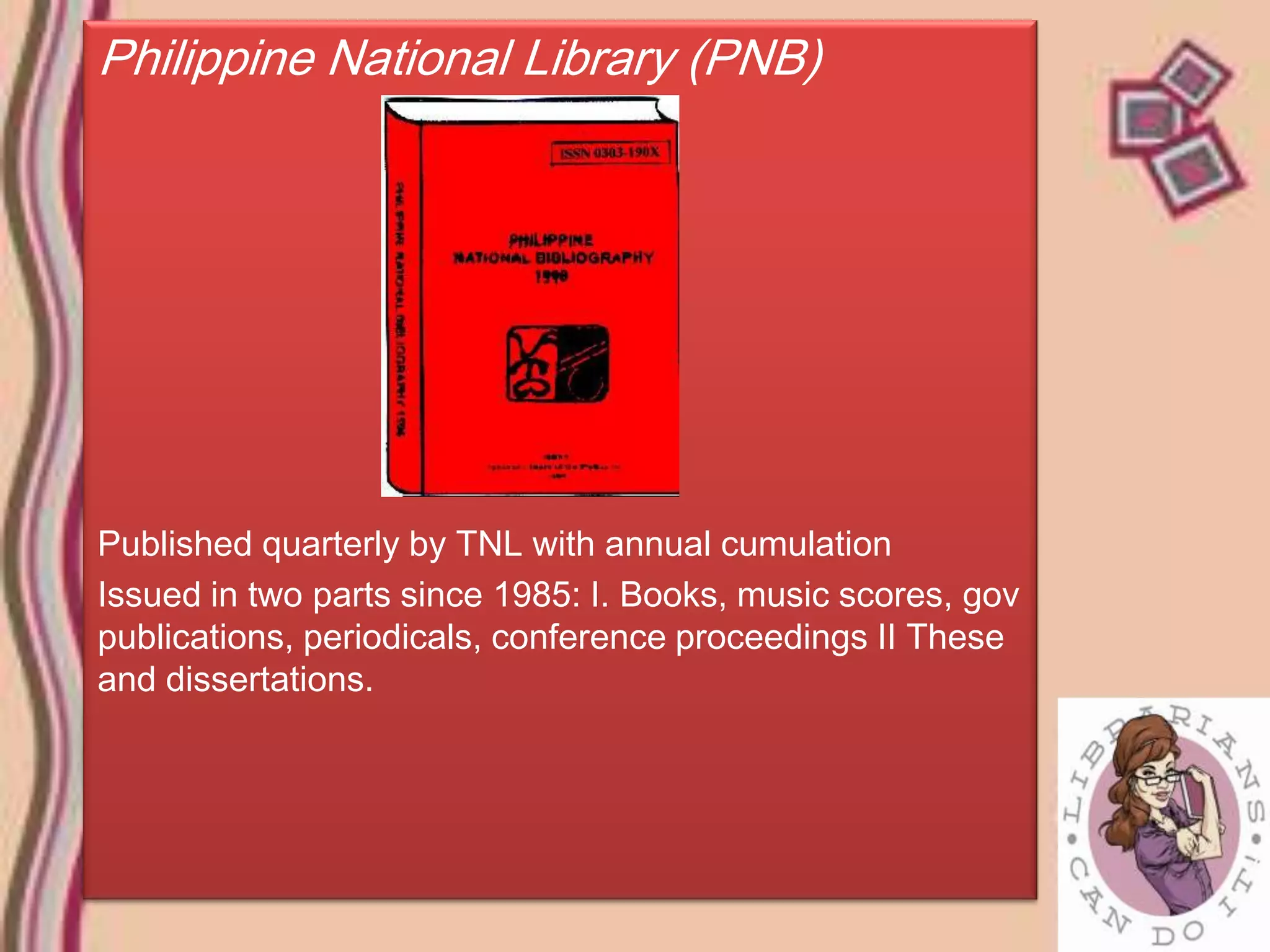
Philippine National Library (PNB)


Published quarterly by TNL with annual cumulation
Issued in two parts since 1985: I. Books, music scores, gov
publications, periodicals, conference proceedings II These
and dissertations.
b. National Library Catalog

     A list of all the works
cataloged by a national library and
other   member      libraries   and
includes items not published in the
country of origin.
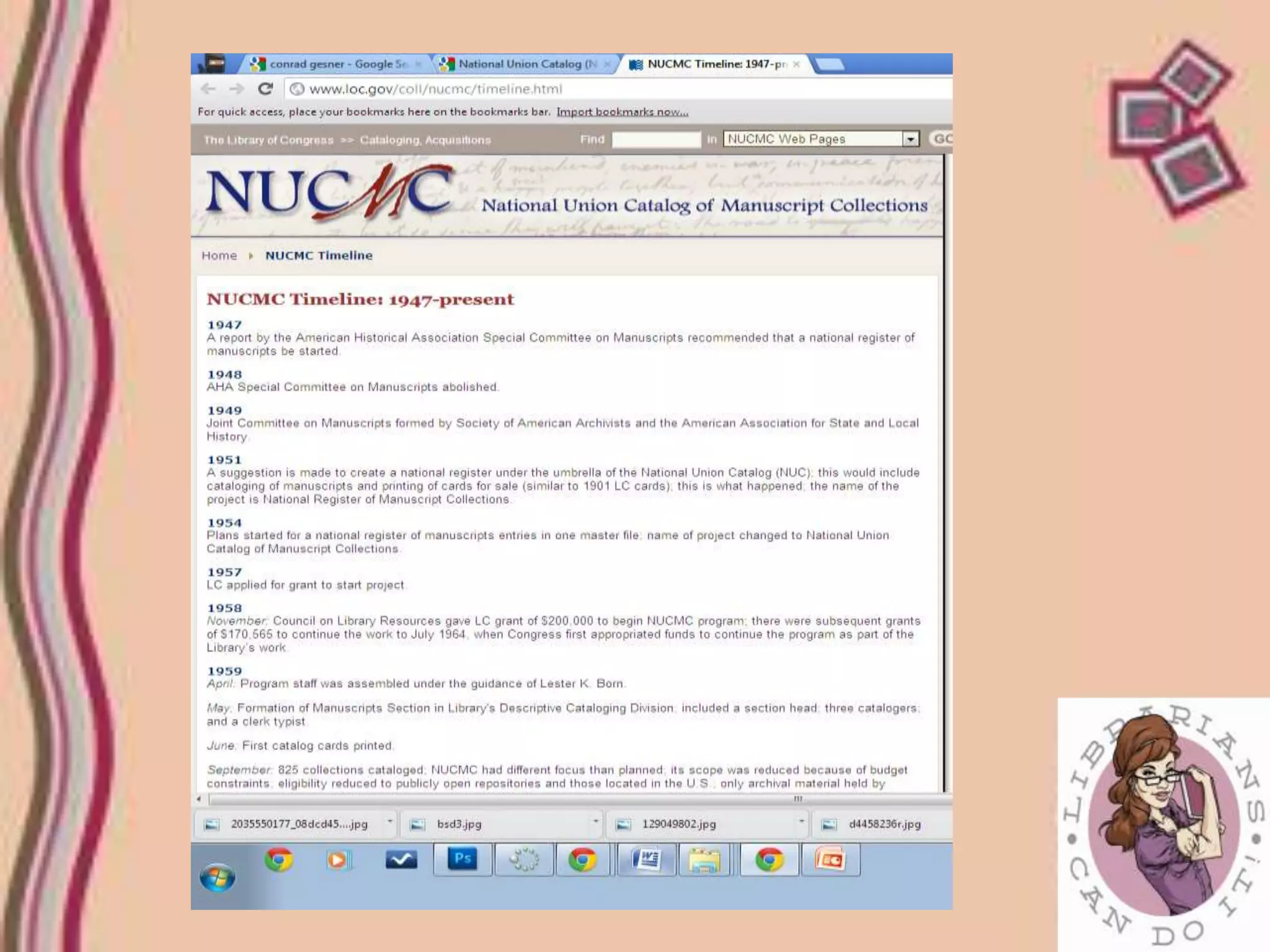
Example:
National Union Catalog (NUC) of the LC
    Issued in microfiche in 1983
    Online version is MARC and
    can be accessed through
DIALOG.
c. Trade Bibliographies

      List commercial publications to aid
in the selection and acquisition recently
published materials, specifically trade
books.
      Information is gathered rom the
published materials, specifically trade
books.
Examples:
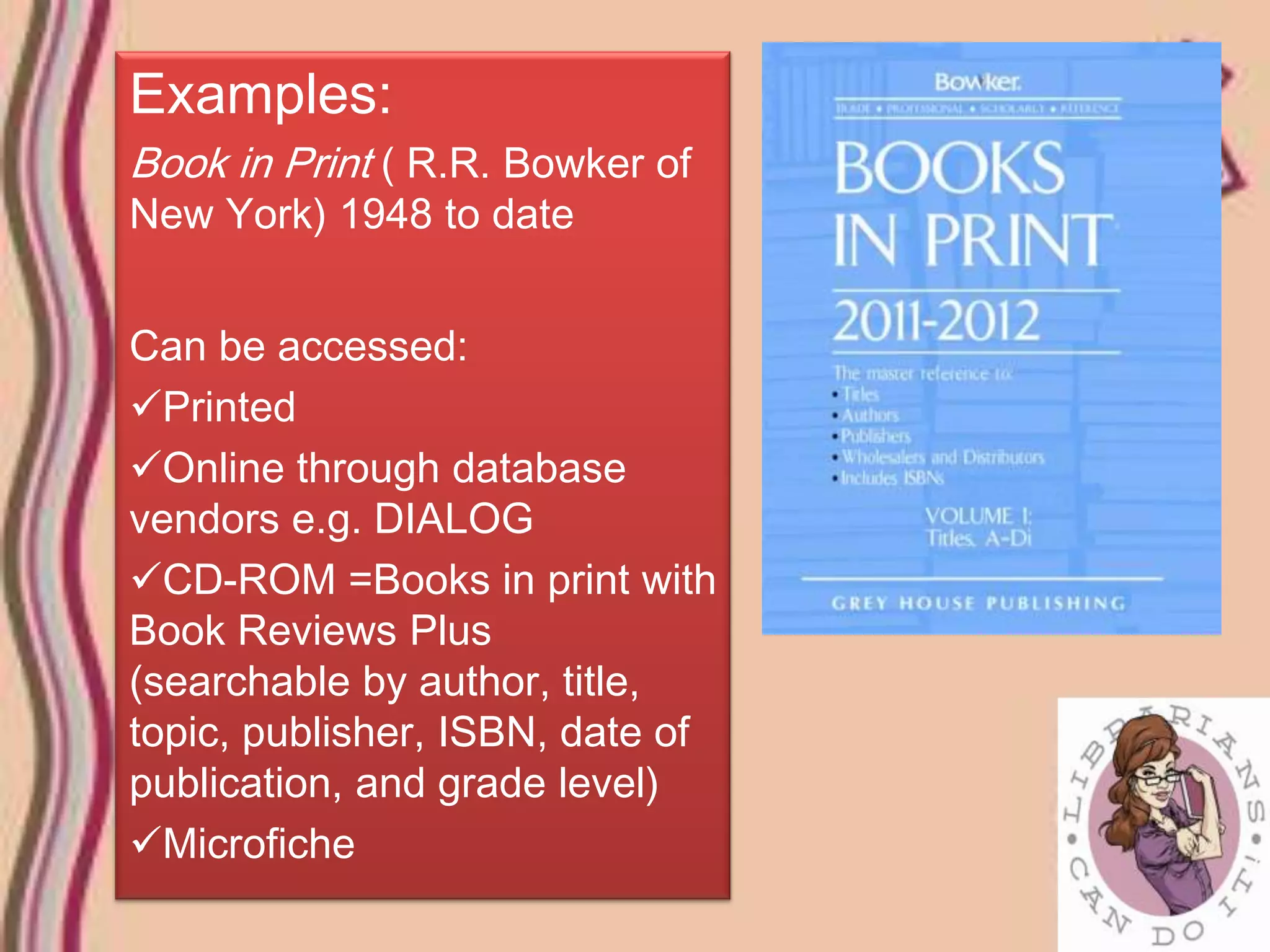
Book in Print ( R.R. Bowker of
New York) 1948 to date


Can be accessed:
Printed
Online through database
vendors e.g. DIALOG
CD-ROM =Books in print with
Book Reviews Plus
(searchable by author, title,
topic, publisher, ISBN, date of
publication, and grade level)
Microfiche
3. Subject Bibliography
      List   materials     that
relate to a particular topic. It
is intended to research
workers and other in special
areas.

Examples:
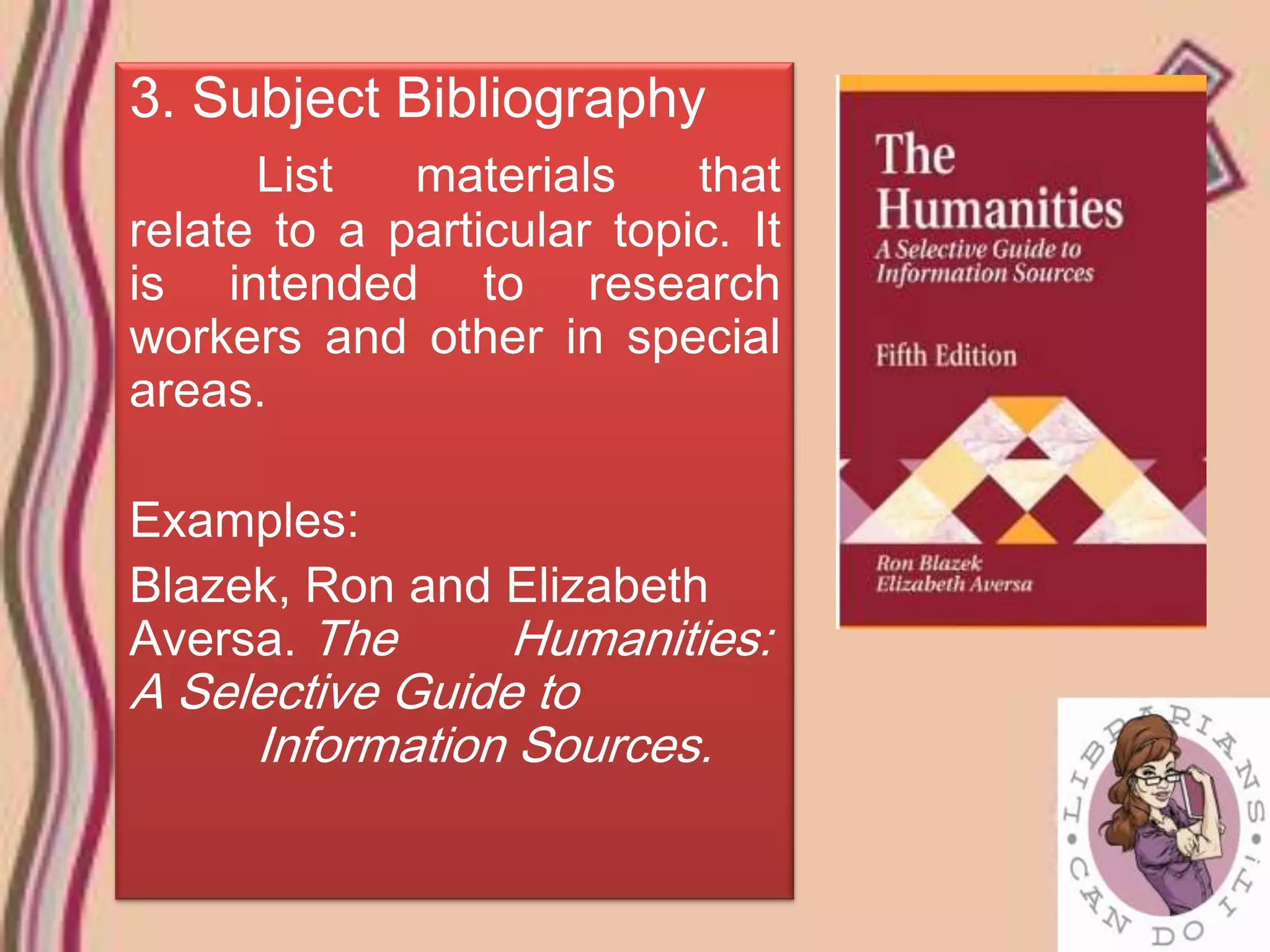
Blazek, Ron and Elizabeth
Aversa. The     Humanities:
A Selective Guide to
     Information Sources.
4. Guide to Reference Materials
       Includes the best works for a given
situation or audience.

      Guides to a reference books,
special reading, list by a library and
items devoted to the best works of a
particular group of people.
Examples:

Guide to Reference Books compiled by
Eugene P. Sheehy (Chicago:ALA)
Concentrates in American, Canadian, and
some British titles divided into 5 major areas.
Guide to Reference
Materials edited by
Albert   J.     Walford
(London:ALA)
Strong in British   and
European titles.
5. Analytical and textual bibliography

Analytical- concerned with the physical
description of books.

Textual- highlights certain textual
variations between a manuscript and the
printed book.
6. Daily Use

Directs the individual to an item and
is primarily used to find a specific
book or article.
B. Current Selection Aids
Examples:
Choice. Chicago:ALA, 1964 to date. Issued
monthly
     Evaluates a number of reference
     titles of value to all libraries.
Reference and Research Book
News.Portland, OR: Book News. 1985 to
date. Monthly.
      Provides full bibliographic
information and a short descriptive
annotation.
C. Bibliography of Bibliographies


 A listing of bibliographies that
were created as a means of
bibliographic control.
Examples:
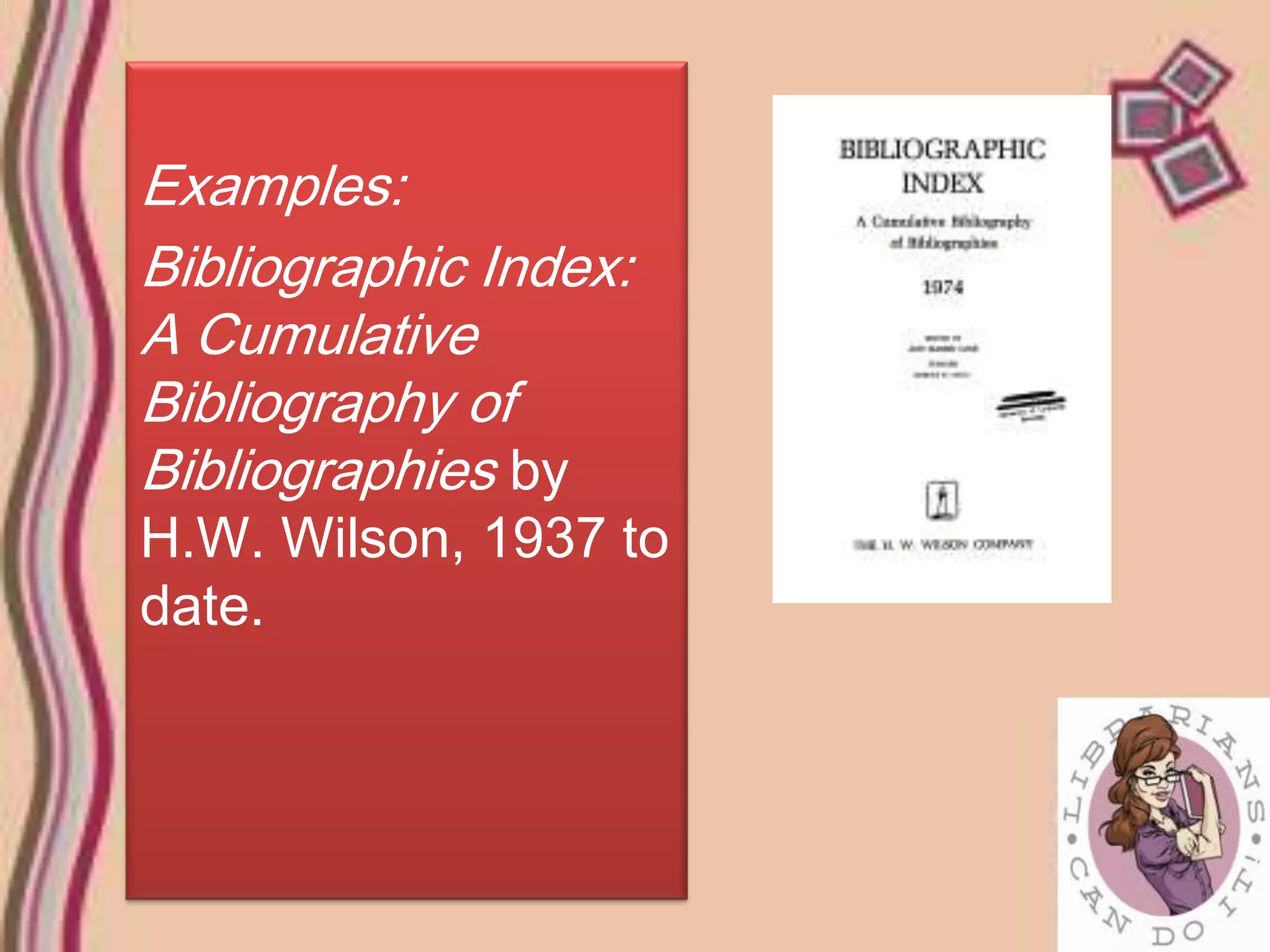
Bibliographic Index:
A Cumulative
Bibliography of
Bibliographies by
H.W. Wilson, 1937 to
date.
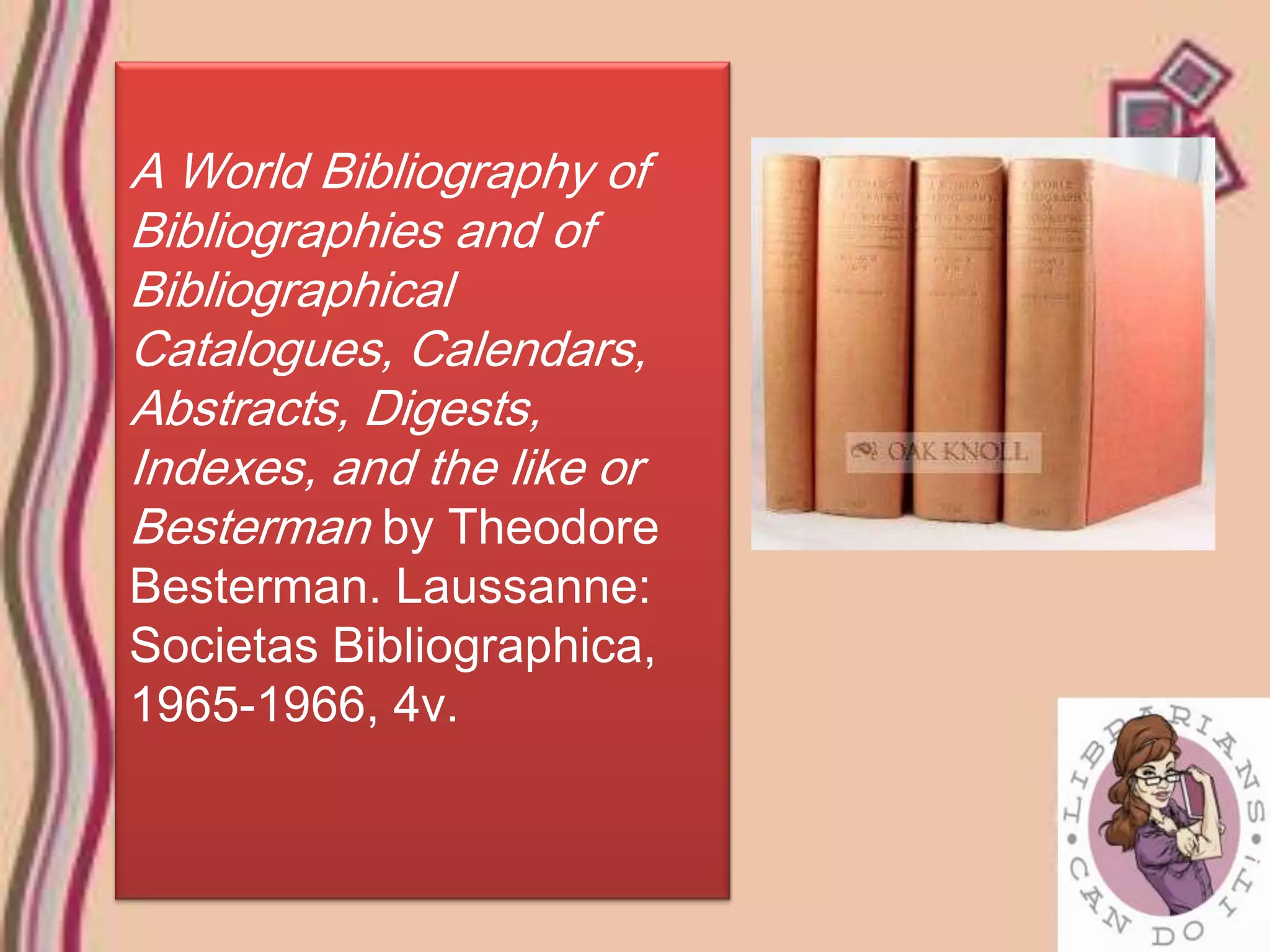
A World Bibliography of
Bibliographies and of
Bibliographical
Catalogues, Calendars,
Abstracts, Digests,
Indexes, and the like or
Besterman by Theodore
Besterman. Laussanne:
Societas Bibliographica,
1965-1966, 4v.
Bibliography of Philippine
Bibliographies

Retana says that this is the
most complete bibliography
that has been compiled of
printing in the Philippines

Written by:
Gabriel Adriano Bernardo
Bibliographies for Non-Print Materials.

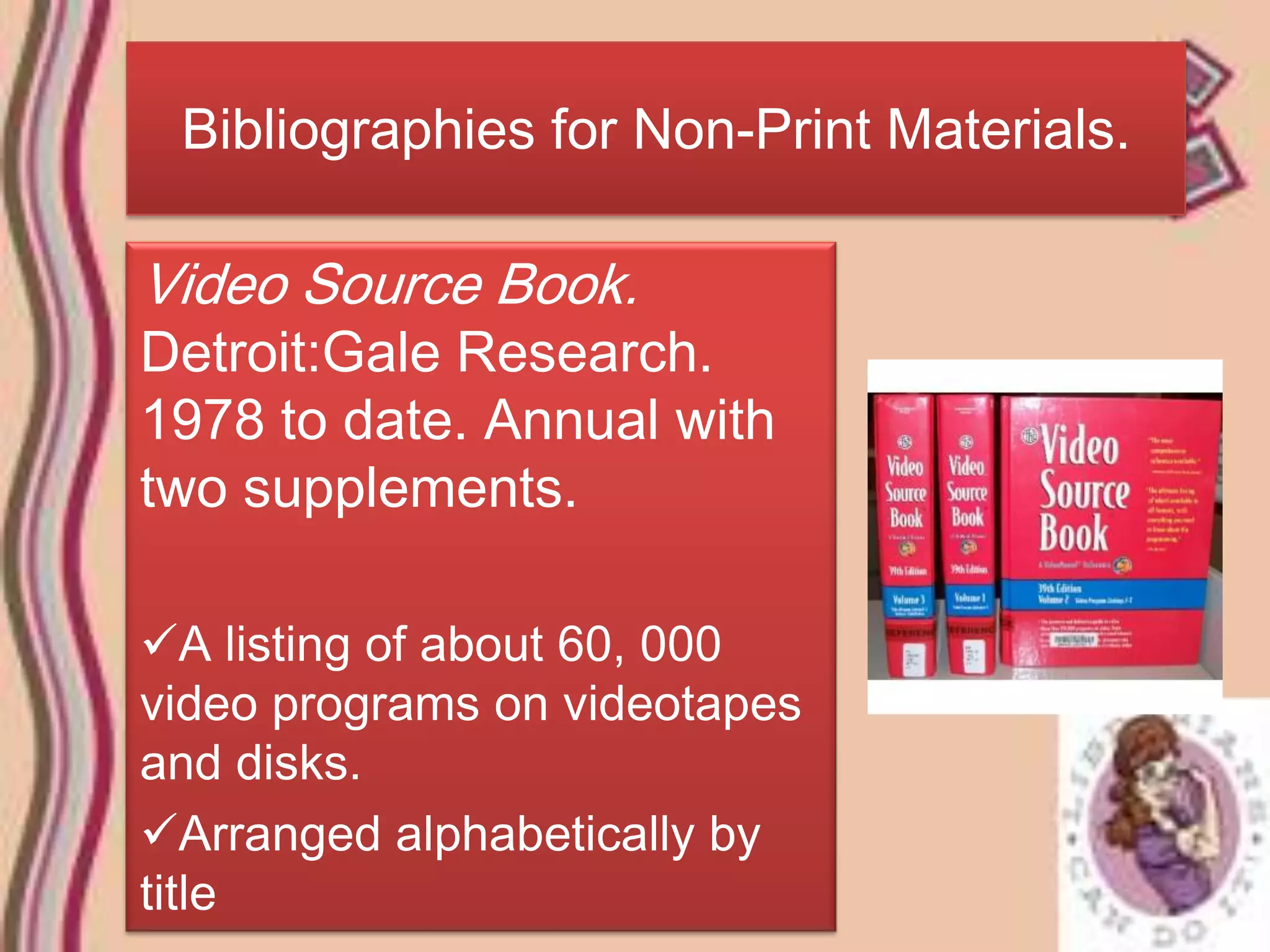
Video Source Book.
Detroit:Gale Research.
1978 to date. Annual with
two supplements.

A listing of about 60, 000
video programs on videotapes
and disks.
Arranged alphabetically by
title
Guide to Microforms in Print. New York:
Bowker-Saur, 1961 to date.

List alphabetically by author and
       title.
Considers sixteen diff. types of
       microform.
The subject guide uses the LCSH
Bibliographies for Periodicals
and Newspapers

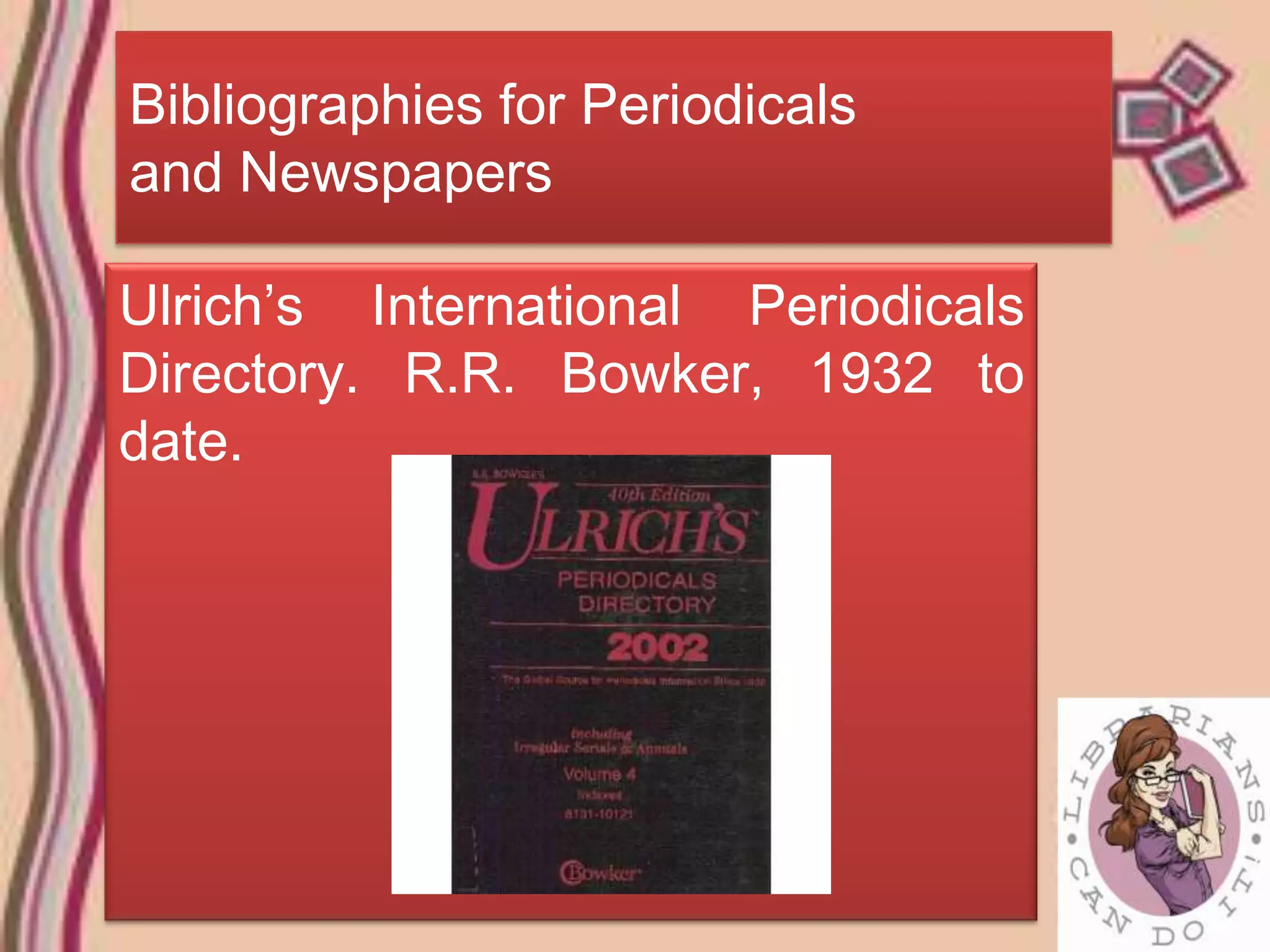
Ulrich’s International Periodicals
Directory. R.R. Bowker, 1932 to
date.
Ulrich’s   International  Periodicals
Directory. R.R. Bowker, 1932 to date.
A guide to currently available periodicals (about
120,000)

Arranged under 600 broad subject headings with
a title index.

Since 1988, it incorporated the Irregular Serials
and Annuals thus providing publication and
ordering information for most directories,
almanacs, and yearbooks.
The Standard Periodical Directory.
New York: Oxbridge
Communications. 1964 to date.
Biannual.
The Standard Periodical Directory.
New York: Oxbridge
Communications. 1964 to date.
Biannual.
List about 75, 000 periodical titles in
the US and Canada, inluding consumer
and special interest magazine,
newsletter, house organs, directories,
gov. publication, bulletins, yearbooks,
and religious association publications.
Current and Retrospective
          Bibliographies


Current Bibliography
Lists books or other items close
to the time at which they are being
published.
Examples:

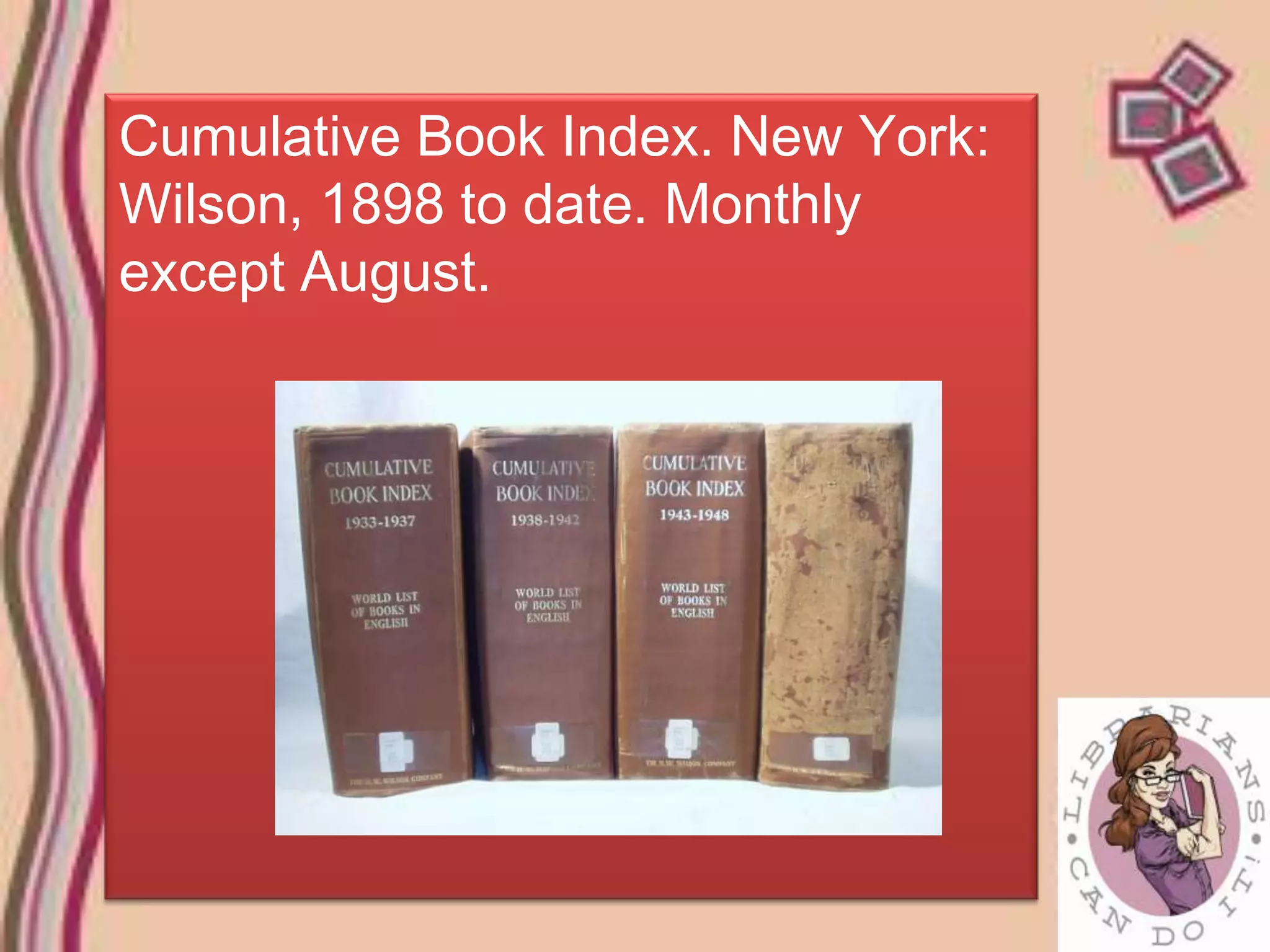
Cumulative Book Index. New York: Wilson, 1898
to date. Monthly except August.
An author title-title-subject international list of books
published in the English Language
Provides author full name, complete title, edition,
series no. of pages, publisher, date of publication, price,
LC Card Number, ISBN.
Can be accessed online through Wilsonline; CD-ROM
version is accessible through Wilson Disc
Cumulative Book Index. New York:
Wilson, 1898 to date. Monthly
except August.
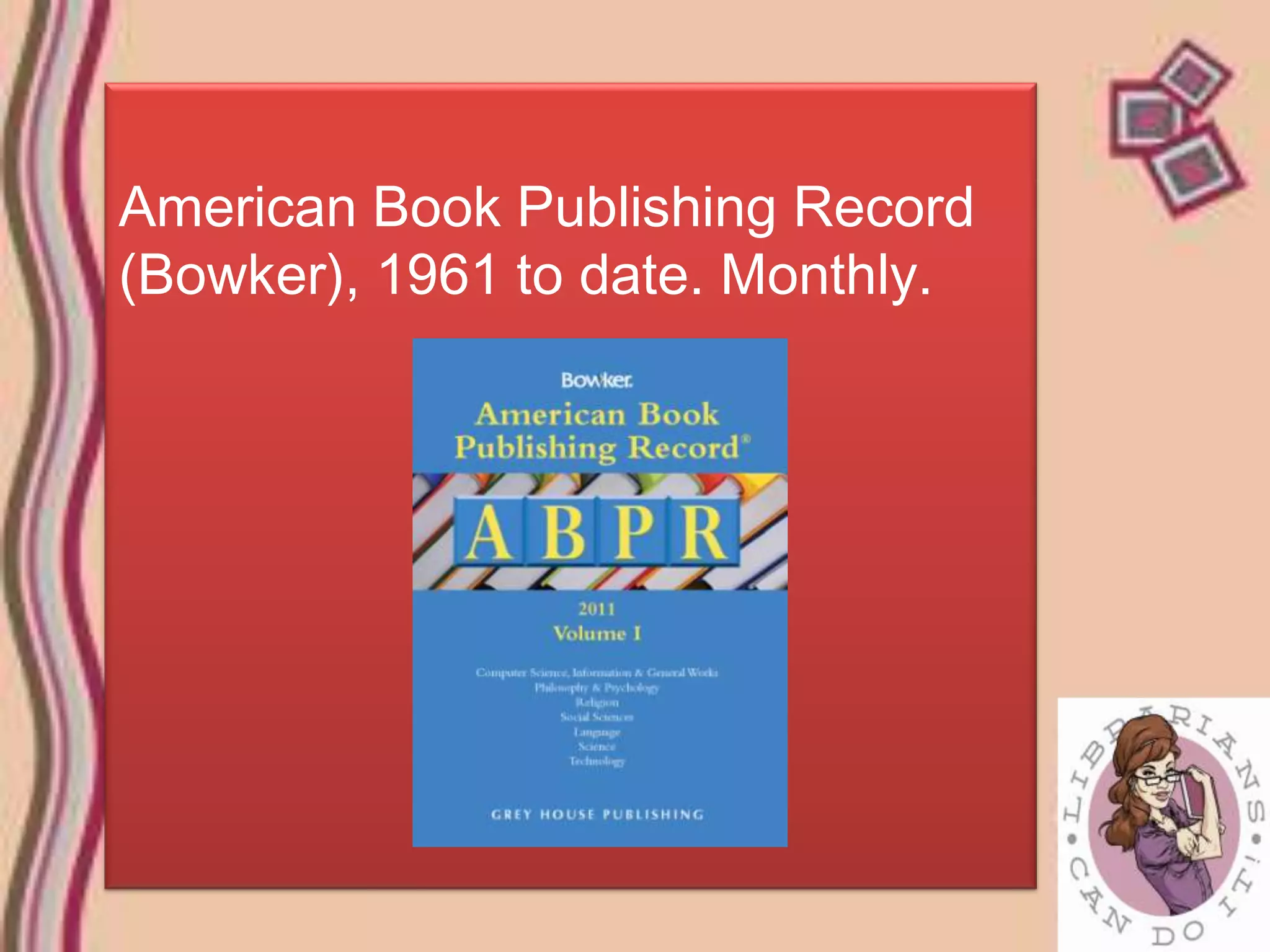
American Book Publishing Record
(Bowker), 1961 to date. Monthly.

Provides complete cataloging, records for
books as they are published.
Excludes gov. publications, subscriptions of
books, pamphlets under 49 pages, and
dissertations
Arrangement is by DDC, with author and title
index.
American Book Publishing Record
(Bowker), 1961 to date. Monthly.
Retrospective Bibliography

Covers materials published during
an earlier time period.
Examples:

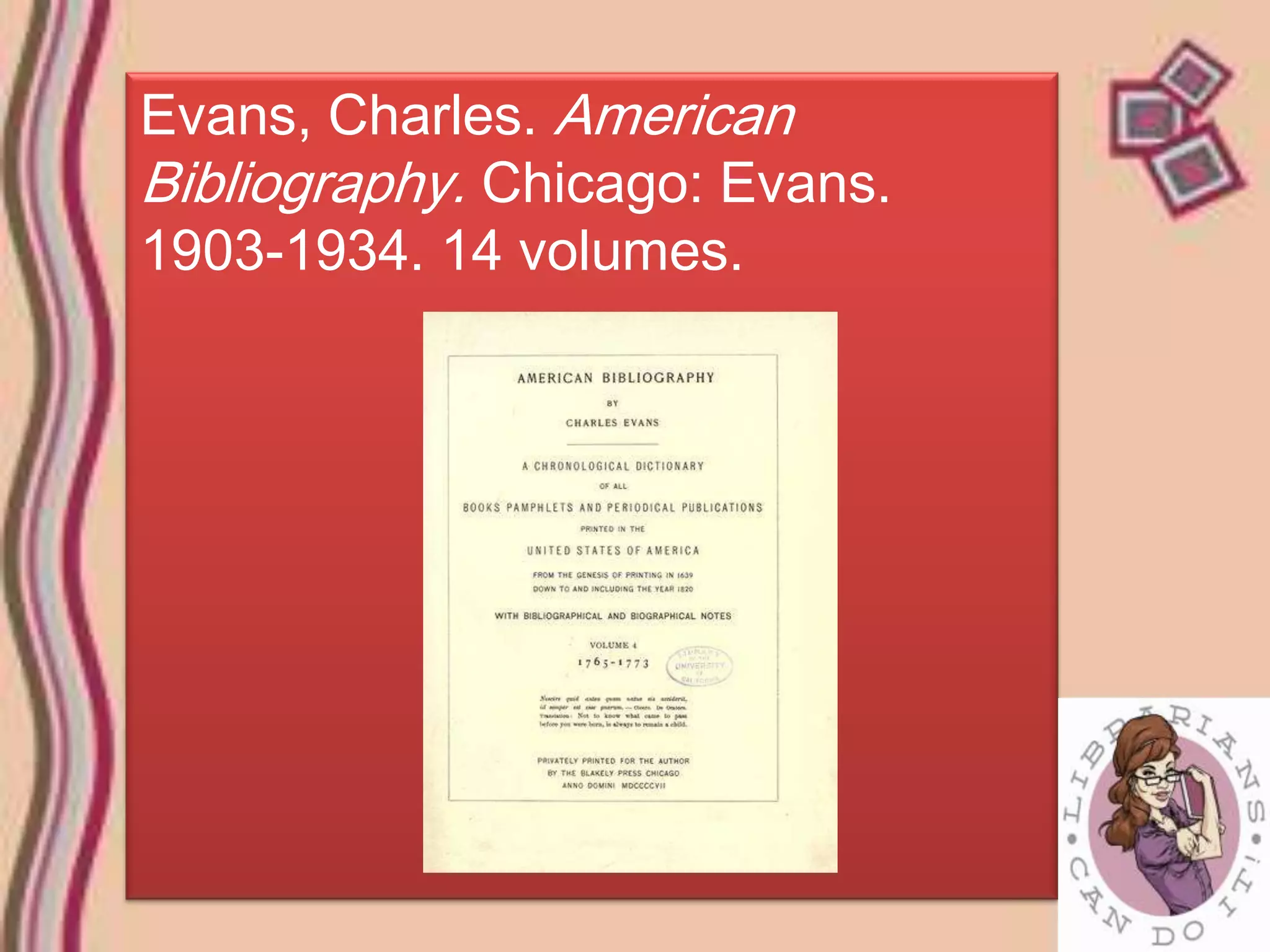
Evans, Charles. American
Bibliography. Chicago: Evans.
1903-1934. 14 volumes.
List books, pamphlets, and periodicals
published in the US from 1903-1934. 14 vol.
 Titles are arranged in chronological order by
date of publication.
Indexes to authors, printers, and publishers
are given.
Evans, Charles. American
Bibliography. Chicago: Evans.
1903-1934. 14 volumes.
Bibliotheca Americana by Joseph
Sabin
List boks relating to to the US from its
European discovery (October 12, 1942)
to 1968.
Provides complete bibliographic
description and locations of copies as
well as references to reviews.
Guides to Databases

Covers bibliographies available
electronically.
Examples:
Gale Directory of Databases.
Detroit: Gale, 1993-. 2 volumes.
Semi-annual.
Contains about 6000 entries arranged
alphabetically by database name.
Examples:
Gale Directory of Databases.
Detroit: Gale, 1993-. 2 volumes.
Semi-annual.
The CD-ROM Directory.
London:TFPL, 1986-. Annual.
La Imprenta en Manila desde sus
origines hasta 1810 (1896).
Jose Toribio Medina, a Chilean
bibliographer listed 565 titles
Of this number, 526 titles are dated,
15 have no dates and 24 are of
doubtful origin.
Access to Bibliographic Sources


CD-ROM
a high-capacity read only optical
disk that is intended for database
publishing and distribution.
Examples:

Bibliofile
A MARC database management utility
produced by the Library Corporation.
Provide acess to catalog records by
main entry, title, ISBN or ISSN, and LC
card no.
Examples:


CD-MARC Bibliographic- a CD-ROM
implementation of the LC MARC Database
LaserQuest from General Research Corporation
SuperCat from Gaylord Research Corporation
CD-CATSS (Catalog Support System) from
Utlas
CAT CD450 from OCLC
Alliance Plus from Follett Software
Bibliographic Utility


      Is a large database for shared
cataloging information created by
the combined efforts of large
libraries.
Examples:

OCLC (Online Computer Library Center)
      Formerly Ohio College Library Center
      The largest bibliographic utility
RLIN (Research Libraries Information Network)
      Started in 1967 at Stanford University
Functions of Bibliographic Utilities

1. Rapid location of a book, article, document,
   etc.
2. Acquisition of materials through either
   direct/indirect file use.
3. Circulation control and remote catalog
   access.
4. Shared cataloging
5. Online access to LC Name Authority File
6. Answering bibliographic verification and
   location queries.
Principles in Compiling
Bibliographies

1. All bibliographical entries must be in accord
   with the purpose of the research paper.
2. All entries should be accurate, logical and
   clear.
3. The bibliographical form which is prescribed
   for a given paper must be followed
   consistently in every entry.
Guidelines in Compiling
Bibliographies
1. A bibliography must be classified and divided
   into sections, usually by type of material, unless
   it is very short.
2. The variety of source of materials may
   sometimes call for further subdivision of the main
   classes, e.g. Primary sources may be divided
   into “Published” and “Unpublished” works.
3. Entries should be arranged in a definite order
   within the division.
4. The bibliography of a paper is single-spaced with
   one blank space between entries. The first line
   of each entry is flush left, and all subsequent
   lines, if any, ate indented five spaces.
5. Give the author’s full name in the inverted
    order.
6. If there are two or more authors, only the first
    author’s name is inverted from while the
    succeeding names are transcribed in natural
    order.
7. Full stops are used in bibliographical entries,
    at the end of each main part.
Bibliographical references to periodicals,
    however, retain the parenthesis around the
    dates of publication when these follow
    volume number.
8. Page numbers are listed in bibliographical
    entries when the main item is part of a whole
    work.
When given, page no. must be inclusive (first
    and the last page of the cited section). When
    an article is continued at the back of the
    journal, only the first page is to be given.
9. Bibliographies are arranged alphabetically by
    author’s family name, letter by letter.
10. In a succession of works by the same
    author, the name given for the first entry and
    an eight space line succeeding with a period
    takes place in subsequent entries.
The End ..
THANK YOU!!

Bibliographies (2)

  • 1.
  • 2.
    What is aBibliography? Derived from two Greek words, “biblion” meaning book and “graphein” meaning to write or the writing of books.
  • 3.
     The history,identification, or description of writings or publications. A list of works written by an author or printed by a publishing house. It is the name given to a list of books, manuscripts, and other publications, systematically described and arranged, which have some relationship to each other.
  • 4.
    Three Basic Purposes ToIdentify and verify information To locate materials To select materials for the collection
  • 5.
    Types of Bibliography A.Systematic Enumerative Bibliography B. Current Selection Aids C. Bibliography of Bibiliographies
  • 6.
    A. Systematic Enumerative Bibliography  Type of bibliography which refers to a list of books, film or recordings.
  • 7.
    1. Universal Bibliography Includes everything, published, issued or printed in the fields of communication from the beginning, through the present to the future. Conrad Gesner, known as the Father of Universal Bibliography. Biblioteca Universalis (1543)
  • 8.
    Conrad Gesner, knownas the Father of Universal Bibliography.
  • 9.
    Biblioteca Universalis (1543) It was the first truly comprehensive "universal" listing of all the books of the first century of printing. It was an alphabeticalbibliography that listed all the known books printed in Latin, Greek, or Hebrew.
  • 10.
    2. National andTrade Bibliographies a. National Bibliography -published by government
  • 11.
    Two basic requirements: Legal Deposit System- law that requires a library to received a copy. The record must be fromdirect examination of materials.
  • 12.
    Examples: Canadiana- CANMA General Catalogueof Printed Books (Published by the British Library)
  • 13.
    Philippine National Library(PNB) Published quarterly by TNL with annual cumulation Issued in two parts since 1985: I. Books, music scores, gov publications, periodicals, conference proceedings II These and dissertations.
  • 14.
    b. National LibraryCatalog A list of all the works cataloged by a national library and other member libraries and includes items not published in the country of origin.
  • 15.
    Example: National Union Catalog(NUC) of the LC Issued in microfiche in 1983 Online version is MARC and can be accessed through DIALOG.
  • 17.
    c. Trade Bibliographies List commercial publications to aid in the selection and acquisition recently published materials, specifically trade books. Information is gathered rom the published materials, specifically trade books.
  • 18.
    Examples: Book in Print( R.R. Bowker of New York) 1948 to date Can be accessed: Printed Online through database vendors e.g. DIALOG CD-ROM =Books in print with Book Reviews Plus (searchable by author, title, topic, publisher, ISBN, date of publication, and grade level) Microfiche
  • 19.
    3. Subject Bibliography List materials that relate to a particular topic. It is intended to research workers and other in special areas. Examples: Blazek, Ron and Elizabeth Aversa. The Humanities: A Selective Guide to Information Sources.
  • 20.
    4. Guide toReference Materials Includes the best works for a given situation or audience. Guides to a reference books, special reading, list by a library and items devoted to the best works of a particular group of people.
  • 21.
    Examples: Guide to ReferenceBooks compiled by Eugene P. Sheehy (Chicago:ALA) Concentrates in American, Canadian, and some British titles divided into 5 major areas.
  • 22.
    Guide to Reference Materialsedited by Albert J. Walford (London:ALA) Strong in British and European titles.
  • 23.
    5. Analytical andtextual bibliography Analytical- concerned with the physical description of books. Textual- highlights certain textual variations between a manuscript and the printed book.
  • 24.
    6. Daily Use Directsthe individual to an item and is primarily used to find a specific book or article.
  • 25.
    B. Current SelectionAids Examples: Choice. Chicago:ALA, 1964 to date. Issued monthly Evaluates a number of reference titles of value to all libraries. Reference and Research Book News.Portland, OR: Book News. 1985 to date. Monthly. Provides full bibliographic information and a short descriptive annotation.
  • 26.
    C. Bibliography ofBibliographies  A listing of bibliographies that were created as a means of bibliographic control.
  • 27.
    Examples: Bibliographic Index: A Cumulative Bibliographyof Bibliographies by H.W. Wilson, 1937 to date.
  • 28.
    A World Bibliographyof Bibliographies and of Bibliographical Catalogues, Calendars, Abstracts, Digests, Indexes, and the like or Besterman by Theodore Besterman. Laussanne: Societas Bibliographica, 1965-1966, 4v.
  • 29.
    Bibliography of Philippine Bibliographies Retanasays that this is the most complete bibliography that has been compiled of printing in the Philippines Written by: Gabriel Adriano Bernardo
  • 30.
    Bibliographies for Non-PrintMaterials. Video Source Book. Detroit:Gale Research. 1978 to date. Annual with two supplements. A listing of about 60, 000 video programs on videotapes and disks. Arranged alphabetically by title
  • 31.
    Guide to Microformsin Print. New York: Bowker-Saur, 1961 to date. List alphabetically by author and title. Considers sixteen diff. types of microform. The subject guide uses the LCSH
  • 32.
    Bibliographies for Periodicals andNewspapers Ulrich’s International Periodicals Directory. R.R. Bowker, 1932 to date.
  • 33.
    Ulrich’s International Periodicals Directory. R.R. Bowker, 1932 to date. A guide to currently available periodicals (about 120,000) Arranged under 600 broad subject headings with a title index. Since 1988, it incorporated the Irregular Serials and Annuals thus providing publication and ordering information for most directories, almanacs, and yearbooks.
  • 34.
    The Standard PeriodicalDirectory. New York: Oxbridge Communications. 1964 to date. Biannual.
  • 35.
    The Standard PeriodicalDirectory. New York: Oxbridge Communications. 1964 to date. Biannual. List about 75, 000 periodical titles in the US and Canada, inluding consumer and special interest magazine, newsletter, house organs, directories, gov. publication, bulletins, yearbooks, and religious association publications.
  • 36.
    Current and Retrospective Bibliographies Current Bibliography Lists books or other items close to the time at which they are being published.
  • 37.
    Examples: Cumulative Book Index.New York: Wilson, 1898 to date. Monthly except August. An author title-title-subject international list of books published in the English Language Provides author full name, complete title, edition, series no. of pages, publisher, date of publication, price, LC Card Number, ISBN. Can be accessed online through Wilsonline; CD-ROM version is accessible through Wilson Disc
  • 38.
    Cumulative Book Index.New York: Wilson, 1898 to date. Monthly except August.
  • 39.
    American Book PublishingRecord (Bowker), 1961 to date. Monthly. Provides complete cataloging, records for books as they are published. Excludes gov. publications, subscriptions of books, pamphlets under 49 pages, and dissertations Arrangement is by DDC, with author and title index.
  • 40.
    American Book PublishingRecord (Bowker), 1961 to date. Monthly.
  • 41.
    Retrospective Bibliography Covers materialspublished during an earlier time period.
  • 42.
    Examples: Evans, Charles. American Bibliography.Chicago: Evans. 1903-1934. 14 volumes. List books, pamphlets, and periodicals published in the US from 1903-1934. 14 vol.  Titles are arranged in chronological order by date of publication. Indexes to authors, printers, and publishers are given.
  • 43.
    Evans, Charles. American Bibliography.Chicago: Evans. 1903-1934. 14 volumes.
  • 44.
    Bibliotheca Americana byJoseph Sabin List boks relating to to the US from its European discovery (October 12, 1942) to 1968. Provides complete bibliographic description and locations of copies as well as references to reviews.
  • 45.
    Guides to Databases Coversbibliographies available electronically.
  • 46.
    Examples: Gale Directory ofDatabases. Detroit: Gale, 1993-. 2 volumes. Semi-annual. Contains about 6000 entries arranged alphabetically by database name.
  • 47.
    Examples: Gale Directory ofDatabases. Detroit: Gale, 1993-. 2 volumes. Semi-annual. The CD-ROM Directory. London:TFPL, 1986-. Annual.
  • 48.
    La Imprenta enManila desde sus origines hasta 1810 (1896). Jose Toribio Medina, a Chilean bibliographer listed 565 titles Of this number, 526 titles are dated, 15 have no dates and 24 are of doubtful origin.
  • 49.
    Access to BibliographicSources CD-ROM a high-capacity read only optical disk that is intended for database publishing and distribution.
  • 50.
    Examples: Bibliofile A MARC databasemanagement utility produced by the Library Corporation. Provide acess to catalog records by main entry, title, ISBN or ISSN, and LC card no.
  • 51.
    Examples: CD-MARC Bibliographic- aCD-ROM implementation of the LC MARC Database LaserQuest from General Research Corporation SuperCat from Gaylord Research Corporation CD-CATSS (Catalog Support System) from Utlas CAT CD450 from OCLC Alliance Plus from Follett Software
  • 52.
    Bibliographic Utility Is a large database for shared cataloging information created by the combined efforts of large libraries.
  • 53.
    Examples: OCLC (Online ComputerLibrary Center) Formerly Ohio College Library Center The largest bibliographic utility RLIN (Research Libraries Information Network) Started in 1967 at Stanford University
  • 54.
    Functions of BibliographicUtilities 1. Rapid location of a book, article, document, etc. 2. Acquisition of materials through either direct/indirect file use. 3. Circulation control and remote catalog access. 4. Shared cataloging 5. Online access to LC Name Authority File 6. Answering bibliographic verification and location queries.
  • 55.
    Principles in Compiling Bibliographies 1.All bibliographical entries must be in accord with the purpose of the research paper. 2. All entries should be accurate, logical and clear. 3. The bibliographical form which is prescribed for a given paper must be followed consistently in every entry.
  • 56.
    Guidelines in Compiling Bibliographies 1.A bibliography must be classified and divided into sections, usually by type of material, unless it is very short. 2. The variety of source of materials may sometimes call for further subdivision of the main classes, e.g. Primary sources may be divided into “Published” and “Unpublished” works. 3. Entries should be arranged in a definite order within the division. 4. The bibliography of a paper is single-spaced with one blank space between entries. The first line of each entry is flush left, and all subsequent lines, if any, ate indented five spaces.
  • 57.
    5. Give theauthor’s full name in the inverted order. 6. If there are two or more authors, only the first author’s name is inverted from while the succeeding names are transcribed in natural order. 7. Full stops are used in bibliographical entries, at the end of each main part. Bibliographical references to periodicals, however, retain the parenthesis around the dates of publication when these follow volume number. 8. Page numbers are listed in bibliographical entries when the main item is part of a whole work.
  • 58.
    When given, pageno. must be inclusive (first and the last page of the cited section). When an article is continued at the back of the journal, only the first page is to be given. 9. Bibliographies are arranged alphabetically by author’s family name, letter by letter. 10. In a succession of works by the same author, the name given for the first entry and an eight space line succeeding with a period takes place in subsequent entries.
  • 59.