LIB 630 Classification and
                      Cataloging
                     Spring 2013


             Searching for
              Shamrocks?


Access Points for St. Patrick’s Day
2


           Access points?
access point
 A unit of information in a bibliographic record
  under which a person may search for and
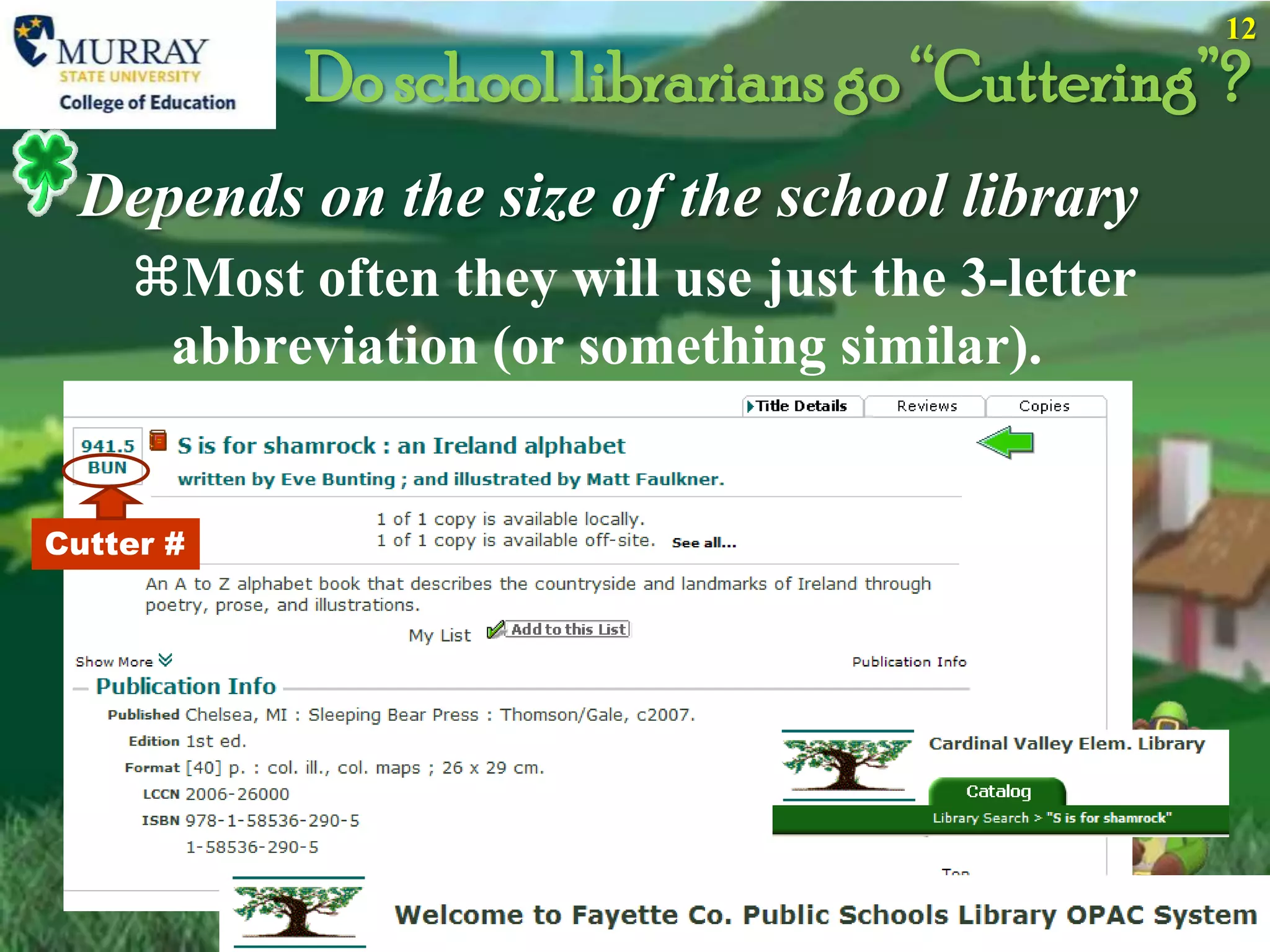
  identify items listed in the library catalog or
  bibliographic database. Access points have
  traditionally included the main entry, added
  entries, subject headings, classification or call
  number, and codes such as the standard
  number, but with machine-readable
  cataloging, almost any portion of the catalog
  record (name of publisher, type of material, etc.)
  can serve as an access point.
3

            Plain English, please?
An access point
 is a feature (or an attribute) of a work
  (book, DVD, etc.) that someone might be
  likely to choose in order to be able to find
  that work
      – e. g. Title, author, other names associated
        with the work (publisher, corporate
        body, etc.), subject, keyword, classification
        number, etc.
4

           Access point: Main entry
Comes from card catalog days
 One card designated as the one to have all
  the information about a book
      – ODLIS:
           “The entry in a library catalog that
            provides the fullest description of a
            bibliographic item, by which the work
            is to be uniformly identified and cited.
            In AACR2, the main entry is the
            primary access point.”
                                        • main entry
5

                 Short Digression
What is AACR2?
 The Anglo-American Cataloguing Rules
  (AACR) are a[n inter]national cataloging
  code first published in 1967. AACR2
  stands for the Anglo-American Cataloguing
  Rules, Second Edition.
 AACR2 has been succeeded by Resource
  Description and Access (commonly
  referred to as RDA), which was released in
  June 2010.
      – From Wikipedia, the free encyclopedia
Form of the main entry
                                             6


Traditionally by author
 The most important thing about a
  book was that there was a person
  responsible for it.
      – Thus, card catalogs were arranged
        first and foremost alphabetically
        by author (where one could be
        found)
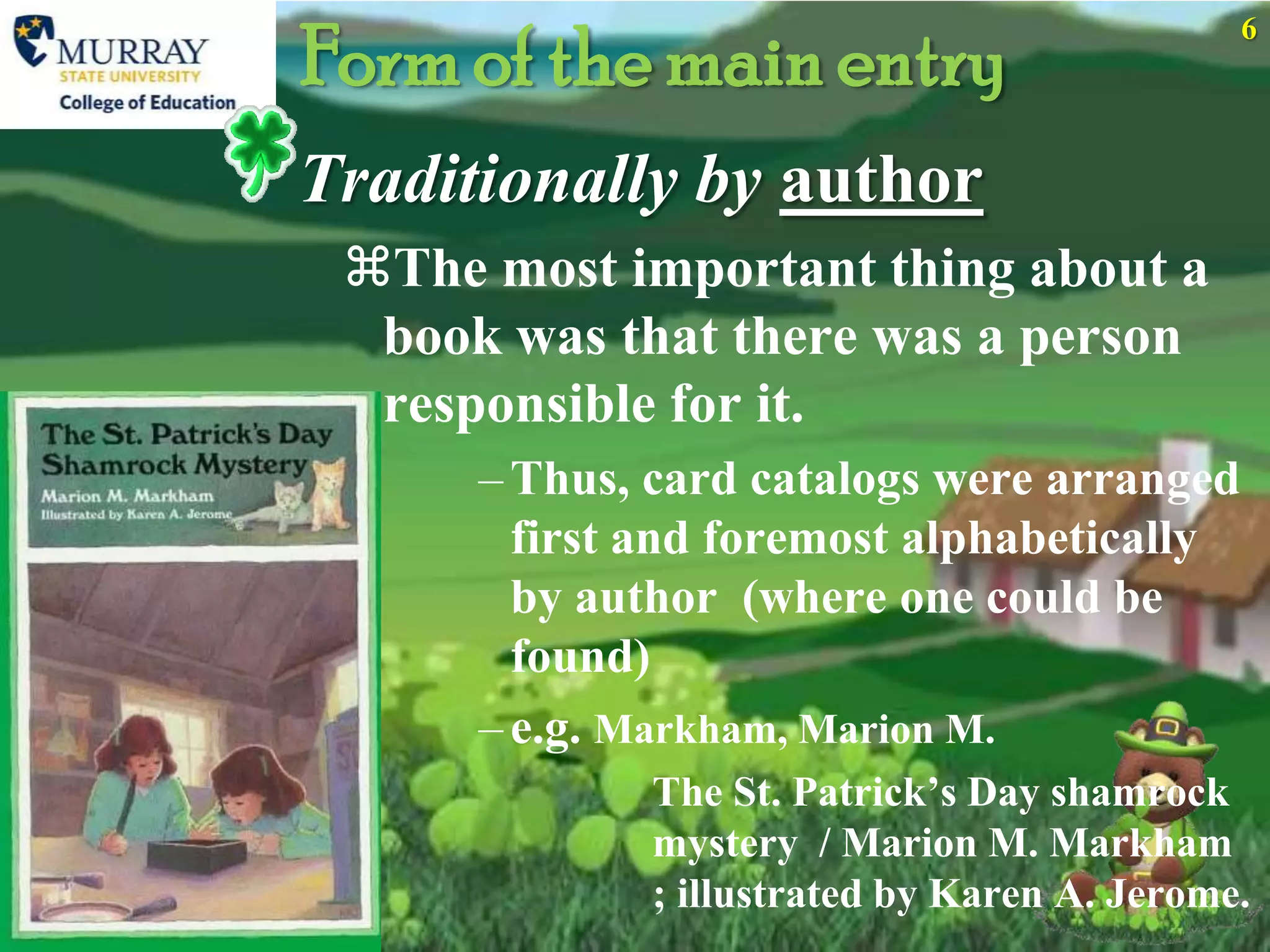
      – e.g. Markham, Marion M.
             The St. Patrick’s Day shamrock
             mystery / Marion M. Markham
             ; illustrated by Karen A. Jerome.
7
            Main Entry
            Example
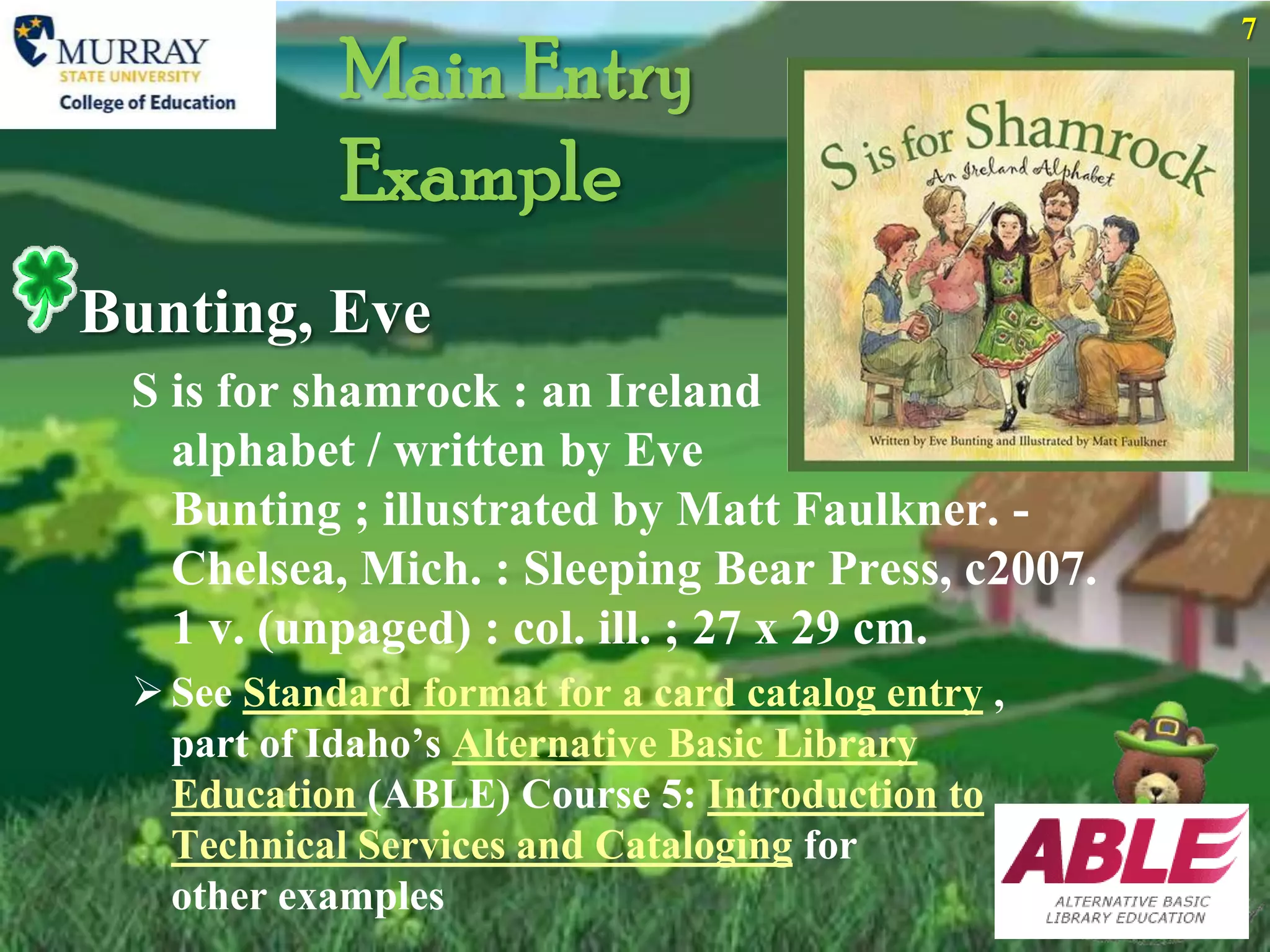
Bunting, Eve
 S is for shamrock : an Ireland
   alphabet / written by Eve
   Bunting ; illustrated by Matt Faulkner. -
   Chelsea, Mich. : Sleeping Bear Press, c2007.
   1 v. (unpaged) : col. ill. ; 27 x 29 cm.
  See Standard format for a card catalog entry ,
   part of Idaho’s Alternative Basic Library
   Education (ABLE) Course 5: Introduction to
   Technical Services and Cataloging for
   other examples
8

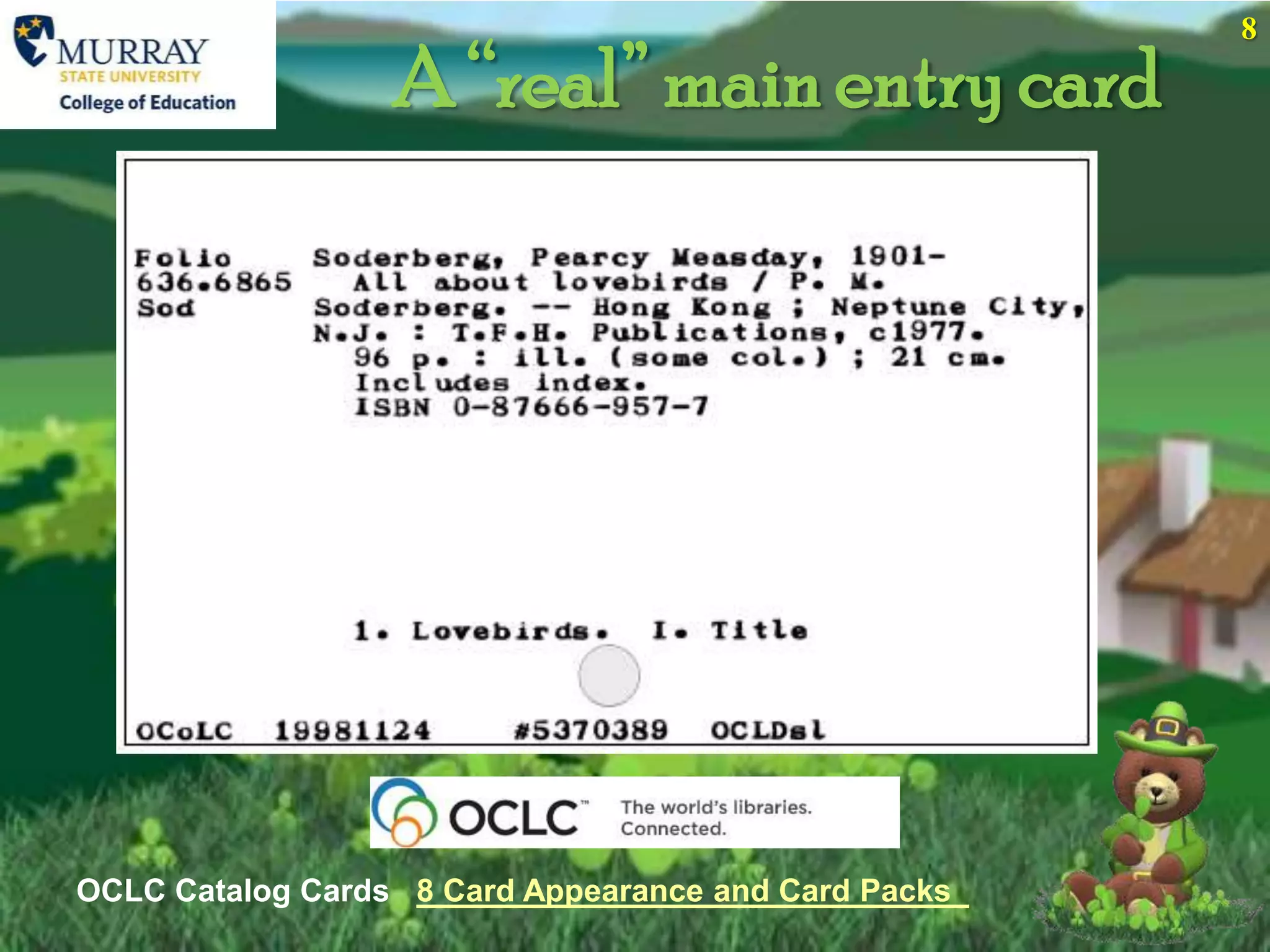
                  A “real” main entry card


OCLC Catalog Cards 8 Card Appearance and Card Packs
9

         Main entry as source for Cutter
What is a “Cutter number”?
 Cutter numbers primarily distinguish among
  books by the same author. A librarian uses a
  table (e.g., the Cutter-Sanborn Three-Figure
  Author table that the Cutter family [still] owns) to
  look up the correct Cutter.
 Cutters usually consist of the first letter of the
  author's last name and a series of numbers that
  makes sure books end up placed on shelves
  alphabetically, usually by title.
        – Catalogers decide numbers following the
          Dewey Decimal
10
                                  Cutter numbers
                 Cutter?
                   Among his other contributions to the
                    wonderful world of librarianship,
                    Charles Ammi Cutter [1837-1903] devised
                    a way to assign an alpha-numeric code for
                    authors' last names. Use of this system
                    allows all books within a particular Dewey
                    Decimal number to be arranged
                    alphabetically on the shelf, usually by title.
                   Catalogers try to assign distinct numbers for
                    each name.
                           The Cutter Number from Dewey Decimal in
                            the UIUC Bookstacks
March 11, 2013                   Classification
11

                         Let’s go Cuttering!
Cutter numbers
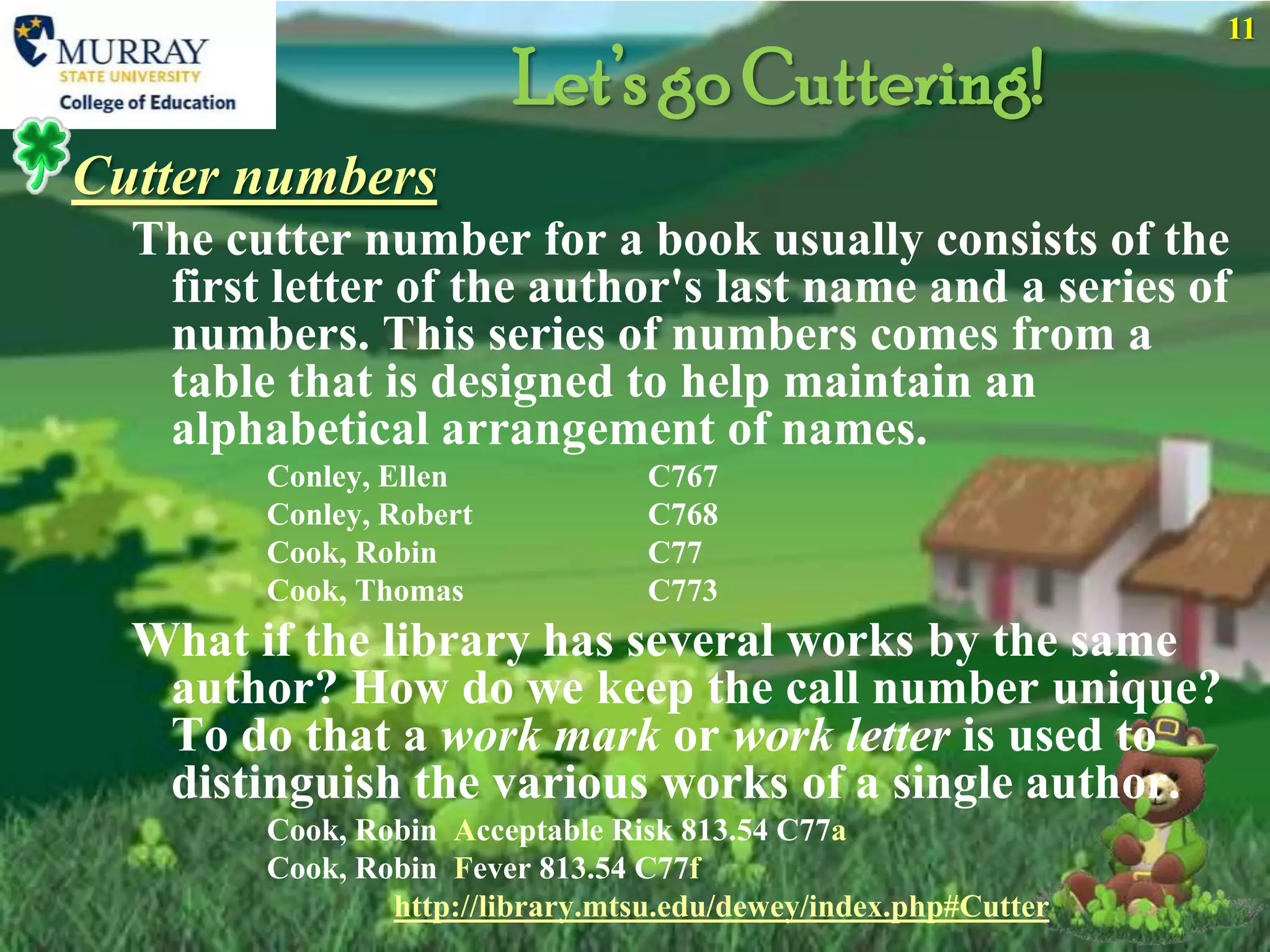
  The cutter number for a book usually consists of the
   first letter of the author's last name and a series of
   numbers. This series of numbers comes from a
   table that is designed to help maintain an
   alphabetical arrangement of names.
        Conley, Ellen             C767
        Conley, Robert            C768
        Cook, Robin               C77
        Cook, Thomas              C773
  What if the library has several works by the same
   author? How do we keep the call number unique?
   To do that a work mark or work letter is used to
   distinguish the various works of a single author.
        Cook, Robin Acceptable Risk 813.54 C77a
        Cook, Robin Fever 813.54 C77f
                http://library.mtsu.edu/dewey/index.php#Cutter
12
           Do school librarians go “Cuttering”?
 Depends on the size of the school library
    Most often they will use just the 3-letter
     abbreviation (or something similar).


Cutter #
Personal names
        How do we write them?
         Concise AACR2:
Why do they call –General Rule:
 it a heading?
                    Rule 31A Choose, as the basis for the
   Because the       heading [i.e. access point], the name by
“access point” on    which the person is commonly known.
  a catalog card
      was the
                     It may be the person’s real
 heading, or the     name, pseudonym, nickname, title, na
header on the top    me in religion, initials, or any other
  of the card, by    type of name.
which they were
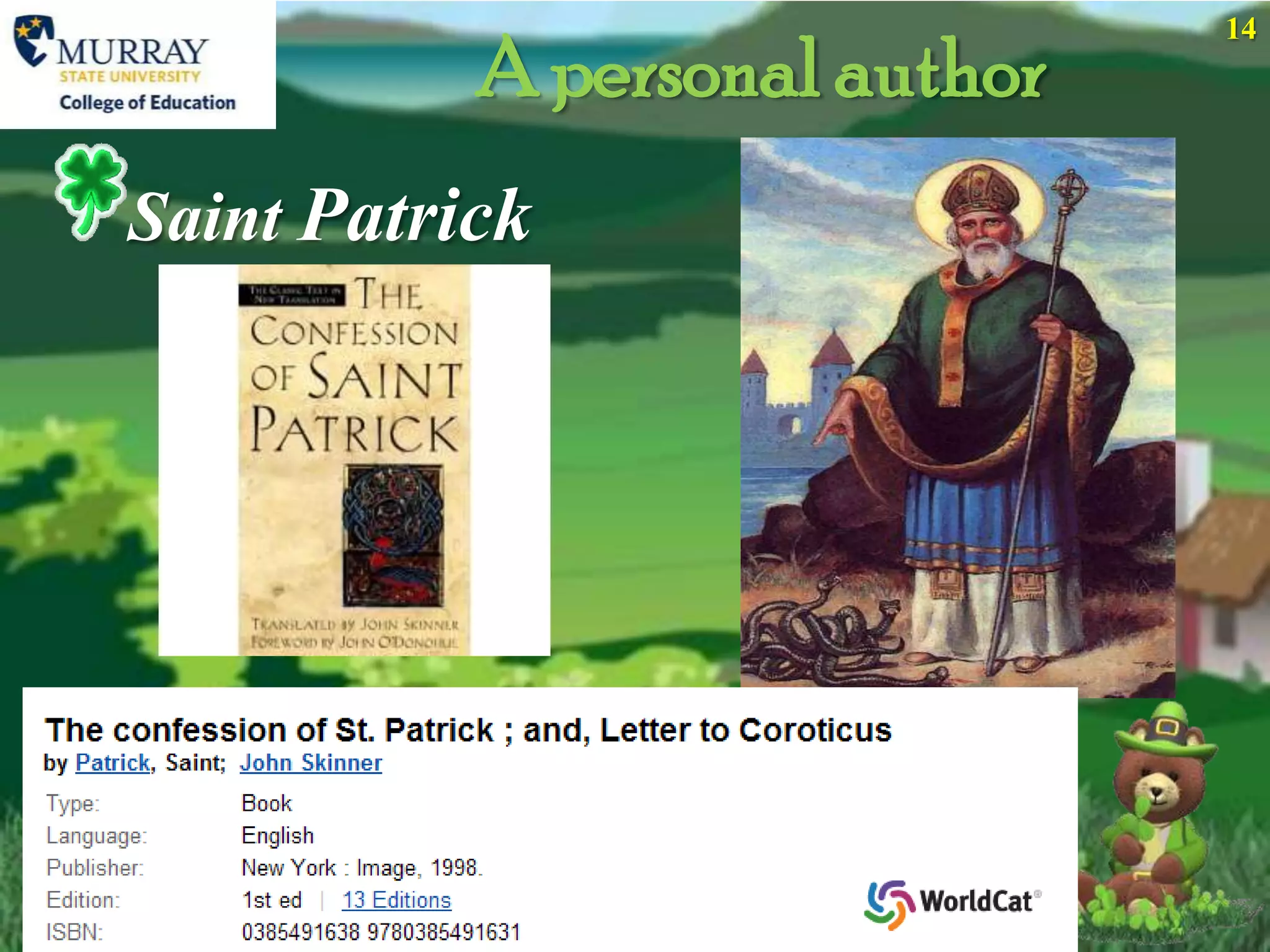
    filed in the         e.g. Saint Patrick (Latin:
 catalog cabinet.        Patricius, Irish: Naomh Pádraig) (from
14
           A personal author
Saint Patrick
15

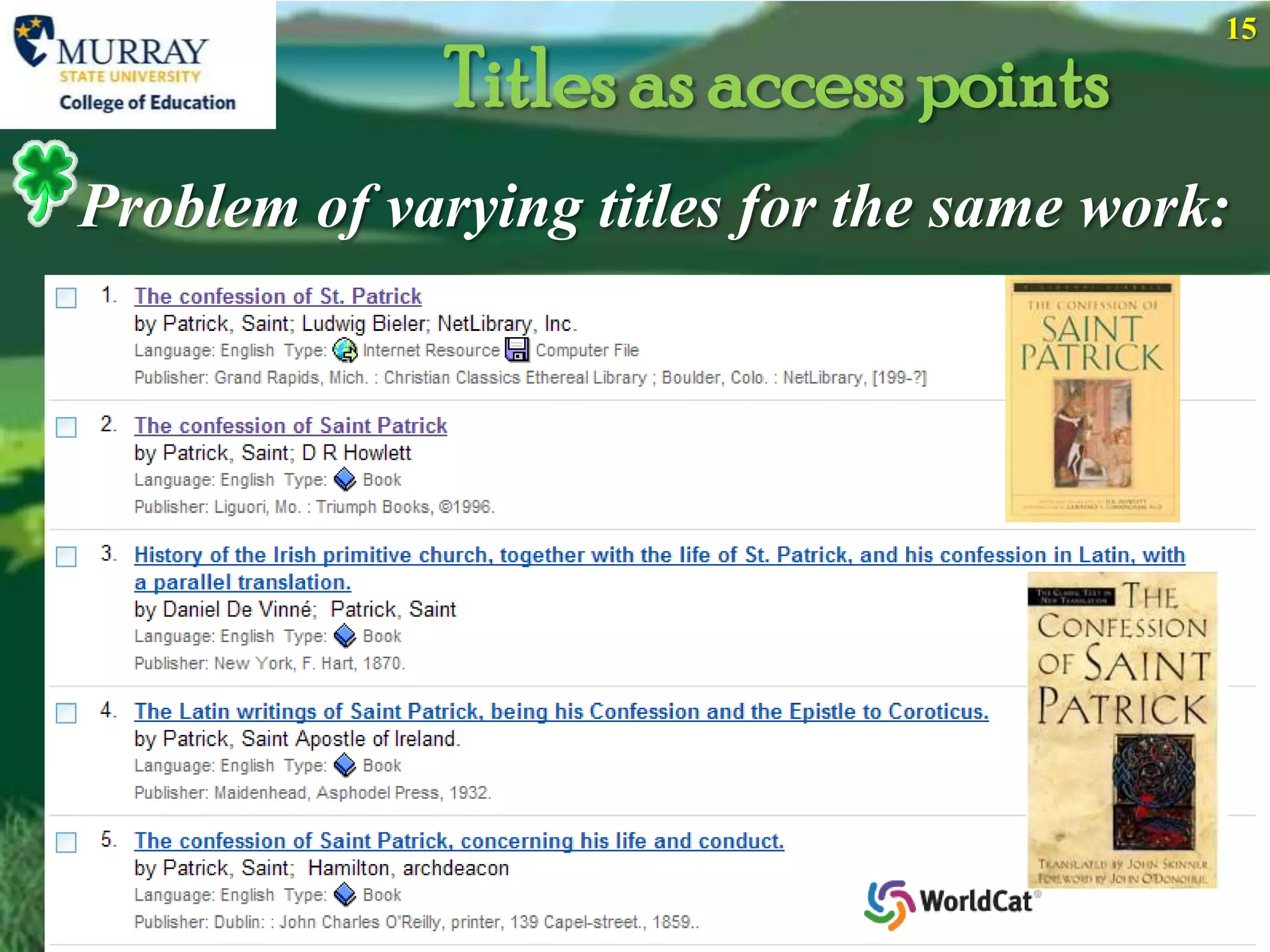
              Titles as access points
Problem of varying titles for the same work:
16

                             Solution?
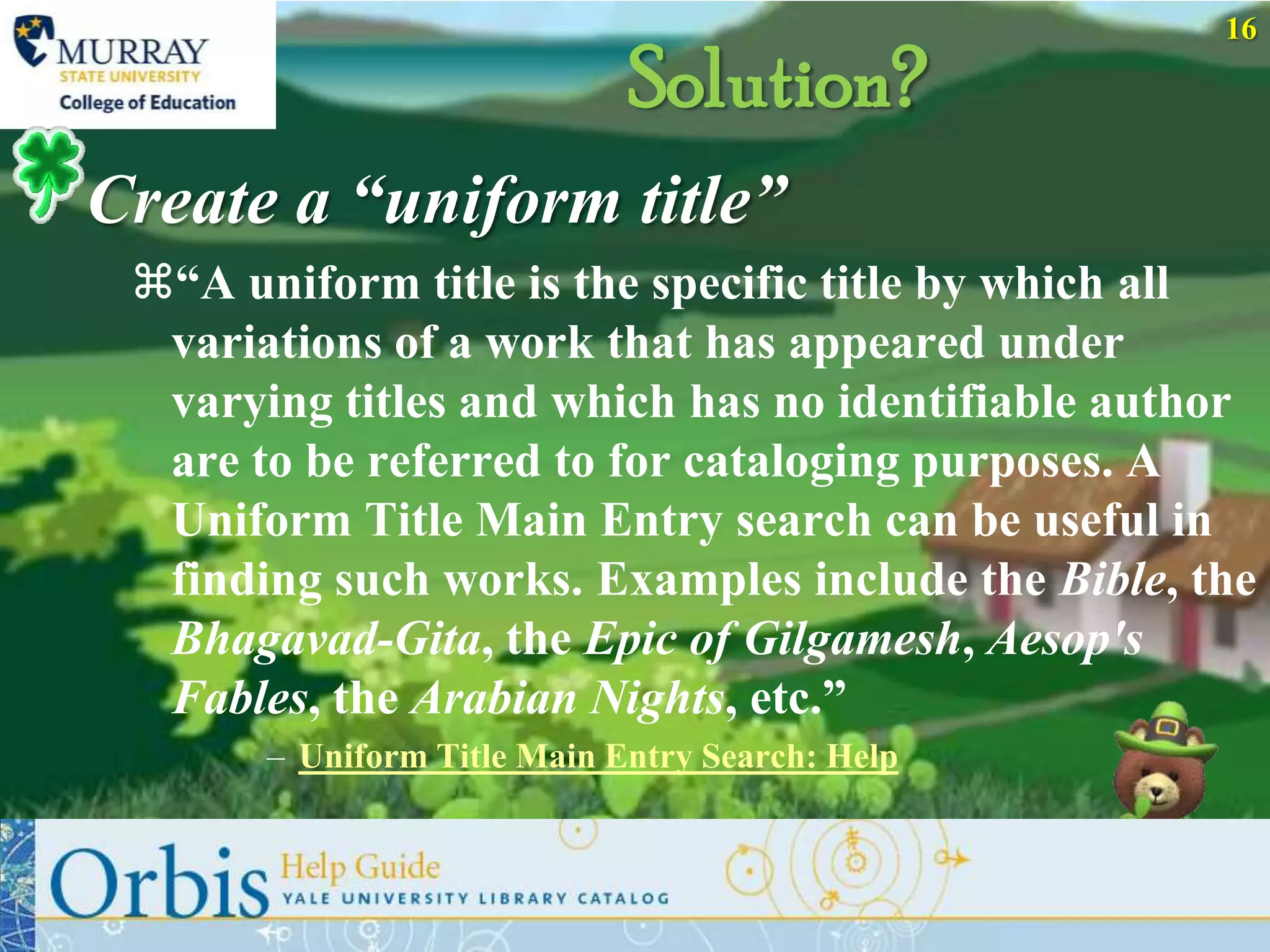
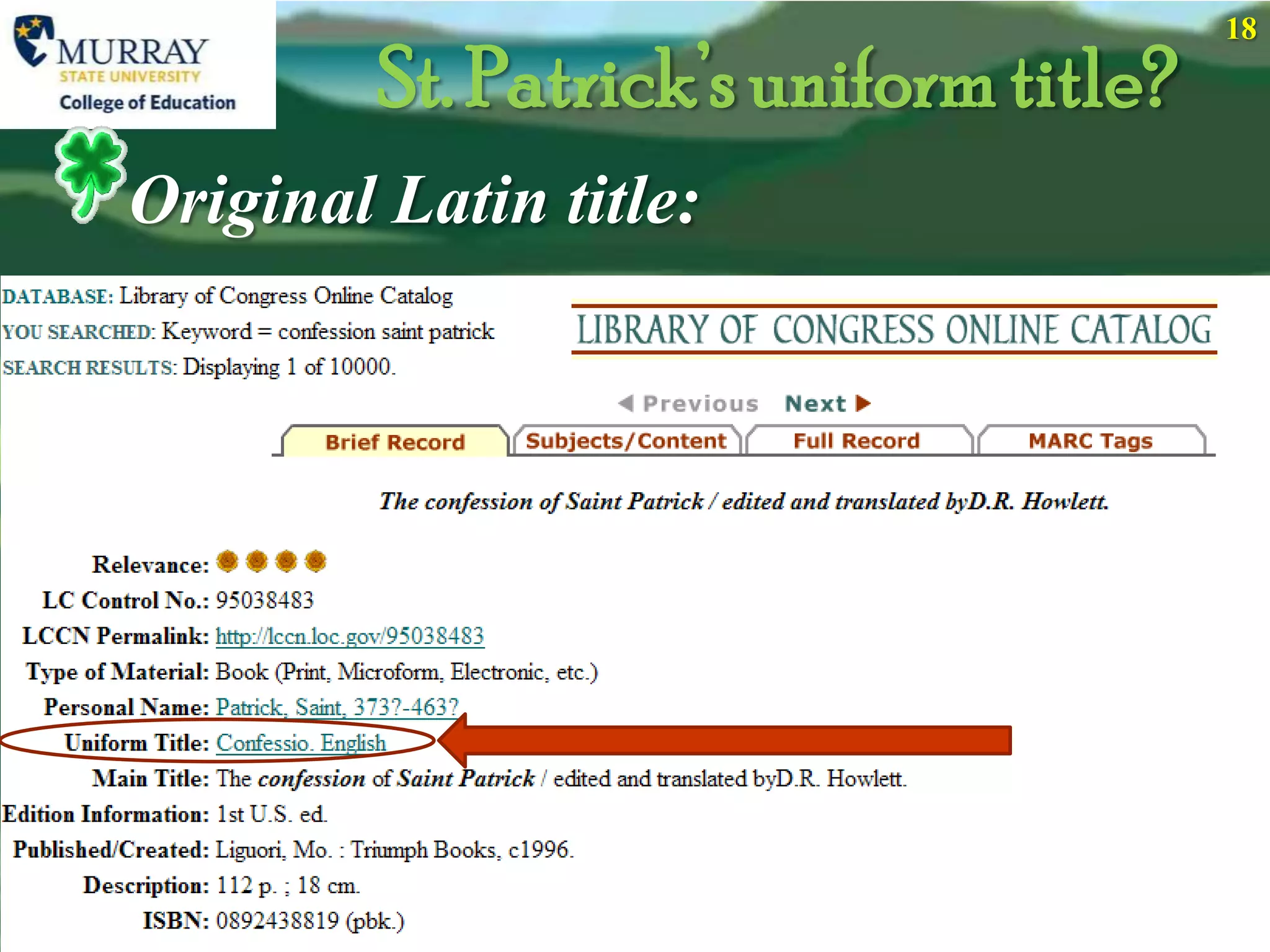
Create a “uniform title”
 “A uniform title is the specific title by which all
  variations of a work that has appeared under
  varying titles and which has no identifiable author
  are to be referred to for cataloging purposes. A
  Uniform Title Main Entry search can be useful in
  finding such works. Examples include the Bible, the
  Bhagavad-Gita, the Epic of Gilgamesh, Aesop's
  Fables, the Arabian Nights, etc.”
       – Uniform Title Main Entry Search: Help
17

               Uniform title rule
Concise AACR2:
 Rule 59 Individual Titles
  – 59A. If you use a uniform title,
    choose the title by which the work is best known.
    Decide this by consulting reference sources (including
    other catalogues) and other manifestations of the
    same work. If you are in doubt as to which title is
    best known, use the earliest title.
  – 59B. Choose the title in the original language, unless
    you are cataloguing an older work originally written
    in a nonroman alphabet language
    [Greek, Russian, etc.]
18

         St. Patrick’s uniform title?
Original Latin title:
19

             Other access points
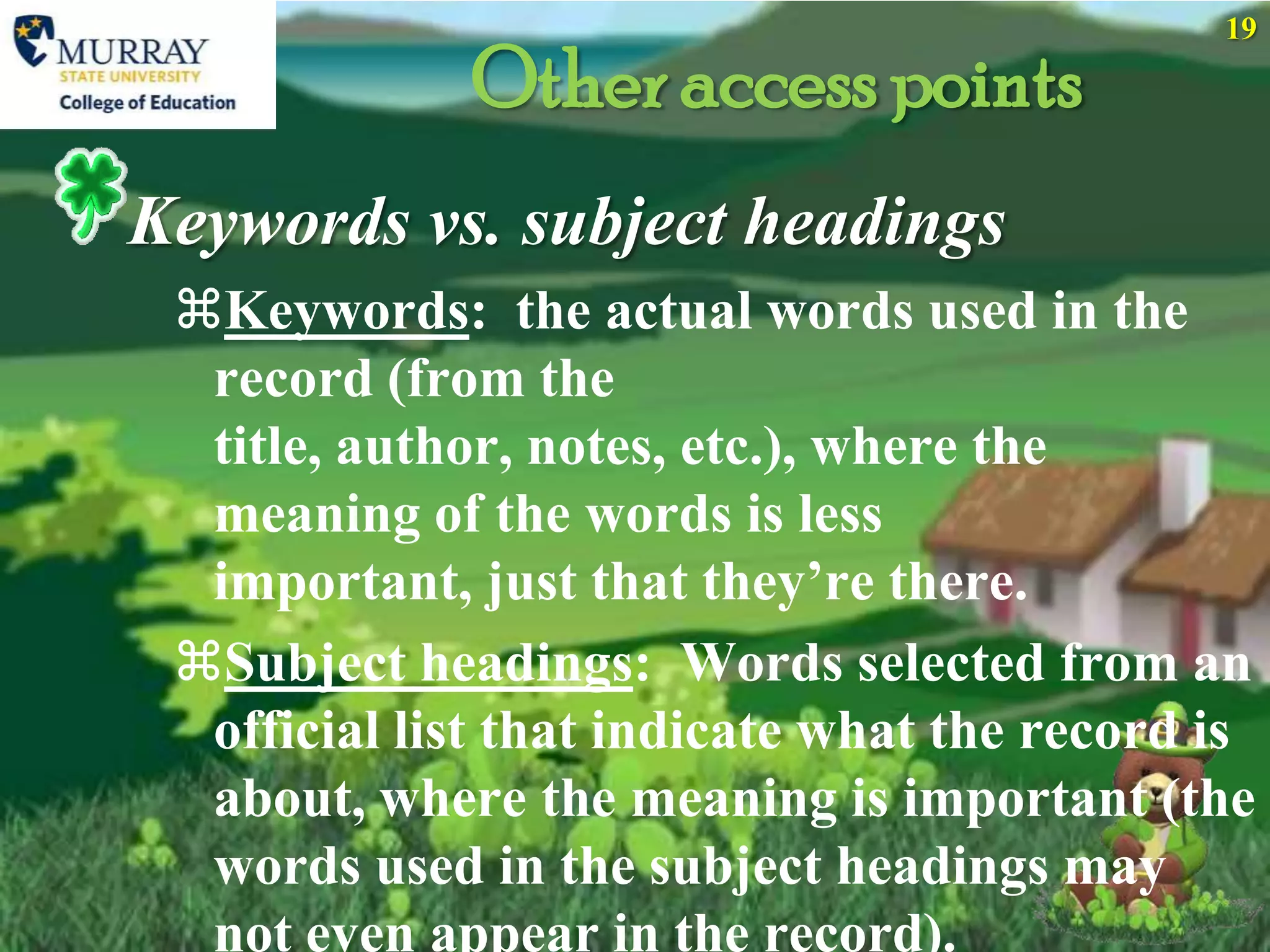
Keywords vs. subject headings
 Keywords: the actual words used in the
  record (from the
  title, author, notes, etc.), where the
  meaning of the words is less
  important, just that they’re there.
 Subject headings: Words selected from an
  official list that indicate what the record is
  about, where the meaning is important (the
  words used in the subject headings may
  not even appear in the record).
20

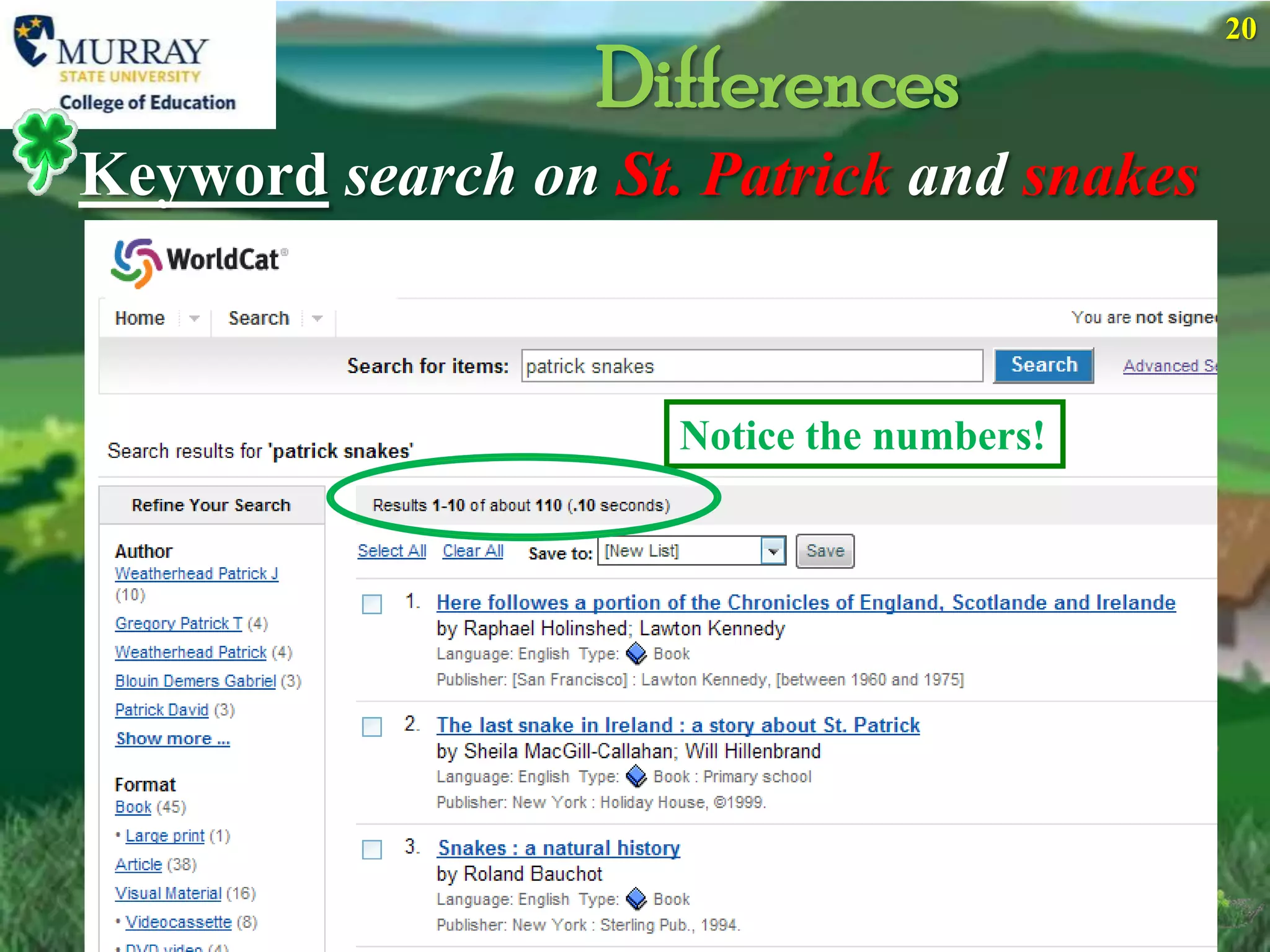
                  Differences
Keyword search on St. Patrick and snakes


                     Notice the numbers!
21

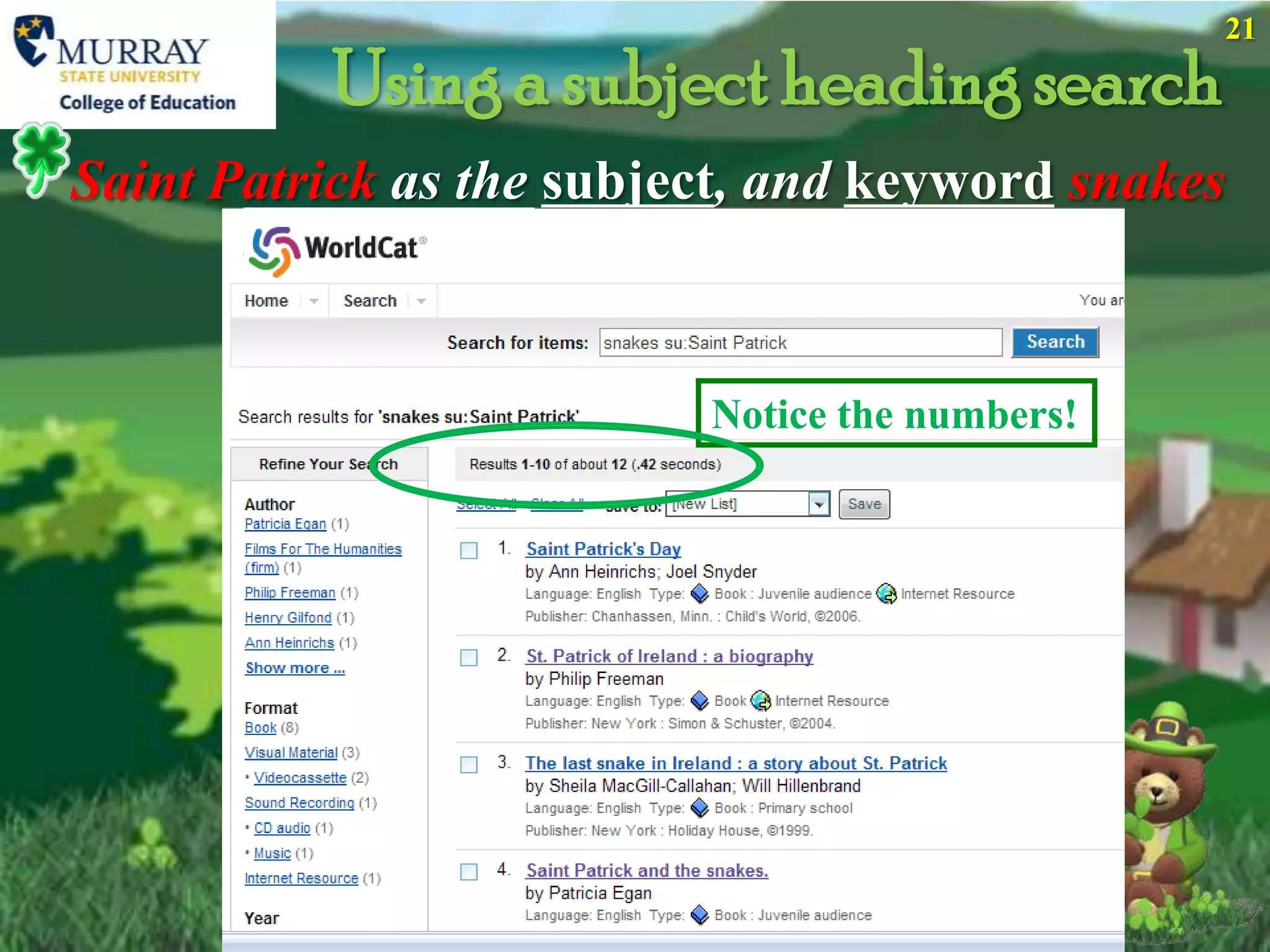
          Using a subject heading search
Saint Patrick as the subject, and keyword snakes


                          Notice the numbers!
22

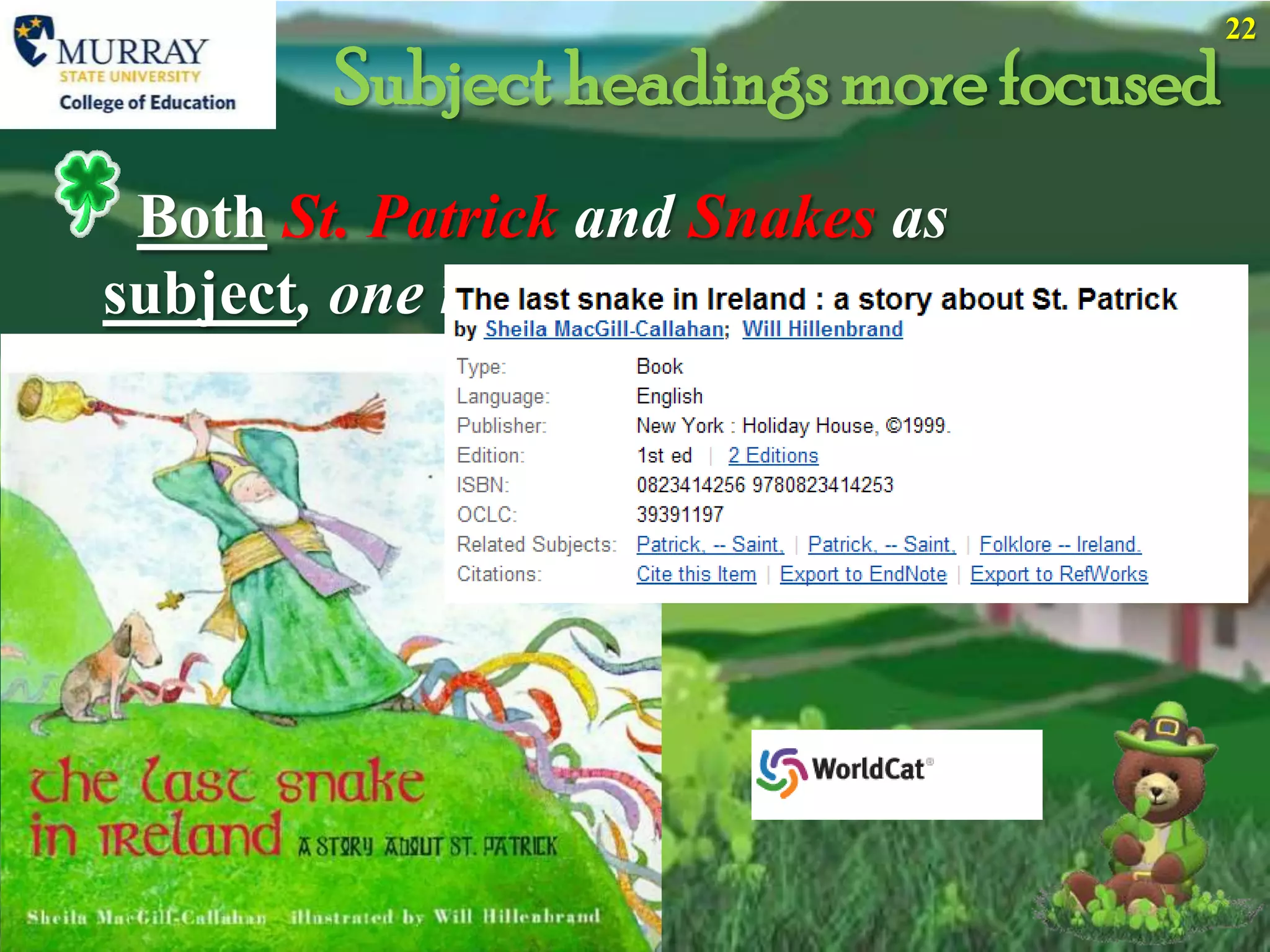
        Subject headings more focused
 Both St. Patrick and Snakes as
subject, one result:
23

               Geographical Headings
Difficulties with geographical names:
 Firstly, there are a number of homonym
  geographical proper names
       – e.g. out of the seven most important cities called
         London, three are located in the U.S. [ and one in
         Ontario, Canada] and there is an island called
         London too
 Secondly, there is a great variety of types of
  geographical names
 Thirdly, the same geographical place can have
  [different] names in different languages
       – Geographical names as access points for retrieving database
         records. Theory and practices of a library regulation Abstract
         from Hungarian Library Review.
24

       An Irish geographical dilemma
Ireland, Eire or what?
 Concise AACR2 rule 46A:
       –Give the name of the place found in
        (in this order of preference):
            1) current English-language
               gazetteers and atlases
            2) other current English-language
               reference sources
25
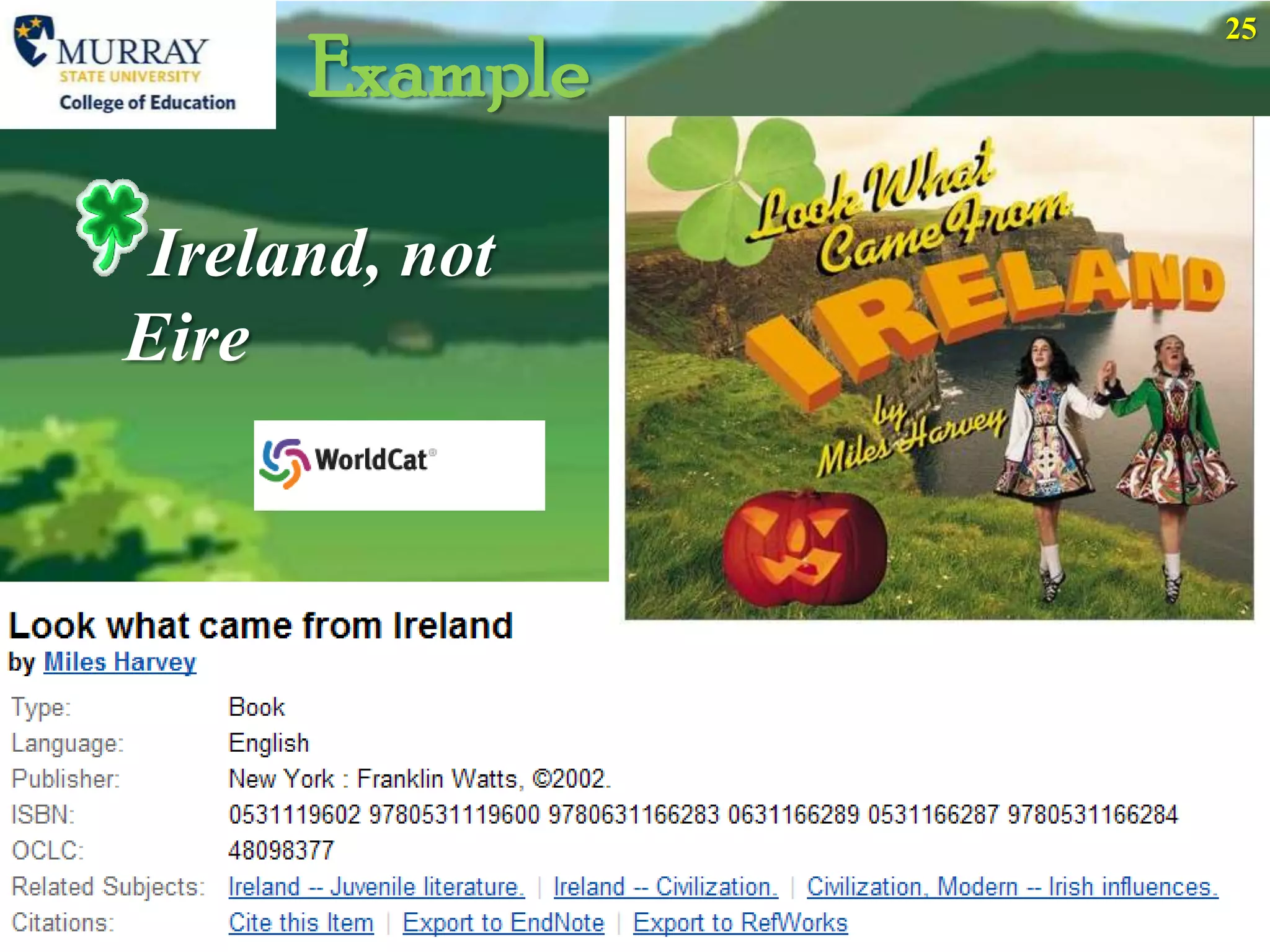
      Example

 Ireland, not
Eire
26

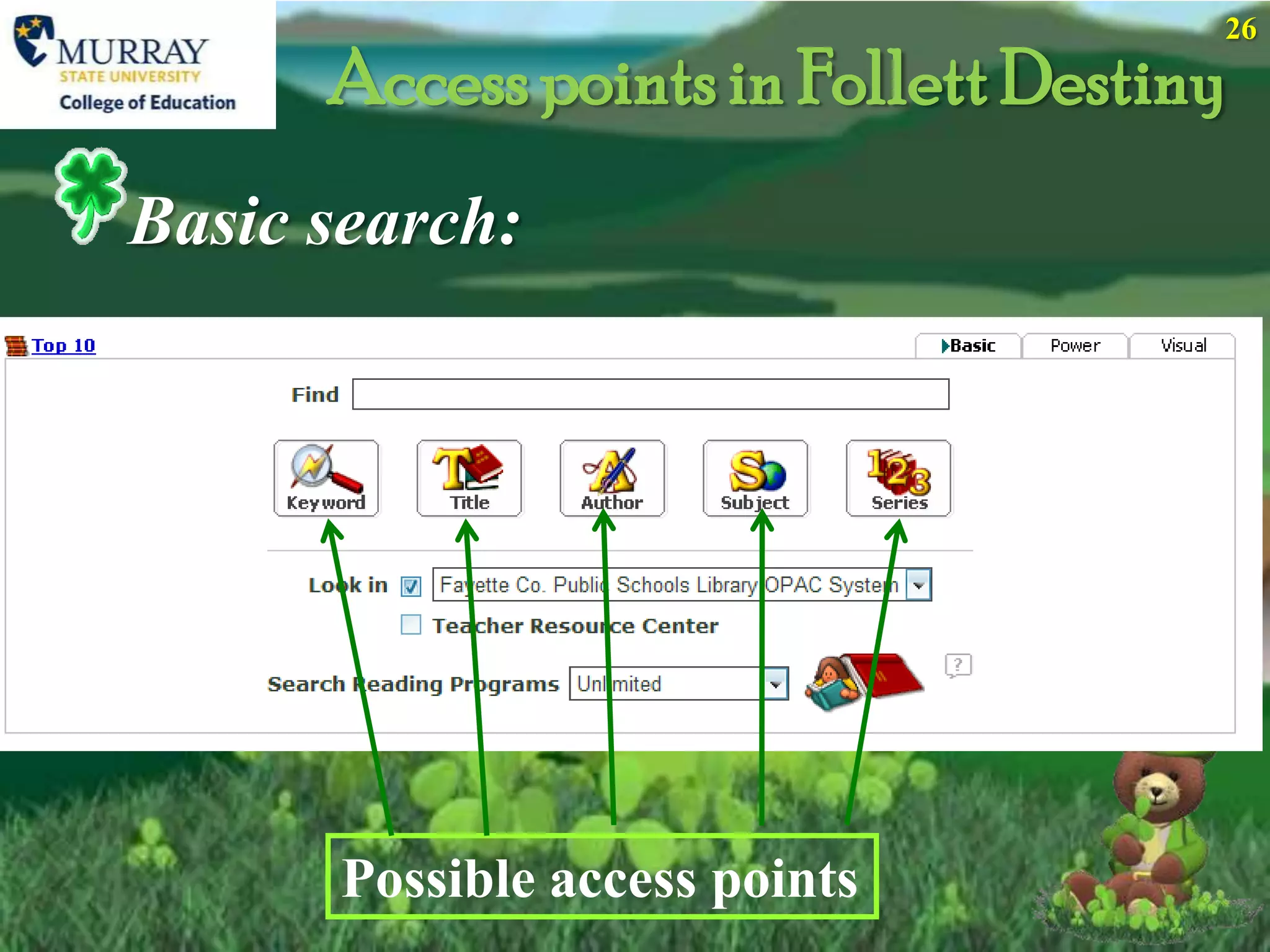
      Access points in Follett Destiny
Basic search:


       Possible access points
27

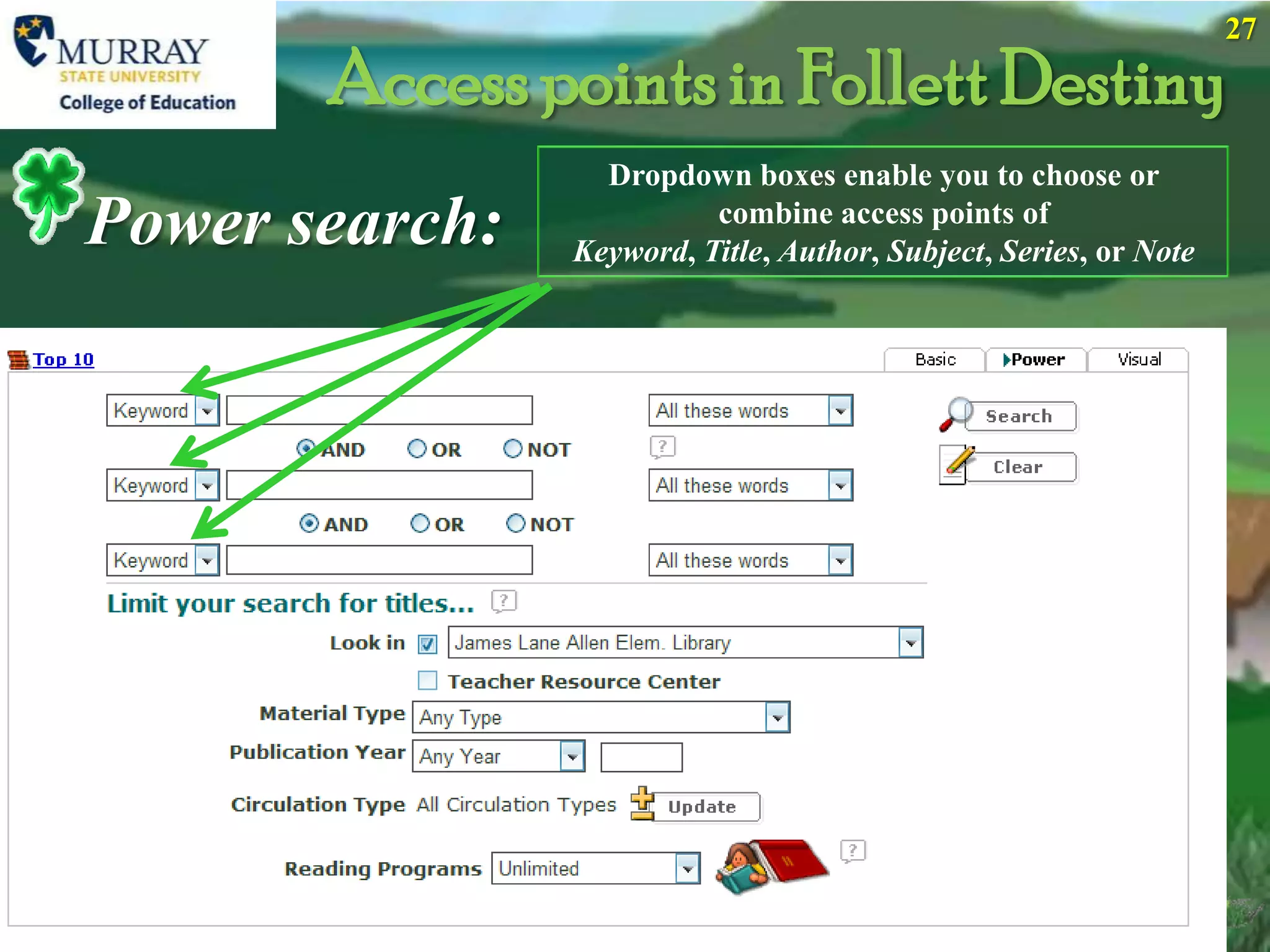
       Access points in Follett Destiny
                  Dropdown boxes enable you to choose or
Power search:             combine access points of
                Keyword, Title, Author, Subject, Series, or Note
28

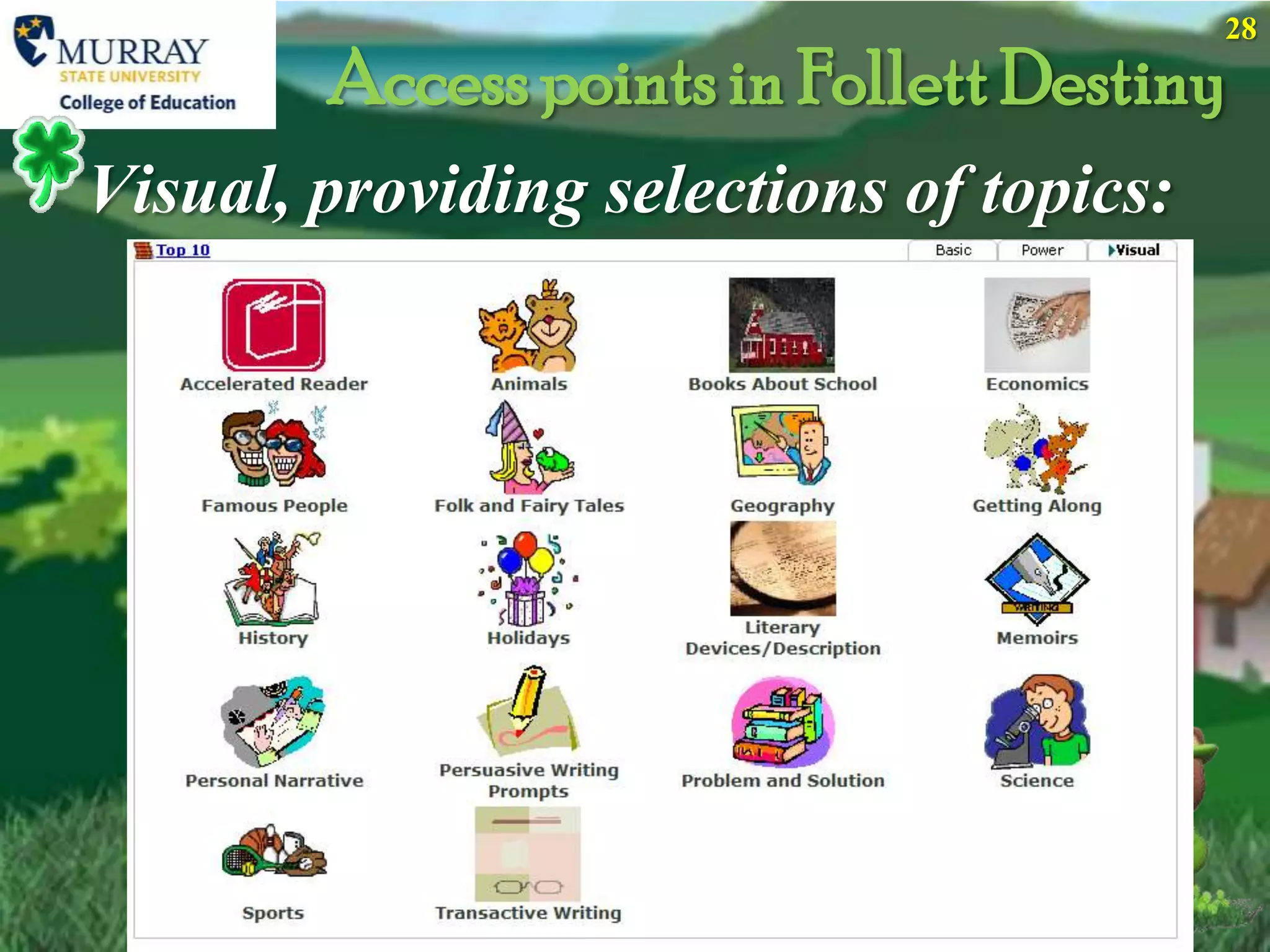
        Access points in Follett Destiny
Visual, providing selections of topics:
Searching shamrocks

Searching shamrocks

  • 1.
    LIB 630 Classificationand Cataloging Spring 2013 Searching for Shamrocks? Access Points for St. Patrick’s Day
  • 2.
    2 Access points? access point A unit of information in a bibliographic record under which a person may search for and identify items listed in the library catalog or bibliographic database. Access points have traditionally included the main entry, added entries, subject headings, classification or call number, and codes such as the standard number, but with machine-readable cataloging, almost any portion of the catalog record (name of publisher, type of material, etc.) can serve as an access point.
  • 3.
    3 Plain English, please? An access point is a feature (or an attribute) of a work (book, DVD, etc.) that someone might be likely to choose in order to be able to find that work – e. g. Title, author, other names associated with the work (publisher, corporate body, etc.), subject, keyword, classification number, etc.
  • 4.
    4 Access point: Main entry Comes from card catalog days One card designated as the one to have all the information about a book – ODLIS: “The entry in a library catalog that provides the fullest description of a bibliographic item, by which the work is to be uniformly identified and cited. In AACR2, the main entry is the primary access point.” • main entry
  • 5.
    5 Short Digression What is AACR2? The Anglo-American Cataloguing Rules (AACR) are a[n inter]national cataloging code first published in 1967. AACR2 stands for the Anglo-American Cataloguing Rules, Second Edition. AACR2 has been succeeded by Resource Description and Access (commonly referred to as RDA), which was released in June 2010. – From Wikipedia, the free encyclopedia
  • 6.
    Form of themain entry 6 Traditionally by author The most important thing about a book was that there was a person responsible for it. – Thus, card catalogs were arranged first and foremost alphabetically by author (where one could be found) – e.g. Markham, Marion M. The St. Patrick’s Day shamrock mystery / Marion M. Markham ; illustrated by Karen A. Jerome.
  • 7.
    7 Main Entry Example Bunting, Eve S is for shamrock : an Ireland alphabet / written by Eve Bunting ; illustrated by Matt Faulkner. - Chelsea, Mich. : Sleeping Bear Press, c2007. 1 v. (unpaged) : col. ill. ; 27 x 29 cm.  See Standard format for a card catalog entry , part of Idaho’s Alternative Basic Library Education (ABLE) Course 5: Introduction to Technical Services and Cataloging for other examples
  • 8.
    8 A “real” main entry card OCLC Catalog Cards 8 Card Appearance and Card Packs
  • 9.
    9 Main entry as source for Cutter What is a “Cutter number”? Cutter numbers primarily distinguish among books by the same author. A librarian uses a table (e.g., the Cutter-Sanborn Three-Figure Author table that the Cutter family [still] owns) to look up the correct Cutter. Cutters usually consist of the first letter of the author's last name and a series of numbers that makes sure books end up placed on shelves alphabetically, usually by title. – Catalogers decide numbers following the Dewey Decimal
  • 10.
    10 Cutter numbers Cutter? Among his other contributions to the wonderful world of librarianship, Charles Ammi Cutter [1837-1903] devised a way to assign an alpha-numeric code for authors' last names. Use of this system allows all books within a particular Dewey Decimal number to be arranged alphabetically on the shelf, usually by title. Catalogers try to assign distinct numbers for each name. The Cutter Number from Dewey Decimal in the UIUC Bookstacks March 11, 2013 Classification
  • 11.
    11 Let’s go Cuttering! Cutter numbers The cutter number for a book usually consists of the first letter of the author's last name and a series of numbers. This series of numbers comes from a table that is designed to help maintain an alphabetical arrangement of names. Conley, Ellen C767 Conley, Robert C768 Cook, Robin C77 Cook, Thomas C773 What if the library has several works by the same author? How do we keep the call number unique? To do that a work mark or work letter is used to distinguish the various works of a single author. Cook, Robin Acceptable Risk 813.54 C77a Cook, Robin Fever 813.54 C77f http://library.mtsu.edu/dewey/index.php#Cutter
  • 12.
    12 Do school librarians go “Cuttering”? Depends on the size of the school library Most often they will use just the 3-letter abbreviation (or something similar). Cutter #
  • 13.
    Personal names How do we write them? Concise AACR2: Why do they call –General Rule: it a heading? Rule 31A Choose, as the basis for the Because the heading [i.e. access point], the name by “access point” on which the person is commonly known. a catalog card was the It may be the person’s real heading, or the name, pseudonym, nickname, title, na header on the top me in religion, initials, or any other of the card, by type of name. which they were filed in the e.g. Saint Patrick (Latin: catalog cabinet. Patricius, Irish: Naomh Pádraig) (from
  • 14.
    14 A personal author Saint Patrick
  • 15.
    15 Titles as access points Problem of varying titles for the same work:
  • 16.
    16 Solution? Create a “uniform title” “A uniform title is the specific title by which all variations of a work that has appeared under varying titles and which has no identifiable author are to be referred to for cataloging purposes. A Uniform Title Main Entry search can be useful in finding such works. Examples include the Bible, the Bhagavad-Gita, the Epic of Gilgamesh, Aesop's Fables, the Arabian Nights, etc.” – Uniform Title Main Entry Search: Help
  • 17.
    17 Uniform title rule Concise AACR2: Rule 59 Individual Titles – 59A. If you use a uniform title, choose the title by which the work is best known. Decide this by consulting reference sources (including other catalogues) and other manifestations of the same work. If you are in doubt as to which title is best known, use the earliest title. – 59B. Choose the title in the original language, unless you are cataloguing an older work originally written in a nonroman alphabet language [Greek, Russian, etc.]
  • 18.
    18 St. Patrick’s uniform title? Original Latin title:
  • 19.
    19 Other access points Keywords vs. subject headings Keywords: the actual words used in the record (from the title, author, notes, etc.), where the meaning of the words is less important, just that they’re there. Subject headings: Words selected from an official list that indicate what the record is about, where the meaning is important (the words used in the subject headings may not even appear in the record).
  • 20.
    20 Differences Keyword search on St. Patrick and snakes Notice the numbers!
  • 21.
    21 Using a subject heading search Saint Patrick as the subject, and keyword snakes Notice the numbers!
  • 22.
    22 Subject headings more focused Both St. Patrick and Snakes as subject, one result:
  • 23.
    23 Geographical Headings Difficulties with geographical names: Firstly, there are a number of homonym geographical proper names – e.g. out of the seven most important cities called London, three are located in the U.S. [ and one in Ontario, Canada] and there is an island called London too Secondly, there is a great variety of types of geographical names Thirdly, the same geographical place can have [different] names in different languages – Geographical names as access points for retrieving database records. Theory and practices of a library regulation Abstract from Hungarian Library Review.
  • 24.
    24 An Irish geographical dilemma Ireland, Eire or what? Concise AACR2 rule 46A: –Give the name of the place found in (in this order of preference): 1) current English-language gazetteers and atlases 2) other current English-language reference sources
  • 25.
    25 Example Ireland, not Eire
  • 26.
    26 Access points in Follett Destiny Basic search: Possible access points
  • 27.
    27 Access points in Follett Destiny Dropdown boxes enable you to choose or Power search: combine access points of Keyword, Title, Author, Subject, Series, or Note
  • 28.
    28 Access points in Follett Destiny Visual, providing selections of topics: