The Entity Relationship Model

             Prepared by:
             Jane L. Garay
Entity
 The word entity in the ERM correspond to a table-not a
 row- in a relational environment.
 The ERM refers to a table row as an entity instance or
  entity occurrence.
Attributes
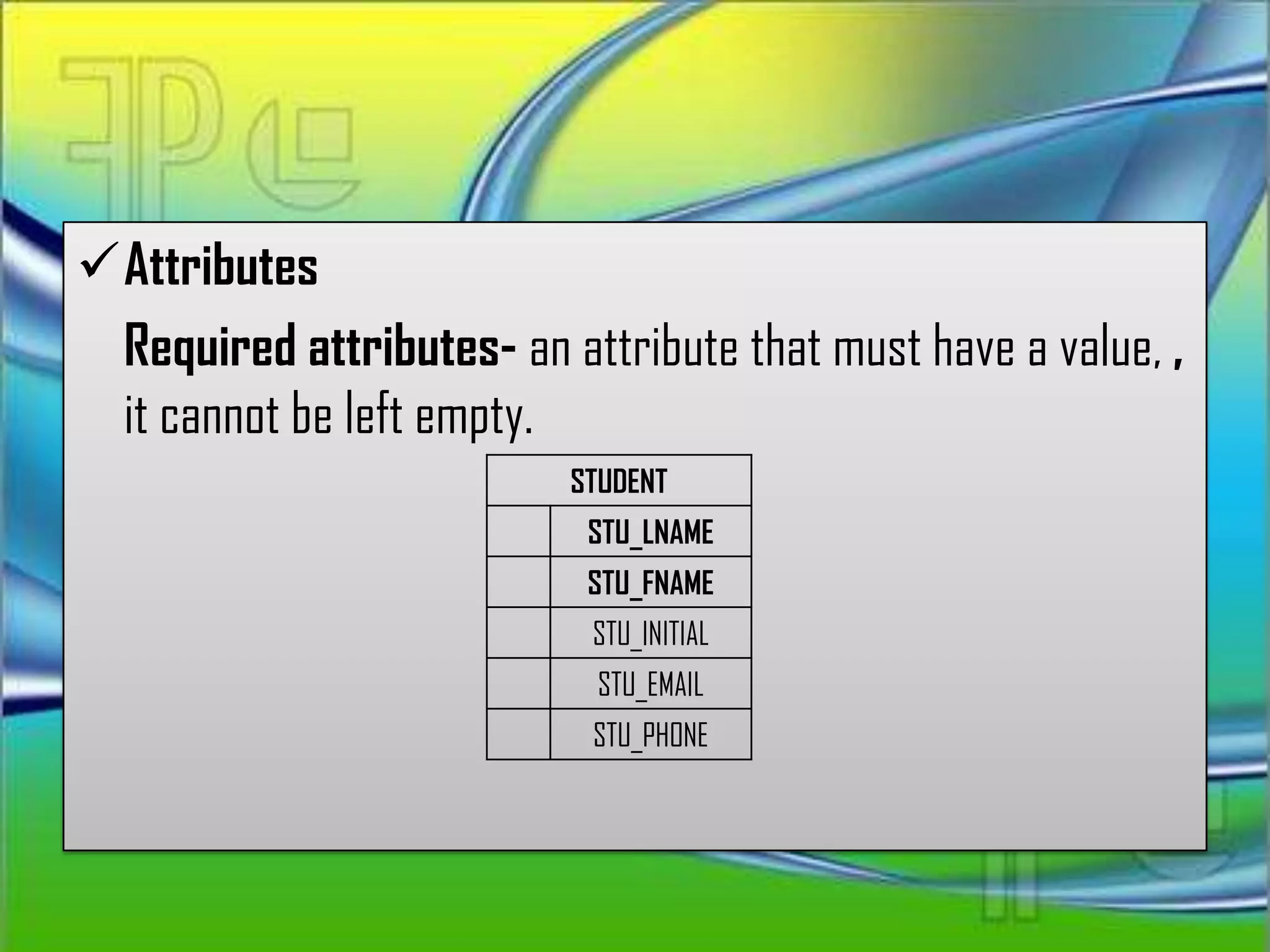
 Required attributes- an attribute that must have a value, ,
 it cannot be left empty.
                          STUDENT
                           STU_LNAME
                           STU_FNAME
                           STU_INITIAL
                            STU_EMAIL
                            STU_PHONE
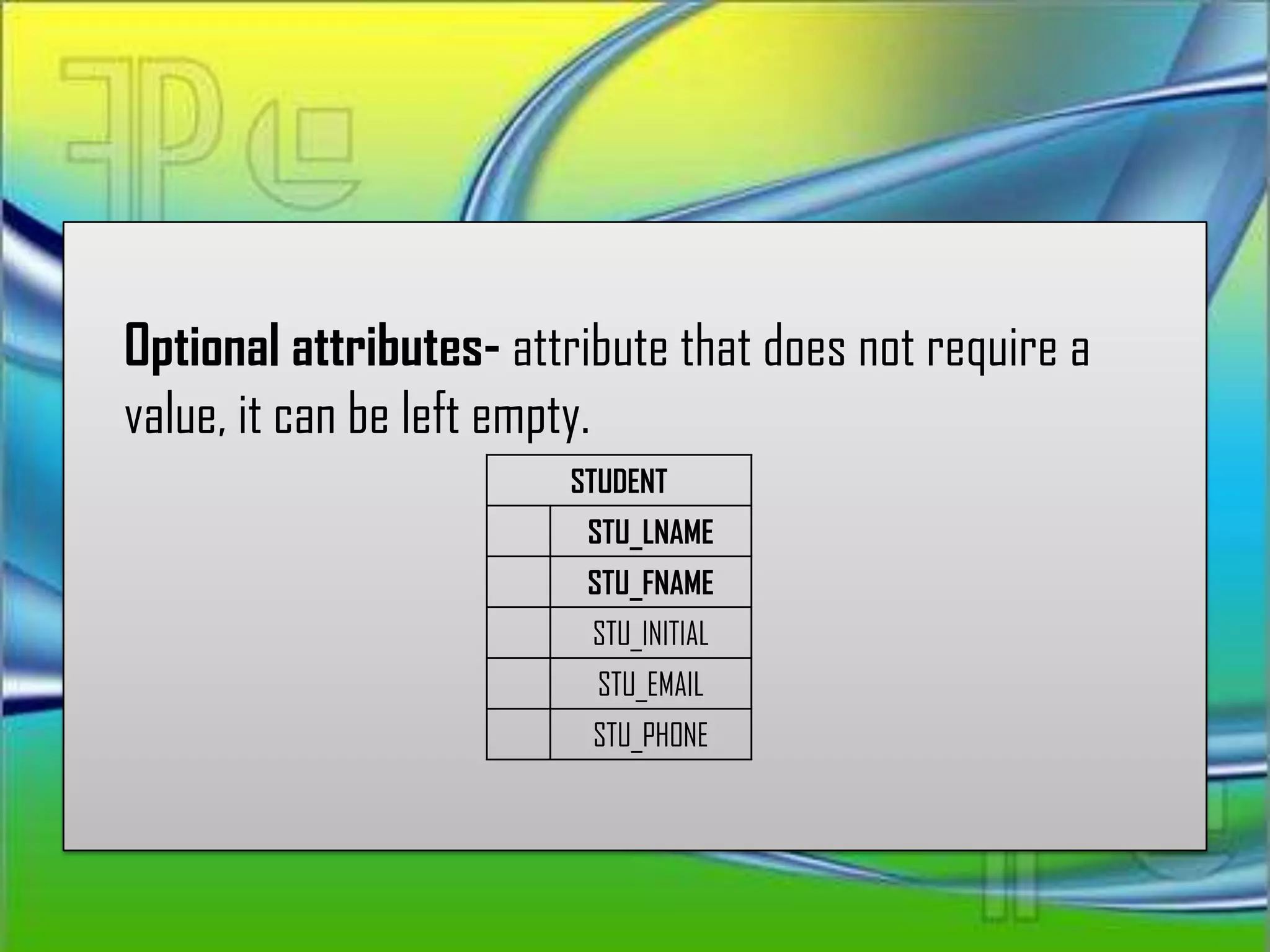
Optional attributes- attribute that does not require a
value, it can be left empty.
                        STUDENT
                         STU_LNAME
                         STU_FNAME
                          STU_INITIAL
                          STU_EMAIL
                          STU_PHONE
Domains- is the set of possible values for a given attribute.
Identifiers (Primary key)- one or more attributes that
 uniquely identify each entity instance.
 Composite identifiers- a primary key composed of more
 than one atribute.
Composite attributes- can be further subdivided to yield
 additional attributes.
 For example the attribute ADDRESS can be subdivided into
 street, city, state, zip code.
Simple attributes- cannot be subdivided.
 For example, age, sex, marital status.
Single-valued attributes- can have only a single value.
 For example, a person can only have one SSS Number.
Multivalued attributes- can have many values.
 For instance, a person may have a several college degrees,
 and a household may have different phones, each with its
 own number.
MOD_CODE         CAR_YEAR              CAR
                                        PK    CAR_VIN

CAR_VIN          CAR        CAR_COLOR
                                             MOD_CODE
                                              CAR_YEAR
                                             CAR_COLOR
Derived attributes – whose value is calculated (derived)
 from other attributes.
 It is derived by using an algorithm.
 Sometimes referred to as computed attributes.
Relationships
 The entities that participate in a relationship are also
 known as participants, and each relationship is identified by
 a name that describes the relationship.
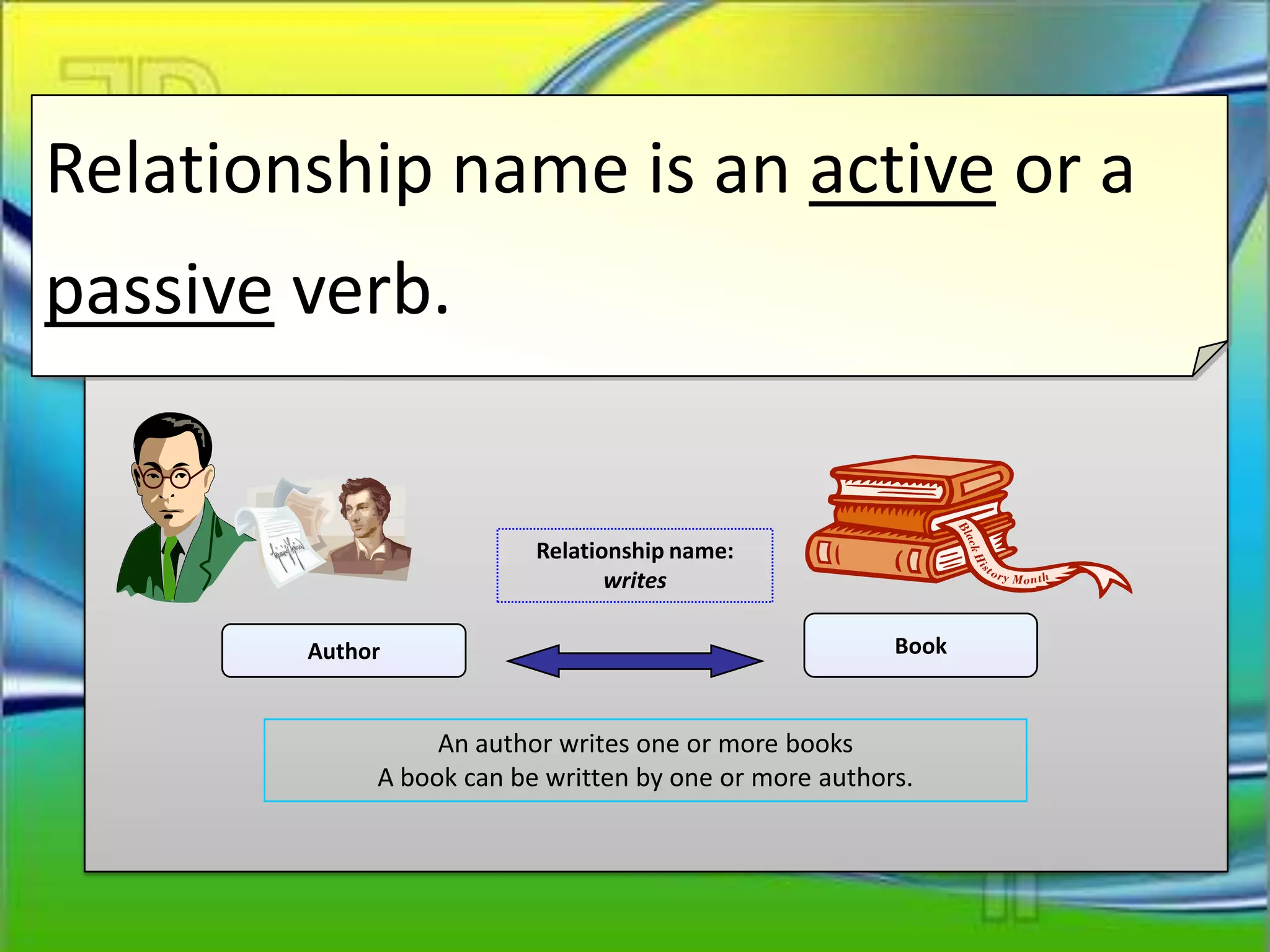
Relationship name is an active or a
passive verb.


                          Relationship name:
                                 writes

        Author                                          Book


                  An author writes one or more books
             A book can be written by one or more authors.
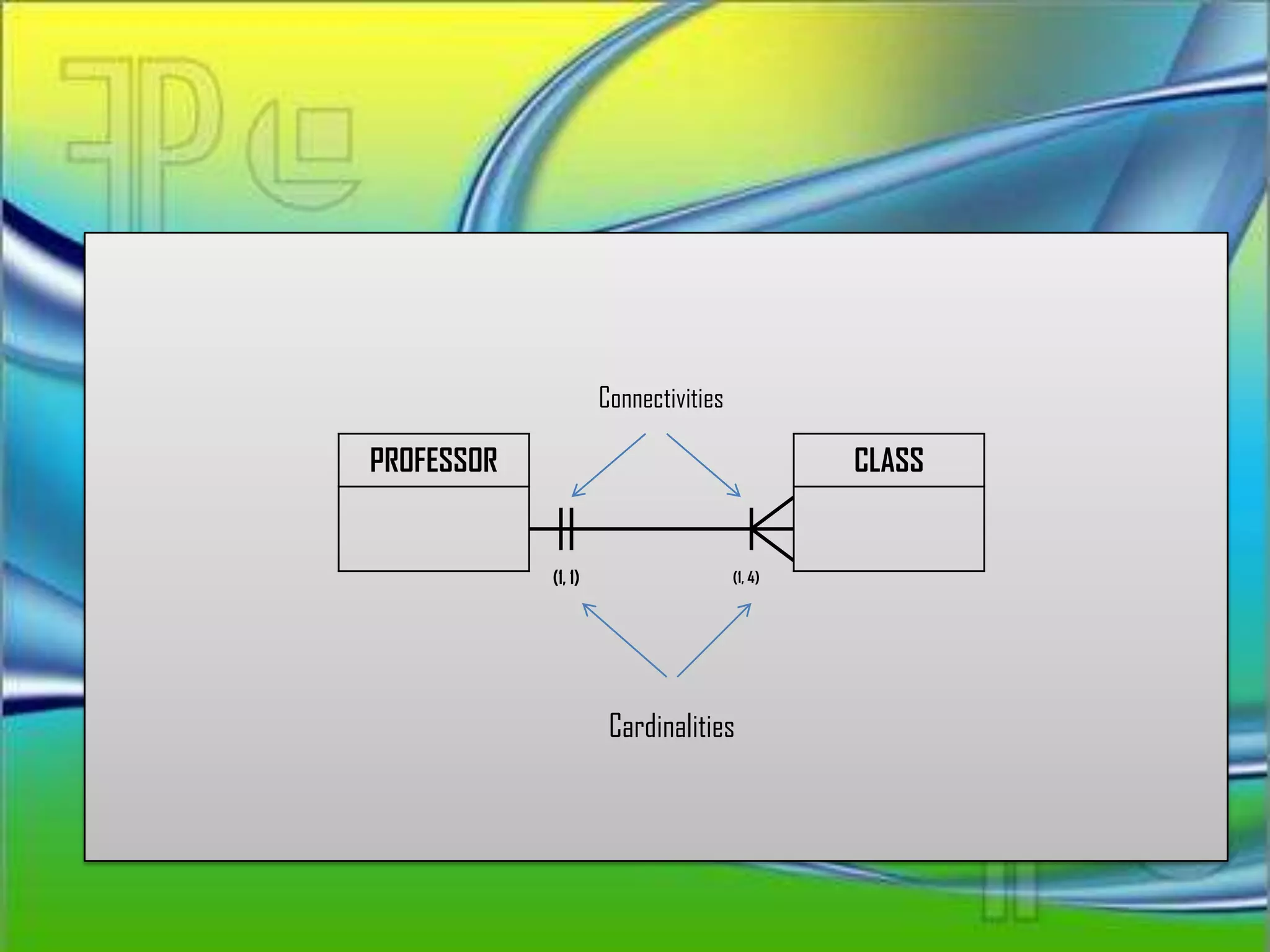
Connectivity and Cardinality
 Connectivity used to describe the relationship
 classification.
 Cardinality expresses the minimum and maximum number
 of entity occurrences associated with one occurrence of
 related entity.
 The first value represents the minimum no. of associated
 entities. The second value represents the maximum no. of
 associated entities
Connectivities

PROFESSOR                                      CLASS


            (1, 1)                    (1, 4)


                      Cardinalities
Erm
Erm

Erm

  • 1.
    The Entity RelationshipModel Prepared by: Jane L. Garay
  • 2.
    Entity The wordentity in the ERM correspond to a table-not a row- in a relational environment. The ERM refers to a table row as an entity instance or entity occurrence.
  • 3.
    Attributes Required attributes-an attribute that must have a value, , it cannot be left empty. STUDENT STU_LNAME STU_FNAME STU_INITIAL STU_EMAIL STU_PHONE
  • 4.
    Optional attributes- attributethat does not require a value, it can be left empty. STUDENT STU_LNAME STU_FNAME STU_INITIAL STU_EMAIL STU_PHONE
  • 5.
    Domains- is theset of possible values for a given attribute. Identifiers (Primary key)- one or more attributes that uniquely identify each entity instance. Composite identifiers- a primary key composed of more than one atribute.
  • 6.
    Composite attributes- canbe further subdivided to yield additional attributes. For example the attribute ADDRESS can be subdivided into street, city, state, zip code. Simple attributes- cannot be subdivided. For example, age, sex, marital status.
  • 7.
    Single-valued attributes- canhave only a single value. For example, a person can only have one SSS Number. Multivalued attributes- can have many values. For instance, a person may have a several college degrees, and a household may have different phones, each with its own number.
  • 8.
    MOD_CODE CAR_YEAR CAR PK CAR_VIN CAR_VIN CAR CAR_COLOR MOD_CODE CAR_YEAR CAR_COLOR
  • 9.
    Derived attributes –whose value is calculated (derived) from other attributes. It is derived by using an algorithm. Sometimes referred to as computed attributes.
  • 10.
    Relationships The entitiesthat participate in a relationship are also known as participants, and each relationship is identified by a name that describes the relationship.
  • 11.
    Relationship name isan active or a passive verb. Relationship name: writes Author Book An author writes one or more books A book can be written by one or more authors.
  • 12.
    Connectivity and Cardinality Connectivity used to describe the relationship classification. Cardinality expresses the minimum and maximum number of entity occurrences associated with one occurrence of related entity. The first value represents the minimum no. of associated entities. The second value represents the maximum no. of associated entities
  • 13.
    Connectivities PROFESSOR CLASS (1, 1) (1, 4) Cardinalities