UNIT-II
What is a Bibliography?
❖ Derived from two Greek
words, “biblion” meaning book
and “graphein” meaning to
write or the writing of books.
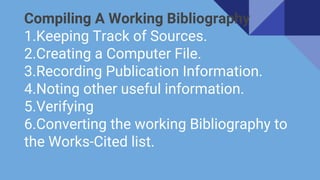
Compiling A Working Bibliography
1.Keeping Track of Sources.
2.Creating a Computer File.
3.Recording Publication Information.
4.Noting other useful information.
5.Verifying
6.Converting the working Bibliography to
the Works-Cited list.
❑ The history, identification, or description of
writings or publications.
❑ A list of works written by an author or printed
by a publishing house.
❑ It is the name given to a list of books,
manuscripts, and other publications,
systematically described and arranged, which
have some relationship to each other
Three Basic Purposes
⮚ To Identify and verify information.
⮚ To locate materials.
⮚ To select materials for the
collection.
There are two main types of bibliography
formats:
❑ MLA (Modern Language Association)
❑ APA (American Psychological
Association)
Bibliography format for a book
❑ Author
❑ Title
❑ Publisher
❑ Date Of Publication
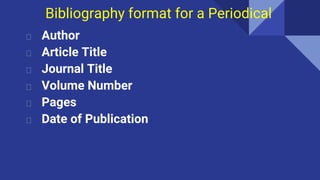
Bibliography format for a Periodical
⮚ Author
⮚ Article Title
⮚ Journal Title
⮚ Volume Number
⮚ Pages
⮚ Date of Publication
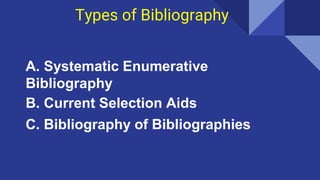
Types of Bibliography
A. Systematic Enumerative Bibliography
A. Systematic Enumerative
Bibliography
B. Current Selection Aids
C. Bibliography of Bibliographies
B.Current Selection Aids
C. Bibliography of Bibliographies
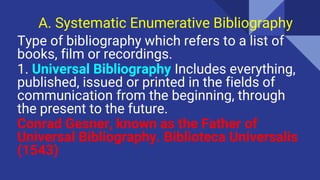
A. Systematic Enumerative Bibliography
Type of bibliography which refers to a list of
books, film or recordings.
1. Universal Bibliography Includes everything,
published, issued or printed in the fields of
communication from the beginning, through
the present to the future.
Conrad Gesner, known as the Father of
Universal Bibliography. Biblioteca Universalis
(1543)
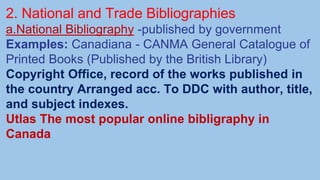
2. National and Trade Bibliographies
a.National Bibliography -published by government
Examples: Canadiana - CANMA General Catalogue of
Printed Books (Published by the British Library)
Copyright Office, record of the works published in
the country Arranged acc. To DDC with author, title,
and subject indexes.
Utlas The most popular online bibligraphy in
Canada
b. National Library Catalog
A list of all the works cataloged by a
national library and other member
libraries and includes items not published
in the country of origin.
Example: National Union Catalog (NUC)
of the LC Issued in microfiche in 1983
c. Trade Bibliographies
List commercial publications to aid in the
selection and acquisition recently published
materials, specifically trade books.
Information is gathered from the published
materials, specifically trade books.
Examples: Book in Print ( R.R. Bowker of
New York) 1948 to date
3. Subject Bibliography
List materials that relate to a particular topic. It
is intended to research workers and other in
special areas.
Examples: Blazek, Ron and Elizabeth Aversa. The
Humanities: A Selective Guide to Information
Sources.
Analytical and textual bibliography
Analytical- concerned with the
physical description of books.
Textual- highlights certain textual
variations between a manuscript and
the printed book.
Retrospective Bibliography
Covers materials published
during an earlier time period.
Examples:
Evans, Charles. American
Bibliography. Chicago: Evans.
1903-1934. 14 volumes.
webliography
list of electronic documents,
websites, or other resources
available on the World Wide Web,
especially those relating to a
particular subject.
Ex:a student's annotated webliography on Shakespeare.
Arachniography
A list of URLs to websites typically used as a
set of reference links on a particular subject or
bibliography. The term was coined by Andrew
Butrica of NASA and comes from "arachnid,"
which is Greek for spider.
Bibliography

Bibliography

  • 1.
  • 2.
    What is aBibliography? ❖ Derived from two Greek words, “biblion” meaning book and “graphein” meaning to write or the writing of books.
  • 3.
    Compiling A WorkingBibliography 1.Keeping Track of Sources. 2.Creating a Computer File. 3.Recording Publication Information. 4.Noting other useful information. 5.Verifying 6.Converting the working Bibliography to the Works-Cited list.
  • 4.
    ❑ The history,identification, or description of writings or publications. ❑ A list of works written by an author or printed by a publishing house. ❑ It is the name given to a list of books, manuscripts, and other publications, systematically described and arranged, which have some relationship to each other
  • 5.
    Three Basic Purposes ⮚To Identify and verify information. ⮚ To locate materials. ⮚ To select materials for the collection.
  • 6.
    There are twomain types of bibliography formats: ❑ MLA (Modern Language Association) ❑ APA (American Psychological Association)
  • 7.
    Bibliography format fora book ❑ Author ❑ Title ❑ Publisher ❑ Date Of Publication
  • 8.
    Bibliography format fora Periodical ⮚ Author ⮚ Article Title ⮚ Journal Title ⮚ Volume Number ⮚ Pages ⮚ Date of Publication
  • 9.
    Types of Bibliography A.Systematic Enumerative Bibliography A. Systematic Enumerative Bibliography B. Current Selection Aids C. Bibliography of Bibliographies B.Current Selection Aids C. Bibliography of Bibliographies
  • 10.
    A. Systematic EnumerativeBibliography Type of bibliography which refers to a list of books, film or recordings. 1. Universal Bibliography Includes everything, published, issued or printed in the fields of communication from the beginning, through the present to the future. Conrad Gesner, known as the Father of Universal Bibliography. Biblioteca Universalis (1543)
  • 11.
    2. National andTrade Bibliographies a.National Bibliography -published by government Examples: Canadiana - CANMA General Catalogue of Printed Books (Published by the British Library) Copyright Office, record of the works published in the country Arranged acc. To DDC with author, title, and subject indexes. Utlas The most popular online bibligraphy in Canada
  • 12.
    b. National LibraryCatalog A list of all the works cataloged by a national library and other member libraries and includes items not published in the country of origin. Example: National Union Catalog (NUC) of the LC Issued in microfiche in 1983
  • 13.
    c. Trade Bibliographies Listcommercial publications to aid in the selection and acquisition recently published materials, specifically trade books. Information is gathered from the published materials, specifically trade books. Examples: Book in Print ( R.R. Bowker of New York) 1948 to date
  • 14.
    3. Subject Bibliography Listmaterials that relate to a particular topic. It is intended to research workers and other in special areas. Examples: Blazek, Ron and Elizabeth Aversa. The Humanities: A Selective Guide to Information Sources.
  • 15.
    Analytical and textualbibliography Analytical- concerned with the physical description of books. Textual- highlights certain textual variations between a manuscript and the printed book.
  • 16.
    Retrospective Bibliography Covers materialspublished during an earlier time period. Examples: Evans, Charles. American Bibliography. Chicago: Evans. 1903-1934. 14 volumes.
  • 17.
    webliography list of electronicdocuments, websites, or other resources available on the World Wide Web, especially those relating to a particular subject. Ex:a student's annotated webliography on Shakespeare.
  • 18.
    Arachniography A list ofURLs to websites typically used as a set of reference links on a particular subject or bibliography. The term was coined by Andrew Butrica of NASA and comes from "arachnid," which is Greek for spider.