BIBLIOGRAPHY
AND REFERNCES
PREPARED BY: Dhruvi patel
FY MSC NURSING
C.M.P.C.O.N
What is bibliography???
• A bibliography is a orderly list of resources on a
particular subject.
• A bibliography provide the full references
information for all the sources which you may have
consulted in preparing a particular project.
• The purpose of a bibliography is to allow the reader
to trace the sources used.
Importance
Recognizing the importance of giving credit to
original authors through proper citations is a key
aspect of academic and ethical research. Proper
citations acknowledge the intellectual contributions
of others, helping to prevent plagiarism. This
practice also maintains the credibility and
authenticity of your work, as it shows that your
conclusions are built upon verified research.
Citations allow others to trace ideas back to their
original sources, fostering scholarly transparency
and furthering intellectual discourse
Elements in bibliography
• Author
• Title of documentation
• Date ( year of publication)
• Place of publication
• Edition
• Periodicity ( volume/ issue/ part number)
• series
standard Citation Styles
Used in a Bibliography
• There are various formats used in the creation of a
bibliography such as the American Psychological
Association (APA), Modern Language Association of
America (MLA) and Chicago Manual of Style and
Council of Biology Editors (CBE)
• The APA style of referencing is common in the papers
written on topics of social science MLA style is used
in field of humanities; and CBE is a popular citation
style in the natural sciences.
• Examples:-
MLA
For book Author Title of book Subtitle City of
Publication Publisher, Year Amold, Francis, Greece,
Texas Steck-Vaughn, 1902
APA
• Author's last name, first initial (Publication date)
book title Additional information City of publication,
Publishing company
• Allen, T. (1974) vanishing wildlife of North america
Washington, DC: National Geographic Society.
Making a Bibliography
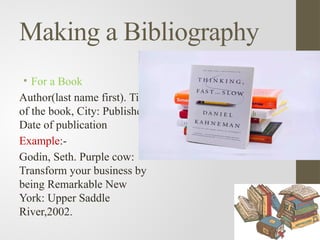
• For a Book
Author(last name first). Title
of the book, City: Publisher,
Date of publication
Example:-
Godin, Seth. Purple cow:
Transform your business by
being Remarkable New
York: Upper Saddle
River,2002.
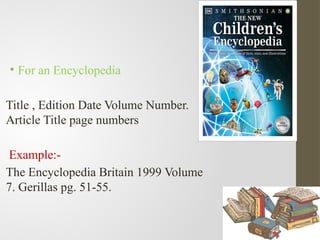
• For an Encyclopedia
Title , Edition Date Volume Number.
Article Title page numbers
Example:-
The Encyclopedia Britain 1999 Volume
7. Gerillas pg. 51-55.
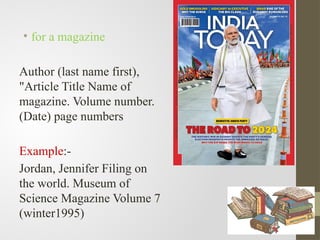
• for a magazine
Author (last name first),
"Article Title Name of
magazine. Volume number.
(Date) page numbers
Example:-
Jordan, Jennifer Filing on
the world. Museum of
Science Magazine Volume 7
(winter1995)
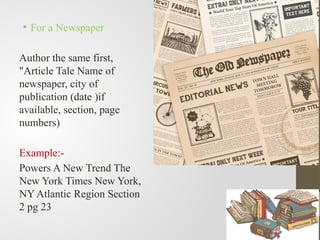
• For a Newspaper
Author the same first,
"Article Tale Name of
newspaper, city of
publication (date )if
available, section, page
numbers)
Example:-
Powers A New Trend The
New York Times New York,
NY Atlantic Region Section
2 pg 23
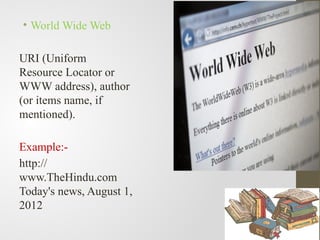
• World Wide Web
URI (Uniform
Resource Locator or
WWW address), author
(or items name, if
mentioned).
Example:-
http://
www.TheHindu.com
Today's news, August 1,
2012
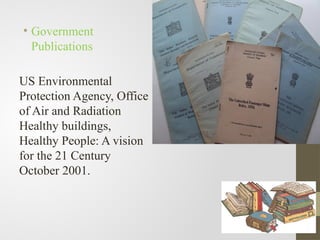
• Government
Publications
US Environmental
Protection Agency, Office
of Air and Radiation
Healthy buildings,
Healthy People: A vision
for the 21 Century
October 2001.
References
What is reference??
The detailed description of the documentation
from which you have obtained your information.
Referencing is a way of demonstrating that you
have done that reading.
Why do we need
references??
• To acknowledge other works.
• To allow other reader to find the original sources
easily.
• To get recognition and authentication of the
work.
• To make the work informative.
• To trace the intellectual development of the ideas
you present.
Source of references
• Book
• Journal
• Newspaper/ magazine
• Conference paper/ proceedings
• Institutional/ government publication
• Electronic sources- website, CD-ROM, database
theses/ report/ unpublished work etc.
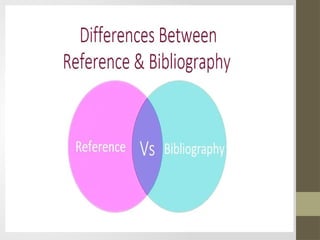
• Most people are not aware of the differences
between bibliography and references. They often
make the mistake that the two are same.
However, they are different and used in different
Most people a contexts in each essay, article, or
book.
• Bibliography is listing of all the materials that have been
consulted while writing an article or a book. References,
on the other hand, are those that have been referred to or
referenced in your article or book.
• you might have consulted a lot of books, essays, and
websites for writing something. Though you might have
referred to these materials while preparing a rough draft,
the contents of these may or may not have been included in
the actual text.
• A list of all such materials is known as bibliography.
• References are a list of those materials that are
directly included in your actual text.
• While all the items in references are cited directly
in the text, all the items of bibliography may not be
cited directly in the text. While reference can be
used to support your statement or argument or used
to supplement your finding, a bibliography does not
have such roles.
• A bibliography may contain all the items that
have appeared in the reference list, plus some
additional works.
• Both bibliography and references are arranged
alphabetically. But a reference list can also be
arranged in numeric style, which means
arranging the references chronologically
accord- ing to the numbers in the text.
Format of Writing the
Reference
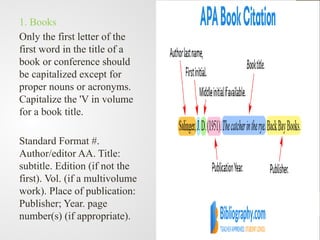
1. Books
Only the first letter of the
first word in the title of a
book or conference should
be capitalized except for
proper nouns or acronyms.
Capitalize the 'V in volume
for a book title.
Standard Format #.
Author/editor AA. Title:
subtitle. Edition (if not the
first). Vol. (if a multivolume
work). Place of publication:
Publisher; Year. page
number(s) (if appropriate).
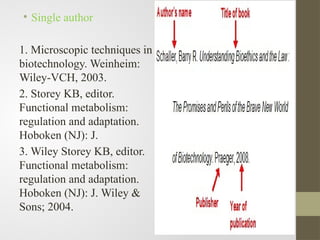
• Single author
1. Microscopic techniques in
biotechnology. Weinheim:
Wiley-VCH, 2003.
2. Storey KB, editor.
Functional metabolism:
regulation and adaptation.
Hoboken (NJ): J.
3. Wiley Storey KB, editor.
Functional metabolism:
regulation and adaptation.
Hoboken (NJ): J. Wiley &
Sons; 2004.
• Two or more authors or
editors
1. Lawhead JB, Baker MC.
Introduction to veterinary
science. Clifton Park
(NY): Thomson Delmar
Learning; 2005.
2. Gilstrap LC, Cunningham
FG, Van Dorsten JP,
editors. Operative
obstetrics. 2nd ed. New
York: McGraw-Hill; 2002.
• No author
The Oxford concise
medical dictionary. 6th ed.
Oxford: Oxford University
Press; 2003. p. 26.
• Multiple volumes
Lee GR, Bithell TC, Foerster
J, Athens JW, Lukens JN,
editors. Wintrobes clinical
hematology. 9th ed. Vol. 2.
Philadelphia: Lea &
Febiger; 1993
VI. Internet Documents
• Standard Format
#. Author A, Author B.
Document title. Webpage name
[format]. Source/production
informa- tion; Date of internet
publication [cited year month
day]. Available from: URL.
• Professional Internet site:
Australian Institute of Health and Welfare. Chronic
diseases and associated risk factors [document on the
Internet]. Canberra: The Institute; 2004 [updated 2005
June 23; cited 2005 Jun 30]. Available from:
http://www.aihw.gov.au/cdarf/index.cfm
• Personal Internet site:
Stanley Health Research [homepage on the
Internet]. Perth: The Institute; 2005 [cited 2005
Jun 30] Available from:
http://www.ichr.uwa.edu.au/about/schools/
• General Internet site:
Lavelle P. Mental state of the nation. Health
matters [document on the Internet]. ABC on line:
2005 May 19 [cited 2005 Jul 1]. Available from:
http://abc.net.au/health/features/ mentalstate/.
AMERICAN
PSYCHOLOGICAL
ASSOCIATION
STYLE OF
REFERENCES
• I. Books
Single-author book and part of a book:
Garner, B. A. (2003). Garner's Modern American
Usage. New York: Oxford University Press.
• Book with two or more authors:
Ligon, M., Carpenter, K., Brown, W., & Milsop, A.
(1983). Computers in the world of business
communications. Hartford, CT: Capital Press.
• Book without author or editor listed:
Webster's New Collegiate Dictionary. (1961).
Springfield, MA: G. & C. Merriam. To alphabetize
such an entry on your Reference page, use the first
significant word of the title (ignoring the articles, "a,"
"an," and "the").
• Multivolume work:
Nadeau, B. M. & Darling, J. M. (Eds.). (1994-2003).
Studies in the history of cutlery (Vols. 4-6). Utica,
NY: Mohican Valley-River Press.
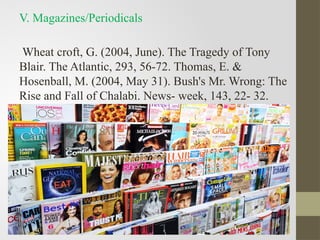
V. Magazines/Periodicals
Wheat croft, G. (2004, June). The Tragedy of Tony
Blair. The Atlantic, 293, 56-72. Thomas, E. &
Hosenball, M. (2004, May 31). Bush's Mr. Wrong: The
Rise and Fall of Chalabi. News- week, 143, 22- 32.

Bibliography-and-Reference and Citation.pptx

  • 1.
    BIBLIOGRAPHY AND REFERNCES PREPARED BY:Dhruvi patel FY MSC NURSING C.M.P.C.O.N
  • 3.
    What is bibliography??? •A bibliography is a orderly list of resources on a particular subject. • A bibliography provide the full references information for all the sources which you may have consulted in preparing a particular project. • The purpose of a bibliography is to allow the reader to trace the sources used.
  • 4.
    Importance Recognizing the importanceof giving credit to original authors through proper citations is a key aspect of academic and ethical research. Proper citations acknowledge the intellectual contributions of others, helping to prevent plagiarism. This practice also maintains the credibility and authenticity of your work, as it shows that your conclusions are built upon verified research. Citations allow others to trace ideas back to their original sources, fostering scholarly transparency and furthering intellectual discourse
  • 5.
    Elements in bibliography •Author • Title of documentation • Date ( year of publication) • Place of publication • Edition • Periodicity ( volume/ issue/ part number) • series
  • 6.
    standard Citation Styles Usedin a Bibliography • There are various formats used in the creation of a bibliography such as the American Psychological Association (APA), Modern Language Association of America (MLA) and Chicago Manual of Style and Council of Biology Editors (CBE) • The APA style of referencing is common in the papers written on topics of social science MLA style is used in field of humanities; and CBE is a popular citation style in the natural sciences.
  • 7.
    • Examples:- MLA For bookAuthor Title of book Subtitle City of Publication Publisher, Year Amold, Francis, Greece, Texas Steck-Vaughn, 1902 APA • Author's last name, first initial (Publication date) book title Additional information City of publication, Publishing company • Allen, T. (1974) vanishing wildlife of North america Washington, DC: National Geographic Society.
  • 8.
    Making a Bibliography •For a Book Author(last name first). Title of the book, City: Publisher, Date of publication Example:- Godin, Seth. Purple cow: Transform your business by being Remarkable New York: Upper Saddle River,2002.
  • 9.
    • For anEncyclopedia Title , Edition Date Volume Number. Article Title page numbers Example:- The Encyclopedia Britain 1999 Volume 7. Gerillas pg. 51-55.
  • 10.
    • for amagazine Author (last name first), "Article Title Name of magazine. Volume number. (Date) page numbers Example:- Jordan, Jennifer Filing on the world. Museum of Science Magazine Volume 7 (winter1995)
  • 11.
    • For aNewspaper Author the same first, "Article Tale Name of newspaper, city of publication (date )if available, section, page numbers) Example:- Powers A New Trend The New York Times New York, NY Atlantic Region Section 2 pg 23
  • 12.
    • World WideWeb URI (Uniform Resource Locator or WWW address), author (or items name, if mentioned). Example:- http:// www.TheHindu.com Today's news, August 1, 2012
  • 13.
    • Government Publications US Environmental ProtectionAgency, Office of Air and Radiation Healthy buildings, Healthy People: A vision for the 21 Century October 2001.
  • 14.
  • 15.
    What is reference?? Thedetailed description of the documentation from which you have obtained your information. Referencing is a way of demonstrating that you have done that reading.
  • 16.
    Why do weneed references?? • To acknowledge other works. • To allow other reader to find the original sources easily. • To get recognition and authentication of the work. • To make the work informative. • To trace the intellectual development of the ideas you present.
  • 17.
    Source of references •Book • Journal • Newspaper/ magazine • Conference paper/ proceedings • Institutional/ government publication • Electronic sources- website, CD-ROM, database theses/ report/ unpublished work etc.
  • 19.
    • Most peopleare not aware of the differences between bibliography and references. They often make the mistake that the two are same. However, they are different and used in different Most people a contexts in each essay, article, or book.
  • 20.
    • Bibliography islisting of all the materials that have been consulted while writing an article or a book. References, on the other hand, are those that have been referred to or referenced in your article or book. • you might have consulted a lot of books, essays, and websites for writing something. Though you might have referred to these materials while preparing a rough draft, the contents of these may or may not have been included in the actual text. • A list of all such materials is known as bibliography.
  • 21.
    • References area list of those materials that are directly included in your actual text. • While all the items in references are cited directly in the text, all the items of bibliography may not be cited directly in the text. While reference can be used to support your statement or argument or used to supplement your finding, a bibliography does not have such roles.
  • 22.
    • A bibliographymay contain all the items that have appeared in the reference list, plus some additional works. • Both bibliography and references are arranged alphabetically. But a reference list can also be arranged in numeric style, which means arranging the references chronologically accord- ing to the numbers in the text.
  • 23.
    Format of Writingthe Reference
  • 24.
    1. Books Only thefirst letter of the first word in the title of a book or conference should be capitalized except for proper nouns or acronyms. Capitalize the 'V in volume for a book title. Standard Format #. Author/editor AA. Title: subtitle. Edition (if not the first). Vol. (if a multivolume work). Place of publication: Publisher; Year. page number(s) (if appropriate).
  • 25.
    • Single author 1.Microscopic techniques in biotechnology. Weinheim: Wiley-VCH, 2003. 2. Storey KB, editor. Functional metabolism: regulation and adaptation. Hoboken (NJ): J. 3. Wiley Storey KB, editor. Functional metabolism: regulation and adaptation. Hoboken (NJ): J. Wiley & Sons; 2004.
  • 26.
    • Two ormore authors or editors 1. Lawhead JB, Baker MC. Introduction to veterinary science. Clifton Park (NY): Thomson Delmar Learning; 2005. 2. Gilstrap LC, Cunningham FG, Van Dorsten JP, editors. Operative obstetrics. 2nd ed. New York: McGraw-Hill; 2002.
  • 27.
    • No author TheOxford concise medical dictionary. 6th ed. Oxford: Oxford University Press; 2003. p. 26. • Multiple volumes Lee GR, Bithell TC, Foerster J, Athens JW, Lukens JN, editors. Wintrobes clinical hematology. 9th ed. Vol. 2. Philadelphia: Lea & Febiger; 1993
  • 28.
    VI. Internet Documents •Standard Format #. Author A, Author B. Document title. Webpage name [format]. Source/production informa- tion; Date of internet publication [cited year month day]. Available from: URL.
  • 29.
    • Professional Internetsite: Australian Institute of Health and Welfare. Chronic diseases and associated risk factors [document on the Internet]. Canberra: The Institute; 2004 [updated 2005 June 23; cited 2005 Jun 30]. Available from: http://www.aihw.gov.au/cdarf/index.cfm
  • 30.
    • Personal Internetsite: Stanley Health Research [homepage on the Internet]. Perth: The Institute; 2005 [cited 2005 Jun 30] Available from: http://www.ichr.uwa.edu.au/about/schools/ • General Internet site: Lavelle P. Mental state of the nation. Health matters [document on the Internet]. ABC on line: 2005 May 19 [cited 2005 Jul 1]. Available from: http://abc.net.au/health/features/ mentalstate/.
  • 31.
  • 32.
    • I. Books Single-authorbook and part of a book: Garner, B. A. (2003). Garner's Modern American Usage. New York: Oxford University Press. • Book with two or more authors: Ligon, M., Carpenter, K., Brown, W., & Milsop, A. (1983). Computers in the world of business communications. Hartford, CT: Capital Press.
  • 33.
    • Book withoutauthor or editor listed: Webster's New Collegiate Dictionary. (1961). Springfield, MA: G. & C. Merriam. To alphabetize such an entry on your Reference page, use the first significant word of the title (ignoring the articles, "a," "an," and "the"). • Multivolume work: Nadeau, B. M. & Darling, J. M. (Eds.). (1994-2003). Studies in the history of cutlery (Vols. 4-6). Utica, NY: Mohican Valley-River Press.
  • 34.
    V. Magazines/Periodicals Wheat croft,G. (2004, June). The Tragedy of Tony Blair. The Atlantic, 293, 56-72. Thomas, E. & Hosenball, M. (2004, May 31). Bush's Mr. Wrong: The Rise and Fall of Chalabi. News- week, 143, 22- 32.