LIBRARY AND ITS
USES
LET’S HAVE
A DEBATE
Books
vs.
internet
LET US
START
THE
DEBATE
WHAT IS A
LIBRARY?
LIBRARY
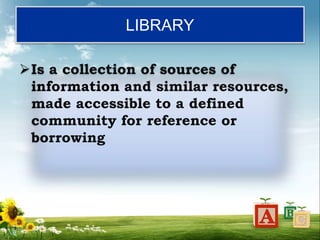
Is a collection of sources of
information and similar resources,
made accessible to a defined
community for reference or
borrowing
A library’s collection
can include
books
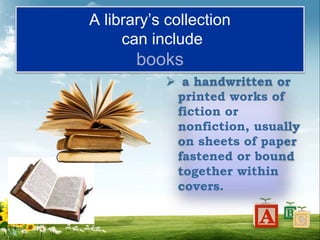
 a handwritten or
printed works of
fiction or
nonfiction, usually
on sheets of paper
fastened or bound
together within
covers.
A library’s collection
can include
periodicals
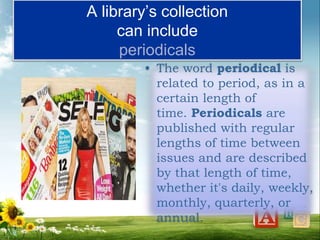
• The word periodical is
related to period, as in a
certain length of
time. Periodicals are
published with regular
lengths of time between
issues and are described
by that length of time,
whether it's daily, weekly,
monthly, quarterly, or
annual.
A library’s collection
can include
newspapers
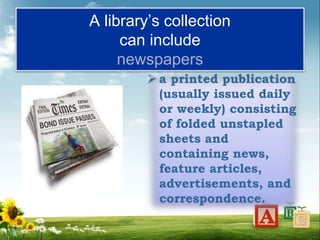
 a printed publication
(usually issued daily
or weekly) consisting
of folded unstapled
sheets and
containing news,
feature articles,
advertisements, and
correspondence.
A library’s collection
can include
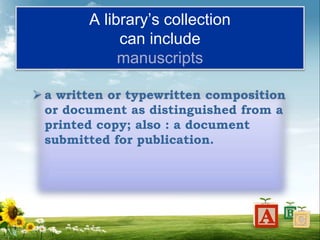
manuscripts
 a written or typewritten composition
or document as distinguished from a
printed copy; also : a document
submitted for publication.
A library’s collection
can include
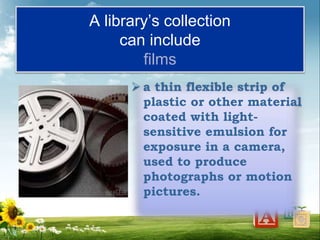
films
 a thin flexible strip of
plastic or other material
coated with light-
sensitive emulsion for
exposure in a camera,
used to produce
photographs or motion
pictures.
A library’s collection
can include
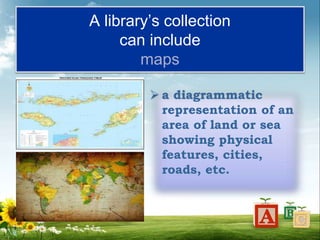
maps
 a diagrammatic
representation of an
area of land or sea
showing physical
features, cities,
roads, etc.
A library’s collection
can include
documents
• a piece of written, printed, or
electronic matter that provides
information or evidence or that
serves as an official record.
A library’s collection
can include
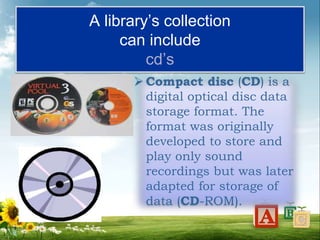
cd’s
 Compact disc (CD) is a
digital optical disc data
storage format. The
format was originally
developed to store and
play only sound
recordings but was later
adapted for storage of
data (CD-ROM).
A library’s collection
can include
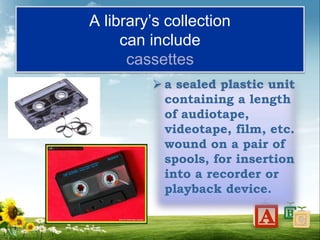
cassettes
 a sealed plastic unit
containing a length
of audiotape,
videotape, film, etc.
wound on a pair of
spools, for insertion
into a recorder or
playback device.
A library’s collection
can include
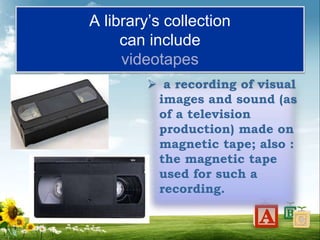
videotapes
 a recording of visual
images and sound (as
of a television
production) made on
magnetic tape; also :
the magnetic tape
used for such a
recording.
A library’s collection
can include
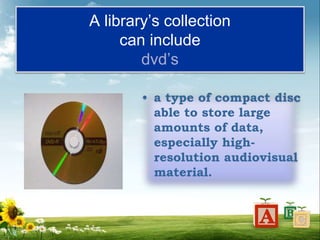
dvd’s
• a type of compact disc
able to store large
amounts of data,
especially high-
resolution audiovisual
material.
A library’s collection
can include
blu-ray discs
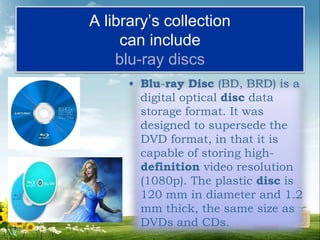
• Blu-ray Disc (BD, BRD) is a
digital optical disc data
storage format. It was
designed to supersede the
DVD format, in that it is
capable of storing high-
definition video resolution
(1080p). The plastic disc is
120 mm in diameter and 1.2
mm thick, the same size as
DVDs and CDs.
A library’s collection
can include
e- books
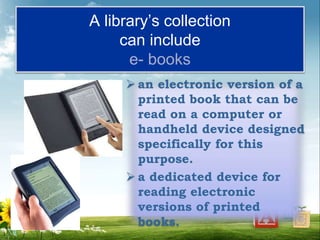
 an electronic version of a
printed book that can be
read on a computer or
handheld device designed
specifically for this
purpose.
 a dedicated device for
reading electronic
versions of printed
books.
A library’s collection
can include
audio books
 an audiocassette or CD recording of a
reading of a book, typically a novel.
1. General Reference Section
2. Periodical Section
3. General Collection/ Circulation
Section
4. Filipiniana Section
5. Special Collection
6. Children’s Section
7. Multimedia and Internet Section
General Reference Section
It houses general encyclopedic
works including dictionaries,
almanacs, atlases, directories,
handbooks, manuals, indexes,
abstracts and etc.
Periodical section
It houses all local and foreign
journals, magazines, newspapers,
government publication, vertical
files such as pamphlets, brochures
and newspapers clippings.
GENERAL Collection/ circulation
section
It houses the main collection of the
library. Books on Philosophy,
Religion, Social Sciences, Language,
Arts, Pure Science, Applied Science,
Literature, History and Geography.
Filipiniana Section
It houses books published within
the Philippines and written about
the Philippines, its history, people,
government, and culture.
Special collection
It houses thesis and dissertation
books, law books and National
Library of the Philippines book
allocation.
Children’s section
It houses children's books,
educational toys and board games
Multimedia and internet section
used for searching and browsing the
net.
 Dewey decimal classification
 library of congress classification
Dewey Decimal
Classification (DDC)
Knowledge classification scheme in
which subjects are divided into ten
main classes (numbered 000 to 999)
and subdivisions within a particular
subject are indicated by decimals.
It is called "Decimal" because it
uses numbers to the right of the
decimal point for more detail. The
system was created by Melvil Dewey
in 1876. It is also called the Dewey
decimal classification. The
classification has been revised and
expanded many times. The latest
edition was published in 2004.
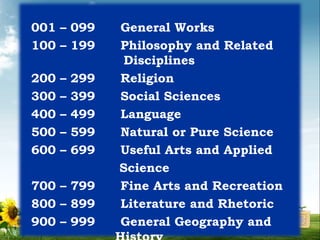
001 – 099 General Works
100 – 199 Philosophy and Related
Disciplines
200 – 299 Religion
300 – 399 Social Sciences
400 – 499 Language
500 – 599 Natural or Pure Science
600 – 699 Useful Arts and Applied
Science
700 – 799 Fine Arts and Recreation
800 – 899 Literature and Rhetoric
900 – 999 General Geography and
Library of Congress Classification
(LCC)
Knowledge classification scheme in
which subject divisions are
indicated by letters and their
subdivisions by numbers. Used in
the libraries for creating call
numbers for books, and other
material, for their systematic
cataloging and shelving.
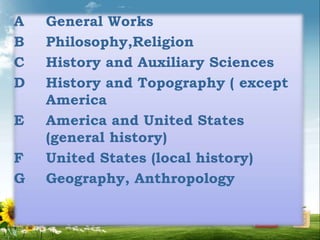
A General Works
B Philosophy,Religion
C History and Auxiliary Sciences
D History and Topography ( except
America
E America and United States
(general history)
F United States (local history)
G Geography, Anthropology
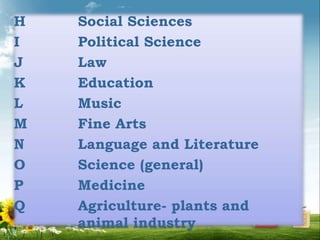
H Social Sciences
I Political Science
J Law
K Education
L Music
M Fine Arts
N Language and Literature
O Science (general)
P Medicine
Q Agriculture- plants and
animal industry
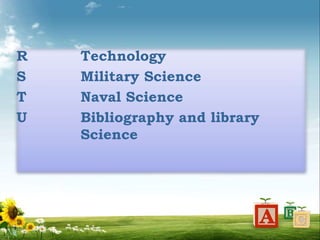
R Technology
S Military Science
T Naval Science
U Bibliography and library
Science
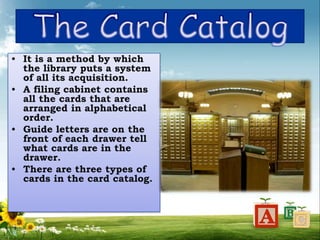
The Card Catalog
What is a card
catalog???
• It is a method by which
the library puts a system
of all its acquisition.
• A filing cabinet contains
all the cards that are
arranged in alphabetical
order.
• Guide letters are on the
front of each drawer tell
what cards are in the
drawer.
• There are three types of
cards in the card catalog.
is the organized collection of note
cards that help locate books in a
library.
An alphabetical listing, especially of
books in a library, containing
information about each item,
historically on cards in a file.
Types of Card Catalog
Title Card
Author Card
Subject Card
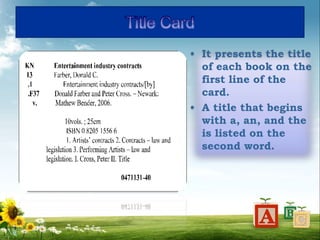
• It presents the title
of each book on the
first line of the
card.
• A title that begins
with a, an, and the
is listed on the
second word.
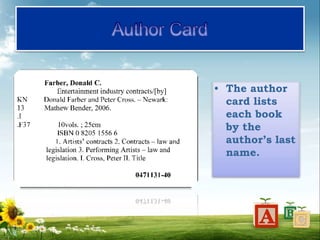
• The author
card lists
each book
by the
author’s last
name.
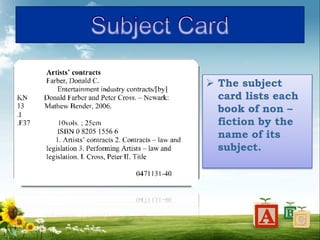
 The subject
card lists each
book of non –
fiction by the
name of its
subject.
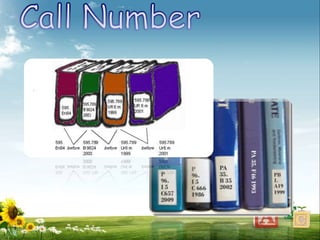
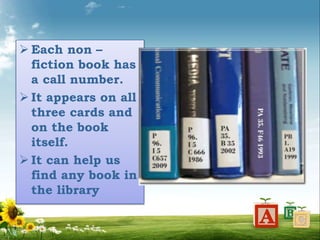
 Each non –
fiction book has
a call number.
 It appears on all
three cards and
on the book
itself.
 It can help us
find any book in
the library

Library

  • 1.
  • 2.
  • 3.
  • 4.
  • 5.
  • 6.
    LIBRARY Is a collectionof sources of information and similar resources, made accessible to a defined community for reference or borrowing
  • 7.
    A library’s collection caninclude books  a handwritten or printed works of fiction or nonfiction, usually on sheets of paper fastened or bound together within covers.
  • 8.
    A library’s collection caninclude periodicals • The word periodical is related to period, as in a certain length of time. Periodicals are published with regular lengths of time between issues and are described by that length of time, whether it's daily, weekly, monthly, quarterly, or annual.
  • 9.
    A library’s collection caninclude newspapers  a printed publication (usually issued daily or weekly) consisting of folded unstapled sheets and containing news, feature articles, advertisements, and correspondence.
  • 10.
    A library’s collection caninclude manuscripts  a written or typewritten composition or document as distinguished from a printed copy; also : a document submitted for publication.
  • 11.
    A library’s collection caninclude films  a thin flexible strip of plastic or other material coated with light- sensitive emulsion for exposure in a camera, used to produce photographs or motion pictures.
  • 12.
    A library’s collection caninclude maps  a diagrammatic representation of an area of land or sea showing physical features, cities, roads, etc.
  • 13.
    A library’s collection caninclude documents • a piece of written, printed, or electronic matter that provides information or evidence or that serves as an official record.
  • 14.
    A library’s collection caninclude cd’s  Compact disc (CD) is a digital optical disc data storage format. The format was originally developed to store and play only sound recordings but was later adapted for storage of data (CD-ROM).
  • 15.
    A library’s collection caninclude cassettes  a sealed plastic unit containing a length of audiotape, videotape, film, etc. wound on a pair of spools, for insertion into a recorder or playback device.
  • 16.
    A library’s collection caninclude videotapes  a recording of visual images and sound (as of a television production) made on magnetic tape; also : the magnetic tape used for such a recording.
  • 17.
    A library’s collection caninclude dvd’s • a type of compact disc able to store large amounts of data, especially high- resolution audiovisual material.
  • 18.
    A library’s collection caninclude blu-ray discs • Blu-ray Disc (BD, BRD) is a digital optical disc data storage format. It was designed to supersede the DVD format, in that it is capable of storing high- definition video resolution (1080p). The plastic disc is 120 mm in diameter and 1.2 mm thick, the same size as DVDs and CDs.
  • 19.
    A library’s collection caninclude e- books  an electronic version of a printed book that can be read on a computer or handheld device designed specifically for this purpose.  a dedicated device for reading electronic versions of printed books.
  • 20.
    A library’s collection caninclude audio books  an audiocassette or CD recording of a reading of a book, typically a novel.
  • 22.
    1. General ReferenceSection 2. Periodical Section 3. General Collection/ Circulation Section 4. Filipiniana Section 5. Special Collection 6. Children’s Section 7. Multimedia and Internet Section
  • 23.
    General Reference Section Ithouses general encyclopedic works including dictionaries, almanacs, atlases, directories, handbooks, manuals, indexes, abstracts and etc.
  • 24.
    Periodical section It housesall local and foreign journals, magazines, newspapers, government publication, vertical files such as pamphlets, brochures and newspapers clippings.
  • 25.
    GENERAL Collection/ circulation section Ithouses the main collection of the library. Books on Philosophy, Religion, Social Sciences, Language, Arts, Pure Science, Applied Science, Literature, History and Geography.
  • 26.
    Filipiniana Section It housesbooks published within the Philippines and written about the Philippines, its history, people, government, and culture.
  • 27.
    Special collection It housesthesis and dissertation books, law books and National Library of the Philippines book allocation.
  • 28.
    Children’s section It houseschildren's books, educational toys and board games
  • 29.
    Multimedia and internetsection used for searching and browsing the net.
  • 31.
     Dewey decimalclassification  library of congress classification
  • 32.
    Dewey Decimal Classification (DDC) Knowledgeclassification scheme in which subjects are divided into ten main classes (numbered 000 to 999) and subdivisions within a particular subject are indicated by decimals.
  • 33.
    It is called"Decimal" because it uses numbers to the right of the decimal point for more detail. The system was created by Melvil Dewey in 1876. It is also called the Dewey decimal classification. The classification has been revised and expanded many times. The latest edition was published in 2004.
  • 34.
    001 – 099General Works 100 – 199 Philosophy and Related Disciplines 200 – 299 Religion 300 – 399 Social Sciences 400 – 499 Language 500 – 599 Natural or Pure Science 600 – 699 Useful Arts and Applied Science 700 – 799 Fine Arts and Recreation 800 – 899 Literature and Rhetoric 900 – 999 General Geography and
  • 35.
    Library of CongressClassification (LCC) Knowledge classification scheme in which subject divisions are indicated by letters and their subdivisions by numbers. Used in the libraries for creating call numbers for books, and other material, for their systematic cataloging and shelving.
  • 36.
    A General Works BPhilosophy,Religion C History and Auxiliary Sciences D History and Topography ( except America E America and United States (general history) F United States (local history) G Geography, Anthropology
  • 37.
    H Social Sciences IPolitical Science J Law K Education L Music M Fine Arts N Language and Literature O Science (general) P Medicine Q Agriculture- plants and animal industry
  • 38.
    R Technology S MilitaryScience T Naval Science U Bibliography and library Science
  • 39.
  • 40.
    What is acard catalog???
  • 41.
    • It isa method by which the library puts a system of all its acquisition. • A filing cabinet contains all the cards that are arranged in alphabetical order. • Guide letters are on the front of each drawer tell what cards are in the drawer. • There are three types of cards in the card catalog.
  • 42.
    is the organizedcollection of note cards that help locate books in a library. An alphabetical listing, especially of books in a library, containing information about each item, historically on cards in a file.
  • 43.
    Types of CardCatalog Title Card Author Card Subject Card
  • 44.
    • It presentsthe title of each book on the first line of the card. • A title that begins with a, an, and the is listed on the second word.
  • 45.
    • The author cardlists each book by the author’s last name.
  • 46.
     The subject cardlists each book of non – fiction by the name of its subject.
  • 48.
     Each non– fiction book has a call number.  It appears on all three cards and on the book itself.  It can help us find any book in the library