Information Management Education


                 Prepared by:
                 Roselyn P. Cea
                 Jane L. Garay
Information Management Education


 The term emerged from Medical Librarianship in the 1980’s
It refers to instructing the users to
 identification,
 retrieval,
evaluation,
 and use of information.
Since we have already discussed
INFORMATION LITERACY in our
subject and also in the seminar…
Let’s have some sort of
     QUIZZ..
        
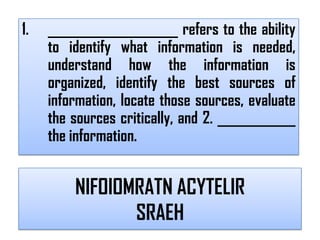
1.   ____________________ refers to the ability
     to identify what information is needed,
     understand how the information is
     organized, identify the best sources of
     information, locate those sources, evaluate
     the sources critically, and 2. ____________
     the information.


         NIFOIOMRATN ACYTELIR
                SRAEH
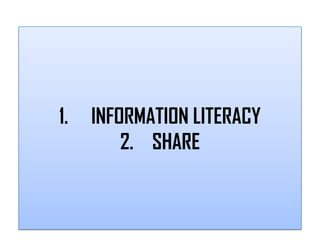
1.   INFORMATION LITERACY
         2. SHARE
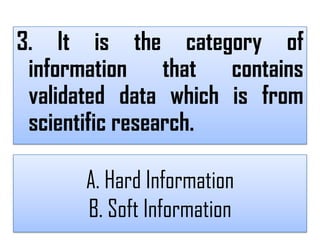
3. It is the category of
 information that contains
 validated data which is from
 scientific research.

       A. Hard Information
       B. Soft Information
3. A
4. It is the category of
 information that contains
 opinionated information

      A. Hard Information
      B. Soft Information
4. B
5. Publications disseminate
 research        and  academic
 discussion among professionals
 within disciplines.
            A. Popular
             B. Trade
           C. Scholarly
5. C
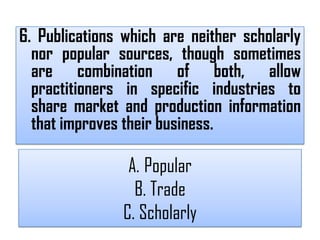
6. Publications which are neither scholarly
  nor popular sources, though sometimes
  are combination of both, allow
  practitioners in specific industries to
  share market and production information
  that improves their business.

                A. Popular
                 B. Trade
               C. Scholarly
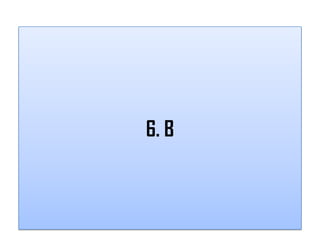
6. B
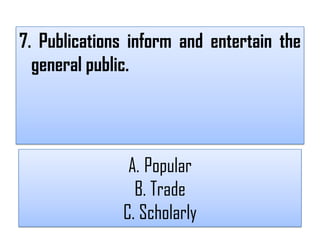
7. Publications inform and entertain the
  general public.


               A. Popular
                B. Trade
              C. Scholarly
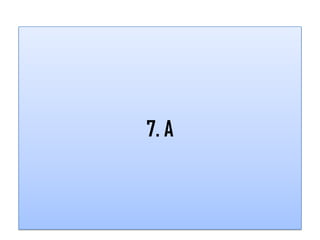
7. A
8. These are the unedited, firsthand acess
  to words, images, or objects created by
  persons directly involved in an activity
  or event or speaking directly for a
  group.
8. PRIMARY SOURCES
9. These are sources which analyzed,
  compiled and digest secondary sources
  included     mostly    in   abstracts,
  bibliographies,            handbooks,
  encyclopedias, etc.
9. TERTIARY SOURCES
10. These are the commentary upon, or
  analysis of, events, ideas, or primary
  sources.
10. SECONDARY SOURCES
11. Which is not an example of
       Primary Sources?

A. Diary         c. Textbooks
B. Manuscripts   d. Interview
11. C
12. It is the collection of data
arranged for ease and speed
   of search and retrieval.
12. DATABASE
13. Every database contains only
  certain types and amounts of
  information, a characteristic
      called ____________.
13. COVERAGE
14-15. Give the two
Information Literacy
Models/Techniques.
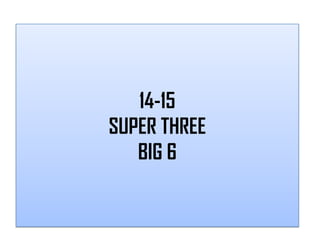
14-15
SUPER THREE
   BIG 6
16-18. What are the three
  skills in Super Three?
16-18
 PLAN
  DO
REVIEW
19. A systematic, painstaking
investigation of a topic, or in
       a field of study.
19. RESEARCH
20-23. Enumerate three
conventions used for creating
      a Search Query.
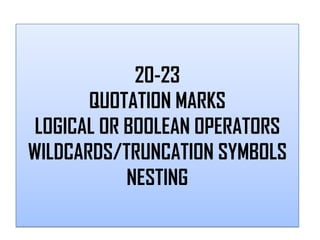
20-23
       QUOTATION MARKS
 LOGICAL OR BOOLEAN OPERATORS
WILDCARDS/TRUNCATION SYMBOLS
            NESTING
24. What do you call the
connecting words that narrow or
broaden a search to include only
         what you need.
24. LOGICAL OR BOOLEAN OPERATORS
25. What do you call the
 conventions for the terms that
have variant forms of spelling or
   different possible endings.
25. WILDCARDS/TRUNCATION
           SYMBOLS
Why do you think Information
  Literacy in important?
How will you use your
Information Literacy Skills?

Information management education

  • 1.
    Information Management Education Prepared by: Roselyn P. Cea Jane L. Garay
  • 2.
    Information Management Education The term emerged from Medical Librarianship in the 1980’s
  • 3.
    It refers toinstructing the users to  identification,  retrieval, evaluation,  and use of information.
  • 4.
    Since we havealready discussed INFORMATION LITERACY in our subject and also in the seminar…
  • 5.
    Let’s have somesort of QUIZZ..  
  • 6.
    1. ____________________ refers to the ability to identify what information is needed, understand how the information is organized, identify the best sources of information, locate those sources, evaluate the sources critically, and 2. ____________ the information. NIFOIOMRATN ACYTELIR SRAEH
  • 7.
    1. INFORMATION LITERACY 2. SHARE
  • 8.
    3. It isthe category of information that contains validated data which is from scientific research. A. Hard Information B. Soft Information
  • 9.
  • 10.
    4. It isthe category of information that contains opinionated information A. Hard Information B. Soft Information
  • 11.
  • 12.
    5. Publications disseminate research and academic discussion among professionals within disciplines. A. Popular B. Trade C. Scholarly
  • 13.
  • 14.
    6. Publications whichare neither scholarly nor popular sources, though sometimes are combination of both, allow practitioners in specific industries to share market and production information that improves their business. A. Popular B. Trade C. Scholarly
  • 15.
  • 16.
    7. Publications informand entertain the general public. A. Popular B. Trade C. Scholarly
  • 17.
  • 18.
    8. These arethe unedited, firsthand acess to words, images, or objects created by persons directly involved in an activity or event or speaking directly for a group.
  • 19.
  • 20.
    9. These aresources which analyzed, compiled and digest secondary sources included mostly in abstracts, bibliographies, handbooks, encyclopedias, etc.
  • 21.
  • 22.
    10. These arethe commentary upon, or analysis of, events, ideas, or primary sources.
  • 23.
  • 24.
    11. Which isnot an example of Primary Sources? A. Diary c. Textbooks B. Manuscripts d. Interview
  • 25.
  • 26.
    12. It isthe collection of data arranged for ease and speed of search and retrieval.
  • 27.
  • 28.
    13. Every databasecontains only certain types and amounts of information, a characteristic called ____________.
  • 29.
  • 30.
    14-15. Give thetwo Information Literacy Models/Techniques.
  • 31.
  • 32.
    16-18. What arethe three skills in Super Three?
  • 33.
    16-18 PLAN DO REVIEW
  • 34.
    19. A systematic,painstaking investigation of a topic, or in a field of study.
  • 35.
  • 36.
    20-23. Enumerate three conventionsused for creating a Search Query.
  • 37.
    20-23 QUOTATION MARKS LOGICAL OR BOOLEAN OPERATORS WILDCARDS/TRUNCATION SYMBOLS NESTING
  • 38.
    24. What doyou call the connecting words that narrow or broaden a search to include only what you need.
  • 39.
    24. LOGICAL ORBOOLEAN OPERATORS
  • 40.
    25. What doyou call the conventions for the terms that have variant forms of spelling or different possible endings.
  • 41.
  • 42.
    Why do youthink Information Literacy in important?
  • 43.
    How will youuse your Information Literacy Skills?