@Waterstonsltd
www.waterstons.com
BI: Beyond Intelligence
Introducing Business Insight Maturity
Dan Burrows, Chris Hatton, Michael Nesbit
Agenda
@ Introduction
@ Some data about data
@ Waterstons’ BI roadmap
@ BI, BA and CPM - Where have we been?
@ Where are we going next?
Introduction
@ The three MISketeers
@ Waterstons and business analytics
@ Our journey to enlightenment
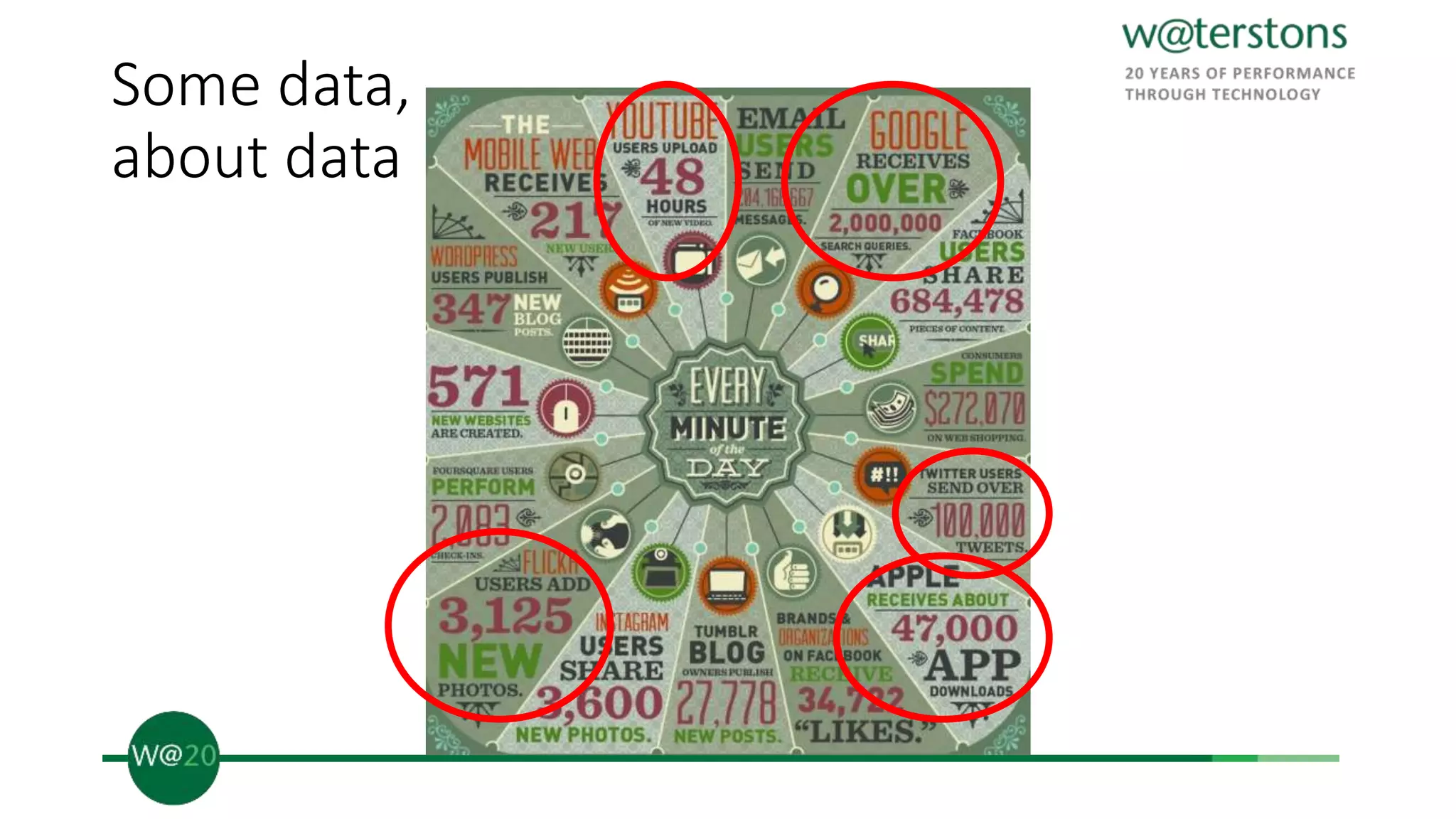
Some data,
about data
What does this mean to me?
@ Largely, probably nothing
@ Most businesses don’t care about Facebook, Instagram, Twitter, etc
@ It’s hard enough interpreting your own data, let alone anyone else’s
@ Maximising the value of your business information is vital
@ Once you understand what you already have you can worry about the rest
Understanding Your Data’s Value
@ Many businesses fail to capitalise on the value of their data
@ Predefined reports are useful, but the real value comes from the insights
hidden in an organisation’s data.
@ Business analytics is not all about answering questions
@ It’s about establishing the most insightful lines of enquiry
@ And supporting decisions with facts, trends and predictions
@ Shocking fact: few businesses are really good at using their data
Waterstons’ BI roadmap
@ An approach to delivering an analytics project
@ A series of delivery actions in a theoretical progression
@ A cradle to grave process for embedding, designing and developing
intelligence
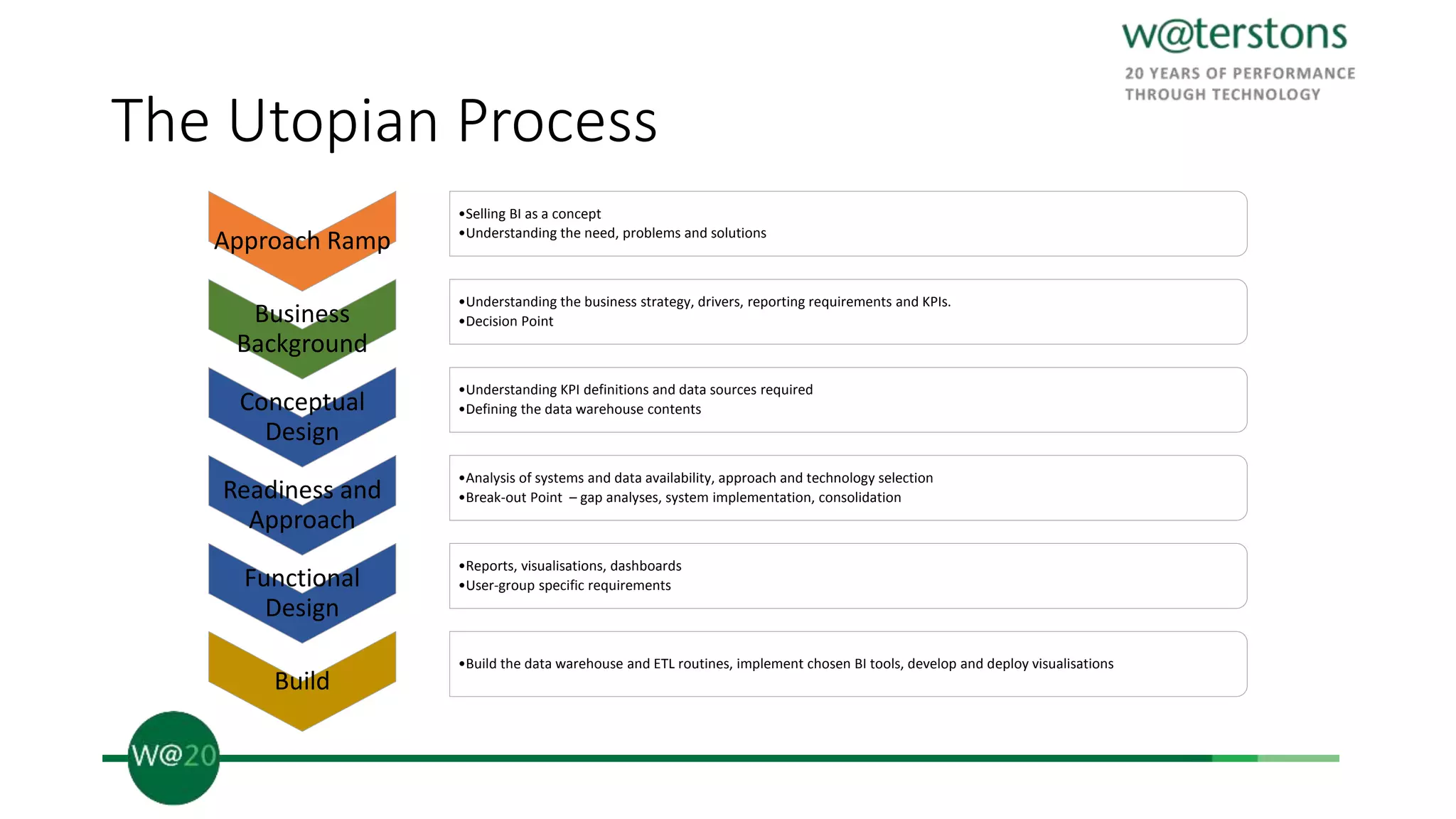
The Utopian Process
Approach Ramp
•Selling BI as a concept
•Understanding the need, problems and solutions
Business
Background
•Understanding the business strategy, drivers, reporting requirements and KPIs.
•Decision Point
Conceptual
Design
•Understanding KPI definitions and data sources required
•Defining the data warehouse contents
Readiness and
Approach
•Analysis of systems and data availability, approach and technology selection
•Break-out Point – gap analyses, system implementation, consolidation
Functional
Design
•Reports, visualisations, dashboards
•User-group specific requirements
Build
•Build the data warehouse and ETL routines, implement chosen BI tools, develop and deploy visualisations
Waterstons’ BI roadmap
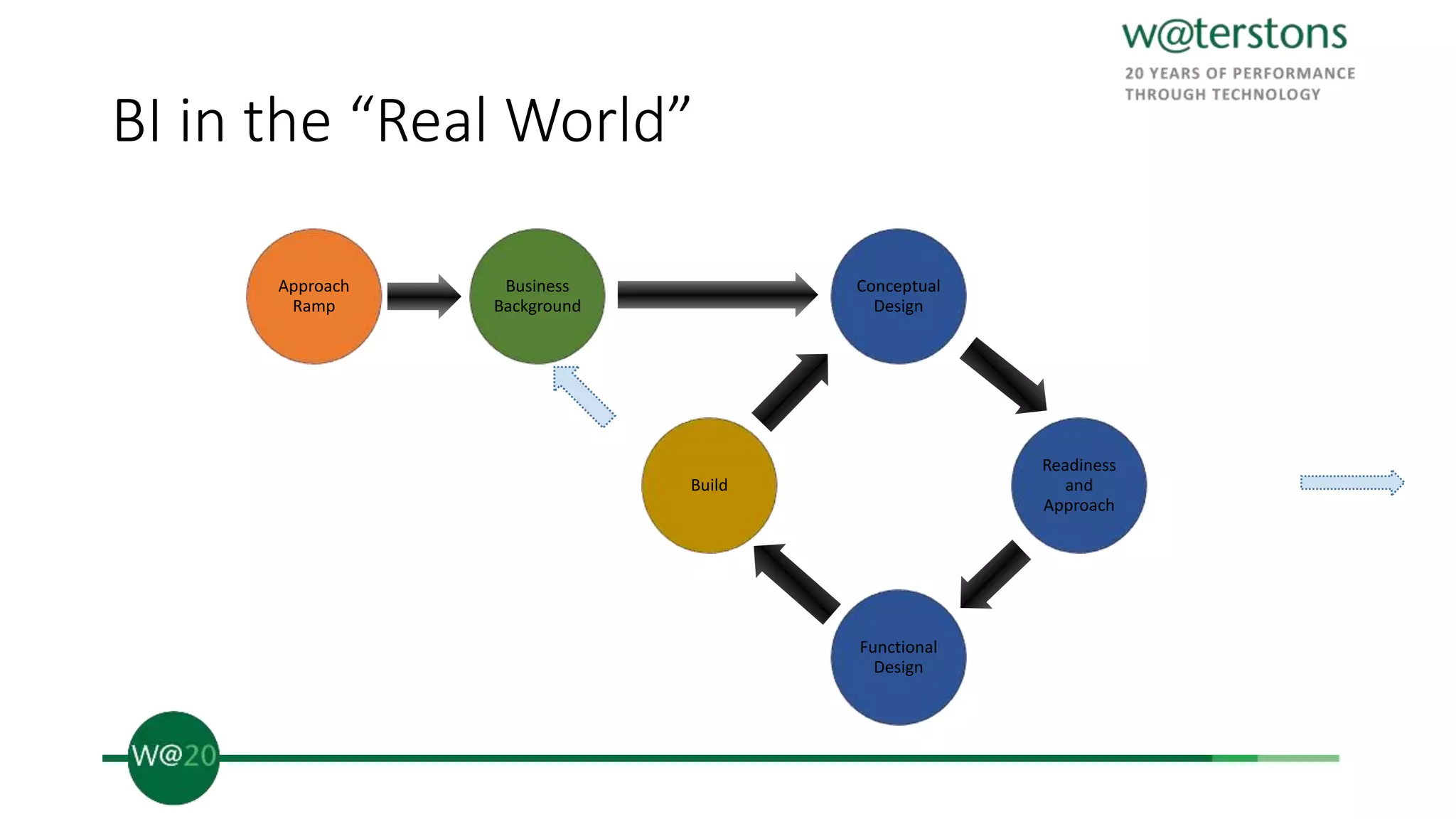
@ Not necessarily a linear progression; focus on business needs
@ Iteration reflects real business
@ Project experience demonstrates a different story
BI in the “Real World”
Approach
Ramp
Business
Background
Conceptual
Design
Readiness
and
Approach
Functional
Design
Build
Time for a change
@ Analysis of business data has moved on significantly
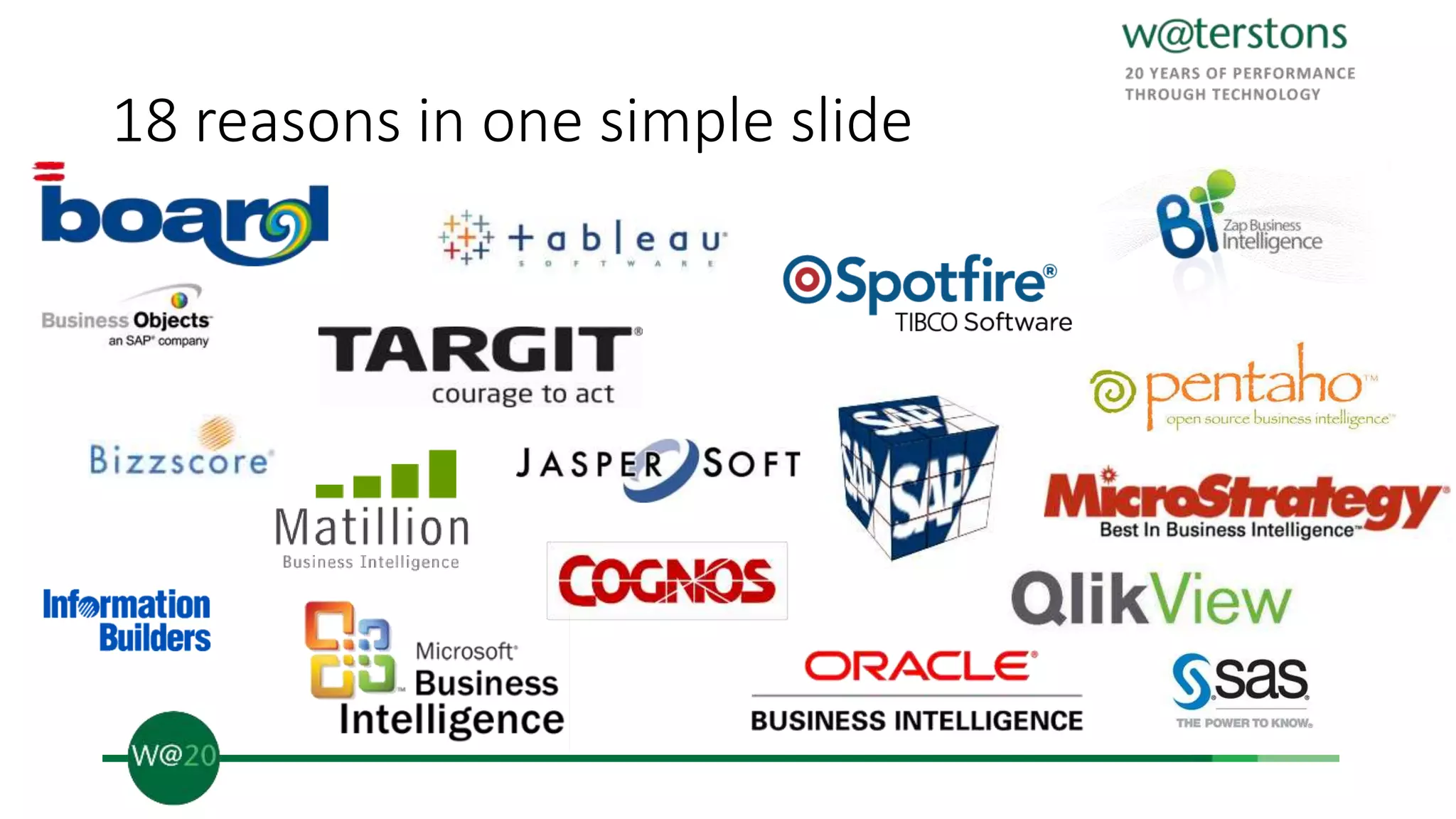
@ New analytics tools and discovery products are available
@ The popularity of, and desire for instant analysis has exploded
@ A new roadmap for delivering insight to our customers was needed
18 reasons in one simple slide
Where did you come from?
@ In the beginning, there was the operational report. With it came
answers to questions.
@ What am I making today?
@ Who should be at work making it?
@ Are all the parts in stock?
@ What orders am I supposed to dispatch?
@ Snapshot answers to questions – focussed on activity
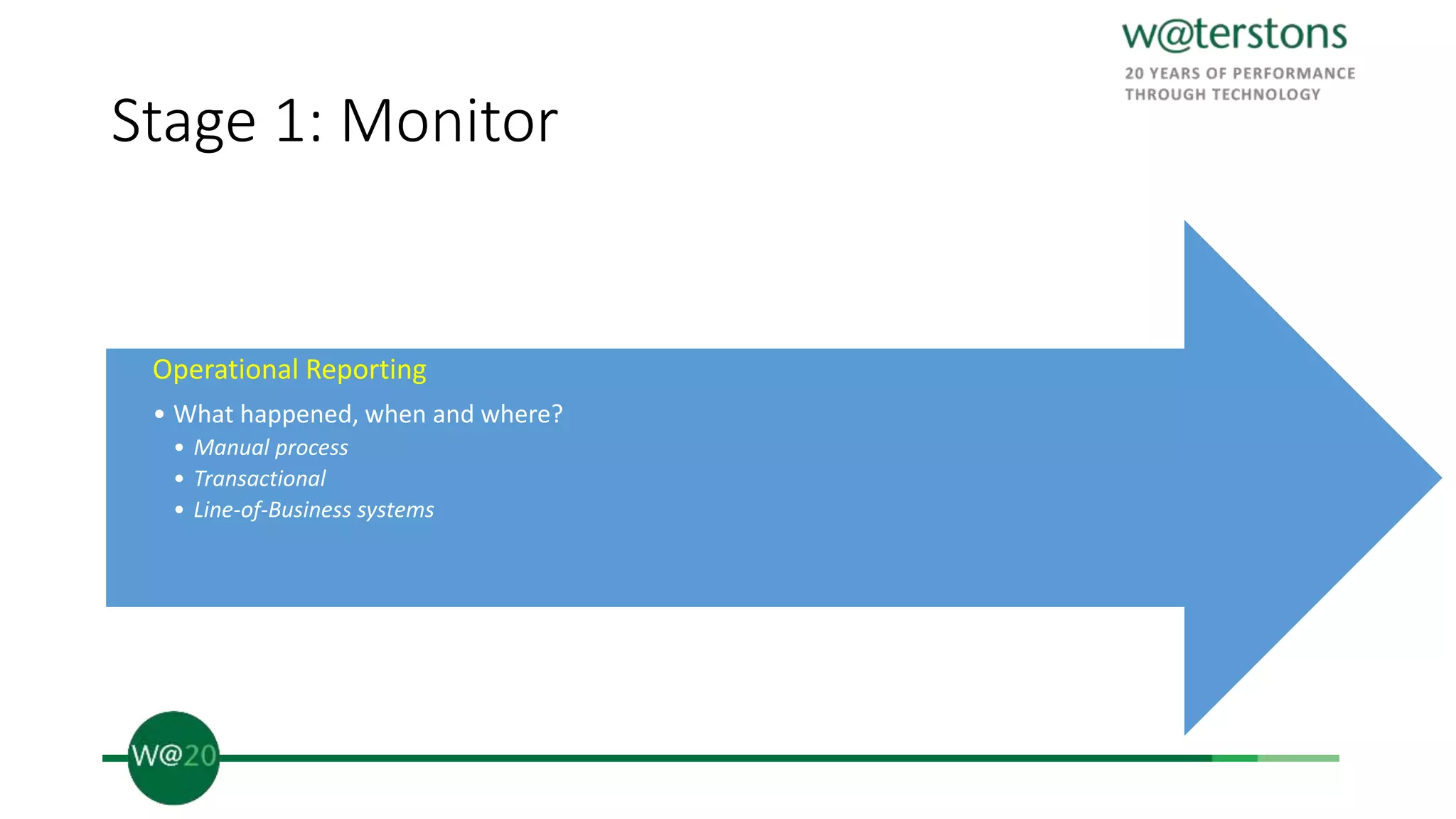
Stage 1: Monitor
Operational Reporting
• What happened, when and where?
• Manual process
• Transactional
• Line-of-Business systems
Operational Reporting
@ Traditional reporting scenarios
@ Real Time
@ Detail
@ Line of business management and staff
@ Operational dashboards
@ Manage intra-daily business processes (low-latency)
@ Legislative reporting requirements
@ Traditional reporting technology is still relevant in an analytics context
@ Frozen historic snapshot
@ Controlled or limited access to interactive analytic features
@ Specific or specialised requirements for data visualisation
Where did you go?
@ Operational reporting was good. But not good enough. Enter the
world of Business Intelligence.
@ What has my performance been vs. KPI target?
@ How does our performance compare with last year?
@ Am I making enough things/enough margin?
@ Are the decisions I made last week/month/year making a difference?
@ Temporally related questions and answers – focussed on results
Stage 2: Question and Control
Business Intelligence
• What can I do about it?
• Consistent data sources
• Scorecards and dashboards
• Metrics-based
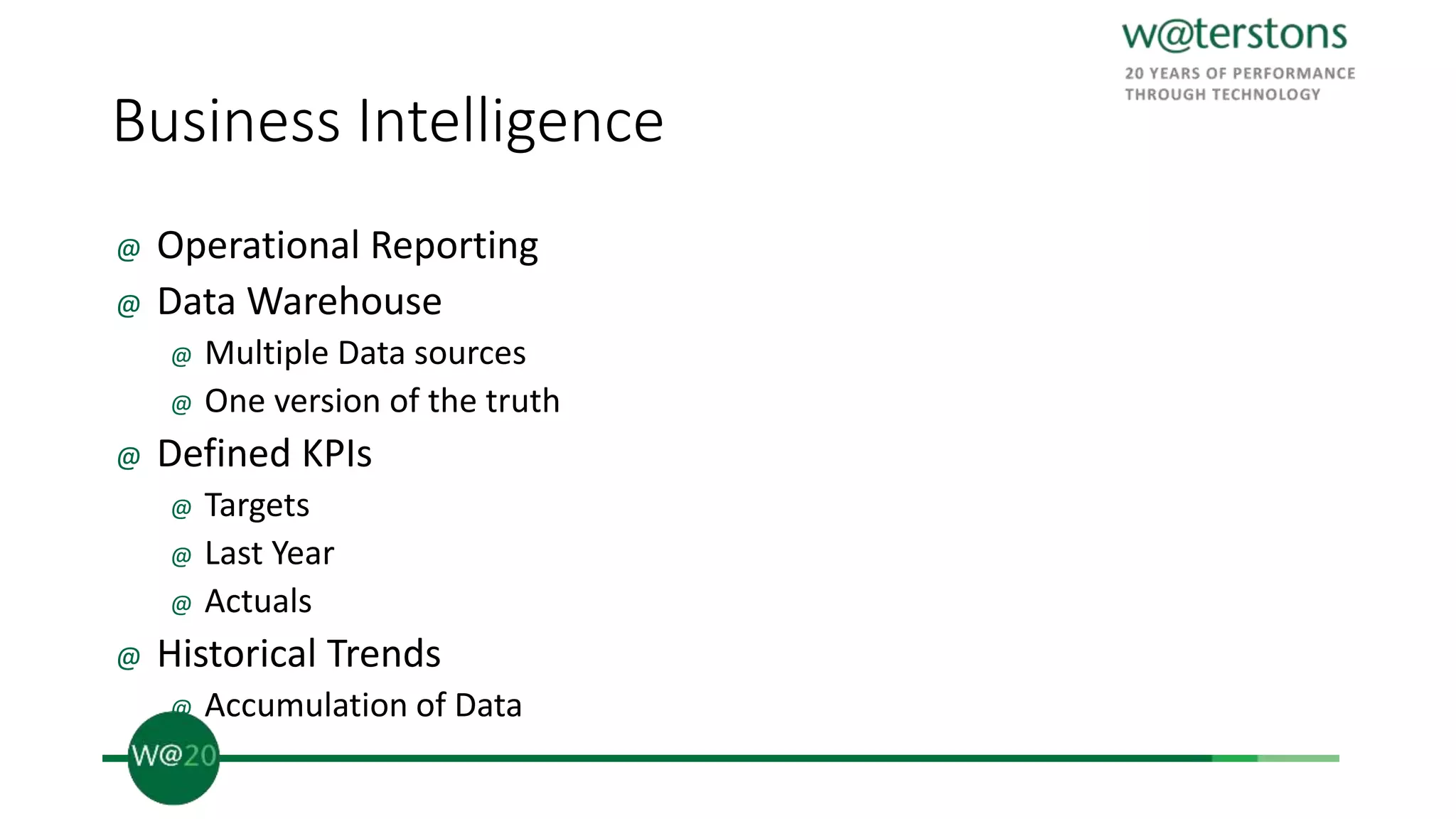
Business Intelligence
@ Operational Reporting
@ Data Warehouse
@ Multiple Data sources
@ One version of the truth
@ Defined KPIs
@ Targets
@ Last Year
@ Actuals
@ Historical Trends
@ Accumulation of Data
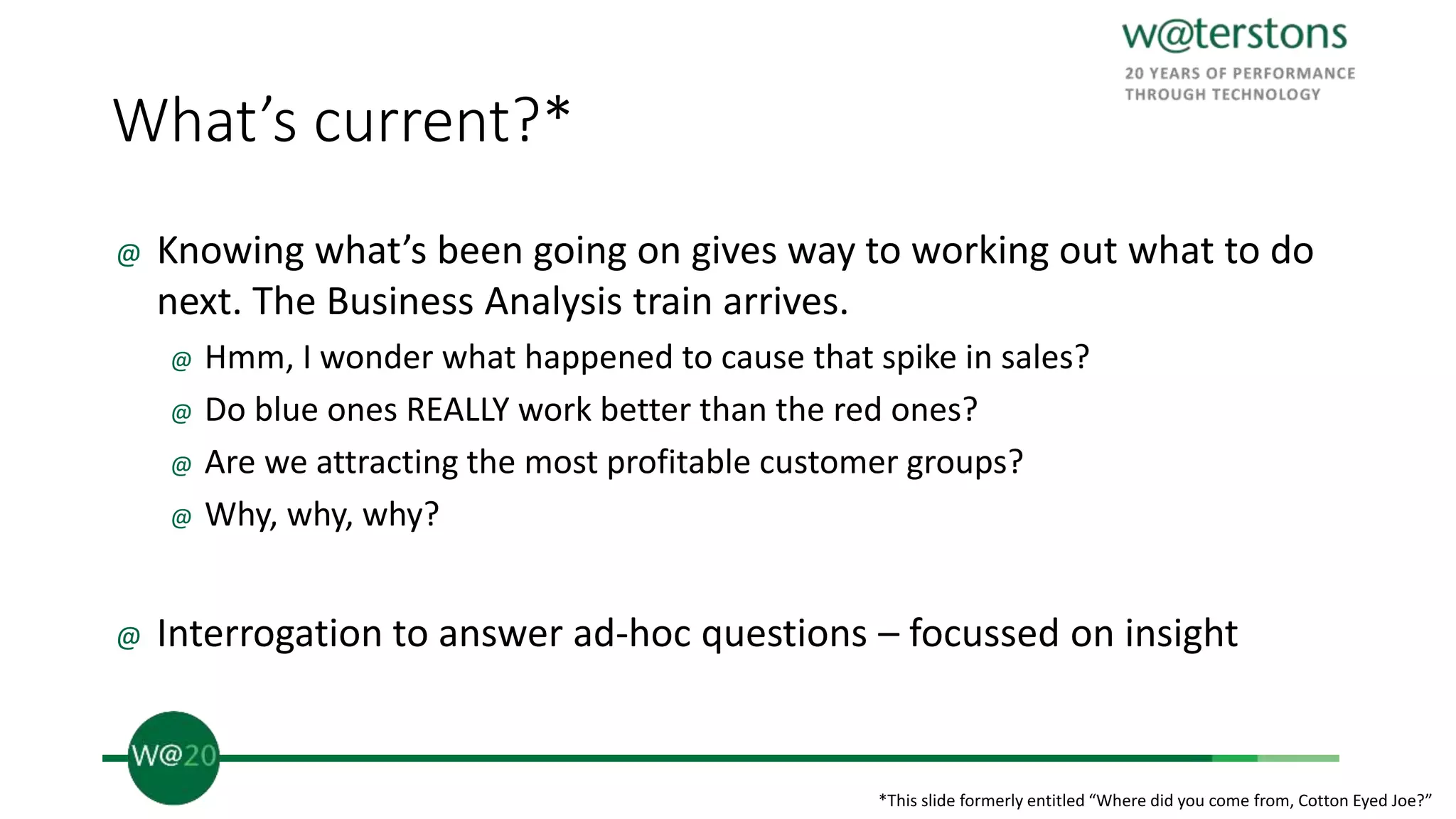
What’s current?*
@ Knowing what’s been going on gives way to working out what to do
next. The Business Analysis train arrives.
@ Hmm, I wonder what happened to cause that spike in sales?
@ Do blue ones REALLY work better than the red ones?
@ Are we attracting the most profitable customer groups?
@ Why, why, why?
@ Interrogation to answer ad-hoc questions – focussed on insight
*This slide formerly entitled “Where did you come from, Cotton Eyed Joe?”
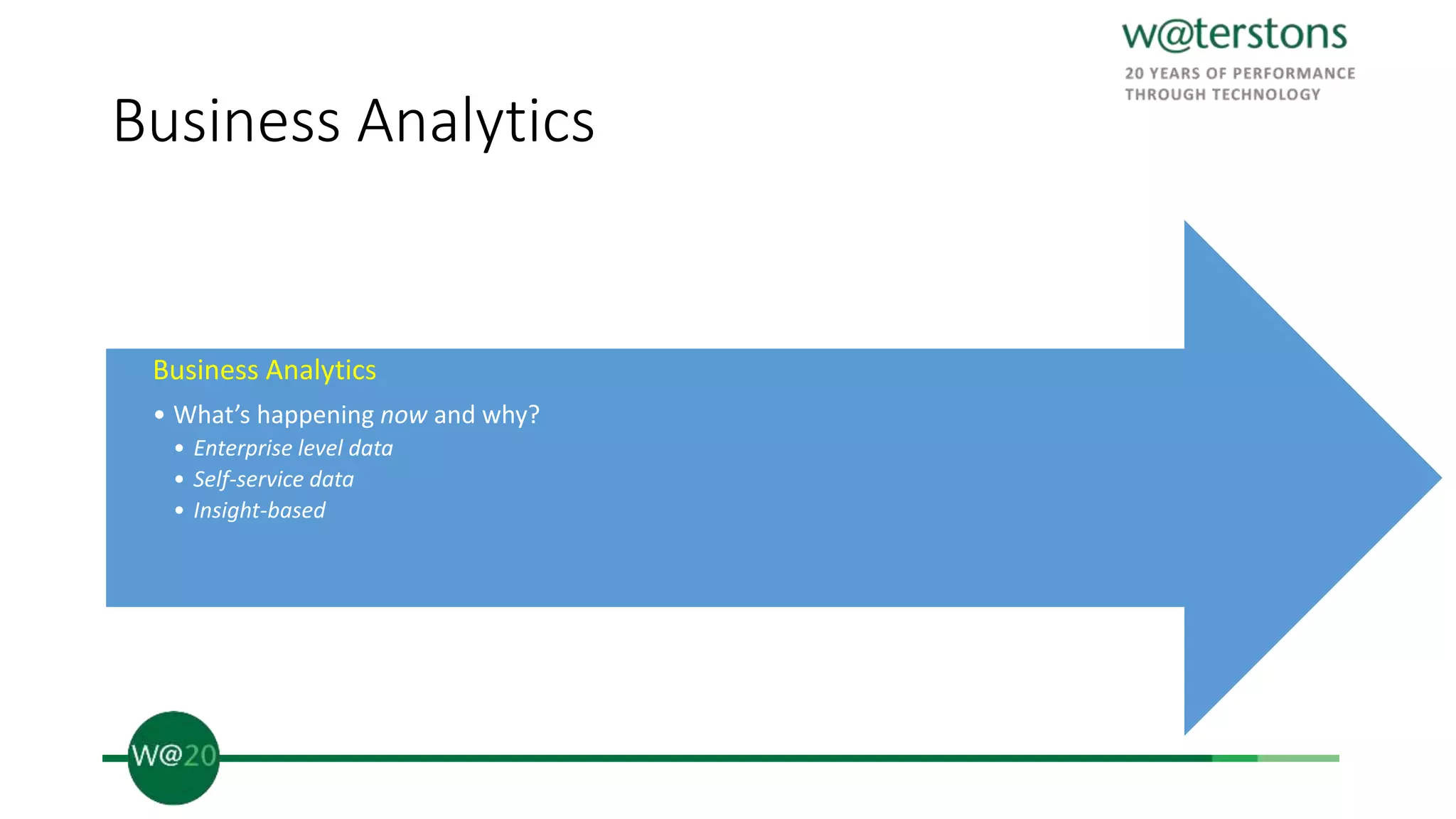
Business Analytics
Business Analytics
• What’s happening now and why?
• Enterprise level data
• Self-service data
• Insight-based
Business Analytics
@ Operational and BI reporting
@ Analysis of reporting to ask questions
@ Why trend occurs?
@ What can be done to change trend?
@ Power users performing analysis
@ Ad-hoc reports
@ Interactive drill down / slice and dice
@ Potentially discover new trends
Where are you going now?
@ What’s leading edge? Data driven forecasting, strategy and planning.
The world of Predictive Analytics is growing.
@ What will next year look like?
@ What would happen if we lost that customer?
@ Could we cope if a competitor entered the market?
@ Could we satisfy demand if the number of customers doubled?
@ Trend analysis answering ‘what-if’ questions – focussed on the future
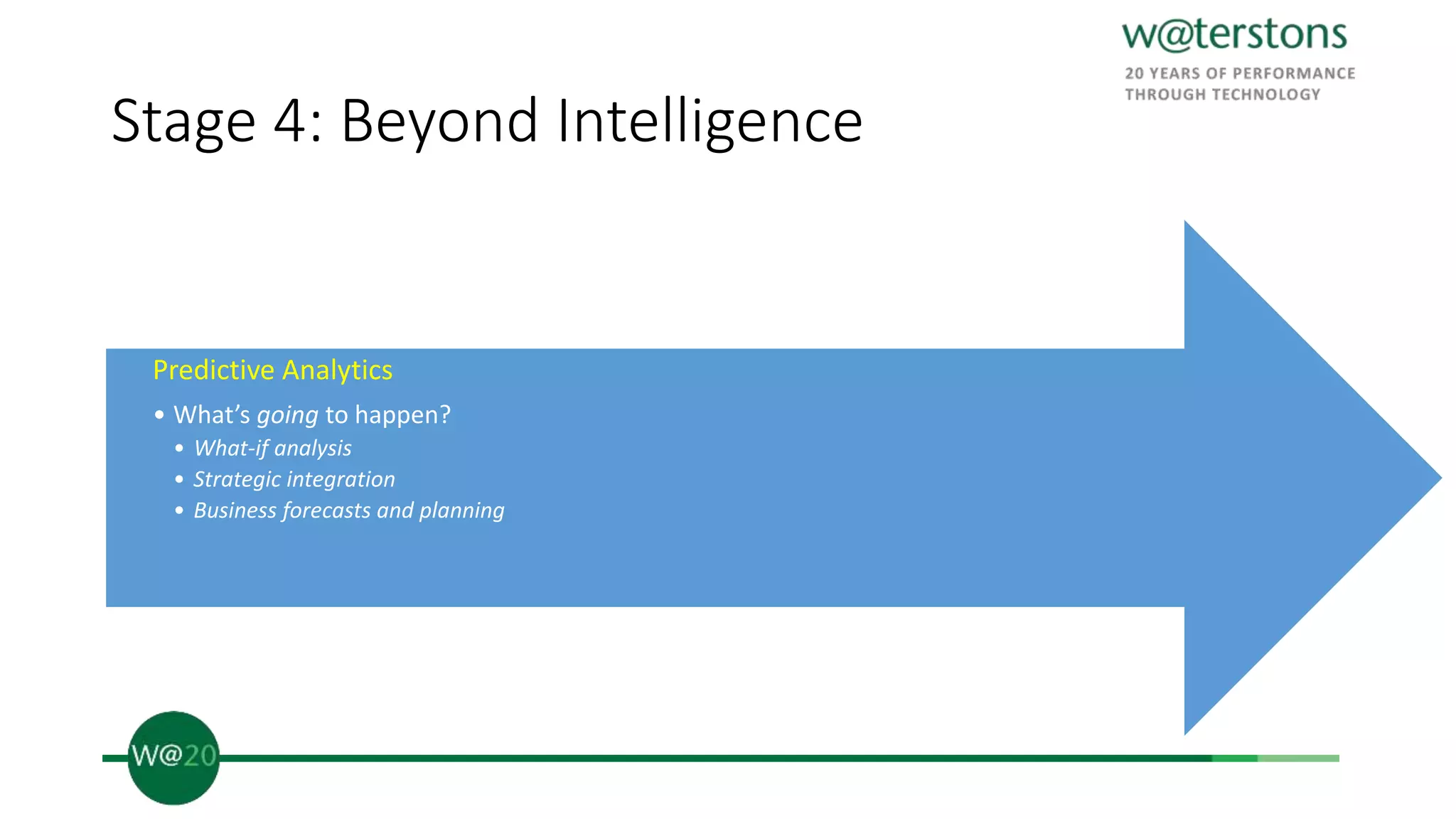
Stage 4: Beyond Intelligence
Predictive Analytics
• What’s going to happen?
• What-if analysis
• Strategic integration
• Business forecasts and planning
Predictive Analytics
@ What-if scenario modelling
@ Manufacturing; forecasting and promotion planning
@ Workflow
@ Predictive
@ Tools for extrapolation of trends
@ Recognition of trends; automatic analysis of data
@ Data mining algorithms:
@ Compute a trend for sales data
@ What characteristics make a good customer
@ How likely a student is to drop out
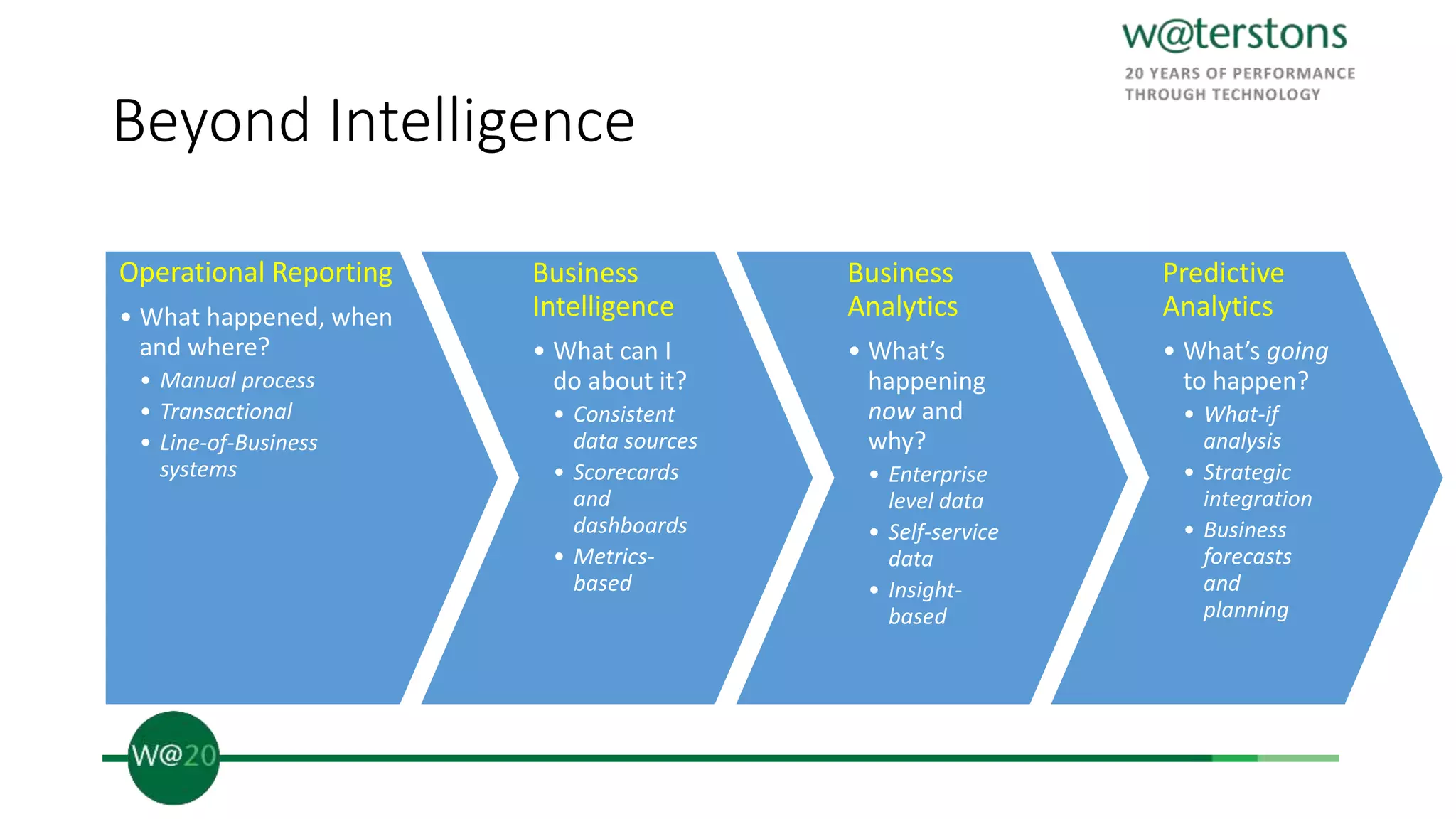
Beyond Intelligence
Operational Reporting
• What happened, when
and where?
• Manual process
• Transactional
• Line-of-Business
systems
Business
Intelligence
• What can I
do about it?
• Consistent
data sources
• Scorecards
and
dashboards
• Metrics-
based
Business
Analytics
• What’s
happening
now and
why?
• Enterprise
level data
• Self-service
data
• Insight-
based
Predictive
Analytics
• What’s going
to happen?
• What-if
analysis
• Strategic
integration
• Business
forecasts
and
planning
Is there life after intelligence?
@ Predictive analytics is not the end
@ As scary as it may seem, there is a Stage 5
@ Automated control methods already exist
@ Extended automation will change decision making processes
@ The ‘self-healing’ business could become a reality
@ Dependent entirely on the risk-appetite of the business
@ Not for the faint hearted!
Any questions?
dan.burrows@waterstons.com
chris.hatton@waterstons.com
michael.nesbit@waterstons.com
http://www.waterstons.com
@WaterstonsLtd
@DanThe7s
Next seminars
@ Mobile Device Management and BYOD – The major players
@ Wednesday 25th June, London Office
@ The Magical Project Manager
@ Friday 4th July, Durham Office
@ Sign up online via www.waterstons.com

BI: Beyond Intelligence

  • 1.
    @Waterstonsltd www.waterstons.com BI: Beyond Intelligence IntroducingBusiness Insight Maturity Dan Burrows, Chris Hatton, Michael Nesbit
  • 2.
    Agenda @ Introduction @ Somedata about data @ Waterstons’ BI roadmap @ BI, BA and CPM - Where have we been? @ Where are we going next?
  • 3.
    Introduction @ The threeMISketeers @ Waterstons and business analytics @ Our journey to enlightenment
  • 4.
  • 5.
    What does thismean to me? @ Largely, probably nothing @ Most businesses don’t care about Facebook, Instagram, Twitter, etc @ It’s hard enough interpreting your own data, let alone anyone else’s @ Maximising the value of your business information is vital @ Once you understand what you already have you can worry about the rest
  • 6.
    Understanding Your Data’sValue @ Many businesses fail to capitalise on the value of their data @ Predefined reports are useful, but the real value comes from the insights hidden in an organisation’s data. @ Business analytics is not all about answering questions @ It’s about establishing the most insightful lines of enquiry @ And supporting decisions with facts, trends and predictions @ Shocking fact: few businesses are really good at using their data
  • 7.
    Waterstons’ BI roadmap @An approach to delivering an analytics project @ A series of delivery actions in a theoretical progression @ A cradle to grave process for embedding, designing and developing intelligence
  • 8.
    The Utopian Process ApproachRamp •Selling BI as a concept •Understanding the need, problems and solutions Business Background •Understanding the business strategy, drivers, reporting requirements and KPIs. •Decision Point Conceptual Design •Understanding KPI definitions and data sources required •Defining the data warehouse contents Readiness and Approach •Analysis of systems and data availability, approach and technology selection •Break-out Point – gap analyses, system implementation, consolidation Functional Design •Reports, visualisations, dashboards •User-group specific requirements Build •Build the data warehouse and ETL routines, implement chosen BI tools, develop and deploy visualisations
  • 9.
    Waterstons’ BI roadmap @Not necessarily a linear progression; focus on business needs @ Iteration reflects real business @ Project experience demonstrates a different story
  • 10.
    BI in the“Real World” Approach Ramp Business Background Conceptual Design Readiness and Approach Functional Design Build
  • 11.
    Time for achange @ Analysis of business data has moved on significantly @ New analytics tools and discovery products are available @ The popularity of, and desire for instant analysis has exploded @ A new roadmap for delivering insight to our customers was needed
  • 12.
    18 reasons inone simple slide
  • 13.
    Where did youcome from? @ In the beginning, there was the operational report. With it came answers to questions. @ What am I making today? @ Who should be at work making it? @ Are all the parts in stock? @ What orders am I supposed to dispatch? @ Snapshot answers to questions – focussed on activity
  • 14.
    Stage 1: Monitor OperationalReporting • What happened, when and where? • Manual process • Transactional • Line-of-Business systems
  • 15.
    Operational Reporting @ Traditionalreporting scenarios @ Real Time @ Detail @ Line of business management and staff @ Operational dashboards @ Manage intra-daily business processes (low-latency) @ Legislative reporting requirements @ Traditional reporting technology is still relevant in an analytics context @ Frozen historic snapshot @ Controlled or limited access to interactive analytic features @ Specific or specialised requirements for data visualisation
  • 16.
    Where did yougo? @ Operational reporting was good. But not good enough. Enter the world of Business Intelligence. @ What has my performance been vs. KPI target? @ How does our performance compare with last year? @ Am I making enough things/enough margin? @ Are the decisions I made last week/month/year making a difference? @ Temporally related questions and answers – focussed on results
  • 17.
    Stage 2: Questionand Control Business Intelligence • What can I do about it? • Consistent data sources • Scorecards and dashboards • Metrics-based
  • 18.
    Business Intelligence @ OperationalReporting @ Data Warehouse @ Multiple Data sources @ One version of the truth @ Defined KPIs @ Targets @ Last Year @ Actuals @ Historical Trends @ Accumulation of Data
  • 19.
    What’s current?* @ Knowingwhat’s been going on gives way to working out what to do next. The Business Analysis train arrives. @ Hmm, I wonder what happened to cause that spike in sales? @ Do blue ones REALLY work better than the red ones? @ Are we attracting the most profitable customer groups? @ Why, why, why? @ Interrogation to answer ad-hoc questions – focussed on insight *This slide formerly entitled “Where did you come from, Cotton Eyed Joe?”
  • 20.
    Business Analytics Business Analytics •What’s happening now and why? • Enterprise level data • Self-service data • Insight-based
  • 21.
    Business Analytics @ Operationaland BI reporting @ Analysis of reporting to ask questions @ Why trend occurs? @ What can be done to change trend? @ Power users performing analysis @ Ad-hoc reports @ Interactive drill down / slice and dice @ Potentially discover new trends
  • 22.
    Where are yougoing now? @ What’s leading edge? Data driven forecasting, strategy and planning. The world of Predictive Analytics is growing. @ What will next year look like? @ What would happen if we lost that customer? @ Could we cope if a competitor entered the market? @ Could we satisfy demand if the number of customers doubled? @ Trend analysis answering ‘what-if’ questions – focussed on the future
  • 23.
    Stage 4: BeyondIntelligence Predictive Analytics • What’s going to happen? • What-if analysis • Strategic integration • Business forecasts and planning
  • 24.
    Predictive Analytics @ What-ifscenario modelling @ Manufacturing; forecasting and promotion planning @ Workflow @ Predictive @ Tools for extrapolation of trends @ Recognition of trends; automatic analysis of data @ Data mining algorithms: @ Compute a trend for sales data @ What characteristics make a good customer @ How likely a student is to drop out
  • 25.
    Beyond Intelligence Operational Reporting •What happened, when and where? • Manual process • Transactional • Line-of-Business systems Business Intelligence • What can I do about it? • Consistent data sources • Scorecards and dashboards • Metrics- based Business Analytics • What’s happening now and why? • Enterprise level data • Self-service data • Insight- based Predictive Analytics • What’s going to happen? • What-if analysis • Strategic integration • Business forecasts and planning
  • 26.
    Is there lifeafter intelligence? @ Predictive analytics is not the end @ As scary as it may seem, there is a Stage 5 @ Automated control methods already exist @ Extended automation will change decision making processes @ The ‘self-healing’ business could become a reality @ Dependent entirely on the risk-appetite of the business @ Not for the faint hearted!
  • 27.
  • 28.
    Next seminars @ MobileDevice Management and BYOD – The major players @ Wednesday 25th June, London Office @ The Magical Project Manager @ Friday 4th July, Durham Office @ Sign up online via www.waterstons.com

Editor's Notes

  • #16 Specialist temperature controlled distribution and storage company. Provide their traffic office with a map of where their trailers are at any point in time across the UK (Usage model: Query then analyse - tactical) e.g. Picking sheets for warehouse operatives Typically produced of a transactional system and a data warehouse is not used; different architecture to a BI system One thinks of paginated reports with lists of tabulated data Up to the minute detail essential to the running of the organisation Typically not interactive, but it can be: (temperature controlled logistics; where is a vehicle now on a map; will it be there on time?) Operational dashboards: - particularly common in environments where it is essential to act on opportunities and issues quickly: e.g. help-desk, supply-chain Continuous view of what is happening in a business unit; maybe not long-term trends that have built up over months More direct connection to source systems for low-latency Usually a single data source; not consolidation of multiple data sources
  • #25 Food manufacturing company Need to quickly respond to demands of supermarkets who run promotions on certain products Plan for seasonal events (Easter, barbeque weather, world cup – things that affect buying patterns) Alterations to pricing, volume and launching in new markets Sales cannibalisation Needs much greater engagement and input from users HE Client - Looking at Bayesian algorithms against student engagement behaviour to identify students that are likely to struggle / drop-out