
PRESENTED BY:
 Bohitesh Misra
 Bijaya Prusty
 Satish Kumar
 Afzal Wadood
Business Analytics
Why now and what next?
15th April 2017
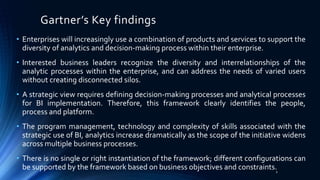
Gartner’s Key findings
• Enterprises will increasingly use a combination of products and services to support the
diversity of analytics and decision-making process within their enterprise.
• Interested business leaders recognize the diversity and interrelationships of the
analytic processes within the enterprise, and can address the needs of varied users
without creating disconnected silos.
• A strategic view requires defining decision-making processes and analytical processes
for BI implementation. Therefore, this framework clearly identifies the people,
process and platform.
• The program management, technology and complexity of skills associated with the
strategic use of BI, analytics increase dramatically as the scope of the initiative widens
across multiple business processes.
• There is no single or right instantiation of the framework; different configurations can
be supported by the framework based on business objectives and constraints.2
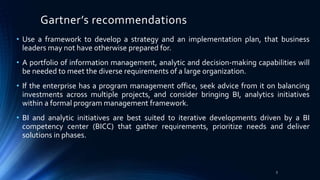
Gartner’s recommendations
• Use a framework to develop a strategy and an implementation plan, that business
leaders may not have otherwise prepared for.
• A portfolio of information management, analytic and decision-making capabilities will
be needed to meet the diverse requirements of a large organization.
• If the enterprise has a program management office, seek advice from it on balancing
investments across multiple projects, and consider bringing BI, analytics initiatives
within a formal program management framework.
• BI and analytic initiatives are best suited to iterative developments driven by a BI
competency center (BICC) that gather requirements, prioritize needs and deliver
solutions in phases.
3
Business Analytics Framework
•Framework defines the people, processes and platforms
that need to be integrated and aligned to take a more
strategic approach to business intelligence (BI), analytics
and performance management (PM) initiatives.
4
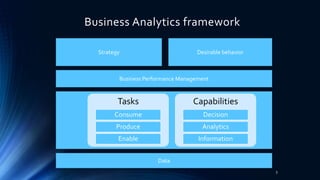
Business Analytics framework
5
Strategy Desirable behavior
Business Performance Management
Data
Tasks
Consume
Produce
Enable
Capabilities
Decision
Analytics
Information
Business Analytics Framework
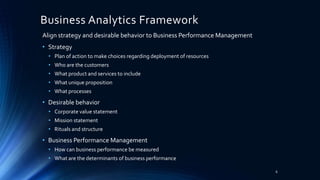
Align strategy and desirable behavior to Business Performance Management
• Strategy
• Plan of action to make choices regarding deployment of resources
• Who are the customers
• What product and services to include
• What unique proposition
• What processes
• Desirable behavior
• Corporate value statement
• Mission statement
• Rituals and structure
• Business Performance Management
• How can business performance be measured
• What are the determinants of business performance
6
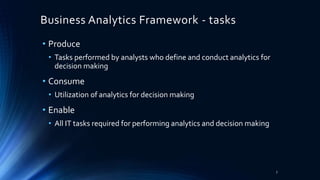
Business Analytics Framework - tasks
• Produce
• Tasks performed by analysts who define and conduct analytics for
decision making
• Consume
• Utilization of analytics for decision making
• Enable
• All IT tasks required for performing analytics and decision making
7
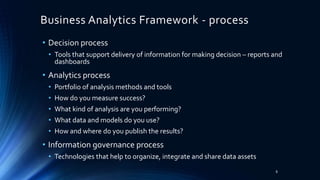
Business Analytics Framework - process
• Decision process
• Tools that support delivery of information for making decision – reports and
dashboards
• Analytics process
• Portfolio of analysis methods and tools
• How do you measure success?
• What kind of analysis are you performing?
• What data and models do you use?
• How and where do you publish the results?
• Information governance process
• Technologies that help to organize, integrate and share data assets
8
Business Analytics – why now ?
• There is ready availability of large amounts of data
• Maturity of business performance management created bridge between
business strategy and data
• Fact-based decisions have resulted in emergence of self-service analytics
and BI
• Advanced analytics techniques helped analysts to have access to
sophisticated algorithms
• Sharp decline in cost per performance level of computing power, data
storage and bandwidth
9
Business Analytics – What next ?
• Analytics helps profitability in cross-selling and up-selling to
current customers
• Helps in reducing costs
• early payments to suppliers to take advantage of discounts,
• Retain cash as long as possible
• Use of matrices to find optimal balance
• Helps in detection and prevention of frauds
• Sophisticated forensic analytics to find irregularities in financial
transactions
• Helps in extrapolating current trends
10
Business Analytics – What next ?
Major focus of use of analytics in areas like:
• Healthcare
• Financial accounting research
• Supply chain analytics
11
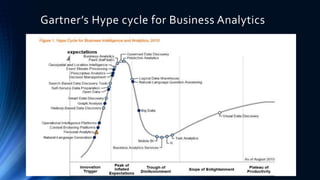
Gartner’s Hype cycle for Business Analytics
12
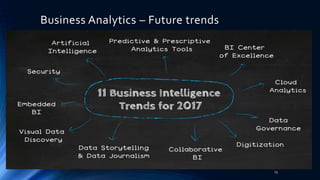
Business Analytics – Future trends
13
Thank you !
14

Business analytics why now_what next

  • 1.
    PRESENTED BY:  BohiteshMisra  Bijaya Prusty  Satish Kumar  Afzal Wadood Business Analytics Why now and what next? 15th April 2017
  • 2.
    Gartner’s Key findings •Enterprises will increasingly use a combination of products and services to support the diversity of analytics and decision-making process within their enterprise. • Interested business leaders recognize the diversity and interrelationships of the analytic processes within the enterprise, and can address the needs of varied users without creating disconnected silos. • A strategic view requires defining decision-making processes and analytical processes for BI implementation. Therefore, this framework clearly identifies the people, process and platform. • The program management, technology and complexity of skills associated with the strategic use of BI, analytics increase dramatically as the scope of the initiative widens across multiple business processes. • There is no single or right instantiation of the framework; different configurations can be supported by the framework based on business objectives and constraints.2
  • 3.
    Gartner’s recommendations • Usea framework to develop a strategy and an implementation plan, that business leaders may not have otherwise prepared for. • A portfolio of information management, analytic and decision-making capabilities will be needed to meet the diverse requirements of a large organization. • If the enterprise has a program management office, seek advice from it on balancing investments across multiple projects, and consider bringing BI, analytics initiatives within a formal program management framework. • BI and analytic initiatives are best suited to iterative developments driven by a BI competency center (BICC) that gather requirements, prioritize needs and deliver solutions in phases. 3
  • 4.
    Business Analytics Framework •Frameworkdefines the people, processes and platforms that need to be integrated and aligned to take a more strategic approach to business intelligence (BI), analytics and performance management (PM) initiatives. 4
  • 5.
    Business Analytics framework 5 StrategyDesirable behavior Business Performance Management Data Tasks Consume Produce Enable Capabilities Decision Analytics Information
  • 6.
    Business Analytics Framework Alignstrategy and desirable behavior to Business Performance Management • Strategy • Plan of action to make choices regarding deployment of resources • Who are the customers • What product and services to include • What unique proposition • What processes • Desirable behavior • Corporate value statement • Mission statement • Rituals and structure • Business Performance Management • How can business performance be measured • What are the determinants of business performance 6
  • 7.
    Business Analytics Framework- tasks • Produce • Tasks performed by analysts who define and conduct analytics for decision making • Consume • Utilization of analytics for decision making • Enable • All IT tasks required for performing analytics and decision making 7
  • 8.
    Business Analytics Framework- process • Decision process • Tools that support delivery of information for making decision – reports and dashboards • Analytics process • Portfolio of analysis methods and tools • How do you measure success? • What kind of analysis are you performing? • What data and models do you use? • How and where do you publish the results? • Information governance process • Technologies that help to organize, integrate and share data assets 8
  • 9.
    Business Analytics –why now ? • There is ready availability of large amounts of data • Maturity of business performance management created bridge between business strategy and data • Fact-based decisions have resulted in emergence of self-service analytics and BI • Advanced analytics techniques helped analysts to have access to sophisticated algorithms • Sharp decline in cost per performance level of computing power, data storage and bandwidth 9
  • 10.
    Business Analytics –What next ? • Analytics helps profitability in cross-selling and up-selling to current customers • Helps in reducing costs • early payments to suppliers to take advantage of discounts, • Retain cash as long as possible • Use of matrices to find optimal balance • Helps in detection and prevention of frauds • Sophisticated forensic analytics to find irregularities in financial transactions • Helps in extrapolating current trends 10
  • 11.
    Business Analytics –What next ? Major focus of use of analytics in areas like: • Healthcare • Financial accounting research • Supply chain analytics 11
  • 12.
    Gartner’s Hype cyclefor Business Analytics 12
  • 13.
    Business Analytics –Future trends 13
  • 14.