
When the Business needs Intelligence… 
! 
DIPTI DALIA PATIL
Agenda 
• Introduction 
• Decision-making 
• Data in the organisation 
• What is Business Intelligence 
• The evolution of analytics 
• BI Strategy
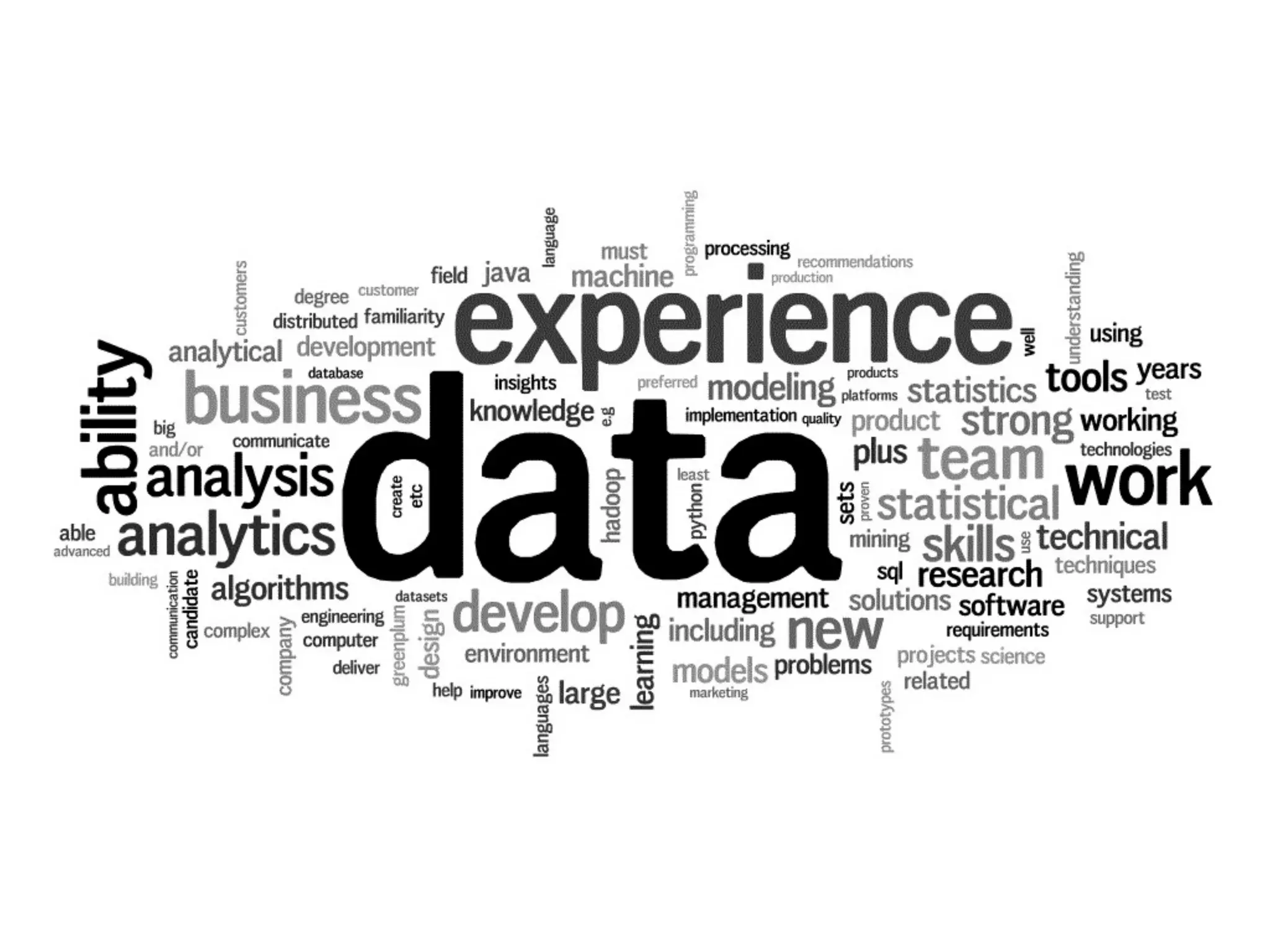
Data 
! 
Data 
! 
Data
So how do I justify my 
decisions?
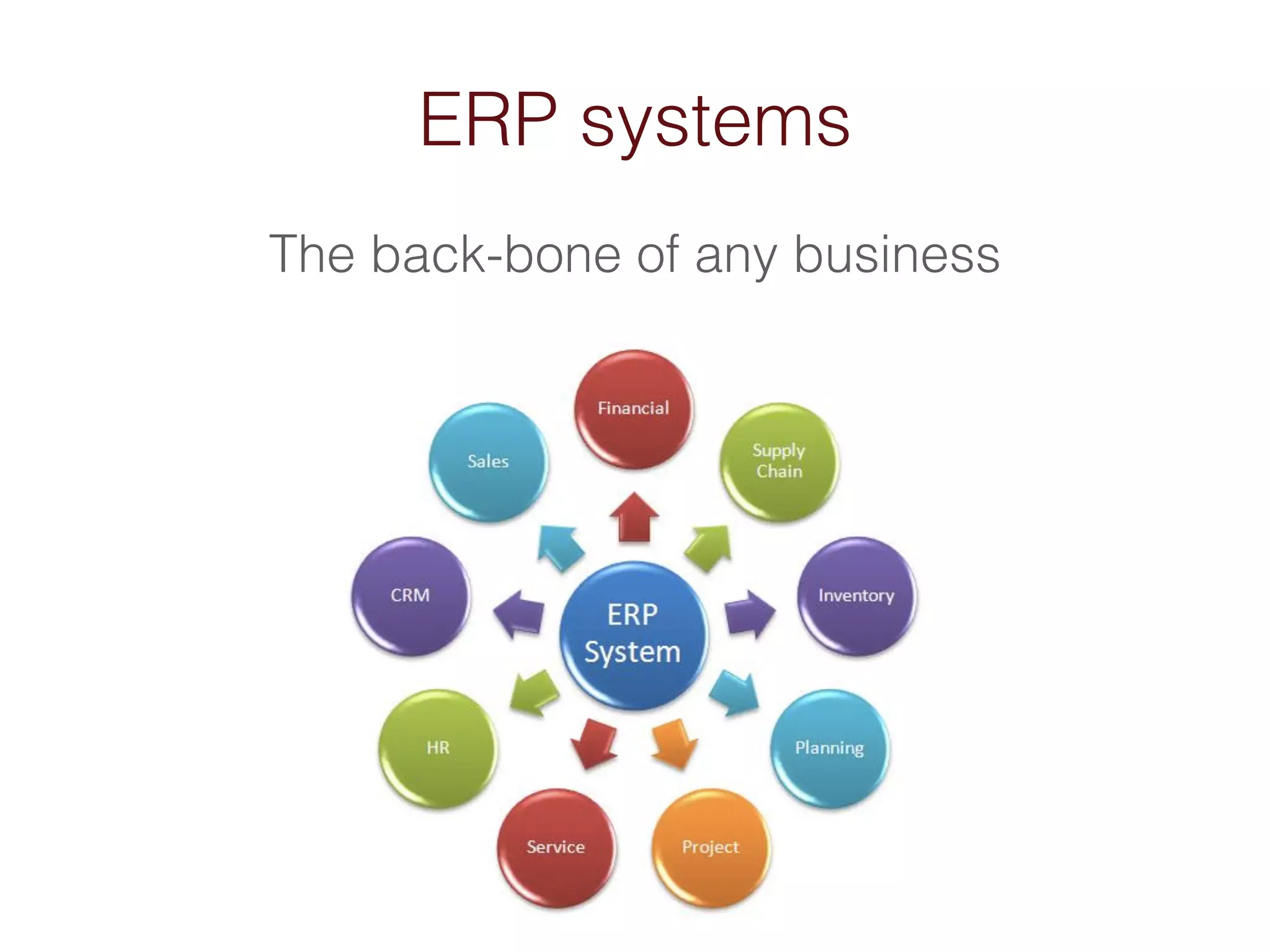
ERP systems 
! 
The back-bone of any business
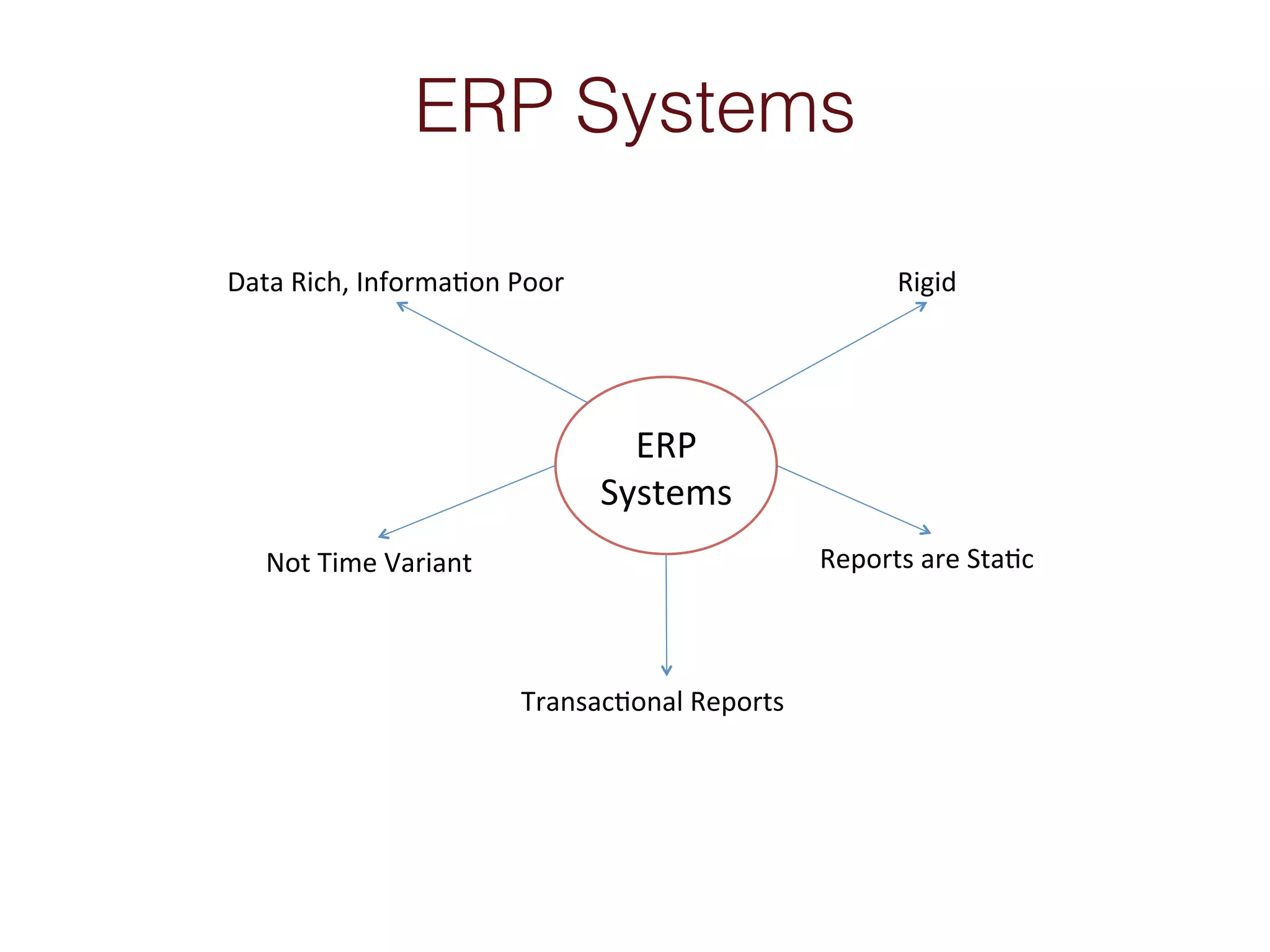
ERP Systems 
Data$Rich,$Informa6on$Poor$ Rigid$ 
ERP$ 
Systems$ 
Not$Time$Variant$ Reports$are$Sta6c$ 
Transac6onal$Reports$
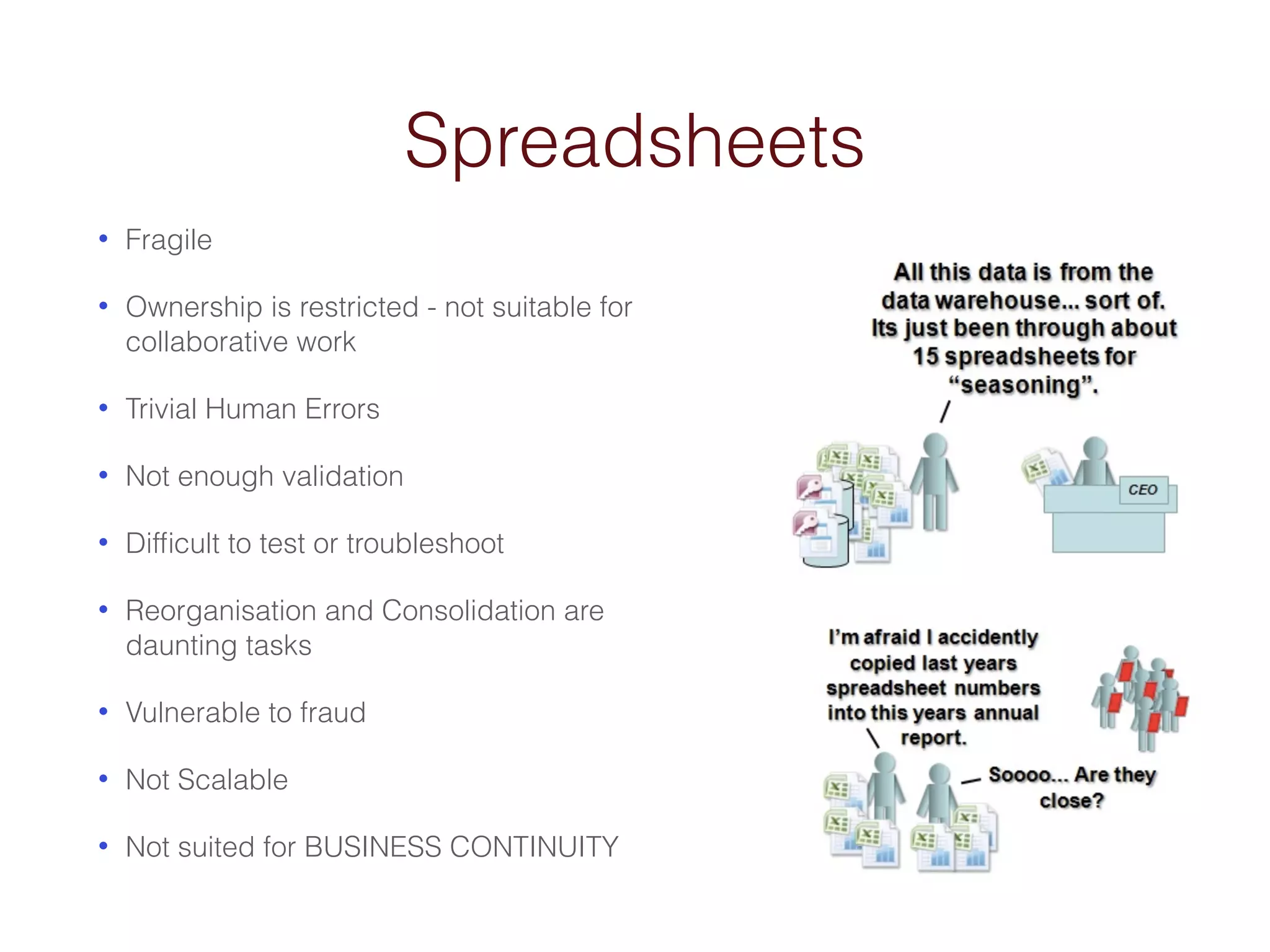
Spreadsheets 
• Fragile 
• Ownership is restricted - not suitable for 
collaborative work 
• Trivial Human Errors 
• Not enough validation 
• Difficult to test or troubleshoot 
• Reorganisation and Consolidation are 
daunting tasks 
• Vulnerable to fraud 
• Not Scalable 
• Not suited for BUSINESS CONTINUITY
“Derive all information from the systems 
and present it in a useful manner!” 
… a daunting task that can haunt any organisation
Business Intelligence gives the 
ability to analyse and interpret the 
wealth of data stored in ERP 
databases
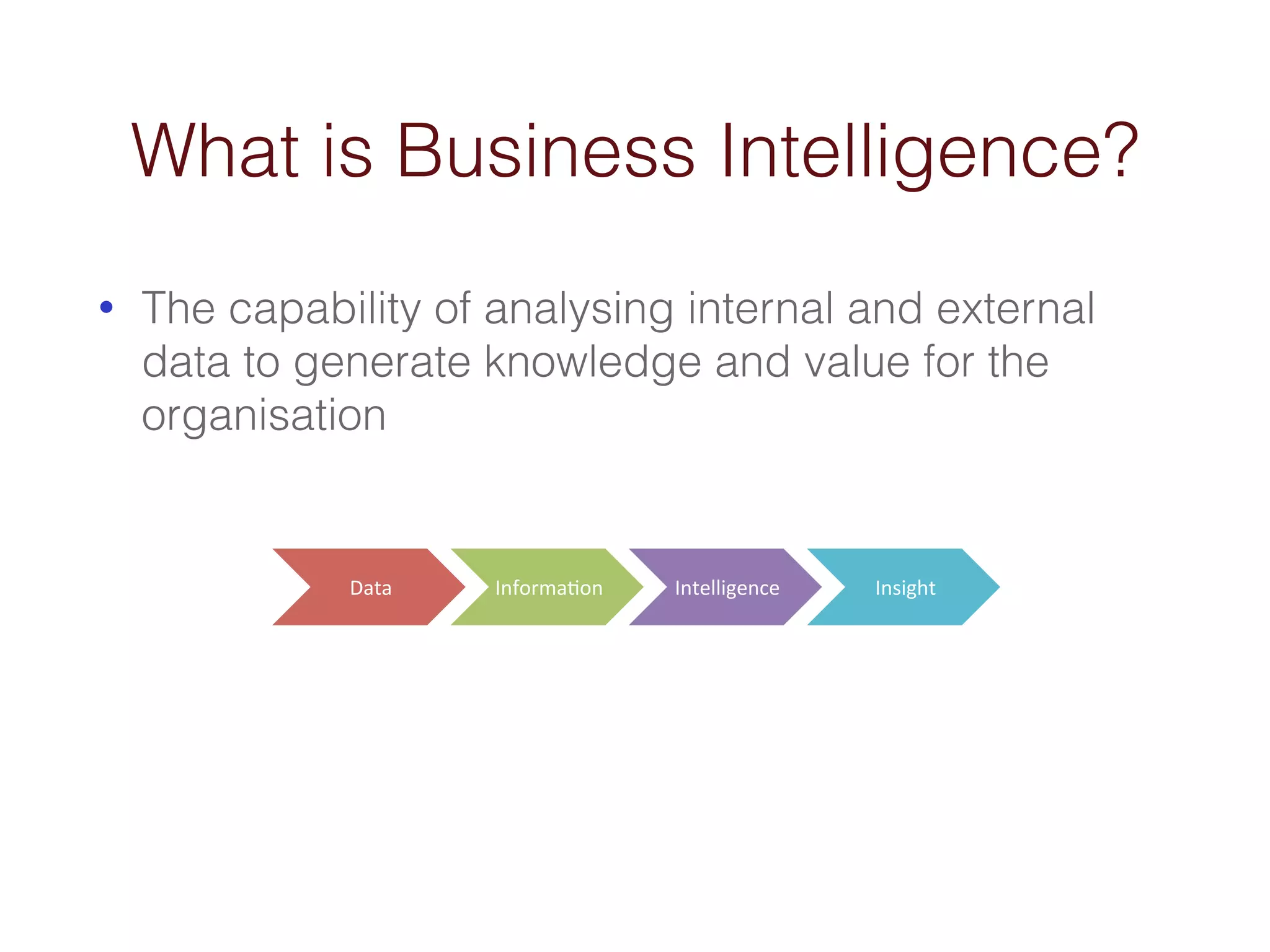
What is Business Intelligence? 
• The capability of analysing internal and external 
data to generate knowledge and value for the 
organisation 
Data$ Informa+on$ Intelligence$ Insight$
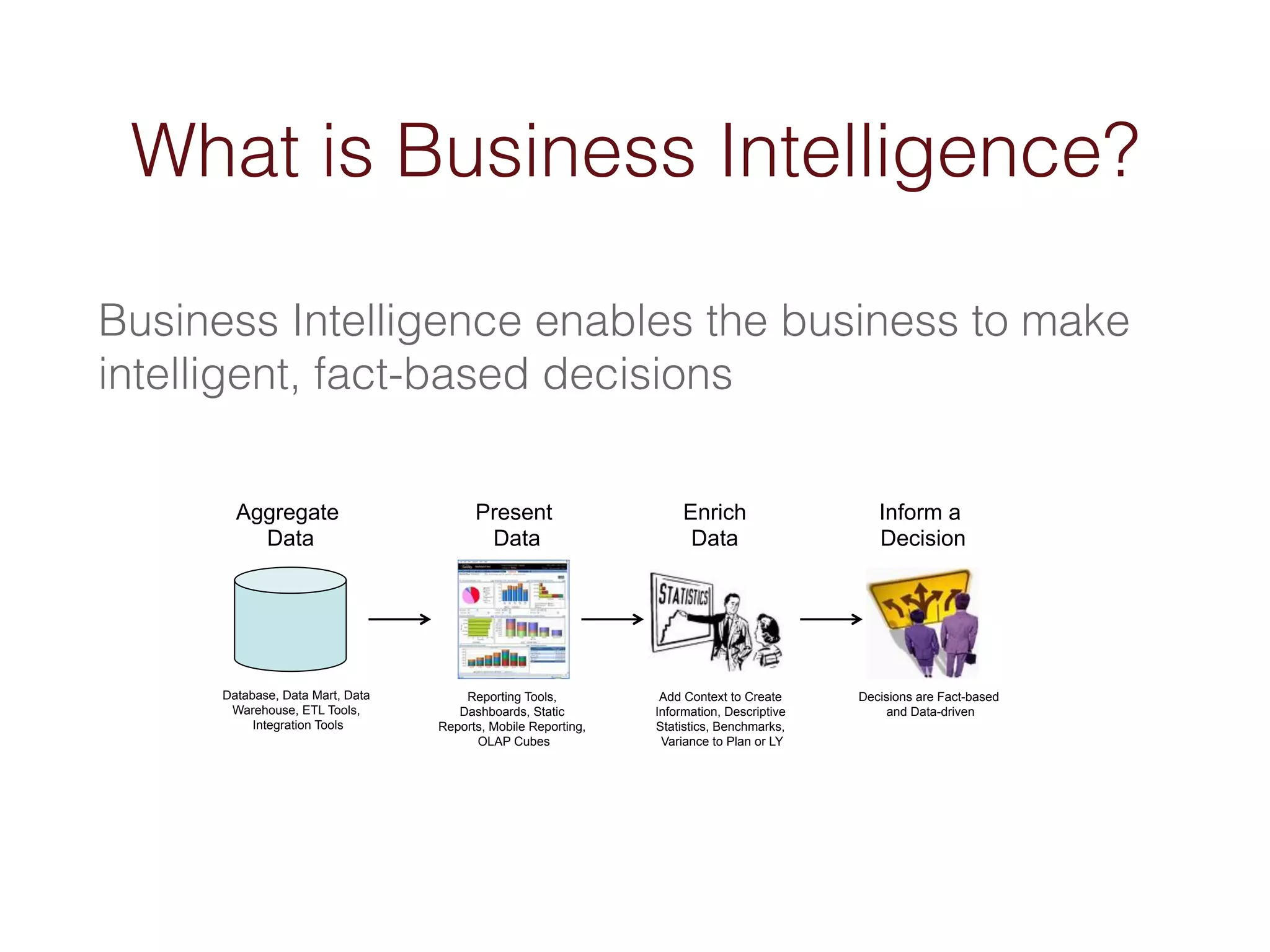
What is Business Intelligence? 
Business Intelligence enables the business to make 
intelligent, fact-based decisions 
Aggregate 
Data 
Database, Data Mart, Data 
Warehouse, ETL Tools, 
Integration Tools 
Present 
Data 
Enrich 
Data 
Inform a 
Decision 
Reporting Tools, 
Dashboards, Static 
Reports, Mobile Reporting, 
OLAP Cubes 
Add Context to Create 
Information, Descriptive 
Statistics, Benchmarks, 
Variance to Plan or LY 
Decisions are Fact-based 
and Data-driven
Goals of a BI Implementation 
• To capture, store and rationalise data from across the 
business to create a unified view of the customer and 
operations 
• To produce a versatile, integrated data warehouse 
architecture to improve the decision-making process and 
enable on-going success 
• Users should spend time analysing data rather than 
collecting it
Trends that Influence the need for 
Business Intelligence 
• Information Quality 
• Data Governance 
• Integrated View of Data 
• Standards and Regulatory Compliance
Information Quality 
• How useable is my information? 
• Is my information accurate? 
• How is the information impacting my business? 
• BI is more about data quality, not quantity
Information Quality 
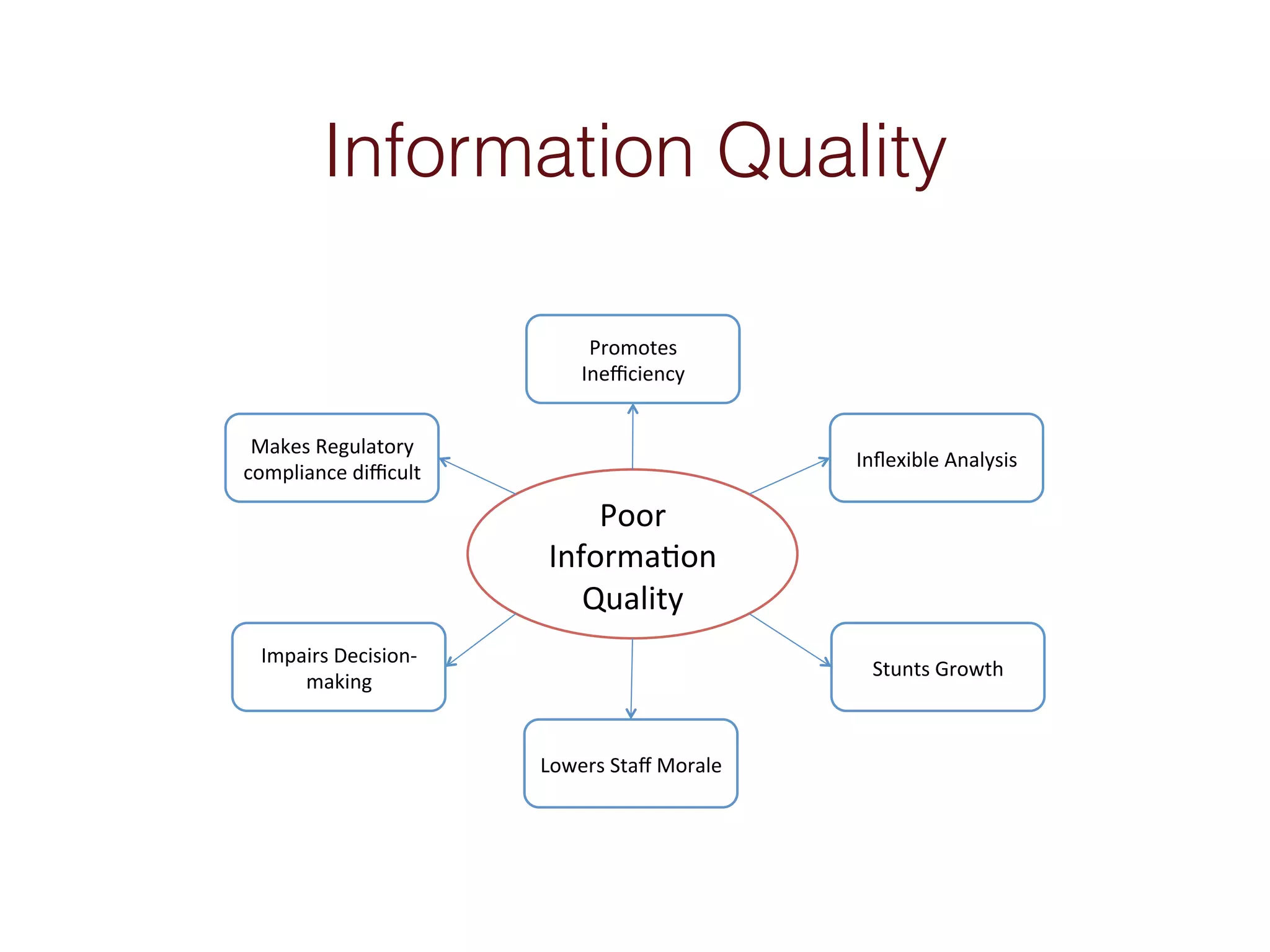
Poor$ 
Informa*on$ 
Quality$ 
Makes$Regulatory$ 
compliance$difficult$ 
Promotes$ 
Inefficiency$ 
Impairs$Decision@ Stunts$Growth$ 
making$ 
Inflexible$Analysis$ 
Lowers$Staff$Morale$
Data Governance 
• Setting standards and procedures to ensure that 
information quality goals are achieved 
• Provides strategic direction
Integrated View of Data 
• Bring together the program and business logic 
dispersed among many applications across the 
organisation 
• Measure and monitor performance consistently at 
an organisational level 
• Requires a solid Enterprise-Level Business 
Intelligence Strategy
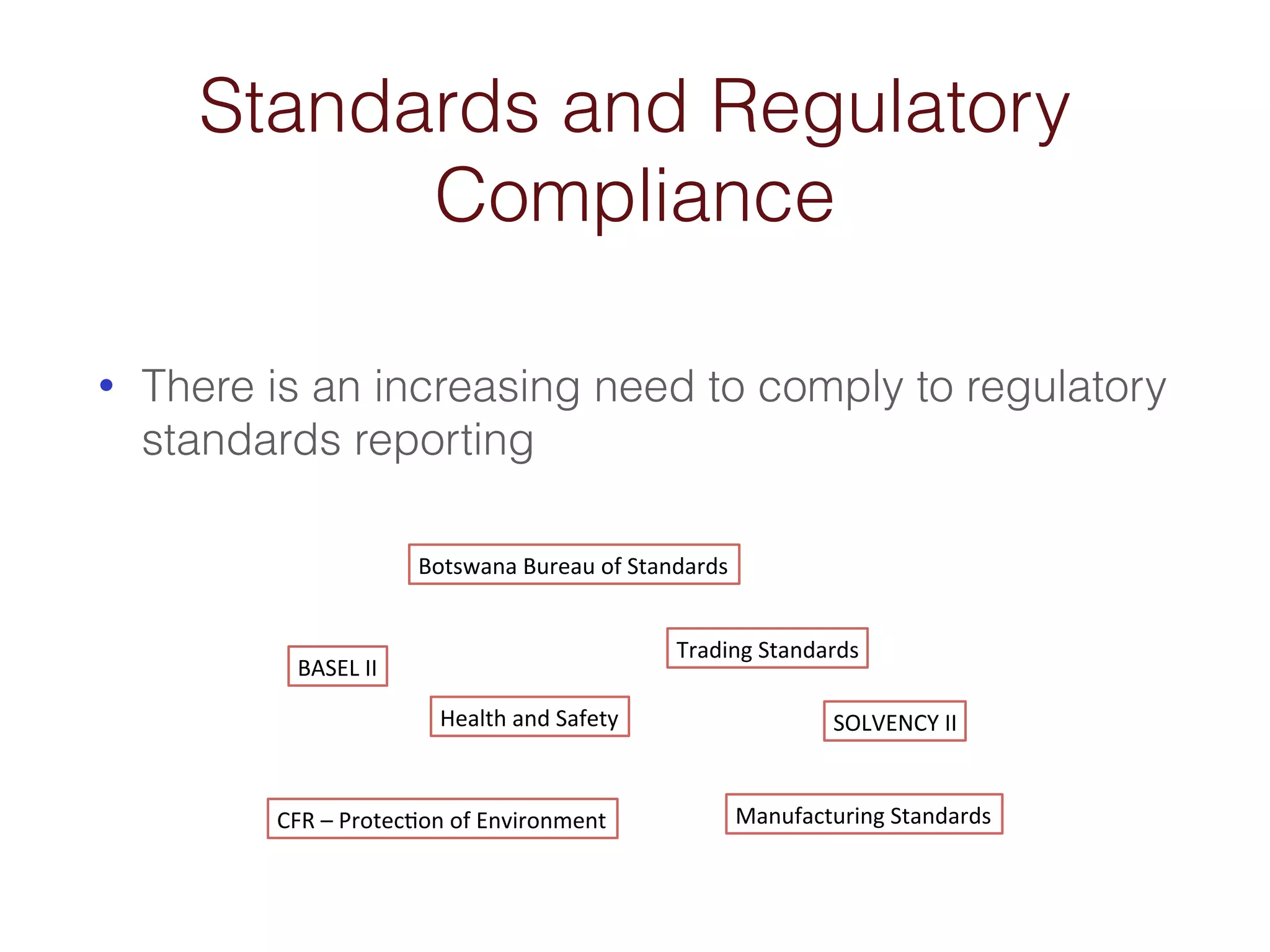
Standards and Regulatory 
Compliance 
• There is an increasing need to comply to regulatory 
standards reporting 
BASEL&II& 
SOLVENCY&II& 
Botswana&Bureau&of&Standards& 
CFR&–&Protec6on&of&Environment& 
Trading&Standards& 
Health&and&Safety& 
Manufacturing&Standards&
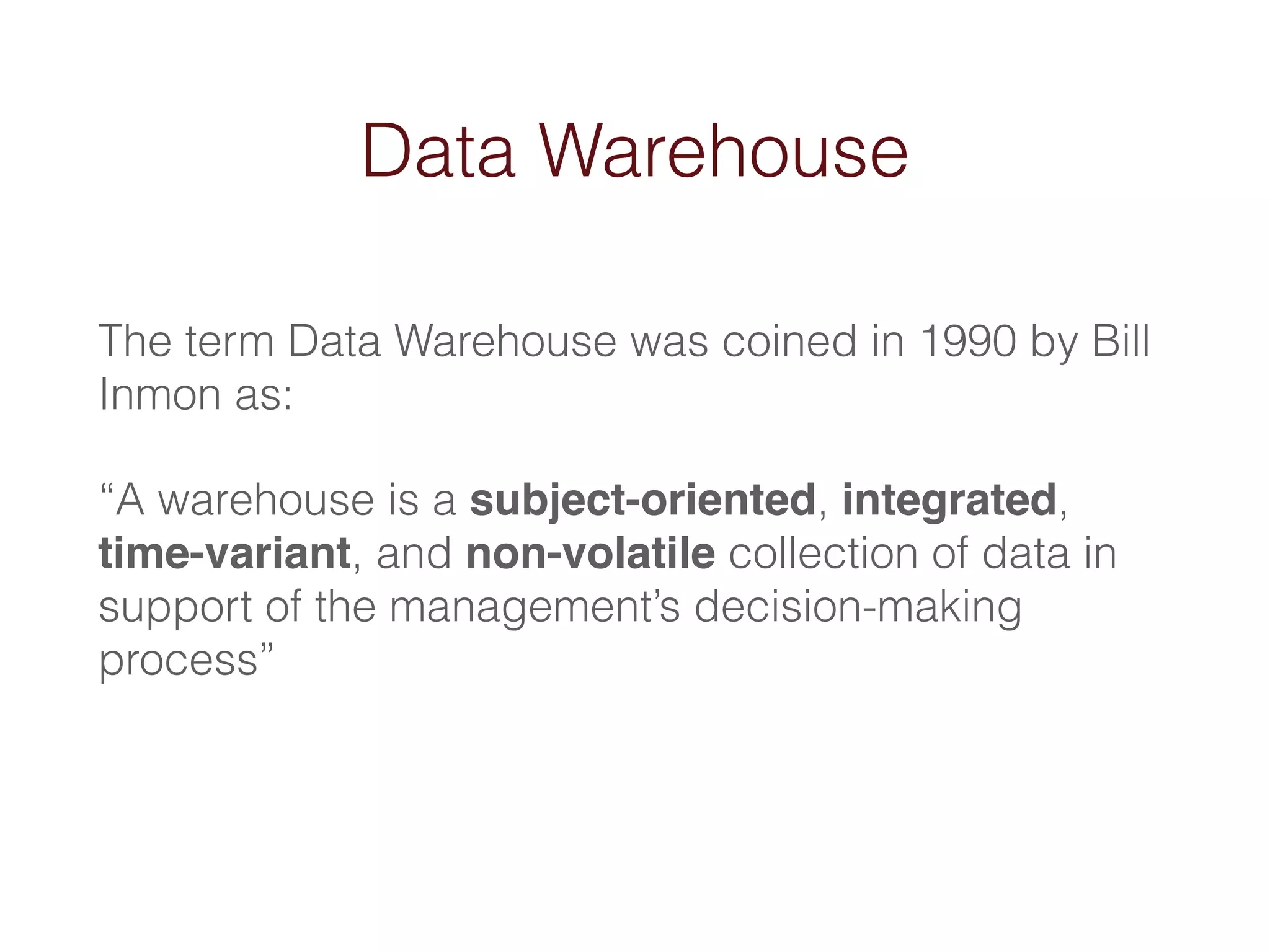
Data Warehouse 
The term Data Warehouse was coined in 1990 by Bill 
Inmon as: 
“A warehouse is a subject-oriented, integrated, 
time-variant, and non-volatile collection of data in 
support of the management’s decision-making 
process”
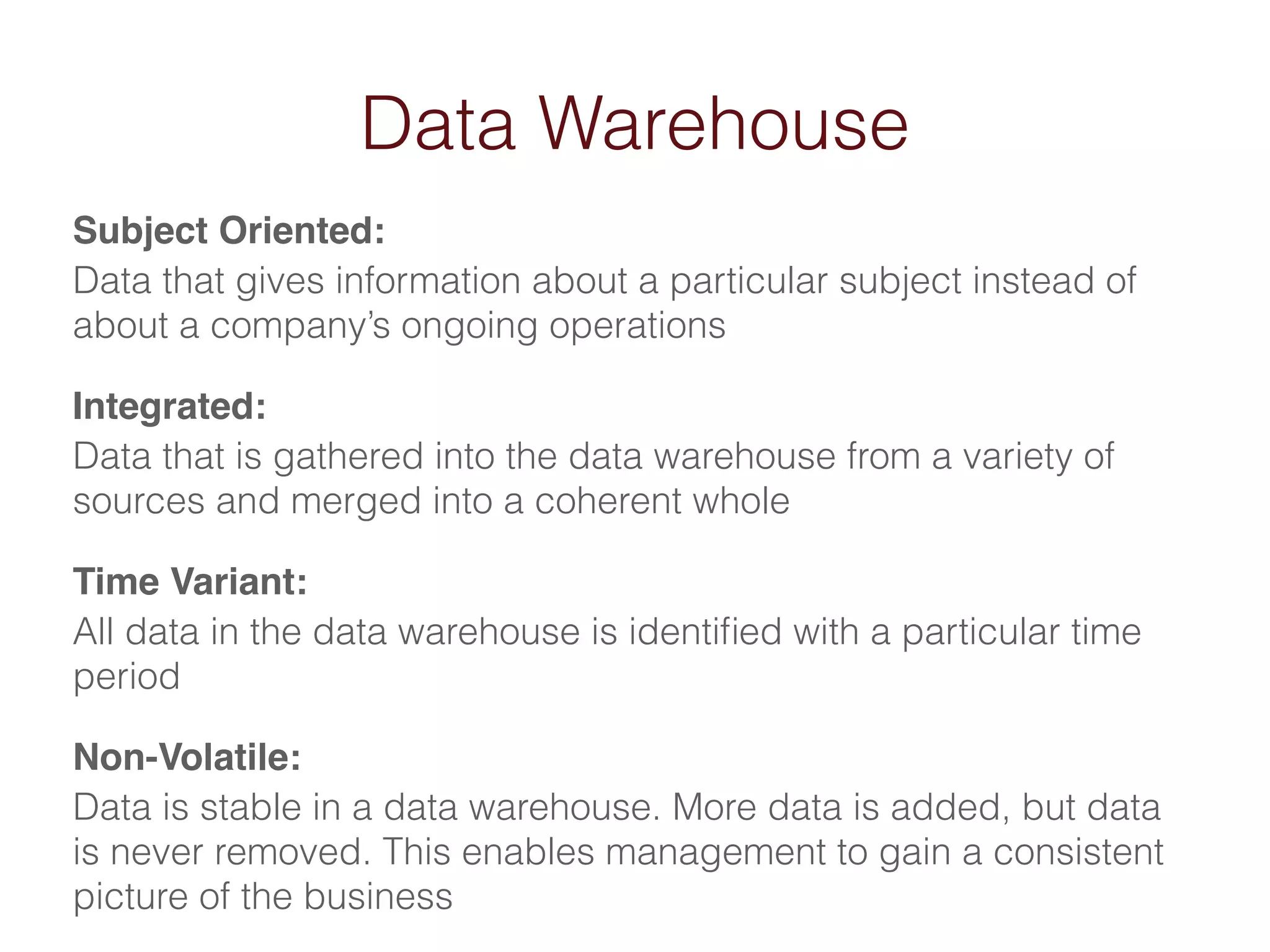
Data Warehouse 
Subject Oriented:! 
Data that gives information about a particular subject instead of 
about a company’s ongoing operations 
Integrated:! 
Data that is gathered into the data warehouse from a variety of 
sources and merged into a coherent whole 
Time Variant:! 
All data in the data warehouse is identified with a particular time 
period 
Non-Volatile:! 
Data is stable in a data warehouse. More data is added, but data 
is never removed. This enables management to gain a consistent 
picture of the business
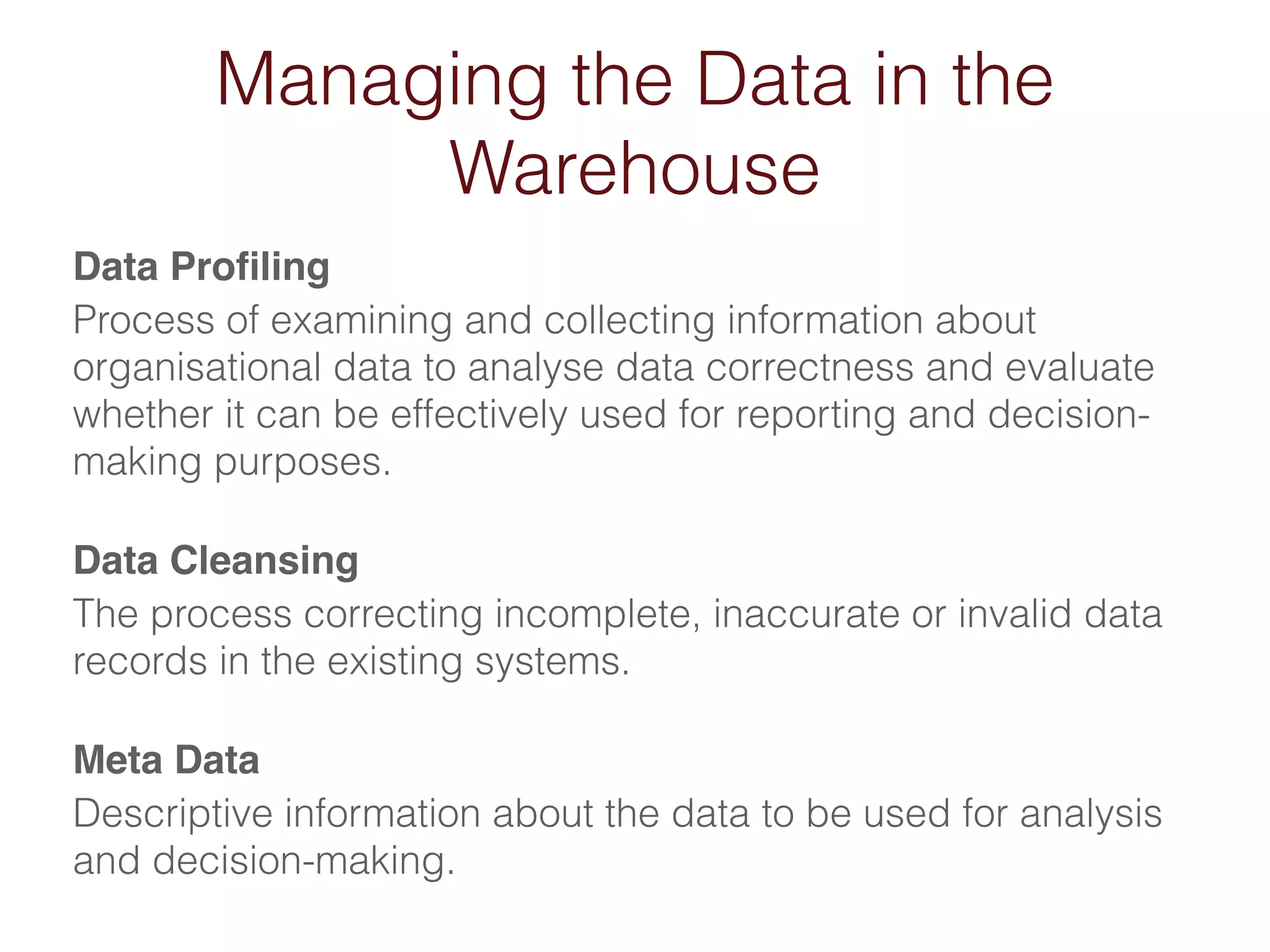
Managing the Data in the 
Warehouse 
Data Profiling! 
Process of examining and collecting information about 
organisational data to analyse data correctness and evaluate 
whether it can be effectively used for reporting and decision-making 
purposes. 
Data Cleansing! 
The process correcting incomplete, inaccurate or invalid data 
records in the existing systems. 
Meta Data! 
Descriptive information about the data to be used for analysis 
and decision-making.
Data Profiling 
• Also known as Data Discovery 
• Using analytical techniques to examine current data for 
completeness, consistency, accuracy and integrity 
• Essential for effective data cleansing and transformation 
• Helps improve data quality by deciphering and validating 
data patterns and formats 
• Reaffirms whether meta data (when available) accurately 
describes the values across all datasets 
• Identify redundant data across data sources 
• Key in identifying data sources for the enterprise data 
warehouse
Data Cleansing 
• Process of correcting incomplete, inaccurate, or duplicate 
records in the systems 
• Necessary to ensure effective reporting and analysis 
• Incorrect data —> Incorrect Analysis —> Incorrect Decisions 
• Strict Cleansing - rejecting any inaccurate or inconsistent 
data 
• Fuzzy Cleansing - correcting records that partially match 
existing, known values
Meta Data 
• Meta Data is descriptive information about the data in the 
warehouse 
• Describes the data in business terms that the users can 
identify with 
• Avoids conflicts in data definitions and interpretations 
• Prevents the “silo-effect” of creating non-integrated pockets 
of data
Why Business Intelligence? 
• Program and business logic dispersed among many 
applications in the organisation 
• Increased data volumes and demand result in 
performance deterioration on the transactional system 
• Transactional systems are not time-variant 
• Transactional Data is volatile 
• Get increased insight into the business processes and 
marketplace 
• Departmental Objectives vary and it is easy to lose sight 
of the core organisational objectives
Why Business Intelligence? 
• Business Intelligence can tap into the vast silos of data in 
the organisation 
• Business Intelligence provides a flexible means to 
analyse and interpret data in different ways 
• Trend Reporting and Predictive Analysis 
• Turn data into meaningful business decisions 
• Monitor performance and promote growth
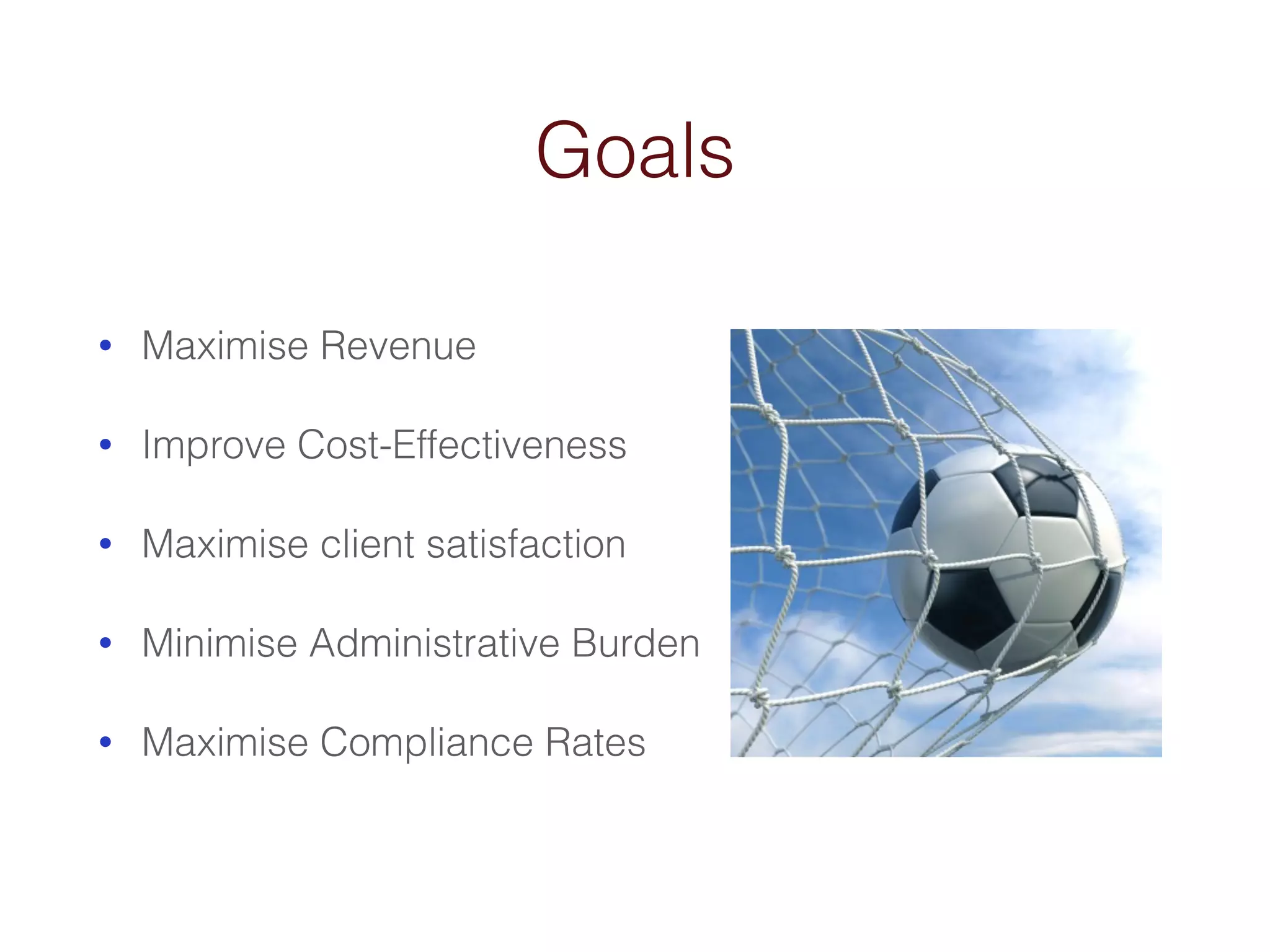
Goals 
• Maximise Revenue 
• Improve Cost-Effectiveness 
• Maximise client satisfaction 
• Minimise Administrative Burden 
• Maximise Compliance Rates
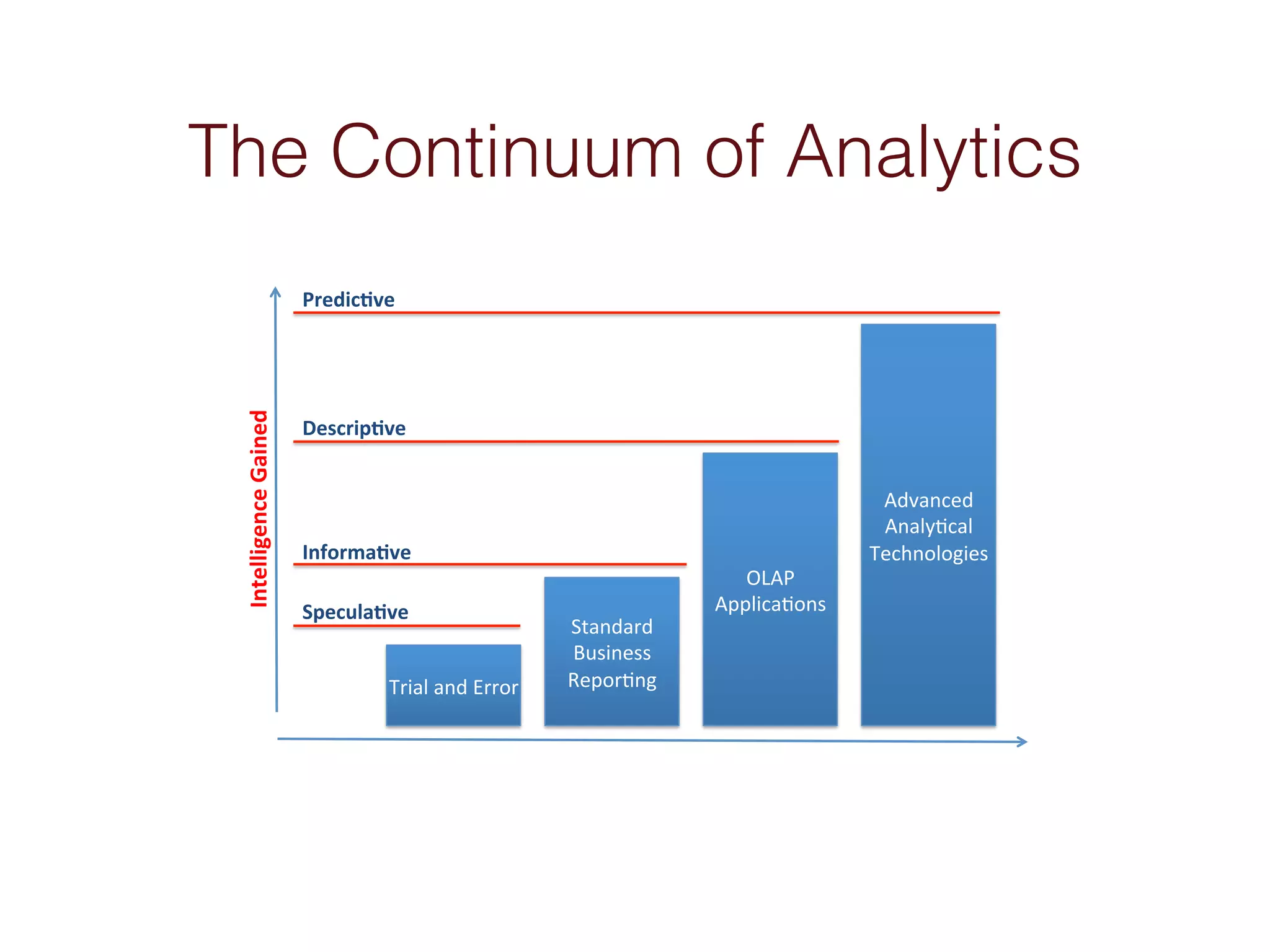
The Continuum of Analytics 
Predic(ve* 
Descrip(ve* 
Informa(ve* 
Trial&and&Error& 
Standard& 
Business& 
Repor3ng& 
OLAP& 
Applica3ons& 
Advanced& 
Analy3cal& 
Technologies& 
Specula(ve* 
Intelligence*Gained*
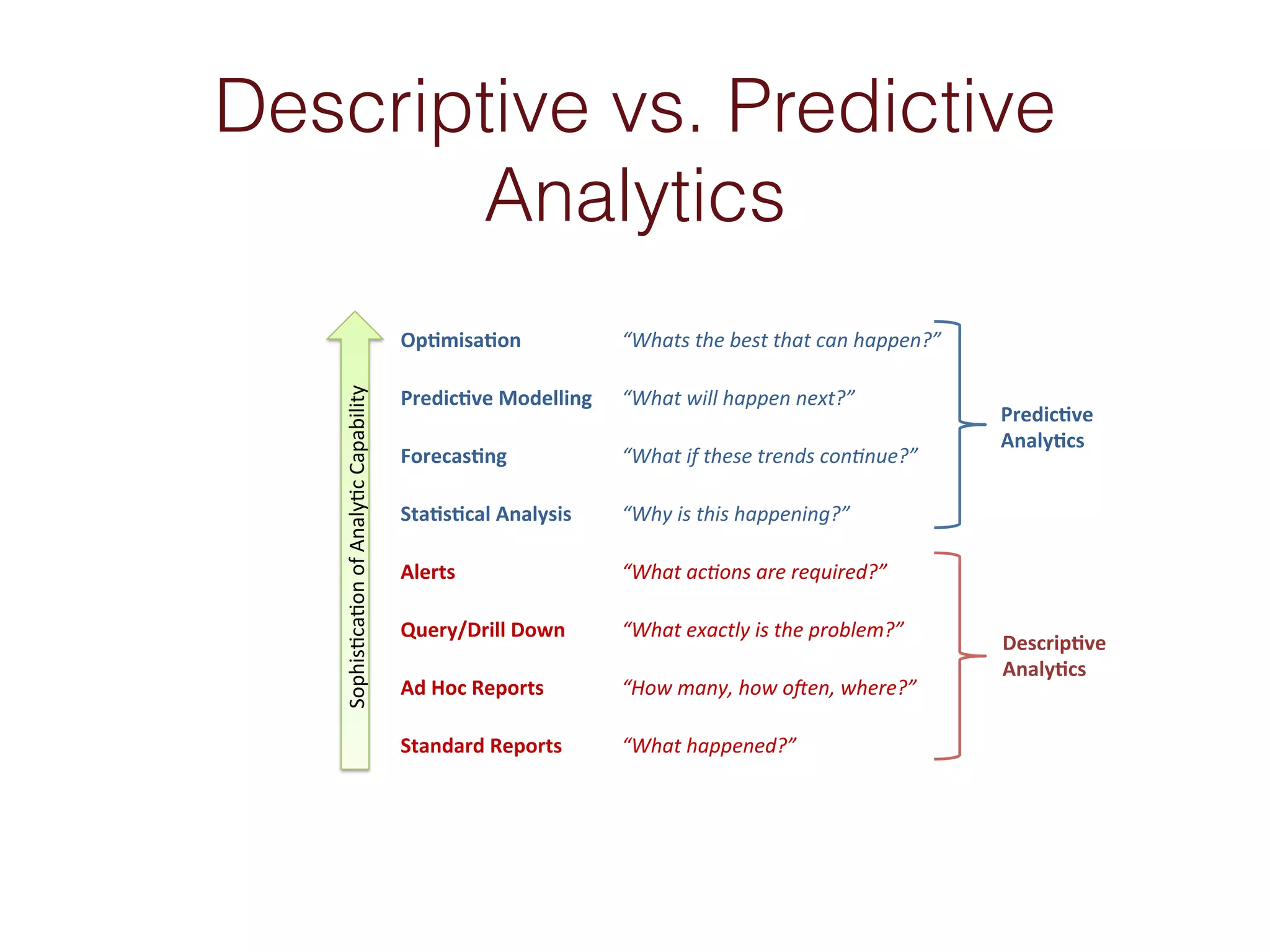
Descriptive vs. Predictive 
Analytics 
Op#misa#on* “Whats'the'best'that'can'happen?”' 
Predic#ve*Modelling* “What'will'happen'next?”' 
Forecas#ng* “What'if'these'trends'con7nue?”' 
Sta#s#cal*Analysis* “Why'is'this'happening?”' 
Alerts* “What'ac7ons'are'required?”' 
Query/Drill*Down* “What'exactly'is'the'problem?”' 
Ad*Hoc*Reports* “How'many,'how'o?en,'where?”' 
Standard*Reports* “What'happened?”' 
Sophis'ca'on+of+Analy'c+Capability+ 
Predic#ve* 
Analy#cs* 
Descrip#ve* 
Analy#cs*
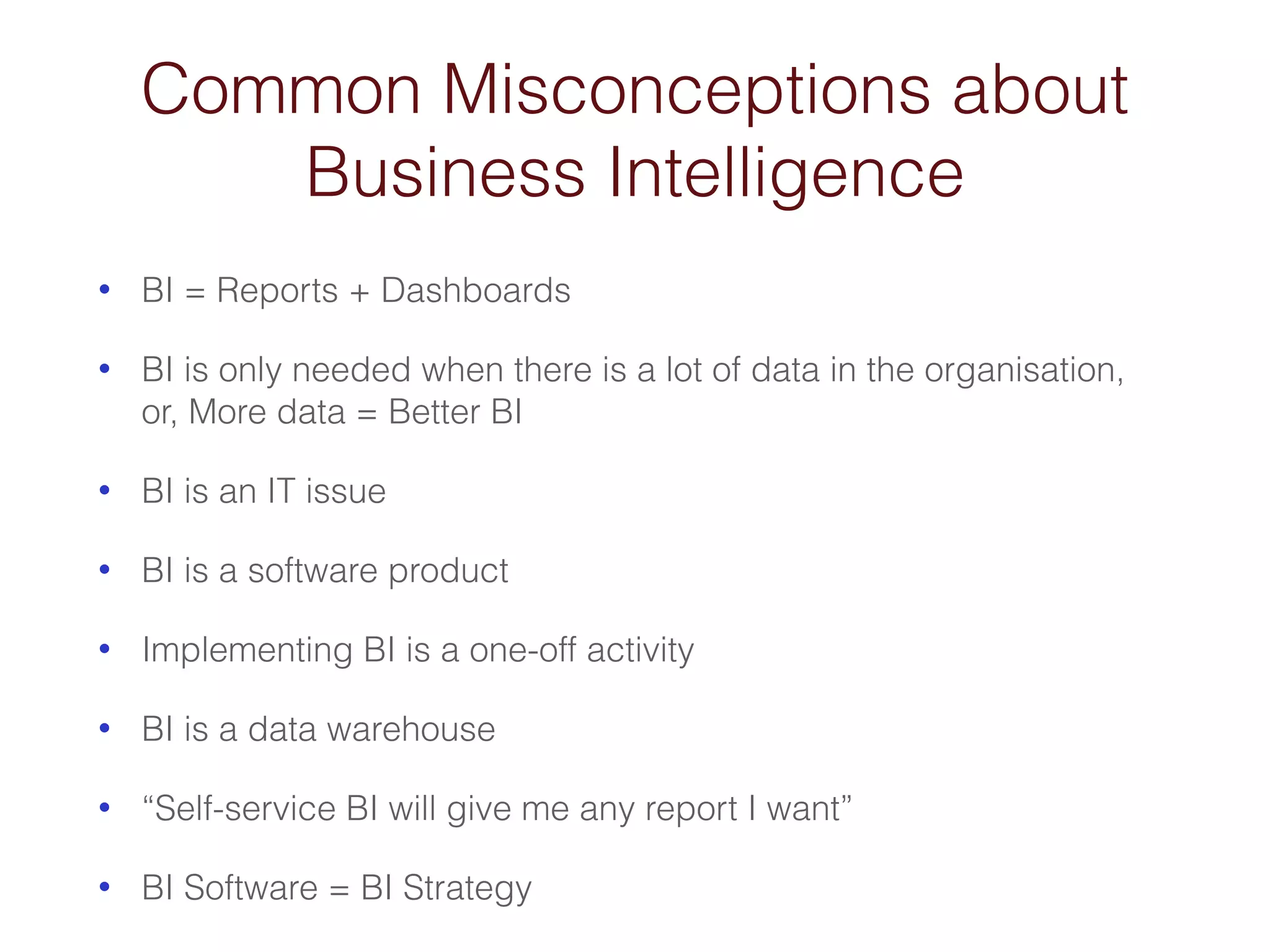
Common Misconceptions about 
Business Intelligence 
• BI = Reports + Dashboards 
• BI is only needed when there is a lot of data in the organisation, 
or, More data = Better BI 
• BI is an IT issue 
• BI is a software product 
• Implementing BI is a one-off activity 
• BI is a data warehouse 
• “Self-service BI will give me any report I want” 
• BI Software = BI Strategy
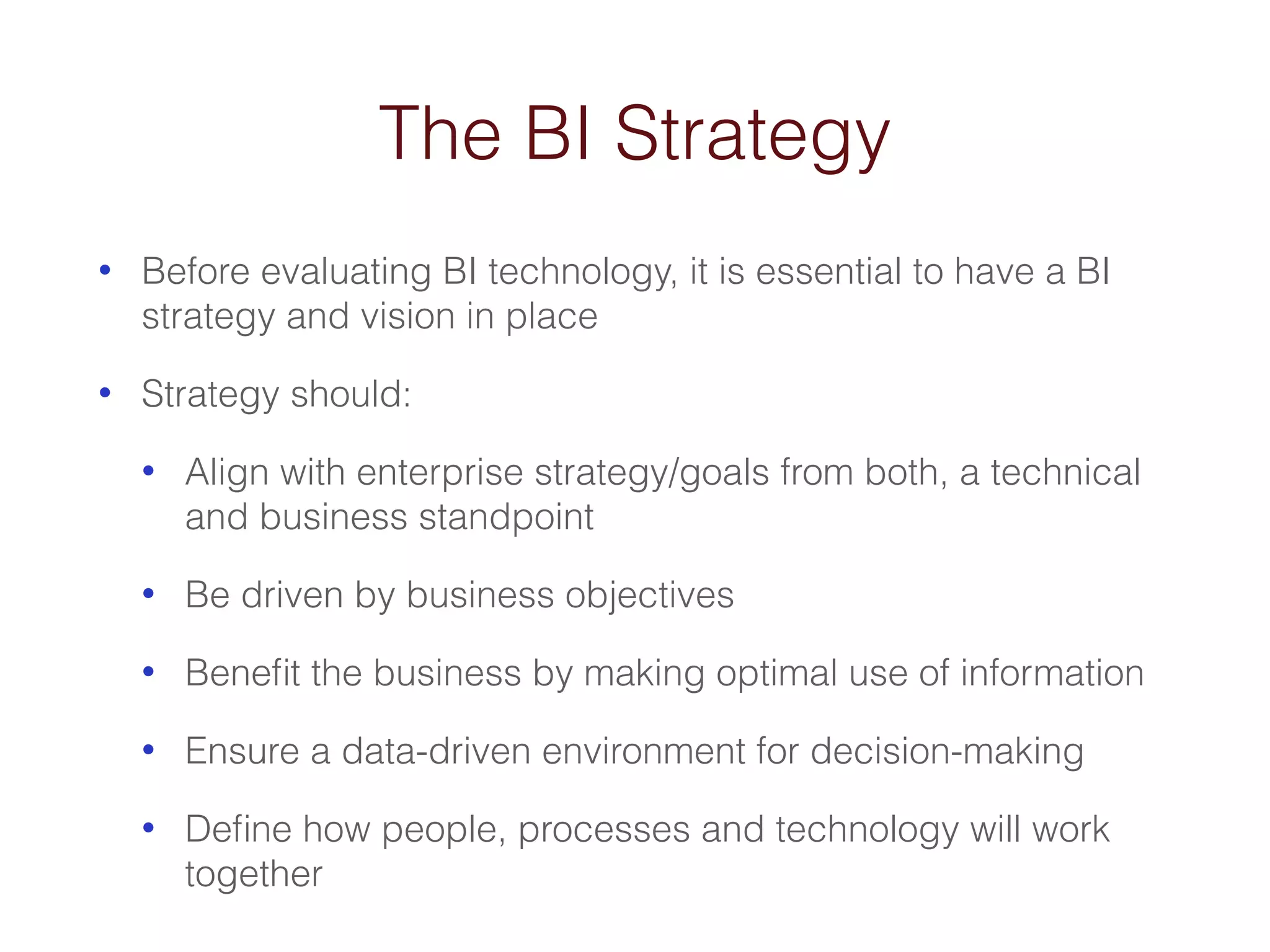
The BI Strategy 
• Before evaluating BI technology, it is essential to have a BI 
strategy and vision in place 
• Strategy should: 
• Align with enterprise strategy/goals from both, a technical 
and business standpoint 
• Be driven by business objectives 
• Benefit the business by making optimal use of information 
• Ensure a data-driven environment for decision-making 
• Define how people, processes and technology will work 
together
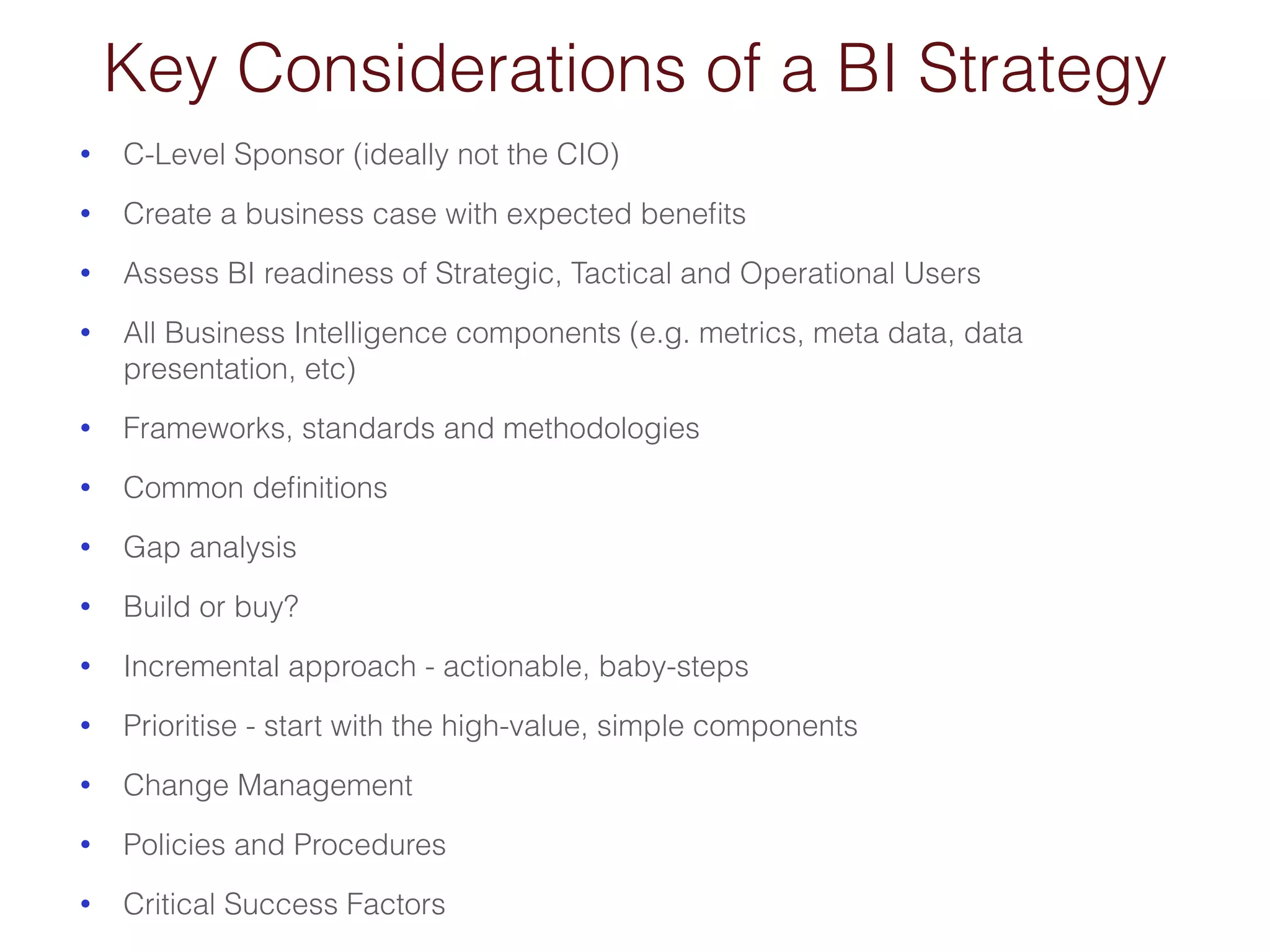
Key Considerations of a BI Strategy 
• C-Level Sponsor (ideally not the CIO) 
• Create a business case with expected benefits 
• Assess BI readiness of Strategic, Tactical and Operational Users 
• All Business Intelligence components (e.g. metrics, meta data, data 
presentation, etc) 
• Frameworks, standards and methodologies 
• Common definitions 
• Gap analysis 
• Build or buy? 
• Incremental approach - actionable, baby-steps 
• Prioritise - start with the high-value, simple components 
• Change Management 
• Policies and Procedures 
• Critical Success Factors
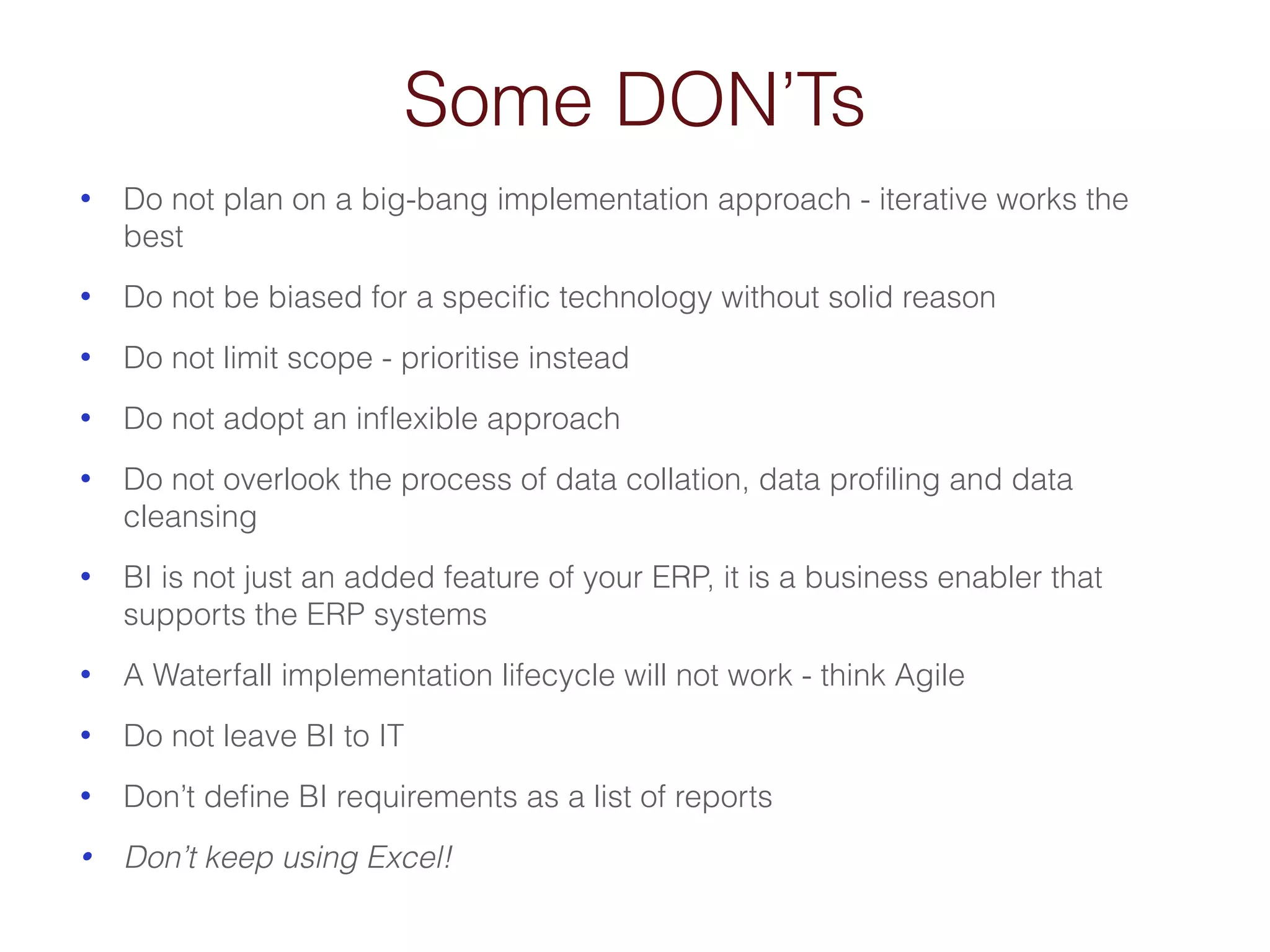
Some DON’Ts 
• Do not plan on a big-bang implementation approach - iterative works the 
best 
• Do not be biased for a specific technology without solid reason 
• Do not limit scope - prioritise instead 
• Do not adopt an inflexible approach 
• Do not overlook the process of data collation, data profiling and data 
cleansing 
• BI is not just an added feature of your ERP, it is a business enabler that 
supports the ERP systems 
• A Waterfall implementation lifecycle will not work - think Agile 
• Do not leave BI to IT 
• Don’t define BI requirements as a list of reports 
• Don’t keep using Excel!
Whats the ROI of Business Intelligence? 
“Its higher than the ROI of ignorance…”
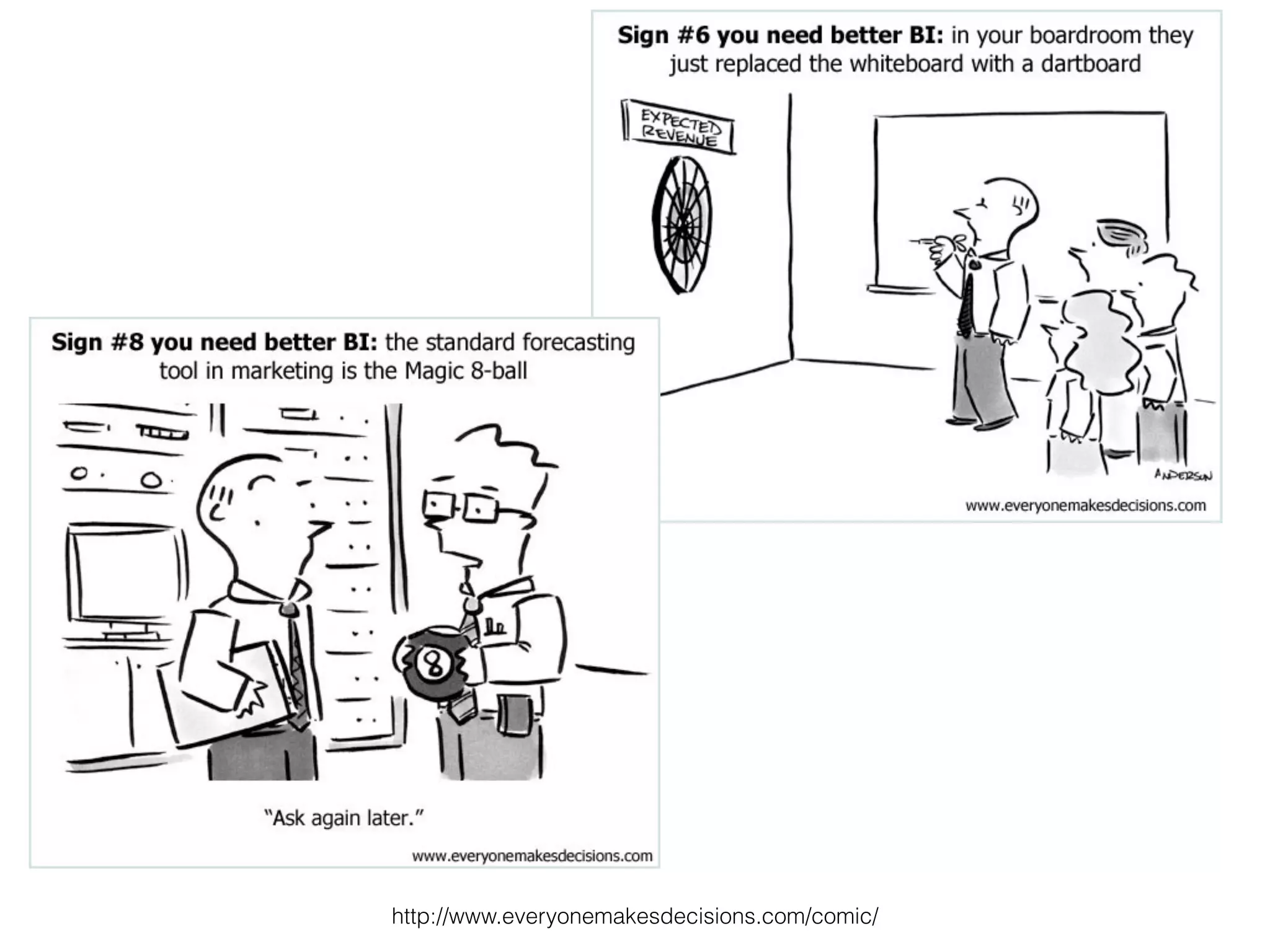
http://www.everyonemakesdecisions.com/comic/
Thank You! 
dipti@patil.co.uk

When the business needs intelligence (15Oct2014)

  • 1.
    When the Businessneeds Intelligence… ! DIPTI DALIA PATIL
  • 2.
    Agenda • Introduction • Decision-making • Data in the organisation • What is Business Intelligence • The evolution of analytics • BI Strategy
  • 5.
    Data ! Data ! Data
  • 6.
    So how doI justify my decisions?
  • 8.
    ERP systems ! The back-bone of any business
  • 9.
    ERP Systems Data$Rich,$Informa6on$Poor$Rigid$ ERP$ Systems$ Not$Time$Variant$ Reports$are$Sta6c$ Transac6onal$Reports$
  • 10.
    Spreadsheets • Fragile • Ownership is restricted - not suitable for collaborative work • Trivial Human Errors • Not enough validation • Difficult to test or troubleshoot • Reorganisation and Consolidation are daunting tasks • Vulnerable to fraud • Not Scalable • Not suited for BUSINESS CONTINUITY
  • 11.
    “Derive all informationfrom the systems and present it in a useful manner!” … a daunting task that can haunt any organisation
  • 13.
    Business Intelligence givesthe ability to analyse and interpret the wealth of data stored in ERP databases
  • 14.
    What is BusinessIntelligence? • The capability of analysing internal and external data to generate knowledge and value for the organisation Data$ Informa+on$ Intelligence$ Insight$
  • 15.
    What is BusinessIntelligence? Business Intelligence enables the business to make intelligent, fact-based decisions Aggregate Data Database, Data Mart, Data Warehouse, ETL Tools, Integration Tools Present Data Enrich Data Inform a Decision Reporting Tools, Dashboards, Static Reports, Mobile Reporting, OLAP Cubes Add Context to Create Information, Descriptive Statistics, Benchmarks, Variance to Plan or LY Decisions are Fact-based and Data-driven
  • 16.
    Goals of aBI Implementation • To capture, store and rationalise data from across the business to create a unified view of the customer and operations • To produce a versatile, integrated data warehouse architecture to improve the decision-making process and enable on-going success • Users should spend time analysing data rather than collecting it
  • 17.
    Trends that Influencethe need for Business Intelligence • Information Quality • Data Governance • Integrated View of Data • Standards and Regulatory Compliance
  • 18.
    Information Quality •How useable is my information? • Is my information accurate? • How is the information impacting my business? • BI is more about data quality, not quantity
  • 19.
    Information Quality Poor$ Informa*on$ Quality$ Makes$Regulatory$ compliance$difficult$ Promotes$ Inefficiency$ Impairs$Decision@ Stunts$Growth$ making$ Inflexible$Analysis$ Lowers$Staff$Morale$
  • 20.
    Data Governance •Setting standards and procedures to ensure that information quality goals are achieved • Provides strategic direction
  • 21.
    Integrated View ofData • Bring together the program and business logic dispersed among many applications across the organisation • Measure and monitor performance consistently at an organisational level • Requires a solid Enterprise-Level Business Intelligence Strategy
  • 22.
    Standards and Regulatory Compliance • There is an increasing need to comply to regulatory standards reporting BASEL&II& SOLVENCY&II& Botswana&Bureau&of&Standards& CFR&–&Protec6on&of&Environment& Trading&Standards& Health&and&Safety& Manufacturing&Standards&
  • 23.
    Data Warehouse Theterm Data Warehouse was coined in 1990 by Bill Inmon as: “A warehouse is a subject-oriented, integrated, time-variant, and non-volatile collection of data in support of the management’s decision-making process”
  • 24.
    Data Warehouse SubjectOriented:! Data that gives information about a particular subject instead of about a company’s ongoing operations Integrated:! Data that is gathered into the data warehouse from a variety of sources and merged into a coherent whole Time Variant:! All data in the data warehouse is identified with a particular time period Non-Volatile:! Data is stable in a data warehouse. More data is added, but data is never removed. This enables management to gain a consistent picture of the business
  • 25.
    Managing the Datain the Warehouse Data Profiling! Process of examining and collecting information about organisational data to analyse data correctness and evaluate whether it can be effectively used for reporting and decision-making purposes. Data Cleansing! The process correcting incomplete, inaccurate or invalid data records in the existing systems. Meta Data! Descriptive information about the data to be used for analysis and decision-making.
  • 26.
    Data Profiling •Also known as Data Discovery • Using analytical techniques to examine current data for completeness, consistency, accuracy and integrity • Essential for effective data cleansing and transformation • Helps improve data quality by deciphering and validating data patterns and formats • Reaffirms whether meta data (when available) accurately describes the values across all datasets • Identify redundant data across data sources • Key in identifying data sources for the enterprise data warehouse
  • 27.
    Data Cleansing •Process of correcting incomplete, inaccurate, or duplicate records in the systems • Necessary to ensure effective reporting and analysis • Incorrect data —> Incorrect Analysis —> Incorrect Decisions • Strict Cleansing - rejecting any inaccurate or inconsistent data • Fuzzy Cleansing - correcting records that partially match existing, known values
  • 28.
    Meta Data •Meta Data is descriptive information about the data in the warehouse • Describes the data in business terms that the users can identify with • Avoids conflicts in data definitions and interpretations • Prevents the “silo-effect” of creating non-integrated pockets of data
  • 29.
    Why Business Intelligence? • Program and business logic dispersed among many applications in the organisation • Increased data volumes and demand result in performance deterioration on the transactional system • Transactional systems are not time-variant • Transactional Data is volatile • Get increased insight into the business processes and marketplace • Departmental Objectives vary and it is easy to lose sight of the core organisational objectives
  • 30.
    Why Business Intelligence? • Business Intelligence can tap into the vast silos of data in the organisation • Business Intelligence provides a flexible means to analyse and interpret data in different ways • Trend Reporting and Predictive Analysis • Turn data into meaningful business decisions • Monitor performance and promote growth
  • 31.
    Goals • MaximiseRevenue • Improve Cost-Effectiveness • Maximise client satisfaction • Minimise Administrative Burden • Maximise Compliance Rates
  • 32.
    The Continuum ofAnalytics Predic(ve* Descrip(ve* Informa(ve* Trial&and&Error& Standard& Business& Repor3ng& OLAP& Applica3ons& Advanced& Analy3cal& Technologies& Specula(ve* Intelligence*Gained*
  • 33.
    Descriptive vs. Predictive Analytics Op#misa#on* “Whats'the'best'that'can'happen?”' Predic#ve*Modelling* “What'will'happen'next?”' Forecas#ng* “What'if'these'trends'con7nue?”' Sta#s#cal*Analysis* “Why'is'this'happening?”' Alerts* “What'ac7ons'are'required?”' Query/Drill*Down* “What'exactly'is'the'problem?”' Ad*Hoc*Reports* “How'many,'how'o?en,'where?”' Standard*Reports* “What'happened?”' Sophis'ca'on+of+Analy'c+Capability+ Predic#ve* Analy#cs* Descrip#ve* Analy#cs*
  • 34.
    Common Misconceptions about Business Intelligence • BI = Reports + Dashboards • BI is only needed when there is a lot of data in the organisation, or, More data = Better BI • BI is an IT issue • BI is a software product • Implementing BI is a one-off activity • BI is a data warehouse • “Self-service BI will give me any report I want” • BI Software = BI Strategy
  • 35.
    The BI Strategy • Before evaluating BI technology, it is essential to have a BI strategy and vision in place • Strategy should: • Align with enterprise strategy/goals from both, a technical and business standpoint • Be driven by business objectives • Benefit the business by making optimal use of information • Ensure a data-driven environment for decision-making • Define how people, processes and technology will work together
  • 36.
    Key Considerations ofa BI Strategy • C-Level Sponsor (ideally not the CIO) • Create a business case with expected benefits • Assess BI readiness of Strategic, Tactical and Operational Users • All Business Intelligence components (e.g. metrics, meta data, data presentation, etc) • Frameworks, standards and methodologies • Common definitions • Gap analysis • Build or buy? • Incremental approach - actionable, baby-steps • Prioritise - start with the high-value, simple components • Change Management • Policies and Procedures • Critical Success Factors
  • 37.
    Some DON’Ts •Do not plan on a big-bang implementation approach - iterative works the best • Do not be biased for a specific technology without solid reason • Do not limit scope - prioritise instead • Do not adopt an inflexible approach • Do not overlook the process of data collation, data profiling and data cleansing • BI is not just an added feature of your ERP, it is a business enabler that supports the ERP systems • A Waterfall implementation lifecycle will not work - think Agile • Do not leave BI to IT • Don’t define BI requirements as a list of reports • Don’t keep using Excel!
  • 38.
    Whats the ROIof Business Intelligence? “Its higher than the ROI of ignorance…”
  • 39.
  • 40.