© 2015 SAGE Publications, Inc.
• Understand conflict and importance of
communication in the process of
handling conflict.
• Explain different kinds of conflict.
• Understand Fisher and Ury’s approach
to conflict negotiation.
• Discuss communication strategies for
conflict resolution.
• Discuss the five conflict handling
styles.
© 2015 SAGE Publications, Inc.
• Are conflicts inevitable?
• What kinds of conflicts make you the
most uncomfortable?
• When have you managed a conflict to
produce positive change?
© 2015 SAGE Publications, Inc.
Myatt, M. (2012, February 22). 5 keys of dealing with workplace
conflict. Forbes.com. Retrieved from
http://www.forbes.com/sites/mikemyatt/2012/02/22/5-
keys-to-dealing-with-workplace-conflict/
5 Keys of Dealing with Workplace Conflict
© 2015 SAGE Publications, Inc.
5 Keys
• 1. Define Acceptable Behavior
• 2. Hit Conflict Head-on
• 3. Understanding the WIIFM Factor
• 4. The Importance Factor
• 5. View Conflict as Opportunity
© 2015 SAGE Publications, Inc.
• Conflict is inevitable in groups and organizations.
• Mutual agreement is possible in any conflict
situation if people are willing to negotiate in
authentic ways.
• Conflict can be uncomfortable, but is not
necessarily unhealthy or bad.
• The question is, How can we manage conflict and
produce positive change?
• Communication plays a central role in handling
conflict.
© 2015 SAGE Publications, Inc.
• Intrapersonal
o Discord that occurs within an individual
o Involves dynamics of personality
• Interpersonal
o Disputes that arise between individuals
o This is the conflict type addressed in Chapter 9
• Societal
o Clashes between societies and nations
o Ex.: Israeli-Palestinian conflict
© 2015 SAGE Publications, Inc.
Conflict is a felt struggle between two or more
interdependent individuals over perceived
incompatible differences in beliefs, values, and
goals, or over differences in desires for
control, status, and connectedness.
© 2015 SAGE Publications, Inc.
• Struggle
o Opposing forces coming together
• Interdependence
o Leaders and followers need each other.
o How much influence do I want? How much am I willing to
accept?
• Feelings
o Emotional arousal within both parties
o Array of emotions including anger, sadness, or disconnection
• Differences
o Differences in beliefs, values, goals, or in desire for control,
status, and connectedness
© 2015 SAGE Publications, Inc.
Content and Relationship Dimension
of Messages
• Content
o Objective, observable aspects
o What the message is about
o Ex.: “Please stop texting at work”
• Relationship
o Indicates how the two parties are affiliated
o Determines how the content dimension should be
interpreted
© 2015 SAGE Publications, Inc.
Content Conflicts
• Center on differences in beliefs and values, or
goals
• Belief conflicts occur when others’ viewpoints
are incompatible with our own.
o Ex.: PETA
• Value conflicts occur when others’ values are
incompatible with our own. Ex.: Should a first-
year college student own a car?
• Goal conflicts occur where individuals have
different goals.
© 2015 SAGE Publications, Inc.
• Procedural Conflict
o When individuals differ on how to reach a
goal
• Substantive Conflict
o When individuals differ on what the goal
should be
© 2015 SAGE Publications, Inc.
• Also known as “personality clashes”
• Center on issues of esteem, control, or affiliation
• Esteem is one of the major human needs:
o We desire to have an effect on our surroundings and to be
seen as worthy of respect.
o When our esteem needs aren’t met, we experience relational
conflict.
o At the same time, others want their own esteem needs
satisfied.
o If either party feels they are receiving insufficient validation, a
clash develops.
© 2015 SAGE Publications, Inc.
• Control issues are common in interpersonal
conflict.
o Each of us desires to have an impact on others.
o Having control increases our feeling of potency and
minimizes feelings of helplessness.
o When we see others hindering us or limiting our control,
conflict often results.
o Each of us seeks different levels of control.
o Control needs may vary from one time to another.
o Ex.: conflict over what a college sophomore is going to do
over Spring Break
© 2015 SAGE Publications, Inc.
• Affiliation is the need to feel included in our relationships, to
be liked and to receive affection (Schutz, 1966).
o If our needs for closeness are not satisfied in our relationships,
we experience feelings of conflict.
o We each vary in our need for affiliation.
o When others behave in ways that are incompatible with our
own desires for warmth and affection, feelings of conflict
emerge.
o Ex.: football coach and one of his players
• Relational issues are often bound to content issues during
conflict.
© 2015 SAGE Publications, Inc.
• Principled negotiation emphasizes
deciding issues on their merits rather
than through competitive haggling or
excessive accommodation.
• Four principles focus on basic elements
of negotiation: people, interests, options,
and criteria.
© 2015 SAGE Publications, Inc.
• Conflicts have a people factor and a problem
factor that need to be separated.
• This is not easy, because they are entangled.
• By separating them we are able to recognize
the other’s uniqueness and needs.
• It enables us to be attentive to our relationships
and work together to mutually confront the
problem.
© 2015 SAGE Publications, Inc.
• Positions represent our stand or perspective in
a particular conflict.
• Interests represent what is behind our positions.
• Interests often relate to basic human concerns
such as belonging, recognition, control,
economic well-being, etc.
• Concentrating on interests helps opposing
parties address the “real” conflict.
• Ex.: class attendance policy
© 2015 SAGE Publications, Inc.
• Humans naturally see conflict as an either-or
proposition; we either win or lose.
• This principle frames conflict as a win-win.
• Parties need to brainstorm and search hard
for creative solutions to conflict.
• Where do parties’ interests overlap?
• By being sensitive to others’ interests we can
make it easier for them to be satisfied.
© 2015 SAGE Publications, Inc.
• Objective criteria help parties view conflict with an
unbiased lens.
• Objective criteria can take many forms:
o Precedent
o Professional standards
o What a court would decide
o Moral standards
o Tradition
o Scientific judgment
• Ex.: salary negotiation
© 2015 SAGE Publications, Inc.
Managing Conflict: Differentiation
Differentiation defines the conflict & requires
individuals to explain their positions.
•Focuses on individuals’ differences rather than
on similarities
•Occurs in the early phases of conflict
•Differentiation is useful because it:
o Focuses the conflict
o Gives credence to both parties’ interest
o Depersonalizes the conflict
© 2015 SAGE Publications, Inc.
Fractionation is a technique of breaking down
large conflicts into smaller, more manageable
pieces.
Helpful because:
•It reduces the conflict by paring it down to a
smaller, less-complex conflict.
•It gives focus to the conflict.
•It facilitates a better working relationship
between participants in the conflict.
© 2015 SAGE Publications, Inc.
Managing Conflict: Face Saving
• Consists of messages that individuals
express to each other to maintain their
positive self-images during a conflict.
• Allows a person to acknowledge the other’s
point of view without offending them.
• Makes conflicts less threatening and helps
participants feel they have handled
themselves appropriately.
© 2015 SAGE Publications, Inc.
Kilmann & Thomas Conflict Styles
• A conflict style is a patterned response that people use
when approaching conflict.
• Conflict styles vary along two dimensions: assertiveness
and cooperativeness.
o Assertiveness refers to attempts to satisfy one’s own
concerns
o Cooperativeness represents attempts to satisfy the
concerns of others
• The Thomas-Kilmann model identifies five conflict styles.
• A person’s individual style is usually a combination of
these five different styles.
© 2015 SAGE Publications, Inc.
Avoidance Style
• This style is low on both cooperativeness and
assertiveness.
• Advantages of the style:
o When an issue is trivial
o When potential damage from the conflict would be too
great
o Can provide a cooling-off period
• Disadvantages of the style:
o Usually counterproductive, leads to stress and further
conflict
o Static approach, does nothing to solve problems
© 2015 SAGE Publications, Inc.
Competition Style
• This style is high on assertiveness but low on
cooperativeness.
• Essentially a win-lose approach
• Advantages of the style:
o Useful when quick, decisive action is needed
o Can generate creativity
o Challenges participants to make their best efforts
• Disadvantages of the style:
o Results in a winner and a loser
o May create an unstable situation and hostile communication
o Is essentially disconfirming, failing to recognize the needs of others
© 2015 SAGE Publications, Inc.
Accommodation Style
• This style is high on cooperativeness and low on
assertiveness.
• Individuals confront problems by deferring to others.
• Advantages of the style:
o Allows people to move away from uncomfortable feelings aroused by
conflict
o Can work when the issue is more important to one party than another or
if harmony in the relationship is the most important goal
• Disadvantages of the style:
o In effect it is a lose-win strategy
o The accommodator sacrifices his or her own values and goals to
maintain smooth relationships
o Need for harmony may override the need to find an optimal solution
© 2015 SAGE Publications, Inc.
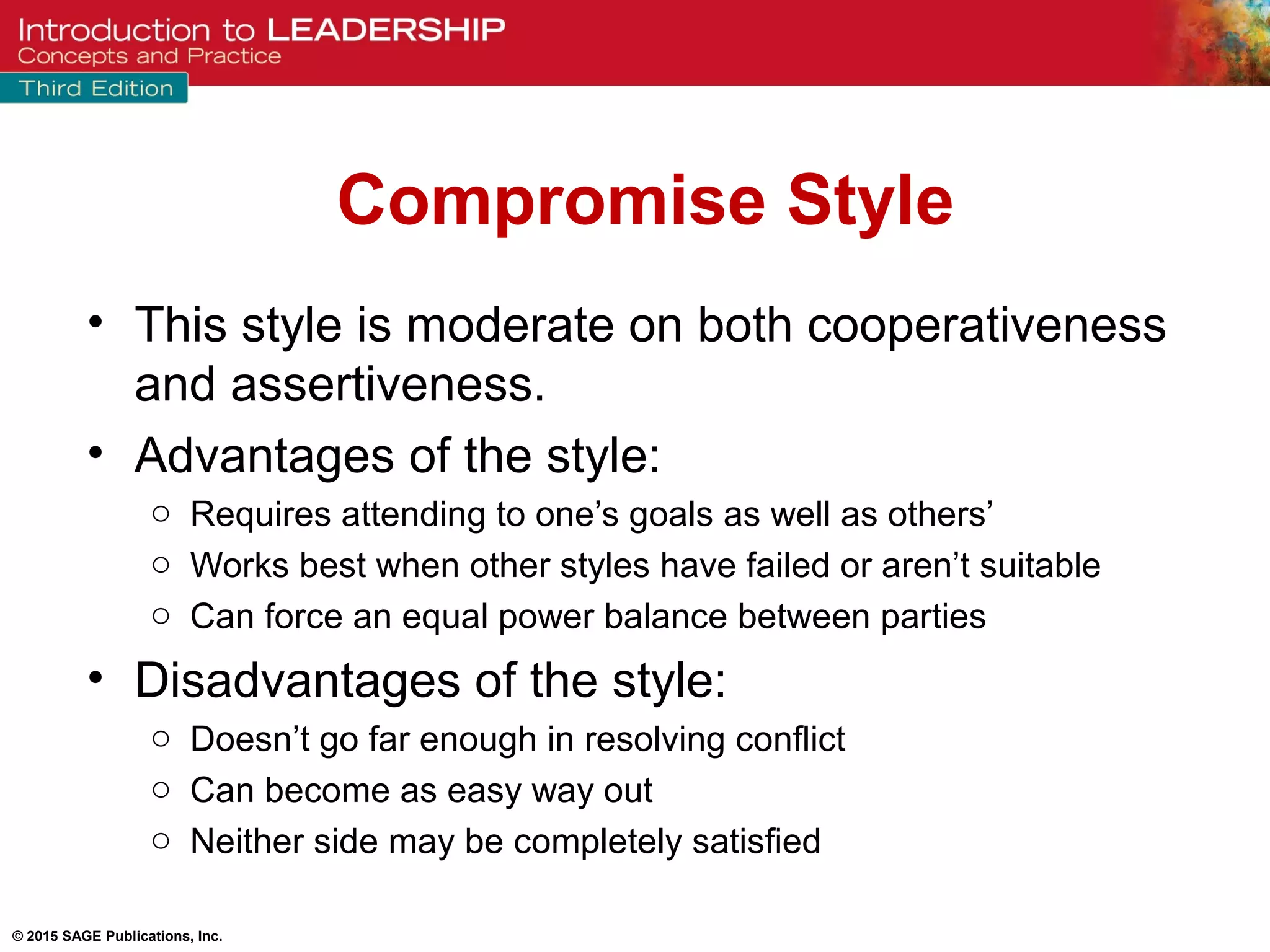
Compromise Style
• This style is moderate on both cooperativeness
and assertiveness.
• Advantages of the style:
o Requires attending to one’s goals as well as others’
o Works best when other styles have failed or aren’t suitable
o Can force an equal power balance between parties
• Disadvantages of the style:
o Doesn’t go far enough in resolving conflict
o Can become as easy way out
o Neither side may be completely satisfied
© 2015 SAGE Publications, Inc.
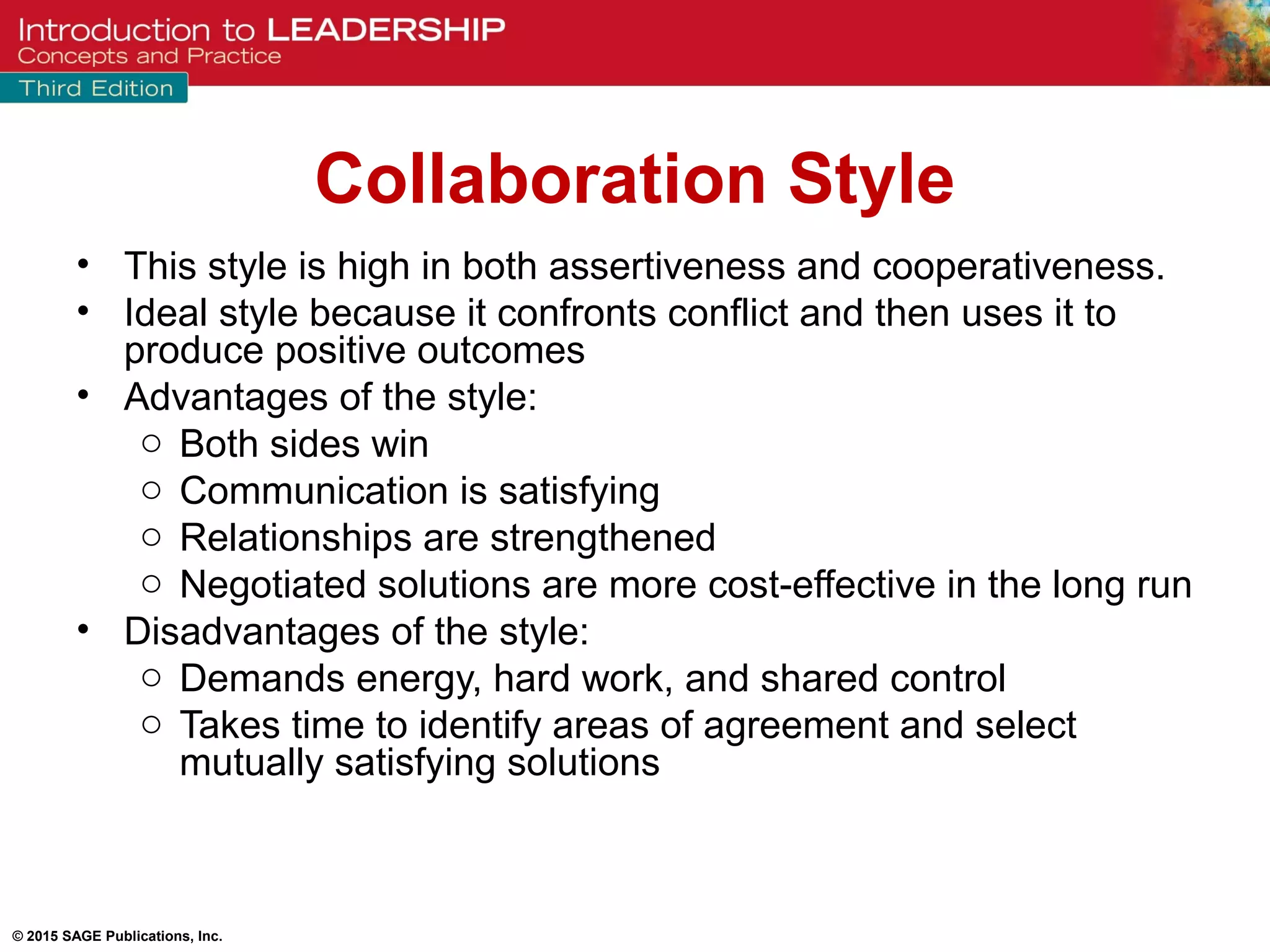
Collaboration Style
• This style is high in both assertiveness and cooperativeness.
• Ideal style because it confronts conflict and then uses it to
produce positive outcomes
• Advantages of the style:
o Both sides win
o Communication is satisfying
o Relationships are strengthened
o Negotiated solutions are more cost-effective in the long run
• Disadvantages of the style:
o Demands energy, hard work, and shared control
o Takes time to identify areas of agreement and select
mutually satisfying solutions
© 2015 SAGE Publications, Inc.
Case Study:
Office Space
• How would you describe the conflict that has arisen between
the members of the web programming department?
• Is the conflict a relational conflict? If so, what type of relational
conflict? Is there a content dimension to this conflict?
• Using Fisher and Ury’s Method of Principled Negotiation, how
would you separate the people from the problem? What do you
think is really, really going on in this conflict?
• Using the Kilmann and Thomas conflict styles, how would you
characterize Sanjay’s conflict style? What about Bradley? Do
Rosa and Kris have a style as well?
• How could Martin use “fractionation” and “face saving” in
attempting to resolve this conflict?
© 2015 SAGE Publications, Inc.
Summary
• Interpersonal conflict is inevitable.
• If managed in appropriate ways, conflict can be constructive.
• Conflict occurs on two levels: content and relationship.
• One approach to resolving conflict is the Method of Principled Negotiation,
which focuses on people, interests, options, and criteria.
• Three practical communication approaches to resolving conflict are
differentiation, fractionation, and face-saving.
• Finally, researchers have found that people approach conflict using five
styles: avoidance, competition, accommodation, compromise, and
collaboration.
• Managing conflict effectively leads to stronger relationships among
participants and more creative solutions to problems.
© 2015 SAGE Publications, Inc.

BHU LS 600 Chapter 10

  • 1.
    © 2015 SAGEPublications, Inc.
  • 2.
    © 2015 SAGEPublications, Inc. • Understand conflict and importance of communication in the process of handling conflict. • Explain different kinds of conflict. • Understand Fisher and Ury’s approach to conflict negotiation. • Discuss communication strategies for conflict resolution. • Discuss the five conflict handling styles.
  • 3.
    © 2015 SAGEPublications, Inc. • Are conflicts inevitable? • What kinds of conflicts make you the most uncomfortable? • When have you managed a conflict to produce positive change?
  • 4.
    © 2015 SAGEPublications, Inc. Myatt, M. (2012, February 22). 5 keys of dealing with workplace conflict. Forbes.com. Retrieved from http://www.forbes.com/sites/mikemyatt/2012/02/22/5- keys-to-dealing-with-workplace-conflict/ 5 Keys of Dealing with Workplace Conflict
  • 5.
    © 2015 SAGEPublications, Inc. 5 Keys • 1. Define Acceptable Behavior • 2. Hit Conflict Head-on • 3. Understanding the WIIFM Factor • 4. The Importance Factor • 5. View Conflict as Opportunity
  • 6.
    © 2015 SAGEPublications, Inc. • Conflict is inevitable in groups and organizations. • Mutual agreement is possible in any conflict situation if people are willing to negotiate in authentic ways. • Conflict can be uncomfortable, but is not necessarily unhealthy or bad. • The question is, How can we manage conflict and produce positive change? • Communication plays a central role in handling conflict.
  • 7.
    © 2015 SAGEPublications, Inc. • Intrapersonal o Discord that occurs within an individual o Involves dynamics of personality • Interpersonal o Disputes that arise between individuals o This is the conflict type addressed in Chapter 9 • Societal o Clashes between societies and nations o Ex.: Israeli-Palestinian conflict
  • 8.
    © 2015 SAGEPublications, Inc. Conflict is a felt struggle between two or more interdependent individuals over perceived incompatible differences in beliefs, values, and goals, or over differences in desires for control, status, and connectedness.
  • 9.
    © 2015 SAGEPublications, Inc. • Struggle o Opposing forces coming together • Interdependence o Leaders and followers need each other. o How much influence do I want? How much am I willing to accept? • Feelings o Emotional arousal within both parties o Array of emotions including anger, sadness, or disconnection • Differences o Differences in beliefs, values, goals, or in desire for control, status, and connectedness
  • 10.
    © 2015 SAGEPublications, Inc. Content and Relationship Dimension of Messages • Content o Objective, observable aspects o What the message is about o Ex.: “Please stop texting at work” • Relationship o Indicates how the two parties are affiliated o Determines how the content dimension should be interpreted
  • 11.
    © 2015 SAGEPublications, Inc.
  • 12.
    © 2015 SAGEPublications, Inc. Content Conflicts • Center on differences in beliefs and values, or goals • Belief conflicts occur when others’ viewpoints are incompatible with our own. o Ex.: PETA • Value conflicts occur when others’ values are incompatible with our own. Ex.: Should a first- year college student own a car? • Goal conflicts occur where individuals have different goals.
  • 13.
    © 2015 SAGEPublications, Inc. • Procedural Conflict o When individuals differ on how to reach a goal • Substantive Conflict o When individuals differ on what the goal should be
  • 14.
    © 2015 SAGEPublications, Inc. • Also known as “personality clashes” • Center on issues of esteem, control, or affiliation • Esteem is one of the major human needs: o We desire to have an effect on our surroundings and to be seen as worthy of respect. o When our esteem needs aren’t met, we experience relational conflict. o At the same time, others want their own esteem needs satisfied. o If either party feels they are receiving insufficient validation, a clash develops.
  • 15.
    © 2015 SAGEPublications, Inc. • Control issues are common in interpersonal conflict. o Each of us desires to have an impact on others. o Having control increases our feeling of potency and minimizes feelings of helplessness. o When we see others hindering us or limiting our control, conflict often results. o Each of us seeks different levels of control. o Control needs may vary from one time to another. o Ex.: conflict over what a college sophomore is going to do over Spring Break
  • 16.
    © 2015 SAGEPublications, Inc. • Affiliation is the need to feel included in our relationships, to be liked and to receive affection (Schutz, 1966). o If our needs for closeness are not satisfied in our relationships, we experience feelings of conflict. o We each vary in our need for affiliation. o When others behave in ways that are incompatible with our own desires for warmth and affection, feelings of conflict emerge. o Ex.: football coach and one of his players • Relational issues are often bound to content issues during conflict.
  • 17.
    © 2015 SAGEPublications, Inc. • Principled negotiation emphasizes deciding issues on their merits rather than through competitive haggling or excessive accommodation. • Four principles focus on basic elements of negotiation: people, interests, options, and criteria.
  • 18.
    © 2015 SAGEPublications, Inc. • Conflicts have a people factor and a problem factor that need to be separated. • This is not easy, because they are entangled. • By separating them we are able to recognize the other’s uniqueness and needs. • It enables us to be attentive to our relationships and work together to mutually confront the problem.
  • 19.
    © 2015 SAGEPublications, Inc. • Positions represent our stand or perspective in a particular conflict. • Interests represent what is behind our positions. • Interests often relate to basic human concerns such as belonging, recognition, control, economic well-being, etc. • Concentrating on interests helps opposing parties address the “real” conflict. • Ex.: class attendance policy
  • 20.
    © 2015 SAGEPublications, Inc. • Humans naturally see conflict as an either-or proposition; we either win or lose. • This principle frames conflict as a win-win. • Parties need to brainstorm and search hard for creative solutions to conflict. • Where do parties’ interests overlap? • By being sensitive to others’ interests we can make it easier for them to be satisfied.
  • 21.
    © 2015 SAGEPublications, Inc. • Objective criteria help parties view conflict with an unbiased lens. • Objective criteria can take many forms: o Precedent o Professional standards o What a court would decide o Moral standards o Tradition o Scientific judgment • Ex.: salary negotiation
  • 22.
    © 2015 SAGEPublications, Inc. Managing Conflict: Differentiation Differentiation defines the conflict & requires individuals to explain their positions. •Focuses on individuals’ differences rather than on similarities •Occurs in the early phases of conflict •Differentiation is useful because it: o Focuses the conflict o Gives credence to both parties’ interest o Depersonalizes the conflict
  • 23.
    © 2015 SAGEPublications, Inc. Fractionation is a technique of breaking down large conflicts into smaller, more manageable pieces. Helpful because: •It reduces the conflict by paring it down to a smaller, less-complex conflict. •It gives focus to the conflict. •It facilitates a better working relationship between participants in the conflict.
  • 24.
    © 2015 SAGEPublications, Inc. Managing Conflict: Face Saving • Consists of messages that individuals express to each other to maintain their positive self-images during a conflict. • Allows a person to acknowledge the other’s point of view without offending them. • Makes conflicts less threatening and helps participants feel they have handled themselves appropriately.
  • 25.
    © 2015 SAGEPublications, Inc. Kilmann & Thomas Conflict Styles • A conflict style is a patterned response that people use when approaching conflict. • Conflict styles vary along two dimensions: assertiveness and cooperativeness. o Assertiveness refers to attempts to satisfy one’s own concerns o Cooperativeness represents attempts to satisfy the concerns of others • The Thomas-Kilmann model identifies five conflict styles. • A person’s individual style is usually a combination of these five different styles.
  • 26.
    © 2015 SAGEPublications, Inc.
  • 27.
    © 2015 SAGEPublications, Inc. Avoidance Style • This style is low on both cooperativeness and assertiveness. • Advantages of the style: o When an issue is trivial o When potential damage from the conflict would be too great o Can provide a cooling-off period • Disadvantages of the style: o Usually counterproductive, leads to stress and further conflict o Static approach, does nothing to solve problems
  • 28.
    © 2015 SAGEPublications, Inc. Competition Style • This style is high on assertiveness but low on cooperativeness. • Essentially a win-lose approach • Advantages of the style: o Useful when quick, decisive action is needed o Can generate creativity o Challenges participants to make their best efforts • Disadvantages of the style: o Results in a winner and a loser o May create an unstable situation and hostile communication o Is essentially disconfirming, failing to recognize the needs of others
  • 29.
    © 2015 SAGEPublications, Inc. Accommodation Style • This style is high on cooperativeness and low on assertiveness. • Individuals confront problems by deferring to others. • Advantages of the style: o Allows people to move away from uncomfortable feelings aroused by conflict o Can work when the issue is more important to one party than another or if harmony in the relationship is the most important goal • Disadvantages of the style: o In effect it is a lose-win strategy o The accommodator sacrifices his or her own values and goals to maintain smooth relationships o Need for harmony may override the need to find an optimal solution
  • 30.
    © 2015 SAGEPublications, Inc. Compromise Style • This style is moderate on both cooperativeness and assertiveness. • Advantages of the style: o Requires attending to one’s goals as well as others’ o Works best when other styles have failed or aren’t suitable o Can force an equal power balance between parties • Disadvantages of the style: o Doesn’t go far enough in resolving conflict o Can become as easy way out o Neither side may be completely satisfied
  • 31.
    © 2015 SAGEPublications, Inc. Collaboration Style • This style is high in both assertiveness and cooperativeness. • Ideal style because it confronts conflict and then uses it to produce positive outcomes • Advantages of the style: o Both sides win o Communication is satisfying o Relationships are strengthened o Negotiated solutions are more cost-effective in the long run • Disadvantages of the style: o Demands energy, hard work, and shared control o Takes time to identify areas of agreement and select mutually satisfying solutions
  • 32.
    © 2015 SAGEPublications, Inc. Case Study: Office Space • How would you describe the conflict that has arisen between the members of the web programming department? • Is the conflict a relational conflict? If so, what type of relational conflict? Is there a content dimension to this conflict? • Using Fisher and Ury’s Method of Principled Negotiation, how would you separate the people from the problem? What do you think is really, really going on in this conflict? • Using the Kilmann and Thomas conflict styles, how would you characterize Sanjay’s conflict style? What about Bradley? Do Rosa and Kris have a style as well? • How could Martin use “fractionation” and “face saving” in attempting to resolve this conflict?
  • 33.
    © 2015 SAGEPublications, Inc. Summary • Interpersonal conflict is inevitable. • If managed in appropriate ways, conflict can be constructive. • Conflict occurs on two levels: content and relationship. • One approach to resolving conflict is the Method of Principled Negotiation, which focuses on people, interests, options, and criteria. • Three practical communication approaches to resolving conflict are differentiation, fractionation, and face-saving. • Finally, researchers have found that people approach conflict using five styles: avoidance, competition, accommodation, compromise, and collaboration. • Managing conflict effectively leads to stronger relationships among participants and more creative solutions to problems.
  • 34.
    © 2015 SAGEPublications, Inc.
  • 35.
    © 2015 SAGEPublications, Inc.