© 2015 SAGE Publications, Inc.
Chapter 2:Chapter 2:
Recognizing Your TraitsRecognizing Your Traits
© 2015 SAGE Publications, Inc.
Chapter Objectives
1. Understand the six key leadership traits.
2. Reviewing traits and characteristics of
famous leaders.
© 2015 SAGE Publications, Inc.
• Why are some people leaders while
others are not?
• What makes people become leaders?
• Do leaders have certain traits?
Discussion Questions
© 2015 SAGE Publications, Inc.
• Studies on leadership identified many important
leader traits.
o What specific traits are needed to be a successful
leader?
• Research points to six traits:
o Intelligence
o Confidence
o Charisma
o Determination
o Sociability
o Integrity
Leadership Traits Explained
© 2015 SAGE Publications, Inc.
• Intelligence includes having good
language skills, perceptual skills, &
reasoning ability.
• It is hard to change Intelligence Quotient
(IQ).
• It is possible to:
o obtain knowledge
o learn about your job & environment
o use information to become better leaders
Intelligence
© 2015 SAGE Publications, Inc.
• Confidence is a trait that has to do with
feeling positive about one’s self & one’s
ability to succeed.
• Confident people:
o feel self-assured
o believe they can accomplish goals
o do not second-guess themselves—they move
forward with clear visions
o they are positive about self & ability
Confidence
© 2015 SAGE Publications, Inc.
• How do we build confidence?
o Understanding what is required from us
o Have a mentor to show the way &
provide constructive feedback
o Practice builds confidence & assures us
that we can do what we need to do (e.g.,
Tiger Woods)
Confidence
© 2015 SAGE Publications, Inc.
• Magnetic charm and appeal that gives leaders
exceptional powers of influence
• Charisma is not a common personality trait.
• To increase charisma:
o Be a strong role model for values
o Be competent in leadership to gain trust
o Articulate clear goals & strong values
o Communicate high expectations & show confidence in
followers’ abilities
o Inspire others
• Ex.: J. F. Kennedy, Gandhi, M. L. King Jr.
Charisma
© 2015 SAGE Publications, Inc.
• Focused & attentive to tasks
• Know where to go & how to get there
• Includes initiative, persistence, & drive
• Persevere in the face of obstacles
• Easiest for leaders to acquire
• Focus on task, clarify goals, articulate vision,
& encourage others to stay the course
• Ex.: marathon runners, Nelson Mandela
Determination
© 2015 SAGE Publications, Inc.
• The capacity to establish pleasant social
relationships
• Friendly, outgoing, courteous, & diplomatic
• Sensitive to others & cooperative
• Easier for some than others
• Increasing sociability requires that we try to get
along with our coworkers
o be friendly, kind, & thoughtful
• Ex.: Anne Fox in leadership class
Sociability
© 2015 SAGE Publications, Inc.
• Honest & trustworthy with strong principles
• Inspire confidence because it creates trust
• Loyal, dependable, & not deceptive
• Undergirds all aspects of leadership
• To increase integrity—be honest & open
• Challenge:
o To strike a balance between being open while
monitoring what is appropriate to disclose
• Ex.: Former President Bill Clinton
Integrity
© 2015 SAGE Publications, Inc.
• George Washington
• Winston Churchill
• Mother Teresa
• Bill Gates
• Oprah Winfrey
• Nelson Mandela
Historical Leaders
© 2015 SAGE Publications, Inc.
• Founding father and general in the
Revolutionary War
• Traits:
o Modest
o Moral
o Common man
o Did not thrive on power
o Provided stability & reason
o Even & predictable
o Was “great” because he was “good”
George Washington
(1732–1799)
© 2015 SAGE Publications, Inc.
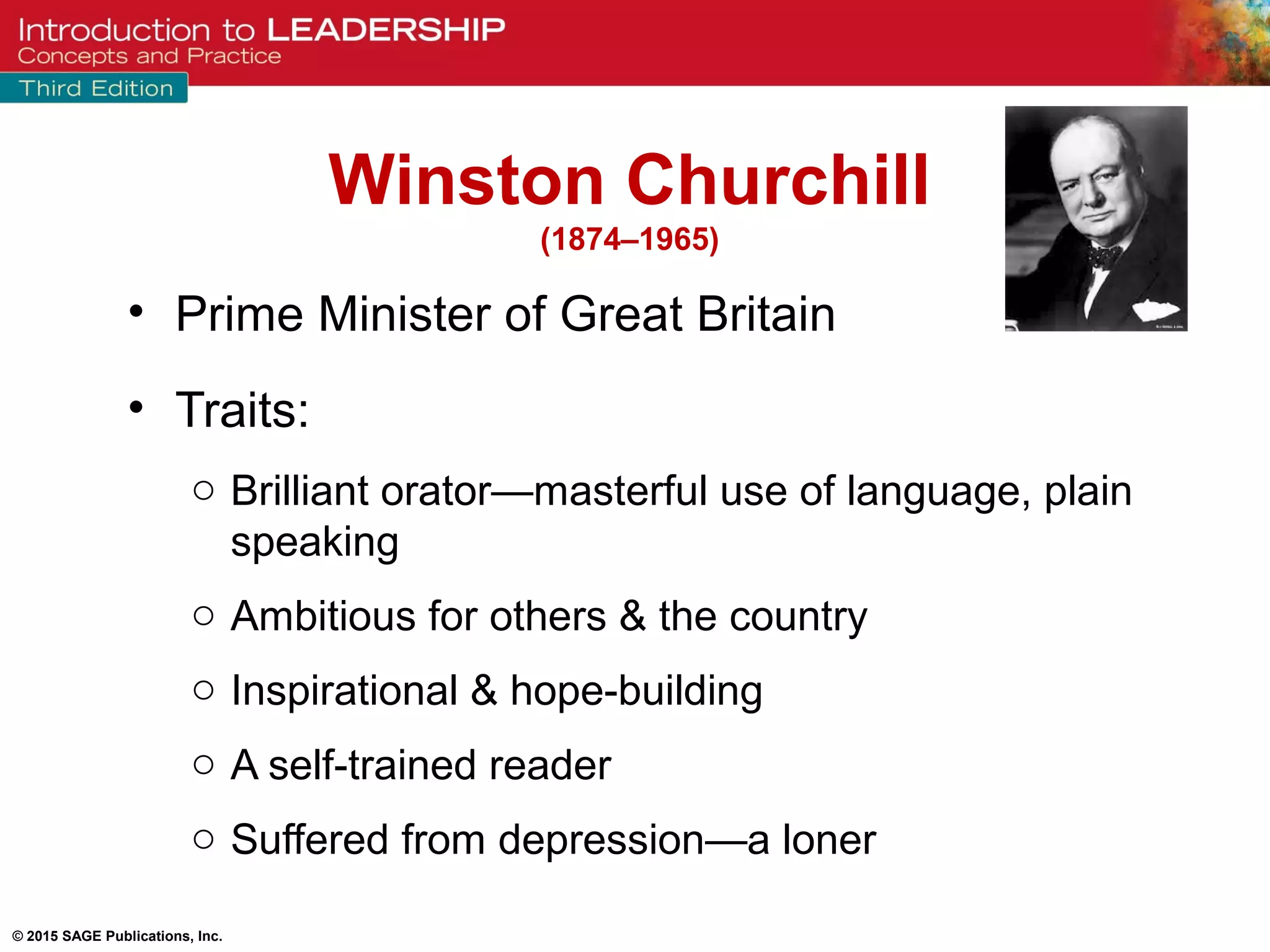
• Prime Minister of Great Britain
• Traits:
o Brilliant orator—masterful use of language, plain
speaking
o Ambitious for others & the country
o Inspirational & hope-building
o A self-trained reader
o Suffered from depression—a loner
Winston Churchill
(1874–1965)
© 2015 SAGE Publications, Inc.
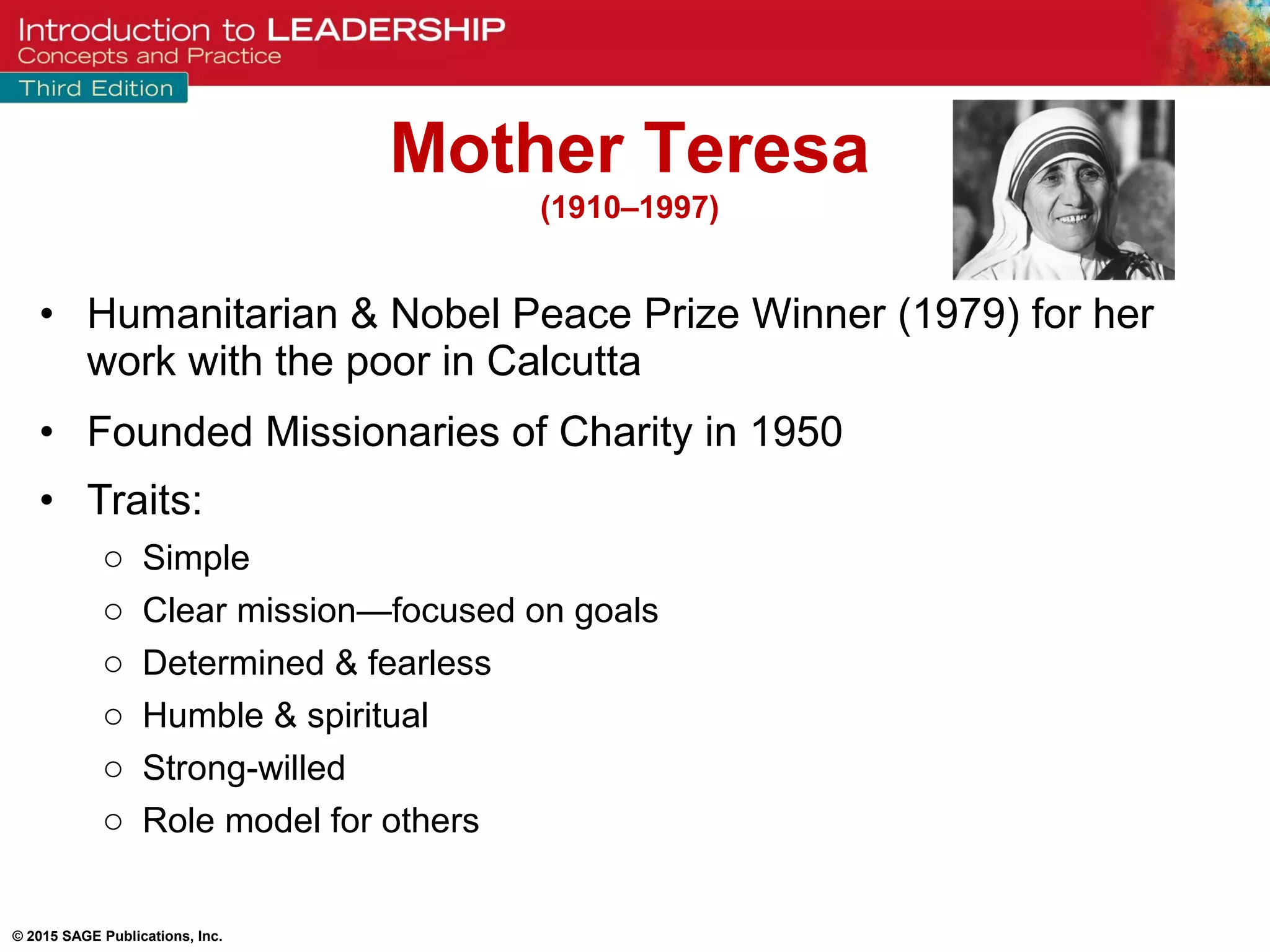
• Humanitarian & Nobel Peace Prize Winner (1979) for her
work with the poor in Calcutta
• Founded Missionaries of Charity in 1950
• Traits:
o Simple
o Clear mission—focused on goals
o Determined & fearless
o Humble & spiritual
o Strong-willed
o Role model for others
Mother Teresa
(1910–1997)
© 2015 SAGE Publications, Inc.
• Founder of Microsoft & wealthiest person in the
world
• Created a foundation for education & global
health
• Traits:
o Intelligent & visionary
o Task-oriented & diligent
o Focused & aggressive
o Simple, straightforward, unpretentious, & altruistic
William (Bill) Gates
(1954– Present )
© 2015 SAGE Publications, Inc.
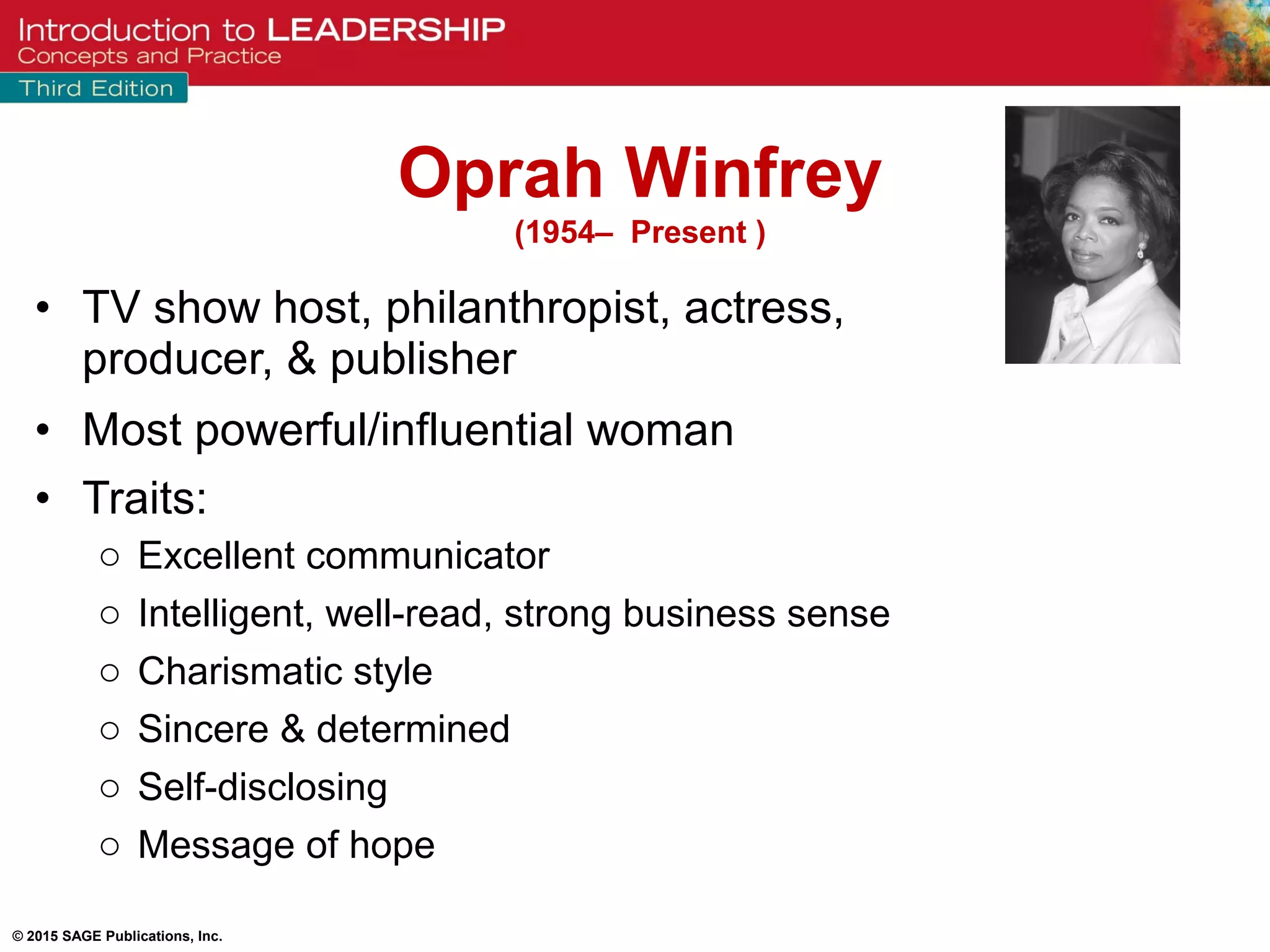
• TV show host, philanthropist, actress,
producer, & publisher
• Most powerful/influential woman
• Traits:
o Excellent communicator
o Intelligent, well-read, strong business sense
o Charismatic style
o Sincere & determined
o Self-disclosing
o Message of hope
Oprah Winfrey
(1954– Present )
© 2015 SAGE Publications, Inc.
• First black president of South Africa &
1993 Nobel Peace Prize Winner for his
role in ending apartheid
• Traits:
o Self-reflective & deeply moral
o Vision unwavering—fairness & justice
o Steadfast, focused, & disciplined
o Nonviolent & not vindictive
o Consensus builder
o Courageous, patient, humble, & compassionate
Nelson Mandela
(1932– 2013)
© 2015 SAGE Publications, Inc.
• Visionary
• Strong-willed
• Diligent
• Inspirational
• Purpose-driven
• Role models
• Symbols of hope
• From these exceptional leaders we can gain a better
understanding of the traits that are important for
effective leadership.
What do they all have in common?
© 2015 SAGE Publications, Inc.
Case Study: An Emerging Leader
• What is your reaction to Tim’s story?
• From your perspective, which has the
greatest impact on Tim’s leadership journey
—nature or nurture?
• Of the six major leadership traits, which are
Tim’s strongest and weakest?
• What characteristics of Tim’s leadership
would you like to incorporate into your own
style of leadership?
© 2015 SAGE Publications, Inc.
• Traits are important
o but only one dimension of a
multidimensional process
• Leadership is a complex process
o no simple paths or guarantees to
becoming an effective leader
Summary

BHU LS 600 Chapter 2

  • 1.
    © 2015 SAGEPublications, Inc. Chapter 2:Chapter 2: Recognizing Your TraitsRecognizing Your Traits
  • 2.
    © 2015 SAGEPublications, Inc. Chapter Objectives 1. Understand the six key leadership traits. 2. Reviewing traits and characteristics of famous leaders.
  • 3.
    © 2015 SAGEPublications, Inc. • Why are some people leaders while others are not? • What makes people become leaders? • Do leaders have certain traits? Discussion Questions
  • 4.
    © 2015 SAGEPublications, Inc. • Studies on leadership identified many important leader traits. o What specific traits are needed to be a successful leader? • Research points to six traits: o Intelligence o Confidence o Charisma o Determination o Sociability o Integrity Leadership Traits Explained
  • 5.
    © 2015 SAGEPublications, Inc. • Intelligence includes having good language skills, perceptual skills, & reasoning ability. • It is hard to change Intelligence Quotient (IQ). • It is possible to: o obtain knowledge o learn about your job & environment o use information to become better leaders Intelligence
  • 6.
    © 2015 SAGEPublications, Inc. • Confidence is a trait that has to do with feeling positive about one’s self & one’s ability to succeed. • Confident people: o feel self-assured o believe they can accomplish goals o do not second-guess themselves—they move forward with clear visions o they are positive about self & ability Confidence
  • 7.
    © 2015 SAGEPublications, Inc. • How do we build confidence? o Understanding what is required from us o Have a mentor to show the way & provide constructive feedback o Practice builds confidence & assures us that we can do what we need to do (e.g., Tiger Woods) Confidence
  • 8.
    © 2015 SAGEPublications, Inc. • Magnetic charm and appeal that gives leaders exceptional powers of influence • Charisma is not a common personality trait. • To increase charisma: o Be a strong role model for values o Be competent in leadership to gain trust o Articulate clear goals & strong values o Communicate high expectations & show confidence in followers’ abilities o Inspire others • Ex.: J. F. Kennedy, Gandhi, M. L. King Jr. Charisma
  • 9.
    © 2015 SAGEPublications, Inc. • Focused & attentive to tasks • Know where to go & how to get there • Includes initiative, persistence, & drive • Persevere in the face of obstacles • Easiest for leaders to acquire • Focus on task, clarify goals, articulate vision, & encourage others to stay the course • Ex.: marathon runners, Nelson Mandela Determination
  • 10.
    © 2015 SAGEPublications, Inc. • The capacity to establish pleasant social relationships • Friendly, outgoing, courteous, & diplomatic • Sensitive to others & cooperative • Easier for some than others • Increasing sociability requires that we try to get along with our coworkers o be friendly, kind, & thoughtful • Ex.: Anne Fox in leadership class Sociability
  • 11.
    © 2015 SAGEPublications, Inc. • Honest & trustworthy with strong principles • Inspire confidence because it creates trust • Loyal, dependable, & not deceptive • Undergirds all aspects of leadership • To increase integrity—be honest & open • Challenge: o To strike a balance between being open while monitoring what is appropriate to disclose • Ex.: Former President Bill Clinton Integrity
  • 12.
    © 2015 SAGEPublications, Inc. • George Washington • Winston Churchill • Mother Teresa • Bill Gates • Oprah Winfrey • Nelson Mandela Historical Leaders
  • 13.
    © 2015 SAGEPublications, Inc. • Founding father and general in the Revolutionary War • Traits: o Modest o Moral o Common man o Did not thrive on power o Provided stability & reason o Even & predictable o Was “great” because he was “good” George Washington (1732–1799)
  • 14.
    © 2015 SAGEPublications, Inc. • Prime Minister of Great Britain • Traits: o Brilliant orator—masterful use of language, plain speaking o Ambitious for others & the country o Inspirational & hope-building o A self-trained reader o Suffered from depression—a loner Winston Churchill (1874–1965)
  • 15.
    © 2015 SAGEPublications, Inc. • Humanitarian & Nobel Peace Prize Winner (1979) for her work with the poor in Calcutta • Founded Missionaries of Charity in 1950 • Traits: o Simple o Clear mission—focused on goals o Determined & fearless o Humble & spiritual o Strong-willed o Role model for others Mother Teresa (1910–1997)
  • 16.
    © 2015 SAGEPublications, Inc. • Founder of Microsoft & wealthiest person in the world • Created a foundation for education & global health • Traits: o Intelligent & visionary o Task-oriented & diligent o Focused & aggressive o Simple, straightforward, unpretentious, & altruistic William (Bill) Gates (1954– Present )
  • 17.
    © 2015 SAGEPublications, Inc. • TV show host, philanthropist, actress, producer, & publisher • Most powerful/influential woman • Traits: o Excellent communicator o Intelligent, well-read, strong business sense o Charismatic style o Sincere & determined o Self-disclosing o Message of hope Oprah Winfrey (1954– Present )
  • 18.
    © 2015 SAGEPublications, Inc. • First black president of South Africa & 1993 Nobel Peace Prize Winner for his role in ending apartheid • Traits: o Self-reflective & deeply moral o Vision unwavering—fairness & justice o Steadfast, focused, & disciplined o Nonviolent & not vindictive o Consensus builder o Courageous, patient, humble, & compassionate Nelson Mandela (1932– 2013)
  • 19.
    © 2015 SAGEPublications, Inc. • Visionary • Strong-willed • Diligent • Inspirational • Purpose-driven • Role models • Symbols of hope • From these exceptional leaders we can gain a better understanding of the traits that are important for effective leadership. What do they all have in common?
  • 20.
    © 2015 SAGEPublications, Inc. Case Study: An Emerging Leader • What is your reaction to Tim’s story? • From your perspective, which has the greatest impact on Tim’s leadership journey —nature or nurture? • Of the six major leadership traits, which are Tim’s strongest and weakest? • What characteristics of Tim’s leadership would you like to incorporate into your own style of leadership?
  • 21.
    © 2015 SAGEPublications, Inc. • Traits are important o but only one dimension of a multidimensional process • Leadership is a complex process o no simple paths or guarantees to becoming an effective leader Summary