© 2015 SAGE Publications, Inc.
Chapter 3:Chapter 3:
Engaging People’s StrengthsEngaging People’s Strengths
© 2015 SAGE Publications, Inc.
Chapter Objectives
• Explore how strengths can make one a better
leader.
• Understand the concept of strength.
• Describe the historical background of strengths-
based leadership.
• Examine how to identify strengths.
• Review measures used to assess strengths.
• Examine strengths-based leadership in practice.
© 2015 SAGE Publications, Inc.
• What was it about you or the way you
presented yourself that made you feel
good?
• What did you do that worked so well?
• Why did others respond to you the way
they did?
Discussion Questions
© 2015 SAGE Publications, Inc.
• An attribute or quality of an individual that
accounts for successful performance.
• Ability to consistently demonstrate
exceptional work.
• Positive features of ourselves that make
us effective and help us flourish.
What are Strengths?
© 2015 SAGE Publications, Inc.
• Researchers at Gallup Organization
initiated a massive study that included
interviews of over 2 million people to
describe what’s right with people.
• The discipline of psychology was also
researching what’s right with people and
their positive attributes. This field came
to be known as positive psychology.
Historical Background
© 2015 SAGE Publications, Inc.
1. Focus expanded from what’s wrong with
people and their weaknesses to what’s right
with people and their positive attributes.
2. Positive psychology can be defined as “the
‘scientific’ study of what makes life most
worth living”.
3. Positive psychology launched that analysis of
people’s strengths into the mainstream of
scientific research.
Positive Psychology
© 2015 SAGE Publications, Inc.
• Gallup researchers discovered 34 themes
or patterns of what makes individuals
perform at a high level.
• Gallup identified themes of human talent,
not strengths.
• The equation for developing a strength is
talent times investment.
• Talents are not strengths, but they provide
the basis for developing strengths when
they are coupled with knowledge, skills,
and practice.
Identifying and Measuring Strengths
© 2015 SAGE Publications, Inc.
• StrengthsFinder is a 177 item questionnaire that
identifies areas where you have the greatest
potential to develop strengths.
• Researchers developed a configuration that included
four domains of leadership strength; executing,
influencing, relationship building, and strategic
thinking.
• Effective teams possess broad groupings of
strengths and work best when all four domains of
leadership strength are represented on their teams.
Gallup’s StrengthFinder Profile
© 2015 SAGE Publications, Inc.
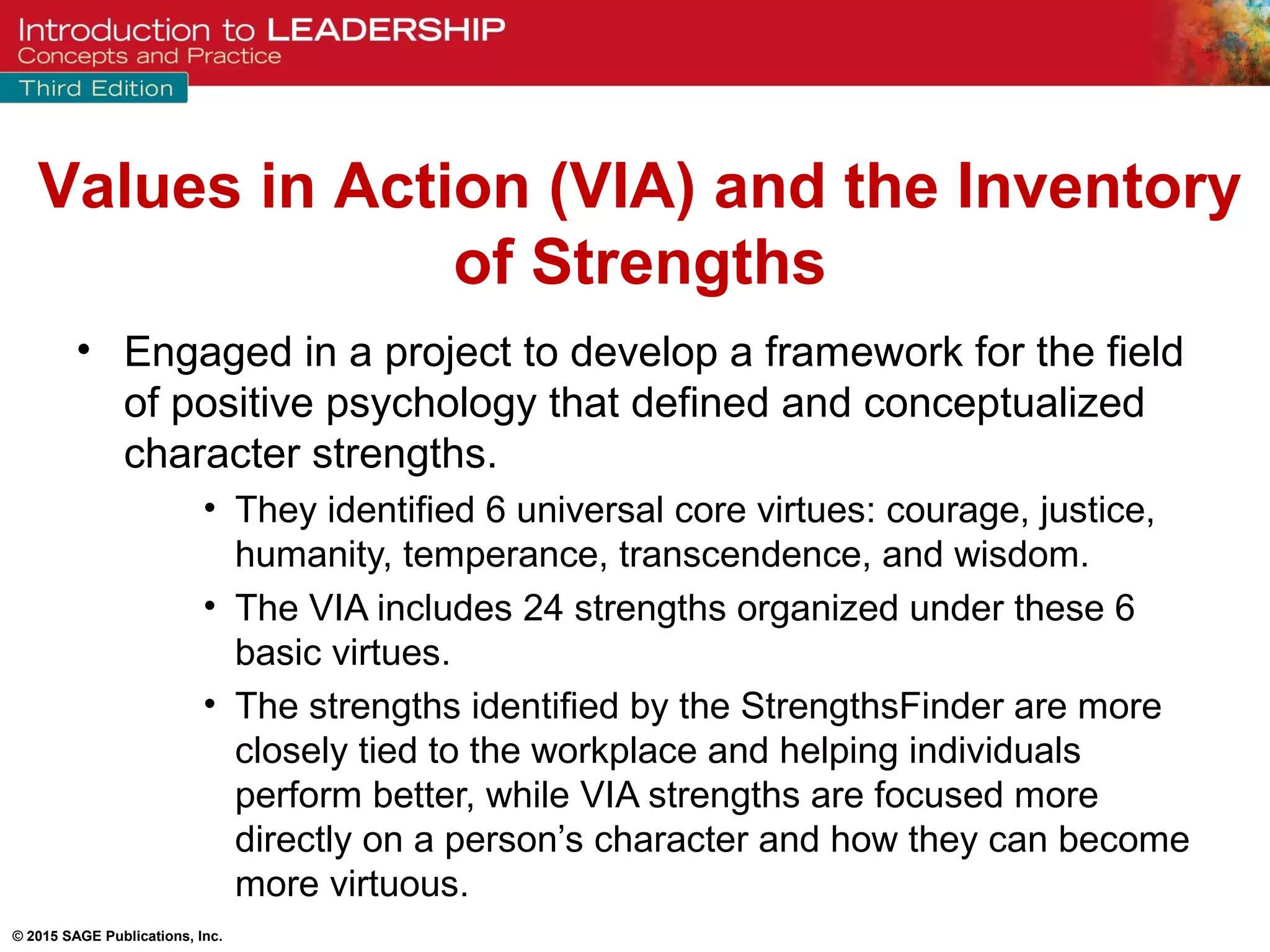
• Engaged in a project to develop a framework for the field
of positive psychology that defined and conceptualized
character strengths.
• They identified 6 universal core virtues: courage, justice,
humanity, temperance, transcendence, and wisdom.
• The VIA includes 24 strengths organized under these 6
basic virtues.
• The strengths identified by the StrengthsFinder are more
closely tied to the workplace and helping individuals
perform better, while VIA strengths are focused more
directly on a person’s character and how they can become
more virtuous.
Values in Action (VIA) and the Inventory
of Strengths
© 2015 SAGE Publications, Inc.
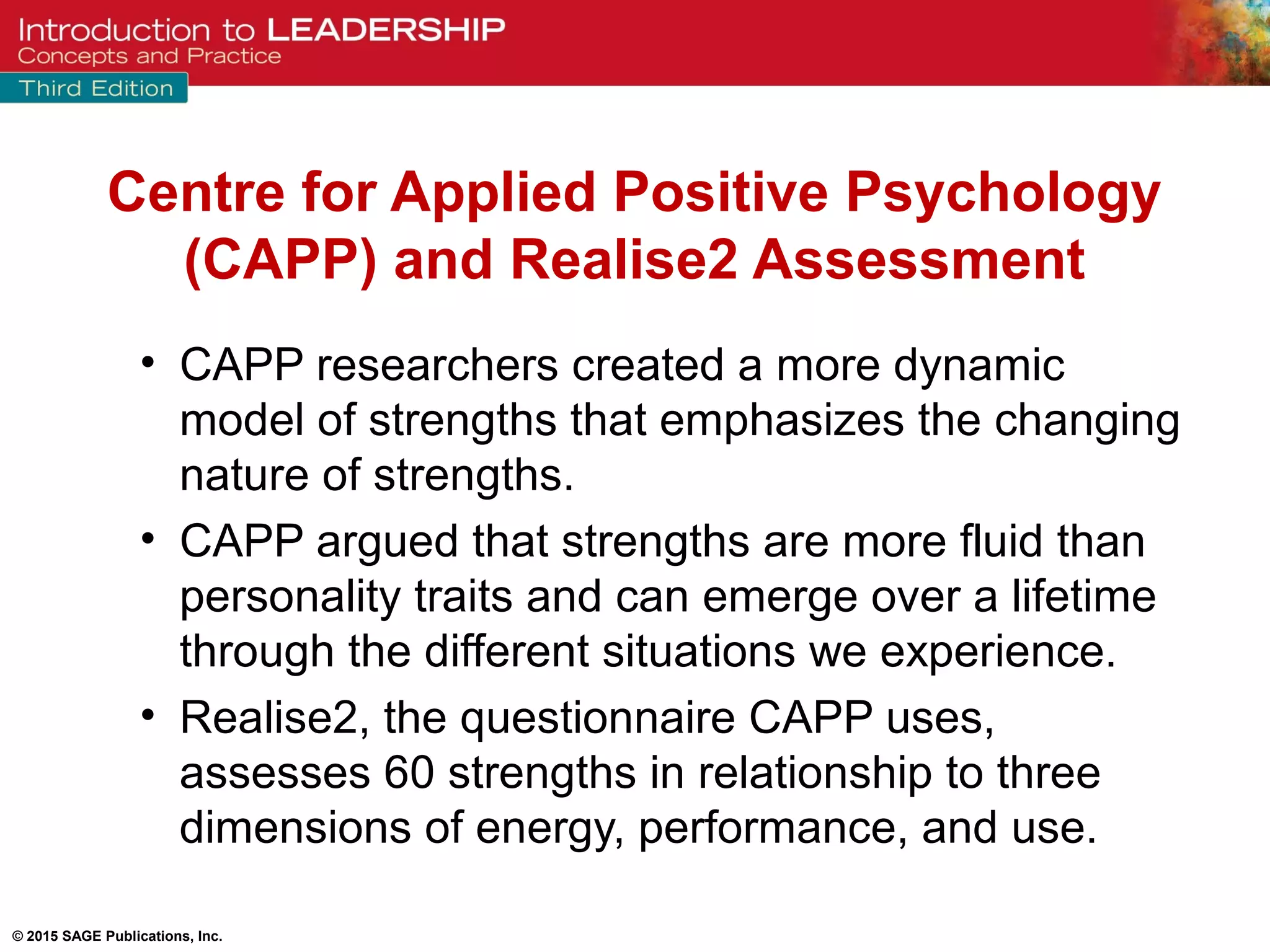
Centre for Applied Positive Psychology
(CAPP) and Realise2 Assessment
• CAPP researchers created a more dynamic
model of strengths that emphasizes the changing
nature of strengths.
• CAPP argued that strengths are more fluid than
personality traits and can emerge over a lifetime
through the different situations we experience.
• Realise2, the questionnaire CAPP uses,
assesses 60 strengths in relationship to three
dimensions of energy, performance, and use.
© 2015 SAGE Publications, Inc.
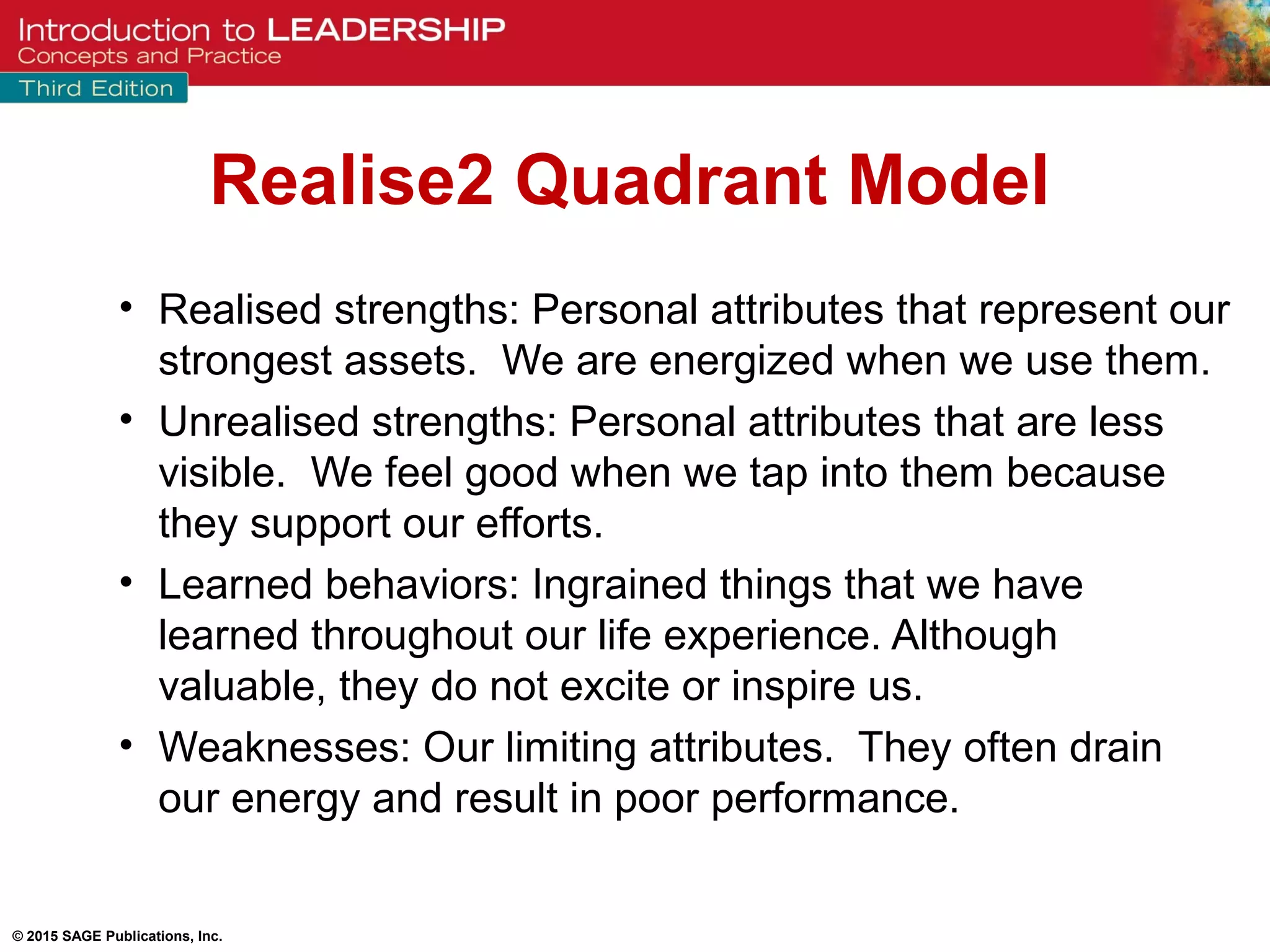
• Realised strengths: Personal attributes that represent our
strongest assets. We are energized when we use them.
• Unrealised strengths: Personal attributes that are less
visible. We feel good when we tap into them because
they support our efforts.
• Learned behaviors: Ingrained things that we have
learned throughout our life experience. Although
valuable, they do not excite or inspire us.
• Weaknesses: Our limiting attributes. They often drain
our energy and result in poor performance.
Realise2 Quadrant Model
© 2015 SAGE Publications, Inc.
Discovering Your Strengths
• Discovering your strengths requires you to
concentrate on your positive attributes and those
times when you feel inspirited.
• There are several ways to discover one’s
strengths:
• Completing one or more of the strengths
questionnaires (StrengthsFinder 2.0, VIA-IS,
Realise2).
• Completing exercises at the end of this
chapter.
© 2015 SAGE Publications, Inc.
• First, you must acknowledge your strengths and be
prepared to reveal them to others because it lets
other know how we can me most useful when
working together.
• People use a variety of ways to reveal their
strengths, such as posting them on Facebook or
LinkedIn, adding them to their email signature, or
listing them on their resume.
• Second, practice working consistently with others
based on your strengths. For example, if your
strength is as an innovator, find ways to be creative
in your leadership.
Developing Your Strength
© 2015 SAGE Publications, Inc.
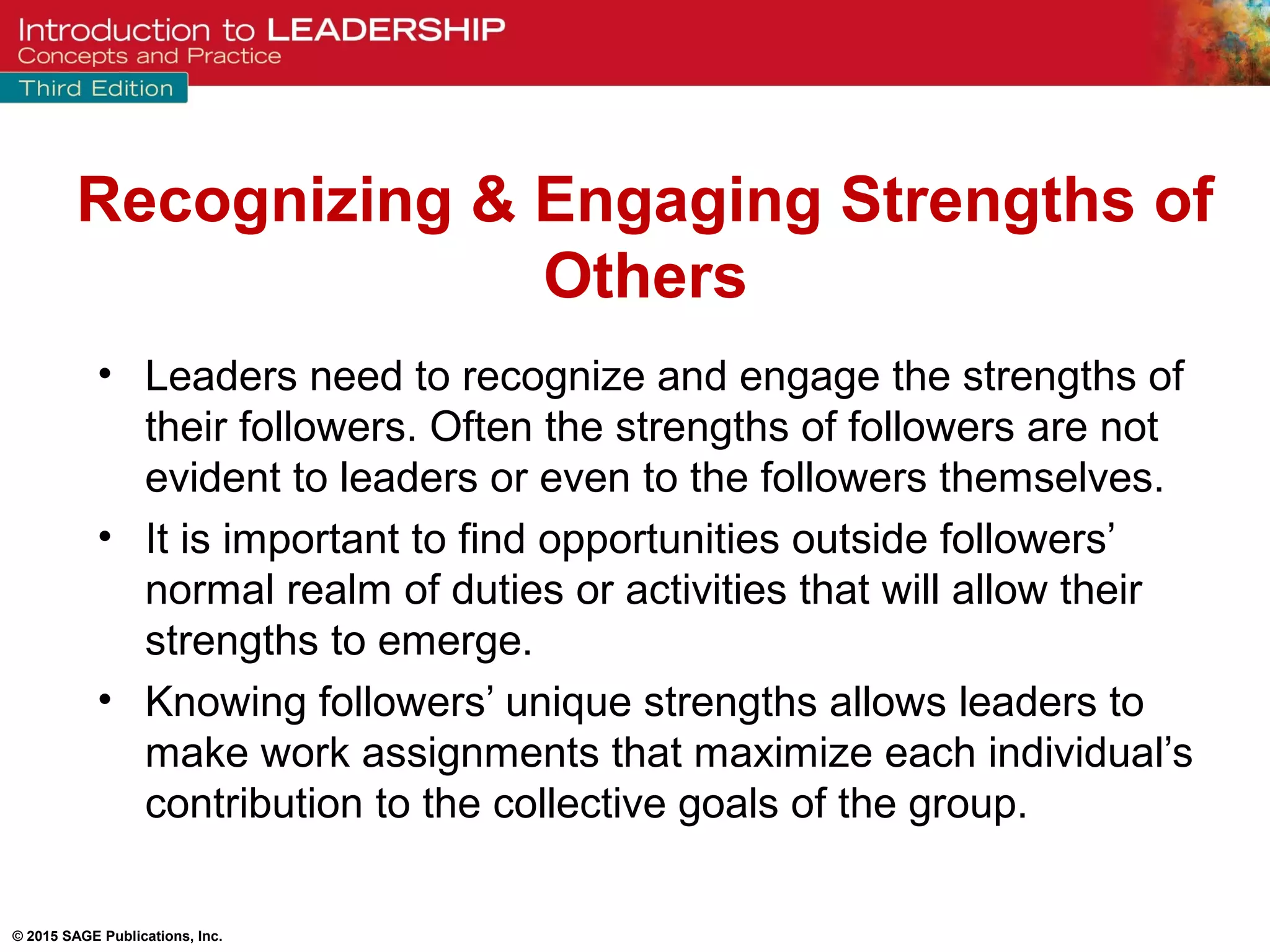
• Leaders need to recognize and engage the strengths of
their followers. Often the strengths of followers are not
evident to leaders or even to the followers themselves.
• It is important to find opportunities outside followers’
normal realm of duties or activities that will allow their
strengths to emerge.
• Knowing followers’ unique strengths allows leaders to
make work assignments that maximize each individual’s
contribution to the collective goals of the group.
Recognizing & Engaging Strengths of
Others
© 2015 SAGE Publications, Inc.
• A final way to practice strengths-based leadership
is to create and promote a positive work
environment in which people’s strengths play an
integral role.
• Organizations that create positive work
environments have a positive physiological impact
on employees which in turn impacts performance.
• Leaders who want to create a positive work
environment should attend to four areas: climate,
relationships, communication, and meaning.
Fostering a Positive Strengths-Based
Environment
© 2015 SAGE Publications, Inc.
• To create a positive climate, leaders should foster
among their employees virtues such as compassion,
forgiveness, and gratitude.
• To build positive relationships, leaders need to
highlight individuals’ positive images and strengths.
• To develop positive communication, leaders must be
supportive, make positive than negative statements,
and be less negatively evaluative of others.
• Leaders can foster positive meaning in their
organizations by emphasizing the connection between
employees’ values and the long term impact of their
work.
Fostering a Positive Strengths-
Based Environment
© 2015 SAGE Publications, Inc.
Leadership Snapshot: Steve Jobs
• Brilliant, yet didn’t possess technical skills to be a
computer genius.
• Notable strengths included creativity, team building,
strategic vision, and influencing.
• Created Apple in 1980 with the partner Steve Wozniak.
Jobs believed rules were meant to be broken and in
1984, Apple did just that, introducing a truly
revolutionary product, the Macintosh.
• Jobs wasn’t perfect; he could be confrontational and
this quality eventually resulted in him being booted out
of his own company.
© 2015 SAGE Publications, Inc.
Leadership Snapshot: Steve Jobs
• Moved on to create NeXt Computers and eventually
acquired Pixar studios, a company that revolutionized
movie animation and made Jobs a multi-billionaire.
• After more than a decade Jobs came back to Apple and
narrowed the focus of his company to laptop and
desktop computers for the professional and home
consumer.
• Over the next 14 years, he dreamt up the iPod, the
iPad, and the iPhone, all very successful products. In
the end, Jobs revolutionized seven industries.
• “Think different” was as much a statement of Jobs’ own
strengths as a leader as it was a mission statement for
Apple.
© 2015 SAGE Publications, Inc.
Case Study: Ready to be CEO?
1. Strengths are considered inborn traits that can be
enhanced with experience. What experiences in
Christine’s background helped her develop her strengths?
2. Of the strengths identified by the assessment, which were
directly observable in Christine’s work? Were there any
that were not?
3. Christine admitted having some weaknesses, especially
in day-to-day management of the organization. Which of
her strengths can she put into use to help her deal with
that and how?
4. What strengths should Christine seek from others that
would complement her own and fill some gaps?
© 2015 SAGE Publications, Inc.
Summary
• Although we all have strengths, they often go
unrecognized and unused. Understanding strengths
can make one a better leader.
• Research shows that people feel better and work
better when the climate in which they work is
positive.
• Strengths-based leadership is a new area of
research that offers a unique approach to becoming
a more effective leader. Not a panacea, strengths
concepts provide an innovative and valuable
perspective to add to our leadership toolbox.

BHU LS 600 Chapter 3

  • 1.
    © 2015 SAGEPublications, Inc. Chapter 3:Chapter 3: Engaging People’s StrengthsEngaging People’s Strengths
  • 2.
    © 2015 SAGEPublications, Inc. Chapter Objectives • Explore how strengths can make one a better leader. • Understand the concept of strength. • Describe the historical background of strengths- based leadership. • Examine how to identify strengths. • Review measures used to assess strengths. • Examine strengths-based leadership in practice.
  • 3.
    © 2015 SAGEPublications, Inc. • What was it about you or the way you presented yourself that made you feel good? • What did you do that worked so well? • Why did others respond to you the way they did? Discussion Questions
  • 4.
    © 2015 SAGEPublications, Inc. • An attribute or quality of an individual that accounts for successful performance. • Ability to consistently demonstrate exceptional work. • Positive features of ourselves that make us effective and help us flourish. What are Strengths?
  • 5.
    © 2015 SAGEPublications, Inc. • Researchers at Gallup Organization initiated a massive study that included interviews of over 2 million people to describe what’s right with people. • The discipline of psychology was also researching what’s right with people and their positive attributes. This field came to be known as positive psychology. Historical Background
  • 6.
    © 2015 SAGEPublications, Inc. 1. Focus expanded from what’s wrong with people and their weaknesses to what’s right with people and their positive attributes. 2. Positive psychology can be defined as “the ‘scientific’ study of what makes life most worth living”. 3. Positive psychology launched that analysis of people’s strengths into the mainstream of scientific research. Positive Psychology
  • 7.
    © 2015 SAGEPublications, Inc. • Gallup researchers discovered 34 themes or patterns of what makes individuals perform at a high level. • Gallup identified themes of human talent, not strengths. • The equation for developing a strength is talent times investment. • Talents are not strengths, but they provide the basis for developing strengths when they are coupled with knowledge, skills, and practice. Identifying and Measuring Strengths
  • 8.
    © 2015 SAGEPublications, Inc. • StrengthsFinder is a 177 item questionnaire that identifies areas where you have the greatest potential to develop strengths. • Researchers developed a configuration that included four domains of leadership strength; executing, influencing, relationship building, and strategic thinking. • Effective teams possess broad groupings of strengths and work best when all four domains of leadership strength are represented on their teams. Gallup’s StrengthFinder Profile
  • 9.
    © 2015 SAGEPublications, Inc. • Engaged in a project to develop a framework for the field of positive psychology that defined and conceptualized character strengths. • They identified 6 universal core virtues: courage, justice, humanity, temperance, transcendence, and wisdom. • The VIA includes 24 strengths organized under these 6 basic virtues. • The strengths identified by the StrengthsFinder are more closely tied to the workplace and helping individuals perform better, while VIA strengths are focused more directly on a person’s character and how they can become more virtuous. Values in Action (VIA) and the Inventory of Strengths
  • 10.
    © 2015 SAGEPublications, Inc. Centre for Applied Positive Psychology (CAPP) and Realise2 Assessment • CAPP researchers created a more dynamic model of strengths that emphasizes the changing nature of strengths. • CAPP argued that strengths are more fluid than personality traits and can emerge over a lifetime through the different situations we experience. • Realise2, the questionnaire CAPP uses, assesses 60 strengths in relationship to three dimensions of energy, performance, and use.
  • 11.
    © 2015 SAGEPublications, Inc. • Realised strengths: Personal attributes that represent our strongest assets. We are energized when we use them. • Unrealised strengths: Personal attributes that are less visible. We feel good when we tap into them because they support our efforts. • Learned behaviors: Ingrained things that we have learned throughout our life experience. Although valuable, they do not excite or inspire us. • Weaknesses: Our limiting attributes. They often drain our energy and result in poor performance. Realise2 Quadrant Model
  • 12.
    © 2015 SAGEPublications, Inc. Discovering Your Strengths • Discovering your strengths requires you to concentrate on your positive attributes and those times when you feel inspirited. • There are several ways to discover one’s strengths: • Completing one or more of the strengths questionnaires (StrengthsFinder 2.0, VIA-IS, Realise2). • Completing exercises at the end of this chapter.
  • 13.
    © 2015 SAGEPublications, Inc. • First, you must acknowledge your strengths and be prepared to reveal them to others because it lets other know how we can me most useful when working together. • People use a variety of ways to reveal their strengths, such as posting them on Facebook or LinkedIn, adding them to their email signature, or listing them on their resume. • Second, practice working consistently with others based on your strengths. For example, if your strength is as an innovator, find ways to be creative in your leadership. Developing Your Strength
  • 14.
    © 2015 SAGEPublications, Inc. • Leaders need to recognize and engage the strengths of their followers. Often the strengths of followers are not evident to leaders or even to the followers themselves. • It is important to find opportunities outside followers’ normal realm of duties or activities that will allow their strengths to emerge. • Knowing followers’ unique strengths allows leaders to make work assignments that maximize each individual’s contribution to the collective goals of the group. Recognizing & Engaging Strengths of Others
  • 15.
    © 2015 SAGEPublications, Inc. • A final way to practice strengths-based leadership is to create and promote a positive work environment in which people’s strengths play an integral role. • Organizations that create positive work environments have a positive physiological impact on employees which in turn impacts performance. • Leaders who want to create a positive work environment should attend to four areas: climate, relationships, communication, and meaning. Fostering a Positive Strengths-Based Environment
  • 16.
    © 2015 SAGEPublications, Inc. • To create a positive climate, leaders should foster among their employees virtues such as compassion, forgiveness, and gratitude. • To build positive relationships, leaders need to highlight individuals’ positive images and strengths. • To develop positive communication, leaders must be supportive, make positive than negative statements, and be less negatively evaluative of others. • Leaders can foster positive meaning in their organizations by emphasizing the connection between employees’ values and the long term impact of their work. Fostering a Positive Strengths- Based Environment
  • 17.
    © 2015 SAGEPublications, Inc. Leadership Snapshot: Steve Jobs • Brilliant, yet didn’t possess technical skills to be a computer genius. • Notable strengths included creativity, team building, strategic vision, and influencing. • Created Apple in 1980 with the partner Steve Wozniak. Jobs believed rules were meant to be broken and in 1984, Apple did just that, introducing a truly revolutionary product, the Macintosh. • Jobs wasn’t perfect; he could be confrontational and this quality eventually resulted in him being booted out of his own company.
  • 18.
    © 2015 SAGEPublications, Inc. Leadership Snapshot: Steve Jobs • Moved on to create NeXt Computers and eventually acquired Pixar studios, a company that revolutionized movie animation and made Jobs a multi-billionaire. • After more than a decade Jobs came back to Apple and narrowed the focus of his company to laptop and desktop computers for the professional and home consumer. • Over the next 14 years, he dreamt up the iPod, the iPad, and the iPhone, all very successful products. In the end, Jobs revolutionized seven industries. • “Think different” was as much a statement of Jobs’ own strengths as a leader as it was a mission statement for Apple.
  • 19.
    © 2015 SAGEPublications, Inc. Case Study: Ready to be CEO? 1. Strengths are considered inborn traits that can be enhanced with experience. What experiences in Christine’s background helped her develop her strengths? 2. Of the strengths identified by the assessment, which were directly observable in Christine’s work? Were there any that were not? 3. Christine admitted having some weaknesses, especially in day-to-day management of the organization. Which of her strengths can she put into use to help her deal with that and how? 4. What strengths should Christine seek from others that would complement her own and fill some gaps?
  • 20.
    © 2015 SAGEPublications, Inc. Summary • Although we all have strengths, they often go unrecognized and unused. Understanding strengths can make one a better leader. • Research shows that people feel better and work better when the climate in which they work is positive. • Strengths-based leadership is a new area of research that offers a unique approach to becoming a more effective leader. Not a panacea, strengths concepts provide an innovative and valuable perspective to add to our leadership toolbox.