BHARAT HEAVY ELECTRICALS LIMITED
SUMMER TRAINING PROJECT REPORT 2016
REPORT
ON
PNEUMATIC BRAKING SYSTEM
UNDER THE GUIDANCE OF: SUBMITTED TO:
Mr B.N Naik Mr. Dhruv Bhargav
(DGM LMM) (AGM HRD)
Mr. Y.R. Tripathi
(sen. Engg. LMM)
SUBMITTED BY:
Siddhartha singh jadaun
B.Tech 3rd
Year Mechanical Engineering
GLA University,(Mathura)
ACKNOWLEDGEMENT
I am extremely thankful and indebted to the numerous
BHEL engineers, who provided vital information about
the functioning of their respective departments thus
helping me to gain an overall idea of the working of the
organization.
I am highly thankful to my project guide Mr B.N Naik
(DGM ,LOCOMOTIVE DEPARTMENT) and Mr. Y.R.
Tripathi (Engineer, Locomotive Department) for
giving me the chance to get acquainted with various
aspects of locomotive breaking system.
Last but not the least I would like to thank my parents
and all my fellow trainees who have been a constant
source of inspiration and encouragement during my
studies and training.
CONTENTS
S.NO Topic Name Page No.
1 BHEL -INTRODUCTION 4
2 BHEL Jhansi 10
3 VISION, MISSION ,VALUES 11
4 ROTATION REPORT 12
5 Locomotive 26
6 Brakes 26
7 Types of brakes 27
8 WAG-7 31
9 T.S. OF WAG-7 31
10 PNEUMATIC FUNCTIONS 36
11 PNEUMATIC EQUIPMENTS 37
12 MAIN AIR SYSTEM 42
13 SA-9 BRAKE VALVE 43
14 A-9 AUTO BRAKE VALVE 46
15 RAISING OF PANTOGRAPH 51
16 DYNAMIC BRAKING 52
17 REFRENCES 53
18 CONCLUSION 53
BHARAT HEAVY ELECTRICALS LIMITED
INTRODUCTION
Bharat Heavy ElectricalsLimited (BHEL) is one of the oldest and largeststate-
owned engineering and manufacturing enterprise in India in the energy-related
and infrastructuresector which includes Power, Railways, Transmission and
Distribution, Oil and Gas sectors and many more. It is the 12th largest power
equipment manufacturer in the world. In the year 2011, itranked ninth most
innovative company in the world by US business magazineForbes. BHEL is the
only Indian Engineering company on the list, which contains online retail firm
Amazon at the second position with Apple and Google at fifth and seventh
positions, respectively. Itis also placed at 4th place in Forbes Asia's Fabulous
50 List of 2010. BHEL was established more than 50 years ago, ushering in the
indigenous Heavy Electrical Equipment industry in India. The company has
been earning profits continuously since 1971-72and paying dividends since
1976-77.74% of thetotal power generated in India is produced by equipment
manufactured by BHEL.
Itis one of India's nine largestPublic Sector Undertakings or PSUs, known as
the “Navratnas” or 'the nine jewels’. In June 2012, BHEL commissioned a 250
MW power generating unit at Harduaganj in Uttar Pradesh. This would add six
million units of electricity on a daily basis.
BHEL is an integrated power plant equipment manufacturer and one of the
largest engineering and manufacturing companies in India in terms of
turnover. Itwas established in 1964, ushering in the indigenous Heavy
Electrical Equipment industry in India - a dream that has been more than
realized with a well-recognized track record of performance. The company has
been earning profits continuously since 1971-72and paying dividends since
1976-77
Itis engaged in the design, engineering, manufacture, construction, testing,
commissioning and servicing of a wide range of products and services for the
core sectors of the economy, viz. Power, Transmission, Industry,
Transportation, Renewable Energy, Oil & Gas and Defence. Ithas 15
manufacturing divisions, two repair units, four regional offices, eight service
centres, eight overseas offices and 15 regional centres and currently operates
at more than 150 projectsites across India and abroad. Itplace strong
emphasis on innovation and creative development of new technologies. Their
research and development (R&D) efforts are aimed not only at improving the
performanceand efficiency of our existing products, butalso at using state-of-
the-art technologies and processes to develop new products. This enables
them to have a strong customer orientation, to be sensitive to their needs and
respond quickly to the changes in the market.
The high level of quality & reliability of their products is due to adherence to
international standards by acquiring and adapting some of the best
technologies from leading companies in the world including General Electric
Company, AlstomSA, Siemens AG and MitsubishiHeavy Industries Ltd.,
together with technologies developed in our own R&D centres. Most of their
manufacturing units and other entities have been accredited to Quality
Management Systems (ISO 9001:2008),EnvironmentalManagementSystems
(ISO 14001:2004) and OccupationalHealth & Safety Management Systems
(OHSAS 18001:2007).
Ithas a shareof around 59% in India's total installed generating capacity
contributing 69% (approx.) to the total power generated from utility sets
(excluding non-conventionalcapacity) as of March 31, 2012. Ithas been
exporting there power and industry segmentproducts and services for
approximately 40 years. Ithas exported our products and services to more
than 70 countries. We had cumulatively installed capacity of over 8,500 MW
outside of India in 21 countries, including Malaysia, Iraq, theUAE, Egypt and
New Zealand. There physicalexports range fromturnkey projects to after sales
services.
Itworks with a vision of becoming a world-class engineering enterprise,
committed to enhancing stakeholder value.
There greatest strength is there highly skilled and committed workforceof
over 49,000 employees. Every employeeis given an equal opportunity to
develop himself and grow in his career. Continuous training and retraining,
career planning, a positive work culture and participative styleof management
- all these have engendered development of a committed and motivated
workforcesetting new benchmarks in terms of productivity, quality and
responsiveness.
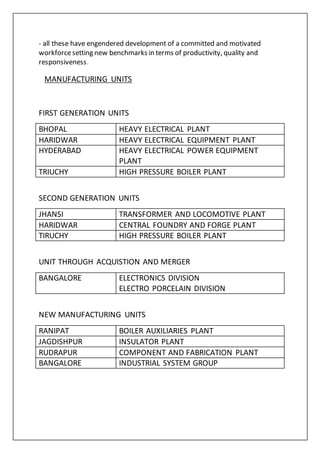
MANUFACTURING UNITS
FIRST GENERATION UNITS
BHOPAL HEAVY ELECTRICAL PLANT
HARIDWAR HEAVY ELECTRICAL EQUIPMENT PLANT
HYDERABAD HEAVY ELECTRICAL POWER EQUIPMENT
PLANT
TRIUCHY HIGH PRESSURE BOILER PLANT
SECOND GENERATION UNITS
JHANSI TRANSFORMER AND LOCOMOTIVE PLANT
HARIDWAR CENTRAL FOUNDRY AND FORGE PLANT
TIRUCHY HIGH PRESSURE BOILER PLANT
UNIT THROUGH ACQUISTION AND MERGER
BANGALORE ELECTRONICS DIVISION
ELECTRO PORCELAIN DIVISION
NEW MANUFACTURING UNITS
RANIPAT BOILER AUXILIARIES PLANT
JAGDISHPUR INSULATOR PLANT
RUDRAPUR COMPONENT AND FABRICATION PLANT
BANGALORE INDUSTRIAL SYSTEM GROUP
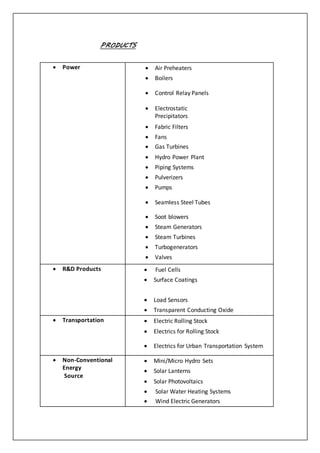
PRODUCTS
 Power   Air Preheaters
  Boilers
  Control Relay Panels
 
 Electrostatic
Precipitators
  Fabric Filters
  Fans
  Gas Turbines
  Hydro Power Plant
  Piping Systems
  Pulverizers
  Pumps
  Seamless Steel Tubes
  Soot blowers
  Steam Generators
  Steam Turbines
  Turbogenerators
  Valves
 R&D Products   Fuel Cells
  Surface Coatings

  Load Sensors
  Transparent Conducting Oxide
 Transportation   Electric Rolling Stock
  Electrics for Rolling Stock
  Electrics for Urban Transportation System
 Non-Conventional
Energy
Source
  Mini/Micro Hydro Sets
  Solar Lanterns
  Solar Photovoltaics
  Solar Water Heating Systems
  Wind Electric Generators
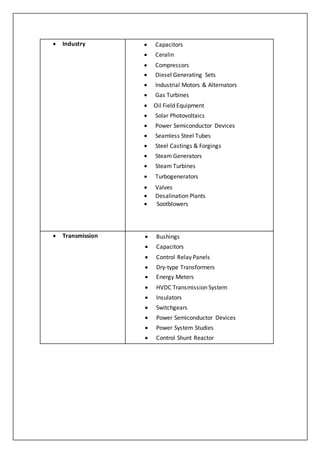
 Industry  Capacitors
 Ceralin
 Compressors
 Diesel Generating Sets
 Industrial Motors & Alternators
 Gas Turbines
 Oil Field Equipment
 Solar Photovoltaics
 Power Semiconductor Devices
 Seamless Steel Tubes
 Steel Castings & Forgings
 Steam Generators
 Steam Turbines
 Turbogenerators
 Valves
 Desalination Plants
 Sootblowers
 Transmission   Bushings
  Capacitors
  Control Relay Panels
  Dry-type Transformers
  Energy Meters
  HVDC Transmission System
  Insulators
  Switchgears
  Power Semiconductor Devices
  Power System Studies
  Control Shunt Reactor
BHEL JHANSI
INTRODUCTION
By the end of 5th five-year plan, it was envisaged by the planning commission that the
demand for power transformer would rise in the coming years. Anticipating the
country’s requirement BHEL decided to set up a new plant, which would manufacture
power and other types of transformers in addition to the capacity available in BHEL
Bhopal. The Bhopal plant was engaged in manufacturing transformers of large ratings
and Jhansi unit would concentrate on power transformer up to 50 MVA, 132 KV class
and other transformers like Instrument Transformers, Traction transformers for railway
etc.
This unit of Jhansi was established around 14 km from the city on the N.H. No 26 on
Jhansi Lalitpur road. It is called second-generation plant of BHEL set up in 1974 at an
estimated cost of Rs 16.22 crores inclusive of Rs 2.1 crores for township. Its foundation
was laid by late Mrs. Indira Gandhi the prime minister on 9th Jan. 1974. The commercial
production of the unit began in 1976-77 with an output of Rs 53 lacs since then there
has been no looking back for BHEL Jhansi.
The plant of BHEL is equipped with most modern manufacturing processing and testing
facilities for the manufacture of power, special transformer and instrument transformer,
Diesel shunting locomotives and AC/DC locomotives. The layout of the plant is well
streamlined to enable smooth material flow from the raw material stages to the finished
goods. All the feeder bays have been laid perpendicular to the main assembly bay and in
each feeder bay raw material smoothly gets converted to sub-assemblies, which after
inspection are sent to main assembly bay.
The raw material that are produced for manufacture are used only after thorough
material testing in the testing lab and with strict quality checks at various stages of
productions. This unit of BHEL is basically engaged in the production and manufacturing
of various types of transformers and capacities. With the growing competition in the
transformer section, in 1985-86 it under took the re-powering of DESL. In 1987-88, BHEL
progressed a step further in under taking the production of AC locomotives, and
subsequently it started manufacturing AC/DC locomotives also.
PRODUCTS
TRANSFORMERS:
TYPE RANGE
Power Transformer up to 400 kV/315 MVA
Rectifier Transformer up to 132 KV/120 kA
Furnace Transformer up to 33 kV/60 MVA
Transformer for ESP up to 95 kVp/1400mA
Voltage Transformer up to 220 kV
Current Transformer up to 400 kV
Traction Transformers
Single Phase Freight Loco - up to 25 kV/5400kVA
Three Phase Freight Loco - up to 25 kV/7475kVA
up to 25 kV/5400kVA
up to 25 kV/7475kVA
Transformer for ACEMU up to 25 kV/1550 kVA up to 25 kV/1550 kVA
Cast Resin Dry Type Transformer up to 33 kV/15 MVA up to 33 kV/15 MVA
LOCOMOTIVES:
- Diesel locomotive
- AC/DC locomotive
- Special purpose wagons
- Rail cumroad Vehicle
- Synchrolift
VISION, MISSION AND VALUES
OF
BHEL, JHANSI
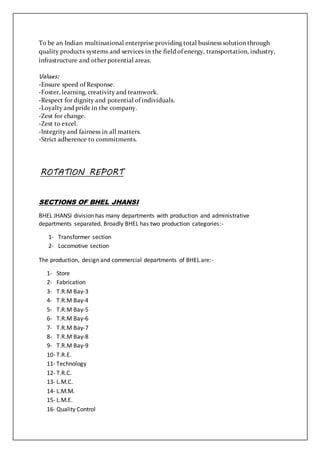
Vision:
A world-class Engineering Enterprise committed to Enhancing Stakeholder Value.
Mission:
To be an Indian multinational enterprise providing total business solution through
quality products systems and services in the field of energy, transportation, industry,
infrastructure and other potential areas.
Values:
-Ensure speed of Response.
-Foster, learning, creativity and teamwork.
-Respect for dignity and potential of individuals.
-Loyalty and pride in the company.
-Zest for change.
-Zest to excel.
-Integrity and fairness in all matters.
-Strict adherence to commitments.
ROTATION REPORT
SECTIONS OF BHEL JHANSI
BHEL JHANSI division has many departments with production and administrative
departments separated. Broadly BHEL has two production categories:-
1- Transformer section
2- Locomotive section
The production, design and commercial departments of BHEL are:-
1- Store
2- Fabrication
3- T.R.M Bay-3
4- T.R.M Bay-4
5- T.R.M Bay-5
6- T.R.M Bay-6
7- T.R.M Bay-7
8- T.R.M Bay-8
9- T.R.M Bay-9
10- T.R.E.
11- Technology
12- T.R.C.
13- L.M.C.
14- L.M.M.
15- L.M.E.
16- Quality Control
17- Testing
18- W.E. & S.
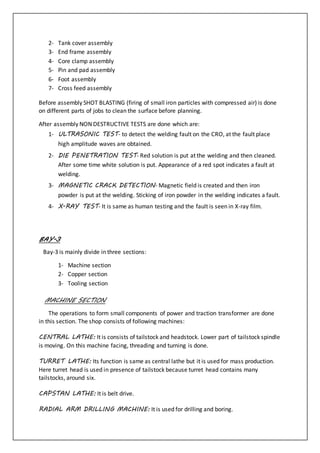
STORE
Here all the material required by the company, is kept, maintained and transported to
various sections of the company.
FABRICATION
Fabrication is nothing but production. It comprises of three bays viz. Bay-0, Bay-1 & Bay-
2.
BAY-0
It is the preparation shop. There are different machines available to perform different
types of functions. This section has the following machines:
 Planar machine- to reduce thickness
 Shearing machine- to shear the metal sheet according to the required dimensions
 CNC Flame cutting machine- to cut complicated shape items using oxy-acetylene
flame
The other cutting machines which use oxy-acetylene are listed below:
o Pantograph machine
o Hand torch cutting machine
 Bending machine- to bend metal sheets and rods
 Flattening machine- in this machine, hammer is used for flattening operation
 Drilling machine- to make hole by drill
BAY-1
It is an assembly shop where different types of tank come from Bay-0. Here welding
processes such as arc welding, CO₂ welding, TIG & MIG welding are used for assembly, after
which a long surface is obtained. Grinder operating at 1200 rpm is used to eliminate the
roughness.
BAY-2
It is an assembly shop dealing with making different objects mentioned below:
1- Tank assembly
2- Tank cover assembly
3- End frame assembly
4- Core clamp assembly
5- Pin and pad assembly
6- Foot assembly
7- Cross feed assembly
Before assembly SHOT BLASTING (firing of small iron particles with compressed air) is done
on different parts of jobs to clean the surface before planning.
After assembly NON DESTRUCTIVE TESTS are done which are:
1- ULTRASONIC TEST- to detect the welding fault on the CRO, at the fault place
high amplitude waves are obtained.
2- DIE PENETRATION TEST- Red solution is put at the welding and then cleaned.
After some time white solution is put. Appearance of a red spot indicates a fault at
welding.
3- MAGNETIC CRACK DETECTION- Magnetic field is created and then iron
powder is put at the welding. Sticking of iron powder in the welding indicates a fault.
4- X-RAY TEST- It is same as human testing and the fault is seen in X-ray film.
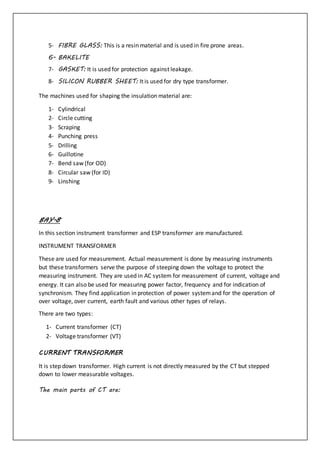
BAY-3
Bay-3 is mainly divide in three sections:
1- Machine section
2- Copper section
3- Tooling section
MACHINE SECTION
The operations to form small components of power and traction transformer are done
in this section. The shop consists of following machines:
CENTRAL LATHE: It is consists of tailstock and headstock. Lower part of tailstock spindle
is moving. On this machine facing, threading and turning is done.
TURRET LATHE: Its function is same as central lathe but it is used for mass production.
Here turret head is used in presence of tailstock because turret head contains many
tailstocks, around six.
CAPSTAN LATHE: It is belt drive.
RADIAL ARM DRILLING MACHINE: It is used for drilling and boring.
HORIZONTAL BORING MACHINE: It is computerized and used for making bore, facing
etc.
MILING MACHINE: It is of two types-
a) Horizontal milling machine: it is used for making gear and cutting operations.
b) Vertical milling machine: by this machine facing, cutting and T-slot cutting is done.
COPPER SECTION
All the processes related to copper are done here.
TUBE SLITTING MACHINE: This machine is developed here and is used for cutting the
tube along its length and across its diameter. Its blade thickness is 3 mm.
SHEARING MACHINE: It is operated hydraulically and its blade has V-shape and
thickness of 15mm.
DIE AND PUNCHING MACHINE: It is also hydraulically operated and has a die and
punch for making holes.
HYDRAULIC BANDING MACHINE: It is used for bending the job up to 90⁰.
SHEARING MACHINE: It is fully mechanical and is used to cut the job along its width.
FLY PRESS MACHINE: It is used to press the job. It is operated mechanically by a
wheel, which is on the top of machine.
BEND SAW MACHINE: This is used for cutting the job having small thickness. It has a
circularly operated blade, around 5.1 m long.
WATER COOLED BRAZING MACHINE: It contains two carbon brushes. The sheet is
put along with a sulphas sheet and the carbon brushes are heated. A lap joint is formed
between the sheets as the sulphas sheet melts.
LINCING BELT MACHINE: It creates a smooth surface.
HYDRAULIC PRESS MACHINE: To press the job.
SOLDER POT MACHINE: It has a pot that contains solder. Solder has composition of
60% zinc and 40% lead.
TOOLING SECTION
In this section servicing of tool is done.
BLADE SHARP MACHINE: It sharpens the blade using a circular diamond cutter. Blade
of CNC cropping line machine is sharpened here.
MINI SURFACE GRINDER MACHINE: It serves grinding purpose. It has a grinding
wheel made of “ALIMINIUM OXIDE”.
TOOL AND SURFACE GRINDING MACHINE: This is specially used to grind the tools
used in Bay-7.
DRILL GRINDING MACHINE: To grind the drills.
BAY-4
This is winding section. Types of windings are:
1- Reverse section locomotive winding
2- Helical winding
3- Spiral winding
4- Interleaved winding
5- Half sectional winding
There are four types of coil fixed in a transformer, they are:
1- Low voltage coil (LV)
2- High voltage coil (HV)
3- Tertiary coil
4- Tap coil
The type of winding depends upon job requirement. Also, the width and thickness of
conductors are designed particulars and are decided by design department. Conductors
used for winding is in the form of very long strips wound on a spool, the conductor is
covered by cellulose paper for insulation.
For winding, first the mould of diameter equal to inner diameter of required coil is made.
The specification of coil is given in drawing. The diameter of mould is adjustable as its body
is made up of wooden sections that interlock with each other. This interlocking can be
increased or decreased to adjust the inner diameter of coil.
BAY-5
It is core and punch section. The lamination used in power, dry, ESP transformers etc. for
making core is cut in this section.
CRGO (cold rolled grain oriented) silicon steel is used for lamination, which is imported in
India from Japan, U.K. and Germany. It is available in 0.27 and 0.28 mm thick sheets, 1 m
wide and measured 1kg. The sheets are coated with very thin layer of insulating material
called “calcites”.
For the purpose of cutting and punching the core three machines are installed
in shop.
1- SLITTING MACHINE: It is used to cut CRGO sheets in different width. It has a
circular cutter whose position can be changed as par the requirement.
2- CNC CROPPING LINE PNEUMATIC: It contains only one blade, which can
rotate 90⁰ about the sheet. It is operated pneumatically.
3- CNC CROPPING LINE HYDRAULIC: It is also used to cut the CRGO sheet. It is
operated hydraulically. It contains two blades, one is fixed and other rotates 90⁰
above the sheet. M4 quality sheet 0.23-0.33 mm thickness is used.
BAY-6
Single phase traction transformer for AC locomotives is assembled in this section. These
freight locomotive transformers are used where there is frequent change in speed. In this
bay core winding and all assembly and testing of traction transformer is done. Three phase
transformer for ACEMU are also manufactured in this section. The supply line for this
transformer is of 25KV and power of the transformer is 6500KVA.
The tap changer of rectifier transformer is also assembled in this bay. Rectified transformer
is used in big furnaces like the thermal power stations/plants (TPP).
BAY-7
This is the insulation shop. Various types of insulation used are:
1- AWWW: All Wood Water Washed press paper. The paper is 0.2-0.5mm thick
cellulose and is wound on the conductors for insulation.
2- PRE-COMPRESSED BOARD: This is widely used for general insulation and
separation of conductors in the form of blocks.
3- PRESS BOARD: This is used for separation of coils e.g. LV from HV. It is up to
38mm thick.
4- UDEL: Un-Demnified Electrical Laminated wood or permawood. This is special type
of plywood made for insulation purposes.
5- FIBRE GLASS: This is a resin material and is used in fire prone areas.
6- BAKELITE
7- GASKET: It is used for protection against leakage.
8- SILICON RUBBER SHEET: It is used for dry type transformer.
The machines used for shaping the insulation material are:
1- Cylindrical
2- Circle cutting
3- Scraping
4- Punching press
5- Drilling
6- Guillotine
7- Bend saw (for OD)
8- Circular saw (for ID)
9- Linshing
BAY-8
In this section instrument transformer and ESP transformer are manufactured.
INSTRUMENT TRANSFORMER
These are used for measurement. Actual measurement is done by measuring instruments
but these transformers serve the purpose of steeping down the voltage to protect the
measuring instrument. They are used in AC system for measurement of current, voltage and
energy. It can also be used for measuring power factor, frequency and for indication of
synchronism. They find application in protection of power systemand for the operation of
over voltage, over current, earth fault and various other types of relays.
There are two types:
1- Current transformer (CT)
2- Voltage transformer (VT)
CURRENT TRANSFORMER
It is step down transformer. High current is not directly measured by the CT but stepped
down to lower measurable voltages.
The main parts of CT are:
a) BODY: The main body is a bushing, which houses the winding and also acts as an
insulator.
 The CT has a bottom and top chamber.
 The top chamber is a cylindrical tank of mild steel. It has terminals for
connectivity oh HV coils. It also has large glass window to indicate the oil
level.
 Below the top chamber is the bushing made of porcelain. It has several folds
rain sheds to provide a specific electric field distribution and long leakage
path. Some bushings are cylindrical while modern ones are conical as amount
of oil porcelain used is reduced without any undesirable effect.
 Bottom chamber houses the secondary winding. There is also connection box
to which the connection of the low voltage coil is made.
b) WINDINGS: The primary winding consists of hollow copper/aluminium pipe bent in
the form of “U”. Aluminium is used for low rating. For higher ratings a set of wires is passed
through the pipe. For still higher ratings a copper pipe is used and for highest rating copper
pipe with copper wires passing through it is used. This arrangement depends on the current
carrying capacity. The bent portion of primary as in bottom chamber whereas the free end
in the top chamber. The straight portion lies inside the bushing.
The primary is wound with crepe paper insulation. The thickness of the insulation goes in
increasing as we go downwards in the bottom chamber. The free ends are provided with
“ferrules”, which are, small hollow cylinders through which wires can pass connection to the
primary are made through these ferrules.
The secondary is divided in a number of coils for different set of tapings. Connections in
different tapings are made in connection box. Each coil has an annular core of CRGO. The
wire used is insulated copper wire. The winding may be done both manually and by
machine. After winding the coils are covered with paper tape insulation. The coils are then
slipped into both the legs of the primary winding and connections are made in connection
box for different tapping.
VOLTAGE TRANSFORMER
This is also a step down transformer. The outer construction is same as that of the CT i.e.
this also has a top chamber, bushing and a bottom chamber. The difference is only in the
winding.
WINDINGS: the primary winding is of thick wire having a few turns. The winding is heavily
insulated with paper insulation. It has a hollow cylinder passing centrally through it, which
houses the secondary winding. The customer gives the choice of paint. Epoxy paint is
generally used in chemical plants and seashore installation. Terminals are then mark and
ratings diagram plate is fixed.
The job is then sent to the shipping department, which take care of its dispatch by packing it
in the wooden boxes.
ESP TRANSFORMER
The electrostatic precipitator transformer is used for environmental application. It is used to
filter in a suspended charge particle in the waste gases of an industry. They are of particular
use in the thermal power stations and cement industry.
The ESP is a single phase transformer. It has a primary and secondary. The core is laminated
and is made up of CRGO silicon steel. It is a step up transformer. An AC reactor is connected
in series with primary coil. The output of transformer must be DC that is obtained by using a
bridge rectifier. A radio frequency choke is connected in series with the DC output for the
protection of the secondary circuit and filter circuit. The output is chosen negative because
the particles are positively charged. The DC output from the secondary is given to a set of
plates arranged one after the other. Impurity particles being positively charged stick to
these plates, which can be jerked off. For this a network of plates has to be setup all across
the plant. This is very costly process in comparison with the transformer cost. A relive vent is
also provided to prevent the transformer from bursting if higher pressure develops inside it.
It is the weakest point in the transformer body. An oil temperature indicator and the
secondary supply spark detector are also provided. One side of the transformer output is
taken and the other side has a “marshalling box “which is the control box of the
transformer.
BAY-9
In this bay power transformer are assembled. After taking different input from different
bays, assembly is done.
Power transformer is used to step up and step down voltages at generating and substations.
There are various ratings- 11KV, 22KV, manufactured; they are generator transformer,
system and auto transformer.
A transformer in a process of assemblage is called a job. The design of the transformer is
done by the design department and is unique to each job as per customer requirement. The
design department provides drawing to the assembly shop, which assembles it accordingly.
The steps involved in assembly are:
1- Core building
2- Core lifting
3- Unlacing
4- Reaching and end frame mounting HV terminal gear and LV terminal
gear mounting
5- Vapour phasing and oil soaking
6- Final servicing and tanking
7- Case fitting
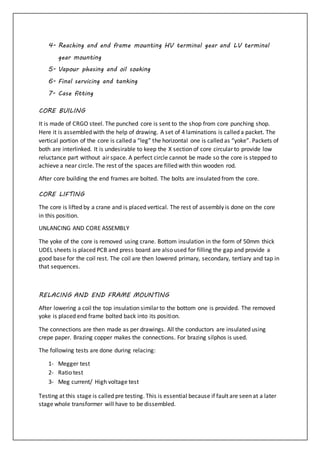
CORE BUILING
It is made of CRGO steel. The punched core is sent to the shop from core punching shop.
Here it is assembled with the help of drawing. A set of 4 laminations is called a packet. The
vertical portion of the core is called a “leg” the horizontal one is called as “yoke”. Packets of
both are interlinked. It is undesirable to keep the X section of core circular to provide low
reluctance part without air space. A perfect circle cannot be made so the core is stepped to
achieve a near circle. The rest of the spaces are filled with thin wooden rod.
After core building the end frames are bolted. The bolts are insulated from the core.
CORE LIFTING
The core is lifted by a crane and is placed vertical. The rest of assembly is done on the core
in this position.
UNLANCING AND CORE ASSEMBLY
The yoke of the core is removed using crane. Bottom insulation in the form of 50mm thick
UDEL sheets is placed PCB and press board are also used for filling the gap and provide a
good base for the coil rest. The coil are then lowered primary, secondary, tertiary and tap in
that sequences.
RELACING AND END FRAME MOUNTING
After lowering a coil the top insulation similar to the bottom one is provided. The removed
yoke is placed end frame bolted back into its position.
The connections are then made as per drawings. All the conductors are insulated using
crepe paper. Brazing copper makes the connections. For brazing silphos is used.
The following tests are done during relacing:
1- Megger test
2- Ratio test
3- Meg current/ High voltage test
Testing at this stage is called pre testing. This is essential because if fault are seen at a later
stage whole transformer will have to be dissembled.
HV TERMINAL GEAR AND LV TERMINAL GEAR MOUNTING
Terminal gears are accessories provided at high voltage and low voltage terminals. Main
device used is tap changer. Tap changer can be on load or offload. In offload type the supply
has to be tripped then the tapings changes, but in on load type the tapings can be changed
while the supply is on. On load type changer (OLTC) are used where the supply is desirable
to be continuous.
The upper portion of the OLTC contains mechanism by which taping is changed. There is
switch which changes tap in very small time. But there is a possibility of sparking. To get rid
of it, OLTC is filled with oil. The bottom part houses the terminals and the mechanism, which
makes automatic connections.
The terminals are made of thick aluminium strips.
VAPOUR PHASING AND OIL SOAKING
It is well known fact that impure water conducts electricity. Therefore, moisture presence in
transformer will effect insulation; the process of moisture removal from transformer is
called vapour phasing.
The job is put in a dummy type and placed in a vacuum vessel. It is an airtight chamber with
heating facilities. A solvent vessel is released in the chamber which enters all transformer
parts and insulations. It absorbs water rapidly. The job is heated in vacuum. All the solvent
vapours are sucked out with moisture.
Metals contain no moisture but a lot of insulations are provided which contains moisture
and if not taken care of, may burst the job.
After moisture removal tank is filled with transformer oil and soaked for at least three
hours, so that everything gets wet with oil.
The job remains in vessel for three days during phasing. It is taken out of the vessel and also
out of the dummy time.
FINAL SERVICING AND TANKING
After taking job out of the dummy time all the parts retightened and any other defect are
rectified and job is retimed in mild steel tank. After tanking oil is filled.
CASE FITTING
The accessories are fixed and final touches given to job. The accessories include tank cover,
fixing bushing, fixing valves etc. the terminals are marked and rating and diagram plate is
fixed by bolting.
Bushings are hollow to provide a passage for conductor; oil is filled inside the hollow spaces
for better insulation. Bushing is built on a mild steel base, which is bolted to bottom
chamber with a cork gasket in vacuum.
The bottom chamber is mild steel tank with a steel frame attached to its base for earthling.
This chamber houses the secondary winding.
TRANSFORMER ENGINEERING (T.R.E.)
This section deals with the designing of all types of transformer. The design is prepared here
and then sent to different departments. The transformer manufactured in BHEL Jhansi
ranges from 10 MVA to 240 MVA and up to 220KV. The various types of transformer
manufactured in this unit are:
POWER TRANSFORMER
a) Generator transformer
b) System transformer
c) Auto transformer
SPECIAL TRANSFORMER
a) Freight loco
b) ESP
c) Instrument
d) Dry type
All the above types are oil cooled except dry type, which is air cooled.
The generator voltages at the power station are 6.9KV, 11KV and 13.8KV but due to certain
advantages like economical generation 11KV is most widely used. For this voltage needs to
be stepped up. Transmission at higher voltage is desirable because it result in lesser losses,
needs thinner wire and hence is economical. If the current is kept high the copper losses
becomes very high but iron losses are practically constant.
In certain cases the required voltage may be less than the output voltage, so in order to
obtain we require a taping circuit. The output voltage may have a certain percentage
variation, which may be taped in 4 or 6 steps.
The type of tap changer depends on the application of the transformer, where a continuous
power supply is not required an off circuit tap changer (OCTC) may be used and where a
continuous power is a must e.g. at a substation in cities on load tap changer (OLTC) is used.
TECHNOLOGY
This department analyses the changes taking place in the world and suggest changes
accordingly. This is very important because the product must not get obsolete in the market
otherwise they will be rejected by the customer.
Functions of this department are:
 Processing sequence: the sequence of process of manufacturing is decided for
timely and economic completion of the job.
 Operation time estimate: it includes incentives scheme management.
 Allowed operation time: it includes incentive amount.
TRANSFORMER COMMERCIAL (T.R.C.)
The objective if the department is interaction with the customers. It brings out tenders and
notices and also responds to them. It is this department that bags contracts of building
transformers. After delivery regarding faults, this department does failures and
maintenance. All such snags are reported to them and they forward the information to the
concerning department.
The main work of the TRC is classified as:
1- Tenders and notices
2- Interaction with design department
3- Place of the work
4- Approximate cost of the work
5- Earnest money
6- The place and the time where documents can be seen
7- The place and time where tenders documents can be obtained
8- The time up to which the tender documents will be sold.
LOCOMOTIVE COMMERCIAL (LMC)
The LMC department functions same as TRC. It takes up order for diesel and electric locos
and report to the concerning manufacturing departments. The orders of small capacity
diesel loco are usually given by large firms such as Coal India Limited (CIL), SAIL and
RELIANCE INDUSTRIES etc. the orders for heavy duty electric loco are given by Indian
Railways.
LOCOMOTIVE MANUFACTURING (LMM)
The loco manufacturing department may be broadly classified as:
 Electric loco manufacturing
 Diesel loco manufacturing
Each of the above 2 manufacturing department is further divided into different shops as
loco store, bogie shop, testing shop etc.
This unit deals with the complete assembly of loco till the end. The
important works done here are:
 Centre pivot assembly
 Suspension tube assembly
 Wheel pressing
 Axle wheel assembly
 Mounting of traction motors
 Mounting of upper and lower base of bogie
 Brake gear assembly
 Testing of traction motor
 Mounting of compressors, transformer, pantograph etc.
 Final circuiting and piping
 Welding and painting of loco
Some of the important machines in the machine area are:
1. Wheel press
2. Axle turning machine
3. CNC lathe machine
4. Turret lathe machine
5. CNC axle gearing machine
6. CNC vertical boring machine
7. Hydraulic press
8. Electric heated oven
WHEEL PRESS MACHINE
RATING:
Power of ram-5000KN
Wheel diameter-1400mm
Max. Distance between ram and res. Head-3000mm
Max. Working pressure-400 bar
Weight of wheel set between centres-5000kg
It is used for mounting of wheel in the axle. The force required for pressing the wheel in the
axle varies from engine to engine.
ELECTRIC HEATED OVEN:
RATING:
Chamber size-1500mm x 1250mm
Temp. Rating-350⁰C (max)
Power rating-40KW
TRACTION MOTOR:
RATING:
RPM Volts Amperes Output (KW)
Continuous rating 895 750 900 630
One hour rating 877 750 960 670
Max. value 2150 900 1350
LOCOMOTIVE ENGINEERING (LME):
Like as TRE, this department deals with design of diesel and electric locos. Design of
assembly of different parts is prepared here and sent to the concerned manufacturing units.
QUALITY CONTROL:
There is central quality service department whose duty is to maintain quality & satisfy
customer needs. Each manufacturing department has a quality control section.
TESTING:
 After complete assembly of loco, all types of testing are done in this shop. Air-brakes
are tested for any leakage and are corrected accordingly. All the electrical and
electronic equipment’s are tested including all digital displays. Functioning of
transformer, compressors and other machinery is also checked. The company owns a
nearly 20 KM railway track to perform all kind of run test. Rain test is also performed
to check for chances of short circuiting.
WORK, ENGINEERING AND SERVICES:
This department looks after the commission and maintenance of all the machinery used in
the factory. It also has 3 two-stage air compressors for supplying compressed air to the
various bays.
The department has 3 different divisions:
 Mechanical engineering
 Electrical engineering
 Electronics engineering
LOCOMOTIVE
 A locomotive or engine is a railway vehicle that provides the motive power for a train.
The word originates from the Latin loco – "from a place", ablative of locus, "place" +
Medieval Latin motivus, "causing motion", and is a shortened form of the
term locomotive engine, first used in the early 19th century to distinguish between
mobile and stationary steam engines.
FIGURE . LOCOMOTIVES MANUFACTURED BY BHEL JHANSI
Brakes
• Brakes used in locomotives (railway trains) to enable deceleration, control acceleration (downhill) or
to keep them standing when parked.
• In the earliest days of railways , braking technology was primitive and the braking effort that could
be achieved was limited.
• As train speeds increased, it became essential to provide some more powerful braking system
capable of instant application and release by the train driver , described as a continuous brake as it
would be effective continuously along the length of the train.
Types of Brakes
Major types of brakes in use are:
1) Air brakes
2) Electro-pneumatic brakes
3) Dynamic brakes
4) Emergency brakes
5) Mechanical braking
6) Vacuum brakes
Brake principle
 A moving train contains energy, known as kinetic energy, which needs to be
removed from the train in order to cause it to stop.
 The simplest way of doing this is to convert the energy into heat.
 The conversion is actually done by attaching a contact material to the rotating
wheels.
 This material creates friction and thus converts the kinetic energy into heat.
 The wheels slow down and eventually the train stops.
 The material used for braking is normally in form of a block or pad.
Vacuum brakes
Principle parts of the vacuum brake systemare:
 Driver’s brake valve
 Exhauster
 Brake pipe
 Dummy coupling
 Coupled hoses
 Brake cylinder
 Vacuum reservoir
 Brake block
 Brake rigging
 Ball valve
Advantage
• The vacuum brake has one major advantage over the original brake system.
• It could provide a partial release which the air brake cannot execute
Disadvantage
• It is slower in operation than the air brake, particularly over a long train.
• A considerable volume of air has to be admitted to the train pipe to make a full
brake application, and a considerable volume has to be exhausted.
• The existence of vacuum in the train pipe causes debris to be sucked in.
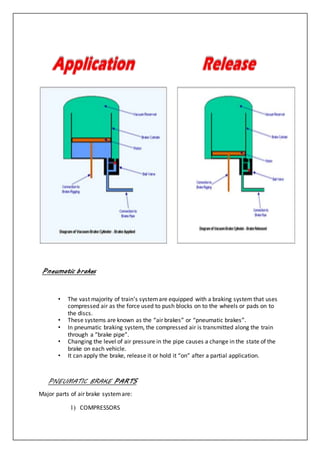
Pneumatic brakes
• The vast majority of train’s systemare equipped with a braking system that uses
compressed air as the force used to push blocks on to the wheels or pads on to
the discs.
• These systems are known as the “air brakes” or “pneumatic brakes”.
• In pneumatic braking system, the compressed air is transmitted along the train
through a “brake pipe”.
• Changing the level of air pressure in the pipe causes a change in the state of the
brake on each vehicle.
• It can apply the brake, release it or hold it “on” after a partial application.
PNEUMATIC BRAKE PARTS
Major parts of air brake systemare:
1) COMPRESSORS
2) MAIN RESERVOIR
3) CUT OFF ANGLE COCK
4) ISOLATING COCK
5) CHECKVALVE WITH CHOKE:
6) CENTRIFUGAL DIRT COLLECTOR:
7) AIR BRAKE HOSE COUPLING
8) SA-9 INDEPENDENT BRAKE VALVE
ELECTRO-PNEUMATIC BRAKES
• A higher performing EP brake has a train pipe delivering air to all the reservoirs
on the train, with the brakes controlled electrically with a 3-wire control circuit.
• This can give several levels of braking, from mild to severe, and allows the driver
greater control over the level of braking used, which greatly increases the
passenger comfort.
• It also allows for faster brake application, as the electrical signal is propagated
effectively instantly to all vehicles in the train.
Advantage
One major advantage of EP brakes is its faster operation as compared to the conventional
systems in which the change in pressure that activates the brake can take several seconds to
propagate fully to the rear of the train.
Disadvantage
One major constraint in front of EP brakes is its high cost due to which it is not used in
freight trains.
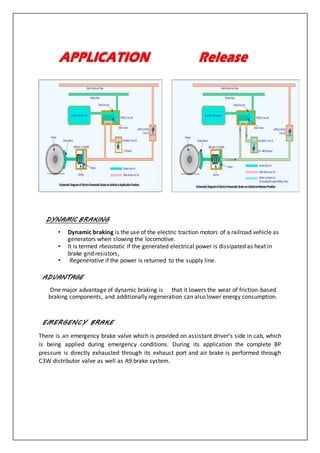
DYNAMIC BRAKING
• Dynamic braking is the use of the electric traction motors of a railroad vehicle as
generators when slowing the locomotive.
• It is termed rheostatic if the generated electrical power is dissipated as heat in
brake grid resistors,
• Regenerative if the power is returned to the supply line.
ADVANTAGE
One major advantage of dynamic braking is that it lowers the wear of friction-based
braking components, and additionally regeneration can also lower energy consumption.
EMERGENCY BRAKE
There is an emergency brake valve which is provided on assistant driver’s side in cab, which
is being applied during emergency conditions. During its application the complete BP
pressure is directly exhausted through its exhaust port and air brake is performed through
C3W distributor valve as well as A9 brake system.
WAG-7
INTRODUCTION
WAG-7 is the name of electric locomotive used in India. It is a very powerful locomotive in
Indian Railways' fleet. Built by Chittaranjan Locomotive Works and BHEL, Jhansi to RDSO
specifications. WAG-7 is an up-rated version of WAG-5 locomotive with high capacity
transformer, rectifier, traction motor, compressor and other matching associated
equipment’s. These are six axles loco with axle and nose suspended drive. The loco is fitted
with six Hitachi designed DC series traction motors types HS15250A, controlled by a tap
changer are used in this locomotive. Indian Railway is going to achieve 700 million tons of
traffic; WAG-7 is the main stay of loco. In the locomotive vehicle market WAG-7 is more
economical option and one of the cheapest in the world.
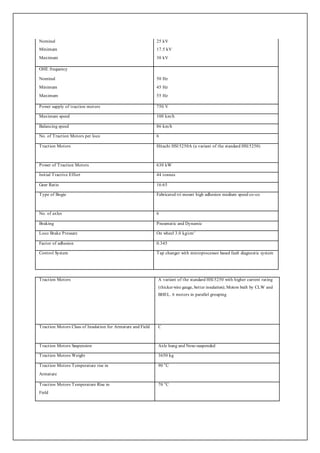
TECHNICAL SPECIFICATION
OF WAG-7
Type of Service Freight
Length 20.394 m
Width 3.005 m
Height 4.162 m
Weight 123 tonnes
Axle Load 20.5 tonnes
Gauge BG 1676 mm
Rated power
Maximum Continuous 5350 hp
5000 hp
OHE Voltage
Nominal
Minimum
Maximum
25 kV
17.5 kV
30 kV
OHE frequency
Nominal
Minimum
Maximum
50 Hz
45 Hz
55 Hz
Power supply of traction motors 750 V
Maximum speed 100 km/h
Balancing speed 86 km/h
No. of Traction Motors per loco 6
Traction Motors Hitachi HS15250A (a variant of the standard HS15250)
Power of Traction Motors 630 kW
Initial Tractive Effort 44 tonnes
Gear Ratio 16:65
Type of Bogie Fabricated tri mount high adhesion medium speed co-co
No. of axles 6
Braking Pneumatic and Dynamic
Loco Brake Pressure On wheel 3.0 kg/cm2
Factor of adhesion 0.345
Control System Tap changer with microprocessor based fault diagnostic system
Traction Motors A variant of the standard HS15250 with higher current rating
(thickerwire gauge, better insulation); Motors built by CLW and
BHEL. 6 motors in parallel grouping
Traction Motors Class of Insulation for Armature and Field C
Traction Motors Suspension Axle hung and Nose-suspended
Traction Motors Weight 3650 kg
Traction Motors Temperature rise in
Armature
90 o
C
Traction Motors Temperature Rise in
Field
70 o
C
Traction Motors Temperature rise in Commutator 85 o
C
Traction Motors Coil resistance at
110 degrees Celsius of Armature
0.0126 Ω
Traction Motors Coil resistance at
110 degrees Celsius of Main pole
0.0117 Ω
Traction Motors Coil resistance at
110 degrees Celsius of Inter pole
0.0089 Ω
Traction Motors Continuous rating 630 kW, 750 V, 900 A, 895 rpm
Traction Motors rating for 1 hour 670 kW, 750 V, 960 A, 877 rpm
Traction Motors Air gap for Main pole 6.35 mm
Traction Motors Air gap for Inter pole 10 mm
Gear Ratio 65:16
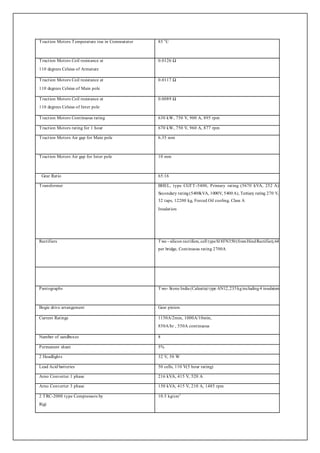
Transformer BHEL, type CGTT-5400, Primary rating (5670 kVA, 252 A)
Secondary rating(5400kVA, 1000V, 5400A), Tertiary rating 270 V,
32 taps, 12200 kg, Forced Oil cooling, Class A
Insulation
Rectifiers Two - silicon rectifiers, cell typeS18FN350(fromHindRectifier),64
per bridge, Continuous rating 2700A
Pantographs Two- Stone India (Calcutta) type AN12,235kgincluding4 insulators
Bogie drive arrangement Gear pinion
Current Ratings 1150A/2min, 1000A/10min,
850A/hr , 550A continuous
Number of sandboxes 8
Permanent shunt 5%
2 Headlights 32 V, 50 W
Lead Acid batteries 50 cells, 110 V(5 hour rating)
Arno Converter 1 phase 216 kVA, 415 V, 520 A
Arno Converter 3 phase 150 kVA, 415 V, 210 A, 1485 rpm
2 TRC-2000 type Compressors by
Rigi
10.5 kg/cm2
2 Compressor Motors 30 hp, 415 V, 930 rpm
2 Exhauster Motors 7.5 kW, 415 V, 970 rpm
2 250 RE type Exhausters by North 4500 litres/minute
2 SF India Ltd. Traction Motor
Blowers
276 m3
/min.
2 Traction Motor Blower Motors by
Siemens
415 V, 26 kW, 50 A, 2920 rpm
2 PFT-59 type Smoothing Reactors by SF India Ltd. 4200 m3
/min.
2 Smoothing Reactor Motors 2.2 kW, 415 V, 2860 rpm
2 KDBR-1 type BreakingResistor Blowers by KEC International 510 m3
/min.
Breaking Resistor Blower Motor 30 kW, 450 V, 76 A DC, 3300 rpm
Brushes grade EG1055/BG 1165(Margnite)
Brushes type 2 split
Brushes size 200 X 40 X 64 mm
Brushes Wear limit 25 mm
2 PHMX-40-6 type Rectifier Blowers by SF India Ltd. 3100-3200 m3
/hour
2 Rectifier Blower Motors 2.2 kW, 415 V, 4.8A, 2860 rpm
MLBH-60-1-H2 type Coil Cooler Blower by SF India Ltd. 22200 m3
/hour
Coil Cooler Blower Motor 22 kW, 415 V, 45 A, 1450 rpm
Oil Pump by Best & Co. Pvt. Ltd. 730 litres/minute
Oil Pump Motor 32 kW, 415 V, 2865 rpm
2 SL 30 type Smoothing Reactors 1250 V, 1350 A
Smoothing Reactor Resistance at 110 o
C 0.00344 Ω
FIGURE . BLOCK DIAGRAM OF AC LOCOMOTIVE WAG-7
FIGURE . INTERIOR VIEW OF WAG-7
PNEUMATIC FUNCTIONS IN WAG-7
Pressurized or compressed air is used for following proposes in WAG-7:
CONTACTORS:
BA panels are there, two in number that are consisting of various contactors and pneumatic
valves. Because of very high voltage of 25KV, there is possibility of very heavy sparking while
switching on various switches, therefore these contactors are used in which pressurized air
is passed through magnetic and pneumatic valves which reduces chances of sparking and
makes contacts with switches.
WIPING, HORN AND SANDING:
This is also a major use of air in locomotives. There are separate reservoirs for
each operation.
PANTOGRAPH RISING:
Pantograph is used for collecting current from OHE. For this, there is an auxiliary
compressor which is started first; this creates pressurized air so that servomotor can be
started and pantograph can raised.
AIR BRAKING:
The vast majority of the world’s trains are equipped with braking systems which use
compressed air as the force used to push blocks on the wheels or pads on to discs. These
systems are known as “air brakes” or “pneumatic brakes”. Changing the level of air pressure
in the pipe causes a change in the state of the brake on each vehicle. It can apply the brakes,
release it or hold it “on” after a partial application.
PNEUMATIC EQUIPMENTS
Various pneumatic equipment generally used in a WAG-7 are:
1)COMPRESSORS:
They are 3 in numbers and used to pump compressed air to the reservoirs. The flow
of air or pressure is maintained by governor through “loading “and “unloading”
stages. The compressor must build reservoir pressure from 50 to 90 psi.
2)MAIN RESERVOIR:
They are 4 in number and named as MR1, MR2, MR 3 & MR4. Their capacity is 205
liters and are tested to withstand pressure about 16 kg/cm². First reservoir to
chamber is known as supply reservoir. The other reservoirs are known as dry
reservoirs.
3)CUT OFF ANGLE COCK:
Cut off cocks are provided at the end of brake pipe and feed pipe on each loco to
maintain flow of air in the air brake system during the run of the vehicle. These cocks
are closed while isolating the vehicle from the train for any reason.
4)ISOLATING COCK:
Ball type isolating cocks are used to provide facility for cutting off of air supply to
auxiliary reservoir from feed pipe.
5)CHECKVALVE WITH CHOKE:
Check valve are used between feed pipe and auxiliary reservoir to permit flow of air
from feed pipe to auxiliary reservoir in one direction only.
6)CENTRIFUGAL DIRT COLLECTOR:
It is used for the removal of dirt as well as heavy particles prior to the entry of air in
the system by centrifugal action.
7)AIR BRAKE HOSE COUPLING BRAKE PIPE AND FEED PIPE:
Air brake hose couplings are used in between two adjacent vehicles for continuation
of air flow between brake pipes as well as in feed pipe lines.
8)BALL TYPE COCKS:
These are used for insulation of air supply in the pneumatic circuits. The body of ball
type cocks is made of steel and ball is made of stainless steel.
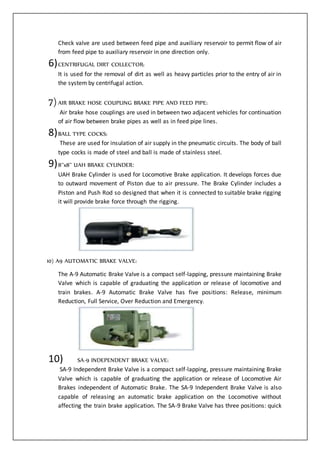
9)8’’x8’’ UAH BRAKE CYLINDER:
UAH Brake Cylinder is used for Locomotive Brake application. It develops forces due
to outward movement of Piston due to air pressure. The Brake Cylinder includes a
Piston and Push Rod so designed that when it is connected to suitable brake rigging
it will provide brake force through the rigging.
10) A9 AUTOMATIC BRAKE VALVE:
The A-9 Automatic Brake Valve is a compact self-lapping, pressure maintaining Brake
Valve which is capable of graduating the application or release of locomotive and
train brakes. A-9 Automatic Brake Valve has five positions: Release, minimum
Reduction, Full Service, Over Reduction and Emergency.
10) SA-9 INDEPENDENT BRAKE VALVE:
SA-9 Independent Brake Valve is a compact self-lapping, pressure maintaining Brake
Valve which is capable of graduating the application or release of Locomotive Air
Brakes independent of Automatic Brake. The SA-9 Independent Brake Valve is also
capable of releasing an automatic brake application on the Locomotive without
affecting the train brake application. The SA-9 Brake Valve has three positions: quick
release, release and application.
11) F-1 SELECTOR VALVE:
The F-1 Selector Valve performs the function of commanding the brake equipment
on the locomotive to lead or trail position of the adjacent locomotive and ensures
operation of brakes in the trail locomotives when initiated from the lead locomotive.
12) C2W RELAY AIR VALVE:
The C2W Relay Air Valve is a diaphragm cooperated self-lapping valve having higher
capacity which is used as a remote controlled pneumatic device to relay a large
quantity of main air reservoir pressure to the operating system for brake application.
13) MU-2B VALVE:
The MU-2B Valve is a manually operated, two position and multi-ported valve
arranged with a pipe bracket and is normally used for locomotive brake equipment
for multiple unit service between locomotives equipped with similar system in
conjunction with F-1 Selector Valve.
14) C3W DISTRIBUTOR VALVE:
C3W Distributor Valve is a graduated release UIC approved Distributor Valve for
application in the Coach Brake System used for initiating the brake application. These
valves are supplied in Aluminum version as well as Cast Iron version as far as Body,
Top covers and Bottom Covers are concerned.
15) J-1 SAFETY VALVE:
The J-1 Safety Valve installed vertically in the main reservoir system vents pressure
at a predetermined setting to atmosphere in order to prevent excessive main
reservoir pressure buildup.
16) N-1 REDUCING VALVE:
The N-1 Reducing Valve reduces the pressure of compressed air supply to a constant
predetermined value and delivers the same usually for operation of auxiliary devices.
17) 24-A DOUBLE CHECK VALVE:
The 24-A Double Check Valve is used to permit a device to be controlled by either of
two other devices.
18) D-1 EMERGENCY BRAKE VALVE:
The D-1 Emergency Brake Valve is a manually operated device which provides a
means of initiating an emergency brake application.
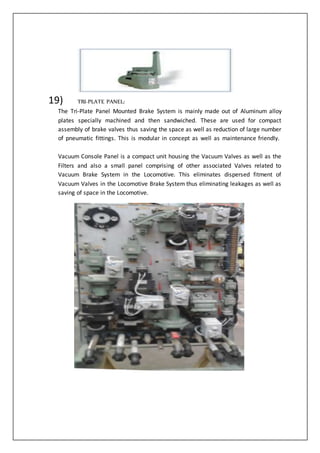
19) TRI-PLATE PANEL:
The Tri-Plate Panel Mounted Brake System is mainly made out of Aluminum alloy
plates specially machined and then sandwiched. These are used for compact
assembly of brake valves thus saving the space as well as reduction of large number
of pneumatic fittings. This is modular in concept as well as maintenance friendly.
Vacuum Console Panel is a compact unit housing the Vacuum Valves as well as the
Filters and also a small panel comprising of other associated Valves related to
Vacuum Brake System in the Locomotive. This eliminates dispersed fitment of
Vacuum Valves in the Locomotive Brake System thus eliminating leakages as well as
saving of space in the Locomotive.
MAIN AIR SYSTEM
Compressors deliver compressed air at 8-10 kg/cm² to system via check valve and shorted to
flow past additional cooling pipe, 2 nos. after cooler, centrifugal dirt collector with reservoir
& drain cock, MR1, MR2, CDC with reservoir & drain cock & isolating cock to brake air
system.
Main air supply is also taken to loco control equipment and air flow measuring devices from
MR3 and MR equalizing pipe from MR2.
Main air supply for sanding equipment, both end cab wipers are taken from MR equalizing
pipe. MR supply for feed pipe is also taken from MR equalizing pipe via isolating cock and
finally reduced to 6 kg/cm² through feed valve. MR equalizing pipe pressure is also tapped
to port 15 of f1 selector valve for its function.
MR3 and MR4 are provided with individual drain cocks. But MR1 and MR2 are provided with
common drain cock. MR air between main compressor and their respective check valve is
also piped to unloader valves, which are provided for each compressor for unloading during
cut-out.
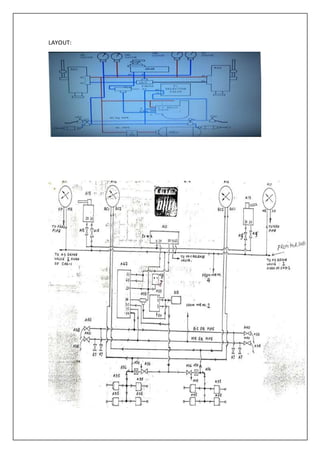
INDEPENDENT BRAKING THROUGH SA-9 BRAKE VALVE
SA9 brake system is used only when engine is running alone. The compressor supply
compressed air to fill up reservoirs MR1, MR2, and MR3 & MR4. MR2 & MR3 and MR3 &
MR4 are connected through check valves which permit flow of air in one direction only.
MR3 is used for other connections like sand, wiping and electric controls. Thus for any
leakage in MR3, the pressure in reservoir MR4 will not drop. After MR4 there is an
isolating cock to provide facility for cutting off of air supply. The system is placed in both
the cabs and can be operated from any cab.
However while operating the brakes from any cab; the control from the other cab must
be closed. To facilitate this two isolating cocks for provided to each cab. The supply of
MR4 reaches to port 1 of C2W relay valve from where it can be transmitted to brake
cylinders.
On released situation port 30 is connected with port 20. This allows pressure to flow till
port 2 of MU2B valve. The pressure reaches to port 20 of MU2B valve. Thus there is
pressure build up at port 2 of C2W relay valve. The pressure at port 2 proportionally
closes port 1 of C2W and port 3 is connected to exhaust. So in released position brake
cylinders are connected to exhaust at atmospheric pressure. Hence there is no braking.
When the handle in one of the cab is moved to applied position, post 20 gets connected
to exhaust and there is no pressure build up at 2 of MU2B valve. The pressure at port 20
of MU2B falls which results in fall in pressure at port 2 of C2W relay valve. The fall in
pressure proportionally allows port 1 of C2W relay valve to connect with port 3. Thus
the pressure from MR4 reaches to brake cylinders via port 1 and port 3 of C2W relay
valve. Hence brakes are applied.
SIMPLE FLOW DIAGRAMS
RELEASE POSITION:
APPLICATION POSITION:
LAYOUT:
BRAKING THROUGH A9 AUTO BRAKE VALVE
A9 brakes system is used when the engine is connected with bogies. Like as SA9, this
system has compressor, 4 main reservoirs and different valves. The system is same in both
the cabs.
When the handle of the brake u=is set to release position, port 30 is connected to port 5
and a pressure of around s kg/cm² is build up in BP. The pressure flows through port 3 and
port 13 of MU2B and reaches to port 2 of C2W relay valve. The pressure at port 2
proportionally connects port 1 to port 3. Thus there is pressure build at BP and MR
disconnects to BC. So pressure at brake cylinders falls and there is no braking.
In applied position port 30 disconnects to port 5 and port 5 connects to exhaust in
proportion of handle moved. The pressure falls at port 3 and 13 of MU2B which reaches to
port 2 of C2W relay valve. The fall in pressure proportionally disconnects port 1 and port 3
of C2W valve. The pressure at BP thus falls which proportionally connects MR to BC.
Pressure at BC through valves of F1 selector valve reaches to brake cylinders and hence
brakes are applied. The pressure from C3W distributor valve reaches to F1 selector valve via
N1 reducing valve which reduces pressure to 1.8 kg/cm².
When the brake valve handle is moved in the minimum reduction position, reduction of
pressure in the brake pipe by 0.2 to 0.5 kg/cm² is achieved and proportional application of
brakes on loco and train takes place. In full service of the automatic brake valve handle, the
BP pressure is reduced to 3.5 kg/cm² and in over reduction to 2.5-2.6 kg/cm² is achieved.
EMERGENCY BRAKE
There is an emergency brake valve which is provided on assistant driver’s side in cab, which
is being applied during emergency conditions. During its application the complete BP
pressure is directly exhausted through its exhaust port and air brake is performed through
C3W distributor valve as well as A9 brake system.
SIMPLE FLOW DIAGRAMS :
RELEASE POSITION:
APPLICATION POSITION:
LAYOUT:
PANTOGRAPH RAISING
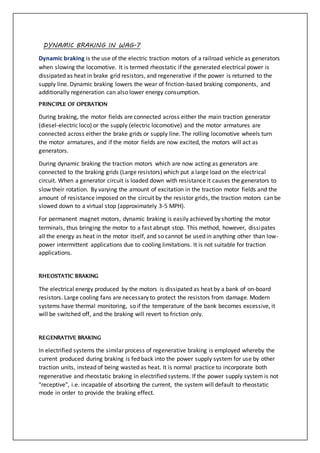
DYNAMIC BRAKING IN WAG-7
Dynamic braking is the use of the electric traction motors of a railroad vehicle as generators
when slowing the locomotive. It is termed rheostatic if the generated electrical power is
dissipated as heat in brake grid resistors, and regenerative if the power is returned to the
supply line. Dynamic braking lowers the wear of friction-based braking components, and
additionally regeneration can also lower energy consumption.
PRINCIPLE OF OPERATION
During braking, the motor fields are connected across either the main traction generator
(diesel-electric loco) or the supply (electric locomotive) and the motor armatures are
connected across either the brake grids or supply line. The rolling locomotive wheels turn
the motor armatures, and if the motor fields are now excited, the motors will act as
generators.
During dynamic braking the traction motors which are now acting as generators are
connected to the braking grids (Large resistors) which put a large load on the electrical
circuit. When a generator circuit is loaded down with resistance it causes the generators to
slow their rotation. By varying the amount of excitation in the traction motor fields and the
amount of resistance imposed on the circuit by the resistor grids, the traction motors can be
slowed down to a virtual stop (approximately 3-5 MPH).
For permanent magnet motors, dynamic braking is easily achieved by shorting the motor
terminals, thus bringing the motor to a fast abrupt stop. This method, however, dissipates
all the energy as heat in the motor itself, and so cannot be used in anything other than low-
power intermittent applications due to cooling limitations. It is not suitable for traction
applications.
RHEOSTATIC BRAKING
The electrical energy produced by the motors is dissipated as heat by a bank of on-board
resistors. Large cooling fans are necessary to protect the resistors from damage. Modern
systems have thermal monitoring, so if the temperature of the bank becomes excessive, it
will be switched off, and the braking will revert to friction only.
REGENRATIVE BRAKING
In electrified systems the similar process of regenerative braking is employed whereby the
current produced during braking is fed back into the power supply system for use by other
traction units, instead of being wasted as heat. It is normal practice to incorporate both
regenerative and rheostatic braking in electrified systems. If the power supply system is not
"receptive", i.e. incapable of absorbing the current, the system will default to rheostatic
mode in order to provide the braking effect.
BLENDED BRAKING
Dynamic braking alone is insufficient to stop a locomotive, as its braking effect rapidly
diminishes below about 10 to 12 miles per hour (16 to 19 km/h). Therefore it is always used
in conjunction with the regular air brake. This combined system is called blended braking. Li-
ion batteries have also been used to store energy for use in bringing trains to a complete
halt.
Although blended braking combines both dynamic and air braking, the resulting braking
force is designed to be the same as what the air brakes on their own provide. This is
achieved by maximizing the dynamic brake portion, and automatically regulating the air
brake portion, as the main purpose of dynamic braking is to reduce the amount of air
braking required. This conserves air, and minimizes the risks of over-heated wheels. One
locomotive manufacturer, Electro-Motive Diesel (EMD), estimates that dynamic braking
provides 50% to 70% of the braking force during blended braking.
REFRENCES
Following are some of the sources I reached out to while working on this project,
 Google
 Wikipedia
 Various project files of my topic “Pneumatic braking system”, obtained from HRD,
BHEL.
CONCLUSION
Air brake or pneumatic brake systemare used by vast majority of the world’s trains. The
system uses compressed air and changing the level of air pressure in the pipe cause a
change in the state of the brake on each vehicle. This systemis quick and effective as
compared to vacuum brakes which are simple in design. An air brake compressor is usually
capable of generating a pressure of 90 psi vs. only 15 psi for vacuum. Therefore, an air brake
system can use a much smaller brake cylinder than a vacuum system to generate the same
braking force. This advantage of air brakes increases at high altitude. The air brake systemis
undoubtedly one of the most enduring features of railway technology. There have been
many improvements over the years but the skill required to control any train fitted with
pure pneumatic brake control is still only acquired with long hours of practice and care at
every stage of the operation.
BHEL Project

BHEL Project

  • 1.
    BHARAT HEAVY ELECTRICALSLIMITED SUMMER TRAINING PROJECT REPORT 2016 REPORT ON PNEUMATIC BRAKING SYSTEM UNDER THE GUIDANCE OF: SUBMITTED TO: Mr B.N Naik Mr. Dhruv Bhargav (DGM LMM) (AGM HRD) Mr. Y.R. Tripathi (sen. Engg. LMM) SUBMITTED BY:
  • 2.
    Siddhartha singh jadaun B.Tech3rd Year Mechanical Engineering GLA University,(Mathura) ACKNOWLEDGEMENT I am extremely thankful and indebted to the numerous BHEL engineers, who provided vital information about the functioning of their respective departments thus helping me to gain an overall idea of the working of the organization. I am highly thankful to my project guide Mr B.N Naik (DGM ,LOCOMOTIVE DEPARTMENT) and Mr. Y.R. Tripathi (Engineer, Locomotive Department) for giving me the chance to get acquainted with various aspects of locomotive breaking system. Last but not the least I would like to thank my parents and all my fellow trainees who have been a constant source of inspiration and encouragement during my studies and training.
  • 3.
    CONTENTS S.NO Topic NamePage No. 1 BHEL -INTRODUCTION 4 2 BHEL Jhansi 10 3 VISION, MISSION ,VALUES 11 4 ROTATION REPORT 12 5 Locomotive 26 6 Brakes 26 7 Types of brakes 27 8 WAG-7 31 9 T.S. OF WAG-7 31 10 PNEUMATIC FUNCTIONS 36 11 PNEUMATIC EQUIPMENTS 37 12 MAIN AIR SYSTEM 42 13 SA-9 BRAKE VALVE 43 14 A-9 AUTO BRAKE VALVE 46 15 RAISING OF PANTOGRAPH 51 16 DYNAMIC BRAKING 52 17 REFRENCES 53 18 CONCLUSION 53
  • 4.
    BHARAT HEAVY ELECTRICALSLIMITED INTRODUCTION Bharat Heavy ElectricalsLimited (BHEL) is one of the oldest and largeststate- owned engineering and manufacturing enterprise in India in the energy-related and infrastructuresector which includes Power, Railways, Transmission and Distribution, Oil and Gas sectors and many more. It is the 12th largest power equipment manufacturer in the world. In the year 2011, itranked ninth most innovative company in the world by US business magazineForbes. BHEL is the only Indian Engineering company on the list, which contains online retail firm Amazon at the second position with Apple and Google at fifth and seventh positions, respectively. Itis also placed at 4th place in Forbes Asia's Fabulous 50 List of 2010. BHEL was established more than 50 years ago, ushering in the indigenous Heavy Electrical Equipment industry in India. The company has been earning profits continuously since 1971-72and paying dividends since 1976-77.74% of thetotal power generated in India is produced by equipment manufactured by BHEL. Itis one of India's nine largestPublic Sector Undertakings or PSUs, known as the “Navratnas” or 'the nine jewels’. In June 2012, BHEL commissioned a 250 MW power generating unit at Harduaganj in Uttar Pradesh. This would add six million units of electricity on a daily basis. BHEL is an integrated power plant equipment manufacturer and one of the largest engineering and manufacturing companies in India in terms of turnover. Itwas established in 1964, ushering in the indigenous Heavy Electrical Equipment industry in India - a dream that has been more than realized with a well-recognized track record of performance. The company has been earning profits continuously since 1971-72and paying dividends since 1976-77
  • 5.
    Itis engaged inthe design, engineering, manufacture, construction, testing, commissioning and servicing of a wide range of products and services for the core sectors of the economy, viz. Power, Transmission, Industry, Transportation, Renewable Energy, Oil & Gas and Defence. Ithas 15 manufacturing divisions, two repair units, four regional offices, eight service centres, eight overseas offices and 15 regional centres and currently operates at more than 150 projectsites across India and abroad. Itplace strong emphasis on innovation and creative development of new technologies. Their research and development (R&D) efforts are aimed not only at improving the performanceand efficiency of our existing products, butalso at using state-of- the-art technologies and processes to develop new products. This enables them to have a strong customer orientation, to be sensitive to their needs and respond quickly to the changes in the market. The high level of quality & reliability of their products is due to adherence to international standards by acquiring and adapting some of the best technologies from leading companies in the world including General Electric Company, AlstomSA, Siemens AG and MitsubishiHeavy Industries Ltd., together with technologies developed in our own R&D centres. Most of their manufacturing units and other entities have been accredited to Quality Management Systems (ISO 9001:2008),EnvironmentalManagementSystems (ISO 14001:2004) and OccupationalHealth & Safety Management Systems (OHSAS 18001:2007). Ithas a shareof around 59% in India's total installed generating capacity contributing 69% (approx.) to the total power generated from utility sets (excluding non-conventionalcapacity) as of March 31, 2012. Ithas been exporting there power and industry segmentproducts and services for approximately 40 years. Ithas exported our products and services to more than 70 countries. We had cumulatively installed capacity of over 8,500 MW outside of India in 21 countries, including Malaysia, Iraq, theUAE, Egypt and New Zealand. There physicalexports range fromturnkey projects to after sales services. Itworks with a vision of becoming a world-class engineering enterprise, committed to enhancing stakeholder value. There greatest strength is there highly skilled and committed workforceof over 49,000 employees. Every employeeis given an equal opportunity to develop himself and grow in his career. Continuous training and retraining, career planning, a positive work culture and participative styleof management
  • 6.
    - all thesehave engendered development of a committed and motivated workforcesetting new benchmarks in terms of productivity, quality and responsiveness. MANUFACTURING UNITS FIRST GENERATION UNITS BHOPAL HEAVY ELECTRICAL PLANT HARIDWAR HEAVY ELECTRICAL EQUIPMENT PLANT HYDERABAD HEAVY ELECTRICAL POWER EQUIPMENT PLANT TRIUCHY HIGH PRESSURE BOILER PLANT SECOND GENERATION UNITS JHANSI TRANSFORMER AND LOCOMOTIVE PLANT HARIDWAR CENTRAL FOUNDRY AND FORGE PLANT TIRUCHY HIGH PRESSURE BOILER PLANT UNIT THROUGH ACQUISTION AND MERGER BANGALORE ELECTRONICS DIVISION ELECTRO PORCELAIN DIVISION NEW MANUFACTURING UNITS RANIPAT BOILER AUXILIARIES PLANT JAGDISHPUR INSULATOR PLANT RUDRAPUR COMPONENT AND FABRICATION PLANT BANGALORE INDUSTRIAL SYSTEM GROUP
  • 7.
    PRODUCTS  Power  Air Preheaters   Boilers   Control Relay Panels    Electrostatic Precipitators   Fabric Filters   Fans   Gas Turbines   Hydro Power Plant   Piping Systems   Pulverizers   Pumps   Seamless Steel Tubes   Soot blowers   Steam Generators   Steam Turbines   Turbogenerators   Valves  R&D Products   Fuel Cells   Surface Coatings    Load Sensors   Transparent Conducting Oxide  Transportation   Electric Rolling Stock   Electrics for Rolling Stock   Electrics for Urban Transportation System  Non-Conventional Energy Source   Mini/Micro Hydro Sets   Solar Lanterns   Solar Photovoltaics   Solar Water Heating Systems   Wind Electric Generators
  • 8.
     Industry Capacitors  Ceralin  Compressors  Diesel Generating Sets  Industrial Motors & Alternators  Gas Turbines  Oil Field Equipment  Solar Photovoltaics  Power Semiconductor Devices  Seamless Steel Tubes  Steel Castings & Forgings  Steam Generators  Steam Turbines  Turbogenerators  Valves  Desalination Plants  Sootblowers  Transmission   Bushings   Capacitors   Control Relay Panels   Dry-type Transformers   Energy Meters   HVDC Transmission System   Insulators   Switchgears   Power Semiconductor Devices   Power System Studies   Control Shunt Reactor
  • 9.
    BHEL JHANSI INTRODUCTION By theend of 5th five-year plan, it was envisaged by the planning commission that the demand for power transformer would rise in the coming years. Anticipating the country’s requirement BHEL decided to set up a new plant, which would manufacture power and other types of transformers in addition to the capacity available in BHEL Bhopal. The Bhopal plant was engaged in manufacturing transformers of large ratings and Jhansi unit would concentrate on power transformer up to 50 MVA, 132 KV class and other transformers like Instrument Transformers, Traction transformers for railway etc. This unit of Jhansi was established around 14 km from the city on the N.H. No 26 on Jhansi Lalitpur road. It is called second-generation plant of BHEL set up in 1974 at an estimated cost of Rs 16.22 crores inclusive of Rs 2.1 crores for township. Its foundation was laid by late Mrs. Indira Gandhi the prime minister on 9th Jan. 1974. The commercial production of the unit began in 1976-77 with an output of Rs 53 lacs since then there has been no looking back for BHEL Jhansi. The plant of BHEL is equipped with most modern manufacturing processing and testing facilities for the manufacture of power, special transformer and instrument transformer, Diesel shunting locomotives and AC/DC locomotives. The layout of the plant is well streamlined to enable smooth material flow from the raw material stages to the finished goods. All the feeder bays have been laid perpendicular to the main assembly bay and in each feeder bay raw material smoothly gets converted to sub-assemblies, which after inspection are sent to main assembly bay. The raw material that are produced for manufacture are used only after thorough material testing in the testing lab and with strict quality checks at various stages of productions. This unit of BHEL is basically engaged in the production and manufacturing of various types of transformers and capacities. With the growing competition in the transformer section, in 1985-86 it under took the re-powering of DESL. In 1987-88, BHEL progressed a step further in under taking the production of AC locomotives, and subsequently it started manufacturing AC/DC locomotives also. PRODUCTS TRANSFORMERS: TYPE RANGE Power Transformer up to 400 kV/315 MVA
  • 10.
    Rectifier Transformer upto 132 KV/120 kA Furnace Transformer up to 33 kV/60 MVA Transformer for ESP up to 95 kVp/1400mA Voltage Transformer up to 220 kV Current Transformer up to 400 kV Traction Transformers Single Phase Freight Loco - up to 25 kV/5400kVA Three Phase Freight Loco - up to 25 kV/7475kVA up to 25 kV/5400kVA up to 25 kV/7475kVA Transformer for ACEMU up to 25 kV/1550 kVA up to 25 kV/1550 kVA Cast Resin Dry Type Transformer up to 33 kV/15 MVA up to 33 kV/15 MVA LOCOMOTIVES: - Diesel locomotive - AC/DC locomotive - Special purpose wagons - Rail cumroad Vehicle - Synchrolift VISION, MISSION AND VALUES OF BHEL, JHANSI Vision: A world-class Engineering Enterprise committed to Enhancing Stakeholder Value. Mission:
  • 11.
    To be anIndian multinational enterprise providing total business solution through quality products systems and services in the field of energy, transportation, industry, infrastructure and other potential areas. Values: -Ensure speed of Response. -Foster, learning, creativity and teamwork. -Respect for dignity and potential of individuals. -Loyalty and pride in the company. -Zest for change. -Zest to excel. -Integrity and fairness in all matters. -Strict adherence to commitments. ROTATION REPORT SECTIONS OF BHEL JHANSI BHEL JHANSI division has many departments with production and administrative departments separated. Broadly BHEL has two production categories:- 1- Transformer section 2- Locomotive section The production, design and commercial departments of BHEL are:- 1- Store 2- Fabrication 3- T.R.M Bay-3 4- T.R.M Bay-4 5- T.R.M Bay-5 6- T.R.M Bay-6 7- T.R.M Bay-7 8- T.R.M Bay-8 9- T.R.M Bay-9 10- T.R.E. 11- Technology 12- T.R.C. 13- L.M.C. 14- L.M.M. 15- L.M.E. 16- Quality Control
  • 12.
    17- Testing 18- W.E.& S. STORE Here all the material required by the company, is kept, maintained and transported to various sections of the company. FABRICATION Fabrication is nothing but production. It comprises of three bays viz. Bay-0, Bay-1 & Bay- 2. BAY-0 It is the preparation shop. There are different machines available to perform different types of functions. This section has the following machines:  Planar machine- to reduce thickness  Shearing machine- to shear the metal sheet according to the required dimensions  CNC Flame cutting machine- to cut complicated shape items using oxy-acetylene flame The other cutting machines which use oxy-acetylene are listed below: o Pantograph machine o Hand torch cutting machine  Bending machine- to bend metal sheets and rods  Flattening machine- in this machine, hammer is used for flattening operation  Drilling machine- to make hole by drill BAY-1 It is an assembly shop where different types of tank come from Bay-0. Here welding processes such as arc welding, CO₂ welding, TIG & MIG welding are used for assembly, after which a long surface is obtained. Grinder operating at 1200 rpm is used to eliminate the roughness. BAY-2 It is an assembly shop dealing with making different objects mentioned below: 1- Tank assembly
  • 13.
    2- Tank coverassembly 3- End frame assembly 4- Core clamp assembly 5- Pin and pad assembly 6- Foot assembly 7- Cross feed assembly Before assembly SHOT BLASTING (firing of small iron particles with compressed air) is done on different parts of jobs to clean the surface before planning. After assembly NON DESTRUCTIVE TESTS are done which are: 1- ULTRASONIC TEST- to detect the welding fault on the CRO, at the fault place high amplitude waves are obtained. 2- DIE PENETRATION TEST- Red solution is put at the welding and then cleaned. After some time white solution is put. Appearance of a red spot indicates a fault at welding. 3- MAGNETIC CRACK DETECTION- Magnetic field is created and then iron powder is put at the welding. Sticking of iron powder in the welding indicates a fault. 4- X-RAY TEST- It is same as human testing and the fault is seen in X-ray film. BAY-3 Bay-3 is mainly divide in three sections: 1- Machine section 2- Copper section 3- Tooling section MACHINE SECTION The operations to form small components of power and traction transformer are done in this section. The shop consists of following machines: CENTRAL LATHE: It is consists of tailstock and headstock. Lower part of tailstock spindle is moving. On this machine facing, threading and turning is done. TURRET LATHE: Its function is same as central lathe but it is used for mass production. Here turret head is used in presence of tailstock because turret head contains many tailstocks, around six. CAPSTAN LATHE: It is belt drive. RADIAL ARM DRILLING MACHINE: It is used for drilling and boring.
  • 14.
    HORIZONTAL BORING MACHINE:It is computerized and used for making bore, facing etc. MILING MACHINE: It is of two types- a) Horizontal milling machine: it is used for making gear and cutting operations. b) Vertical milling machine: by this machine facing, cutting and T-slot cutting is done. COPPER SECTION All the processes related to copper are done here. TUBE SLITTING MACHINE: This machine is developed here and is used for cutting the tube along its length and across its diameter. Its blade thickness is 3 mm. SHEARING MACHINE: It is operated hydraulically and its blade has V-shape and thickness of 15mm. DIE AND PUNCHING MACHINE: It is also hydraulically operated and has a die and punch for making holes. HYDRAULIC BANDING MACHINE: It is used for bending the job up to 90⁰. SHEARING MACHINE: It is fully mechanical and is used to cut the job along its width. FLY PRESS MACHINE: It is used to press the job. It is operated mechanically by a wheel, which is on the top of machine. BEND SAW MACHINE: This is used for cutting the job having small thickness. It has a circularly operated blade, around 5.1 m long. WATER COOLED BRAZING MACHINE: It contains two carbon brushes. The sheet is put along with a sulphas sheet and the carbon brushes are heated. A lap joint is formed between the sheets as the sulphas sheet melts. LINCING BELT MACHINE: It creates a smooth surface. HYDRAULIC PRESS MACHINE: To press the job. SOLDER POT MACHINE: It has a pot that contains solder. Solder has composition of 60% zinc and 40% lead. TOOLING SECTION In this section servicing of tool is done.
  • 15.
    BLADE SHARP MACHINE:It sharpens the blade using a circular diamond cutter. Blade of CNC cropping line machine is sharpened here. MINI SURFACE GRINDER MACHINE: It serves grinding purpose. It has a grinding wheel made of “ALIMINIUM OXIDE”. TOOL AND SURFACE GRINDING MACHINE: This is specially used to grind the tools used in Bay-7. DRILL GRINDING MACHINE: To grind the drills. BAY-4 This is winding section. Types of windings are: 1- Reverse section locomotive winding 2- Helical winding 3- Spiral winding 4- Interleaved winding 5- Half sectional winding There are four types of coil fixed in a transformer, they are: 1- Low voltage coil (LV) 2- High voltage coil (HV) 3- Tertiary coil 4- Tap coil The type of winding depends upon job requirement. Also, the width and thickness of conductors are designed particulars and are decided by design department. Conductors used for winding is in the form of very long strips wound on a spool, the conductor is covered by cellulose paper for insulation. For winding, first the mould of diameter equal to inner diameter of required coil is made. The specification of coil is given in drawing. The diameter of mould is adjustable as its body is made up of wooden sections that interlock with each other. This interlocking can be increased or decreased to adjust the inner diameter of coil. BAY-5 It is core and punch section. The lamination used in power, dry, ESP transformers etc. for making core is cut in this section.
  • 16.
    CRGO (cold rolledgrain oriented) silicon steel is used for lamination, which is imported in India from Japan, U.K. and Germany. It is available in 0.27 and 0.28 mm thick sheets, 1 m wide and measured 1kg. The sheets are coated with very thin layer of insulating material called “calcites”. For the purpose of cutting and punching the core three machines are installed in shop. 1- SLITTING MACHINE: It is used to cut CRGO sheets in different width. It has a circular cutter whose position can be changed as par the requirement. 2- CNC CROPPING LINE PNEUMATIC: It contains only one blade, which can rotate 90⁰ about the sheet. It is operated pneumatically. 3- CNC CROPPING LINE HYDRAULIC: It is also used to cut the CRGO sheet. It is operated hydraulically. It contains two blades, one is fixed and other rotates 90⁰ above the sheet. M4 quality sheet 0.23-0.33 mm thickness is used. BAY-6 Single phase traction transformer for AC locomotives is assembled in this section. These freight locomotive transformers are used where there is frequent change in speed. In this bay core winding and all assembly and testing of traction transformer is done. Three phase transformer for ACEMU are also manufactured in this section. The supply line for this transformer is of 25KV and power of the transformer is 6500KVA. The tap changer of rectifier transformer is also assembled in this bay. Rectified transformer is used in big furnaces like the thermal power stations/plants (TPP). BAY-7 This is the insulation shop. Various types of insulation used are: 1- AWWW: All Wood Water Washed press paper. The paper is 0.2-0.5mm thick cellulose and is wound on the conductors for insulation. 2- PRE-COMPRESSED BOARD: This is widely used for general insulation and separation of conductors in the form of blocks. 3- PRESS BOARD: This is used for separation of coils e.g. LV from HV. It is up to 38mm thick. 4- UDEL: Un-Demnified Electrical Laminated wood or permawood. This is special type of plywood made for insulation purposes.
  • 17.
    5- FIBRE GLASS:This is a resin material and is used in fire prone areas. 6- BAKELITE 7- GASKET: It is used for protection against leakage. 8- SILICON RUBBER SHEET: It is used for dry type transformer. The machines used for shaping the insulation material are: 1- Cylindrical 2- Circle cutting 3- Scraping 4- Punching press 5- Drilling 6- Guillotine 7- Bend saw (for OD) 8- Circular saw (for ID) 9- Linshing BAY-8 In this section instrument transformer and ESP transformer are manufactured. INSTRUMENT TRANSFORMER These are used for measurement. Actual measurement is done by measuring instruments but these transformers serve the purpose of steeping down the voltage to protect the measuring instrument. They are used in AC system for measurement of current, voltage and energy. It can also be used for measuring power factor, frequency and for indication of synchronism. They find application in protection of power systemand for the operation of over voltage, over current, earth fault and various other types of relays. There are two types: 1- Current transformer (CT) 2- Voltage transformer (VT) CURRENT TRANSFORMER It is step down transformer. High current is not directly measured by the CT but stepped down to lower measurable voltages. The main parts of CT are:
  • 18.
    a) BODY: Themain body is a bushing, which houses the winding and also acts as an insulator.  The CT has a bottom and top chamber.  The top chamber is a cylindrical tank of mild steel. It has terminals for connectivity oh HV coils. It also has large glass window to indicate the oil level.  Below the top chamber is the bushing made of porcelain. It has several folds rain sheds to provide a specific electric field distribution and long leakage path. Some bushings are cylindrical while modern ones are conical as amount of oil porcelain used is reduced without any undesirable effect.  Bottom chamber houses the secondary winding. There is also connection box to which the connection of the low voltage coil is made. b) WINDINGS: The primary winding consists of hollow copper/aluminium pipe bent in the form of “U”. Aluminium is used for low rating. For higher ratings a set of wires is passed through the pipe. For still higher ratings a copper pipe is used and for highest rating copper pipe with copper wires passing through it is used. This arrangement depends on the current carrying capacity. The bent portion of primary as in bottom chamber whereas the free end in the top chamber. The straight portion lies inside the bushing. The primary is wound with crepe paper insulation. The thickness of the insulation goes in increasing as we go downwards in the bottom chamber. The free ends are provided with “ferrules”, which are, small hollow cylinders through which wires can pass connection to the primary are made through these ferrules. The secondary is divided in a number of coils for different set of tapings. Connections in different tapings are made in connection box. Each coil has an annular core of CRGO. The wire used is insulated copper wire. The winding may be done both manually and by machine. After winding the coils are covered with paper tape insulation. The coils are then slipped into both the legs of the primary winding and connections are made in connection box for different tapping. VOLTAGE TRANSFORMER This is also a step down transformer. The outer construction is same as that of the CT i.e. this also has a top chamber, bushing and a bottom chamber. The difference is only in the winding. WINDINGS: the primary winding is of thick wire having a few turns. The winding is heavily insulated with paper insulation. It has a hollow cylinder passing centrally through it, which houses the secondary winding. The customer gives the choice of paint. Epoxy paint is generally used in chemical plants and seashore installation. Terminals are then mark and ratings diagram plate is fixed.
  • 19.
    The job isthen sent to the shipping department, which take care of its dispatch by packing it in the wooden boxes. ESP TRANSFORMER The electrostatic precipitator transformer is used for environmental application. It is used to filter in a suspended charge particle in the waste gases of an industry. They are of particular use in the thermal power stations and cement industry. The ESP is a single phase transformer. It has a primary and secondary. The core is laminated and is made up of CRGO silicon steel. It is a step up transformer. An AC reactor is connected in series with primary coil. The output of transformer must be DC that is obtained by using a bridge rectifier. A radio frequency choke is connected in series with the DC output for the protection of the secondary circuit and filter circuit. The output is chosen negative because the particles are positively charged. The DC output from the secondary is given to a set of plates arranged one after the other. Impurity particles being positively charged stick to these plates, which can be jerked off. For this a network of plates has to be setup all across the plant. This is very costly process in comparison with the transformer cost. A relive vent is also provided to prevent the transformer from bursting if higher pressure develops inside it. It is the weakest point in the transformer body. An oil temperature indicator and the secondary supply spark detector are also provided. One side of the transformer output is taken and the other side has a “marshalling box “which is the control box of the transformer. BAY-9 In this bay power transformer are assembled. After taking different input from different bays, assembly is done. Power transformer is used to step up and step down voltages at generating and substations. There are various ratings- 11KV, 22KV, manufactured; they are generator transformer, system and auto transformer. A transformer in a process of assemblage is called a job. The design of the transformer is done by the design department and is unique to each job as per customer requirement. The design department provides drawing to the assembly shop, which assembles it accordingly. The steps involved in assembly are: 1- Core building 2- Core lifting 3- Unlacing
  • 20.
    4- Reaching andend frame mounting HV terminal gear and LV terminal gear mounting 5- Vapour phasing and oil soaking 6- Final servicing and tanking 7- Case fitting CORE BUILING It is made of CRGO steel. The punched core is sent to the shop from core punching shop. Here it is assembled with the help of drawing. A set of 4 laminations is called a packet. The vertical portion of the core is called a “leg” the horizontal one is called as “yoke”. Packets of both are interlinked. It is undesirable to keep the X section of core circular to provide low reluctance part without air space. A perfect circle cannot be made so the core is stepped to achieve a near circle. The rest of the spaces are filled with thin wooden rod. After core building the end frames are bolted. The bolts are insulated from the core. CORE LIFTING The core is lifted by a crane and is placed vertical. The rest of assembly is done on the core in this position. UNLANCING AND CORE ASSEMBLY The yoke of the core is removed using crane. Bottom insulation in the form of 50mm thick UDEL sheets is placed PCB and press board are also used for filling the gap and provide a good base for the coil rest. The coil are then lowered primary, secondary, tertiary and tap in that sequences. RELACING AND END FRAME MOUNTING After lowering a coil the top insulation similar to the bottom one is provided. The removed yoke is placed end frame bolted back into its position. The connections are then made as per drawings. All the conductors are insulated using crepe paper. Brazing copper makes the connections. For brazing silphos is used. The following tests are done during relacing: 1- Megger test 2- Ratio test 3- Meg current/ High voltage test Testing at this stage is called pre testing. This is essential because if fault are seen at a later stage whole transformer will have to be dissembled.
  • 21.
    HV TERMINAL GEARAND LV TERMINAL GEAR MOUNTING Terminal gears are accessories provided at high voltage and low voltage terminals. Main device used is tap changer. Tap changer can be on load or offload. In offload type the supply has to be tripped then the tapings changes, but in on load type the tapings can be changed while the supply is on. On load type changer (OLTC) are used where the supply is desirable to be continuous. The upper portion of the OLTC contains mechanism by which taping is changed. There is switch which changes tap in very small time. But there is a possibility of sparking. To get rid of it, OLTC is filled with oil. The bottom part houses the terminals and the mechanism, which makes automatic connections. The terminals are made of thick aluminium strips. VAPOUR PHASING AND OIL SOAKING It is well known fact that impure water conducts electricity. Therefore, moisture presence in transformer will effect insulation; the process of moisture removal from transformer is called vapour phasing. The job is put in a dummy type and placed in a vacuum vessel. It is an airtight chamber with heating facilities. A solvent vessel is released in the chamber which enters all transformer parts and insulations. It absorbs water rapidly. The job is heated in vacuum. All the solvent vapours are sucked out with moisture. Metals contain no moisture but a lot of insulations are provided which contains moisture and if not taken care of, may burst the job. After moisture removal tank is filled with transformer oil and soaked for at least three hours, so that everything gets wet with oil. The job remains in vessel for three days during phasing. It is taken out of the vessel and also out of the dummy time. FINAL SERVICING AND TANKING After taking job out of the dummy time all the parts retightened and any other defect are rectified and job is retimed in mild steel tank. After tanking oil is filled. CASE FITTING The accessories are fixed and final touches given to job. The accessories include tank cover, fixing bushing, fixing valves etc. the terminals are marked and rating and diagram plate is fixed by bolting. Bushings are hollow to provide a passage for conductor; oil is filled inside the hollow spaces for better insulation. Bushing is built on a mild steel base, which is bolted to bottom chamber with a cork gasket in vacuum.
  • 22.
    The bottom chamberis mild steel tank with a steel frame attached to its base for earthling. This chamber houses the secondary winding. TRANSFORMER ENGINEERING (T.R.E.) This section deals with the designing of all types of transformer. The design is prepared here and then sent to different departments. The transformer manufactured in BHEL Jhansi ranges from 10 MVA to 240 MVA and up to 220KV. The various types of transformer manufactured in this unit are: POWER TRANSFORMER a) Generator transformer b) System transformer c) Auto transformer SPECIAL TRANSFORMER a) Freight loco b) ESP c) Instrument d) Dry type All the above types are oil cooled except dry type, which is air cooled. The generator voltages at the power station are 6.9KV, 11KV and 13.8KV but due to certain advantages like economical generation 11KV is most widely used. For this voltage needs to be stepped up. Transmission at higher voltage is desirable because it result in lesser losses, needs thinner wire and hence is economical. If the current is kept high the copper losses becomes very high but iron losses are practically constant. In certain cases the required voltage may be less than the output voltage, so in order to obtain we require a taping circuit. The output voltage may have a certain percentage variation, which may be taped in 4 or 6 steps. The type of tap changer depends on the application of the transformer, where a continuous power supply is not required an off circuit tap changer (OCTC) may be used and where a continuous power is a must e.g. at a substation in cities on load tap changer (OLTC) is used. TECHNOLOGY This department analyses the changes taking place in the world and suggest changes accordingly. This is very important because the product must not get obsolete in the market otherwise they will be rejected by the customer.
  • 23.
    Functions of thisdepartment are:  Processing sequence: the sequence of process of manufacturing is decided for timely and economic completion of the job.  Operation time estimate: it includes incentives scheme management.  Allowed operation time: it includes incentive amount. TRANSFORMER COMMERCIAL (T.R.C.) The objective if the department is interaction with the customers. It brings out tenders and notices and also responds to them. It is this department that bags contracts of building transformers. After delivery regarding faults, this department does failures and maintenance. All such snags are reported to them and they forward the information to the concerning department. The main work of the TRC is classified as: 1- Tenders and notices 2- Interaction with design department 3- Place of the work 4- Approximate cost of the work 5- Earnest money 6- The place and the time where documents can be seen 7- The place and time where tenders documents can be obtained 8- The time up to which the tender documents will be sold. LOCOMOTIVE COMMERCIAL (LMC) The LMC department functions same as TRC. It takes up order for diesel and electric locos and report to the concerning manufacturing departments. The orders of small capacity diesel loco are usually given by large firms such as Coal India Limited (CIL), SAIL and RELIANCE INDUSTRIES etc. the orders for heavy duty electric loco are given by Indian Railways. LOCOMOTIVE MANUFACTURING (LMM) The loco manufacturing department may be broadly classified as:  Electric loco manufacturing  Diesel loco manufacturing
  • 24.
    Each of theabove 2 manufacturing department is further divided into different shops as loco store, bogie shop, testing shop etc. This unit deals with the complete assembly of loco till the end. The important works done here are:  Centre pivot assembly  Suspension tube assembly  Wheel pressing  Axle wheel assembly  Mounting of traction motors  Mounting of upper and lower base of bogie  Brake gear assembly  Testing of traction motor  Mounting of compressors, transformer, pantograph etc.  Final circuiting and piping  Welding and painting of loco Some of the important machines in the machine area are: 1. Wheel press 2. Axle turning machine 3. CNC lathe machine 4. Turret lathe machine 5. CNC axle gearing machine 6. CNC vertical boring machine 7. Hydraulic press 8. Electric heated oven WHEEL PRESS MACHINE RATING: Power of ram-5000KN Wheel diameter-1400mm Max. Distance between ram and res. Head-3000mm Max. Working pressure-400 bar Weight of wheel set between centres-5000kg
  • 25.
    It is usedfor mounting of wheel in the axle. The force required for pressing the wheel in the axle varies from engine to engine. ELECTRIC HEATED OVEN: RATING: Chamber size-1500mm x 1250mm Temp. Rating-350⁰C (max) Power rating-40KW TRACTION MOTOR: RATING: RPM Volts Amperes Output (KW) Continuous rating 895 750 900 630 One hour rating 877 750 960 670 Max. value 2150 900 1350 LOCOMOTIVE ENGINEERING (LME): Like as TRE, this department deals with design of diesel and electric locos. Design of assembly of different parts is prepared here and sent to the concerned manufacturing units. QUALITY CONTROL: There is central quality service department whose duty is to maintain quality & satisfy customer needs. Each manufacturing department has a quality control section. TESTING:  After complete assembly of loco, all types of testing are done in this shop. Air-brakes are tested for any leakage and are corrected accordingly. All the electrical and electronic equipment’s are tested including all digital displays. Functioning of transformer, compressors and other machinery is also checked. The company owns a nearly 20 KM railway track to perform all kind of run test. Rain test is also performed to check for chances of short circuiting. WORK, ENGINEERING AND SERVICES: This department looks after the commission and maintenance of all the machinery used in the factory. It also has 3 two-stage air compressors for supplying compressed air to the various bays.
  • 26.
    The department has3 different divisions:  Mechanical engineering  Electrical engineering  Electronics engineering LOCOMOTIVE  A locomotive or engine is a railway vehicle that provides the motive power for a train. The word originates from the Latin loco – "from a place", ablative of locus, "place" + Medieval Latin motivus, "causing motion", and is a shortened form of the term locomotive engine, first used in the early 19th century to distinguish between mobile and stationary steam engines. FIGURE . LOCOMOTIVES MANUFACTURED BY BHEL JHANSI Brakes • Brakes used in locomotives (railway trains) to enable deceleration, control acceleration (downhill) or to keep them standing when parked. • In the earliest days of railways , braking technology was primitive and the braking effort that could be achieved was limited. • As train speeds increased, it became essential to provide some more powerful braking system capable of instant application and release by the train driver , described as a continuous brake as it would be effective continuously along the length of the train.
  • 27.
    Types of Brakes Majortypes of brakes in use are: 1) Air brakes 2) Electro-pneumatic brakes 3) Dynamic brakes 4) Emergency brakes 5) Mechanical braking 6) Vacuum brakes Brake principle  A moving train contains energy, known as kinetic energy, which needs to be removed from the train in order to cause it to stop.  The simplest way of doing this is to convert the energy into heat.  The conversion is actually done by attaching a contact material to the rotating wheels.  This material creates friction and thus converts the kinetic energy into heat.  The wheels slow down and eventually the train stops.  The material used for braking is normally in form of a block or pad. Vacuum brakes Principle parts of the vacuum brake systemare:  Driver’s brake valve  Exhauster  Brake pipe
  • 28.
     Dummy coupling Coupled hoses  Brake cylinder  Vacuum reservoir  Brake block  Brake rigging  Ball valve Advantage • The vacuum brake has one major advantage over the original brake system. • It could provide a partial release which the air brake cannot execute Disadvantage • It is slower in operation than the air brake, particularly over a long train. • A considerable volume of air has to be admitted to the train pipe to make a full brake application, and a considerable volume has to be exhausted. • The existence of vacuum in the train pipe causes debris to be sucked in.
  • 29.
    Pneumatic brakes • Thevast majority of train’s systemare equipped with a braking system that uses compressed air as the force used to push blocks on to the wheels or pads on to the discs. • These systems are known as the “air brakes” or “pneumatic brakes”. • In pneumatic braking system, the compressed air is transmitted along the train through a “brake pipe”. • Changing the level of air pressure in the pipe causes a change in the state of the brake on each vehicle. • It can apply the brake, release it or hold it “on” after a partial application. PNEUMATIC BRAKE PARTS Major parts of air brake systemare: 1) COMPRESSORS
  • 30.
    2) MAIN RESERVOIR 3)CUT OFF ANGLE COCK 4) ISOLATING COCK 5) CHECKVALVE WITH CHOKE: 6) CENTRIFUGAL DIRT COLLECTOR: 7) AIR BRAKE HOSE COUPLING 8) SA-9 INDEPENDENT BRAKE VALVE ELECTRO-PNEUMATIC BRAKES • A higher performing EP brake has a train pipe delivering air to all the reservoirs on the train, with the brakes controlled electrically with a 3-wire control circuit. • This can give several levels of braking, from mild to severe, and allows the driver greater control over the level of braking used, which greatly increases the passenger comfort. • It also allows for faster brake application, as the electrical signal is propagated effectively instantly to all vehicles in the train. Advantage One major advantage of EP brakes is its faster operation as compared to the conventional systems in which the change in pressure that activates the brake can take several seconds to propagate fully to the rear of the train. Disadvantage One major constraint in front of EP brakes is its high cost due to which it is not used in freight trains.
  • 31.
    DYNAMIC BRAKING • Dynamicbraking is the use of the electric traction motors of a railroad vehicle as generators when slowing the locomotive. • It is termed rheostatic if the generated electrical power is dissipated as heat in brake grid resistors, • Regenerative if the power is returned to the supply line. ADVANTAGE One major advantage of dynamic braking is that it lowers the wear of friction-based braking components, and additionally regeneration can also lower energy consumption. EMERGENCY BRAKE There is an emergency brake valve which is provided on assistant driver’s side in cab, which is being applied during emergency conditions. During its application the complete BP pressure is directly exhausted through its exhaust port and air brake is performed through C3W distributor valve as well as A9 brake system.
  • 32.
    WAG-7 INTRODUCTION WAG-7 is thename of electric locomotive used in India. It is a very powerful locomotive in Indian Railways' fleet. Built by Chittaranjan Locomotive Works and BHEL, Jhansi to RDSO specifications. WAG-7 is an up-rated version of WAG-5 locomotive with high capacity transformer, rectifier, traction motor, compressor and other matching associated equipment’s. These are six axles loco with axle and nose suspended drive. The loco is fitted with six Hitachi designed DC series traction motors types HS15250A, controlled by a tap changer are used in this locomotive. Indian Railway is going to achieve 700 million tons of traffic; WAG-7 is the main stay of loco. In the locomotive vehicle market WAG-7 is more economical option and one of the cheapest in the world. TECHNICAL SPECIFICATION OF WAG-7 Type of Service Freight Length 20.394 m Width 3.005 m Height 4.162 m Weight 123 tonnes Axle Load 20.5 tonnes Gauge BG 1676 mm Rated power Maximum Continuous 5350 hp 5000 hp OHE Voltage
  • 33.
    Nominal Minimum Maximum 25 kV 17.5 kV 30kV OHE frequency Nominal Minimum Maximum 50 Hz 45 Hz 55 Hz Power supply of traction motors 750 V Maximum speed 100 km/h Balancing speed 86 km/h No. of Traction Motors per loco 6 Traction Motors Hitachi HS15250A (a variant of the standard HS15250) Power of Traction Motors 630 kW Initial Tractive Effort 44 tonnes Gear Ratio 16:65 Type of Bogie Fabricated tri mount high adhesion medium speed co-co No. of axles 6 Braking Pneumatic and Dynamic Loco Brake Pressure On wheel 3.0 kg/cm2 Factor of adhesion 0.345 Control System Tap changer with microprocessor based fault diagnostic system Traction Motors A variant of the standard HS15250 with higher current rating (thickerwire gauge, better insulation); Motors built by CLW and BHEL. 6 motors in parallel grouping Traction Motors Class of Insulation for Armature and Field C Traction Motors Suspension Axle hung and Nose-suspended Traction Motors Weight 3650 kg Traction Motors Temperature rise in Armature 90 o C Traction Motors Temperature Rise in Field 70 o C
  • 34.
    Traction Motors Temperaturerise in Commutator 85 o C Traction Motors Coil resistance at 110 degrees Celsius of Armature 0.0126 Ω Traction Motors Coil resistance at 110 degrees Celsius of Main pole 0.0117 Ω Traction Motors Coil resistance at 110 degrees Celsius of Inter pole 0.0089 Ω Traction Motors Continuous rating 630 kW, 750 V, 900 A, 895 rpm Traction Motors rating for 1 hour 670 kW, 750 V, 960 A, 877 rpm Traction Motors Air gap for Main pole 6.35 mm Traction Motors Air gap for Inter pole 10 mm Gear Ratio 65:16 Transformer BHEL, type CGTT-5400, Primary rating (5670 kVA, 252 A) Secondary rating(5400kVA, 1000V, 5400A), Tertiary rating 270 V, 32 taps, 12200 kg, Forced Oil cooling, Class A Insulation Rectifiers Two - silicon rectifiers, cell typeS18FN350(fromHindRectifier),64 per bridge, Continuous rating 2700A Pantographs Two- Stone India (Calcutta) type AN12,235kgincluding4 insulators Bogie drive arrangement Gear pinion Current Ratings 1150A/2min, 1000A/10min, 850A/hr , 550A continuous Number of sandboxes 8 Permanent shunt 5% 2 Headlights 32 V, 50 W Lead Acid batteries 50 cells, 110 V(5 hour rating) Arno Converter 1 phase 216 kVA, 415 V, 520 A Arno Converter 3 phase 150 kVA, 415 V, 210 A, 1485 rpm 2 TRC-2000 type Compressors by Rigi 10.5 kg/cm2
  • 35.
    2 Compressor Motors30 hp, 415 V, 930 rpm 2 Exhauster Motors 7.5 kW, 415 V, 970 rpm 2 250 RE type Exhausters by North 4500 litres/minute 2 SF India Ltd. Traction Motor Blowers 276 m3 /min. 2 Traction Motor Blower Motors by Siemens 415 V, 26 kW, 50 A, 2920 rpm 2 PFT-59 type Smoothing Reactors by SF India Ltd. 4200 m3 /min. 2 Smoothing Reactor Motors 2.2 kW, 415 V, 2860 rpm 2 KDBR-1 type BreakingResistor Blowers by KEC International 510 m3 /min. Breaking Resistor Blower Motor 30 kW, 450 V, 76 A DC, 3300 rpm Brushes grade EG1055/BG 1165(Margnite) Brushes type 2 split Brushes size 200 X 40 X 64 mm Brushes Wear limit 25 mm 2 PHMX-40-6 type Rectifier Blowers by SF India Ltd. 3100-3200 m3 /hour 2 Rectifier Blower Motors 2.2 kW, 415 V, 4.8A, 2860 rpm MLBH-60-1-H2 type Coil Cooler Blower by SF India Ltd. 22200 m3 /hour Coil Cooler Blower Motor 22 kW, 415 V, 45 A, 1450 rpm Oil Pump by Best & Co. Pvt. Ltd. 730 litres/minute Oil Pump Motor 32 kW, 415 V, 2865 rpm 2 SL 30 type Smoothing Reactors 1250 V, 1350 A Smoothing Reactor Resistance at 110 o C 0.00344 Ω
  • 36.
    FIGURE . BLOCKDIAGRAM OF AC LOCOMOTIVE WAG-7 FIGURE . INTERIOR VIEW OF WAG-7
  • 37.
    PNEUMATIC FUNCTIONS INWAG-7 Pressurized or compressed air is used for following proposes in WAG-7: CONTACTORS: BA panels are there, two in number that are consisting of various contactors and pneumatic valves. Because of very high voltage of 25KV, there is possibility of very heavy sparking while switching on various switches, therefore these contactors are used in which pressurized air is passed through magnetic and pneumatic valves which reduces chances of sparking and makes contacts with switches. WIPING, HORN AND SANDING: This is also a major use of air in locomotives. There are separate reservoirs for each operation. PANTOGRAPH RISING: Pantograph is used for collecting current from OHE. For this, there is an auxiliary compressor which is started first; this creates pressurized air so that servomotor can be started and pantograph can raised. AIR BRAKING: The vast majority of the world’s trains are equipped with braking systems which use compressed air as the force used to push blocks on the wheels or pads on to discs. These systems are known as “air brakes” or “pneumatic brakes”. Changing the level of air pressure
  • 38.
    in the pipecauses a change in the state of the brake on each vehicle. It can apply the brakes, release it or hold it “on” after a partial application. PNEUMATIC EQUIPMENTS Various pneumatic equipment generally used in a WAG-7 are: 1)COMPRESSORS: They are 3 in numbers and used to pump compressed air to the reservoirs. The flow of air or pressure is maintained by governor through “loading “and “unloading” stages. The compressor must build reservoir pressure from 50 to 90 psi. 2)MAIN RESERVOIR: They are 4 in number and named as MR1, MR2, MR 3 & MR4. Their capacity is 205 liters and are tested to withstand pressure about 16 kg/cm². First reservoir to chamber is known as supply reservoir. The other reservoirs are known as dry reservoirs. 3)CUT OFF ANGLE COCK: Cut off cocks are provided at the end of brake pipe and feed pipe on each loco to maintain flow of air in the air brake system during the run of the vehicle. These cocks are closed while isolating the vehicle from the train for any reason. 4)ISOLATING COCK: Ball type isolating cocks are used to provide facility for cutting off of air supply to auxiliary reservoir from feed pipe. 5)CHECKVALVE WITH CHOKE:
  • 39.
    Check valve areused between feed pipe and auxiliary reservoir to permit flow of air from feed pipe to auxiliary reservoir in one direction only. 6)CENTRIFUGAL DIRT COLLECTOR: It is used for the removal of dirt as well as heavy particles prior to the entry of air in the system by centrifugal action. 7)AIR BRAKE HOSE COUPLING BRAKE PIPE AND FEED PIPE: Air brake hose couplings are used in between two adjacent vehicles for continuation of air flow between brake pipes as well as in feed pipe lines. 8)BALL TYPE COCKS: These are used for insulation of air supply in the pneumatic circuits. The body of ball type cocks is made of steel and ball is made of stainless steel. 9)8’’x8’’ UAH BRAKE CYLINDER: UAH Brake Cylinder is used for Locomotive Brake application. It develops forces due to outward movement of Piston due to air pressure. The Brake Cylinder includes a Piston and Push Rod so designed that when it is connected to suitable brake rigging it will provide brake force through the rigging. 10) A9 AUTOMATIC BRAKE VALVE: The A-9 Automatic Brake Valve is a compact self-lapping, pressure maintaining Brake Valve which is capable of graduating the application or release of locomotive and train brakes. A-9 Automatic Brake Valve has five positions: Release, minimum Reduction, Full Service, Over Reduction and Emergency. 10) SA-9 INDEPENDENT BRAKE VALVE: SA-9 Independent Brake Valve is a compact self-lapping, pressure maintaining Brake Valve which is capable of graduating the application or release of Locomotive Air Brakes independent of Automatic Brake. The SA-9 Independent Brake Valve is also capable of releasing an automatic brake application on the Locomotive without affecting the train brake application. The SA-9 Brake Valve has three positions: quick
  • 40.
    release, release andapplication. 11) F-1 SELECTOR VALVE: The F-1 Selector Valve performs the function of commanding the brake equipment on the locomotive to lead or trail position of the adjacent locomotive and ensures operation of brakes in the trail locomotives when initiated from the lead locomotive. 12) C2W RELAY AIR VALVE: The C2W Relay Air Valve is a diaphragm cooperated self-lapping valve having higher capacity which is used as a remote controlled pneumatic device to relay a large quantity of main air reservoir pressure to the operating system for brake application. 13) MU-2B VALVE: The MU-2B Valve is a manually operated, two position and multi-ported valve arranged with a pipe bracket and is normally used for locomotive brake equipment for multiple unit service between locomotives equipped with similar system in conjunction with F-1 Selector Valve. 14) C3W DISTRIBUTOR VALVE:
  • 41.
    C3W Distributor Valveis a graduated release UIC approved Distributor Valve for application in the Coach Brake System used for initiating the brake application. These valves are supplied in Aluminum version as well as Cast Iron version as far as Body, Top covers and Bottom Covers are concerned. 15) J-1 SAFETY VALVE: The J-1 Safety Valve installed vertically in the main reservoir system vents pressure at a predetermined setting to atmosphere in order to prevent excessive main reservoir pressure buildup. 16) N-1 REDUCING VALVE: The N-1 Reducing Valve reduces the pressure of compressed air supply to a constant predetermined value and delivers the same usually for operation of auxiliary devices. 17) 24-A DOUBLE CHECK VALVE: The 24-A Double Check Valve is used to permit a device to be controlled by either of two other devices. 18) D-1 EMERGENCY BRAKE VALVE: The D-1 Emergency Brake Valve is a manually operated device which provides a means of initiating an emergency brake application.
  • 42.
    19) TRI-PLATE PANEL: TheTri-Plate Panel Mounted Brake System is mainly made out of Aluminum alloy plates specially machined and then sandwiched. These are used for compact assembly of brake valves thus saving the space as well as reduction of large number of pneumatic fittings. This is modular in concept as well as maintenance friendly. Vacuum Console Panel is a compact unit housing the Vacuum Valves as well as the Filters and also a small panel comprising of other associated Valves related to Vacuum Brake System in the Locomotive. This eliminates dispersed fitment of Vacuum Valves in the Locomotive Brake System thus eliminating leakages as well as saving of space in the Locomotive.
  • 43.
    MAIN AIR SYSTEM Compressorsdeliver compressed air at 8-10 kg/cm² to system via check valve and shorted to flow past additional cooling pipe, 2 nos. after cooler, centrifugal dirt collector with reservoir & drain cock, MR1, MR2, CDC with reservoir & drain cock & isolating cock to brake air system. Main air supply is also taken to loco control equipment and air flow measuring devices from MR3 and MR equalizing pipe from MR2. Main air supply for sanding equipment, both end cab wipers are taken from MR equalizing pipe. MR supply for feed pipe is also taken from MR equalizing pipe via isolating cock and finally reduced to 6 kg/cm² through feed valve. MR equalizing pipe pressure is also tapped to port 15 of f1 selector valve for its function. MR3 and MR4 are provided with individual drain cocks. But MR1 and MR2 are provided with common drain cock. MR air between main compressor and their respective check valve is also piped to unloader valves, which are provided for each compressor for unloading during cut-out.
  • 44.
    INDEPENDENT BRAKING THROUGHSA-9 BRAKE VALVE SA9 brake system is used only when engine is running alone. The compressor supply compressed air to fill up reservoirs MR1, MR2, and MR3 & MR4. MR2 & MR3 and MR3 & MR4 are connected through check valves which permit flow of air in one direction only. MR3 is used for other connections like sand, wiping and electric controls. Thus for any leakage in MR3, the pressure in reservoir MR4 will not drop. After MR4 there is an isolating cock to provide facility for cutting off of air supply. The system is placed in both the cabs and can be operated from any cab. However while operating the brakes from any cab; the control from the other cab must be closed. To facilitate this two isolating cocks for provided to each cab. The supply of MR4 reaches to port 1 of C2W relay valve from where it can be transmitted to brake
  • 45.
    cylinders. On released situationport 30 is connected with port 20. This allows pressure to flow till port 2 of MU2B valve. The pressure reaches to port 20 of MU2B valve. Thus there is pressure build up at port 2 of C2W relay valve. The pressure at port 2 proportionally closes port 1 of C2W and port 3 is connected to exhaust. So in released position brake cylinders are connected to exhaust at atmospheric pressure. Hence there is no braking. When the handle in one of the cab is moved to applied position, post 20 gets connected to exhaust and there is no pressure build up at 2 of MU2B valve. The pressure at port 20 of MU2B falls which results in fall in pressure at port 2 of C2W relay valve. The fall in pressure proportionally allows port 1 of C2W relay valve to connect with port 3. Thus the pressure from MR4 reaches to brake cylinders via port 1 and port 3 of C2W relay valve. Hence brakes are applied. SIMPLE FLOW DIAGRAMS RELEASE POSITION: APPLICATION POSITION:
  • 46.
  • 47.
    BRAKING THROUGH A9AUTO BRAKE VALVE A9 brakes system is used when the engine is connected with bogies. Like as SA9, this system has compressor, 4 main reservoirs and different valves. The system is same in both the cabs. When the handle of the brake u=is set to release position, port 30 is connected to port 5 and a pressure of around s kg/cm² is build up in BP. The pressure flows through port 3 and port 13 of MU2B and reaches to port 2 of C2W relay valve. The pressure at port 2 proportionally connects port 1 to port 3. Thus there is pressure build at BP and MR disconnects to BC. So pressure at brake cylinders falls and there is no braking. In applied position port 30 disconnects to port 5 and port 5 connects to exhaust in proportion of handle moved. The pressure falls at port 3 and 13 of MU2B which reaches to port 2 of C2W relay valve. The fall in pressure proportionally disconnects port 1 and port 3 of C2W valve. The pressure at BP thus falls which proportionally connects MR to BC. Pressure at BC through valves of F1 selector valve reaches to brake cylinders and hence brakes are applied. The pressure from C3W distributor valve reaches to F1 selector valve via N1 reducing valve which reduces pressure to 1.8 kg/cm². When the brake valve handle is moved in the minimum reduction position, reduction of pressure in the brake pipe by 0.2 to 0.5 kg/cm² is achieved and proportional application of brakes on loco and train takes place. In full service of the automatic brake valve handle, the BP pressure is reduced to 3.5 kg/cm² and in over reduction to 2.5-2.6 kg/cm² is achieved. EMERGENCY BRAKE There is an emergency brake valve which is provided on assistant driver’s side in cab, which is being applied during emergency conditions. During its application the complete BP pressure is directly exhausted through its exhaust port and air brake is performed through C3W distributor valve as well as A9 brake system.
  • 48.
    SIMPLE FLOW DIAGRAMS: RELEASE POSITION: APPLICATION POSITION:
  • 49.
  • 53.
  • 54.
    DYNAMIC BRAKING INWAG-7 Dynamic braking is the use of the electric traction motors of a railroad vehicle as generators when slowing the locomotive. It is termed rheostatic if the generated electrical power is dissipated as heat in brake grid resistors, and regenerative if the power is returned to the supply line. Dynamic braking lowers the wear of friction-based braking components, and additionally regeneration can also lower energy consumption. PRINCIPLE OF OPERATION During braking, the motor fields are connected across either the main traction generator (diesel-electric loco) or the supply (electric locomotive) and the motor armatures are connected across either the brake grids or supply line. The rolling locomotive wheels turn the motor armatures, and if the motor fields are now excited, the motors will act as generators. During dynamic braking the traction motors which are now acting as generators are connected to the braking grids (Large resistors) which put a large load on the electrical circuit. When a generator circuit is loaded down with resistance it causes the generators to slow their rotation. By varying the amount of excitation in the traction motor fields and the amount of resistance imposed on the circuit by the resistor grids, the traction motors can be slowed down to a virtual stop (approximately 3-5 MPH). For permanent magnet motors, dynamic braking is easily achieved by shorting the motor terminals, thus bringing the motor to a fast abrupt stop. This method, however, dissipates all the energy as heat in the motor itself, and so cannot be used in anything other than low- power intermittent applications due to cooling limitations. It is not suitable for traction applications. RHEOSTATIC BRAKING The electrical energy produced by the motors is dissipated as heat by a bank of on-board resistors. Large cooling fans are necessary to protect the resistors from damage. Modern systems have thermal monitoring, so if the temperature of the bank becomes excessive, it will be switched off, and the braking will revert to friction only. REGENRATIVE BRAKING In electrified systems the similar process of regenerative braking is employed whereby the current produced during braking is fed back into the power supply system for use by other traction units, instead of being wasted as heat. It is normal practice to incorporate both regenerative and rheostatic braking in electrified systems. If the power supply system is not "receptive", i.e. incapable of absorbing the current, the system will default to rheostatic mode in order to provide the braking effect.
  • 55.
    BLENDED BRAKING Dynamic brakingalone is insufficient to stop a locomotive, as its braking effect rapidly diminishes below about 10 to 12 miles per hour (16 to 19 km/h). Therefore it is always used in conjunction with the regular air brake. This combined system is called blended braking. Li- ion batteries have also been used to store energy for use in bringing trains to a complete halt. Although blended braking combines both dynamic and air braking, the resulting braking force is designed to be the same as what the air brakes on their own provide. This is achieved by maximizing the dynamic brake portion, and automatically regulating the air brake portion, as the main purpose of dynamic braking is to reduce the amount of air braking required. This conserves air, and minimizes the risks of over-heated wheels. One locomotive manufacturer, Electro-Motive Diesel (EMD), estimates that dynamic braking provides 50% to 70% of the braking force during blended braking. REFRENCES Following are some of the sources I reached out to while working on this project,  Google  Wikipedia  Various project files of my topic “Pneumatic braking system”, obtained from HRD, BHEL. CONCLUSION Air brake or pneumatic brake systemare used by vast majority of the world’s trains. The system uses compressed air and changing the level of air pressure in the pipe cause a change in the state of the brake on each vehicle. This systemis quick and effective as compared to vacuum brakes which are simple in design. An air brake compressor is usually capable of generating a pressure of 90 psi vs. only 15 psi for vacuum. Therefore, an air brake system can use a much smaller brake cylinder than a vacuum system to generate the same braking force. This advantage of air brakes increases at high altitude. The air brake systemis undoubtedly one of the most enduring features of railway technology. There have been many improvements over the years but the skill required to control any train fitted with pure pneumatic brake control is still only acquired with long hours of practice and care at every stage of the operation.