A
Project Report on
DESIGN AND FABRICATION OF HYDRAULIC SHEET METAL
PUNCHING MACHINE USING LEVERAGE PRINCIPLES.
Submitted to
Rajiv Gandhi Proudyogiki Vishwavidyalaya, Bhopal
Towards Partial Fulfillment for the Award of
Bachelor of Engineering (MECHANICAL ENGINEERING) 2013-2017
Submitted By-
Arun Singh, Harshil Sehariya, Mahendra Singh Candrawat, Shubham Bagi,
Shubham Dhaneshree, Shubham Mathur.
Guided By-
Prof. Pankaj Gera
Department of MECHANICAL Engineering
Mahakal Institute of Technology & Science, Ujjain
MAHAKAL INSTITUTE OF TECHNOLOGY &
SCIENCE, UJJAIN
CERTIFICATE
This is to certify that Mr. Arun Singh, Mr. Harshil Sehariya, Mr. Mahendra Singh
Candrawat, Mr. Shubham Bagi, Mr. Shubham Dhaneshree and Mr. Shubham
Mathur student of B.E. (Mechanical Engineering Department) of this college has
carried out Project DESIGN AND FABRICATION OF HYDRAULIC SHEET
METAL PUNCHING MACHINE USING LEVERAGE PRINCIPLES. It is
submitted by in partial fulfillment of the requirements for the award of Bachelor of
Engineering in Mechanical Engineering from Mahakal Institute of Technology &
Science; Ujjain affiliated to Rajiv Gandhi ProudyogikiVishwavidyalaya, Bhopal
(M.P.).
Prof. Pankaj Gera Prof. Santosh Vyas Dr. V.M Shah
Project Guide Head of Department Director
M.I.T.S., Ujjain M.I.T.S., Ujjain M.I.T.S., Ujjain
ACKNOWLEDGEMENT
We wish to express our heartfelt appreciation to all the people who had
contributed to this project, both explicitly and implicitly.
First to all we want to thank our projects guide Prof. Pankaj Gera
for giving us this opportunity to work under his guidance. His empathy
towards us made our work easy. Many thank to him for encouraging and
supporting us to complete this project work.
We are thankful to Prof. Santos Vyas Head of the Department,
Mechanical Engineering and Dr. V.M Shah Director Mahakal Institute
Of Technology & Science, Ujjain for understanding our problem and
shorting them out. We are thankful to staff of Mechanical
EngineeringDepartment for letting us know about problem of industry
and encouraging us to work on it.
In the last but not least, we are also thankful to all the persons and
colleagues who have helped us directly or indirectly during this project.
.
Mr. Arun Singh
Mr. Mahendra Singh Candrawat
Mr. Shubham Bagi,
Mr. Shubham Dhaneshree
Mr. Shubham Mathur
Mr. Harshil Sehariya
ABSTRACT
In our report on “Hydraulic Punching Machine”, we have included four
chapters.
In chapter one, introduction is given about the hydraulic system and
Leverage. This chapter gives brief knowledge about the hydraulic
components used in our circuit and types of levers/Leverages.
In chapter two, introduction given about the punching machine this
chapter contain brief idea various components and terminology of
punching machine.
In chapter three, we design the machine parts. This chapter gives design
of each and every component of our machine parts. This chapter also
contains design calculation required for the machine.
In chapter four, drawing machine part is given. This chapter included
detail of assembly drawing of our machine i.e. 2-D AutoCAD drawing
of major components.
At the end of our project report we have described briefly conclusion of
our project. It contains results that we derived from the experiments we
done of the machine. So this chapter shows the outcome of the whole
project.
Content
INTRODUCTION
HYDAULIC SYSTEM
1) AN INTRODUCTION TO HYDRAULICS
The study of hydraulics deals with the use and characteristics of liquids.
Since the beginning of time, man has used fluids to ease his burden.
1.1) HYDRULIC POWER TRANSMISSION
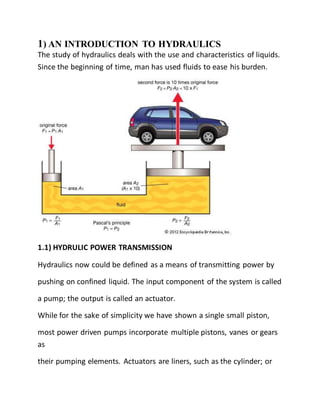
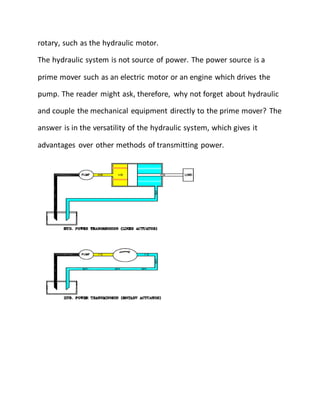
Hydraulics now could be defined as a means of transmitting power by
pushing on confined liquid. The input component of the system is called
a pump; the output is called an actuator.
While for the sake of simplicity we have shown a single small piston,
most power driven pumps incorporate multiple pistons, vanes or gears
as
their pumping elements. Actuators are liners, such as the cylinder; or
rotary, such as the hydraulic motor.
The hydraulic system is not source of power. The power source is a
prime mover such as an electric motor or an engine which drives the
pump. The reader might ask, therefore, why not forget about hydraulic
and couple the mechanical equipment directly to the prime mover? The
answer is in the versatility of the hydraulic system, which gives it
advantages over other methods of transmitting power.
2) COMPONNENTS OF HYDRAULIC SYSTEM
Hydraulic system content mainly following parts.
(1) Hydraulic fluids.
(2) Seals and Packing.
(3) Reservoirs
(4) Filter and strainers
(5) Cylinders
(6) Pressure control valve
2.1.1) HYDRAULIC FLUIDS: Proper selection and care of hydraulic fluids
for a machine will have an important effect on how the machine
performs and on the life of the hydraulic components.
2.1.2) PURPOSE OF THE FLUID The hydraulic fluid has four primary
purposes:
(1) To transmit power,
(2) To lubricate moving parts,
(3) To seal clearance between parts, and
(4) To cool or dissipate heat.
2.1.3) LUBRICANTION:In most hydraulic component, internal
lubrication by the fluid. Pump elements and other wearing part slide
against each other on a film of fluid. For long component life the oil
must contain the necessary additives to ensure high antiwar
characteristics. Not all hydraulic oils contain these additives.
2.1.4) QUALITY REQUREMENTS In addition to these primary functions,
the hydraulic fluid may have a number of other quality requirements.
Some of these are to:
Prevent rust
Prevent formation of sludge, gum, and varnish
Depress foaming
Maintain its own stability and thereby reduce fluid replacement cost
Maintain relatively stable body over a wide temperature range
Prevent corrosion and pitting
Be compatible with seals and gaskets
Separate out water
These quality requirements often are the result of special compounding
and may not be present in every mind.
2.1.5) FLUID PROPERTIESlet us now consider the properties of
hydraulic fluid which enable it to carry out its primary functions and
fulfill some or its entire quality requirement:
Viscosity
Pour point
Lubricating ability
Oxidation resistance
Rust and corrosion protection
2.2) SEALS AND PACKING: Seals are device for closing gaps to prevent
leakage or make pressure tight joints and also to prevent entry of air
and dirt from outside in to the system. A wide variety of seals of
different shapes and material are used. The material of the seal must
be compatible with the fluid medium.
2.2.1) SEAL MATERIALS Seals are device for closing gaps to prevent
leakage of make pressure tight joints and also the prevent entry of air
and dirt from outside into the system. A wide verity of seals of different
shapes and material are used Synthetic rubbers (elestomers), however,
are the most part quite compatible with oil. Elestomer can be made in
many compositions to meet various operating condition. Most of the
hydraulic equipment seals today are made of one of these elastomers:
Nit rile (Buna-N), chloroprene (Neoprene) Teflon.ERP/EPDM (also
known as EPM),of silicon.
2.2.2) PREVENTING LEAKAGE Three general considerations in
preventing leakage are:
1. Design to minimize the possibility (back, gasket of sub-plate
mounting)
2. Proper installation.
3. Control of operating conditions.
2.2.2.1) OPRATING CONDITIONS Control over operating conditions can
be very important to seal life. A number of factor that can help prevent
leakage are discussed below.
Contamination prevention: An atmosphere contaminated with
moisture, dirt or any abrasive material shortens the life of shaft seals
and a piston rod seal exposed to the air. Protective device should be
used in customized atmosphere. Equally important clean fluid and
proper filtration to avoid damage to internal seals and surfaces.
Fluid Compatibility: Some fire-resistance fluid attack and disintegrate
certain elastomer seals. Few seals, in tact, are compatible with all
fluids. The fluid supplier should always be consulted when in doubt
whether the change seals when in change in made in the type of fluid.
Fluid additives (added by the machines user) also may attack seals and
should be used only at the recommendation of the fluid supplier.
Temperature: At extremely low temperature, a seal may become too
brittle to be effective. At too high a temperature, a seal may harden,
soften, or swell. The operating temperature should always be kept well
within the temperature range of the seals being used.
Pressure: Excess fluid pressure puts an addition strain on oil seals and
may “blow” a seal causing a leak. Lubrication: no seal should ever be
installed or operated dry. All must be lubricated prior to installation or
the seal will wear quickly and leak.
2.3) RESERVOIRS The main function of the reservoir in a hydraulic
system is to store arid supply hydraulic fluid for use by the system. The
section discusses this and other reservoir function such as heat
exchange and desertion.
2.3.1) FUNCTION OF A RESERVOIR Since, in addition to holding the
system fluid supply, a reservoir can also reserve several secondary
functions, some system designer feel that the reservoir is the key to
effective hydraulic system. Some examples of these functions are
discussed below. By transferring waste heat through its walls, the
reservoir acts as the heat exchanger that cools the fluid within. As the
deaerator, the reservoir allows entrained air to rise and escape while
solid contaminants settle to the bottom of the tank. Making it a fluid
conditioner. These are function that can also be provided to the system
by methods that do not involved the reservoir. In some instance, the
reservoir may be used as a platform to support the pump, motor, and
other system components. This saves floor space and is a simple way to
keep the is a simple way to keep the pumps and valves at the good
night the servicing.
2.3.2) RESERVOIR COMPONENTS a typical industrial reservoir is
constructed of welded steel plate with end-plate extension that
support the unit. To reduce the chance of condensed moisture within
the tank causing rust, the inside of the reservoir is painted with a sealer
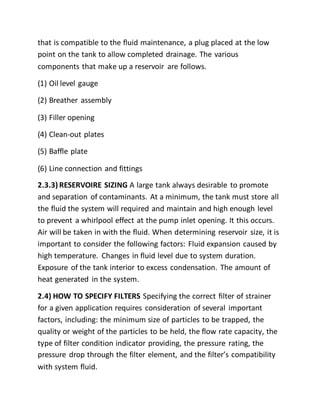
that is compatible to the fluid maintenance, a plug placed at the low
point on the tank to allow completed drainage. The various
components that make up a reservoir are follows.
(1) Oil level gauge
(2) Breather assembly
(3) Filler opening
(4) Clean-out plates
(5) Baffle plate
(6) Line connection and fittings
2.3.3) RESERVOIRE SIZING A large tank always desirable to promote
and separation of contaminants. At a minimum, the tank must store all
the fluid the system will required and maintain and high enough level
to prevent a whirlpool effect at the pump inlet opening. It this occurs.
Air will be taken in with the fluid. When determining reservoir size, it is
important to consider the following factors: Fluid expansion caused by
high temperature. Changes in fluid level due to system duration.
Exposure of the tank interior to excess condensation. The amount of
heat generated in the system.
2.4) HOW TO SPECIFY FILTERS Specifying the correct filter of strainer
for a given application requires consideration of several important
factors, including: the minimum size of particles to be trapped, the
quality or weight of the particles to be held, the flow rate capacity, the
type of filter condition indicator providing, the pressure rating, the
pressure drop through the filter element, and the filter’s compatibility
with system fluid.
2.4.1) FILTER OR STRAINER There will probably always be controversy
in the industry over the exact definition of filter and strainers. In the
past, many such devices were named filters, but technically classed as
strainers. To minimize he controversy, the national fluid power
association gives these definition:
FILTER: A device whole primary function is the retention, by some
porous medium, of insoluble contaminants from a fluid. STRAINER: A
course filter, to put it simply, whether the device as a filter or strainers,
its function is to trap contaminants from fluid flowing through it.
“Porous medium” simply refers to screen or filtering material that
allows fluid to flow through it. “Porous medium” simply refers to a
screen or to filtering material that allows fluid to flow through it. But
stops other materials.
2.5) HYDRAULIC CYLINDER The focus of this topic is on the output
member or actuator, a device for converting hydraulic energy in to
mechanical energy. Two types of hydraulic actuators are cylinder or
motors. The type of job done and its power requirements determine
the correct type and size motor or cylinder for an application. Cylinder
and liner actuators. This means that the output of the cylinder is a
straight-line motion and/or force. The major function of the hydraulic
cylinder in to convert hydraulic power in to liner mechanical power.
2.5.1) TYPES OF CYLINDERS Following are the main types of cylinder.
(1) Single Acting Cylinder
(2) Ram
(3) Telescopic Cylinder
(4) Spring Return
(5) Double acting cylinder
(6) Double Rod Cylinder
(7) Tandem Cylinder
2.5.1.1) DOUBLE ACTING CYLIDER
The double-acting cylinder is the most common type in industrial
hydraulic. Hydraulics pressure is applied is port, giving powered motion
when extending or retracting.Basic double-acting cylinder. The majority
of cylinders is use are basic double acting cylinders. These cylinder are
classed as differential cylinder because there are unequal area exposed
to pressure during the extend and retract movements. The different is
caused by the cross-sectional area of the road which reduced area of
the road which reduced the area under pressure during retraction.
Extension is slower than retraction because more fluid is required to fill
the swept volume of me piston. However greater force is possible
because the pressure operates on the full piston area.When retracting,
the same flow from a pump causes faster movement of the
cylinder because the swept volume is less. Which the same system
pressure, the maximum force exerted by the cylinder is also less
because of the smaller area under pressure.
2.6) DIRECTIONAL VALVES As the same name implies, directional valves
start, stop, and control the direction of fluid flow. Although they share
this common function, directional valves very considerably in
construction and operation.
They are classified according to principal characteristic such as those
listed below.
Type of internal valving element- poppet, rotary spool, or sliding spool.
Method of actuation- manual, mechanical, pneumatic, hydraulic,
electrical, or combinations of these.
Number of flow path- two-way, three-way, and four-way. Size-
nominal size of port or flange connection to the valves or its mounting
pattern.
Connection- pipe thread, straight thread flange and subplate, or
manifold mounted.
2.6.1) DIRECTION CONTROL VALVES These valves are deployed to
steer the flow selected flow paths to any part of a hydraulic circuit. The
spool types valves both of the liner as well as the rotary movement are
advised for the purpose. Rotary type directions of these valves are
commonly seen as applied to machine tool table reversals. These valves
are operated either on AC or DC. The AC operated valves have a
drawback in they tend to burn to due to flow through the valves and
fast response of direction control of solenoid valves are that important
requirement of direction control valves. Solenoid valves can function
satisfactory at frequencies as high as 1500-2000 operation an hour.
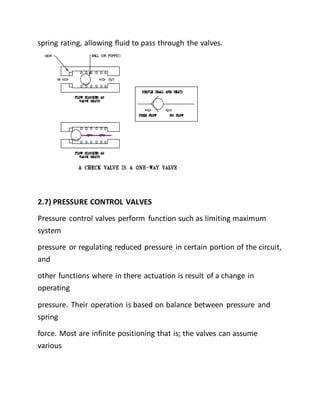
2.6.2) CHECK VALVES
In its simplest form, a check valves in a one-way directional valve. It
allows
free flow in one direction, while blocking flow in the other direction.
The
graphic symbol for a check valve is a ball and sheet. A light spring,
usually
equivalent to 5 psi, holds the poppet in the normal closed position.
Other
spring pressures are available to suit application requirement. In the
free
flow direction, the poppet cracks open at the pressure equivalent to
the
spring rating, allowing fluid to pass through the valves.
2.7) PRESSURE CONTROL VALVES
Pressure control valves perform function such as limiting maximum
system
pressure or regulating reduced pressure in certain portion of the circuit,
and
other functions where in there actuation is result of a change in
operating
pressure. Their operation is based on balance between pressure and
spring
force. Most are infinite positioning that is; the valves can assume
various
positions fully closed and fully open, depending on flow rate and
pressure
differential.
Pressure control are usually named for their primary function, such a
relief
valve, sequence valve, break valve, etc. they are classified by size
pressure
operating range, and type of connection.
2.7.1) RELIEF VALVES The relief valve is found in virtually every
hydraulic system. It is normally closed valve connected between the
pump outlet and the reservoir. Its purpose is no limit is to limit pressure
in to system to a pressure setting is reached.
(1) Direct Acting Relief Valves
(2) Pilot Operated Relief Valves
(3) Electronically Modulated Relief Valves
(4) Pilot Operated Sequence Valve
(5) Unloading Relief Valve
INTRODUCTION
LEVERS AND MECHANICAL LEVERAGE
LEVER
The principle of the lever tells us that the above is in static equilibrium,
with all forces balancing, if F1D1 = F2D2.
In physics, a lever (from Old French levier, the agent noun to lever "to
raise", c. f. Levant ) is a rigid object that is used with an appropriate
fulcrum or pivot point to multiply the mechanical force that can be
applied to another object.
This is also termed mechanical advantage, and is one example of the
principle of moments. The principle of leverage can also be derived
using Newton's laws of motion and modern statics .
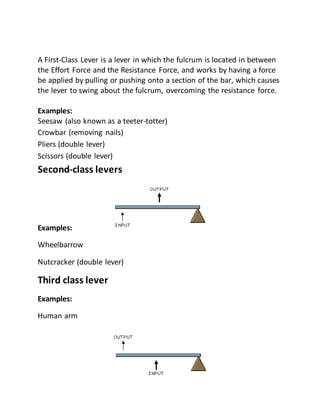
The three classes of levers
There are three classes of levers representing variations in the location
of the fulcrum and the input and output forces.
First-Class levers
A First-Class Lever is a lever in which the fulcrum is located in between
the Effort Force and the Resistance Force, and works by having a force
be applied by pulling or pushing onto a section of the bar, which causes
the lever to swing about the fulcrum, overcoming the resistance force.
Examples:
Seesaw (also known as a teeter-totter)
Crowbar (removing nails)
Pliers (double lever)
Scissors (double lever)
Second-class levers
Examples:
Wheelbarrow
Nutcracker (double lever)
Third class lever
Examples:
Human arm
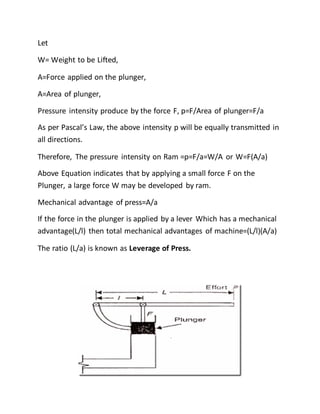
Let
W= Weight to be Lifted,
A=Force applied on the plunger,
A=Area of plunger,
Pressure intensity produce by the force F, p=F/Area of plunger=F/a
As per Pascal’s Law, the above intensity p will be equally transmitted in
all directions.
Therefore, The pressure intensity on Ram =p=F/a=W/A or W=F(A/a)
Above Equation indicates that by applying a small force F on the
Plunger, a large force W may be developed by ram.
Mechanical advantage of press=A/a
If the force in the plunger is applied by a lever Which has a mechanical
advantage(L/l) then total mechanical advantages of machine=(L/l)(A/a)
The ratio (L/a) is known as Leverage of Press.
INTRODUCTION TO PUNCHING
MACHINE
[A] TERMINOLOGY OF PUNCHING MACHINE
Introduction: Punching machine type of cold working process in which
punching done by the punch machine tool and die designed to hole the
sheet metal by applying mechanical force or pressure. The punch
governs the size of the hole and the clearance is provided on the die.
(1) Punch: It is the male member of the unit and kept as small as
possible consistent with required strength and rigidity. The punch made
of the hard, wear resistance metal and is finally ground to the pre-
determine size providing just opium clearance between the punch and
die.
(2) Punch retainer of punch plate: It fits closely over the body of the
punch and holds it in a proper relative position. The retainer is turn to
bolt to the punch holder.
(3) Punch holder: It provided a wide plate surface which face against
the lower end of the press ram and is anchored to it with help of the
shank which is an integral part of the punch holder shank exactly fits in
to the ram opening, to help in properly positioning and aligning the
punch holder is made of cast steel.
(4)Backing plate: Whenever the punch is headless a hardness steel
backing plate is introduced between the back of the punch holder so
that intensity of pressure does not become excessive on the punch
holder. Backing plate distribute the pressure over wide area and
intensity of the pressure on the punch holder is reduced to avoid
crushing.
5) Die Block: it is female working member & is kept as small as possible
consistent with required strength. It is also made of hard, wear-
resistant metal and finish ground to predetermined size and tolerance.
6) Die retainer: Just like the punch retainer, the die retainer also holds
the die block at proper position with respect to punch. The retainer is
mounted on the die shoe or holder. In certain die shoe it self serves as a
retainer for the die block the block is then mounted directly on to die
shoe.
7) Die shoe: Die shoe assembly consisting of die block and die. These in
turn bolted or clamped to the bolster plate.
8) Guide posts and bushing: the punch and die makers once properly
located aligned are held in aligned are held in alignment by means of
guide post and bushing which resist movement or deflection of die
members as operating pressure increase guide post and bushing are
part of the commercially available punch and die holders.
9) Stripper and stripper plate: When the punch has completed its
downward movement and start returning, the scrape strip tries to go
up along with it. The stripper plate prevents this upper movement of
scrape stripes and frees and punches of these for next stroke.
10) Stock stops & Stock guide: Fixed type of stripper sometimes are
used to guide the stock are also where as stock stops locate the work
material at a suitable position in relation to previously blanked surfaced
in preparation to the next downward movement of the punch.
11) Bed: The bed is the lower part of a press frame that serves as a
table to which a bolster plate is mounted.
12) Bolster plate: This is thick plate secured to the press bed, which is
used for locating and supporting the die assembly. It is usually 5 to 12.5
cm thick.
13) Die set: It is unit assembly, which incorporates lower and upper
shoe, two or more guidepost and guidepost bussing.
14) Die: The die may be defined as a female of a complete part of a
complete tool producing work in press. It also referred to a complete
tool consisting of a pair of mating members for producing work in a
press.
15) Lower shoe: The lower shoe of a die set is generally mounted on
the bolster plate of a press. The die block is mounted on the lower
shoe. Also, the guideposts are mounted in it.
16) Upper shoe: This is the upper part of the die set, which contains
guidepost bushing.
17) Knockout: It is mechanism, usually connected to and operated by a
press ram, for freeing a work piece from a die.
18) Pit man: It is connecting rod, which is used to transmit motion the
main drive shaft to the press slide.
19) Shut height: It is distance from top of the bed to the bottom of a
slide, with its stroke down and adjustment up.
20) Stroke: The stroke of a press is the distance of ram its up position to
its down position. It is equal to twice the crankshaft and eccentric
drives but it is Variable on the hydraulic press.
[B] SHEARING ACTION IN DIE CUTTING OPERATION: In die
cutting operation the sheet metal stressed in shear between two
cutting edges to the point of fracture beyond it ultimate strength. In die
cutting operation when the punch presses at various places as shown in
fig. layer below the punch are subjected to different type of stresses at
various placed shown in fig. layer below the punch are subjected to
compressive stressed and the bottom most layer of the sheet die are
subjected to tensile stresses, this leads to stretching beyond the elastic
limit. Further moment of punch leads to plastic deformation, reduction
in area and finally fracture start through cleavage planes in a reduced
area.
THE VARIOUS STEPS IN SHERING ARE AS BELOW:
a) Plastic deformation: The pressure is applied by the punch on the
sheet metal tends to deform it in to die opening. As the elastic limit
exceeded by further loading a portion of the metal is forced in to the
die opening in the form of an embossed pad on the lower face of
material and corresponding depression on the upper face.
b) Reduction in thickness: As the load is further increased, the punch
penetrates the metal to certain depth and force and equal portion of
metal thickness in the die. This penetrates occurs before factoring
starts and reduced the cross-section area of metal through which is cut
being made.
c) Fracture: After above stage, fracture will start in the reduced area n
both upper and lower cutting edges and if the die and punch is suitable
for the material being cut, these fracture will spread out to word each
other and eventually meet, causing complete separation. Thus the
punch penetrates the metal causing plastic deformation it then shears
it and pushes the cut piece from the sheet.
[C] SELECTING THE PROPER PRESS: In the selection of proper
size and style of press for a given kind of work the following points are
to be considered.
1. The size and type of die required.
2. The length of stroke necessary.
3. The pressure for doing the work.
4. The distance above the bottom of the stroke where the pressure
first occurs.
5. Any additional pressure required due to the attachment such as the
blank holder, ironing wrinkles or stretching the material in drawing
work.
6. The method of feeding, the direction of feed and the size of sheet
blank or work piece.
[D] CLEARANCE: The die opening must be sufficiently larger than
the punch to permit and clean fracture of the metal. This different is
dimensions between the mating members or a die set are called
“clearance”. This clearance is applied in the following manners. When
the holes has to be held to size, i.e., the hole in the sheet metal is to be
accurate, and slug is to be discarded, the punch is made to the size of
hole and to a die opening size is obtained by adding clearance to the
punch size. C is the amount of clearance per size of the die opening.
The clearance is function of the kind, thickness and temper of the work
material requiring larger clearance than soft material. The exception
being aluminum. The usual clearances per side of the die, for various
metals, are giving below in terms of the stock thickness, t:
For brass and soft steel, C=5% of t
For medium steel, C=6% of t
For hard steel, C=7%of t
For Aluminum, C=10%of t
The total clearance between punch and die size will be this figure.
These clearances may be determined with the help of the following
relation:
C=0.0032 t (Ts), mm
Where T0 is the shear strength of the material in N/mm2
[E] DIE: The die may be defined as the female part of complete tool
for producing work in press. It also referred to a complete tool
consisting of a pan of mating members for producing work in press.
TYPES OF DIES:
This die may be classified according to the type of press operation and
according to the method of operation.
Type of press operation: according to this to this criterion, the dies may
be classified as: cutting dies and forming dies.
Cutting dies: These dies are used to cut the metal they utilize the
cutting or shearing action. The common cutting dies are: blanking dies,
piercing dies, perforating dies, notching trimming, saving and nibbling
dies etc.
Method of operation: according to this criterion, the dies may be
classified as: single operation or simple dies, compound dies,
combination dies, progressive dies, transfer dies, and multiple dies.
Simple dies: simple dies or single action dies perform single operation
for each stroke of the press slide the operation may be any of the
opration listed under cutting or forming dies.
[F] PUNCH:
This is the male component of the die assembly. This is directly or
indirectly moved by and fastened to the press ram or slide.
Method of mounting punches:
 Headless punches
 Peen head punches
 Quelled punches
 Larger punches are provided with heads or shoulders
 Thin rectangular punches
Peen head punches Punches
less than 20mm diameter are often made from 20mm or smaller
diameter rod and are left shoulder less until assembly when the punch
pressed tightly in to a counter sunk reamed hole in the punch plate an
the riveted our the shank of the port blow of the punch placed in the
punch plate is always made circular and larger than the piercing section
in older to facilitate assembly to 5mm and 3mm for punch dimension
up to 10mm and 4mm for dimension up to 15mm.
This type of construction on the punch head is widely used on
perforating operation where a great many small and closely spaced
whole must be pierced slender punches for perforating further
supported and guided by making then sliding fit in the stripper plate.
DESIGN OF MACHINE
PARTS
1. Cylinder design:-
Capacity=
Diameter of Piston=
Stroke length=
A=D2
=
Using leverage force applied F=W*(L/l)*(A/a) =
2. Spring Design:-
F’=
K*x
Total force on punch= (F-F’
)/n=
3. Tool Design:-
Specification and material-
4037 Alloy Steel
303-316 Stainless steel
Diameter of punch D=10mm
Length of punch=25mm
Surface hardness RC=60 minimum
Core hardness RC=47 minimum
Yield Strength Mpa
Shear stress to punch a Plate F/A=F/(πdt)
Where F= Calculated force
T=Thickness of sheet plate
Shear yield strength of punch = /2
& Hence design is safe.
4. Design of die:-
Diameter of hole=10mm
Clearance C=5% of Thickness
Thickness of sheet 1.16
Therefore, C=0.05*1.16=0.0805mm
Thus, diameter of Die= 10+2*0.0805=10.16
DRAWINGS OF MACHINE
PARTS
CONCLUSIONS
REFERENCE

Hydraulic punching machine project report.

  • 1.
    A Project Report on DESIGNAND FABRICATION OF HYDRAULIC SHEET METAL PUNCHING MACHINE USING LEVERAGE PRINCIPLES. Submitted to Rajiv Gandhi Proudyogiki Vishwavidyalaya, Bhopal Towards Partial Fulfillment for the Award of Bachelor of Engineering (MECHANICAL ENGINEERING) 2013-2017 Submitted By- Arun Singh, Harshil Sehariya, Mahendra Singh Candrawat, Shubham Bagi, Shubham Dhaneshree, Shubham Mathur. Guided By- Prof. Pankaj Gera Department of MECHANICAL Engineering Mahakal Institute of Technology & Science, Ujjain
  • 2.
    MAHAKAL INSTITUTE OFTECHNOLOGY & SCIENCE, UJJAIN CERTIFICATE This is to certify that Mr. Arun Singh, Mr. Harshil Sehariya, Mr. Mahendra Singh Candrawat, Mr. Shubham Bagi, Mr. Shubham Dhaneshree and Mr. Shubham Mathur student of B.E. (Mechanical Engineering Department) of this college has carried out Project DESIGN AND FABRICATION OF HYDRAULIC SHEET METAL PUNCHING MACHINE USING LEVERAGE PRINCIPLES. It is submitted by in partial fulfillment of the requirements for the award of Bachelor of Engineering in Mechanical Engineering from Mahakal Institute of Technology & Science; Ujjain affiliated to Rajiv Gandhi ProudyogikiVishwavidyalaya, Bhopal (M.P.). Prof. Pankaj Gera Prof. Santosh Vyas Dr. V.M Shah Project Guide Head of Department Director M.I.T.S., Ujjain M.I.T.S., Ujjain M.I.T.S., Ujjain
  • 3.
    ACKNOWLEDGEMENT We wish toexpress our heartfelt appreciation to all the people who had contributed to this project, both explicitly and implicitly. First to all we want to thank our projects guide Prof. Pankaj Gera for giving us this opportunity to work under his guidance. His empathy towards us made our work easy. Many thank to him for encouraging and supporting us to complete this project work. We are thankful to Prof. Santos Vyas Head of the Department, Mechanical Engineering and Dr. V.M Shah Director Mahakal Institute Of Technology & Science, Ujjain for understanding our problem and shorting them out. We are thankful to staff of Mechanical EngineeringDepartment for letting us know about problem of industry and encouraging us to work on it. In the last but not least, we are also thankful to all the persons and colleagues who have helped us directly or indirectly during this project. . Mr. Arun Singh Mr. Mahendra Singh Candrawat Mr. Shubham Bagi, Mr. Shubham Dhaneshree Mr. Shubham Mathur Mr. Harshil Sehariya
  • 4.
    ABSTRACT In our reporton “Hydraulic Punching Machine”, we have included four chapters. In chapter one, introduction is given about the hydraulic system and Leverage. This chapter gives brief knowledge about the hydraulic components used in our circuit and types of levers/Leverages. In chapter two, introduction given about the punching machine this chapter contain brief idea various components and terminology of punching machine. In chapter three, we design the machine parts. This chapter gives design of each and every component of our machine parts. This chapter also contains design calculation required for the machine. In chapter four, drawing machine part is given. This chapter included detail of assembly drawing of our machine i.e. 2-D AutoCAD drawing of major components. At the end of our project report we have described briefly conclusion of our project. It contains results that we derived from the experiments we done of the machine. So this chapter shows the outcome of the whole project.
  • 5.
  • 6.
  • 7.
    1) AN INTRODUCTIONTO HYDRAULICS The study of hydraulics deals with the use and characteristics of liquids. Since the beginning of time, man has used fluids to ease his burden. 1.1) HYDRULIC POWER TRANSMISSION Hydraulics now could be defined as a means of transmitting power by pushing on confined liquid. The input component of the system is called a pump; the output is called an actuator. While for the sake of simplicity we have shown a single small piston, most power driven pumps incorporate multiple pistons, vanes or gears as their pumping elements. Actuators are liners, such as the cylinder; or
  • 8.
    rotary, such asthe hydraulic motor. The hydraulic system is not source of power. The power source is a prime mover such as an electric motor or an engine which drives the pump. The reader might ask, therefore, why not forget about hydraulic and couple the mechanical equipment directly to the prime mover? The answer is in the versatility of the hydraulic system, which gives it advantages over other methods of transmitting power.
  • 9.
    2) COMPONNENTS OFHYDRAULIC SYSTEM Hydraulic system content mainly following parts. (1) Hydraulic fluids. (2) Seals and Packing. (3) Reservoirs (4) Filter and strainers (5) Cylinders (6) Pressure control valve 2.1.1) HYDRAULIC FLUIDS: Proper selection and care of hydraulic fluids for a machine will have an important effect on how the machine performs and on the life of the hydraulic components. 2.1.2) PURPOSE OF THE FLUID The hydraulic fluid has four primary purposes: (1) To transmit power, (2) To lubricate moving parts, (3) To seal clearance between parts, and
  • 10.
    (4) To coolor dissipate heat. 2.1.3) LUBRICANTION:In most hydraulic component, internal lubrication by the fluid. Pump elements and other wearing part slide against each other on a film of fluid. For long component life the oil must contain the necessary additives to ensure high antiwar characteristics. Not all hydraulic oils contain these additives. 2.1.4) QUALITY REQUREMENTS In addition to these primary functions, the hydraulic fluid may have a number of other quality requirements. Some of these are to: Prevent rust Prevent formation of sludge, gum, and varnish Depress foaming Maintain its own stability and thereby reduce fluid replacement cost Maintain relatively stable body over a wide temperature range Prevent corrosion and pitting Be compatible with seals and gaskets Separate out water These quality requirements often are the result of special compounding and may not be present in every mind. 2.1.5) FLUID PROPERTIESlet us now consider the properties of hydraulic fluid which enable it to carry out its primary functions and fulfill some or its entire quality requirement:
  • 11.
    Viscosity Pour point Lubricating ability Oxidationresistance Rust and corrosion protection 2.2) SEALS AND PACKING: Seals are device for closing gaps to prevent leakage or make pressure tight joints and also to prevent entry of air and dirt from outside in to the system. A wide variety of seals of different shapes and material are used. The material of the seal must be compatible with the fluid medium. 2.2.1) SEAL MATERIALS Seals are device for closing gaps to prevent leakage of make pressure tight joints and also the prevent entry of air and dirt from outside into the system. A wide verity of seals of different shapes and material are used Synthetic rubbers (elestomers), however, are the most part quite compatible with oil. Elestomer can be made in many compositions to meet various operating condition. Most of the hydraulic equipment seals today are made of one of these elastomers: Nit rile (Buna-N), chloroprene (Neoprene) Teflon.ERP/EPDM (also known as EPM),of silicon. 2.2.2) PREVENTING LEAKAGE Three general considerations in preventing leakage are: 1. Design to minimize the possibility (back, gasket of sub-plate mounting) 2. Proper installation.
  • 12.
    3. Control ofoperating conditions. 2.2.2.1) OPRATING CONDITIONS Control over operating conditions can be very important to seal life. A number of factor that can help prevent leakage are discussed below. Contamination prevention: An atmosphere contaminated with moisture, dirt or any abrasive material shortens the life of shaft seals and a piston rod seal exposed to the air. Protective device should be used in customized atmosphere. Equally important clean fluid and proper filtration to avoid damage to internal seals and surfaces. Fluid Compatibility: Some fire-resistance fluid attack and disintegrate certain elastomer seals. Few seals, in tact, are compatible with all fluids. The fluid supplier should always be consulted when in doubt whether the change seals when in change in made in the type of fluid. Fluid additives (added by the machines user) also may attack seals and should be used only at the recommendation of the fluid supplier. Temperature: At extremely low temperature, a seal may become too brittle to be effective. At too high a temperature, a seal may harden, soften, or swell. The operating temperature should always be kept well within the temperature range of the seals being used. Pressure: Excess fluid pressure puts an addition strain on oil seals and may “blow” a seal causing a leak. Lubrication: no seal should ever be installed or operated dry. All must be lubricated prior to installation or the seal will wear quickly and leak.
  • 13.
    2.3) RESERVOIRS Themain function of the reservoir in a hydraulic system is to store arid supply hydraulic fluid for use by the system. The section discusses this and other reservoir function such as heat exchange and desertion. 2.3.1) FUNCTION OF A RESERVOIR Since, in addition to holding the system fluid supply, a reservoir can also reserve several secondary functions, some system designer feel that the reservoir is the key to effective hydraulic system. Some examples of these functions are discussed below. By transferring waste heat through its walls, the reservoir acts as the heat exchanger that cools the fluid within. As the deaerator, the reservoir allows entrained air to rise and escape while solid contaminants settle to the bottom of the tank. Making it a fluid conditioner. These are function that can also be provided to the system by methods that do not involved the reservoir. In some instance, the reservoir may be used as a platform to support the pump, motor, and other system components. This saves floor space and is a simple way to keep the is a simple way to keep the pumps and valves at the good night the servicing. 2.3.2) RESERVOIR COMPONENTS a typical industrial reservoir is constructed of welded steel plate with end-plate extension that support the unit. To reduce the chance of condensed moisture within the tank causing rust, the inside of the reservoir is painted with a sealer
  • 14.
    that is compatibleto the fluid maintenance, a plug placed at the low point on the tank to allow completed drainage. The various components that make up a reservoir are follows. (1) Oil level gauge (2) Breather assembly (3) Filler opening (4) Clean-out plates (5) Baffle plate (6) Line connection and fittings 2.3.3) RESERVOIRE SIZING A large tank always desirable to promote and separation of contaminants. At a minimum, the tank must store all the fluid the system will required and maintain and high enough level to prevent a whirlpool effect at the pump inlet opening. It this occurs. Air will be taken in with the fluid. When determining reservoir size, it is important to consider the following factors: Fluid expansion caused by high temperature. Changes in fluid level due to system duration. Exposure of the tank interior to excess condensation. The amount of heat generated in the system. 2.4) HOW TO SPECIFY FILTERS Specifying the correct filter of strainer for a given application requires consideration of several important factors, including: the minimum size of particles to be trapped, the quality or weight of the particles to be held, the flow rate capacity, the type of filter condition indicator providing, the pressure rating, the pressure drop through the filter element, and the filter’s compatibility with system fluid.
  • 15.
    2.4.1) FILTER ORSTRAINER There will probably always be controversy in the industry over the exact definition of filter and strainers. In the past, many such devices were named filters, but technically classed as strainers. To minimize he controversy, the national fluid power association gives these definition: FILTER: A device whole primary function is the retention, by some porous medium, of insoluble contaminants from a fluid. STRAINER: A course filter, to put it simply, whether the device as a filter or strainers, its function is to trap contaminants from fluid flowing through it. “Porous medium” simply refers to screen or filtering material that allows fluid to flow through it. “Porous medium” simply refers to a screen or to filtering material that allows fluid to flow through it. But stops other materials. 2.5) HYDRAULIC CYLINDER The focus of this topic is on the output member or actuator, a device for converting hydraulic energy in to mechanical energy. Two types of hydraulic actuators are cylinder or motors. The type of job done and its power requirements determine the correct type and size motor or cylinder for an application. Cylinder and liner actuators. This means that the output of the cylinder is a straight-line motion and/or force. The major function of the hydraulic cylinder in to convert hydraulic power in to liner mechanical power. 2.5.1) TYPES OF CYLINDERS Following are the main types of cylinder. (1) Single Acting Cylinder (2) Ram (3) Telescopic Cylinder (4) Spring Return
  • 16.
    (5) Double actingcylinder (6) Double Rod Cylinder (7) Tandem Cylinder 2.5.1.1) DOUBLE ACTING CYLIDER The double-acting cylinder is the most common type in industrial hydraulic. Hydraulics pressure is applied is port, giving powered motion when extending or retracting.Basic double-acting cylinder. The majority of cylinders is use are basic double acting cylinders. These cylinder are classed as differential cylinder because there are unequal area exposed to pressure during the extend and retract movements. The different is caused by the cross-sectional area of the road which reduced area of the road which reduced the area under pressure during retraction. Extension is slower than retraction because more fluid is required to fill the swept volume of me piston. However greater force is possible because the pressure operates on the full piston area.When retracting, the same flow from a pump causes faster movement of the cylinder because the swept volume is less. Which the same system pressure, the maximum force exerted by the cylinder is also less because of the smaller area under pressure.
  • 17.
    2.6) DIRECTIONAL VALVESAs the same name implies, directional valves start, stop, and control the direction of fluid flow. Although they share this common function, directional valves very considerably in construction and operation. They are classified according to principal characteristic such as those listed below. Type of internal valving element- poppet, rotary spool, or sliding spool. Method of actuation- manual, mechanical, pneumatic, hydraulic, electrical, or combinations of these. Number of flow path- two-way, three-way, and four-way. Size- nominal size of port or flange connection to the valves or its mounting pattern. Connection- pipe thread, straight thread flange and subplate, or manifold mounted.
  • 18.
    2.6.1) DIRECTION CONTROLVALVES These valves are deployed to steer the flow selected flow paths to any part of a hydraulic circuit. The spool types valves both of the liner as well as the rotary movement are advised for the purpose. Rotary type directions of these valves are commonly seen as applied to machine tool table reversals. These valves are operated either on AC or DC. The AC operated valves have a drawback in they tend to burn to due to flow through the valves and fast response of direction control of solenoid valves are that important requirement of direction control valves. Solenoid valves can function satisfactory at frequencies as high as 1500-2000 operation an hour. 2.6.2) CHECK VALVES In its simplest form, a check valves in a one-way directional valve. It allows free flow in one direction, while blocking flow in the other direction. The graphic symbol for a check valve is a ball and sheet. A light spring, usually equivalent to 5 psi, holds the poppet in the normal closed position. Other spring pressures are available to suit application requirement. In the free flow direction, the poppet cracks open at the pressure equivalent to the
  • 19.
    spring rating, allowingfluid to pass through the valves. 2.7) PRESSURE CONTROL VALVES Pressure control valves perform function such as limiting maximum system pressure or regulating reduced pressure in certain portion of the circuit, and other functions where in there actuation is result of a change in operating pressure. Their operation is based on balance between pressure and spring force. Most are infinite positioning that is; the valves can assume various
  • 20.
    positions fully closedand fully open, depending on flow rate and pressure differential. Pressure control are usually named for their primary function, such a relief valve, sequence valve, break valve, etc. they are classified by size pressure operating range, and type of connection. 2.7.1) RELIEF VALVES The relief valve is found in virtually every hydraulic system. It is normally closed valve connected between the pump outlet and the reservoir. Its purpose is no limit is to limit pressure in to system to a pressure setting is reached. (1) Direct Acting Relief Valves (2) Pilot Operated Relief Valves (3) Electronically Modulated Relief Valves (4) Pilot Operated Sequence Valve (5) Unloading Relief Valve
  • 21.
  • 22.
    LEVER The principle ofthe lever tells us that the above is in static equilibrium, with all forces balancing, if F1D1 = F2D2. In physics, a lever (from Old French levier, the agent noun to lever "to raise", c. f. Levant ) is a rigid object that is used with an appropriate fulcrum or pivot point to multiply the mechanical force that can be applied to another object. This is also termed mechanical advantage, and is one example of the principle of moments. The principle of leverage can also be derived using Newton's laws of motion and modern statics . The three classes of levers There are three classes of levers representing variations in the location of the fulcrum and the input and output forces. First-Class levers
  • 23.
    A First-Class Leveris a lever in which the fulcrum is located in between the Effort Force and the Resistance Force, and works by having a force be applied by pulling or pushing onto a section of the bar, which causes the lever to swing about the fulcrum, overcoming the resistance force. Examples: Seesaw (also known as a teeter-totter) Crowbar (removing nails) Pliers (double lever) Scissors (double lever) Second-class levers Examples: Wheelbarrow Nutcracker (double lever) Third class lever Examples: Human arm
  • 24.
    Let W= Weight tobe Lifted, A=Force applied on the plunger, A=Area of plunger, Pressure intensity produce by the force F, p=F/Area of plunger=F/a As per Pascal’s Law, the above intensity p will be equally transmitted in all directions. Therefore, The pressure intensity on Ram =p=F/a=W/A or W=F(A/a) Above Equation indicates that by applying a small force F on the Plunger, a large force W may be developed by ram. Mechanical advantage of press=A/a If the force in the plunger is applied by a lever Which has a mechanical advantage(L/l) then total mechanical advantages of machine=(L/l)(A/a) The ratio (L/a) is known as Leverage of Press.
  • 25.
  • 26.
    [A] TERMINOLOGY OFPUNCHING MACHINE Introduction: Punching machine type of cold working process in which punching done by the punch machine tool and die designed to hole the sheet metal by applying mechanical force or pressure. The punch governs the size of the hole and the clearance is provided on the die. (1) Punch: It is the male member of the unit and kept as small as possible consistent with required strength and rigidity. The punch made of the hard, wear resistance metal and is finally ground to the pre- determine size providing just opium clearance between the punch and die. (2) Punch retainer of punch plate: It fits closely over the body of the punch and holds it in a proper relative position. The retainer is turn to bolt to the punch holder. (3) Punch holder: It provided a wide plate surface which face against the lower end of the press ram and is anchored to it with help of the shank which is an integral part of the punch holder shank exactly fits in to the ram opening, to help in properly positioning and aligning the punch holder is made of cast steel. (4)Backing plate: Whenever the punch is headless a hardness steel backing plate is introduced between the back of the punch holder so that intensity of pressure does not become excessive on the punch holder. Backing plate distribute the pressure over wide area and intensity of the pressure on the punch holder is reduced to avoid crushing. 5) Die Block: it is female working member & is kept as small as possible consistent with required strength. It is also made of hard, wear-
  • 27.
    resistant metal andfinish ground to predetermined size and tolerance. 6) Die retainer: Just like the punch retainer, the die retainer also holds the die block at proper position with respect to punch. The retainer is mounted on the die shoe or holder. In certain die shoe it self serves as a retainer for the die block the block is then mounted directly on to die shoe. 7) Die shoe: Die shoe assembly consisting of die block and die. These in turn bolted or clamped to the bolster plate. 8) Guide posts and bushing: the punch and die makers once properly located aligned are held in aligned are held in alignment by means of guide post and bushing which resist movement or deflection of die members as operating pressure increase guide post and bushing are part of the commercially available punch and die holders. 9) Stripper and stripper plate: When the punch has completed its downward movement and start returning, the scrape strip tries to go up along with it. The stripper plate prevents this upper movement of scrape stripes and frees and punches of these for next stroke. 10) Stock stops & Stock guide: Fixed type of stripper sometimes are used to guide the stock are also where as stock stops locate the work material at a suitable position in relation to previously blanked surfaced in preparation to the next downward movement of the punch. 11) Bed: The bed is the lower part of a press frame that serves as a table to which a bolster plate is mounted. 12) Bolster plate: This is thick plate secured to the press bed, which is used for locating and supporting the die assembly. It is usually 5 to 12.5 cm thick.
  • 28.
    13) Die set:It is unit assembly, which incorporates lower and upper shoe, two or more guidepost and guidepost bussing. 14) Die: The die may be defined as a female of a complete part of a complete tool producing work in press. It also referred to a complete tool consisting of a pair of mating members for producing work in a press. 15) Lower shoe: The lower shoe of a die set is generally mounted on the bolster plate of a press. The die block is mounted on the lower shoe. Also, the guideposts are mounted in it. 16) Upper shoe: This is the upper part of the die set, which contains guidepost bushing. 17) Knockout: It is mechanism, usually connected to and operated by a press ram, for freeing a work piece from a die. 18) Pit man: It is connecting rod, which is used to transmit motion the main drive shaft to the press slide. 19) Shut height: It is distance from top of the bed to the bottom of a slide, with its stroke down and adjustment up. 20) Stroke: The stroke of a press is the distance of ram its up position to its down position. It is equal to twice the crankshaft and eccentric drives but it is Variable on the hydraulic press.
  • 29.
    [B] SHEARING ACTIONIN DIE CUTTING OPERATION: In die cutting operation the sheet metal stressed in shear between two cutting edges to the point of fracture beyond it ultimate strength. In die cutting operation when the punch presses at various places as shown in fig. layer below the punch are subjected to different type of stresses at various placed shown in fig. layer below the punch are subjected to compressive stressed and the bottom most layer of the sheet die are subjected to tensile stresses, this leads to stretching beyond the elastic limit. Further moment of punch leads to plastic deformation, reduction in area and finally fracture start through cleavage planes in a reduced area. THE VARIOUS STEPS IN SHERING ARE AS BELOW: a) Plastic deformation: The pressure is applied by the punch on the sheet metal tends to deform it in to die opening. As the elastic limit exceeded by further loading a portion of the metal is forced in to the die opening in the form of an embossed pad on the lower face of material and corresponding depression on the upper face. b) Reduction in thickness: As the load is further increased, the punch penetrates the metal to certain depth and force and equal portion of metal thickness in the die. This penetrates occurs before factoring starts and reduced the cross-section area of metal through which is cut being made. c) Fracture: After above stage, fracture will start in the reduced area n both upper and lower cutting edges and if the die and punch is suitable for the material being cut, these fracture will spread out to word each other and eventually meet, causing complete separation. Thus the
  • 30.
    punch penetrates themetal causing plastic deformation it then shears it and pushes the cut piece from the sheet. [C] SELECTING THE PROPER PRESS: In the selection of proper size and style of press for a given kind of work the following points are to be considered. 1. The size and type of die required. 2. The length of stroke necessary. 3. The pressure for doing the work. 4. The distance above the bottom of the stroke where the pressure first occurs. 5. Any additional pressure required due to the attachment such as the blank holder, ironing wrinkles or stretching the material in drawing work. 6. The method of feeding, the direction of feed and the size of sheet blank or work piece.
  • 31.
    [D] CLEARANCE: Thedie opening must be sufficiently larger than the punch to permit and clean fracture of the metal. This different is dimensions between the mating members or a die set are called “clearance”. This clearance is applied in the following manners. When the holes has to be held to size, i.e., the hole in the sheet metal is to be accurate, and slug is to be discarded, the punch is made to the size of hole and to a die opening size is obtained by adding clearance to the punch size. C is the amount of clearance per size of the die opening. The clearance is function of the kind, thickness and temper of the work material requiring larger clearance than soft material. The exception being aluminum. The usual clearances per side of the die, for various metals, are giving below in terms of the stock thickness, t: For brass and soft steel, C=5% of t For medium steel, C=6% of t For hard steel, C=7%of t For Aluminum, C=10%of t The total clearance between punch and die size will be this figure. These clearances may be determined with the help of the following relation: C=0.0032 t (Ts), mm Where T0 is the shear strength of the material in N/mm2
  • 32.
    [E] DIE: Thedie may be defined as the female part of complete tool for producing work in press. It also referred to a complete tool consisting of a pan of mating members for producing work in press. TYPES OF DIES: This die may be classified according to the type of press operation and according to the method of operation. Type of press operation: according to this to this criterion, the dies may be classified as: cutting dies and forming dies. Cutting dies: These dies are used to cut the metal they utilize the cutting or shearing action. The common cutting dies are: blanking dies, piercing dies, perforating dies, notching trimming, saving and nibbling dies etc. Method of operation: according to this criterion, the dies may be classified as: single operation or simple dies, compound dies, combination dies, progressive dies, transfer dies, and multiple dies. Simple dies: simple dies or single action dies perform single operation for each stroke of the press slide the operation may be any of the opration listed under cutting or forming dies.
  • 33.
    [F] PUNCH: This isthe male component of the die assembly. This is directly or indirectly moved by and fastened to the press ram or slide. Method of mounting punches:  Headless punches  Peen head punches  Quelled punches  Larger punches are provided with heads or shoulders  Thin rectangular punches Peen head punches Punches less than 20mm diameter are often made from 20mm or smaller diameter rod and are left shoulder less until assembly when the punch pressed tightly in to a counter sunk reamed hole in the punch plate an the riveted our the shank of the port blow of the punch placed in the punch plate is always made circular and larger than the piercing section in older to facilitate assembly to 5mm and 3mm for punch dimension up to 10mm and 4mm for dimension up to 15mm. This type of construction on the punch head is widely used on perforating operation where a great many small and closely spaced whole must be pierced slender punches for perforating further supported and guided by making then sliding fit in the stripper plate.
  • 34.
  • 35.
    1. Cylinder design:- Capacity= Diameterof Piston= Stroke length= A=D2 = Using leverage force applied F=W*(L/l)*(A/a) = 2. Spring Design:- F’= K*x Total force on punch= (F-F’ )/n= 3. Tool Design:- Specification and material- 4037 Alloy Steel 303-316 Stainless steel Diameter of punch D=10mm Length of punch=25mm Surface hardness RC=60 minimum Core hardness RC=47 minimum
  • 36.
    Yield Strength Mpa Shearstress to punch a Plate F/A=F/(πdt) Where F= Calculated force T=Thickness of sheet plate Shear yield strength of punch = /2 & Hence design is safe. 4. Design of die:- Diameter of hole=10mm Clearance C=5% of Thickness Thickness of sheet 1.16 Therefore, C=0.05*1.16=0.0805mm Thus, diameter of Die= 10+2*0.0805=10.16
  • 37.
  • 38.
  • 39.