International Center for Agricultural Research in the Dry Areas
icarda.org cgiar.org
A CGIAR Research Center
Strengthening KM for Greater
Development Effectiveness:
Knowledge Management Plan
9/10/2018
ICARDA-IFAD Inception Meeting
Rabat, Morocco
Enrico Bonaiuti, Valerio Graziano &
KM Team
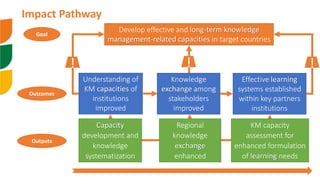
Impact Pathway
Effective learning
systems established
within key partners
institutions
Understanding of
KM capacities of
institutions
improved
Develop effective and long-term knowledge
management-related capacities in target countries
!
Goal
Outcomes
Outputs
Knowledge
exchange among
stakeholders
improved
! !
Capacity
development and
knowledge
systematization
KM capacity
assessment for
enhanced formulation
of learning needs
Regional
knowledge
exchange
enhanced
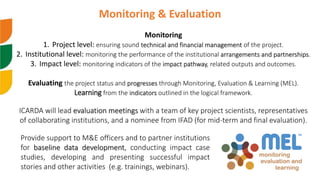
Monitoring & Evaluation
Monitoring
1. Project level: ensuring sound technical and financial management of the project.
2. Institutional level: monitoring the performance of the institutional arrangements and partnerships.
3. Impact level: monitoring indicators of the impact pathway, related outputs and outcomes.
Evaluating the project status and progresses through Monitoring, Evaluation & Learning (MEL).
Learning from the indicators outlined in the logical framework.
ICARDA will lead evaluation meetings with a team of key project scientists, representatives
of collaborating institutions, and a nominee from IFAD (for mid-term and final evaluation).
Provide support to M&E officers and to partner institutions
for baseline data development, conducting impact case
studies, developing and presenting successful impact
stories and other activities (e.g. trainings, webinars).
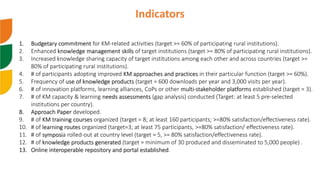
Indicators
1. Budgetary commitment for KM-related activities (target >= 60% of participating rural institutions).
2. Enhanced knowledge management skills of target institutions (target >= 80% of participating rural institutions).
3. Increased knowledge sharing capacity of target institutions among each other and across countries (target >=
80% of participating rural institutions).
4. # of participants adopting improved KM approaches and practices in their particular function (target >= 60%).
5. Frequency of use of knowledge products (target = 600 downloads per year and 3,000 visits per year).
6. # of innovation platforms, learning alliances, CoPs or other multi-stakeholder platforms established (target = 3).
7. # of KM capacity & learning needs assessments (gap analysis) conducted (Target: at least 5 pre-selected
institutions per country).
8. Approach Paper developed.
9. # of KM training courses organized (target = 8; at least 160 participants; >=80% satisfaction/effectiveness rate).
10. # of learning routes organized (target=3; at least 75 participants, >=80% satisfaction/ effectiveness rate).
11. # of symposia rolled-out at country level (target = 5, >= 80% satisfaction/effectiveness rate).
12. # of knowledge products generated (target = minimum of 30 produced and disseminated to 5,000 people) .
13. Online interoperable repository and portal established.
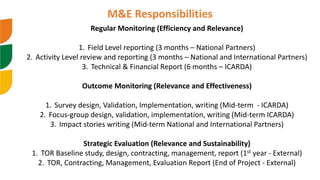
M&E Responsibilities
Regular Monitoring (Efficiency and Relevance)
1. Field Level reporting (3 months – National Partners)
2. Activity Level review and reporting (3 months – National and International Partners)
3. Technical & Financial Report (6 months – ICARDA)
Outcome Monitoring (Relevance and Effectiveness)
1. Survey design, Validation, Implementation, writing (Mid-term - ICARDA)
2. Focus-group design, validation, implementation, writing (Mid-term ICARDA)
3. Impact stories writing (Mid-term National and International Partners)
Strategic Evaluation (Relevance and Sustainability)
1. TOR Baseline study, design, contracting, management, report (1st year - External)
2. TOR, Contracting, Management, Evaluation Report (End of Project - External)
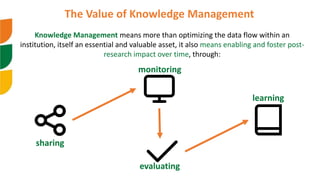
The Value of Knowledge Management
Knowledge Management means more than optimizing the data flow within an
institution, itself an essential and valuable asset, it also means enabling and foster post-
research impact over time, through:
sharing
monitoring
evaluating
learning
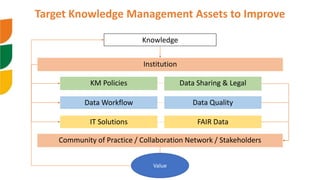
Target Knowledge Management Assets to Improve
KM Policies
IT Solutions
Data Workflow
Institution
Knowledge
Data Sharing & Legal
Data Quality
FAIR Data
Community of Practice / Collaboration Network / Stakeholders
Value
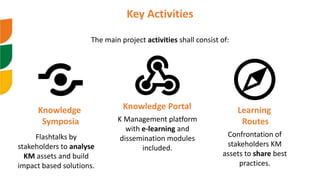
Key Activities
The main project activities shall consist of:
Knowledge Portal
Knowledge
Symposia
Learning
Routes
Flashtalks by
stakeholders to analyse
KM assets and build
impact based solutions.
Confrontation of
stakeholders KM
assets to share best
practices.
K Management platform
with e-learning and
dissemination modules
included.
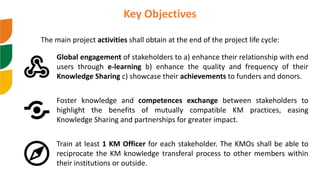
Global engagement of stakeholders to a) enhance their relationship with end
users through e-learning b) enhance the quality and frequency of their
Knowledge Sharing c) showcase their achievements to funders and donors.
Key Objectives
The main project activities shall obtain at the end of the project life cycle:
Foster knowledge and competences exchange between stakeholders to
highlight the benefits of mutually compatible KM practices, easing
Knowledge Sharing and partnerships for greater impact.
Train at least 1 KM Officer for each stakeholder. The KMOs shall be able to
reciprocate the KM knowledge transferal process to other members within
their institutions or outside.
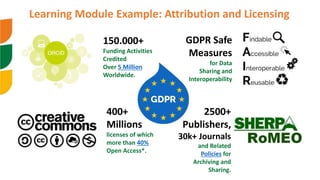
Learning Module Example: Attribution and Licensing
150.000+
Funding Activities
Credited
Over 5 Million
Worldwide.
GDPR Safe
Measures
for Data
Sharing and
Interoperability
400+
Millions
licenses of which
more than 40%
Open Access*.
2500+
Publishers,
30k+ Journals
and Related
Policies for
Archiving and
Sharing.
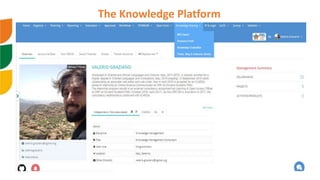
The Knowledge Platform
International Center for Agricultural Research in the Dry Areas
icarda.org cgiar.org
A CGIAR Research Center
Thank You!
Any Question?
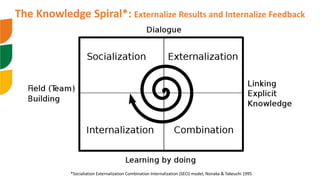
The Knowledge Spiral*: Externalize Results and Internalize Feedback
*Socialiation Externalization Combination Internalization (SECI) model, Nonaka & Takeuchi 1995

Food Assessment tools and frameworks.pptx

  • 1.
    International Center forAgricultural Research in the Dry Areas icarda.org cgiar.org A CGIAR Research Center Strengthening KM for Greater Development Effectiveness: Knowledge Management Plan 9/10/2018 ICARDA-IFAD Inception Meeting Rabat, Morocco Enrico Bonaiuti, Valerio Graziano & KM Team
  • 2.
    Impact Pathway Effective learning systemsestablished within key partners institutions Understanding of KM capacities of institutions improved Develop effective and long-term knowledge management-related capacities in target countries ! Goal Outcomes Outputs Knowledge exchange among stakeholders improved ! ! Capacity development and knowledge systematization KM capacity assessment for enhanced formulation of learning needs Regional knowledge exchange enhanced
  • 3.
    Monitoring & Evaluation Monitoring 1.Project level: ensuring sound technical and financial management of the project. 2. Institutional level: monitoring the performance of the institutional arrangements and partnerships. 3. Impact level: monitoring indicators of the impact pathway, related outputs and outcomes. Evaluating the project status and progresses through Monitoring, Evaluation & Learning (MEL). Learning from the indicators outlined in the logical framework. ICARDA will lead evaluation meetings with a team of key project scientists, representatives of collaborating institutions, and a nominee from IFAD (for mid-term and final evaluation). Provide support to M&E officers and to partner institutions for baseline data development, conducting impact case studies, developing and presenting successful impact stories and other activities (e.g. trainings, webinars).
  • 4.
    Indicators 1. Budgetary commitmentfor KM-related activities (target >= 60% of participating rural institutions). 2. Enhanced knowledge management skills of target institutions (target >= 80% of participating rural institutions). 3. Increased knowledge sharing capacity of target institutions among each other and across countries (target >= 80% of participating rural institutions). 4. # of participants adopting improved KM approaches and practices in their particular function (target >= 60%). 5. Frequency of use of knowledge products (target = 600 downloads per year and 3,000 visits per year). 6. # of innovation platforms, learning alliances, CoPs or other multi-stakeholder platforms established (target = 3). 7. # of KM capacity & learning needs assessments (gap analysis) conducted (Target: at least 5 pre-selected institutions per country). 8. Approach Paper developed. 9. # of KM training courses organized (target = 8; at least 160 participants; >=80% satisfaction/effectiveness rate). 10. # of learning routes organized (target=3; at least 75 participants, >=80% satisfaction/ effectiveness rate). 11. # of symposia rolled-out at country level (target = 5, >= 80% satisfaction/effectiveness rate). 12. # of knowledge products generated (target = minimum of 30 produced and disseminated to 5,000 people) . 13. Online interoperable repository and portal established.
  • 5.
    M&E Responsibilities Regular Monitoring(Efficiency and Relevance) 1. Field Level reporting (3 months – National Partners) 2. Activity Level review and reporting (3 months – National and International Partners) 3. Technical & Financial Report (6 months – ICARDA) Outcome Monitoring (Relevance and Effectiveness) 1. Survey design, Validation, Implementation, writing (Mid-term - ICARDA) 2. Focus-group design, validation, implementation, writing (Mid-term ICARDA) 3. Impact stories writing (Mid-term National and International Partners) Strategic Evaluation (Relevance and Sustainability) 1. TOR Baseline study, design, contracting, management, report (1st year - External) 2. TOR, Contracting, Management, Evaluation Report (End of Project - External)
  • 6.
    The Value ofKnowledge Management Knowledge Management means more than optimizing the data flow within an institution, itself an essential and valuable asset, it also means enabling and foster post- research impact over time, through: sharing monitoring evaluating learning
  • 7.
    Target Knowledge ManagementAssets to Improve KM Policies IT Solutions Data Workflow Institution Knowledge Data Sharing & Legal Data Quality FAIR Data Community of Practice / Collaboration Network / Stakeholders Value
  • 8.
    Key Activities The mainproject activities shall consist of: Knowledge Portal Knowledge Symposia Learning Routes Flashtalks by stakeholders to analyse KM assets and build impact based solutions. Confrontation of stakeholders KM assets to share best practices. K Management platform with e-learning and dissemination modules included.
  • 9.
    Global engagement ofstakeholders to a) enhance their relationship with end users through e-learning b) enhance the quality and frequency of their Knowledge Sharing c) showcase their achievements to funders and donors. Key Objectives The main project activities shall obtain at the end of the project life cycle: Foster knowledge and competences exchange between stakeholders to highlight the benefits of mutually compatible KM practices, easing Knowledge Sharing and partnerships for greater impact. Train at least 1 KM Officer for each stakeholder. The KMOs shall be able to reciprocate the KM knowledge transferal process to other members within their institutions or outside.
  • 10.
    Learning Module Example:Attribution and Licensing 150.000+ Funding Activities Credited Over 5 Million Worldwide. GDPR Safe Measures for Data Sharing and Interoperability 400+ Millions licenses of which more than 40% Open Access*. 2500+ Publishers, 30k+ Journals and Related Policies for Archiving and Sharing.
  • 11.
  • 12.
    International Center forAgricultural Research in the Dry Areas icarda.org cgiar.org A CGIAR Research Center Thank You! Any Question?
  • 13.
    The Knowledge Spiral*:Externalize Results and Internalize Feedback *Socialiation Externalization Combination Internalization (SECI) model, Nonaka & Takeuchi 1995

Editor's Notes

  • #3 …, ensuring the sustainability, replication and the scaling over time of KM practices
  • #7 KM Starts with the definition of an institutional WF (Zeroing Liabilities; Data Management Transparency for Donors’ review) Share the peer-reviewed information products through impactful media (e.g. journals, institutional repositories and websites, research (ASNS) and social media), platforms and events, according their type and subjects, within the communication plan framework. Monitor the information products position within media, guarding the knowledge’s safety from predators and ensuring correct licensing and attribution. Evaluate the shared knowledge through authoritative platforms, events, indexes and metrics. Learn from the feedback of knowledge sharing and evaluation. TO-DO: produce Knowledge and report/attribute/license it in the best ways (we will see few simple measures in the next slides) in order to make it easy to go through KM steps, so to reduce time spent in the workflow and maximize the effectiveness of Knowledge Sharing. Remember: each result will in time become obsolete and your research too, minimizing the time spent in the workflow will maximize the research value.
  • #8 These 3 elements will encompass key aspects of institutional Knowledge Management in an holistic perspective: Policies/Administrative Workflow/Programmatic IT/End User Interface Knowledge Management activities will aim at: Establish or enhance a clear workflow of data within stakeholders (to boost performance and 0 liabilities) Increase Data Quality Have Findable Accessible Interoperable Reusable Data Appropriate KM implies a system approach to the whole process, in order to systematize the data flow within institutions, this being Reports, E-Learning Modules, Policy Briefs, Comm products, Technologies, Methodologies or any other kind of Knowledge produced that can be built upon for future scaling-up and scaling-out of practices or initiatives. IMPORTANT: Time is Impact! Don’t let your Knowledge get stuck in the workflow. KM process and tools (i.e. Knowledge Portal) will help you. Accurately plan and timely report your Knowledge and Intellectual Assets. The KM responsible in your institutions will provide the right kind of support in time for the Knowledge to keep flowing. Time is Impact!
  • #11 Correct attribution and licensing is not always easy to ensure with traditional measures (i.e. signing the info products). To keep up with the digital environment and minimize the leaks KM needs up to date tools. ORCID provides global, unique recognition and attribution to the Scientist. TO-DO: register and ORCID iD and use it for attribution. Sync it to MEL for automatic attribution. FAIR principles of KM ensure Institutional transparency that, shared with partners Institutions, ensures better KM overall and better attribution and licensing. TO-DO: only trust ASES and repositories respecting these principles, it will help your research and foster the dissemination of papers. CC is the global standard for attribution and licensing, easy to use and suitable for every individual or Institution. *Data of CC Network https://network.creativecommons.org/ last updated up to 2010. TO-DO: use Creative Commons to license your work, it is a world wide recognizable standard easy to implement as metadata in all repositories, also it is free to use. Just apply the label generated here https://creativecommons.org/choose/ SHERPA/RoMEO is one of the most authoritative web services for Publishers attribution and combined with other global standards and trends for publications safety (such as Beall’s List) ensures great accuracy in mapping products. TO-DO: before submitting your paper, use SHERPA/RoMEO to check for the journal’s and publisher’s authority, licensing and sharing policies. MEL will automatically detect the sharing policy of the publisher when a JA is reported. Employing such measures raises the prestige of the Institution and the value of its research toward Partners, Stakeholders and Funding agencies.
  • #12 ICARDA builds on the experience of 2 successfully lead portals: MEL, AReS (new generation) KM Portal needs tools able to (basics): disseminate Knowledge (repository, mailing system) store Knowledge (repository) up to date metadata standards and web services (for Data Quality and Legal) Module for e-learning (survey system, resource packs) dashboard for Donor’s supervision of activities and results (open facts) … (An Open Alpha link will be provided for the partners to follow up the development step by step)
  • #14 3 minutes KManagement takes care of guiding knowledge through SECI and maximize research results in a way to form the basis for new research and applications, boosting impact, benefiting scientists and their institutions. SECI in details: Socialization (Knowledge Sharing, informal) is the process of sharing tacit knowledge through observation, imitation, practice, and participation in formal and informal communities (Yeh et al., 2011), both within a physical or virtual space. It is the first step of results out of a conducted research. Externalization (Knowledge Sharing, formal) is the process of articulating tacit knowledge into explicit concepts (Yeh et al., 2011) aka manuscripts and drafts, peer review. Combination (Monitoring & Evaluation) is the process of integrating concepts into a knowledge system (Yeh et al., 2011) aka reports, trend analysis, policy briefs, executive summaries, database upgrades. Internalization (Learning) is the process of embodying explicit knowledge into tacit knowledge (Nonaka & Takeuchi, 1995), learning from feedbacks, developing and adopting best practices adoption, scaling. It is the final step of results, now ready to form the basis for a new research. TO-DO: engage in communities, peer-reviews and other academically relevant social activities to collect the best insights for your Knowledge to be formulated in the best shareable way (see slide 2). Connect with ASESs (Academic Social Networking Sites) but especially go through institutional repositories such as CGSpace and MELSpace, which are already the result of the KM flow and are at your disposal 24/7 free of charge.