PRESENTED BY :
DR. PRITIKA
ASSISTANT PROF. ,
BKAMCH COLLEGE DAUDHAR MOGA PUNJAB
RATNA VARGA
INTRODUCTION
 Ratnas are those which are considered the
best with regards to qualities and properties
in their respective groups.
tkrkStkS;nqRd`“Va rf)jRuaizp{krs A
 It includes both animal and mineral products.
They are well known as gema and precious
stones.
 It is divided into two groups:
Ratna varga
CONT….
 Upratna varga
A gem stone is a piece of mineral crystal
which, in cut & polished form, is used to make
jewellery & other adornments.
 Synonyms :
Ratna, mani, varpashan
NAMES OF RATNA
 Nine ratna have been described by Ras
Ratna Samuchyaa. These are:
ekf.kD;eqDrkQyfonzqekf.krk{;Z p iq”iafHknqjap uhye~A
xksesndap fonwjdap dzes.k jRukfuuoxzgk.kke~AA
Manikya , mukta, parval, taksharya, pukhraaj, hira,
neelam, gomeda, vaidurya.
RELATIONSHIP WITH NINE GRAHA(PLANET)
NAME OF RATNA HINDI NAME ENGLISH
NAME
GRAHA
Manikya Manik Ruby Surya -sun
Mukta Moti Pearl Chandra -Moon
Vidrum Praval Coral Mangal -mars
Taksharya Panna Emerald Budha - mercury
Pushapraga Pukhraaj Topaz Guru -jupiter
Bhidura Hira Diamond Shukra -venus
Nilam Nila Sapphire Shani-saturn
Gomedaka Gomeda Zircon Rahu
Vaidurya Lahsuniya Cat’s eye Ketu
TYPES OF VARIOUS RATNA
 Mineral origin: manikya, taksharya,
pushapraag, vajra, neelam, gomeda,
vaidurya
 Pranij origin: mukta, praval
 Vanaspatik: trinkant, sangemusha
QUALITIES OF RATNA:
Sawcha, laghu, chamakdar, ashatfalak,
shatkona
DOSHA OF RATNA
 According to various acharya, there are five
types of dosha:
1. Grasa : opaque/ black spoted
2. Trasa : discolouration
3. Bindu: presence of grains/erosions
4. Rekha: lines/boundaries
5. Jalagarbhta : presence of bubbles
SHODHANA
 Samanya shodhna: jayanti sawrasa, kumari
sawrasa, tanduliyak sawrasa, amal dravya,
kshara dravya, gomutra- dolayantra – 1
prahara
 Vishesh shodhana – R.R.S.
VISHESH SHODHANA
RATNA SHODHNA DRAVYA
Manikya Amla dravya
Mukta Jayanti sawrasa
Praval Kshaar varga
Panna (taksharya) godhudh
Pukhraaj Kulath kwatha/ sandhan
Vajra Tanduliya
Neelam Nilani sawrasa
Gomeda Gorochna
Vaidurya Trifala
MARANA
 Marana dravya –
1. Manhashilla
2. Hartala
3. Gandhaka
 Gajputa , -- 8 puta for hiraka bhasma
RATNA DRUTI
 For dravanartha –
1. Hing,
2. Panchlavana
3. Traya kshaar
4. Navsadar
5. Amalvetas
6. Snuhikasheer etc.
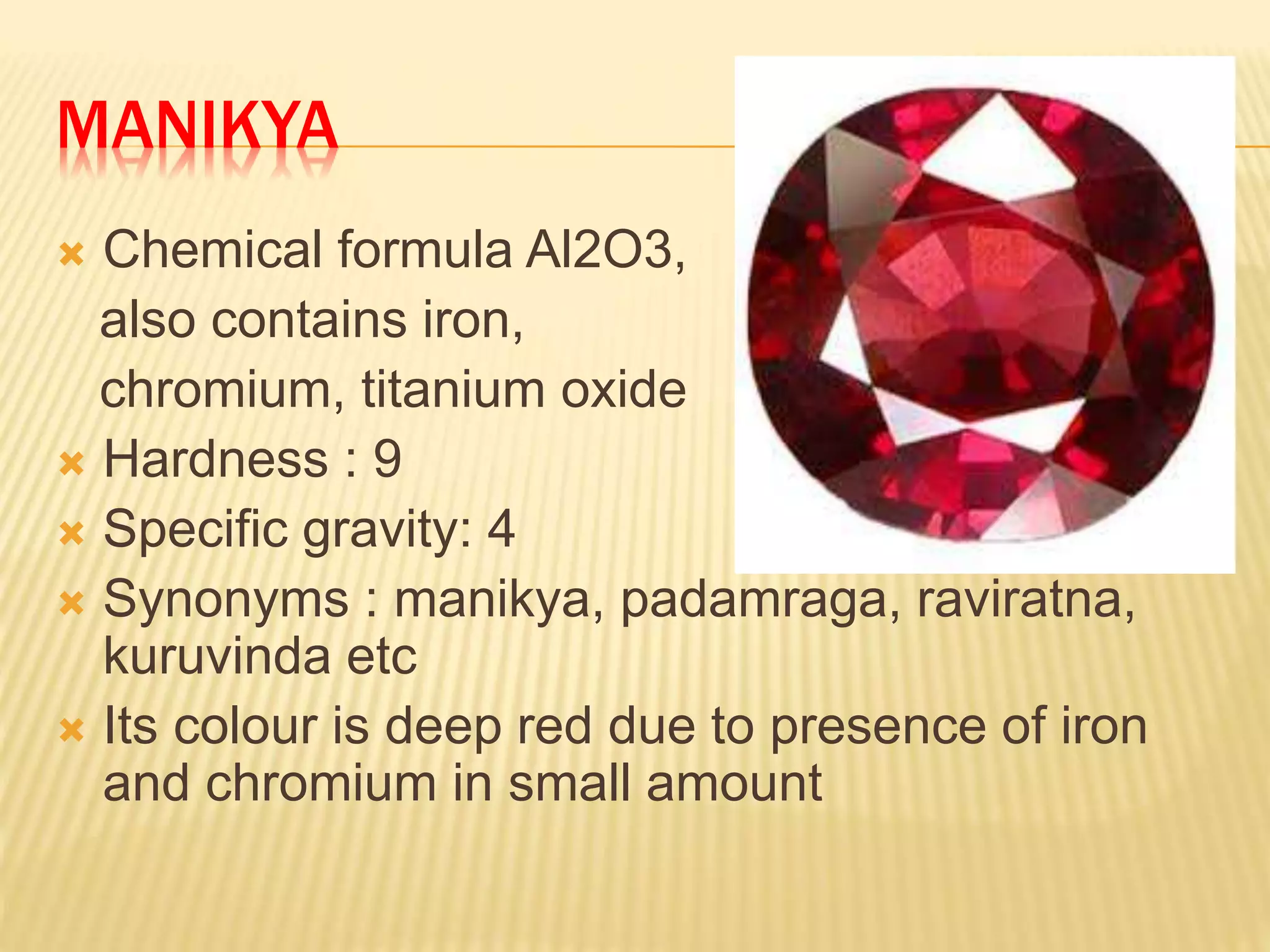
MANIKYA
 Chemical formula Al2O3,
also contains iron,
chromium, titanium oxide
 Hardness : 9
 Specific gravity: 4
 Synonyms : manikya, padamraga, raviratna,
kuruvinda etc
 Its colour is deep red due to presence of iron
and chromium in small amount
TYPES
 Two types :
1. Padamaraga
2. Neelgandhi
 Acceptable variety (grahya )
It should be like raktakamalvata, vrita, ayata,
samgatram
 Pure manikya examination : it should
emanate red rays on coming in contact with
the morning sun, even when put in milk , it
will make the milk look red.
DOSE., USES
 Dose –
¼ ratti to ½ ratti
 Uses –
medhya, rasayaana, ayushya, vaatpitnashak
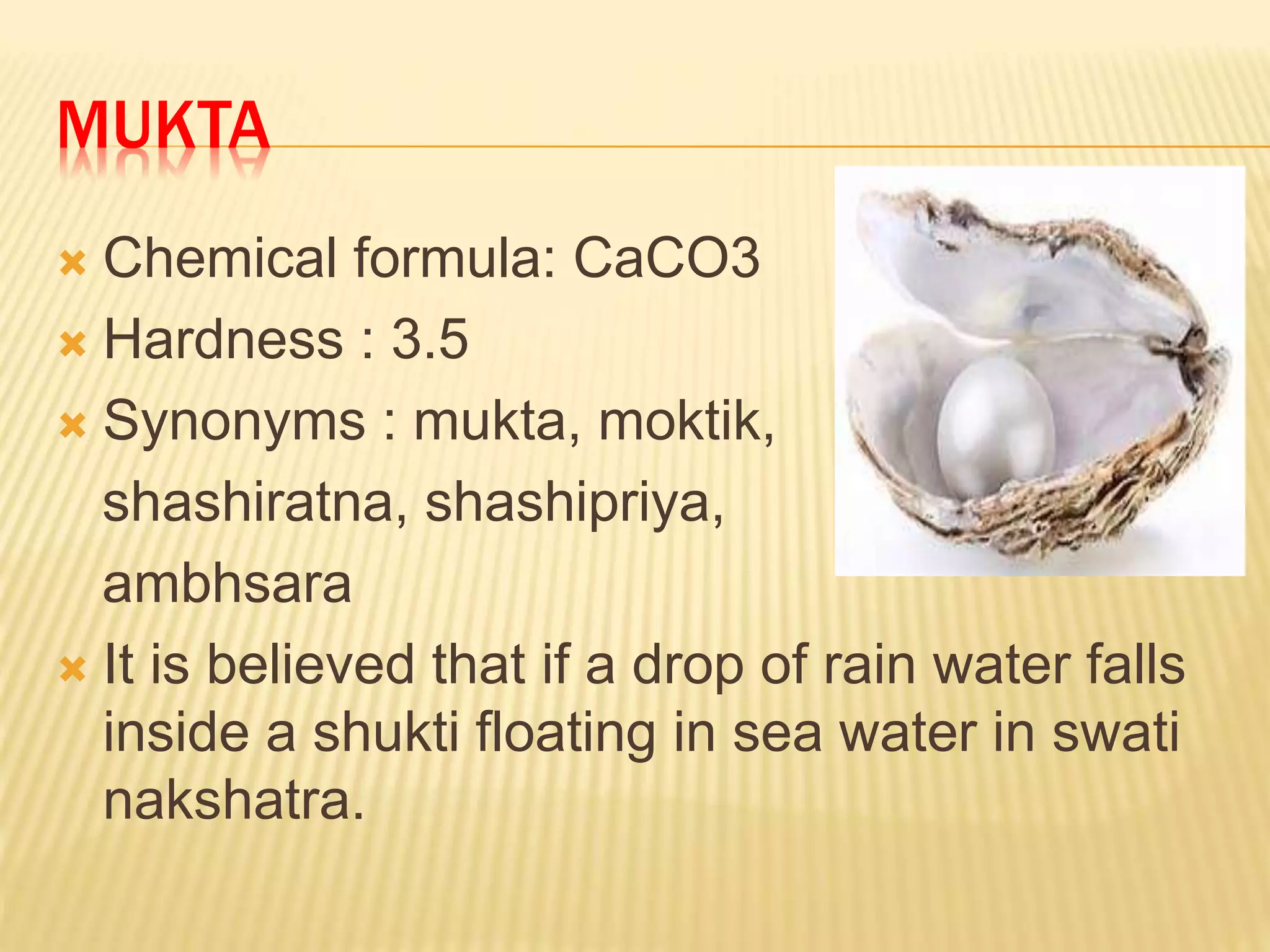
MUKTA
 Chemical formula: CaCO3
 Hardness : 3.5
 Synonyms : mukta, moktik,
shashiratna, shashipriya,
ambhsara
 It is believed that if a drop of rain water falls
inside a shukti floating in sea water in swati
nakshatra.
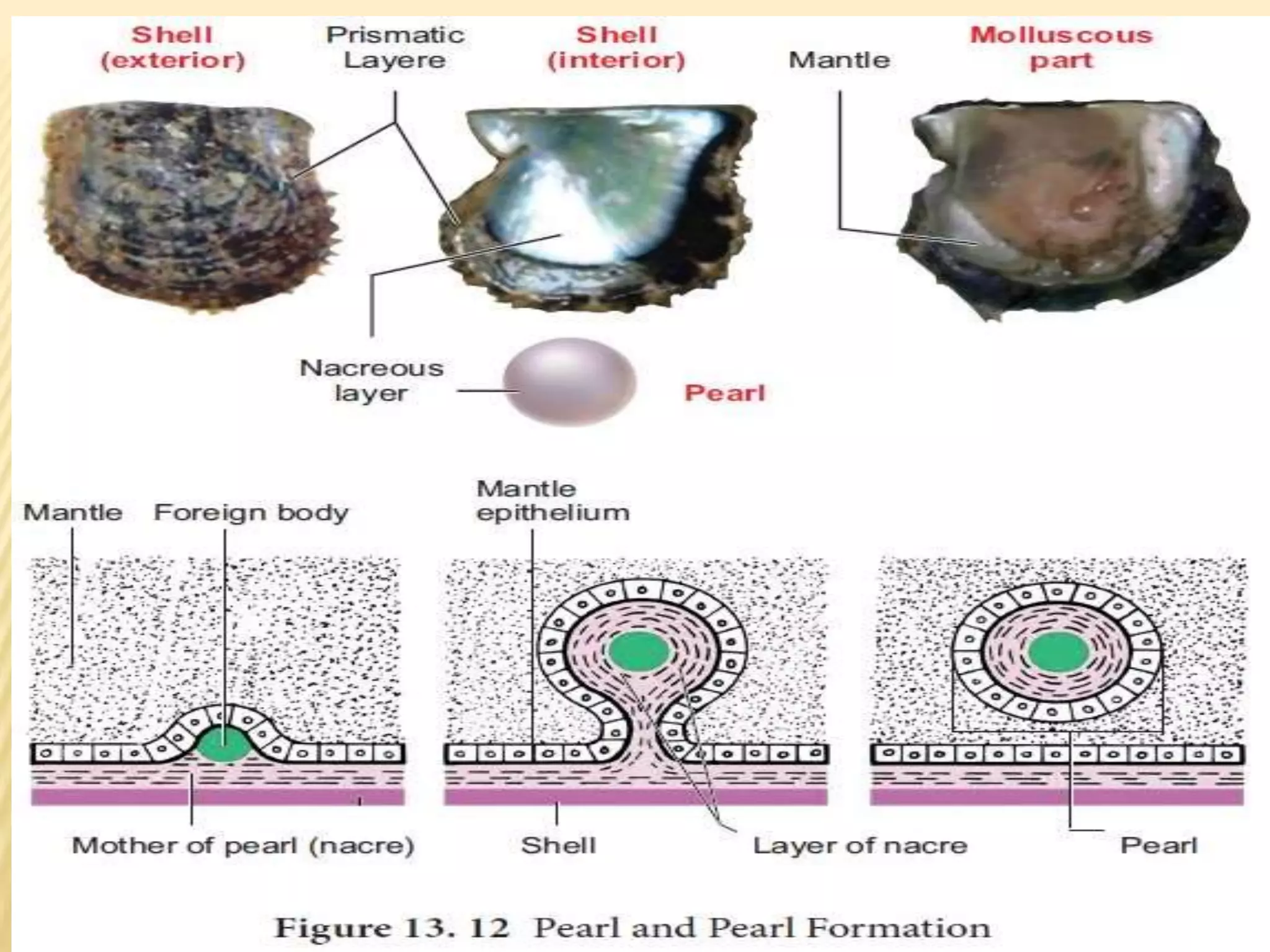
 Cultured pearls are cultivated in various
countries. The live oyster – shells are opened
, minute pieces of pearl are kept inside and
they are left into sea. After ripening of pearl,
they are collected . The pearl are obtained by
cycloid worms. They kept forming layers on
the nucleus. These are of two varieties, one
contains calcium carbonate and other
conchialine.
ORIGIN
 Acc to origin, it is of eight types:
1. Shuktij
2. Shankhaj
3. Hastija
4. Varahaj
5. Sarpaj
6. Matasyaj
7. Darduraj
8. Venuja
ACCEPATBLE QUALITY
 Vrita,sathula,guru,shuchi
 Shaweta , laghu, snigdha, rashmivitnirmal.
The pearl, which are rough,uneven,blackish in
colour, lustreless, dirty, opaque, half white,
contains nodules should be rejected.
DOSHA
 4 Mahadosha, 6 sadharana dosha
Examination : the pearl is rubbed against
paddy husk and washed with cow’s urine, on
which natural one doesn’t show any change,
while artificial one gets roughened or looses
lusture.
Bhasamikaran: (R.T.) Grounded with Gulab
jala and put into 3 laghu puta.
White in colour & formed as CaO2 may has
corrosive effect on buccal cavity on direct use.
MUKTA PISHTI
 Purified mukta is grounded with gulab jala for
two days- , preserved and used as mukta
pishti.
 DOSE:
25mg to 100mg
PRAVAL (CORAL)
 Chemical formula:CaCO3
 Hindi name: Praval, Munga
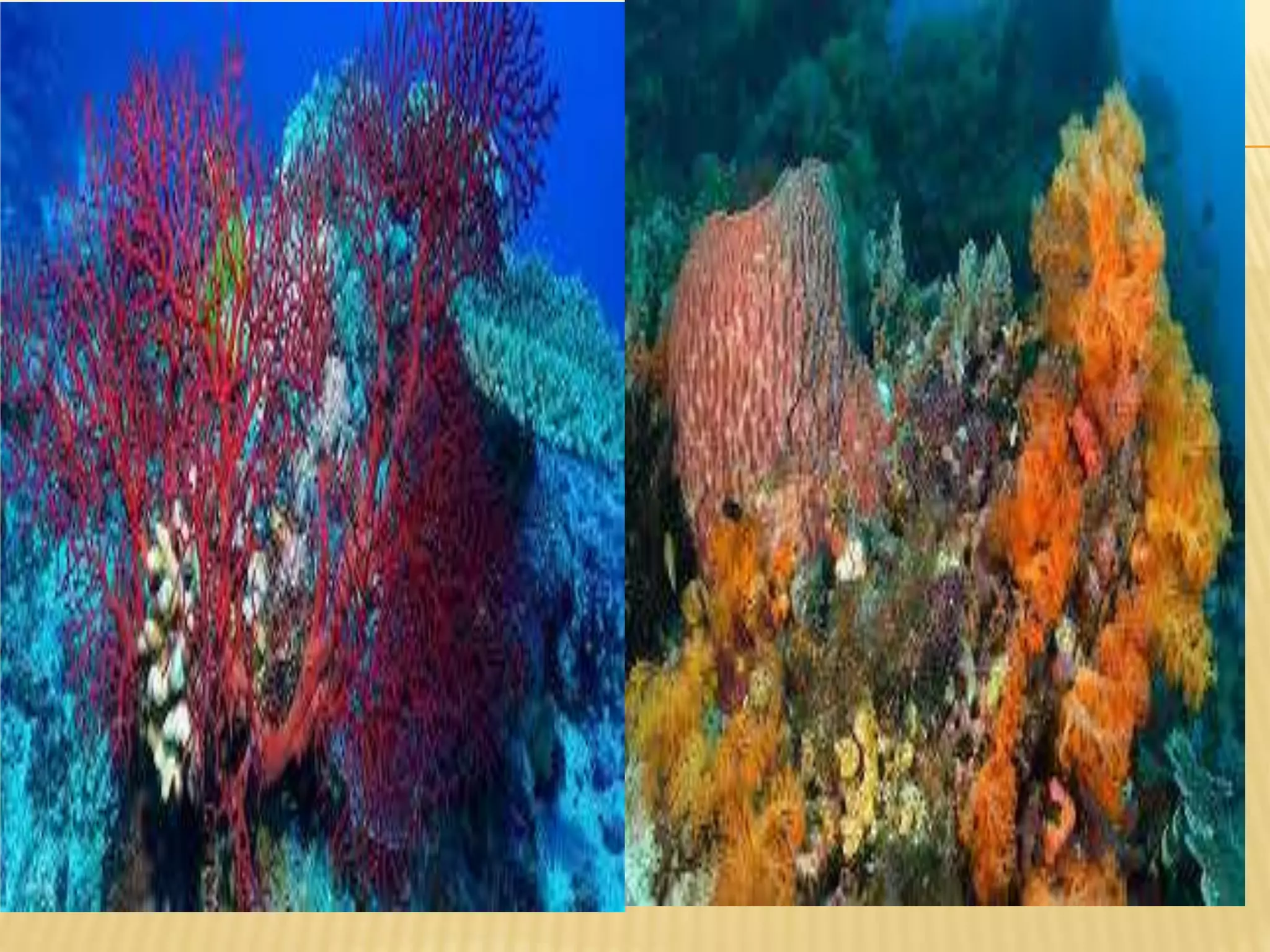
Coral is marine living organism known as
Anthozoan polyp. According to zoology, it is
coralligenous zoophytus.
 Druma is tree and prefix, “vi” suggests the
peculiarity in the sense that it is a peculiar –
tree grown in water.
FORMATION OF PRAVAL:
 It is said that these species, are attached to
one another continuously that appears like a
plant/tree shape. The hardening process of
pravala, from soft stage to ripened condition
is divided into 3 stages:
 Zoontheria
 Rugosa
 Alcyonaria
 Formation of Pravala is seen abundantly in the
Central Pacific Ocean, Indian Ocean, Red Sea,
Shores zanzibar, Madagascar etc.
 GRAHYA PRAVALA:
Pakwabimbiphala , vrita, aayata, avakram,
snigadha, sathula
 AGRAHYA :
Pandur, dhusar, ruksha, savarnam,
kotar(holes),shubhram
VARIETIES
 Four types (Ratna vigyan)
1. Brahma jaati: aruna, shashak rakta, komal,
sanigdha
2. Kashtriya : japa, bandhuk flower, dadima
kusumaprbha.
3. Vaishya : palasha kusum, patalasanibha
4. Shudhra : rakta, utpal dalakar, kathina
 A coral reef is an underwater ecosystem
characterized by reef-building corals. Reefs
are formed of colonies of coral polyps held
together by calcium carbonate. Most coral
reefs are built from stony corals, whose
polyps cluster in groups.
TYPES
 According to shape:
1. Paraval shakha
2. Praval Mula: (honey comb)reef
 Shodhana : Dola yantra- 3 hours
Also dipped in hot water with amla dravya.
 Marana : Aloe vera- 3puta
 Chandra puti praval pishti: 21 days with gulab
jala
 DOSE:
½ ratti – 2 ratti
GUNA-KARMA-UPYOGA:
 Madhura , laghu, sheeta, alkaline in taste,
deepan, pachana, hitkar, tridoshghna, balya,
vrishya,
 Kashya, kasa, ratri saweda hara etc.
 200mg of pravala mixed with honey is taken
to alleviate night sweating.
 Acc. to unani therapeutics, pravala bhasma
is administered in childern who suddenly
wake up from sleep in the nights.
MARAKATA (TAKSHARYA)
 Chemical formula: 2BeOAl2O36SiO2
 Hardness : 7- 7.5
Green colour of precious stone due to sesque
oxide. The content Neryl in this, is considered
to be poisonous and acts as antidote to
poisons.
This is worn on right little finger of hand, on
Wednesday .
It is identified by observing changelessness in
its lustre even after rubbing , exposing to
sunlight .
GRAHYA
 Harita varna, guru (heaviness), snigdha
(smoothness), rashmich,
shubhram(lustrous,) msrina, bhasurum(good
look).
 AGRAHYA :
kapila, karksha, neel, pandur, krishna,
malayukta, chipit, vikit, rukshm, laghu,
 DOSE:
25mg-100mg
They are beautiful healing crystals for you to use and
are highly sought after as one of the most valued
stones, as from within them emerges the purest form
of green ray energy.
Within all of nature, in the plants and the grass and
the trees you can see this clear green color, and the
energy of the green ray.
The energy of nature itself is embodied within stones
that carry the green ray, like green stones.
This lovely stone has many excellent metaphysical
qualities, which is why it was chosen to be a May
birthstone and is commonly used in engagement
rings, as it has a strong loving vibration.
PROPERTIES
 Balya,vishghana, jawara, chardi, pandu
shofaghna, ojo vardhana, amalpithara etc.
PUSHPARAGA(TOPAZ)
 Hindi name: pukhraja
 Chemical name: Al2SiO4(FOH)2
 Hardness: 8
Types :
Two types- by colour : white, yellow
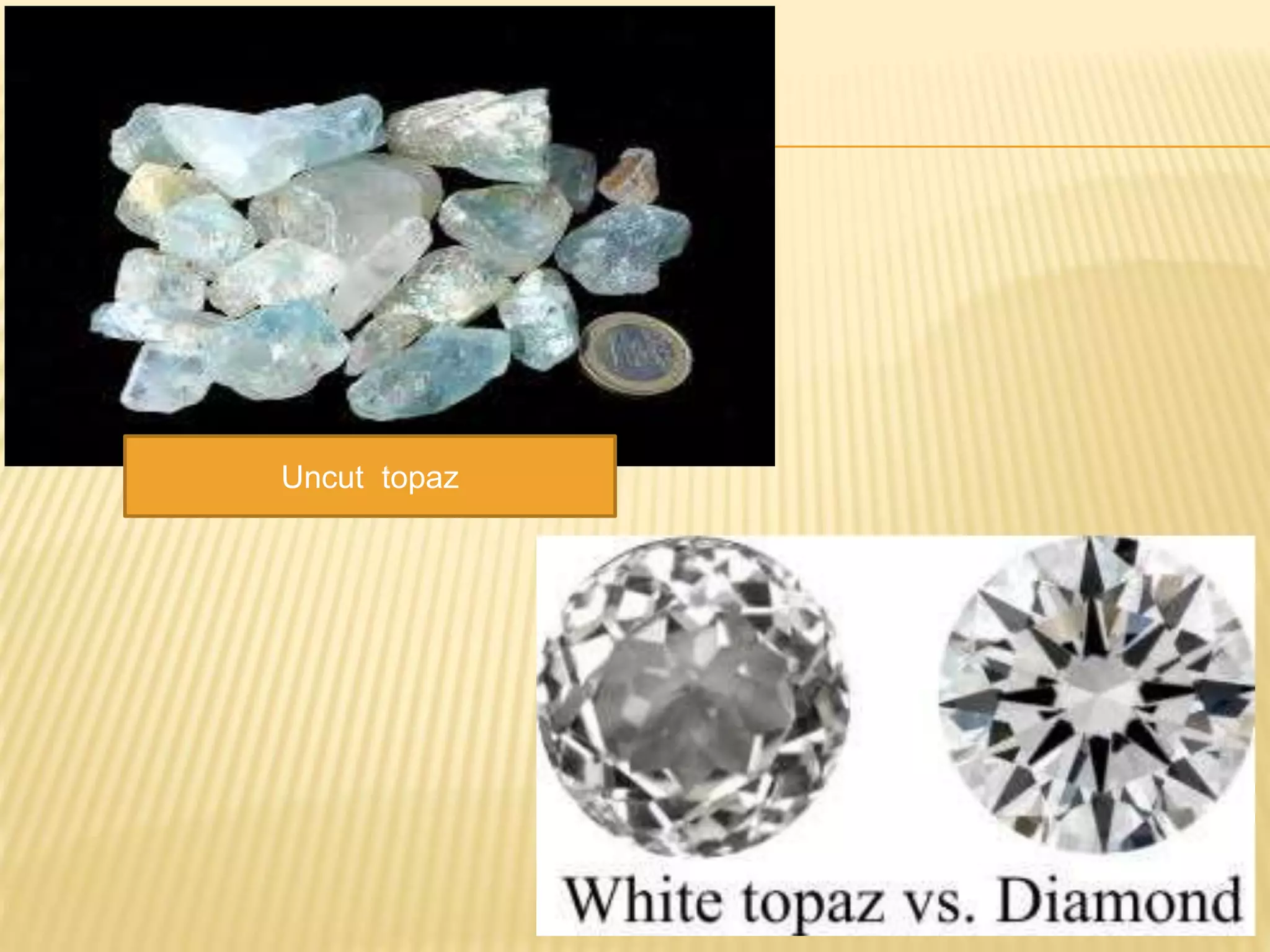
The white is confused with diamond can be
differentiated by estimation of hardness and less
reflection seen in Topaz.
44 carat white topaz
Uncut topaz
CRITERIA FOR GOOD PUSHPRAAG
 Guru, snigdha, sawcha, sathula, sam, mridu,
having colour kranikar flower, and become
bright on rubbing against testing stone.
 AGRAHYA :
nishprabham, karkasha, ruksha,
peetshyama, kapish, kapilam, pandu
 shodhana : dola yantra- kulatha kwatha
 Dose : 25 mg to 100mg
USES
 Vish chardi, kaphavaatnashaka,
dahakushthaghna
 Vishghna, daahprashamna
VAJRA (DIAMOND)
 Chemical formula: C
 Hardness :10
 The Indian and Arabian diamonds are
considered most valuable because of their
hardness.
 Diamonds are made of carbon so they form
as carbon atoms under a high temperature and
pressure; they bond together to start growing
crystals. ... That's why a diamond is such a
hard material because you have
each carbon atom participating in four of these
very strong covalent bonds that form
between carbon atoms.
TYPES
 Nara,
 Nari
 Napunsaka
 Nara vajra is identified by shape of eight
edges, eight surfaces, six angles, stunning
brightness, reflecting the VIBGYOR colours
of rainbow.
 Ashatasra, ashatfalaka, shatakona,
atibhasuram, ambuindradanurvaritaram
 Nari vajra: flat, round in shape (chipitkar.
Vartula)
 Napunska
Types according to colour:
Shaweta : brahmin: rasayana
Rakta : kshatriya: vyadhi naashak
Peeta : vaishya: dhanprada, dehdadyakra
Krishna: shudra : vyadhinashak, vayasatmbha
DOSHA OF VAJRA
 Bindu : looks like drop of water, spot of any
colour in side the diamond is bindu dosha-
looses all his wealth
 Kakpada: the mark in diamond looks like foot of
crow- death
 Yava : the barley shaped mark in the diamond, if
this white in colour , it is considered good.
 Mala : impurity or partial opacity in the diamond
is mala dosha
 Rekha: criss cross lines in diamond are called
rekha that gives bad luck to wearer.
MINEROLOGICAL DESCRIPTION
 Isometric hex-octahedral
 Dose :1/32-1/16 ratti
 USES:
yogavahi, hridya param, shadarasa,
rajykshma har, pandushothahara,
tridoshnashak
NEELAM (SAPPHIRE)
 Hardness: 9
 Chemical composition: Al2O3
 Synonyms: nilamani, nilopalaha, saniratnam,
mahanila, indranila
 If this is dominated by chromium and iron it
would be called Manikya, while cobalt and
iron make it nilam(bluish in colour).
VARIETIES
 Jalanila
 Indranila
 The one which is white internally and blue
externally is called jalanila.
 Indranila has blue colour internal and black
externally.
GRAHYA
 Swascha,msrina, guru, mahaujjwala,
snigdha, guru
 AGRAHYA:
raktardham, ruksha, laghu, komal
Wearing a blue
sapphire protects against
danger, travel problems, terror,
thieves, accidents and problems
from storms, fire, or natural
disasters. It can cause financial
fortunes to change for the
better, help with a person's
career, and make the wearer
rich. It can free one of mental
anxiety
PROPERTIES
 Dose : 1/8 to ½ ratti
 USES: tridosha, varnya, shawasakashara,
vrishya, deepan, vishamjawrahara
GOMEDA
 English name : zircon
 Chemical name: ZrSiO4
 Hardness: 7.5
 Grahya : suswacha gojalachaya, sawcha,
snigdha, samam guru, nirdala, misrina
 Agrhya: vischaya(no lusture), laghu,
rakshanga, patalavinta, nishprabham,
peetkayabham
PROPERTIES:
 Kaphapittaghna, kshayapandughna, deepan,
pachan, ruchi, budhiprobobhna
 Dose:
1/3th ratti- 1/2ratti
VAIDURYA (CATSEYE)
 Hardness 8.5
 It is available in two varieties: chrysoberyl
and quartz
 Yellowish green, brown
 Chemically : BeAl2O4
 Grahya :
shyamshubram, sam, sawcham, guru,
safutam,
PROPERTIES
 Raktpitghna, pragyaayurvalvardhnam,
deepan, balyam, chakshushyam,
malabhednam,
 Ushnaamla, kaphamarutanm, gulamhara
 Dose : 1/4th ratti- 1ratti
Ratna varga

Ratna varga

  • 1.
    PRESENTED BY : DR.PRITIKA ASSISTANT PROF. , BKAMCH COLLEGE DAUDHAR MOGA PUNJAB RATNA VARGA
  • 2.
    INTRODUCTION  Ratnas arethose which are considered the best with regards to qualities and properties in their respective groups. tkrkStkS;nqRd`“Va rf)jRuaizp{krs A  It includes both animal and mineral products. They are well known as gema and precious stones.  It is divided into two groups: Ratna varga
  • 3.
    CONT….  Upratna varga Agem stone is a piece of mineral crystal which, in cut & polished form, is used to make jewellery & other adornments.  Synonyms : Ratna, mani, varpashan
  • 4.
    NAMES OF RATNA Nine ratna have been described by Ras Ratna Samuchyaa. These are: ekf.kD;eqDrkQyfonzqekf.krk{;Z p iq”iafHknqjap uhye~A xksesndap fonwjdap dzes.k jRukfuuoxzgk.kke~AA Manikya , mukta, parval, taksharya, pukhraaj, hira, neelam, gomeda, vaidurya.
  • 5.
    RELATIONSHIP WITH NINEGRAHA(PLANET) NAME OF RATNA HINDI NAME ENGLISH NAME GRAHA Manikya Manik Ruby Surya -sun Mukta Moti Pearl Chandra -Moon Vidrum Praval Coral Mangal -mars Taksharya Panna Emerald Budha - mercury Pushapraga Pukhraaj Topaz Guru -jupiter Bhidura Hira Diamond Shukra -venus Nilam Nila Sapphire Shani-saturn Gomedaka Gomeda Zircon Rahu Vaidurya Lahsuniya Cat’s eye Ketu
  • 6.
    TYPES OF VARIOUSRATNA  Mineral origin: manikya, taksharya, pushapraag, vajra, neelam, gomeda, vaidurya  Pranij origin: mukta, praval  Vanaspatik: trinkant, sangemusha QUALITIES OF RATNA: Sawcha, laghu, chamakdar, ashatfalak, shatkona
  • 7.
    DOSHA OF RATNA According to various acharya, there are five types of dosha: 1. Grasa : opaque/ black spoted 2. Trasa : discolouration 3. Bindu: presence of grains/erosions 4. Rekha: lines/boundaries 5. Jalagarbhta : presence of bubbles
  • 8.
    SHODHANA  Samanya shodhna:jayanti sawrasa, kumari sawrasa, tanduliyak sawrasa, amal dravya, kshara dravya, gomutra- dolayantra – 1 prahara  Vishesh shodhana – R.R.S.
  • 9.
    VISHESH SHODHANA RATNA SHODHNADRAVYA Manikya Amla dravya Mukta Jayanti sawrasa Praval Kshaar varga Panna (taksharya) godhudh Pukhraaj Kulath kwatha/ sandhan Vajra Tanduliya Neelam Nilani sawrasa Gomeda Gorochna Vaidurya Trifala
  • 10.
    MARANA  Marana dravya– 1. Manhashilla 2. Hartala 3. Gandhaka  Gajputa , -- 8 puta for hiraka bhasma
  • 11.
    RATNA DRUTI  Fordravanartha – 1. Hing, 2. Panchlavana 3. Traya kshaar 4. Navsadar 5. Amalvetas 6. Snuhikasheer etc.
  • 12.
    MANIKYA  Chemical formulaAl2O3, also contains iron, chromium, titanium oxide  Hardness : 9  Specific gravity: 4  Synonyms : manikya, padamraga, raviratna, kuruvinda etc  Its colour is deep red due to presence of iron and chromium in small amount
  • 13.
    TYPES  Two types: 1. Padamaraga 2. Neelgandhi  Acceptable variety (grahya ) It should be like raktakamalvata, vrita, ayata, samgatram  Pure manikya examination : it should emanate red rays on coming in contact with the morning sun, even when put in milk , it will make the milk look red.
  • 15.
    DOSE., USES  Dose– ¼ ratti to ½ ratti  Uses – medhya, rasayaana, ayushya, vaatpitnashak
  • 16.
    MUKTA  Chemical formula:CaCO3  Hardness : 3.5  Synonyms : mukta, moktik, shashiratna, shashipriya, ambhsara  It is believed that if a drop of rain water falls inside a shukti floating in sea water in swati nakshatra.
  • 17.
     Cultured pearlsare cultivated in various countries. The live oyster – shells are opened , minute pieces of pearl are kept inside and they are left into sea. After ripening of pearl, they are collected . The pearl are obtained by cycloid worms. They kept forming layers on the nucleus. These are of two varieties, one contains calcium carbonate and other conchialine.
  • 21.
    ORIGIN  Acc toorigin, it is of eight types: 1. Shuktij 2. Shankhaj 3. Hastija 4. Varahaj 5. Sarpaj 6. Matasyaj 7. Darduraj 8. Venuja
  • 22.
    ACCEPATBLE QUALITY  Vrita,sathula,guru,shuchi Shaweta , laghu, snigdha, rashmivitnirmal. The pearl, which are rough,uneven,blackish in colour, lustreless, dirty, opaque, half white, contains nodules should be rejected.
  • 23.
    DOSHA  4 Mahadosha,6 sadharana dosha Examination : the pearl is rubbed against paddy husk and washed with cow’s urine, on which natural one doesn’t show any change, while artificial one gets roughened or looses lusture. Bhasamikaran: (R.T.) Grounded with Gulab jala and put into 3 laghu puta. White in colour & formed as CaO2 may has corrosive effect on buccal cavity on direct use.
  • 24.
    MUKTA PISHTI  Purifiedmukta is grounded with gulab jala for two days- , preserved and used as mukta pishti.  DOSE: 25mg to 100mg
  • 25.
    PRAVAL (CORAL)  Chemicalformula:CaCO3  Hindi name: Praval, Munga Coral is marine living organism known as Anthozoan polyp. According to zoology, it is coralligenous zoophytus.  Druma is tree and prefix, “vi” suggests the peculiarity in the sense that it is a peculiar – tree grown in water.
  • 26.
    FORMATION OF PRAVAL: It is said that these species, are attached to one another continuously that appears like a plant/tree shape. The hardening process of pravala, from soft stage to ripened condition is divided into 3 stages:  Zoontheria  Rugosa  Alcyonaria
  • 28.
     Formation ofPravala is seen abundantly in the Central Pacific Ocean, Indian Ocean, Red Sea, Shores zanzibar, Madagascar etc.  GRAHYA PRAVALA: Pakwabimbiphala , vrita, aayata, avakram, snigadha, sathula  AGRAHYA : Pandur, dhusar, ruksha, savarnam, kotar(holes),shubhram
  • 29.
    VARIETIES  Four types(Ratna vigyan) 1. Brahma jaati: aruna, shashak rakta, komal, sanigdha 2. Kashtriya : japa, bandhuk flower, dadima kusumaprbha. 3. Vaishya : palasha kusum, patalasanibha 4. Shudhra : rakta, utpal dalakar, kathina
  • 30.
     A coralreef is an underwater ecosystem characterized by reef-building corals. Reefs are formed of colonies of coral polyps held together by calcium carbonate. Most coral reefs are built from stony corals, whose polyps cluster in groups.
  • 31.
    TYPES  According toshape: 1. Paraval shakha 2. Praval Mula: (honey comb)reef  Shodhana : Dola yantra- 3 hours Also dipped in hot water with amla dravya.  Marana : Aloe vera- 3puta  Chandra puti praval pishti: 21 days with gulab jala  DOSE: ½ ratti – 2 ratti
  • 32.
    GUNA-KARMA-UPYOGA:  Madhura ,laghu, sheeta, alkaline in taste, deepan, pachana, hitkar, tridoshghna, balya, vrishya,  Kashya, kasa, ratri saweda hara etc.  200mg of pravala mixed with honey is taken to alleviate night sweating.  Acc. to unani therapeutics, pravala bhasma is administered in childern who suddenly wake up from sleep in the nights.
  • 33.
    MARAKATA (TAKSHARYA)  Chemicalformula: 2BeOAl2O36SiO2  Hardness : 7- 7.5 Green colour of precious stone due to sesque oxide. The content Neryl in this, is considered to be poisonous and acts as antidote to poisons. This is worn on right little finger of hand, on Wednesday . It is identified by observing changelessness in its lustre even after rubbing , exposing to sunlight .
  • 36.
    GRAHYA  Harita varna,guru (heaviness), snigdha (smoothness), rashmich, shubhram(lustrous,) msrina, bhasurum(good look).  AGRAHYA : kapila, karksha, neel, pandur, krishna, malayukta, chipit, vikit, rukshm, laghu,  DOSE: 25mg-100mg
  • 37.
    They are beautifulhealing crystals for you to use and are highly sought after as one of the most valued stones, as from within them emerges the purest form of green ray energy. Within all of nature, in the plants and the grass and the trees you can see this clear green color, and the energy of the green ray. The energy of nature itself is embodied within stones that carry the green ray, like green stones. This lovely stone has many excellent metaphysical qualities, which is why it was chosen to be a May birthstone and is commonly used in engagement rings, as it has a strong loving vibration.
  • 38.
    PROPERTIES  Balya,vishghana, jawara,chardi, pandu shofaghna, ojo vardhana, amalpithara etc.
  • 39.
    PUSHPARAGA(TOPAZ)  Hindi name:pukhraja  Chemical name: Al2SiO4(FOH)2  Hardness: 8 Types : Two types- by colour : white, yellow The white is confused with diamond can be differentiated by estimation of hardness and less reflection seen in Topaz.
  • 40.
  • 41.
  • 42.
    CRITERIA FOR GOODPUSHPRAAG  Guru, snigdha, sawcha, sathula, sam, mridu, having colour kranikar flower, and become bright on rubbing against testing stone.  AGRAHYA : nishprabham, karkasha, ruksha, peetshyama, kapish, kapilam, pandu  shodhana : dola yantra- kulatha kwatha  Dose : 25 mg to 100mg
  • 43.
    USES  Vish chardi,kaphavaatnashaka, dahakushthaghna  Vishghna, daahprashamna
  • 44.
    VAJRA (DIAMOND)  Chemicalformula: C  Hardness :10  The Indian and Arabian diamonds are considered most valuable because of their hardness.  Diamonds are made of carbon so they form as carbon atoms under a high temperature and pressure; they bond together to start growing crystals. ... That's why a diamond is such a hard material because you have each carbon atom participating in four of these very strong covalent bonds that form between carbon atoms.
  • 46.
    TYPES  Nara,  Nari Napunsaka  Nara vajra is identified by shape of eight edges, eight surfaces, six angles, stunning brightness, reflecting the VIBGYOR colours of rainbow.  Ashatasra, ashatfalaka, shatakona, atibhasuram, ambuindradanurvaritaram
  • 47.
     Nari vajra:flat, round in shape (chipitkar. Vartula)  Napunska Types according to colour: Shaweta : brahmin: rasayana Rakta : kshatriya: vyadhi naashak Peeta : vaishya: dhanprada, dehdadyakra Krishna: shudra : vyadhinashak, vayasatmbha
  • 48.
    DOSHA OF VAJRA Bindu : looks like drop of water, spot of any colour in side the diamond is bindu dosha- looses all his wealth  Kakpada: the mark in diamond looks like foot of crow- death  Yava : the barley shaped mark in the diamond, if this white in colour , it is considered good.  Mala : impurity or partial opacity in the diamond is mala dosha  Rekha: criss cross lines in diamond are called rekha that gives bad luck to wearer.
  • 49.
    MINEROLOGICAL DESCRIPTION  Isometrichex-octahedral  Dose :1/32-1/16 ratti  USES: yogavahi, hridya param, shadarasa, rajykshma har, pandushothahara, tridoshnashak
  • 50.
    NEELAM (SAPPHIRE)  Hardness:9  Chemical composition: Al2O3  Synonyms: nilamani, nilopalaha, saniratnam, mahanila, indranila  If this is dominated by chromium and iron it would be called Manikya, while cobalt and iron make it nilam(bluish in colour).
  • 51.
    VARIETIES  Jalanila  Indranila The one which is white internally and blue externally is called jalanila.  Indranila has blue colour internal and black externally.
  • 52.
    GRAHYA  Swascha,msrina, guru,mahaujjwala, snigdha, guru  AGRAHYA: raktardham, ruksha, laghu, komal
  • 55.
    Wearing a blue sapphireprotects against danger, travel problems, terror, thieves, accidents and problems from storms, fire, or natural disasters. It can cause financial fortunes to change for the better, help with a person's career, and make the wearer rich. It can free one of mental anxiety
  • 56.
    PROPERTIES  Dose :1/8 to ½ ratti  USES: tridosha, varnya, shawasakashara, vrishya, deepan, vishamjawrahara
  • 57.
    GOMEDA  English name: zircon  Chemical name: ZrSiO4  Hardness: 7.5  Grahya : suswacha gojalachaya, sawcha, snigdha, samam guru, nirdala, misrina  Agrhya: vischaya(no lusture), laghu, rakshanga, patalavinta, nishprabham, peetkayabham
  • 60.
    PROPERTIES:  Kaphapittaghna, kshayapandughna,deepan, pachan, ruchi, budhiprobobhna  Dose: 1/3th ratti- 1/2ratti
  • 61.
    VAIDURYA (CATSEYE)  Hardness8.5  It is available in two varieties: chrysoberyl and quartz  Yellowish green, brown  Chemically : BeAl2O4  Grahya : shyamshubram, sam, sawcham, guru, safutam,
  • 64.
    PROPERTIES  Raktpitghna, pragyaayurvalvardhnam, deepan,balyam, chakshushyam, malabhednam,  Ushnaamla, kaphamarutanm, gulamhara  Dose : 1/4th ratti- 1ratti