CONCEPT OF
MARANA
BY :- Dr PAVAN V H
1st
yr PG Scholar
Dept of RSBK
CONTENTS
Introduction
Objectives of marana
Definition and types
Method of marana
Purva karma
Pradhana karma
Paschath karma
Articles
Discussion
Conclussion
INTRODUCTI
ON
Historically the metals / minerals are used in the fine powder form
since the time of Charak Samhita and Sushrut Samhita.
It is another most important pharmaceutical process applicable to the
drugs of mineral or metal origin for their conversion into fine ash
form ie. Bhasma.
Bhasma shows quick efficacy in retaining the health of the patients.
To achieve this form, the drugs of mineral or metal origin are first
mixed with Marana drugs and then the mixture is subjected to
Bhavana.
After drying. Putapaka is given.
On shelf cooling, the material is taken out and used for further
proceedings.
OBJECTIVES
OF
MARANA
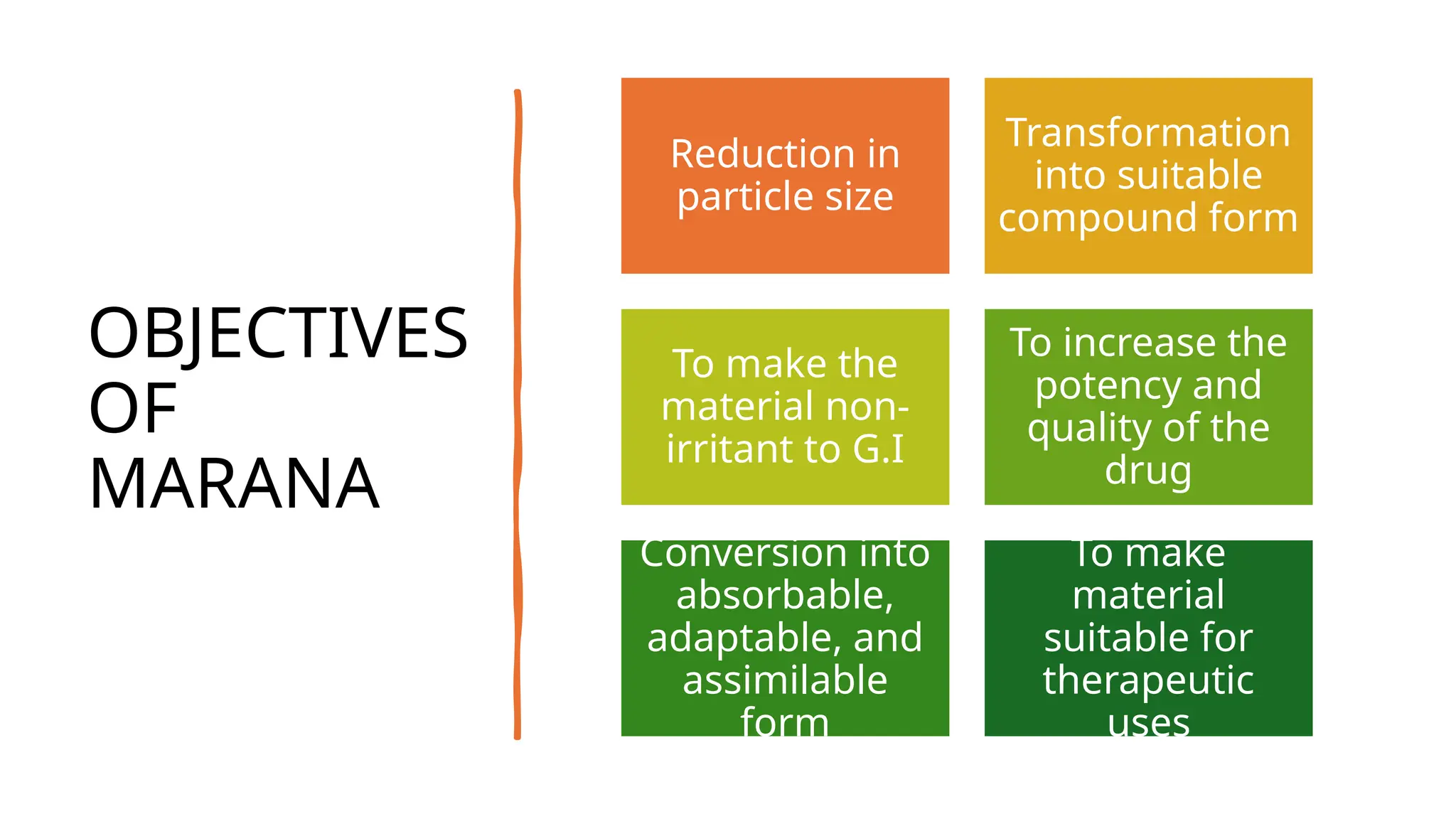
Reduction in
particle size
Transformation
into suitable
compound form
To make the
material non-
irritant to G.I
To increase the
potency and
quality of the
drug
Conversion into
absorbable,
adaptable, and
assimilable
form
To make
material
suitable for
therapeutic
uses
Definition of Marana
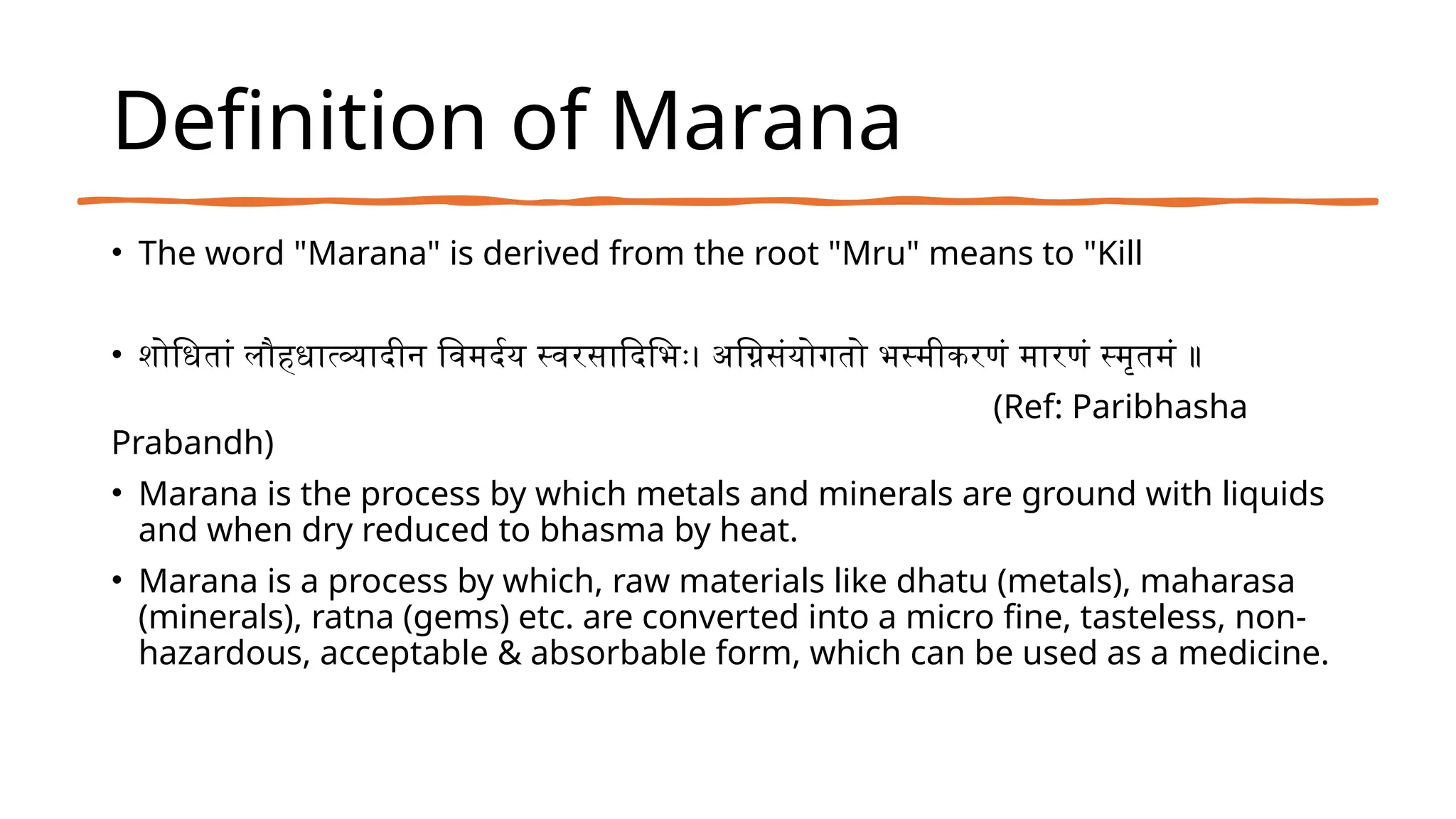
• The word "Marana" is derived from the root "Mru" means to "Kill
• शोधितां लौहधात्व्यादीन विमर्दय स्वरसादिभिः। अग्निसंयोगतो भस्मीकरणं मारणं स्मृतमं ॥
(Ref: Paribhasha
Prabandh)
• Marana is the process by which metals and minerals are ground with liquids
and when dry reduced to bhasma by heat.
• Marana is a process by which, raw materials like dhatu (metals), maharasa
(minerals), ratna (gems) etc. are converted into a micro fine, tasteless, non-
hazardous, acceptable & absorbable form, which can be used as a medicine.
TYPES
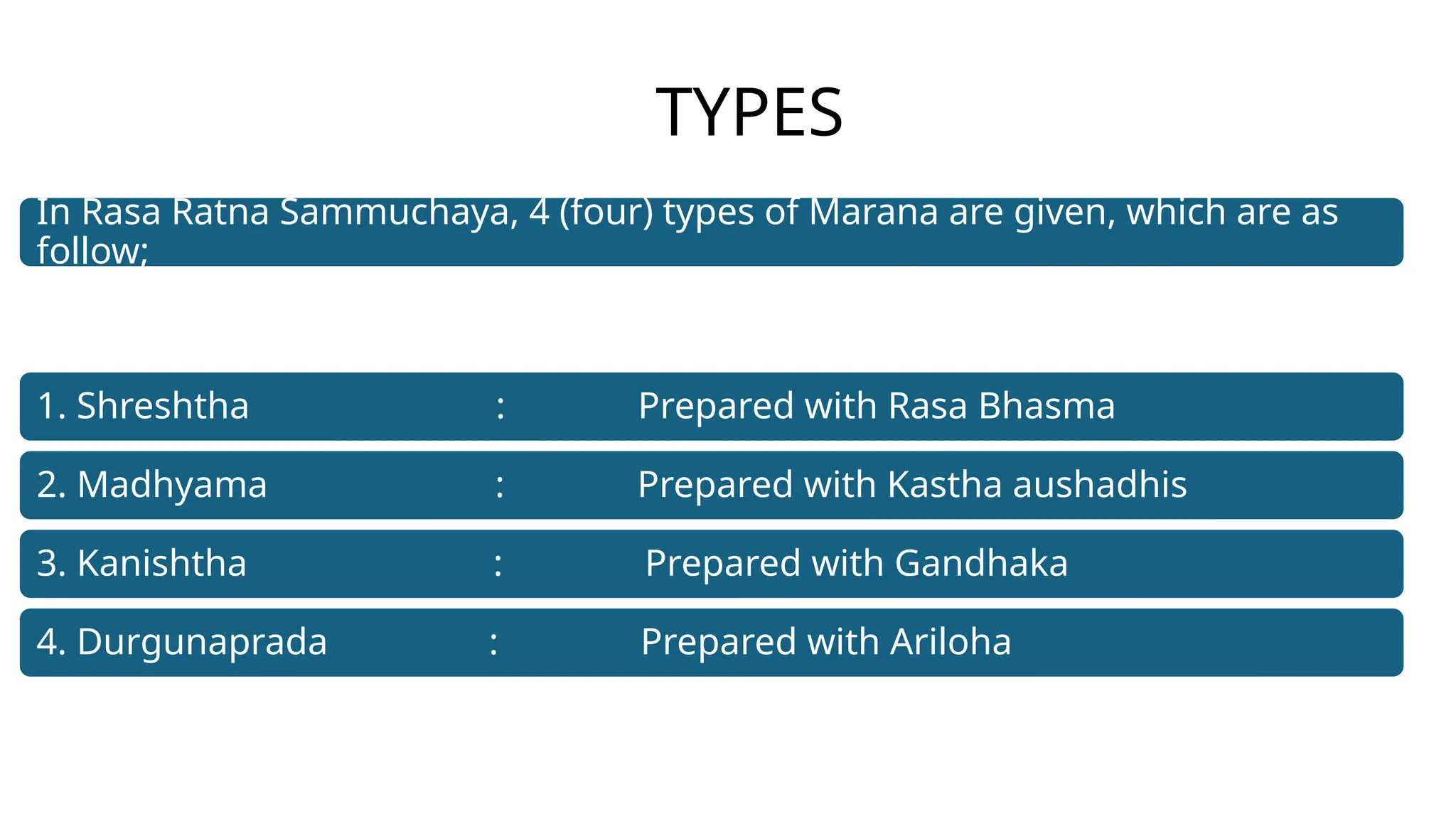
In Rasa Ratna Sammuchaya, 4 (four) types of Marana are given, which are as
follow;
1. Shreshtha : Prepared with Rasa Bhasma
2. Madhyama : Prepared with Kastha aushadhis
3. Kanishtha : Prepared with Gandhaka
4. Durgunaprada : Prepared with Ariloha
METHO
D OF
MARAΝ
Α
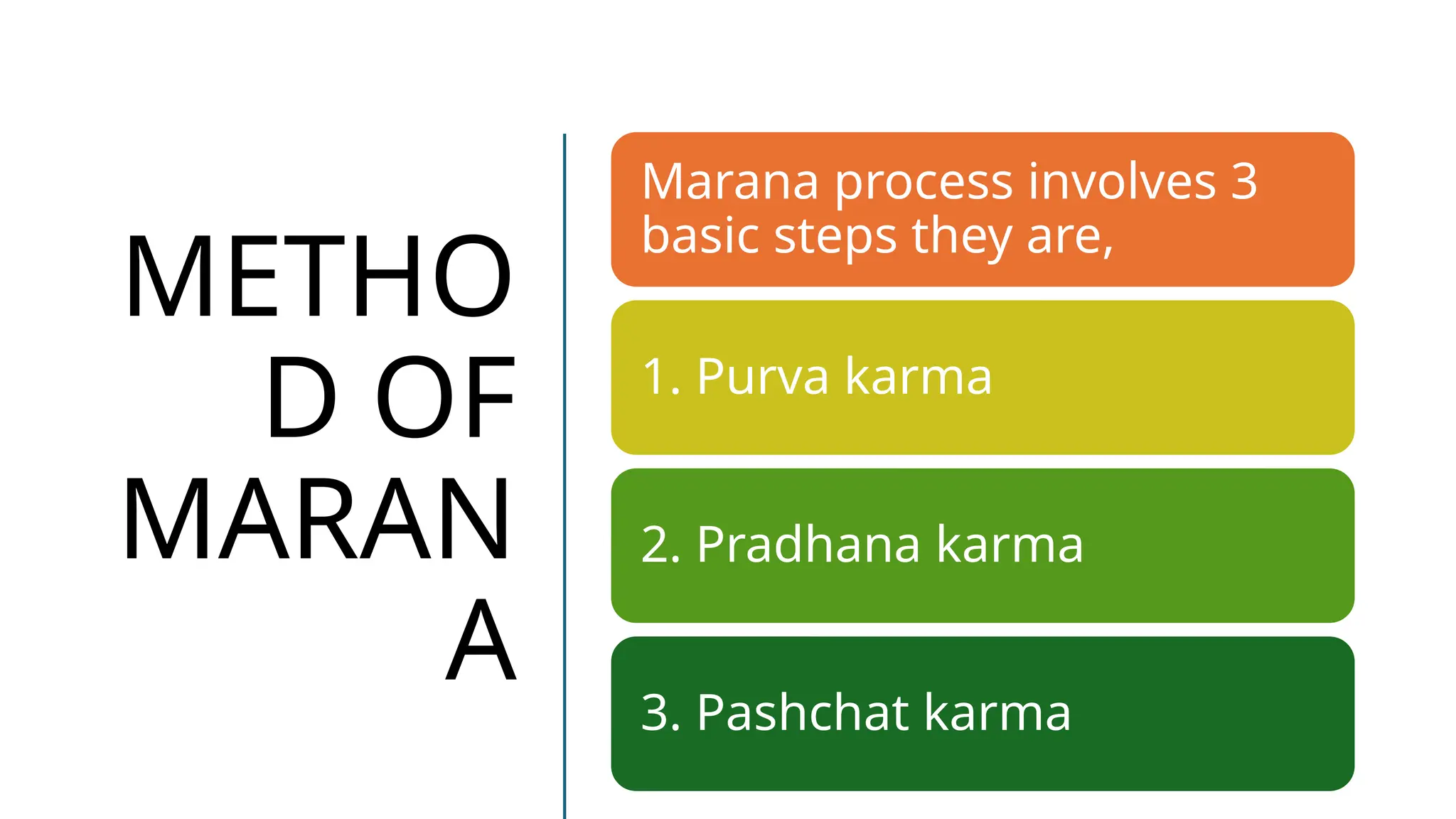
Marana process involves 3
basic steps they are,
1. Purva karma
2. Pradhana karma
3. Pashchat karma
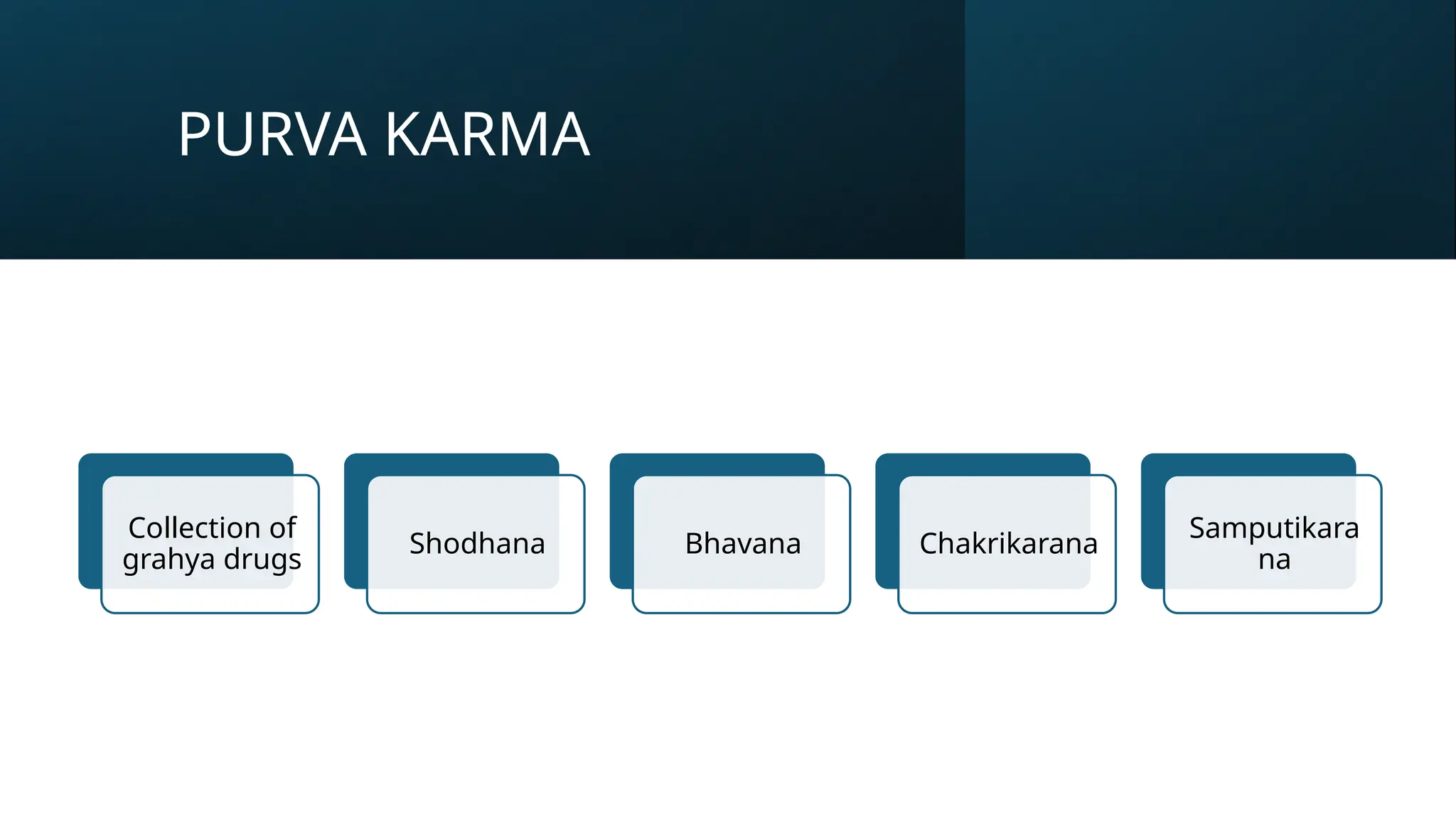
PURVA KARMA
Collection of
grahya drugs
Shodhana Bhavana Chakrikarana
Samputikara
na
SHODHANA
• When a substance is subjected to trituration
with specified plant or animal resources
with the help of 'peshani' so as to remove
impurities, it is known as shodhana.
BHAVANA
• A liquid is added to the powder and is
triturated till all the liquid portion is
absorbed. This procedure is known as
bhavana.
• Carried out for 7 days
• Quantity of liquid- Till the Powder should
just become wet
• If done with kwatha -1/8th 10
CHAKRIKARANA
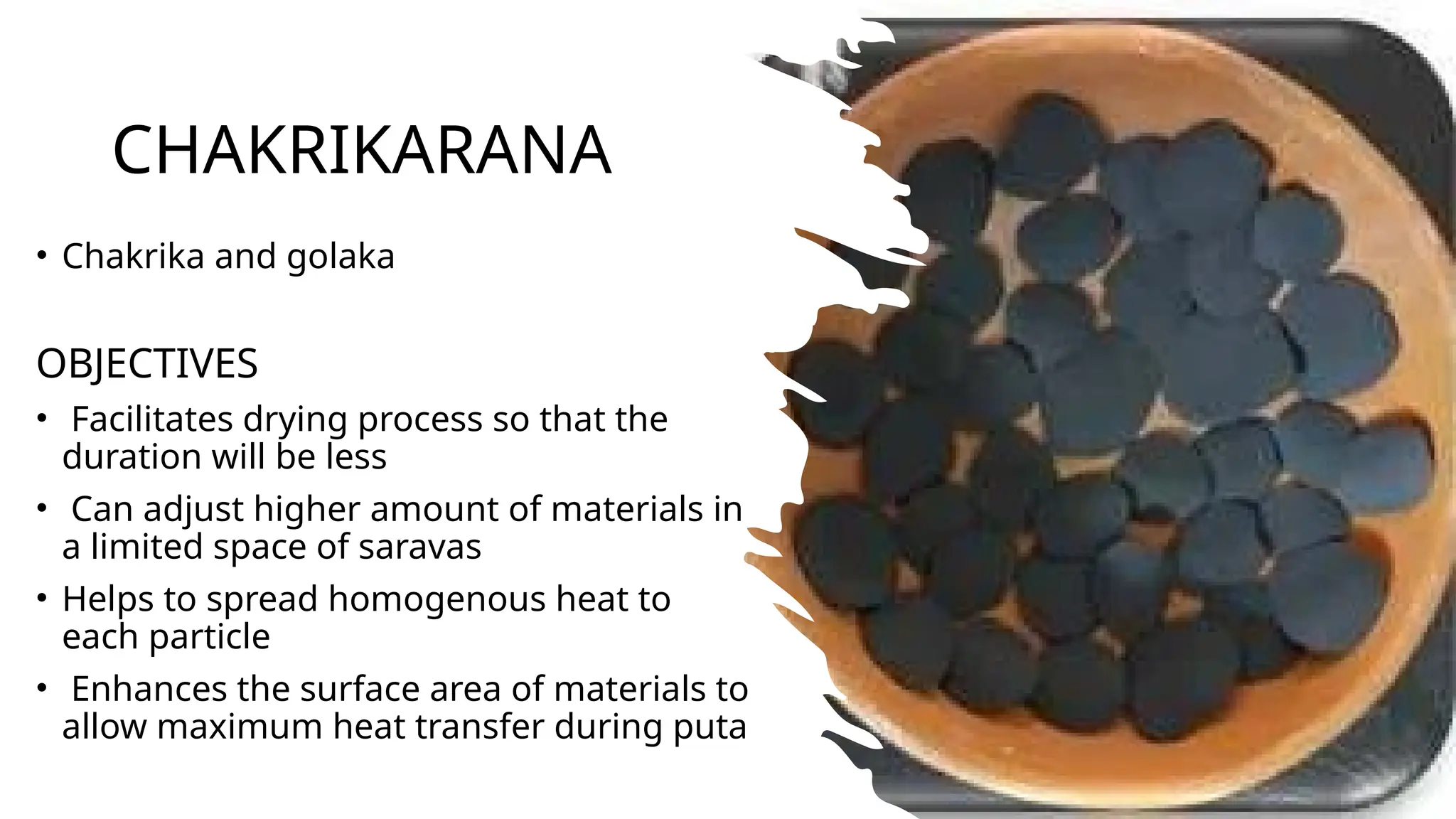
• Chakrika and golaka
OBJECTIVES
• Facilitates drying process so that the
duration will be less
• Can adjust higher amount of materials in
a limited space of saravas
• Helps to spread homogenous heat to
each particle
• Enhances the surface area of materials to
allow maximum heat transfer during puta
SAMPUTIKARAN
A
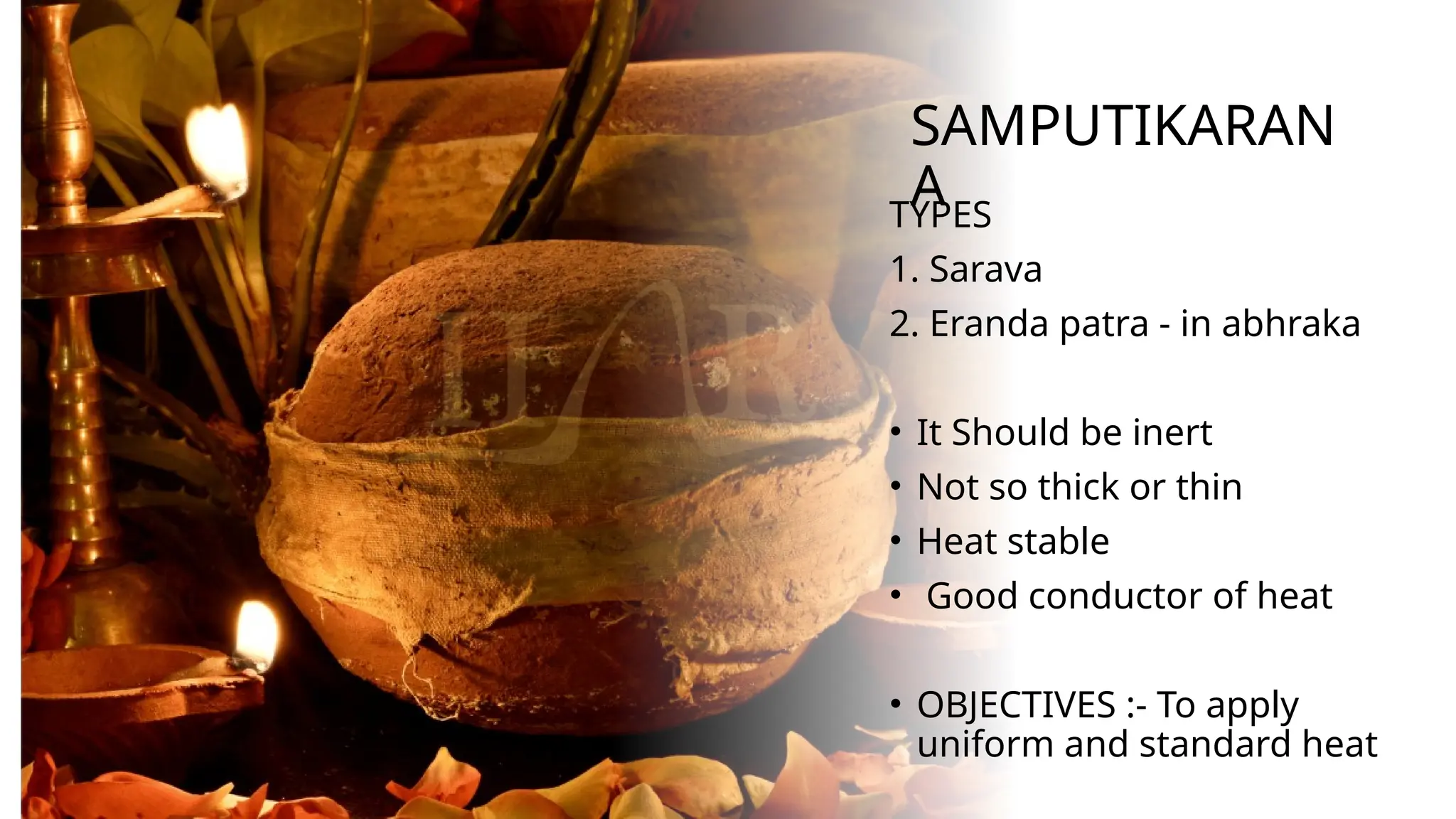
TYPES
1. Sarava
2. Eranda patra - in abhraka
• It Should be inert
• Not so thick or thin
• Heat stable
• Good conductor of heat
• OBJECTIVES :- To apply
uniform and standard heat
PRADHANA
KARMA
Here Putapaka is given with the help of
vanyopalas (cow dung cakes).
Depending upon the nature of the drug,
different types of Putapakas are
mentioned in the classics like;
Mahaputa
Gajaputa
Varaha puta
Kukkuta puta
Kapot puta, etc.
The heat applied from outside of samputa through puta, the fuel will slowly
enter into the material kept in sarava and convert into powder form.
It is the process in which the degree of heat which is necessary for paka of
Rasa, uparasa, maharasa or metals. The degree of heat is neither less nor
more than necessary because the medicines which are prepared by using
proper required application of heat is considered as hitha.
PUTA :-
PASHCHAT
KARMA
Bhasma Pariksha
Varitara :- If the bhasma floats over the
water surface that is known as varitara. It is to
study the lightness and fineness of Bhasma Here
the particles of bhasma attain so much fine and
light that they cannot break the surface tension
of stagnant water.
Rekhapurnata :- A small amount of
incinerated metal is to be rubbed in
between the index finger and thumb, If
the Bhasma particles enters in to the
creases of the fingers, it indicates that the
metal is incinerated properly
Apunarbhava :-
If the bhasma is mixed with mitra panchakas and
if it doesn't regain its original form after heating.
Uttama:-
Bhasma is slowly placed on the water and it floats,
if it doesn't sink even after placing the grain but
floats like swan then such bhasma is called
uttama
Niruttha:-
Incinerated metal is to be added with little
quantity of silver and this complex is to be heated
in a crucible until the silver melts completely.
After self cooling, the silver is to be examined for
changes in weight and colour. If the metal is
properly incinerated, there won't be any change
in the weight of silver.
Amla pariksha :-when Bhasma is
tested on any amla rasa if it
turns to different colour then
bhasma is not prepared
properly.
Nirdhuma-Niswadu-Nischandra
Avaami :- It should be
smokeless, tasteless and it does
not contains any shiny particles.
AFTER
MARANA
Lightness
Softness
Smoothness
More potent form
Enhances the property of substances
Rapid spreading in body and rapid relief
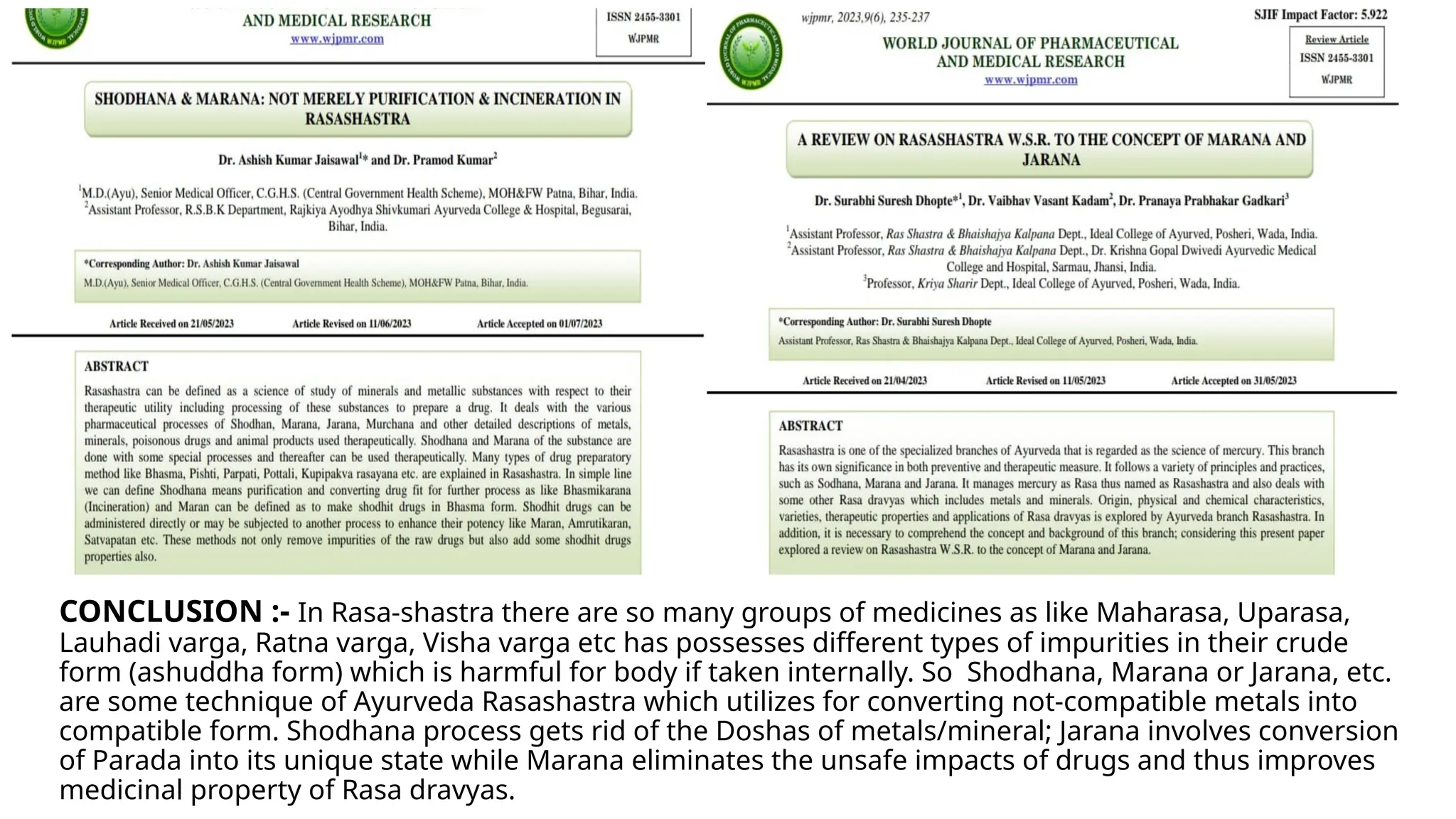
CONCLUSION :- In Rasa-shastra there are so many groups of medicines as like Maharasa, Uparasa,
Lauhadi varga, Ratna varga, Visha varga etc has possesses different types of impurities in their crude
form (ashuddha form) which is harmful for body if taken internally. So Shodhana, Marana or Jarana, etc.
are some technique of Ayurveda Rasashastra which utilizes for converting not-compatible metals into
compatible form. Shodhana process gets rid of the Doshas of metals/mineral; Jarana involves conversion
of Parada into its unique state while Marana eliminates the unsafe impacts of drugs and thus improves
medicinal property of Rasa dravyas.
DISCUSSION
The process involves triturating substances that have already
undergone Shodhana with Bhavana drugs swarasa, and then
subjecting the mixture to agni.
The Bhasma form of the metals and minerals cannot be converted
back to their original form.
Bhavana is an initial and important stage in the Marana process. It
involves subjecting a metal or mineral churna to a mardana prakriya
with a specific liquid media until it dries up.
• After doing marana of the rasa dravya the particle size will
reduces so it can penetrate deeply to each and every
srothas.
• Bhavana dravya plays very important role in marana
samskara because the phytochemicals present in bhavana
dravya will inculculate in rasa dravya hence increases the
potency of the dravya.
CONCLUSION
In Rasashastra, Marana is a crucial step in the process of
converting metals and minerals into a fine ash form called
Bhasma.
The process of Marana converts metals and minerals into a fine
ash form that can be easily absorbed by the body.
The process of Marana enhances the natural properties of the
metals and minerals, and can even add new properties.
Detail explanation of Concept of Marana.

Detail explanation of Concept of Marana.

  • 1.
    CONCEPT OF MARANA BY :-Dr PAVAN V H 1st yr PG Scholar Dept of RSBK
  • 2.
    CONTENTS Introduction Objectives of marana Definitionand types Method of marana Purva karma Pradhana karma Paschath karma Articles Discussion Conclussion
  • 3.
    INTRODUCTI ON Historically the metals/ minerals are used in the fine powder form since the time of Charak Samhita and Sushrut Samhita. It is another most important pharmaceutical process applicable to the drugs of mineral or metal origin for their conversion into fine ash form ie. Bhasma. Bhasma shows quick efficacy in retaining the health of the patients. To achieve this form, the drugs of mineral or metal origin are first mixed with Marana drugs and then the mixture is subjected to Bhavana. After drying. Putapaka is given. On shelf cooling, the material is taken out and used for further proceedings.
  • 4.
    OBJECTIVES OF MARANA Reduction in particle size Transformation intosuitable compound form To make the material non- irritant to G.I To increase the potency and quality of the drug Conversion into absorbable, adaptable, and assimilable form To make material suitable for therapeutic uses
  • 5.
    Definition of Marana •The word "Marana" is derived from the root "Mru" means to "Kill • शोधितां लौहधात्व्यादीन विमर्दय स्वरसादिभिः। अग्निसंयोगतो भस्मीकरणं मारणं स्मृतमं ॥ (Ref: Paribhasha Prabandh) • Marana is the process by which metals and minerals are ground with liquids and when dry reduced to bhasma by heat. • Marana is a process by which, raw materials like dhatu (metals), maharasa (minerals), ratna (gems) etc. are converted into a micro fine, tasteless, non- hazardous, acceptable & absorbable form, which can be used as a medicine.
  • 6.
    TYPES In Rasa RatnaSammuchaya, 4 (four) types of Marana are given, which are as follow; 1. Shreshtha : Prepared with Rasa Bhasma 2. Madhyama : Prepared with Kastha aushadhis 3. Kanishtha : Prepared with Gandhaka 4. Durgunaprada : Prepared with Ariloha
  • 7.
    METHO D OF MARAΝ Α Marana processinvolves 3 basic steps they are, 1. Purva karma 2. Pradhana karma 3. Pashchat karma
  • 8.
    PURVA KARMA Collection of grahyadrugs Shodhana Bhavana Chakrikarana Samputikara na
  • 9.
    SHODHANA • When asubstance is subjected to trituration with specified plant or animal resources with the help of 'peshani' so as to remove impurities, it is known as shodhana. BHAVANA • A liquid is added to the powder and is triturated till all the liquid portion is absorbed. This procedure is known as bhavana. • Carried out for 7 days • Quantity of liquid- Till the Powder should just become wet • If done with kwatha -1/8th 10
  • 10.
    CHAKRIKARANA • Chakrika andgolaka OBJECTIVES • Facilitates drying process so that the duration will be less • Can adjust higher amount of materials in a limited space of saravas • Helps to spread homogenous heat to each particle • Enhances the surface area of materials to allow maximum heat transfer during puta
  • 11.
    SAMPUTIKARAN A TYPES 1. Sarava 2. Erandapatra - in abhraka • It Should be inert • Not so thick or thin • Heat stable • Good conductor of heat • OBJECTIVES :- To apply uniform and standard heat
  • 12.
    PRADHANA KARMA Here Putapaka isgiven with the help of vanyopalas (cow dung cakes). Depending upon the nature of the drug, different types of Putapakas are mentioned in the classics like; Mahaputa Gajaputa Varaha puta Kukkuta puta Kapot puta, etc.
  • 13.
    The heat appliedfrom outside of samputa through puta, the fuel will slowly enter into the material kept in sarava and convert into powder form. It is the process in which the degree of heat which is necessary for paka of Rasa, uparasa, maharasa or metals. The degree of heat is neither less nor more than necessary because the medicines which are prepared by using proper required application of heat is considered as hitha. PUTA :-
  • 14.
    PASHCHAT KARMA Bhasma Pariksha Varitara :-If the bhasma floats over the water surface that is known as varitara. It is to study the lightness and fineness of Bhasma Here the particles of bhasma attain so much fine and light that they cannot break the surface tension of stagnant water. Rekhapurnata :- A small amount of incinerated metal is to be rubbed in between the index finger and thumb, If the Bhasma particles enters in to the creases of the fingers, it indicates that the metal is incinerated properly
  • 15.
    Apunarbhava :- If thebhasma is mixed with mitra panchakas and if it doesn't regain its original form after heating. Uttama:- Bhasma is slowly placed on the water and it floats, if it doesn't sink even after placing the grain but floats like swan then such bhasma is called uttama Niruttha:- Incinerated metal is to be added with little quantity of silver and this complex is to be heated in a crucible until the silver melts completely. After self cooling, the silver is to be examined for changes in weight and colour. If the metal is properly incinerated, there won't be any change in the weight of silver.
  • 16.
    Amla pariksha :-whenBhasma is tested on any amla rasa if it turns to different colour then bhasma is not prepared properly. Nirdhuma-Niswadu-Nischandra Avaami :- It should be smokeless, tasteless and it does not contains any shiny particles.
  • 17.
    AFTER MARANA Lightness Softness Smoothness More potent form Enhancesthe property of substances Rapid spreading in body and rapid relief
  • 18.
    CONCLUSION :- InRasa-shastra there are so many groups of medicines as like Maharasa, Uparasa, Lauhadi varga, Ratna varga, Visha varga etc has possesses different types of impurities in their crude form (ashuddha form) which is harmful for body if taken internally. So Shodhana, Marana or Jarana, etc. are some technique of Ayurveda Rasashastra which utilizes for converting not-compatible metals into compatible form. Shodhana process gets rid of the Doshas of metals/mineral; Jarana involves conversion of Parada into its unique state while Marana eliminates the unsafe impacts of drugs and thus improves medicinal property of Rasa dravyas.
  • 19.
    DISCUSSION The process involvestriturating substances that have already undergone Shodhana with Bhavana drugs swarasa, and then subjecting the mixture to agni. The Bhasma form of the metals and minerals cannot be converted back to their original form. Bhavana is an initial and important stage in the Marana process. It involves subjecting a metal or mineral churna to a mardana prakriya with a specific liquid media until it dries up.
  • 20.
    • After doingmarana of the rasa dravya the particle size will reduces so it can penetrate deeply to each and every srothas. • Bhavana dravya plays very important role in marana samskara because the phytochemicals present in bhavana dravya will inculculate in rasa dravya hence increases the potency of the dravya.
  • 21.
    CONCLUSION In Rasashastra, Maranais a crucial step in the process of converting metals and minerals into a fine ash form called Bhasma. The process of Marana converts metals and minerals into a fine ash form that can be easily absorbed by the body. The process of Marana enhances the natural properties of the metals and minerals, and can even add new properties.

Editor's Notes

  • #19 After doing marana of the rasa dravya the particle size will reduces so it can penetrate deeply to each and every srothas. Bhavana dravya plays very important role in marana samskara because the phytochemicals present in bhavana dravya will inculculate in rasa dravya hence increases the potency of the dravya.