BFP-2 Impact Pathways
        Workshop


        4 – 5 February, 2008
                CIAT
Boru Douthwaite and Sophie Alvarez, CPWF
              Impact Project
          CIAT, Cali, Colombia
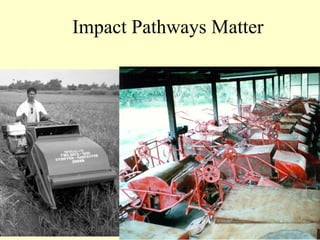
Impact Pathways Matter
Why make Impact Pathways
             explicit?
• People plan and implement projects (programs, countries
  …) on the basis of their change models - their implicit
  theories about how the world works, i.e., impact pathways
• If you can improve the impact pathways (IPs) you can
  improve the practice, making impact more likely
• IPs show a project’s rationale and networks
   – Help communicate what the project is doing
       • More fundable
   – Help with planning, including MTPs
   – Provide a basis for evaluation
       • Starting point for evaluation is a good model of what you think will
         happen
• Provide information to support programmatic integration
• Provides impact hypotheses for ex-post impact assessment
PIPA makes Impact Pathways
               explicit
    It does so by developing two
           perspectives ….

1. A problem tree that shows a linear logic
   linking project outputs to project goal; and
2. Network maps that show the evolving
   relationships necessary to achieve the goal
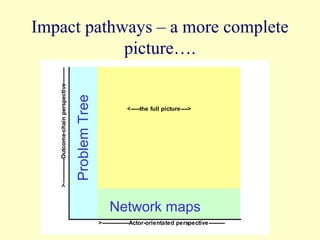
Impact pathways – a more complete
            picture….
   >--------------Outcome-chain perspective------------------>


                                                                 Problem Tree
                                                                                            <-----the full picture---->


                                                                                    Network maps
                                                                                >---------------Actor-orientated perspective---------
Foundations

• Adaptation of concepts from Program Evaluation
   – Renger and Titcomb (2002) – problem trees
   – Chen (2005) – program theory
   – Mayne (2004) - performance stories
• Innovation histories
   – Douthwaite and Ashby, 2005
• Social network analysis
   – Cross and Parker, 2004
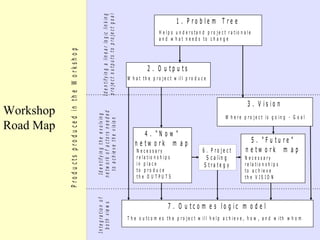
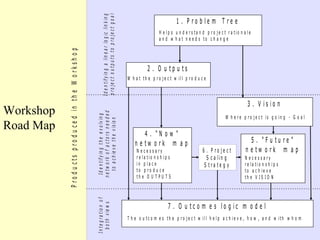
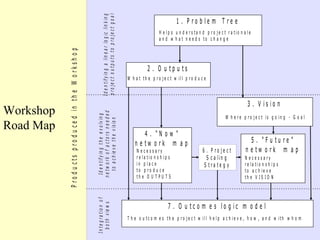
p ro je c t o u tp u ts to p ro je c t g o a l
                                                                              I d e n t if y in g a lin e a r lo g ic lin k in g
                                                                                                                                                               1 . P ro b le m T re e
                                                                                                                                                     H e lp s u n d e rs ta n d p ro je c t ra tio n a le
                                                                                                                                                     a n d w h a t n e e d s to c h a n g e


           P r o d u c ts p r o d u c e d in th e W o r k s h o p
                                                                                                                                              2 . O u tp u ts
                                                                                                                                   W h a t th e p ro je c t w ill p ro d u c e


                                                                                                                                                                                                       3 . V is io n
Workshop                                                            n e tw o rk o f a cto rs n e e d e d
                                                                      I d e n t if y in g t h e e v o lv in g


                                                                                                                                                                                          W h e re p ro je c t is g o in g - G o a l
                                                                         t o a c h ie v e t h e v is io n

Road Map
                                                                                                                                           4 . "N o w "
                                                                                                                                       n e tw o rk m a p                                                5 . "F u tu re "
                                                                                                                                        N e c e s s a ry                     6 . P ro je ct           n e tw o rk m a p
                                                                                                                                        re la tio n s h ip s                   S c a lin g           N e c e s s a ry
                                                                                                                                        in p la c e                           S tra te g y           re la tio n s h ip s
                                                                                                                                        to p ro d u c e                                              to a c h ie v e
                                                                                                                                        th e O U T P U T S                                           th e V IS IO N
                                                                    I n t e g r a t io n o f


                                                                                                                                                          7 . O u tc o m e s lo g ic m o d e l
                                                                       b o t h v ie w s


                                                                                                                                   T h e o u tc o m e s th e p ro je c t w ill h e lp a c h ie v e , h o w , a n d w ith w h o m
After the Workshop
• Complete outcomes logic model (that
  contains outcome hypotheses)
• Identify outcome targets and milestones
  measuring progress towards them
• Project M&E based on these
• Regular reflection and updating of outcome
  hypotheses (i.e., impact pathways)
Expectations
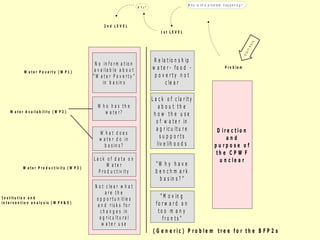
W h y is t h is p r o b le m h a p p e n in g ?
                                                                                     W hy?


                                                               2nd LEVEL
                                                                                                  1st LEVEL


                                                                                                                                                                            e
                                                                                                                                                                         er
                                                                                                                                                                     t H
                                                                                                                                                                    ar
                                                                                                                                                                    St
                                                                                              R e l a t io n s h ip
                                                          N o in f o r m a t io n
                                                         a v a ila b le a b o u t            w a te r- fo o d -                                   P ro b le m
               W a te r P o v e rty (W P 1 )
                                                         "W a te r P o v e rty "              p o v e rty n o t
                                                              in b a s in s                          c le a r

                                                                                             L a c k o f c l a r it y
                                                           W h o h a s th e                       a b o u t th e
     W a t e r A v a ila b ilit y ( W P 2 )                   w a te r?                        h o w th e u se
                                                                                                o f w a t e r in
                                                                                                a g r ic u lt u r e                       D ire c tio n
                                                            W hat does
                                                            w a t e r d o in
                                                                                                   s u p p o rts                              and
                                                               b a s in s ?                      li v e lih o o d s                      p u rp o s e o f
                                                                                                                                          th e C P W F
                                                         La ck o f d a ta o n                                                              u n c le a r
                                                                 W a te r                      "W h y h a v e
              W a t e r P ro d u c t iv it y ( W P 3 )
                                                           P r o d u c t iv it y               b e n ch m a rk
                                                                                                 b a s in s ? "
                                                          N o t c le a r w h a t
                                                                a re th e
I n s t it u t io n a n d                                  o p p o r t u n it ie s               " M o v in g
in t e rv e n t io n a n a ly s is ( W P 4 & 5 )
                                                            a n d r is k s f o r               fo rw a rd o n
                                                             c h a n g e s in                   to o m a n y
                                                             a g r ic u lt u r a l                fro n ts "
                                                              w a te r u se
                                                                                             ( G e n e ric ) P ro b le m tre e fo r th e B F P 2 s
Exercise       Deriving Products/
   1        Outputs from the Problem
                      Tree
• List the outputs, the use of which will address
  the determinants
  – The determinants are the problems the project is
    directly addressing with its outputs
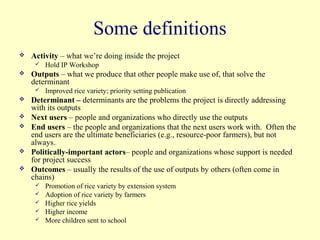
Some definitions
   Activity – what we’re doing inside the project
        Hold IP Workshop
   Outputs – what we produce that other people make use of, that solve the
    determinant
        Improved rice variety; priority setting publication
   Determinant – determinants are the problems the project is directly addressing
    with its outputs
   Next users – people and organizations who directly use the outputs
   End users – the people and organizations that the next users work with. Often the
    end users are the ultimate beneficiaries (e.g., resource-poor farmers), but not
    always.
   Politically-important actors– people and organizations whose support is needed
    for project success
   Outcomes – usually the results of the use of outputs by others (often come in
    chains)
        Promotion of rice variety by extension system
        Adoption of rice variety by farmers
        Higher rice yields
        Higher income
        More children sent to school
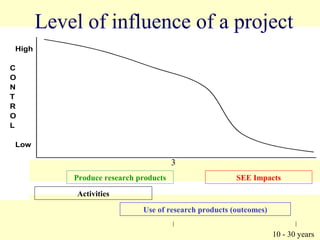
Level of influence of Project
       Level of influence of a project
High

C
O
N
T
R
O
L

Low

       Research         Output             3
                                          Output           Outcome             Impact
       activity         target
                  Produce research products                   SEE Impacts

                  Activities

                                    Use of research products (outcomes)


                                                                          10 - 30 years
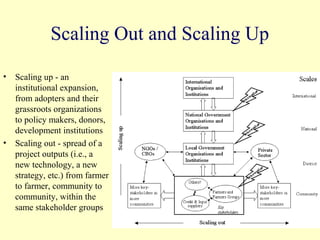
Scaling Out and Scaling Up

•   Scaling up - an
    institutional expansion,
    from adopters and their
    grassroots organizations
    to policy makers, donors,
    development institutions
•   Scaling out - spread of a
    project outputs (i.e., a
    new technology, a new
    strategy, etc.) from farmer
    to farmer, community to
    community, within the
    same stakeholder groups
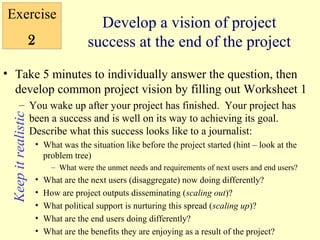
Exercise
                                           Develop a vision of project
                     2                   success at the end of the project
• Take 5 minutes to individually answer the question, then
  develop common project vision by filling out Worksheet 1
         – You wake up after your project has finished. Your project has
 Keep it realistic


           been a success and is well on its way to achieving its goal.
           Describe what this success looks like to a journalist:
                         • What was the situation like before the project started (hint – look at the
                           problem tree)
                               – What were the unmet needs and requirements of next users and end users?
                         •   What are the next users (disaggregate) now doing differently?
                         •   How are project outputs disseminating (scaling out)?
                         •   What political support is nurturing this spread (scaling up)?
                         •   What are the end users doing differently?
                         •   What are the benefits they are enjoying as a result of the project?
p ro je c t o u tp u ts to p ro je c t g o a l
                                                                              I d e n t if y in g a lin e a r lo g ic lin k in g
                                                                                                                                                               1 . P ro b le m T re e
                                                                                                                                                     H e lp s u n d e rs ta n d p ro je c t ra tio n a le
                                                                                                                                                     a n d w h a t n e e d s to c h a n g e


           P r o d u c ts p r o d u c e d in th e W o r k s h o p
                                                                                                                                              2 . O u tp u ts
                                                                                                                                   W h a t th e p ro je c t w ill p ro d u c e


                                                                                                                                                                                                       3 . V is io n
Workshop                                                            n e tw o rk o f a cto rs n e e d e d
                                                                      I d e n t if y in g t h e e v o lv in g


                                                                                                                                                                                          W h e re p ro je c t is g o in g - G o a l
                                                                         t o a c h ie v e t h e v is io n

Road Map
                                                                                                                                           4 . "N o w "
                                                                                                                                       n e tw o rk m a p                                                5 . "F u tu re "
                                                                                                                                        N e c e s s a ry                     6 . P ro je ct           n e tw o rk m a p
                                                                                                                                        re la tio n s h ip s                   S c a lin g           N e c e s s a ry
                                                                                                                                        in p la c e                           S tra te g y           re la tio n s h ip s
                                                                                                                                        to p ro d u c e                                              to a c h ie v e
                                                                                                                                        th e O U T P U T S                                           th e V IS IO N
                                                                    I n t e g r a t io n o f


                                                                                                                                                          7 . O u tc o m e s lo g ic m o d e l
                                                                       b o t h v ie w s


                                                                                                                                   T h e o u tc o m e s th e p ro je c t w ill h e lp a c h ie v e , h o w , a n d w ith w h o m
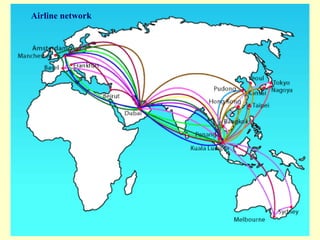
Airline network
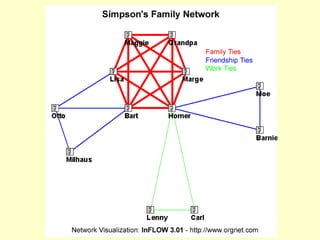
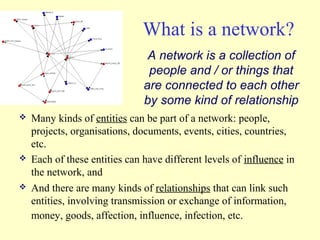
What is a network?
                                A network is a collection of
                                people and / or things that
                               are connected to each other
                               by some kind of relationship
   Many kinds of entities can be part of a network: people,
    projects, organisations, documents, events, cities, countries,
    etc.
   Each of these entities can have different levels of influence in
    the network, and
   And there are many kinds of relationships that can link such
    entities, involving transmission or exchange of information,
    money, goods, affection, influence, infection, etc.
Advantages of network models
   Actor-oriented descriptions:
       observable, understandable, verifiable
   Captures real-life complexity:
       We are subject to multiple influences
       We influence many others
   Network models help us understand innovation
    processes:
       Innovation processes happen through different actors,
        acting in networks
       These interactions, relationships and influence are modeled
        in network maps
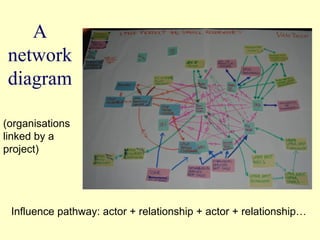
A
network
diagram

(organisations
linked by a
project)


 Influence pathway: actor + relationship + actor + relationship…
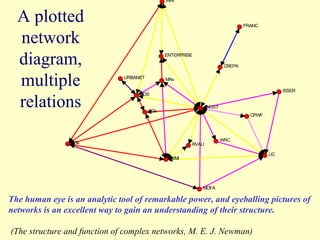
WRI


  A plotted                                                                  FRANC


  network
  diagram,                                     ENTERPRISE

                                                                     CREPA


  multiple                     URBANET         MAs

                                                                                           ISSER


  relations
                                    UDS

                                                            KNUST
                                         SGs
                                                                               CPWF


                                                                    WRC
                FGs                                     RVAU

                                                                                      UC
                                                IWMI


                                                            MOFA

The human eye is an analytic tool of remarkable power, and eyeballing pictures of
networks is an excellent way to gain an understanding of their structure.

(The structure and function of complex networks, M. E. J. Newman)
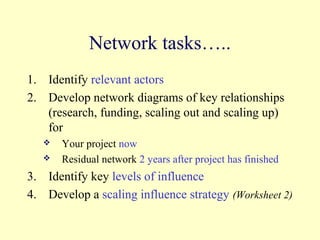
Network tasks…..
1. Identify relevant actors
2. Develop network diagrams of key relationships
   (research, funding, scaling out and scaling up)
   for
      Your project now
      Residual network 2 years after project has finished
3. Identify key levels of influence
4. Develop a scaling influence strategy (Worksheet 2)
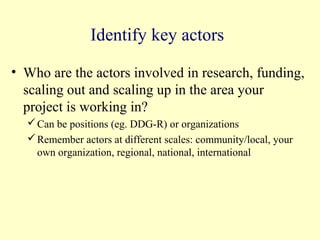
Identify key actors

• Who are the actors involved in research, funding,
  scaling out and scaling up in the area your
  project is working in?
   Can be positions (eg. DDG-R) or organizations
   Remember actors at different scales: community/local, your
    own organization, regional, national, international
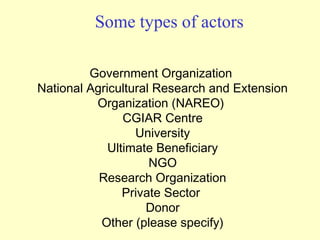
Some types of actors

         Government Organization
National Agricultural Research and Extension
          Organization (NAREO)
                CGIAR Centre
                  University
             Ultimate Beneficiary
                     NGO
           Research Organization
                Private Sector
                    Donor
           Other (please specify)
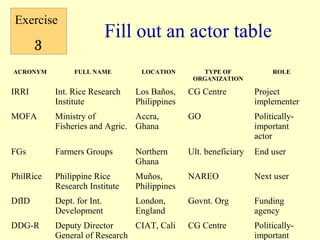
Exercise
                            Fill out an actor table
       3
ACRONYM         FULL NAME        LOCATION        TYPE OF              ROLE
                                               ORGANIZATION

IRRI       Int. Rice Research   Los Baños,    CG Centre          Project
           Institute            Philippines                      implementer
MOFA       Ministry of          Accra,        GO                 Politically-
           Fisheries and Agric. Ghana                            important
                                                                 actor
FGs        Farmers Groups       Northern      Ult. beneficiary   End user
                                Ghana
PhilRice   Philippine Rice      Muños,        NAREO              Next user
           Research Institute   Philippines
DfID       Dept. for Int.       London,       Govnt. Org         Funding
           Development          England                          agency
DDG-R      Deputy Director     CIAT, Cali     CG Centre          Politically-
           General of Research                                   important
Exercise
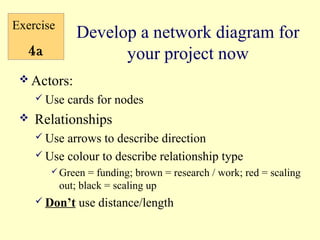
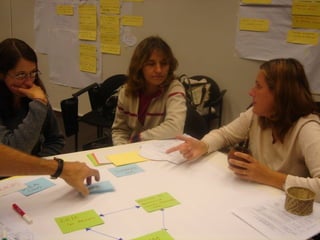
               Develop a network diagram for
   4a                your project now
  Actors:
      Use   cards for nodes
    Relationships
      Use arrows to describe direction
      Use colour to describe relationship type
         Green   = funding; brown = research / work; red = scaling
           out; black = scaling up
      Don’t   use distance/length
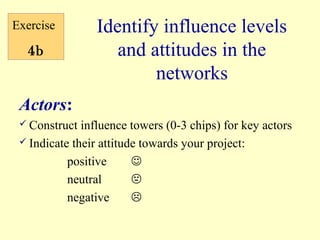
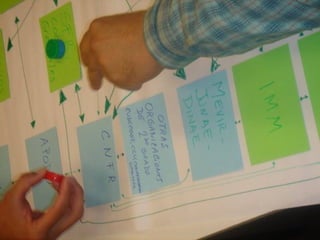
Exercise        Identify influence levels
  4b               and attitudes in the
                        networks
 Actors:
  Construct  influence towers (0-3 chips) for key actors
  Indicate their attitude towards your project:

           positive      
           neutral       
           negative      
Exercise
                                Develop a future network
        5                      corresponding to the vision
 Draw a second network showing how actors need to be linked to achieve the vision
 Adjust the influence and attitude
       Will the attitude of the actor remain the same or change?
       Will the same actors still be equally influential?
       Will there be new influential actors in the area?
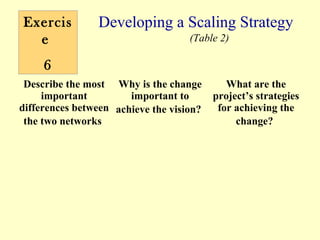
Exercis         Developing a Scaling Strategy
  e                                 (Table 2)

     6
 Describe the most Why is the change         What are the
     important         important to       project’s strategies
differences between achieve the vision?    for achieving the
 the two networks                              change?
p ro je c t o u tp u ts to p ro je c t g o a l
                                                                              I d e n t if y in g a lin e a r lo g ic lin k in g
                                                                                                                                                               1 . P ro b le m T re e
                                                                                                                                                     H e lp s u n d e rs ta n d p ro je c t ra tio n a le
                                                                                                                                                     a n d w h a t n e e d s to c h a n g e


           P r o d u c ts p r o d u c e d in th e W o r k s h o p
                                                                                                                                              2 . O u tp u ts
                                                                                                                                   W h a t th e p ro je c t w ill p ro d u c e


                                                                                                                                                                                                       3 . V is io n
Workshop                                                            n e tw o rk o f a cto rs n e e d e d
                                                                      I d e n t if y in g t h e e v o lv in g


                                                                                                                                                                                          W h e re p ro je c t is g o in g - G o a l
                                                                         t o a c h ie v e t h e v is io n

Road Map
                                                                                                                                           4 . "N o w "
                                                                                                                                       n e tw o rk m a p                                                5 . "F u tu re "
                                                                                                                                        N e c e s s a ry                     6 . P ro je ct           n e tw o rk m a p
                                                                                                                                        re la tio n s h ip s                   S c a lin g           N e c e s s a ry
                                                                                                                                        in p la c e                           S tra te g y           re la tio n s h ip s
                                                                                                                                        to p ro d u c e                                              to a c h ie v e
                                                                                                                                        th e O U T P U T S                                           th e V IS IO N
                                                                    I n t e g r a t io n o f


                                                                                                                                                          7 . O u tc o m e s lo g ic m o d e l
                                                                       b o t h v ie w s


                                                                                                                                   T h e o u tc o m e s th e p ro je c t w ill h e lp a c h ie v e , h o w , a n d w ith w h o m
Developing the Outcomes Logic
Model (a description of the project’s impact
                 pathways)
•   Why (Dart, 2005)?
    –   To evaluate or clarify the logic of the project
        intervention
    –   To provide a framework to evaluate the
        performance of a project
        •   Before, during and after
        •   Evaluation can provide information to improve
            decision making and enhance learning
Exercis
  e
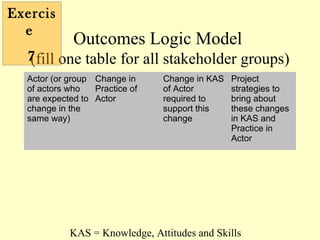
             Outcomes Logic Model
  7
  (fill one table for all stakeholder groups)
  Actor (or group Change in     Change in KAS   Project
  of actors who   Practice of   of Actor        strategies to
  are expected to Actor         required to     bring about
  change in the                 support this    these changes
  same way)                     change          in KAS and
                                                Practice in
                                                Actor


            KAS = Knowledge, Attitudes and Skills
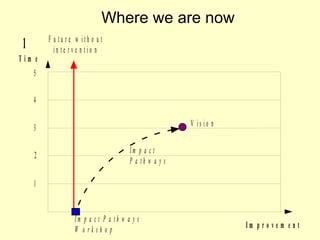
Where we are now
         F u tu re w ith o u t
 1         in te rve n tio n
Tim e
     5

     4


     3                                                   V is io n

                                        Im p a c t
     2
                                        P a th w a y s

     1


                   Im p a c t P a th w a y s
                   W orkshop                                         Im p r o v e m e n t
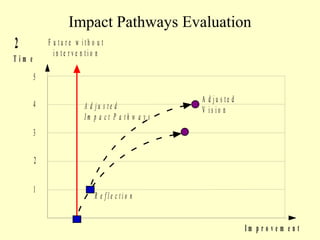
Impact Pathways Evaluation
2           F u tu re w ith o u t
              in te rve n tio n
Tim e
        5

                                                     A d ju s te d
        4                A d ju s te d               V is io n
                         Im p a c t P a th w a y s
        3

        2


        1
                             R e fle ctio n


                                                                     Im p r o v e m e n t
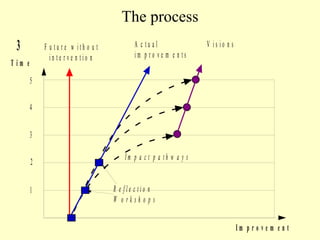
The process
 3           F u tu re w ith o u t          A c tu al
                                            im p ro ve m e n ts
                                                                    V is io n s
               in te rve n tio n
T im e
         5

         4


         3

                                        Im p a c t p a th w a y s
         2


         1                           R e fle ctio n
                                     W o rksh o ps


                                                                                  Im p r o v e m e n t
Resources
• http://impactpathways.pbwiki.com
• Douthwaite, Alvarez, Thiele, Mackay. 2008.
  Participatory Impact Pathways Analysis: A
  Practical Method for Project Planning and
  Evaluation. ILAC Brief (in press)

• b.s.alvarez@cgiar.org

BFP-2 Impact Pathways Workshop

  • 1.
    BFP-2 Impact Pathways Workshop 4 – 5 February, 2008 CIAT Boru Douthwaite and Sophie Alvarez, CPWF Impact Project CIAT, Cali, Colombia
  • 2.
  • 3.
    Why make ImpactPathways explicit? • People plan and implement projects (programs, countries …) on the basis of their change models - their implicit theories about how the world works, i.e., impact pathways • If you can improve the impact pathways (IPs) you can improve the practice, making impact more likely • IPs show a project’s rationale and networks – Help communicate what the project is doing • More fundable – Help with planning, including MTPs – Provide a basis for evaluation • Starting point for evaluation is a good model of what you think will happen • Provide information to support programmatic integration • Provides impact hypotheses for ex-post impact assessment
  • 4.
    PIPA makes ImpactPathways explicit It does so by developing two perspectives …. 1. A problem tree that shows a linear logic linking project outputs to project goal; and 2. Network maps that show the evolving relationships necessary to achieve the goal
  • 5.
    Impact pathways –a more complete picture…. >--------------Outcome-chain perspective------------------> Problem Tree <-----the full picture----> Network maps >---------------Actor-orientated perspective---------
  • 6.
    Foundations • Adaptation ofconcepts from Program Evaluation – Renger and Titcomb (2002) – problem trees – Chen (2005) – program theory – Mayne (2004) - performance stories • Innovation histories – Douthwaite and Ashby, 2005 • Social network analysis – Cross and Parker, 2004
  • 7.
    p ro jec t o u tp u ts to p ro je c t g o a l I d e n t if y in g a lin e a r lo g ic lin k in g 1 . P ro b le m T re e H e lp s u n d e rs ta n d p ro je c t ra tio n a le a n d w h a t n e e d s to c h a n g e P r o d u c ts p r o d u c e d in th e W o r k s h o p 2 . O u tp u ts W h a t th e p ro je c t w ill p ro d u c e 3 . V is io n Workshop n e tw o rk o f a cto rs n e e d e d I d e n t if y in g t h e e v o lv in g W h e re p ro je c t is g o in g - G o a l t o a c h ie v e t h e v is io n Road Map 4 . "N o w " n e tw o rk m a p 5 . "F u tu re " N e c e s s a ry 6 . P ro je ct n e tw o rk m a p re la tio n s h ip s S c a lin g N e c e s s a ry in p la c e S tra te g y re la tio n s h ip s to p ro d u c e to a c h ie v e th e O U T P U T S th e V IS IO N I n t e g r a t io n o f 7 . O u tc o m e s lo g ic m o d e l b o t h v ie w s T h e o u tc o m e s th e p ro je c t w ill h e lp a c h ie v e , h o w , a n d w ith w h o m
  • 8.
    After the Workshop •Complete outcomes logic model (that contains outcome hypotheses) • Identify outcome targets and milestones measuring progress towards them • Project M&E based on these • Regular reflection and updating of outcome hypotheses (i.e., impact pathways)
  • 9.
  • 10.
    W h yis t h is p r o b le m h a p p e n in g ? W hy? 2nd LEVEL 1st LEVEL e er t H ar St R e l a t io n s h ip N o in f o r m a t io n a v a ila b le a b o u t w a te r- fo o d - P ro b le m W a te r P o v e rty (W P 1 ) "W a te r P o v e rty " p o v e rty n o t in b a s in s c le a r L a c k o f c l a r it y W h o h a s th e a b o u t th e W a t e r A v a ila b ilit y ( W P 2 ) w a te r? h o w th e u se o f w a t e r in a g r ic u lt u r e D ire c tio n W hat does w a t e r d o in s u p p o rts and b a s in s ? li v e lih o o d s p u rp o s e o f th e C P W F La ck o f d a ta o n u n c le a r W a te r "W h y h a v e W a t e r P ro d u c t iv it y ( W P 3 ) P r o d u c t iv it y b e n ch m a rk b a s in s ? " N o t c le a r w h a t a re th e I n s t it u t io n a n d o p p o r t u n it ie s " M o v in g in t e rv e n t io n a n a ly s is ( W P 4 & 5 ) a n d r is k s f o r fo rw a rd o n c h a n g e s in to o m a n y a g r ic u lt u r a l fro n ts " w a te r u se ( G e n e ric ) P ro b le m tre e fo r th e B F P 2 s
  • 11.
    Exercise Deriving Products/ 1 Outputs from the Problem Tree • List the outputs, the use of which will address the determinants – The determinants are the problems the project is directly addressing with its outputs
  • 12.
    Some definitions  Activity – what we’re doing inside the project  Hold IP Workshop  Outputs – what we produce that other people make use of, that solve the determinant  Improved rice variety; priority setting publication  Determinant – determinants are the problems the project is directly addressing with its outputs  Next users – people and organizations who directly use the outputs  End users – the people and organizations that the next users work with. Often the end users are the ultimate beneficiaries (e.g., resource-poor farmers), but not always.  Politically-important actors– people and organizations whose support is needed for project success  Outcomes – usually the results of the use of outputs by others (often come in chains)  Promotion of rice variety by extension system  Adoption of rice variety by farmers  Higher rice yields  Higher income  More children sent to school
  • 13.
    Level of influenceof Project Level of influence of a project High C O N T R O L Low Research Output 3 Output Outcome Impact activity target Produce research products SEE Impacts Activities Use of research products (outcomes) 10 - 30 years
  • 14.
    Scaling Out andScaling Up • Scaling up - an institutional expansion, from adopters and their grassroots organizations to policy makers, donors, development institutions • Scaling out - spread of a project outputs (i.e., a new technology, a new strategy, etc.) from farmer to farmer, community to community, within the same stakeholder groups
  • 15.
    Exercise Develop a vision of project 2 success at the end of the project • Take 5 minutes to individually answer the question, then develop common project vision by filling out Worksheet 1 – You wake up after your project has finished. Your project has Keep it realistic been a success and is well on its way to achieving its goal. Describe what this success looks like to a journalist: • What was the situation like before the project started (hint – look at the problem tree) – What were the unmet needs and requirements of next users and end users? • What are the next users (disaggregate) now doing differently? • How are project outputs disseminating (scaling out)? • What political support is nurturing this spread (scaling up)? • What are the end users doing differently? • What are the benefits they are enjoying as a result of the project?
  • 16.
    p ro jec t o u tp u ts to p ro je c t g o a l I d e n t if y in g a lin e a r lo g ic lin k in g 1 . P ro b le m T re e H e lp s u n d e rs ta n d p ro je c t ra tio n a le a n d w h a t n e e d s to c h a n g e P r o d u c ts p r o d u c e d in th e W o r k s h o p 2 . O u tp u ts W h a t th e p ro je c t w ill p ro d u c e 3 . V is io n Workshop n e tw o rk o f a cto rs n e e d e d I d e n t if y in g t h e e v o lv in g W h e re p ro je c t is g o in g - G o a l t o a c h ie v e t h e v is io n Road Map 4 . "N o w " n e tw o rk m a p 5 . "F u tu re " N e c e s s a ry 6 . P ro je ct n e tw o rk m a p re la tio n s h ip s S c a lin g N e c e s s a ry in p la c e S tra te g y re la tio n s h ip s to p ro d u c e to a c h ie v e th e O U T P U T S th e V IS IO N I n t e g r a t io n o f 7 . O u tc o m e s lo g ic m o d e l b o t h v ie w s T h e o u tc o m e s th e p ro je c t w ill h e lp a c h ie v e , h o w , a n d w ith w h o m
  • 18.
  • 20.
    What is anetwork? A network is a collection of people and / or things that are connected to each other by some kind of relationship  Many kinds of entities can be part of a network: people, projects, organisations, documents, events, cities, countries, etc.  Each of these entities can have different levels of influence in the network, and  And there are many kinds of relationships that can link such entities, involving transmission or exchange of information, money, goods, affection, influence, infection, etc.
  • 21.
    Advantages of networkmodels  Actor-oriented descriptions:  observable, understandable, verifiable  Captures real-life complexity:  We are subject to multiple influences  We influence many others  Network models help us understand innovation processes:  Innovation processes happen through different actors, acting in networks  These interactions, relationships and influence are modeled in network maps
  • 22.
    A network diagram (organisations linked by a project) Influence pathway: actor + relationship + actor + relationship…
  • 23.
    WRI Aplotted FRANC network diagram, ENTERPRISE CREPA multiple URBANET MAs ISSER relations UDS KNUST SGs CPWF WRC FGs RVAU UC IWMI MOFA The human eye is an analytic tool of remarkable power, and eyeballing pictures of networks is an excellent way to gain an understanding of their structure. (The structure and function of complex networks, M. E. J. Newman)
  • 24.
    Network tasks….. 1. Identifyrelevant actors 2. Develop network diagrams of key relationships (research, funding, scaling out and scaling up) for  Your project now  Residual network 2 years after project has finished 3. Identify key levels of influence 4. Develop a scaling influence strategy (Worksheet 2)
  • 25.
    Identify key actors •Who are the actors involved in research, funding, scaling out and scaling up in the area your project is working in?  Can be positions (eg. DDG-R) or organizations  Remember actors at different scales: community/local, your own organization, regional, national, international
  • 26.
    Some types ofactors Government Organization National Agricultural Research and Extension Organization (NAREO) CGIAR Centre University Ultimate Beneficiary NGO Research Organization Private Sector Donor Other (please specify)
  • 27.
    Exercise Fill out an actor table 3 ACRONYM FULL NAME LOCATION TYPE OF ROLE ORGANIZATION IRRI Int. Rice Research Los Baños, CG Centre Project Institute Philippines implementer MOFA Ministry of Accra, GO Politically- Fisheries and Agric. Ghana important actor FGs Farmers Groups Northern Ult. beneficiary End user Ghana PhilRice Philippine Rice Muños, NAREO Next user Research Institute Philippines DfID Dept. for Int. London, Govnt. Org Funding Development England agency DDG-R Deputy Director CIAT, Cali CG Centre Politically- General of Research important
  • 28.
    Exercise Develop a network diagram for 4a your project now  Actors:  Use cards for nodes  Relationships  Use arrows to describe direction  Use colour to describe relationship type  Green = funding; brown = research / work; red = scaling out; black = scaling up  Don’t use distance/length
  • 30.
    Exercise Identify influence levels 4b and attitudes in the networks Actors:  Construct influence towers (0-3 chips) for key actors  Indicate their attitude towards your project: positive  neutral  negative 
  • 32.
    Exercise Develop a future network 5 corresponding to the vision  Draw a second network showing how actors need to be linked to achieve the vision  Adjust the influence and attitude  Will the attitude of the actor remain the same or change?  Will the same actors still be equally influential?  Will there be new influential actors in the area?
  • 33.
    Exercis Developing a Scaling Strategy e (Table 2) 6 Describe the most Why is the change What are the important important to project’s strategies differences between achieve the vision? for achieving the the two networks change?
  • 34.
    p ro jec t o u tp u ts to p ro je c t g o a l I d e n t if y in g a lin e a r lo g ic lin k in g 1 . P ro b le m T re e H e lp s u n d e rs ta n d p ro je c t ra tio n a le a n d w h a t n e e d s to c h a n g e P r o d u c ts p r o d u c e d in th e W o r k s h o p 2 . O u tp u ts W h a t th e p ro je c t w ill p ro d u c e 3 . V is io n Workshop n e tw o rk o f a cto rs n e e d e d I d e n t if y in g t h e e v o lv in g W h e re p ro je c t is g o in g - G o a l t o a c h ie v e t h e v is io n Road Map 4 . "N o w " n e tw o rk m a p 5 . "F u tu re " N e c e s s a ry 6 . P ro je ct n e tw o rk m a p re la tio n s h ip s S c a lin g N e c e s s a ry in p la c e S tra te g y re la tio n s h ip s to p ro d u c e to a c h ie v e th e O U T P U T S th e V IS IO N I n t e g r a t io n o f 7 . O u tc o m e s lo g ic m o d e l b o t h v ie w s T h e o u tc o m e s th e p ro je c t w ill h e lp a c h ie v e , h o w , a n d w ith w h o m
  • 35.
    Developing the OutcomesLogic Model (a description of the project’s impact pathways) • Why (Dart, 2005)? – To evaluate or clarify the logic of the project intervention – To provide a framework to evaluate the performance of a project • Before, during and after • Evaluation can provide information to improve decision making and enhance learning
  • 36.
    Exercis e Outcomes Logic Model 7 (fill one table for all stakeholder groups) Actor (or group Change in Change in KAS Project of actors who Practice of of Actor strategies to are expected to Actor required to bring about change in the support this these changes same way) change in KAS and Practice in Actor KAS = Knowledge, Attitudes and Skills
  • 37.
    Where we arenow F u tu re w ith o u t 1 in te rve n tio n Tim e 5 4 3 V is io n Im p a c t 2 P a th w a y s 1 Im p a c t P a th w a y s W orkshop Im p r o v e m e n t
  • 38.
    Impact Pathways Evaluation 2 F u tu re w ith o u t in te rve n tio n Tim e 5 A d ju s te d 4 A d ju s te d V is io n Im p a c t P a th w a y s 3 2 1 R e fle ctio n Im p r o v e m e n t
  • 39.
    The process 3 F u tu re w ith o u t A c tu al im p ro ve m e n ts V is io n s in te rve n tio n T im e 5 4 3 Im p a c t p a th w a y s 2 1 R e fle ctio n W o rksh o ps Im p r o v e m e n t
  • 40.
    Resources • http://impactpathways.pbwiki.com • Douthwaite,Alvarez, Thiele, Mackay. 2008. Participatory Impact Pathways Analysis: A Practical Method for Project Planning and Evaluation. ILAC Brief (in press) • b.s.alvarez@cgiar.org

Editor's Notes

  • #3 See http://cigr-ejournal.tamu.edu/submissions/volume4/Douthwaite%20Invited%20Paper--28Nov2002.pdf for the story