Yellow River Basin Focal Project
      BFP Program Workshop
           February 3
          Cali,
          Cali Colombia
OUTLINE

            Overview of the YRB
            Key water-food challenges
              y                   g
            YRB Work Packages
            Project implementation challenges


INTERNATIONAL FOOD POLICY RESEARCH INSTITUTE
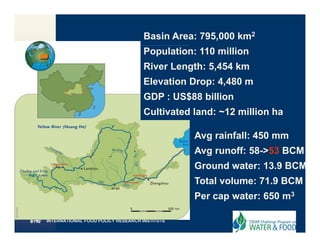
Basin Area: 795,000 km2
                                   Population: 110 million
                                   River Length: 5,454 km
                                   Elevation Drop: 4,480 m
                                   GDP : US$88 billion
                                   Cultivated land: ~12 million ha

                                               Avg rainfall: 450 mm
                                                 g
                                               Avg runoff: 58->53 BCM
                                               Ground water: 13.9 BCM
                                               Total volume: 71.9 BCM
                                               Per cap water: 650 m3

INTERNATIONAL FOOD POLICY RESEARCH INSTITUTE
KEY WATER-FOOD CHALLENGES
        Intense urban-industrial development along
        the Yellow River has had serious
        consequences for water and food security
        and environmental sustainability   y
        Focus on reallocating water to the
        environment and new sediment flushing
        policies t k water away f
           li i take       t         from irrigation
                                          i i ti
        New estimates reduced water availability,
        thus 1987 province level water allocation
                      province-level
        needs to be revised – current negotiations
        will likely lead to (sub-optimal) proportional
        reduction
          d ti
INTERNATIONAL FOOD POLICY RESEARCH INSTITUTE
KEY WATER-FOOD CHALLENGES

        Irrigation policies in some places support
        increased WUE, in others they don’t
        Ag water saving strategies work ( y)
          g              g       g        (only)
        when they also save labor--at least d/s--
        due to significant off-farm opportunities
        Hypothesis: Poverty is concentrated in
        upland/upstream rainfed areas without
        non-farm income opportunities


INTERNATIONAL FOOD POLICY RESEARCH INSTITUTE
KEY WATER-FOOD CHALLENGES

          Large sediment erosion in the basin
              g
          affect water availability for other uses
          and require US$ billions of investment
          into dams and d k
          i t d          d dykes
          Increasing water quality problems
          reduce ater availability
          red ce water a ailabilit for irrigation
          Very little knowledge on future impact
          of climate change
          Very little knowledge on benefit of
          water use in domestic-industrial uses
                        domestic industrial
INTERNATIONAL FOOD POLICY RESEARCH INSTITUTE
PROJECT OBJECTIVES
          Study water p
                y      poverty, water availability
                             y,                  y
          and access, water productivity, and
          water and related institutions in the YRB
          to develop and rank a series of high-
          priority interventions aimed at
          increasing water and food security for
          the poor while maintaining
          environmental sustainability
              i        t l    t i bilit


INTERNATIONAL FOOD POLICY RESEARCH INSTITUTE
PROJECT PARTNERS
       • Yellow River Conservancy Commission
                                    y
         [WP2/WP5]
       • Beijing Normal University [WP2]
       • China Center for Agricultural Policy
         [WP4]
       • University of Illinois [WP3]
       • Int. Food Policy Research Institute
         [WP1/WP6]


INTERNATIONAL FOOD POLICY RESEARCH INSTITUTE
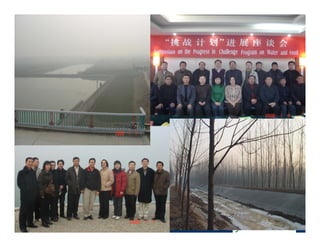
Basin Diagnostic Tour [lower
                     basin]
          Water scarcity considered the largest problem
          for irrigation
                  g
          Water fees and water quality are also important
          Increased competition with urban-industrial and
          environmental water uses
          Zero tillage as one strategy to save water and
          labor, adoption for maize and wheat
          Most f
          M t farmers are part-time [
                                 t ti    [small l d area,
                                              ll land
          many non-farm employment opportunities]
          Climate change potential future threat –
          experience of more extreme cold events during
                  i       f        t         ld       t d i
          winter and reduced runoff despite stable rainfall
          Relatively low poverty in Henan and Shandong
          provinces [d
                i      [downstream b i ]
                             t        basin]
INTERNATIONAL FOOD POLICY RESEARCH INSTITUTE
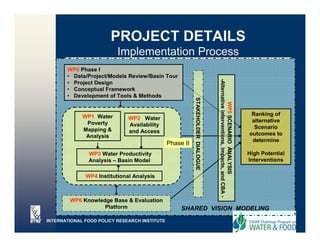
PROJECT DETAILS
                          Implementation Process
       WP0 Phase I
       • Data/Project/Models Review/Basin Tour


                                                                                 -Alternative intervention impacts, and CBA -
       • Project Design
       • Conceptual Framework
       • Development of Tools & Methods


                                                          STA
                                                          STA


                                                                                          WP SCENARI ANALYSIS
                                                            AKEHOLDER DIALOGUE
                                                            AKEHOLDER DIALOGUE


                                                                                            e
                                                                                            P5
             WP1 Water                                                                                                           Ranking of
                              WP2 Water                                                                                          alternative
              Poverty         Availability
             Mapping &                                                                                                            Scenario
                              and Access                                                                                        outcomes to
              Analysis
                  y


                                                                                                         IO
                                                                                                         ns,
                                                                                                                                 determine
                                                                                                                                 d t    i
                                               Phase II
               WP3 Water Productivity                                                                                           High Potential
               Analysis – Basin Model                                                                                           Interventions


              WP4 Institutional Analysis


        WP6 Knowledge Base & Evaluation
                   Platform                         SHARED VISION MODELING
INTERNATIONAL FOOD POLICY RESEARCH INSTITUTE
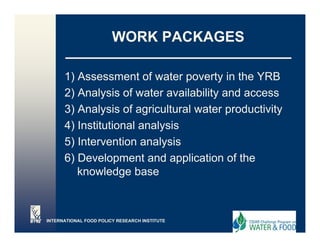
WORK PACKAGES

      1) Assessment of water poverty in the YRB
      2) Analysis of water availability and access
      3) Analysis of agricultural water productivity
      4) Institutional analysis
      5) I t
         Intervention analysis
                   ti      l i
      6) Development and application of the
         knowledge base


INTERNATIONAL FOOD POLICY RESEARCH INSTITUTE
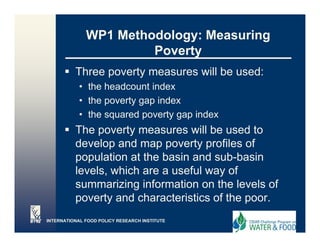
WP1 Methodology: Measuring
                       Poverty
          Three poverty measures will be used:
                p     y
            • the headcount index
            • the poverty gap index
            • the squared poverty gap index
          The poverty measures will be used to
          develop and map poverty profiles of
          d    l     d                  fil   f
          population at the basin and sub-basin
          levels,
          levels which are a useful way of
          summarizing information on the levels of
          poverty and characteristics of the poor.
INTERNATIONAL FOOD POLICY RESEARCH INSTITUTE
WP1 Methodology: Assessing Water
                    Poverty
          The framework to analyze the linkage
                                 y            g
          between poverty and water will involve
          multivariate regression analysis through
          modeling the determinants of household
                                       f
          welfare


INTERNATIONAL FOOD POLICY RESEARCH INSTITUTE
WP1 Methodology: Poverty Map
                  et odo ogy o e ty ap

          Use statistical, small area estimation
              statistical small-area
          (SAE), techniques
            •   Produces readily interpretable estimates
            •   Statistical precision can be gauged
            •   Encouraging results to date
                         g g
            •   But, extensive data requirements
                [combination of household-level data of
                Population Census and household
                expenditure data]


INTERNATIONAL FOOD POLICY RESEARCH INSTITUTE
WP2 - Methodologies
                                    g

          Large body of information on
          [spatial/temporal] distribution of water
          availability and water h
              il bilit   d   t hazards  d
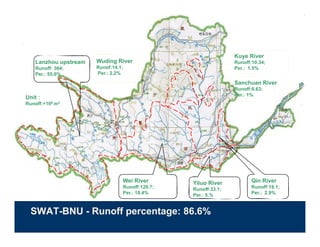
          Use SWAT-BNU to estimate rainfall-runoff
          [sediment and human interactions]
          Will feed into aggregated existing Yellow
          River Hydrologic Model


INTERNATIONAL FOOD POLICY RESEARCH INSTITUTE
Kuye River
   Lanzhou upstream   Wuding River                             Runoff:10.34;
   Runoff: 364;       Runof:14.1;                              Per.: 1.5%
   Per.: 55.6%        Per.: 2.2%

                                                               Sanchuan River
                                                               Runoff:6.63;
                                                               Per.: 1%
Unit:
Runoff:×108 m3


                                Wei River       Yiluo River           Qin River
                                Runoff:120.7;   Runoff:33.1;          Runoff:19.1;
                                Per.: 18.4%     Per.: 5.%             Per.: 2.9%


  SWAT-BNU - Runoff percentage: 86.6%
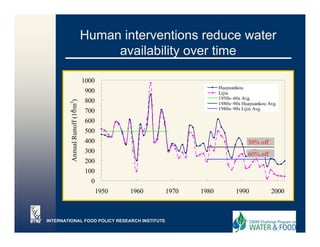
Human interventions reduce water
                                     availability over time

                                1000
                                                                   Huayuankou
                                 900                               Lijin
                                                                   1950s~60s Avg.
                                 800
        Annual Runoff (10 m3)


                                                                   1980s~90s Huayuankou Avg.
                                                                   1980s~90s Lijin A
                                                                   1980 90 Liji Avg.
                                 700
                        8


                                 600
                                 500
               R


                                 400                                           30% off
                                 300                                           60% off
                                 200
                                 100
                                   0
                                       1950   1960   1970   1980          1990           2000


INTERNATIONAL FOOD POLICY RESEARCH INSTITUTE
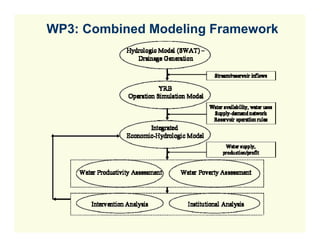
WP3: Combined Modeling Framework
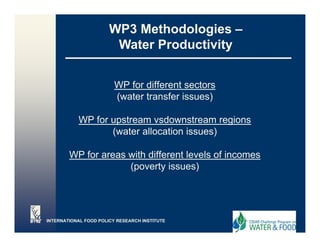
WP3 Methodologies –
                        Water Productivity


                         WP for different sectors
                         (water transfer issues)

           WP for upstream vsdownstream regions
                  (water allocation issues)

        WP for areas with different levels of incomes
                     (p
                     (poverty issues)
                              y       )


INTERNATIONAL FOOD POLICY RESEARCH INSTITUTE
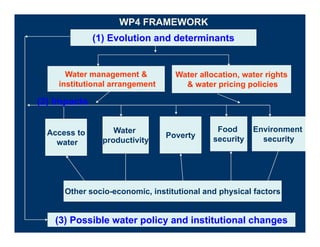
WP4 FRAMEWORK
              (1) Evolution and determinants


      Water management &          Water allocation, water rights
    institutional arrangement       & water pricing policies

(2) Impacts


  Access to        Water                     Food      Environment
                                Poverty
                                      y     security     security
    water       productivity


      Other socio-economic, institutional and physical factors


   (3) Possible water policy and institutional changes
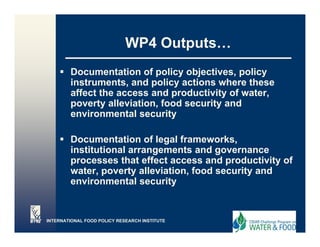
WP4 Outputs…
                                 Outputs
        Documentation of policy objectives, policy
                           p    y j           p   y
        instruments, and policy actions where these
        affect the access and productivity of water,
        p
        poverty alleviation, food security and
               y           ,             y
        environmental security

        Documentation of legal frameworks,
                                  frameworks
        institutional arrangements and governance
        processes that effect access and productivity of
        water,
        water poverty alleviation, food security and
                        alleviation
        environmental security


INTERNATIONAL FOOD POLICY RESEARCH INSTITUTE
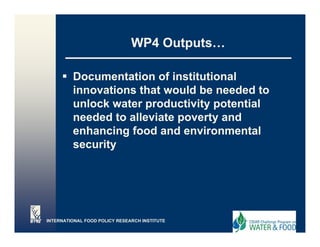
WP4 Outputs…

         Documentation of institutional
         innovations that would be needed to
         unlock water productivity p
                      p          y potential
         needed to alleviate poverty and
         enhancing food and environmental
         security


INTERNATIONAL FOOD POLICY RESEARCH INSTITUTE
WP5: Intervention Analysis

L a n d u s e / c ro p p in g
        p a tte rn s
                                      YRCC & SW AT
                                           W a te r
                                       A c c o u n tin g                    W a te r
E n v iro n m e n ta l flo w s                                         p r o d u c tiv it y                                      S C E N A R IO
                                              W a te r                 [e c o n o m ic &
                                                                          p h y s ic a l]                                        A N A L Y S IS
                                         a c c o u n tin g &


                                                                                                 Institution & Policy Dialogue
                                          A g ric u ltu ra l
        Irrig a tio n                          w a te r                   L iv e s to c k
     d e v e lo p m e n t                a v a ila b ility &          Irrig a te d c ro p s
                                             access                   R a in fe d c ro p s
                                                                             (F is h )
   N o n a g ric u ltu ra l
   w a te r d e m a n d
                                        E c o n o m ic -


                                                                                                           ns
                                       In s titu tio n a l-                W a te r
In s titu tio n a l a n a ly s is                                         p o v e rty                                                H IG H
                                       A g r o n o m ic -
                                                                          Im p a c ts                                             P R IO R IT Y
M a c ro /S e c to ra l a n d            E q u a tio n
                                                                         d is trib u te d                                           IN T E R -
   T ra d e p o lic ie s                  s y s te m s                by gender and
                                                                                                                                 V E N T IO N S
                                                                      in c o m e g ro u p
  P o v e rty M a p p in g


K n o w le d g e b a s e

                                    S H A R E D V IS IO N M O D E L IN G / IN F O R M A T IO N
                                        S H A R IN G – / R E S U L T D IS S E M IN A T IO N
WP 5 – Methodologies

          Identification of high-impact interventions
                            high impact
          through scenario analysis
          Including trade and g
                    g           general agricultural
                                           g
          policies that relate to irrigated agriculture
          Analyzing alternative province-level water
          allocations and alternative sectoral water
           ll    ti      d lt       ti      t l      t
          allocations
          Shared vision modeling
            • 3 policy dialogues: U/s, M/s and D/s to discuss
              scenarios and model parameters

INTERNATIONAL FOOD POLICY RESEARCH INSTITUTE
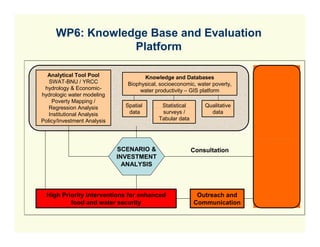
WP6: Knowledge Base and Evaluation
                 Platform

  Analytical Tool Pool                                                         Basin
                                     Knowledge and Databases
   SWAT-BNU / YRCC                                                           diagnostic
                               Biophysical, socioeconomic, water poverty,
 hydrology & Economic-             water productivity – GIS platform            study
hydrologic water modeling
    Poverty Mapping /                                                        Capacity
   Regression Analysis         Spatial
                                p           Statistical       Qualitative
                                data        surveys /           data         building
   Institutional Analysis
Policy/Investment Analysis                 Tabular data
                                                                            Field visits


                             SCENARIO &                   Consultation      Stakeholder
                             INVESTMENT                                      dialogue
                               ANALYSIS

                                                                            Development
                                                                               policy/
  High Priority Interventions for enhanced                 Outreach and      investment
          food and water security
                      ater sec rit                        Communication
                                                          Comm nication      Processes
WP6 - Potential datasets

          Agroecological zones and potential
          (physiography, climate, soil constraints)
          Natural resources (rivers, catchements, wetlands,
          forests,
          forests protected areas ecoregions etc)
                               areas,
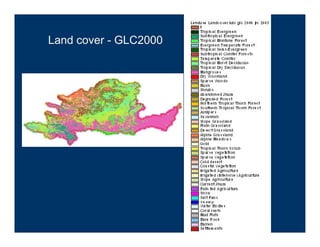
          Land cover and land cover change
          Production systems (c op a d/pas u e/ es oc
             oduc o sys e s (cropland/pasture/livestock
          distribution, irrigated/rainfed production)
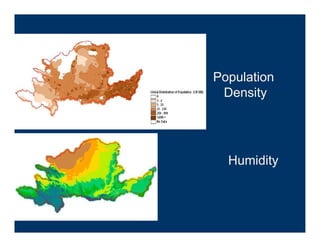
          Population density and market access


INTERNATIONAL FOOD POLICY RESEARCH INSTITUTE
WP6 - Potential datasets

        Poverty maps and water-related poverty indicators
        (WP1)
        Ag. Water availability maps under various level of
        hydroclimatic conditions intervention and
                       conditions,
        investment scenarios (WP2)
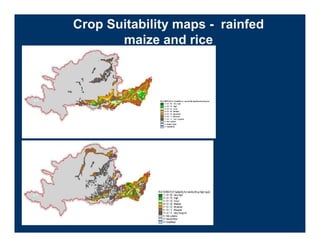
        Water productivity maps for individual rainfed and
        irrigated crops (WP3)
        Environmental and socioeconomical indicators
        under different interventions (WP5)
        Models and tools from this project?
        TO BE LINKED TO DIGITAL YELLOW RIVER

INTERNATIONAL FOOD POLICY RESEARCH INSTITUTE
Land cover - GLC2000
Population
 Density


  Humidity
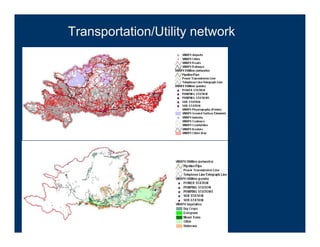
Transportation/Utility network
Crop Suitability maps - rainfed
       maize and rice
On the Adverse Challenges Side

        Hydrology: YRCC has no mandate on tributary
        flow data
        Poverty – Water agencies have no specific
        mandate related to poverty
        Socioeconomic data availability seems now
        more diffi lt t obtain b t would b required
               difficult to bt i but  ld be    i d
        for the among economists most accepted
        poverty mapping method (Small Area
        Estimation Technique)


INTERNATIONAL FOOD POLICY RESEARCH INSTITUTE
On the Adverse Challenges Side

       While sub-basin poverty lines would be
       necessary, Chinese Gov policy only supports
       use of 1 national poverty line
       Domestic and industrial water benefit curve
       estimates will likely need to be synthesized
       Water
       W t agencies have no mandate over and d
                    i h               d t         d do
       not want to increase access to rainfed areas,
       where the poorest likely reside


INTERNATIONAL FOOD POLICY RESEARCH INSTITUTE
On the Positive Challenges Side

        Need to re-negotiate provincial water allocation –
        but no information on provincial water use benefits
        Large demand for knowledge on pro-poor water
        savings and willingness to experiment with water
        rights trading
        Large interest in outcomes of tradeoff analysis
        among water-using sectors
        Several Chinese Government policy changes
        [trade,
        [trade ag policies] that allow for useful scenario
        analysis
        Need for information on climate change impacts
                                               g     p

INTERNATIONAL FOOD POLICY RESEARCH INSTITUTE

Yellow River Basin Focal Project

  • 1.
    Yellow River BasinFocal Project BFP Program Workshop February 3 Cali, Cali Colombia
  • 2.
    OUTLINE Overview of the YRB Key water-food challenges y g YRB Work Packages Project implementation challenges INTERNATIONAL FOOD POLICY RESEARCH INSTITUTE
  • 3.
    Basin Area: 795,000km2 Population: 110 million River Length: 5,454 km Elevation Drop: 4,480 m GDP : US$88 billion Cultivated land: ~12 million ha Avg rainfall: 450 mm g Avg runoff: 58->53 BCM Ground water: 13.9 BCM Total volume: 71.9 BCM Per cap water: 650 m3 INTERNATIONAL FOOD POLICY RESEARCH INSTITUTE
  • 4.
    KEY WATER-FOOD CHALLENGES Intense urban-industrial development along the Yellow River has had serious consequences for water and food security and environmental sustainability y Focus on reallocating water to the environment and new sediment flushing policies t k water away f li i take t from irrigation i i ti New estimates reduced water availability, thus 1987 province level water allocation province-level needs to be revised – current negotiations will likely lead to (sub-optimal) proportional reduction d ti INTERNATIONAL FOOD POLICY RESEARCH INSTITUTE
  • 5.
    KEY WATER-FOOD CHALLENGES Irrigation policies in some places support increased WUE, in others they don’t Ag water saving strategies work ( y) g g g (only) when they also save labor--at least d/s-- due to significant off-farm opportunities Hypothesis: Poverty is concentrated in upland/upstream rainfed areas without non-farm income opportunities INTERNATIONAL FOOD POLICY RESEARCH INSTITUTE
  • 6.
    KEY WATER-FOOD CHALLENGES Large sediment erosion in the basin g affect water availability for other uses and require US$ billions of investment into dams and d k i t d d dykes Increasing water quality problems reduce ater availability red ce water a ailabilit for irrigation Very little knowledge on future impact of climate change Very little knowledge on benefit of water use in domestic-industrial uses domestic industrial INTERNATIONAL FOOD POLICY RESEARCH INSTITUTE
  • 7.
    PROJECT OBJECTIVES Study water p y poverty, water availability y, y and access, water productivity, and water and related institutions in the YRB to develop and rank a series of high- priority interventions aimed at increasing water and food security for the poor while maintaining environmental sustainability i t l t i bilit INTERNATIONAL FOOD POLICY RESEARCH INSTITUTE
  • 8.
    PROJECT PARTNERS • Yellow River Conservancy Commission y [WP2/WP5] • Beijing Normal University [WP2] • China Center for Agricultural Policy [WP4] • University of Illinois [WP3] • Int. Food Policy Research Institute [WP1/WP6] INTERNATIONAL FOOD POLICY RESEARCH INSTITUTE
  • 9.
    INTERNATIONAL FOOD POLICYRESEARCH INSTITUTE
  • 10.
    Basin Diagnostic Tour[lower basin] Water scarcity considered the largest problem for irrigation g Water fees and water quality are also important Increased competition with urban-industrial and environmental water uses Zero tillage as one strategy to save water and labor, adoption for maize and wheat Most f M t farmers are part-time [ t ti [small l d area, ll land many non-farm employment opportunities] Climate change potential future threat – experience of more extreme cold events during i f t ld t d i winter and reduced runoff despite stable rainfall Relatively low poverty in Henan and Shandong provinces [d i [downstream b i ] t basin] INTERNATIONAL FOOD POLICY RESEARCH INSTITUTE
  • 11.
    PROJECT DETAILS Implementation Process WP0 Phase I • Data/Project/Models Review/Basin Tour -Alternative intervention impacts, and CBA - • Project Design • Conceptual Framework • Development of Tools & Methods STA STA WP SCENARI ANALYSIS AKEHOLDER DIALOGUE AKEHOLDER DIALOGUE e P5 WP1 Water Ranking of WP2 Water alternative Poverty Availability Mapping & Scenario and Access outcomes to Analysis y IO ns, determine d t i Phase II WP3 Water Productivity High Potential Analysis – Basin Model Interventions WP4 Institutional Analysis WP6 Knowledge Base & Evaluation Platform SHARED VISION MODELING INTERNATIONAL FOOD POLICY RESEARCH INSTITUTE
  • 12.
    WORK PACKAGES 1) Assessment of water poverty in the YRB 2) Analysis of water availability and access 3) Analysis of agricultural water productivity 4) Institutional analysis 5) I t Intervention analysis ti l i 6) Development and application of the knowledge base INTERNATIONAL FOOD POLICY RESEARCH INSTITUTE
  • 13.
    WP1 Methodology: Measuring Poverty Three poverty measures will be used: p y • the headcount index • the poverty gap index • the squared poverty gap index The poverty measures will be used to develop and map poverty profiles of d l d fil f population at the basin and sub-basin levels, levels which are a useful way of summarizing information on the levels of poverty and characteristics of the poor. INTERNATIONAL FOOD POLICY RESEARCH INSTITUTE
  • 14.
    WP1 Methodology: AssessingWater Poverty The framework to analyze the linkage y g between poverty and water will involve multivariate regression analysis through modeling the determinants of household f welfare INTERNATIONAL FOOD POLICY RESEARCH INSTITUTE
  • 15.
    WP1 Methodology: PovertyMap et odo ogy o e ty ap Use statistical, small area estimation statistical small-area (SAE), techniques • Produces readily interpretable estimates • Statistical precision can be gauged • Encouraging results to date g g • But, extensive data requirements [combination of household-level data of Population Census and household expenditure data] INTERNATIONAL FOOD POLICY RESEARCH INSTITUTE
  • 16.
    WP2 - Methodologies g Large body of information on [spatial/temporal] distribution of water availability and water h il bilit d t hazards d Use SWAT-BNU to estimate rainfall-runoff [sediment and human interactions] Will feed into aggregated existing Yellow River Hydrologic Model INTERNATIONAL FOOD POLICY RESEARCH INSTITUTE
  • 17.
    Kuye River Lanzhou upstream Wuding River Runoff:10.34; Runoff: 364; Runof:14.1; Per.: 1.5% Per.: 55.6% Per.: 2.2% Sanchuan River Runoff:6.63; Per.: 1% Unit: Runoff:×108 m3 Wei River Yiluo River Qin River Runoff:120.7; Runoff:33.1; Runoff:19.1; Per.: 18.4% Per.: 5.% Per.: 2.9% SWAT-BNU - Runoff percentage: 86.6%
  • 18.
    Human interventions reducewater availability over time 1000 Huayuankou 900 Lijin 1950s~60s Avg. 800 Annual Runoff (10 m3) 1980s~90s Huayuankou Avg. 1980s~90s Lijin A 1980 90 Liji Avg. 700 8 600 500 R 400 30% off 300 60% off 200 100 0 1950 1960 1970 1980 1990 2000 INTERNATIONAL FOOD POLICY RESEARCH INSTITUTE
  • 19.
  • 20.
    WP3 Methodologies – Water Productivity WP for different sectors (water transfer issues) WP for upstream vsdownstream regions (water allocation issues) WP for areas with different levels of incomes (p (poverty issues) y ) INTERNATIONAL FOOD POLICY RESEARCH INSTITUTE
  • 21.
    WP4 FRAMEWORK (1) Evolution and determinants Water management & Water allocation, water rights institutional arrangement & water pricing policies (2) Impacts Access to Water Food Environment Poverty y security security water productivity Other socio-economic, institutional and physical factors (3) Possible water policy and institutional changes
  • 22.
    WP4 Outputs… Outputs Documentation of policy objectives, policy p y j p y instruments, and policy actions where these affect the access and productivity of water, p poverty alleviation, food security and y , y environmental security Documentation of legal frameworks, frameworks institutional arrangements and governance processes that effect access and productivity of water, water poverty alleviation, food security and alleviation environmental security INTERNATIONAL FOOD POLICY RESEARCH INSTITUTE
  • 23.
    WP4 Outputs… Documentation of institutional innovations that would be needed to unlock water productivity p p y potential needed to alleviate poverty and enhancing food and environmental security INTERNATIONAL FOOD POLICY RESEARCH INSTITUTE
  • 24.
    WP5: Intervention Analysis La n d u s e / c ro p p in g p a tte rn s YRCC & SW AT W a te r A c c o u n tin g W a te r E n v iro n m e n ta l flo w s p r o d u c tiv it y S C E N A R IO W a te r [e c o n o m ic & p h y s ic a l] A N A L Y S IS a c c o u n tin g & Institution & Policy Dialogue A g ric u ltu ra l Irrig a tio n w a te r L iv e s to c k d e v e lo p m e n t a v a ila b ility & Irrig a te d c ro p s access R a in fe d c ro p s (F is h ) N o n a g ric u ltu ra l w a te r d e m a n d E c o n o m ic - ns In s titu tio n a l- W a te r In s titu tio n a l a n a ly s is p o v e rty H IG H A g r o n o m ic - Im p a c ts P R IO R IT Y M a c ro /S e c to ra l a n d E q u a tio n d is trib u te d IN T E R - T ra d e p o lic ie s s y s te m s by gender and V E N T IO N S in c o m e g ro u p P o v e rty M a p p in g K n o w le d g e b a s e S H A R E D V IS IO N M O D E L IN G / IN F O R M A T IO N S H A R IN G – / R E S U L T D IS S E M IN A T IO N
  • 25.
    WP 5 –Methodologies Identification of high-impact interventions high impact through scenario analysis Including trade and g g general agricultural g policies that relate to irrigated agriculture Analyzing alternative province-level water allocations and alternative sectoral water ll ti d lt ti t l t allocations Shared vision modeling • 3 policy dialogues: U/s, M/s and D/s to discuss scenarios and model parameters INTERNATIONAL FOOD POLICY RESEARCH INSTITUTE
  • 26.
    WP6: Knowledge Baseand Evaluation Platform Analytical Tool Pool Basin Knowledge and Databases SWAT-BNU / YRCC diagnostic Biophysical, socioeconomic, water poverty, hydrology & Economic- water productivity – GIS platform study hydrologic water modeling Poverty Mapping / Capacity Regression Analysis Spatial p Statistical Qualitative data surveys / data building Institutional Analysis Policy/Investment Analysis Tabular data Field visits SCENARIO & Consultation Stakeholder INVESTMENT dialogue ANALYSIS Development policy/ High Priority Interventions for enhanced Outreach and investment food and water security ater sec rit Communication Comm nication Processes
  • 27.
    WP6 - Potentialdatasets Agroecological zones and potential (physiography, climate, soil constraints) Natural resources (rivers, catchements, wetlands, forests, forests protected areas ecoregions etc) areas, Land cover and land cover change Production systems (c op a d/pas u e/ es oc oduc o sys e s (cropland/pasture/livestock distribution, irrigated/rainfed production) Population density and market access INTERNATIONAL FOOD POLICY RESEARCH INSTITUTE
  • 28.
    WP6 - Potentialdatasets Poverty maps and water-related poverty indicators (WP1) Ag. Water availability maps under various level of hydroclimatic conditions intervention and conditions, investment scenarios (WP2) Water productivity maps for individual rainfed and irrigated crops (WP3) Environmental and socioeconomical indicators under different interventions (WP5) Models and tools from this project? TO BE LINKED TO DIGITAL YELLOW RIVER INTERNATIONAL FOOD POLICY RESEARCH INSTITUTE
  • 29.
    Land cover -GLC2000
  • 30.
  • 31.
  • 32.
    Crop Suitability maps- rainfed maize and rice
  • 33.
    On the AdverseChallenges Side Hydrology: YRCC has no mandate on tributary flow data Poverty – Water agencies have no specific mandate related to poverty Socioeconomic data availability seems now more diffi lt t obtain b t would b required difficult to bt i but ld be i d for the among economists most accepted poverty mapping method (Small Area Estimation Technique) INTERNATIONAL FOOD POLICY RESEARCH INSTITUTE
  • 34.
    On the AdverseChallenges Side While sub-basin poverty lines would be necessary, Chinese Gov policy only supports use of 1 national poverty line Domestic and industrial water benefit curve estimates will likely need to be synthesized Water W t agencies have no mandate over and d i h d t d do not want to increase access to rainfed areas, where the poorest likely reside INTERNATIONAL FOOD POLICY RESEARCH INSTITUTE
  • 35.
    On the PositiveChallenges Side Need to re-negotiate provincial water allocation – but no information on provincial water use benefits Large demand for knowledge on pro-poor water savings and willingness to experiment with water rights trading Large interest in outcomes of tradeoff analysis among water-using sectors Several Chinese Government policy changes [trade, [trade ag policies] that allow for useful scenario analysis Need for information on climate change impacts g p INTERNATIONAL FOOD POLICY RESEARCH INSTITUTE