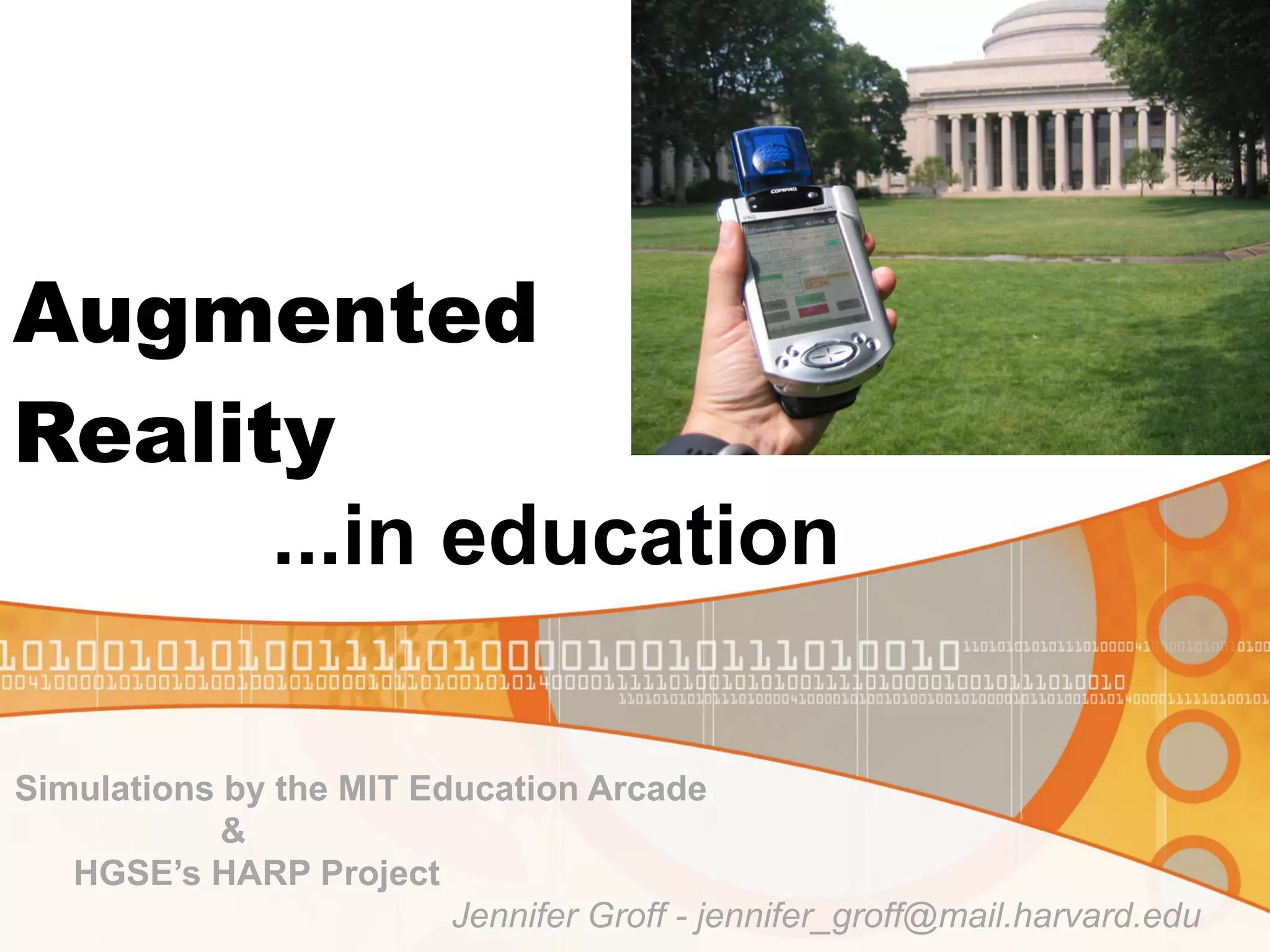
Augmented
Reality
      ...in education

Simulations by the MIT Education Arcade
            &
   HGSE’s HARP Project
                         Jennifer Groff - jennifer_groff@mail.harvard.edu
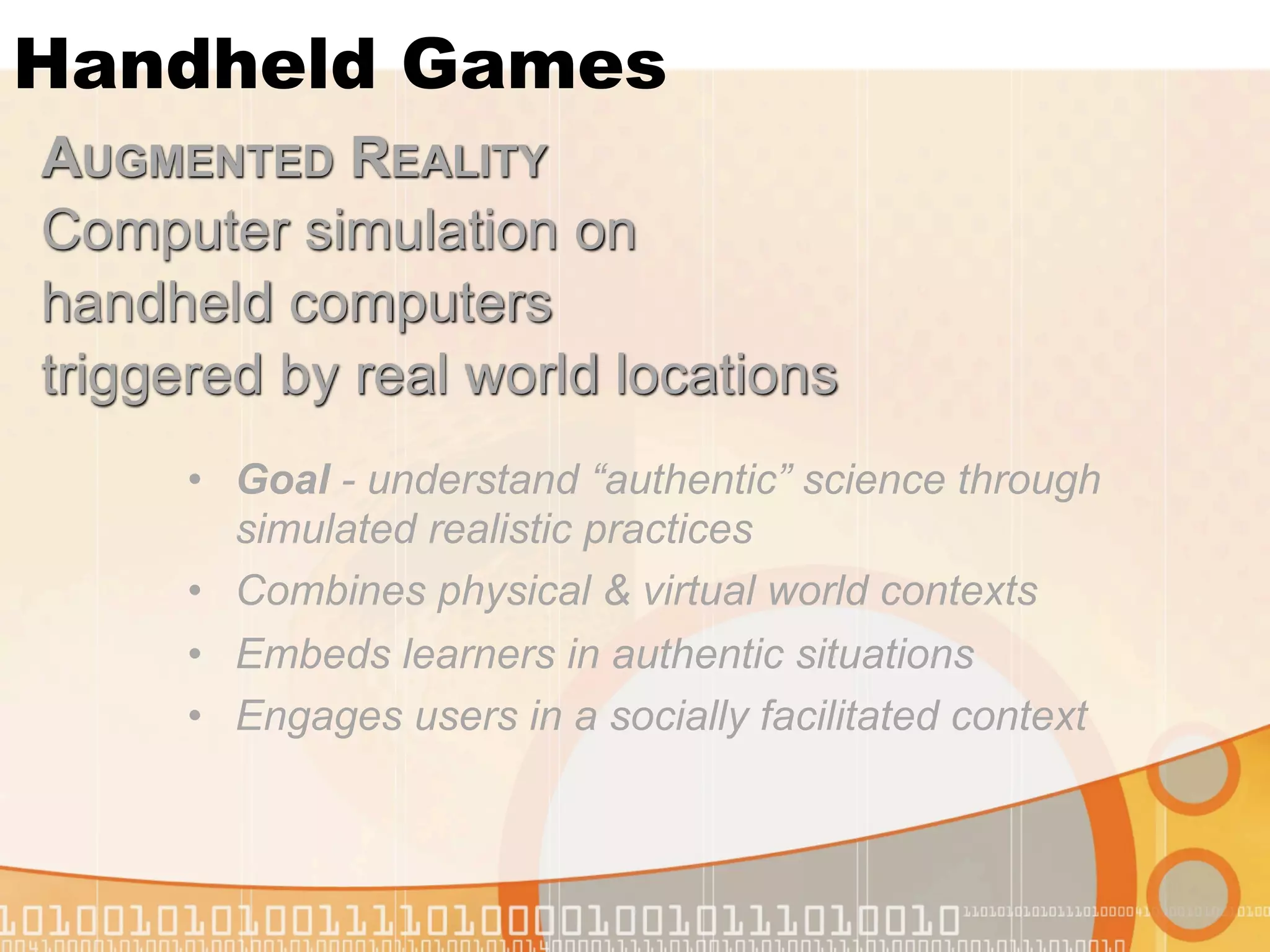
Handheld Games
AUGMENTED REALITY
Computer simulation on
handheld computers
triggered by real world locations
      • Goal - understand “authentic” science through
        simulated realistic practices
      • Combines physical & virtual world contexts
      • Embeds learners in authentic situations
      • Engages users in a socially facilitated context
Handheld Games
AUGMENTED REALITY
Computer simulation on
handheld computers
triggered by real world locations
A location-based experience
• Uses GPS (Global Positioning
  System) outdoors…
• …or wi-fi positioning indoors


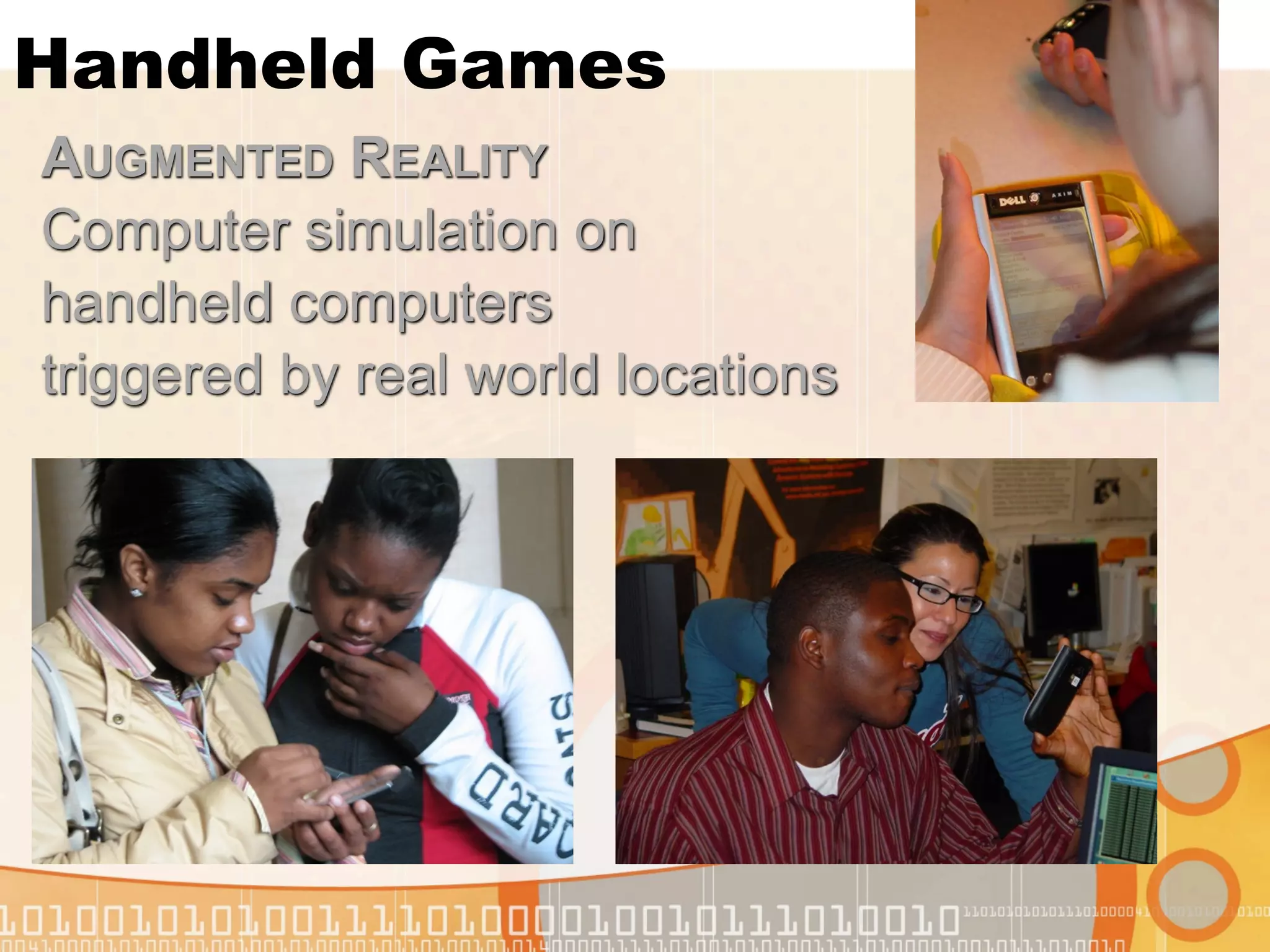
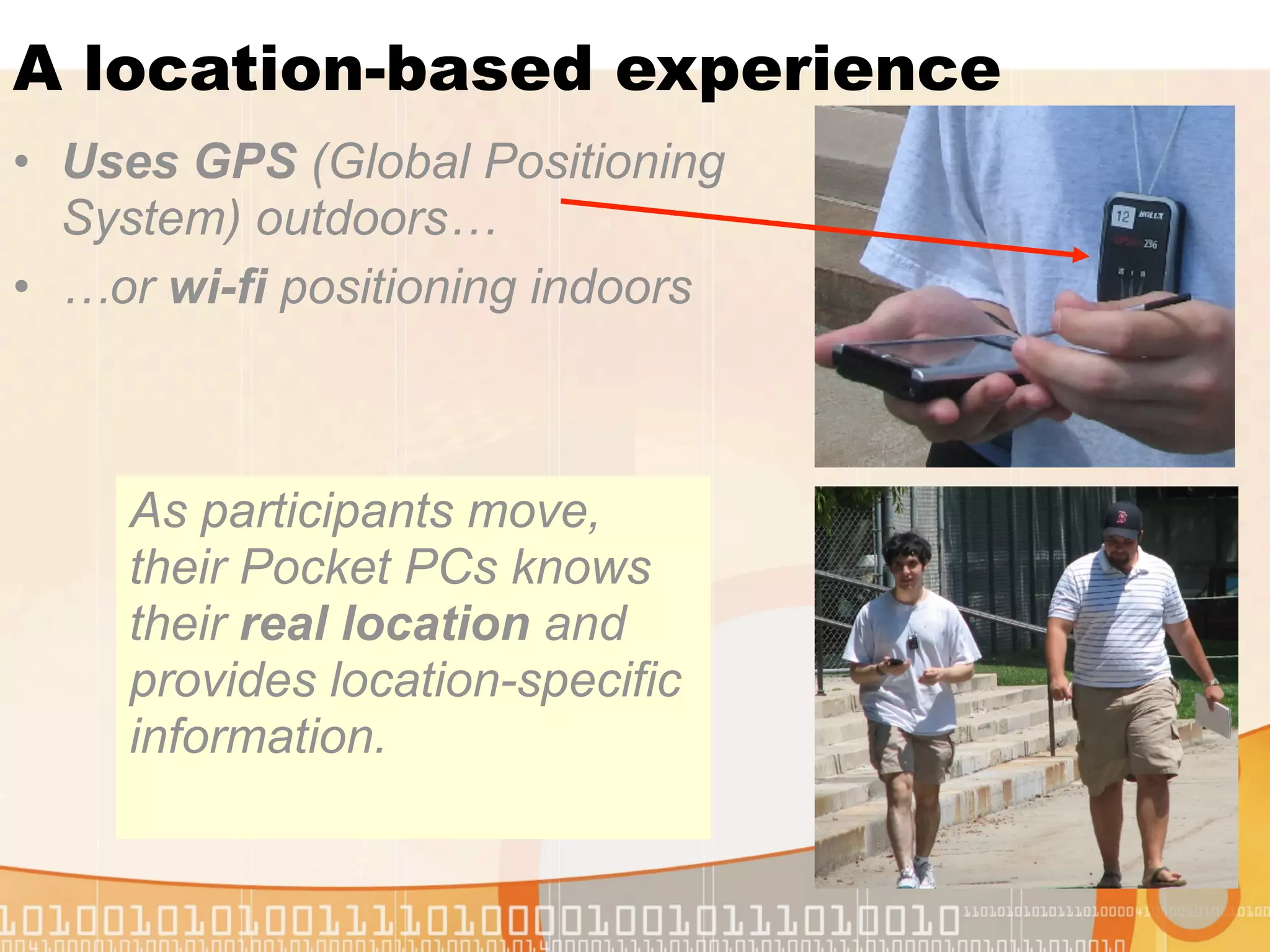
     As participants move,
     their Pocket PCs knows
     their real location and
     provides location-specific
     information.
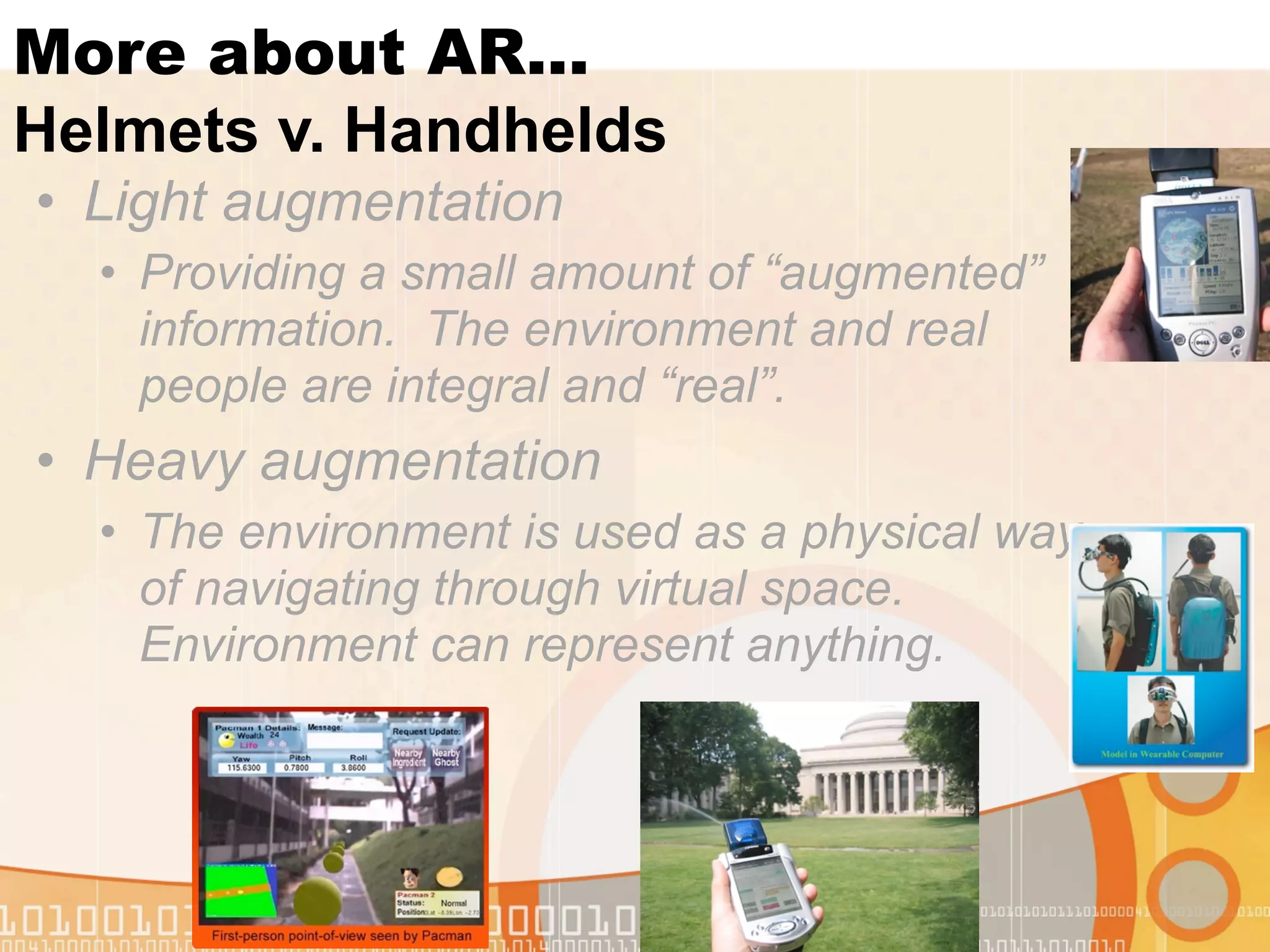
More about AR...
Helmets v. Handhelds
• Light augmentation
  • Providing a small amount of “augmented”
    information. The environment and real
    people are integral and “real”.
• Heavy augmentation
  • The environment is used as a physical way
    of navigating through virtual space.
    Environment can represent anything.
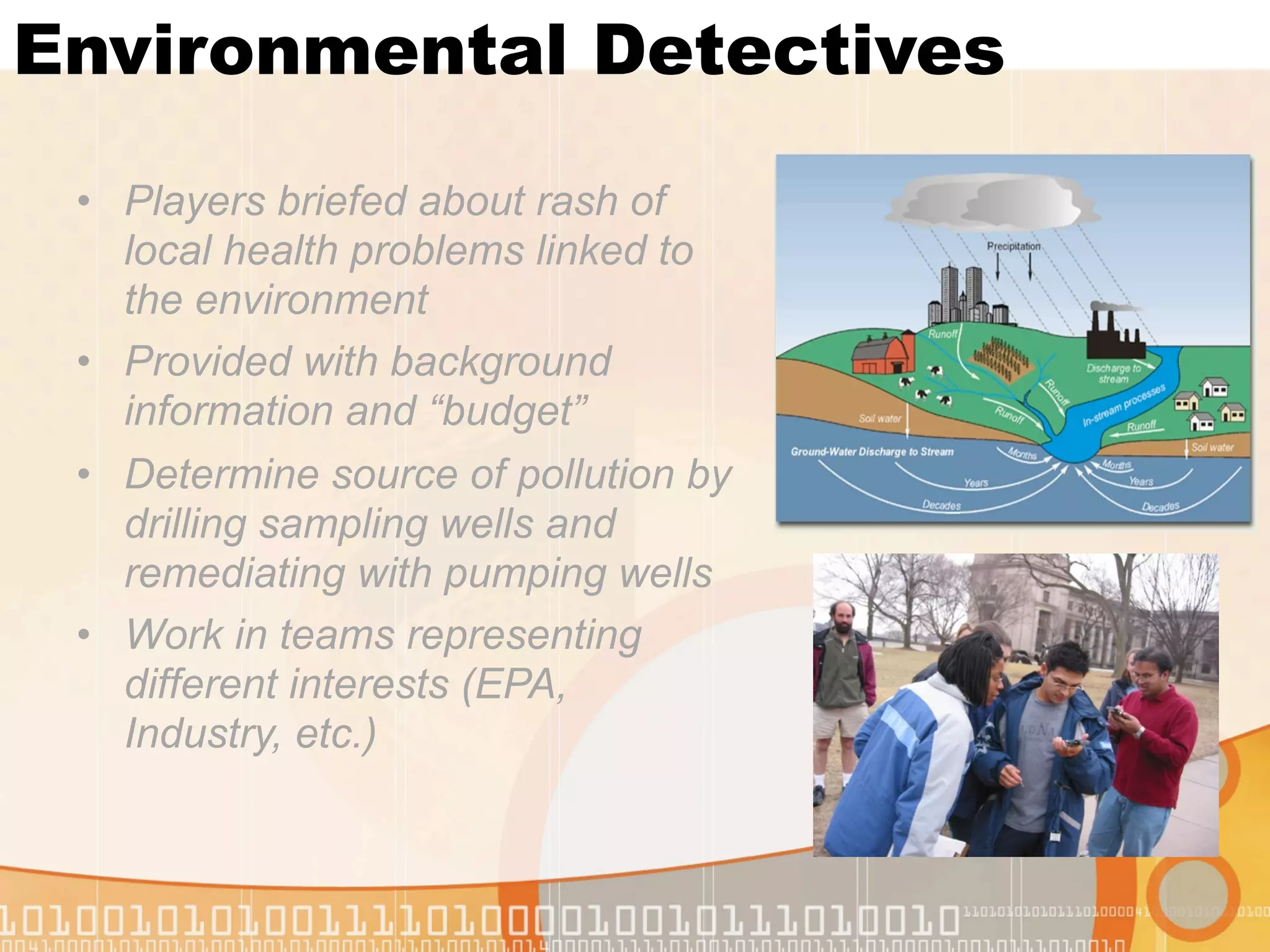
Environmental Detectives

 • Players briefed about rash of
   local health problems linked to
   the environment
 • Provided with background
   information and “budget”
 • Determine source of pollution by
   drilling sampling wells and
   remediating with pumping wells
 • Work in teams representing
   different interests (EPA,
   Industry, etc.)
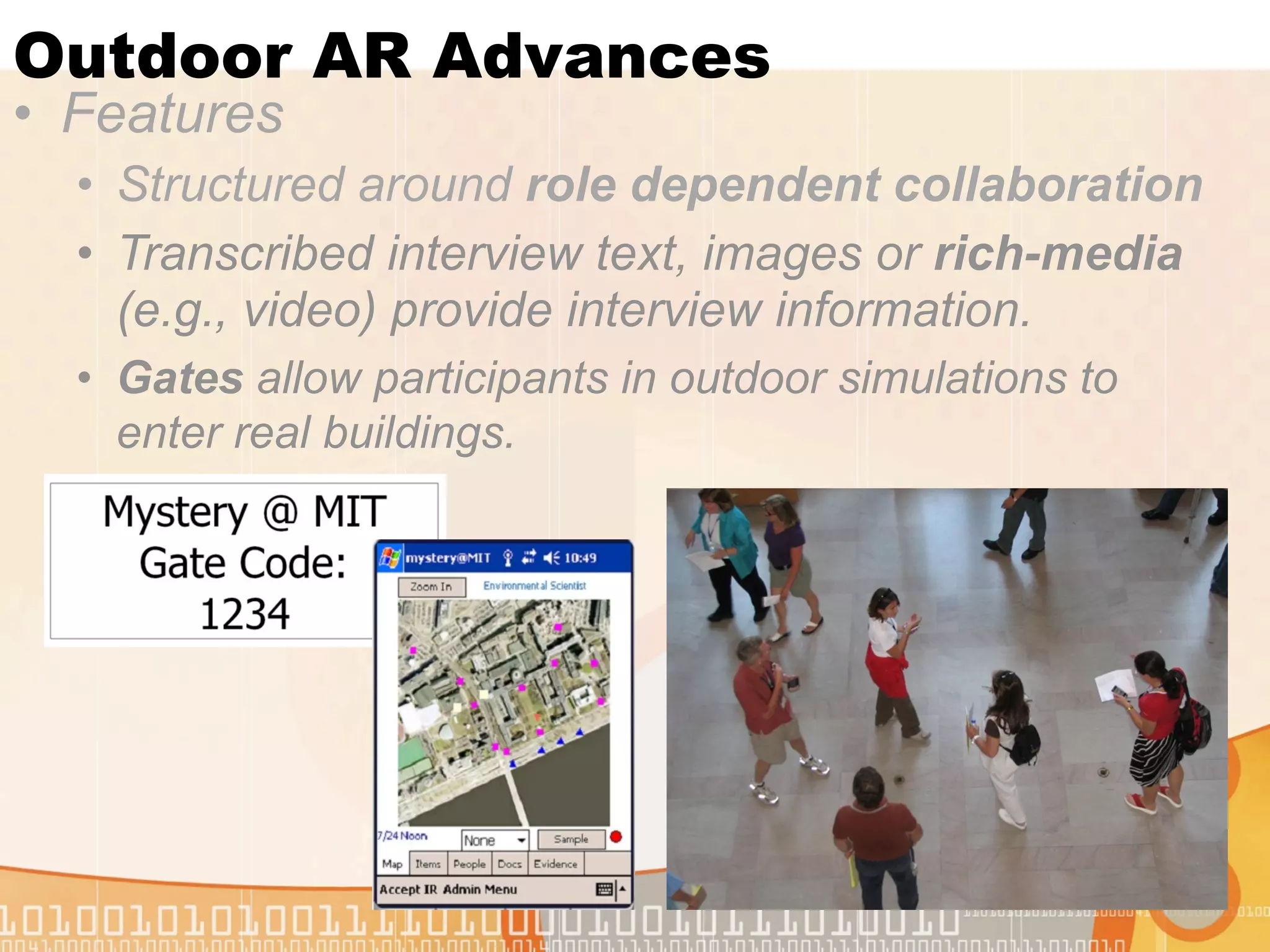
Outdoor AR Advances
• Features
  • Structured around role dependent collaboration
  • Transcribed interview text, images or rich-media
    (e.g., video) provide interview information.
  • Gates allow participants in outdoor simulations to
    enter real buildings.
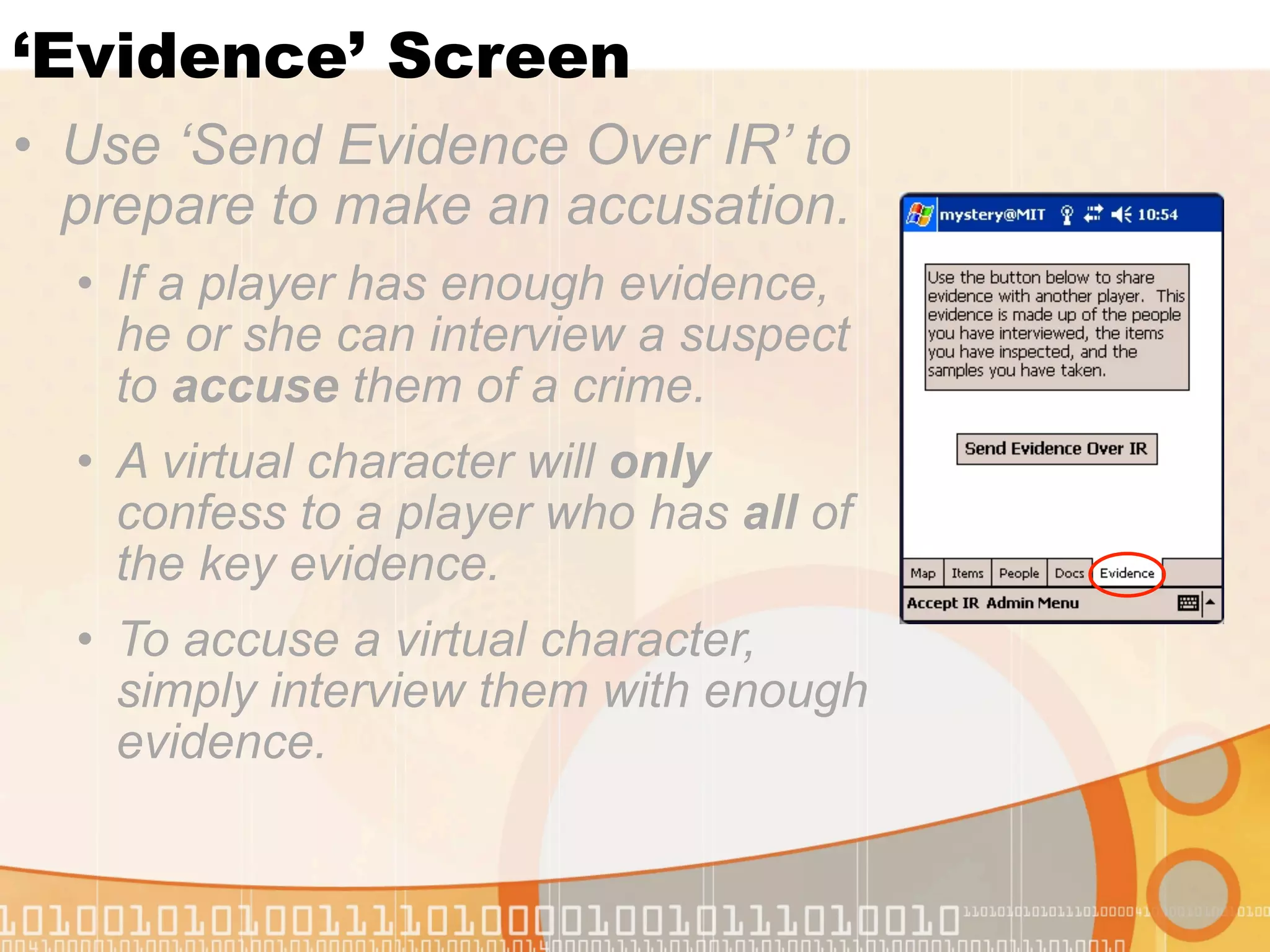
‘Evidence’ Screen
• Use ‘Send Evidence Over IR’ to
  prepare to make an accusation.
  • If a player has enough evidence,
    he or she can interview a suspect
    to accuse them of a crime.
  • A virtual character will only
    confess to a player who has all of
    the key evidence.
  • To accuse a virtual character,
    simply interview them with enough
    evidence.
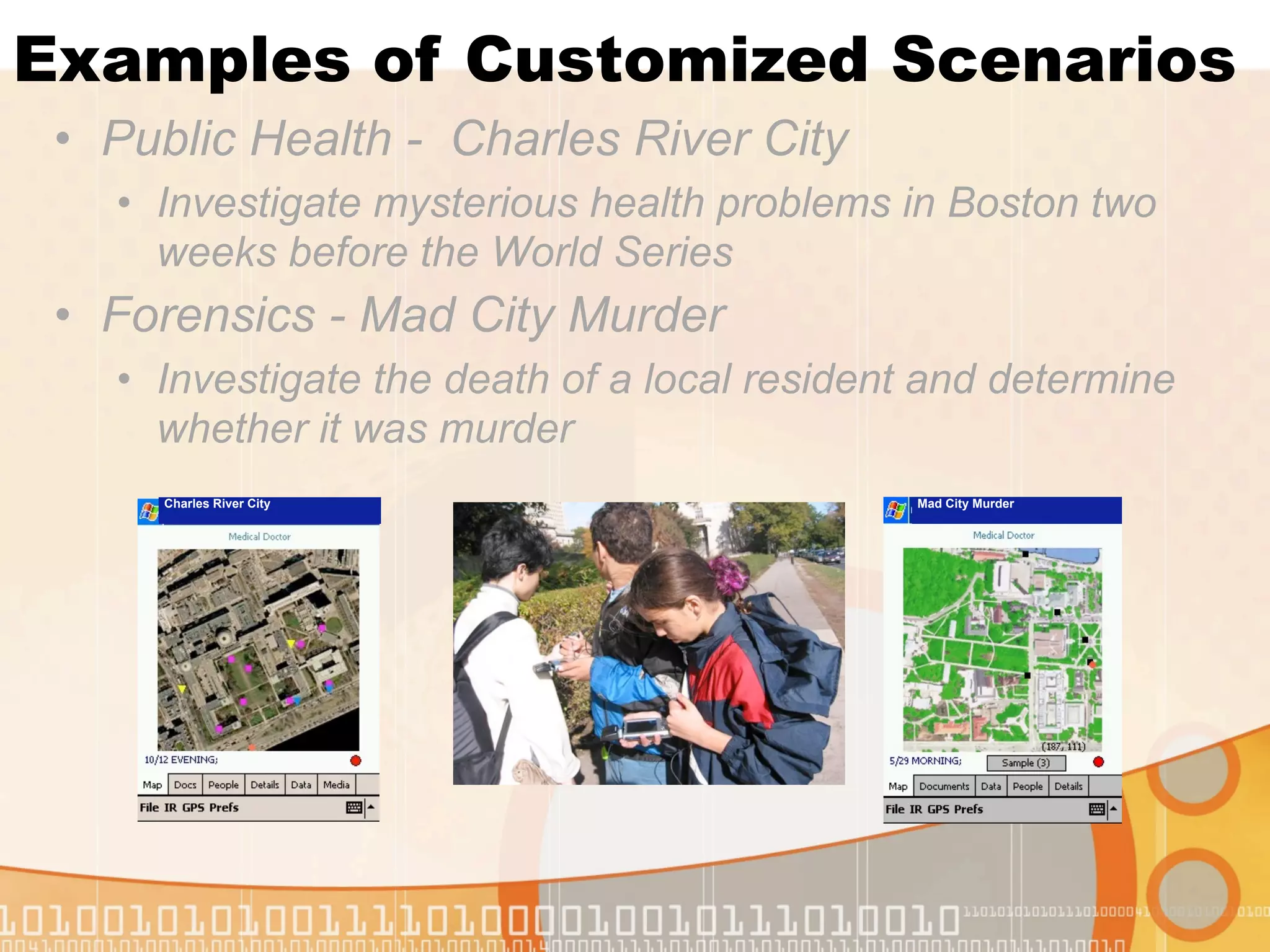
Examples of Customized Scenarios
 • Public Health - Charles River City
   • Investigate mysterious health problems in Boston two
     weeks before the World Series
 • Forensics - Mad City Murder
   • Investigate the death of a local resident and determine
     whether it was murder
      Charles River City                      Mad City Murder
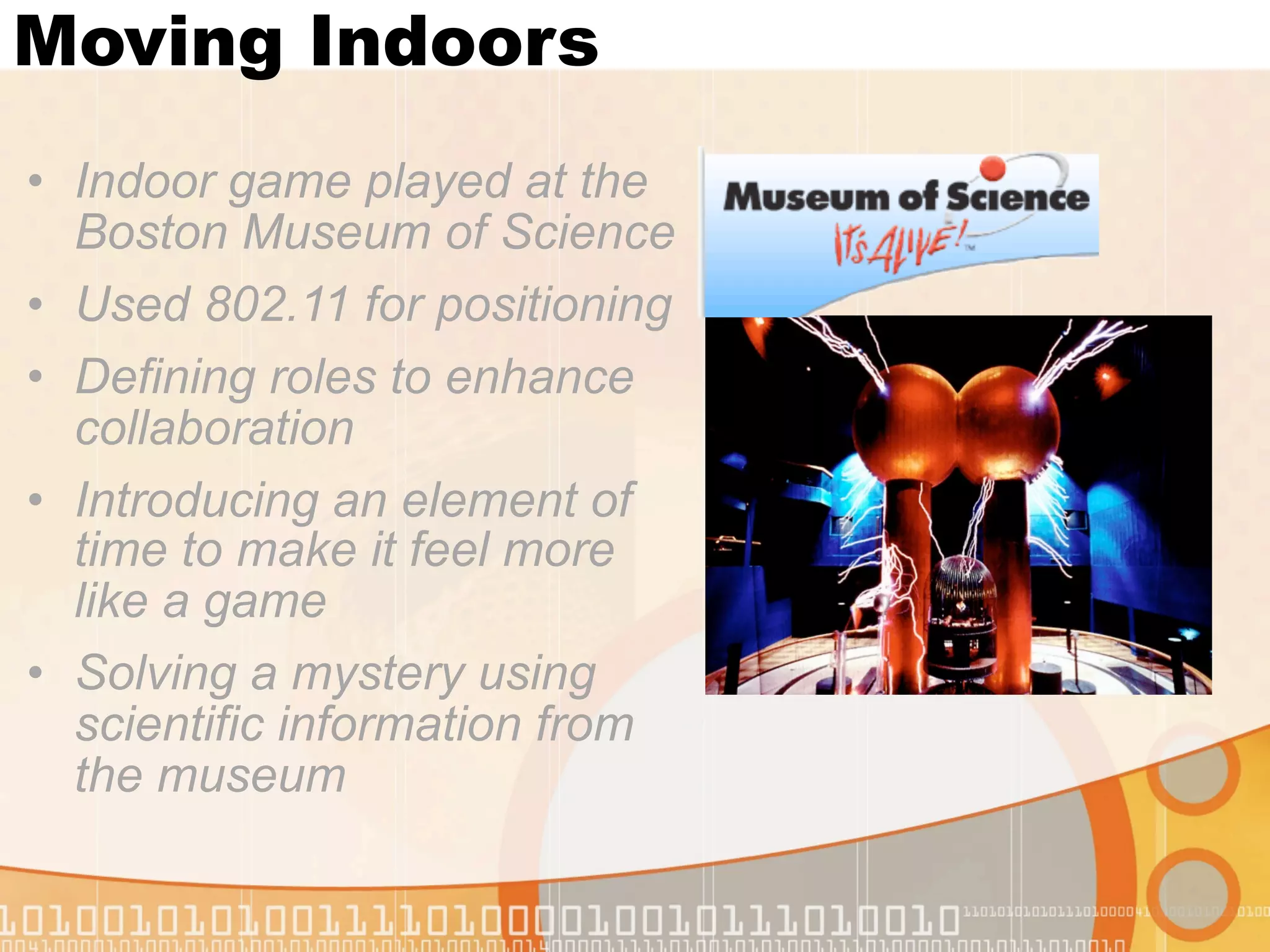
Moving Indoors
• Indoor game played at the
  Boston Museum of Science
• Used 802.11 for positioning
• Defining roles to enhance
  collaboration
• Introducing an element of
  time to make it feel more
  like a game
• Solving a mystery using
  scientific information from
  the museum
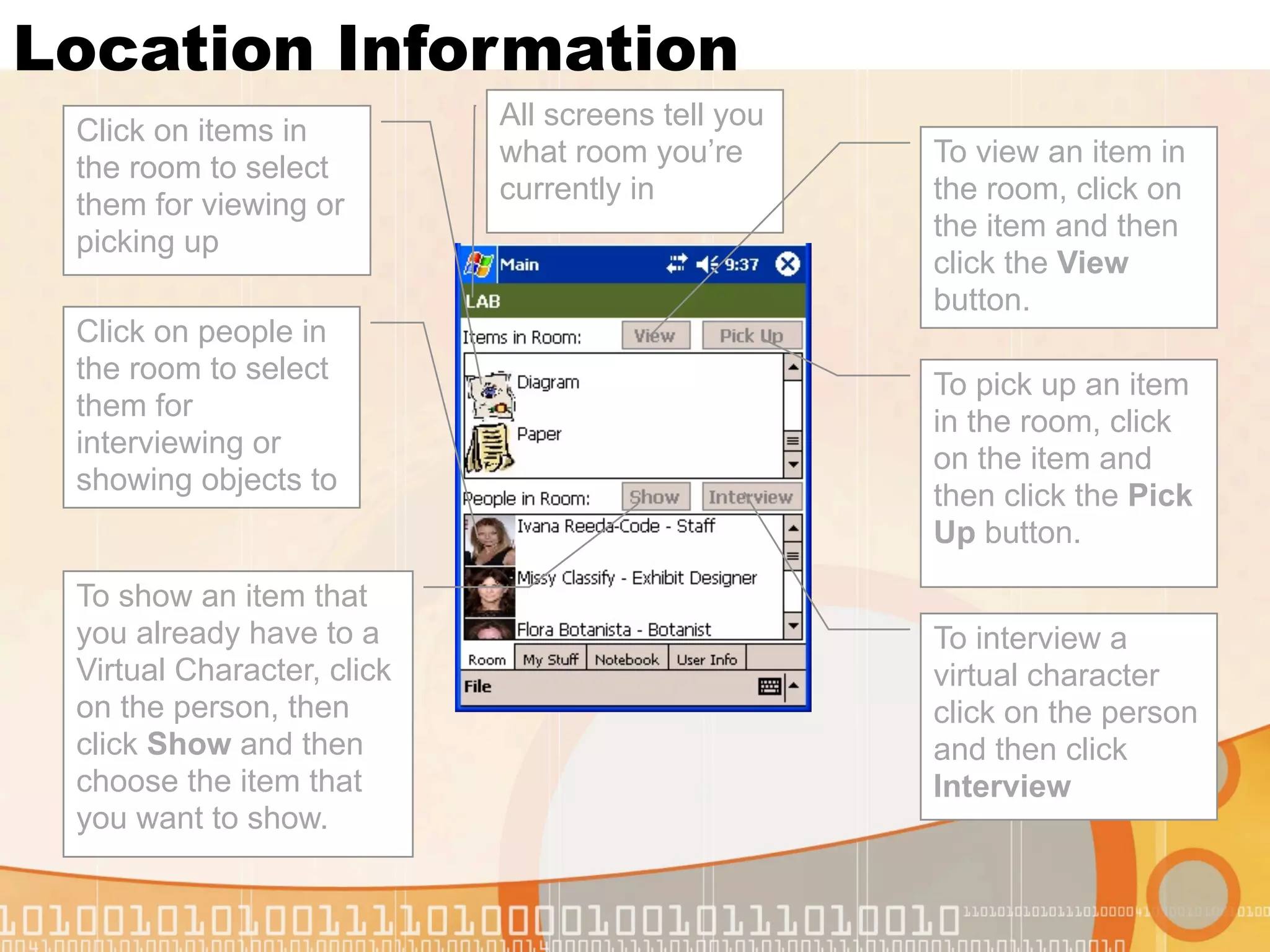
Location Information
                            All screens tell you
 Click on items in
                            what room you’re       To view an item in
 the room to select
                            currently in           the room, click on
 them for viewing or
                                                   the item and then
 picking up
                                                   click the View
                                                   button.
 Click on people in
 the room to select                                To pick up an item
 them for                                          in the room, click
 interviewing or                                   on the item and
 showing objects to                                then click the Pick
                                                   Up button.

 To show an item that
 you already have to a                             To interview a
 Virtual Character, click                          virtual character
 on the person, then                               click on the person
 click Show and then                               and then click
 choose the item that                              Interview
 you want to show.
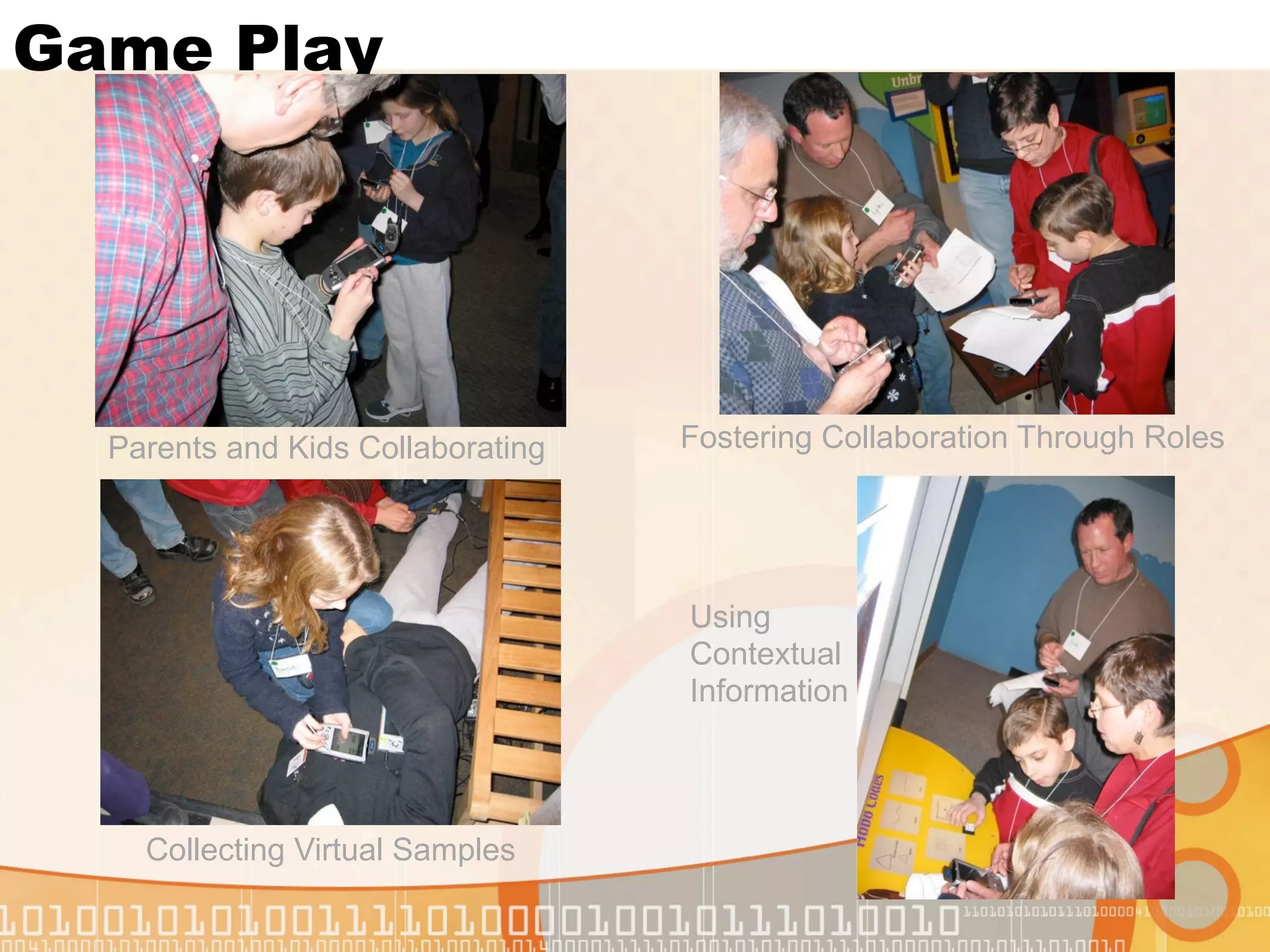
Game Play


  Parents and Kids Collaborating   Fostering Collaboration Through Roles


                                   Using
                                   Contextual
                                   Information


    Collecting Virtual Samples
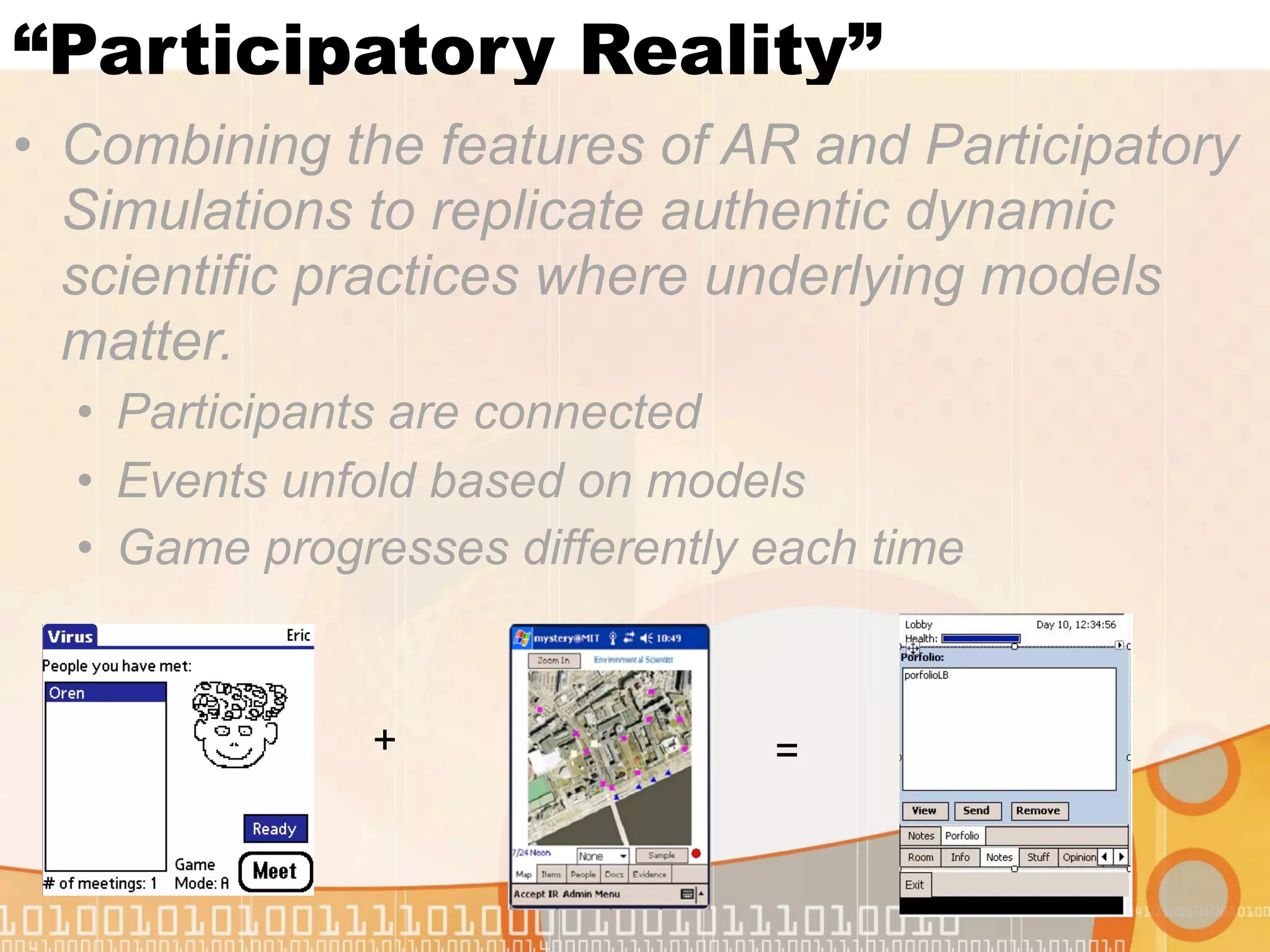
“Participatory Reality”
• Combining the features of AR and Participatory
  Simulations to replicate authentic dynamic
  scientific practices where underlying models
  matter.
  • Participants are connected
  • Events unfold based on models
  • Game progresses differently each time


               +                =
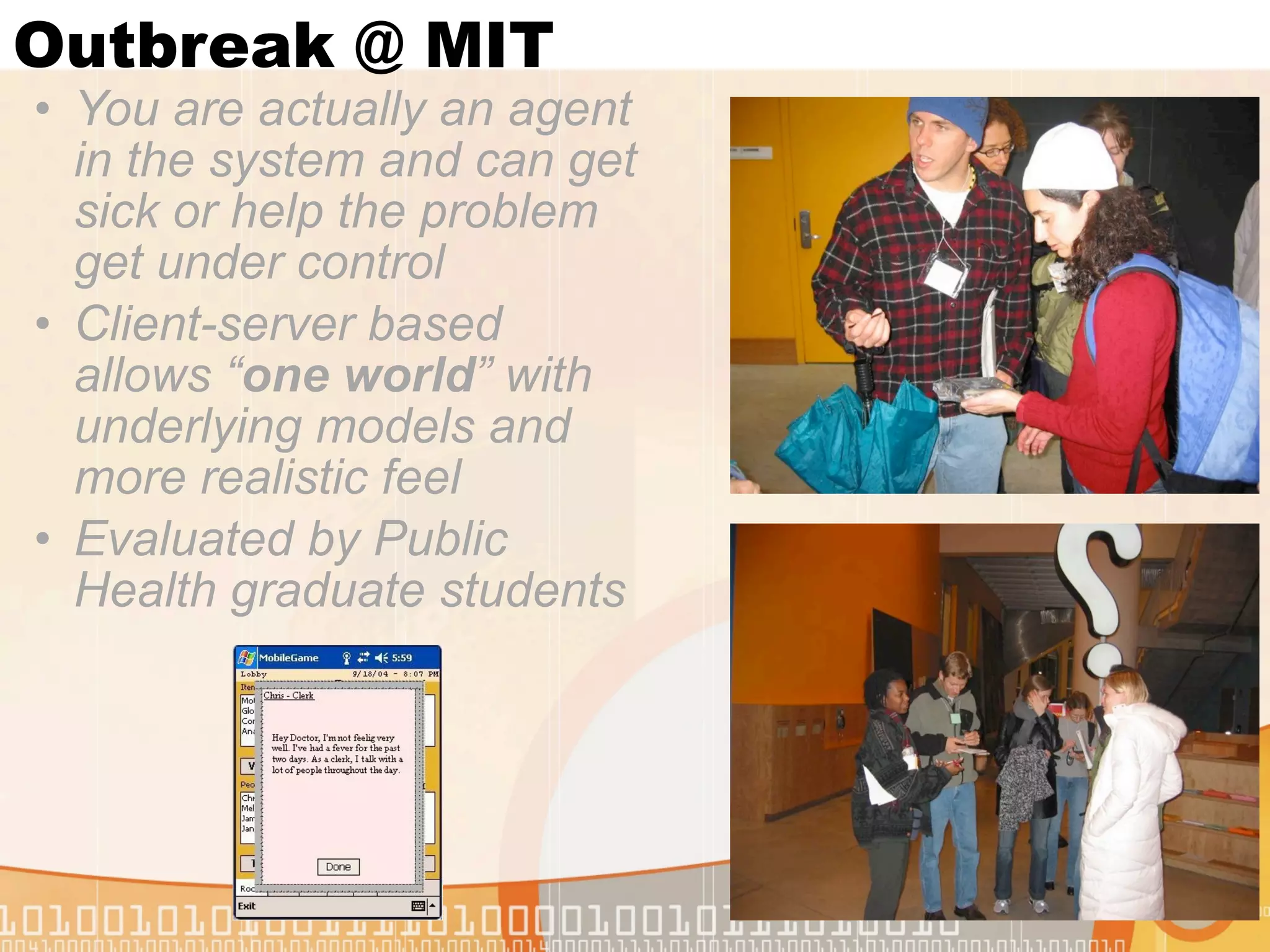
Outbreak @ MIT
• You are actually an agent
  in the system and can get
  sick or help the problem
  get under control
• Client-server based
  allows “one world” with
  underlying models and
  more realistic feel
• Evaluated by Public
  Health graduate students
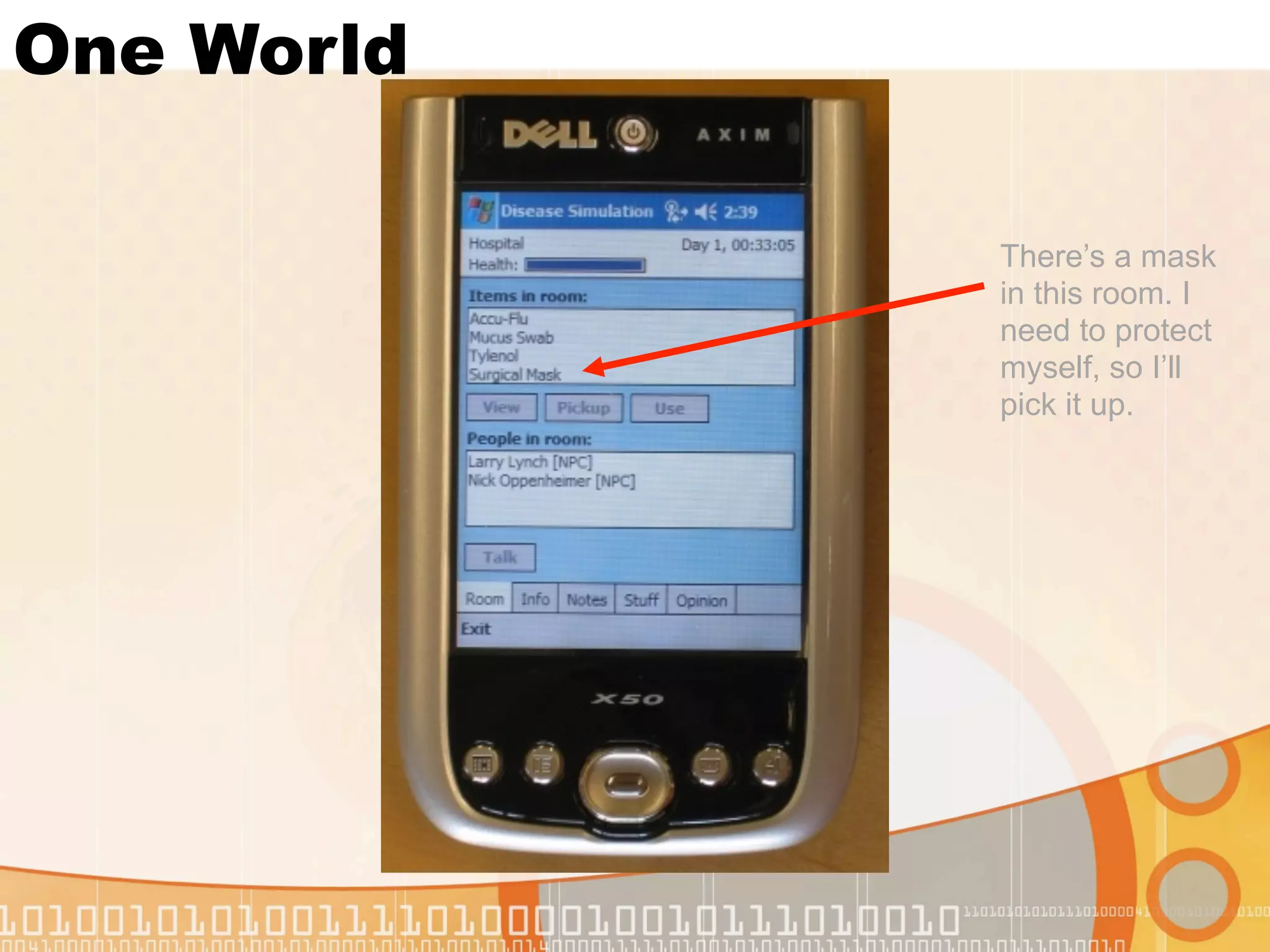
One World

            There’s a mask
            in this room. I
            need to protect
            myself, so I’ll
            pick it up.
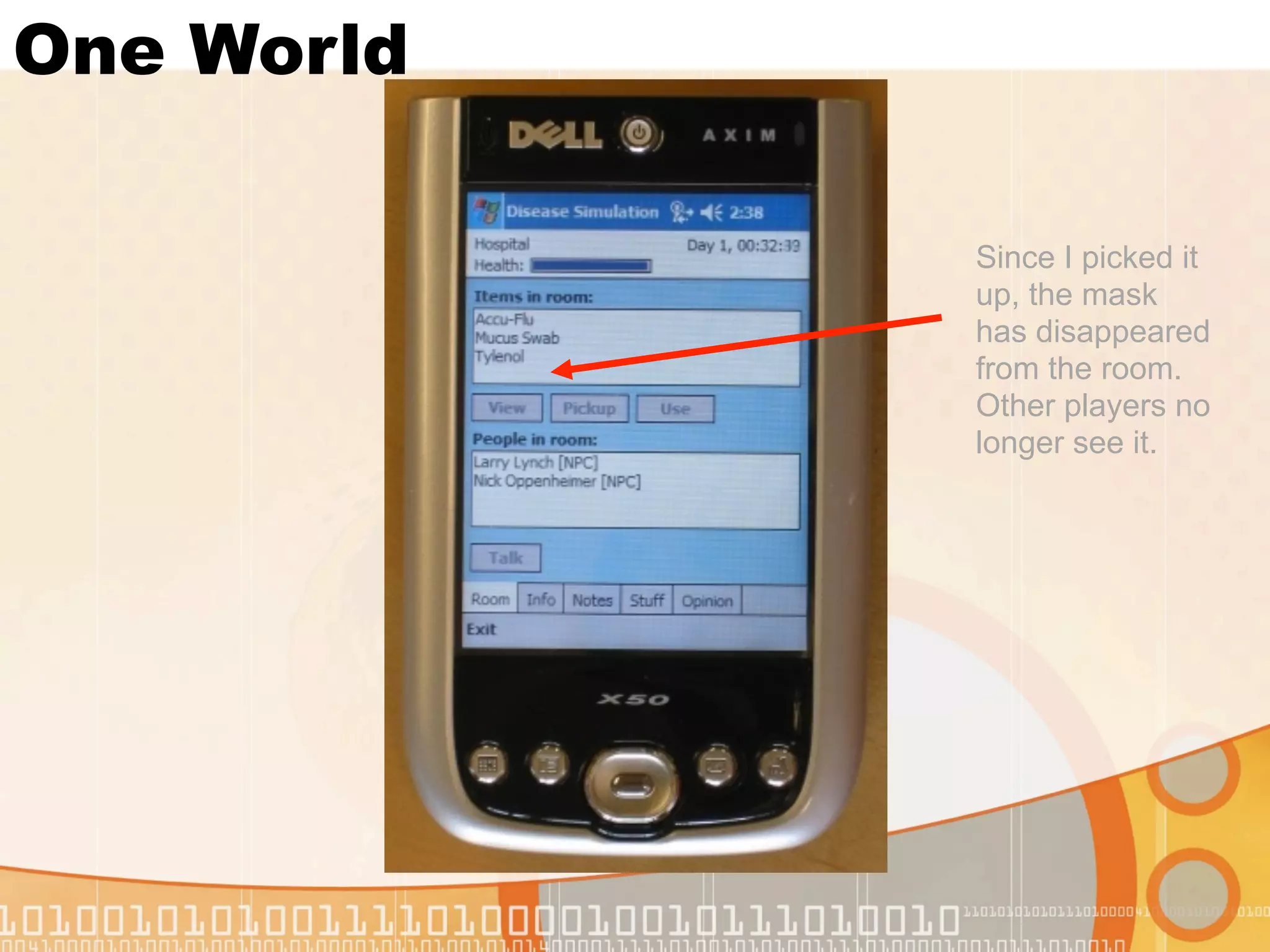
One World

            Since I picked it
            up, the mask
            has disappeared
            from the room.
            Other players no
            longer see it.
One World

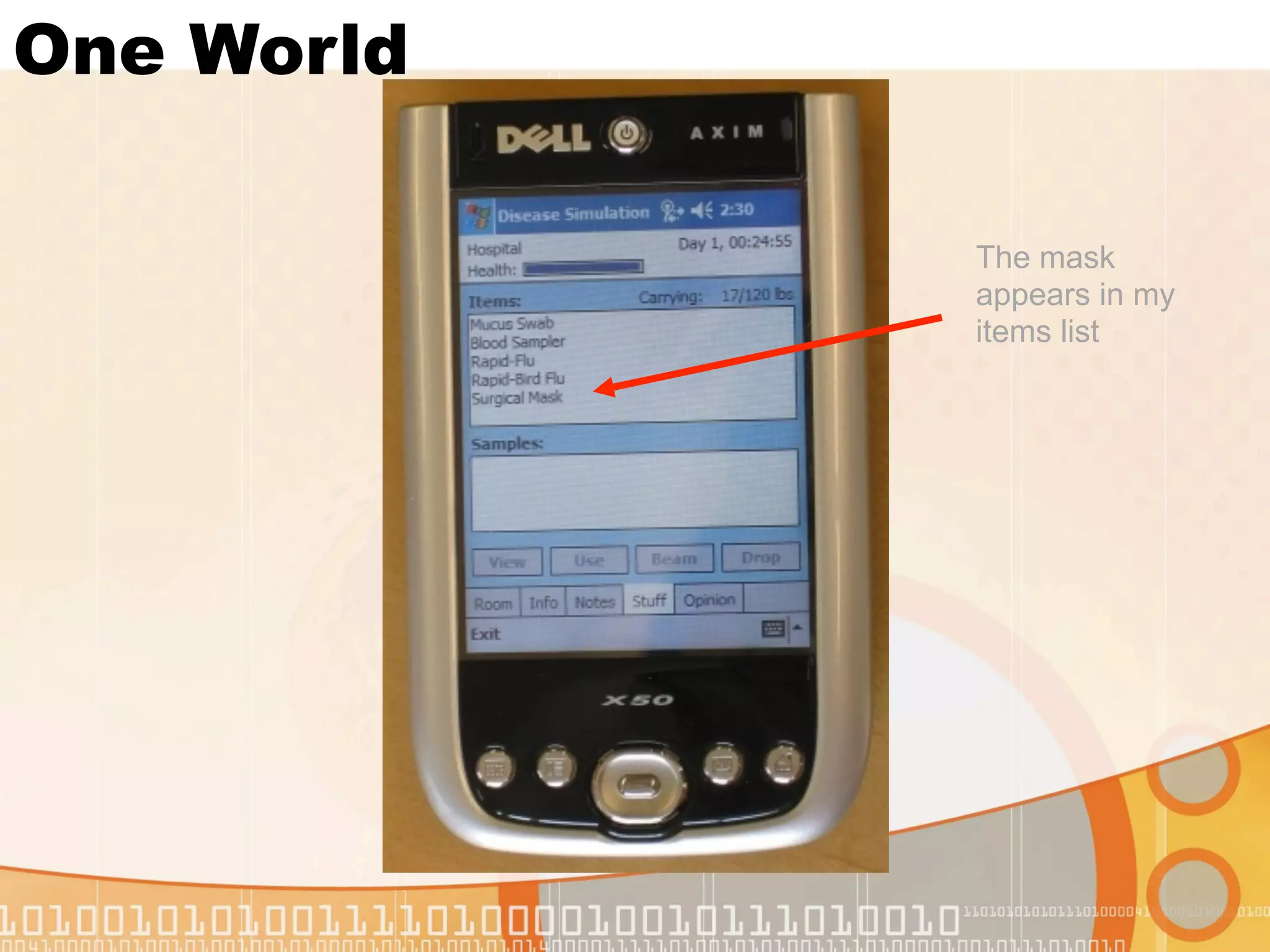
            The mask
            appears in my
            items list
One World


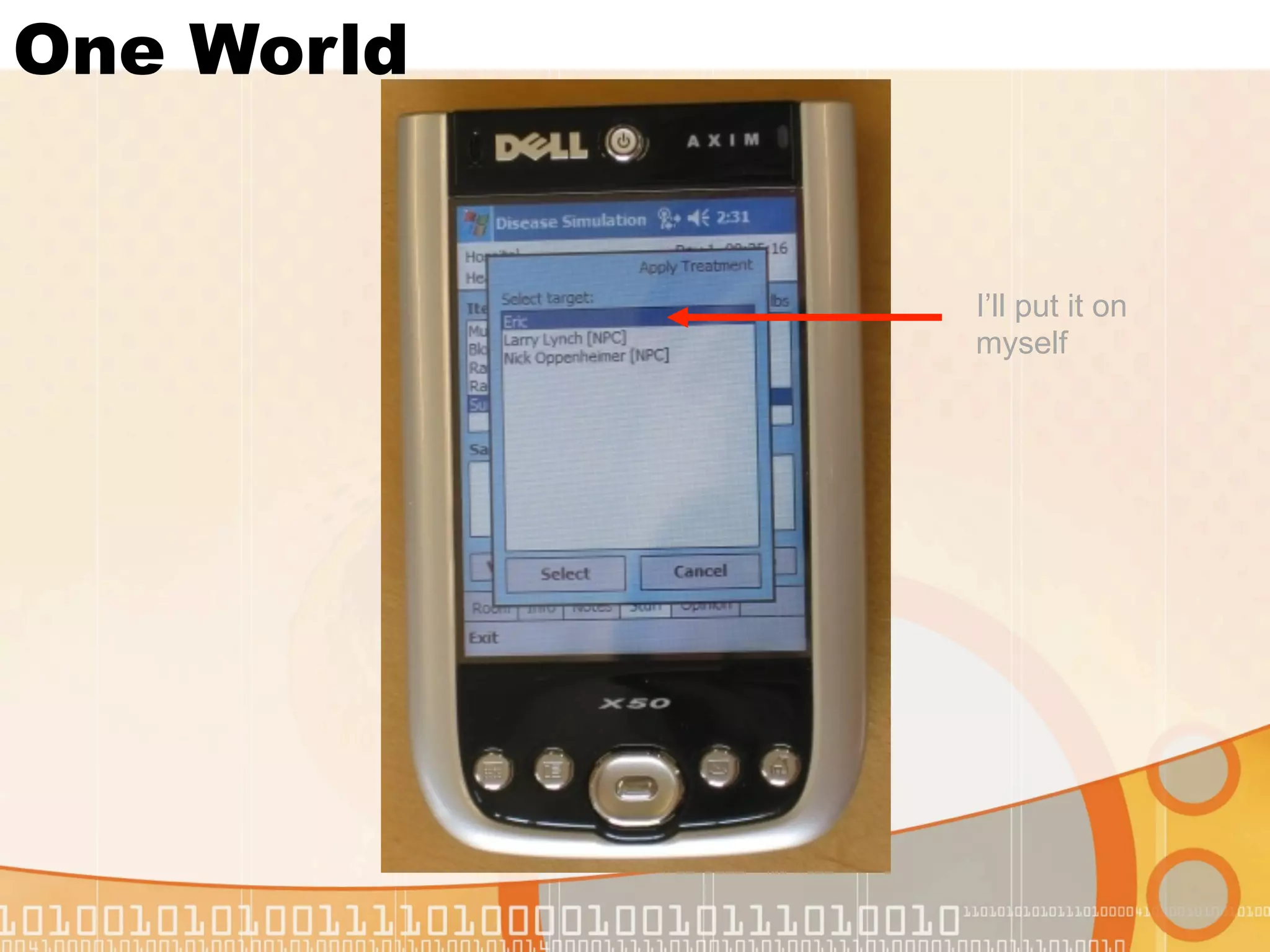
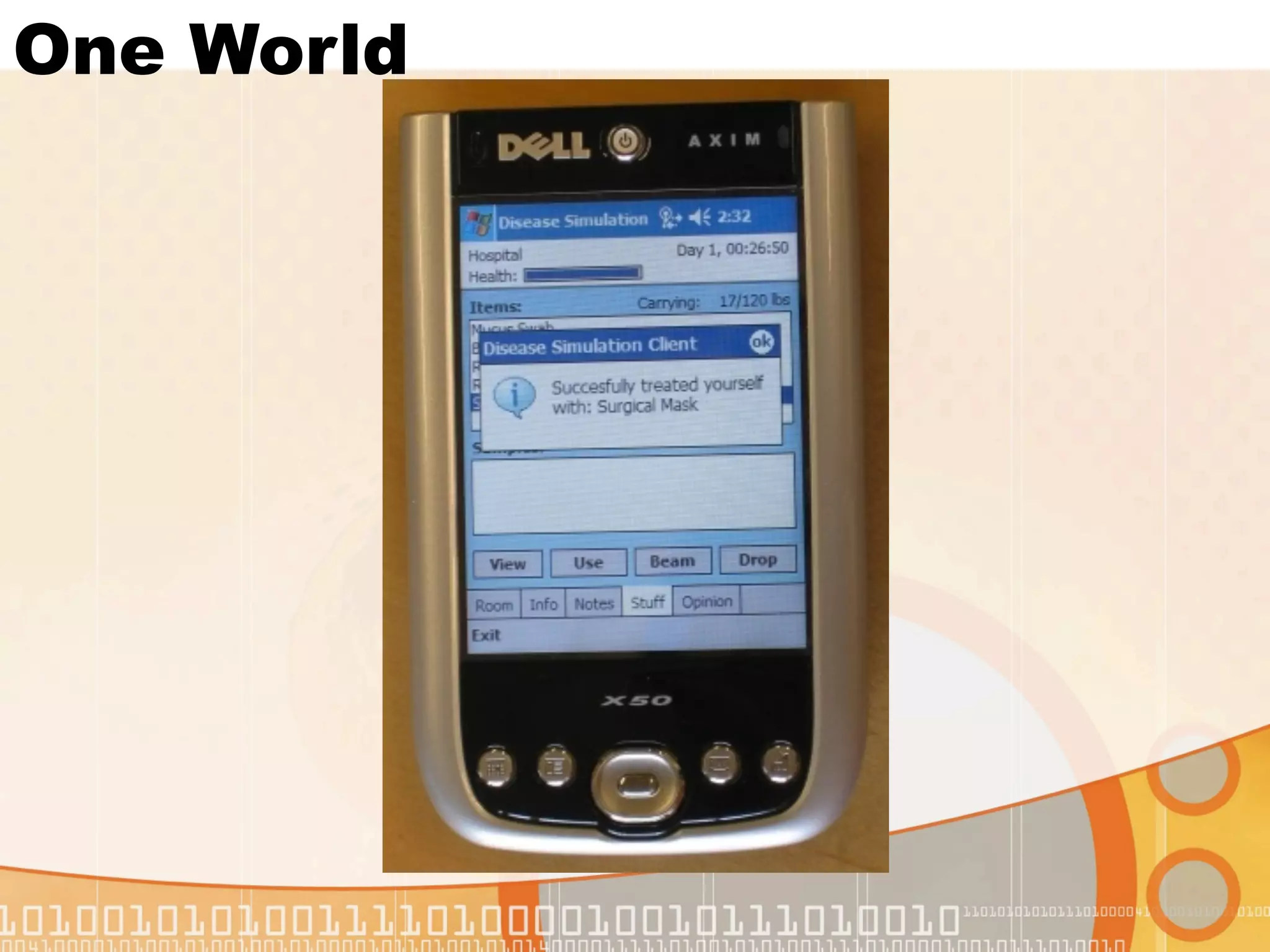
            I’ll put it on
            myself
One World
One World


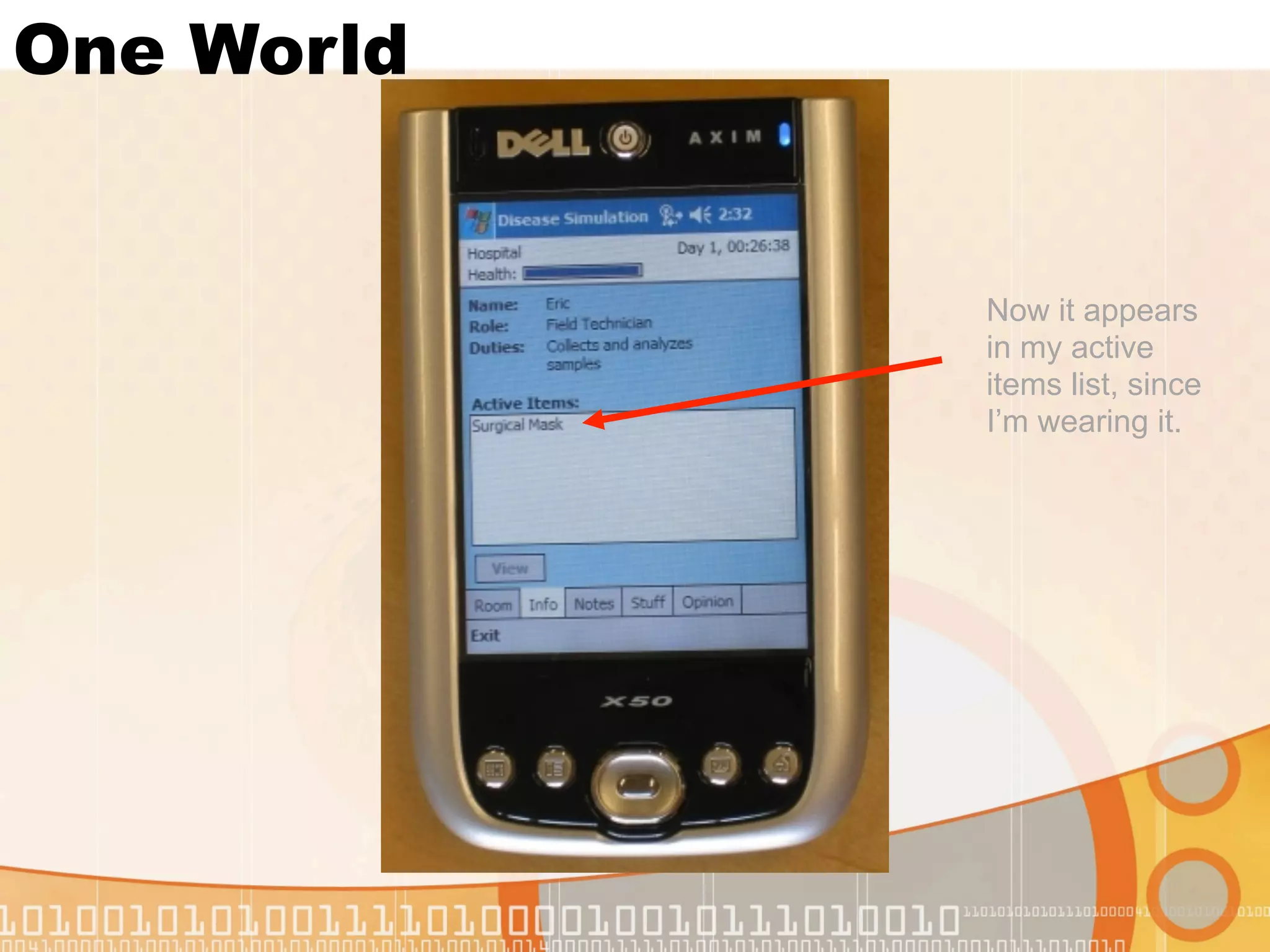
            Now it appears
            in my active
            items list, since
            I’m wearing it.
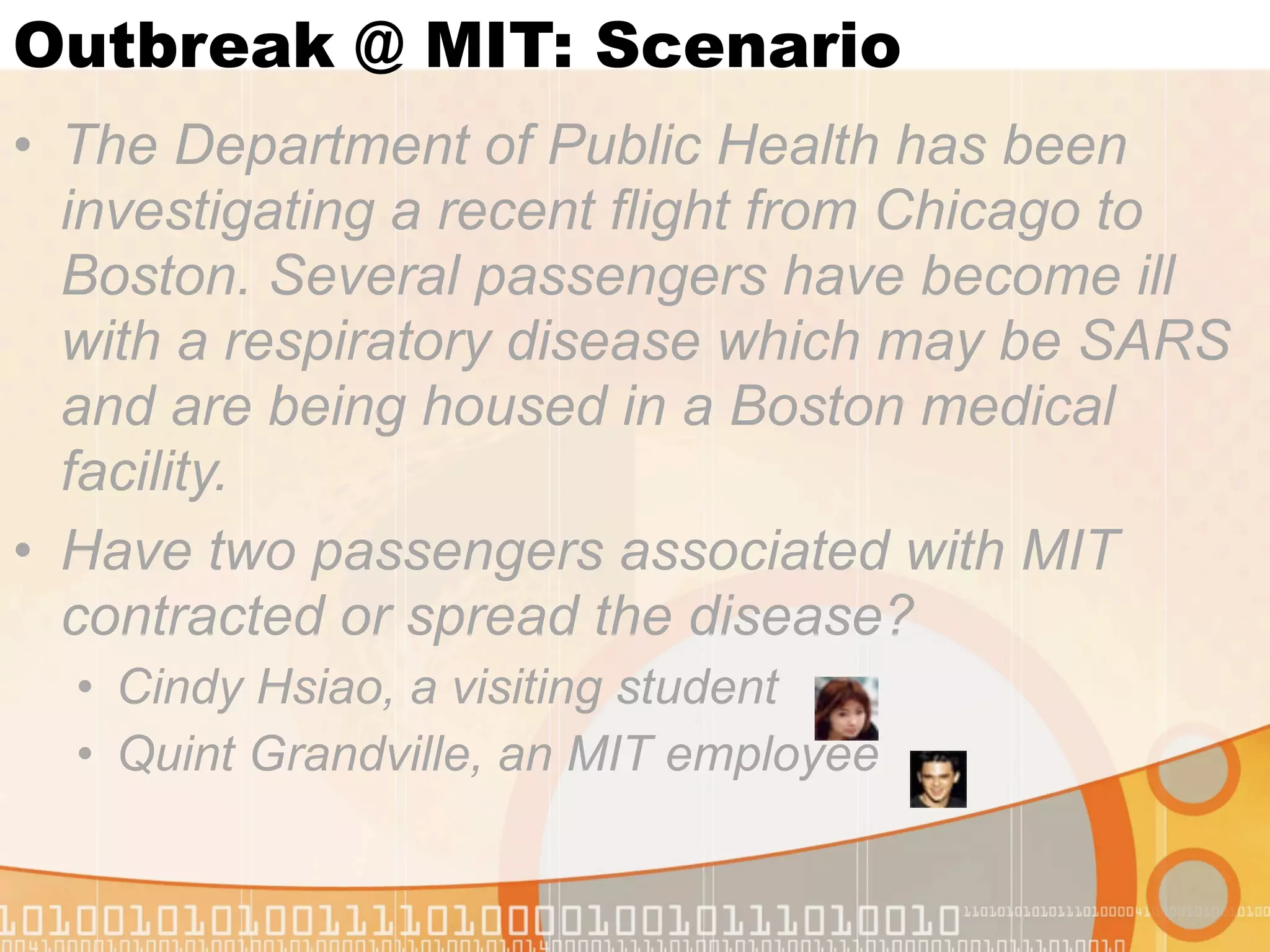
Outbreak @ MIT: Scenario
• The Department of Public Health has been
  investigating a recent flight from Chicago to
  Boston. Several passengers have become ill
  with a respiratory disease which may be SARS
  and are being housed in a Boston medical
  facility.
• Have two passengers associated with MIT
  contracted or spread the disease?
  • Cindy Hsiao, a visiting student
  • Quint Grandville, an MIT employee
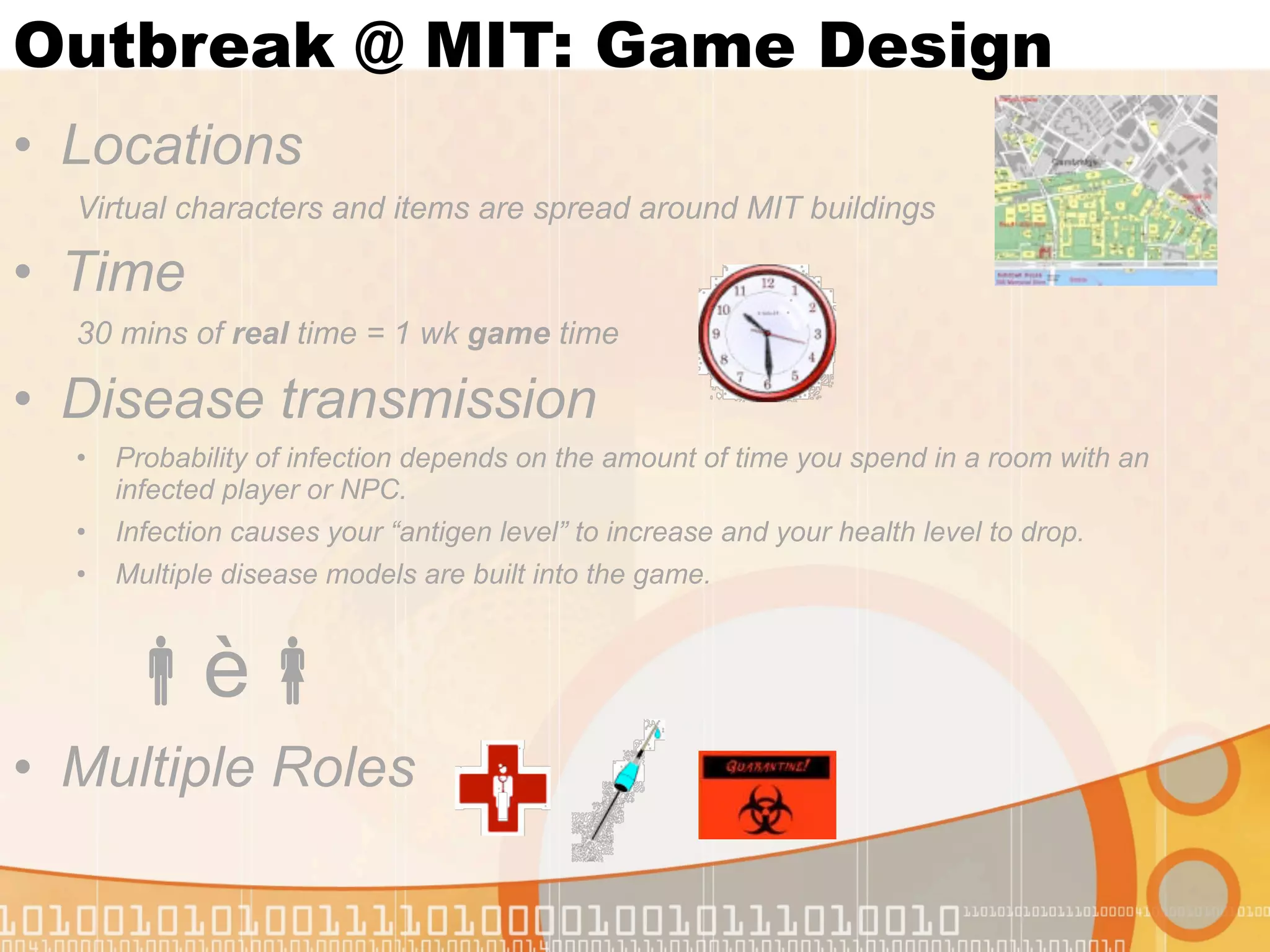
Outbreak @ MIT: Game Design
• Locations
  Virtual characters and items are spread around MIT buildings

• Time
  30 mins of real time = 1 wk game time

• Disease transmission
  •   Probability of infection depends on the amount of time you spend in a room with an
      infected player or NPC.
  •   Infection causes your “antigen level” to increase and your health level to drop.
  •   Multiple disease models are built into the game.


      è
• Multiple Roles

AugmentedRealityGames

  • 1.
    Augmented Reality ...in education Simulations by the MIT Education Arcade & HGSE’s HARP Project Jennifer Groff - jennifer_groff@mail.harvard.edu
  • 2.
    Handheld Games AUGMENTED REALITY Computersimulation on handheld computers triggered by real world locations • Goal - understand “authentic” science through simulated realistic practices • Combines physical & virtual world contexts • Embeds learners in authentic situations • Engages users in a socially facilitated context
  • 3.
    Handheld Games AUGMENTED REALITY Computersimulation on handheld computers triggered by real world locations
  • 4.
    A location-based experience •Uses GPS (Global Positioning System) outdoors… • …or wi-fi positioning indoors As participants move, their Pocket PCs knows their real location and provides location-specific information.
  • 5.
    More about AR... Helmetsv. Handhelds • Light augmentation • Providing a small amount of “augmented” information. The environment and real people are integral and “real”. • Heavy augmentation • The environment is used as a physical way of navigating through virtual space. Environment can represent anything.
  • 6.
    Environmental Detectives •Players briefed about rash of local health problems linked to the environment • Provided with background information and “budget” • Determine source of pollution by drilling sampling wells and remediating with pumping wells • Work in teams representing different interests (EPA, Industry, etc.)
  • 7.
    Outdoor AR Advances •Features • Structured around role dependent collaboration • Transcribed interview text, images or rich-media (e.g., video) provide interview information. • Gates allow participants in outdoor simulations to enter real buildings.
  • 8.
    ‘Evidence’ Screen • Use‘Send Evidence Over IR’ to prepare to make an accusation. • If a player has enough evidence, he or she can interview a suspect to accuse them of a crime. • A virtual character will only confess to a player who has all of the key evidence. • To accuse a virtual character, simply interview them with enough evidence.
  • 9.
    Examples of CustomizedScenarios • Public Health - Charles River City • Investigate mysterious health problems in Boston two weeks before the World Series • Forensics - Mad City Murder • Investigate the death of a local resident and determine whether it was murder Charles River City Mad City Murder
  • 10.
    Moving Indoors • Indoorgame played at the Boston Museum of Science • Used 802.11 for positioning • Defining roles to enhance collaboration • Introducing an element of time to make it feel more like a game • Solving a mystery using scientific information from the museum
  • 11.
    Location Information All screens tell you Click on items in what room you’re To view an item in the room to select currently in the room, click on them for viewing or the item and then picking up click the View button. Click on people in the room to select To pick up an item them for in the room, click interviewing or on the item and showing objects to then click the Pick Up button. To show an item that you already have to a To interview a Virtual Character, click virtual character on the person, then click on the person click Show and then and then click choose the item that Interview you want to show.
  • 12.
    Game Play Parents and Kids Collaborating Fostering Collaboration Through Roles Using Contextual Information Collecting Virtual Samples
  • 13.
    “Participatory Reality” • Combiningthe features of AR and Participatory Simulations to replicate authentic dynamic scientific practices where underlying models matter. • Participants are connected • Events unfold based on models • Game progresses differently each time + =
  • 14.
    Outbreak @ MIT •You are actually an agent in the system and can get sick or help the problem get under control • Client-server based allows “one world” with underlying models and more realistic feel • Evaluated by Public Health graduate students
  • 15.
    One World There’s a mask in this room. I need to protect myself, so I’ll pick it up.
  • 16.
    One World Since I picked it up, the mask has disappeared from the room. Other players no longer see it.
  • 17.
    One World The mask appears in my items list
  • 18.
    One World I’ll put it on myself
  • 19.
  • 20.
    One World Now it appears in my active items list, since I’m wearing it.
  • 21.
    Outbreak @ MIT:Scenario • The Department of Public Health has been investigating a recent flight from Chicago to Boston. Several passengers have become ill with a respiratory disease which may be SARS and are being housed in a Boston medical facility. • Have two passengers associated with MIT contracted or spread the disease? • Cindy Hsiao, a visiting student • Quint Grandville, an MIT employee
  • 22.
    Outbreak @ MIT:Game Design • Locations Virtual characters and items are spread around MIT buildings • Time 30 mins of real time = 1 wk game time • Disease transmission • Probability of infection depends on the amount of time you spend in a room with an infected player or NPC. • Infection causes your “antigen level” to increase and your health level to drop. • Multiple disease models are built into the game. è • Multiple Roles