Better Courses in Half the
Time
THE RAPID DEVELOPMENT OF A GRADUATE COURSE IN AN EMBA PROGRAM
Stephen Murgatroyd, PhD FBPSS FRSA
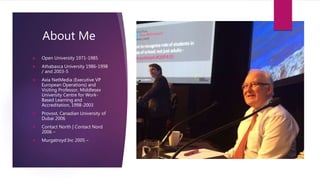
About Me
 Open University 1971-1985
 Athabasca University 1986-1998
/ and 2003-5
 Axia NetMedia (Executive VP
European Operations) and
Visiting Professor, Middlesex
University Centre for Work-
Based Learning and
Accreditation, 1998-2003
 Provost, Canadian University of
Dubai 2006
 Contact North | Contact Nord
2006 –
 Murgatroyd Inc 2005 –
What This
Session is
About
Look at how we created a
specific graduate course in a
few days
Look at how we revise the
course
Explore the possibilities of this
approach through a
conversation in the room
In 1983-5 I Chaired the OU(UK) Statistics
Course Team
 Budget = $4 million (£2.4 million)
 Team of 11 (8 academics, 1 instructional designer, 1 technology advisor, 1
BBC Producer)
 9 BBC production quality TV programs of 24.5 minutes and 6 radio
programs of 28 mins.
 10 course modules of between 30 and 50 full colour graphically
designed pages.
 25,000+ students a year
 Expectation was that the course would last between 6 and 10 years
The Course:
Knowledge, Learning,
Innovation & Performance
EKLI 682
Course Overview
The course focuses on some of the contemporary critical issues that will shape
Canada’s future—competitiveness, productivity, and innovation. The main objective
is to learn about how innovation could help with firm performance and strategy by
leveraging knowledge management and leadership.
We will explore some of the structural challenges for Canada’s competitiveness and
learn about organizational and inter-organizational factors that can thwart or
facilitate innovation at the regional and firm level.
We then study how to implement change that will enable Canadian firms to
become more productive through organizational learning in a knowledge-driven
economy.
We Know
 There will be 30-50 students in the course most almost at the end of their MBA – we
arrange them in teams of 7-8. All students are executive managers with significant
responsibilities and (usually) all are full-time employees with leadership
responsibilities.
 That they already have done a lot of reading / formal learning before entering the
course
 That they are highly skilled
 That they are in positions of authority / responsibility in organizations – firms,
government agencies, non-profits
 They they are networked..
 That these topics are in the news all the time and are always current…
We Also
 Want to challenge them to engage and learn
 Get them to do somethings they have not done before
 Get them to really think about their own work from a reflective-action
perspective – this is action learning in a networked community of inquiry
 To see the course as a co-creation process – they know as much (if not more)
than we do – we’ve just been thinking about the issues longer (i.e. we are old!)
Our Learning Platform: IBM Notes
 In 1993-4 this was the ONLY platform we considered to be a learning space – its
still pretty robust
 Permits dialogue and team-based work
 Operates both online and offline
 Permits ”chat”, document sharing, video sharing etc.
 Learning is asynchronous – students can be anywhere in the world – but
sometimes students create their own “synchronous” components
THE DESIGN PROCESS
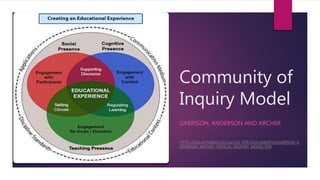
A COURSE IS AN EXPERIENCE IN LEARNING..
 You need PRESENCE
 Cognitive Presence – challenge, activity, exploration, substance
 Teaching Presence – engaging with learners, groups, knowledge, sharing experience,
insights and having fun
 Social Presence – engagement with social networks, peer networks, international
networks..
 Learner Presence – the learners voice needs to be heard and understood..they need
channels to ensure that their ideas can be explored…
Community of
Inquiry Model
GARRISON, ANDERSON AND ARCHER
HTTP://CDE.ATHABASCAU.CA/COI_SITE/DOCUMENTS/GARRISON_A
NDERSON_ARCHER_CRITICAL_INQUIRY_MODEL.PDF
TEACH LESS,
LEARN MORE
 You DO NOT NEED a lot of
 CONTENT – content is everywhere, what you
need are roadmaps, insights infographics and
coaching for use
 ASSESSMENTS – you need some, but not every
10’
 INSTRUCTION – in higher education, we need
to develop the skills of exploration, critical
review and assessment, communication,
teamwork and knowledge building…peer
learning is a key component of this design
HOW MUCH TIME EACH
WEEK DO WE HAVE?
 Total time for learning
 Time for exploring /
understanding
 Time for sharing
 Time for writing
Understand Purpose and Meaning
 What is the purpose of this experience?
 What meaning(s) should we be seeking
to enable?
 What “shocks” and “surprises” do we
hope to create for our learners?
 What communities are we seeking to
connect to?
 WHAT DO WE HOPE LEARNERS WILL
LEARN AND EXPERIENCE?
 Knowledge
 Capabilities
 Skills
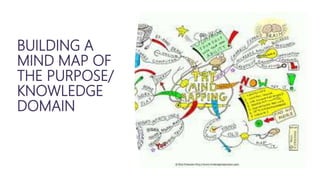
BUILDING A
MIND MAP OF
THE PURPOSE/
KNOWLEDGE
DOMAIN
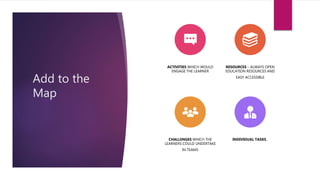
Add to the
Map
ACTIVITIES WHICH WOULD
ENGAGE THE LEARNER
RESOURCES – ALWAYS OPEN
EDUCATION RESOURCES AND
EASY ACCESSIBLE
CHALLENGES WHICH THE
LEARNERS COULD UNDERTAKE
IN TEAMS
INDIVIDUAL TASKS..
By Topic, Build an Asset Inventory
 For a topic - e.g. Innovation – what assets could we deploy which would change
the assumptions learners often make about the topic and open up new ways of
thinking..
 Videos / Ted-Talks
 Podcasts
 Research Summaries and Articles (e.g. Harvard Business Review, Forbes)
 Research Papers
 Working principle: each topic needs a variety of different kinds of resources to
keep peoples interest, reflect different preferences (visual versus text) and
stimulate challenge and encourage a quest for more..
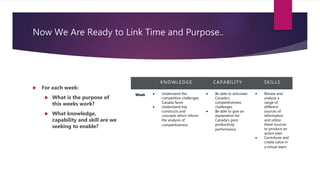
Now We Are Ready to Link Time and Purpose..
 For each week:
 What is the purpose of
this weeks work?
 What knowledge,
capability and skill are we
seeking to enable?
KNOWLEDGE CAPABILITY SKILLS
Week  Understand the
competitive challenges
Canada faces
 Understand key
constructs and
concepts which inform
the analysis of
competitiveness
 Be able to articulate
Canada’s
competitiveness
challenges
 Be able to give an
explanation for
Canada’s poor
productivity
performance
 Review and
analyze a
range of
different
sources of
information
and utilize
these sources
to produce an
action plan
 Contribute and
create value in
a virtual team.
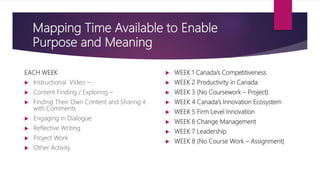
Mapping Time Available to Enable
Purpose and Meaning
EACH WEEK
 Instructional Video –
 Content Finding / Exploring –
 Finding Their Own Content and Sharing it
with Comments
 Engaging in Dialogue
 Reflective Writing
 Project Work
 Other Activity
 WEEK 1 Canada’s Competitiveness
 WEEK 2 Productivity in Canada
 WEEK 3 (No Coursework – Project)
 WEEK 4 Canada’s Innovation Ecosystem
 WEEK 5 Firm Level Innovation
 WEEK 6 Change Management
 WEEK 7 Leadership
 WEEK 8 (No Course Work – Assignment)
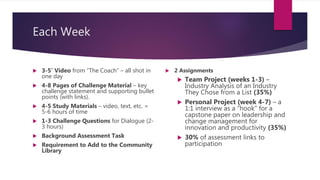
Each Week
 3-5’ Video from “The Coach” – all shot in
one day
 4-8 Pages of Challenge Material – key
challenge statement and supporting bullet
points (with links).
 4-5 Study Materials – video, text, etc. =
5-6 hours of time
 1-3 Challenge Questions for Dialogue (2-
3 hours)
 Background Assessment Task
 Requirement to Add to the Community
Library
 2 Assignments
 Team Project (weeks 1-3) –
Industry Analysis of an Industry
They Chose from a List (35%)
 Personal Project (week 4-7) – a
1:1 interview as a “hook” for a
capstone paper on leadership and
change management for
innovation and productivity (35%)
 30% of assessment links to
participation
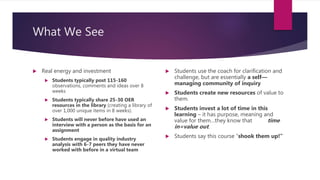
What We See
 Real energy and investment
 Students typically post 115-160
observations, comments and ideas over 8
weeks
 Students typically share 25-30 OER
resources in the library (creating a library of
over 1,000 unique items in 8 weeks).
 Students will never before have used an
interview with a person as the basis for an
assignment
 Students engage in quality industry
analysis with 6-7 peers they have never
worked with before in a virtual team
 Students use the coach for clarification and
challenge, but are essentially a self—
managing community of inquiry
 Students create new resources of value to
them.
 Students invest a lot of time in this
learning – it has purpose, meaning and
value for them…they know that time
in=value out.
 Students say this course “shook them up!”
My 5 Big Learning Points
 Less is more.. For both content and instruction
 Challenge leads to more learning than textbooks
 Co-creation and a community of inquiry produces surprisingly deep learning
 The authenticity of the content they co-create leads to deeper learning for all
 Peer to peer feedback is faster and often more critical / challenging than coach’s
feedback
YOUR OBSERVATIONS /
QUESTIONS?
murgatroydstephen@gmail.com
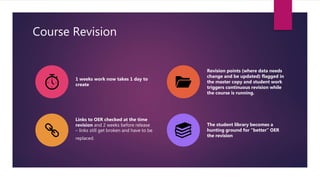
Course Revision
1 weeks work now takes 1 day to
create
Revision points (where data needs
change and be updated) flagged in
the master copy and student work
triggers continuous revision while
the course is running.
Links to OER checked at the time
revision and 2 weeks before release
– links still get broken and have to be
replaced.
The student library becomes a
hunting ground for “better” OER
the revision

Better courses in half the time

  • 1.
    Better Courses inHalf the Time THE RAPID DEVELOPMENT OF A GRADUATE COURSE IN AN EMBA PROGRAM Stephen Murgatroyd, PhD FBPSS FRSA
  • 2.
    About Me  OpenUniversity 1971-1985  Athabasca University 1986-1998 / and 2003-5  Axia NetMedia (Executive VP European Operations) and Visiting Professor, Middlesex University Centre for Work- Based Learning and Accreditation, 1998-2003  Provost, Canadian University of Dubai 2006  Contact North | Contact Nord 2006 –  Murgatroyd Inc 2005 –
  • 3.
    What This Session is About Lookat how we created a specific graduate course in a few days Look at how we revise the course Explore the possibilities of this approach through a conversation in the room
  • 4.
    In 1983-5 IChaired the OU(UK) Statistics Course Team  Budget = $4 million (£2.4 million)  Team of 11 (8 academics, 1 instructional designer, 1 technology advisor, 1 BBC Producer)  9 BBC production quality TV programs of 24.5 minutes and 6 radio programs of 28 mins.  10 course modules of between 30 and 50 full colour graphically designed pages.  25,000+ students a year  Expectation was that the course would last between 6 and 10 years
  • 5.
  • 6.
    Course Overview The coursefocuses on some of the contemporary critical issues that will shape Canada’s future—competitiveness, productivity, and innovation. The main objective is to learn about how innovation could help with firm performance and strategy by leveraging knowledge management and leadership. We will explore some of the structural challenges for Canada’s competitiveness and learn about organizational and inter-organizational factors that can thwart or facilitate innovation at the regional and firm level. We then study how to implement change that will enable Canadian firms to become more productive through organizational learning in a knowledge-driven economy.
  • 7.
    We Know  Therewill be 30-50 students in the course most almost at the end of their MBA – we arrange them in teams of 7-8. All students are executive managers with significant responsibilities and (usually) all are full-time employees with leadership responsibilities.  That they already have done a lot of reading / formal learning before entering the course  That they are highly skilled  That they are in positions of authority / responsibility in organizations – firms, government agencies, non-profits  They they are networked..  That these topics are in the news all the time and are always current…
  • 8.
    We Also  Wantto challenge them to engage and learn  Get them to do somethings they have not done before  Get them to really think about their own work from a reflective-action perspective – this is action learning in a networked community of inquiry  To see the course as a co-creation process – they know as much (if not more) than we do – we’ve just been thinking about the issues longer (i.e. we are old!)
  • 9.
    Our Learning Platform:IBM Notes  In 1993-4 this was the ONLY platform we considered to be a learning space – its still pretty robust  Permits dialogue and team-based work  Operates both online and offline  Permits ”chat”, document sharing, video sharing etc.  Learning is asynchronous – students can be anywhere in the world – but sometimes students create their own “synchronous” components
  • 10.
  • 11.
    A COURSE ISAN EXPERIENCE IN LEARNING..  You need PRESENCE  Cognitive Presence – challenge, activity, exploration, substance  Teaching Presence – engaging with learners, groups, knowledge, sharing experience, insights and having fun  Social Presence – engagement with social networks, peer networks, international networks..  Learner Presence – the learners voice needs to be heard and understood..they need channels to ensure that their ideas can be explored…
  • 12.
    Community of Inquiry Model GARRISON,ANDERSON AND ARCHER HTTP://CDE.ATHABASCAU.CA/COI_SITE/DOCUMENTS/GARRISON_A NDERSON_ARCHER_CRITICAL_INQUIRY_MODEL.PDF
  • 13.
    TEACH LESS, LEARN MORE You DO NOT NEED a lot of  CONTENT – content is everywhere, what you need are roadmaps, insights infographics and coaching for use  ASSESSMENTS – you need some, but not every 10’  INSTRUCTION – in higher education, we need to develop the skills of exploration, critical review and assessment, communication, teamwork and knowledge building…peer learning is a key component of this design
  • 14.
    HOW MUCH TIMEEACH WEEK DO WE HAVE?  Total time for learning  Time for exploring / understanding  Time for sharing  Time for writing
  • 15.
    Understand Purpose andMeaning  What is the purpose of this experience?  What meaning(s) should we be seeking to enable?  What “shocks” and “surprises” do we hope to create for our learners?  What communities are we seeking to connect to?  WHAT DO WE HOPE LEARNERS WILL LEARN AND EXPERIENCE?  Knowledge  Capabilities  Skills
  • 16.
    BUILDING A MIND MAPOF THE PURPOSE/ KNOWLEDGE DOMAIN
  • 17.
    Add to the Map ACTIVITIESWHICH WOULD ENGAGE THE LEARNER RESOURCES – ALWAYS OPEN EDUCATION RESOURCES AND EASY ACCESSIBLE CHALLENGES WHICH THE LEARNERS COULD UNDERTAKE IN TEAMS INDIVIDUAL TASKS..
  • 18.
    By Topic, Buildan Asset Inventory  For a topic - e.g. Innovation – what assets could we deploy which would change the assumptions learners often make about the topic and open up new ways of thinking..  Videos / Ted-Talks  Podcasts  Research Summaries and Articles (e.g. Harvard Business Review, Forbes)  Research Papers  Working principle: each topic needs a variety of different kinds of resources to keep peoples interest, reflect different preferences (visual versus text) and stimulate challenge and encourage a quest for more..
  • 19.
    Now We AreReady to Link Time and Purpose..  For each week:  What is the purpose of this weeks work?  What knowledge, capability and skill are we seeking to enable? KNOWLEDGE CAPABILITY SKILLS Week  Understand the competitive challenges Canada faces  Understand key constructs and concepts which inform the analysis of competitiveness  Be able to articulate Canada’s competitiveness challenges  Be able to give an explanation for Canada’s poor productivity performance  Review and analyze a range of different sources of information and utilize these sources to produce an action plan  Contribute and create value in a virtual team.
  • 20.
    Mapping Time Availableto Enable Purpose and Meaning EACH WEEK  Instructional Video –  Content Finding / Exploring –  Finding Their Own Content and Sharing it with Comments  Engaging in Dialogue  Reflective Writing  Project Work  Other Activity  WEEK 1 Canada’s Competitiveness  WEEK 2 Productivity in Canada  WEEK 3 (No Coursework – Project)  WEEK 4 Canada’s Innovation Ecosystem  WEEK 5 Firm Level Innovation  WEEK 6 Change Management  WEEK 7 Leadership  WEEK 8 (No Course Work – Assignment)
  • 21.
    Each Week  3-5’Video from “The Coach” – all shot in one day  4-8 Pages of Challenge Material – key challenge statement and supporting bullet points (with links).  4-5 Study Materials – video, text, etc. = 5-6 hours of time  1-3 Challenge Questions for Dialogue (2- 3 hours)  Background Assessment Task  Requirement to Add to the Community Library  2 Assignments  Team Project (weeks 1-3) – Industry Analysis of an Industry They Chose from a List (35%)  Personal Project (week 4-7) – a 1:1 interview as a “hook” for a capstone paper on leadership and change management for innovation and productivity (35%)  30% of assessment links to participation
  • 22.
    What We See Real energy and investment  Students typically post 115-160 observations, comments and ideas over 8 weeks  Students typically share 25-30 OER resources in the library (creating a library of over 1,000 unique items in 8 weeks).  Students will never before have used an interview with a person as the basis for an assignment  Students engage in quality industry analysis with 6-7 peers they have never worked with before in a virtual team  Students use the coach for clarification and challenge, but are essentially a self— managing community of inquiry  Students create new resources of value to them.  Students invest a lot of time in this learning – it has purpose, meaning and value for them…they know that time in=value out.  Students say this course “shook them up!”
  • 23.
    My 5 BigLearning Points  Less is more.. For both content and instruction  Challenge leads to more learning than textbooks  Co-creation and a community of inquiry produces surprisingly deep learning  The authenticity of the content they co-create leads to deeper learning for all  Peer to peer feedback is faster and often more critical / challenging than coach’s feedback
  • 24.
  • 25.
    Course Revision 1 weekswork now takes 1 day to create Revision points (where data needs change and be updated) flagged in the master copy and student work triggers continuous revision while the course is running. Links to OER checked at the time revision and 2 weeks before release – links still get broken and have to be replaced. The student library becomes a hunting ground for “better” OER the revision