A definition for student
collaboration in EAP
Implications for practice
Averil Bolster
&
Peter Levrai
averilbolster@gmail.com
peterlevrai@gmail.com
University of Turku / University
of the Basque Country
Our Interest in Collaboration
• Wrote a course incorporating collaborative
assignments (available for free download).
• Developed a framework to support group
essays (Levrai & Bolster, 2018).
• PhD interests in:
Teacher attitude
to student
collaboration
Assessment of
collaborative
assignments
https://developeap.weebly.com
Background
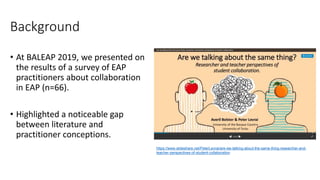
• At BALEAP 2019, we presented on
the results of a survey of EAP
practitioners about collaboration
in EAP (n=66).
• Highlighted a noticeable gap
between literature and
practitioner conceptions.
https://www.slideshare.net/PeterLevrai/are-we-talking-about-the-same-thing-researcher-and-
teacher-perspectives-of-student-collaboration
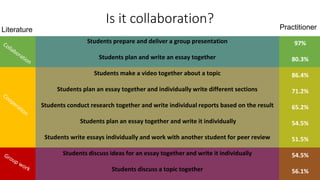
Students prepare and deliver a group presentation
Students plan and write an essay together
Students make a video together about a topic
Students plan an essay together and individually write different sections
Students conduct research together and write individual reports based on the result
Students plan an essay together and write it individually
Students write essays individually and work with another student for peer review
Students discuss ideas for an essay together and write it individually
Students discuss a topic together
Is it collaboration? PractitionerLiterature
97%
80.3%
86.4%
71.2%
65.2%
54.5%
51.5%
54.5%
56.1%
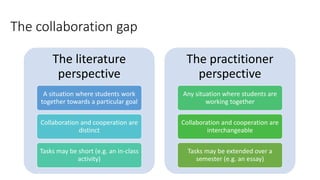
The collaboration gap
The literature
perspective
A situation where students work
together towards a particular goal
Collaboration and cooperation are
distinct
Tasks may be short (e.g. an in-class
activity)
The practitioner
perspective
Any situation where students are
working together
Collaboration and cooperation are
interchangeable
Tasks may be extended over a
semester (e.g. an essay)
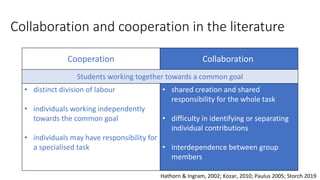
Cooperation Collaboration
Students working together towards a common goal
• distinct division of labour
• individuals working independently
towards the common goal
• individuals may have responsibility for
a specialised task
• shared creation and shared
responsibility for the whole task
• difficulty in identifying or separating
individual contributions
• interdependence between group
members
Collaboration and cooperation in the literature
Hathorn & Ingram, 2002; Kozar, 2010; Paulus 2005; Storch 2019
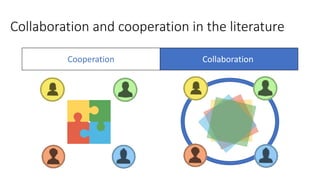
Collaboration and cooperation in the literature
Cooperation Collaboration
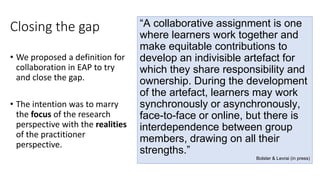
Closing the gap
• We proposed a definition for
collaboration in EAP to try
and close the gap.
• The intention was to marry
the focus of the research
perspective with the realities
of the practitioner
perspective.
“A collaborative assignment is one
where learners work together and
make equitable contributions to
develop an indivisible artefact for
which they share responsibility and
ownership. During the development
of the artefact, learners may work
synchronously or asynchronously,
face-to-face or online, but there is
interdependence between group
members, drawing on all their
strengths.”
Bolster & Levrai (in press)
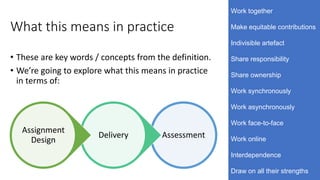
What this means in practice
• These are key words / concepts from the definition.
• We’re going to explore what this means in practice
in terms of:
AssessmentDelivery
Assignment
Design
Work together
Make equitable contributions
Indivisible artefact
Share responsibility
Share ownership
Work synchronously
Work asynchronously
Work face-to-face
Work online
Interdependence
Draw on all their strengths
Implications for assignment design
• Collaboration has to be identified as a distinct
learning outcome (Swan, Shen & Hiltz, 2006; Le,
Janssen & Wubbels, 2018).
• There has to be a valid reason for students to
collaborate (McDonald, 2003).
• Mechanisms need to be in place to facilitate /
monitor / assess collaboration. The teacher is more
than ‘the guide on the side’ (Rummel & Deiglmayr,
2018).
Work together
Make equitable contributions
Indivisible artefact
Share responsibility
Share ownership
Work synchronously
Work asynchronously
Work face-to-face
Work online
Interdependence
Draw on all their strengths
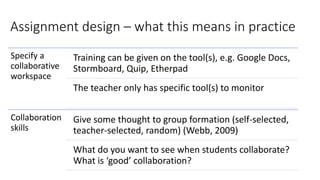
Assignment design – what this means in practice
Specify a
collaborative
workspace
Training can be given on the tool(s), e.g. Google Docs,
Stormboard, Quip, Etherpad
The teacher only has specific tool(s) to monitor
Collaboration
skills
Give some thought to group formation (self-selected,
teacher-selected, random) (Webb, 2009)
What do you want to see when students collaborate?
What is ‘good’ collaboration?
Implications for delivery
• From outset need to raise awareness of collaboration e.g.
• pre-writing team-building activities (Webb, 2009; Le,
Janssen & Wubbels, 2018).
• discussion of team roles, different types of
interactions patterns (Storch, 2002; Webb, 2009).
• familiarising students with collaborative platforms /
workspaces.
• Ongoing requirement for teacher to monitor / students to
self-report collaboration face-to-face and online.
• Interventions may be necessary in a breakdown in
collaboration (Webb, 2009; Le, Janssen & Wubbels
(2018).
Work together
Make equitable contributions
Indivisible artefact
Share responsibility
Share ownership
Work synchronously
Work asynchronously
Work face-to-face
Work online
Interdependence
Draw on all their strengths
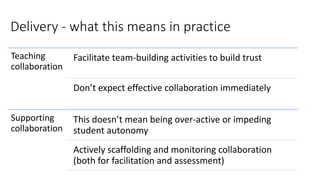
Delivery - what this means in practice
Teaching
collaboration
Facilitate team-building activities to build trust
Don’t expect effective collaboration immediately
Supporting
collaboration
This doesn’t mean being over-active or impeding
student autonomy
Actively scaffolding and monitoring collaboration
(both for facilitation and assessment)
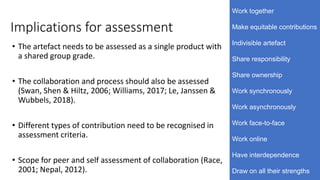
Implications for assessment
• The artefact needs to be assessed as a single product with
a shared group grade.
• The collaboration and process should also be assessed
(Swan, Shen & Hiltz, 2006; Williams, 2017; Le, Janssen &
Wubbels, 2018).
• Different types of contribution need to be recognised in
assessment criteria.
• Scope for peer and self assessment of collaboration (Race,
2001; Nepal, 2012).
Work together
Make equitable contributions
Indivisible artefact
Share responsibility
Share ownership
Work synchronously
Work asynchronously
Work face-to-face
Work online
Have interdependence
Draw on all their strengths
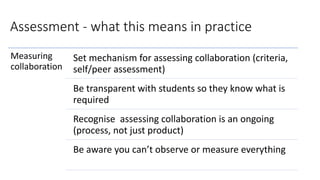
Assessment - what this means in practice
Measuring
collaboration
Set mechanism for assessing collaboration (criteria,
self/peer assessment)
Be transparent with students so they know what is
required
Recognise assessing collaboration is an ongoing
(process, not just product)
Be aware you can’t observe or measure everything
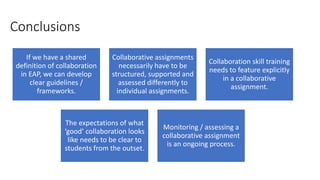
Conclusions
If we have a shared
definition of collaboration
in EAP, we can develop
clear guidelines /
frameworks.
Collaborative assignments
necessarily have to be
structured, supported and
assessed differently to
individual assignments.
Collaboration skill training
needs to feature explicitly
in a collaborative
assignment.
The expectations of what
‘good’ collaboration looks
like needs to be clear to
students from the outset.
Monitoring / assessing a
collaborative assignment
is an ongoing process.
References
Bolster, A. and Levrai, P. (In press). Student collaboration in English for academic purposes – theory, practitioner
perceptions and reality. Kielikeskus tutkii 4.
Hathorn, L and Ingram. A. (2002). Online Collaboration: Making it Work. Educational Technology, 41 (2), 33-40.
Kozar, O. (2010). Towards Better Group Work: Seeing the Difference between Cooperation and
Collaboration. English Teaching Forum 48(2), 16-23.
Le, H., Janssen, J., & Wubbels, T. (2018). Collaborative learning practices: teacher and student perceived obstacles
to effective student collaboration. Cambridge Journal of Education, 48(1), 103-122.
Levrai, P. and Bolster, A. (2018). A framework to support group essay writing in English for Academic Purposes: a
case study from an English-medium instruction context. Assessment & Evaluation in Higher Education, 44(2),
186-202.
McDonald, J. (2003) Assessing online collaborative learning: process and product. Computers & Education (40) 377-
391.
Nepal, K.P. (2012). An approach to assign individual marks from a team mark: the case of Australian grading system
at universities, Assessment & Evaluation in Higher Education, 37(5), 555-562.
References (cont.)
Paulus, T. M. (2005). Collaboration or cooperation? Analyzing small group interactions in educational environments.
In Computer-supported collaborative learning in higher education (pp. 100-124). IGI Global.
Race, P. (2001). A Briefing on Self, Peer and Group Assessment. Assessment Series No. 9. York: LTSN Generic Centre.
Rummel, N. & Deiglmayr, A. (2018a, November). Collaborative Learning in Higher Education: Relevant Dimensions.
Paper presented at TAL 2018: Teaching for Active Learning, University of Southern Denmark. Retrieved from:
https://www.sdu.dk/en/tal2018
Storch, N. (2002). Patterns of interaction in ESL pair work. Language Learning, 52, 119-158.
Storch, N. (2019). Collaborative writing. Language Teaching, 52(1), 40-59.
Swan, K., Shen, J. & Hiltz, S. (2006). Assessment and Collaboration in Online Learning. Journal of Asynchronous
Learning, 10(1), 45-62.
Webb, N. M. (2009). The teacher's role in promoting collaborative dialogue in the classroom. British Journal of
Educational Psychology, 79(1), 1-28.
Williams, P. (2017) Assessing collaborative learning: big data, analytics and university futures, Assessment &
Evaluation in Higher Education, 42(6), 978-989.
Any questions?
https://developeap.weebly.com/
https://www.slideshare.net/PeterLevrai
peterlevrai@gmail.com
averilbolster@gmail.com
Thank you!

A definition for student collaboration in EAP: Implications for practice

  • 1.
    A definition forstudent collaboration in EAP Implications for practice Averil Bolster & Peter Levrai averilbolster@gmail.com peterlevrai@gmail.com University of Turku / University of the Basque Country
  • 2.
    Our Interest inCollaboration • Wrote a course incorporating collaborative assignments (available for free download). • Developed a framework to support group essays (Levrai & Bolster, 2018). • PhD interests in: Teacher attitude to student collaboration Assessment of collaborative assignments https://developeap.weebly.com
  • 3.
    Background • At BALEAP2019, we presented on the results of a survey of EAP practitioners about collaboration in EAP (n=66). • Highlighted a noticeable gap between literature and practitioner conceptions. https://www.slideshare.net/PeterLevrai/are-we-talking-about-the-same-thing-researcher-and- teacher-perspectives-of-student-collaboration
  • 4.
    Students prepare anddeliver a group presentation Students plan and write an essay together Students make a video together about a topic Students plan an essay together and individually write different sections Students conduct research together and write individual reports based on the result Students plan an essay together and write it individually Students write essays individually and work with another student for peer review Students discuss ideas for an essay together and write it individually Students discuss a topic together Is it collaboration? PractitionerLiterature 97% 80.3% 86.4% 71.2% 65.2% 54.5% 51.5% 54.5% 56.1%
  • 5.
    The collaboration gap Theliterature perspective A situation where students work together towards a particular goal Collaboration and cooperation are distinct Tasks may be short (e.g. an in-class activity) The practitioner perspective Any situation where students are working together Collaboration and cooperation are interchangeable Tasks may be extended over a semester (e.g. an essay)
  • 6.
    Cooperation Collaboration Students workingtogether towards a common goal • distinct division of labour • individuals working independently towards the common goal • individuals may have responsibility for a specialised task • shared creation and shared responsibility for the whole task • difficulty in identifying or separating individual contributions • interdependence between group members Collaboration and cooperation in the literature Hathorn & Ingram, 2002; Kozar, 2010; Paulus 2005; Storch 2019
  • 7.
    Collaboration and cooperationin the literature Cooperation Collaboration
  • 8.
    Closing the gap •We proposed a definition for collaboration in EAP to try and close the gap. • The intention was to marry the focus of the research perspective with the realities of the practitioner perspective. “A collaborative assignment is one where learners work together and make equitable contributions to develop an indivisible artefact for which they share responsibility and ownership. During the development of the artefact, learners may work synchronously or asynchronously, face-to-face or online, but there is interdependence between group members, drawing on all their strengths.” Bolster & Levrai (in press)
  • 9.
    What this meansin practice • These are key words / concepts from the definition. • We’re going to explore what this means in practice in terms of: AssessmentDelivery Assignment Design Work together Make equitable contributions Indivisible artefact Share responsibility Share ownership Work synchronously Work asynchronously Work face-to-face Work online Interdependence Draw on all their strengths
  • 10.
    Implications for assignmentdesign • Collaboration has to be identified as a distinct learning outcome (Swan, Shen & Hiltz, 2006; Le, Janssen & Wubbels, 2018). • There has to be a valid reason for students to collaborate (McDonald, 2003). • Mechanisms need to be in place to facilitate / monitor / assess collaboration. The teacher is more than ‘the guide on the side’ (Rummel & Deiglmayr, 2018). Work together Make equitable contributions Indivisible artefact Share responsibility Share ownership Work synchronously Work asynchronously Work face-to-face Work online Interdependence Draw on all their strengths
  • 11.
    Assignment design –what this means in practice Specify a collaborative workspace Training can be given on the tool(s), e.g. Google Docs, Stormboard, Quip, Etherpad The teacher only has specific tool(s) to monitor Collaboration skills Give some thought to group formation (self-selected, teacher-selected, random) (Webb, 2009) What do you want to see when students collaborate? What is ‘good’ collaboration?
  • 12.
    Implications for delivery •From outset need to raise awareness of collaboration e.g. • pre-writing team-building activities (Webb, 2009; Le, Janssen & Wubbels, 2018). • discussion of team roles, different types of interactions patterns (Storch, 2002; Webb, 2009). • familiarising students with collaborative platforms / workspaces. • Ongoing requirement for teacher to monitor / students to self-report collaboration face-to-face and online. • Interventions may be necessary in a breakdown in collaboration (Webb, 2009; Le, Janssen & Wubbels (2018). Work together Make equitable contributions Indivisible artefact Share responsibility Share ownership Work synchronously Work asynchronously Work face-to-face Work online Interdependence Draw on all their strengths
  • 13.
    Delivery - whatthis means in practice Teaching collaboration Facilitate team-building activities to build trust Don’t expect effective collaboration immediately Supporting collaboration This doesn’t mean being over-active or impeding student autonomy Actively scaffolding and monitoring collaboration (both for facilitation and assessment)
  • 14.
    Implications for assessment •The artefact needs to be assessed as a single product with a shared group grade. • The collaboration and process should also be assessed (Swan, Shen & Hiltz, 2006; Williams, 2017; Le, Janssen & Wubbels, 2018). • Different types of contribution need to be recognised in assessment criteria. • Scope for peer and self assessment of collaboration (Race, 2001; Nepal, 2012). Work together Make equitable contributions Indivisible artefact Share responsibility Share ownership Work synchronously Work asynchronously Work face-to-face Work online Have interdependence Draw on all their strengths
  • 15.
    Assessment - whatthis means in practice Measuring collaboration Set mechanism for assessing collaboration (criteria, self/peer assessment) Be transparent with students so they know what is required Recognise assessing collaboration is an ongoing (process, not just product) Be aware you can’t observe or measure everything
  • 16.
    Conclusions If we havea shared definition of collaboration in EAP, we can develop clear guidelines / frameworks. Collaborative assignments necessarily have to be structured, supported and assessed differently to individual assignments. Collaboration skill training needs to feature explicitly in a collaborative assignment. The expectations of what ‘good’ collaboration looks like needs to be clear to students from the outset. Monitoring / assessing a collaborative assignment is an ongoing process.
  • 17.
    References Bolster, A. andLevrai, P. (In press). Student collaboration in English for academic purposes – theory, practitioner perceptions and reality. Kielikeskus tutkii 4. Hathorn, L and Ingram. A. (2002). Online Collaboration: Making it Work. Educational Technology, 41 (2), 33-40. Kozar, O. (2010). Towards Better Group Work: Seeing the Difference between Cooperation and Collaboration. English Teaching Forum 48(2), 16-23. Le, H., Janssen, J., & Wubbels, T. (2018). Collaborative learning practices: teacher and student perceived obstacles to effective student collaboration. Cambridge Journal of Education, 48(1), 103-122. Levrai, P. and Bolster, A. (2018). A framework to support group essay writing in English for Academic Purposes: a case study from an English-medium instruction context. Assessment & Evaluation in Higher Education, 44(2), 186-202. McDonald, J. (2003) Assessing online collaborative learning: process and product. Computers & Education (40) 377- 391. Nepal, K.P. (2012). An approach to assign individual marks from a team mark: the case of Australian grading system at universities, Assessment & Evaluation in Higher Education, 37(5), 555-562.
  • 18.
    References (cont.) Paulus, T.M. (2005). Collaboration or cooperation? Analyzing small group interactions in educational environments. In Computer-supported collaborative learning in higher education (pp. 100-124). IGI Global. Race, P. (2001). A Briefing on Self, Peer and Group Assessment. Assessment Series No. 9. York: LTSN Generic Centre. Rummel, N. & Deiglmayr, A. (2018a, November). Collaborative Learning in Higher Education: Relevant Dimensions. Paper presented at TAL 2018: Teaching for Active Learning, University of Southern Denmark. Retrieved from: https://www.sdu.dk/en/tal2018 Storch, N. (2002). Patterns of interaction in ESL pair work. Language Learning, 52, 119-158. Storch, N. (2019). Collaborative writing. Language Teaching, 52(1), 40-59. Swan, K., Shen, J. & Hiltz, S. (2006). Assessment and Collaboration in Online Learning. Journal of Asynchronous Learning, 10(1), 45-62. Webb, N. M. (2009). The teacher's role in promoting collaborative dialogue in the classroom. British Journal of Educational Psychology, 79(1), 1-28. Williams, P. (2017) Assessing collaborative learning: big data, analytics and university futures, Assessment & Evaluation in Higher Education, 42(6), 978-989.
  • 19.