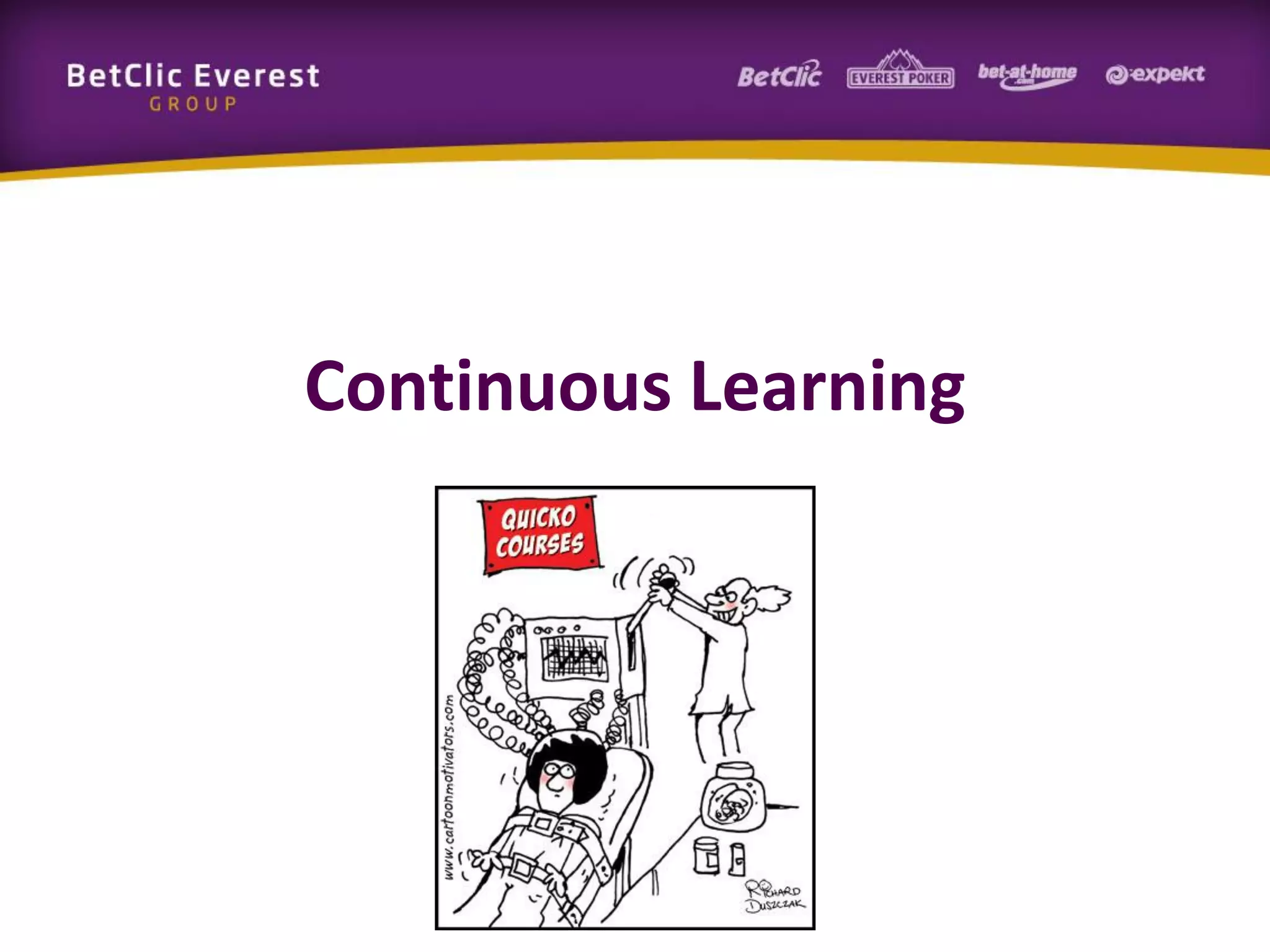
Continuous Learning
Developing a Culture of Learning
– The pace of change in our market and on the web in general forces
companies to adapt fast. To be adaptive as an organization, that
organization must intentionally engage in Continuous Learning.
– When you learn as a team, you become more adaptable and achieve
much better results, especially when the pace of change is fast.
Teams that learn quickly are more adaptive than teams that don't.
Adaptive teams are teams that can get better results, by rapid
response to change.
f.rivain@betclicgroup.com
Levels of learning
• 3 levels:
1. Individual
2. Team
3. Organization
f.rivain@betclicgroup.com
Continuous Learning at Individual Level
• Learning requires time and effort, as well as the decision to
want to learn.
• Make individuals understand the value of continuous learning,
and how it will not only help the organization, but most
importantly, it will be a great benefit to the learner as well.
• Examples: trainings, coaching and mentoring, seminars and
workshops, also through actual application and practice of
skills and knowledge
f.rivain@betclicgroup.com
Continuous Learning at Team Level
• Means collective individual learning: if the members
of the team acquire and share new knowledge and
information, then team learning takes place.
• Involves a set of learning processes that support and
aid team performance
• Examples: reflections, feedback, experimentation,
group discussions, and Q&A sessions.
f.rivain@betclicgroup.com
Continuous Learning at Organization Level
• Comprises change of interaction patterns,
change of policies and procedures, new
culture and new innovations.
• Example: feedback from the employees
themselves, from clients, and from customers.
Getting comments and ideas.
f.rivain@betclicgroup.com
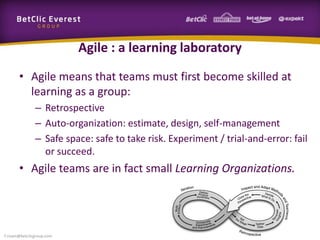
Agile : a learning laboratory
• Agile means that teams must first become skilled at
learning as a group:
– Retrospective
– Auto-organization: estimate, design, self-management
– Safe space: safe to take risk. Experiment / trial-and-error: fail
or succeed.
• Agile teams are in fact small Learning Organizations.
f.rivain@betclicgroup.com
Scaling Agile at enterprise level
• Very complicated task. Hard to achieve.
• Agile teams operate in a safe space for learning.
• Creation of enterprise-wide safe space is a non-trivial
problem to solve.
 Tribal Learning: start below the enterprise, above the team,
by Managers, for groups of 20 to 150 people.
f.rivain@betclicgroup.com
Tribal Learning: practices
• Encourage good group behavior on top of
Agile patterns to facilitate meetings and group
work:
• paying explicit attention,
• being punctual,
• honoring Scrum values: Focus, Commitment, Openness,
Courage, and Respect.
f.rivain@betclicgroup.com
Tribal Learning: automatic authorization
• As a manager, you have implicit authorization
to try and change a few things around.
• You are pre-authorized = empowered.
• Leverage your formal, positional authority as
a manager to direct your staff, convene
meetings, and so on. Don't ask permission!
• Example: change meeting rules if people are
usually late.
f.rivain@betclicgroup.com
Tribal Learning: tribal leadership
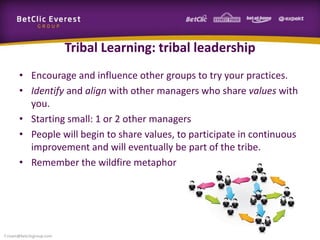
• Encourage and influence other groups to try your practices.
• Identify and align with other managers who share values with
you.
• Starting small: 1 or 2 other managers
• People will begin to share values, to participate in continuous
improvement and will eventually be part of the tribe.
• Remember the wildfire metaphor
f.rivain@betclicgroup.com
Learning and Change
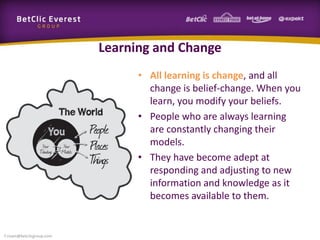
• All learning is change, and all
change is belief-change. When you
learn, you modify your beliefs.
• People who are always learning
are constantly changing their
models.
• They have become adept at
responding and adjusting to new
information and knowledge as it
becomes available to them.
f.rivain@betclicgroup.com
The learning cycle
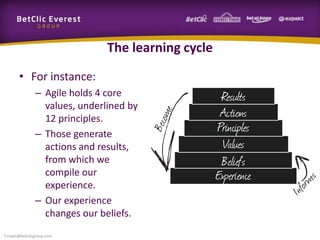
• For instance:
– Agile holds 4 core
values, underlined by
12 principles.
– Those generate
actions and results,
from which we
compile our
experience.
– Our experience
changes our beliefs.
f.rivain@betclicgroup.com
HOW TO CONTRIBUTE TO A CULTURE
OF CONTINUOUS LEARNING
f.rivain@betclicgroup.com
Be Purposeful / Announce your intent
 State your purpose early and often. Make it easy
for those who follow you to understand your
vision, your mission and your intent.
 This clarity helps everyone around you, and
increases levels of group learning.
f.rivain@betclicgroup.com
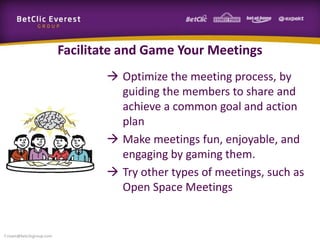
Facilitate and Game Your Meetings
 Optimize the meeting process, by
guiding the members to share and
achieve a common goal and action
plan
 Make meetings fun, enjoyable, and
engaging by gaming them.
 Try other types of meetings, such as
Open Space Meetings
f.rivain@betclicgroup.com
Examine Your Norms
 Normal is what you willingly tolerate. Examine
your norms, because what you tolerate is a
minimal level of what you insist on.
 What you insist on is more likely to happen. Insist
on norms that encourage greatness.
f.rivain@betclicgroup.com
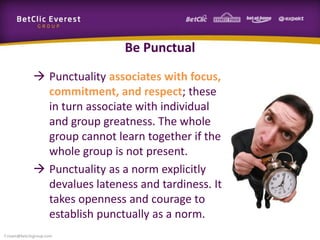
Be Punctual
 Punctuality associates with focus,
commitment, and respect; these
in turn associate with individual
and group greatness. The whole
group cannot learn together if the
whole group is not present.
 Punctuality as a norm explicitly
devalues lateness and tardiness. It
takes openness and courage to
establish punctually as a norm.
f.rivain@betclicgroup.com
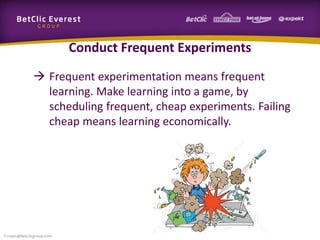
Conduct Frequent Experiments
 Frequent experimentation means frequent
learning. Make learning into a game, by
scheduling frequent, cheap experiments. Failing
cheap means learning economically.
f.rivain@betclicgroup.com
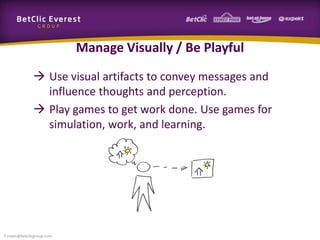
Manage Visually / Be Playful
 Use visual artifacts to convey messages and
influence thoughts and perception.
 Play games to get work done. Use games for
simulation, work, and learning.
f.rivain@betclicgroup.com
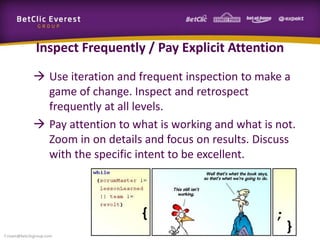
Inspect Frequently / Pay Explicit Attention
 Use iteration and frequent inspection to make a
game of change. Inspect and retrospect
frequently at all levels.
 Pay attention to what is working and what is not.
Zoom in on details and focus on results. Discuss
with the specific intent to be excellent.
f.rivain@betclicgroup.com
Get Coached
 Coaching helps the learning process and is a best
practice. A coach will see what you do not and
cannot.
f.rivain@betclicgroup.com
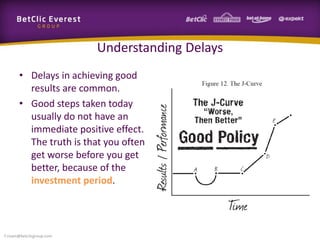
Understanding Delays
• Delays in achieving good
results are common.
• Good steps taken today
usually do not have an
immediate positive effect.
The truth is that you often
get worse before you get
better, because of the
investment period.
f.rivain@betclicgroup.com
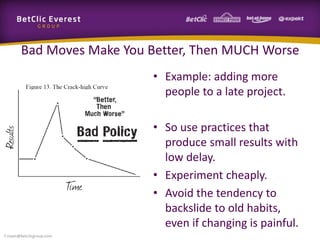
Bad Moves Make You Better, Then MUCH Worse
• Example: adding more
people to a late project.
• So use practices that
produce small results with
low delay.
• Experiment cheaply.
• Avoid the tendency to
backslide to old habits,
even if changing is painful.
f.rivain@betclicgroup.com
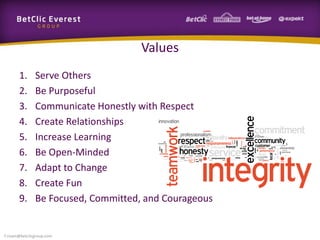
Values
1. Serve Others
2. Be Purposeful
3. Communicate Honestly with Respect
4. Create Relationships
5. Increase Learning
6. Be Open-Minded
7. Adapt to Change
8. Create Fun
9. Be Focused, Committed, and Courageous
f.rivain@betclicgroup.com
CONCRETE IDEAS FOR A CONTINUOUS
LEARNING IT ORGANIZATION
f.rivain@betclicgroup.com
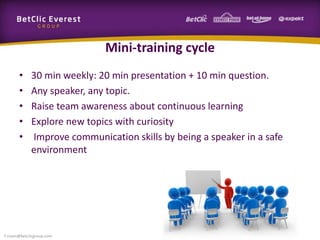
Mini-training cycle
• 30 min weekly: 20 min presentation + 10 min question.
• Any speaker, any topic.
• Raise team awareness about continuous learning
• Explore new topics with curiosity
• Improve communication skills by being a speaker in a safe
environment
f.rivain@betclicgroup.com
Blogs
• Internal
o Share, Communicate, Serve Others.
o Increase Learning
• External
o Promote Betclic IT team, Motivate, hire,
retain top engineers
o Contribute to team learning and
performance, by reflecting, formalizing
and sharing our practices (with the peer
pressure of making it public)
o Atracting external contributions
f.rivain@betclicgroup.com
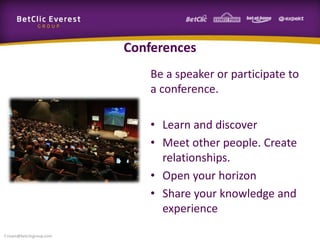
Conferences
Be a speaker or participate to
a conference.
• Learn and discover
• Meet other people. Create
relationships.
• Open your horizon
• Share your knowledge and
experience
f.rivain@betclicgroup.com
Hack Days / Innovation Days
Take some time off to make a break and innovate:
– Take 1 day to build prototypes, demo them, vote for the
best and reward the best team, follow up to put in
production the best ones.
• Be creative
• Work with other developers and with business teams
• Learn and have fun
f.rivain@betclicgroup.com
Monthly Lab Days
Regularly organize days where developers are
allowed to do other stuff (IT intelligence,
training, clean up code, prototype, code for
external projects, write blog articles…)
– Agenda for each person to be explicit.
• Auto-learning
f.rivain@betclicgroup.com
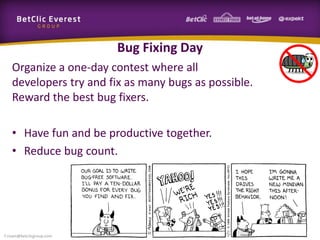
Bug Fixing Day
Organize a one-day contest where all
developers try and fix as many bugs as possible.
Reward the best bug fixers.
• Have fun and be productive together.
• Reduce bug count.
f.rivain@betclicgroup.com
Developer Exchange Program
Switch developers between teams or companies
to share and learn.
• Discover and learn other practices
• Be open-minded
• Create relationships
f.rivain@betclicgroup.com
Pair and Mob Programming
• Pair Programming is 2 developers working together: either for
mentoring, or between peers on a complex topic.
• Mob Programming: is an extension to a whole team to
collectively train the team to a new technology or
architecture.
– http://mobprogramming.org/
– https://techblog.betclicgroup.com/2014/09/03/weve-done-a-3-days-mob-
programming-at-betclic/
– https://techblog.betclicgroup.com/2014/09/23/mob-programming-angularjs-dojo/
f.rivain@betclicgroup.com
Code Dojos & Coding Katas
• Train your programming skills with small
exercises, challenge your abilities and
encourage to find multiple approaches.
– Play with code without fearing any consequences!
Also discover & learn new methods, areas,
algorithms, languages, libraries ...
• https://techblog.betclicgroup.com/2015/04/29/coding-dojo-the-fruit-shop/
• https://github.com/Betclic/CodingDojo-Katas
• http://codingkata.net/
• http://www.cyber-dojo.com/
• http://www.codechef.com/f.rivain@betclicgroup.com
Brown-Bag Lunches
• Invite an external expert to come and speak to
the team (and offer him lunch).
• Another opportunity to learn, from the
experts.
• http://www.brownbaglunch.fr/
• https://techblog.betclicgroup.com/2014/10/10/bbl-an-introduction-to-f-by-pierre-irrmann/
• https://techblog.betclicgroup.com/2014/05/12/bbl-code-refactoring-by-david-gageot/
• https://techblog.betclicgroup.com/2014/04/08/bbl-on-xamarin/
f.rivain@betclicgroup.com
Ciné-Goûter / Watching tech videos at tea time
• Watching together and commenting a video
from a conference.
• Drinks and cookies.
• We usually do it during Lab Days.
f.rivain@betclicgroup.com
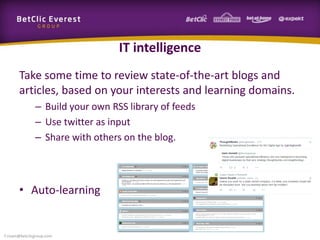
IT intelligence
Take some time to review state-of-the-art blogs and
articles, based on your interests and learning domains.
– Build your own RSS library of feeds
– Use twitter as input
– Share with others on the blog.
• Auto-learning
f.rivain@betclicgroup.com
External projects
Encourage senior dev to participate in external projects:
– http://www.codeplex.com/
– https://github.com/explore
– http://sourceforge.net/blog/potm/
Open-Source your internal tools.
• Learning with others
• Practice other areas of coding
• « Peer pressure » on code cleanup
f.rivain@betclicgroup.com
Programming and Logic Puzzles
• To tickle the brain and challenge your
logical/mathematical/programming skills
– http://programmingpraxis.com/
– http://projecteuler.net/
– http://www.topcoder.com/tc
– http://www.pythonchallenge.com/
– http://rubyquiz.com/
– http://uva.onlinejudge.org/
– http://www.spoj.pl/
– http://code.google.com/codejam/contests.html
– http://www.ocf.berkeley.edu/~wwu/riddles/intro.shtml
f.rivain@betclicgroup.com
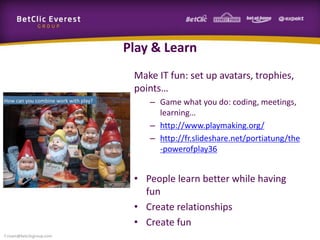
Play & Learn
Make IT fun: set up avatars, trophies,
points…
– Game what you do: coding, meetings,
learning…
– http://www.playmaking.org/
– http://fr.slideshare.net/portiatung/the
-powerofplay36
• People learn better while having
fun
• Create relationships
• Create fun
f.rivain@betclicgroup.com
References
• The Culture Game, Dan Mezick
• http://www.exforsys.com/career-
center/performance-development/importance-of-
continuous-learning.html
• http://adulted.about.com/od/onthejobtraining/p/
whatsinitforyou.htm
• http://managementhelp.org/blogs/training-and-
development/2011/06/06/how-many-steps-to-
continuous-learning-none/
• Tribes & Chapters (Agile at Spotify):
https://dl.dropbox.com/u/1018963/Articles/Spotif
yScaling.pdf
f.rivain@betclicgroup.com
Find out more
• On https://techblog.betclicgroup.com/
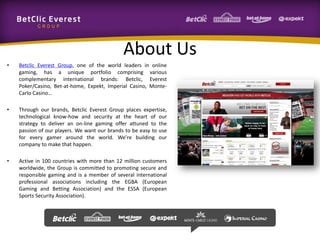
About Us
• Betclic Everest Group, one of the world leaders in online
gaming, has a unique portfolio comprising various
complementary international brands: Betclic, Everest
Poker/Casino, Bet-at-home, Expekt, Imperial Casino, Monte-
Carlo Casino…
• Through our brands, Betclic Everest Group places expertise,
technological know-how and security at the heart of our
strategy to deliver an on-line gaming offer attuned to the
passion of our players. We want our brands to be easy to use
for every gamer around the world. We’re building our
company to make that happen.
• Active in 100 countries with more than 12 million customers
worldwide, the Group is committed to promoting secure and
responsible gaming and is a member of several international
professional associations including the EGBA (European
Gaming and Betting Association) and the ESSA (European
Sports Security Association).
We want our Sports betting, Poker, Horse racing and
Casino & Games brands to be easy to use for every
gamer around the world. Code with us to make that
happen.
Look at all the challenges we offer HERE
Check our Employer Page
Follow us on LinkedIn
WE’RE HIRING !

Continuous Learning (updated June 2015, with more examples of learning practices)

  • 1.
  • 2.
    Developing a Cultureof Learning – The pace of change in our market and on the web in general forces companies to adapt fast. To be adaptive as an organization, that organization must intentionally engage in Continuous Learning. – When you learn as a team, you become more adaptable and achieve much better results, especially when the pace of change is fast. Teams that learn quickly are more adaptive than teams that don't. Adaptive teams are teams that can get better results, by rapid response to change. f.rivain@betclicgroup.com
  • 3.
    Levels of learning •3 levels: 1. Individual 2. Team 3. Organization f.rivain@betclicgroup.com
  • 4.
    Continuous Learning atIndividual Level • Learning requires time and effort, as well as the decision to want to learn. • Make individuals understand the value of continuous learning, and how it will not only help the organization, but most importantly, it will be a great benefit to the learner as well. • Examples: trainings, coaching and mentoring, seminars and workshops, also through actual application and practice of skills and knowledge f.rivain@betclicgroup.com
  • 5.
    Continuous Learning atTeam Level • Means collective individual learning: if the members of the team acquire and share new knowledge and information, then team learning takes place. • Involves a set of learning processes that support and aid team performance • Examples: reflections, feedback, experimentation, group discussions, and Q&A sessions. f.rivain@betclicgroup.com
  • 6.
    Continuous Learning atOrganization Level • Comprises change of interaction patterns, change of policies and procedures, new culture and new innovations. • Example: feedback from the employees themselves, from clients, and from customers. Getting comments and ideas. f.rivain@betclicgroup.com
  • 7.
    Agile : alearning laboratory • Agile means that teams must first become skilled at learning as a group: – Retrospective – Auto-organization: estimate, design, self-management – Safe space: safe to take risk. Experiment / trial-and-error: fail or succeed. • Agile teams are in fact small Learning Organizations. f.rivain@betclicgroup.com
  • 8.
    Scaling Agile atenterprise level • Very complicated task. Hard to achieve. • Agile teams operate in a safe space for learning. • Creation of enterprise-wide safe space is a non-trivial problem to solve.  Tribal Learning: start below the enterprise, above the team, by Managers, for groups of 20 to 150 people. f.rivain@betclicgroup.com
  • 9.
    Tribal Learning: practices •Encourage good group behavior on top of Agile patterns to facilitate meetings and group work: • paying explicit attention, • being punctual, • honoring Scrum values: Focus, Commitment, Openness, Courage, and Respect. f.rivain@betclicgroup.com
  • 10.
    Tribal Learning: automaticauthorization • As a manager, you have implicit authorization to try and change a few things around. • You are pre-authorized = empowered. • Leverage your formal, positional authority as a manager to direct your staff, convene meetings, and so on. Don't ask permission! • Example: change meeting rules if people are usually late. f.rivain@betclicgroup.com
  • 11.
    Tribal Learning: triballeadership • Encourage and influence other groups to try your practices. • Identify and align with other managers who share values with you. • Starting small: 1 or 2 other managers • People will begin to share values, to participate in continuous improvement and will eventually be part of the tribe. • Remember the wildfire metaphor f.rivain@betclicgroup.com
  • 12.
    Learning and Change •All learning is change, and all change is belief-change. When you learn, you modify your beliefs. • People who are always learning are constantly changing their models. • They have become adept at responding and adjusting to new information and knowledge as it becomes available to them. f.rivain@betclicgroup.com
  • 13.
    The learning cycle •For instance: – Agile holds 4 core values, underlined by 12 principles. – Those generate actions and results, from which we compile our experience. – Our experience changes our beliefs. f.rivain@betclicgroup.com
  • 14.
    HOW TO CONTRIBUTETO A CULTURE OF CONTINUOUS LEARNING f.rivain@betclicgroup.com
  • 15.
    Be Purposeful /Announce your intent  State your purpose early and often. Make it easy for those who follow you to understand your vision, your mission and your intent.  This clarity helps everyone around you, and increases levels of group learning. f.rivain@betclicgroup.com
  • 16.
    Facilitate and GameYour Meetings  Optimize the meeting process, by guiding the members to share and achieve a common goal and action plan  Make meetings fun, enjoyable, and engaging by gaming them.  Try other types of meetings, such as Open Space Meetings f.rivain@betclicgroup.com
  • 17.
    Examine Your Norms Normal is what you willingly tolerate. Examine your norms, because what you tolerate is a minimal level of what you insist on.  What you insist on is more likely to happen. Insist on norms that encourage greatness. f.rivain@betclicgroup.com
  • 18.
    Be Punctual  Punctualityassociates with focus, commitment, and respect; these in turn associate with individual and group greatness. The whole group cannot learn together if the whole group is not present.  Punctuality as a norm explicitly devalues lateness and tardiness. It takes openness and courage to establish punctually as a norm. f.rivain@betclicgroup.com
  • 19.
    Conduct Frequent Experiments Frequent experimentation means frequent learning. Make learning into a game, by scheduling frequent, cheap experiments. Failing cheap means learning economically. f.rivain@betclicgroup.com
  • 20.
    Manage Visually /Be Playful  Use visual artifacts to convey messages and influence thoughts and perception.  Play games to get work done. Use games for simulation, work, and learning. f.rivain@betclicgroup.com
  • 21.
    Inspect Frequently /Pay Explicit Attention  Use iteration and frequent inspection to make a game of change. Inspect and retrospect frequently at all levels.  Pay attention to what is working and what is not. Zoom in on details and focus on results. Discuss with the specific intent to be excellent. f.rivain@betclicgroup.com
  • 22.
    Get Coached  Coachinghelps the learning process and is a best practice. A coach will see what you do not and cannot. f.rivain@betclicgroup.com
  • 23.
    Understanding Delays • Delaysin achieving good results are common. • Good steps taken today usually do not have an immediate positive effect. The truth is that you often get worse before you get better, because of the investment period. f.rivain@betclicgroup.com
  • 24.
    Bad Moves MakeYou Better, Then MUCH Worse • Example: adding more people to a late project. • So use practices that produce small results with low delay. • Experiment cheaply. • Avoid the tendency to backslide to old habits, even if changing is painful. f.rivain@betclicgroup.com
  • 25.
    Values 1. Serve Others 2.Be Purposeful 3. Communicate Honestly with Respect 4. Create Relationships 5. Increase Learning 6. Be Open-Minded 7. Adapt to Change 8. Create Fun 9. Be Focused, Committed, and Courageous f.rivain@betclicgroup.com
  • 26.
    CONCRETE IDEAS FORA CONTINUOUS LEARNING IT ORGANIZATION f.rivain@betclicgroup.com
  • 27.
    Mini-training cycle • 30min weekly: 20 min presentation + 10 min question. • Any speaker, any topic. • Raise team awareness about continuous learning • Explore new topics with curiosity • Improve communication skills by being a speaker in a safe environment f.rivain@betclicgroup.com
  • 28.
    Blogs • Internal o Share,Communicate, Serve Others. o Increase Learning • External o Promote Betclic IT team, Motivate, hire, retain top engineers o Contribute to team learning and performance, by reflecting, formalizing and sharing our practices (with the peer pressure of making it public) o Atracting external contributions f.rivain@betclicgroup.com
  • 29.
    Conferences Be a speakeror participate to a conference. • Learn and discover • Meet other people. Create relationships. • Open your horizon • Share your knowledge and experience f.rivain@betclicgroup.com
  • 30.
    Hack Days /Innovation Days Take some time off to make a break and innovate: – Take 1 day to build prototypes, demo them, vote for the best and reward the best team, follow up to put in production the best ones. • Be creative • Work with other developers and with business teams • Learn and have fun f.rivain@betclicgroup.com
  • 31.
    Monthly Lab Days Regularlyorganize days where developers are allowed to do other stuff (IT intelligence, training, clean up code, prototype, code for external projects, write blog articles…) – Agenda for each person to be explicit. • Auto-learning f.rivain@betclicgroup.com
  • 32.
    Bug Fixing Day Organizea one-day contest where all developers try and fix as many bugs as possible. Reward the best bug fixers. • Have fun and be productive together. • Reduce bug count. f.rivain@betclicgroup.com
  • 33.
    Developer Exchange Program Switchdevelopers between teams or companies to share and learn. • Discover and learn other practices • Be open-minded • Create relationships f.rivain@betclicgroup.com
  • 34.
    Pair and MobProgramming • Pair Programming is 2 developers working together: either for mentoring, or between peers on a complex topic. • Mob Programming: is an extension to a whole team to collectively train the team to a new technology or architecture. – http://mobprogramming.org/ – https://techblog.betclicgroup.com/2014/09/03/weve-done-a-3-days-mob- programming-at-betclic/ – https://techblog.betclicgroup.com/2014/09/23/mob-programming-angularjs-dojo/ f.rivain@betclicgroup.com
  • 35.
    Code Dojos &Coding Katas • Train your programming skills with small exercises, challenge your abilities and encourage to find multiple approaches. – Play with code without fearing any consequences! Also discover & learn new methods, areas, algorithms, languages, libraries ... • https://techblog.betclicgroup.com/2015/04/29/coding-dojo-the-fruit-shop/ • https://github.com/Betclic/CodingDojo-Katas • http://codingkata.net/ • http://www.cyber-dojo.com/ • http://www.codechef.com/f.rivain@betclicgroup.com
  • 36.
    Brown-Bag Lunches • Invitean external expert to come and speak to the team (and offer him lunch). • Another opportunity to learn, from the experts. • http://www.brownbaglunch.fr/ • https://techblog.betclicgroup.com/2014/10/10/bbl-an-introduction-to-f-by-pierre-irrmann/ • https://techblog.betclicgroup.com/2014/05/12/bbl-code-refactoring-by-david-gageot/ • https://techblog.betclicgroup.com/2014/04/08/bbl-on-xamarin/ f.rivain@betclicgroup.com
  • 37.
    Ciné-Goûter / Watchingtech videos at tea time • Watching together and commenting a video from a conference. • Drinks and cookies. • We usually do it during Lab Days. f.rivain@betclicgroup.com
  • 38.
    IT intelligence Take sometime to review state-of-the-art blogs and articles, based on your interests and learning domains. – Build your own RSS library of feeds – Use twitter as input – Share with others on the blog. • Auto-learning f.rivain@betclicgroup.com
  • 39.
    External projects Encourage seniordev to participate in external projects: – http://www.codeplex.com/ – https://github.com/explore – http://sourceforge.net/blog/potm/ Open-Source your internal tools. • Learning with others • Practice other areas of coding • « Peer pressure » on code cleanup f.rivain@betclicgroup.com
  • 40.
    Programming and LogicPuzzles • To tickle the brain and challenge your logical/mathematical/programming skills – http://programmingpraxis.com/ – http://projecteuler.net/ – http://www.topcoder.com/tc – http://www.pythonchallenge.com/ – http://rubyquiz.com/ – http://uva.onlinejudge.org/ – http://www.spoj.pl/ – http://code.google.com/codejam/contests.html – http://www.ocf.berkeley.edu/~wwu/riddles/intro.shtml f.rivain@betclicgroup.com
  • 41.
    Play & Learn MakeIT fun: set up avatars, trophies, points… – Game what you do: coding, meetings, learning… – http://www.playmaking.org/ – http://fr.slideshare.net/portiatung/the -powerofplay36 • People learn better while having fun • Create relationships • Create fun f.rivain@betclicgroup.com
  • 42.
    References • The CultureGame, Dan Mezick • http://www.exforsys.com/career- center/performance-development/importance-of- continuous-learning.html • http://adulted.about.com/od/onthejobtraining/p/ whatsinitforyou.htm • http://managementhelp.org/blogs/training-and- development/2011/06/06/how-many-steps-to- continuous-learning-none/ • Tribes & Chapters (Agile at Spotify): https://dl.dropbox.com/u/1018963/Articles/Spotif yScaling.pdf f.rivain@betclicgroup.com
  • 43.
    Find out more •On https://techblog.betclicgroup.com/
  • 44.
    About Us • BetclicEverest Group, one of the world leaders in online gaming, has a unique portfolio comprising various complementary international brands: Betclic, Everest Poker/Casino, Bet-at-home, Expekt, Imperial Casino, Monte- Carlo Casino… • Through our brands, Betclic Everest Group places expertise, technological know-how and security at the heart of our strategy to deliver an on-line gaming offer attuned to the passion of our players. We want our brands to be easy to use for every gamer around the world. We’re building our company to make that happen. • Active in 100 countries with more than 12 million customers worldwide, the Group is committed to promoting secure and responsible gaming and is a member of several international professional associations including the EGBA (European Gaming and Betting Association) and the ESSA (European Sports Security Association).
  • 45.
    We want ourSports betting, Poker, Horse racing and Casino & Games brands to be easy to use for every gamer around the world. Code with us to make that happen. Look at all the challenges we offer HERE Check our Employer Page Follow us on LinkedIn WE’RE HIRING !