Continuous Learning:  A framework for Developing a Workplace Essential Habit personal story of CNI’s journey Kenny Ong CNI Holdings Berhad
Contents: Introduction Strategy example Personal Reflection
About: CNI Holdings Bhd 17 years old Main Board Public Listing: August 2005 Products: Consumer Goods and Services Core Business: MLM Others: Contract Manufacturing, Export/Trading, eCommerce Malaysia, Singapore, Brunei, Indonesia, India, China, Hong Kong, Philippines Staff force:  ± 500 Distributors: ± 250,000  Malaysia
Intro:  Learning Culture Habits
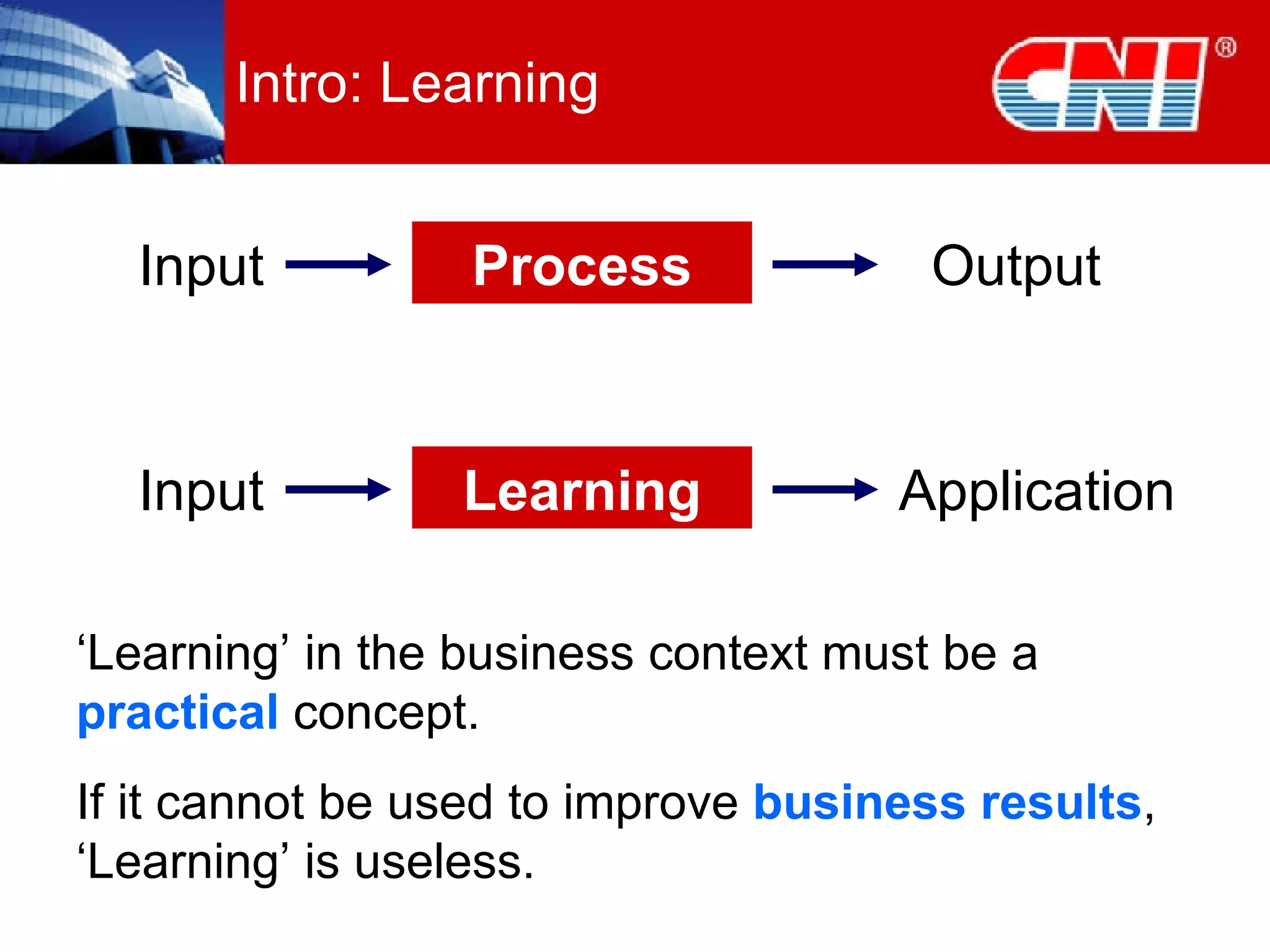
Intro: Learning  Process Input Output Learning Input Application ‘ Learning’ in the business context must be a  practical  concept.  If it cannot be used to improve  business results , ‘Learning’ is useless.
Intro: Habits/Culture Habits “ You cannot eliminate a habit. You can only  replace  one habit with another habit”
Intro: Habits/Culture Why focus on Habits? Start Early! Small differences in return matter. A lot! Don't squander your inheritance on sex, drugs and rock'n'roll Over time, regular saving of quite small amounts can build up an astonishing sum of money. Time and patience are the friends of compounding and, therefore, of investing. © Copyright 1998-2005, The Motley Fool Limited.
Intro: Why? Before we start… “ Is Learning Culture really a desirable characteristic for business?” “ Are you sure?” Key: Sustainable business performance *Refer: “The Fifth Discipline” by Peter Senge for basic knowledge on Learning Organizations
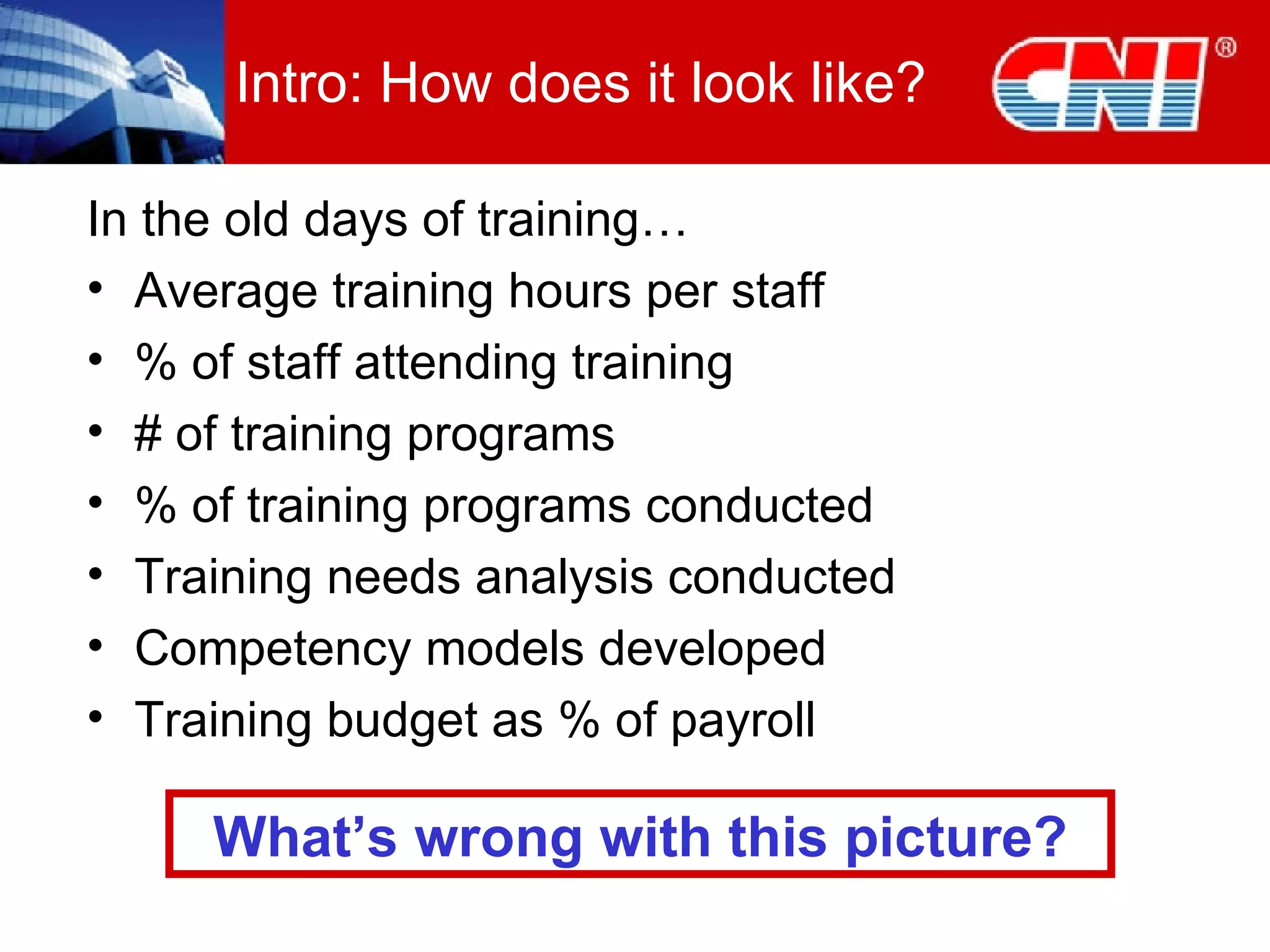
Intro: How does it look like? In the old days of training… Average training hours per staff % of staff attending training # of training programs % of training programs conducted Training needs analysis conducted Competency models developed Training budget as % of payroll What’s wrong with this picture?
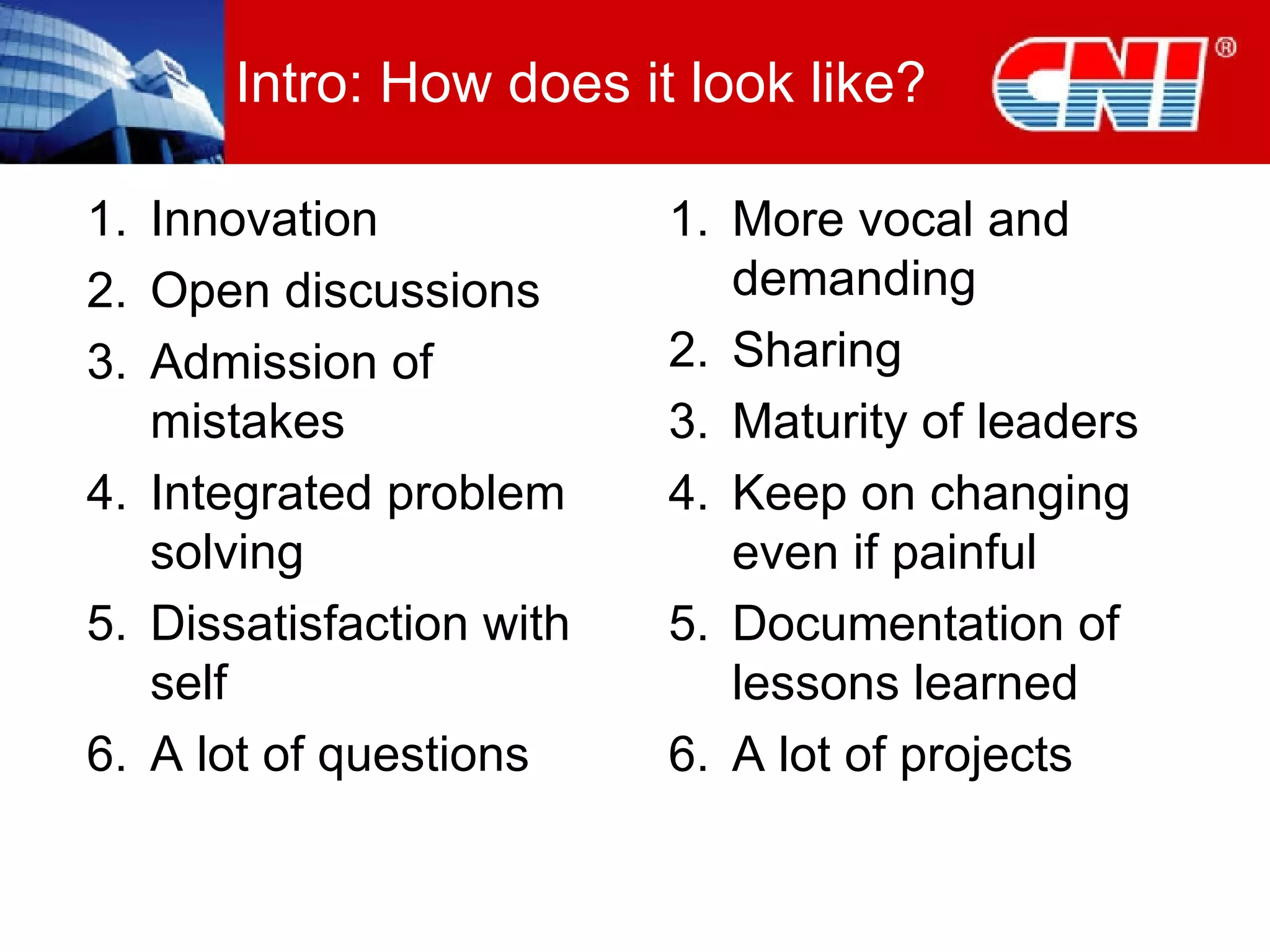
Intro: How does it look like? Innovation Open discussions Admission of mistakes Integrated problem solving Dissatisfaction with self A lot of questions More vocal and demanding Sharing Maturity of leaders Keep on changing even if painful Documentation of lessons learned A lot of projects
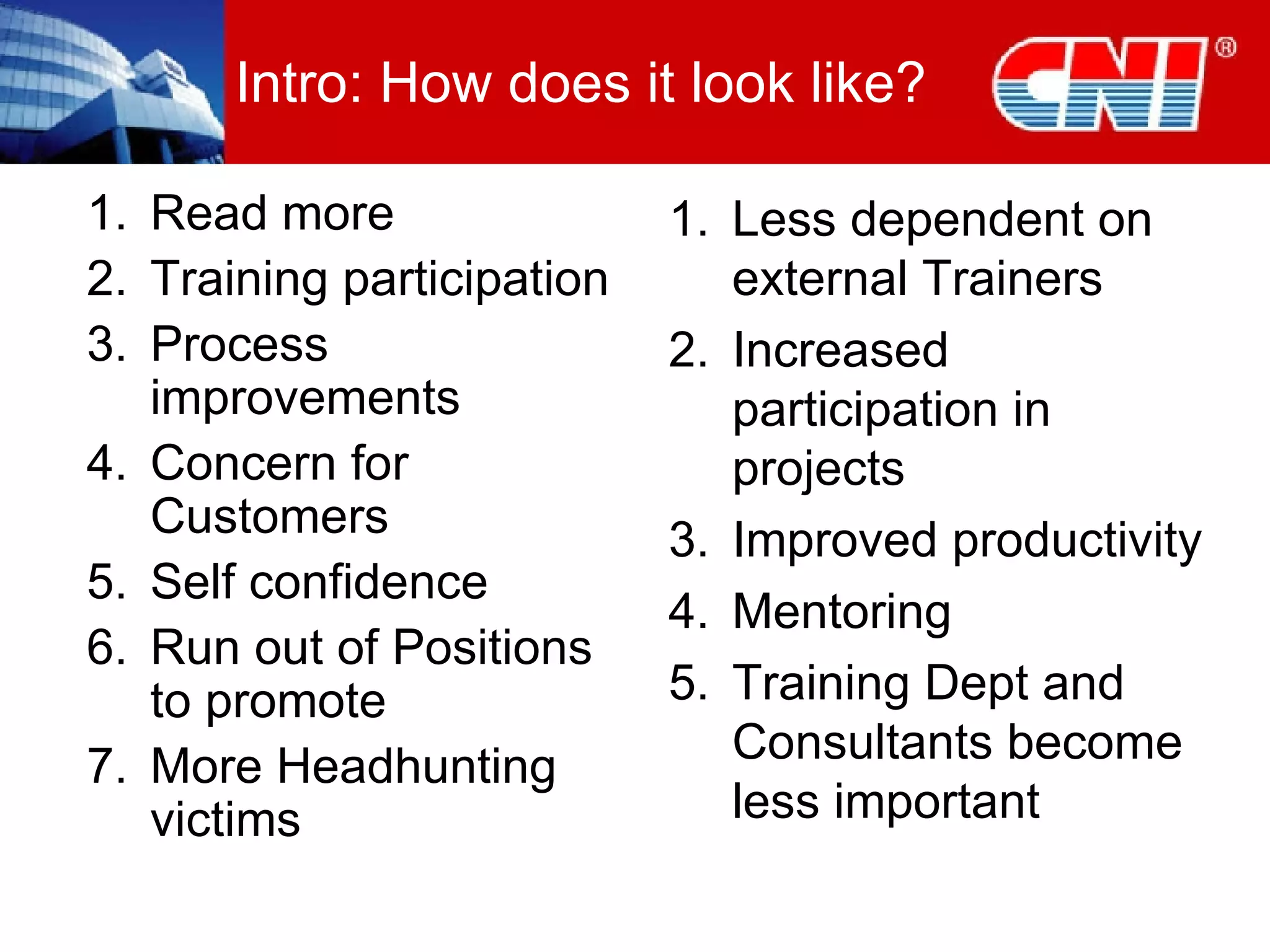
Intro: How does it look like? Read more Training participation Process improvements Concern for Customers Self confidence Run out of Positions to promote More Headhunting victims Less dependent on external Trainers Increased participation in projects Improved productivity Mentoring Training Dept and Consultants become less important
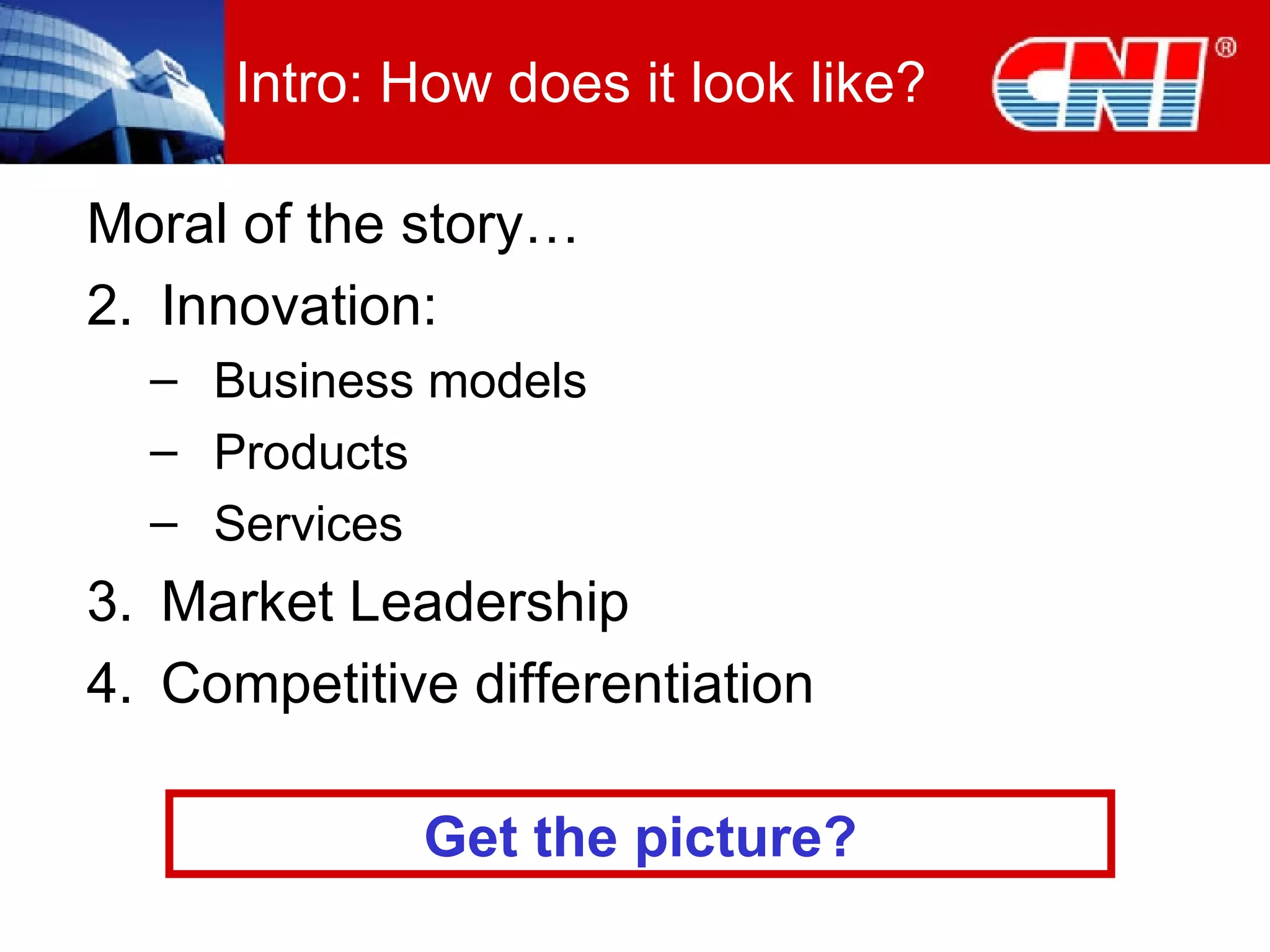
Intro: How does it look like? Moral of the story… Innovation: Business models Products Services  Market Leadership Competitive differentiation Get the picture?
Intro: Q&A Questions? Comments?
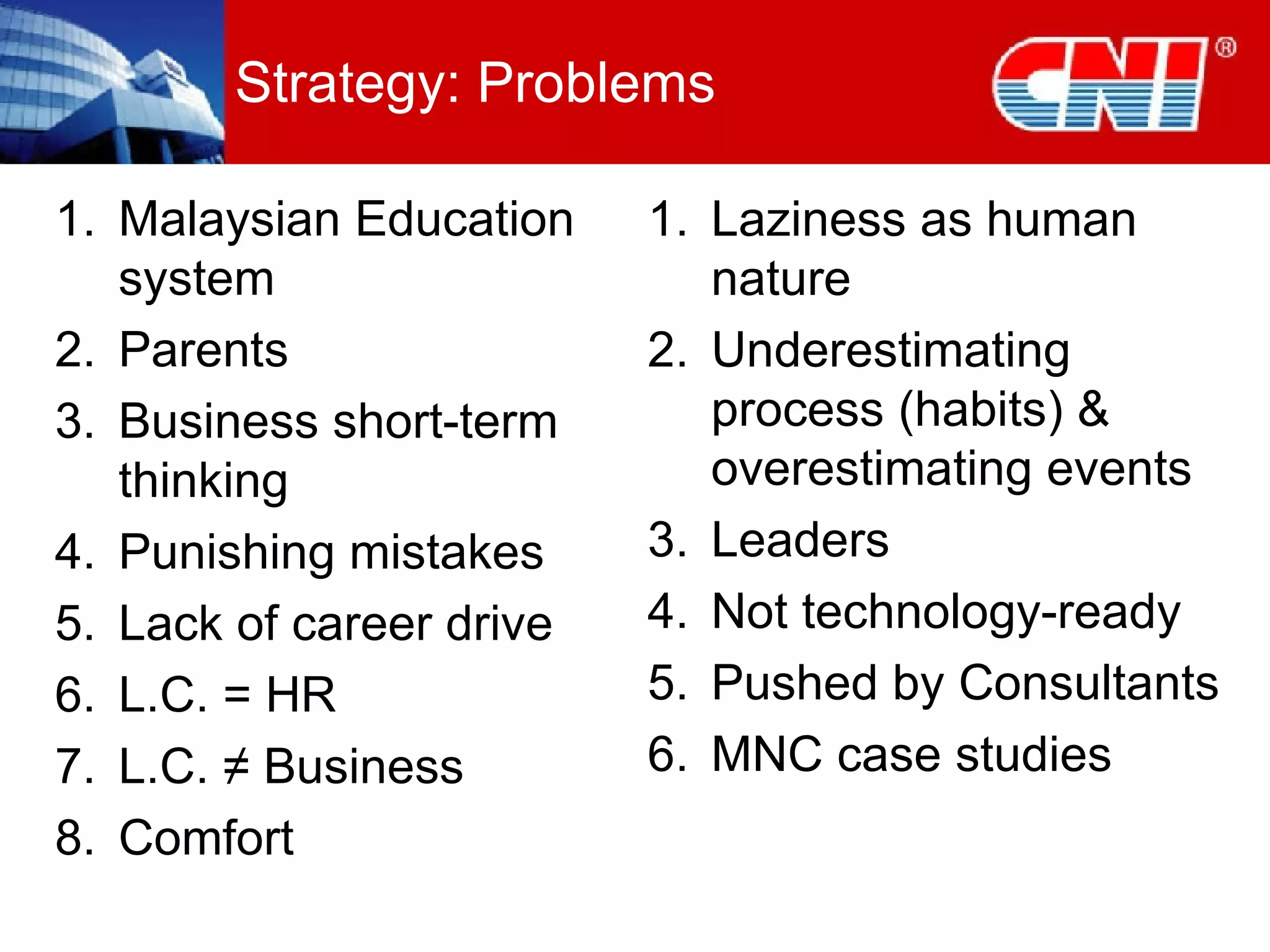
Strategy: Problems Malaysian Education system Parents Business short-term thinking Punishing mistakes Lack of career drive L.C. = HR L.C.  ≠ Business  Comfort Laziness as human nature Underestimating process (habits) & overestimating events Leaders Not technology-ready Pushed by Consultants MNC case studies
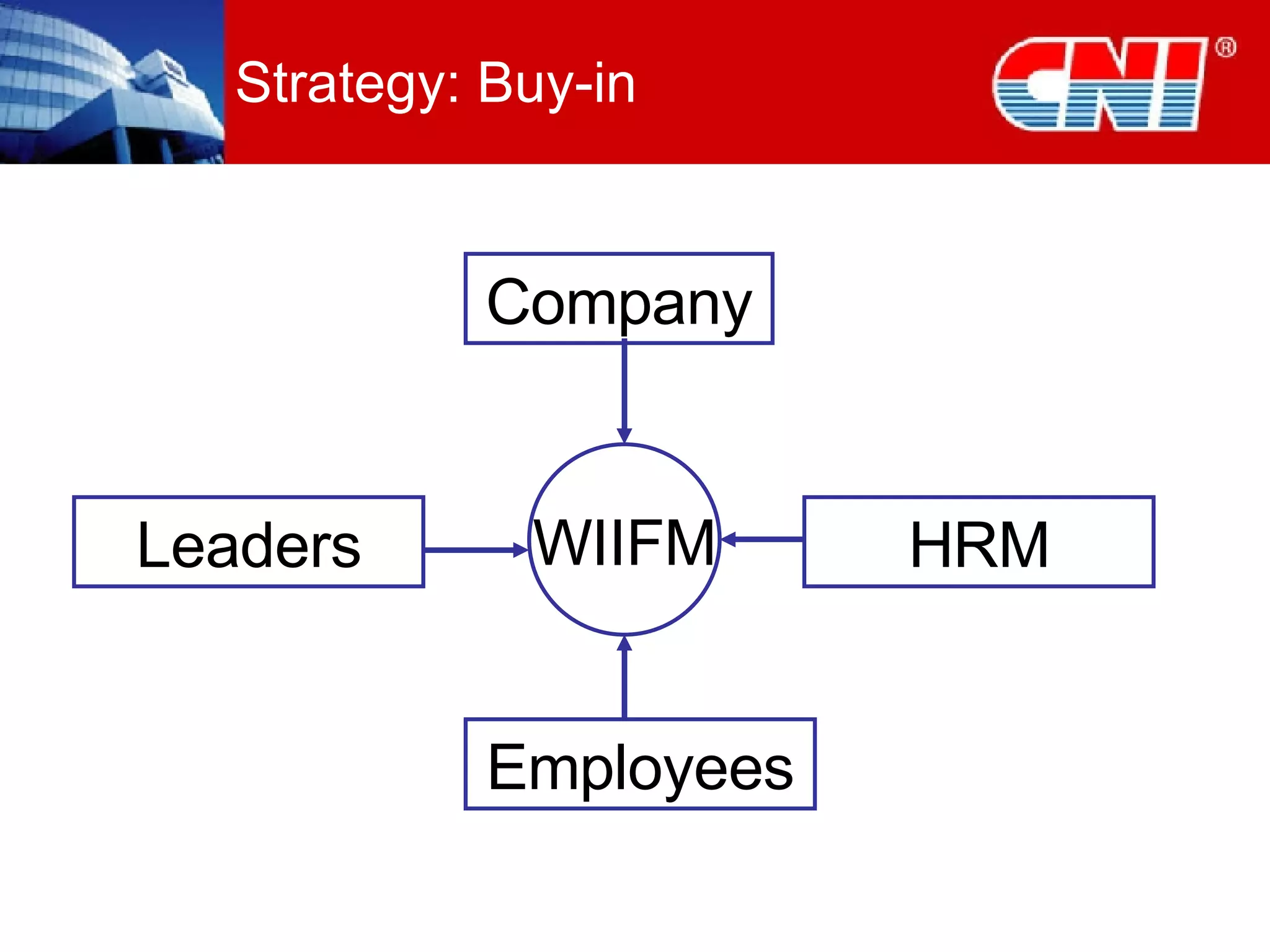
Strategy: Buy-in WIIFM Company Employees Leaders HRM
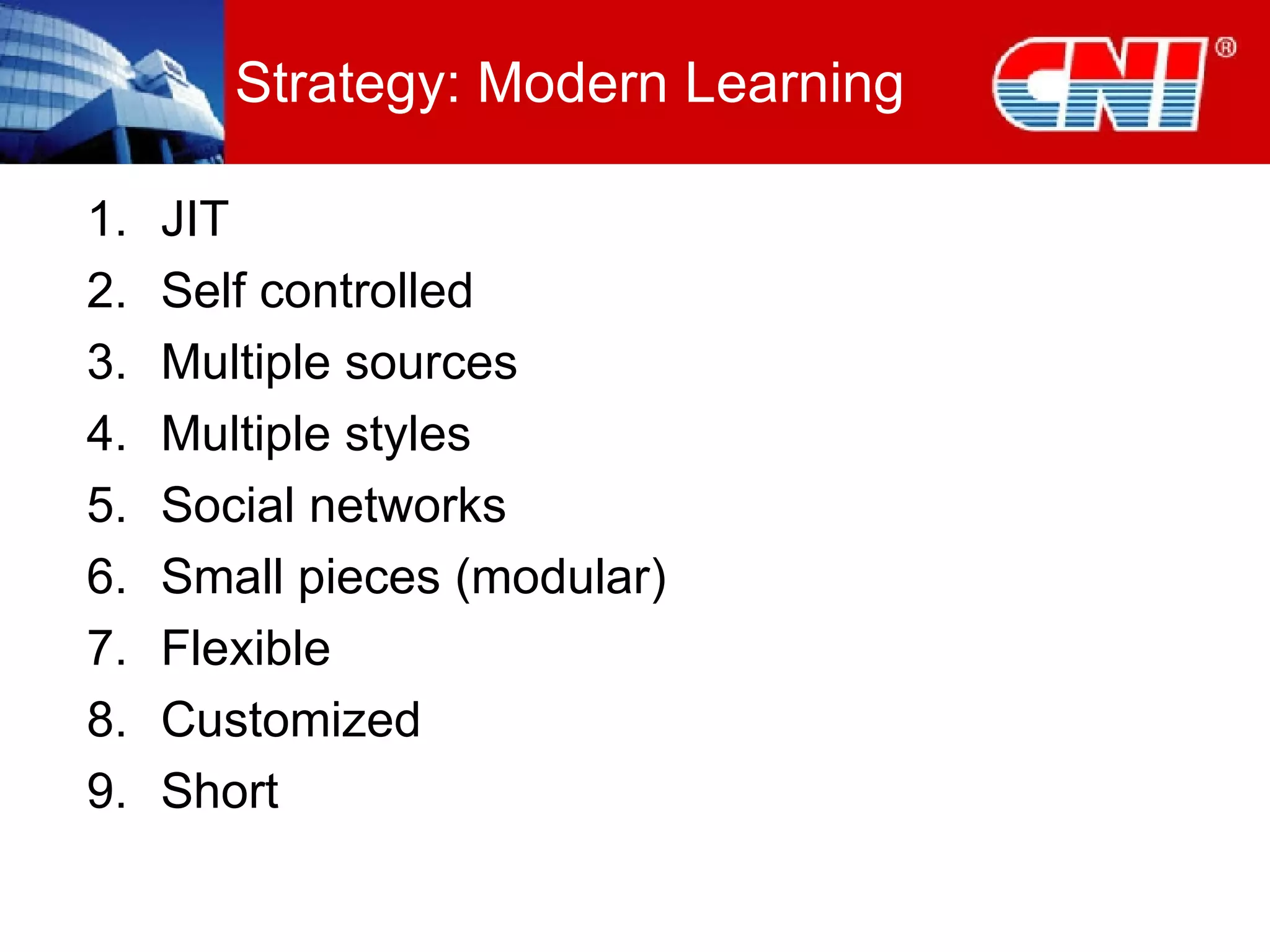
Strategy: Modern Learning JIT Self controlled Multiple sources Multiple styles Social networks Small pieces (modular) Flexible Customized Short
Strategy: Framework Family
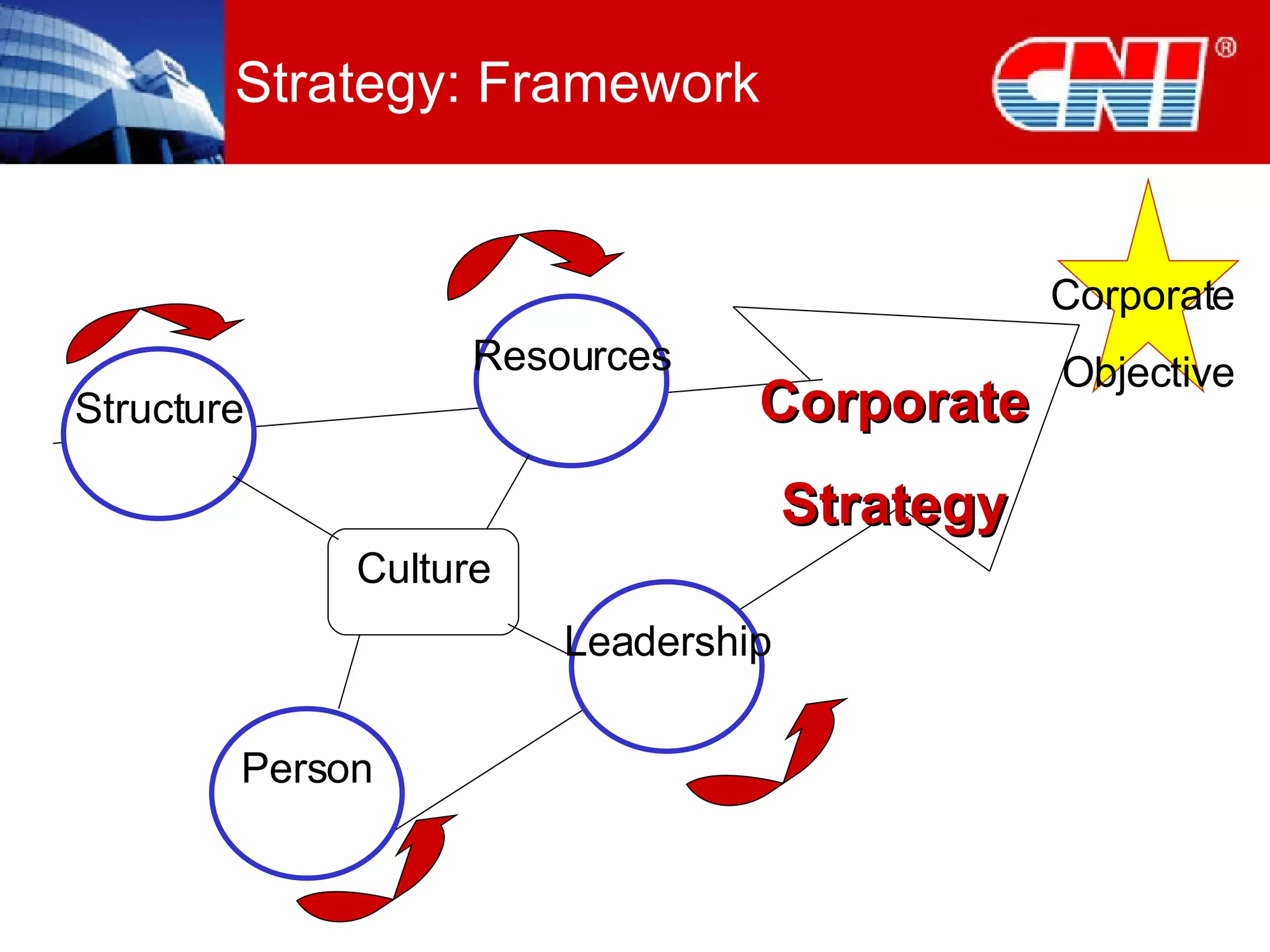
Strategy: Framework Culture Corporate  Objective Corporate Strategy Structure Resources Leadership Person
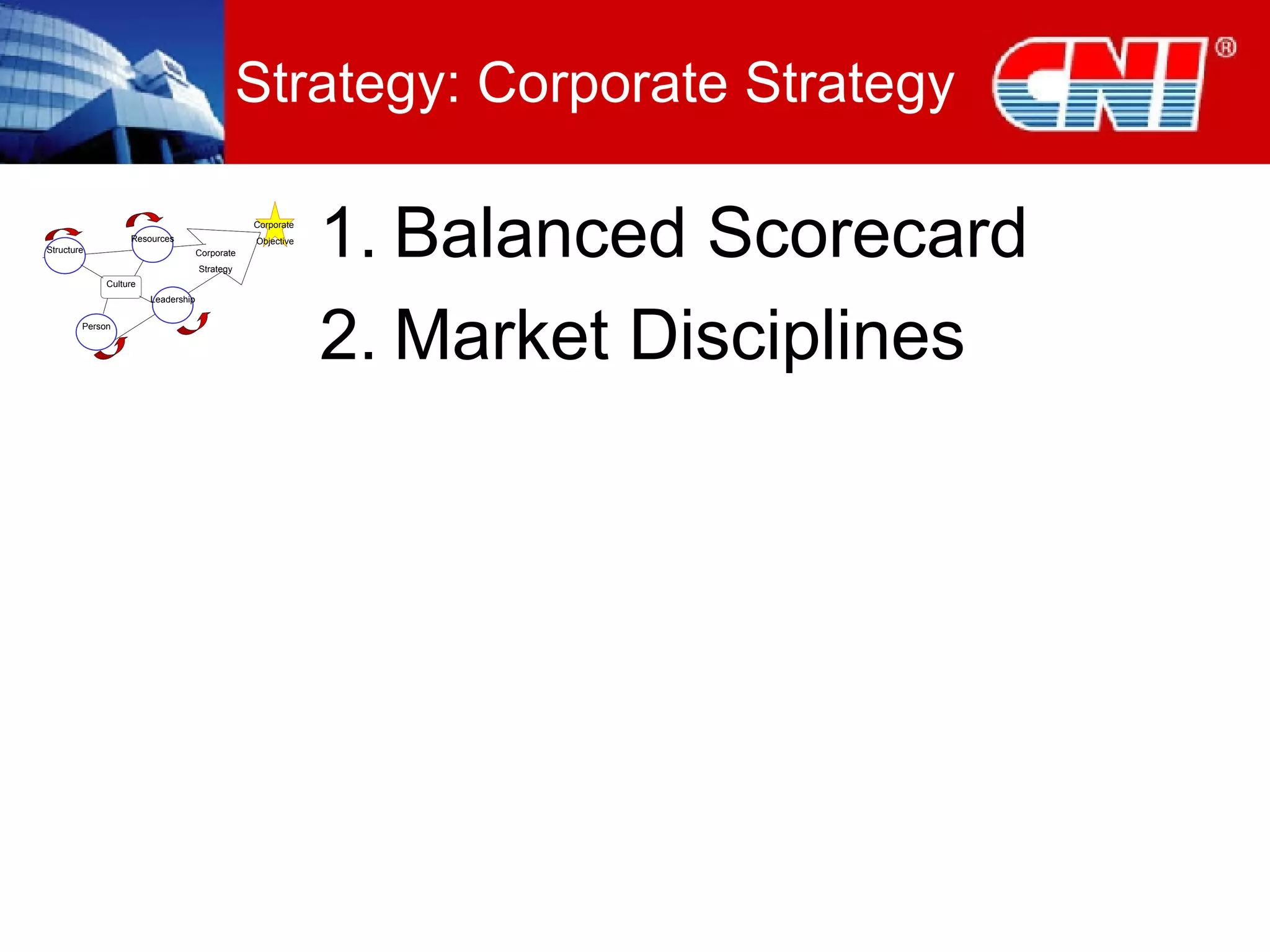
Strategy: Corporate Strategy Balanced Scorecard Market Disciplines
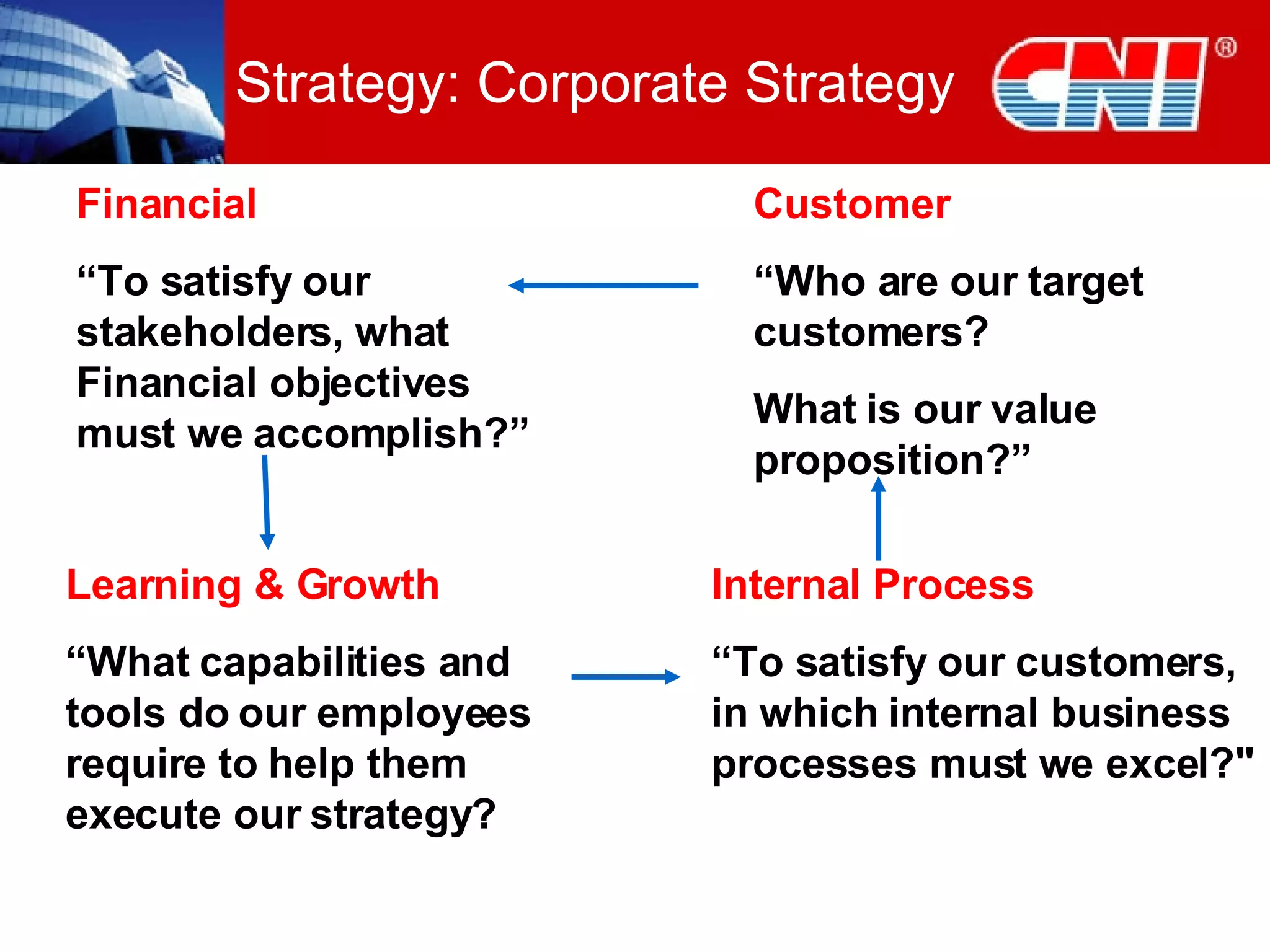
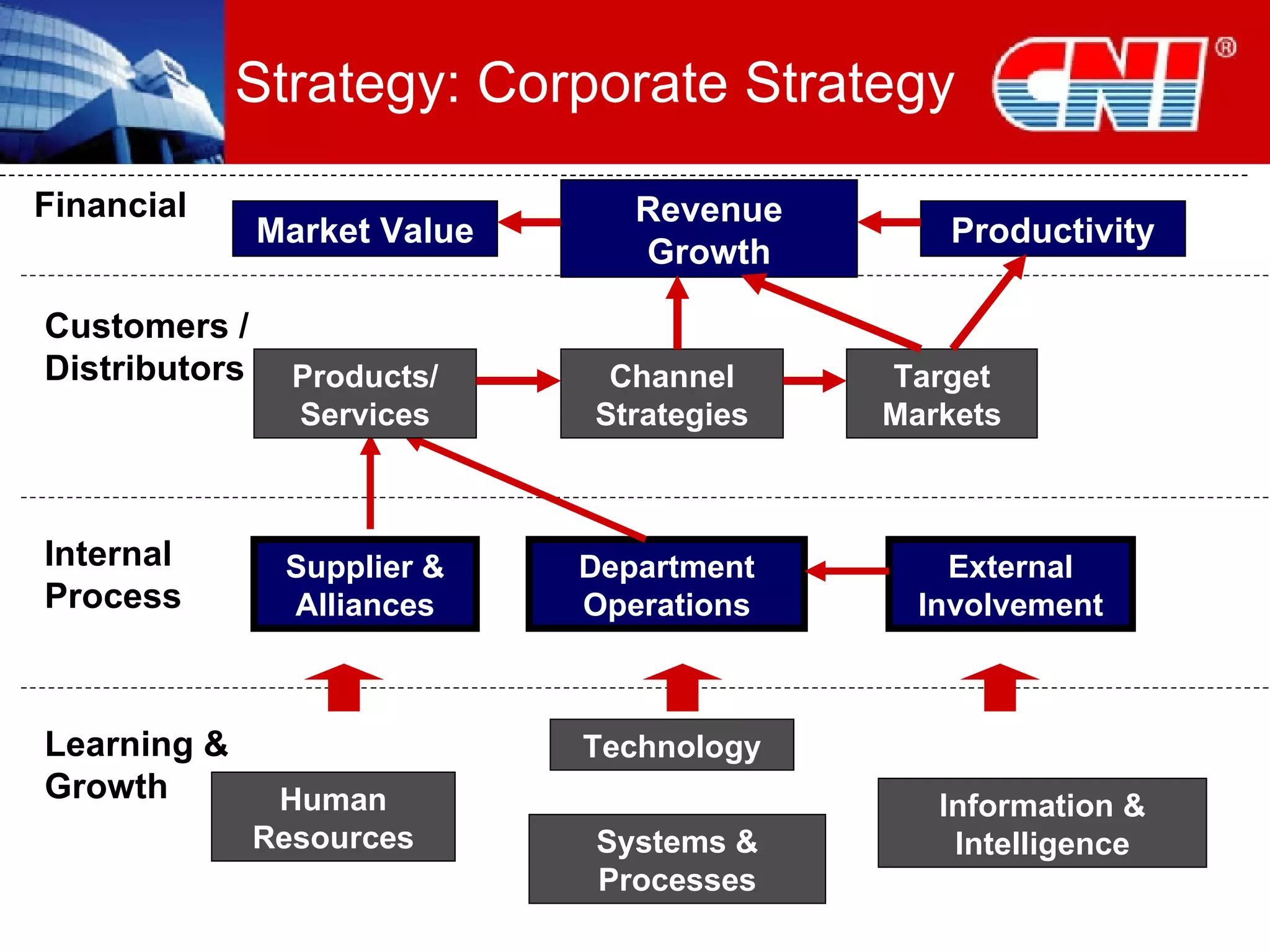
Strategy: Corporate Strategy Financial “ To satisfy our stakeholders, what Financial objectives must we accomplish?” Internal Process “ To satisfy our customers, in which internal business processes must we excel?" Customer “ Who are our target customers? What is our value proposition?” Learning & Growth “ What capabilities and tools do our employees require to help them execute our strategy?
Strategy: Corporate Strategy Financial Learning & Growth Internal Process Customers / Distributors Revenue Growth Productivity Market Value Department Operations Supplier & Alliances External Involvement Target Markets Products/ Services Channel Strategies Human Resources Technology Information & Intelligence Systems & Processes
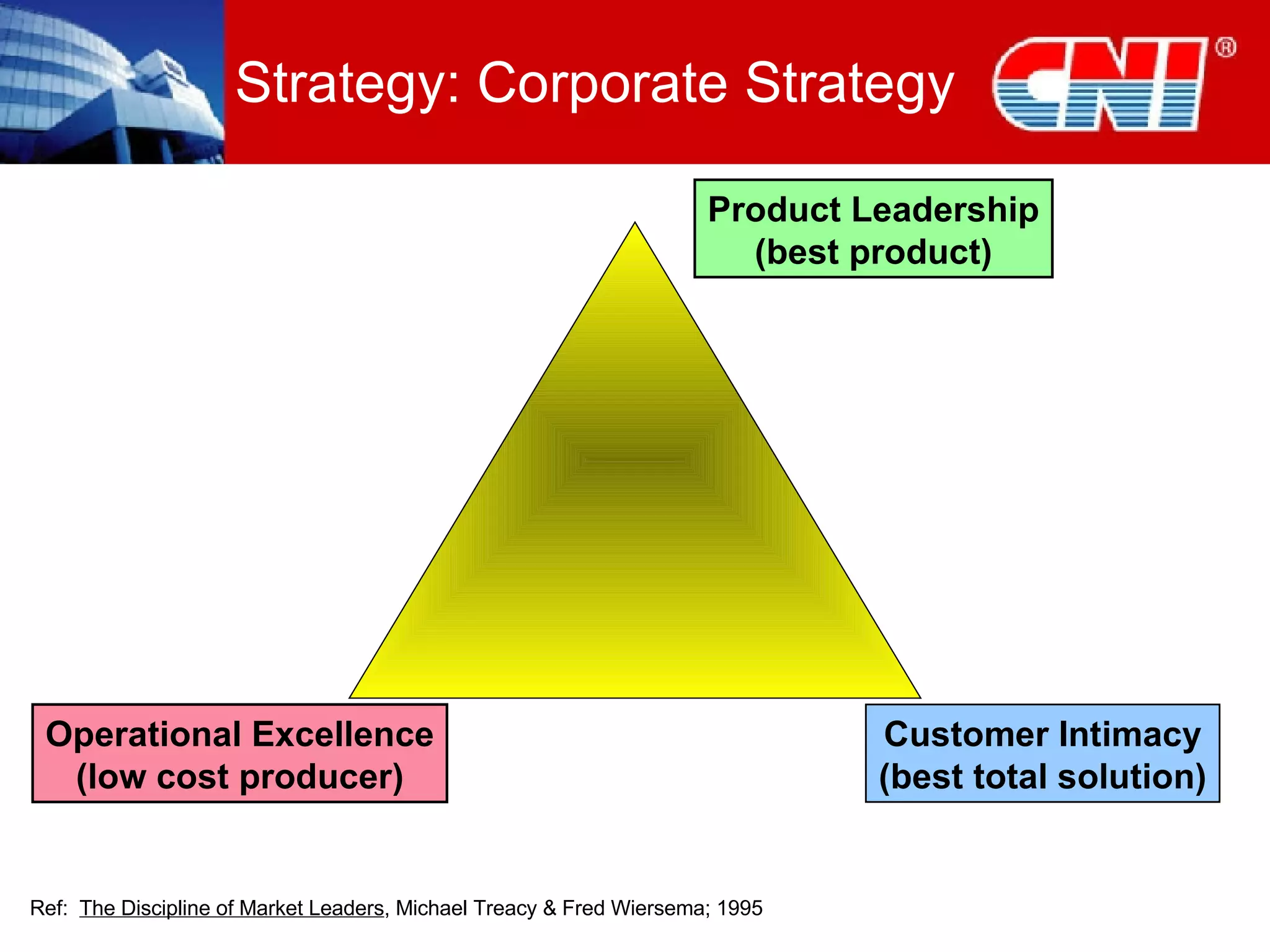
Strategy: Corporate Strategy Operational Excellence (low cost producer) Ref:  The Discipline of Market Leaders , Michael Treacy & Fred Wiersema; 1995 Product Leadership (best product) Customer Intimacy (best total solution)
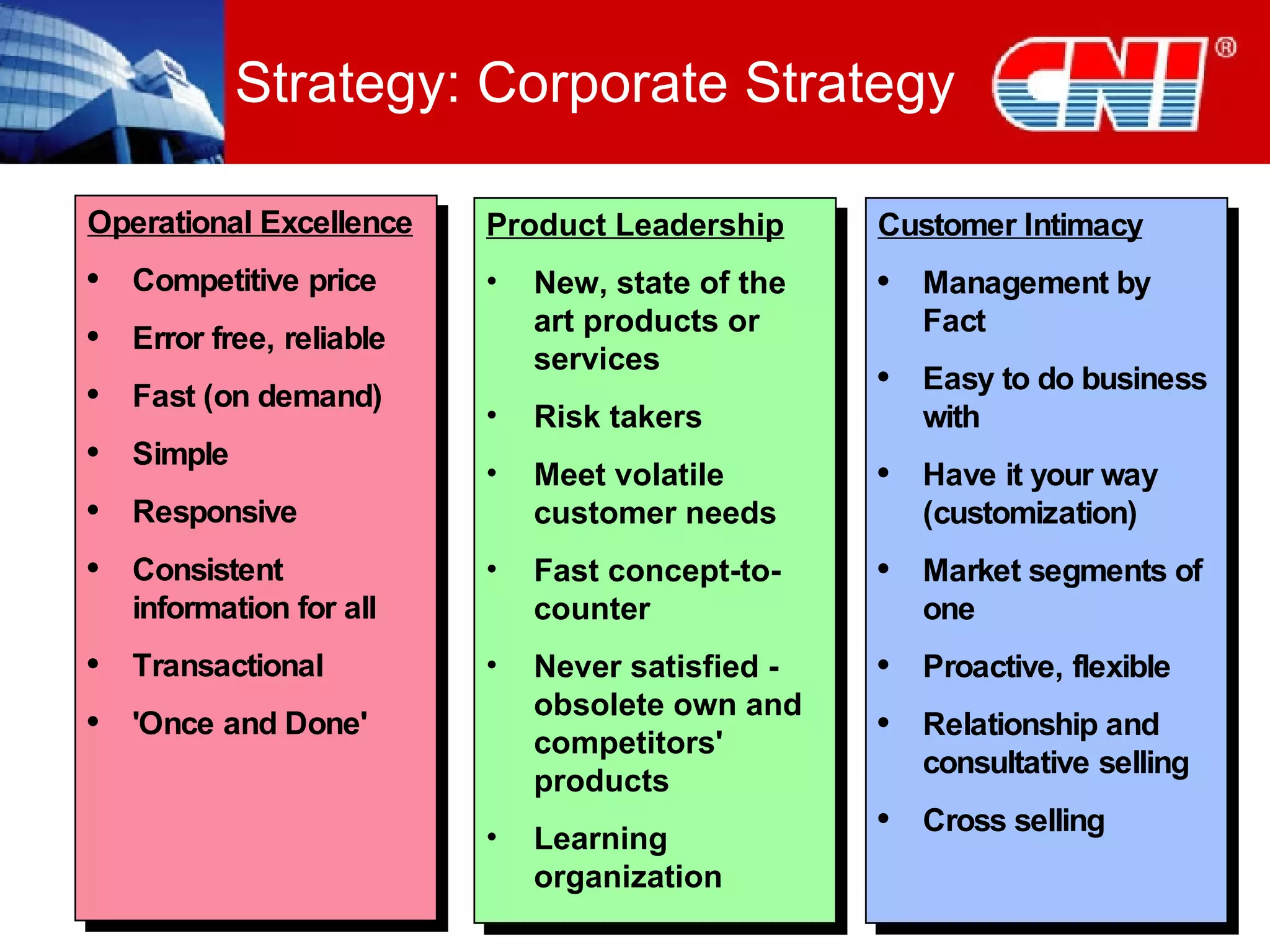
Product Leadership New, state of the art products or services Risk takers Meet volatile customer needs Fast concept-to- counter Never satisfied - obsolete own and competitors' products Learning organization Strategy: Corporate Strategy Operational Excellence Competitive price Error free, reliable Fast (on demand) Simple Responsive Consistent information for all Transactional 'Once and Done' Customer Intimacy Management by Fact Easy to do business with Have it your way (customization) Market segments of one Proactive, flexible Relationship and consultative selling Cross selling
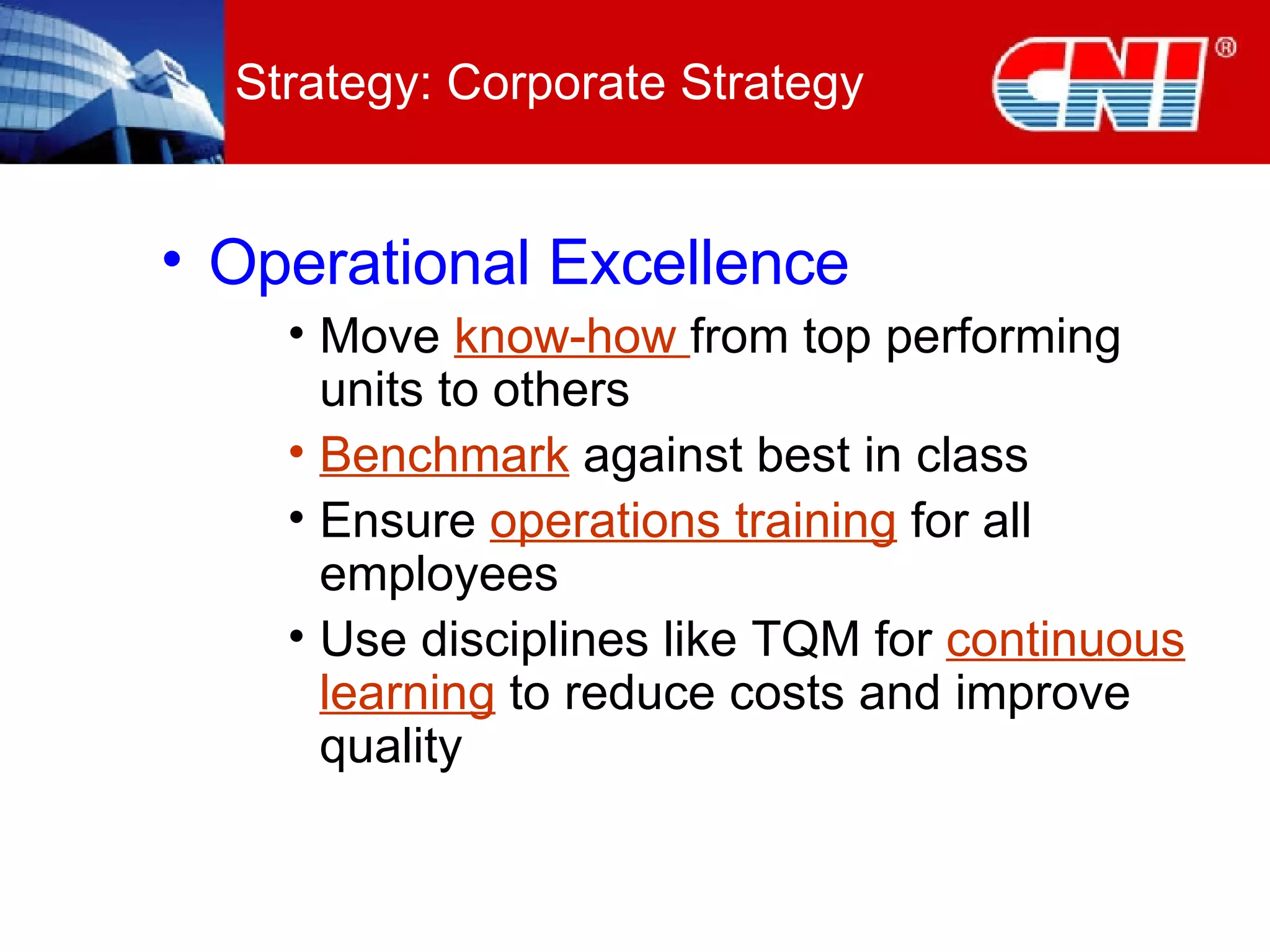
Operational Excellence Move  know-how  from top performing units to others Benchmark  against best in class Ensure  operations training  for all employees Use disciplines like TQM for  continuous learning  to reduce costs and improve quality Strategy: Corporate Strategy
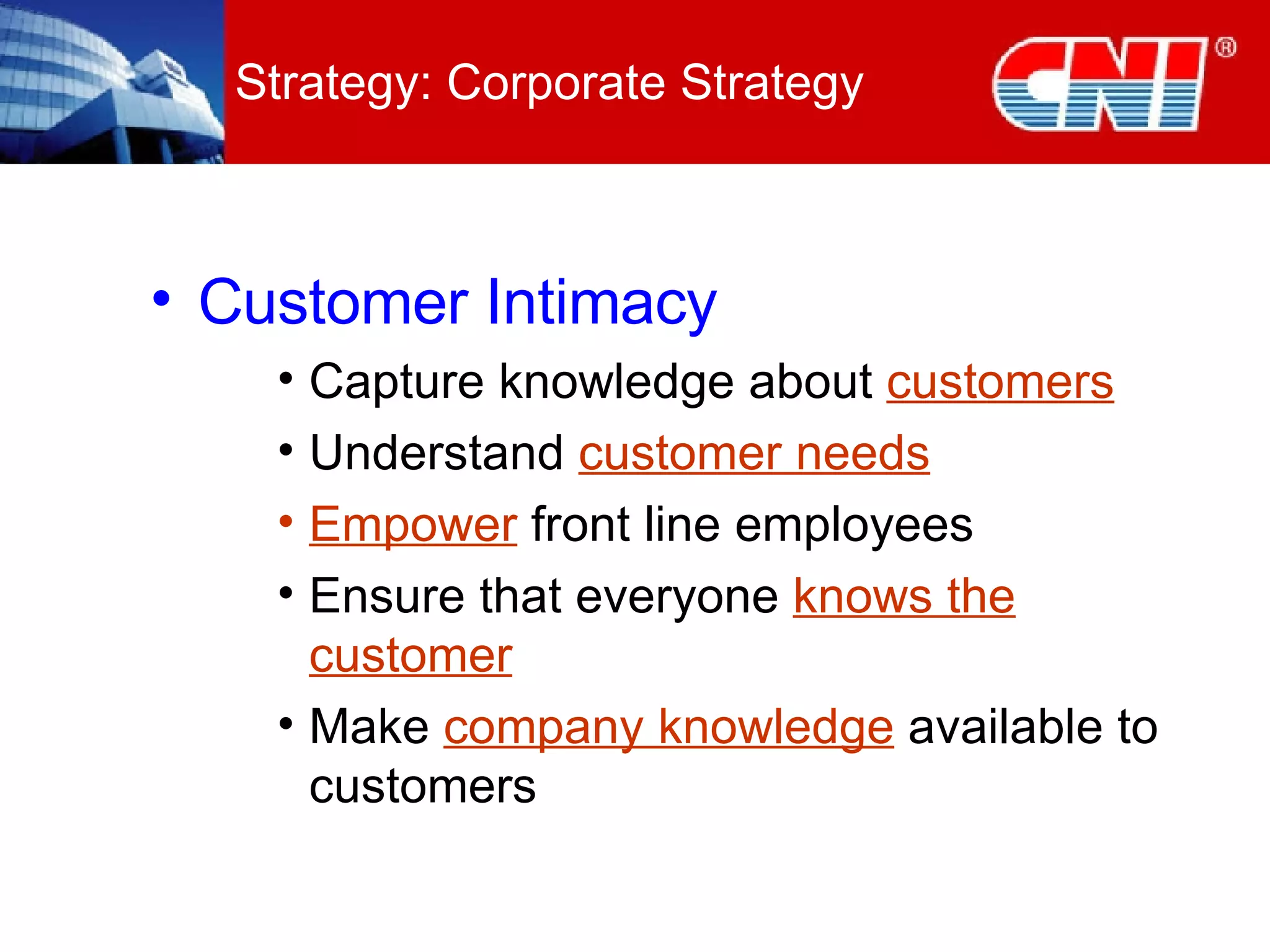
Strategy: Corporate Strategy Customer Intimacy Capture knowledge about  customers Understand  customer needs Empower  front line employees Ensure that everyone  knows the customer Make  company knowledge  available to customers
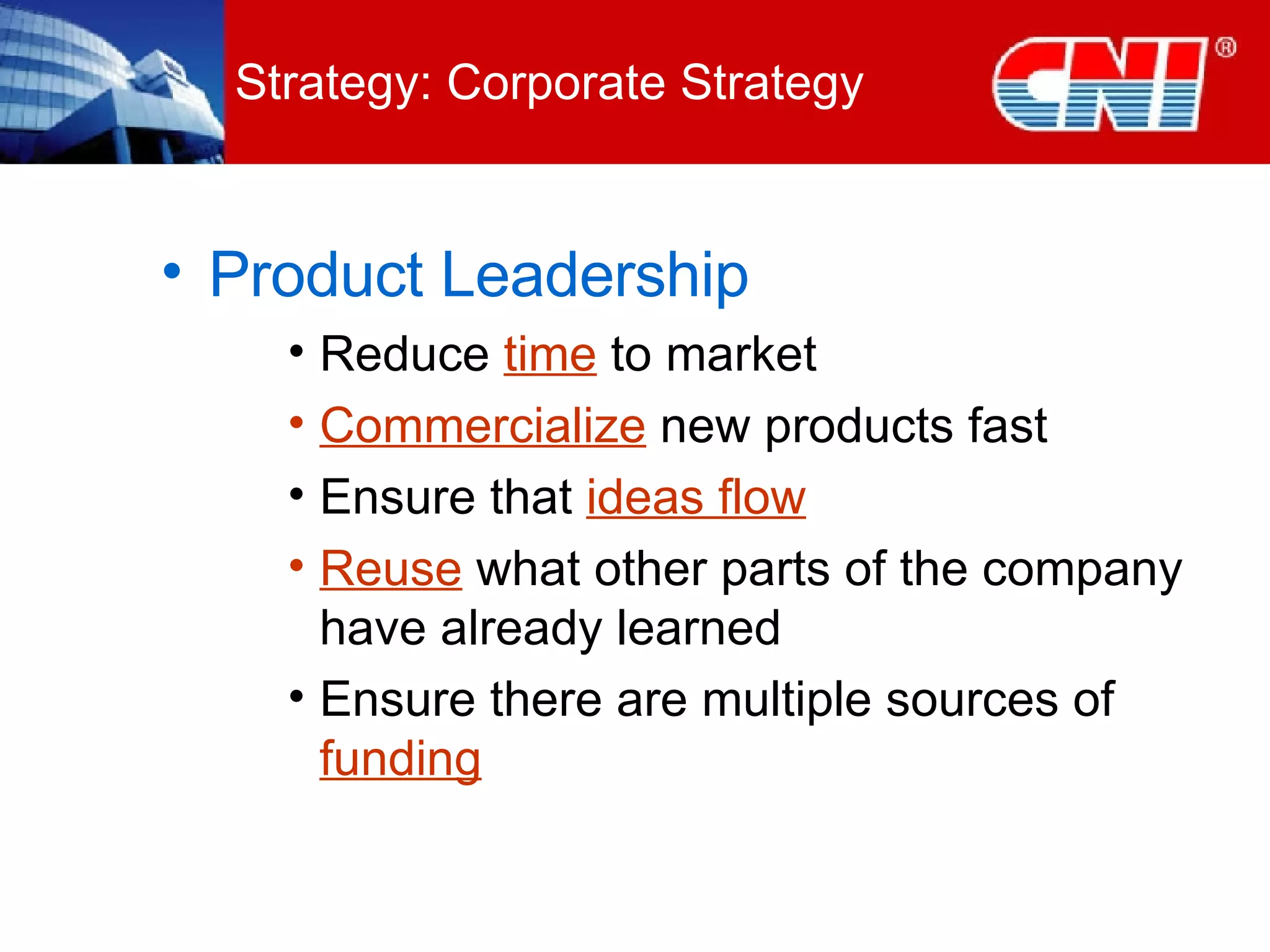
Product Leadership Reduce  time  to market Commercialize  new products fast Ensure that  ideas flow Reuse  what other parts of the company have already learned Ensure there are multiple sources of  funding Strategy: Corporate Strategy
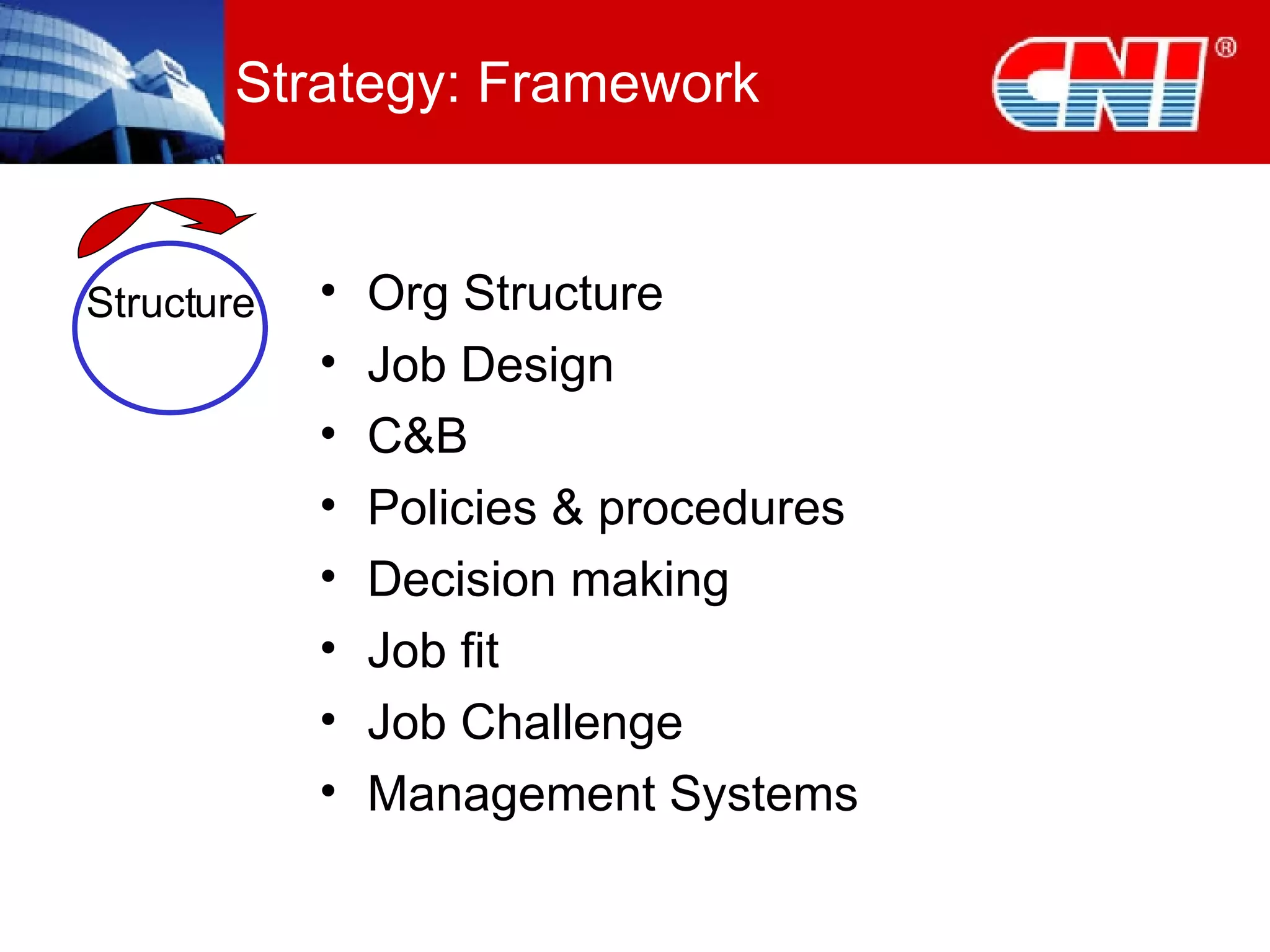
Strategy: Framework Org Structure Job Design C&B Policies & procedures Decision making Job fit Job Challenge Management Systems Structure
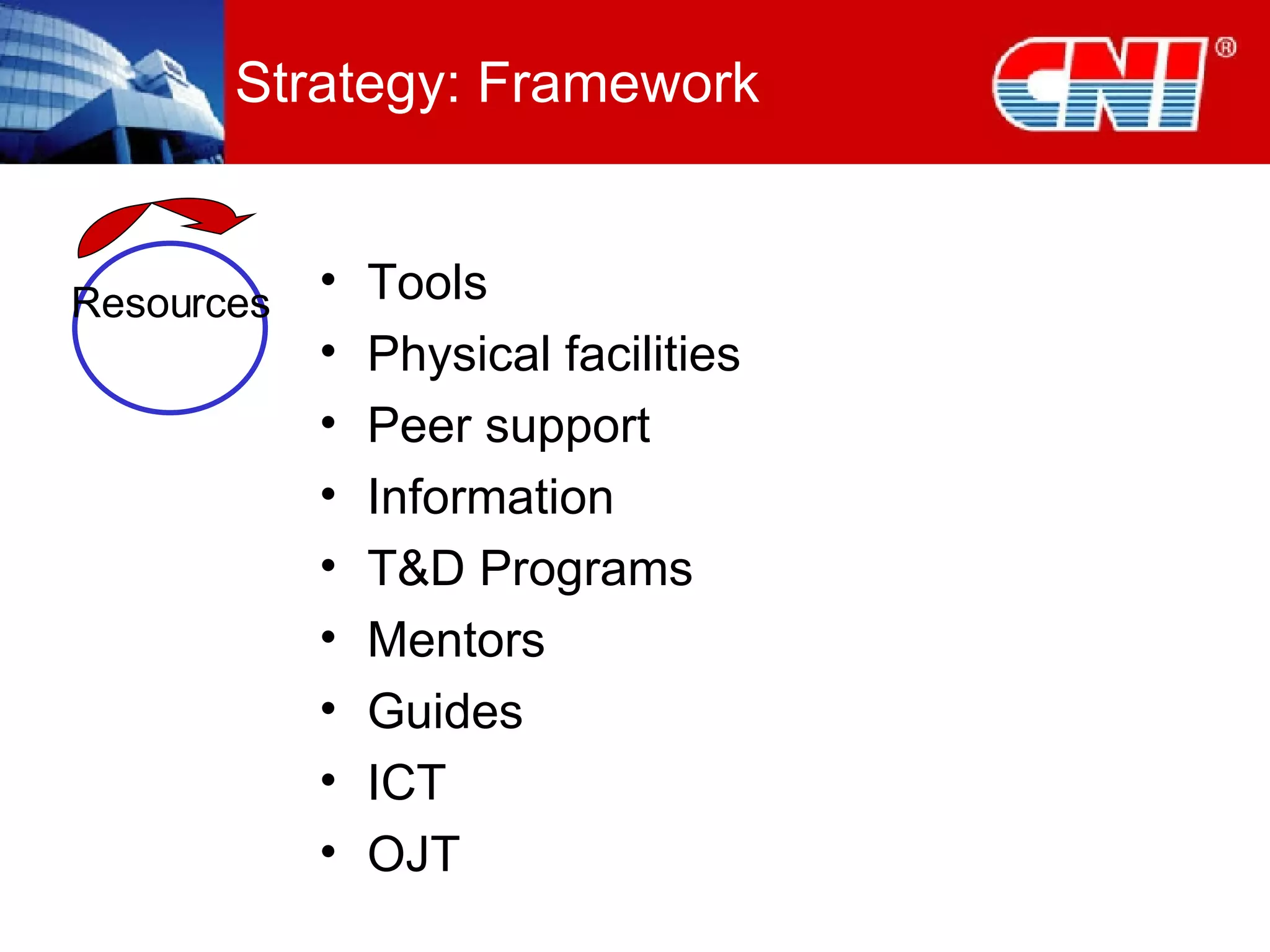
Strategy: Framework Tools Physical facilities Peer support Information T&D Programs Mentors Guides ICT OJT Resources
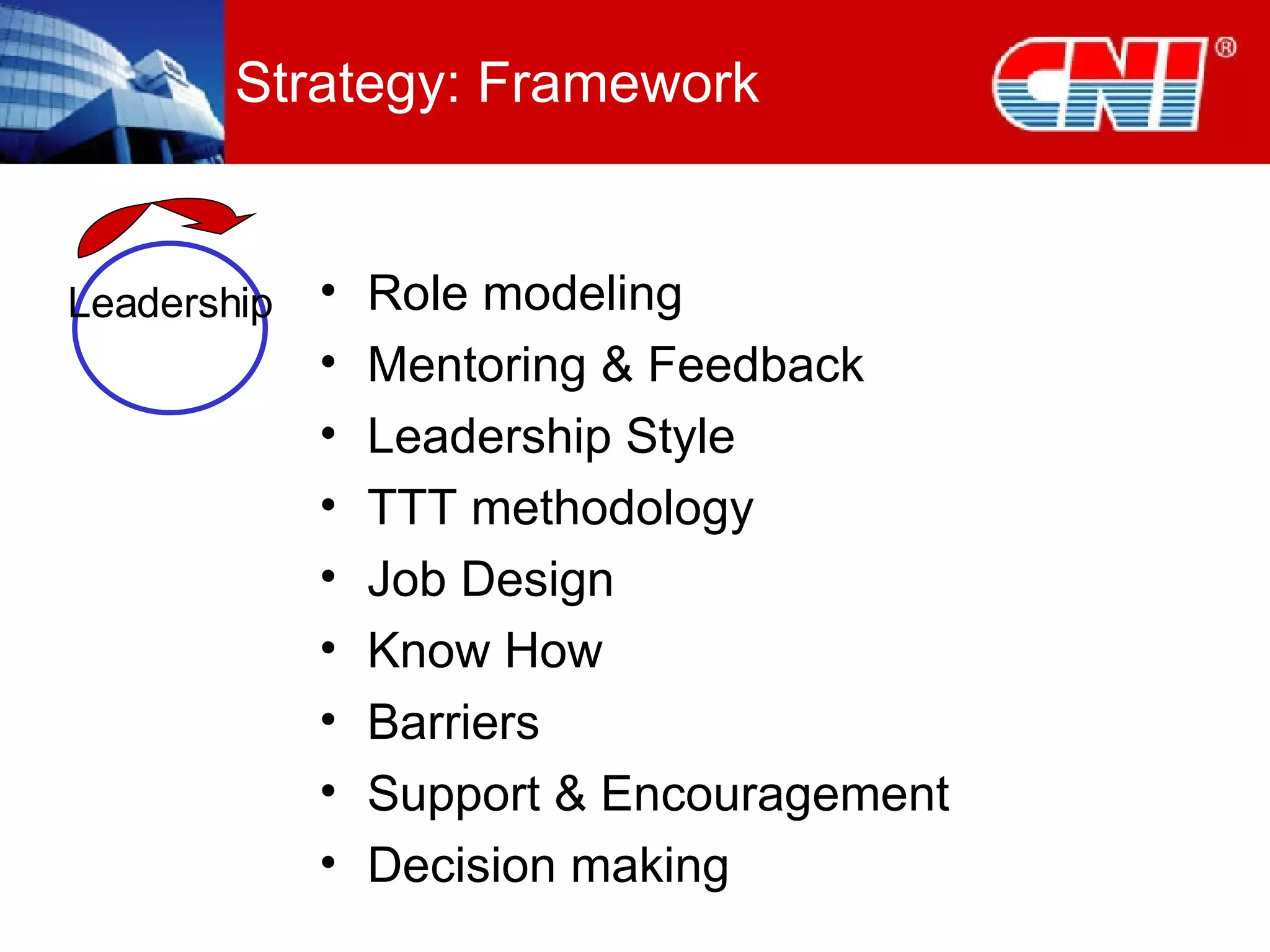
Strategy: Framework Role modeling Mentoring & Feedback Leadership Style TTT methodology Job Design Know How Barriers Support & Encouragement Decision making Leadership
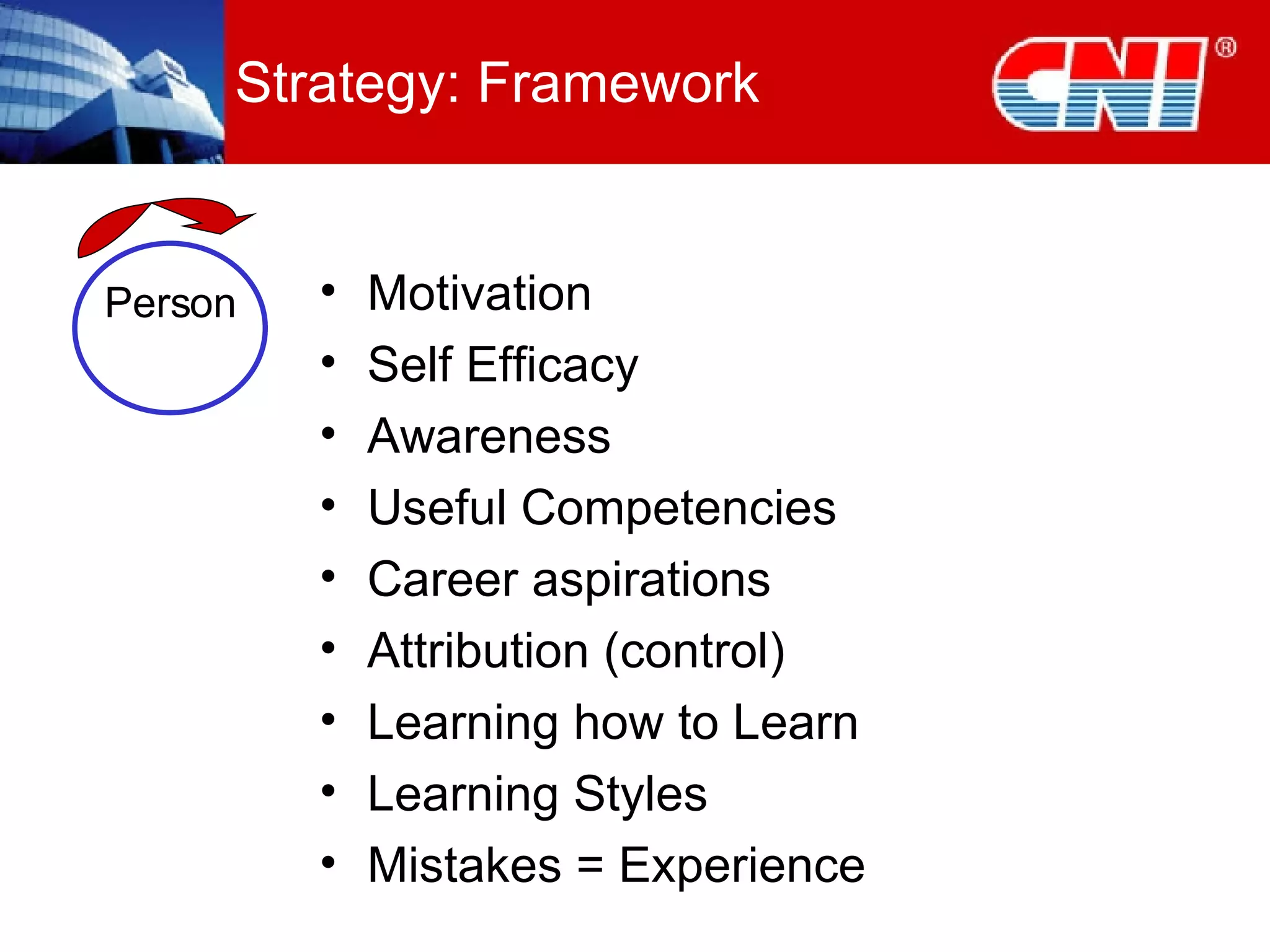
Strategy: Framework Motivation Self Efficacy Awareness Useful Competencies Career aspirations Attribution (control) Learning how to Learn Learning Styles Mistakes = Experience Person
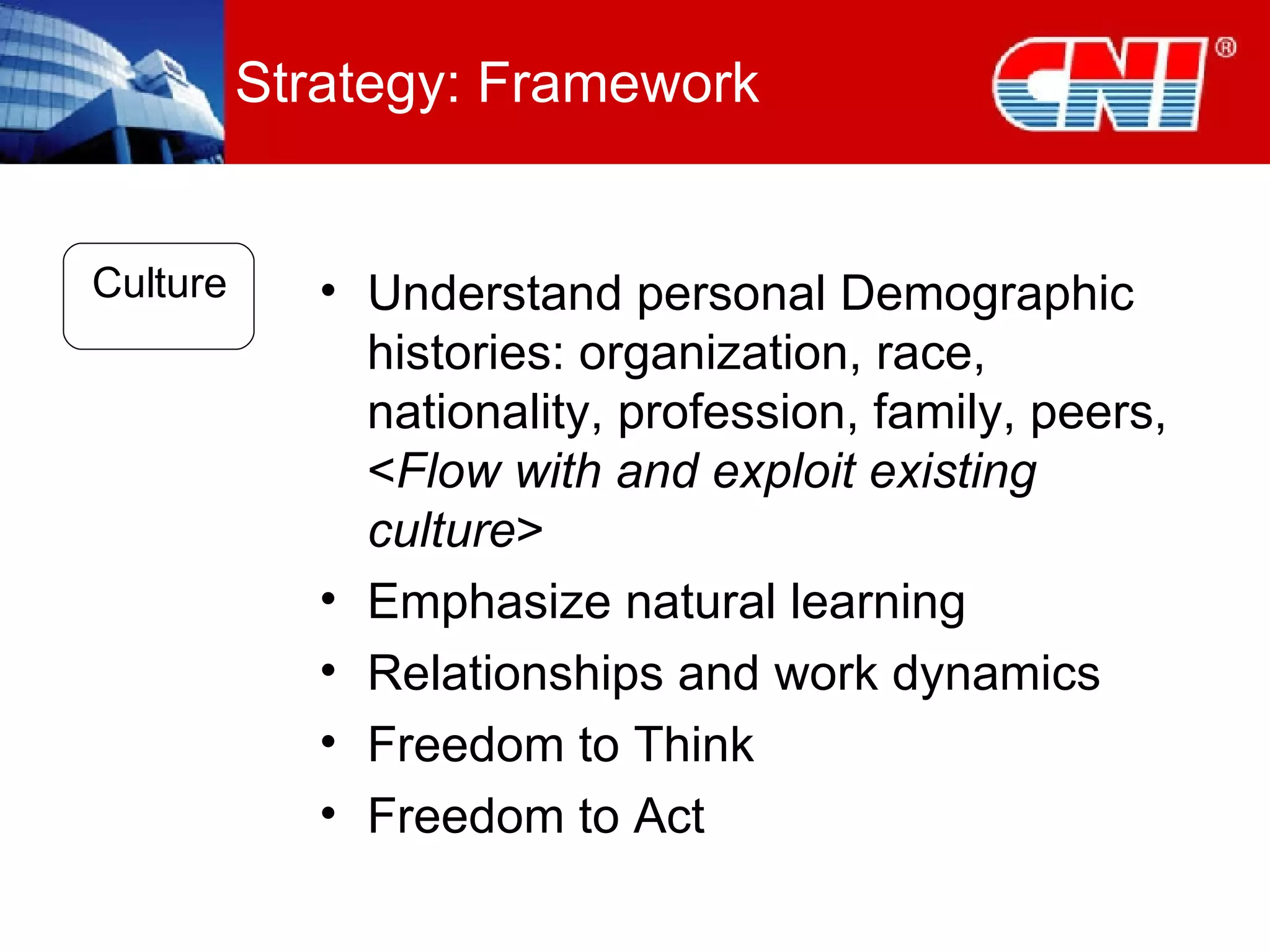
Strategy: Framework Understand personal Demographic histories: organization, race, nationality, profession, family, peers, < Flow with and exploit existing culture > Emphasize natural learning Relationships and work dynamics Freedom to Think Freedom to Act Culture
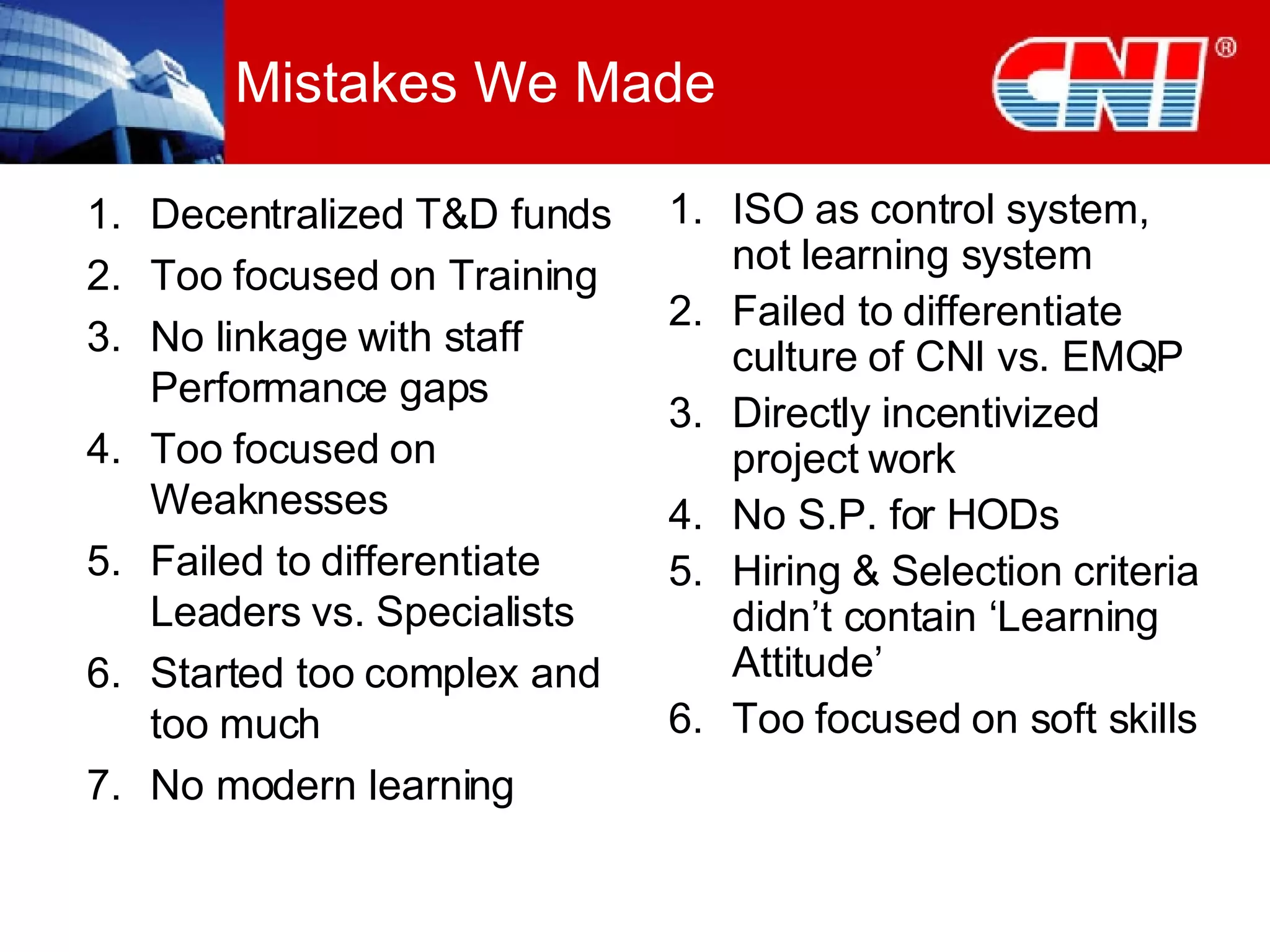
Mistakes We Made Decentralized T&D funds Too focused on Training No linkage with staff Performance gaps Too focused on Weaknesses Failed to differentiate Leaders vs. Specialists Started too complex and too much No modern learning ISO as control system, not learning system Failed to differentiate culture of CNI vs. EMQP Directly incentivized project work No S.P. for HODs Hiring & Selection criteria didn’t contain ‘Learning Attitude’ Too focused on soft skills
Strategy: Practical start-up “ Start small, grow fast, make money”
Strategy: 10 Practical start-up steps Link training objectives to business strategy. Address the corporate culture. Focus on outcomes. De-emphasize training. Demand similar changes from Training suppliers
Strategy: 10 Practical start-up steps Create an obsession Learning resources Learning goals Diverse assignments  Mentoring
Strategy: Q&A Questions? Comments?
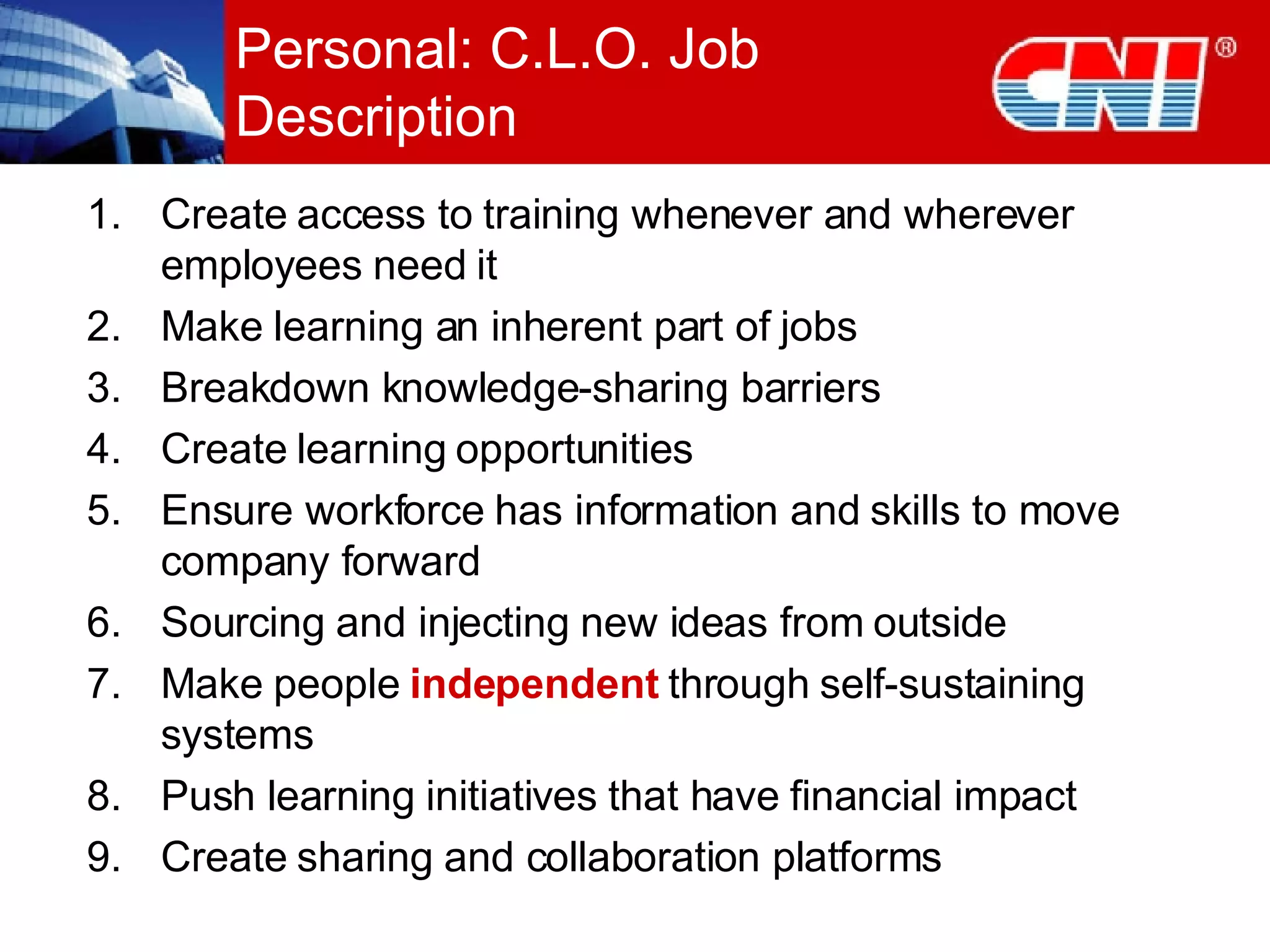
Personal: C.L.O. Job Description Create access to training whenever and wherever employees need it Make learning an inherent part of jobs Breakdown knowledge-sharing barriers Create learning opportunities Ensure workforce has information and skills to move company forward Sourcing and injecting new ideas from outside Make people  independent  through self-sustaining systems Push learning initiatives that have financial impact Create sharing and collaboration platforms
Personal: How about me? Get invited to multi disciplinary committees  Invite other disciplines into your teams & meetings Find a Mentor & shadow him everywhere  Read broad based books, magazines Study the company’s business plan  Write down how the work you do supports those plans  Volunteer to serve on a strategic planning committee or task force. Read more Case Studies Attend more  ATCEN  courses
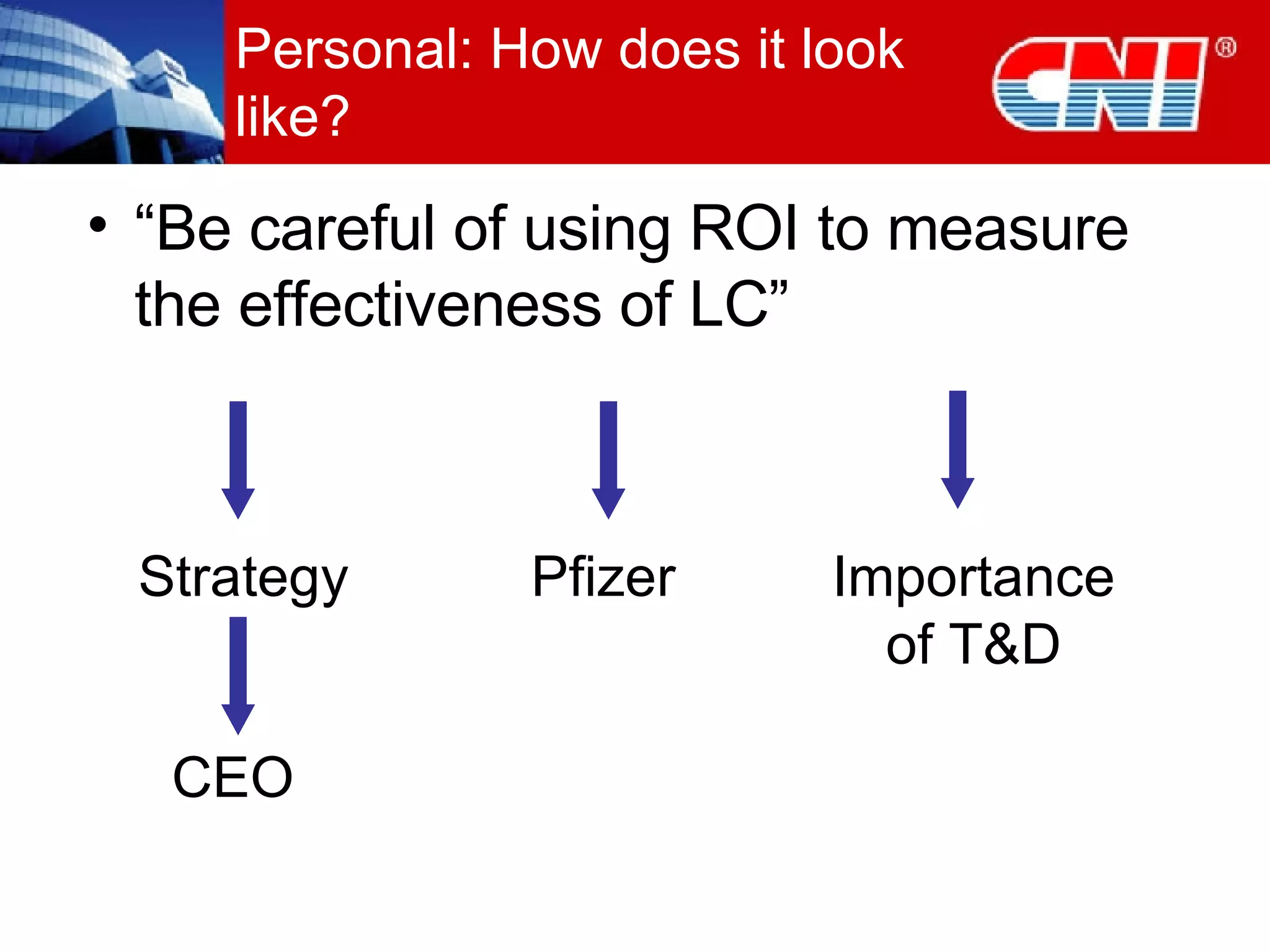
Personal: How does it look like? “ Be careful of using ROI to measure the effectiveness of LC” Strategy CEO Pfizer Importance of T&D
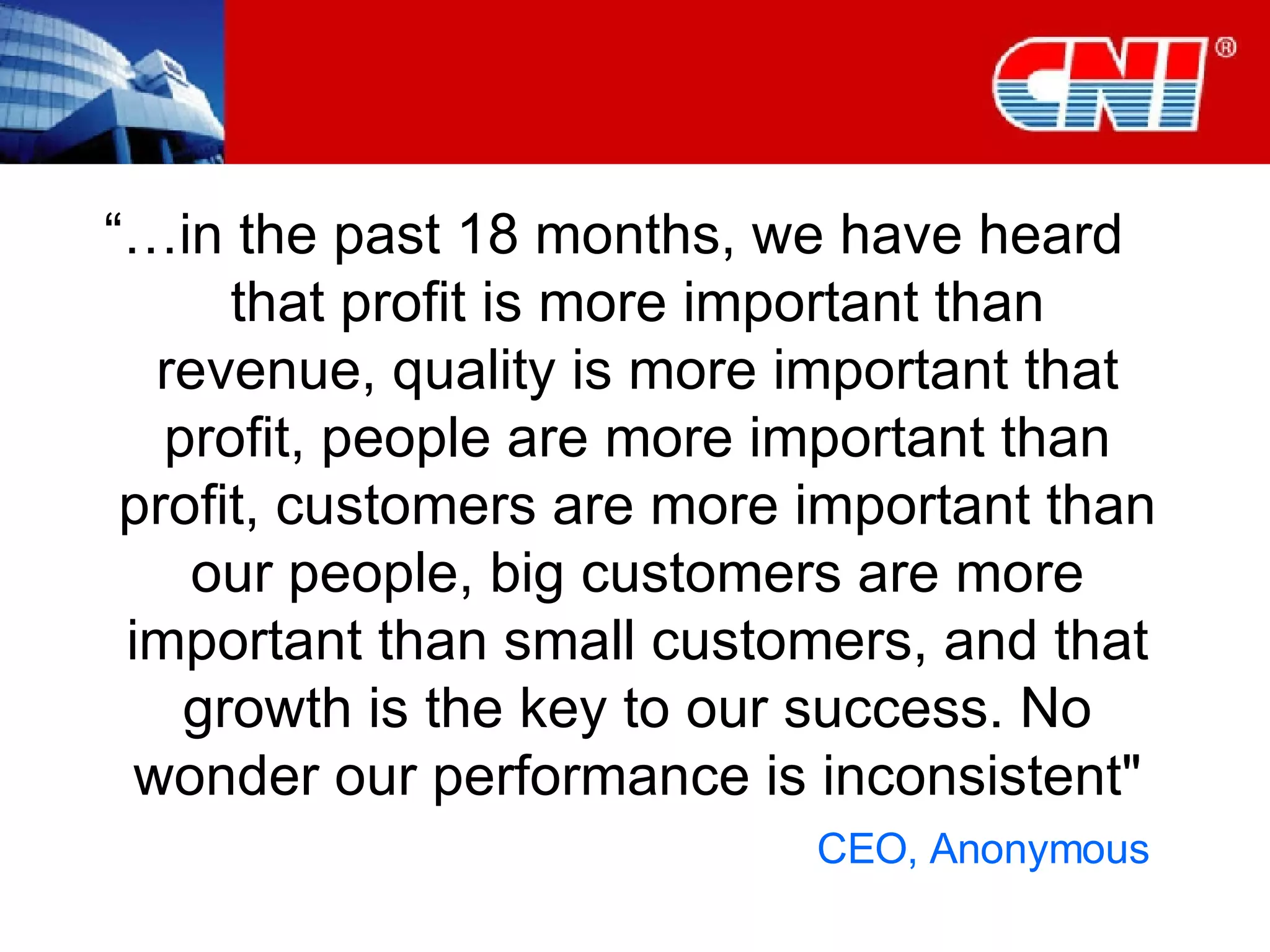
“… in the past 18 months, we have heard that profit is more important than revenue, quality is more important that profit, people are more important than profit, customers are more important than our people, big customers are more important than small customers, and that growth is the key to our success. No wonder our performance is inconsistent&quot; CEO, Anonymous
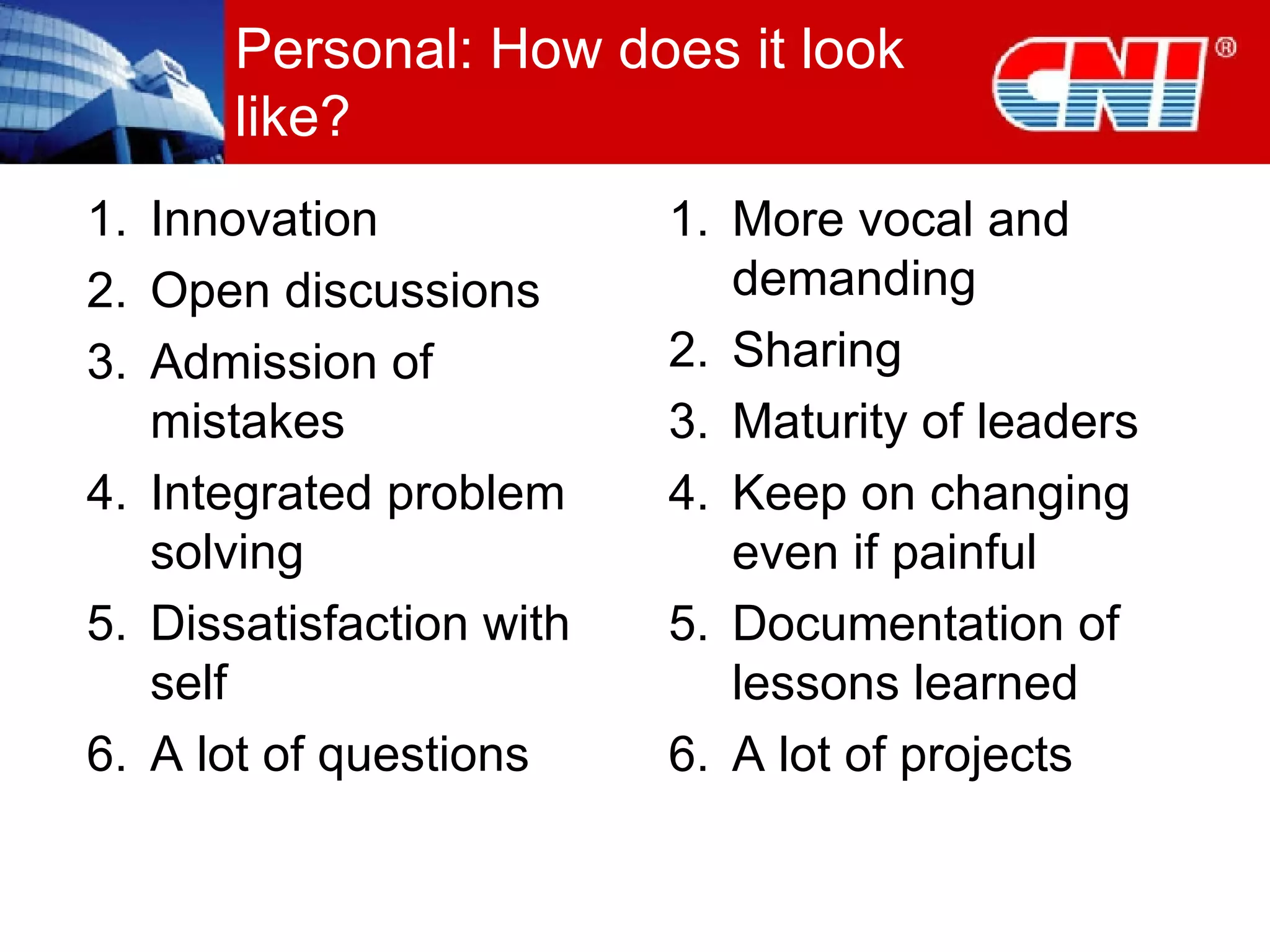
Personal: How does it look like? Innovation Open discussions Admission of mistakes Integrated problem solving Dissatisfaction with self A lot of questions More vocal and demanding Sharing Maturity of leaders Keep on changing even if painful Documentation of lessons learned A lot of projects
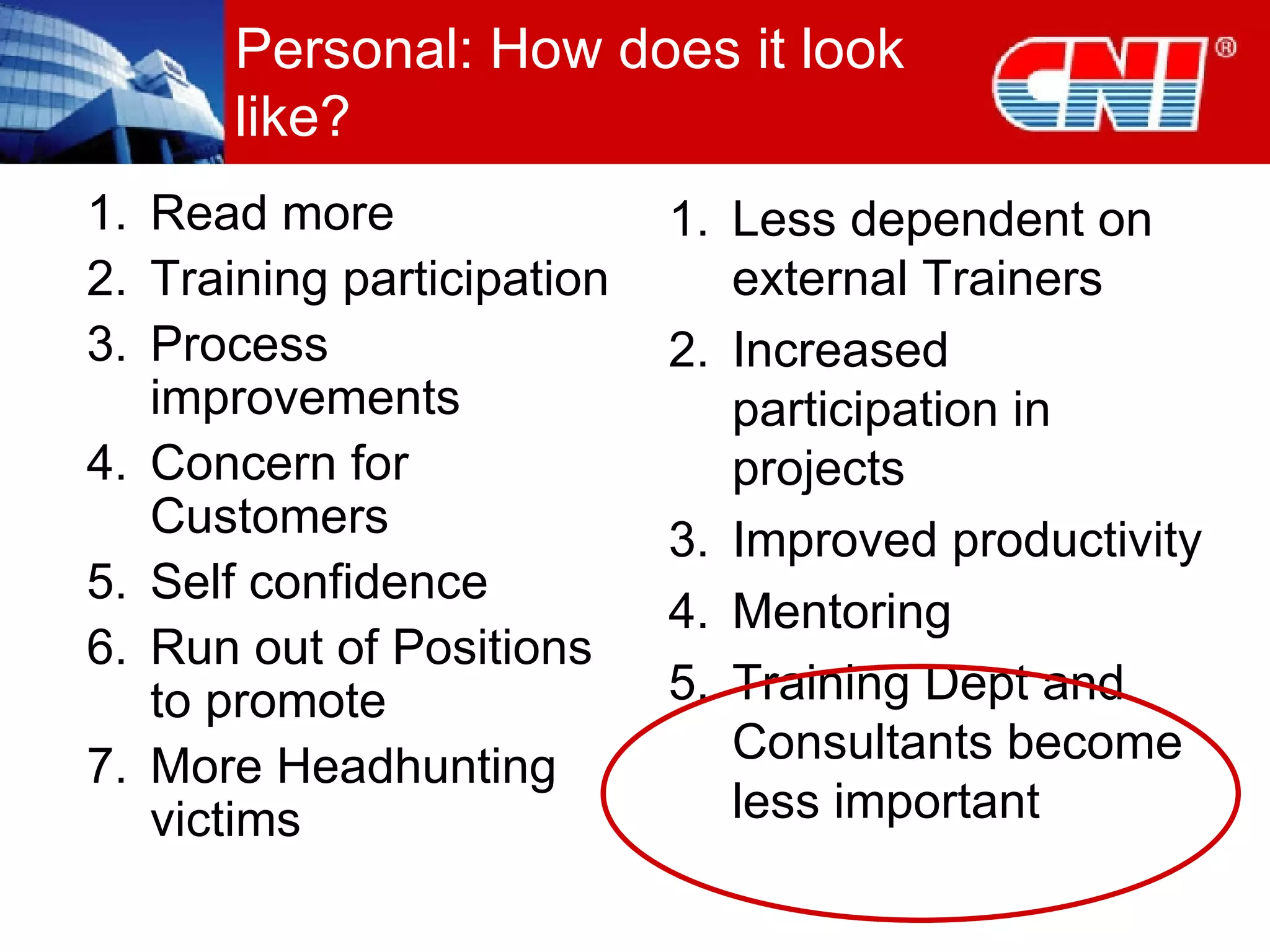
Personal: How does it look like? Read more Training participation Process improvements Concern for Customers Self confidence Run out of Positions to promote More Headhunting victims Less dependent on external Trainers Increased participation in projects Improved productivity Mentoring Training Dept and Consultants become less important
Personal: Q&A Questions? Comments?
Last Words “ Be careful how you sell Learning Culture.  You may be better off selling Training & Development if you are not ready”
To learn more… For more information and education regarding Learning Culture and Strategic Training & Development, please refer to  ATCEN  trainers and courses
Thank You. soft copy of slides:  [email_address]

Continuous Learning: A framework for Developing a Workplace Essential Habit - Atcen Conference

  • 1.
    Continuous Learning: A framework for Developing a Workplace Essential Habit personal story of CNI’s journey Kenny Ong CNI Holdings Berhad
  • 2.
    Contents: Introduction Strategyexample Personal Reflection
  • 3.
    About: CNI HoldingsBhd 17 years old Main Board Public Listing: August 2005 Products: Consumer Goods and Services Core Business: MLM Others: Contract Manufacturing, Export/Trading, eCommerce Malaysia, Singapore, Brunei, Indonesia, India, China, Hong Kong, Philippines Staff force: ± 500 Distributors: ± 250,000 Malaysia
  • 4.
    Intro: LearningCulture Habits
  • 5.
    Intro: Learning Process Input Output Learning Input Application ‘ Learning’ in the business context must be a practical concept. If it cannot be used to improve business results , ‘Learning’ is useless.
  • 6.
    Intro: Habits/Culture Habits“ You cannot eliminate a habit. You can only replace one habit with another habit”
  • 7.
    Intro: Habits/Culture Whyfocus on Habits? Start Early! Small differences in return matter. A lot! Don't squander your inheritance on sex, drugs and rock'n'roll Over time, regular saving of quite small amounts can build up an astonishing sum of money. Time and patience are the friends of compounding and, therefore, of investing. © Copyright 1998-2005, The Motley Fool Limited.
  • 8.
    Intro: Why? Beforewe start… “ Is Learning Culture really a desirable characteristic for business?” “ Are you sure?” Key: Sustainable business performance *Refer: “The Fifth Discipline” by Peter Senge for basic knowledge on Learning Organizations
  • 9.
    Intro: How doesit look like? In the old days of training… Average training hours per staff % of staff attending training # of training programs % of training programs conducted Training needs analysis conducted Competency models developed Training budget as % of payroll What’s wrong with this picture?
  • 10.
    Intro: How doesit look like? Innovation Open discussions Admission of mistakes Integrated problem solving Dissatisfaction with self A lot of questions More vocal and demanding Sharing Maturity of leaders Keep on changing even if painful Documentation of lessons learned A lot of projects
  • 11.
    Intro: How doesit look like? Read more Training participation Process improvements Concern for Customers Self confidence Run out of Positions to promote More Headhunting victims Less dependent on external Trainers Increased participation in projects Improved productivity Mentoring Training Dept and Consultants become less important
  • 12.
    Intro: How doesit look like? Moral of the story… Innovation: Business models Products Services Market Leadership Competitive differentiation Get the picture?
  • 13.
  • 14.
    Strategy: Problems MalaysianEducation system Parents Business short-term thinking Punishing mistakes Lack of career drive L.C. = HR L.C. ≠ Business Comfort Laziness as human nature Underestimating process (habits) & overestimating events Leaders Not technology-ready Pushed by Consultants MNC case studies
  • 15.
    Strategy: Buy-in WIIFMCompany Employees Leaders HRM
  • 16.
    Strategy: Modern LearningJIT Self controlled Multiple sources Multiple styles Social networks Small pieces (modular) Flexible Customized Short
  • 17.
  • 18.
    Strategy: Framework CultureCorporate Objective Corporate Strategy Structure Resources Leadership Person
  • 19.
    Strategy: Corporate StrategyBalanced Scorecard Market Disciplines
  • 20.
    Strategy: Corporate StrategyFinancial “ To satisfy our stakeholders, what Financial objectives must we accomplish?” Internal Process “ To satisfy our customers, in which internal business processes must we excel?&quot; Customer “ Who are our target customers? What is our value proposition?” Learning & Growth “ What capabilities and tools do our employees require to help them execute our strategy?
  • 21.
    Strategy: Corporate StrategyFinancial Learning & Growth Internal Process Customers / Distributors Revenue Growth Productivity Market Value Department Operations Supplier & Alliances External Involvement Target Markets Products/ Services Channel Strategies Human Resources Technology Information & Intelligence Systems & Processes
  • 22.
    Strategy: Corporate StrategyOperational Excellence (low cost producer) Ref: The Discipline of Market Leaders , Michael Treacy & Fred Wiersema; 1995 Product Leadership (best product) Customer Intimacy (best total solution)
  • 23.
    Product Leadership New,state of the art products or services Risk takers Meet volatile customer needs Fast concept-to- counter Never satisfied - obsolete own and competitors' products Learning organization Strategy: Corporate Strategy Operational Excellence Competitive price Error free, reliable Fast (on demand) Simple Responsive Consistent information for all Transactional 'Once and Done' Customer Intimacy Management by Fact Easy to do business with Have it your way (customization) Market segments of one Proactive, flexible Relationship and consultative selling Cross selling
  • 24.
    Operational Excellence Move know-how from top performing units to others Benchmark against best in class Ensure operations training for all employees Use disciplines like TQM for continuous learning to reduce costs and improve quality Strategy: Corporate Strategy
  • 25.
    Strategy: Corporate StrategyCustomer Intimacy Capture knowledge about customers Understand customer needs Empower front line employees Ensure that everyone knows the customer Make company knowledge available to customers
  • 26.
    Product Leadership Reduce time to market Commercialize new products fast Ensure that ideas flow Reuse what other parts of the company have already learned Ensure there are multiple sources of funding Strategy: Corporate Strategy
  • 27.
    Strategy: Framework OrgStructure Job Design C&B Policies & procedures Decision making Job fit Job Challenge Management Systems Structure
  • 28.
    Strategy: Framework ToolsPhysical facilities Peer support Information T&D Programs Mentors Guides ICT OJT Resources
  • 29.
    Strategy: Framework Rolemodeling Mentoring & Feedback Leadership Style TTT methodology Job Design Know How Barriers Support & Encouragement Decision making Leadership
  • 30.
    Strategy: Framework MotivationSelf Efficacy Awareness Useful Competencies Career aspirations Attribution (control) Learning how to Learn Learning Styles Mistakes = Experience Person
  • 31.
    Strategy: Framework Understandpersonal Demographic histories: organization, race, nationality, profession, family, peers, < Flow with and exploit existing culture > Emphasize natural learning Relationships and work dynamics Freedom to Think Freedom to Act Culture
  • 32.
    Mistakes We MadeDecentralized T&D funds Too focused on Training No linkage with staff Performance gaps Too focused on Weaknesses Failed to differentiate Leaders vs. Specialists Started too complex and too much No modern learning ISO as control system, not learning system Failed to differentiate culture of CNI vs. EMQP Directly incentivized project work No S.P. for HODs Hiring & Selection criteria didn’t contain ‘Learning Attitude’ Too focused on soft skills
  • 33.
    Strategy: Practical start-up“ Start small, grow fast, make money”
  • 34.
    Strategy: 10 Practicalstart-up steps Link training objectives to business strategy. Address the corporate culture. Focus on outcomes. De-emphasize training. Demand similar changes from Training suppliers
  • 35.
    Strategy: 10 Practicalstart-up steps Create an obsession Learning resources Learning goals Diverse assignments Mentoring
  • 36.
  • 37.
    Personal: C.L.O. JobDescription Create access to training whenever and wherever employees need it Make learning an inherent part of jobs Breakdown knowledge-sharing barriers Create learning opportunities Ensure workforce has information and skills to move company forward Sourcing and injecting new ideas from outside Make people independent through self-sustaining systems Push learning initiatives that have financial impact Create sharing and collaboration platforms
  • 38.
    Personal: How aboutme? Get invited to multi disciplinary committees Invite other disciplines into your teams & meetings Find a Mentor & shadow him everywhere Read broad based books, magazines Study the company’s business plan Write down how the work you do supports those plans Volunteer to serve on a strategic planning committee or task force. Read more Case Studies Attend more ATCEN courses
  • 39.
    Personal: How doesit look like? “ Be careful of using ROI to measure the effectiveness of LC” Strategy CEO Pfizer Importance of T&D
  • 40.
    “… in thepast 18 months, we have heard that profit is more important than revenue, quality is more important that profit, people are more important than profit, customers are more important than our people, big customers are more important than small customers, and that growth is the key to our success. No wonder our performance is inconsistent&quot; CEO, Anonymous
  • 41.
    Personal: How doesit look like? Innovation Open discussions Admission of mistakes Integrated problem solving Dissatisfaction with self A lot of questions More vocal and demanding Sharing Maturity of leaders Keep on changing even if painful Documentation of lessons learned A lot of projects
  • 42.
    Personal: How doesit look like? Read more Training participation Process improvements Concern for Customers Self confidence Run out of Positions to promote More Headhunting victims Less dependent on external Trainers Increased participation in projects Improved productivity Mentoring Training Dept and Consultants become less important
  • 43.
  • 44.
    Last Words “Be careful how you sell Learning Culture. You may be better off selling Training & Development if you are not ready”
  • 45.
    To learn more…For more information and education regarding Learning Culture and Strategic Training & Development, please refer to ATCEN trainers and courses
  • 46.
    Thank You. softcopy of slides: [email_address]