Challenges	
  of	
  implemen/ng	
  Agile	
  and	
  what’s	
  coming	
  next	
  
2nd	
  Annual	
  Maine	
  Agile	
  Gathering!	
  
Bob	
  Sarni	
  
bobsarni@ionagility.com	
  
www.ionagility.com	
  
LinkedIn:	
  www.linkedin/in/bobsarni/	
  
TwiGer:	
  bobsarni	
  	
  
© 2014 iOnAgility. All Rights Reserved
–  Agile	
  2014	
  Program	
  Chair	
  –	
  Process	
  at	
  Large	
  –	
  Orlando,	
  July	
  28	
  –	
  August	
  1,	
  2014	
  
–  Agile	
  2015	
  Program	
  Chair	
  –	
  Process	
  at	
  Large	
  –	
  Washington	
  DC,	
  August	
  3	
  –	
  August	
  
7,	
  2015	
  
–  Agile	
  2016	
  Conference	
  Chair	
  –	
  Atlanta,	
  July	
  25	
  –	
  July	
  29,	
  2015	
  
–  CerJfied	
  Scrum	
  Coach	
  (CSC)	
  and	
  CerJfied	
  Scrum	
  Trainer	
  (CST)	
  
•  Founder	
  and	
  Principal	
  –	
  iOnAgility	
  –	
  www.ionagility.com	
  
•  20+	
  years	
  in	
  project	
  management,	
  porPolio	
  management,	
  program	
  
management	
  and	
  product	
  development	
  –	
  From	
  power	
  plant	
  construc/on	
  to	
  
soRware	
  development!	
  Last	
  10+	
  years	
  focused	
  on	
  agile	
  efforts.	
  
•  Experience	
  with	
  many	
  large	
  enterprise	
  Agile	
  adop/ons	
  and	
  transforma/ons	
  
•  Experience	
  as	
  ScrumMaster,	
  Product	
  Owner,	
  Team	
  Coach,	
  Coach	
  of	
  Coaches,	
  
Agile	
  Prac/ce	
  Leader,	
  Enterprise	
  Agile	
  Coach	
  
© 2014 iOnAgility. All Rights Reserved
Bob	
  Sarni	
  
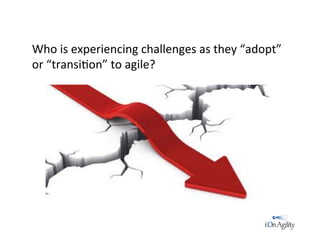
Who	
  is	
  experiencing	
  challenges	
  as	
  they	
  “adopt”	
  
or	
  “transi/on”	
  to	
  agile?	
  
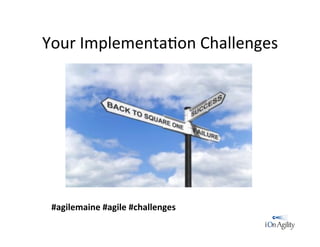
Your	
  Implementa/on	
  Challenges	
  
#agilemaine	
  #agile	
  #challenges	
  
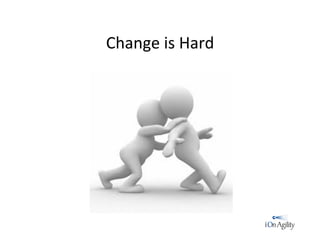
Change	
  is	
  Hard	
  
•  Change	
  is	
  hard	
  
–  Change	
  is	
  constant	
  
–  Change	
  wears	
  you	
  down	
  
–  People	
  are	
  not	
  resistant	
  to	
  change,	
  they	
  are	
  resistant	
  to	
  being	
  changed	
  
•  Agile	
  should	
  not	
  be	
  the	
  goal	
  
–  Agile	
  is	
  journey,	
  not	
  a	
  des/na/on–	
  you	
  are	
  never	
  done.	
  Con/nuous	
  learning	
  
–  Agile	
  is	
  an	
  avenue	
  to	
  achieve	
  a	
  bigger	
  goal	
  
–  What	
  are	
  your	
  business	
  and	
  strategic	
  goals?	
  How	
  can	
  agile	
  assist	
  with	
  those	
  
goals?	
  
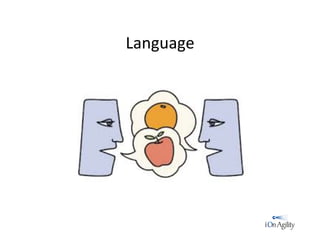
Language	
  
•  Language	
  
–  Agile	
  means	
  many	
  things	
  and	
  in	
  different	
  ways	
  to	
  people	
  and	
  organiza/ons	
  
–  It	
  is	
  hard	
  to	
  measure	
  and	
  compare	
  successes	
  –	
  the	
  context	
  is	
  missing.	
  Culture,	
  
organiza/onal	
  design,	
  market	
  drivers,	
  customer	
  profiles,	
  employee	
  DNA	
  
–  Organiza/ons	
  look	
  for	
  case	
  studies	
  they	
  can	
  compare	
  themselves	
  to	
  or	
  
measure	
  themselves	
  against	
  
–  There	
  is	
  not	
  a	
  common,	
  consistent	
  place	
  to	
  look	
  for	
  answers	
  and	
  advice	
  
Organiza/onal	
  Culture	
  
8	


"One	
  cannot	
  become	
  a	
  bu-erfly	
  by	
  remaining	
  
a	
  caterpillar."	


"In	
  the	
  change	
  from	
  being	
  a	
  caterpillar	
  
to	
  becoming	
  a	
  bu-erfly,	
  
you're	
  nothing	
  more	
  than	
  a	
  yellow,	
  
gooey	
  s=cky	
  mess.”	
  
Ted	
  Forbes	
  –	
  Darden	
  School	
  of	
  Business	
  
•  Culture	
  
–  Culture	
  eats	
  strategy	
  for	
  breakfast	
  –	
  Peter	
  Drucker	
  
•  Developing	
  a	
  culture	
  suppor/ve	
  of	
  change	
  is	
  cri/cal	
  
–  No	
  posi/ve	
  vision	
  for	
  the	
  future.	
  There	
  is	
  less	
  “change	
  fa/gue”	
  and	
  a	
  lot	
  less	
  
resistance	
  with	
  hope	
  as	
  a	
  founda/on	
  
–  Unwillingness	
  to	
  stop	
  doing	
  things	
  that	
  do	
  not	
  add	
  value	
  because	
  of	
  the	
  illusion	
  of	
  
precision	
  and	
  big	
  elaborate	
  charts	
  that	
  tell	
  false	
  stories	


–  Unwillingness	
  to	
  create	
  “systems	
  always	
  under	
  test”	
  type	
  environments	
  that	
  are	
  
not	
  overly	
  complicated	
  and	
  unaGainable	
  
–  Autonomous	
  and	
  self	
  organizing	
  teams	
  may	
  be	
  a	
  threat	
  to	
  leadership	
  and	
  
management	
  
–  Let’s	
  "keep	
  doing	
  what	
  we've	
  been	
  doing	
  AND	
  adopt	
  agile”	
  
–  Too	
  much	
  focus	
  on	
  the	
  process	
  (and	
  too	
  liGle	
  on	
  the	
  people)	
  	
  
What	
  does	
  the	
  future	
  hold?	
  
#agilemaine	
  #agile	
  #thefuture	
  
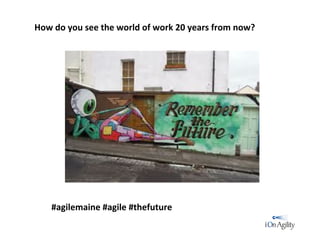
How	
  do	
  you	
  see	
  the	
  world	
  of	
  work	
  20	
  years	
  from	
  now?	
  
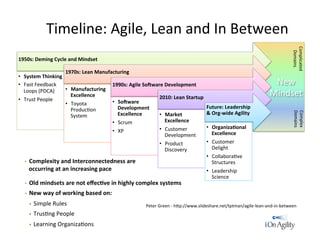
Timeline:	
  Agile,	
  Lean	
  and	
  In	
  Between	
  
1950s:	
  Deming	
  Cycle	
  and	
  Mindset	
  
•  System	
  Thinking	
  
•  Fast	
  Feedback	
  
Loops	
  (PDCA)	
  
•  Trust	
  People	
  
1970s:	
  Lean	
  Manufacturing	
  
•  Manufacturing	
  
Excellence	
  
•  Toyota	
  
Produc/on	
  
System	
  
1990s:	
  Agile	
  SoXware	
  Development	
  
•  SoXware	
  
Development	
  
Excellence	
  
•  Scrum	
  
•  XP	
  
2010:	
  Lean	
  Startup	
  
•  Market	
  
Excellence	
  
•  Customer	
  
Development	
  
•  Product	
  
Discovery	
  
Future:	
  Leadership	
  
&	
  Org-­‐wide	
  Agility	
  
•  OrganizaJonal	
  
Excellence	
  
•  Customer	
  
Delight	
  
•  Collabora/ve	
  
Structures	
  
•  Leadership	
  
Science	
  
Complex	
  
Domains	


§  Complexity	
  and	
  Interconnectedness	
  are	
  
occurring	
  at	
  an	
  increasing	
  pace	
  
§  Old	
  mindsets	
  are	
  not	
  effecJve	
  in	
  highly	
  complex	
  systems	
  
§  New	
  way	
  of	
  working	
  based	
  on:	
  
§  Simple	
  Rules	
  
§  Trus/ng	
  People	
  
§  Learning	
  Organiza/ons	
  
Complicated	
  
Domains	


New	
  
Mindset	
  
Peter	
  Green	
  -­‐	
  hGp://www.slideshare.net/tptman/agile-­‐lean-­‐and-­‐in-­‐between	
  	
  
•  Considera/ons	
  for	
  the	
  future	
  
–  Agile	
  is	
  an	
  evolu/on	
  
–  It	
  is	
  an	
  approach	
  to	
  rapid	
  change	
  
–  The	
  pace	
  of	
  change	
  con/nues	
  to	
  increase	
  –	
  it	
  is	
  not	
  going	
  backwards	
  
–  Our	
  responses	
  today,	
  may	
  not	
  be	
  fast	
  enough	
  tomorrow	
  –	
  we	
  need	
  to	
  
con/nue	
  to	
  adapt	
  
–  We	
  may	
  not	
  be	
  doing	
  Scrum	
  in	
  another	
  10	
  years	
  –	
  whatever	
  we	
  are	
  doing	
  is	
  
likely	
  to	
  be	
  more	
  agile	
  
•  The	
  future	
  world	
  of	
  work	


–  Lean	
  startup	
  thinking	
  will	
  con/nue	
  to	
  drive	
  innova/on	
  and	
  success	
  through	
  
experimenta/on	
  and	
  MVP	
  thinking	
  
–  Team-­‐driven	
  and	
  collabora/ve	
  
–  Performance	
  evalua/ons	
  go	
  away	
  	
  
–  More	
  about	
  mindsets	
  than	
  individual	
  frameworks	
  
–  The	
  mindset	
  applies	
  to	
  business	
  and	
  work	
  in	
  general	
  –	
  not	
  just	
  soRware	
  
development	
  
•  The	
  future	
  world	
  of	
  work	
  
–  Con/nuous	
  delivery	
  
•  The	
  daily	
  scrum	
  becomes	
  the	
  daily	
  sprint	
  
–  Big	
  products	
  companies	
  are	
  not	
  the	
  only	
  players	
  in	
  the	
  game	
  
•  Trend	
  towards	
  small	
  “apps”	
  
•  Ability	
  to	
  build	
  networks	
  of	
  “apps”	
  that	
  talk	
  to	
  each	
  other	
  
•  Smaller	
  companies	
  will	
  become	
  the	
  new	
  large	
  companies	
  
•  Large	
  companies	
  will	
  s/ll	
  exist	
  but	
  their	
  new	
  compe/tors	
  will	
  be	
  these	
  
highly	
  adaptable,	
  agile	
  companies	


–  Value	
  teams	
  
Bob Sarni's Presentation for Agile Maine 2014

Bob Sarni's Presentation for Agile Maine 2014

  • 1.
    Challenges  of  implemen/ng  Agile  and  what’s  coming  next   2nd  Annual  Maine  Agile  Gathering!   Bob  Sarni   bobsarni@ionagility.com   www.ionagility.com   LinkedIn:  www.linkedin/in/bobsarni/   TwiGer:  bobsarni     © 2014 iOnAgility. All Rights Reserved
  • 2.
    –  Agile  2014  Program  Chair  –  Process  at  Large  –  Orlando,  July  28  –  August  1,  2014   –  Agile  2015  Program  Chair  –  Process  at  Large  –  Washington  DC,  August  3  –  August   7,  2015   –  Agile  2016  Conference  Chair  –  Atlanta,  July  25  –  July  29,  2015   –  CerJfied  Scrum  Coach  (CSC)  and  CerJfied  Scrum  Trainer  (CST)   •  Founder  and  Principal  –  iOnAgility  –  www.ionagility.com   •  20+  years  in  project  management,  porPolio  management,  program   management  and  product  development  –  From  power  plant  construc/on  to   soRware  development!  Last  10+  years  focused  on  agile  efforts.   •  Experience  with  many  large  enterprise  Agile  adop/ons  and  transforma/ons   •  Experience  as  ScrumMaster,  Product  Owner,  Team  Coach,  Coach  of  Coaches,   Agile  Prac/ce  Leader,  Enterprise  Agile  Coach   © 2014 iOnAgility. All Rights Reserved Bob  Sarni  
  • 3.
    Who  is  experiencing  challenges  as  they  “adopt”   or  “transi/on”  to  agile?  
  • 4.
    Your  Implementa/on  Challenges   #agilemaine  #agile  #challenges  
  • 5.
  • 6.
    •  Change  is  hard   –  Change  is  constant   –  Change  wears  you  down   –  People  are  not  resistant  to  change,  they  are  resistant  to  being  changed   •  Agile  should  not  be  the  goal   –  Agile  is  journey,  not  a  des/na/on–  you  are  never  done.  Con/nuous  learning   –  Agile  is  an  avenue  to  achieve  a  bigger  goal   –  What  are  your  business  and  strategic  goals?  How  can  agile  assist  with  those   goals?  
  • 7.
  • 8.
    •  Language   – Agile  means  many  things  and  in  different  ways  to  people  and  organiza/ons   –  It  is  hard  to  measure  and  compare  successes  –  the  context  is  missing.  Culture,   organiza/onal  design,  market  drivers,  customer  profiles,  employee  DNA   –  Organiza/ons  look  for  case  studies  they  can  compare  themselves  to  or   measure  themselves  against   –  There  is  not  a  common,  consistent  place  to  look  for  answers  and  advice  
  • 9.
  • 10.
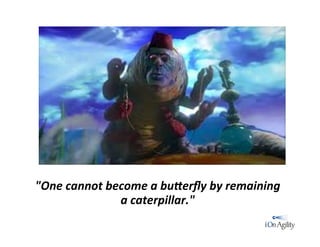
        "One  cannot  become  a  bu-erfly  by  remaining   a  caterpillar."  
  • 11.
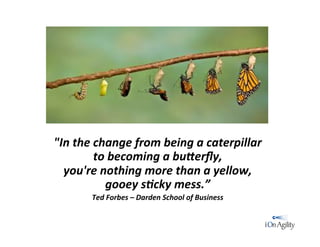
          "In  the  change  from  being  a  caterpillar   to  becoming  a  bu-erfly,   you're  nothing  more  than  a  yellow,   gooey  s=cky  mess.”   Ted  Forbes  –  Darden  School  of  Business  
  • 12.
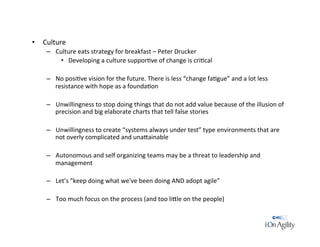
    •  Culture   – Culture  eats  strategy  for  breakfast  –  Peter  Drucker   •  Developing  a  culture  suppor/ve  of  change  is  cri/cal   –  No  posi/ve  vision  for  the  future.  There  is  less  “change  fa/gue”  and  a  lot  less   resistance  with  hope  as  a  founda/on   –  Unwillingness  to  stop  doing  things  that  do  not  add  value  because  of  the  illusion  of   precision  and  big  elaborate  charts  that  tell  false  stories     –  Unwillingness  to  create  “systems  always  under  test”  type  environments  that  are   not  overly  complicated  and  unaGainable   –  Autonomous  and  self  organizing  teams  may  be  a  threat  to  leadership  and   management   –  Let’s  "keep  doing  what  we've  been  doing  AND  adopt  agile”   –  Too  much  focus  on  the  process  (and  too  liGle  on  the  people)    
  • 13.
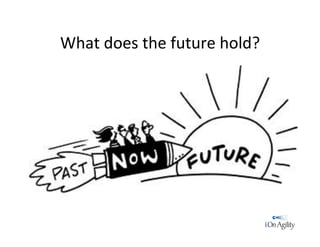
    What  does  the  future  hold?  
  • 14.
    #agilemaine  #agile  #thefuture   How  do  you  see  the  world  of  work  20  years  from  now?  
  • 15.
    Timeline:  Agile,  Lean  and  In  Between   1950s:  Deming  Cycle  and  Mindset   •  System  Thinking   •  Fast  Feedback   Loops  (PDCA)   •  Trust  People   1970s:  Lean  Manufacturing   •  Manufacturing   Excellence   •  Toyota   Produc/on   System   1990s:  Agile  SoXware  Development   •  SoXware   Development   Excellence   •  Scrum   •  XP   2010:  Lean  Startup   •  Market   Excellence   •  Customer   Development   •  Product   Discovery   Future:  Leadership   &  Org-­‐wide  Agility   •  OrganizaJonal   Excellence   •  Customer   Delight   •  Collabora/ve   Structures   •  Leadership   Science   Complex   Domains     §  Complexity  and  Interconnectedness  are   occurring  at  an  increasing  pace   §  Old  mindsets  are  not  effecJve  in  highly  complex  systems   §  New  way  of  working  based  on:   §  Simple  Rules   §  Trus/ng  People   §  Learning  Organiza/ons   Complicated   Domains     New   Mindset   Peter  Green  -­‐  hGp://www.slideshare.net/tptman/agile-­‐lean-­‐and-­‐in-­‐between    
  • 16.
    •  Considera/ons  for  the  future   –  Agile  is  an  evolu/on   –  It  is  an  approach  to  rapid  change   –  The  pace  of  change  con/nues  to  increase  –  it  is  not  going  backwards   –  Our  responses  today,  may  not  be  fast  enough  tomorrow  –  we  need  to   con/nue  to  adapt   –  We  may  not  be  doing  Scrum  in  another  10  years  –  whatever  we  are  doing  is   likely  to  be  more  agile  
  • 17.
    •  The  future  world  of  work     –  Lean  startup  thinking  will  con/nue  to  drive  innova/on  and  success  through   experimenta/on  and  MVP  thinking   –  Team-­‐driven  and  collabora/ve   –  Performance  evalua/ons  go  away     –  More  about  mindsets  than  individual  frameworks   –  The  mindset  applies  to  business  and  work  in  general  –  not  just  soRware   development  
  • 18.
    •  The  future  world  of  work   –  Con/nuous  delivery   •  The  daily  scrum  becomes  the  daily  sprint   –  Big  products  companies  are  not  the  only  players  in  the  game   •  Trend  towards  small  “apps”   •  Ability  to  build  networks  of  “apps”  that  talk  to  each  other   •  Smaller  companies  will  become  the  new  large  companies   •  Large  companies  will  s/ll  exist  but  their  new  compe/tors  will  be  these   highly  adaptable,  agile  companies     –  Value  teams