© 2009 Mountain Goat Software© Copyright Mountain Goat Software®
Prioritizing Your
Product Backlog
Mike Cohn
mike@mountaingoatsoftware.com
June 8, 2010
1
© Copyright Mountain Goat Software®
®
Mike Cohn
Founding member and
director of Agile Alliance
and Scrum Alliance
Founder of Mountain
Goat Software
Doing Scrum since 1995
Started my career as a
programmer
2
© Copyright Mountain Goat Software®
®
Combine formal & informal
Formal prioritization approaches for
Choosing among projects
Choosing between “epics” or “big features”
An informal approach (expert opinion)
Once you’ve selected the epics / big features
3
© Copyright Mountain Goat Software®
®
Why?
Features that are too small cannot be
effectively prioritized against each other
What’s more important in a word processor?
The A key or the E key?
Tables or undo?
What’s more important on a car?
The left front wheel or the right front wheel?
Increased leg room or a larger engine?
4
© Copyright Mountain Goat Software®
®
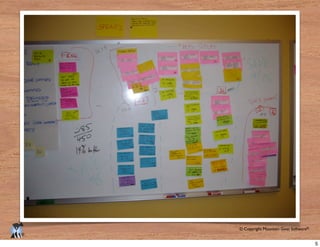
5
© Copyright Mountain Goat Software®
®
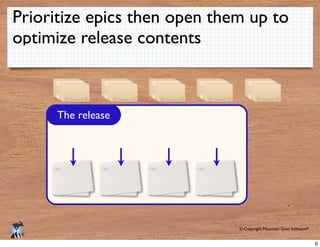
Prioritize epics then open them up to
optimize release contents
The release
6
© Copyright Mountain Goat Software®
®
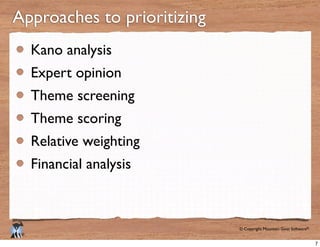
Approaches to prioritizing
Kano analysis
Expert opinion
Theme screening
Theme scoring
Relative weighting
Financial analysis
7
© Copyright Mountain Goat Software®
®
Non-financial
prioritization
8
© Copyright Mountain Goat Software®
®
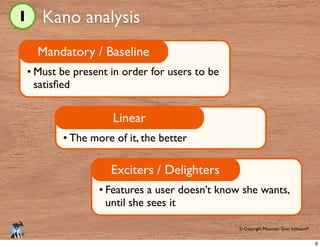
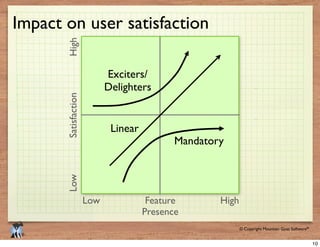
Kano analysis1
Must be present in order for users to be
Mandatory / Baseline
The more of it, the better
Linear
Features a user doesn’t know she wants,
until she sees it
Exciters / Delighters
9
© 2009 Mountain Goat Software© Copyright Mountain Goat Software®
®
Impact on user satisfaction
Feature
Presence
SatisfactionLowHigh
Low High
Exciters/
Delighters
Mandatory
Linear
10
© Copyright Mountain Goat Software®
®
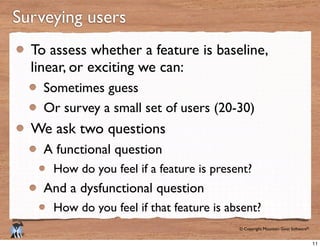
Surveying users
To assess whether a feature is baseline,
linear, or exciting we can:
Sometimes guess
Or survey a small set of users (20-30)
We ask two questions
A functional question
How do you feel if a feature is present?
And a dysfunctional question
How do you feel if that feature is absent?
11
© Copyright Mountain Goat Software®
®
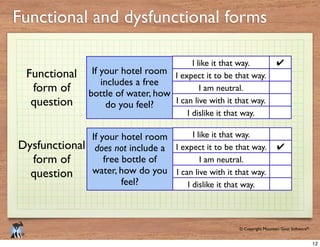
Functional and dysfunctional forms
If your hotel room
includes a free
bottle of water, how
do you feel?
I expect it to be that way.
I like it that way.
I am neutral.
I can live with it that way.
I dislike it that way.
✔
If your hotel room
does not include a
free bottle of
water, how do you
feel?
I expect it to be that way.
I like it that way.
I am neutral.
I can live with it that way.
I dislike it that way.
✔
Functional
form of
question
Dysfunctional
form of
question
12
© Copyright Mountain Goat Software®
®
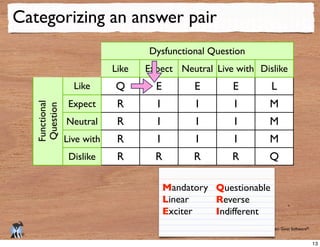
Categorizing an answer pair
Dysfuncctional Quuestion
Like Expect Neutral Live with Dislike
Like
Expect
Neutral
Live with
Dislike
Q E E E L
R I I I M
R I I I M
R I I I M
R R R R Q
Functional
Question
Mandatory
Linear
Exciter
Questionable
Reverse
Indifferent
13
© Copyright Mountain Goat Software®
®
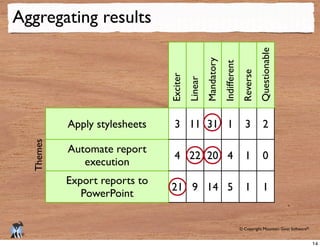
Aggregating results
Apply stylesheets
Automate report
execution
Export reports to
PowerPoint
3 11 31 1 3 2
4 22 20 4 1 0
21 9 14 5 1 1
Questionable
Reverse
Indifferent
Mandatory
Linear
Exciter
Themes
14
© Copyright Mountain Goat Software®
®
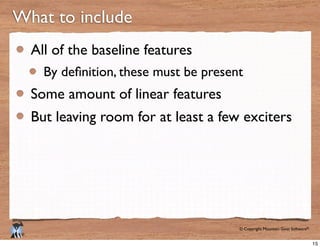
What to include
All of the baseline features
Some amount of linear features
But leaving room for at least a few exciters
15
© Copyright Mountain Goat Software®
®
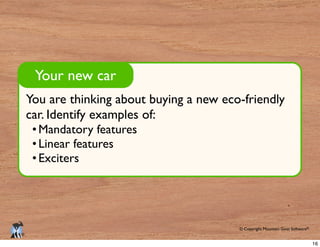
You are thinking about buying a new eco-friendly
car. Identify examples of:
Mandatory features
Linear features
Exciters
Your new car
16
© Copyright Mountain Goat Software®
®
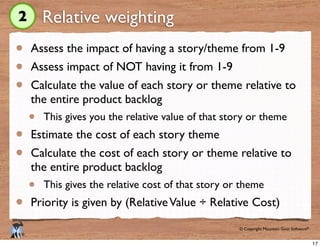
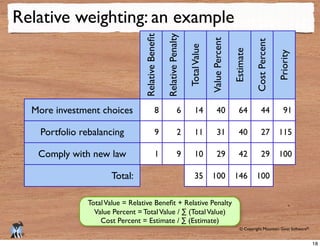
Relative weighting
Assess the impact of having a story/theme from 1-9
Assess impact of NOT having it from 1-9
Calculate the value of each story or theme relative to
the entire product backlog
This gives you the relative value of that story or theme
Estimate the cost of each story theme
Calculate the cost of each story or theme relative to
the entire product backlog
This gives the relative cost of that story or theme
Priority is given by (RelativeValue ÷ Relative Cost)
2
17
© Copyright Mountain Goat Software®
®
Relative weighting: an example
More investment choices
Portfolio rebalancing
Comply with new law
Total: RelativePenalty
TotalValue
ValuePercent
Estimate
CostPercent
Priority
8
9
1
6
2
9
14
11
10
35
40
31
29
100
64
40
42
146
44
27
29
100
91
115
100
Value Percent = TotalValue / ∑ (TotalValue)
Cost Percent = Estimate / ∑ (Estimate)
18
© Copyright Mountain Goat Software®
®
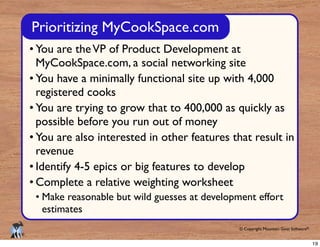
You are theVP of Product Development at
MyCookSpace.com, a social networking site
You have a minimally functional site up with 4,000
registered cooks
You are trying to grow that to 400,000 as quickly as
possible before you run out of money
You are also interested in other features that result in
revenue
Identify 4-5 epics or big features to develop
Complete a relative weighting worksheet
Make reasonable but wild guesses at development effort
estimates
Prioritizing MyCookSpace.com
19
© Copyright Mountain Goat Software®
®
20
© Copyright Mountain Goat Software®
®
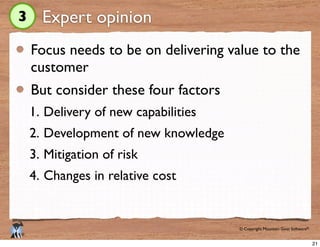
Expert opinion
Focus needs to be on delivering value to the
customer
But consider these four factors
1. Delivery of new capabilities
2. Development of new knowledge
3. Mitigation of risk
4. Changes in relative cost
3
21
© Copyright Mountain Goat Software®
®
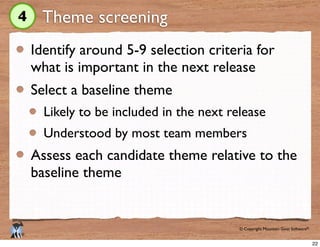
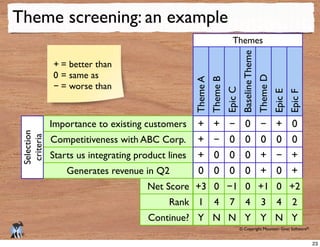
Theme screening
Identify around 5-9 selection criteria for
what is important in the next release
Select a baseline theme
Likely to be included in the next release
Understood by most team members
Assess each candidate theme relative to the
baseline theme
4
22
© Copyright Mountain Goat Software®
®
Theme screening: an example
Continue?
ThemeARank
Net Score
Generates revenue in Q2
Starts us integrating product lines
Competitiveness with ABC Corp.
Importance to existing customers
0
ThemeB
−
0
0
EpicC
BaselineTheme
ThemeD
EpicE
EpicF
0
−
0
0
0
−1
0
0
0
0
0
−
0 0
−
0
0
0
0
1 7 34 4 4 2
N N NY Y Y Y
Selection
criteria Themes
	

= better than
0	

= same as
−	

= worse than
23
© Copyright Mountain Goat Software®
®
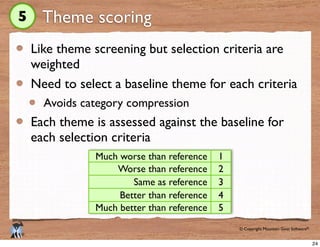
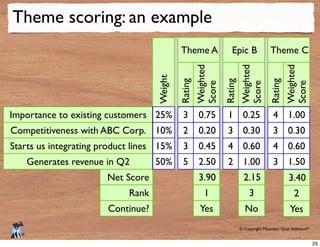
Theme scoring
Like theme screening but selection criteria are
weighted
Need to select a baseline theme for each criteria
Avoids category compression
Each theme is assessed against the baseline for
each selection criteria
5
Much worse than reference 1
Worse than reference 2
Same as reference 3
Better than reference 4
Much better than reference 5
24
© Copyright Mountain Goat Software®
®
3.90
1 3 2
Yes No Yes
Theme scoring: an example
Continue?
Rank
Net Score
Generates revenue in Q2
Starts us integrating product lines
Competitiveness with ABC Corp.
Importance to existing customers
Weight
Rating
Theme A
Weighted
Score
3
2
3
5
0.75
0.20
0.45
2.50
Rating
Epic B
Weighted
Score
1
3
4
2
2.15
0.25
0.30
0.60
1.00
Rating
Theme C
Weighted
Score
4
3
4
3
3.40
1.00
0.30
0.60
1.50
25%
10%
15%
50%
25
© Copyright Mountain Goat Software®
®
the relative weighting exercise, complete
a theme screening or theme scoring
worksheet for MyCookSpace.com
Theme screening or scoring
26
© Copyright Mountain Goat Software®
®
Financial
prioritization
27
© Copyright Mountain Goat Software®
®
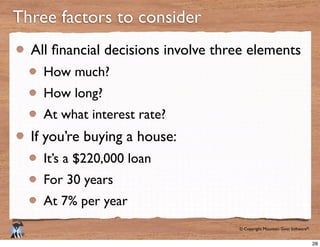
How much?
How long?
At what interest rate?
If you’re buying a house:
It’s a $220,000 loan
For 30 years
At 7% per year
Three factors to consider
28
© Copyright Mountain Goat Software®
®
Technique #1
Net PresentValue (NPV)
29
© Copyright Mountain Goat Software®
®
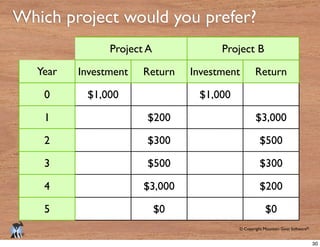
Which project would you prefer?
Year
Projeect A Projeect B
Investment Return Investment Return
0
1
2
3
4
5
$1,000 $1,000
$200 $3,000
$300 $500
$500 $300
$3,000 $200
$0 $0
30
© Copyright Mountain Goat Software®
®
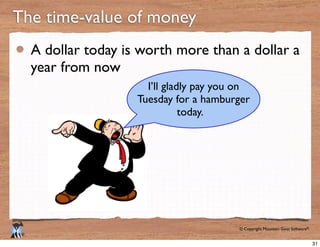
A dollar today is worth more than a dollar a
year from now
The time-value of money
I’ll gladly pay you on
Tuesday for a hamburger
today.
31
© Copyright Mountain Goat Software®
®
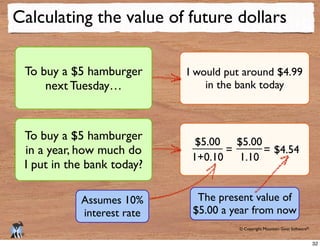
Calculating the value of future dollars
To buy a $5 hamburger
next Tuesday…
To buy a $5 hamburger
in a year, how much do
I put in the bank today?
I would put around $4.99
in the bank today
$5.00 $5.00
1.10
$4.54==
Assumes 10%
interest rate
The present value of
$5.00 a year from now
32
© 2009 Mountain Goat Software© Copyright Mountain Goat Software®
®
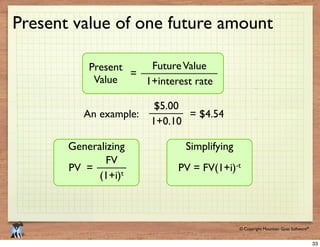
Present value of one future amount
FutureValuePresent
Value
=
$5.00
= $4.54An example:
Generalizing
FV
t
PV =
Simplifying
-t
33
© Copyright Mountain Goat Software®
®
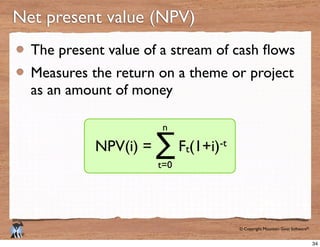
Measures the return on a theme or project
as an amount of money
Net present value (NPV)
Ft
-tNPV(i) = ∑t=0
n
34
© Copyright Mountain Goat Software®
®
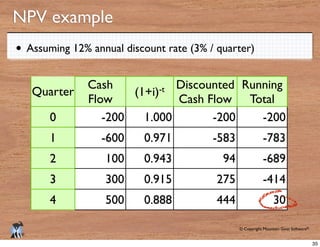
NPV example
Quarter
Cash
Flow
-t Discounted
Cash Flow
Running
Total
0
1
2
3
4
-200 1.000 -200 -200
-600 0.971 -583 -783
100 0.943 94 -689
300 0.915 275 -414
500 0.888 444 30
Assuming 12% annual discount rate (3% / quarter)
35
© Copyright Mountain Goat Software®
®
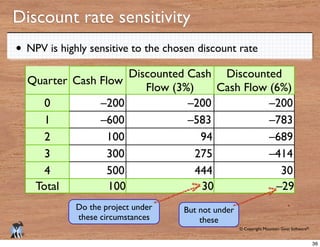
Discount rate sensitivity
Quarter Cash Flow
Discounted Cash
Flow (3%)
Discounted
Cash Flow (6%)
0
1
2
3
4
Total
–200 –200 –200
–600 –583 –783
100 94 –689
300 275 –414
500 444 30
100 30 –29
NPV is highly sensitive to the chosen discount rate
Do the project under
these circumstances
But not under
these
36
© 2009 Mountain Goat Software© Copyright Mountain Goat Software®
®
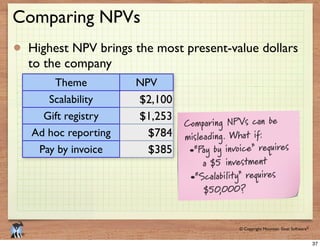
Comparing NPVs
Highest NPV brings the most present-value dollars
to the company
Theme NPV
Scalability
Gift registry
Ad hoc reporting
Pay by invoice
$2,100
$1,253
$784
$385
Comparing NPVs can be
misleading. What if:
•“Pay by invoice” requires
a $5 investment
•“Scalability” requires
$50,000?
37
© Copyright Mountain Goat Software®
®
Technique #2
Internal Rate
of
Return (IRR)
38
© Copyright Mountain Goat Software®
®
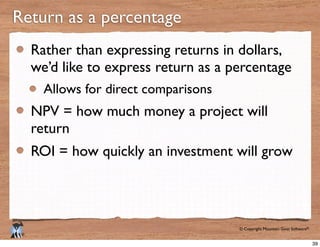
Rather than expressing returns in dollars,
we’d like to express return as a percentage
Allows for direct comparisons
NPV = how much money a project will
return
ROI = how quickly an investment will grow
Return as a percentage
39
© Copyright Mountain Goat Software®
®
Internal rate of return (IRR) and ROI
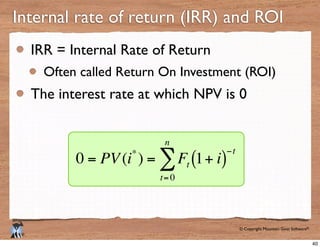
IRR = Internal Rate of Return
Often called Return On Investment (ROI)
The interest rate at which NPV is 0
0 = PV(i*
) = Ft 1+ i( )
−t
t= 0
n
∑
40
© Copyright Mountain Goat Software®
®
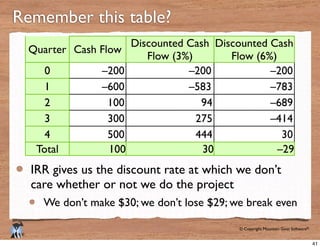
IRR gives us the discount rate at which we don’t
care whether or not we do the project
We don’t make $30; we don’t lose $29; we break even
Remember this table?
Quarter Cash Flow
Discounted Cash
Flow (3%)
Discounted Cash
Flow (6%)
0
1
2
3
4
Total
–200 –200 –200
–600 –583 –783
100 94 –689
300 275 –414
500 444 30
100 30 –29
41
© Copyright Mountain Goat Software®
®
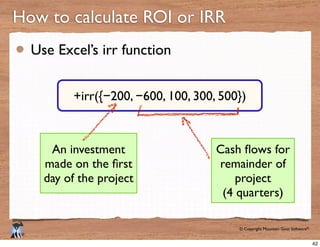
Use Excel’s irr function
How to calculate ROI or IRR
−200, −600, 100, 300, 500})
An investment
day of the project
remainder of
project
(4 quarters)
42
© Copyright Mountain Goat Software®
®
Advantages and disadvantages
Advantages
You don’t need to guess at a discount rate like
with NPV
Can be used to directly compare projects
Disadvantages
Calculation is hard to do by hand (but easy in
Excel); may lead to numbers being distrusted
Cannot use in all circumstances
positive
43
© Copyright Mountain Goat Software®
®
Technique #3
Payback period
44
© 2009 Mountain Goat Software© Copyright Mountain Goat Software®
®
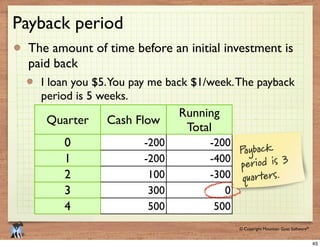
Payback period
The amount of time before an initial investment is
paid back
I loan you $5.You pay me back $1/week.The payback
period is 5 weeks.
Quarter Cash Flow
Running
Total
0
1
2
3
4
-200 -200
-200 -400
100 -300
300 0
500 500
Payback
period is 3
quarters.
45
© Copyright Mountain Goat Software®
®
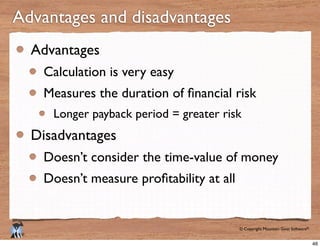
Advantages
Calculation is very easy
Longer payback period = greater risk
Disadvantages
Doesn’t consider the time-value of money
Advantages and disadvantages
46
© Copyright Mountain Goat Software®
®
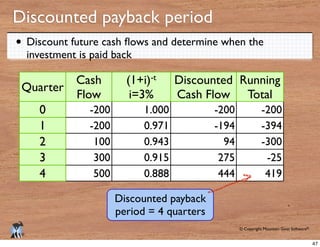
Discounted payback period
Quarter
Cash
Flow
-t
i=3%
Discounted
Cash Flow
Running
Total
0
1
2
3
4
-200 1.000 -200 -200
-200 0.971 -194 -394
100 0.943 94 -300
300 0.915 275 -25
500 0.888 444 419
investment is paid back
Discounted payback
period = 4 quarters
47
© Copyright Mountain Goat Software®
®
Net PresentValue (NPV)
Expresses return as an amount of money
Return on Investment (ROI) / Internal Rate of Return
The interest rate at which NPV = 0
That is, at which you’d be indifferent to the investment
Expresses return as a percentage
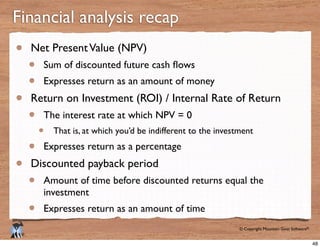
Discounted payback period
Amount of time before discounted returns equal the
investment
Expresses return as an amount of time
Financial analysis recap
48
© Copyright Mountain Goat Software®
®
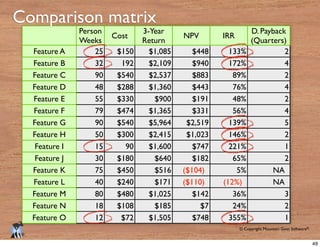
Person
Weeks
Cost
3-Year
Return
NPV IRR
D. Payback
(Quarters)
Feature A
Feature B
Feature C
Feature D
Feature E
Feature F
Feature G
Feature H
Feature I
Feature J
Feature K
Feature L
Feature M
Feature N
Feature O
25 $150 $1,085 $448 133% 2
32 192 $2,109 $940 172% 4
90 $540 $2,537 $883 89% 2
48 $288 $1,360 $443 76% 4
55 $330 $900 $191 48% 2
79 $474 $1,365 $331 56% 4
90 $540 $5,964 $2,519 139% 5
50 $300 $2,415 $1,023 146% 2
15 90 $1,600 $747 221% 1
30 $180 $640 $182 65% 2
75 $450 $516 ($104) 5% NA
40 $240 $171 ($110) (12%) NA
80 $480 $1,025 $142 36% 3
18 $108 $185 $7 24% 2
12 $72 $1,505 $748 355% 1
Comparison matrix
49
© Copyright Mountain Goat Software®
®
Mike Cohn
mike@mountaingoatsoftware.com
www.mountaingoatsoftware.com
twitter: mikewcohn
(720) 890−6110
50

Prioritizing Your Product Backlog

  • 1.
    © 2009 MountainGoat Software© Copyright Mountain Goat Software® Prioritizing Your Product Backlog Mike Cohn mike@mountaingoatsoftware.com June 8, 2010 1
  • 2.
    © Copyright MountainGoat Software® ® Mike Cohn Founding member and director of Agile Alliance and Scrum Alliance Founder of Mountain Goat Software Doing Scrum since 1995 Started my career as a programmer 2
  • 3.
    © Copyright MountainGoat Software® ® Combine formal & informal Formal prioritization approaches for Choosing among projects Choosing between “epics” or “big features” An informal approach (expert opinion) Once you’ve selected the epics / big features 3
  • 4.
    © Copyright MountainGoat Software® ® Why? Features that are too small cannot be effectively prioritized against each other What’s more important in a word processor? The A key or the E key? Tables or undo? What’s more important on a car? The left front wheel or the right front wheel? Increased leg room or a larger engine? 4
  • 5.
    © Copyright MountainGoat Software® ® 5
  • 6.
    © Copyright MountainGoat Software® ® Prioritize epics then open them up to optimize release contents The release 6
  • 7.
    © Copyright MountainGoat Software® ® Approaches to prioritizing Kano analysis Expert opinion Theme screening Theme scoring Relative weighting Financial analysis 7
  • 8.
    © Copyright MountainGoat Software® ® Non-financial prioritization 8
  • 9.
    © Copyright MountainGoat Software® ® Kano analysis1 Must be present in order for users to be Mandatory / Baseline The more of it, the better Linear Features a user doesn’t know she wants, until she sees it Exciters / Delighters 9
  • 10.
    © 2009 MountainGoat Software© Copyright Mountain Goat Software® ® Impact on user satisfaction Feature Presence SatisfactionLowHigh Low High Exciters/ Delighters Mandatory Linear 10
  • 11.
    © Copyright MountainGoat Software® ® Surveying users To assess whether a feature is baseline, linear, or exciting we can: Sometimes guess Or survey a small set of users (20-30) We ask two questions A functional question How do you feel if a feature is present? And a dysfunctional question How do you feel if that feature is absent? 11
  • 12.
    © Copyright MountainGoat Software® ® Functional and dysfunctional forms If your hotel room includes a free bottle of water, how do you feel? I expect it to be that way. I like it that way. I am neutral. I can live with it that way. I dislike it that way. ✔ If your hotel room does not include a free bottle of water, how do you feel? I expect it to be that way. I like it that way. I am neutral. I can live with it that way. I dislike it that way. ✔ Functional form of question Dysfunctional form of question 12
  • 13.
    © Copyright MountainGoat Software® ® Categorizing an answer pair Dysfuncctional Quuestion Like Expect Neutral Live with Dislike Like Expect Neutral Live with Dislike Q E E E L R I I I M R I I I M R I I I M R R R R Q Functional Question Mandatory Linear Exciter Questionable Reverse Indifferent 13
  • 14.
    © Copyright MountainGoat Software® ® Aggregating results Apply stylesheets Automate report execution Export reports to PowerPoint 3 11 31 1 3 2 4 22 20 4 1 0 21 9 14 5 1 1 Questionable Reverse Indifferent Mandatory Linear Exciter Themes 14
  • 15.
    © Copyright MountainGoat Software® ® What to include All of the baseline features Some amount of linear features But leaving room for at least a few exciters 15
  • 16.
    © Copyright MountainGoat Software® ® You are thinking about buying a new eco-friendly car. Identify examples of: Mandatory features Linear features Exciters Your new car 16
  • 17.
    © Copyright MountainGoat Software® ® Relative weighting Assess the impact of having a story/theme from 1-9 Assess impact of NOT having it from 1-9 Calculate the value of each story or theme relative to the entire product backlog This gives you the relative value of that story or theme Estimate the cost of each story theme Calculate the cost of each story or theme relative to the entire product backlog This gives the relative cost of that story or theme Priority is given by (RelativeValue ÷ Relative Cost) 2 17
  • 18.
    © Copyright MountainGoat Software® ® Relative weighting: an example More investment choices Portfolio rebalancing Comply with new law Total: RelativePenalty TotalValue ValuePercent Estimate CostPercent Priority 8 9 1 6 2 9 14 11 10 35 40 31 29 100 64 40 42 146 44 27 29 100 91 115 100 Value Percent = TotalValue / ∑ (TotalValue) Cost Percent = Estimate / ∑ (Estimate) 18
  • 19.
    © Copyright MountainGoat Software® ® You are theVP of Product Development at MyCookSpace.com, a social networking site You have a minimally functional site up with 4,000 registered cooks You are trying to grow that to 400,000 as quickly as possible before you run out of money You are also interested in other features that result in revenue Identify 4-5 epics or big features to develop Complete a relative weighting worksheet Make reasonable but wild guesses at development effort estimates Prioritizing MyCookSpace.com 19
  • 20.
    © Copyright MountainGoat Software® ® 20
  • 21.
    © Copyright MountainGoat Software® ® Expert opinion Focus needs to be on delivering value to the customer But consider these four factors 1. Delivery of new capabilities 2. Development of new knowledge 3. Mitigation of risk 4. Changes in relative cost 3 21
  • 22.
    © Copyright MountainGoat Software® ® Theme screening Identify around 5-9 selection criteria for what is important in the next release Select a baseline theme Likely to be included in the next release Understood by most team members Assess each candidate theme relative to the baseline theme 4 22
  • 23.
    © Copyright MountainGoat Software® ® Theme screening: an example Continue? ThemeARank Net Score Generates revenue in Q2 Starts us integrating product lines Competitiveness with ABC Corp. Importance to existing customers 0 ThemeB − 0 0 EpicC BaselineTheme ThemeD EpicE EpicF 0 − 0 0 0 −1 0 0 0 0 0 − 0 0 − 0 0 0 0 1 7 34 4 4 2 N N NY Y Y Y Selection criteria Themes = better than 0 = same as − = worse than 23
  • 24.
    © Copyright MountainGoat Software® ® Theme scoring Like theme screening but selection criteria are weighted Need to select a baseline theme for each criteria Avoids category compression Each theme is assessed against the baseline for each selection criteria 5 Much worse than reference 1 Worse than reference 2 Same as reference 3 Better than reference 4 Much better than reference 5 24
  • 25.
    © Copyright MountainGoat Software® ® 3.90 1 3 2 Yes No Yes Theme scoring: an example Continue? Rank Net Score Generates revenue in Q2 Starts us integrating product lines Competitiveness with ABC Corp. Importance to existing customers Weight Rating Theme A Weighted Score 3 2 3 5 0.75 0.20 0.45 2.50 Rating Epic B Weighted Score 1 3 4 2 2.15 0.25 0.30 0.60 1.00 Rating Theme C Weighted Score 4 3 4 3 3.40 1.00 0.30 0.60 1.50 25% 10% 15% 50% 25
  • 26.
    © Copyright MountainGoat Software® ® the relative weighting exercise, complete a theme screening or theme scoring worksheet for MyCookSpace.com Theme screening or scoring 26
  • 27.
    © Copyright MountainGoat Software® ® Financial prioritization 27
  • 28.
    © Copyright MountainGoat Software® ® How much? How long? At what interest rate? If you’re buying a house: It’s a $220,000 loan For 30 years At 7% per year Three factors to consider 28
  • 29.
    © Copyright MountainGoat Software® ® Technique #1 Net PresentValue (NPV) 29
  • 30.
    © Copyright MountainGoat Software® ® Which project would you prefer? Year Projeect A Projeect B Investment Return Investment Return 0 1 2 3 4 5 $1,000 $1,000 $200 $3,000 $300 $500 $500 $300 $3,000 $200 $0 $0 30
  • 31.
    © Copyright MountainGoat Software® ® A dollar today is worth more than a dollar a year from now The time-value of money I’ll gladly pay you on Tuesday for a hamburger today. 31
  • 32.
    © Copyright MountainGoat Software® ® Calculating the value of future dollars To buy a $5 hamburger next Tuesday… To buy a $5 hamburger in a year, how much do I put in the bank today? I would put around $4.99 in the bank today $5.00 $5.00 1.10 $4.54== Assumes 10% interest rate The present value of $5.00 a year from now 32
  • 33.
    © 2009 MountainGoat Software© Copyright Mountain Goat Software® ® Present value of one future amount FutureValuePresent Value = $5.00 = $4.54An example: Generalizing FV t PV = Simplifying -t 33
  • 34.
    © Copyright MountainGoat Software® ® Measures the return on a theme or project as an amount of money Net present value (NPV) Ft -tNPV(i) = ∑t=0 n 34
  • 35.
    © Copyright MountainGoat Software® ® NPV example Quarter Cash Flow -t Discounted Cash Flow Running Total 0 1 2 3 4 -200 1.000 -200 -200 -600 0.971 -583 -783 100 0.943 94 -689 300 0.915 275 -414 500 0.888 444 30 Assuming 12% annual discount rate (3% / quarter) 35
  • 36.
    © Copyright MountainGoat Software® ® Discount rate sensitivity Quarter Cash Flow Discounted Cash Flow (3%) Discounted Cash Flow (6%) 0 1 2 3 4 Total –200 –200 –200 –600 –583 –783 100 94 –689 300 275 –414 500 444 30 100 30 –29 NPV is highly sensitive to the chosen discount rate Do the project under these circumstances But not under these 36
  • 37.
    © 2009 MountainGoat Software© Copyright Mountain Goat Software® ® Comparing NPVs Highest NPV brings the most present-value dollars to the company Theme NPV Scalability Gift registry Ad hoc reporting Pay by invoice $2,100 $1,253 $784 $385 Comparing NPVs can be misleading. What if: •“Pay by invoice” requires a $5 investment •“Scalability” requires $50,000? 37
  • 38.
    © Copyright MountainGoat Software® ® Technique #2 Internal Rate of Return (IRR) 38
  • 39.
    © Copyright MountainGoat Software® ® Rather than expressing returns in dollars, we’d like to express return as a percentage Allows for direct comparisons NPV = how much money a project will return ROI = how quickly an investment will grow Return as a percentage 39
  • 40.
    © Copyright MountainGoat Software® ® Internal rate of return (IRR) and ROI IRR = Internal Rate of Return Often called Return On Investment (ROI) The interest rate at which NPV is 0 0 = PV(i* ) = Ft 1+ i( ) −t t= 0 n ∑ 40
  • 41.
    © Copyright MountainGoat Software® ® IRR gives us the discount rate at which we don’t care whether or not we do the project We don’t make $30; we don’t lose $29; we break even Remember this table? Quarter Cash Flow Discounted Cash Flow (3%) Discounted Cash Flow (6%) 0 1 2 3 4 Total –200 –200 –200 –600 –583 –783 100 94 –689 300 275 –414 500 444 30 100 30 –29 41
  • 42.
    © Copyright MountainGoat Software® ® Use Excel’s irr function How to calculate ROI or IRR −200, −600, 100, 300, 500}) An investment day of the project remainder of project (4 quarters) 42
  • 43.
    © Copyright MountainGoat Software® ® Advantages and disadvantages Advantages You don’t need to guess at a discount rate like with NPV Can be used to directly compare projects Disadvantages Calculation is hard to do by hand (but easy in Excel); may lead to numbers being distrusted Cannot use in all circumstances positive 43
  • 44.
    © Copyright MountainGoat Software® ® Technique #3 Payback period 44
  • 45.
    © 2009 MountainGoat Software© Copyright Mountain Goat Software® ® Payback period The amount of time before an initial investment is paid back I loan you $5.You pay me back $1/week.The payback period is 5 weeks. Quarter Cash Flow Running Total 0 1 2 3 4 -200 -200 -200 -400 100 -300 300 0 500 500 Payback period is 3 quarters. 45
  • 46.
    © Copyright MountainGoat Software® ® Advantages Calculation is very easy Longer payback period = greater risk Disadvantages Doesn’t consider the time-value of money Advantages and disadvantages 46
  • 47.
    © Copyright MountainGoat Software® ® Discounted payback period Quarter Cash Flow -t i=3% Discounted Cash Flow Running Total 0 1 2 3 4 -200 1.000 -200 -200 -200 0.971 -194 -394 100 0.943 94 -300 300 0.915 275 -25 500 0.888 444 419 investment is paid back Discounted payback period = 4 quarters 47
  • 48.
    © Copyright MountainGoat Software® ® Net PresentValue (NPV) Expresses return as an amount of money Return on Investment (ROI) / Internal Rate of Return The interest rate at which NPV = 0 That is, at which you’d be indifferent to the investment Expresses return as a percentage Discounted payback period Amount of time before discounted returns equal the investment Expresses return as an amount of time Financial analysis recap 48
  • 49.
    © Copyright MountainGoat Software® ® Person Weeks Cost 3-Year Return NPV IRR D. Payback (Quarters) Feature A Feature B Feature C Feature D Feature E Feature F Feature G Feature H Feature I Feature J Feature K Feature L Feature M Feature N Feature O 25 $150 $1,085 $448 133% 2 32 192 $2,109 $940 172% 4 90 $540 $2,537 $883 89% 2 48 $288 $1,360 $443 76% 4 55 $330 $900 $191 48% 2 79 $474 $1,365 $331 56% 4 90 $540 $5,964 $2,519 139% 5 50 $300 $2,415 $1,023 146% 2 15 90 $1,600 $747 221% 1 30 $180 $640 $182 65% 2 75 $450 $516 ($104) 5% NA 40 $240 $171 ($110) (12%) NA 80 $480 $1,025 $142 36% 3 18 $108 $185 $7 24% 2 12 $72 $1,505 $748 355% 1 Comparison matrix 49
  • 50.
    © Copyright MountainGoat Software® ® Mike Cohn mike@mountaingoatsoftware.com www.mountaingoatsoftware.com twitter: mikewcohn (720) 890−6110 50