Part 2. How to make work work again.
How to break the barrier of command-and-control –
and create the peak-performance, networked organization
BetaCodex Network Associates
Niels Pflaeging & Silke Hermann & Lars Vollmer
Illustrations by Pia Steinmann
BetaCodex Network White Paper No. 13, June 2012
Make it real!
ORGANIZE
FOR
COMPLEXITY
This paper addresses fundamental questions of interest to
business owners, managers, professionals and change agents
This is the 2nd part of our paper.
Some of the questions you will find addressed in it are:
•  How can organizations deal with growing complexity?
•  How to adjust a growing organization, without creating
falling into the bureaucracy trap?
•  How to become more capable of adapting to new
circumstances?
•  How to overcome existing barriers to performance,
innovation and growth?
•  How to become an organization more fit to human beings,
and achieve higher engagement?
•  How to produce profound change, without hitting the
barrier?
In this paper, you will learn about concepts that allow to
design entire organizations for complexity, regardless of size,
age, industry, country or culture.
Part 4.
Organizations as systems: How to design for complexity
“Organize for Complexity“ - BetaCodex Network White Paper No. 13
The dominant mindset turned into a problem:
To imagine organizations as pyramids is a misguided metaphor
Design principle "Alpha":
The organization as a bureaucratic
hierarchy, steered by managers who
are always in control
Managers commanding/controlling a
pyramid of “followers” from above is
not a smart way to organize. Most of
us sense that, intuitively: Our
experience from practice contradicts
that this can actually work.
This remains, however, the dominant
mindset in companies, since the
development of management theory
about a century ago. When we speak
of “management”, we usually refer to
techniques, tools and models aimed
at improving, optimizing, or fixing
organizations as command-and-
control pyramids.
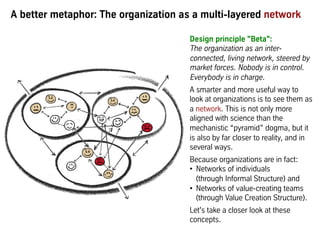
Design principle "Beta":
The organization as an inter-
connected, living network, steered by
market forces. Nobody is in control.
Everybody is in charge.
A smarter and more useful way to
look at organizations is to see them as
a network. This is not only more
aligned with science than the
mechanistic “pyramid” dogma, but it
is also by far closer to reality, and in
several ways.
Because organizations are in fact:
•  Networks of individuals
(through Informal Structure) and
•  Networks of value-creating teams
(through Value Creation Structure).
Let's take a closer look at these
concepts.
A better metaphor: The organization as a multi-layered network
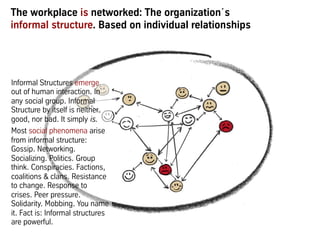
The workplace is networked: The organization´s
informal structure. Based on individual relationships
Informal Structures emerge
out of human interaction. In
any social group. Informal
Structure by itself is neither
good, nor bad. It simply is.
Most social phenomena arise
from informal structure:
Gossip. Networking.
Socializing. Politics. Group
think. Conspiracies. Factions,
coalitions & clans. Resistance
to change. Response to
crises. Peer pressure.
Solidarity. Mobbing. You name
it. Fact is: Informal structures
are powerful.
The workplace is networked: The organization's
value creation structure, based on team interaction
In an organization, value-creation
flows from the inside-out.
Value creation is never the result of
individual action: It is a team-based
process of working interactively,
“with-one-another-for-each-other”.
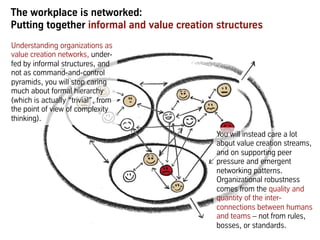
The workplace is networked:
Putting together informal and value creation structures
You will instead care a lot
about value creation streams,
and on supporting peer
pressure and emergent
networking patterns.
Organizational robustness
comes from the quality and
quantity of the inter-
connections between humans
and teams – not from rules,
bosses, or standards.
Understanding organizations as
value creation networks, under-
fed by informal structures, and
not as command-and-control
pyramids, you will stop caring
much about formal hierarchy
(which is actually “trivial”, from
the point of view of complexity
thinking).
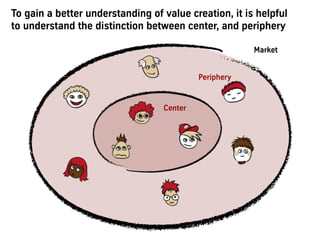
To gain a better understanding of value creation, it is helpful
to understand the distinction between center, and periphery
Center
Market
Periphery
The periphery: the only part of the organization
with market contact
Center
Market
Periphery
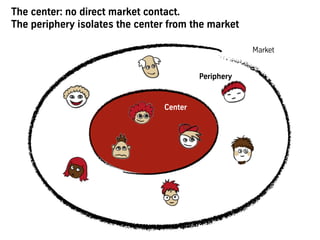
The center: no direct market contact.
The periphery isolates the center from the market
Center
Market
Periphery
2 Information
4 Command
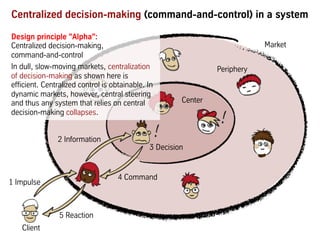
Centralized decision-making (command-and-control) in a system
1 Impulse
4 Command
3 Decision
2 Information
5 Reaction
Center
Market
Periphery
Client
!
Design principle "Alpha":
Centralized decision-making,
command-and-control
In dull, slow-moving markets, centralization
of decision-making as shown here is
efficient. Centralized control is obtainable. In
dynamic markets, however, central steering
and thus any system that relies on central
decision-making collapses.
2 Information
4 Command
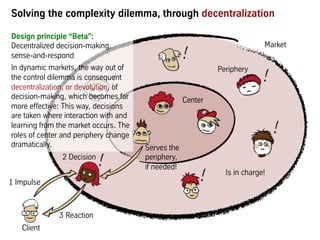
Solving the complexity dilemma, through decentralization
2 Decision
Center
Market
Periphery
Serves the
periphery,
if needed!
Is in charge!
1 Impulse
3 Reaction
Client
Design principle “Beta”:
Decentralized decision-making,
sense-and-respond
In dynamic markets, the way out of
the control dilemma is consequent
decentralization, or devolution, of
decision-making, which becomes far
more effective: This way, decisions
are taken where interaction with and
learning from the market occurs. The
roles of center and periphery change
dramatically.
Part 5.
How to transform your organization into a
complexity-robust network and how to turn
“Beta” into the dominant mindset
“Organize for Complexity“ - BetaCodex Network White Paper No. 13
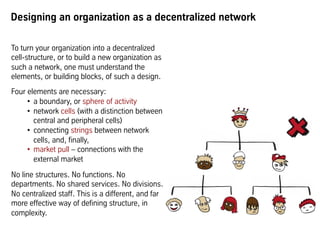
Designing an organization as a decentralized network
To turn your organization into a decentralized
cell-structure, or to build a new organization as
such a network, one must understand the
elements, or building blocks, of such a design.
Four elements are necessary:
•  a boundary, or sphere of activity
•  network cells (with a distinction between
central and peripheral cells)
•  connecting strings between network
cells, and, finally,
•  market pull – connections with the
external market
No line structures. No functions. No
departments. No shared services. No divisions.
No centralized staff. This is a different, and far
more effective way of defining structure, in
complexity.
Identity and the sphere of activity
Organization & teams
Sphere of Activity
- (shared) Values
- Principles
- Positioning
- Rituals
- Memes
- ...
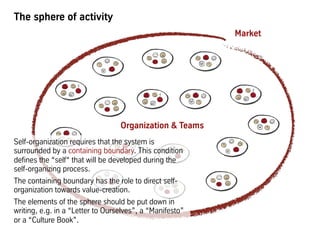
The sphere of activity
Organization & Teams
Market
Self-organization requires that the system is
surrounded by a containing boundary. This condition
defines the “self“ that will be developed during the
self-organizing process.
The containing boundary has the role to direct self-
organization towards value-creation.
The elements of the sphere should be put down in
writing, e.g. in a “Letter to Ourselves”, a “Manifesto”
or a “Culture Book”.
The market and its components
Organization & teams
Market
- Customers
- Owners
- Banks
- Society
- Competitors
- Unions
- ….
Value-creation flows from the inside out.
Market-pull does the steering.
Center
Market
Periphery
A cell-structure network gains stability and
resilience not through hierarchical power
relationships, or through “resistance to
pressure”, but through the “pull” that comes
from the external market, and from the
complex human relationships it nourishes
internally. Market dynamics do the steering.
Sounds simple? It is.
From value-creating teams to value-creating network
We call the links between network cells strings.
We call the links of peripheral cells
with the market market pull.
Market pull: Only peripheral cells have direct links to the
market and can thus deliver value externally
Step 1 in drafting your organization as a value-flow network:
Start from the outside-in, by thinking about peripheral cells first
Peripheral cells should be:
•  As autonomous as possible in their decision-
making, functioning like “mini-enterprises”,
responsible for a business, holistically
•  Contain no less than 3 team members each,
with cross-functional capacities
•  Measuring their own results
Step 2: Design central cells as internally
value-creating supply units
The role of central cells is to
deliver value to peripheral
teams that these cannot create
themselves.
Their role is to serve, not to
rule the periphery. It is not to
execute power, or control.
Ideally, these teams sell their
services to peripheral cells
through priced transactions,
and on an internal market.
Examples for how to do this
exist at companies such as
Handelsbanken, dm-drogerie
markt, and Morning Star.
Central network cells
Central services might include:
•  Human Resources
•  Finance
•  System Administration (IT)
•  Juridical
•  Centers of Expertise
•  Communities of Practice
•  ...
In smaller organizations, there
might simply be central “shops”,
•  “Org Shop” – a team delivering
organization services, and
•  “Info Shop” - a team delivering
services related to information
Step 3: Iterate – involve many, many people
in the process of designing a full network structure
Usually, you will have to go through a
few iterations to arrive at a value-
structure design that is not only better
than the previous formal structure, but
also as decentralized as possible,
scalable and viable in the long-term.
More often than not, an organization
will make adjustments after some
initial learning with the new design.
Individuals and “portfolios of roles”:
A normality in decentralized network structures
In a decentralized network structure, “positions” cease to
exist. “Roles” rule. Individuals usually are not confined to
one network cell alone, but will act in different cells, filling
in different roles in different parts of the network.
Consequently, everyone keeps “juggling with roles“, all
the time.
An example: A person with the official title of ”CFO“ on
the business card would play a role in a central cell when
serving other teams of the network, but be part of a
peripheral cell when dealing with a bank. The same
person might also fulfill additional roles within the
organization that might have little or nothing to do with
finance.
Part 6.
Additional recommendations
“Organize for Complexity“ - BetaCodex Network White Paper No. 13
Promote a result-based achievement culture
Make team performance visible (results only!), to nurture a
team-based “winning culture”.
Never, ever, attempt to manage individual performance,
though, as individual performance simply does not exist.
Stop managing working time or controlling individual
behavior - “behaviorism” has been proved wrong a long
time ago!
What works, instead: The most adaptive and successful
organizations focus on nurturing a culture that highlights
the importance of “fun, while winning in the marketplace.”
You cannot have that controlling individual's behavior.
Promote self-development and mastery
You cannot and need not develop people. People can
do that on their own. An organization, however, can
create and should create conditions and forums for
self-development, and it can also take care that
leaders get out of the way by not trying to control or
contain self-development.
Individual mastery is the only viable problem-solving
mechanism in complexity.
We usually tend to overrate talent, and underrate
systematic, disciplined learning. We tend to overrate
class-room training, and underrate learning that is
integrated into the actual work life. We tend to overrate
formal instruction and underrate inspirational
interaction, informal networking and communities of
practice.
Training budgets only serve for control – not for
learning. So scrap them and make learning resources
available to those who learn, on demand.
Cultivate principles, not rules
Simple/few principles > Complex behavior
Complicated/many rules > Stupid behavior
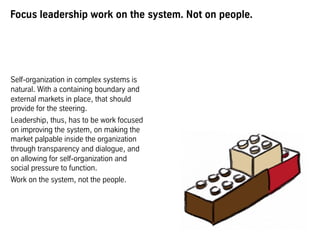
Focus leadership work on the system. Not on people.
Self-organization in complex systems is
natural. With a containing boundary and
external markets in place, that should
provide for the steering.
Leadership, thus, has to be work focused
on improving the system, on making the
market palpable inside the organization
through transparency and dialogue, and
on allowing for self-organization and
social pressure to function.
Work on the system, not the people.
Practice radical transparency
Information is to entrepreneurial responsibility
what oxygen is to the human body.
In an organization, without fast and easy access to
information – including that on team performance and
financial results or the organization – teams and
individuals will be waking around in darkness.
Transparency is like turning the light on.
Transparency makes ambition, a healthy spirit of
competitiveness, and group or peer pressure, possible.
Having “open books“ is part of that. If you find yourself
thinking about possible ”dangers“ of opening the books,
then you probably haven't thought the topic through, yet.
Then it's time to do that, now.
Make targets, measures and compensation “relative“
In dynamic markets, prognosis
becomes impossible. Planning turns
into a futile, if not dangerous ritual. In
knowledge-intensive work, dangling
carrots in front of people not only fails
to work, it actually de-motivates
people, strangles engagement and
team spirit.
Direction through targets, measuring
of performance, and compensation
systems have to consider complexity
and the nature of human motivation.
Let purpose drive behavior, not
numbers or manipulative and
controlling processes.
Fixed & individual targets
Management by Objectives
Budgets & Plans
Performance appraisals
Pay by Position
Pay for Performance
Incentives & Bonuses
…
Transparency & Improvement
Peer team comparisons
Comparisons w/previous periods
Dialogue & dissent
Pay by market value
Result sharing
…
Beta
	
  
Alpha
	
  
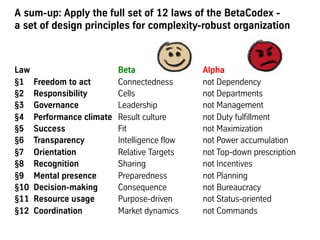
A sum-up: Apply the full set of 12 laws of the BetaCodex -
a set of design principles for complexity-robust organization
Law Beta Alpha
§1 Freedom to act Connectedness not Dependency
§2 Responsibility Cells not Departments
§3 Governance Leadership not Management
§4 Performance climate Result culture not Duty fulfillment
§5 Success Fit not Maximization
§6 Transparency Intelligence flow not Power accumulation
§7 Orientation Relative Targets not Top-down prescription
§8 Recognition Sharing not Incentives
§9 Mental presence Preparedness not Planning
§10 Decision-making Consequence not Bureaucracy
§11 Resource usage Purpose-driven not Status-oriented
§12 Coordination Market dynamics not Commands
More reading and resources
For more about organizational structures, see our white paper no. 11.
For more about cell-structure design: see our white papers no. 8, 9 and 11.
For more about “relative“ performance management: see our white paper no. 10.
For more about problem-solving in complexity, see our white paper no. 7.
For more about the BetaCodex, see our white papers no. 5 and 6.
All papers can be accessed from this page: www.betacodex.org/papers
You are free to use & share this material. If you make use of this material in your work,
please let us know –we would love to learn about that!
We welcome your suggestions to improve future versions of this paper.
Thanks to Pia Steinmann, who crafted all illustrations used in this paper,
and to Jurgen Appelo, whose drawings originally inspired it.
© BetaCodex Network – All rights reservedWhite paper – The 3 Structures of an Organization 25
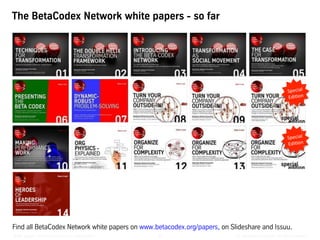
Find all BetaCodex Network white papers on www.betacodex.org/papers and on Slideshare.
Special	
  
Edi+on	
  
Special	
  
Edi+on	
  
The BetaCodex Network white papers - so far
www.organizeforcomplexity.com
The “Organize for Complexity” book
Paperback edition Deluxe edition
(with bonus chapter)
betacodex.org
Get in touch with us for more information about leading BetaCodex transformation,
and ask us for a keynote or a workshop proposal.
Make it real!
Niels Pflaeging
contact@nielspflaeging.com
nielspflaeging.com
New York, Wiesbaden
Valérya Carvalho
mvaleriacarv@gmail.com
LinkedIn
São Paulo
Silke Hermann
silke.hermann@nsights-group.de
insights-group.de
Wiesbaden, Berlin, New York
Lars Vollmer
me@lars-vollmer.com
lars-vollmer.com
Hannover, Stuttgart

Organize for Complexity, part II (BetaCodex13)

  • 1.
    Part 2. Howto make work work again. How to break the barrier of command-and-control – and create the peak-performance, networked organization BetaCodex Network Associates Niels Pflaeging & Silke Hermann & Lars Vollmer Illustrations by Pia Steinmann BetaCodex Network White Paper No. 13, June 2012 Make it real! ORGANIZE FOR COMPLEXITY
  • 2.
    This paper addressesfundamental questions of interest to business owners, managers, professionals and change agents This is the 2nd part of our paper. Some of the questions you will find addressed in it are: •  How can organizations deal with growing complexity? •  How to adjust a growing organization, without creating falling into the bureaucracy trap? •  How to become more capable of adapting to new circumstances? •  How to overcome existing barriers to performance, innovation and growth? •  How to become an organization more fit to human beings, and achieve higher engagement? •  How to produce profound change, without hitting the barrier? In this paper, you will learn about concepts that allow to design entire organizations for complexity, regardless of size, age, industry, country or culture.
  • 3.
    Part 4. Organizations assystems: How to design for complexity “Organize for Complexity“ - BetaCodex Network White Paper No. 13
  • 4.
    The dominant mindsetturned into a problem: To imagine organizations as pyramids is a misguided metaphor Design principle "Alpha": The organization as a bureaucratic hierarchy, steered by managers who are always in control Managers commanding/controlling a pyramid of “followers” from above is not a smart way to organize. Most of us sense that, intuitively: Our experience from practice contradicts that this can actually work. This remains, however, the dominant mindset in companies, since the development of management theory about a century ago. When we speak of “management”, we usually refer to techniques, tools and models aimed at improving, optimizing, or fixing organizations as command-and- control pyramids.
  • 5.
    Design principle "Beta": Theorganization as an inter- connected, living network, steered by market forces. Nobody is in control. Everybody is in charge. A smarter and more useful way to look at organizations is to see them as a network. This is not only more aligned with science than the mechanistic “pyramid” dogma, but it is also by far closer to reality, and in several ways. Because organizations are in fact: •  Networks of individuals (through Informal Structure) and •  Networks of value-creating teams (through Value Creation Structure). Let's take a closer look at these concepts. A better metaphor: The organization as a multi-layered network
  • 6.
    The workplace isnetworked: The organization´s informal structure. Based on individual relationships Informal Structures emerge out of human interaction. In any social group. Informal Structure by itself is neither good, nor bad. It simply is. Most social phenomena arise from informal structure: Gossip. Networking. Socializing. Politics. Group think. Conspiracies. Factions, coalitions & clans. Resistance to change. Response to crises. Peer pressure. Solidarity. Mobbing. You name it. Fact is: Informal structures are powerful.
  • 7.
    The workplace isnetworked: The organization's value creation structure, based on team interaction In an organization, value-creation flows from the inside-out. Value creation is never the result of individual action: It is a team-based process of working interactively, “with-one-another-for-each-other”.
  • 8.
    The workplace isnetworked: Putting together informal and value creation structures You will instead care a lot about value creation streams, and on supporting peer pressure and emergent networking patterns. Organizational robustness comes from the quality and quantity of the inter- connections between humans and teams – not from rules, bosses, or standards. Understanding organizations as value creation networks, under- fed by informal structures, and not as command-and-control pyramids, you will stop caring much about formal hierarchy (which is actually “trivial”, from the point of view of complexity thinking).
  • 9.
    To gain abetter understanding of value creation, it is helpful to understand the distinction between center, and periphery Center Market Periphery
  • 10.
    The periphery: theonly part of the organization with market contact Center Market Periphery
  • 11.
    The center: nodirect market contact. The periphery isolates the center from the market Center Market Periphery
  • 12.
    2 Information 4 Command Centralizeddecision-making (command-and-control) in a system 1 Impulse 4 Command 3 Decision 2 Information 5 Reaction Center Market Periphery Client ! Design principle "Alpha": Centralized decision-making, command-and-control In dull, slow-moving markets, centralization of decision-making as shown here is efficient. Centralized control is obtainable. In dynamic markets, however, central steering and thus any system that relies on central decision-making collapses.
  • 13.
    2 Information 4 Command Solvingthe complexity dilemma, through decentralization 2 Decision Center Market Periphery Serves the periphery, if needed! Is in charge! 1 Impulse 3 Reaction Client Design principle “Beta”: Decentralized decision-making, sense-and-respond In dynamic markets, the way out of the control dilemma is consequent decentralization, or devolution, of decision-making, which becomes far more effective: This way, decisions are taken where interaction with and learning from the market occurs. The roles of center and periphery change dramatically.
  • 14.
    Part 5. How totransform your organization into a complexity-robust network and how to turn “Beta” into the dominant mindset “Organize for Complexity“ - BetaCodex Network White Paper No. 13
  • 15.
    Designing an organizationas a decentralized network To turn your organization into a decentralized cell-structure, or to build a new organization as such a network, one must understand the elements, or building blocks, of such a design. Four elements are necessary: •  a boundary, or sphere of activity •  network cells (with a distinction between central and peripheral cells) •  connecting strings between network cells, and, finally, •  market pull – connections with the external market No line structures. No functions. No departments. No shared services. No divisions. No centralized staff. This is a different, and far more effective way of defining structure, in complexity.
  • 16.
    Identity and thesphere of activity Organization & teams Sphere of Activity - (shared) Values - Principles - Positioning - Rituals - Memes - ...
  • 17.
    The sphere ofactivity Organization & Teams Market Self-organization requires that the system is surrounded by a containing boundary. This condition defines the “self“ that will be developed during the self-organizing process. The containing boundary has the role to direct self- organization towards value-creation. The elements of the sphere should be put down in writing, e.g. in a “Letter to Ourselves”, a “Manifesto” or a “Culture Book”.
  • 18.
    The market andits components Organization & teams Market - Customers - Owners - Banks - Society - Competitors - Unions - ….
  • 19.
    Value-creation flows fromthe inside out. Market-pull does the steering. Center Market Periphery A cell-structure network gains stability and resilience not through hierarchical power relationships, or through “resistance to pressure”, but through the “pull” that comes from the external market, and from the complex human relationships it nourishes internally. Market dynamics do the steering. Sounds simple? It is.
  • 20.
    From value-creating teamsto value-creating network We call the links between network cells strings. We call the links of peripheral cells with the market market pull.
  • 21.
    Market pull: Onlyperipheral cells have direct links to the market and can thus deliver value externally
  • 22.
    Step 1 indrafting your organization as a value-flow network: Start from the outside-in, by thinking about peripheral cells first Peripheral cells should be: •  As autonomous as possible in their decision- making, functioning like “mini-enterprises”, responsible for a business, holistically •  Contain no less than 3 team members each, with cross-functional capacities •  Measuring their own results
  • 23.
    Step 2: Designcentral cells as internally value-creating supply units The role of central cells is to deliver value to peripheral teams that these cannot create themselves. Their role is to serve, not to rule the periphery. It is not to execute power, or control. Ideally, these teams sell their services to peripheral cells through priced transactions, and on an internal market. Examples for how to do this exist at companies such as Handelsbanken, dm-drogerie markt, and Morning Star.
  • 24.
    Central network cells Centralservices might include: •  Human Resources •  Finance •  System Administration (IT) •  Juridical •  Centers of Expertise •  Communities of Practice •  ... In smaller organizations, there might simply be central “shops”, •  “Org Shop” – a team delivering organization services, and •  “Info Shop” - a team delivering services related to information
  • 25.
    Step 3: Iterate– involve many, many people in the process of designing a full network structure Usually, you will have to go through a few iterations to arrive at a value- structure design that is not only better than the previous formal structure, but also as decentralized as possible, scalable and viable in the long-term. More often than not, an organization will make adjustments after some initial learning with the new design.
  • 26.
    Individuals and “portfoliosof roles”: A normality in decentralized network structures In a decentralized network structure, “positions” cease to exist. “Roles” rule. Individuals usually are not confined to one network cell alone, but will act in different cells, filling in different roles in different parts of the network. Consequently, everyone keeps “juggling with roles“, all the time. An example: A person with the official title of ”CFO“ on the business card would play a role in a central cell when serving other teams of the network, but be part of a peripheral cell when dealing with a bank. The same person might also fulfill additional roles within the organization that might have little or nothing to do with finance.
  • 27.
    Part 6. Additional recommendations “Organizefor Complexity“ - BetaCodex Network White Paper No. 13
  • 28.
    Promote a result-basedachievement culture Make team performance visible (results only!), to nurture a team-based “winning culture”. Never, ever, attempt to manage individual performance, though, as individual performance simply does not exist. Stop managing working time or controlling individual behavior - “behaviorism” has been proved wrong a long time ago! What works, instead: The most adaptive and successful organizations focus on nurturing a culture that highlights the importance of “fun, while winning in the marketplace.” You cannot have that controlling individual's behavior.
  • 29.
    Promote self-development andmastery You cannot and need not develop people. People can do that on their own. An organization, however, can create and should create conditions and forums for self-development, and it can also take care that leaders get out of the way by not trying to control or contain self-development. Individual mastery is the only viable problem-solving mechanism in complexity. We usually tend to overrate talent, and underrate systematic, disciplined learning. We tend to overrate class-room training, and underrate learning that is integrated into the actual work life. We tend to overrate formal instruction and underrate inspirational interaction, informal networking and communities of practice. Training budgets only serve for control – not for learning. So scrap them and make learning resources available to those who learn, on demand.
  • 30.
    Cultivate principles, notrules Simple/few principles > Complex behavior Complicated/many rules > Stupid behavior
  • 31.
    Focus leadership workon the system. Not on people. Self-organization in complex systems is natural. With a containing boundary and external markets in place, that should provide for the steering. Leadership, thus, has to be work focused on improving the system, on making the market palpable inside the organization through transparency and dialogue, and on allowing for self-organization and social pressure to function. Work on the system, not the people.
  • 32.
    Practice radical transparency Informationis to entrepreneurial responsibility what oxygen is to the human body. In an organization, without fast and easy access to information – including that on team performance and financial results or the organization – teams and individuals will be waking around in darkness. Transparency is like turning the light on. Transparency makes ambition, a healthy spirit of competitiveness, and group or peer pressure, possible. Having “open books“ is part of that. If you find yourself thinking about possible ”dangers“ of opening the books, then you probably haven't thought the topic through, yet. Then it's time to do that, now.
  • 33.
    Make targets, measuresand compensation “relative“ In dynamic markets, prognosis becomes impossible. Planning turns into a futile, if not dangerous ritual. In knowledge-intensive work, dangling carrots in front of people not only fails to work, it actually de-motivates people, strangles engagement and team spirit. Direction through targets, measuring of performance, and compensation systems have to consider complexity and the nature of human motivation. Let purpose drive behavior, not numbers or manipulative and controlling processes. Fixed & individual targets Management by Objectives Budgets & Plans Performance appraisals Pay by Position Pay for Performance Incentives & Bonuses … Transparency & Improvement Peer team comparisons Comparisons w/previous periods Dialogue & dissent Pay by market value Result sharing … Beta   Alpha  
  • 34.
    A sum-up: Applythe full set of 12 laws of the BetaCodex - a set of design principles for complexity-robust organization Law Beta Alpha §1 Freedom to act Connectedness not Dependency §2 Responsibility Cells not Departments §3 Governance Leadership not Management §4 Performance climate Result culture not Duty fulfillment §5 Success Fit not Maximization §6 Transparency Intelligence flow not Power accumulation §7 Orientation Relative Targets not Top-down prescription §8 Recognition Sharing not Incentives §9 Mental presence Preparedness not Planning §10 Decision-making Consequence not Bureaucracy §11 Resource usage Purpose-driven not Status-oriented §12 Coordination Market dynamics not Commands
  • 35.
    More reading andresources For more about organizational structures, see our white paper no. 11. For more about cell-structure design: see our white papers no. 8, 9 and 11. For more about “relative“ performance management: see our white paper no. 10. For more about problem-solving in complexity, see our white paper no. 7. For more about the BetaCodex, see our white papers no. 5 and 6. All papers can be accessed from this page: www.betacodex.org/papers You are free to use & share this material. If you make use of this material in your work, please let us know –we would love to learn about that! We welcome your suggestions to improve future versions of this paper. Thanks to Pia Steinmann, who crafted all illustrations used in this paper, and to Jurgen Appelo, whose drawings originally inspired it.
  • 36.
    © BetaCodex Network– All rights reservedWhite paper – The 3 Structures of an Organization 25 Find all BetaCodex Network white papers on www.betacodex.org/papers and on Slideshare. Special   Edi+on   Special   Edi+on   The BetaCodex Network white papers - so far
  • 37.
    www.organizeforcomplexity.com The “Organize forComplexity” book Paperback edition Deluxe edition (with bonus chapter)
  • 38.
    betacodex.org Get in touchwith us for more information about leading BetaCodex transformation, and ask us for a keynote or a workshop proposal. Make it real! Niels Pflaeging contact@nielspflaeging.com nielspflaeging.com New York, Wiesbaden Valérya Carvalho mvaleriacarv@gmail.com LinkedIn São Paulo Silke Hermann silke.hermann@nsights-group.de insights-group.de Wiesbaden, Berlin, New York Lars Vollmer me@lars-vollmer.com lars-vollmer.com Hannover, Stuttgart