Scaling	
Organizational	
Structure
©	Happy	Melly	One	BV
(Original	Management	3.0	Foundation	Workshop	Material)
Grow	Structure:	

Many	teams	operate	within	
the	context	of	a	complex	
organization,	and	thus	it	is	
important	to	consider	
structures	that	enhance	
communication.
What	is	the	best	
organizational	structure?	
How	do	we	scale	the	
business	in	an	agile	way?
4
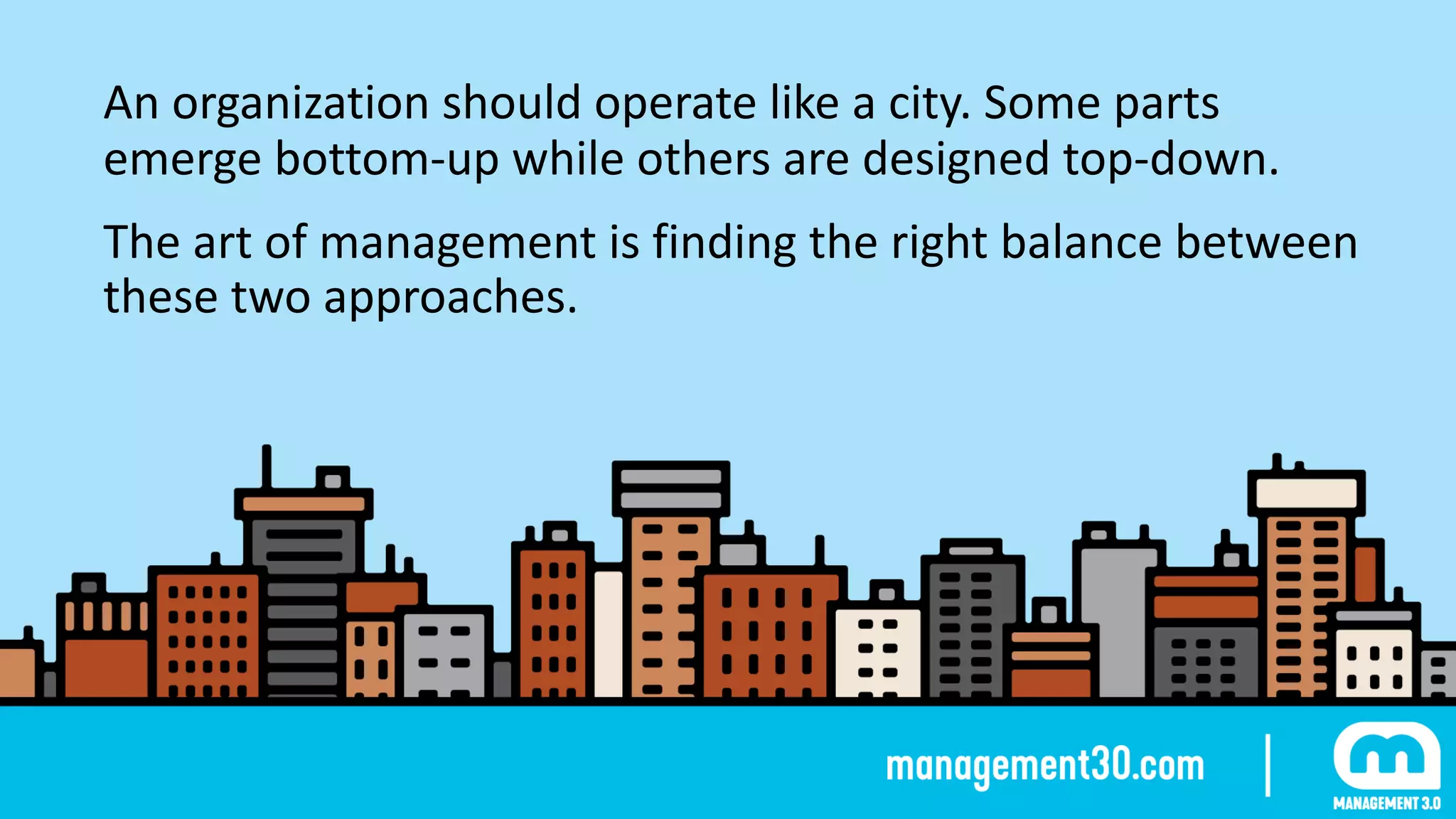
An	organization	should	operate	like	a	city.	Some	parts	
emerge	bottom-up	while	others	are	designed	top-down.	
The	art	of	management	is	finding	the	right	balance	between	
these	two	approaches.
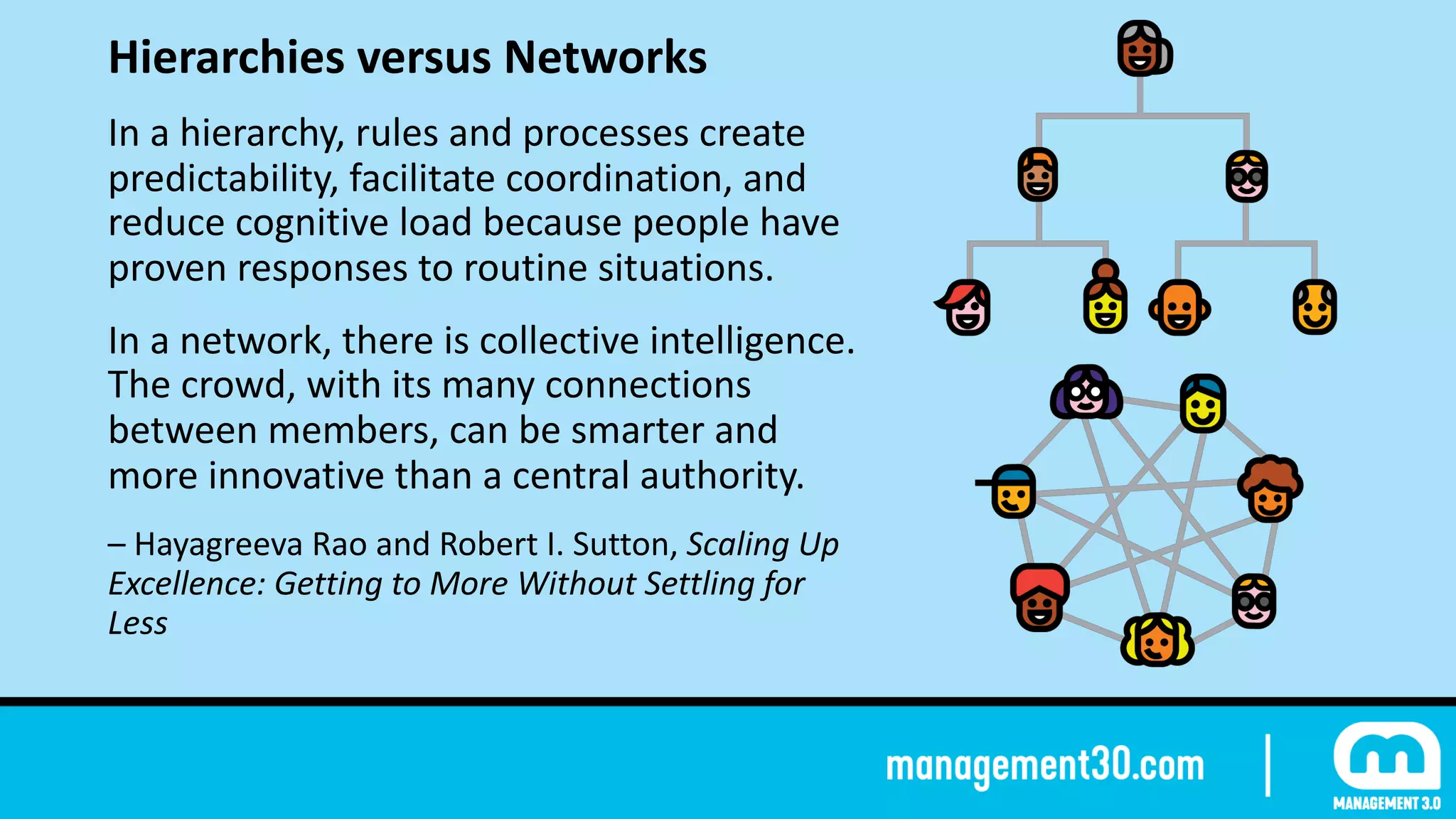
Hierarchies	versus	Networks	
In	a	hierarchy,	rules	and	processes	create	
predictability,	facilitate	coordination,	and	
reduce	cognitive	load	because	people	have	
proven	responses	to	routine	situations.	
In	a	network,	there	is	collective	intelligence.	
The	crowd,	with	its	many	connections	
between	members,	can	be	smarter	and	
more	innovative	than	a	central	authority.	
–	Hayagreeva	Rao	and	Robert	I.	Sutton,	Scaling	Up	
Excellence:	Getting	to	More	Without	Settling	for	
Less
Knowledge	work	requires	specialization	(going	deeper)	
but	innovation	requires	generalization	(spreading	out).	
The	economies	of	specialization	make	functional	division	
the	most	common.	But	innovation	requires	

us	to	do	things	we’ve	never	done	before	and	thus	
innovation	is	incompatible	with	the	functional	
organization.	
–	Peter	F.	Drucker,	Management	

–	Burton,	Obel,	DeSanctis,	Organizational	Design
Specialization	versus	Generalization
Efficiency	versus	Effectivity	
Efficiency	is	a	primary	focus	on	inputs,	
use	of	resources,	and	costs.	Effectivity	
is	a	focus	on	outputs,	products	or	
services,	and	revenues.	
You	can	achieve	efficiency	only	in	
predictable,	stable	environments.	You	
need	effectivity	when	environments	
are	complex	and	changing	fast.


–	Burton,	Obel,	DeSanctis,	

			Organizational	Design
Centralization	versus	Decentralization	
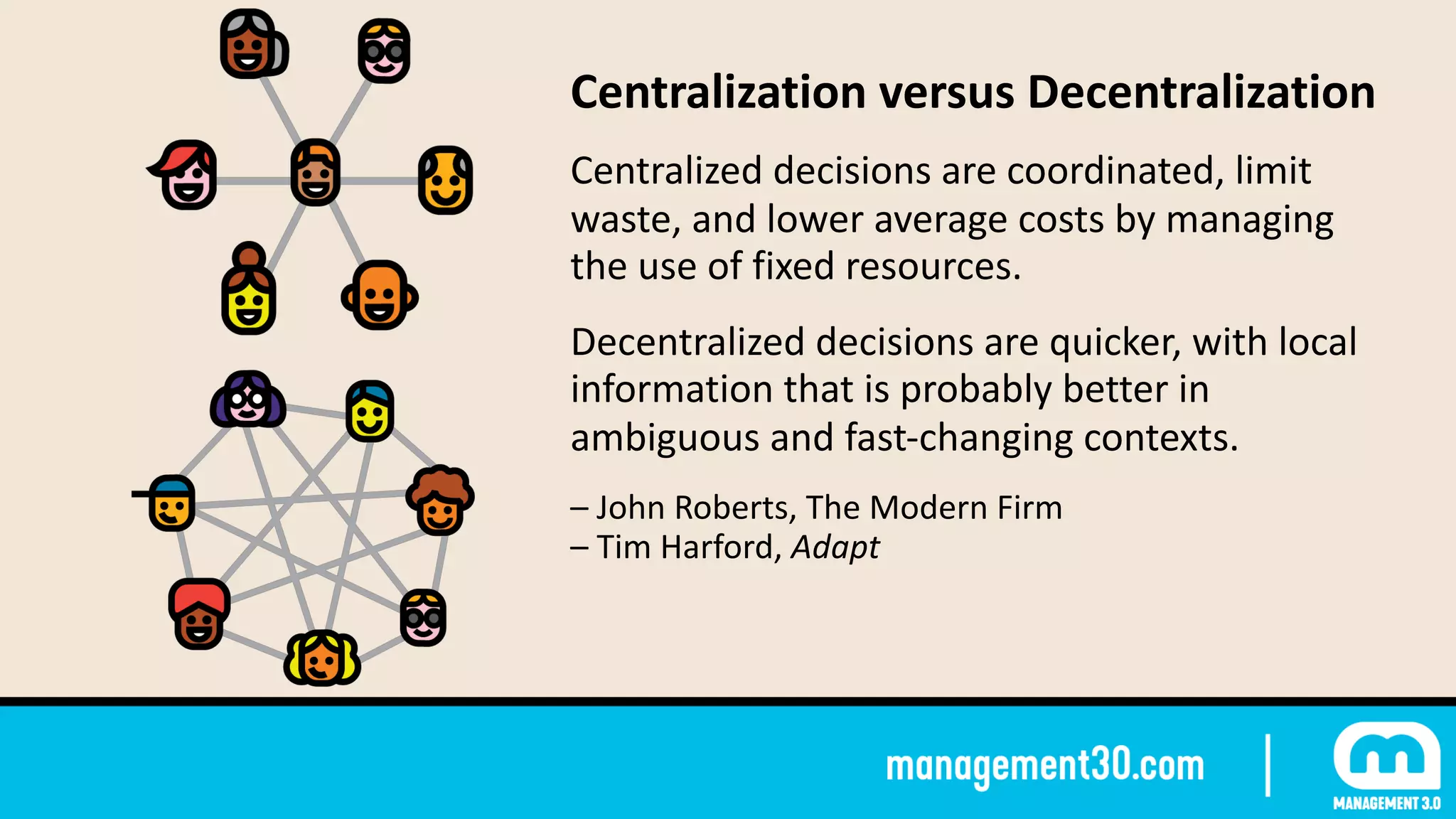
Centralized	decisions	are	coordinated,	limit	
waste,	and	lower	average	costs	by	managing	
the	use	of	fixed	resources.	
Decentralized	decisions	are	quicker,	with	local	
information	that	is	probably	better	in	
ambiguous	and	fast-changing	contexts.	
–	John	Roberts,	The	Modern	Firm

–	Tim	Harford,	Adapt
9
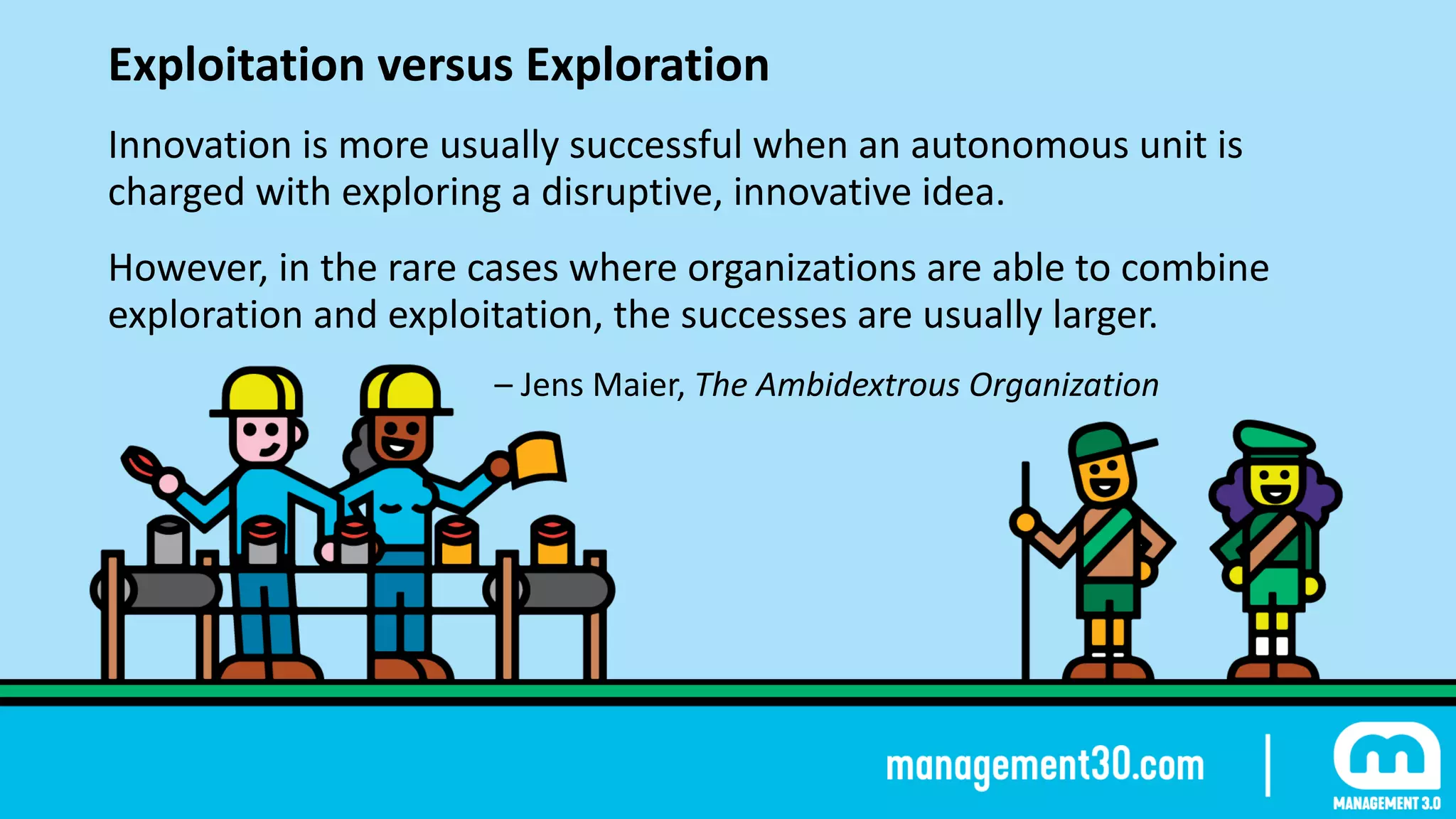
Exploitation	versus	Exploration	
Innovation	is	more	usually	successful	when	an	autonomous	unit	is	
charged	with	exploring	a	disruptive,	innovative	idea.	
However,	in	the	rare	cases	where	organizations	are	able	to	combine	
exploration	and	exploitation,	the	successes	are	usually	larger.	
																																															–	Jens	Maier,	The	Ambidextrous	Organization
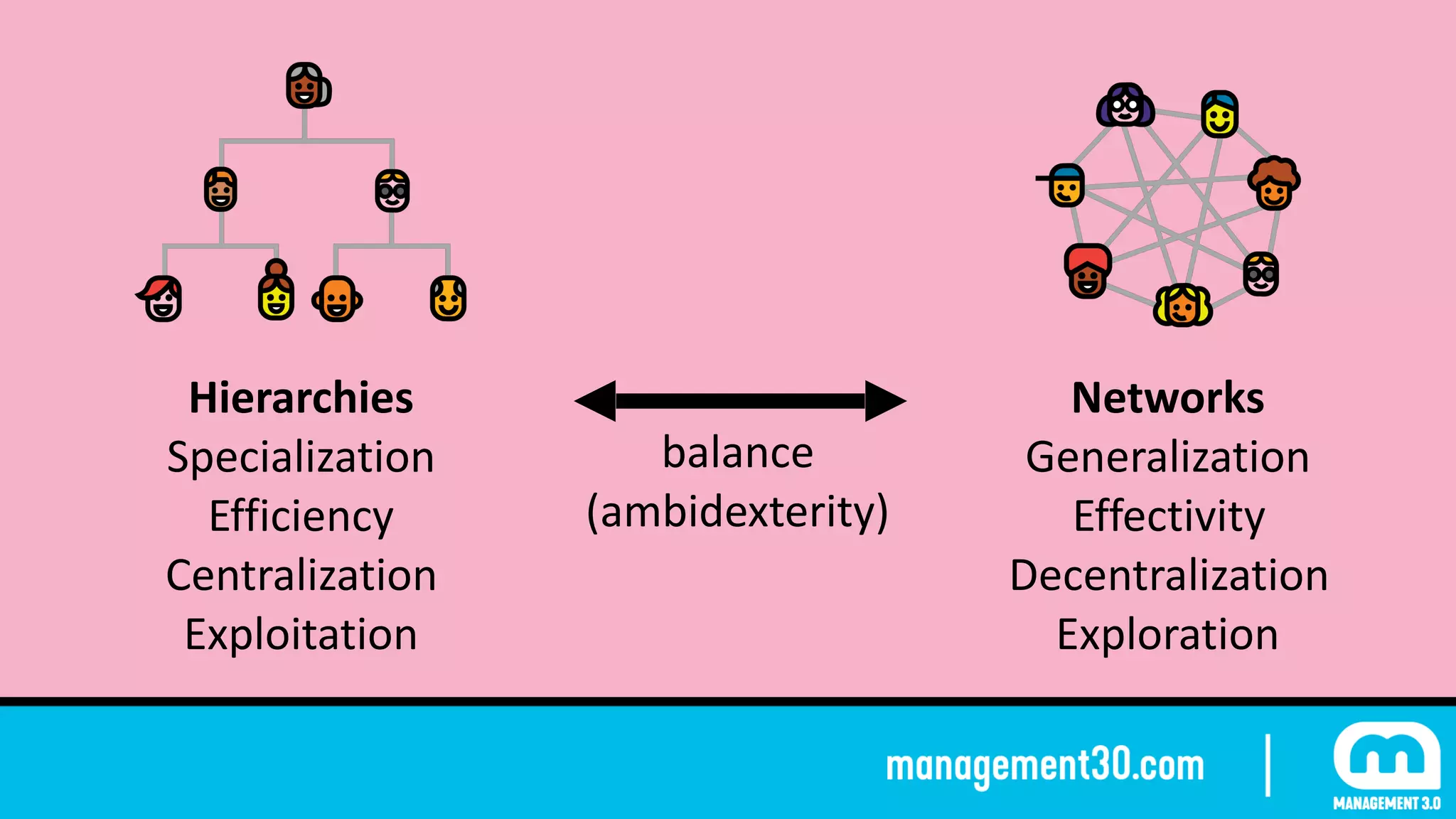
Hierarchies	
Specialization	
Efficiency	
Centralization	
Exploitation
Networks	
Generalization	
Effectivity	
Decentralization	
Exploration
balance	
(ambidexterity)
Learn	more	about	structures	that	enhance	
communicaFon	at	a	Management	3.0	Workshop!	
www.management30.com/events/
What	are	common	
patterns	for	balancing	
organizational	structures?
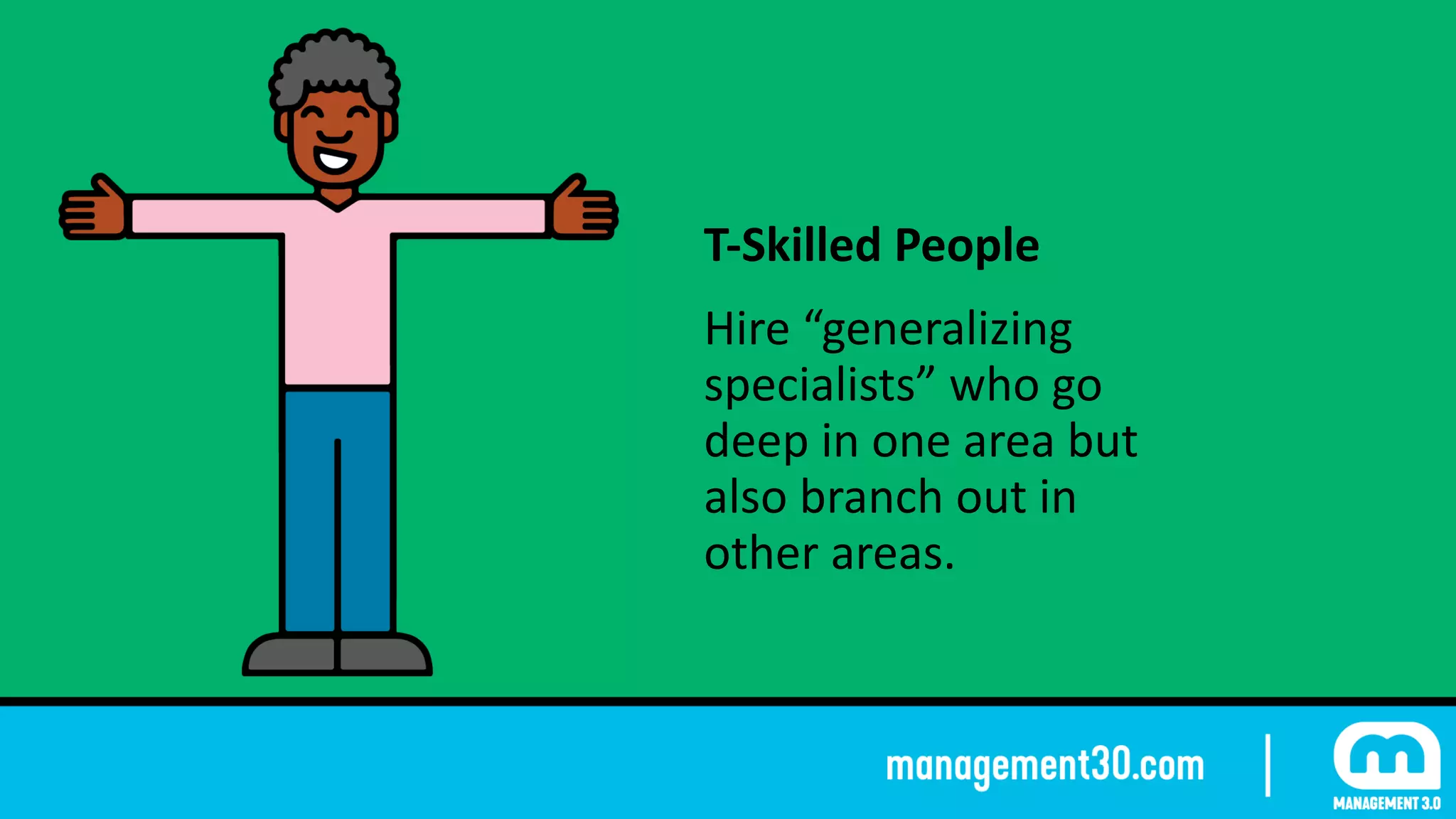
T-Skilled	People	
Hire	“generalizing	
specialists”	who	go	
deep	in	one	area	but	
also	branch	out	in	
other	areas.
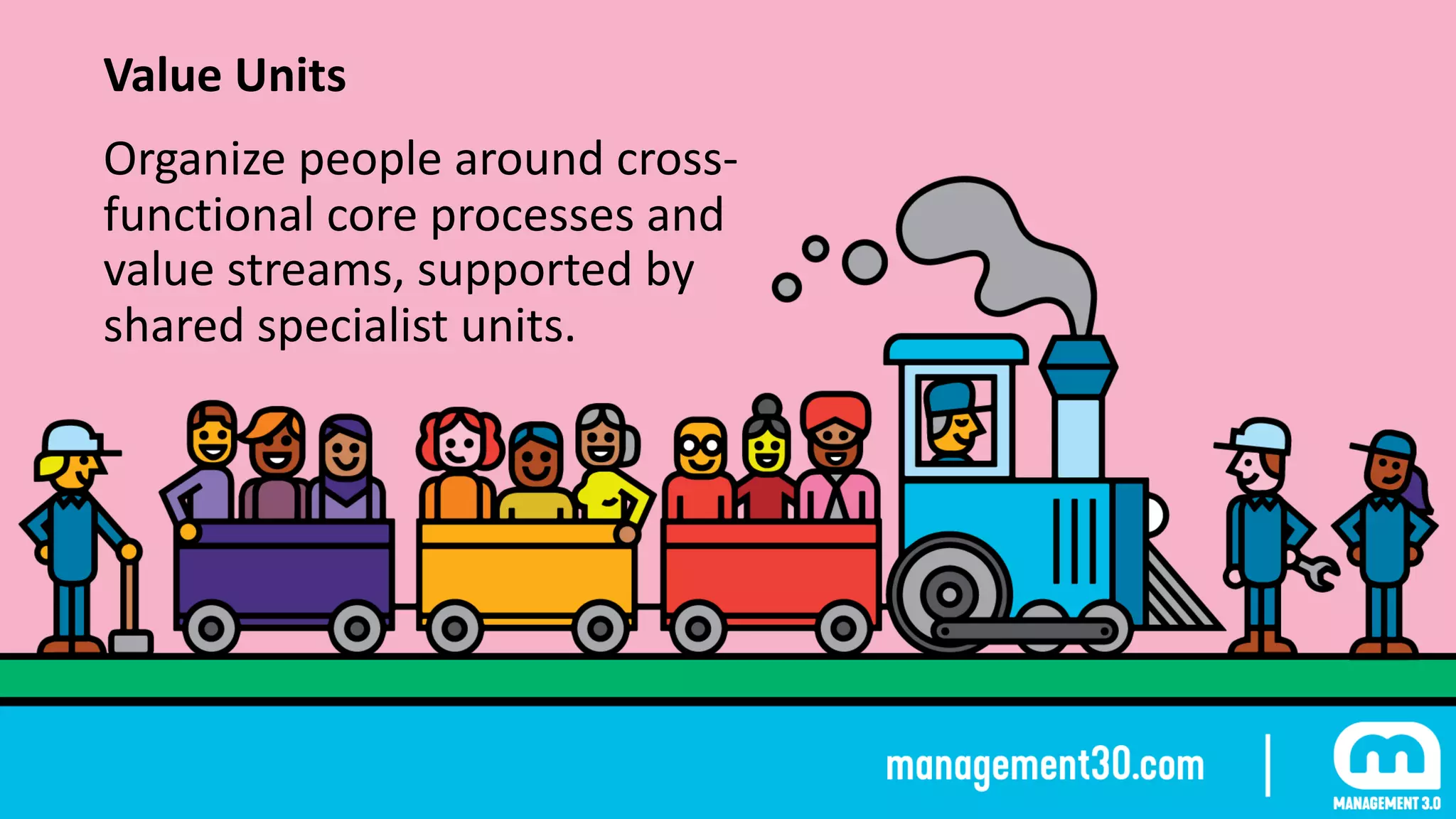
Value	Units	
Organize	people	around	cross-
functional	core	processes	and	
value	streams,	supported	by	
shared	specialist	units.
15
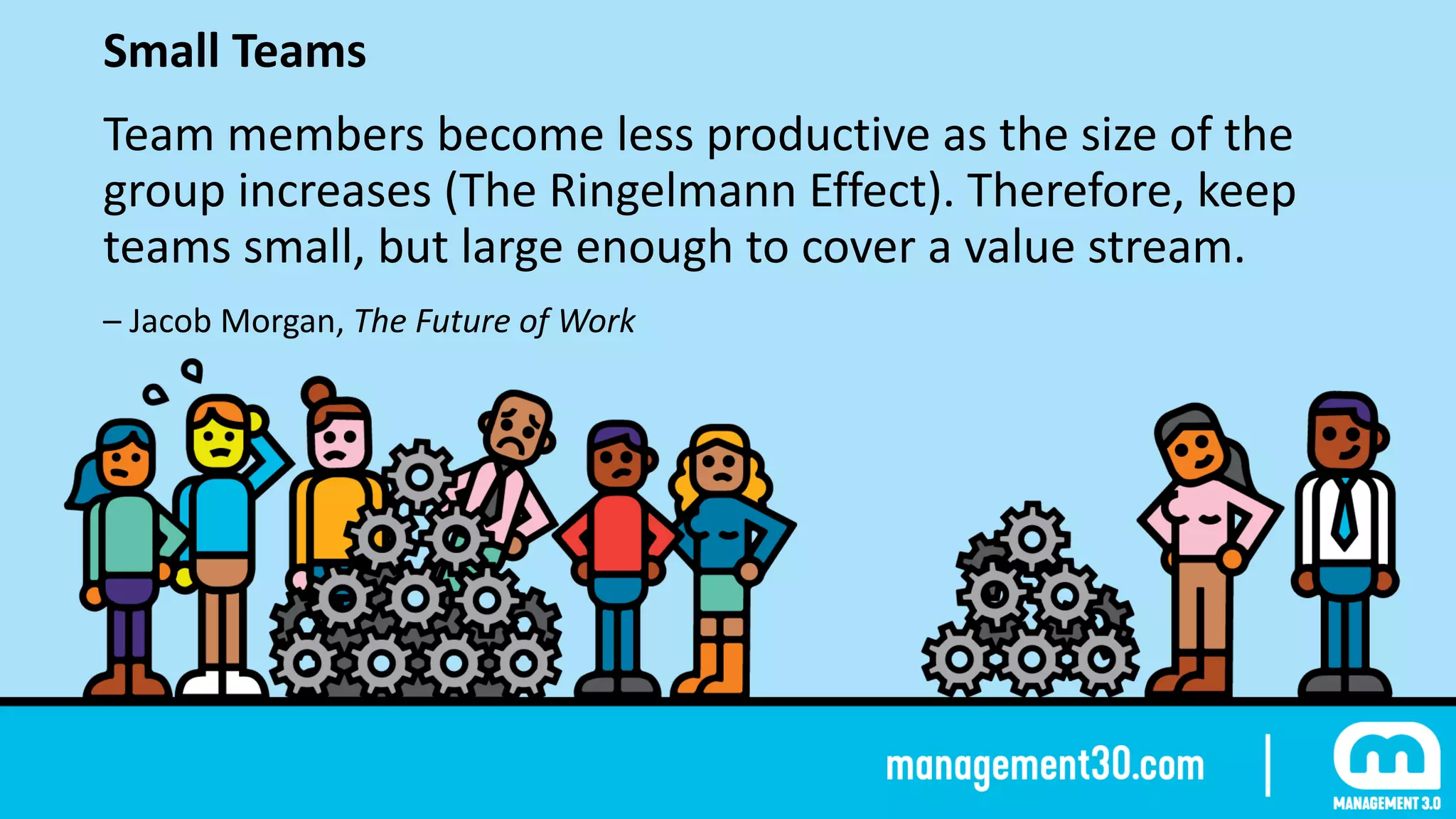
Small	Teams	
Team	members	become	less	productive	as	the	size	of	the	
group	increases	(The	Ringelmann	Effect).	Therefore,	keep	
teams	small,	but	large	enough	to	cover	a	value	stream.	
–	Jacob	Morgan,	The	Future	of	Work
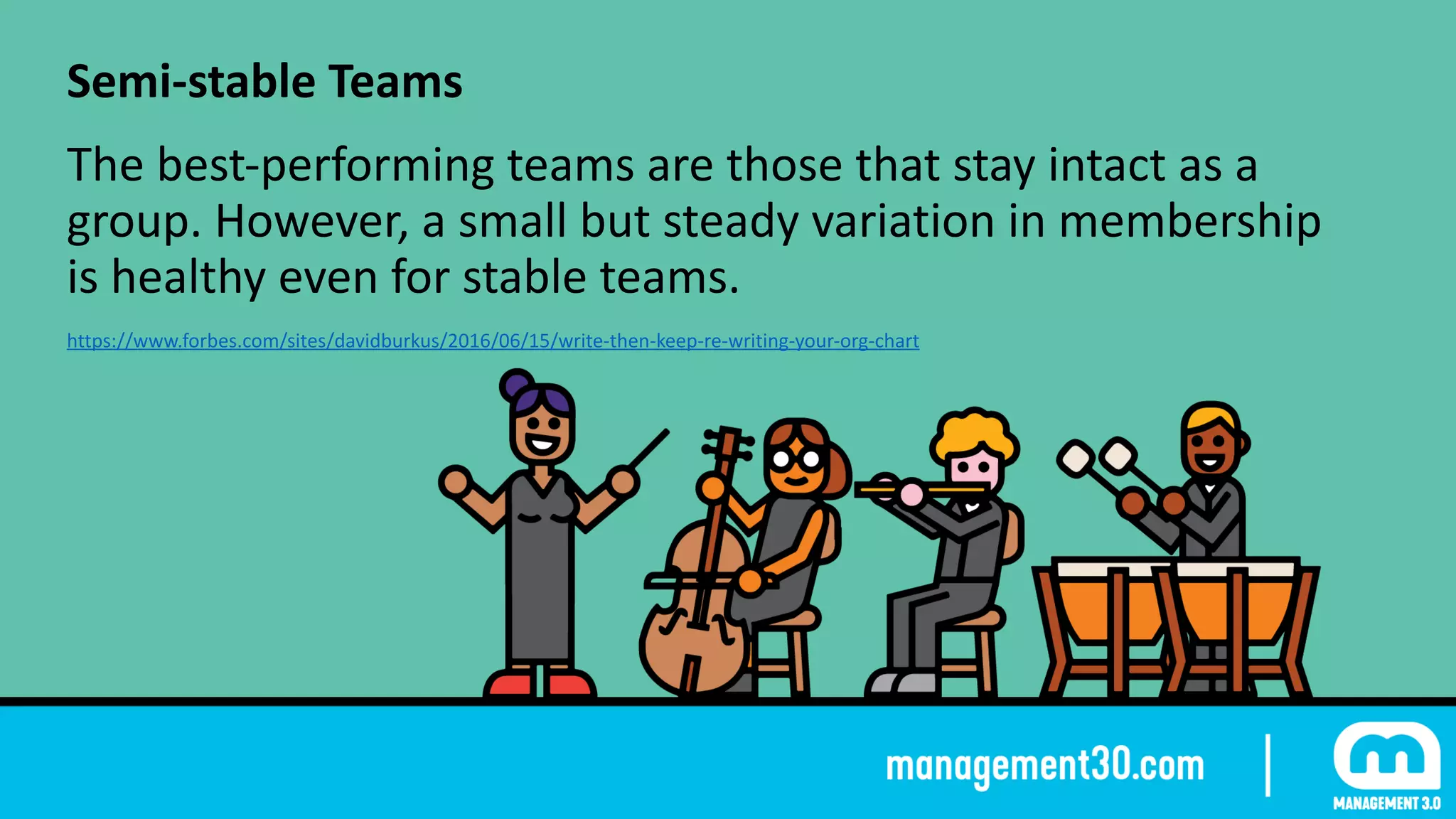
Semi-stable	Teams	
The	best-performing	teams	are	those	that	stay	intact	as	a	
group.	However,	a	small	but	steady	variation	in	membership	
is	healthy	even	for	stable	teams.	
https://www.forbes.com/sites/davidburkus/2016/06/15/write-then-keep-re-writing-your-org-chart
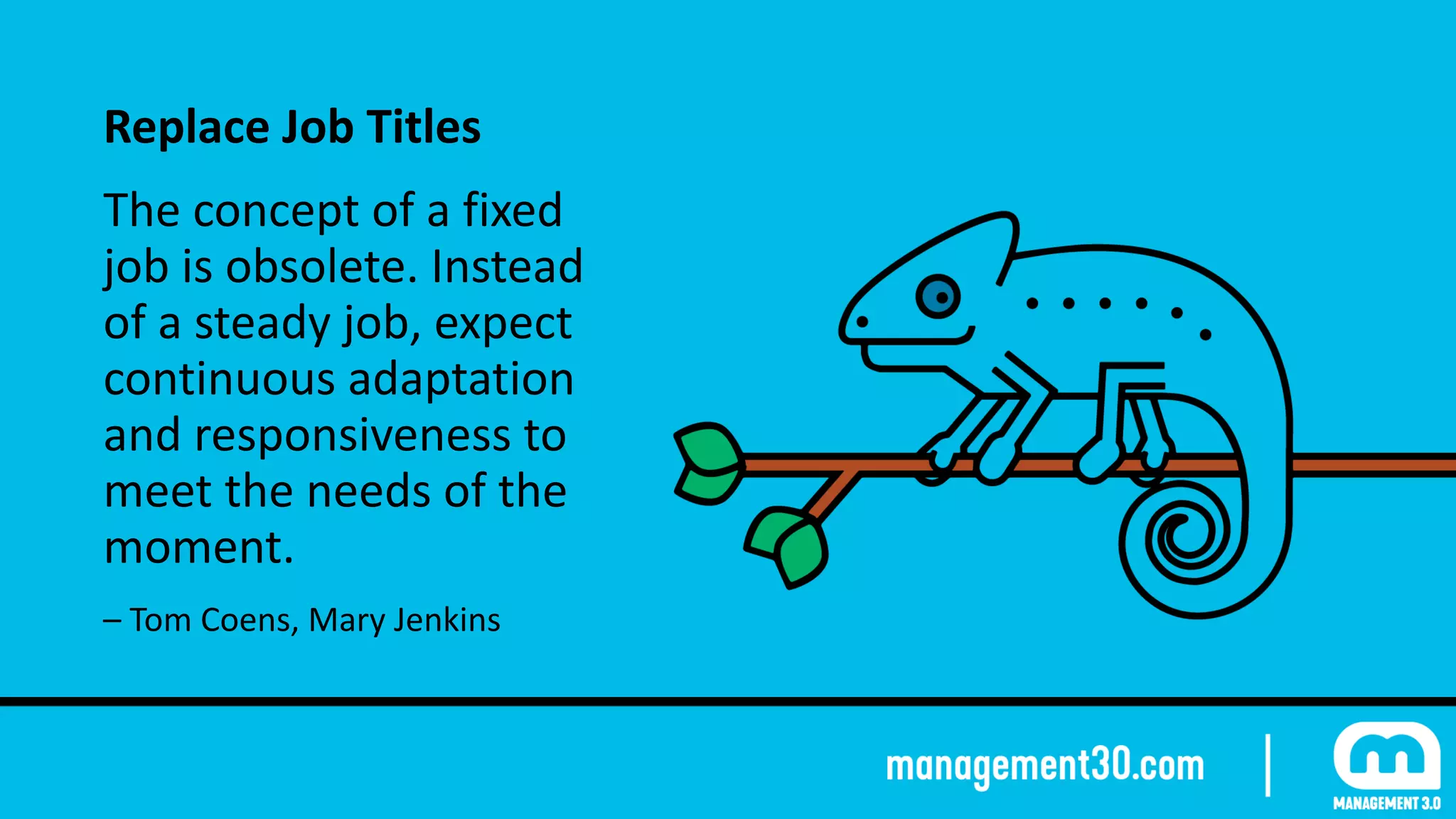
Replace	Job	Titles	
The	concept	of	a	fixed	
job	is	obsolete.	Instead	
of	a	steady	job,	expect	
continuous	adaptation	
and	responsiveness	to	
meet	the	needs	of	the	
moment.	
–	Tom	Coens,	Mary	Jenkins
Communities	of	Practice	
A	community	of	practice	(CoP)	is	a	group	of	people	with	a	
shared	concern,	interest	or	passion,	who	deepen	their	
knowledge	and	expertise	in	this	area	by	interacting	on	an	
ongoing	basis.	
–	E.	Wenger,	

R.	McDermott,	

W.	Snyder
Open	Allocation	
Let	employees	pick	and	choose	the	
projects	that	interest	them	most	
instead	of	being	told	what	to	do	and	
what	teams	to	be	part	of.	
http://www.forbes.com/sites/quora/2012/11/26/what-is-open-allocation/
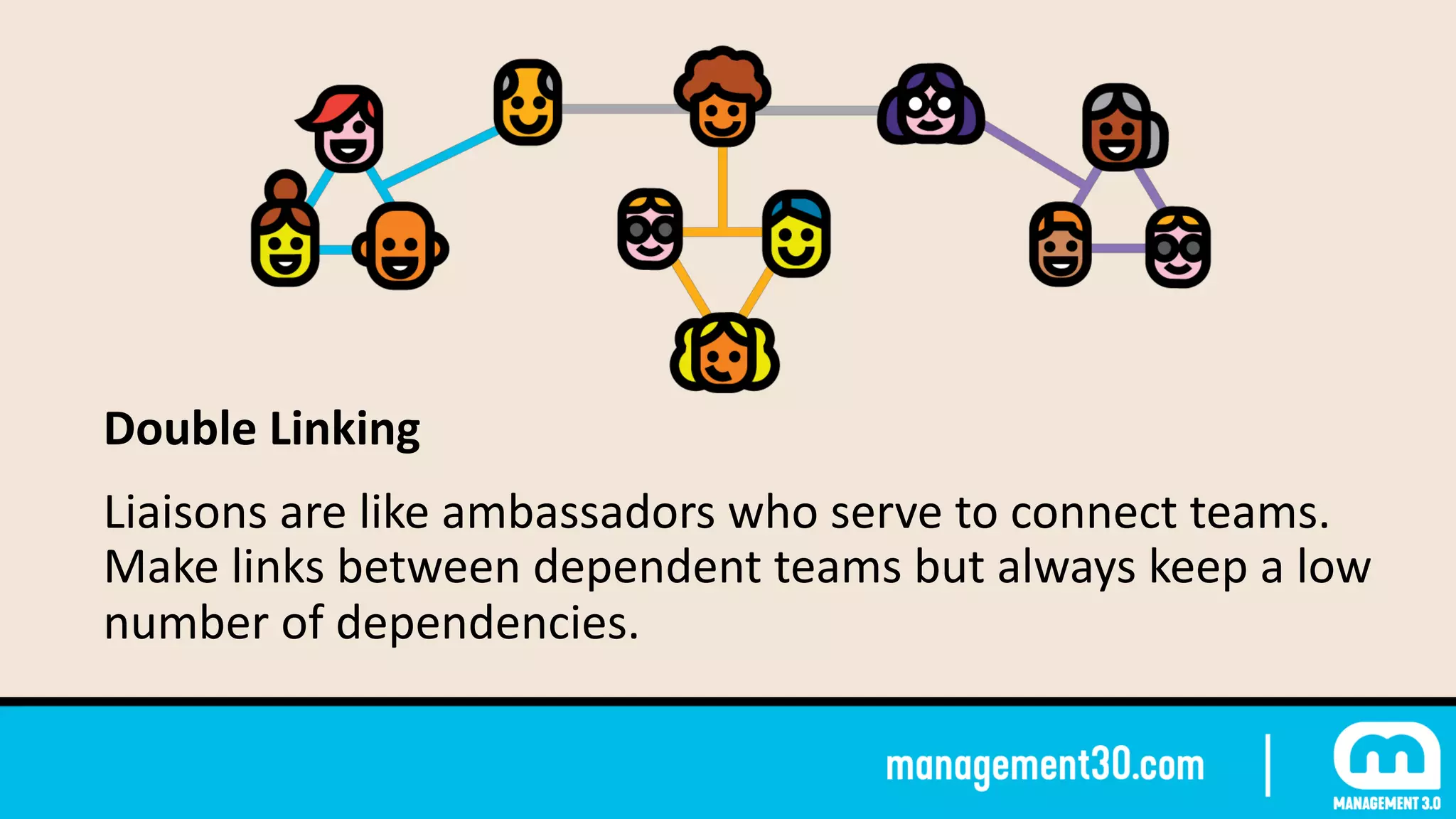
Double	Linking	
Liaisons	are	like	ambassadors	who	serve	to	connect	teams.	
Make	links	between	dependent	teams	but	always	keep	a	low	
number	of	dependencies.
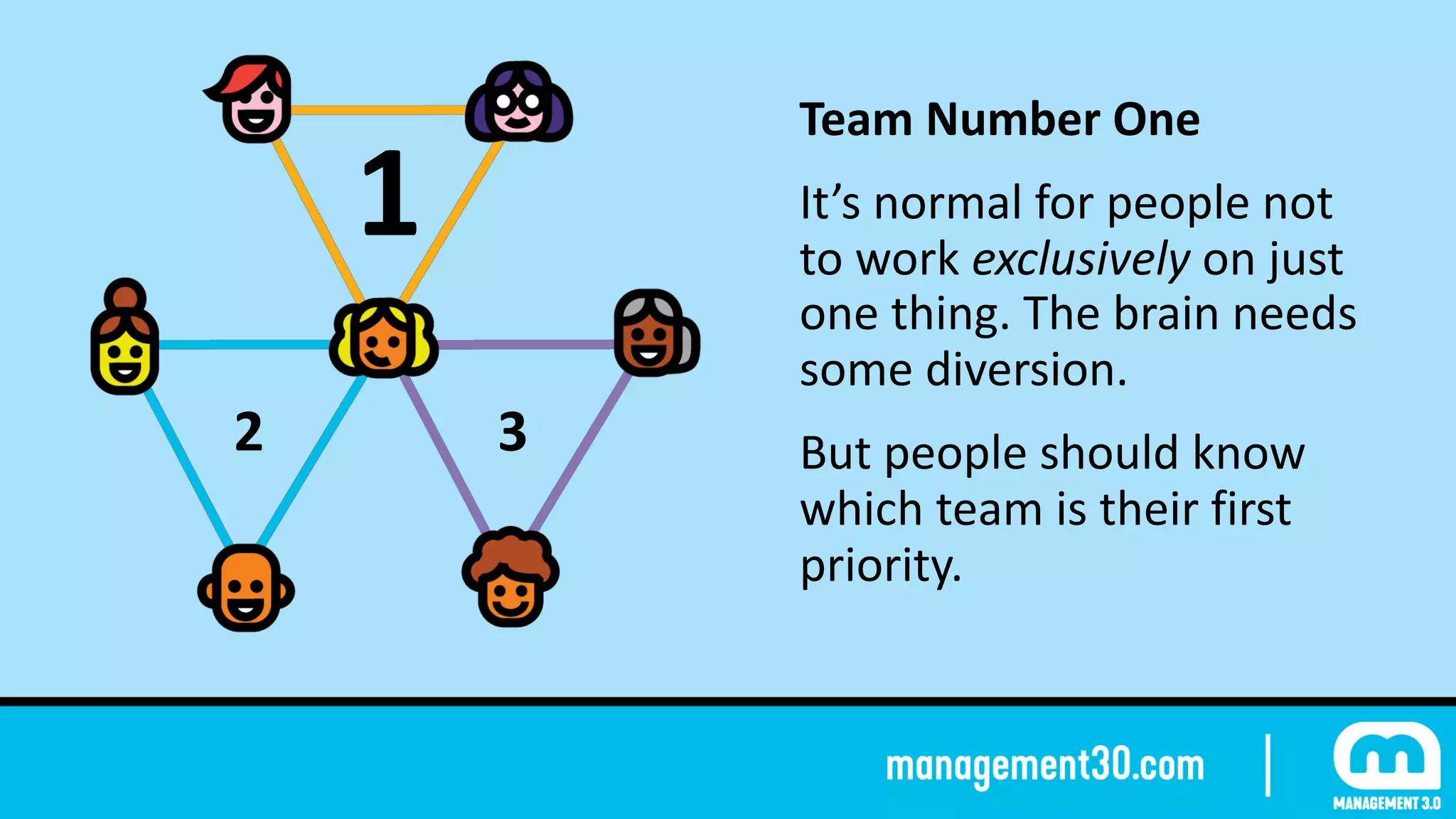
1
2 3
Team	Number	One	
It’s	normal	for	people	not	
to	work	exclusively	on	just	
one	thing.	The	brain	needs	
some	diversion.	
But	people	should	know	
which	team	is	their	first	
priority.
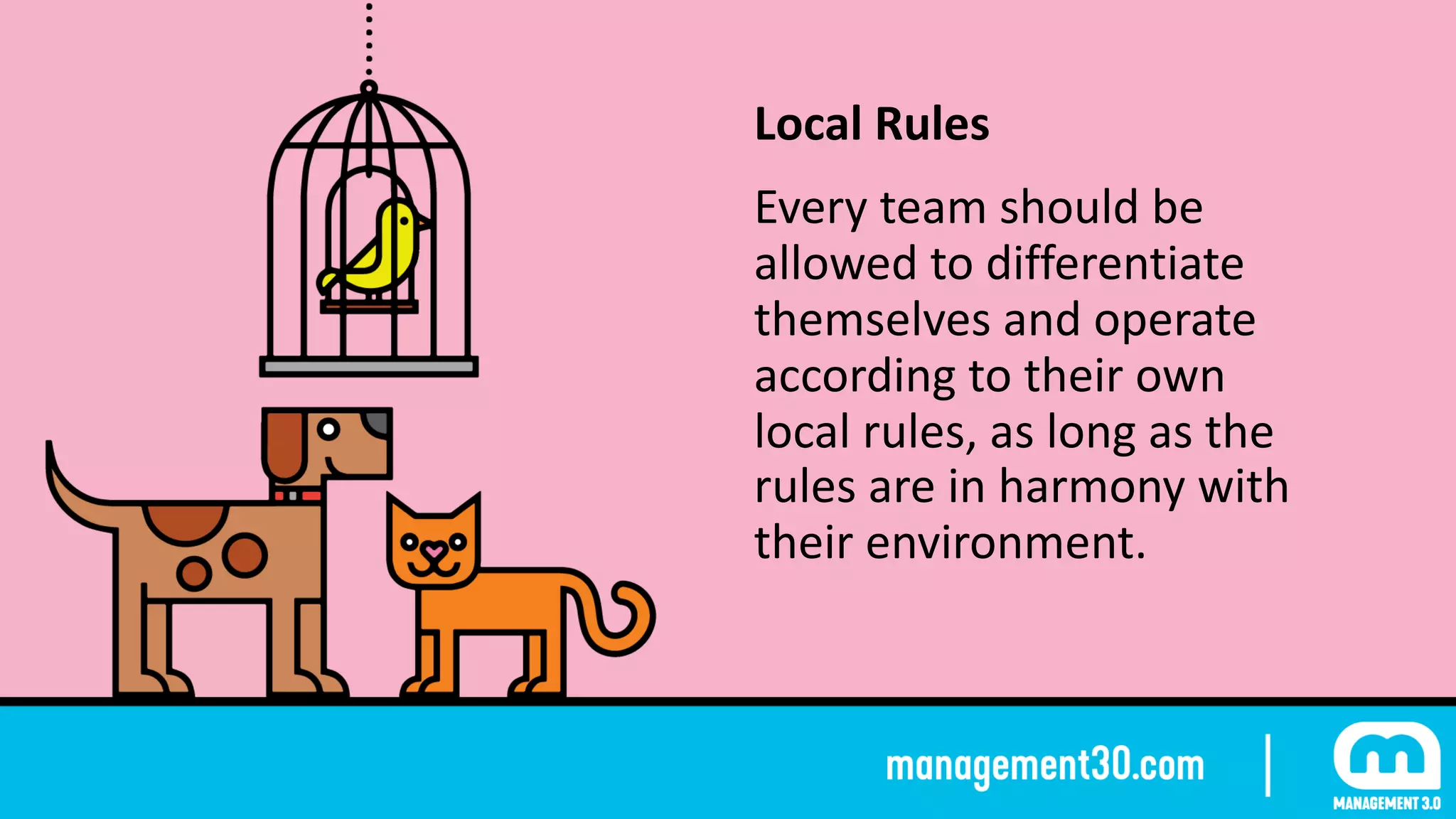
Local	Rules	
Every	team	should	be	
allowed	to	differentiate	
themselves	and	operate	
according	to	their	own	
local	rules,	as	long	as	the	
rules	are	in	harmony	with	
their	environment.
Management	3.0	is	not	another	framework,	it’s	a	mindset,	combined	
with	an	ever-changing	collecFon	of	games,	tools,	and	pracFces	to	help	
any	worker	manage	the	organizaFon.	It’s	a	way	of	looking	at	work	
systems.	
Management	3.0	examines	how	to	analyze	that	system	to	come	up	with	
the	right	soluFons	for	beZer	leadership	across	organizaFons.	
Management	3.0	FoundaFon	Workshops	are	all	about	principles	and	
pracFces.	Combining	the	best	of	classical	thinking	with	a	fresh	approach	
and	new	insights.	All	embedded	in	a	social	context	and	in	the	networked	
businesses	we	work	in	today.
Book	your	Management	3.0	Workshop	today	and	improve	your	
Leadership	Skills.		
Visit	www.management30.com	
info@management30.com	
www.management30.com

Leadership Skills: Scaling Organizational Structure