AGILE LEADERSHIP
INTRODUCTION
MARTIN ELLEMANN OLESEN
AGILE LEADERSHIP COACH
MARTIN@UGILIC.DK
(+45) 31 32 40 22
@MEOLESEN
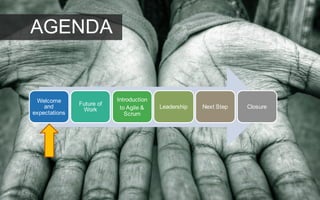
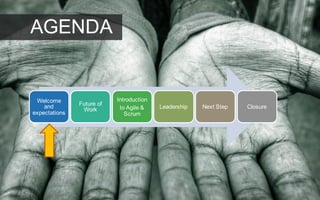
Welcome
and
expectations
Future of
Work
Introduction
to Agile &
Scrum
Leadership Next Step Closure
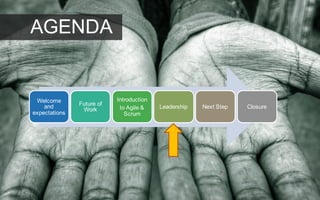
AGENDA
Welcome
and
expectations
Future of
Work
Introduction
to Agile &
Scrum
Leadership Next Step Closure
AGENDA
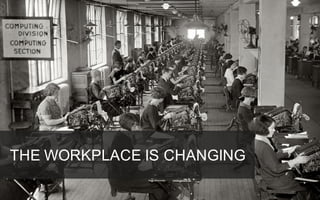
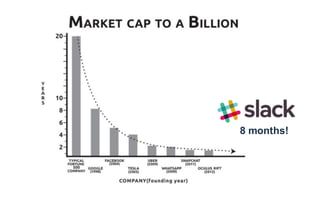
THE WORKPLACE IS CHANGING
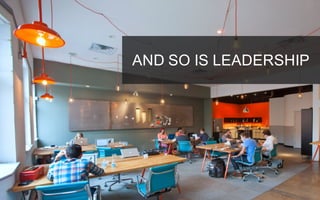
AND SO IS LEADERSHIP
8 months!
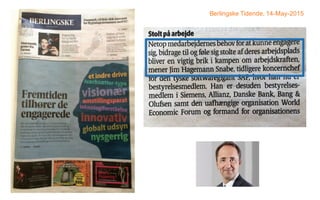
Berlingske Tidende, 14-May-2015
MEGATRENDS
Meaningfulness
Relations + Connectedness
Silver Backs + Millennia
Female Shift in Leadership
Radical Sustainability
Urbanisation + Globalisation
Technology + Going digital
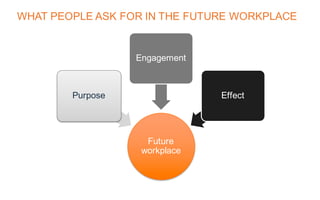
WHAT PEOPLE ASK FOR IN THE FUTURE WORKPLACE
Future
workplace
Purpose
Engagement
Effect
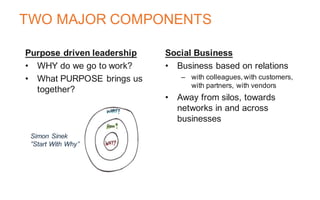
TWO MAJOR COMPONENTS
Purpose driven leadership
• WHY do we go to work?
• What PURPOSE brings us
together?
Social Business
• Business based on relations
– with colleagues, with customers,
with partners, with vendors
• Away from silos, towards
networks in and across
businesses
Simon Sinek
”Start With Why”
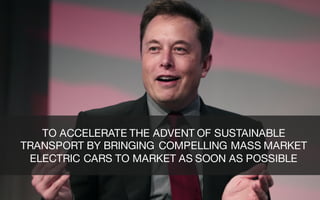
TO ACCELERATE THE ADVENT OF SUSTAINABLE
TRANSPORT BY BRINGING COMPELLING MASS MARKET
ELECTRIC CARS TO MARKET AS SOON AS POSSIBLE
Failure is not an option
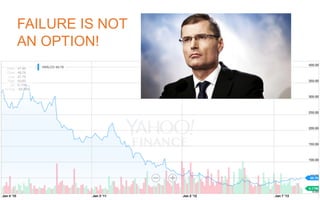
FAILURE IS NOT
AN OPTION!
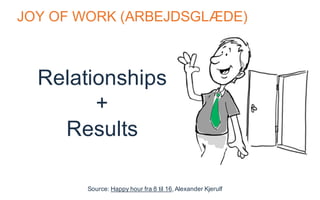
JOY OF WORK (ARBEJDSGLÆDE)
Relationships
+
Results
Source: Happy hour fra 8 til 16, Alexander Kjerulf
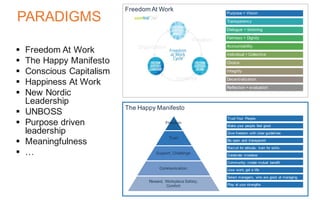
Freedom At Work
The Happy Manifesto
PARADIGMS
§ Freedom At Work
§ The Happy Manifesto
§ Conscious Capitalism
§ Happiness At Work
§ New Nordic
Leadership
§ UNBOSS
§ Purpose driven
leadership
§ Meaningfulness
§ …
Purpose + Vision
Transparency
Dialogue + listening
Fairness + Dignity
Accountability
Individual + Collective
Choice
Integrity
Decentralization
Reflection + evaluation
Trust Your People
Make your people feel good
Give freedom with clear guidelines
Be open and transparent
Recruit for attitude, train for skills
Celebrate mistakes
Community: create mutual benefit
Love work, get a life
Select managers, who are good at managing
Play at your strengths
Freedom
Trust
Support, Challenge
Communication
Reward, Workplace Safety,
Comfort
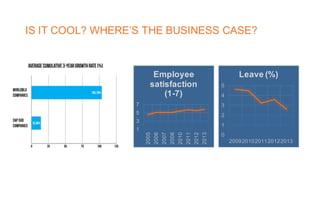
IS IT COOL? WHERE’S THE BUSINESS CASE?
1
3
5
7
2005
2006
2007
2008
2010
2011
2012
2013
Employee
satisfaction
(1-7)
0
1
2
3
4
5
20092010201120122013
Leave (%)
Welcome
and
expectations
Future of
Work
Introduction
to Agile &
Scrum
Leadership Next Step Closure
AGENDA
AGILE IS TO SCRUM
AS BEER IS TO CARLSBERG
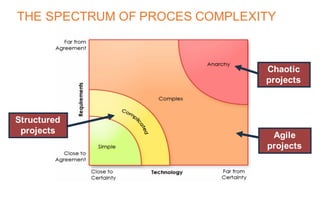
THE SPECTRUM OF PROCES COMPLEXITY
Agile
projects
Structured
projects
Chaotic
projects
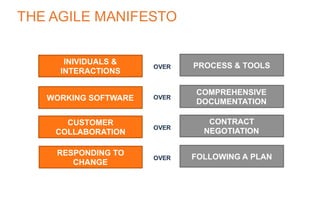
INIVIDUALS &
INTERACTIONS
WORKING SOFTWARE
CUSTOMER
COLLABORATION
RESPONDING TO
CHANGE
PROCESS & TOOLS
COMPREHENSIVE
DOCUMENTATION
CONTRACT
NEGOTIATION
FOLLOWING A PLAN
OVER
OVER
OVER
OVER
THE AGILE MANIFESTO
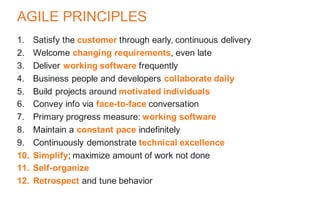
AGILE PRINCIPLES
1. Satisfy the customer through early, continuous delivery
2. Welcome changing requirements, even late
3. Deliver working software frequently
4. Business people and developers collaborate daily
5. Build projects around motivated individuals
6. Convey info via face-to-face conversation
7. Primary progress measure: working software
8. Maintain a constant pace indefinitely
9. Continuously demonstrate technical excellence
10. Simplify; maximize amount of work not done
11. Self-organize
12. Retrospect and tune behavior
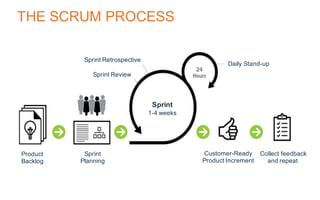
THE SCRUM PROCESS
Sprint Retrospective
Sprint Review
Sprint
Planning
Product
Backlog
Customer-Ready
Product Increment
Collect feedback
and repeat
Daily Stand-up
Sprint
1-4 weeks
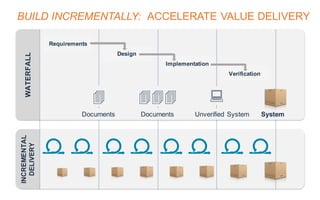
BUILD INCREMENTALLY: ACCELERATE VALUE DELIVERY
4 444 :
Documents Documents Unverified System System
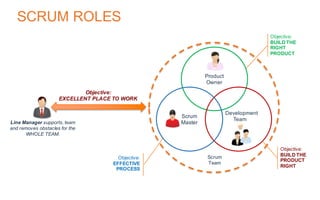
SCRUM ROLES
Line Manager supports, team
and removes obstacles for the
WHOLE TEAM.
Objective:
EXCELLENT PLACE TO WORK
Scrum
Team
Product
Owner
Development
Team
Scrum
Master
Objective:
EFFECTIVE
PROCESS
Objective:
BUILD THE
PRODUCT
RIGHT
Objective:
BUILD THE
RIGHT
PRODUCT
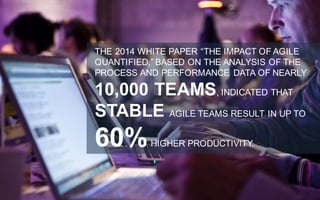
THE 2014 WHITE PAPER “THE IMPACT OF AGILE
QUANTIFIED,” BASED ON THE ANALYSIS OF THE
PROCESS AND PERFORMANCE DATA OF NEARLY
10,000 TEAMS, INDICATED THAT
STABLE AGILE TEAMS RESULT IN UP TO
60%HIGHER PRODUCTIVITY.
TRANSPARENCY
& VISIBILITY
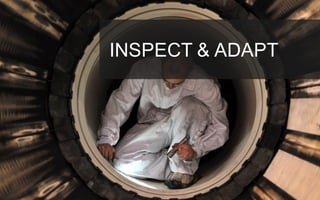
INSPECT & ADAPT
COURAGE
OPENNESS
FOCUS
RESPECT
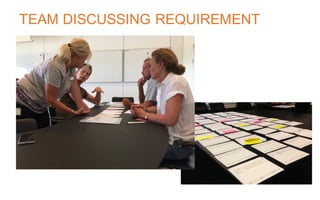
TEAM DISCUSSING REQUIREMENT
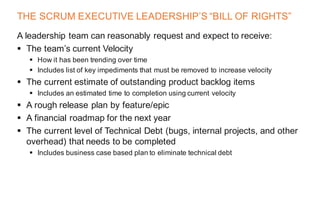
THE SCRUM EXECUTIVE LEADERSHIP’S “BILL OF RIGHTS”
A leadership team can reasonably request and expect to receive:
§ The team’s current Velocity
§ How it has been trending over time
§ Includes list of key impediments that must be removed to increase velocity
§ The current estimate of outstanding product backlog items
§ Includes an estimated time to completion using current velocity
§ A rough release plan by feature/epic
§ A financial roadmap for the next year
§ The current level of Technical Debt (bugs, internal projects, and other
overhead) that needs to be completed
§ Includes business case based plan to eliminate technical debt
Welcome
and
expectations
Future of
Work
Introduction
to Agile &
Scrum
Leadership Next Step Closure
AGENDA
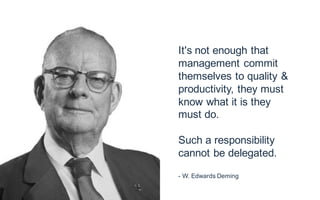
It's not enough that
management commit
themselves to quality &
productivity, they must
know what it is they
must do.
Such a responsibility
cannot be delegated.
- W. Edwards Deming
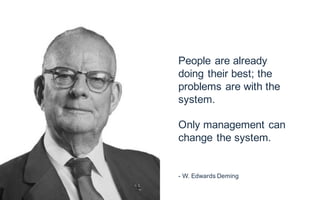
People are already
doing their best; the
problems are with the
system.
Only management can
change the system.
- W. Edwards Deming
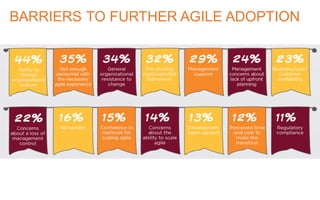
BARRIERS TO FURTHER AGILE ADOPTION
WHO’S GOING TO MAKE IT HAPPEN?
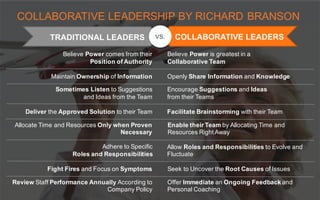
COLLABORATIVE LEADERSHIP BY RICHARD BRANSON
VS.
Believe Power comes from their
Position of Authority
Believe Power is greatest in a
Collaborative Team
Maintain Ownership of Information Openly Share Information and Knowledge
Sometimes Listen to Suggestions
and Ideas from the Team
Encourage Suggestions and Ideas
from their Teams
Deliver the Approved Solution to their Team Facilitate Brainstorming with their Team
Allocate Time and Resources Only when Proven
Necessary
Enable their Team by Allocating Time and
Resources Right Away
Adhere to Specific
Roles and Responsibilities
Allow Roles and Responsibilities to Evolve and
Fluctuate
Fight Fires and Focus on Symptoms Seek to Uncover the Root Causes of Issues
Review Staff Performance Annually According to
Company Policy
Offer Immediate an Ongoing Feedback and
Personal Coaching
COLLABORATIVE LEADERSTRADITIONAL LEADERS
COMMUNICATION, DIALOGUE, VISIBILITY, PRESENCE
§ You cannot not communicate
§ Silence is also communication
§ Not being present is also communication
§ People need you, your time, and your listening skills
§ Dialogue provides safety and comfort
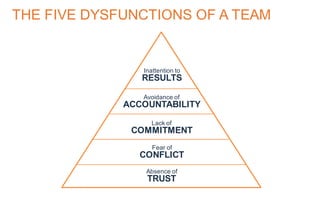
THE FIVE DYSFUNCTIONS OF A TEAM
Absence of
TRUST
Fear of
CONFLICT
Lack of
COMMITMENT
Avoidance of
ACCOUNTABILITY
Inattention to
RESULTS
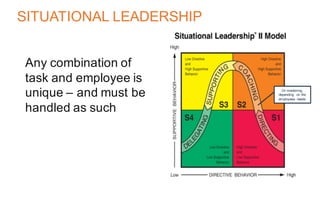
SITUATIONAL LEADERSHIP
Any combination of
task and employee is
unique – and must be
handled as such
Or mentoring,
depending on the
employees needs
THE LEADER AS MENTOR
§ A leader is a mentor (not only a coach), and inspires and supports
§ Build trust and intimacy with them, and provide guidance, experiences, good
advice, and inspiration frequently.
§ Do not be afraid to provide specific, concrete advice.
§ You are a mentor too, not only a coach,
depending on the Situational Leadership.
§ Empathy
§ The capacity to understand or feel what another person is experiencing from
within the other person's frame of reference
§ “The capacity to place oneself in another's shoes”
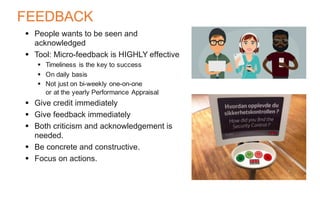
FEEDBACK
§ People wants to be seen and
acknowledged
§ Tool: Micro-feedback is HIGHLY effective
§ Timeliness is the key to success
§ On daily basis
§ Not just on bi-weekly one-on-one
or at the yearly Performance Appraisal
§ Give credit immediately
§ Give feedback immediately
§ Both criticism and acknowledgement is
needed.
§ Be concrete and constructive.
§ Focus on actions.
HELP TEAMS SELF-ORGANIZE
§ Make the team rally behind meaningful targets, goals or outcomes
§ Make team boundaries crystal clear
§ Under-organize the team
§ Make sure supporting processes are in place
§ Reward teams, not individuals, for pulling through
§ Ask yourself: can the team break down the silos?
§ Help the team make clear agreements and set behavioral expectations
that match their unique situation and culture
§ Provide continuous feedback
§ … hire an external coach ;-)
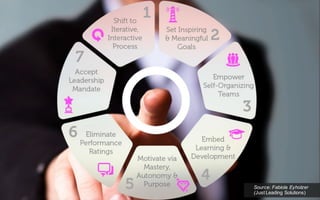
Source: Fabiola Eyholzer
(Just Leading Solutions)
AGILE HR
1. Focus on creating valuable employee experiences and exceeding expectations
2. Give people purpose, meaning, and context
3. Shape a strong culture, where core values are lived up to – by everyone – every day
4. Create a stimulating work environment and provide necessary tools and access
5. Appoint amazing people and nourish their passion and potential
6. Build an organizational network around collaborative teams and motivated people
7. Value face to face conversations and be courageous and genuine in all your
interactions
8. Stimulate and boost meaningful growth
9. Ensure continuous learning and exchange of ideas, information and knowledge
10. Care about the happiness, health and welfare of your people
REFLECTIONS?
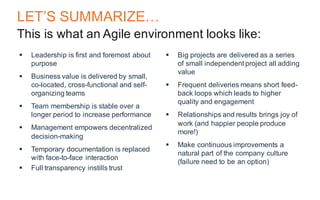
LET’S SUMMARIZE…
This is what an Agile environment looks like:
§ Leadership is first and foremost about
purpose
§ Business value is delivered by small,
co-located, cross-functional and self-
organizing teams
§ Team membership is stable over a
longer period to increase performance
§ Management empowers decentralized
decision-making
§ Temporary documentation is replaced
with face-to-face interaction
§ Full transparency instills trust
§ Big projects are delivered as a series
of small independent project all adding
value
§ Frequent deliveries means short feed-
back loops which leads to higher
quality and engagement
§ Relationships and results brings joy of
work (and happier people produce
more!)
§ Make continuous improvements a
natural part of the company culture
(failure need to be an option)
Welcome
and
expectations
Future of
Work
Introduction
to Agile &
Scrum
Leadership Next Step Closure
AGENDA
NEXT STEP?
MARTIN ELLEMANN OLESEN
AGILE LEADERSHIP COACH
MARTIN@UGILIC.DK
(+45) 31 32 40 22
@MEOLESEN
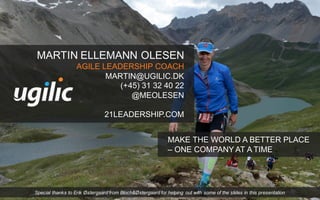
21LEADERSHIP.COM
MAKE THE WORLD A BETTER PLACE
– ONE COMPANY AT A TIME
Special thanks to Erik Østergaard from Bloch&Østergaard for helping out with some of the slides in this presentation

Agile Leadership introduction

  • 1.
  • 2.
    MARTIN ELLEMANN OLESEN AGILELEADERSHIP COACH MARTIN@UGILIC.DK (+45) 31 32 40 22 @MEOLESEN
  • 3.
    Welcome and expectations Future of Work Introduction to Agile& Scrum Leadership Next Step Closure AGENDA
  • 5.
    Welcome and expectations Future of Work Introduction to Agile& Scrum Leadership Next Step Closure AGENDA
  • 6.
  • 7.
    AND SO ISLEADERSHIP
  • 9.
  • 10.
  • 11.
    MEGATRENDS Meaningfulness Relations + Connectedness SilverBacks + Millennia Female Shift in Leadership Radical Sustainability Urbanisation + Globalisation Technology + Going digital
  • 12.
    WHAT PEOPLE ASKFOR IN THE FUTURE WORKPLACE Future workplace Purpose Engagement Effect
  • 13.
    TWO MAJOR COMPONENTS Purposedriven leadership • WHY do we go to work? • What PURPOSE brings us together? Social Business • Business based on relations – with colleagues, with customers, with partners, with vendors • Away from silos, towards networks in and across businesses Simon Sinek ”Start With Why”
  • 15.
    TO ACCELERATE THEADVENT OF SUSTAINABLE TRANSPORT BY BRINGING COMPELLING MASS MARKET ELECTRIC CARS TO MARKET AS SOON AS POSSIBLE
  • 16.
    Failure is notan option
  • 17.
  • 18.
    JOY OF WORK(ARBEJDSGLÆDE) Relationships + Results Source: Happy hour fra 8 til 16, Alexander Kjerulf
  • 19.
    Freedom At Work TheHappy Manifesto PARADIGMS § Freedom At Work § The Happy Manifesto § Conscious Capitalism § Happiness At Work § New Nordic Leadership § UNBOSS § Purpose driven leadership § Meaningfulness § … Purpose + Vision Transparency Dialogue + listening Fairness + Dignity Accountability Individual + Collective Choice Integrity Decentralization Reflection + evaluation Trust Your People Make your people feel good Give freedom with clear guidelines Be open and transparent Recruit for attitude, train for skills Celebrate mistakes Community: create mutual benefit Love work, get a life Select managers, who are good at managing Play at your strengths Freedom Trust Support, Challenge Communication Reward, Workplace Safety, Comfort
  • 20.
    IS IT COOL?WHERE’S THE BUSINESS CASE? 1 3 5 7 2005 2006 2007 2008 2010 2011 2012 2013 Employee satisfaction (1-7) 0 1 2 3 4 5 20092010201120122013 Leave (%)
  • 21.
    Welcome and expectations Future of Work Introduction to Agile& Scrum Leadership Next Step Closure AGENDA
  • 22.
    AGILE IS TOSCRUM AS BEER IS TO CARLSBERG
  • 23.
    THE SPECTRUM OFPROCES COMPLEXITY Agile projects Structured projects Chaotic projects
  • 24.
    INIVIDUALS & INTERACTIONS WORKING SOFTWARE CUSTOMER COLLABORATION RESPONDINGTO CHANGE PROCESS & TOOLS COMPREHENSIVE DOCUMENTATION CONTRACT NEGOTIATION FOLLOWING A PLAN OVER OVER OVER OVER THE AGILE MANIFESTO
  • 25.
    AGILE PRINCIPLES 1. Satisfythe customer through early, continuous delivery 2. Welcome changing requirements, even late 3. Deliver working software frequently 4. Business people and developers collaborate daily 5. Build projects around motivated individuals 6. Convey info via face-to-face conversation 7. Primary progress measure: working software 8. Maintain a constant pace indefinitely 9. Continuously demonstrate technical excellence 10. Simplify; maximize amount of work not done 11. Self-organize 12. Retrospect and tune behavior
  • 26.
    THE SCRUM PROCESS SprintRetrospective Sprint Review Sprint Planning Product Backlog Customer-Ready Product Increment Collect feedback and repeat Daily Stand-up Sprint 1-4 weeks
  • 27.
    BUILD INCREMENTALLY: ACCELERATEVALUE DELIVERY 4 444 : Documents Documents Unverified System System
  • 28.
    SCRUM ROLES Line Managersupports, team and removes obstacles for the WHOLE TEAM. Objective: EXCELLENT PLACE TO WORK Scrum Team Product Owner Development Team Scrum Master Objective: EFFECTIVE PROCESS Objective: BUILD THE PRODUCT RIGHT Objective: BUILD THE RIGHT PRODUCT
  • 29.
    THE 2014 WHITEPAPER “THE IMPACT OF AGILE QUANTIFIED,” BASED ON THE ANALYSIS OF THE PROCESS AND PERFORMANCE DATA OF NEARLY 10,000 TEAMS, INDICATED THAT STABLE AGILE TEAMS RESULT IN UP TO 60%HIGHER PRODUCTIVITY.
  • 30.
  • 31.
  • 32.
  • 33.
  • 34.
  • 35.
  • 36.
  • 37.
    THE SCRUM EXECUTIVELEADERSHIP’S “BILL OF RIGHTS” A leadership team can reasonably request and expect to receive: § The team’s current Velocity § How it has been trending over time § Includes list of key impediments that must be removed to increase velocity § The current estimate of outstanding product backlog items § Includes an estimated time to completion using current velocity § A rough release plan by feature/epic § A financial roadmap for the next year § The current level of Technical Debt (bugs, internal projects, and other overhead) that needs to be completed § Includes business case based plan to eliminate technical debt
  • 38.
    Welcome and expectations Future of Work Introduction to Agile& Scrum Leadership Next Step Closure AGENDA
  • 39.
    It's not enoughthat management commit themselves to quality & productivity, they must know what it is they must do. Such a responsibility cannot be delegated. - W. Edwards Deming
  • 40.
    People are already doingtheir best; the problems are with the system. Only management can change the system. - W. Edwards Deming
  • 41.
    BARRIERS TO FURTHERAGILE ADOPTION
  • 42.
    WHO’S GOING TOMAKE IT HAPPEN?
  • 43.
    COLLABORATIVE LEADERSHIP BYRICHARD BRANSON VS. Believe Power comes from their Position of Authority Believe Power is greatest in a Collaborative Team Maintain Ownership of Information Openly Share Information and Knowledge Sometimes Listen to Suggestions and Ideas from the Team Encourage Suggestions and Ideas from their Teams Deliver the Approved Solution to their Team Facilitate Brainstorming with their Team Allocate Time and Resources Only when Proven Necessary Enable their Team by Allocating Time and Resources Right Away Adhere to Specific Roles and Responsibilities Allow Roles and Responsibilities to Evolve and Fluctuate Fight Fires and Focus on Symptoms Seek to Uncover the Root Causes of Issues Review Staff Performance Annually According to Company Policy Offer Immediate an Ongoing Feedback and Personal Coaching COLLABORATIVE LEADERSTRADITIONAL LEADERS
  • 44.
    COMMUNICATION, DIALOGUE, VISIBILITY,PRESENCE § You cannot not communicate § Silence is also communication § Not being present is also communication § People need you, your time, and your listening skills § Dialogue provides safety and comfort
  • 45.
    THE FIVE DYSFUNCTIONSOF A TEAM Absence of TRUST Fear of CONFLICT Lack of COMMITMENT Avoidance of ACCOUNTABILITY Inattention to RESULTS
  • 46.
    SITUATIONAL LEADERSHIP Any combinationof task and employee is unique – and must be handled as such Or mentoring, depending on the employees needs
  • 47.
    THE LEADER ASMENTOR § A leader is a mentor (not only a coach), and inspires and supports § Build trust and intimacy with them, and provide guidance, experiences, good advice, and inspiration frequently. § Do not be afraid to provide specific, concrete advice. § You are a mentor too, not only a coach, depending on the Situational Leadership. § Empathy § The capacity to understand or feel what another person is experiencing from within the other person's frame of reference § “The capacity to place oneself in another's shoes”
  • 48.
    FEEDBACK § People wantsto be seen and acknowledged § Tool: Micro-feedback is HIGHLY effective § Timeliness is the key to success § On daily basis § Not just on bi-weekly one-on-one or at the yearly Performance Appraisal § Give credit immediately § Give feedback immediately § Both criticism and acknowledgement is needed. § Be concrete and constructive. § Focus on actions.
  • 49.
    HELP TEAMS SELF-ORGANIZE §Make the team rally behind meaningful targets, goals or outcomes § Make team boundaries crystal clear § Under-organize the team § Make sure supporting processes are in place § Reward teams, not individuals, for pulling through § Ask yourself: can the team break down the silos? § Help the team make clear agreements and set behavioral expectations that match their unique situation and culture § Provide continuous feedback § … hire an external coach ;-)
  • 50.
  • 51.
    AGILE HR 1. Focuson creating valuable employee experiences and exceeding expectations 2. Give people purpose, meaning, and context 3. Shape a strong culture, where core values are lived up to – by everyone – every day 4. Create a stimulating work environment and provide necessary tools and access 5. Appoint amazing people and nourish their passion and potential 6. Build an organizational network around collaborative teams and motivated people 7. Value face to face conversations and be courageous and genuine in all your interactions 8. Stimulate and boost meaningful growth 9. Ensure continuous learning and exchange of ideas, information and knowledge 10. Care about the happiness, health and welfare of your people
  • 52.
  • 53.
    LET’S SUMMARIZE… This iswhat an Agile environment looks like: § Leadership is first and foremost about purpose § Business value is delivered by small, co-located, cross-functional and self- organizing teams § Team membership is stable over a longer period to increase performance § Management empowers decentralized decision-making § Temporary documentation is replaced with face-to-face interaction § Full transparency instills trust § Big projects are delivered as a series of small independent project all adding value § Frequent deliveries means short feed- back loops which leads to higher quality and engagement § Relationships and results brings joy of work (and happier people produce more!) § Make continuous improvements a natural part of the company culture (failure need to be an option)
  • 54.
    Welcome and expectations Future of Work Introduction to Agile& Scrum Leadership Next Step Closure AGENDA
  • 55.
  • 56.
    MARTIN ELLEMANN OLESEN AGILELEADERSHIP COACH MARTIN@UGILIC.DK (+45) 31 32 40 22 @MEOLESEN 21LEADERSHIP.COM MAKE THE WORLD A BETTER PLACE – ONE COMPANY AT A TIME Special thanks to Erik Østergaard from Bloch&Østergaard for helping out with some of the slides in this presentation