DYNAMIC-
ROBUST
PROBLEM-SOLVINGThinking Tools for Outperformance
A guest contribution white paper for the BetaCodex Network
Courtesy of Dr. Gerhard Wohland
Make it real!
BetaCodex Network White Paper, Aug 2008
Page 2
The Author:
Dr. Gerhard Wohland,
gerhard.wohland@comperdi.de
•  PhD in physics
•  1946, Germany
•  Director of the Institute for
Dynamic-Robust Outperformance (IdH), Germany
Some clients: Deutsche Telekom AG,
DaimlerChrysler AG Stuttgart. VW AG Wolfsburg,
Schwan-STABILO Nürnberg, Gerling Köln,
debis Systemhaus Stuttgart, Bosch Stuttgart
Page 3
1.  The “Taylor tub” - about the historic course of market dynamics
2.  Duality - the distinction between “red” and “blue”
3.  Centre and periphery under dynamic pressure
4.  Innovation and problem-solving in dynamic markets
Fundamental concepts for understanding of market dynamics
and how organizations can deal with them
Page 4
formal
dynamic
sluggishness high dynamicshigh dynamics
machine
man
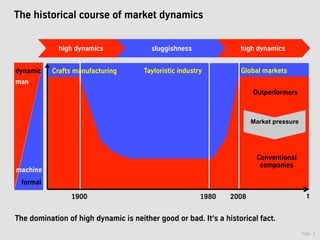
The historical course of market dynamics
The domination of high dynamic is neither good or bad. It‘s a historical fact.
t1900 1980 2008
Conventional
companies
Outperformers
Market pressure
Crafts manufacturing Tayloristic industry Global markets
Page 5
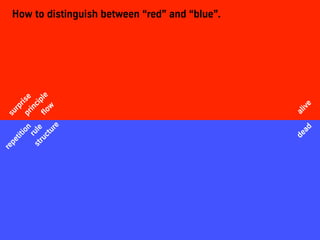
How to distinguish between “red” and “blue”.
Page 6
.........
InformationData
ValuesBehavior
to practiceto learn
Ability (skill)Knowledge
LeadershipAdministration
complex
dynamic
alive
complicate
formal
dead
Blue
Duality – the distinction between “red“ and “blue“
Red
....
Communication
Culture
Qualification
Competence
Management
”World“
The Integration
behind
the Distinction
Distinctions are needed, if you want to think and describe dynamic relations.
Page 7
Centre
Dynamic market
Stimulus
Response
Centre
Dull market
Peri-
phery
Peri-
phery
Peri-
phery
Peri-
phery
Stimulus
Response
Peri-
phery
Peri-
phery
In dynamic markets, the centre loses its knowledge superiority, and steering collapses.
Centre and periphery under dynamic pressure
Peri-
phery
Page 8
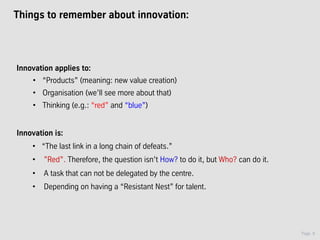
Things to remember about innovation:
Innovation is:
•  “The last link in a long chain of defeats.”
•  ”Red”. Therefore, the question isn’t How? to do it, but Who? can do it.
•  A task that can not be delegated by the centre.
•  Depending on having a “Resistant Nest” for talent.
Innovation applies to:
•  “Products” (meaning: new value creation)
•  Organisation (we’ll see more about that)
•  Thinking (e.g.: “red” and “blue”)
Page 9
Centre
High dynamic (leadership)Low dynamic (steering and control)
Peri-
phery
Peri-
phery
Peri-
phery
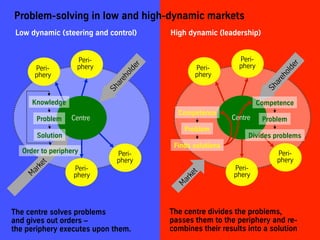
The centre solves problems
and gives out orders –
the periphery executes upon them.
Problem-solving in low and high-dynamic markets
Peri-
phery
The centre divides the problems,
passes them to the periphery and re-
combines their results into a solution
Knowledge
Problem
Solution
Order to periphery
Peri-
phery
Peri-
phery
Peri-
phery
Peri-
phery
Competence
Problem
Finds solutions
Competence
Problem
Divides problems
Centre
Page 10
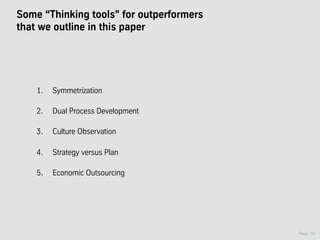
1.  Symmetrization
2.  Dual Process Development
3.  Culture Observation
4.  Strategy versus Plan
5.  Economic Outsourcing
Some “Thinking tools” for outperformers
that we outline in this paper
Page 11
value creation
value creation
Centre
Periphery
Asymmetrical Symmetrical
Day-to-day business
Innovation
Symmetric coupling of centre and periphery
service
serviceservice
“right to demand”
Innovation
Day-to-day business
Control
Leadership
customer customer
Central service Central service
The reintegration of day-to-day business responsibilty into the periphery
turns the interface symmetric, and innovation becomes possible.
Self-control
Page 12
Low dynamics High dynamics
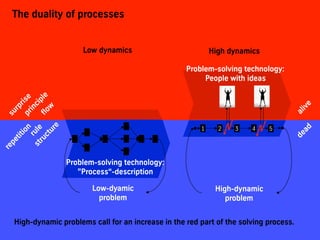
The duality of processes
1 2 3 4 5
Problem-solving technology:
”Process“-description
Problem-solving technology:
People with ideas
Low-dyamic
problem
High-dynamic
problem
High-dynamic problems call for an increase in the red part of the solving process.
Page 13
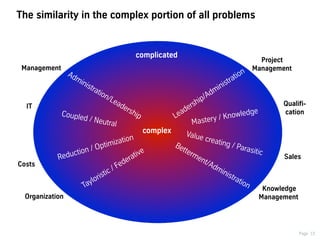
The similarity in the complex portion of all problems
Management
Sales
IT
Costs
Project
Management
Knowledge
ManagementOrganization
Mastery / Knowledge
Qualifi-
cation
Value creating / Parasitic
Reduction / Optimization
Coupled / Neutral
complex
complicated
Page 14
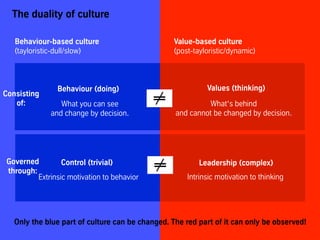
The duality of culture
Only the blue part of culture can be changed. The red part of it can only be observed!
Behaviour (doing) Values (thinking)
Behaviour-based culture
(tayloristic-dull/slow)
Value-based culture
(post-tayloristic/dynamic)
Consisting
of:
Governed
through:
What you can see
and change by decision.
Control (trivial)
What‘s behind
and cannot be changed by decision.
Extrinsic motivation to behavior
Leadership (complex)
Intrinsic motivation to thinking
Page 15
“Strategy”, or “planning”?
In conformity with strategy
Out of bounds!
Future
Status
(Target)
Current
Status “Strategic space“
1
2
3
4
5
6
Out of bounds!
If you know the way, then you can make a plan.
If you don‘t know the way, then you need strategy.
Page 16
Make shell
(waste/muda)
Make core
Buy shell
(outsourcing)
Buy core
(“Santa Clause“
interface)
we make it
ourselves!
we buy it!
existing missing
supplier market
(external reference)
Business
intention
(internal
reference)
Outsourcing: Harmony and conflict between
“core“ competence and “shell“ competence
1
4
3
2
The outsourcing decision is determined exclusively by the supplier market,
not internally. Innovation is limited to core competence.
© BetaCodex Network – All rights reservedWhite paper – The 3 Structures of an Organization 25
Find all BetaCodex Network white papers on www.betacodex.org/papers and on Slideshare.
Special	
  
Edi+on	
  
Special	
  
Edi+on	
  
The BetaCodex Network white papers - so far
www.organizeforcomplexity.com
The “Organize for Complexity” book
Paperback edition Deluxe edition
(with bonus chapter)
betacodex.org
Get in touch with us for more information about leading BetaCodex transformation,
and ask us for a keynote or a workshop proposal.
Make it real!
Niels Pflaeging
contact@nielspflaeging.com
nielspflaeging.com
New York, Wiesbaden
Valérya Carvalho
mvaleriacarv@gmail.com
LinkedIn
São Paulo
Silke Hermann
silke.hermann@nsights-group.de
insights-group.de
Wiesbaden, Berlin, New York
Lars Vollmer
me@lars-vollmer.com
lars-vollmer.com
Hannover, Stuttgart

Dynamic-Robust Problem Solving (BetaCodex07)

  • 1.
    DYNAMIC- ROBUST PROBLEM-SOLVINGThinking Tools forOutperformance A guest contribution white paper for the BetaCodex Network Courtesy of Dr. Gerhard Wohland Make it real! BetaCodex Network White Paper, Aug 2008
  • 2.
    Page 2 The Author: Dr.Gerhard Wohland, gerhard.wohland@comperdi.de •  PhD in physics •  1946, Germany •  Director of the Institute for Dynamic-Robust Outperformance (IdH), Germany Some clients: Deutsche Telekom AG, DaimlerChrysler AG Stuttgart. VW AG Wolfsburg, Schwan-STABILO Nürnberg, Gerling Köln, debis Systemhaus Stuttgart, Bosch Stuttgart
  • 3.
    Page 3 1.  The“Taylor tub” - about the historic course of market dynamics 2.  Duality - the distinction between “red” and “blue” 3.  Centre and periphery under dynamic pressure 4.  Innovation and problem-solving in dynamic markets Fundamental concepts for understanding of market dynamics and how organizations can deal with them
  • 4.
    Page 4 formal dynamic sluggishness highdynamicshigh dynamics machine man The historical course of market dynamics The domination of high dynamic is neither good or bad. It‘s a historical fact. t1900 1980 2008 Conventional companies Outperformers Market pressure Crafts manufacturing Tayloristic industry Global markets
  • 5.
    Page 5 How todistinguish between “red” and “blue”.
  • 6.
    Page 6 ......... InformationData ValuesBehavior to practicetolearn Ability (skill)Knowledge LeadershipAdministration complex dynamic alive complicate formal dead Blue Duality – the distinction between “red“ and “blue“ Red .... Communication Culture Qualification Competence Management ”World“ The Integration behind the Distinction Distinctions are needed, if you want to think and describe dynamic relations.
  • 7.
    Page 7 Centre Dynamic market Stimulus Response Centre Dullmarket Peri- phery Peri- phery Peri- phery Peri- phery Stimulus Response Peri- phery Peri- phery In dynamic markets, the centre loses its knowledge superiority, and steering collapses. Centre and periphery under dynamic pressure Peri- phery
  • 8.
    Page 8 Things toremember about innovation: Innovation is: •  “The last link in a long chain of defeats.” •  ”Red”. Therefore, the question isn’t How? to do it, but Who? can do it. •  A task that can not be delegated by the centre. •  Depending on having a “Resistant Nest” for talent. Innovation applies to: •  “Products” (meaning: new value creation) •  Organisation (we’ll see more about that) •  Thinking (e.g.: “red” and “blue”)
  • 9.
    Page 9 Centre High dynamic(leadership)Low dynamic (steering and control) Peri- phery Peri- phery Peri- phery The centre solves problems and gives out orders – the periphery executes upon them. Problem-solving in low and high-dynamic markets Peri- phery The centre divides the problems, passes them to the periphery and re- combines their results into a solution Knowledge Problem Solution Order to periphery Peri- phery Peri- phery Peri- phery Peri- phery Competence Problem Finds solutions Competence Problem Divides problems Centre
  • 10.
    Page 10 1.  Symmetrization 2. Dual Process Development 3.  Culture Observation 4.  Strategy versus Plan 5.  Economic Outsourcing Some “Thinking tools” for outperformers that we outline in this paper
  • 11.
    Page 11 value creation valuecreation Centre Periphery Asymmetrical Symmetrical Day-to-day business Innovation Symmetric coupling of centre and periphery service serviceservice “right to demand” Innovation Day-to-day business Control Leadership customer customer Central service Central service The reintegration of day-to-day business responsibilty into the periphery turns the interface symmetric, and innovation becomes possible. Self-control
  • 12.
    Page 12 Low dynamicsHigh dynamics The duality of processes 1 2 3 4 5 Problem-solving technology: ”Process“-description Problem-solving technology: People with ideas Low-dyamic problem High-dynamic problem High-dynamic problems call for an increase in the red part of the solving process.
  • 13.
    Page 13 The similarityin the complex portion of all problems Management Sales IT Costs Project Management Knowledge ManagementOrganization Mastery / Knowledge Qualifi- cation Value creating / Parasitic Reduction / Optimization Coupled / Neutral complex complicated
  • 14.
    Page 14 The dualityof culture Only the blue part of culture can be changed. The red part of it can only be observed! Behaviour (doing) Values (thinking) Behaviour-based culture (tayloristic-dull/slow) Value-based culture (post-tayloristic/dynamic) Consisting of: Governed through: What you can see and change by decision. Control (trivial) What‘s behind and cannot be changed by decision. Extrinsic motivation to behavior Leadership (complex) Intrinsic motivation to thinking
  • 15.
    Page 15 “Strategy”, or“planning”? In conformity with strategy Out of bounds! Future Status (Target) Current Status “Strategic space“ 1 2 3 4 5 6 Out of bounds! If you know the way, then you can make a plan. If you don‘t know the way, then you need strategy.
  • 16.
    Page 16 Make shell (waste/muda) Makecore Buy shell (outsourcing) Buy core (“Santa Clause“ interface) we make it ourselves! we buy it! existing missing supplier market (external reference) Business intention (internal reference) Outsourcing: Harmony and conflict between “core“ competence and “shell“ competence 1 4 3 2 The outsourcing decision is determined exclusively by the supplier market, not internally. Innovation is limited to core competence.
  • 17.
    © BetaCodex Network– All rights reservedWhite paper – The 3 Structures of an Organization 25 Find all BetaCodex Network white papers on www.betacodex.org/papers and on Slideshare. Special   Edi+on   Special   Edi+on   The BetaCodex Network white papers - so far
  • 18.
    www.organizeforcomplexity.com The “Organize forComplexity” book Paperback edition Deluxe edition (with bonus chapter)
  • 19.
    betacodex.org Get in touchwith us for more information about leading BetaCodex transformation, and ask us for a keynote or a workshop proposal. Make it real! Niels Pflaeging contact@nielspflaeging.com nielspflaeging.com New York, Wiesbaden Valérya Carvalho mvaleriacarv@gmail.com LinkedIn São Paulo Silke Hermann silke.hermann@nsights-group.de insights-group.de Wiesbaden, Berlin, New York Lars Vollmer me@lars-vollmer.com lars-vollmer.com Hannover, Stuttgart