BERT – Bird’s Eye View
PART1
Learning Notes of Senthil Kumar
Agenda
Bird’s eye view (PART1)
About Language Models
What is BERT? – A SOTA LM
What does BERT do? – Multi-task Learning
How is BERT built? – BERT Architecture
BERT Fine-tuning and Results
What is powering NLP’s Growth?
Two important trends that power recent NLP growth
• Better representation of the text data (with no supervision)
• By grasping the 'context' better
(e.g. terms used language models, word embeddings, contextualized word embeddings)
• By enabling 'transfer learning’
(e.g.: term used pre-trained language models)
• Deep Learning Models that use the better representations to solve real-world problems like Text
Classification, Semantic Role Labelling, Translation, Image Captioning, etc.,
Important Terms
Language Model:
A language model (LM) is a model that generates a probability distribution over sequences of words
Language Model - A model to predict the next word in a sequence of words
***************************
Encoder:
Converts variable length text (any sequence information) into a fixed length vector
***************************
Transformer:
- A sequence model forgoes the recurrent structure of RNN to adopt attention-based approach
- Transformer vs Seq2Seq Model
- { Encoder + (attention-mechanism) + Decoder } vs { Encoder + Decoder }
***************************
Recurrent Structure: Processes all input elements sequentially
Attention-based Approach: Process all input elements SIMULTANEOUSLY
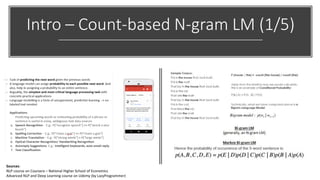
Intro – Count-based N-gram LM (1/5)
Sources:
NLP course on Coursera – National Higher School of Economics
Advanced NLP and Deep Learning course on Udemy (by LazyProgrammer)
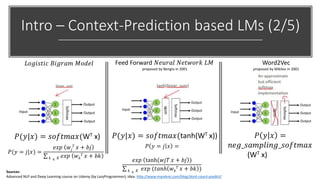
Intro – Context-Prediction based LMs (2/5)
𝑃(𝑦|𝑥) = 𝑠𝑜𝑓𝑡𝑚𝑎𝑥(WT x)
𝑃(𝑦 = 𝑗|𝑥) =
𝑒𝑥𝑝 𝑤𝑗
𝑇 𝑥 + 𝑏𝑗
σ 𝑘 ∊ 𝐾 𝑒𝑥𝑝 𝑤 𝑘
𝑇 𝑥 + 𝑏𝑘
𝑃 𝑦 = 𝑗 𝑥 =
𝑒𝑥𝑝 tanh(𝑤𝑗𝑇 𝑥 + 𝑏𝑗 )
σ 𝑘 ∊ 𝐾 𝑒𝑥𝑝 (𝑡𝑎𝑛ℎ 𝑤 𝑘
𝑇 𝑥 + 𝑏𝑘 )
𝑃(𝑦|𝑥) = 𝑠𝑜𝑓𝑡𝑚𝑎𝑥(tanh(WT x))
𝐿𝑜𝑔𝑖𝑠𝑡𝑖𝑐 𝐵𝑖𝑔𝑟𝑎𝑚 𝑀𝑜𝑑𝑒𝑙 Feed Forward 𝑁𝑒𝑢𝑟𝑎𝑙 𝑁𝑒𝑡𝑤𝑜𝑟𝑘 𝐿𝑀
proposed by Bengio in 2001
Sources:
Advanced NLP and Deep Learning course on Udemy (by LazyProgrammer); Idea: http://www.marekrei.com/blog/dont-count-predict/
Word2Vec
proposed by Mikilov in 2001
𝑃 𝑦 𝑥 =
𝑛𝑒𝑔_𝑠𝑎𝑚𝑝𝑙𝑖𝑛𝑔_𝑠𝑜𝑓𝑡𝑚𝑎𝑥
(WT x)
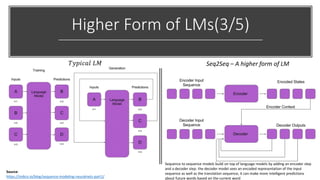
Higher Form of LMs(3/5)
𝑇𝑦𝑝𝑖𝑐𝑎𝑙 𝐿𝑀
Source:
https://indico.io/blog/sequence-modeling-neuralnets-part1/
Seq2Seq – A higher form of LM
Sequence to sequence models build on top of language models by adding an encoder step
and a decoder step. the decoder model sees an encoded representation of the input
sequence as well as the translation sequence, it can make more intelligent predictions
about future words based on the current word
Higher Form of LMs(4/5)
𝑇𝑦𝑝𝑖𝑐𝑎𝑙 𝑆𝑒𝑞2𝑆𝑒𝑞 𝑀𝑜𝑑𝑒𝑙 𝑇𝑟𝑎𝑛𝑠𝑓𝑜𝑟𝑚𝑒𝑟 𝑀𝑜𝑑𝑒𝑙
{ Encoder + (attention-mechanism) + Decoder }
Attention-based Approach: Process all input elements
SIMULTANEOUSLY
{ Encoder + Decoder }
Recurrent Structure: Processes all input elements
sequentially
Sources:
https://towardsdatascience.com/nlp-sequence-to-sequence-networks-part-2-seq2seq-model-encoderdecoder-model-6c22e29fd7e1
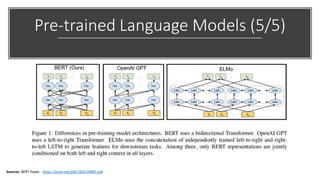
Pre-trained Language Models (5/5)
Sources: BERT Paper - https://arxiv.org/pdf/1810.04805.pdf
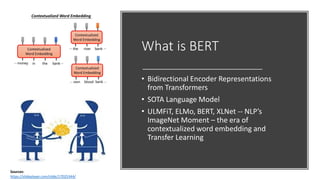
What is BERT
• Bidirectional Encoder Representations
from Transformers
• SOTA Language Model
• ULMFiT, ELMo, BERT, XLNet -- NLP’s
ImageNet Moment – the era of
contextualized word embedding and
Transfer Learning
Sources:
https://slideplayer.com/slide/17025344/
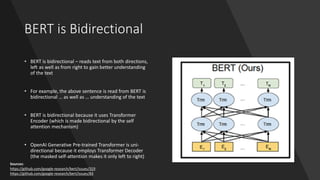
BERT is Bidirectional
• BERT is bidirectional – reads text from both directions,
left as well as from right to gain better understanding
of the text
• For example, the above sentence is read from BERT is
bidirectional … as well as … understanding of the text
• BERT is bidirectional because it uses Transformer
Encoder (which is made bidirectional by the self
attention mechanism)
• OpenAI Generative Pre-trained Transformer is uni-
directional because it employs Transformer Decoder
(the masked self-attention makes it only left to right)
Sources:
https://github.com/google-research/bert/issues/319
https://github.com/google-research/bert/issues/83
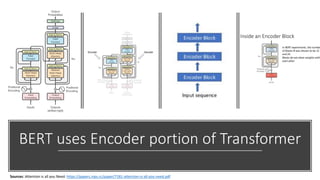
BERT uses Encoder portion of Transformer
Sources: Attention is all you Need: https://papers.nips.cc/paper/7181-attention-is-all-you-need.pdf
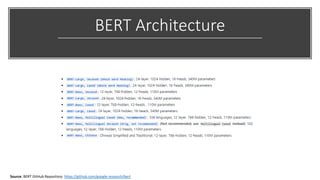
BERT Architecture
Source: BERT GitHub Repository: https://github.com/google-research/bert
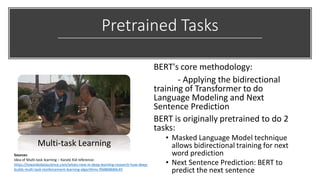
Pretrained Tasks
BERT's core methodology:
- Applying the bidirectional
training of Transformer to do
Language Modeling and Next
Sentence Prediction
BERT is originally pretrained to do 2
tasks:
• Masked Language Model technique
allows bidirectional training for next
word prediction
• Next Sentence Prediction: BERT to
predict the next sentence
Multi-task Learning
Sources:
Idea of Multi-task learning – Karate Kid reference:
https://towardsdatascience.com/whats-new-in-deep-learning-research-how-deep-
builds-multi-task-reinforcement-learning-algorithms-f0d868684c45
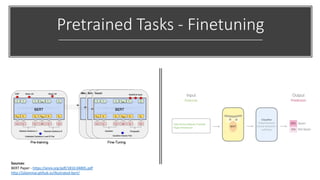
Pretrained Tasks - Finetuning
Sources:
BERT Paper - https://arxiv.org/pdf/1810.04805.pdf
http://jalammar.github.io/illustrated-bert/
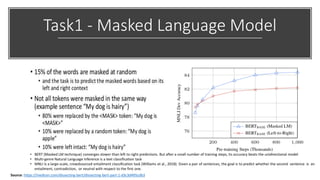
Task1 - Masked Language Model
• BERT (Masked LM technique) converges slower than left to right predictions. But after a small number of training steps, its accuracy beats the unidirectional model
• Multi-genre Natural Language Inference is a text classification task
• MNLI is a large-scale, crowdsourced entailment classification task (Williams et al., 2018). Given a pair of sentences, the goal is to predict whether the second sentence is an
entailment, contradiction, or neutral with respect to the first one.
Source: https://medium.com/dissecting-bert/dissecting-bert-part-1-d3c3d495cdb3
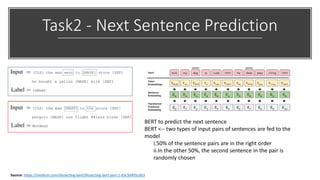
Task2 - Next Sentence Prediction
BERT to predict the next sentence
BERT <-- two types of input pairs of sentences are fed to the
model
i.50% of the sentence pairs are in the right order
ii.In the other 50%, the second sentence in the pair is
randomly chosen
Source: https://medium.com/dissecting-bert/dissecting-bert-part-1-d3c3d495cdb3
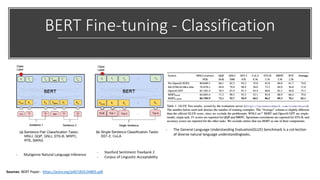
BERT Fine-tuning - Classification
- Stanford Sentiment Treebank 2
- Corpus of Linguistic Acceptability
- Mutigenre Natural Language Inference
- The General Language Understanding Evaluation(GLUE) benchmark is a col-lection
of diverse natural language understandingtasks.
Sources: BERT Paper - https://arxiv.org/pdf/1810.04805.pdf
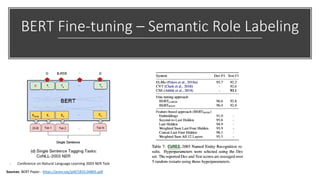
BERT Fine-tuning – Semantic Role Labeling
- Conference on Natural Language Learning 2003 NER Task
Sources: BERT Paper - https://arxiv.org/pdf/1810.04805.pdf
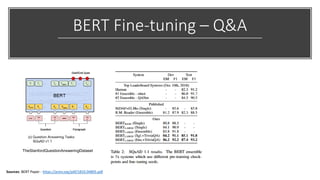
BERT Fine-tuning – Q&A
TheStanfordQuestionAnsweringDataset
Sources: BERT Paper - https://arxiv.org/pdf/1810.04805.pdf
Thank You

BERT - Part 1 Learning Notes of Senthil Kumar

  • 1.
    BERT – Bird’sEye View PART1 Learning Notes of Senthil Kumar
  • 2.
    Agenda Bird’s eye view(PART1) About Language Models What is BERT? – A SOTA LM What does BERT do? – Multi-task Learning How is BERT built? – BERT Architecture BERT Fine-tuning and Results
  • 3.
    What is poweringNLP’s Growth? Two important trends that power recent NLP growth • Better representation of the text data (with no supervision) • By grasping the 'context' better (e.g. terms used language models, word embeddings, contextualized word embeddings) • By enabling 'transfer learning’ (e.g.: term used pre-trained language models) • Deep Learning Models that use the better representations to solve real-world problems like Text Classification, Semantic Role Labelling, Translation, Image Captioning, etc.,
  • 4.
    Important Terms Language Model: Alanguage model (LM) is a model that generates a probability distribution over sequences of words Language Model - A model to predict the next word in a sequence of words *************************** Encoder: Converts variable length text (any sequence information) into a fixed length vector *************************** Transformer: - A sequence model forgoes the recurrent structure of RNN to adopt attention-based approach - Transformer vs Seq2Seq Model - { Encoder + (attention-mechanism) + Decoder } vs { Encoder + Decoder } *************************** Recurrent Structure: Processes all input elements sequentially Attention-based Approach: Process all input elements SIMULTANEOUSLY
  • 5.
    Intro – Count-basedN-gram LM (1/5) Sources: NLP course on Coursera – National Higher School of Economics Advanced NLP and Deep Learning course on Udemy (by LazyProgrammer)
  • 6.
    Intro – Context-Predictionbased LMs (2/5) 𝑃(𝑦|𝑥) = 𝑠𝑜𝑓𝑡𝑚𝑎𝑥(WT x) 𝑃(𝑦 = 𝑗|𝑥) = 𝑒𝑥𝑝 𝑤𝑗 𝑇 𝑥 + 𝑏𝑗 σ 𝑘 ∊ 𝐾 𝑒𝑥𝑝 𝑤 𝑘 𝑇 𝑥 + 𝑏𝑘 𝑃 𝑦 = 𝑗 𝑥 = 𝑒𝑥𝑝 tanh(𝑤𝑗𝑇 𝑥 + 𝑏𝑗 ) σ 𝑘 ∊ 𝐾 𝑒𝑥𝑝 (𝑡𝑎𝑛ℎ 𝑤 𝑘 𝑇 𝑥 + 𝑏𝑘 ) 𝑃(𝑦|𝑥) = 𝑠𝑜𝑓𝑡𝑚𝑎𝑥(tanh(WT x)) 𝐿𝑜𝑔𝑖𝑠𝑡𝑖𝑐 𝐵𝑖𝑔𝑟𝑎𝑚 𝑀𝑜𝑑𝑒𝑙 Feed Forward 𝑁𝑒𝑢𝑟𝑎𝑙 𝑁𝑒𝑡𝑤𝑜𝑟𝑘 𝐿𝑀 proposed by Bengio in 2001 Sources: Advanced NLP and Deep Learning course on Udemy (by LazyProgrammer); Idea: http://www.marekrei.com/blog/dont-count-predict/ Word2Vec proposed by Mikilov in 2001 𝑃 𝑦 𝑥 = 𝑛𝑒𝑔_𝑠𝑎𝑚𝑝𝑙𝑖𝑛𝑔_𝑠𝑜𝑓𝑡𝑚𝑎𝑥 (WT x)
  • 7.
    Higher Form ofLMs(3/5) 𝑇𝑦𝑝𝑖𝑐𝑎𝑙 𝐿𝑀 Source: https://indico.io/blog/sequence-modeling-neuralnets-part1/ Seq2Seq – A higher form of LM Sequence to sequence models build on top of language models by adding an encoder step and a decoder step. the decoder model sees an encoded representation of the input sequence as well as the translation sequence, it can make more intelligent predictions about future words based on the current word
  • 8.
    Higher Form ofLMs(4/5) 𝑇𝑦𝑝𝑖𝑐𝑎𝑙 𝑆𝑒𝑞2𝑆𝑒𝑞 𝑀𝑜𝑑𝑒𝑙 𝑇𝑟𝑎𝑛𝑠𝑓𝑜𝑟𝑚𝑒𝑟 𝑀𝑜𝑑𝑒𝑙 { Encoder + (attention-mechanism) + Decoder } Attention-based Approach: Process all input elements SIMULTANEOUSLY { Encoder + Decoder } Recurrent Structure: Processes all input elements sequentially Sources: https://towardsdatascience.com/nlp-sequence-to-sequence-networks-part-2-seq2seq-model-encoderdecoder-model-6c22e29fd7e1
  • 9.
    Pre-trained Language Models(5/5) Sources: BERT Paper - https://arxiv.org/pdf/1810.04805.pdf
  • 10.
    What is BERT •Bidirectional Encoder Representations from Transformers • SOTA Language Model • ULMFiT, ELMo, BERT, XLNet -- NLP’s ImageNet Moment – the era of contextualized word embedding and Transfer Learning Sources: https://slideplayer.com/slide/17025344/
  • 11.
    BERT is Bidirectional •BERT is bidirectional – reads text from both directions, left as well as from right to gain better understanding of the text • For example, the above sentence is read from BERT is bidirectional … as well as … understanding of the text • BERT is bidirectional because it uses Transformer Encoder (which is made bidirectional by the self attention mechanism) • OpenAI Generative Pre-trained Transformer is uni- directional because it employs Transformer Decoder (the masked self-attention makes it only left to right) Sources: https://github.com/google-research/bert/issues/319 https://github.com/google-research/bert/issues/83
  • 12.
    BERT uses Encoderportion of Transformer Sources: Attention is all you Need: https://papers.nips.cc/paper/7181-attention-is-all-you-need.pdf
  • 13.
    BERT Architecture Source: BERTGitHub Repository: https://github.com/google-research/bert
  • 14.
    Pretrained Tasks BERT's coremethodology: - Applying the bidirectional training of Transformer to do Language Modeling and Next Sentence Prediction BERT is originally pretrained to do 2 tasks: • Masked Language Model technique allows bidirectional training for next word prediction • Next Sentence Prediction: BERT to predict the next sentence Multi-task Learning Sources: Idea of Multi-task learning – Karate Kid reference: https://towardsdatascience.com/whats-new-in-deep-learning-research-how-deep- builds-multi-task-reinforcement-learning-algorithms-f0d868684c45
  • 15.
    Pretrained Tasks -Finetuning Sources: BERT Paper - https://arxiv.org/pdf/1810.04805.pdf http://jalammar.github.io/illustrated-bert/
  • 16.
    Task1 - MaskedLanguage Model • BERT (Masked LM technique) converges slower than left to right predictions. But after a small number of training steps, its accuracy beats the unidirectional model • Multi-genre Natural Language Inference is a text classification task • MNLI is a large-scale, crowdsourced entailment classification task (Williams et al., 2018). Given a pair of sentences, the goal is to predict whether the second sentence is an entailment, contradiction, or neutral with respect to the first one. Source: https://medium.com/dissecting-bert/dissecting-bert-part-1-d3c3d495cdb3
  • 17.
    Task2 - NextSentence Prediction BERT to predict the next sentence BERT <-- two types of input pairs of sentences are fed to the model i.50% of the sentence pairs are in the right order ii.In the other 50%, the second sentence in the pair is randomly chosen Source: https://medium.com/dissecting-bert/dissecting-bert-part-1-d3c3d495cdb3
  • 18.
    BERT Fine-tuning -Classification - Stanford Sentiment Treebank 2 - Corpus of Linguistic Acceptability - Mutigenre Natural Language Inference - The General Language Understanding Evaluation(GLUE) benchmark is a col-lection of diverse natural language understandingtasks. Sources: BERT Paper - https://arxiv.org/pdf/1810.04805.pdf
  • 19.
    BERT Fine-tuning –Semantic Role Labeling - Conference on Natural Language Learning 2003 NER Task Sources: BERT Paper - https://arxiv.org/pdf/1810.04805.pdf
  • 20.
    BERT Fine-tuning –Q&A TheStanfordQuestionAnsweringDataset Sources: BERT Paper - https://arxiv.org/pdf/1810.04805.pdf
  • 21.