BERT MODEL FOR TEXT
CLASSIFICATION
Presented by,
Mokshadayini K S
TECHNICAL SEMINAR PRESENTATION 2021-22
Under the guidance of
Dr. Ravi Kumar V
TABLE OF
CONTENT
• What is BERT?
• Introduction
• Architecture
• Working
• Text Classification
INTRODUCTION
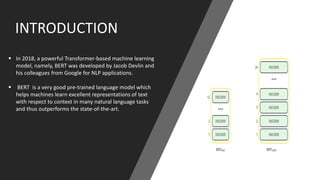
 In 2018, a powerful Transformer-based machine learning
model, namely, BERT was developed by Jacob Devlin and
his colleagues from Google for NLP applications.
 BERT is a very good pre-trained language model which
helps machines learn excellent representations of text
with respect to context in many natural language tasks
and thus outperforms the state-of-the-art.
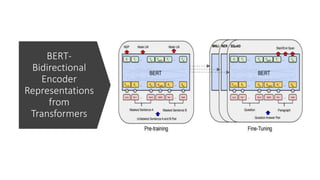
BERT-
Bidirectional
Encoder
Representations
from
Transformers
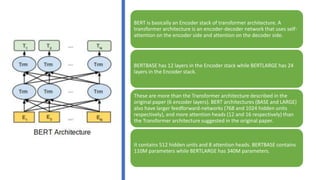
BERT is basically an Encoder stack of transformer architecture. A
transformer architecture is an encoder-decoder network that uses self-
attention on the encoder side and attention on the decoder side.
BERTBASE has 12 layers in the Encoder stack while BERTLARGE has 24
layers in the Encoder stack.
These are more than the Transformer architecture described in the
original paper (6 encoder layers). BERT architectures (BASE and LARGE)
also have larger feedforward-networks (768 and 1024 hidden units
respectively), and more attention heads (12 and 16 respectively) than
the Transformer architecture suggested in the original paper.
It contains 512 hidden units and 8 attention heads. BERTBASE contains
110M parameters while BERTLARGE has 340M parameters.
BERT WORKING
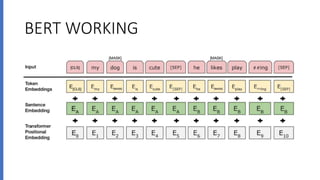
Masked Language Model:
• In this NLP task, we replace 15% of words
in the text with the [MASK] token.
• The model then predicts the original words
that are replaced by [MASK] token.
• Beyond masking, the masking also mixes
things a bit in order to improve how the
model later for fine-tuning because [MASK]
token created a mismatch between training
and fine-tuning.
• In this model, we add a classification layer
at the top of the encoder input. We also
calculate the probability of the output using
a fully connected and a softmax layer.
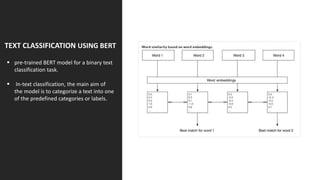
 pre-trained BERT model for a binary text
classification task.
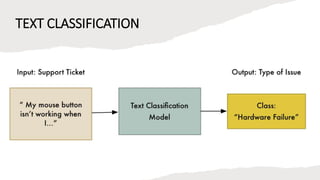
 In-text classification, the main aim of
the model is to categorize a text into one
of the predefined categories or labels.
TEXT CLASSIFICATION USING BERT
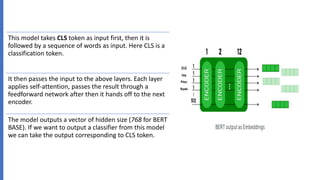
This model takes CLS token as input first, then it is
followed by a sequence of words as input. Here CLS is a
classification token.
It then passes the input to the above layers. Each layer
applies self-attention, passes the result through a
feedforward network after then it hands off to the next
encoder.
The model outputs a vector of hidden size (768 for BERT
BASE). If we want to output a classifier from this model
we can take the output corresponding to CLS token.
TEXT CLASSIFICATION
THANK YOU

BERT MODULE FOR TEXT CLASSIFICATION.pptx

  • 1.
    BERT MODEL FORTEXT CLASSIFICATION Presented by, Mokshadayini K S TECHNICAL SEMINAR PRESENTATION 2021-22 Under the guidance of Dr. Ravi Kumar V
  • 2.
    TABLE OF CONTENT • Whatis BERT? • Introduction • Architecture • Working • Text Classification
  • 3.
    INTRODUCTION  In 2018,a powerful Transformer-based machine learning model, namely, BERT was developed by Jacob Devlin and his colleagues from Google for NLP applications.  BERT is a very good pre-trained language model which helps machines learn excellent representations of text with respect to context in many natural language tasks and thus outperforms the state-of-the-art.
  • 4.
  • 5.
    BERT is basicallyan Encoder stack of transformer architecture. A transformer architecture is an encoder-decoder network that uses self- attention on the encoder side and attention on the decoder side. BERTBASE has 12 layers in the Encoder stack while BERTLARGE has 24 layers in the Encoder stack. These are more than the Transformer architecture described in the original paper (6 encoder layers). BERT architectures (BASE and LARGE) also have larger feedforward-networks (768 and 1024 hidden units respectively), and more attention heads (12 and 16 respectively) than the Transformer architecture suggested in the original paper. It contains 512 hidden units and 8 attention heads. BERTBASE contains 110M parameters while BERTLARGE has 340M parameters.
  • 6.
  • 7.
    Masked Language Model: •In this NLP task, we replace 15% of words in the text with the [MASK] token. • The model then predicts the original words that are replaced by [MASK] token. • Beyond masking, the masking also mixes things a bit in order to improve how the model later for fine-tuning because [MASK] token created a mismatch between training and fine-tuning. • In this model, we add a classification layer at the top of the encoder input. We also calculate the probability of the output using a fully connected and a softmax layer.
  • 8.
     pre-trained BERTmodel for a binary text classification task.  In-text classification, the main aim of the model is to categorize a text into one of the predefined categories or labels. TEXT CLASSIFICATION USING BERT
  • 9.
    This model takesCLS token as input first, then it is followed by a sequence of words as input. Here CLS is a classification token. It then passes the input to the above layers. Each layer applies self-attention, passes the result through a feedforward network after then it hands off to the next encoder. The model outputs a vector of hidden size (768 for BERT BASE). If we want to output a classifier from this model we can take the output corresponding to CLS token.
  • 10.
  • 11.