Introduction
BERT, or BidirectionalEncoder Representations from Transformers, is a revolutionary model for
natural language processing that employs deep learning architecture to understand the context
of words in search queries, improving the efficacy of various NLP tasks.
Overview of BERT
BERTis designed to pre-train deep bidirectional representations by jointly conditioning on both left
and right context in all layers. It is trained on vast text data and achieves state-of-the-art results on
several NLP tasks, emphasizing the benefits of understanding context in language processing.
5.
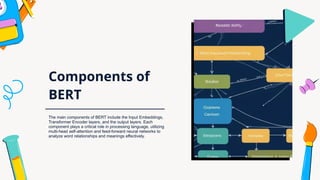
Components of
BERT
The maincomponents of BERT include the Input Embeddings,
Transformer Encoder layers, and the output layers. Each
component plays a critical role in processing language, utilizing
multi-head self-attention and feed-forward neural networks to
analyze word relationships and meanings effectively.
6.
Self-Attention Mechanism
The self-attentionmechanism allows BERT to weigh the significance of different words in a sentence
relative to each other. It helps the model focus on relevant parts of the text based on context, leading
to a deeper understanding of language nuances. This mechanism is crucial for capturing
relationships between words, regardless of their position in the text.
Fine-Tuning Process
Fine-tuning BERTinvolves taking a pre-trained model and training it on a specific task with a labeled dataset. The
process includes adjusting the model parameters to improve performance for tasks such as sentiment analysis,
question answering, or named entity recognition. Fine-tuning typically requires less data and resources compared to
training from scratch, leveraging the knowledge embedded in the pre-trained model.
9.
Applications of Fine-
TunedBERT
Fine-tuned BERT has a wide range of applications in NLP, including chatbots, search engines,
automated summarization, and sentiment analysis. Companies utilize fine-tuned BERT to improve
user experience by providing accurate responses and insights from textual data, demonstrating its
versatility and effectiveness in real-world scenarios.
10.
Performance
Improvements
Fine-tuning BERT significantlyenhances its accuracy and
efficiency compared to base models. It allows for the optimization
of the model according to task-specific requirements, resulting in
faster inference times and better performance on benchmarks.
These improvements make fine-tuned BERT a preferred choice for
many NLP applications.
11.
Conclusions
BERT's architecture andfine-tuning approach revolutionize NLP by enabling models that understand
language context dynamically. The self-attention mechanism and the ability to fine-tune for specific
tasks lead to significant performance gains across applications, confirming BERT's position as a
powerful tool in the field of natural language processing.
12.
CREDITS: This presentationtemplate was created by Slidesgo, and
includes icons by Flaticon, and infographics & images by Freepik
Do you have any questions?
Thank you!











![[Paper review] BERT](https://cdn.slidesharecdn.com/ss_thumbnails/paperreviewbert-190507052754-thumbnail.jpg?width=640&height=640&fit=bounds)


