Business Models for Open Access Publishing Matthew Cockerill Publisher, BioMed Central
What is fundamentally different about an Open Access publishing business model?
Traditional research publishing The research community transfers the rights to the research to the publisher The publisher covers its costs by selling access to the content
Open Access research publishing There are no barriers to access The publisher generally does not acquire any exclusive rights Typically the publisher is paid for the service of publication
Revenue streams for open access publishers Publication fees From authors From meeting organizers From sponsoring organizations Subscription content (e.g. reviews)  Services (e.g. Open Repository) Advertising Implicit/explicit subsidy
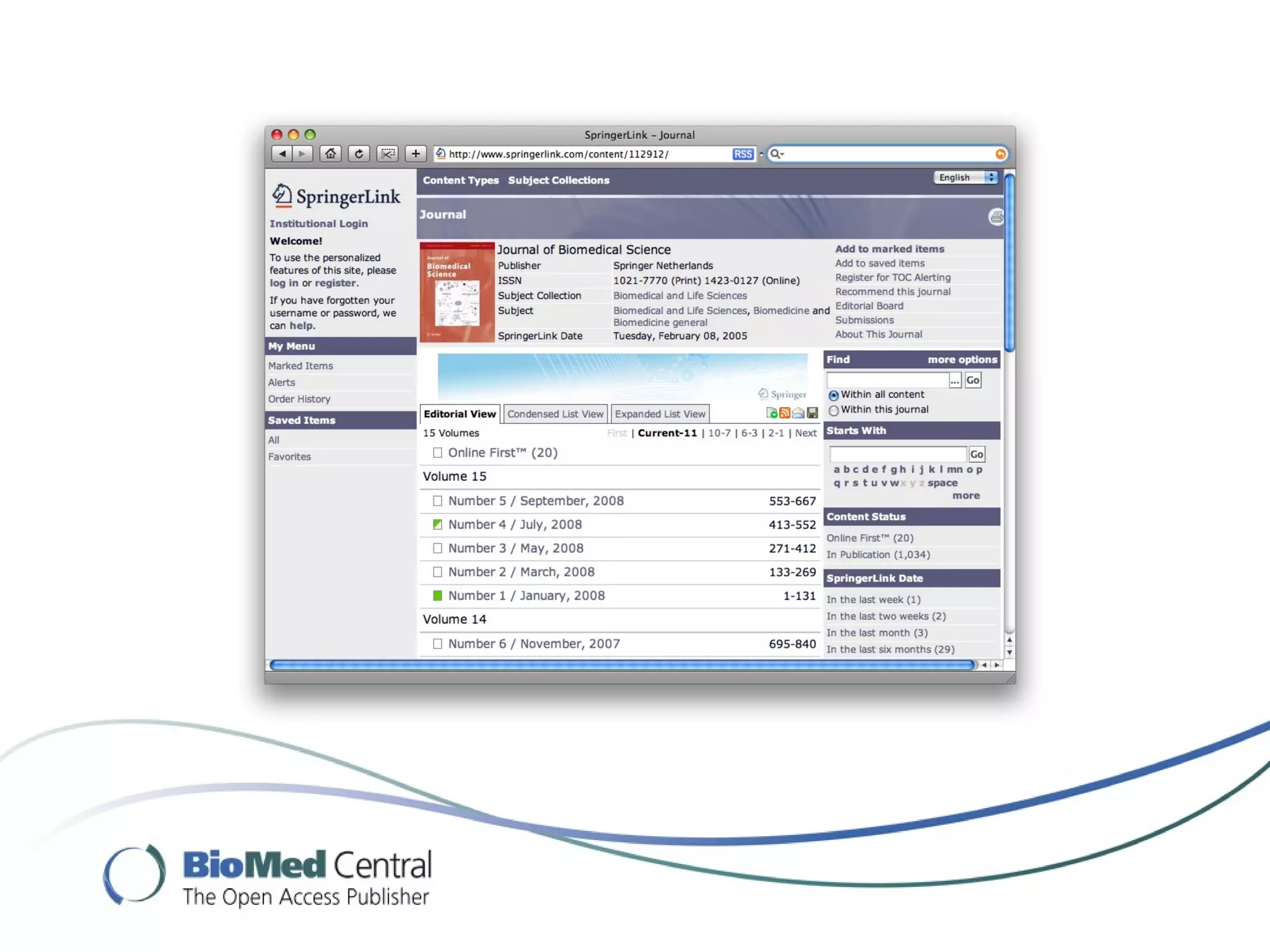
BioMed Central journals which do not charge author fees Chinese Medicine Chiropractic & Osteopathy Italian Journal of Pediatrics Journal of Biomedical Science Journal of Brachial Plexus and Peripheral Nerve Injury Journal of Orthopaedic Surgery and Research Journal of the International AIDS Society Scandinavian Journal of Trauma, Resuscitation and Emergency Medicine Sports Medicine, Arthroscopy, Rehabilitation, Therapy & Technology
Some journals operate mixed models Author’s pay publication fee for research articles DFG funding covers cost of additional articles
BioMed Central journal’s with additional subscription content Coming soon…
Examples of additional services A hosted digital repository solution Integration ensures articles published in OA journals can easily be included
Advertising? Some potential editors ask:  “can we support a journal entirely with advertising?” Unlikely - advertising is tiny fraction of BioMed Central’s revenue
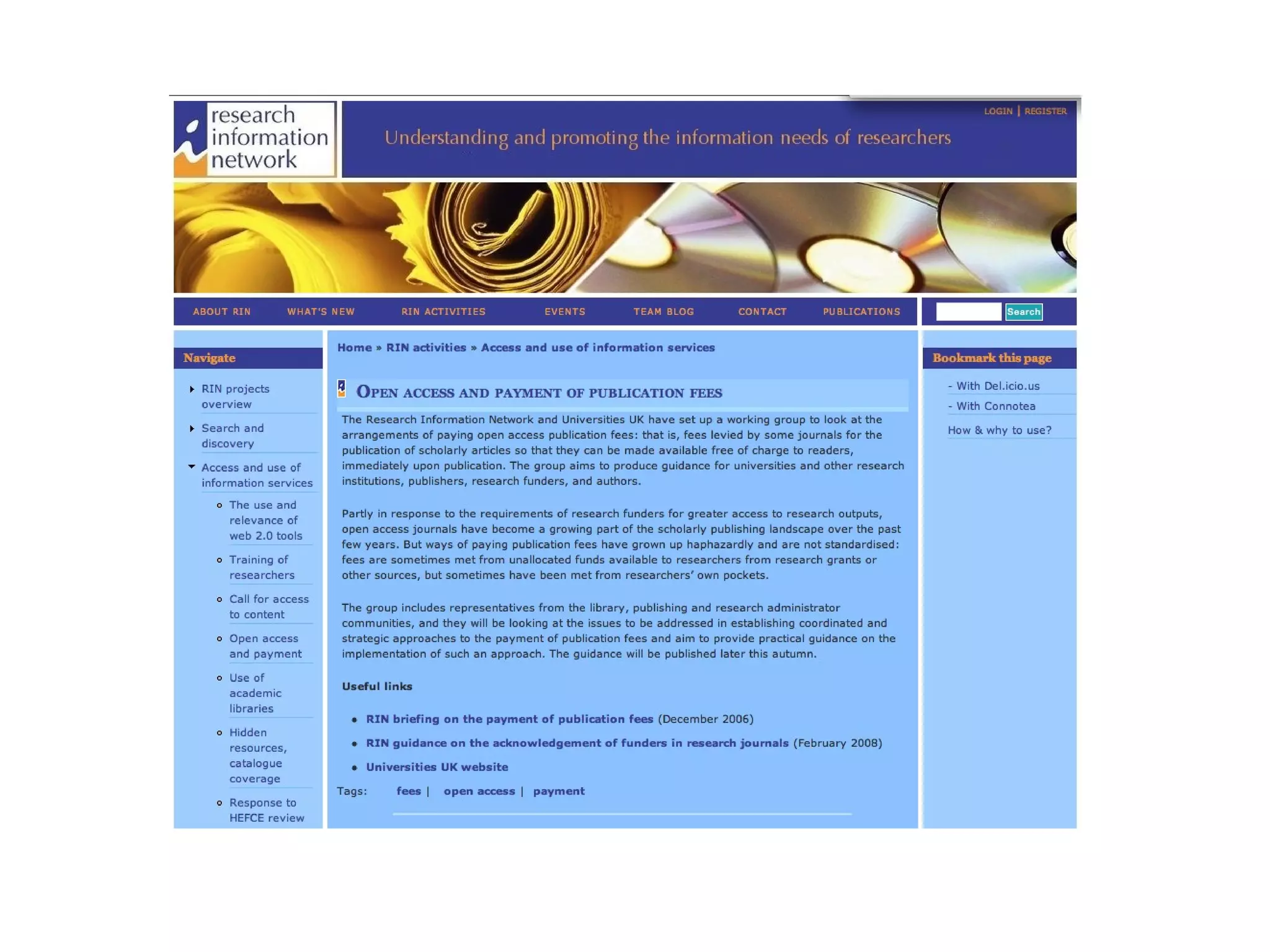
OA Publication Fees
Putting Open Access fees in the context of the traditional system Top-down and bottom-up analyses come to similar conclusion Average publisher revenue per STM article is around £3000 ($4700)
What do OA publication fees cover? Open access publishing has most of the same costs as the traditional system: Editorial Technical Production Customer services Marketing ( e.g.  conference attendance)
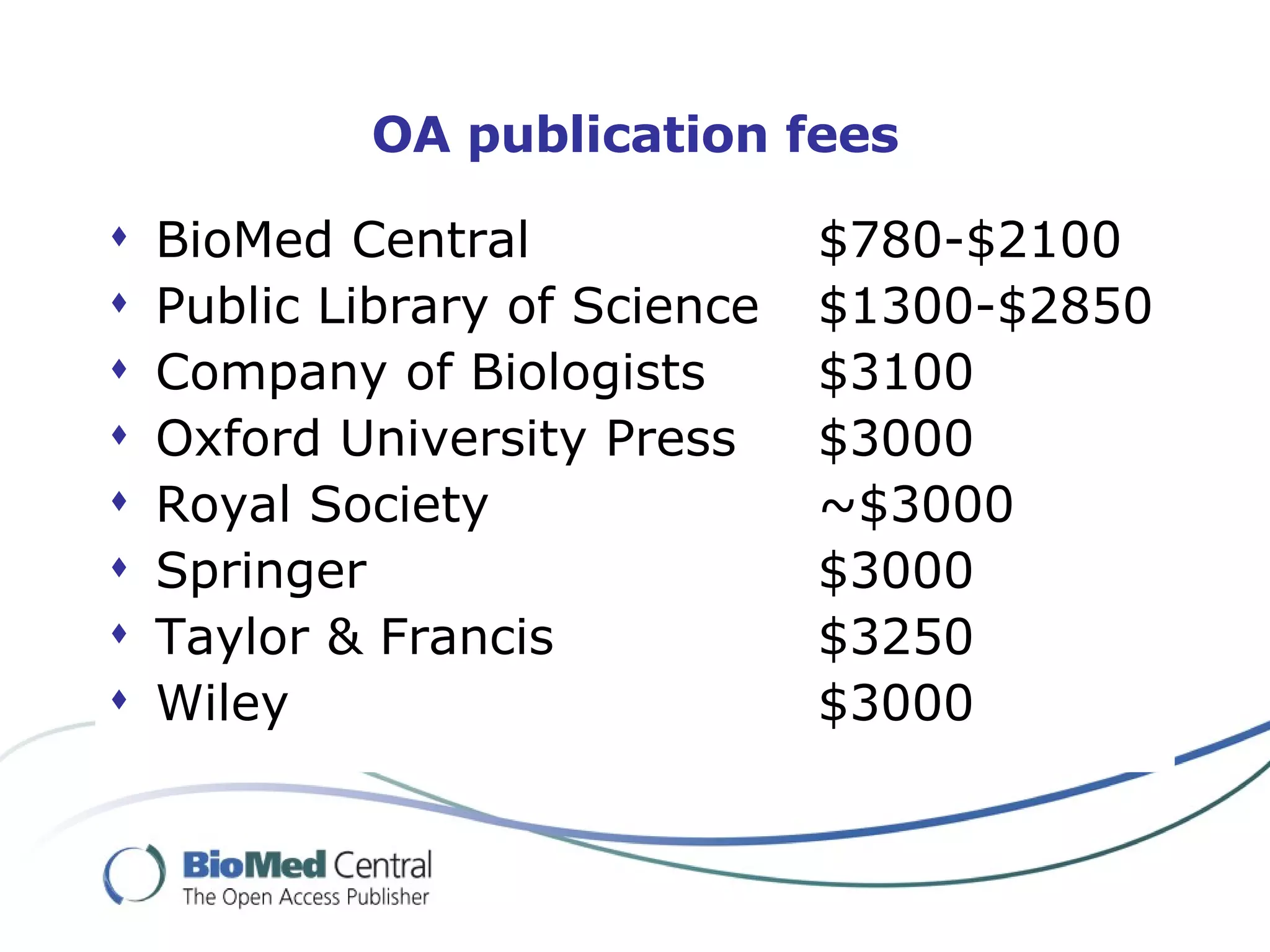
OA publication fees BioMed Central  $780-$2100 Public Library of Science  $1300-$2850 Company of Biologists  $3100 Oxford University Press  $3000 Royal Society ~$3000 Springer $3000 Taylor & Francis $3250 Wiley $3000
How do OA publication fees get paid? Authors may pay out of grant funds Some funders provide dedicated funds for open access publishing costs Institutions may cover costs centrally (via open access funds and/or membership arrangements with OA publishers) Some journals are run by organizations which cover costs themselves
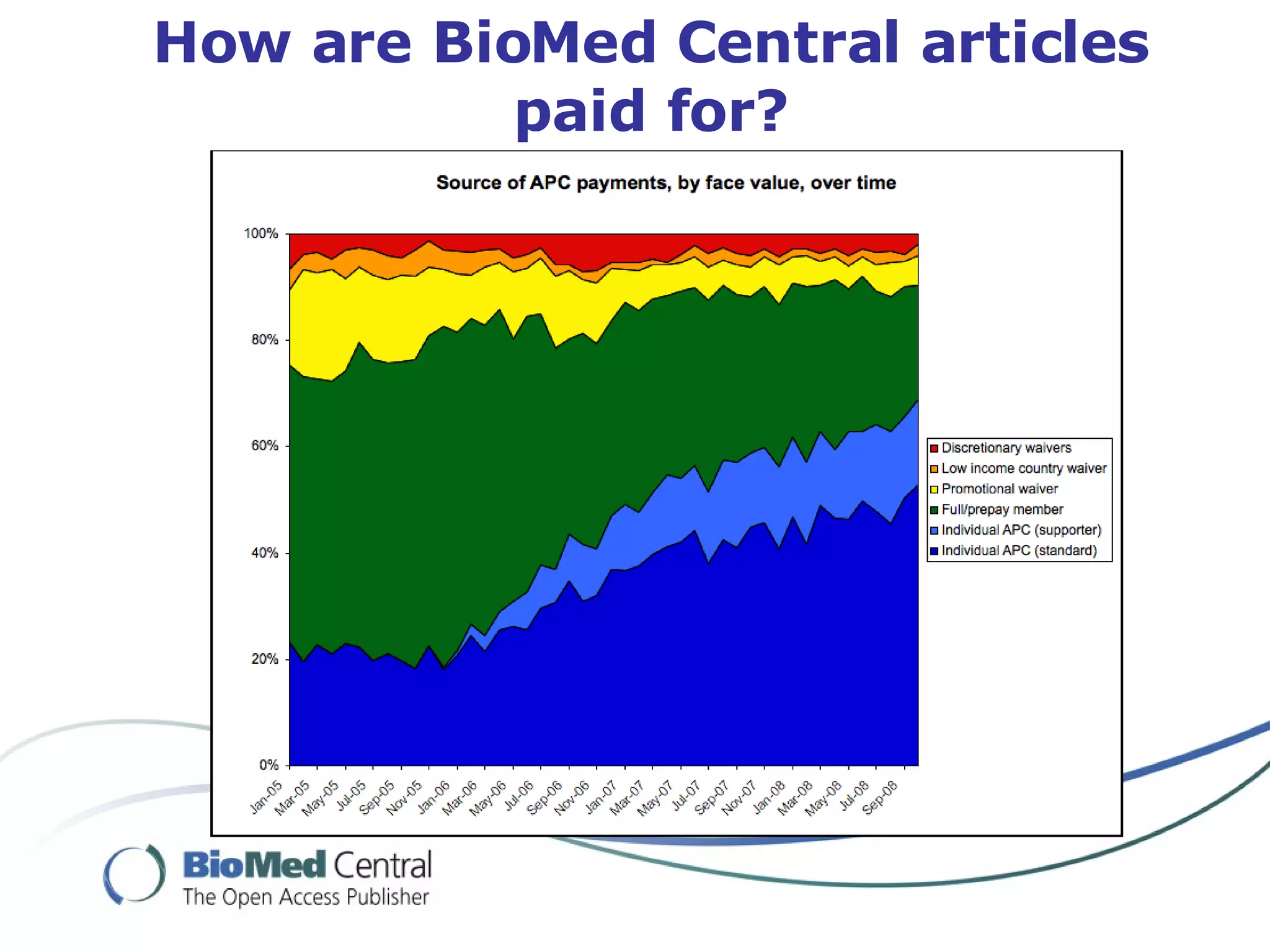
BioMed Central membership Prepay membership Institution pays funds into a deposit account Article Processing Charge is covered by funds from account Discount depending on deposit amount Author does not have to pay Simplified administration/reporting Supporter membership Institutions pay a flat fee Authors pay a discounted Article Processing Charge
How are BioMed Central articles paid for?
Can the open access model work for high-rejection rate journals?
Submission fees? Submission fees are often proposed as a means to make high-rejection rate journals economically feasible under OA However, charging a fee for the service of rejection problematic
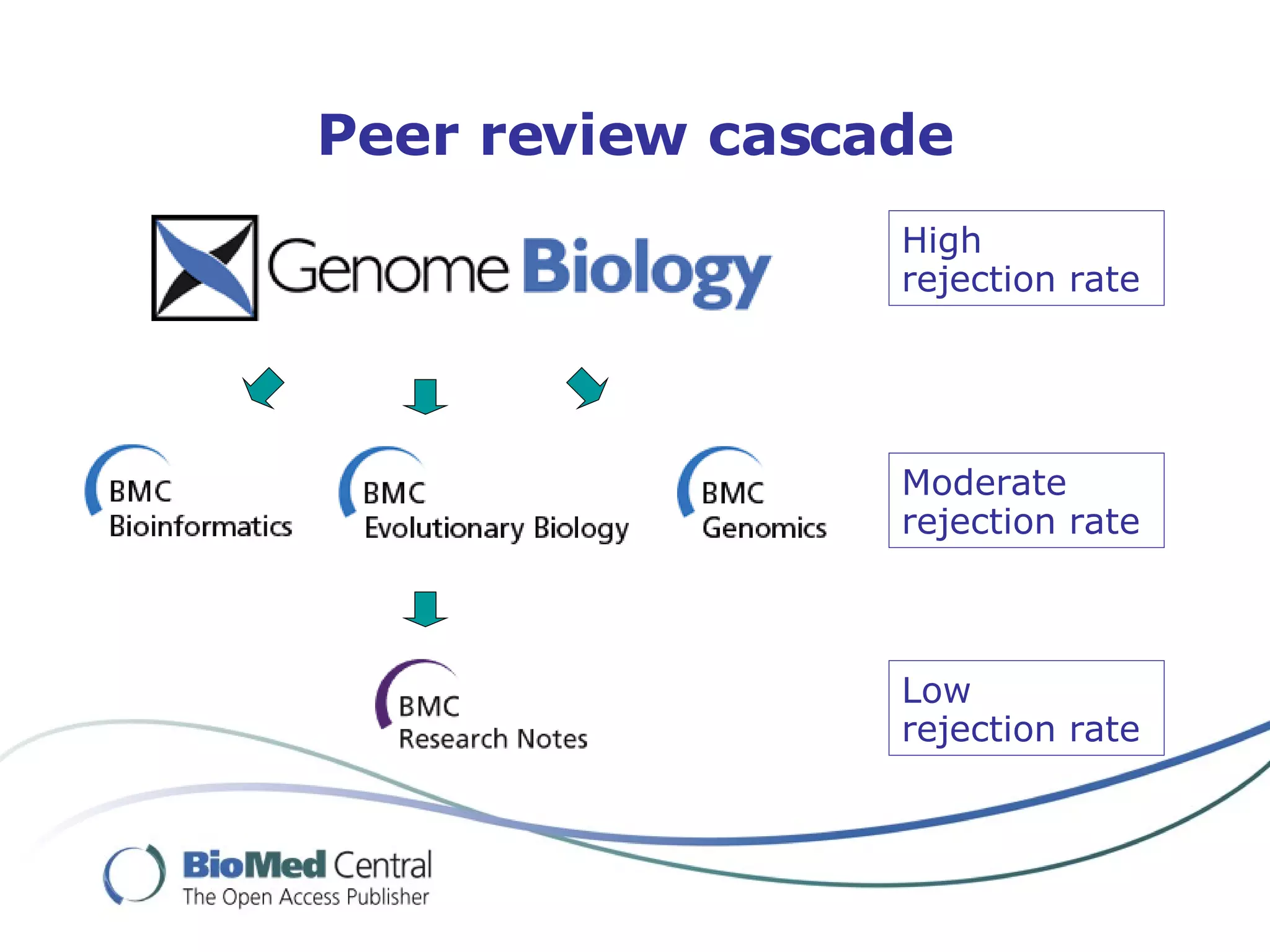
Peer review cascade High rejection rate Moderate rejection rate Low rejection rate
Advantages of this approach Avoids delays for authors Avoids saddling academics with repeated peer review of less interesting papers, wasting a precious resource Separates question of  soundness  of research from  level of interest Soundness determines  whether  to publish Interest determines  where  to publish For the publisher, high-prestige, high rejection rate titles are magnets for research articles
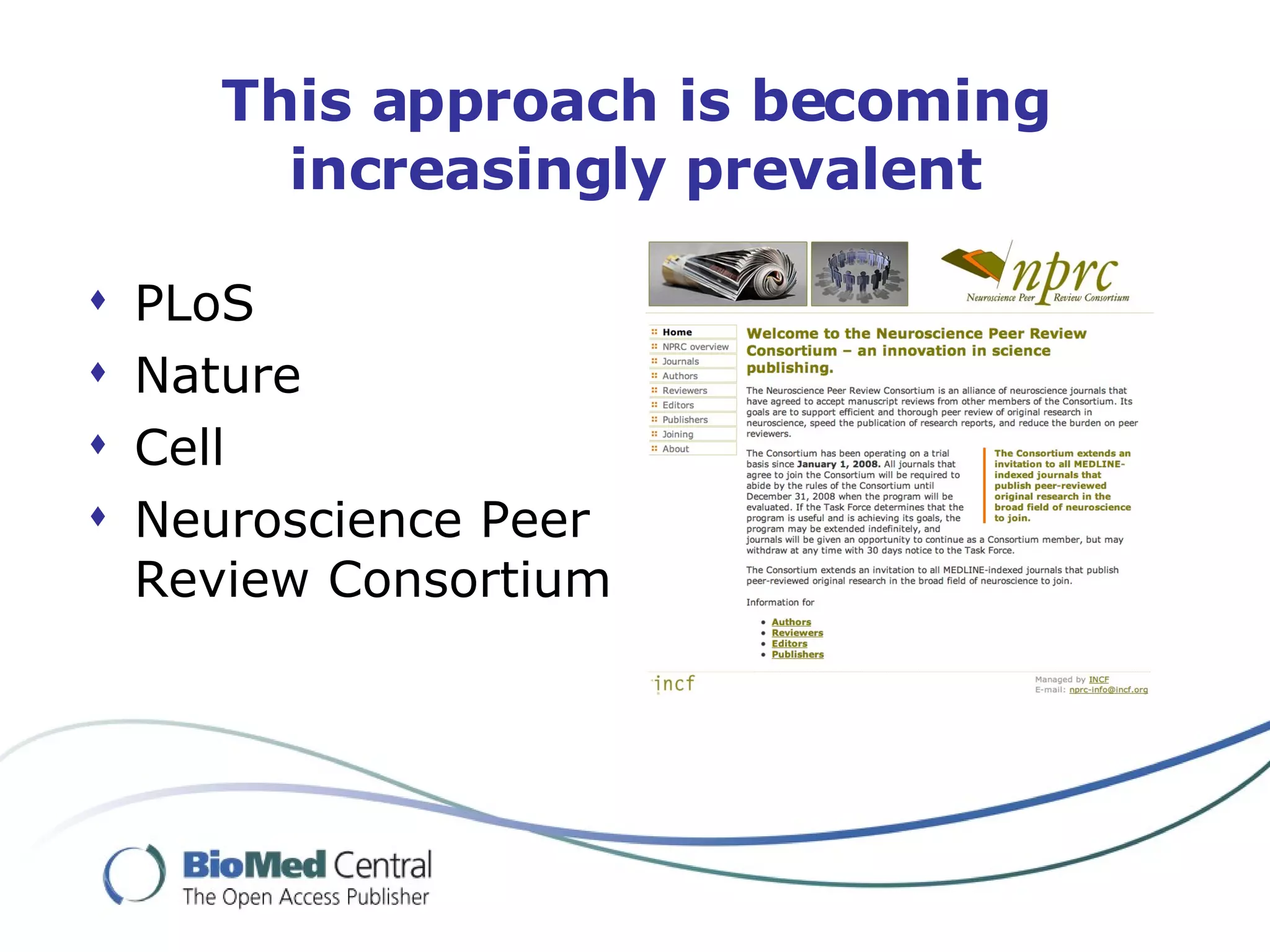
This approach is becoming increasingly prevalent PLoS Nature Cell Neuroscience Peer Review Consortium
How can institutions help to make the open access model work?
Institutional policy on the payment of OA fees Publication fees are not just a matter for libraries, but are a strategic issue for the institution as a whole A senior member of the institution should take ownership and coordinate activities   Institutions need to work hard to communicate policy to researchers
Centrally managed funds for Open Access publication charges Aarhus Berkeley Calgary Harvard (part of plan for Office of Scholarly Communication) Nottingham
 
Is the Open Access business model viable?
Growth of OA publishing in BioMed Central’s journals
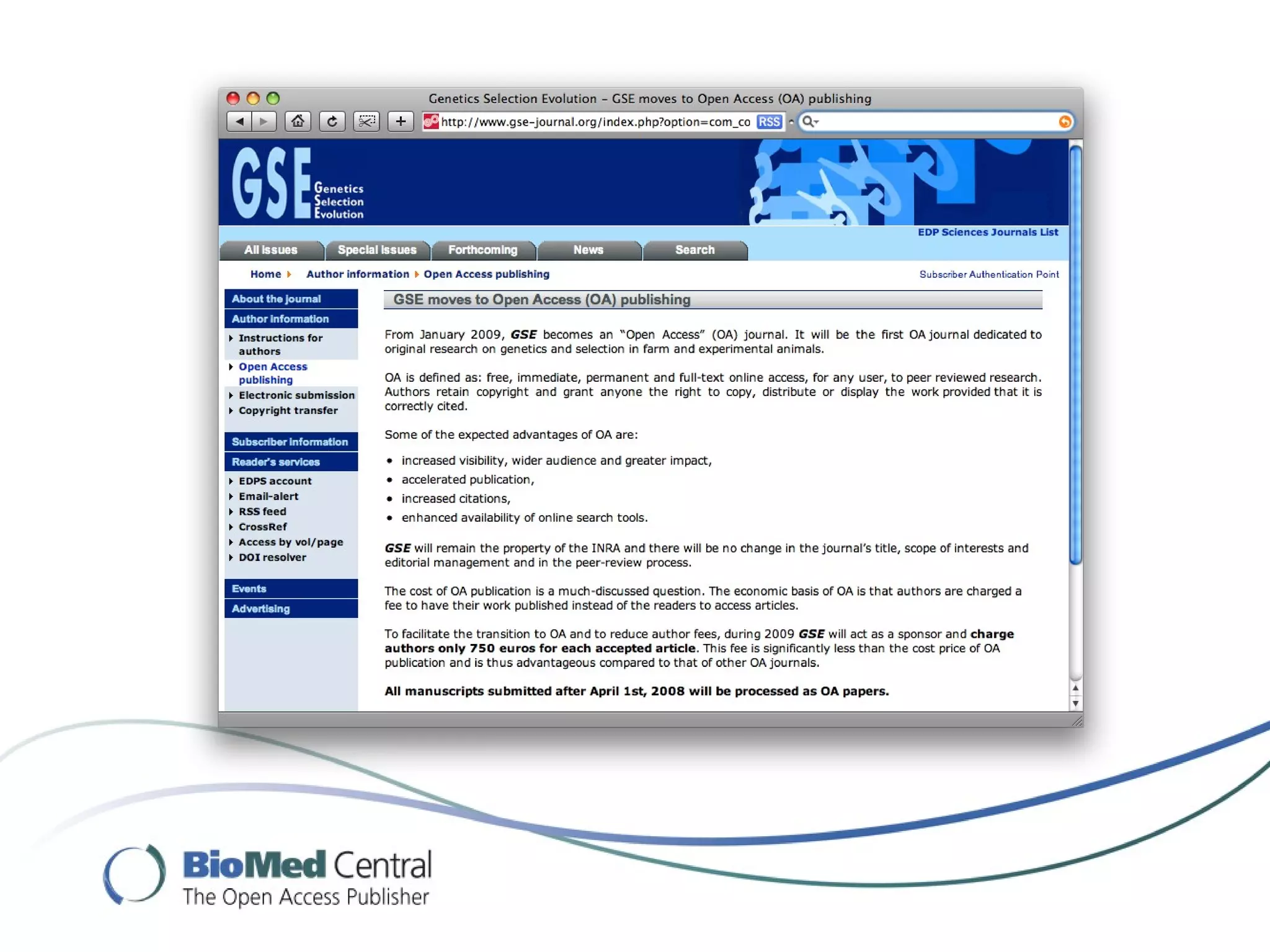
Established journals are switching to the open access model in increasing numbers
 
 
Open Access publishing, then and now… 2008 2000 And more…
A new industry association
Goals of OASPA Represent interests of Open Access publishers as a group Agree common definition of Open Access Establish and enforce good standards of editorial and business practices amongst members Identify guidelines and best practices for publishers and institutions in managing payment of publication fees
Springer’s acquisition  of BioMed Central +
Springer acquisition FAQs Will BioMed Central’s policy of open access to all research continue? Yes – this was an obligatory condition for the deal to gain approval by BioMed Central’s Board of Trustees Is BioMed Central profitable? Springer bought BioMed Central because it is a healthy publishing business, in a growing sector of the market Will BioMed Central APCs be increased to Springer Open Choice levels? There are no plans to change BioMed Central’s APC pricing policy as a result of the deal
Experimental institutional Open Access deals at Springer Several institutions/consortia now have licensing deals with Springer allow their authors to select the Open Choice option without additional payment Max Planck UKB  (Dutch consortium) Georg-August University of Goettingen The University of California has publicly stated that it is working on a similar deal with Springer for its campuses.

Berlin 6 Open Access Conference: Matthew Cockerill

  • 1.
    Business Models forOpen Access Publishing Matthew Cockerill Publisher, BioMed Central
  • 2.
    What is fundamentallydifferent about an Open Access publishing business model?
  • 3.
    Traditional research publishingThe research community transfers the rights to the research to the publisher The publisher covers its costs by selling access to the content
  • 4.
    Open Access researchpublishing There are no barriers to access The publisher generally does not acquire any exclusive rights Typically the publisher is paid for the service of publication
  • 5.
    Revenue streams foropen access publishers Publication fees From authors From meeting organizers From sponsoring organizations Subscription content (e.g. reviews) Services (e.g. Open Repository) Advertising Implicit/explicit subsidy
  • 6.
    BioMed Central journalswhich do not charge author fees Chinese Medicine Chiropractic & Osteopathy Italian Journal of Pediatrics Journal of Biomedical Science Journal of Brachial Plexus and Peripheral Nerve Injury Journal of Orthopaedic Surgery and Research Journal of the International AIDS Society Scandinavian Journal of Trauma, Resuscitation and Emergency Medicine Sports Medicine, Arthroscopy, Rehabilitation, Therapy & Technology
  • 7.
    Some journals operatemixed models Author’s pay publication fee for research articles DFG funding covers cost of additional articles
  • 8.
    BioMed Central journal’swith additional subscription content Coming soon…
  • 9.
    Examples of additionalservices A hosted digital repository solution Integration ensures articles published in OA journals can easily be included
  • 10.
    Advertising? Some potentialeditors ask: “can we support a journal entirely with advertising?” Unlikely - advertising is tiny fraction of BioMed Central’s revenue
  • 11.
  • 12.
    Putting Open Accessfees in the context of the traditional system Top-down and bottom-up analyses come to similar conclusion Average publisher revenue per STM article is around £3000 ($4700)
  • 13.
    What do OApublication fees cover? Open access publishing has most of the same costs as the traditional system: Editorial Technical Production Customer services Marketing ( e.g. conference attendance)
  • 14.
    OA publication feesBioMed Central $780-$2100 Public Library of Science $1300-$2850 Company of Biologists $3100 Oxford University Press $3000 Royal Society ~$3000 Springer $3000 Taylor & Francis $3250 Wiley $3000
  • 15.
    How do OApublication fees get paid? Authors may pay out of grant funds Some funders provide dedicated funds for open access publishing costs Institutions may cover costs centrally (via open access funds and/or membership arrangements with OA publishers) Some journals are run by organizations which cover costs themselves
  • 16.
    BioMed Central membershipPrepay membership Institution pays funds into a deposit account Article Processing Charge is covered by funds from account Discount depending on deposit amount Author does not have to pay Simplified administration/reporting Supporter membership Institutions pay a flat fee Authors pay a discounted Article Processing Charge
  • 17.
    How are BioMedCentral articles paid for?
  • 18.
    Can the openaccess model work for high-rejection rate journals?
  • 19.
    Submission fees? Submissionfees are often proposed as a means to make high-rejection rate journals economically feasible under OA However, charging a fee for the service of rejection problematic
  • 20.
    Peer review cascadeHigh rejection rate Moderate rejection rate Low rejection rate
  • 21.
    Advantages of thisapproach Avoids delays for authors Avoids saddling academics with repeated peer review of less interesting papers, wasting a precious resource Separates question of soundness of research from level of interest Soundness determines whether to publish Interest determines where to publish For the publisher, high-prestige, high rejection rate titles are magnets for research articles
  • 22.
    This approach isbecoming increasingly prevalent PLoS Nature Cell Neuroscience Peer Review Consortium
  • 23.
    How can institutionshelp to make the open access model work?
  • 24.
    Institutional policy onthe payment of OA fees Publication fees are not just a matter for libraries, but are a strategic issue for the institution as a whole A senior member of the institution should take ownership and coordinate activities Institutions need to work hard to communicate policy to researchers
  • 25.
    Centrally managed fundsfor Open Access publication charges Aarhus Berkeley Calgary Harvard (part of plan for Office of Scholarly Communication) Nottingham
  • 26.
  • 27.
    Is the OpenAccess business model viable?
  • 28.
    Growth of OApublishing in BioMed Central’s journals
  • 29.
    Established journals areswitching to the open access model in increasing numbers
  • 30.
  • 31.
  • 32.
    Open Access publishing,then and now… 2008 2000 And more…
  • 33.
    A new industryassociation
  • 34.
    Goals of OASPARepresent interests of Open Access publishers as a group Agree common definition of Open Access Establish and enforce good standards of editorial and business practices amongst members Identify guidelines and best practices for publishers and institutions in managing payment of publication fees
  • 35.
    Springer’s acquisition of BioMed Central +
  • 36.
    Springer acquisition FAQsWill BioMed Central’s policy of open access to all research continue? Yes – this was an obligatory condition for the deal to gain approval by BioMed Central’s Board of Trustees Is BioMed Central profitable? Springer bought BioMed Central because it is a healthy publishing business, in a growing sector of the market Will BioMed Central APCs be increased to Springer Open Choice levels? There are no plans to change BioMed Central’s APC pricing policy as a result of the deal
  • 37.
    Experimental institutional OpenAccess deals at Springer Several institutions/consortia now have licensing deals with Springer allow their authors to select the Open Choice option without additional payment Max Planck UKB (Dutch consortium) Georg-August University of Goettingen The University of California has publicly stated that it is working on a similar deal with Springer for its campuses.